My thwarted career as teenage reggae music journalist : 1972 : Jamaica

 I blame Jesse James. Though cowboys and westerns held zero interest for me, something about the record ‘Jesse James’ appealed, much as an Israeli novelty song ‘Cinderella Rockefella’ the previous year had possessed sufficient charm to become my first ever vinyl single purchase. Now, having heard this reggae tribute to the outlaw played on ‘BBC Radio One’ or ‘Radio Luxembourg’, I placed my order at the record counter on the first floor of ‘Harveys’ department store in Camberley and, within a fortnight, it arrived. There was no song, merely Laurel Aitken shouting ‘Jesse James rides again’ with gunshot effects over an incessant rhythm. Nevertheless, I had just purchased my first reggae record [Nu Beat NB 045] and I loved it. It was 1969.

After that, my reggae buying accelerated as fast as pocket money would permit. There was the intriguing instrumental single ‘Dynamic Pressure’ [London American HLJ 10309] recorded at Federal Studio, but so-named as the original had been cut by Byron Lee at his Dynamic Studio. I inexplicably bought the terrible cover version by Brit studio band The Mohawks of ‘Let It Be’ [Supreme SUP 204] for reasons I cannot recall. A recently opened second Camberley record shop in the High Street displayed a rotating stand of reggae albums from which I bought ‘The Wonderful World of Reggae’ [Music for Pleasure MFP 1355] because it cost only 14/6 for twelve tracks. I had been unaware it actually comprised (half-decent) cover versions by London session musicians of recent reggae songs heard on the radio.


In 1970, I bought several reggae singles that had reached the UK charts, including ‘Young Gifted and Black’ [Harry J HJ 6605], ‘Montego Bay’ [Trojan TR 7791] and ‘Black Pearl [Trojan TR 7790], all of which I was to discover later were cover versions of American songs. During this era prior to Jamaican sound engineers’ creation of ‘dub’, most B-sides were straight instrumental ‘versions’ of their A-sides. However, it was the occasional exceptions that offered my earliest insight into the remarkable creativity and fresh ideas issuing from Jamaica’s (and London’s) recording studios:

The B-side of ‘You Can Get If You Really Want It’ [Trojan TR 7777], a straight cover of Jimmy Cliff’s song, was a Desmond Dekker original ‘Perseverance’ with great lyrics over an amazingly fast rhythm track that came to unexpected abrupt halts. I still love it more than the A-side.

The B-side of ‘Leaving Rome’ [Trojan TR 7774], an exceptionally haunting instrumental laced with strings, was another instrumental ‘In the Nude’ with trumpet player Jo Jo Bennett double-tracked improvising over an urgent rhythm. This must have been the first ‘jazz’ recording I had heard and I loved it.

The B-side of ‘Rain’ [Trojan TR 7814], a cover of the Jose Feliciano song, had ‘Geronimo’ wrongly credited to singer Bruce Ruffin but consisted of a man shouting ‘Geronimo’ and ‘hit it’, echoed over a rhythm I later learned was by UK band The Pyramids. It was bizarre but fascinating.

Most significant was the B-side of ‘Love of The Common People’ [Trojan TR 7750], another cover version with a string arrangement overdubbed in the UK by ‘BBC Radio 2’ doyen Johnny Arthy’s orchestra. The instrumental ‘Compass’, credited to producer Joe Gibbs’ studio band ‘The Destroyers’, could not have been more different than the unrelated smooth A-side. It literally changed my life. Essentially it was a jazzy solo saxophone workout, but over an instrumental track drastically different from anything I had ever heard. The walking bass was turned up loud but had been deliberately dropped out of the mix on occasions. The continuous rhythm track had been filtered to leave only its high frequencies and then echo added, making the result impossible to determine which instruments were playing. The whole thing was bathed in enough reverb to sound as if was recorded in a bathroom.

For me, ‘Compass’ was a really radical production, emphasising the bassline and using studio effects to contort other instruments into sounds that were unrecognisable and ethereal. The sound engineer (likely Winston ‘Niney’ Holness at Gibbs’ studio in Duhaney Park, Kingston) had transformed a typical reggae rhythm track recorded (for an unrecognisable song) onto four-track tape into something completely different and incredibly creative, using only a standard mixing desk and some basic electronic effects. It was the first example I had heard of a ‘mix’ that had not tried to reproduce musical instruments as they sounded naturally, but to have deliberately distorted them into unnatural noises that created a whole new audio experience. It was the first track I had heard that stripped a recording down to so few elements: a pumping bass, a bizarre ultra-tinny ‘clop-clop’ rhythm and a booming saxophone. ‘Compass’ was a harbinger of ‘drum and bass’ mixes which reggae would soon pioneer (the first occasion I saw this term used was the B-side of Big Youth’s 1973 single ‘Dock of The Bay’ [Downtown DT 497]).

More than anything, it was ‘Compass’ that hooked me onto reggae at the age of twelve. I played that B-side at home hundreds of times but was desperate to hear more recordings like it. Not easy when you live thirty miles outside of London. Instead, my reggae research started in earnest. From the ‘Recordwise’ record shop owned by Adam Gibbs opposite my school in Egham, I collected weekly new singles release pamphlets distributed to retailers and stared longingly at the many titles of new reggae releases, more of which were issued in the UK during this period than all other music genres added together. I joined the shop’s ‘record library’ which loaned vinyl albums to customers for a fortnight for a small charge. I soon ‘worked’ in that shop during lunchtimes as my knowledge about popular music was becoming encyclopaedic. But, above all, I became obsessive about reggae.

I wrote to ‘Trojan Records’, one of London’s two major reggae distributors, requesting information and was invited to join the newly created ‘Trojan Appreciation Society’ run by two female fans. For my subscription fee, I received monthly Roneo-ed newsletters, some free records and a huge gold metal medallion imprinted with the company’s logo attached to an imitation gold chain, which I wore to school every day under my white school shirt and striped tie for the next five years … until the gold paint had worn off on my chest. I had a fold-out double-sided A2 sheet of all Trojan’s past releases, listed by each of its myriad of weird and wonderful record labels, which I would peruse in awe for hours. I so wanted to hear all this wonderful music, but how?

My luck was in. I was already an avid fan of ‘BBC Radio London’ when it launched Britain’s first ever reggae radio show, ‘Reggae Time’ hosted by Steve Barnard on Sunday lunchtimes. To the chagrin of my mother’s attempts to serve our family’s Sunday dinner, I would sit listening with headphones plugged into our hi-fi system, cataloguing a list of every record played each week from the very first show, recording songs onto cassettes. It was my much-needed window into the world of reggae and enabled me to enjoy almost two hours of new releases weekly, interviews with artists and dates of sound system events (inevitably all in London). Doing my homework on weekday nights, I would listen to my cassettes over and over again until I knew the songs by heart. From then, my pocket money was used to buy less well-known reggae records beyond those in the charts and played on mainstream radio. My personal reggae ‘wants list’ inevitably grew longer and longer.

Somehow, I discovered the existence of a music and entertainment magazine published in Jamaica named ‘Swing’. I may have finally identified its address in an international publishing directory in the local library, sending them cash for a subscription and henceforth received monthly copies by air mail. Along with interviews and features, it published advertisements for record shops and record labels in Jamaica, offering a first-hand insight into the island’s reggae industry. I devoured each A4 colour issue and treasured them like valuable artifacts.

My parents’ hands-off attitude to childrearing allowed me to pursue my interest in reggae without interference. From the Camberley High Street record shop, I bought another 1970 compilation ‘Tighten Up Volume 3’ [Trojan TTL 32] for 15/6, this time comprising twelve amazing original recordings. It became the first of many album purchases on ‘Trojan Records’. When I Blu-Tacked onto my bedroom wall its daring poster of a full-length naked woman daubed with the album’s song titles, my parents did not even blink. My mother even liked some of the reggae records I played loudly on the hi-fi system in our open-plan living room, particularly ‘Leaving Rome’.

In 1972, my father announced that he had booked a family winter holiday for the five of us to Jamaica, paid for with cash proceeds from dodgy property deals with his latest business partner Bill Beaver. He had shown no prior interest in my music and probably had no idea this was where reggae originated. It was just a lucky coincidence. Until then, the furthest our family had vacationed was Spain, making this our first long-haul destination. I was over the moon. While my family sunbathed on the beach, MY objective would be to travel to Kingston and explore the reggae music industry. I started to write out an address list of all the recording studios and record shops whose names I had found printed on record labels, album sleeves and in ‘Swing’ magazine.

As an avid reader of Charlie Gillett’s column in ‘Record Mirror’, I had ordered his 1970 book ‘The Sound of the City’ and been amazed to realise it was possible to write about popular music in a scholarly and meticulously researched format. Establishment voices then considered ‘pop music’ frivolous and worthless, condemning it as ephemeral, while their favoured classical music was deemed valuable and enduring. Gillett’s paperback opened my eyes, became my musical ‘bible’ for years to come and changed my life’s direction. I wanted to write about reggae in the same passionate yet factual way that Gillett had documented American black music so brilliantly. I already knew the names of reggae’s producers, recording studios, record labels and artists. A ‘research’ trip to Jamaica would complete the jigsaw puzzle.

I owned a Bush portable cassette recorder with microphone I would take with me to record interviews. I had a Kodak Instamatic camera and I might be able to borrow my father’s Canon Dial 35mm camera. Although I had no contacts in Jamaica, my plan was to find and hang out at the addresses I had researched. At that time, almost no journalist in Britain was writing about reggae music. Although I lacked formal training beyond my English GCE, I was already a competent writer and believed, on my return to Britain, I could approach music publications to interest them in my unique content. I could be a young reggae music journalist. I might have been a naïve fourteen-year-old, but it seemed an exciting prospect.

Then, weeks before we were due to fly to the Caribbean, my father suddenly told us he was leaving our home. I had observed my parents’ relationship recently dogged by shouting, arguments and violence, but he offered no explanation of where or why he was going. Only afterwards did we learn from our gobsmacked neighbour Mark Anthony that my father had run off with his recent teenage bride to set up house in a posh part of Weybridge. As suddenly as it had been announced, our family holiday to Jamaica was withdrawn. My father did take the vacation, but without his (former) family and instead accompanied by who knows. I was left with my list of Jamaican addresses and a working holiday plan that was in tatters.

In the years that followed, reggae was suddenly ‘discovered’ by the mainstream music press that sent journalists, sometimes knowing next to nothing about the music, to Jamaica to report on the industry there. Weeklies ‘NME’ and ‘Melody Maker’ splashed reggae artists on their front covers. More knowledgeably, Carl Gayle wrote excellently in the ground-breaking ‘Black Music’ magazine launched in December 1973. Dave Hendley started a ‘Reggae Scene’ column in fortnightly ‘Blues & Soul’ magazine. An amazing A5 fanzine ‘Pressure Drop’ was launched from Camden in 1975 by Nick Kimberley, Penny Reel and Chris Lane with a penchant I shared for lists, such as its original discography of Big Youth singles.

I read all these writers’ reggae articles avidly and was pleased to see my favourite music now exposed to a wider audience. However, my appreciation was tinged with sorrow that I had no involvement in this ‘movement’ despite the knowledge I had acquired since buying my first reggae record in 1969. It was hard not to occasionally entertain the jealous notion that ‘it should have been me’ (as the song goes). Instead, my time and resources were diverted by unexpectedly bearing the mantle of eldest of three siblings in a one-parent family while my mother held a full-time day job and cleaned offices during evenings. My ambition to write about reggae had to be put on hold until attending university in 1976 … by which time reggae music had suffered press overkill and ‘punk’ was the next big thing.

My passion for reggae continues to this day. Listening to ‘Compass’ now still makes me shiver. Four decades after buying that single and playing it to death, I accidentally discovered its original vocal version was ‘Honey’ by Slim Smith [Unity UN 542], a truly unremarkable song that had masked a remarkable rhythm track. For me, that remains one of the enduring wonders of discovering reggae’s multiple versions.

[Click on the record labels to hear their music. I curate several reggae playlists on Spotify.]

[Originally published at https://peoplelikeyoudontworkinradio.blogspot.com/2024/01/my-thwarted-career-as-teenage-reggae.html ]

One little indie music show : 1980-1981 : Saturday night 10 to midnight, Metro Radio

“You will present a weekly two-hour rock music show on Saturday night,” my manager informed me.

No if’s or but’s. No offer over which to mull. No demo tape to produce. No question asked about previous experience. Without warning, I was appointed as presenter on one of Britain’s largest commercial radio stations. I had just started a full-time backroom job at ‘Metro Radio’ but had never asked to present a show. This was my first paying job in radio and suddenly I was also to be put on-air. The start of my radio career seemed to be heading in a positive direction.

Some aspiring DJs spend their whole life trying to secure a presenting job on radio, often without success. I felt slightly guilty that this opportunity had fallen into my lap without effort. My employer did not even realise that I had started presenting for various London pirate stations seven years earlier, as such lawbreaking activities were not productive additions to a CV then. A decade into the future, employed as programme director of London’s ‘KISS FM’, one young hopeful desiring a DJ job would sit in the station’s reception area day after day, awaiting his opportunity to buttonhole me on my way to lunch at the ‘greasy spoon’ on Highbury Corner. Little did he know that we already had the largest DJ roster of any British radio station, or that management had just cut payments per show by half, or that several loyal presenters had been made redundant within months of launch. Oblivious, he was not so much ‘networking’ as ‘stalking’.

Management at Metro Radio seemed not to care one jot what was broadcast evenings and overnight because commercial stations then believed their advertisers were only interested in daytime shows and that their most significant audience was housewives. My small additional payment for the rock show was eaten into by the cost of driving twenty miles to the studio on Saturday night and then back again in the early hours of Sunday. Nevertheless, the station would jump at any chance to cut its minor expenses, such as the occasion excellent overnight presenter Tony Crosby was replaced in 1981 by a new DJ who offered to do the same show for free. Never mind the quality, feel the penny-pinching! (Tony went on to train as a solicitor.)

No direction was offered me as to what to do in my show. Whereas daytime presenters were required to wait outside programme controller Mic Johnson’s office for individual appointments to hear his critique whenever a JICRAR ratings book was published, management expressed zero interest in what I was doing on-air. There were already two other rock shows on the station. My line manager Malcolm Herdman played two hours of heavy metal and hard rock. Full-time producer John Coulson used his two hours to play an esoteric mix of mainstream rock and read passages from ‘beat generation’/‘new journalism’ authors. I decided to fill the evident gap for the ‘indie’ music that had emerged after several years of punk.

Music trade weekly ‘Record Business’ had published its first weekly ‘indie’ chart in January 1980, following a suggestion by Iain McNay, founder of London’s ‘Cherry Red Records’. I decided to use one hour of my show to run down this chart, playing the new entries and highest climbing singles. As far as I know, mine was the first ever British radio ‘indie’ chart show and was soon mentioned in the ‘indie’ columns of the music trade press. Most ‘indie’ releases were not supplied to commercial radio stations because there was zero possibility of them being playlisted, necessitating me to establish contact with the main ‘indie’ distributor, ‘Rough Trade’ in London, to receive copies. Each week, I would phone its very helpful director and head of promotions Scott Piering to request records that he would then mail to me (later that decade I worked in Scott’s office).

In the other hour of my show, I would play a selection of newly released album tracks, both indie and mainstream. Working full-time in the station’s record library, I had access to all major label releases that arrived either by post or from weekly visits by record company promotion staff. I would place interesting new albums in a holdall I carried back and forward to the show although, with only time to play around fifteen tracks within an hour, my hoard of unplayed recent releases grew heavier by the week. My running order ranged from ‘Steely Dan’ to ‘Joy Division’ to ‘Crass’, none of which were exposed elsewhere within the station’s output.

Although the Tyneside local band scene then was dominated by heavy metal bands and record labels such as ‘Neat’ and ‘Guardian’, there were a few ‘indie’ bands that were recording good quality demo’s or releasing their records independently. I received a nice letter from Paddy McAloon asking me to play his group ‘Prefab Sprout’s first self-published single. I had already been the lone person not walking straight past the stage when the band had performed at the Durham Miners’ Gala, so I was happy to oblige. There were some excellent local bands, including ‘Dire Straits’ and ‘The Police’ who were quickly signed by major labels, but also many that went largely unnoticed until ‘Kitchenware Records’ launch in Newcastle in 1982. I tried to play any local band recordings I found or received.

Because my two hours on-air were so precious, I talked minimally between records and rarely featured interviews. I recall receiving a telegram at home from the station one day asking me to phone it urgently. Our house had no phone so I had to walk to the one phone box in Sherburn Village and call in. Was I interested in recording an interview for my show with ‘Duran Duran’ who were promoting their first single release ‘Planet Earth’? I turned down this opportunity because the group was not local, were not ‘indie’ (having already signed to ‘EMI’) and their music was audibly more ‘pop’ than ‘rock’. However, I did interview local artists such as Pauline Murray from Ferryhill whose first solo album (after the punk group ‘Penetration’) sounded remarkably innovative and remains one of my favourite recordings.

I spent quite a lot of time each week compiling a local ‘gig guide’ from adverts in local newspapers (pre-internet newsprint) and flyers. I would update it each week, type it out myself, pin it on the radio station’s noticeboard and mail copies to all the local record shops. In my show, I would read out the following week’s concerts though I never heard any other presenter refer to my list because, beyond Malcolm and myself, the station seemed to be disconnected from the local music scene. On occasional visits to ‘Volume Records’, the only ‘indie’ record shop in Newcastle, I would secretly feel proud to see the latest A4 sheet of gigs I had mailed out pinned to its noticeboard. Like my show’s content, the reason for undertaking this research-intensive work was because nobody else seemed to be exposing this information at the time. There was no ‘what’s on’ publication for the region.

Although I had competently operated radio studio equipment myself since my days at school recording pirate radio shows, management at Metro Radio insisted I sat in a soundproofed studio in front of the microphone while a ‘technical operator’ facing me from an adjoining control room played the records, advertisements and mixed the audio. I was unfamiliar with this arrangement, which the station’s managers had brought with them from overstaffed BBC local radio stations at which they had worked previously. I was extremely lucky to have had John Oley assigned as my ‘T.O.’, one of the most professional and enthusiastic people I have had the pleasure to work with in radio. His contribution to my show was enormous and freed me to talk my rubbish on-air and answer the phone line when I occasionally held competitions.

Metro Radio showed no interest in promoting my show so it seemed a miracle when I started receiving letters from listeners who had discovered it. In the days before internet or community stations, each region of Britain was served by only one local BBC station and one commercial music station. Although my show was tucked away in the weekend schedule, it still felt groundbreaking to play music little heard outside of John Peel’s weeknight show on national ‘BBC Radio One’. There were quite a few records lasting only two or three minutes that each required several hours’ work transferring them to quarter-inch tape in order to edit out swear words with a razor blade and white editing tape on a metal block. If only those bands knew how much extra effort was necessary just for them to receive one radio play!

Living in a rural village, there were Saturday nights during winter snows when I was unable to drive to the station. Snowploughs would habitually clear the roads eastward from Durham City as far as the junction with the A1(M) motorway but, frustratingly, not the further one mile beyond to my home. I would have to trudge out in icy temperatures to the public phone box and call either Malcolm Herdman or John Coulson at home, asking if they could reach the studio to fill in for me on those days. Because they lived in Newcastle city, I think they found it hard to believe that I was literally ‘snowed in’. Unfortunately, my salary was insufficient to contemplate a relocation nearer my workplace, meaning I missed out on concerts and the city nightlife which I would have loved to explore.

All good things come to an end. Quickly in my case. Metro Radio made me redundant from my full-time job. I continued to present my Saturday night show for a while through 1981 but the expense of maintaining a car to drive to Newcastle was proving greater than my payments from the station, which had to be subtracted from my Unemployment Benefit. I was applying for any relevant vacancy in the radio and music industries but getting nowhere. In the end, I had to follow Tebbit’s advice and get on my bike (well, in my car to be accurate), leaving the region where I had lived the last five years in order to take a totally different job 218 miles down south. It was disappointing because I had acquired so much knowledge of indie music, the regional music scene and had built an audience for my unique radio show.

The start of my radio career now seemed to be heading in a negative direction. I was unable to secure work in the broadcast industry for a further four years and, only then, by taking a contract in Israel on a pirate radio ship that paid little more than expenses. However, I have always treasured the memories of my time working alongside John Oley and Tony Crosby late on Saturday nights when the only other person in the darkened Metro Radio building on a bleak industrial estate was the security guard downstairs. This was when innovative radio programmes were made … even though Metro Radio probably never realised it.

Postscript: Forty years later, I received a polite email from a member of a former local band enquiring if I still had their demo tape I had been sent and played on my Metro Radio show. Sadly, no.

[Originally published at https://peoplelikeyoudontworkinradio.blogspot.com/2023/11/one-little-indie-music-show-1980-1981.html]

I can't dance to that music you're playin' : 1970 : Emperor Rosko, The Paris Theatre, London

 “Would you like to dance?” the girl asked.

I was dumbfounded. Nobody had ever asked me to dance. Particularly a girl!

“Er, no thanks,” I mumbled pathetically.

“Oh, go on, please,” she chivvied. Anyone else would have been flattered. But me? I was terrified. 

“Sorry, but I can’t dance,” I tried to explain. The girl looked disappointed but gave up and walked back to the stage. It might have been the beginning of a beautiful friendship. But I blew it.

It was true. I have never been able to dance. Too self-conscious. Too buttoned-up in that English way. The last occasion I recall dancing wildly was the 1977 Trevelyan College Summer Ball to which fellow student Zena Carter had generously invited me and whom I must have embarrassed immensely with my feeble attempt at ‘Saturday Night Fever’ moves I had just seen at Durham’s cinema. All the posh male students in attendance wore black tuxedos, while I looked completely out-of-place in a borrowed white suit, jigging around to the local live band ‘No Exit’ featuring a certain ‘Sting’. I still cringe. Three years later, my job would be adding hit songs by his next band ‘The Police’ to local station ‘Metro Radio’s playlist.

But that was in the future. Back in 1970, another reason I turned down the girl’s invitation to dance was that I had become terribly shy. At primary school I had considered myself no different from my classmates. Then, after moving to grammar school in 1969, I was developing a creeping sense of inferiority, not comprehending why my termly school reports criticised me for not being sufficiently vocal in class. Achieving classwork and exam results near the top of my year of sixty students was seemingly judged insufficient unless you flaunted your cleverness by regularly sticking up your hand in class and pushing yourself in front of teachers. In my new ‘streamed’ school, populated by many privately educated ‘prep school’ protegees, it appeared a boy might inexplicably be considered deficient for simply being ‘quiet’ and demonstrating no interest in blowing his own trumpet. I responded to my school’s reproaches by retreating into shyness in company … which dogged me for decades to come.

I might have felt less self-conscious about the girl walking up to me in the end seat of the fourth row on the left side of the centre aisle, had my mother not been sat right next to me. I was embarrassed. I was twelve years old, though I appeared older because of my height. I had written to the BBC Ticket Unit to request a pair of tickets to attend the live broadcast of Emperor Rosko’s Saturday lunchtime ‘BBC Radio One’ show at London’s Paris Theatre. None of my new schoolfriends appeared to be interested in the music I followed, so my mother had accompanied me on the train from Camberley.

The Paris Theatre had been an art-house cinema showing French films in Lower Regent Street until the BBC acquired it in 1946 and equipped it with a radio studio to record concerts and live comedy shows before a seated audience of around 400. From 1968, the weekday lunchtime ‘Radio One Club’ show had been broadcast live from the venue, hosted by a station DJ and showcasing a live band in front of an audience who had all sent to the BBC for their ‘Club’ membership cards. It was the station’s earliest attempt at outreach to its listeners and, by the 1970’s, was extended from London to cities around the country. In 1974, it was replaced by the touring ‘Radio One Roadshow’ whose format was similar to the large summer outdoor events Rosko had been organising independently since the 1960’s.

I was a huge fan of Rosko’s weekly radio show because he played reggae and new American soul records as yet unreleased in Britain. At that time, when around 100 new singles were released a week in the UK, record companies would wait to see which American singles proved successful in North American charts before committing to a British release date. This delay could be months, often allowing British pop artists to ‘cover’ American soul hits before the original was available in shops. My parents owned Julie Grant’s single of ‘Up On The Roof’ which had reached number 33 in 1962, but they had never heard the original by The Drifters which failed to chart in Britain. Grant successfully parlayed her chart success into several television appearances and a concert tour with The Rolling Stones, another British act recycling American black music at the time.

Each week I would record Rosko’s 90-minute Saturday show onto an audiocassette and listen to it repeatedly on headphones while I did my homework, before recording the next show over it the following weekend. This was the first occasion I heard James Brown’s ‘Sex Machine’ single, Rosko playing the A-side one week and its B-side the next. It changed my life! Many outstanding tracks like this recorded onto my cassette I went on to buy as imported American singles from ‘Contempo’ at 42 Hanway Street or ‘Record Corner’ in Balham, the main retailers for new American black music as yet unreleased in the UK. Many of those songs first heard on Rosko’s show I still know by heart and treasure to this day. Without the benefit of a black music radio station in Britain (London soul pirate ‘Radio Invicta’ did not launch until December 1970), Rosko was the nearest experience available, even though he mixed reggae and soul with some pop and rock tracks.

What marked Rosko’s shows out from the rest of ‘Radio One’s output was that he simultaneously operated a mobile discotheque (the ‘Rosko International Roadshow’) and compered concerts by American soul artists touring the UK. That gave him a unique insight into the specific music British audiences wanted to hear, something that many of his studio-bound radio colleagues did not understand. The other factor was that Rosko was allowed to choose his own records to play on the radio, whereas the music in most shows was selected by ‘Radio One’ producers, the majority of whom preferred twee British novelty acts to ‘foreign’ reggae and soul. These ‘gatekeepers’ could determine through national airplay whether a record was to become a hit or not in Britain, so the charts inevitably reflected their value judgements.

I was fascinated when analysing the British singles charts from this period to discover the volume of chart-topping pop songs that are never played as ‘oldies’ nowadays because they sound embarrassingly quaint or sentimental. Compare that to the significantly lower chart positions achieved by many black music recordings considered now to be ‘classic’ or ‘standards’ [documented in my book ‘KISS FM’]. It is forgotten just how ‘white’ the BBC’s popular music station sounded overall, despite valiant attempts to play more soul by daytime DJ’s Tony Blackburn and Dave Lee Travis. My appreciation of reggae was sparked by Rosko but had to be developed by evenings tuned to ‘Radio Luxembourg’ which Trojan Records paid to play their latest reggae releases. In 1971, singer Nicky Thomas even recorded the song ‘BBC’ to chastise ‘Radio One’ for not playing enough reggae, its release accompanied by a protest march to Broadcasting House. This had no evident impact on the station’s producers who were almost exclusively recruited from the white middle-classes and who moulded ‘Radio One’ in their own image.

This was why my visit (without dancing) to the Paris Theatre that Saturday was to become such a memorable experience, having enjoyed some of my favourite soul and reggae tunes played loudly through Rosko’s enormous sound system loudspeakers. When the girl asked me to dance, Rosko had been playing Edwin Starr’s ‘War’, a remarkably innovative Motown production by Norman Whitfield recorded to protest the Vietnam War with its chorus: “war … what is it good for? … absolutely nothing!”

A few years ago, I created a Spotify playlist of several hundred Whitfield productions, such remains my unbridled enthusiasm for his work (often with songwriting partner Barrett Strong). At the beginning of October this year, something prompted me to return to this playlist and update it with songs Whitfield subsequently recorded for his own label, notably by Rose Royce. I spent the following days listening non-stop to songs from my enlarged playlist such as ‘War’, ‘Stop The War Now’, ‘Friendship Train’, ‘Unite The World’ and ‘You Make Your Own Heaven And Hell Right Here On Earth’ all recorded half a century ago, all explicitly criticising violence and promoting peace. This was the music I was listening to only days later when news broke of atrocities committed in Israel. The music was appropriate … but the timing was inexplicably spooky.

[Originally published at https://peoplelikeyoudontworkinradio.blogspot.com/2023/10/i-cant-dance-to-that-music-youre-playin.html]

Baby, we were bored to death : 2000 : FM radio station market, Toronto

 Why does Toronto have such insipid and boring radio? Our city is vibrant, artistic, culturally diverse and entertaining, so why is none of that reflected in our uninspired radio stations? Travelling in Europe and North America as a radio consultant, I listen to a lot of radio and it is tragic to concede that my own city has some of the most boring radio stations known to mankind.

Opportunities to change this sad state of radio in our city are everywhere, but have too often been ignored. When Shaw Communications purchased ‘Energy 108’ a couple of years ago, it could have reinvented the station as a cultural focus for Toronto’s young people. Instead, Shaw fired ‘Energy’s most knowledgeable DJ’s, introduced Sarah McLachlan songs once an hour (in a dance music format?) and changed the name to … ‘Energy 107.9’. Wow! How many minutes did it take the marketing department to devise a strategy that unambitious?

Rogers Media’s purchase of ‘KISS 92’ last year was a complete no-brainer. Can you name any other city of similar size in North America that has had no Top Forty radio station for a period of even a few months? And yet Toronto suffered this malaise for several years. Even if Rogers had hired a helium-voiced bimbo DJ to front a Top Forty format, it still could have captured a huge audience hungry for what used to be called ‘pop music’. And that is exactly what they did. ‘KISS’s ratings are noteworthy, not just for the hordes of spotty grade nine students who naturally gravitate towards Backstreet Boys soundalikes and terrible Canadian techno. But the station’s substantial audience over the age of twenty is a sad reflection of the lack of any other remotely exciting music station in Toronto. For those of us past our teen years, ‘KISS 92’ at least makes you feel good to be alive, compared with other FM music stations that treat listeners like senile geriatrics with one foot already in the grave.

One would hope that ‘KISS 92’s runaway success might encourage its competitors to try and become a little more imaginative in their programs. The signs so far are not particularly encouraging. ‘EZ Rock 97’ revamped its daytime line-up last week to introduce even more soporific DJ’s and has changed its slogan from ‘My Music At Work’ to ‘Soft Rock Favourites’. Station owner Telemedia appointed a new Program Director drafted from its Calgary operation to oversee these changes. Yes, Calgary – that hotbed of radical, imaginative radio formats! ‘EZ Rock’ looks certain to retain its nickname of ‘Radio Slumberland’ in our household.

Milestone Radio, scheduled to launch next year, has an incredible opportunity to turn its black music format into an exciting, inclusive station that could electrify the city. After all, black culture has never been so predominant, nor so imitated, in mainstream music and arts. With imagination, Milestone could be a very successful radio version of ‘City TV’. Whether its owners can grasp that challenge, let alone succeed with it, depends upon the station’s ability to overcome three obstacles. Milestone’s programming plans are the obvious product of committee debate, with too many worthy (but commercially disastrous) ideas generated by individuals who have particular axes to grind. Its recent effort to recruit a Program Director in the US rings alarm bells that Milestone is creating a cookie-cutter US-style urban music station that would reflect nothing of Toronto (listen to ‘WBLK’ for days on end and you will learn absolutely nothing about Buffalo, but everything about ‘strong songs’). And lastly, the spectre of minority shareholder Standard Broadcasting might be waiting quietly in the shadows for Milestone’s ambitious plans to fail in the first year, so that it can take control and resurrect the station as a smooth-jazz format, fitting perfectly alongside its mind-numbing ‘MIX 99’.

As for ‘Edge 102’ and ‘Q-107’, their owners should have been bold enough to extinguish these dinosaur formats years ago. There is so much exciting new music in the world, but you will certainly never hear any of it played on these two stations. The malaise is so bad that Toronto radio critic Marc Weisblott felt obliged to apologise in a recent column (radiodigest.com) for spending so much time listening to New York City radio via the internet. No need to apologise, Marc. Our only ray of hope is that one fine morning, some bold senior executive in Shaw/Corus, Standard, CHUM or Rogers might suddenly understand that radio which is stimulating and challenging can also be a commercial success. I would prescribe that executive a quick radio listening visit to any major city in the world to understand the potential. Otherwise, Toronto radio is condemned to be a mere revenue-generating asset designed to send us all to permanent sleep with yet another Celine Dion or Bryan Adams song.

[Submitted to Toronto weekly what’s on paper, unpublished]

[Originally published at https://peoplelikeyoudontworkinradio.blogspot.com/2023/09/baby-we-were-bored-to-death-2000-fm.html]

Give them a foot and they’ll take a metre : 1972 : Bill Beaver, Camberley & Alicante

 It was the summer of rock’n’roll. Bill Haley. Buddy Holly. Chuck Berry. Fats Domino. The Big Bopper. Now, every time I hear one of their songs, I am reminded of a summer vacation never to be forgotten … for all the wrong reasons! Certainly, much of it had been spent lazing on a lounger beside a swimming pool, immersed in an interesting book I had brought along. However, my ears had been battered for days by continuous rock’n’roll, blasted at maximum volume from a tinny cassette machine leant against the wall of a Spanish villa’s veranda. This was not the preferred soundtrack of my teenage years.

At age fourteen, ‘oldies’ from a decade earlier already belonged to a bygone generation. I was obsessed with contemporary pop music and, since the occasion Jim Morrison had dropped his leather pants onstage, every Thursday a slice of my pocket money crossed the counter of a Frimley High Street newsagent for ‘Disc & Music Echo’, ‘Record Mirror’, ‘Sounds’, ‘NME’, ‘Melody Maker’ and ‘Blues & Soul’. I devoured their every word cover-to-cover, as well as teen magazine ‘Fab 208’ that my grandparents bought for older cousin Lynn but offered me a sneaked read. These publications’ preoccupation with the newest music (aligning perfectly with their most lucrative advertisers, the major record companies) reinforced my youthful music snobbery, as dismissive of rock’n’roll as I was of The Andrews Sisters.

Our family’s summer sojourn read like a rejected script for ‘Benidorm’. Following his impulsive visit to a Camberley travel agent to book a package holiday to Spain for the five of us, my father had handed me a pocket guide to Spanish, anticipating my fluency by the time we arrived. Although I shouldered the mantle of family administrator, this expectation proved unrealistic considering my recent struggle at school to learn French, where I had come bottom of the class during my first two years. As the teacher insisted on seating us in his classroom in rank order of our most recent termly exam result, I was placed in the front row due to my consistently dismal performances. By the time our charter flight touched down in Alicante, I had just about mastered Spanish numbers, greetings, shopping etiquette and the ordering of ‘steak and chips’.

Arrived at our hotel in the Albufereta district, the receptionist confessed that the promised restaurant and swimming pool were still ‘under construction’. Our two adjacent bedrooms on an upper floor lacked air conditioning and offered a view of only the hotel’s ongoing noisy building works. Daily pills my father took for high blood pressure had insufficient efficacy to stop him raising hell with the hotel’s management, to no avail, tipping his mood into a very un-holiday rage. To escape the confines of our half-finished accommodation, one hot afternoon we all trooped down to the beach, only for my months-old sister to put a handful of sand in her mouth. She cried, my mother panicked, my father shouted, screaming that he would never take his family to a beach again … a threat he kept.

After that incident, my father decided to hire a small Seat car so that we could explore Spain beyond the coast. One day he drove us inland to a random small village where we disembarked and wandered around in the heat of the blazing sun. It resembled a sand-blown ghost town from a television Western where everything was closed up, my parents having no knowledge of Spain’s daily siesta. The odd elderly person we encountered stopped what they were doing to stare pointedly at us, as if we resembled aliens arrived from another galaxy. They understood that only mad Brits and package holiday families came out in the midday sun. Feeling somewhat intimidated and having found nothing to do there, we retreated to the hire car to return to the ‘civilisation’ of our hotel.

My father tried to rescue our totally unedifying village visit by driving back along the picturesque Alicante seafront. Confronted by a small roundabout, he drove around it at his usual excessive speed in the wrong direction and collided with a car headed towards us. Nobody was hurt but the encounter caused visible damage to the front of both cars. The Spanish driver jumped out and understandably raged at my father, whose short fuse had been smouldering since the hour of our arrival. My translation skills were demanded, unrealistically as the pocket guide lacked a chapter on Spanish expletives. While the two drivers locked in verbal combat, the four of us sat on the low wall along the edge of the brightly tiled Alicante promenade. Passers-by stared. My baby sister was screaming. My mother was crying. The sun was baking us.

After a while, a police car arrived. My father was offered two choices. Either he could be arrested and taken to the police station to face a charge of dangerous driving, or he could pay the other driver to repair his car. While we remained sat on the promenade, my father accompanied a policeman to the nearest money exchange bureau to swap our remaining British ‘Travellers’ Cheques’ for Spanish pesetas. In the heat, it seemed like an eternity until he returned, paid the driver and we could all depart the scene of the crime. Our hire car was damaged but fortunately driveable, though there remained the problem of what to explain to the hire company at the end of our holiday from hell.

Our more immediate problem was how to survive the remainder of our fortnight now that almost all our money had been used to pay the angry driver. British credit cards might have launched in 1966 but had not been offered to families like ours. Debit cards would not exist until 1987. The limited amount of cash or Travellers’ Cheques you were permitted to take abroad had to be inscribed on the last page of your passport. Transferring funds from a British bank account to Spain, while you were in Spain, was an impossibility. During the following days, I escaped the worsening parental arguments at our hotel by finding a nearby newsagent where I would sit cross-legged on the floor for hours, looking through piles of imported DC comic titles never seen at home. I also found a record shop where I used pocket-money I had secreted to buy a Spanish 1971 James Brown picture-sleeve single (‘I Cried’) unreleased in the UK.

That summer’s rock’n’roll soundtrack was a consequence of my father’s solution to our predicament. While we would continue to sleep in our package holiday’s half-finished hotel, he had hustled an invitation to spend our remaining vacation daytimes at the nearby villa of one of his business associates. We lounged beside an Olympic-size outdoor swimming pool whose shallow end was bizarrely three times my height. The towering villa’s doorways were big enough to drive through a truck. Its rooms were the height of a church and the living room resembled a ballroom. We had traded our building-site hotel for a newly built mansion that could have easily served as a set for ‘Land of The Giants’ or the inspiration for a new ‘The Borrowers Abroad’ sequel.

The owner had purchased the plot of land, ordered a custom plan for a villa from an architect in Britain, brought the designs on paper to Spain and given them to local builders to construct during his absence. Returning only once it had been finished, he was astonished to realise that his plan’s dimensions in ‘feet’ had been misinterpreted as ‘metres’, resulting in the building and pool being three times their intended size. It was too late to remedy the error and too expensive to demolish it and rebuild. Planning regulations? What were they? The accidentally gigantic villa was there to stay … and we were now its guests.

It was the owner’s two sons, around a decade older than me, who had wired up a cassette machine outdoors to play their favoured rock’n’roll music. Though our three hosts hung around the villa and pool all day, they mostly ignored me quietly reading my book in the shade. Even the pool’s shallow end was too scary for a non-swimmer like me, however much they tried to persuade me to dive in. They were plainly enjoying their lazy, hazy days of summer on the ‘Costa del Dodgy’. I must have appeared quite a joyless nerd to them.

Our ebullient host Bill Beaver owned a successful car and truck dealership in Camberley, located on an expansive near-derelict triangle of land at the town’s western extreme. He lived in an old-style mansion named ‘Badgers’ Sett’ opposite ‘The Cricketers’ pub on Bracknell Road in nearby Bagshot. His accent was ‘Eastenders’ and his patter was pure Del Boy. My father had lately begun to forge local property redevelopment deals for which Beaver provided the cash, while he ensured local council planning approval for architectural schemes he drafted. My parents had uncharacteristically started hosting dinner parties for Beaver and his wife, despite my mother not warming to the couple’s brash ostentatiousness. My father probably hoped Beaver’s wealth would rub off on him … and, for a while, some of it did.

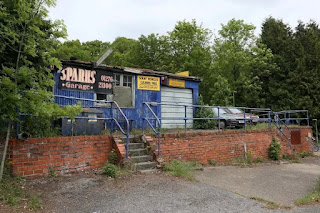
I had been pressganged into their joint enterprise to calculate the potential ‘return on investment’ of their projects, using my O-level maths studies to amortise the costs over varying numbers of years. One such development site was an anachronistic one-pump petrol station and car repair workshop that occupied a valuable rectangular plot on the busy London Road at Maultway North between Camberley and Bagshot. Owner John Sparks had inherited the business in 1966 upon the death of his father Arthur, though neither had updated its blue corrugated iron shack since 1926 when Arthur’s mother had purchased this large corner plot from the adjacent secondary school sportsground for her son to launch his one-man business.

Once I had calculated the viability of replacing the ramshackle building with flats, including the cost of removing the underground petrol tank and cleansing the polluted soil, the project was determined a ‘go’. However, we had not reckoned on Sparks’ stubborn refusal to sell. Beaver visited him. My father visited him. The Beaver sons visited him. Sparks remained intransigent. Their ‘persuasion’ techniques were evidently not working. Beaver purchased the Jolly Farmer pub on the roundabout opposite the Sparks site. One night it suffered a large unexplained fire. Sparks still refused to sell. In the end, the project had to be abandoned.

Like my mother, I was less in thrall of Beaver’s ‘entrepreneurship’ style than was my wide-eyed father, so the end of our disastrous two-week holiday in Spain and our farewells to his oversized villa came as a welcomed relief. On the flight home, I was seated next to larger-than-life Trinidadian bandleader Edmundo Ross. Despite already loving reggae and Brazilian music, my youthful snobbery regarded Ross as old-school due to his regularity on ‘BBC Radio 2’. Unaware of his fascinating life, I now regret not having chatted with him more.

A short time after our return to Britain, my father left us permanently to set up a new home with a teenage girl only a few years older than me. Our Spanish holiday seemed to have proven his last straw playing ‘happy families’. Children just got in his way. I had no further contact with the Beaver family … and I disowned my father.

In 1986, Tesco and Marks & Spencer jointly purchased a huge 76-acre site on the western fringe of Camberley to build two massive superstores (‘The Meadows’). The adjacent four-acre site, bounded by the London Road, Laundry Lane and Tank Road housed Bill Beaver’s open-air vehicle sales operation and was necessary to developers for a revised traffic flow system that included a new Sainsbury’s Homebase superstore. This plot on the far edge of town had suddenly become Camberley’s most valuable piece of land … to the benefit of its wily owner.

In 1990, John Sparks applied to Surrey Heath council for permission to build a bungalow (for his retirement?) on empty land at the back of his one-man garage. It was granted but never built. In 2014, seventy-eight-year-old Sparks retired, closed his business and sold the land to developer North Maultway Limited which demolished the workshop to build ten flats, for which planning permission was approved the following year. By 2017, the land had been sold to Seville Developments Limited which reapplied for planning permission to build nine flats. Two years later, this permission expired … leaving the former ‘Sparks Garage’ site derelict to this day.

[Originally published at https://peoplelikeyoudontworkinradio.blogspot.com/2023/08/give-them-foot-and-theyll-take-metre.html]

One small step for radio, one giant leap for black music radio in London : 1990 : KISS 100 FM launch day

 The final few days before KISS FM’s official launch were a blur of frenetic activity and outright panic. It was only at this late date that construction of the three studios was completed by the contractors. Now, at last, they were ready for the engineers from the Independent Broadcasting Authority [IBA] to test and inspect. Much to my relief, their report required only a few minor alterations to the air conditioning system, after which the IBA issued KISS FM with a certificate of technical competence. I affixed it to my office wall, alongside the poster of Betty Boo [I had pinned as my memento of DJ Tim Westwood’s ‘reason’ for reneging last-minute on his scheduled daily daytime show].

With only days to go, I held two long, evening meetings with all the part-time DJs to explain what they could and could not do legally on-air. As former pirate DJs, they were unfamiliar with the conventions of libel, slander and other legal niceties which legitimate radio DJs have to learn. It was important for me to emphasise how essential it was for KISS FM to protect itself against prosecution or rebuke by the commercial radio regulator, the IBA. I went through their employment contracts, page by page, explaining what the jargon meant and what implications the clauses had for their radio shows. Also, I had to stress the importance of playing the right advertisements at the right time. This was a contractual requirement that had been relatively relaxed on pirate stations.

The night before the station’s launch, I was still busy putting the finishing touches to the inside of the studio until the early hours of the morning. Although two on-air studios had been built, there was only time to bring one of them up to scratch with all the accessories required for live broadcasts. With only hours to go, the engineers and I were frantically drilling holes in the studio walls to hang the storage racks for audio cartridges used to play advertisements, as well as wiring up the studio lights on the ceiling. I handwrote several large posters in thick felt pen to remind the presenters of the station’s address, its phone number for requests, and what to say about the station’s launch. Then, I had to spend several hours making labels with a Dymo and sticking them onto each piece of equipment in the studio for the presenters to know precisely which button performed which task. Finally, when everything was ready, I drove home and collapsed into bed.

The next morning, Saturday 1 September 1990, was the biggest day of our lives. Some weeks earlier, [managing director] Gordon McNamee had hung a handwritten sign on his office wall that read “X DAYS TO GO” with the number being changed daily. That number was now down to zero and the sign had finally become redundant. The day had arrived at last, whether we were ready for it or not. McNamee and I met at the station in the morning and locked ourselves away inside the production studio. McNamee wanted to perform a countdown to the station’s launch at midday but, in order to ensure that it went perfectly smoothly, he wanted to pre-record it. I set the timer on my digital wristwatch to five minutes and recorded McNamee’s voice, counting down at one-minute intervals from five minutes to one minute, and then counting down the seconds during the final minute until the alarm sounded. It took two attempts to get it right.

After that, we moved to the main on-air studio, taking the tape of the countdown with us. We had decided not to allow anyone other than essential station personnel into the studio for the launch. It was not a big enough room to comfortably accommodate more than a few people, and the presence of journalists would only have made us even more nervous. McNamee had arranged for Mentorn Films, which was making the television documentary about the station, to erect a tripod camera in the corner of the studio to record the whole event. A video link had also been booked to relay the picture live to a large screen in Dingwalls nightclub, where the official KISS FM launch party was being held that day.

With all the tension that surrounded that historic day, we quickly forgot that we were being watched by a video camera from the corner of the room. I spooled McNamee’s countdown recording onto a tape machine and started it at precisely five minutes to midday. McNamee’s countdown was now automatically being superimposed over the music from the test transmission VHS cassette that had been playing continuously for the last ten days. Over the beats of the Kid Frost hip hop track ‘La Raza,’ McNamee’s voice coolly counted down the minutes. At the one-minute point, McNamee counted “59, 58, 57, 56….” and I slowly faded out the music to increase the suspense of the moment. Accompanied by the pre-recorded sound of my digital watch alarm, McNamee said the magic words “twelve o’clock.”

I turned up the microphone in the studio for McNamee to make KISS FM’s live opening speech:

“This is Gordon Mac. There are no words to express the way I feel at this moment. So, with your permission, I’d just like to get something out of my system. Altogether – we’re on air – hooray!”

Everyone in the studio joined in a loud cheer, before McNamee continued:

“Welcome, London. Do you realise it’s taken us fifty-nine months, four hundred and sixty-five thousand, seven hundred and twenty working hours, plus three and a half million pounds, as well as all of your support over the last five years, to reach this moment? As from today, London and everywhere around the M25, within and without, will have their own twenty-four-hour dance music radio station. I’m talking to you from our new studios in KISS House, which is completely different from the dodgy old studios we used to have in the past [laughter in the studio]. The odds were against us. None of the establishment fancied our chances but, with the force of public opinion and our determination, the authorities had to sit up and listen and take notice. Today, I’m being helped by Rufaro Hove, the winner of ‘The Evening Standard’ KISS 100 FM competition. Rufaro was chosen from thousands of people who entered and she will press the button for the first record. But before that, the first jingle.”

McNamee pushed the cartridge button to play a lo-fi jingle from KISS FM’s pirate days. The sound of a telephone answering machine tone was followed by McNamee’s personal assistant, Rosee Laurence, saying:

“It’s me again. I forgot to say – hooray, we’re on. Bye-bye.”

The jingle ended with the sound of a phone being put down. McNamee continued:

“There we go, Rufaro, now you can press the first one. Go!”

The first record played on the new KISS FM was the reggae song ‘Pirates’ Anthem’ by Home T, Cocoa Tea & Shabba Ranks. The song was a tribute to London’s pirate radio stations. The rallying call of the chorus was:

“Them a call us pirates

Them a call us illegal broadcasters

Just because we play what the people want

DTI tries [to] stop us, but they can’t”

One of the song’s verses narrated the story of pirate radio in the UK:

“Down in England we’ve got lots of radio stations

Playing the peoples’ music night and day

Reggae, calypso, hip hop or disco

The latest sound today is what we play……..

They’re passing laws. They’re planning legislation

Trying their best to keep the music down

DTI, why don’t you leave us alone?

We only play the music others want”

These lyrics were the perfect choice for the station’s first record. KISS FM’s pirate history may have been behind it now, but the station had proven that pirate broadcasting had been necessary to open up the British airwaves to new musical sounds and fresh ideas for the 1990s. ‘Pirates’ Anthem’ was followed by the personal choice of the Evening Standard competition winner, ‘Facts of Life’ by Danny Madden. In the studio, the atmosphere was electric. It was difficult to believe that the few of us crowded into that little room were making broadcasting history. This was the creation of the dream that some of us thought we might never witness – a legal black music radio station in London, at last. It was difficult to believe we were really on the air.

Next, McNamee thanked “all the original disc jockeys, all the backers, all the new staff and last, but not by any means least, all of the listeners that have supported us over the five years.”

He introduced the record that he had adopted as KISS FM’s theme tune – ‘Our Day Will Come’ by Fontella Bass. The station’s first advertisement followed, booked by the Rhythm King record label to publicise its latest releases. Soon, McNamee’s stint as the station’s first DJ came to an end and his place was taken by Norman Jay, whose croaky voice betrayed the emotion of the day. Jay told listeners over his instrumental ‘Windy City’ theme tune:

“After nearly two very long years, all the good times, all the bad times we shared on radio … Thanks to all of you. Without your help, this day could not have been possible. On a cold and wet October day in 1985, KISS FM was born. Gordon Mac, George Power and a long-time friend of mine, Tosca, got together to put together a station which meant so much to so many. And thanks to those guys, Norman Jay is now on-air.”

Once Jay was on the air, McNamee said farewell to the rest of us in the studio and left to attend the station’s official launch party at Dingwalls. We stayed in the studio, still thrilled to be part of the celebration of that historic moment and enjoying the music that Jay played. Throughout the rest of the weekend, each KISS FM DJ presented their first show on the newly legal station. Many of them reminisced about the pirate days of KISS FM and played music from that era, when they had last graced the airwaves of London. To the majority of the station’s audience, who might never have heard of KISS FM until now, the weekend’s broadcasts must have sounded rather indulgent. Far from most of the records played that weekend reflecting the cutting edge of new dance music that the new KISS FM had promised, the songs mostly reeked of nostalgia and the station’s former glory days as a pirate station. This brief moment of indulgence was a healing process that was necessary for the station’s staff.

I remained in the studio the rest of the day, helping the DJs to grapple with the unfamiliar equipment and showing them the new systems with which they had to contend. Despite the intensive training they had been given in the last ten days, it had been twenty months since any of them had spoken a word on the radio, let alone presented a professional show. Nearly all the DJs looked incredibly nervous, and several seemed gripped with terror at the prospect of having to present a show from a fully equipped radio studio for the first time in their lives. I stayed there until the early hours of Sunday morning, with only an occasional break for a takeaway pizza.

Everybody involved in KISS FM, apart from the small group of us left in the studio – the DJ on the air, me, [head of talks] Lyn Champion and programme assistants Colin Faver and Hannah Brack – were at Dingwalls, enjoying the party celebrations. It felt strange, during the station’s first day on-air, that the rest of the huge KISS FM building was entirely empty. In the evening, the only lights visible from outside were in the tiny studio on the first floor. By two o’clock in the morning, I was absolutely exhausted. It had been an incredibly exciting day and everything had run much more smoothly than I had expected. I drove home, having left Champion and Brack to ‘babysit’ the studio overnight to ensure that the rest of the presenters could cope with the equipment.

[Excerpt from ‘KISS FM: From Radical Radio To Big Business: The Inside Story Of A London Pirate Radio Station’s Path To Success’ by Grant Goddard, Radio Books, 2011, 528 pages]

[Originally published at https://peoplelikeyoudontworkinradio.blogspot.com/2023/08/one-small-step-for-radio-one-giant-leap.html]

Watch out! Watch out! There’s a Houdini about : 1980 : Metro Radio record library

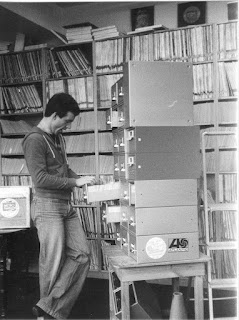
[presenter Stephen Ayres in Metro Radio record library, 1980]

 Do you believe in destiny? Not the Bardot-like Angels squadron leader Destiny who battled evil-ised Captain Black and the mysterious Mysterons. No, destiny as in fate. The notion that our futures are determined long before we realise it ourselves.

My earliest job, having just learned to write, was to take it upon myself to sort my parents’ two-dozen albums and two-score singles into some kind of order and to biro sequential numbers on their covers and labels. Nobody had told me to. Then I instructed my parents to always put their vinyl records back in the correct sleeves and return them to the shelf in the correct order.

Almost two decades later, my first full-time job required me to instruct my colleagues to always put the vinyl records back in the correct sleeves and return them to the shelves in the correct order. Destiny? Or was it fate? My office desk was located in the first-floor record library of local commercial stationMetro Radio’ in Newcastle. It was not strictly MY desk. It belonged to my line manager, Malcolm Herdman, who had just been seconded to record a jingle package in the station’s ground-floor studio. I had been appointed to perform Malcolm’s tasks as head of music, albeit as his deputy, and to create a new daytime playlist system that could reverse the station’s ratings decline.

Two other staff worked in the same room: at one end, young librarian Liz Elliott who was enthusiastic, helpful, chatty and a music fan; and, at the other, middle-aged Ann who was not. They faced each other with my desk positioned midway like a tennis referee. Liz catalogued newly arrived records, returned items to their shelves and maintained the card catalogue index. Ann was busy doing, er … mostly chatting with the station’s presenters or on the office phone to her friends. Colleagues alleged that she enjoyed a close personal relationship with the station’s managing director, Neil Robinson, who just happened to be paying her husband to write a computerised library programme … that never made an appearance while I was working there. I attempted small-talk with Ann but her preferred communication was to glare at me in silence.

Just inside the record library was a grey metal, two-door, six-foot tall stationery cupboard. It held spare copies of currently playlisted singles and valuable albums autographed by visiting pop and rock musicians that awaited mail-out to listeners as competition prizes. Soon after starting work, I found that records I had locked in this cupboard seemed to disappear overnight. The first occasion, I thought I must have been mistaken. However, on the second occasion, I was convinced that items I had secured had somehow been stolen. To replace them, I had to drive to the nearest record shop and buy multiple copies of our playlisted singles. The problem started to reoccur regularly. I was somewhat baffled.

When I told my colleagues about the suspected thefts, they described an event that had happened before I joined the station. The lone key to this stationery cupboard had disappeared (I cannot recall how), then was allegedly found several days later by helpful daytime DJ Giles Squire on the carpet immediately in front of the cupboard. This surprised my colleagues who had hunted high and low throughout the library for the key over several days, without success. How could it have suddenly appeared days later exactly where it had been lost? It was as if the key had been temporarily hidden by some kind of ‘Star Trek’ cloaking device. I was told that, after the key reappeared, things had started to go missing from inside the cupboard.

Theft from the library was a wider problem. Some library shelves of catalogued albums had visible gaps where items had not been returned. Behind Liz’s desk was a pigeonhole A-to-Z system where newly released seven-inch vinyl singles were filed by artist name. The station received multiple copies of around sixty newly released singles each week, most of which were stored there openly. So how come the pigeonholes rarely became overcrowded? It seemed that hundreds of new records were disappearing. I had the embarrassing task of having to phone record companies and ask for further copies of records that had already been delivered to us by post or by visiting reps. There were only so many occasions you could blame the Post Office.

The library had to be left open at night and over weekends because presenters were required to select records to play within their programmes. A security person was present twenty-four hours a day inside the station’s front door but their responsibility was apparently only to stop unwanted persons entering the building, not to frisk those leaving. Thus, theoretically it would have been easy for a presenter to exit to their truck in the car park carrying boxes of the radio station’s vinyl records that could then be exchanged for animal feed to use on their farm in Northumberland.

I embarked upon a ‘good cop’ strategy, sticking post-it notes on the most valuable items inside the cupboard with a handwritten message: ‘Dear Thief. Please leave this record which is essential to the running of the station and is needed for […]. Thank you, Grant.’ It made no difference. These items would still disappear overnight and the post-it notes would be left behind without any kind of riposte from the thief. Back to the drawing board.

I went to my manager, programme controller Mic Johnson, and informed him what had been happening. I always wondered if he was stuck with Velcro to his office chair as he was so rarely seen on the station’s ‘shop floor’. If he wanted to meet someone, rather than simply approaching them for a chat, his secretary would place a typed ‘docket’ in their pigeonhole. Sometimes I would see several presenters waiting in the corridor outside his office door, as if he were headmaster of Xavier’s School for Gifted Wafflers, where DJ’s whose latest ratings were sub-par should expect a good spanking to improve their superpowers. Did Mic wish to do anything about the thefts? No.

I switched to a ‘bad cop’ strategy. I visited a hardware shop and bought a thick metal chain that I wrapped tightly around the door handles of the stationery cardboard and secured with a large padlock. I was the only person with the key. For a few weeks, nothing disappeared from the cupboard. I no longer wrote post-it notes for the thief. Some staff laughed at my chain which admittedly looked hideous but, for a while, it worked until … records started disappearing once again. I was angry and frustrated. How could that happen? There were no signs that the chain had been cut or that the padlock had been replaced. Could the thief have tracked down the padlock I had purchased and found one that used exactly the same key? Had the culprit recently attended a GCSE evening class in lockpicking at a local den of thieves?

It was hard to accept that I had failed. However, the atmosphere within the station had recently turned icy as the result of a strike for increased pay by staff who were union members. Management had bigger fish to fry than my problem of vinyl records being pilfered by some Houdini. Presenters began to keep discs they wanted to use (or had used) inside the security of their personal lockers. Producer John Coulson stashed records he wanted to play on his weekend rock show behind the snack machine in the station canteen. If I needed Van Morrison’s latest album, he showed me, this is where I could find it.

Six months into my job, Malcolm Herdman was excited to play me the station identification jingles he had just finished producing. I went downstairs to the station’s recording studio for the first time and listened. Oh dear! Whereas ‘jingles’ are meant to be of only a few seconds’ duration to be used between records and adverts, Malcolm’s efforts were short ‘songs’ that lasted a minute, sometimes longer. How do I tell my boss, particularly when he has been so generous to me, that his last six months’ work was wasted? I tried to offer constructive criticism but had to point out that, if these longform jingles were played regularly, then fewer playlisted songs would be heard each hour … the very content for which listeners tuned in to the station.

This jingle project had been the outcome of an agreement with the Musicians’ Union, made seven years earlier upon the launch of commercial radio in Britain, requiring each local station to spend 3% annually of its net advertising revenues on Union members’ performances. For most stations, this translated into them paying local music acts to either perform at events or record songs for airplay. However, Metro Radio decided to blow the whole of that year’s budget on recording identification jingles by local band Lindisfarne who were already signed to a major label and since 1972 had achieved four Top Forty singles, including two in the Top Five. Hardly a struggling local band! The outcome was that, as long as Metro Radio paid its 3% to Union members, it mattered not a jot whether the results were ever broadcast.

If I had been asked earlier, I could have offered some advice. As a teenager, I had recorded jingles on my two-track tape machine initially for one London pirate radio station, only to be asked by other stations to produce similar work. Had the ill-fated Metro Radio jingles been some kind of reverse destiny where, sat only one floor away from this impending disaster, I might have rescued the project if only I had known?

Destiny quickly transformed into fate when I was called into managing director Neil Robinson’s office. It was the first occasion we had met because he and his fellow managers kept their distance from the rest of the staff and took lunches from the station canteen to their separate dining room. He told me I was being made redundant. So long and no thanks for all the fish.

[Originally published at https://peoplelikeyoudontworkinradio.blogspot.com/2023/06/watch-out-watch-out-theres-houdini.html]

Living on the frontline : 1985 : Dave Asher, 21 Aharonson Street, Tel Aviv

[Dave Asher, 1985]
“There’s a bomb!” someone shouted. “There’s a bomb!” 
I had just collected ‘NME’ from the newsagent that reserved it for me each week and had been lazily staring at a display of the new ‘designer’ stretch jeans in the windows of Gloria Vandebilt’s shop. All had been calm on the city’s main shopping street. Then suddenly it was chaos. People ran in all directions as if their lives depended upon it … which they did. Men, women and children screamed as they fled down side streets, their shopping bags flying behind them like parachutes. I was in amongst them, running at full pelt until I thought I was far enough away from the suspect device. How would I know? I didn’t. Did I hear an explosion? No. Was it really a bomb? I never knew.
On the walk home, I called in at the post office and joined a lengthy queue at the counter for overseas mail. Once I handed over my letter, the man behind the counter inspected it and adopted the withering look of an adult castigating a child … or a new immigrant.
“You cannot send this,” he said, visibly weighing up my ignorance. “We are at war.”
“Oh,” I said sheepishly, taking back my letter. “Okay. Thanks.”
Where I came from, you could send a letter anywhere in the world. I had spent much of my childhood doing just that, writing to radio stations as far away as China, Russia and Syria … and receiving replies. However, I was now learning that life is different during a time of war. I had written a fan letter to ‘Radio One’, an FM station in Beirut, Lebanon with English-speaking DJs who played the latest international hits, interspersed with familiar identification jingles stolen from ‘BBC Radio One’. Since radio transmissions ignore borders and war zones, I had become a committed listener in recent months. Now I had to return home with my unsent letter.
‘Home’ was temporarily a house at 21 Rehov Aharonson in Tel Aviv, where I was sleeping on the living room floor of the lower flat rented by fellow Brit Dave Asher. He was a well-known DJ in Israel from having presented the ‘Voice of Peaceradio station’s breakfast show for several years. There were drawbacks to my accommodation. One morning I awoke to find ants nesting in my hair, while the nocturnal journeys of slugs from behind the adjacent bathroom sink gave me frequent ‘Alien’-type nightmares. But Dave had let me stay for free and I was grateful for his generosity. Weeks turned into months; how quick they pass.
Dave had a job as DJ at a city centre basement lesbian nightclub which he kept inviting me to attend. I did visit on one occasion, but was faced with the challenge of convincing two burly doormen that I wanted to enter a female-only club filled with scantily clad women because I said my male friend was working inside. Dave was also the DJ at a packed concert by American drag queen Divine in a huge former cinema, one of the most entertaining events I have attended. My crazy plan was to remain in Tel Aviv by finding a job in the record industry, for which Dave had helped me make contact with people he knew in the business. Pre-internet and pre-mobiles, this required a lengthy wait for replies to handwritten letters.
As summer was hot inside the flat, at the end of the day I would walk the short distance to the end of the street and sit on one of the public seats along the promenade. I could put my feet up on the sea wall, read the day’s ‘Jerusalem Post’ newspaper, watch the sun set over the Mediterranean and cool down in the onshore breeze. One day, a man seated near me asked if he could read my paper when I had finished with it. He spoke in Hebrew and I replied likewise.
By then, I had learnt enough of the language to hold a basic conversation. The frustration of not even understanding destinations displayed on the front of city buses had forced me to learn the Hebrew alphabet and numbers from a schoolbook. Every afternoon I developed my vocabulary by watching ‘Sesame Street’ (‘Rehov Sumsum’ in Hebrew) on television, where the first word I learnt was the ‘dustbin’ in which Grouch (Moishe Oofnik) lived.
I was suspicious of this man trying to strike up a conversation because, weeks earlier, I had been sunbathing alone on Tel Aviv beach when a man came and sat far too close to me on the sand and propositioned me for sex. He appeared to interpret my indignant refusal as merely ‘playing hard to get’ and continued to pester me, so I now avoided the beach and its potential for further unwanted attentions.
Thankfully this man on the promenade seemed different. Because our initial conversation had been in Hebrew, he found it hard to believe that I was not a recent immigrant to Israel struggling to learn my new language. After several rounds of questioning, he was eventually convinced that: I was not Jewish; I was British; I spoke English; and I was Christian. Only once these facts had been established did he have sufficient confidence to identify himself to me as a Christian Palestinian.
“Meet me here at the same time tomorrow,” he told me. “There is something I want to show you.”
Despite an incendiary device having recently exploded at the end of our street, thankfully with no casualties, I decided to risk meeting this man again the next day on the promenade. We walked to a walled compound a few hundred metres away where he spoke Arabic into the intercom, the gate opened and we walked through a garden into a house. He took me inside and knocked on what appeared to be a bedroom door. When it opened, it was immediately apparent that this was no normal small bedroom.
Bunk beds were butted up against each other on three walls of the room, leaving no space in their midst for other furniture. The small window had been covered so that the room was dark except for a single lightbulb on the ceiling. After my entrance, I was being stared at by six men, each sat on their bunk, their sweat thick in this non-air-conditioned room. My guide explained to them in Arabic why I was there, then he turned to address me.
“I wanted you to see how Palestinians have to live in Israel, the same land in which our families were born,” he told me. “Before dawn every day, we are employed outside to clean the beaches, sweep the streets and collect rubbish but, by the time the sun comes up and the crowds come out, we have to make ourselves invisible by returning to accommodation like this. As a fellow Christian, I wanted you to see how we are forced to live in our own homeland so that you can tell people what life is really like in Israel for those who are not Jews.”
A man arrived with a big bag of takeaway food which he started to dole out to each of the men in the room. I wondered to myself if I was to be included in their evening meal and how that could happen when there was no available space for a guest to sit. My guide quickly quashed that notion.
“The men will not eat their food in front of a stranger,” he explained. “We have to go now.”
It had only required a few minutes in that crowded room for the man to have made his point. He was understandably angry about his people’s situation. He told me that, having seen their conditions myself, I now had evidence to refute the disinformation that most of the world believed. We left the compound, he went his own way and I never saw him again.
After several months of messages, letters and calls from public phone boxes, I was finally offered a meeting with the head of an international record company’s Israeli subsidiary in his penthouse flat. There I explained that I had recently secured airplay on British radio for Israeli pop records through my knowledge of the UK radio industry. I believed I could do more like this to develop Israeli music’s presence overseas.
“You should go home,” he told me sternly. “Israel is not the place for you. There is a war going on. The economy is in bad shape. Things are terrible here. Go home and find yourself a job there.”
I departed Israel on the next available flight, disappointed by my failure to secure a job. I left behind an economy with an annual rate of inflation nearing 1,000% and a currency so devalued that it required a thick wad of banknotes just to buy a loaf of bread. Prices in shops had to be updated daily, written on post-it notes stuck along shelf edges. At checkouts, there were insufficient banknotes in tills to provide change, so customers were given the equivalent value in sweets and candies. Coins had become obsolete because they were worthless. I was carrying around several hundred banknotes stuffed down the front of my underpants because my wallet was now too small.
Back in Britain, within three years I had organised the release and promotion of an Israeli record that reached number 15 in the UK singles chart, accompanied by a ‘Top of the Pops’ television appearance. It became the biggest selling Israeli record in Britain since Esther and Abi Ofarim’s ‘Cinderella Rockefella’ in 1968, coincidentally my very first single purchase. Singer Ofra Haza became an international star, later recording songs for a Disney movie. Despite failing to find a job in Tel Aviv, I had managed to successfully pin music from Israel on the ‘world music’ map of the 1980’s.
It was Dave Asher who had first introduced me to Ofra Haza’s music in 1985. Two decades later, his job was presenting the breakfast show on a radio station … in Beirut!

[Originally published at https://peoplelikeyoudontworkinradio.blogspot.com/2023/04/living-on-frontline-1985-dave-asher-21.html]

I’m gonna git you sucka : 1988 : Ace Records, Harlesden NW10

[my pyjama top, 1988 to 2023]

I recognised the tune. Not only did I recognise it, I knew all the words and would have happily rapped along with it. But not here. Definitely not here during rush hour on a crowded Underground train. I was seated in the end carriage on the Metropolitan line at Baker Street station, where the service often paused for around ten minutes before heading northbound. A man had just plonked himself down on the seat next to me, put on headphones and started his cassette player. The volume of his music was not excessive but, sat in close proximity to his headset on a stationary train, I was able to recognise the tune.

We were still awaiting our departure when I overheard my neighbour’s next track. I was even more surprised to recognise that tune. Not only did I recognise it, I was shocked that the two tunes he had just played were in the same order at the start of a cassette compilation I had created only weeks earlier. Once a third tune started, I had absolute certainty. The chance that a stranger would be listening to three tunes in the same order as mine was infinitesimally small. This unknown person must be listening to my cassette. I wanted to turn to him and explain this coincidence, but he would have thought I was a crazed madman. I had no idea who this man was. I had no idea how he possessed my cassette. Instead, I just sat there, smiling to myself that somebody seemed to be enjoying my music choices, until the train moved off and I could overhear his music no longer.

At the time, I had a job working three days a week at Ace Records, a small independent record label that specialised in reissues of American black music from previous decades. My task was to promote its releases to the press and radio by writing press releases, designing marketing materials, maintaining contact lists and sending out sample copies of records (tasks which I enjoyed), as well as cold-calling journalists (which I hated). I had been hired by the company’s co-founder Roger Armstrong, one of the best bosses I have worked for, with whom I shared a huge modern office. The Ace team were friendly and the building was a delight to work in, located on an industrial estate in Harlesden NW10, overlooking the Grand Union Canal. Opposite was the United Biscuits factory where you could determine which biscuit brand was rolling off its production line by the smell that permeated the air.

Harlesden had long been one of the hotspots of London pirate radio as a result of its significant Afro-Caribbean population. Walk along Harlesden High Street and you would see tall FM antenna masts installed atop roofs of the numerous record shops, transmitting live soul and reggae shows across London. All these stations were illegal and had to play cat-and-mouse games with authorities who sporadically shut them down and impounded their equipment. Working at Ace, I would often listen all day to Harlesden’s stations alone in my first-floor office because Roger spent a lot of time in the States copying master recordings from tape archives. I got to know the names of the pirate radio DJs and the styles of black music each of them played.

My colleagues at Ace were fans of the music the company released and we often shared recordings of music we had discovered. Brian Nevill, a musician with a deep knowledge of black music, worked in the ground floor stockroom and generously gave me a cassette of R&B/soul singles issued on the Sue and Chess record labels recorded from his record collection. His tape launched my ongoing search for music released by these companies, many of which are now my favourite tunes from this era. As a return favour, I recorded a 1970s reggae compilation from my record collection that I named ‘DJ’s Choice’, wrapped it in a cassette cover that I had designed and printed on Ace’s photocopier and gave it to Brian.

In my office at Ace, I particularly liked listening to one pirate radio programme of roots reggae oldies from the 1970s, unusually for the time presented by a female DJ. I had a bright idea! Maybe she would enjoy my cassette compilation. I made another copy and mailed it to her at the station. I never knew if she received or even listened to it. What I did know was that, within weeks, the man sat next to me on the Underground train was playing this cassette. For all I knew, copies might already be for sale on somebody’s market stall somewhere. Such was the world of pirate radio.

Then, one day at work, I heard a commotion and shouting from the reception desk at the other end of the corridor. There were loud voices and suddenly, behind me while I was sat at my desk, I heard a man’s loud, angry gruff voice:

“Are you Grant Goddard?”

I turned in my seat to see a large man looming over me, evidently angry in the belief that I had somehow wronged him. In between cursing me, he was shouting that I had refused to send him free copies of records that he had requested for a pirate radio show that he presented. Aha! I knew what this was about. It was true. He had written a letter asking for a long list of Ace Records’ 1950s and 1960s American R&B reissues, informing me that he worked for a Harlesden pirate radio station. I had written back, politely explaining that I was given limited numbers of free records to distribute because Ace was a small company that was forced to carefully select a minimal number of radio DJs to supply. This was all true. But there were additional truths I had not explained to him: Ace Records had a policy of not supplying records to illegal radio stations; the music he was asking for I had never heard played on ANY Harlesden pirate radio station; and I had never heard his name mentioned on ANY of the pirate stations I regularly listened to.

“I’m gonna [expletive] kill you,” he was shouting in my face. This hubbub attracted colleagues from adjacent offices who came to see what was happening. They demanded this stranger leave our building immediately, but he was not finished with me yet.

“How dare you refuse to give me the records I asked for,” he was shouting. “You’re gonna pay for this because I am gonna [expletive] KILL you.”

I realised that if I caved in now and gave him some records, he would simply return here again and again to demand even more from me. It was essential to hold the line. I calmly restated the reasons I had sent him in my written reply. Naturally this had no calming effect on him. He repeated his threat of violence. My colleagues repeated their demand that he leave. I noticed from his clothing that he must have come to our office straight from work. On his lapel was a Royal Mail badge with an identifying number, the type worn by postmen collecting and delivering mail. 

After venting his anger so violently on me, and seeing how many of my colleagues were now present, he thankfully decided not to kill me and eventually stormed out of the building, just the way he had barged his way in. Once my adrenalin subsided, I realised how frightened I had been by this confrontation. My colleagues comforted me and suggested I leave work early that day. I wanted them to call the police and report the incident. I felt that if he knew he had got away with such threats, he would feel encouraged to do the same at some other record company. However, they refused steadfastly to involve the police. My colleague from the adjacent office, Chris Popham, kindly gave me a lift to the nearest railway station.

My journey to/from work at Ace required a one-kilometre walk between Harlesden station and the last building on a cul-de-sac through a sparse industrial estate. During winter months, I walked in darkness along these poorly lit roads. Following the incident, I was scared that this angry man would jump out and attack me as I walked along side roads that had little traffic. Not only could I no longer listen to my Walkman on my walk to work, I would constantly look left and right, and even over my shoulder, to be certain I was not being followed. The incident had transformed my enjoyable working environment at Ace Records into one where I was now living in fear.

It did not take long to decide to quit this job. There was another factor in my decision. After three years’ work promoting world music artist Ofra Haza, whom I had discovered in Israel and persuaded Ace Records to release her recordings, I finally achieved a UK Top Twenty single. I then asked Ace Records’ directors for a bonus because I was receiving no royalty from record sales and such chart success was a rare occurrence within its business. However, all I was eventually offered was a small payment to cover my promotion expenses to date. Furthermore, a colleague at Ace had taken credit in press interviews for Haza’s success. My role had never been mentioned. It felt like the right time to move on. Lesson learnt: the music industry fails to acknowledge or reward those who create success.

Still unsatisfied with Ace Records’ unwillingness to report the incident, I wrote to Music Week, the weekly trade magazine of the music industry, explaining how someone who had claimed to work for a pirate radio station had burst into my record company office and threatened my life. It published my letter anonymously. I was sad to leave Ace Records but it was time for me to start a new job … working for a London pirate radio station!

[My curated Chess Records R&B and soul playlists are on Spotify. A detailed history of London pirate radio is a significant part of my KISS FM book.]

[Originally published at https://peoplelikeyoudontworkinradio.blogspot.com/2023/04/im-gonna-git-you-sucka-1989-ace-records.html]

Is it because I’m (not) Blacker Dread? : 2006 : Rockers International Record Shop

“It’s for you,” shouted the man behind the counter, holding the telephone handset at arm’s length toward me after having answered the call.

“For me?” I echoed incredulously. “But nobody even knows I’m here!”

I was standing in a shop, but not just any shop. This was a record shop. I dread to calculate how many thousand hours I must have spent in record shops over the last half-century, thumbing through vinyl. It started with my first record purchase in 1968, from Dykes Records in Camberley, of the novelty single ‘Cinderella Rockefella’, after it was performed on The Eammon Andrews Show. In the early 1970’s, my first ‘job’ was helping during lunch breaks in the Recordwise shop opposite my school in Egham where owner Adam Gibbs paid me in vinyl rather than cash. He taught me so much about the retail end of the music industry inside his huge, well stocked record shop, while my classmates were otherwise occupied feeding their pocket money into a nearby café’s pinball machines.

I was standing in a record shop, but not just any record shop. This was a reggae music record shop. From 1972, I would spend many weekends standing at reggae stalls and shops listening to new releases, initially around Brixton’s Granville Arcade, having travelled to London by flashing my green cardboard British Rail school season ticket paid for by Surrey County Council. Soon my trips extended to Harlesden, Finsbury Park and occasionally the East End to find the latest imported ‘pre’ singles. A common response to my multiple requests to buy certain new ‘tunes’ was “It finish, man”, an indication that the limited quantities had already sold out. I still have a wants list of unfound records from that time, probably never to be fulfilled.

I was standing in a reggae record shop, but not just any reggae record shop. This was Rockers International Record Shop, established by musician and producer Augustus Pablo. I had followed his output passionately since hearing his melodica versions on single B-sides and was hooked by the time his ground-breaking debut album was released in 1974, the first reggae LP I had heard mixed in stereo. Although Pablo had succumbed to long-term illness in 1999, his shop remained and my visit that day was to try and fill a few gaps in my collection of the man’s works.

The shop was on a street, but not just any street. This was Orange Street in downtown Kingston, Jamaica where the island’s music industry had been centred for decades. Across the street was the long-closed shopfront of Prince Buster’s Record Shack, after this artist and producer’s prolific and internationally successful career had fizzled out thirty years earlier. No single street in the world has been responsible for as great a volume of music as Orange Street. After Savoy Record Shop opened at number 118 in the mid-1950’s, the entire long street was soon heaving with noisy music, musicians, producers, record shops and studios. In its heyday, hundreds of new reggae singles were released right here every week. Small island, big sounds.

The man behind the counter was still offering me the phone receiver on its coiled cable. I approached the counter and took it from him, despite complete bafflement as to how a call could possibly be for me. Jamaica often proved as confusing as this.

“Hello,” I said with great trepidation.

“How was your flight? I hope you had a safe journey,” said an unrecognisable man with a Jamaican accent on the other end.

“I did, thank you for asking, but I ….”

“And the place you are staying is working out well for you?” he interrupted. I had absolutely no idea who I was talking to, but he was so quick to interject before I could explain.

“Yes, thank you,” I replied, not wanting to offend this stranger. “Where I am staying is fine but I think you should …”

“And have you found some music you wanted in the record shop?” he interrupted again.

“Yes, I have,” I answered, but this time I continued with more haste to try and avoid him interrupting me yet again. “But who do you think you are talking with?”

“Look,” he replied. “I’m sorry I haven’t yet arrived at the shop and I know I had promised I would meet you there.” It was evident that this man had misunderstood or simply ignored my seemingly straightforward question. How can communication sometimes prove so difficult?

“Don’t worry yourself,” I spluttered, as if it really was me that he had arranged to meet. “But I think there must be some confusion because I had not agreed to meet anyone here.”

“So my man is not with you yet?” he asked. “But will he arrive there later? Do you know what time he will arrive? Shall I call again later?”

It felt as if I was rapidly descending into a Kafka-like world of intrigue and ’39 Steps’ hazard, all because I had been mistaken for someone who I definitely was not. It was time to draw a halt to this madness.

“Please, please tell me exactly who it is you had arranged to meet here?” I pleaded with him.

“Blacker Dread, man, of course,” he finally blurted out. “Is he travelling with you?”

“No, he is not with me, but I know of him,” I explained. Finally, a little light had started to shine at the end of this conversational tunnel. But it soon became apparent that I had failed to choose my wording precisely enough and was misunderstood yet again.

“So you know Blacker and you know we are going to meet up when he has some time, so we can catch up together,” the man continued. “And you will be accompanying him too?”

Just when I thought we had made progress, that glimmer of light began to fade away again. It was imperative to put a stop to this right now. I needed to break out of my timid English-ness to fix this nonsense. I needed to be firm and I needed to explain my mistaken identity in the bluntest language I could muster.

“No, you have misunderstood, I’m afraid,” I started. “I don’t KNOW Blacker Dread personally. I know OF him. I know WHO he is. But I haven’t met him. He is not with me. I just happened to be in this record shop when your call came in. But Blacker Dread is not here. I’m sorry but I have no idea if, or when, he will be in this shop or even in Jamaica. It is just a coincidence that I am here and the man in the shop insisted that I take your call.”

“Oh, oh, okay, okay” said the man, as if I had been telling him off. In a way, maybe I was. Why cannot people simply identify themselves when they call someone? Why can they not ask for the person they wish to speak with? Why do they launch straight into conversations without first establishing that they are connected to the person they want? Anyway, it had taken some time but now the misunderstanding had finally been sorted out.

But who is Blacker Dread? Born in Jamaica (coincidentally the same year as me), his family had emigrated to South London when he was nine and he attended Penge Grammar School after having passed the 11+ exam (twice!). In the 1980’s he was selector for Lloyd Coxsone’s legendary London sound system. In 1993, he opened the Muzik Store record shop in Brixton and made huge contributions to the local community through his voluntary work. A remarkable and moving feature-length documentary, ‘Being Blacker’ by Molly Dineen, was broadcast in 2018 on BBC2 that followed three years in his life, including a tragic prison sentence in 2014 that forced closure of his shop and curtailment of his community work and reggae productions. I could never hope to achieve Blacker Dread’s stature.

Before ringing off the phone call, I asked the unknown man who he was. He said he was Jimmy Radway. I knew the name instantly as a respected 1970’s roots reggae producer whose releases had included ‘Warning’, ‘Black Cinderella’ and ‘Mother Liza’ on his record label Fe Me Time. (For me, Big Youth’s doom-laden prophetic 1975 DJ version of ‘Warning’ about Haile Selassie’s assassination, titled ‘Wolf In Sheep’s Clothing’, has always remained an absolute favourite.) I thanked Radway for his patience with me and bided him goodbye.

I handed the phone back to the man behind the counter and asked him exactly what the caller had said after he had answered the phone.

“He said he wanted to talk to the Englishman in the shop,” the man replied, “so I knew that must be you.”

I looked around the tiny record shop. I certainly had been the only Englishman in the shop. In fact, I had been the only person in the shop for the last hour while I flicked through vinyl records … except for my brother-in-law who had been waiting patiently nearby for me to finish.

“Who were you talking with?” he asked me.

“It was Jimmy Radway and he thought he was talking to Blacker Dread,” I explained. Having himself worked in the reggae music industry, my brother-in-law laughed heartily. We both realised that there could never have been a more unlikely case of mistaken identity in a reggae record shop on Orange Street, Kingston, Jamaica.

Respect to DJ Conscious for jogging my memory. My curated discography of 700+ Augustus Pablo tunes is a Spotify playlist.

[Originally published at https://peoplelikeyoudontworkinradio.blogspot.com/2023/03/is-it-because-im-not-blacker-dread-2006.html]