The day my world stood still [part three] : 7 October 1971 : Calvin Close, Camberley

 “At the age of thirteen I thought I was carrying the weight of the whole world on my shoulders …”

‘Patches’ had become a surprise number two UK hit single for blind southern soul singer Clarence Carter at the end of 1970 (written by General Johnson whose group ‘Chairmen Of The Board’ had just had a number three UK hit single with their wonderful debut ‘Give Me Just A Little More Time’). In the lyrics, ‘Patches’ is the thirteen-year-old son of a poor American farmer who, on his deathbed, pleaded:

“Patches, I’m depending on you, son
To pull the family through
My son, it’s all left up to you”

‘Patches’ was one of my mother’s favourite records of that period. At the time, I could never understand why because, to my young ears, it was an over-sentimental, over-American rural fantasy and not a patch on Bobbie Gentry’s enthralling and mysterious ‘Ode To Billie Joe’ family tragedy from 1967. Whenever ‘Patches’ was heard on ‘BBC Radio 1’, my mother would stop whatever she was doing and listen intently to the lyrics. Why did this song mean so much to her?

A little over a year after ‘Patches’, unexpectedly I was to become that thirteen-year-old carrying the weight of the whole world on his shoulders. However, rather than my father dying surrounded by his loving family, mine had sordidly run off with a girl only a few years older than me, scarcely to be seen again. From that day, though neither parent instructed me as such, it seemed to be left to me “to pull the family through”. My father’s new mission was to wreak vengeance on our family in every which way, disowning us whilst stealing possessions we valued [see blog]. My mother fell into a resigned malaise that lasted the remainder of her life [see blog]. I felt only relief my father had left, a better outcome than observing my mother cower from his violence. Fortunately, he had never touched me, my knowledge having proven too valuable to his businesses [see blog].

Hearing the lyrics of ‘Patches’, had my mother anticipated the inevitable dissolution of her marriage and the consequential demands on me, her eldest son? Her husband had been cheating on her since the 1950’s and, now that his business ventures were finally generating significant ‘cash’ profits, he felt justified in unilaterally indulging juvenile desires unaffordable until now. In 1970, he had proudly shown me his impulse purchase of one of the first handheld electronic calculators, whose £100 price tag infuriated my pregnant mother. In 1971, he had changed his recent American Motors ‘Javelin’ sports car unnecessarily for a newer, more powerful ‘AMX’ model [see blog], a totally impractical upgrade for a three-child family. He had been behaving like a kid in a sweetshop as he approached forty. And then he was gone.

During the preceding years, I had already taken on a role as our family’s administrator, typing correspondence, posting letters, opening and filing incoming mail. Our financial management – paying the bills, writing cheques – had rested with my father. In retrospect, I am never sure if it was coincidence that my parents had trained me in administrative skills from an early age, or whether my mother had foreseen that I would have to become the family’s ‘Patches’, required to steer our family away from administrative and financial oblivion. Although it was she who had taught me financial skills, her husband’s departure paralysed her into inaction, clinging to a hope that he would someday return and restore our family’s equilibrium, or at least take care of family finances once again.

We should all have been living in Canada by now. For more than a decade, my parents had planned to emigrate there. In 1962, they had visited Canada House in Trafalgar Square and come away with a huge, colour fold-out wall map of the country (that I still have). In those days, neither visa nor migration papers were necessary. You could simply book seats on a plane or boat and be welcomed as a newcomer to the great Dominions. Unexpectedly, during the two years following my brother’s birth in late 1963, my parents abandoned this long-held plan. No explanation was offered me. All their preparations for a North American lifestyle – me and my brother’s names [see blog], our succession of American cars, my father’s ice skating [see blog], our weekly ten-pin bowling [see blog], our American music, our American kitchen appliances [see blog] – came to nothing, never to be mentioned again. I was disappointed.

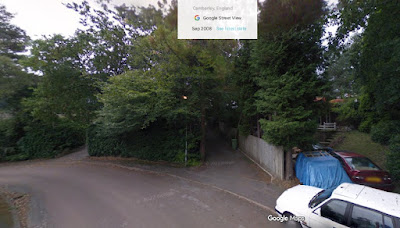
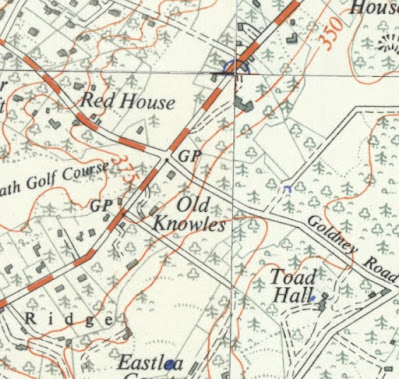
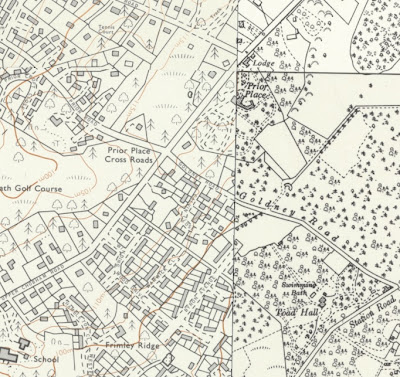
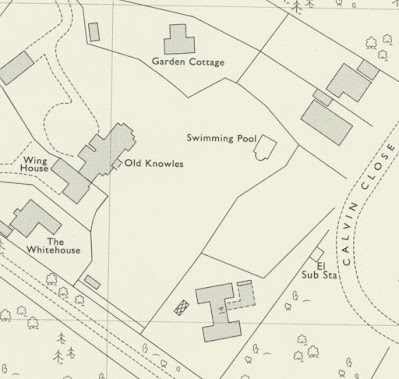
In 1965, my father discovered for sale an empty plot of land on the other side of Camberley that might be purchased at a discount. The owner of one of Camberley’s huge Edwardian mansions, ‘Old Knowles’ on Upper Chobham Road, had divided the far reaches of their estate into small plots, each sufficient for one family house to be built. However, ‘Plot 7’ remained unsold due to its odd shape and access problems. A new ‘Calvin Close’ cul-de-sac had been constructed to reach these new properties and building work had already progressed on some sold plots. Plot 7 comprised a long narrow upward-sloping driveway, barely wide enough for a car, that ended in a flat square-ish plateau. However, for some crazy reason, the new electricity sub-station serving the street’s houses had been built at road level slap bang on the driveway, preventing any vehicle access.

I visited the plot with my parents, us having to squeeze past the sub-station’s wooden fence and clamber up to the plot. It was clear that, though Old Knowles had retained a huge perfectly manicured rear garden, the plots up for sale beyond had been left as wilderness for years. It was a jungle. My parents were unaware that this land had once held an industrial gravel pit. Each plot had apparently been drawn on a map without consideration about what might be on or under the ground. In Plot 7, we found the end of an old concrete ornamental pond, though its substantive part stretched onto an adjacent plot. There was no back fence to the big house (the right-hand edge of Plot 7), just a line of thick high rhododendrons that you could push through, tempting you to march across their perfect garden.

The rear of the plot was marked by an ancient sunken alleyway wide enough for a horse and cart, the dug-out soil having been piled up on either side and planted with thick bushes that grew into a canopy of foliage, making the path invisible from beyond. It stretched in a perfect straight line southeast from Upper Chobham Road 600 yards to a neighbouring estate, ‘Toad Hall’ (formerly ‘Edgemoor’), and then diverted with a 90-degree turn southwest to ‘Eastlea Court’ estate (formerly ‘The Firs’) on Chobham Road. Perhaps this overlarge ditch had marked the western limit of the 300 acres of heathland purchased in 1860 by Swiss botanist Augustus Mongredien to build a silk farm named ‘Heatherside’ that soon failed, the land defaulting to mortgage lender Sir Gabriel Goldney of Chippenham. A century later, ‘Goldney Road’ was the unmade, potholed rough access road necessary to enter our cul-de-sec and the new Heatherside housing development beyond, then under construction by housebuilder Bovis that had acquired most of Goldney’s land.

I failed to understand how the wilderness of Plot 7 could be transformed into a home for our family. It was full of insects, spiders and creepy-crawlies that terrified me. For the next two years, I elected to spend weekends at home alone [see blog] whilst my parents spent every daylight hour at Plot 7 to clear the site and house build. My father petitioned the Electricity Board to relocate its problematic sub-station to adjacent land not yet built upon and, following a long wait, his request was approved and executed, allowing vehicles to reach the site for the first time. My father made a sign on a sample floor tile saying ‘Plot 7’ in white Letraset and nailed it to the fir tree on the left of the driveway at street level. To save money, my parents did as much of the building work as they could, employing specialists only for tasks that needed heavy equipment or trade skills.

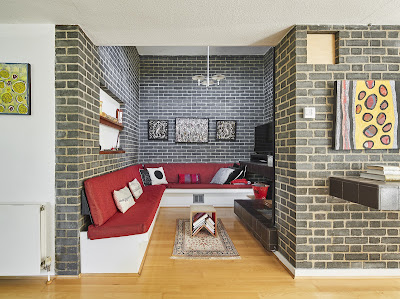
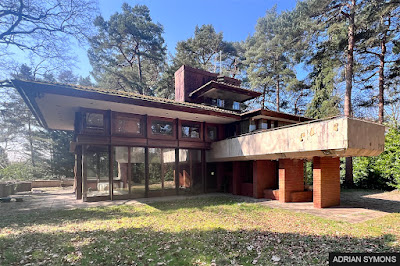
My father was an admirer of American architect Frank Lloyd Wright’s modernist buildings and seized the opportunity to build a similarly novel property in Camberley. Having executed so many renovations and extensions for clients, this would be his first opportunity to design an entire house to his own specifications. Perhaps he was inspired by a photo-feature in his beloved ‘Architects Journal’ of the 1959 ‘Rossdale House’ on Hendon Road in London, since many of its features were replicated in our home – a carport instead of a garage, exposed dark purple brickwork inside and out, floor-to-ceiling glass sliding doors, an adjoining pond/pool and a white oval dining table and chairs (as seen in ‘2001’). Though the London house comprised two storeys built on stilts, ours was limited to one floor by the land deeds, the owners of stately Old Knowles not wishing to look out their back windows and sight the top of our modest home beyond their perfectly kept garden.

My father designed his house in the shape of the letter ‘H’, the right sidebar comprising three bedrooms, the left a long, open living/dining room and, within the crossbar, the kitchen, bathroom, WC, coat cupboard and heating/hot water system. The majority of the ‘walls’ were floor-to-ceiling glass, enabling sightlines from outside straight through both wings of the house. The roof was flat concrete, supported by the bare brickwork between the glass windows. The bathroom included a separate bath and enclosed shower cubical, unusual in that era. The bathroom mirror was a huge sheet of thin aluminium foil stretched over a frame ordered from the US. Instead of a letterbox in the front door, there was an American-style upright post-box on the wall alongside the two-vehicle carport, much to the confusion of postmen/women who had walked up our long driveway. Instead of a front door key, embedded in the wood was a press-button combination lock ordered from the US. Opening the front door from outside, you were confronted with a huge floor-to-ceiling clear Perspex window that overlooked an exterior pond at the rear. The heating system was underfloor gas air, also ordered from the US. The living room thermostat was manufactured by Honeywell, ordered from the US. The kitchen sink included a waste disposal unit, ordered from the US. In the garden was constructed a greenhouse that resembled the top half of a clear glass sphere.

The house was initially designed to be completely open-plan, with internal doors only for the bedrooms, bathroom and WC. However, British building regulations necessitated the addition of fire doors to separate the kitchen from the bedrooms, as well as from the living/dining room. Frustrated by these rules, my father installed a ridiculously expensive kitchen door constructed entirely of thick, frosted glass, an unnecessary appendage that we never closed in all the time we lived there. Essentially, my father had built a ‘showhouse’, permitting his potential architectural clients to view a real-world example of futuristic living that might have been commonplace in California but was rarely seen in suburban Surrey. I loved living in the house, though its purpose echoed the earlier building of the Rossdale House as a marketing exercise for architect Geoffry Powell’s practice ‘Chamberlain, Powell & Bon’.

Our new futuristic home was not without its problems. The mostly glass exterior made birds believe they could fly at speed straight through the house during daylight, only to ‘thud’ against the glass window and be found dead, requiring regular burials in our garden. Leaving a glass sliding door open meant the occasional squirrel would enter, then panic and race around the floor inside the house, banging against the glass windows until we could usher it back outside. The deafening roar of low-flying test flights by Concorde from nearby Farnborough Royal Aircraft Establishment would rattle the huge glass windows, worrying us they might shatter. At night, our house lights would attract foxes, whose two red eyes would appear out of the darkness at a living room window, staring at us sat within like a horror movie. My mother purchased yards of thick, olive-green patterned material from Liberty that I helped her measure, cut, line, pleat, add curtain heading tape and hang in front of the eight expanses of glass window. The house being located some distance from the road, it felt as if we were living in countryside since neighbouring properties were not visible from our windows, a major change from our previous home fronting a bus route near Camberley town centre.

The red standalone enamel hooded fireplace mounted on a large inch-thick black slate square in the living room looked impressive but, when there was the slightest wind outside, smoke from a lit fire would blow back down the iron chimney and fill the living room. In summer, sunlight on the glass windows heated up the rooms terribly, particularly when the house was closed up. Conversely, in winter, the absence of insulation and the bare brickwork made the house cold, particularly the bedrooms that all faced northwards, while the open-plan design made it impossible to retain heat in one part of the house. Only a few years later (after my father had left), the heating system failed completely and, despite my repair efforts [see blog], we lived in an unheated house for years thereafter. The house’s legacy was that much of its equipment purchased from the United States could not be serviced or repaired in Britain, rendering those amenities defunct.

The inspiration for our home unexpectedly appeared in my music listening. Having bought the Simon & Garfunkel album ‘Bridge Over Troubled Water’ in 1970 from ‘Dykes’ record shop in Camberley [see blog], I was surprised to hear the Paul Simon composition ‘So Long, Frank Lloyd Wright’ dedicated to this American architect who had died in 1959. My father had regularly shown me articles about Wright in architectural magazines and glossy American coffee-table books bought on trips to London, filled with his modernist building designs. In distant Camberley, it turned out he was not the only one inspired by Wright:

“Architects may come and architects may go
And never change your point of view.
When I run dry
I stop awhile and think of you.”

During the first years in our new home, I was given new responsibilities. My father insisted I regularly clean his preposterous American sports car in and out, afterwards spending hours polishing its bodywork inch by inch, a task I really hated. I was charged with mowing the grass lawns on three flanks of the house with a newfangled ‘Flymo’ lawnmower (‘It’s a lot less bovver with a hover’), after my mother’s attempt nearly electrocuted her when she rolled over and sliced its electric cable. For some reason, I was also the one who had to light the living room fireplace in winter, struggling with matches, firelighters and bits of damp wood. After initially continuing to share a bedroom with my younger brother, one year later my parents moved me into the house’s third bedroom, the first time I had occupied a room of my own. Despite the unwelcomed isolation from friends and my much-loved maternal grandparents, life proved enjoyable.

This stasis did not last long. My parents had spent two years building their ‘dream home’ and then four years living in it when my father deserted his wife and children [see blog]. My mother was left with a millstone property, raising alone three children in a now unheated home that she could ill afford to maintain or repair. Her dream had become a nightmare. Each of the house’s five sets of glass sliding doors were locked with a key, one each of which my father kept. The front door could only be opened with a number combination which my father knew. Securing the house from my newly vengeful father proved impossible. When we were all out, he would walk in and steal whatever he wanted, including parts of my precious vinyl record collection for which I would never forgive him [see blog]. Every summer, my mother’s sister Pam would generously pay for our one-parent family to stay somewhere in Britain, but I would never again accompany my mother and two siblings on holiday as I had to stay home alone to guard it from my father [see blog].

The most immediate impact of my father’s departure was my education. Three years earlier, when my parents decided to send me to a secondary school the other end of the county [see blog], they had promised to give me a lift every school day to Camberley railway station to catch the 8.10 train. Arriving back at Camberley station at 5pm, I would walk to my father’s town centre office and cadge a lift home. That was then. Now that my parents’ promise was in tatters, I had to be the first to rise at 6.30, make breakfast, then walk out to the Prior Road bus stop just after 7 to catch the irregular bus to the town centre and await the 8.10 train. Now, arriving back in Camberley at 5pm meant a wait until 5.40 for the next 39B bus that would deliver me home after 6. Outside of winter, if the weather was fine and I was not carrying too many books, I would choose to walk the two miles home, though it meant a trudge to the top of Church Hill, down Crawley Hill, across the M3 interchange, a walk up Prior Road, then finally down Goldney Road. I could arrive home shortly before 6, but often exhausted.

To avoid such long days, I asked my mother to sign a letter I had typed to my school, asking if I could be let out ten minutes early at the end of the day, as I could arrive home a full hour earlier by catching the 4pm train from Egham. The school reluctantly agreed though, in practice, it proved impossible to enact because teachers of the final afternoon lesson set the day’s homework during their final minutes, to be handed in the following day. It was Hobson’s Choice: get home early or fail my homework. The school office had already become suspicious of my home circumstances. At the end of one term, my regular school report booklet failed to arrive home by post. On enquiring, I was informed that my father had phoned, asking for it to be sent to his new address. I had to explain repeatedly that I did not live with my father and that he took no interest in my life, before I could persuade staff reluctantly to change back the address. How could I admit that most of my father’s stories were lies?

There were reasons for needing to reach home from school at a sensible hour, none of which I wanted to explain to my school. Every weekday, teachers set two subjects of homework that had to be submitted the next school day. They seemed to imagine students reached home within minutes after the school bell, joined their family for formal dinner, then one or other of their parents helped them complete their schoolwork. In my case, nothing could be further from the reality. Neither of my parents ever assisted with my homework because they lacked the knowledge or skills. Instead, once I reached home, my most urgent ‘home work’ now was to administer my mother’s perilous circumstances.

I had multiple uncharted waters to navigate. Our mortgage lender. The municipality’s property ‘rates’. Southern Water. Southern Gas. Southern Electricity. The Post Office telephone service. Buildings insurance. Contents insurance. Car insurance. Service contracts. Inland Revenue. Midland Bank. Until then, all household bills had been paid by my father. I had to contact these agencies by typing letters in my mother’s name and setting up new payment plans, urgently where outstanding balances had accrued due to my father’s abrupt cancellations. I had to field regular ‘red reminders’ and threatening court summonses. Once my mother had signed this correspondence, I would carry it to school and post it in my lunch hour at Egham Post Office. I created a set of labelled folders at home to track all the documents, filing carbon copies of letters I had typed (rediscovered intact four decades later during house clearance following my mother’s death).

At the same time, I had to respond to my father’s resort to the legal system to harass us. He filed a case for regular access to his one-year-old daughter, despite having tried to prevent her birth and never having shown an interest in the upbringing of his children. Farnham Court ordered my mother to permit him to take my sister one weekend a month, seemingly oblivious that neither he nor his teenage mistress knew the slightest about baby care. Those weekends were particularly fraught in our home when my mother would fret terribly that her husband might disappear with her daughter merely to spite her. Eventually, my father bored of this antagonistic routine, spurning further contact with his daughter for the remainder of his life.

I now diverted my school lunchtimes to the upstairs reference section of Egham public library, reading dusty law books to understand our family’s rights in the face of my father’s legal onslaught. He was well aware that he had left my mother without sufficient funds to fight his actions, requiring me to fill out forms for ‘Legal Aid’ and attach the requisite proof of our dire financial situation. I had to apply to Surrey County Council to support my education, most urgently for the expensive termly railway season ticket necessary for travel to school, as well as subsidies to buy my school uniform and entitlement to free school meals [see blog]. Until my mother could find employment, having not worked since my sister’s birth the previous year, I had to apply for social security benefits from the government DHSS agency. My mother’s change of status proved difficult to document when we were unaware of my father’s new address as he had ended direct communication with us.

To represent her in court, my mother hired local solicitor Neale Turk whose office on Kings Ride had recently opened. I accompanied her to their initial meeting and explained our family’s situation with reference to the legal statutes I had read and photocopied at Egham library. While my mother would attend follow-up meetings, she said Turk instructed her not to invite me again. Unfortunately, my mother’s outcomes from a succession of Farnham court appearances, none of which I was permitted to attend, proved not particularly positive. Only later did we discover that my father had at some time been a client of Turk. Mmmmm.

Court orders requiring my father to make maintenance payments to my mother for her and his children were ignored. It was left to me to phone the Clerk to Farnham court from home once a fortnight to ask why we had still not received his overdue funds, me having to fib to the school that I had some medical or dental appointment. I heard every excuse under the sun relayed by the Clerk. Eventually, once my father’s arrears had accumulated to astronomical amounts, he disappeared. He never did pay what he owed us. Only later did we discover he was an illegal immigrant in the United States, the place he had sought to emulate so much in his architectural work [see blog].

Before he fled, his design legacy was left for all to see on Calvin Close, not only in our house but also at the far end of the cul-de-sac. His ‘showhouse’ had brought him a commission to design a group of identical houses around the bottom of our road. Quite how the municipal planning committee approved his plans I never fathomed, as they were designed in the style of Swiss chalets with steep pitched roofs, completely out of character with surrounding homes. Whenever I happened to pass them, I felt ashamed of my association. Decades later, most of those monstrosities were demolished and replaced with orthodox houses. 

In 2004, visiting my mother in the tiny house she now occupied in a town near Camberley, she showed me estate agent sale particulars for a property about which she had enquired, having seen it advertised in the local paper. It was our former home in Calvin Close. She told me she was thinking of arranging a viewing. I was horrified. No no no! Even after all the terrible things that had happened in her life, she still imagined she could resume her ‘happy family’ years between 1968 and 1972 by living in that house again. Mercifully, the £340,000 price tag was way beyond her means. I never did find out if she ignored my pleas to stay well away.

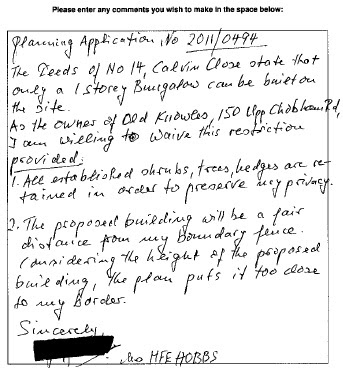
My parents’ now rather post-modern home was demolished after planning permission was approved in 2011 for a conventional, two-storey house to replace it. Their decision not to emigrate to Canada had had disastrous consequences. Their dream of a ‘new start’ there had turned to dust: my father an illegal immigrant on the run and my mother impoverished for the remainder of her life.

[to be continued…]

POSTSCRIPT:

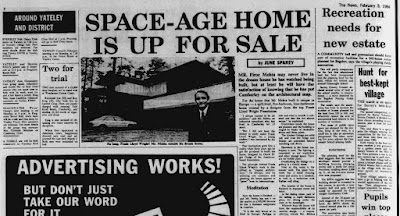
Nearly two decades after our Calvin Close house had been built, another Frank Lloyd Wright-inspired house was constructed in Camberley at 11 Crawley Hill, an address I had walked past hundreds of times on my way home from school via the railway station. Built between 1981 and 1984, initially named ‘Rhododendron’ but later renamed ‘Betterwords’, it was designed by architect David Elgin Dodge (of the American ‘Dodge’ car dynasty) for owner Firoz Mehta, an “industrial consultant” who had lived in Camberley since 1972 and “had always wanted to be an architect”. By remarkable coincidence, in late 1985 I happened to work briefly in this house and experienced an eerie familiarity with my childhood home that, by then, had been consigned to memory. This later property attracted considerable press coverage for its retro-1960’s stylings (“It is the only house of its kind in Europe”, Mehta proudly told ‘The Camberley News’), including in the national ‘Daily Telegraph’. It now apparently fulfils three Surrey Heath Borough Council criteria that make it a “significance of heritage asset”, whereas my father’s genuine contemporary 1960’s modernist design, built one mile away, had attracted zero public attention … perhaps because he had not been a ‘real’ architect [see blog].

[Originally published at https://peoplelikeyoudontworkinradio.blogspot.com/2026/09/the-day-my-world-stood-still-part-three.html ]

Why are Canadian radio station audience data a state secret? : 2000 : BBM Canada

 Letters to the Editors, Marketing Magazine, Toronto

Dear Sirs

I am a radio programming consultant based in Toronto with twenty years’ experience in the industry. My work has created successful commercial radio stations in the UKRussiaHungaryLatviaCzech RepublicEstonia & Lithuania. When I start a new project in a city, the first thing I do is contact the designated agency for media ratings. On every occasion, agency staff have always been very happy to share their data with me and are always pleased to discuss their findings with a fellow professional. Some agencies have even produced custom reports to help me better understand their media market. They recognise implicitly that we are both working towards the same goal – a wider understanding of audience research data will produce a more efficient medium that delivers bigger audiences to more satisfied advertisers.

The story could not be more different in Canada. I called the Bureau of Broadcast Measurement (BBM Canada, founded 1944) this morning and was surprised to learn that it offers no public access to documents at its offices, and expressly forbids public access to any survey less than a year old, even to industry professionals such as myself. I was given two options: subscribe to BBM at a cost of over a thousand dollars; or consult back issues of surveys at Ryerson University. I had visited Ryerson earlier this week, where the latest data on the shelves is 1998 (prehistoric in media terms) and I was told by the Librarian that the University’s contract with BBM expressly forbids access to any data more recent.

I am at a complete loss to understand why the broadcasting industry in Canada funds BBM for research purposes and then does its utmost to hide the results. The radio industry may whine about declining audiences but, unless consultants such as myself are permitted to read, understand and interpret the latest market data, how can we make any positive contribution to our industry? I can call the Audit Bureau of Circulation in Canada, enquire about magazine readership, and be bombarded with reams of statistical data. But the radio industry in Canada – nothing!

In the UK in the 1990’s, I made a modest contribution to the development of radio research by tabulating and publishing the first Arbitron-style radio station rankings for every major market in the country. Such basic, easy-to-understand information seems to be impossible to collate in my own backyard, even for professional purposes. Or is that the way Canada’s cosy little media cartel wants it? And how does such a policy help grow the broadcasting industry in the long run?

Yours sincerely

GRANT GODDARD

11 August 2000

[Originally published at https://peoplelikeyoudontworkinradio.blogspot.com/2025/02/why-are-canadian-radio-station-audience.html ]

Kick archaic studio-bound public radio production out into 21st century public spaces : 2011 : BBC Radio

 Technological advances made during the last two to three decades have changed our world almost beyond recognition. Everyone now has the ability to be almost permanently ‘connected’ to a world beyond their immediate personal space.

Has BBC radio fully embraced the benefits of these technological advances? From an external perspective, the answer appears to be both ‘yes’ and ‘no’. BBC radio seems to have implemented new technologies less obviously than BBC television. Yes, BBC radio programmes and stations now have an online presence, receive e-mails and tweets, and distribute their output live and on-demand via IP. But no, the basics of radio production have changed very little beyond a conversion from analogue tape to digital hard-drive storage.

In the 1920’s, a male radio announcer would sit in a BBC radio studio, dressed in a dinner jacket and reading a pre-prepared script. In order to be interviewed, guests would have to physically come to the studio. Everything had to be broadcast live, as there was no technology to include ‘actuality’ from beyond the studio’s confines. All the news and information had to be filtered through the on-air presenter. Listener involvement was limited to letters submitted, selected, edited and read on-air by the presenter.

Surprisingly, the radio production format has changed little in the interim ninety years. Presenters still sit in studios filled with expensive radio hardware and they still act as filters for the information that flows into the studio. Only three substantial changes are evident: recording systems have allowed interviews and actuality to be incorporated into programmes, and a programme itself to be time-shifted; phone-ins have allowed listener voices to be put live on-air via the telephone; and BBC reporters can be incorporated live into programmes via ISDN or IP from around the world. All these developments were pioneered by the BBC.

If we look at BBC television, we see that an increasing amount of content broadcast on the ‘BBC News’ channel comes in the form of photographs, poor quality mobile phone video (viz the ‘Arab Spring’ in Syria), eyewitness reports by phone line and Skype video/audio interviews supplied by the public from their offices or homes. In the current jargon, much of this could be called ‘user generated content’.

However, in radio, this revolution has simply not happened. When did you last hear a piece of audio on BBC radio that had been recorded and submitted by a member of the public? Never? In radio, public participation in the output still remains limited to content initiated or filtered by the production team. A member of the public will be asked to connect to the studio for a formal interview with a presenter either live in the studio, from a BBC contribution studio or via a phone line. Or a reporter may take a portable audio recorder out to interview a member of the public on location and the outcome is edited before transmission into an audio ‘package.’

The result is that, just as in the 1920’s, what we hear on the radio has still been filtered through the programme presenter and producer, so that the resulting programme is delivered from the confines of a cosy, air-conditioned studio. Radio is still largely produced in a vacuum that is far apart from the real world. Of course, there are obvious exceptions such as ‘From Our Own Correspondent’ and ‘Question Time.’ But these remain exceptions.

The continuing reliance within radio upon the hardware-equipped studio is particularly hard to understand when digital audio equipment is smaller, lighter, more portable and cheaper than its analogue ancestors. A radio programme can be produced, mixed, edited and broadcast from a basic laptop computer using software-based technology rather than considerably more expensive hardware. In this sense, radio should by now be far ahead of television, where digital equipment remains expensive, complex and still requires substantial bit rates and data storage for broadcast quality.

These incredible technological advances in radio production have been well understood and seized upon by people outside the BBC who do not have privileged access to expensive hardware-based recording studios. In their thousands, these people are making their own radio programmes (‘podcasts’) and creating their own online radio stations. The technology has filtered down so far that even a local primary school has its own radio production studio, linked to a low-power FM transmitter on the school’s roof so that children can listen on ordinary radios to the programmes they make.

London is one of the most exciting cities in the world. Yet, when I listen to ‘BBC London 94.9 FM’, I do not hear that excitement reflected much in its output. What I do hear are presenters sat in hardware-based studios, talking with guests they have invited there or talking via phone lines to selected contributors outside. What is sorely missing is ‘actuality.’ News stories are often reduced to ‘packages’ that can be inserted into hourly news bulletins. Yet the technology already exists (smartphones, IP, 3G) so that the hundreds of news stories that happen in London each day could be put to-air quickly using actuality live or ‘as-live’ recorded by either BBC reporters or the public.

Existing technologies could be implemented to create an exciting news and information driven radio station for London that more closely reflected life in the capital. It would entail taking risks, but it is only through risk-taking that innovation will happen. BBC London’s share of radio listening in London is only 1.4% and the station reaches only 5% of the population each week. Licence Fee payers could be better served by a local radio station in London that used new technologies to create an audio soundtrack that reflected their lives in this city. Such opportunities to use new technologies to change the face of radio are being missed, or being left to television to implement.

I lived in Toronto for five years and the city’s only independent television station, ‘CityTV’, offered one of the most impressive uses of new technology I have ever seen. For a start, the station did not have traditional TV studios. News programmes were presented by anchors perched on the corner of their own office desks. The nightly one-hour local news programme was filled to the brim with reports from a small team of one-person ‘videographers’ who whizzed around the city all day and recorded every available story using a single handheld camera. Sometimes the quality was not great, but the content accurately reflected the life of the city much better than any other local medium in Toronto.

At CityTV, the weekday morning show was presented from the station’s ground floor foyer. Cameras, lights, cables, production staff were all left in-shot, as were the people on the busy street outside and casual visitors to the station’s offices. CityTV’s owner, ‘media visionary’ Moses Znaimer, called this infrastructure “the streetfront/studioless television operating system” and it worked fantastically. Every Friday evening, the same foyer was turned into a free nightclub that was televised live for several hours with DJs, visiting music acts and short interviews. Admittedly, CityTV’s output was sometimes chaotic but it used cheap, lightweight technologies to successfully break down the barrier that had existed previously between formal, studio-limited programmes and their audiences. The people of Toronto felt truly connected with CityTV because every city dweller knew the location of its downtown building and could wander in, even during its live shows.

I had marvelled at CityTV’s bold use of cutting-edge technology fifteen years ago. And, since then, technologies for television have advanced much further. But it is the medium of audio where even more fundamental breakthroughs have taken place. The ability to use a smartphone, a laptop or a cheap audio recorder to record perfect digital sound quality in WAV format has opened up the possibility to produce content for broadcast much more significantly than in television. Yet, from the outside, there seems to be no strategic vision to implement these technologies within the BBC in order to change the way in which radio more pro-actively involves itself with the world outside its radio studios.

Individual BBC reporters are doing amazing things with new technology. Nick Garnett provided live interviews for ‘Radio Four’ about the outcome of the last election from a moving tram in Sheffield using only his smartphone installed with the ‘Luci Live’ application for broadcasters. His personal website demonstrates in videos his evangelism for these new technologies. He contrasts his ability to produce live coverage of the recent Salford/Manchester riots safely using only his handled smartphone with the impossibility twenty years earlier when a high-tech van was necessary, even for a short live report, and the job of holding the microphone remained the responsibility of a BBC Studio Manager.

At the heart of technological change is a necessary accompanying change in working practices in many parts of BBC radio. Whilst television underwent fundamental change when it was transformed into ‘BBC Vision’, the radio infrastructure has remained much the same. Whilst BBC television has been mostly casualised by freelance staff, radio remains dominated by full-time employees. Although BBC television has stiff competition from commercial stations, BBC radio attracts the majority of listening (54% currently) and its share continues to grow. The grave danger is that complacency in BBC radio from high ratings can stunt innovation. 

Whilst there is no doubt that technological innovations have been successfully incorporated into current working practices within BBC radio, it is a much greater challenge to incorporate the disruptive influences of those technologies in a way that forces change in current working methods. For example, at present, producers and editors of radio programmes set the agendas of programmes themselves and then seek to fulfil those plans by inviting ‘talking heads’ and commissioning ‘packages’ to make their points. This is a demand-led production system, working from the demands of the producer.

However, in a world where there are already hundreds of pieces of audio content available to choose from to make a programme, the production system could become more supply-led. The editor would use a mix of commissioned pieces and the best or most appropriate of what already existed from BBC contributors or the public. In fact, the radio editor would become more like an editor of a newspaper, selecting from what content already existed, rather than commissioning every item from scratch.

If the thought of including ‘user generated content’ from the British public in network radio output proves alarming, it is worth remembering that there are dozens of media courses up and down the country whose students would love to add some BBC radio contributions to their CVs. There are also 300 community radio stations that have an existing ‘Memorandum of Understanding’ with the BBC to share content in both directions. Yet BBC radio at network level does not seem to have reached out to the wider constituency of audio producers beyond its own staff and ex-staff. When I interviewed senior BBC network radio staff last year for a ‘BBC Trust’ report and asked why no audio was being recycled from BBC local radiostudent radio or podcast producers, I was told that they would not meet the ‘quality’ threshold. Equally, you might ask why the Sony Award-winning ‘Hackney Podcast’ is not a regular part of BBC London’s output.

This ‘quality’ barrier is an anachronism that remains in place in radio and yet seems to have been largely overcome in television. Within BBC radio, ‘quality’ is even used as a means to segregate one division’s content from another’s. In television, if the content communicates something newsworthy or significant, blurry mobile phone footage is broadcast. Yet, in radio, the audio quality often seems more important to producers than the content itself. This requires not so much a change in technology, as a change in attitudes and editorial policies that have not caught up with the technological possibilities.

A station such as ‘BBC 1Xtra’ should be an exciting and ground-breaking experience to listen to. Yet, on the occasions I have listened, its output has seemed hideously studio-bound and insular to me. There appears to be little difference between 1Xtra and 1920’s BBC radio, as a presenter still sits in a hardware studio, but with an assistant who reads tweets instead of letters. During one show I heard recently, the presenter was reduced to bemoaning that he had left his lip balm at home, and a clip was used of musician interviews made days earlier backstage at an awards ceremony.

Surely a station such as BBC 1Xtra that is aimed at young people should have an immediacy and an incredibly ‘live’ feel to it that is able to challenge the speed of competing information sources delivered via the internet. 1Xtra should be overflowing with exclusive news, information and music, artists dropping in for short chats and ‘actuality’ broadcast live or ‘as-live’ that reflect the diversity of the British black music scene. Yet I do not hear this kind of excitement when I listen to 1Xtra. The station would be a perfect candidate to adopt CityTV’s studio-less operating system, where it could operate from an open-door shopfront rather than from the remote bowels of a BBC office. It could even broadcast from different cities week to week, like an ever-travelling roadshow.

I have a particular interest in 1Xtra because, twenty years ago, I had launched ‘KISS FM’ in London as the UK’s first black music radio station. Even then, I had used what few new technologies were available to make the programme content less studio-bound. I regularly sent one reporter out with my mobile phone (at a time when they were uncommon) and her interviews and actuality were put live to air using nothing more sophisticated than the phone’s low-quality microphone. The audience loved that immediacy. Then, after work, I would take a digital recorder to London clubs and record the whole night’s DJ set for subsequent broadcast. These technological innovations made KISS FM one of the most successful station launches of its time because listeners understood that the station was ‘out there in London’ rather than always studio-bound. 

 Let us be clear here. Radio needs to implement as many new technologies as possible in order to adapt and change what it can do if it is to remain relevant and valuable to its audiences. Although, in total, radio listening in the UK has reached an all-time high (partly as an outcome of the increasing population), there are some disturbing long-terms trends. Six years ago, 15–24-year-olds started to spend significantly less time listening to broadcast radio. More recently, 25–34-year-olds are also spending less time with broadcast radio. If this trend continues, part of an entire generation could lose the radio habit.

BBC Radio needs to compete for consumers’ time with every other distraction out there – particularly the internet, games, social networking and video. To do that, radio has to re-invent itself so that it is exciting and entertaining for a whole new generation. That requires radio to respond to the disruptive influences of new technology, not in a defensive way, but to embrace change and to understand that, just as with other businesses, if you do not change and adapt with the times, your brand could easily die.

At present, the BBC’s strategy for implementation of new technologies in radio could appear to be somewhat slow, scattershot and disjointed. What is needed is a joined-up roadmap to bring BBC radio firmly into the 21st century, a determined push to move radio beyond its 1920’s production methods, and a programme to combat internal complacency and inertia through persuasion and education. The biggest enemy to such change often derives from the people entrenched in an organisation, not from the availability of technologies. In that sense, the imperative for change has to come from within.

The BBC has a long tradition of being at the forefront of new technological developments in radio. It is admired the world over for its innovation in the radio medium and the quality of its outputs. The biggest current danger is that, unless a strategy is developed for BBC radio that combines the implementation of new technologies with changing methods of radio production, the BBC’s track record of innovation could be acceded elsewhere.

In our enlarged, globalised radio marketplace, it would be perfectly possible for Google or Microsoft to invest sufficient R&D seed money to develop a new style of radio that could set the youth of the world on fire (viz Facebook). Until now, the main threat to broadcast radio from the internet has been in back-to-back music applications (SpotifyLast.fm) which add no value to widely available pre-recorded music. However, compared to the visual medium, it would prove relatively cheap to add value to that audio content if you could identify the appropriate editorial that will appeal to a whole new generation as ‘the new radio.’ It is important that BBC radio faces this global threat by implementing innovation as a must-have-now rather than as a long-term objective.

Within the BBC, there are already plenty of staff embracing such change on an individual level. More than 300 BBC staff have signed up to Audioboo, a UK-based online exchange for short audio clips. Similarly, some BBC programme makers are contributing to PRX, a US-based online marketplace for both complete programmes and short audio clips. I understand that the BBC is currently developing its own in-house version of these sort of E-Bay‘s for audio content.

The imperative to centralise data storage of BBC audio so as to create an internal ‘cloud’ system for radio content provides the perfect opportunity to develop new production systems that can share content, both internally and from outside the BBC. The traditional ‘silo’ system, whereby individual radio programmes and individual radio stations have managed their own content resources, cannot be productive during a time when the Licence Fee produces pressures to share and consolidate resources as much as possible.

More than ever, in BBC radio, change is necessary. But change can also be very hard to make happen, particularly within large organisations. I would suggest that the task ahead is to develop an interlocking roadmap for radio technologies that embraces:

  •   more agile content ingest, storage and accessibility (avoiding transcoding)
  •   radio production processes that focus on the intrinsic public value of content, more than its audio quality or source
  •   the evolution of radio studios from fixed hardware to portable software
  •   a plan for multi-platform distribution based on cost-benefit analysis and accurate usage data (RAJAR platform data are inaccurate)
  •   IP delivery of radio via frictionless technologies, reducing bandwidth through multicasting
  •   a focus on content availability, connectivity and ‘searchability’
  •   the unlocking of BBC archive radio content
  •   an appropriate and future-proof metadata architecture for audio content distribution
  •   use of commodity software or collaborations with external suppliers wherever possible.

The aim: to ensure that the connections between BBC radio and its audiences are maximised through available technologies, delivering content efficiently and easily wherever and whenever it is demanded.

[In 2011, London recruitment agency Lonmoor invited me to apply for the vacancy of ‘Technology Controller, Audio & Music’ at the BBC. Following initial discussion, it was suggested I submit these ideas on paper, after which I received an email response: “We shall conclude our shortlisting process in the next week and be back in touch.” I am still waiting. It became the fifty-ninth consecutive BBC job for which my application was rejected.]

[Originally published at https://peoplelikeyoudontworkinradio.blogspot.com/2025/01/kick-archaic-studio-bound-public-radio.html Available as a download.]

The customer is always “a crazy, crazy man” : 2000 : Indian Consulate visa office, Toronto

 India? I might have loved the 1980 song of that name by ‘The Psychedelic Furs’ but had never entertained going there. Then an email arrived from John Catlett, who had hired me the previous decade to assist him rebooting radio stations in Russia and East Europe, informing me that he had just been contracted for three years to launch and manage India’s first local commercial FM radio stations. Did I want to join him on a six-month on-site consulting contract? Desperation made that decision for me.

I had moved to Toronto in 1996 whilst working for huge American public corporation Metromedia International Inc. Within a year of that relocation, my job had suddenly and unexpectedly come to an abrupt end. ‘Suddenly’ because I had been invited down to its New York City office supposedly to finalise my appointment as vice president (promised by Metromedia International Group president Carl Brazell), only to be told to my face by recently appointed marketing president Bill Hogan that I was to be replaced immediately by a newly recruited American. ‘Unexpectedly’ because, during the previous four years, I had implemented very successful strategies that relaunched radio stations Metromedia had acquired in Russia, Hungary and Latvia.

Since that setback, I had spent three years making approaches and job applications to Toronto’s dozens of radio stations, none of which cared to reply. The industry there turned out to be incredibly insular, dominated by national media groups and family businesses who had no interest in hiring an ‘outsider’. I had already had to leave Britain after having failed to secure a radio job there, despite having managed the most successful station launch of the decade at London’s ‘KISS FM’. Now I was having to relocate temporarily to India because Toronto had proven an equally impossible nut to crack. By then, I was desperate for radio work after a gap of three years.

On 11 October 2000, I brought my completed visa application form to the Indian Consulate in Toronto at the 9.30am opening time, took a numbered ticket from the dispenser and waited patiently for two hours until my number was called. I passed my documents to the clerk at the window, who told me the visa charge was $120. I asked her why, when the form itself stated the fee was $78 for a one-year visa. She waved me to an office at the end of the counter to see someone else.

I waited my turn to enter this small office, where a male officer asked me what my problem was. I explained that there was no problem, but that the form said the visa was $78. “This is an old form,” he said, “the price has changed.” I showed him that my form, printed by the Toronto Consulate, was dated August 2000 and I had collected it only a few days ago. The officer quickly became very angry and told me: “What does it matter to you how much it is? We give you a receipt.” I explained that I had brought with me my budgeted cash amount of $78. The officer slammed my passport and papers down on his desk and shouted at me: “Either you want a visa, or you don’t want a visa.” So I picked up my papers and exited his office.

I returned to the line of visa windows and waited for a clerk to become free again. But the officer had followed me out of his office and now stood right in front of me, pushing me back from the windows and shouting in my face: “You are a crazy man. You are a crazy, crazy man. Who do you think you are, coming in here and demanding preferential treatment? What makes you so special? You must wait your turn, just like everybody else. Why do you want to be treated so special? You are a crazy, crazy man.” Then he stormed off. I was dumbstruck. The only thing I had done was ask why the price had suddenly increased by $42. The crowd of more than a hundred people in the waiting room looked at me in astonishment. I patiently waited my turn again and the same clerk at the same window I had visited earlier charged me $130, a further increase of $10 within only a few minutes.

Er, welcome to India?

[Originally published at https://peoplelikeyoudontworkinradio.blogspot.com/2024/09/the-customer-is-always-crazy-crazy-man.html ]

Baby, we were bored to death : 2000 : FM radio station market, Toronto

 Why does Toronto have such insipid and boring radio? Our city is vibrant, artistic, culturally diverse and entertaining, so why is none of that reflected in our uninspired radio stations? Travelling in Europe and North America as a radio consultant, I listen to a lot of radio and it is tragic to concede that my own city has some of the most boring radio stations known to mankind.

Opportunities to change this sad state of radio in our city are everywhere, but have too often been ignored. When Shaw Communications purchased ‘Energy 108’ a couple of years ago, it could have reinvented the station as a cultural focus for Toronto’s young people. Instead, Shaw fired ‘Energy’s most knowledgeable DJ’s, introduced Sarah McLachlan songs once an hour (in a dance music format?) and changed the name to … ‘Energy 107.9’. Wow! How many minutes did it take the marketing department to devise a strategy that unambitious?

Rogers Media’s purchase of ‘KISS 92’ last year was a complete no-brainer. Can you name any other city of similar size in North America that has had no Top Forty radio station for a period of even a few months? And yet Toronto suffered this malaise for several years. Even if Rogers had hired a helium-voiced bimbo DJ to front a Top Forty format, it still could have captured a huge audience hungry for what used to be called ‘pop music’. And that is exactly what they did. ‘KISS’s ratings are noteworthy, not just for the hordes of spotty grade nine students who naturally gravitate towards Backstreet Boys soundalikes and terrible Canadian techno. But the station’s substantial audience over the age of twenty is a sad reflection of the lack of any other remotely exciting music station in Toronto. For those of us past our teen years, ‘KISS 92’ at least makes you feel good to be alive, compared with other FM music stations that treat listeners like senile geriatrics with one foot already in the grave.

One would hope that ‘KISS 92’s runaway success might encourage its competitors to try and become a little more imaginative in their programs. The signs so far are not particularly encouraging. ‘EZ Rock 97’ revamped its daytime line-up last week to introduce even more soporific DJ’s and has changed its slogan from ‘My Music At Work’ to ‘Soft Rock Favourites’. Station owner Telemedia appointed a new Program Director drafted from its Calgary operation to oversee these changes. Yes, Calgary – that hotbed of radical, imaginative radio formats! ‘EZ Rock’ looks certain to retain its nickname of ‘Radio Slumberland’ in our household.

Milestone Radio, scheduled to launch next year, has an incredible opportunity to turn its black music format into an exciting, inclusive station that could electrify the city. After all, black culture has never been so predominant, nor so imitated, in mainstream music and arts. With imagination, Milestone could be a very successful radio version of ‘City TV’. Whether its owners can grasp that challenge, let alone succeed with it, depends upon the station’s ability to overcome three obstacles. Milestone’s programming plans are the obvious product of committee debate, with too many worthy (but commercially disastrous) ideas generated by individuals who have particular axes to grind. Its recent effort to recruit a Program Director in the US rings alarm bells that Milestone is creating a cookie-cutter US-style urban music station that would reflect nothing of Toronto (listen to ‘WBLK’ for days on end and you will learn absolutely nothing about Buffalo, but everything about ‘strong songs’). And lastly, the spectre of minority shareholder Standard Broadcasting might be waiting quietly in the shadows for Milestone’s ambitious plans to fail in the first year, so that it can take control and resurrect the station as a smooth-jazz format, fitting perfectly alongside its mind-numbing ‘MIX 99’.

As for ‘Edge 102’ and ‘Q-107’, their owners should have been bold enough to extinguish these dinosaur formats years ago. There is so much exciting new music in the world, but you will certainly never hear any of it played on these two stations. The malaise is so bad that Toronto radio critic Marc Weisblott felt obliged to apologise in a recent column (radiodigest.com) for spending so much time listening to New York City radio via the internet. No need to apologise, Marc. Our only ray of hope is that one fine morning, some bold senior executive in Shaw/Corus, Standard, CHUM or Rogers might suddenly understand that radio which is stimulating and challenging can also be a commercial success. I would prescribe that executive a quick radio listening visit to any major city in the world to understand the potential. Otherwise, Toronto radio is condemned to be a mere revenue-generating asset designed to send us all to permanent sleep with yet another Celine Dion or Bryan Adams song.

[Submitted to Toronto weekly what’s on paper, unpublished]

[Originally published at https://peoplelikeyoudontworkinradio.blogspot.com/2023/09/baby-we-were-bored-to-death-2000-fm.html]

CANADA: DAB radio “is no longer a replacement for analogue AM and FM services”

The Canadian government has published a consultation that proposes to re-allocate radio spectrum previously used for DAB radio to fixed and mobile wireless devices. The consultation document narrates the story of the failure of DAB radio in Canada.

In 1996, the [Industry Canada] Department published an allotment plan to accommodate all existing and some new FM and AM radio stations by providing each with a DAB assignment. The dedication of the sub-band 1452-1492 MHz for DAB was justified on the expectation that DAB would replace analogue FM and AM stations, and that the associated spectrum would be released for new wireless services. Canada adopted the Eureka 147 standard for DAB, which was widely accepted by European countries and others. In response to the interest of broadcasters to offer some non-broadcasting services using DAB broadcasting facilities, the Canadian Radio-television Television Commission (CRTC, 1996) and the Department (1997) made provisions to permit a limited amount of non-programming services.

Starting in the late 1990s, the CRTC licensed 76 DAB stations in Toronto, Windsor, Montréal, Vancouver, Victoria and Ottawa. In addition, the CRTC approved a stand-alone ethnic commercial radio station. After a promising start, the roll-out of DAB has virtually come to a stop and some stations have ceased operation. The marginal development of DAB services in Canada can be attributed to several factors.
• First, consumers have only had limited access to high-priced DAB receivers.
• Secondly, the United States, with its influential market, is implementing HD digital technologies on the shoulders of the analogue FM and AM channels.
• Most European countries have implemented DAB services in the VHF band III (174-230 MHz) instead of the anticipated L-band. Only a few countries have pursued DAB in the L-band. The success in such countries has been quite limited.
• Furthermore, Canada used a different channelling system that required the few receivers imported to Canada to be customized for this small market.

An ongoing concern of Canadian broadcasters has been the inability to broadcast a significant level of new programming on DAB stations in order to attract subscribers during the transition phase. Moreover, as digital radio was implemented in only a few cities, without contiguous coverage over major transport corridors, car manufacturers are not installing DAB receivers in new vehicles for sale in Canada. Since then, with the availability of two subscription digital radio satellite services, the Canadian automobile manufacturers have proceeded to install satellite digital radio receivers in new vehicles.

In 2006, the CRTC launched a public review of its commercial radio policy, which included a review of the L-band DAB transition policy. It culminated in a new licensing model being adopted for digital radio broadcasting (Broadcasting Public Notice CRTC 2006-160). Some of the findings related to digital broadcasting and to the decision aspects with respect to this spectrum review are as follows:
• the offering of new and innovative program content may raise consumer interest for DAB services, but technical quality alone will not drive demand;
• the FM and AM frequency bands will be needed in the future for radio broadcasting, and HD radio digital broadcasting could further enhance the importance of this spectrum for over-the-air radio broadcasting;
• the transition model of replacing analogue FM and AM stations with L-band DAB is no longer a tenable objective.

In summary, several impediments will continue to affect the implementation of DAB services under the new licensing model, such as:
• the lack of affordable L-band DAB receivers;
• the lack of factory-installed DAB receivers in new vehicles;
• the U.S. market influence of digital radio services using HD radio technology on existing analogue FM and AM channels; and
• the European market influence of having adopted DAB service in the VHF Band III (174-230 MHz) and their review of the L-band spectrum for a variety of technologies and service applications.

The Canadian government’s policy that DAB radio “is no longer a replacement for analogue AM and FM services” follows on from US policy in debate that FM radio will be the universal radio platform to be included in all mobile phone handsets. There is an important lesson for the UK market in the Canadian conclusion that “the offering of new and innovative program content may raise consumer interest for DAB services, but technical quality alone will not drive demand.

DAB radio’s death in Canada is demonstrated by World DMB’s country page for Canada not having been updated since September 2008, while the last news entry on Canada’s own digital radio website was posted in 2007. The world map has lost the largest country to have implemented DAB and the only country in the Americas.