The day my world stood still [part three] : 7 October 1971 : Calvin Close, Camberley

 “At the age of thirteen I thought I was carrying the weight of the whole world on my shoulders …”

‘Patches’ had become a surprise number two UK hit single for blind southern soul singer Clarence Carter at the end of 1970 (written by General Johnson whose group ‘Chairmen Of The Board’ had just had a number three UK hit single with their wonderful debut ‘Give Me Just A Little More Time’). In the lyrics, ‘Patches’ is the thirteen-year-old son of a poor American farmer who, on his deathbed, pleaded:

“Patches, I’m depending on you, son
To pull the family through
My son, it’s all left up to you”

‘Patches’ was one of my mother’s favourite records of that period. At the time, I could never understand why because, to my young ears, it was an over-sentimental, over-American rural fantasy and not a patch on Bobbie Gentry’s enthralling and mysterious ‘Ode To Billie Joe’ family tragedy from 1967. Whenever ‘Patches’ was heard on ‘BBC Radio 1’, my mother would stop whatever she was doing and listen intently to the lyrics. Why did this song mean so much to her?

A little over a year after ‘Patches’, unexpectedly I was to become that thirteen-year-old carrying the weight of the whole world on his shoulders. However, rather than my father dying surrounded by his loving family, mine had sordidly run off with a girl only a few years older than me, scarcely to be seen again. From that day, though neither parent instructed me as such, it seemed to be left to me “to pull the family through”. My father’s new mission was to wreak vengeance on our family in every which way, disowning us whilst stealing possessions we valued [see blog]. My mother fell into a resigned malaise that lasted the remainder of her life [see blog]. I felt only relief my father had left, a better outcome than observing my mother cower from his violence. Fortunately, he had never touched me, my knowledge having proven too valuable to his businesses [see blog].

Hearing the lyrics of ‘Patches’, had my mother anticipated the inevitable dissolution of her marriage and the consequential demands on me, her eldest son? Her husband had been cheating on her since the 1950’s and, now that his business ventures were finally generating significant ‘cash’ profits, he felt justified in unilaterally indulging juvenile desires unaffordable until now. In 1970, he had proudly shown me his impulse purchase of one of the first handheld electronic calculators, whose £100 price tag infuriated my pregnant mother. In 1971, he had changed his recent American Motors ‘Javelin’ sports car unnecessarily for a newer, more powerful ‘AMX’ model [see blog], a totally impractical upgrade for a three-child family. He had been behaving like a kid in a sweetshop as he approached forty. And then he was gone.

During the preceding years, I had already taken on a role as our family’s administrator, typing correspondence, posting letters, opening and filing incoming mail. Our financial management – paying the bills, writing cheques – had rested with my father. In retrospect, I am never sure if it was coincidence that my parents had trained me in administrative skills from an early age, or whether my mother had foreseen that I would have to become the family’s ‘Patches’, required to steer our family away from administrative and financial oblivion. Although it was she who had taught me financial skills, her husband’s departure paralysed her into inaction, clinging to a hope that he would someday return and restore our family’s equilibrium, or at least take care of family finances once again.

We should all have been living in Canada by now. For more than a decade, my parents had planned to emigrate there. In 1962, they had visited Canada House in Trafalgar Square and come away with a huge, colour fold-out wall map of the country (that I still have). In those days, neither visa nor migration papers were necessary. You could simply book seats on a plane or boat and be welcomed as a newcomer to the great Dominions. Unexpectedly, during the two years following my brother’s birth in late 1963, my parents abandoned this long-held plan. No explanation was offered me. All their preparations for a North American lifestyle – me and my brother’s names [see blog], our succession of American cars, my father’s ice skating [see blog], our weekly ten-pin bowling [see blog], our American music, our American kitchen appliances [see blog] – came to nothing, never to be mentioned again. I was disappointed.
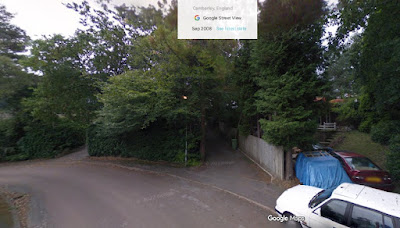
In 1965, my father discovered for sale an empty plot of land on the other side of Camberley that might be purchased at a discount. The owner of one of Camberley’s huge Edwardian mansions, ‘Old Knowles’ on Upper Chobham Road, had divided the far reaches of their estate into small plots, each sufficient for one family house to be built. However, ‘Plot 7’ remained unsold due to its odd shape and access problems. A new ‘Calvin Close’ cul-de-sac had been constructed to reach these new properties and building work had already progressed on some sold plots. Plot 7 comprised a long narrow upward-sloping driveway, barely wide enough for a car, that ended in a flat square-ish plateau. However, for some crazy reason, the new electricity sub-station serving the street’s houses had been built at road level slap bang on the driveway, preventing any vehicle access.
I visited the plot with my parents, us having to squeeze past the sub-station’s wooden fence and clamber up to the plot. It was clear that, though Old Knowles had retained a huge perfectly manicured rear garden, the plots up for sale beyond had been left as wilderness for years. It was a jungle. My parents were unaware that this land had once held an industrial gravel pit. Each plot had apparently been drawn on a map without consideration about what might be on or under the ground. In Plot 7, we found the end of an old concrete ornamental pond, though its substantive part stretched onto an adjacent plot. There was no back fence to the big house (the right-hand edge of Plot 7), just a line of thick high rhododendrons that you could push through, tempting you to march across their perfect garden.
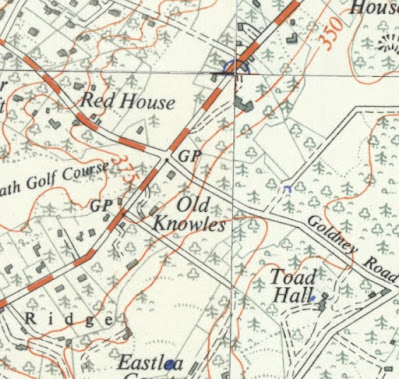
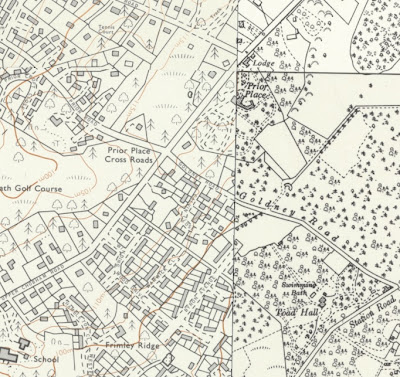
The rear of the plot was marked by an ancient sunken alleyway wide enough for a horse and cart, the dug-out soil having been piled up on either side and planted with thick bushes that grew into a canopy of foliage, making the path invisible from beyond. It stretched in a perfect straight line southeast from Upper Chobham Road 600 yards to a neighbouring estate, ‘Toad Hall’ (formerly ‘Edgemoor’), and then diverted with a 90-degree turn southwest to ‘Eastlea Court’ estate (formerly ‘The Firs’) on Chobham Road. Perhaps this overlarge ditch had marked the western limit of the 300 acres of heathland purchased in 1860 by Swiss botanist Augustus Mongredien to build a silk farm named ‘Heatherside’ that soon failed, the land defaulting to mortgage lender Sir Gabriel Goldney of Chippenham. A century later, ‘Goldney Road’ was the unmade, potholed rough access road necessary to enter our cul-de-sec and the new Heatherside housing development beyond, then under construction by housebuilder Bovis that had acquired most of Goldney’s land.
I failed to understand how the wilderness of Plot 7 could be transformed into a home for our family. It was full of insects, spiders and creepy-crawlies that terrified me. For the next two years, I elected to spend weekends at home alone [see blog] whilst my parents spent every daylight hour at Plot 7 to clear the site and house build. My father petitioned the Electricity Board to relocate its problematic sub-station to adjacent land not yet built upon and, following a long wait, his request was approved and executed, allowing vehicles to reach the site for the first time. My father made a sign on a sample floor tile saying ‘Plot 7’ in white Letraset and nailed it to the fir tree on the left of the driveway at street level. To save money, my parents did as much of the building work as they could, employing specialists only for tasks that needed heavy equipment or trade skills.
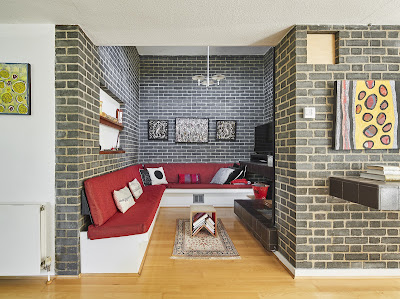
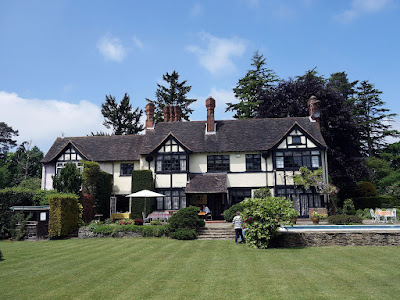
My father was an admirer of American architect Frank Lloyd Wright’s modernist buildings and seized the opportunity to build a similarly novel property in Camberley. Having executed so many renovations and extensions for clients, this would be his first opportunity to design an entire house to his own specifications. Perhaps he was inspired by a photo-feature in his beloved ‘Architects Journal’ of the 1959 ‘Rossdale House’ on Hendon Road in London, since many of its features were replicated in our home – a carport instead of a garage, exposed dark purple brickwork inside and out, floor-to-ceiling glass sliding doors, an adjoining pond/pool and a white oval dining table and chairs (as seen in ‘2001’). Though the London house comprised two storeys built on stilts, ours was limited to one floor by the land deeds, the owners of stately Old Knowles not wishing to look out their back windows and sight the top of our modest home beyond their perfectly kept garden.
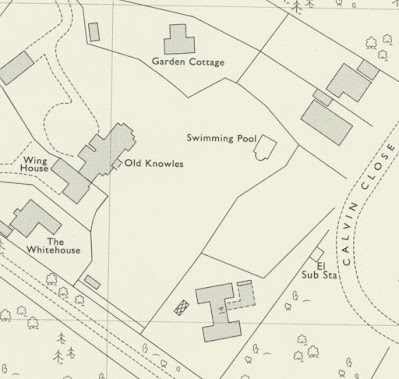
My father designed his house in the shape of the letter ‘H’, the right sidebar comprising three bedrooms, the left a long, open living/dining room and, within the crossbar, the kitchen, bathroom, WC, coat cupboard and heating/hot water system. The majority of the ‘walls’ were floor-to-ceiling glass, enabling sightlines from outside straight through both wings of the house. The roof was flat concrete, supported by the bare brickwork between the glass windows. The bathroom included a separate bath and enclosed shower cubical, unusual in that era. The bathroom mirror was a huge sheet of thin aluminium foil stretched over a frame ordered from the US. Instead of a letterbox in the front door, there was an American-style upright post-box on the wall alongside the two-vehicle carport, much to the confusion of postmen/women who had walked up our long driveway. Instead of a front door key, embedded in the wood was a press-button combination lock ordered from the US. Opening the front door from outside, you were confronted with a huge floor-to-ceiling clear Perspex window that overlooked an exterior pond at the rear. The heating system was underfloor gas air, also ordered from the US. The living room thermostat was manufactured by Honeywell, ordered from the US. The kitchen sink included a waste disposal unit, ordered from the US. In the garden was constructed a greenhouse that resembled the top half of a clear glass sphere.

The house was initially designed to be completely open-plan, with internal doors only for the bedrooms, bathroom and WC. However, British building regulations necessitated the addition of fire doors to separate the kitchen from the bedrooms, as well as from the living/dining room. Frustrated by these rules, my father installed a ridiculously expensive kitchen door constructed entirely of thick, frosted glass, an unnecessary appendage that we never closed in all the time we lived there. Essentially, my father had built a ‘showhouse’, permitting his potential architectural clients to view a real-world example of futuristic living that might have been commonplace in California but was rarely seen in suburban Surrey. I loved living in the house, though its purpose echoed the earlier building of the Rossdale House as a marketing exercise for architect Geoffry Powell’s practice ‘Chamberlain, Powell & Bon’.

Our new futuristic home was not without its problems. The mostly glass exterior made birds believe they could fly at speed straight through the house during daylight, only to ‘thud’ against the glass window and be found dead, requiring regular burials in our garden. Leaving a glass sliding door open meant the occasional squirrel would enter, then panic and race around the floor inside the house, banging against the glass windows until we could usher it back outside. The deafening roar of low-flying test flights by Concorde from nearby Farnborough Royal Aircraft Establishment would rattle the huge glass windows, worrying us they might shatter. At night, our house lights would attract foxes, whose two red eyes would appear out of the darkness at a living room window, staring at us sat within like a horror movie. My mother purchased yards of thick, olive-green patterned material from Liberty that I helped her measure, cut, line, pleat, add curtain heading tape and hang in front of the eight expanses of glass window. The house being located some distance from the road, it felt as if we were living in countryside since neighbouring properties were not visible from our windows, a major change from our previous home fronting a bus route near Camberley town centre.

The red standalone enamel hooded fireplace mounted on a large inch-thick black slate square in the living room looked impressive but, when there was the slightest wind outside, smoke from a lit fire would blow back down the iron chimney and fill the living room. In summer, sunlight on the glass windows heated up the rooms terribly, particularly when the house was closed up. Conversely, in winter, the absence of insulation and the bare brickwork made the house cold, particularly the bedrooms that all faced northwards, while the open-plan design made it impossible to retain heat in one part of the house. Only a few years later (after my father had left), the heating system failed completely and, despite my repair efforts [see blog], we lived in an unheated house for years thereafter. The house’s legacy was that much of its equipment purchased from the United States could not be serviced or repaired in Britain, rendering those amenities defunct.

The inspiration for our home unexpectedly appeared in my music listening. Having bought the Simon & Garfunkel album ‘Bridge Over Troubled Water’ in 1970 from ‘Dykes’ record shop in Camberley [see blog], I was surprised to hear the Paul Simon composition ‘So Long, Frank Lloyd Wright’ dedicated to this American architect who had died in 1959. My father had regularly shown me articles about Wright in architectural magazines and glossy American coffee-table books bought on trips to London, filled with his modernist building designs. In distant Camberley, it turned out he was not the only one inspired by Wright:

“Architects may come and architects may go
And never change your point of view.
When I run dry
I stop awhile and think of you.”

During the first years in our new home, I was given new responsibilities. My father insisted I regularly clean his preposterous American sports car in and out, afterwards spending hours polishing its bodywork inch by inch, a task I really hated. I was charged with mowing the grass lawns on three flanks of the house with a newfangled ‘Flymo’ lawnmower (‘It’s a lot less bovver with a hover’), after my mother’s attempt nearly electrocuted her when she rolled over and sliced its electric cable. For some reason, I was also the one who had to light the living room fireplace in winter, struggling with matches, firelighters and bits of damp wood. After initially continuing to share a bedroom with my younger brother, one year later my parents moved me into the house’s third bedroom, the first time I had occupied a room of my own. Despite the unwelcomed isolation from friends and my much-loved maternal grandparents, life proved enjoyable.

This stasis did not last long. My parents had spent two years building their ‘dream home’ and then four years living in it when my father deserted his wife and children [see blog]. My mother was left with a millstone property, raising alone three children in a now unheated home that she could ill afford to maintain or repair. Her dream had become a nightmare. Each of the house’s five sets of glass sliding doors were locked with a key, one each of which my father kept. The front door could only be opened with a number combination which my father knew. Securing the house from my newly vengeful father proved impossible. When we were all out, he would walk in and steal whatever he wanted, including parts of my precious vinyl record collection for which I would never forgive him [see blog]. Every summer, my mother’s sister Pam would generously pay for our one-parent family to stay somewhere in Britain, but I would never again accompany my mother and two siblings on holiday as I had to stay home alone to guard it from my father [see blog].

The most immediate impact of my father’s departure was my education. Three years earlier, when my parents decided to send me to a secondary school the other end of the county [see blog], they had promised to give me a lift every school day to Camberley railway station to catch the 8.10 train. Arriving back at Camberley station at 5pm, I would walk to my father’s town centre office and cadge a lift home. That was then. Now that my parents’ promise was in tatters, I had to be the first to rise at 6.30, make breakfast, then walk out to the Prior Road bus stop just after 7 to catch the irregular bus to the town centre and await the 8.10 train. Now, arriving back in Camberley at 5pm meant a wait until 5.40 for the next 39B bus that would deliver me home after 6. Outside of winter, if the weather was fine and I was not carrying too many books, I would choose to walk the two miles home, though it meant a trudge to the top of Church Hill, down Crawley Hill, across the M3 interchange, a walk up Prior Road, then finally down Goldney Road. I could arrive home shortly before 6, but often exhausted.

To avoid such long days, I asked my mother to sign a letter I had typed to my school, asking if I could be let out ten minutes early at the end of the day, as I could arrive home a full hour earlier by catching the 4pm train from Egham. The school reluctantly agreed though, in practice, it proved impossible to enact because teachers of the final afternoon lesson set the day’s homework during their final minutes, to be handed in the following day. It was Hobson’s Choice: get home early or fail my homework. The school office had already become suspicious of my home circumstances. At the end of one term, my regular school report booklet failed to arrive home by post. On enquiring, I was informed that my father had phoned, asking for it to be sent to his new address. I had to explain repeatedly that I did not live with my father and that he took no interest in my life, before I could persuade staff reluctantly to change back the address. How could I admit that most of my father’s stories were lies?

There were reasons for needing to reach home from school at a sensible hour, none of which I wanted to explain to my school. Every weekday, teachers set two subjects of homework that had to be submitted the next school day. They seemed to imagine students reached home within minutes after the school bell, joined their family for formal dinner, then one or other of their parents helped them complete their schoolwork. In my case, nothing could be further from the reality. Neither of my parents ever assisted with my homework because they lacked the knowledge or skills. Instead, once I reached home, my most urgent ‘home work’ now was to administer my mother’s perilous circumstances.

I had multiple uncharted waters to navigate. Our mortgage lender. The municipality’s property ‘rates’. Southern Water. Southern Gas. Southern Electricity. The Post Office telephone service. Buildings insurance. Contents insurance. Car insurance. Service contracts. Inland Revenue. Midland Bank. Until then, all household bills had been paid by my father. I had to contact these agencies by typing letters in my mother’s name and setting up new payment plans, urgently where outstanding balances had accrued due to my father’s abrupt cancellations. I had to field regular ‘red reminders’ and threatening court summonses. Once my mother had signed this correspondence, I would carry it to school and post it in my lunch hour at Egham Post Office. I created a set of labelled folders at home to track all the documents, filing carbon copies of letters I had typed (rediscovered intact four decades later during house clearance following my mother’s death).

At the same time, I had to respond to my father’s resort to the legal system to harass us. He filed a case for regular access to his one-year-old daughter, despite having tried to prevent her birth and never having shown an interest in the upbringing of his children. Farnham Court ordered my mother to permit him to take my sister one weekend a month, seemingly oblivious that neither he nor his teenage mistress knew the slightest about baby care. Those weekends were particularly fraught in our home when my mother would fret terribly that her husband might disappear with her daughter merely to spite her. Eventually, my father bored of this antagonistic routine, spurning further contact with his daughter for the remainder of his life.

I now diverted my school lunchtimes to the upstairs reference section of Egham public library, reading dusty law books to understand our family’s rights in the face of my father’s legal onslaught. He was well aware that he had left my mother without sufficient funds to fight his actions, requiring me to fill out forms for ‘Legal Aid’ and attach the requisite proof of our dire financial situation. I had to apply to Surrey County Council to support my education, most urgently for the expensive termly railway season ticket necessary for travel to school, as well as subsidies to buy my school uniform and entitlement to free school meals [see blog]. Until my mother could find employment, having not worked since my sister’s birth the previous year, I had to apply for social security benefits from the government DHSS agency. My mother’s change of status proved difficult to document when we were unaware of my father’s new address as he had ended direct communication with us.

To represent her in court, my mother hired local solicitor Neale Turk whose office on Kings Ride had recently opened. I accompanied her to their initial meeting and explained our family’s situation with reference to the legal statutes I had read and photocopied at Egham library. While my mother would attend follow-up meetings, she said Turk instructed her not to invite me again. Unfortunately, my mother’s outcomes from a succession of Farnham court appearances, none of which I was permitted to attend, proved not particularly positive. Only later did we discover that my father had at some time been a client of Turk. Mmmmm.

Court orders requiring my father to make maintenance payments to my mother for her and his children were ignored. It was left to me to phone the Clerk to Farnham court from home once a fortnight to ask why we had still not received his overdue funds, me having to fib to the school that I had some medical or dental appointment. I heard every excuse under the sun relayed by the Clerk. Eventually, once my father’s arrears had accumulated to astronomical amounts, he disappeared. He never did pay what he owed us. Only later did we discover he was an illegal immigrant in the United States, the place he had sought to emulate so much in his architectural work [see blog].
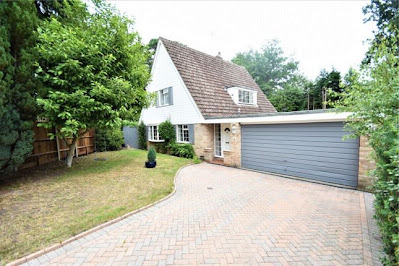
Before he fled, his design legacy was left for all to see on Calvin Close, not only in our house but also at the far end of the cul-de-sac. His ‘showhouse’ had brought him a commission to design a group of identical houses around the bottom of our road. Quite how the municipal planning committee approved his plans I never fathomed, as they were designed in the style of Swiss chalets with steep pitched roofs, completely out of character with surrounding homes. Whenever I happened to pass them, I felt ashamed of my association. Decades later, most of those monstrosities were demolished and replaced with orthodox houses. 

In 2004, visiting my mother in the tiny house she now occupied in a town near Camberley, she showed me estate agent sale particulars for a property about which she had enquired, having seen it advertised in the local paper. It was our former home in Calvin Close. She told me she was thinking of arranging a viewing. I was horrified. No no no! Even after all the terrible things that had happened in her life, she still imagined she could resume her ‘happy family’ years between 1968 and 1972 by living in that house again. Mercifully, the £340,000 price tag was way beyond her means. I never did find out if she ignored my pleas to stay well away.
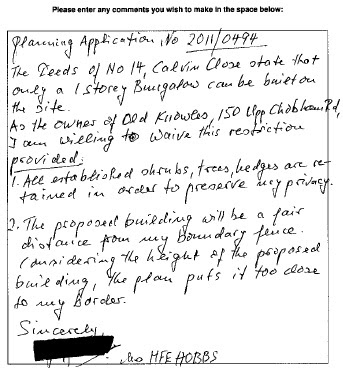
My parents’ now rather post-modern home was demolished after planning permission was approved in 2011 for a conventional, two-storey house to replace it. Their decision not to emigrate to Canada had had disastrous consequences. Their dream of a ‘new start’ there had turned to dust: my father an illegal immigrant on the run and my mother impoverished for the remainder of her life.

[to be continued…]

POSTSCRIPT:
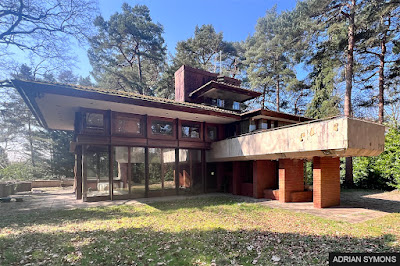
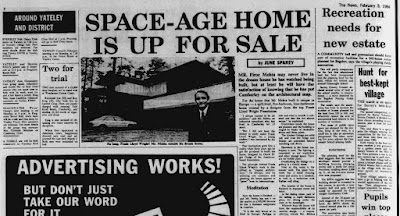
Nearly two decades after our Calvin Close house had been built, another Frank Lloyd Wright-inspired house was constructed in Camberley at 11 Crawley Hill, an address I had walked past hundreds of times on my way home from school via the railway station. Built between 1981 and 1984, initially named ‘Rhododendron’ but later renamed ‘Betterwords’, it was designed by architect David Elgin Dodge (of the American ‘Dodge’ car dynasty) for owner Firoz Mehta, an “industrial consultant” who had lived in Camberley since 1972 and “had always wanted to be an architect”. By remarkable coincidence, in late 1985 I happened to work briefly in this house and experienced an eerie familiarity with my childhood home that, by then, had been consigned to memory. This later property attracted considerable press coverage for its retro-1960’s stylings (“It is the only house of its kind in Europe”, Mehta proudly told ‘The Camberley News’), including in the national ‘Daily Telegraph’. It now apparently fulfils three Surrey Heath Borough Council criteria that make it a “significance of heritage asset”, whereas my father’s genuine contemporary 1960’s modernist design, built one mile away, had attracted zero public attention … perhaps because he had not been a ‘real’ architect [see blog].
[Originally published at https://peoplelikeyoudontworkinradio.blogspot.com/2026/09/the-day-my-world-stood-still-part-three.html ]
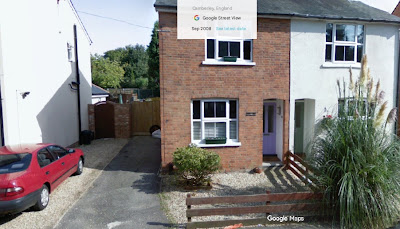
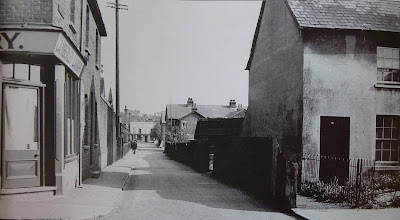
The day my world stood still [part two] : 7 October 1971 : Kings Ride, Camberley

 Had I been born a century earlier, I suspect my parents would have bundled me off to climb up the insides of neighbourhood chimneys for a few farthings. Things then would have turned out much worse for me, as my mother’s guidance for childrearing was apparently forged by her half-dozen visits accompanying me to 1964’s ‘Mary Poppins’ at the Camberley Odeon. As Julie Andrews had seen nothing immoral about grubby children being pressganged into Dick van Dyke’s happy posse of sweeps, the film seemed to convince my mother that offspring were meant to be seen (working) rather than heard (playing).

Some kids embark upon a paper round once they have learnt to ride a bike. Others help out in the neighbourhood shop for pocket money. Visiting a mini-mart to pay your newspaper bill, you would rightly be surprised to find a child of single-digit age and less than three feet tall stocking shelves. Apparently not my parents! As soon as I could walk, my father was taking me with him in his ostentatious American car to survey local properties whose owners required renovations or extensions. Initially I was charged with holding the end of his long roll-out, wind-up tape measure at the far end of large rooms [see blog]. Before long, I was sketching out on paper the floorplan of buildings and noting their dimensions. Later on, I was calculating floor areas using the long multiplication my father had evidently failed to pay attention to before quitting his education aged fourteen from a Dickensian school he would show me on School Lane, just along from Ron Francis’ long-time photographic studio.

Thanks to an apprenticeship and ‘night school’, my father became a qualified quantity surveyor who passed as an architect by appending ‘AFS ARIBA’ to his name on business cards printed by Southwell Press [see blog]. In his school-hut office in the back garden behind our garage, my first administrative task was to maintain his professional periodicals such as ‘Architects Journal’ in strict date order. Soon he would teach me how to transfer Letraset from large sheets onto architectural drawings. I could calculate the relevant scale for plonking images of furniture, white goods and American-styled human figures onto the tracing paper plans masking-taped to his drawing board. If we did not have the necessary sheet, I would locate it within the huge, well-thumbed ring-bound Letraset catalogue and my father would then walk down to ‘Camberley Stationers’ on the High Street to buy it on account.

Whilst my father was self-employed at home, my mother worked as bookkeeper for a local garage 290 yards away that serviced vehicles, hired out a fleet of coaches and owned the town’s only petrol station on the busy A30 London Road. She would regularly bring her wide accounts ledgers home, set them out on our kitchen table alongside a paper-roll adding machine and require my services to help ‘balance the books’ and calculate the weekly payroll [see blog]. At my school, some classmates were still struggling with basic addition whilst I was already adept at calculating Income Tax and National Insurance deductions for a local company’s workforce.

After leaving school at sixteen without a Certificate, my mother had enrolled for some kind of local secretarial course which led to our home having a manual typewriter and shorthand texts. I taught myself to type and was soon faster and more accurate than my mother. If my parents had to fill out a form, I would type it for them. After my brother was born, his name had to be added to their passports alongside mine, so I typed the application form to be mailed to the Passport Office in Little Venice. When the passports were returned, I was so proud to see that the civil servants had merely cut out the paper on which I had typed my brother’s details and glued it onto a spare page. My handiwork!

Without realising what was happening, I became our family’s ‘administrator’ merely because I excelled at reading, writing and arithmetic. When there were Christmas cards to send to my father’s clients, it was my job to write addresses on dozens of envelopes. When there were letters to be sent to the Council, Inland Revenue or DHSS, I was tasked with typing them and their respective envelopes. After my parents gave me a ‘Kodak Instamatic 126’ camera for my birthday in 1964, I also became the family’s photographer, carefully sticking hundreds of square pics in a photo album and labelling them with precise dates, locations and names. (Decades later, my brother stole this treasured album from our mother’s home before emigrating [see blog], leaving me now without a single family photo, despite having been our family’s only photographer then.)

If I had been a teenager when pressganged into this family work, perhaps I could be accused of some collusion. But I was still under ten years old when all this happened. Other kids in my class went home to spend evenings playing worry-free games in their back gardens, while I returned home to yet another round of administrative tasks. My cleverness was being mercilessly exploited by two un-clever parents who had left school without an examination pass between them. I had no idea why I was clever. I often wondered whether I was truly the offspring of the adults I was being forced to live with. Had I been swapped, accidentally or deliberately, at birth? However, my birth certificate said I had been born at home. How was my DNA related to theirs? During my early years, I had a mop of blonde hair. But neither parent was blonde. I had blue eyes. But neither of my parents had blue eyes. Having watched 1960’s American sci-fi series screened on British television, I even pondered whether aliens had planted me with this suburban family. Was I the boy who fell to earth?

As the years progressed, my parents’ grip over my life tightened. At age eleven, having passed the compulsory ‘Eleven Plus’ exam, I was entitled to join the one grammar school in Camberley, adjacent to the infant/junior school I had attended for six years. Instead, my parents chose to send me to a grammar school twelve miles away at the opposite end of the county, the outcome of my father’s desire to impress a potential business partner [see blog]. I was not even consulted for my opinion before being condemned to spend hours travelling on public transport for the next seven years. I would never again see my many junior school friends.

After my father switched to renting a town centre office, I was additionally charged with calculating, typing and sending out client invoices, statements and reminders on his newly purchased ‘IBM 72’ electric typewriter. I was also required to spend days making photocopies and dyeline prints for my fathers’ clients in a darkened unventilated room, damaging my health irreparably [see blog]. When my father diversified into property speculation with a new business partner, my expertise in maths was required to figure out the potential profits of buying local businesses and redeveloping them with blocks of flats [see blog]. Though not yet a teenager, my calculations would determine whether projects worth millions could prove viable for my father’s latest business, which I had been required to name (‘IMIC Properties Limited’) even though I was still too young to be one of its directors. It was crazy.

The upside of all this work for my ‘family business’ was that, once their tasks were completed, my parents left me alone to pursue my own interests without interference. My mother could not be bothered to divert to Camberley’s only Post Office at the far end of the London Road from the town centre so, while she shopped, I would walk there and cash her fortnightly ‘Family Allowance’ vouchers from the booklet sent by the government. The postal staff knew me by sight because, from the time I could barely peer over their counter, I had been sending and receiving many more letters than my parents. My ‘pocket money’ comprised this useful cash that my mother would let me keep.

During childhood, I developed a wide range of interests that I maintained … until the fateful day in 1972 when my father deserted his family and abandoned his three children, leaving us to grow up in chaotic deprivation [see blog]. After that, I had neither the time nor the money to pursue anything beyond day-to-day survival. After that, I lived an even more isolated existence away from friends and extended family. These unwelcomed losses were initiated in 1968 when my parents relocated to a new housing estate on the edge of town. I was now three miles from my grandparents who, having lived next door almost my entire life, had generously provided the childrearing skills to which my parents seemed oblivious. I was now three miles away from the neighbourhood kids on our street with whom I had played regularly on the roads leading to Barossa Common [see blog]. I was now three miles away from the junior school I would attend for one further year which, until then, had been a short solo ride away on buses 1, 2 or 3c of the Aldershot & District Traction Company Limited. I now had no friends living within miles. I needed a lift to get to school.

In our home on Kings Ride, my parents had bought me a metal full-size pedal-powered go-kart with a handbrake that could travel so fast that it would have proven dangerous to meet a pedestrian on our narrow pavements. Instead, I would drive it along the road outside our house when there was little traffic around, pursued by my neighbourhood mates on their bikes. Sometimes a double decker bus would unexpectedly pass in the opposite direction and you could see the passengers stare out its windows in disbelief. My parents never told me not to play in the traffic and not once was I stopped or told off by passing adults.

My earliest hobby was ten-pin bowling. My parents’ plan since their marriage was to emigrate to Canada, despite knowing nobody there nor having visited the country [see blog]. That was the reason my brother and I were given what they believed were common North American names. That was why my father taught himself to ice skate by practising surreptitiously each winter on the frozen lake of the Sandhurst Royal Military Academy. That was why, every Saturday morning, my parents drove to the nearest bowling alley in Wokingham to practice, accompanied by me. I was tall for my age and soon became sufficiently accomplished to be asked to join Wokingham’s junior bowling team. Every Saturday morning, I would don my team bowling shirt and either compete at Wokingham or our team would be driven from there by coach to an away match at Heathrow, Brighton or one of the few towns that had a bowling alley. One birthday, my parents bought me my own bowling ball with my name engraved next to the finger holes and a ‘mod’ black and white bowling bag in which to carry it.

I became a manic stamp collector, initially steaming off the stamps on my family’s incoming mail and later visiting the regular Stampex exhibition in the Central Hall at Westminster. My weekly visits to the local library were useful to consult the Stanley Gibbons stamp catalogues in the reference section upstairs. Before long, I had saved enough pocket money to buy my own copies, along with a special stamp album that had spaces to mount every British stamp ever issued. I would write to a stamp dealer in Much Wenlock, enclosing a Postal Order bought from the Post Office to purchase all sorts of strange and wonderful stamps from countries around the world. Every occasion a new set of commemorative stamps was issued, I would traipse down to the Post Office, stick them on the associated special envelope and send it to myself as a ‘First Day Cover’. I even saved up to buy Britain’s first stamp, the 1840 ‘Penny Black’.

My maternal grandfather had sown the seeds of my fascination with the radio medium. I loved listening to music radio stations and discovered I could hear stations from all over Europe on an ordinary portable radio. In my early years, I would comb my parents’ and grandparents’ daily newspapers for any stories about radio, cut them out and stick them in a series of scrapbooks I maintained. Then I would enter every competition I heard announced on radio and, as my knowledge of popular music was good, send in postcard entries. I won quite a few contests on ‘BBC Radio London’ after it opened in 1970, usually with prizes of vinyl albums (such as the debut of the amazing group Batti Mamzelle). Despite my dozens of entries, I never won anything from national ‘BBC Radio One’ after its launch in 1967. However, I did win some albums (including ‘King Tubby Meets The Upsetter At The Grass Roots Of Dub’) from Tommy Vance’s Saturday ‘TV On Reggae’ show with Raymondo (alias Ray Edwards) on London’s ‘Capital Radio’ in the early 70’s. 

I badgered my parents into buying me a Trio 9R59DS radio receiver so I could listen to more radio stations from further away on the shortwave band. Due to my fear of heights, I persuaded schoolfriend Jeremy Mitchell to climb trees at each end of our garden to hang as an antenna a long piece of copper wire I had bought from my grandfather in the ironmonger shop ‘Dolton Bournes & Dolton’ on the High Street, his workplace following the closure of Camberley’s timber yards [see blog]. I bought the thick annual ‘World Radio & Television Handbook’ so that I could find the address of every radio station I heard in order to write to them. I was sending off dozens of letters a month and receiving all sorts of packages in return – programme schedules, postcards, badges, playlists, magazines, books and pennants. The postman often was carrying so much mail to deliver to me alone that he would knock on our front door rather than try and fit it all in our wall-mounted post-box.

I subscribed to monthly Roneo-ed newsletters that shared information about distant radio stations that could be heard and I would send the editors my lists for publication of new ones I had heard recently. I even travelled by train on my own to a meeting organised by some of these radio fans (‘DX-ers’) held in Reading one weekend but, sat amongst men who were twice and three times my age, I was too intimidated to utter a word. However, my listening taught me to identify languages from around the world and to understand the geography of continents. I can still recall the names of many of the oddball radio stations I heard, such as Austria’s ‘Der Schulungssender des Österreichischen Bundesheeres’ on 6221kHz. I think this global knowledge was the reason I managed an ‘A’ grade for my Geography O-level. It also gave me motivation to one day visit some of the faraway places whose radio I had listened to and whose citizens I had corresponded with.

As well as being an enthusiastic radio listener, I was also interested in the technical aspects of the medium. One Christmas in the 1960’s, I asked my parents for a junior home electronic kit that taught me about resistors, capacitors, circuit boards and to build basic projects. A few years later, I would accompany my aforementioned school friend Jeremy on trips to ancient Edgware Road shops to buy second-hand electronic parts so that we could build our own valve-powered radio transmitter to launch an AM pirate radio station. We possessed some suitable circuit diagrams from hobby magazines and were inspired by weekend London pirate stations we had heard.

Starting with technical books held in the upstairs reference section of Camberley library, I studied the theories of how radio transmitters, receivers and antennas functioned and their practical applications. This led me to a correspondence course to take the ‘RAE’ radio amateur examination that would allow me to communicate on the airwaves with other radio ‘hams’. For a small charge, I was mailed study notes by post, learnt them, wrote answers to a set of questions and sent them back. If my responses were correct, I would be mailed the next unit of the course. It could be a rather laborious process at times, but there was nowhere locally I could undertake the necessary training to take this exam.

One of my less technical interests was launching helium-filled balloons from our back garden, attached to postcards asking the finder to write to me with the location it had landed. Most of these efforts disappeared without a trace but occasionally I would receive a card from somewhere in West Europe that one had reached, a few of whom I started writing to regularly as pen pals. I think it reflected my early notion that there must be a bigger world out there beyond the suburban town where my mother’s family had lived for generations. It was a symptom of my alienation from my parents and the quest for an existence that promised more than small-town living. I already felt I did not belong there and I was seeking somewhere else where I might feel more at home (“going where the weather suits my clothes”).

One of the properties my father had insisted I help him measure to prepare for some rebuilding work was the future Lakeside Country Club in Frimley Green to be launched in 1971. We met its owner, musician Bob Potter, to whom I explained my interest in learning music studio production. He also ran the Bob Potter Studio in nearby Mytchett and invited me to attend a forthcoming recording session there by jazz duo John Dankworth and Cleo Laine whom I had seen on television. Although I was not (yet) a fan of jazz, this seemed to be a great opportunity to understand the basics of music recording techniques. I enthusiastically accepted the invitation and looked forward to that visit.

I was a regular customer of the large toy shop on Princess Street where I saved up to buy Airfix plastic model kits and multiple little pots of Humbrol paint, taking them home to assemble whilst trying not to glue my fingers together. Aircraft models appealed most, perhaps because my parents occasionally took me to Heathrow Airport on weekends to stand on the open observation platform of the new Queen’s Building with a free map showing airline logos so that we could identify planes taking off and landing. I built and carefully painted a Fokker DR1, Harrier ‘Jump Jet’ and Gloster Whittle, adding the transfer markings provided with each kit. I was yet to travel on a plane so aircraft seemed exciting and other-worldly.

I had started buying soul and reggae records in 1969, initially from Dykes record shop on the corner of Park Street and Princess Street where a line of soundproofed listening booths along the right-hand wall permitted visitors to request from the shop assistant an audio preview of a single or album before deciding whether to purchase it. Within a few years, I was making Saturday solo trips to London to buy imported soul records unavailable in Camberley from Contempo Records on Hanway Street and imported reggae from the many stalls in and around Granville Arcade in Brixton [see blog]. Though my termly green cardboard train season ticket to commute to school only reached as far east as Egham [see blog], I would continue on the same line to Waterloo station, flash my pass hurriedly at the gate and then only have to pay the minimal Tube fares to travel around London. Sometimes I might go further to visit the many reggae shops in Harlesden or to Lord Koos’ outlet for hard-to-find releases.

In early 1972, My father impulsively booked a holiday in Jamaica for our whole family so I made plans to explore its reggae haunts I knew about while the rest of them would be lounging on the beach [see blog]. We had recently visited Spain for a short family holiday which had proven an unmitigated disaster [see blog] so I considered it more productive for me to set personal objectives to achieve on this holiday, putting as much distance as possible between me and my troublesome father.

A significant reason I had developed so many interests was because, throughout my years at infant and junior schools, no classmates lived anywhere near our home. As the eldest child, neither did I have siblings with whom to play. Then, for two years, my parents spent every weekend on the plot of land the opposite side of town where they were building their dream house. They took my younger brother with them but always left me at home alone the entire weekend. I was never bored as I had developed so many interests that I could pursue. I was perfectly happy in my own company, particularly as my parents demonstrated little interest in me even when they were present. If I wanted interaction, I would go next door and play dominoes for hours with my grandfather on his wooden dining table, notching up our scores with matchsticks on his ancient cribbage board.

Two subsequent events ruined this equilibrium in which I had existed during my early years. Firstly, the move to our new house on the edge of town two miles from Camberley town centre. Until then, I had been only a short unaccompanied walk away from the shops, municipal library and railway station. Now I needed a lift from my parents because the two bus routes 39b and 34a from our new location ran only hourly and two-hourly respectively during peak times. Neither was there a single shop near our new home.

Secondly, my father’s departure four years later left my mother without a car [see blog] or the resources initially to buy one. The impact was two-fold: I was stranded on an outlying housing estate without transport; and the money to support my interests was no longer available. I still visited the Post Office, though less regularly than before, as it was now three miles away instead of a brisk walk. I would cash the Family Allowance vouchers there but now the money had to be passed to my mother to support us because my father was deliberately denying his family any financial help.

It was not just the lack of money that changed my life going forward. Having unexpectedly had additional responsibilities as our family’s ‘eldest child’ thrust upon me, I could no longer find sufficient hours in the day to pursue my own interests. Until then, I had spent most of my childhood in my own company whilst my siblings were under the eye of one or other of my parents. From now on, because my mother was at work every weekday from morning ‘til night, I was left with my younger brother and sister whenever I was home from school. I had become the family babysitter, supervising a nine-year old and one-year old for hours on end. This was not how I had anticipated my teenage years would be spent from age thirteen to eighteen.

There was no gradual change in my life. In the weeks before my father left us, I was still busy with my own interests. Then, suddenly, everything had to be dropped. My go-kart was never used again. My bowling ball remained in its 1960’s two-tone bag to this day, kept as a reminder of a now distant past when I once scored over 200 in a competition game. I was not given the chance to say farewell to my bowling team friends because I never returned to Wokingham bowling alley. My various stamp albums were placed in a large plastic shopping bag, never to be examined again. My plans to build a radio transmitter with school friend Jeremy came to nothing, as did our electronics buying trips to Edgware Road. Although I was close to completing the radio amateur correspondence course, I abruptly ended the monthly correspondence because now I would never have been able to afford the equipment even if I gained a licence.

Correspondence with overseas pen pals came to a sudden halt due to my lack of time. Bob Potter’s invitation to attend a recording session would never be fulfilled because my father now disowned me and was hellbent on doing everything he could to disrupt my future, despite my childhood having been spent working for his various businesses. I never again bought or assembled another Airfix model kit, let alone visited Camberley’s toy shop. Regular record-buying trips to London had to be curtailed because, without parental transport, buses from our home to the railway station were unreliable outside of weekday daytime hours. Besides, my pocket money had all but disappeared, sacrificed to more essential needs. My much-anticipated visit to Jamaica was scotched when my father changed the names on our family’s four tickets to that of his new mistress and unknown flunkies [see blog].

What activities was I left with? My radio listening continued because I already had the equipment and it was a free pastime. As a much-needed escape from my family responsibilities, at weekends I would sometimes stay up all night listening to faraway stations. I tried for months to receive a North American station on Medium Wave and my perseverance paid off during the early hours when I distinctly heard ‘CJON 930’ in St John’s, Newfoundland. Encouraged, I soon heard ‘Radio Demerara 760’ from British Guyana and ‘Radio Rebelde 670’ from Cuba. I knew even then that I wanted a career in radio.

I also continued my long running passion for music. I discovered that, instead of visiting London to buy reggae records, I could save money by writing directly to the UK record companies that issued them, claiming to be a record shop named ‘Channel One’ (copied from the recording studio I idolised in Maxfield Avenue, Kingston, Jamaica). Whereas in shops an album would cost £2.15, I could buy the same record ‘wholesale’ for a little over half that price. A typed letter and accompanying Postal Order proved sufficient to convince them to send me the desired albums, often accompanied by marketing materials, their catalogues, additional album sleeves and free promotional copies of singles. I was never asked difficult questions about my fake record shop bizarrely located on a suburban Camberley housing development.

There was no time then to think too deeply about these myriad changes to our family’s existence. We just had to cope with the way things were now. I never complained. It is only in retrospect that I understand how much of my youth was taken away from me by my parents. I never spoke to anyone at school about these changes or the responsibilities foisted upon me at such an early age. I tried to carry on as if everything was fine and that nothing significant had changed. But it had. I was no longer the youthful kid with diverse interests that I had been until now. I had been forced to become an adult though I was only just a teenager. Worse, I felt I would never have complete control over my destiny now that I was tied inextricably to my family’s immediate needs, but continuing into the longer term as well. My life had undergone significant change soon after the day in 1971 when my sister was born … a change that would unexpectedly impact my life from then on.

[to be continued…]

[Originally published at https://peoplelikeyoudontworkinradio.blogspot.com/2026/08/the-day-my-world-stood-still-part-two-7.html ]

The day my world stood still [part one] : 7 October 1971 : Speech Day, Strode’s School, Egham

 Thursdays meant a trip to the newsagent to purchase that week’s ‘New Musical Express’ and a dash back to my college room to read the issue cover-to-cover and then tackle the latest ‘NME crossword’. It was a weekly head-to-head contest between me and fellow Collingwood first-year student Keith Miller to prove our superior knowledge of popular music. I was no crossword fanatic. I had no competitive streak. However, I was sufficiently motivated to demonstrate there was one subject in which I had expertise, my university academic course and student life having quickly proven a major personal disappointment.

Both my friend Keith and I were fish out of water. We had both arrived at Durham University from state schools, me from Surrey and Keith from Essex. 95% of our fellow students had arrived from private schools and looked down their posh noses at us, just as they probably did their nannies, servants and chauffeurs [see blog]. We were invisible to them. We were not worth the time of day. They were loud, arrogant and domineering. We were the little people that they had been put on earth to lord it over. It must have proven a worse experience for Keith than for me. He appeared to be the only visible minority in our college of three hundred students. He was regularly ribbed by colleagues for having achieved a GCE certificate in ‘African Drumming’ at school.

Aside from my NME crossword years (1976-1978), I have never been a competitive person. In secondary school classes, I never shot my hand up in the air in order to prove to teachers or my mates how superior I must be. Graham Taylor, our Physical Education teacher, resented me because I had no interest in ‘winning’ at the ‘Games’ he forced upon us every Wednesday afternoon for seven years [see blog]. I tried to avoid his team sports. He once sent me to race in a Surrey County athletics championship where I demonstrated no interest in winning against other schools. My termly school reports criticised me for not participating more in class and not speaking up at the slightest opportunity. Was ‘taciturn’ an appropriate adjective for our headmaster to write about a boy whose results in many subjects were amongst the top five of his year of sixty students? Feeling under attack from such judgemental adults, I responded by engaging even less.

At the time, I failed to comprehend that my secondary school’s objective was not to turn its boy students into well rounded individuals, as experienced previously at my wonderful primary school on a Camberley council estate [see blog]. Although this grammar school operated within the state education sector, it emulated the British private school system, aiming to produce self-important ‘leaders’ who could confidently dominate any room they entered and shout loudly amongst their peers about their breeding and supposed superiority. In that endeavour, I was already a lost cause. It was not that I lacked self-confidence. One school report had even labelled me “a tower of strength”. It was just that I felt no need to wear my abilities loudly on my sleeve. Perhaps that was because my parents showed no interest in whether I performed well or badly at school. I was never called upon to show off at home that I was ‘clever’. Besides, I thought actions were supposed to speak louder than words. On that score, my term and exam results spoke for themselves. My motivation to do well came purely from inside me, not from my parents, family or peers.

At the end of my first year at Strode’s School, I was somewhat surprised to be awarded three School Prizes. As if to prove that British society was not founded on meritocracy, these book token prizes [see blog] were rarely given to students who had scored the highest examination or classwork results. Rather, they seemed to be determined by the whim of each subject teacher. This was proven by me being awarded the first-year ‘Religious Knowledge’ prize, despite having never read the Bible, having no belief in God and having attended church only once in my life [see blog]. During the first term of my second year, an event was held in the school hall to formally award boys the prizes they had won, dragging them onto the stage to receive a book token. It was called ‘Speech Day’ even though it was only the staff who made speeches. Parents were invited to watch their bright young things be acclaimed as ‘special’. That year, neither I nor my disinterested parents chose to attend.

One year later, things turned out different. I had been awarded no second-year School Prize. This outcome did not bother me. It merely confirmed my suspicion that the prize criteria were wholly subjective since my exam and classwork rankings in some subjects had improved over the previous year. Exactly how could I have achieved first place in Mathematics during the academic year but fail to be awarded that subject prize? Maybe the school was displeased with my demonstrated deficit of competitive spirit. Maybe me and my parents’ absence from last year’s ceremony had been grudgefully noted. Maybe the school had merely concluded that I was an ‘unworthy’ student as, during my remaining five years, I was awarded no prize.

The other difference that second year was that, despite my lack of prize, I attended Speech Day with my father. There was no compulsion for us to be present. I was confused that a father who took zero interest in his son’s education had unilaterally decided we both attend. I had explained to him that I was not receiving a prize that year but he remained firm. It felt very strange. This was the only occasion on which my father visited my school during my entire seven years there. He parked his ridiculously ostentatious American sports car [see blog] on the playground outside the main hall in which we sat together during a ceremony lasting several hours, me completely befuddled about why we were both there.

I had absolutely no inkling then that this one day would change the rest of my life. Not because of Speech Day. Not because of my school. Not because of me. Not even because of my father. Or even the silly car he had driven frighteningly fast and dangerously to and from the event. So what happened? The clue was in the absence of my mother that day at that event. Where was she and what was she doing?

To understand her absence, it proves necessary to go back in time thirteen years and 173 days to the occasion my mother gave birth to her first child in a semi-detached council house on the Old Dean Estate. I have no knowledge about the circumstances of that arrival because my mother refused to elucidate, except to accuse her husband of absenteeism because he was visiting a mistress due to give birth imminently to his child. Within months, my parents and their new baby were evicted for non-payment of rent, due to my father having unilaterally purchased an unaffordable car to impress his mistress. If my mother’s father had not bailed them out with accommodation, they would have become homeless.

Five years and 217 days later, my mother gave birth to her second child in Farnham Hospital, a facility Camberley (population 33,770) still lacked. During her absence, she entrusted childcare of her firstborn to her husband, despite him having never shown any paternal feelings for his offspring. Luckily, my mother’s parents now lived next door and ended up feeding and entertaining their grandson during his mother’s absence. Did her husband drive his son daily to the state infant school on Old Dean Estate he had started three months earlier, as asked? No, but he did warn his son not to admit this absenteeism to his mother when she returned a week later. Did he visit his wife in hospital? Not once. Was he busy with yet another mistress? Who knows.

Take a further leap forward in time to where my story started – Speech Day at my school in 1971 and the absence of my mother. Where was she? She was in hospital giving birth to her third child that day. My father would have done anything to avoid being alongside her in hospital, even if it meant him attending a function at my school for the first and last time. It proved convenient for him to be 21 miles and a 53-minute drive away from his wife on that day, armed with a suitably fatherly excuse, having demonstrated a sudden interest in my schooling. In retrospect, my two parents were already moving along divergent paths, that day merely widening the gulf between them and soon leading to the breakup of our now three-child family.

My mother had grown up during the War in a two-up, two-down suburban semi-detached house, sharing a bedroom with two older sisters in a loving working-class family. Together, the three children had shared homemade girly pastimes in an era before they had radio or television. They lived on a quiet residential street in a house with a large back garden, surviving the War with produce grown in their father’s well-maintained allotment at the top end of Barossa Road where he raised chickens. It had been an idyllic childhood, despite having to occasionally hide under the wooden dining table when the German bombers arrived to attack adjacent Sandhurst Royal Military Academy [see blog].

My father was raised in a household filled with anger and violence. His brutal father beat his wife and his two sons, for none of whom he ever demonstrated love or affection. He knocked his wife down the stairs which killed her. A significant part of my father’s attraction to my mother and her family was that they were everything that he was not. She had loving parents, she had attended grammar school, she was beautiful and radiated a youthful, confident optimism. He had left school at age fourteen with few prospects and was desperate to escape the hell of his parents’ home. When the couple eventually married, once my father returned from Army conscription to the Suez Canal, my mother’s father refused to attend their Registry Office ceremony, believing that his much-loved youngest daughter deserved a partner with better prospects from a less abusive family.

When my mother became pregnant the first time in 1957, she hoped to have a girl with whom she could relive all the girly activities she had enjoyed with her sisters. She was disappointed to give birth to a boy. She persevered anyway, teaching me to knit, to sew, to bake cakes in the kitchen with her and to cut out clothes patterns with pinking shears. She passed down to me her and her sisters’ 1930’s childhood books such as ‘Heidi’, ‘Black Beauty’ and ‘Anne of Green Gables’. But I showed no interest in dressing up, sculpting elaborate hair-do’s or playing with makeup. I was a disappointment. As the youngest of three sisters, she had never experienced a baby in her household. She had no idea how to raise a boy, so she left me to my own devices most of the time, failing to instruct me in personal hygiene [see blog] or the three R’s. Our home possessed few books, but I consumed cover-to-cover the huge piles of 1960’s women’s magazine titles my mother bought, teaching myself to read and write. Once old enough to walk out by myself, the nearby local municipal library in Knoll Road became my saviour [see blog].

Five years later, after my mother gave birth to another boy, her sense of disappointment was even more self-evident. She committed even less effort to raising him than she had her firstborn, allowing him to grow up barely literate or numerate. He ran away regularly from primary school, showed destructive/self-destructive, violent tendencies and barely spoke to his older brother, despite them sharing a bedroom for six years. Much later in life, he was treated for addiction and was divorced by his wife. In the words of the song [Epic EPC7632]:

“One child grows up to be somebody who just loves to learn.
Another child grows up to be somebody who just loves to burn.”

Eight years later, my mother unexpectedly became pregnant for a third time. I learned this from hearing my parents arguing at night in their bedroom adjacent to mine. My mother wanted to keep the baby, hoping finally to have the girl she had always desired (there now being an 87% chance). My father was insisting she have an abortion. The arguments became more heated. Soon my mother refused to leave the house for a week due to a huge bruise across the right side of her face. On another occasion, she locked herself in the toilet, only for her husband to kick a hole in the wooden toilet door. The door remained that way for the next decade as a visual reminder of his violent behaviour.

My mother eventually won the argument and her third child, a girl, was born whilst I was sat with my father in the school hall, enduring Speech Day presentations. He took no interest in his newly arrived daughter nor, by extension, in her mother. Approaching the age of forty, he was riding a middle-age wave of selfish indulgence, fuelled by cash profits from dodgy property deals he was making with his new business partner, a local second-hand car dealer not afraid to employ mafia-style pressure tactics [see blog]. Flush with money for the first time since leaving school, he could at last satisfy his craving for fast sports cars, dinner parties, restaurant meals and foreign holidays. He took me with him on a flimsy pretext to Florida for a week, only to abandon me alone in a motel whilst he practiced a playboy lifestyle [see blog].

Within months, after increasingly unexplained and lengthening absences, my father walked away from his family altogether to pursue the hedonistic lifestyle he had evidently desired all along [see blog]. I did not miss him because he had played almost no role in my upbringing. He no longer had to pretend publicly that he loved his family. Instead, he decided to do everything possible to cause us pain and suffering, just as his parents had done to each other, to him and his brother. He now took zero responsibility for his former family, fighting in the courts not to provide financial support. He broke into our house and stole everything of value, including the car he had given my mother and most of her jewellery [see blog]. Our lives would never be the same.

During the months leading up to his departure, my father had been regularly playing on the living room stereo a vinyl single he had bought by The Fifth Dimension called ‘One Less Bell to Answer’ [Bell BLL1137] whose lyrics included:

“I only know that since he left
My life’s so empty
Though I try to forget
It just can’t be done
Each time the doorbell rings
I still run
I don’t know how in the world
To stop thinking of him
‘Coz I still love him so
I end each day the way I start out
Crying my heart out”

Only in retrospect did I realise these words represented the pain my father had been planning for some time to inflict upon his wife. During the previous two decades, she had ignored his regular philandering. Now, having finally gained the daughter she had long desired, he was determined to make her pay. He secretly visited each of her relatives and friends to convince them that his wife had done something heinous that had forced him to leave her and their three children. Most ignored his pleas but some, notably my mother’s older sister Sheila, bought his lies and refused contact with my mother for decades [see blog]. The outcome was that my mother became isolated, lacking moral support she should have received from the people in Camberley she had known her entire life. Meanwhile, my father set up home on an affluent private estate with a runaway teenage bride who had lived only a few doors away from us [see blog].

My mother could not adjust to our changed circumstances. Until the day she died half a century later (or, more accurately, until the day my father died eight years before her), she continued to believe that her husband would one day knock on her front door and come back to her. He never did. Her father having disapproved so publicly of her marriage choice, she had tried to do everything to prove him wrong, even ignoring the mistresses my father had accumulated over many years and the unknown children he had sired. The remainder of my mother’s life was lived in a sad, darkened interregnum in which she awaited a resumption of her pre-1971 ‘happy family’ married lifestyle. It never happened.

Although her daughter was not yet one year old, my mother was forced to take two jobs to generate income to feed her family because her spiteful husband was paying nothing. Her full-time day job was as bookkeeper for British Car Auctions in Frimley. Her evening job was cleaning offices in Yorktown. Her retired parents, who stuck by her, looked after my baby sister during weekday daytimes. Year after year from that moment, all my mother seemed to do was work to try and make ends meet. Having lost her own car to her husband’s new mistress, she had to borrow her father’s 1963 Austin Cambridge car just to get to work. Fortunately, my eight-year-old brother’s school was within walking distance of our home.

Although she possessed the skills to administer her new single-parent life, the result of having previously been employed in bank and accounts offices, my mother now abdicated all responsibility for her affairs. Almost all of the mail she now received were bills, red reminders and threats of court action. Not only did she refuse to open them, she would stuff them all into a drawer in the living room, never to be retrieved. Out of sight, out of mind. Neither was this a temporary reaction to her struggling situation. Until the day she died half a century later, she refused to deal with any paperwork she received or was required to action. It was a blatant refusal to adapt to a life in which her household budgets and accounts needed to be balanced, paradoxically the very work she performed for her employer five days a week.

Not once did my mother ever ask me to take on the responsibility of managing her affairs. She could not have cared less. I realised that her strategy was irresponsible and would doubtless drive our family into disaster. Unopened letters stuffed into a drawer would inevitably lead to court actions, debt collectors and bailiffs. My mother would lose her jobs. We would lose our home. Me and my siblings would be placed into care. We would all have to change schools. Perhaps that was the exact outcome that my cruel father wanted. I was the oldest child of our family. I was clever. I had already received more formal education than any of our relatives. I was barely fourteen. By default, I had become the ‘head’ of the family, a role I had never wanted but which was now thrust upon me.

Within months of my attendance at my school’s Speech Day alongside my father, my whole world was turned upside down. My supposedly carefree teenage years and adolescence were taken away from me. I was suddenly a young adult. Never again would I observe my life as similar to that of my peers. I had responsibilities. Huge responsibilities. My own personal ambitions had to be subsumed to the struggle for mere survival of our family unit. There was nobody with whom I could share this responsibility or even explain the tasks I now had to do. My schoolfriends would never have understood. School staff were already unsympathetic towards me, having sent me home occasionally for wearing the wrong colour socks, the wrong colour shoes, slip-on’s instead of lace-ups and having hair touching my collar [see blog].

Events that took place on that one day, 7 October 1971, events over which I had no control would impact the entirety of my life. I did not realise it then. At the time, I thought I was simply doing ‘the right thing’ whilst those around me seemed hellbent on doing ‘the wrong thing’. I had no idea that a life of making small personal sacrifices as a teenager would lead to making bigger and bigger sacrifices as the years passed and end up stealing away so many opportunities to satisfy my own life.

After my father walked out and disowned his family, I could have just ignored the consequences and retreated into my own world, as my younger brother chose to do. But I was old enough and wise enough to understand the outcome of that route. Our circumstances would fall into irreparable disaster and we might all be split up and sent to children’s homes. Our mother might be imprisoned for unpaid debts. I decided to do my best to stop those disasters happening. Nobody else was there to help. It was me alone who had to try and keep us all together. So I tried.

[to be continued…]

[Originally published at https://peoplelikeyoudontworkinradio.blogspot.com/2026/08/the-day-my-world-stood-still-7-october.html ]

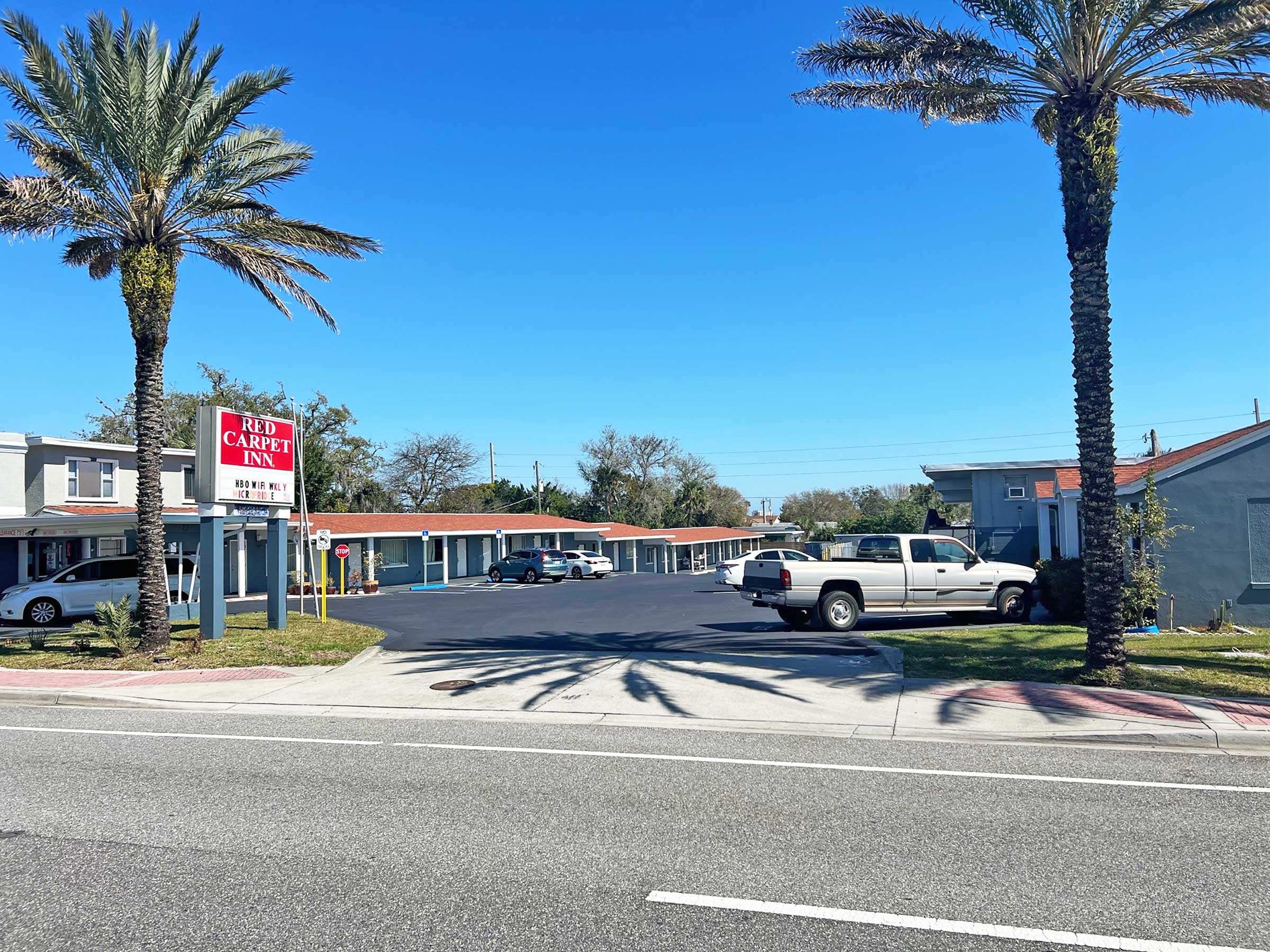
I don’t want to be like my daddy : 1972 : Red Carpet Inn, Daytona Beach & ‘Baby Sitter’ by Betty Wright

 Having answered the front door, its frame was filled by the 11pm silhouette of a large black man wearing overalls and carrying a toolbox. The only words I could discern from his Southern drawl were ‘air con’. Aha! He must have arrived to fix the air conditioning malfunction of which I had alerted the reception desk an hour earlier. He lumbered in and set to work while I continued to watch television.

“You on your own here, sir?” he asked whilst precariously balancing on a chair to grope the insides of the wall-mounted unit. Nobody had ever called me ‘sir’ before. I was a fourteen-year-old boy. He was at least three times my age.

“I am staying here with my dad,” I replied matter-of-factly. Was I meant to call him ‘sir’ too? He looked at me quizzically, seemingly not having comprehended my response. It suddenly dawned that, though Brits know American vocabulary from their TV and movies, Americans understand almost no British English.

“My father,” I clarified. “I am staying here with my father. But he has gone out this evening.”

“D’ya know when your pa gonna return, sir?” the man asked. I shook my head. I was not being coy. I did not know.

It took about a quarter-hour for the man to persuade the air conditioning to function again. Now, whenever I watch Robert De Niro fighting air ducts in ‘Brazil’, I am reminded of that maintenance man. Before he left, he kindly warned me:

“You’s be careful now, sir. And don’t you answer the door to anyone tonight as long as you is alone.”

I thanked him and continued watching television. My parents had raised me on the numerous 1960’s American shows broadcast in Britain, many of which were years old, so it was heavenly to binge on new episodes of familiar shows and those unknown to me. I had bought that week’s ‘TV Guide’ from the reception desk and was thrilled to discover shows like ‘Love American Style’ and ‘Room 222’ on ABC that made me laugh out loud, stretched out on my motel bed.

The late film that night was ‘The Magus’, a baffling watch despite the presence of Michael Caine and Anthony Quinn. Because American TV networks cut off movie credits, I had no idea that it was a critically mauled adaptation of a 1965 John Fowles novel. Back home, a female librarian at Camberley Civic Library had suggested I borrow Fowles’ 1963 debut ‘The Collector’, perhaps not realising from my height that I was only ten years old then, not a suitable age to read a harrowing account of a lonely young man kidnaping a girl and locking her in his cellar until she dies. For years after, I could not supress regular nightmares about this scenario … in which I was the young man.

A decade hence, university friend and housemate John Chandler would insist I read the paperback of ‘The Magus’. Despite the disappointment of the film, Fowles’ book proved to be riveting and not to give me nightmares. It remains one of my favourite reads, alongside another of John’s recommendations, Ursula Le Guinn’s 1974 novel ‘The Dispossessed’. I digress.

So where was my father that evening? I had no idea. He had left me in our motel room and driven away our hire car, promising to be back later. I eventually crawled into bed. He did not reappear until the next morning, offering neither explanation nor apology. As a teenage boy accustomed to parental indifference [see blog], I failed to recognise how irresponsible was his behaviour. Had the ‘Red Carpet Inn’ in Daytona Beach burnt to the ground that night with me inside, how would he have explained his decision to abandon me overnight 4,286 miles from home?

This whole father/son trip had been a bizarre undertaking from its outset. Unencumbered by prior discussion with me or my mother, he had visited a travel agency in Egham and booked a package tour to Florida for me and he alone, omitting our three other family members. My mother was understandably furious. My form tutor at school was furious as it meant me missing lessons for a week during term time and, henceforth, I was never awarded another School Prize [see blog]. Our first long-haul trip was ostensibly booked to witness the launch of the final Apollo rocket from Cape Kennedy. For years I had been a fanatic of the ‘space race’, following every event in detail and even corresponding with NASA for a primary school project. But my father was not.

Our father/son relationship could best be described as ‘business-like’. As soon as I could walk, my father had pressganged me into his one-man quantity surveyor business [see blog], me initially holding the end of his lengthy roll-out tape measure at properties, but more recently calculating returns on potential property developments [see blog]. Was this trip meant to be the reward for my decade’s unpaid service? My father had never seemed, er, fatherly to me. I do not recall him ever sitting me on his knee, holding my hand, hugging me or even reading me a book. When there was something he wanted to do that disinterested my mother, I was merely a handy substitute. Hence, despite my few years, I accompanied him to Camberley Odeon to watch ‘One Million Years B.C.’ in 1966 (aged eight), ‘2001: A Space Odyssey’ and ‘Planet of The Apes’ in 1968 (ten) and ‘Vanishing Point’ in 1971 (thirteen), the latter supported by a violent B-movie western in which a woman is stalked and raped by cowboys. Parental guidance, what’s that?

In the months between my father booking this trip and our departure, his behaviour had become more and more erratic, abandoning our family home for days on end without explanation. At the same time, he had become increasingly violent towards my mother, then caring for my months-old sister whom he had never wanted. Even though he had already indulged in purchasing a new American Motors Javelin sports car, he replaced it with an even more expensive and ostentatious two-seater ‘AMX’ model that resembled the drag racing cars he insisted on taking me to watch on weekends at nearby Blackbushe Airport. Was he experiencing some kind of mid-life crisis?

Whilst driving around Daytona Beach, I had noticed us pass a record shop which I wanted to visit. Having purchased my first soul single in 1969, I since had used pocket money to regularly buy imported American soul records from ‘Record Corner’ in Balham and ‘Contempo Records’ in Hanway Street. We stopped by the store and I bought some recent soul singles I had heard played on ‘American Forces Network’ Frankfurt, audible evenings in the UK on 873kHz AM, songs which had not yet been released at home: ‘Me and Mrs Jones’ by Billy Paul [Philadelphia International ZS7 3521], ‘One Life To Live’ by The Manhattans [Deluxe 45-139] and ‘Baby Sitter’ by Betty Wright [Alston A-4614].

After witnessing the delayed but spectacular night-time launch of Apollo 17 from the bonnet of our hire car, parked amongst hundreds of similar spectators, we caught our flight home from Melbourne airport. I felt sick and delirious that entire journey, unaware I was suffering sunstroke, my father having never considered providing me ‘sun creme’ or a hat during hours spent strolling together along the Florida shoreline for him to ogle bikini girls. Before our arrival home, he told me not to tell my mother about his unexplained overnight disappearances, our day of arrival having been the only night he had slept in his motel bed.

My silence made no difference because, only weeks later, my father left his family for good, similarly without explanation. Had the Florida trip been his clumsy way of bidding me farewell? Or had it been an experiment for him to explore a potential alternate lifestyle unencumbered by his wife and three children? Whatever it was, I did not miss him for one minute. All he had ever done was utilise my skills for his own ends. I did not shed one tear. For the previous fourteen years, he had only been present in my life when there had been some task I could do for him … rather than with him. Never had he demonstrated a genuine interest in his children.

Before he finally left, the few times he was at home, my father would play repeatedly the ‘Baby Sitter’ single we had brought back from Daytona Beach. It was a song in the Southern soul storytelling mould in which singer Betty Wright hires a teenage babysitter to look after her child, later discovering the girl has ‘stolen’ her man. The lyrics relate:

“This sixteen-year-old chick walked in

With her skirt up to her waist

She had a truckload of you-know-what

And all of it in place.”

Wright learnt the lesson after her man left:

“I should have been aware

Of the babysitter

I should have known from the junk, yeah

She was a man-getter.”

I felt it was a bit of a novelty song, nowhere near as classy as Wright’s 1971 ‘Clean Up Woman’ single [Alston A-4601] which I had purchased as an import single and loved. I had no idea why her new song seemed to resonate so strongly with my father until …

The day after my father left us, there was an unexpected knock on our front door. It was our friendly neighbour Mark Anthony who lived three houses along our cul-de-sac. He was visibly upset because his young bride had disappeared the day before without explanation. Had she contacted my mother, since we were the only family she knew on our street, the couple having only recently moved there? No, explained my mother, but my father had disappeared the same day. Oh dear! It seemed that my forty-one-year-old father had run away with Mark’s nineteen-year-old wife Suzie. She may never have been our family’s babysitter but she did resemble the girl in the song. I suddenly realised why my father had identified with its lyrics. He had abandoned us for a teenager. Was that how he had spent his nights in Florida?

During the months that followed, my father tried his utmost to destroy his family. While we were out, he would break into our home and steal as much as he could drive away of our possessions [see blog]. I lost a large number of soul records I had bought with my pocket money, many of which were irreplaceable and in which he had shown no previous interest. Amongst them was the ‘Baby Sitter’ single.

Years later, on the run from Court Orders requiring back-payment of thousands of pounds to my mother for the maintenance of his children, he fled to America. Eventually, the US Immigration Service caught up with him and expelled this ‘illegal alien’ back to the UK from Everton (population 133) in Arkansas where he had been confident/stupid enough in 1985 to register a business named ‘Andre Associates Inc’ with an address there at ‘Route 3, Box 68’, as well as a corporation of the same name in 1986 at ‘1608 Avalon Place, Fort Myers, Florida’. Extradited back to home soil, he disappeared again to Wales and then Christchurch. He never did pay his debts to us.

Upon his death in 2013, following who knows how many more failed marriages, my father left a handwritten will that bequeathed the bulk of his estate to my younger brother, along with his “collection of soul LP, CD, cassette music”. This was my apparent non-reward for having passed a decade working in my father’s business, whereas my brother had contributed not one day. I hope my brother has enjoyed listening to old records I had eked out of my teenage pocket money. Oh, I almost forgot, he had never shown any interest in soul music. To add insult to injury, my brother did not invite me to my father’s funeral, nor my sister, nor our mother. Evidently, he is the son of his father!

[I was reminded of these events whilst compiling my Spotify playlist of 2000+ 1970’s soul, funk and disco recordings from the catalogue of Miami’s ‘T.K. Records’, home to Betty Wright, George McCrae and KC & The Sunshine Band, amongst others. Naturally, it includes ‘Baby Sitter’.]

[First published at https://peoplelikeyoudontworkinradio.blogspot.com/2025/09/i-dont-want-to-be-like-my-daddy-1972.html ]

Traitor at the gates of soul : 1990 : Tony Blackburn, Capital Radio versus KISS 100 FM, London

 Pop music had been outlawed by the British government. Twiddle the dial of an AM transistor radio and you would not have found a single UK radio station playing the hits of the day. It was crazy. Contemporary popular music, along with the latest fashions and art, had become Britain’s biggest cultural exports. The ‘British Invasion’ had taken America by storm a few years earlier. Liverpool’s Beatles were the most popular pop group in the world. Yet none of this music could be heard on radio in Britain. It was so crazy.

The British establishment, populated by the upper classes, had always looked down their monocled noses at popular culture. It had never touched their lives because they inhabited a world of people just like themselves who valued classical music, opera and English literature. Not only did pop music appear entirely frivolous to them, but it was an artform they found difficult to completely control. Not only did pop music’s lyrics (‘Lucy In The Sky With Diamonds’?) baffle their sensibilities, but they suspected songs were laced with messages (‘Won’t Get Fooled Again’?) that might incite rebellion against their rightful position at the apex of British society.

The radio waves of Britain had been tightly controlled by the British government almost since the earliest invention of the medium. Although commercial radio stations playing pop music had existed in the United States since 1920, Britain’s elite remained doggedly determined to maintain a firm grip on every item broadcast to a heathen population that needed to be managed and patronised. From its beginnings until the present day, our government-controlled BBC has been stuffed with Oxbridge graduates who resolutely uphold the class status quo.

Despite the birth of rock’n’roll in 1954, BBC radio had remained determined throughout the 1960’s to ignore the resultant resurgence of British popular music that held unprecedented appeal amongst the young generation. Though The Beatles had sold more records than any other musicians in history, you would never know it from listening to BBC radio. The Fab Four’s songs were mostly confined to occasional live guest appearances on the ‘BBC Light Programme’ that my father anxiously recorded on his second-hand Uher reel-to-reel tape recorder so that we could replay their beloved pop music ad nauseum. Otherwise, the BBC’s lone music radio station remained firmly stuck in a bygone era.

On 14 August 1967, the United Kingdom parliament had passed ‘The Marine Broadcasting Offences Act’ whose outcome was to ban the British population from listening to pop music on the radio. From the early 1960’s, to the annoyance of the country’s elite, smart entrepreneurs from the US, Canada and Ireland had filled the yawning gap in the British radio market for pop music by anchoring ships off its coast, transmitting unscripted North American disc jockeys playing chart hits from beyond Britain’s territorial waters. Whenever we journeyed in our family car, I was always sat on the front bench seat of our Rambler between my parents, in charge of the volume and tuning dials of its American-made AM radio. Our favourite listening since its arrival in 1964 had been pirate radio ‘Big L’ on 266 metres that played lots of Motown soul and pop songs.

At midnight on 14 August 1967, Big L and its offshore companions closed forever, all made illegal by the new legislation. Suddenly and unexpectedly, the pop music radio station we adored had been eradicated from our lives. Pirate radio ships had enjoyed immense audiences, too popular for bigwigs at the non-commercial BBC and the stuffy British establishment to control, and (shock horror) they had used advertising revenues to fund their unlicensed activities. Commercial radio would remain outlawed in Britain until the following decade. Our household was reduced to listening to the multiple reel-to-reel tapes my father had previously recorded with a microphone from radio and television shows, though we already knew the songs’ running order by heart.

Weeks passed until 30 September 1967, the memorable day that pop music returned to the British airwaves when the BBC launched a new national station it named ‘Radio One’. The British government had implemented a ‘stick and carrot’ strategy by having banned the popular pirate stations whilst simultaneously forcing a reluctant BBC to initiate a replacement pop music service. This was a repeat of the 1945 fiasco when the government had had to force the BBC not to close its much-loved temporary wartime radio service of popular entertainment, the ‘BBC General Forces Programme’, and instead maintain transmissions to motivate Britain’s post-war weary working class [see blog]. Ironically, both these stations, BBC Radio 1 and the renamed ‘Radio 2’, would attract considerably larger audiences by playing recorded music than the BBC’s more expensive networks of original drama, discussions, classical music and news (‘Radio 3’ and ‘Radio 4’) that targeted the chattering classes predominantly in the Home Counties.

To those of us who had been committed fans of Big L, the BBC’s new pop station sounded like a pale carbon copy, even employing many presenters who were already household names from their pirate days. ‘Innovation’ at the BBC has long been the outcome of it copying someone else’s ideas that had already proven successful (viz BBC launched ‘1Xtra’ only after the success of my ground-breaking black music format at ‘KISS 100 FM’). Not desiring its new team of young, long-haired, non-Oxbridge presenters to spoil the refined atmosphere so carefully cultivated in Broadcasting House, the BBC installed these recruits in an out-building across the road named Egton House.

Bizarrely, the BBC made no attempt to ensure Radio 1 possessed brand integrity, frustrating its intended young audience by making the new station ‘share’ some daytime shows with long-time Radio 2 old fogey presenters (such as former 1950’s crooner Jimmy Young), and by not broadcasting at all during evenings when teenagers were most readily available to listen. The resulting junctions were jarring. I recall the Number One pop chart single unveiled before seven o’clock every Sunday by Alan Freeman on Radio 1’s ‘Pick of the Pops’ show, then immediately switching to Radio 2’s anachronistic ‘Sing Something Simple’ show of post-war karaoke tunes that ran for 42 years from 1959. I can still sing its dreadful theme tune that signalled my rush to the radio’s ‘off’ button.

From his very first Radio 1 programme, for years to come I would wake every weekday to Tony Blackburn’s breakfast show on my bedside radio alarm clock. I already knew him from his pirate Big L days, but the national exposure on the new station’s most listened to show catapulted him into national celebrity status. He went on to present the weekly BBC TV pop music show ‘Top of the Pops’, to appear on Mike Read’s ‘Pop Quiz’ TV game show and to host the ITV series ‘Time for Blackburn’. When he split from his actress wife Tessa Wyatt, the tabloid newspapers had a field day. His radio shows were always upbeat, optimistic and entertaining, accompanied by the barking of his fake pet dog Arnold.

Blackburn was an unabashed fan of soul music and was able to slip in the odd personal favourite amongst the playlisted pop records mandated by his staid BBC producer, Johnny Beerling. His persistent airplay of the song ‘Remember Me’ from the Diana Ross album ‘Surrender’ persuaded EMI Records to release it as a UK-only single that reached chart position seven in 1971. He wrote sleeve notes for several UK soul albums including the ‘Motown Chartbusters’ series and live albums by The Temptations and The O’Jays.

In 1973, the BBC put thirty-year old Blackburn out to pasture on Radio 2’s mid-morning show, replacing him on the Radio 1 breakfast show with twenty-four-year-old clever clogs Noel Edmonds, much heralded as the station’s ‘rising star’ since joining in 1969 rather than accepting his university place. It was time to retune my morning radio alarm to new offshore pirate radio station ‘RNI’. Although Radio 1 had been broadcasting a weekly soul show on Saturday afternoons, Blackburn was inexplicably never its presenter. However, in 1980 Blackburn did return to Radio 1 as host of the weekend breakfast show which would abandon its previous, child-centric ‘Junior Choice’ identity under which posh presenter Ed ‘Stewpot’ Stewart had played almost the same ‘comedic’ records week in week out for the last twelve years.

In 1981, Blackburn joined local station ‘BBC Radio London’ where, freed from the musical straightjacket exerted by Radio 1 producers, he could play soul music to his heart’s content on its weekday afternoon show. Fellow soul music fans Robbie Vincent and Dave Simmons had already played much black music there since its launch in 1970. Blackburn’s arrival, followed by Dave Pearce in 1984, cemented the station’s reputation amongst London’s black music fans as the only legal station worth a listen alongside the capital’s multiple pirate broadcasters.

In a masterstroke of mismanagement, this soul music ‘beacon’ on London’s airwaves was destroyed at a stroke in 1988 when the BBC decided to transform its predominantly music station into an all-talk station, sacking existing presenters and appointing Matthew Bannister from Capital Radio’s daily evening news show ‘The Way It Is’ to manage the renamed ‘GLR’. I attended the Corporation’s overhyped launch press conference (everyone arriving by Thames ferry) where it was self-evident that disaster loomed, Bannister having an excellent track record as journalist but no experience managing a radio station, let alone marketing a new brand image. Despite much bollocks propagated in the media that ‘GLR’ was the face of a revolutionary style of radio, the ratings testified otherwise. The station’s share of London radio listening nosedived from 5.0% in 1987 to 1.6% by 1992 (source: JICRAR) when it had become the second least listened to of the city’s fourteen licensed stations. The BBC had deliberately abandoned London’s soul music fans and sent us hordes back to pirate radio listening.

Immediately, Blackburn joined Capital Radio’s newly launched all-oldies ‘Capital Gold’ London AM station (previously programmes had always been simulcast on FM and AM), presenting its weekday breakfast show of pop music plus a Sunday soul music show syndicated to Capital’s co-owned UK stations outside London. This new station attracted 10.2% of London radio listening in its launch year (source: JICRAR), surpassing earlier ratings achieved during Blackburn’s seven-year tenure at BBC Radio London. His national profile was raised by television appearances on Channel 4’s ‘After Dark’ show in 1987 and Sky One’s weekday morning show ‘Sky by Day’ in 1989. I purchased his 1985 autobiography ‘Living Legend: The Tony Blackburn Story’ in an ex-library book sale and enjoyed reading it as a fan who had spent thousands of hours listening to his radio shows since the 1960’s.

When the government announced in 1988 the opening of bids for new commercial radio licences for London, the first since 1973, there was substantial hope amongst the capital’s myriad pirate stations that a black music station would be selected. Alliances were forged between existing commercial radio owners greedy for more licences so as to eliminate competitors, moneybags who had witnessed commercial radio become a ‘licence to print money’, music enthusiasts and contemporary pirate station owners. I teamed up with London pirate ‘KISS FM’ which, although not the longest running black music broadcaster, nor the most pervasive (on-air only during weekends, rather than 24 hours per day like others), had the greatest potential to win a licence.

‘Blues & Soul’ magazine published a rumour that Tony Blackburn was considering a licence bid in association with former ‘Radio Luxembourg’ DJ Tony Prince. In his autobiography, Blackburn had written that “if the [Controller] job at [BBC] Radio One is filled, I would like to open a twenty-four hour a day soul music station in London.”

In the KISS FM open plan basement room at Blackstock Mews, a planning meeting attended by more than a dozen people was held to report on progress of the licence application that would be submitted to the broadcasting regulator. Introduced to us was Dave Cash who had been hired to co-ordinate the production of the document. To this day, I have no idea how he came to be involved, how much he was paid or by whom. He had had no prior involvement in KISS FM’s pirate activities and had demonstrated no particular interest in black music during a radio career remarkably similar to Blackburn’s: presenting for pirate ship Big L, joining BBC Radio 1 at launch in 1967 to present a weekday daytime show, then defecting in 1973 to become launch production manager of London’s Capital Radio where he presented shows for the next 21 years.

The resultant KISS FM licence application submitted by Cash was weak, lacked relevant market research, offered a flimsy business plan and failed to argue a convincing case. The bid failed despite Cash’s experience from two decades in the radio industry. Whether any application would have won up against the government’s preferred bevy of old jazz music chums we will never know [see blog]. Cash’s involvement in KISS FM ended the day the licence outcome was announced. Maybe he was busy clinking champagne glasses with Capital Radio’s directors in their boardroom at Euston Tower. A jazz station would prove no competition to Capital’s fifteen-year commercial monopoly over music radio in London. Maybe even more champagne would be gulped the following year after the launch of the ‘Jazz FM’ station proved to be a ratings and commercial disaster (1% share of London listening, 1990 JICRAR).

Tony Blackburn had been moved to comment to ‘Music Week’ trade magazine: “I was amazed that the new London FM was a jazz station. I think KISS FM should have got the licence. I would have thought it would have been a soul station. If I’d been the IBA [broadcast regulator], that’s the one I would have given. The problem is, if they don’t give a proper legalised soul station soon, there’s going to be more and more pirate radio stations.”

To cut a long story short [see book], following Dave Cash’s rejected application, the government eventually offered two further London radio licences as the consequence of a lobbying campaign by Heddi Greenwood and myself at KISS FM. I co-ordinated, researched and wrote the second KISS FM licence application which won [see blog]. I then launched the newly legal station ‘KISS 100’ on 1 September 1990 [see blog] as its programme director, the sole management team member with prior UK commercial radio experience.

Tony Blackburn wrote in ‘Jocks’ magazine: “Now that KISS FM are legal, it will be interesting to see how they face up to the challenge of broadcasting for the first time on a truly competitive basis. Gone are the days when they paid nothing for playing records. Gone are the days when a truly amateur DJ, sitting in a makeshift studio in someone’s bedroom, was tolerated because he was a ‘pirate.’ And gone are the days when DJs on the station was [sic] paid little or nothing for their services. Now that KISS FM is legit, it will have to put out a truly professional sound to attract audience and advertisers alike.”

‘Blues & Soul’ magazine correctly responded that it had been the pioneering work of the many soul pirate stations, from ‘Radio Invicta’ in 1970 onwards [see blog], that had spearheaded the long running campaign for a legal black music station in London. Despite Blackburn’s evident affinity for soul music, there was nothing he had done personally to further that particular cause.

Asked his opinions about KISS FM’s launch by ‘Radio & Music’ magazine, Blackburn responded: “I’m pleased KISS FM is coming on air. I think it’s good for radio, but it isn’t guaranteed to get an audience. It’s not enough to play the right music any more – it has to be presented well.”

However, following the station’s launch, Blackburn wrote in Jocks magazine: “KISS FM didn’t so much open up on September 1st, it staggered onto the air with all the professionalism of a British Rail station announcement, infact [sic] I think some of the station announcers have better voices than a lot of the KISS FM DJs. For a whole weekend, we were subjected to humourless, badly spoken amateurs thanking the management and telling us all that they were now legal, something we’d all worked out for ourselves. At least every half hour, I was told how much the DJ loved me and that everything was ‘crucial.’ At one stage on the first day, I heard a DJ actually play a record for ‘everyone who knows me’ and then invited listeners to send in ‘fax messages on a fax ‘cause our phones ain’t workin’.’“ 

Blackburn continued in this vein for a further three paragraphs before concluding: “On radio, a good voice is important and the ability to use it properly, a lot of the DJs on KISS talk on a monotone, all sound the same and are not a bit entertaining. These people might be very good in clubs but make the station sound so bad I would go as far as to say it is not professionally acceptable. Naturally these remarks don’t apply to the professionals they have on the station such as Robbie Vincent, David Rodigan and a few others.”

A profile of Blackburn also appeared in the ‘Sunday Telegraph’ newspaper, in which he said: “When you listen to those new stations like KISS FM, it shows up how good these old guys are.” The interviewer noted, with understatement, that Blackburn “has a bit of a bee in his bonnet about KISS FM.”

Every Monday morning at nine o’clock, the heads of each KISS FM department met in its upstairs boardroom. At our next meeting, managing director Gordon McNamee insisted upon playing in its entirety from VHS cassette a five-minute commentary Tony Blackburn had broadcast on ‘Channel 4’. He seemed to take Blackburn’s criticisms very personally and asked me what was to be done. I expressed the opinion that this commentary, along with Blackburn’s similar press articles, had been cleverly staged by Capital Radio, but gave KISS FM nothing to worry about. After Blackburn had left BBC Radio One, he had criticised the station in the harshest tones. Then, after he had left BBC Radio London, he had criticised that station too. Blackburn was highly self-opinionated and conveniently seemed happy to damn any station that was not his current employer.

I suggested that, if Blackburn’s main criticism of KISS FM was that it sounded very different from Capital Radio, then it should be taken as a compliment. The huge volume of market research I had commissioned pre-launch demonstrated conclusively that, if KISS FM had launched sounding the same as every other music radio station, it would fail. It was our station’s very differences from its competitors that would make us successful. In fact, Blackburn’s stance in criticising KISS FM should only demonstrate to us that he had no idea what young people wanted from a radio station. His criticisms might even encourage more young people to listen to KISS FM than if he had said that he loved the station.

McNamee seemed unconvinced by my arguments. He was wounded by Blackburn’s comments and suddenly seemed filled with self-doubt about the station’s ‘different’ sound. I was reminded of the accusations he had lobbed in my direction late one night before the station’s launch – that it was I who would be personally responsible for the station’s failure. Now, at this management meeting, I was feeling that McNamee was too eager to blame me for Blackburn’s criticisms. Neither did I feel I was receiving support from the other heads of department present.

I could not understand what was going on inside my boss’ head. Had McNamee lost the courage of his convictions about the radio station he had co-founded? Rather than be a strong leader who demonstrated commitment to his loyal staff, McNamee already seemed to be floundering, only days after the station had launched. Through its employee Tony Blackburn’s criticisms, Capital Radio had scored a direct hit on the managing director of its first ever competitor in the London commercial radio market. It seemed to be left to me now to hold the ship steady and to demonstrate that KISS FM would only succeed if it refused to follow Tony Blackburn’s ‘advice.’

Already, I was becoming used to hearing highly critical opinions expressed publicly about KISS FM. The station was being targeted by the DJs of radio stations competing with KISS FM, and by people who were themselves probably outside of the youth audience the station was seeking to attract. For me, the fact that long established radio stations were bothering to criticise KISS FM on national television must have meant that our new, little London radio station was worrying them considerably. They had not made similar comments when Jazz FM or ‘Melody Radio’ had launched. I felt that this validated what we were doing. However, these issues would not go away and, if anything, they had started to become more significant within the station.

At the beginning of October 1990, Gordon McNamee showed me a two-page letter that KISS FM non-executive director Tony Prince had written to him, criticising the station’s unprofessionalism and expressing doubts about the daytime music policy. I met with McNamee and head of marketing Malcolm Cox and, together, we drafted a detailed response for McNamee to send back to Prince. It explained that KISS FM sounded this way not because we were sloppy or unprofessional, but because all the pre-launch market research that the station had commissioned demonstrated that this was the style of broadcasting that would prove popular with young people. KISS FM’s potential audience had stated categorically that they would not tune to a new radio station that sounded like a pale imitation of BBC Radio One or Capital Radio.

Having received McNamee’s reply, Prince still expressed reservations about the station’s direction, so I was asked to meet him in the boardroom to discuss the matter. This was a rare occasion for me to chat with one of the station’s directors. Prince’s main criticism was that there were insufficient features in KISS FM’s daytime programmes, something that, he believed, made successful radio. Why, he asked me, were there not more competitions in the morning show aimed at housewives? Could not the station introduce recipes or features that would specifically attract housewives to listen? I explained to Prince that the notion that housewives constituted the majority of radio’s daytime audience was a myth. I had painstakingly analysed the radio industry audience data to determine KISS FM’s likely listenership during the day, and it was certainly not housewives. The commercial radio industry had propagated the myth of the ‘housewife’ listener since its inception in 1973. I was programming KISS FM to appeal to the agreed target audience of fifteen- to thirty-four-year-olds. I did not believe that they wanted silly competitions or recipes. Forty-six-year-old Prince listened to me, but still seemed unconvinced. 

I knew that the only incontrovertible proof of the appropriateness of KISS FM’s current programming policy would be statistics that showed the station was attracting a significant audience. Fortunately, only a few days later, the station received the results of a market research survey that its advertising agency, BBDO, had commissioned. It showed that the station had just over 750,000 listeners between 19 and 25 September. These numbers were a solid indication that KISS FM was already on target to achieve the one million listeners it had promised advertisers by the following September. The figures also showed that 96% of listeners were within the ten- to thirty-four-year-old demographic that the station was targeting. McNamee called a meeting in the boardroom to inform the staff of this good news, and the station issued a press release the same day. More than anything, this press release helped calm the internal rumblings from Tony Prince.

Whilst I was pleased with the 750,000 figure, I knew that the only data that mattered were the official JICRAR radio industry numbers that would not be published until January 1991. Neither did I want the programming staff to think that the battle for listeners had already been won and that they could work less hard from now on. I circulated a note to all fifty-seven personnel in my department:

“Many thanks for all the hard work you’ve put in to help achieve these impressive results. We all need to keep it up so that we reach our ultimate goal of getting one million listeners tuned in … In the meantime, it’s worth remembering that that our first full-scale audience research is underway. JICRAR started last month and continues into December. Thousands of people all over London are filling in diaries right now every day with what they listen to on the radio hour by hour … So, we’ve come a long way in the first month. Let’s carry on in the knowledge that we’re on the right course and can turn KISS into the most successful new radio station ever heard in London.”

The target demanded of me by the business plan was to attract one million listeners per week by the end of KISS FM’s first year on-air. I achieved 1,078,000 listeners within the first few months (2.7% of London listening, 1990 JICRAR; growing to 3.4% in 1991), while the proportion of housewives listening to our daytime shows was proven to be a mere 9%. If I had failed, I would have been sacked. Once I succeeded, I was sacked anyway by a boss desperate to take the credit and my job [see blog]. I took no pleasure observing him then lead the station on a downward ratings spiral to a low of 2.3% (1993 JICRAR).

I never met or heard from Tony Prince again. I never met Tony Blackburn. Both had frustrated my work. Neither had managed the launch of a new radio station, let alone one with a ground-breaking music format that truly became “the most successful new radio station ever heard in London” … since Capital Radio’s arrival on 16 October 1973.

[Includes extracts from ‘KISS FM: From Radical Radio To Big Business: The Inside Story Of A London Pirate Radio Station’s Path To Success’ by Grant Goddard, Radio Books, 2011, 528 pages]

[First published at https://peoplelikeyoudontworkinradio.blogspot.com/2025/08/traitor-at-gates-of-soul-1990-tony.html ]

Caribbean drubbing on such an “Armageddon-like” day : 2024 : Hurricane Beryl, Carriacou

 “Clackety-clack clackety-clack, from Kalamazoo to Timbuctoo, from Timbuctoo and back!”

As a young reader, I learned these words by heart from a favourite children’s book, ‘The Train to Timbuctoo’ written in 1951 by Margaret Wise Brown. I daydreamed about the journey between these two strangely-named railway stations, evoked so perfectly by the author’s prose and accompanying illustrations. Decades later, I discovered I had been sold a fantasy, it being as improbable to take a train from Kalamazoo (a city in Michigan) to Timbuktu (an ancient city in Mali) as it would to line up at Marrakesh station ticket office behind Graham Nash. Only recently did I learn that Timbuctoo (a different spelling from the Mali one) is in fact the name of: a ghost town in California; a small settlement in New Jersey; and a failed farming community in upstate New York, none of which boast a railway station. Whichever were the book’s fantasy locations, I never did manage to travel there … by train or other means. But it had stimulated dreams of foreign sojourns.

Although I never read the book, the haunting instrumental theme music to the French dramatisation of ‘Robinson Crusoe’ remains embedded in my memory, half a century after having watched its thirteen black-and-white dubbed episodes repeated ad nauseum on BBC children’s television. Seven-year-old suburban me was enthralled by the prospect of living beside the sandy beach of a sunny tropical island, despite my aversion to spiders and snakes. Scenic landscapes filmed on Gran Canaria looked picture-postcard remarkable in the era before ‘package holidays’ and ‘charter flights’ opened up international travel. The series fomented a childhood dream of one day relishing a ‘simple’ life beside a gently lapping sea … perhaps accompanied by a ‘Girl Friday’ such as Tuesday Weld whom I had just ogled alongside ‘Richard Kimble’ in ‘The Fugitive’, my parents’ favourite TV serial. It was ‘Robinson Crusoe’ that fostered dreams of island-living.

For a month during early 2004, much of my time was wasted sat at a desk in the air-conditioned open-plan BBC office in Phnom Penh with a workload stymied by disagreements with management over the danger of fulfilling my contract in the crumbling Radio National Kampuchea headquarters, following the recent workplace death of a staff member. Seeking escapism from these frustrations, I listened to the few extant streaming reggae music stations of the time, but found none were playing the selection of ‘roots’ oldies I desired. My fruitless search had identified a gap in the global online market for listeners like me who had grown up during reggae’s most fertile and creative period between the 1960’s and 1980’s.

On my return to the UK later that year, I spent months awaiting the follow-up BBC work contracts I had been promised, but which never materialised. Without employment, I busied myself creating an automated online music station ‘rootsrockreggae’, digitising 15,000 reggae recordings I had collected since childhood. Broadcast from servers in Jamaica, I managed the operation remotely, generating revenue from a few local advertisers and commissions from listeners buying compact discs of music they had heard. It started small but, using an early iteration of ‘Google Ads’ to target North American reggae fans, the audience grew quickly. Within a few years, Winamp/Shoutcast ranked it amongst the five most listened to online reggae radio stations in the world, attracting an audience of tens of thousands each day. Its online player displayed constantly updated headlines from Jamaica, reggae news and weather reports, using my computer programming skills first learnt in the 1970’s. Like most online start-ups, sadly it never turned a profit.

Out of the blue, I received an email from the engineer of an FM radio station ‘Kyak 106’, asking if it could re-broadcast rootsrockreggae’s online overnight stream of dub and DJ music when no live presenters were available. I found the station’s website, listened and loved its enthusiasm for reggae, broadcasting to an island called Carriacou of which I knew absolutely nothing. I responded positively. This random communication prompted me to find out more about the location where my online station was suddenly being broadcast on 106.3 FM.

I discovered that Carriacou is a 12-square-mile island in the southeast Caribbean Sea with a population of 9,000. It is part of the former British colony of Grenada, independent since 1974 but retaining King Charles III as head of state. Physically, it is closer to Saint Vincent & The Grenadines (another independent former British colony, population 110,000, 4 miles away) than to the main island of Grenada (population 120,000, 17 miles away). Reading what little I could find online, I was quickly charmed by Carriacou’s old-style, friendly, relaxed way of life. It was not a resort island for rich Americans, its single airstrip too small for commercial planes, its colourful buildings were low-rise and its capital Hillsborough (population 1,200) had the feel of a quaint village with a short ‘High Street’.

Such was my enthusiasm, buoyed by regular listening to Kyak 106’s live shows, that I started to sketch a budget holiday plan for Carriacou, taking a Monarch Airlines flight from the UK to Grenada, a ferry to the island and staying at ‘Ades Dream Guesthouse’. Initially, it was time constraints that delayed such a visit because my workload had permitted only a single day off that year (to attend my daughter’s graduation). Then, having unexpectedly and suddenly lost my over-demanding job and unable to find another, finance became the restricting factor.

Inevitably, life moved on. Although the listenership to my reggae station had continued to grow, revenues fell precipitously when the dollar commissions earned from compact disc sales were replaced by mere cents generated by newly legalised MP3 download sales. Lacking a job, I reluctantly closed rootsrockreggae in 2009, even though it was now regularly ranked the most-listened online reggae station in the world after five years continuously on-air. It was a disappointing and frustrating time. Without access to development funds, life had to be focused on survival above all else. I promised myself to retire to Carriacou as soon as I won the lottery.

Kyak 106 closed in 2014, the product of a falling-out between two of its three directors that escalated as far as a 2022 High Court judgement. Station engineer Michael Ward, having been summarily sacked by presenter Kimberlain ‘Kim D King‘ Mills, proceeded to commandeer the radio station and continue broadcasting from its Belair studio in Carriacou, until Mills called time and unilaterally shut the operation. Subsequently, Ward transformed Kyak 106 into an automated online reggae music station, adopting a slogan ‘Roots Rock Reggae from Carriacou’ that sounded remarkably familiar!

28 August 2008. When tropical storm Gustav arrived in Jamaica, I was listening for news to FM talk radio station ‘Power 106’ where presenter Althea McKenzie remained barricaded in its Bradley Avenue studio in Half Way Tree for hours on end. You could hear the wind and the rains aggressively pounding the building as she valiantly relayed information updates for residents and took phone calls from listeners, her voice sometimes wracked with dread and emotion. It produced some of the most impressive (but frightening) live radio I have ever heard, for which she should have won some broadcasting award. Gustav resulted in fifteen deaths and US$210m in damages on the island. McKenzie is still heard daily from 5am on this excellent station. I still dreamt of living on a Caribbean island, despite weather disasters such as this.

October 2017. I had accompanied my daughter for a meal in a Wokingham pizzeria when my sister asked me: “If you could live anywhere in the world, where would you want to be?” Without hesitation, repetition or deviation, I responded: “Carriacou.” The dream was still alive.

1 July 2024. Category 4 Hurricane Beryl tore through Carriacou on Monday morning, destroying 98% of its buildings, cutting its electricity, water supply and mobile phone coverage. Houses were reduced to matchsticks. Huge trees were uprooted. All vegetation was stripped away, turning the island from luscious green to brown. Several people (number still unconfirmed) died. Roads became impassable. All communication with the outside world was lost. To discover what had happened there, I turned to YouTube. There I discovered award-winning American journalist and ‘storm chaser’ Jonathan Petramala who had arrived on the island the previous day with colleague Brandon Clement to document the hurricane’s passage. His videos provided an absolutely remarkable record of the devastation.


Two decades earlier, when I had first sought information about Carriacou, YouTube was yet to launch. Today there are dozens of videos about the island. Petramala captured the ‘calm before the storm’ mere hours before the hurricane struck, incorporating drone footage illustrating the charm of its colourful buildings and its ‘paradise’ sandy beaches. His impassioned commentary heralded the calamity that was to come and, although the island’s one petrol station had closed after a run on fuel and the mini-mart was busy, there was no evident panic. “It’s going to be horrific,” he said … and it was.


The following day’s video was a bleak testament to the destruction Carriacou had endured. “This island is shredded,” Petramala commented. “These people are in desperate need of help.” A resident said: “Right now, Carriacou is finished for a couple of years.” I had never seen anything weather-related as shocking as the complete devastation shown here. It resembled a war-zone. The drone shots were heartbreaking. Another shell-shocked resident said: “The thing is: we have three [storm] systems right behind it. What about the people who don’t have the time to recover, who don’t have a roof over their head, who don’t have the resources to rebuild?”

This video was unique because communications (mobile, internet, radio) had been completely lost on the island in the hurricane’s aftermath. Carriacou has no TV station and its two local FM radios (‘Vibes 101.3’ and ‘Sister Isles 92.9’) had been knocked out. Using a vehicle battery, Petramala uploaded his video via the Starlink satellite. That Tuesday, there was no other footage online. Residents could be seen filming on their mobile phones but there was no signal coverage to share or upload videos and no electricity to keep their phones charged. The island’s population was in an evident state of shock. Petramala’s footage, in which he made repeated appeals for outsiders to help the population, was used in weather stories broadcast by television stations the world over to illustrate the disaster, deservedly garnering millions of views.

The next day, Wednesday, roads in the capital had been partially cleared by residents, allowing Petramala to explore beyond by vehicle. His next video showed the ‘Dover Government School’, designated as one of eight emergency shelters on the island, entirely reduced to rubble. Those who were sheltering there had to evacuate to its tiny library outbuilding completed in April 2023 that remained standing. In March 2023, the 40-bed Princess Royal Smart Hospital had reopened in Belair with fanfare as the island’s sole hospital after having been “retrofitted to improve [its] resistance to disasters like hurricanes”, using funds from the UK government and Pan American Health Organization. This video showed all its facilities unusable due to water damage.

Then, arriving at the government’s Emergency Operations Centre on Carriacou, also in Belair, Petramala explained to its seemingly baffled staff:

“I’m the only journalist on the island. We have a Starlink [satellite terminal] so we’ve been able to get in touch with the government down in Grenada. I think we’re the only people who have contact with the outside [world]. They want to be able to get in touch with you guys but nothing is working. … We can set [Starlink] up outside and give you guys ten minutes if you want to call down to the government in Grenada and communicate what has happened here.”

Surprisingly, the Centre did not appear to be a hive of activity after such total devastation. We did learn that only five of the island’s eight emergency shelters had survived (for 9,000 population?). Although the building’s generator was powering lighting, its “communications hub” (as promised by the US Charge d’Affaires) had not survived the hurricane, despite this “fantastic facility” having only been completed in 2021 with US$3m funding from the US Embassy. Did we see a basic radio transceiver (even a retail amateur radio set) to provide SOME two-way inter-island communication? No. Did we see walkie-talkies used by emergency staff for intra-island communication? No. An apparent dependence on commercial mobile phone networks (operators Digicell and Flow) was, er, unwise when their towers prove so vulnerable to weather and power issues.

Set up in their vehicle, Petramala and Clement allowed nearby traumatised residents to use their Starlink satellite link to contact their loved ones overseas, leading to emotional scenes. Later that day, a helicopter landed at Carriacou’s airport, Grenada prime minster Dickon Mitchell emerged and, interviewed by Petramala, resembled a deer caught in headlights (commented my wife). He promised aid “from tomorrow” but proposed recruitment of volunteers from the mainland and assistance from other countries over guaranteeing immediate assistance from his government. For islanders who had no homes, no water, no electricity, no food and no petrol, with vehicles destroyed and roads blocked, the unfortunate impression was of a lack of urgency two days after the hurricane had hit. (Excellent silent drone footage of the devastation recorded by Clement fills six YouTube videos.)

While Petramala and Clement had been arriving in Carriacou on the eve of the hurricane, Belair resident Rina Mills had been similarly filming from her vehicle the calm that reined that Sunday before the storm (accompanied by Belair youth worker Shem ‘Ambassador’ Quamina). Employed by the Carriacou office of the ‘Grenada Tourism Authority’, Mills’ warnings about the impending disaster were stark and serious. With hindsight, this video (like her many others) was a testament to the beauty of the island though, within a few hours, it sadly became a historic record of how much habitat and infrastructure were about to be destroyed. Her exceptional knowledge of the geography, history and culture of Carriacou, combined with her informal conversations, made her videos compelling. She promised: “After the storm, we’ll do an update as well.”

However, the next day’s destruction of mobile phone masts prevented Mills from updating viewers until Friday, when her 24-minute live feed was managed only by climbing to a high point on the south of the island to connect over the horizon to an antenna on the mainland. Mills and her partner had lost their home, like many other islanders, and appeared in an understandable state of shock whilst cataloguing the “total devastation” of their island and five known associated deaths. It was a sad, upsetting video that acknowledged how precarious is our day-to-day existence, whilst also demonstrating the resilience of the population and its sense of community in the face of unprecedented disaster. The contrast with Mills’ chatty pre-disaster videos could not have been starker. Coincidentally, I heard Mills interviewed that weekend on the BBC World Service show ‘Newshour’ about Beryl’s impact on Carriacou.

Once partial mobile communication was restored on the island, Mills uploaded video previously recorded in the aftermath of the hurricane. In the centre of the capital Hillsborough, next to the destroyed Post Office, a mobile water desalination plant had been set up to offer free drinking water to residents. This vital resource had been provided by American religious charity ‘Samaritan’s Purse’ which amazingly had dispatched a DC-8 cargo plane to Grenada (video of landing) the day after the hurricane, loaded with materials (video) to establish a field hospital, desalination plants around the island, foodstuffs, tarpaulins, clothing and bedding. Two dozen of its volunteers were airlifted to Carriacou and a barge was chartered the following day to bring the equipment there from Grenada. It was a much-needed vital resource at a time when Grenada government assistance was still not visible. “Hats off to Samaritan’s Purse,” commented Mills’ partner. “They were the first to get here, in my opinion.”

I had never heard of Samaritan’s Purse but was incredibly impressed by the scale and urgency of its work, operating a fleet of 24 aircraft and two helicopters from North Carolina. Video of a public tour of this DC-8 plane at the Dayton Air Show only days earlier demonstrated the huge volume of supplies it had carried. Its volunteers quickly spread across the island, distributing materials to residents from churches (Pastor Happy Akasie’s church in Brunswick in this video). By the following week, it had set up its second field hospital in Carriacou with doctors, nurses, medications and counsellors (video). Despite the island’s hotels/B&B’s having been destroyed, the charity operates self-sufficiently, building its own accommodation and bringing food and water for staff. It seems to embody the fictional Tracy family’s ‘International Rescue’.

Towards the end of this video, Mills understandably rails against sightseers arriving by ferry from Grenada merely to video the destruction in order to attract ‘hits’ to their social media channels. One example of this was bizarre ‘Coleen AKA Bright Diamond’ from the mainland who appeared to enjoy her ‘day out’ on the destroyed island, travelling on the back of an aid truck, making inappropriate comments, drinking from a wine bottle in the back of a car and buying bottled beer. Afterwards, the Grenada government introduced vetting of ferry travellers to Carriacou to prevent further ‘disaster tourists’ consuming the island’s scarce resources. Fortunately, these self-promoting types were in a minority, overshadowed by the many people and organisations who arrived on Carriacou to genuinely help out.

British solicitor and author Nadine Matheson had been visiting her parents’ house on Carriacou when the hurricane struck and recorded this scary video of its almost total destruction. Once back home, she is recording informative updates on her parents’ situation and a fundraising effort to replace the house’s roof. The structure is now covered by a temporary blue tarpaulin which, like so many other properties, was donated by Samaritan’s Purse.

Meanwhile, videos published by the Grenada government since the disaster have proven a quite surreal soft-focus experience after the stark wholesale destruction visible in locally-made videos. After its prime minister (who is additionally minister for disaster management) visited the island, one video showed him standing on the wreckage of a resident’s home, looking wistfully into the distance, accompanied by soft tinkling music. Its editor seems to be a big fan of 1980’s Lionel Ritchie music videos. There is lots of footage of government officials in fluorescent vests talking to each other, pointing at the destruction and being interviewed explaining what WILL happen but – dare I say? – not much footage of action IMMEDIATELY to tackle this humanitarian crisis. Initially, the government’s media focus (including its partly owned GBN television channel) was much more on the relatively minor damage suffered on the main island, rather than the total destruction of ‘sister isle’ Carriacou.

Watching hours and hours of government press conferences uploaded online, I was struck by the preoccupation with ‘process’ they exhibit, talking endlessly about which department and which officers are responsible, which meetings WILL take place and who reports to whom. This habitual use of the future tense is alarming when what should be stated was what had ALREADY happened and what was happening RIGHT NOW. The government’s adoption of the slogan ‘Carriacou and Petite Martinique Will Rise Again!’ for the disaster seems symptomatic of this somewhat wishful thinking. It raises the big question: WHEN? Electricity is unlikely to be restored to the whole island for many months. Petrol remains in short supply. The situation on-the-ground for islanders remains dire.

The government press briefing on 9 July, eight days after the hurricane had hit, promised: a 2,000-gallon water truck loaned by a company on St Lucia “will commence distribution to residents starting Wednesday July 10th 2024”; then “a second 1,800-gallon water truck loaned by the Barbados Water Authority is expected to arrive on Carriacou during the coming week.” Does Grenada not own one water truck? How have 9,000 people on Carriacou been expected to survive without government-supplied fresh water for more than a week? Why does the co-ordinator of Grenada’s ‘National Disaster Management Agency’ (whose last web site news update was three weeks ago), Dr Terence Walters, seem to consider in this press conference that distributing 2,000 food packages to residents (who number 9,000) five days after the hurricane hit was a satisfactory response?

Coincidentally, a mere four days before Hurricane Beryl hit Carriacou, a 120-page report entitled ‘Grenada: National Disaster Preparedness Baseline Assessment’ had been published by the ‘Pacific Disaster Center’. It concluded that:

“… results for Grenada showed significant multi-hazard exposure including hurricane winds, earthquakes, and volcanoes with nearly the entire population exposed. […] The assessment pointed to vulnerabilities due to Environmental Stress, Information Access, and Gender Inequality and significant deficiencies in coping capacity areas such as Air Support and Transportation Capacity indicating enhancements are necessary to bolster Grenada’s disaster response capabilities. Addressing these gaps, alongside targeted efforts to mitigate the identified vulnerabilities, will strengthen the nation’s overall resilience to disasters. […] Strengthening communication and information management systems is essential to support effective disaster response and comprehensive risk reduction strategies.” [emphasis added]

In 2019, the World Bank had allocated US$20m to be drawn down by Grenada to address natural catastrophes, but had noted in its report:

[Grenada’s] Institutional capacity for implementation [risk] is rated Substantial due to weak inter-institutional coordination and the lack of technical expertise. Implementing the proposed operation will require the integrated work of several actors at the national and local levels to move the proposed policy actions forward. This could result in scattered, low impact, and/or uncoordinated actions.” [emphasis added]

Estimated damages and losses to Grenada’s economy from its most significant disasters suffered between 1975 and 2018 were estimated by the World Bank to have totalled US$967m (at 2017 prices). Hurricane Beryl’s financial impact is likely to be greater than these prior disasters combined, eclipsing the island’s annual GDP several times. Evidently, the fiscal catastrophe of accelerating climate change not only decimates small economies such as Grenada’s but cumulatively will precipitate a global diversion of resources away from consumption towards mitigation and repair of weather, temperature and sea level changes. 

It was evident in videos posted online that aid had quickly arrived from diverse sources: generous individuals, volunteers and groups on mainland Grenada, other Caribbean islands, the United Nations, France providing boats of supplies and troops on the ground (Grenada has no army), global charities. I watched a video of the French ambassador to Grenada interviewed whilst off-loading aid. Have I similarly seen the British high commissioner or governor general on Carriacou? Maybe I missed them. On 5 July, the UK provided £0.5m of immediate aid to Grenada and St Vincent, but will more substantial longer term assistance be forthcoming from the island’s former colonial power?

In 1983, the United States had sent 7,300 troops to invade and occupy Grenada because president Reagan chose to believe its newly built airport, funded partially by the British government, would be used to land Soviet bombers. 45 Grenadians were killed and 358 wounded. Today, if a major power were to devote similar resources to rebuild Carriacou quickly, its population might be able to endure the hardship it currently faces. However, despite residents suffering no electricity, water, food or a roof over their heads and with several emergency shelters destroyed, the government in Grenada has no current plan for significant evacuation of the island, preferring to remove only pregnant women, residents of old people’s homes and the hospitalised. How long are its citizens expected to survive when no cash is available from destroyed banks or ATM’s, forcing residents to make a four-hour round trip to the mainland? In 2024, these generous and stoic island people have been marooned in a hellish medieval landscape.

My dream of island-living is over for now. Carriacou can never be the same again. What will happen there is difficult to fathom. Its economy, seemingly reliant on retirees from the diaspora and small-scale tourism (independent travellers and two marinas of yachts) is ruined, forcing its people to make lifechanging decisions. Nowhere have I read that Grenada main island’s schools and sports halls have been opened to Carriacou refugees who have lost everything. At a time when thousands of its residents remain sat amongst the ruins of their dwellings, the Grenada government announced precipitously that:

“… the [Cayman Islands] Premier is extending an invitation to Grenadians who wish to work in the Cayman Islands, to return with her on Tuesday July 16 2024.”

The premier of this British Overseas Territory (population 85,000) was due to deliver aid relief to Grenada that day, but not before a further press statement had to hurriedly clarify that “no such offer was made during the courtesy call made to the Prime Minister of Grenada by the Premier of the Cayman Islands” and withdraw the implied invitation to potential economic migrants. Oh dear. (I recall when 8,000 refugees out of a population of 13,000 left the decimated Caribbean island of Montserrat following its 1995 volcanic eruption.)

I never got to visit Carriacou but, compared to the suffering endured presently by its resilient people, my regrets are insignificant. Watching the news from Carriacou engenders a sense of helplessness in the face of such overwhelming humanitarian need. I am highlighting Carriacou here only because it has been on my mind for two decades since receiving that fateful email from Kyak 106. The neighbouring islands of Petit Martinique and Union Island have been just as badly devastated by Hurricane Beryl. Though I am continuing to follow events in Carriacou, the mainstream media has inevitably moved on swiftly to other disasters elsewhere.

Observing the aftermath of this catastrophic event since 1 July has merely reinforced the devastating impact of ‘climate change’ us humans have foisted upon populations who have done nothing to cause it. Nobody on Earth can afford to ignore this issue because its effects will inevitably be coming to your corner of the world soon. Nobody will be immune. It is coming to get you, whether or not you choose to believe it is real. Voicing this eloquently was an emotional call-to-arms video (initially at https://youtu.be/oYn-XarQM3M but mysteriously deleted since) by United Nations climate change executive secretary Simon Stiell who is seen hugging his grandmother amongst the ruins of her home on Carriacou, his homeland.

After having viewed Beryl’s immediate impact from a helicopter, Grenada prime minister Dickon Mitchell had described the destruction as “Armageddon-like” in a press briefing and promised:

“We know it is not something that will happen overnight, but we certainly believe that in the next week to two and a half weeks we should have a complete clean up.”

Weeks later, new videos from Carriacou continue to show a post-Armageddon catastrophe that could last months and years for its beleaguered population.

POSTSCRIPT

On 27 Jul, this blog entry had suggested “Hurricane Beryl’s financial impact [on Grenada’s economy] is likely to be greater than these prior disasters [1975 to 2018] combined, eclipsing the island’s annual GDP several times.” The World Bank had previously documented that “damages and losses” from Hurricane Ivan in 2008 had amounted to 148% of Grenada’s then GDP.

On 30 Jul, Grenada prime minister Dickon Mitchell, closing the 47th CARICOM heads of state meeting he hosted and chaired there, suggested that the country’s early estimated losses from Hurricane Beryl would amount to EC$ 1,000,000,000 = US$ 370,000,000.

A back-of-the envelope calculation of this assertion:

  • Grenada GDP = US$ 1,320,000,000 (source: World Bank)
  • 98% of buildings destroyed or damaged in Carriacou & Petit Martinique (source: Grenada government)
  • estimated population of Carriacou & Petit Martinique =  9,000estimated number of buildings (homes + businesses + public buildings) = 5,000 (wild guess)
  • estimated impact on GDP = 28%
    • estimated impact per building on GDP = US$ 75,500

However, the destroyed buildings included public schools, emergency shelters, Carriacou’s hospital, post office and police station, each likely to cost millions to rebuild/repair. Additional costs include destroyed infrastructure such as island-wide overhead electric cabling, ports, marinas, airport, beaches, agriculture, fishing, environment plus lost tourism income (14% of Grenada GDP in 2019, source: UN).

[Originally published at https://peoplelikeyoudontworkinradio.blogspot.com/2024/07/caribbean-drubbing-on-such-armageddon.html ]

Teach your children well? : 1960s-1970s : vegetable-free adolescence, Camberley

 “How often do you wash your face?” asked the doctor.

“Like how?” I responded, uncertain about what he was enquiring.

“You know, with soap and water,” he clarified.

“Er, never,” I replied truthfully.

“Why not?” he demanded.

“Because nobody ever told me I needed to,” I said, somewhat embarrassed.

The doctor regarded me pitifully, imagining I must belong to a tribe of itinerant gypsies or have been raised by wolves. To the casual observer, my suburban home life appeared quite normal. Scratch the surface and you would have discovered that my parents had given me few of the ‘life skills’ that are supposed to be demonstrated to children. On this occasion, my mother had sent her teenage son to the family doctor in Frimley Road because his face had become progressively covered in spots. But neither she nor my father had ever instructed me how or when to wash. Once a week, I stood under the water in our modern home’s shower cubicle. If my face became wet while shampooing my hair, I merely dabbed it dry with a towel.

The doctor wrote a prescription for a liquid called ‘Phisohex’ which came in a large green bottle. After a few weeks washing my face twice daily with this cleanser, my spots magically disappeared, following more than a decade of cheeks shamefully having been untouched by soap. Did my mother acknowledge this shortfall in her parental duties? Of course not. This was but one aspect of her ‘hands-off’ approach to childrearing. She had enjoyed a good post-war education at Camberley’s girls’ grammar school in Frimley Road where she was likely taught conventional housekeeping and domestic skills in preparation for marriage. She was goodlooking and always dressed immaculately in the latest trends. Her parents had raised her and her two sisters impressively. So where had her own parenting regime gone awry?

Most of the basic skills I developed – writing, reading, arithmetic – I learned from books and television rather than parental instruction. However, one ability that proved impossible to appropriate in that way was tying shoelaces. As a result, at junior school, after ‘PE’ (Physical Education) lessons that required us to change into slip-on plimsolls, I always had to seek out my cousin Deborah in the year below mine to ask her to retie the laces on my shoes. Once I progressed to grammar school, my skill deficit became more difficult to hide. The mandated school uniform required black lace-up shoes. My mother acknowledged my ‘shoelace’ issue but, instead of simply demonstrating how to do it, she bought me slip-on ‘Hush Puppies‘ shoes for school which resulted in regular disciplinary action. Finally, I had to draft an embarrassing letter from my mother to the school, asking for her son to be excused from the dress code due to difficulty finding suitable lace-up shoes for his high in-step feet.

Like many 1960’s housewives, my mother regularly cut out recipes from magazines and stuffed them in a kitchen drawer. She was particularly proud of a plastic box with transparent lid holding two rows of Marguerite Patten recipe cards that she had sent for to ‘Family Circle’ magazine and which I was tasked with keeping in correct order. She loved making cakes and had a sweet tooth that probably promoted the development of diabetes in her later life. However, her skills with main meals were limited and she preferred to rely upon ‘instant’ foods like fish fingers that were heavily marketed to ‘busy’ housewives at the time. This was probably why I remained as thin as a rake during my childhood, despite teenage years spent scoffing two bowls of cereal both morning and night.

I had been a regular visitor to the family dentist on Middle Gordon Road due to the dreadful state of my teeth. Even at a tender age, I was being gassed for extractions. On one occasion, the stern dentist accused me of not brushing my teeth sufficiently firmly to prevent decay. I resolved to use the state-of-the-art electric toothbrush in our family bathroom with greater pressure during twice-daily cleanings. I returned to the dentist six months later, only for him to inform me that I had rubbed away most of the enamel from my remaining teeth. The outcome of his ‘advice’ was merely more extractions. Not once did this dentist question my mother about her children’s diet. Even if he had, she would have been unlikely to respond honestly.

My mother had an inexplicable lifelong aversion to vegetables. Only the humble potato would accompany our meals, usually in the form of Cadbury’s ‘Smash’. Carrots? Never. Peas? Nope. Broccoli? Unseen. There were other foodstuffs we never experienced – spaghetti, yoghurts, condiments, rice – because my mother had a preference for jellies, custard and blancmange, but it was the lack of vegetables that must have impacted our health growing up the most. I never understood how, despite the piles of women’s magazines around our home, she somehow studiously avoided taking their practical advice regarding suitable family diets. Such behaviour could have been excused earlier in the twentieth century when literacy and knowledge were less prevalent, but surely not by the 1960’s.

Much of my childhood during weekends and school holidays was spent at my maternal grandparents’ adjoining house where I helped prepare ingredients for their meals. Instructed by my wonderful grandmother, I would sit on the backdoor step with a bowl between my knees, shucking peas from their pods. I would use a peeler to remove the skins from various vegetables whose names I did not know. I would carefully place dozens of apples in rows within cardboard boxes, separating each layer with old ‘Daily Sketch’ newspapers before carrying them into the recesses of the house’s darkened larder under the stairs. My grandmother loved to make jams with these fruits, for which I carefully wrote out white adhesive labels carrying the manufacture date and type. Bizarrely, none of these vegetables or jams were ever served in our own house next door.

From the day she left school at twelve until the day she finally retired, my grandmother worked in fruit and vegetable shop ‘H.A. Cousins & Son’ at 11 High Street on the corner of St George’s Road in Camberley. During all those decades, her ‘sales assistant’ job never changed, standing all day on the shop’s bare floorboards, putting requested items in brown paper bags, weighing them on old-style scales against combinations of various brass weights, calculating the cost in her head and then the correct change to return to the customer.

Shop owner Mr Cousins would daily travel thirty miles to the fruit, vegetable and flower markets in London at the crack of dawn, returning with a van of produce to sell. Once a day’s stocks were sold, that was it. Any produce left over would be given to the shop staff. My grandmother regularly brought home quantities of all sorts of fruit and vegetables which she shared with us, though my mother always refused the vegetables. Thankfully, she did accept the fruit which became the sole source of my necessary five portions per day.

Cousins advertised its shop locally as “by appointment to Staff College” (Sandhurst Royal Military Academy), providing “Dessert Fruit and Flowers for Dinner Parties, etc.” Its upper-class customers and Sandhurst’s foreign residents necessitated it stock a variety of exotic fruits, the excess of which ended up in my family’s fruit bowl. Visitors to our house in the 1960’s were shocked to see pineapples, mangoes and lychees on our dining table, delicacies that I enjoyed as ‘normal’ long before their availability in supermarkets.

My mother insisted that fruit always be eaten covered in sugar, her favourite ingredient. Cups of tea required two spoons of white sugar, coffee two lumps of Demerara sugar, stewed apples or pears served frequently as our dessert had to be sprinkled with granulated ‘Tate & Lyle’. Even when I visited my mother in her final years, she would buy in a banana to offer me (she refused to eat them), accompanied by a plate of sugar in which to dip it. Thanks, mum. Banana yes, sugar no.

When my grandmother reached the statutory retirement age of the time, we all went round to her house for a little celebration of her departure from a lifetime of work on Cousins’ shop floor. She was pleased to be able to retire before Britain switched to decimalisation in 1971 as she feared metric calculations that no longer involved farthings, florins, half-crowns and guineas. Months later, the shop asked if she would return and work part-time because it was short-staffed. Of course she agreed. In total, she clocked up more than half a century working for that one employer in that one location, a 400-metre walk from her sole marital home.

In 1976, on arrival at university, the bulk of my Surrey County Council grant had to be paid in advance for one term of accommodation and three meals per day within college. Having never taken school dinners and rarely eaten out in restaurants, I was unfamiliar with the canteen system where you line up and tell the kitchen servers which food you want. I hardly recognised any of the foodstuffs on offer and would often merely opt for two identical desserts, skipping main courses entirely. Most intimidating were twice-weekly ‘formal dinners’ lasting an hour, during which more than a hundred students remained seated at long benches in the huge dining room to be served by staff a succession of courses completely foreign to me. The table places were laid with radiating lines of various cutlery, none of which I knew their specific purpose. My fellow students seemed to find all this ‘etiquette’, including ritual table-banging and foot-stomping, perfectly normal because 90%+ of them had grown up around such ‘practises’ at elitist private schools. I often avoided these ghastly events and sat in my room munching a packet of biscuits.

My parents having never taught me how to use cutlery, I had developed my own system whereby I always used my right hand to hold the fork. Only when I had to cut up some food would I transfer the fork to my left hand and then simultaneously use the knife in my right hand. The rest of the time, I placed the knife down on the table. Nobody had ever corrected me. Not until sitting in that university dining room, surrounded by loud toffs with posh accents and double-barrel surnames, did I have to learn to eat holding the fork in my left hand. To this day, my default way of eating is to grab the fork with my right hand. Old habits die hard.

In 1986, my little sister was offered a Saturday job on the till of a small self-serve fruit and vegetable shop in Camberley town centre. She was worried that she would not recognise the produce she would be expected to ring up, since our mother had never fed us veg other than potatoes. By then, I had spent a decade living away from our vegetable-free home and was able to accompany my sister on a ‘Secret Squirrel’ mission to the shop, during which we walked slowly around its one central aisle and tried to identify the varieties of common vegetable on sale. ‘Common’ to everyone else, particularly to our beloved late grandmother, but weirdly not at all to us!

In retrospect, my childhood must have been quite unusual because, although I lacked some basic life skills, I was steeped in other abilities beyond my age. By junior school, I had taught myself to type, to read music and play the piano (despite having non-musical parents). Having recruited me into his business once I could walk, my father taught me how to survey a property, create architectural plans on a drawing board, use Letraset, calculate floor areas and room volumes, prepare client invoices and statements on an electric typewriter, photocopy and make dyeline prints. Meanwhile, my mother enrolled me into reconciling her employer‘s accounts and calculating its staff’s pay packets, pinning and cutting dress patterns to materials, basic knitting stitches, using her sewing machine and threading multiple yarns on her knitting machine. I was eight when typing the forms for my parents’ passport renewals, testing my mother’s knowledge for her driving test and testing my father for his pilot licence. By the time I started secondary school, I was holding the fort at my father’s town centre office, learning shorthand from my mother’s discarded 1950’s text books and calculating potential profits of deals for my father’s new property business. What a strangely un-childlike childhood it was!

[Originally published at https://peoplelikeyoudontworkinradio.blogspot.com/2024/06/teach-your-children-well-1960s-1970s.html ]

Attempted murder on the Waterloo express? : 1971 : Bagshot railway station

 Kapow! There was an explosion. Before I even grasped what had just happened, I could see I was covered with shards of glass. What was that noise? The train window I was sat next to had suddenly vanished and was in pieces on me and the seat. Luckily, I had not been looking towards the window at the time, otherwise my face would have been injured. Luckily, because it was winter, I was wearing an army surplus hat with furry earflaps that had protected my head and ears. Luckily, I was wearing a coat over my school blazer, gloves and long trousers that had shielded me, these winter woollies necessary because trains’ heating systems rarely functioned adequately.

I caught the ten-past-eight number 28 train every day for seven years from Camberley station to my school half-an-hour away in Egham. It was part of a commuter route propelling workers on the one-hour journey into London’s busy Waterloo terminus. Travelling to school this way felt like stepping into Narnia through the wardrobe door of our suburban British Rail station. Journeys were populated by strange characters not present in my normal day-to-day homelife. The station platform was awash with bowler-hatted, suited gentlemen carrying leather briefcases and rolled-up umbrellas. Women were a rare sight. Humourless station staff in uniforms shouted announcements about delays in the tone of army drill sergeants. Bumptious Terry-Thomas ticket inspectors walked through train carriages, looking down their noses at our thick green cardboard season tickets as if we were interlopers on their Orient Express.

At least the trains on our line were relatively modern electric rolling stock. As a small child, I recall standing at the top of the open footbridge over Camberley station, looking down at the signal box beside the level crossing and feeling clouds of smoke envelope me from a steam train passing underneath. Or was that a ‘Railway Children’-inspired false memory, acquired from reminiscences by my grandfather who had worked unloading timber for local building firm ‘Dolton, Bournes & Dolton’ in the goods yard beside the station? He had been made redundant in the early 1960’s for the yard to be replaced by a new ring road and Camberley ‘bus station’, in reality no more than a line of bus stops and tiny shelters without a waiting room. After my afternoon arrival in Camberley by train to await the hourly 39B (40 minutes past every hour) or two-hourly 34A bus (15 minutes past even hours) for the final two-mile journey home, I would have to walk over to the railway station lobby and sit opposite the ticket window to keep warm and dry.

My schoolfriends and I were the Pevensie children of Camberley, rendezvousing every morning at the very rear of the station’s eastbound platform that could accommodate only four carriages, despite our train normally being eight. When the train driver pulled up close to the signal at the top of the platform, we could just about clamber up to open the first door of the fifth carriage from the platform’s sloping end. Those rear four carriages became our playground because, until the train reached Ascot station’s longer platform, we had that section entirely to ourselves. No other passengers, no train staff. We could be as loud and unruly as we wanted. We would walk down the corridor to sit at the very rear of the train because, eventually alighting at Egham station’s full-length platform, we would be right next to the exit gate.

When the incident happened that morning, the train had slowed down to pull into Bagshot station and was about to cross the Guildford Road viaduct, a massively tall structure of four arches built in 1878. On either side of this bridge carrying dual train tracks were high embankments with steep, near vertical sides. On the north side, below the railway, was a vast tract of land owned by ‘Waterers Nurseries’ since 1829 to grow and sell plants. Before reaching that was Bagshot Infant School, set back from the embankment, on School Lane that ended in a footpath passing under the embankment towards Bagshot Green farm on the south side. At the time, undeveloped land stretched on both sides and (unlike now) the embankment was not bordered by trees.

Could a person have thrown a stone from the north side to make the train window next to me shatter? Unlikely because the embankment on which the train passed was too steep to stand upon. If the culprit had stood further away, below the embankment, a rock could not have reached the height necessary to make contact with the train, nor would it have retained sufficient momentum to smash the window with enough force for it to have not merely cracked, but to have shattered in its entirety.

What kind of projectile could have caused such damage? A powerful gun of some kind could have generated the necessary velocity and momentum for its bullet to shatter the thick glass window. A gunman (or woman?) would have needed practiced skill to aim upwards from the land below the embankment, or possibly to have lain half-way up the embankment adjacent to the footpath (now ‘School Lane Field’). In either case, it would have required planning and experience to succeed in such a challenging topography next to the train route. Since only two trains per hour travelled in either direction, this act could not have been a spur-of-the-moment impulse.

Why was the window I had sat beside targeted? As the train decelerated to enter Bagshot station, the rear carriages would have passed at a slower speed, making them an easier moving target than the front ones. Us schoolboys were habitually the only passengers anywhere in those rear four carriages, making my head the one visible sign of on-board life amongst dozens of otherwise empty train windows. That implies that my window must have been purposefully selected as the intended target. It was a dark winter morning and the internal carriage lighting would have made my outline visible from outside the train.

So where did the bullet land? Only one thing was certain: it had not hit me, otherwise I would not be here to tell the tale. Did we look to see if a bullet had passed over my head and become embedded in the carriage’s structure? No. In that pre-‘CSI’ era, forensic science remained an unknown foreign land. From watching weekly television detective shows, all we understood was that ‘McCloud’ cracked cases by riding his horse down Broadway, ‘Columbo’ used his raincoat and ‘McMillan’ solved crimes by getting into bed with sweatshirt-wearing wife Sally. In the aftermath, I had not even deduced that I had likely been targeted by somebody shooting a gun. That is how unworldly I must have been, though I had always enjoyed the pellet-gun target shooting stall at the fair’s bi-annual visits to Camberley Recreation Ground.

So how DID I react to this dramatic event? Did I scream? Cry? Sob uncontrollably? No, I simply stood up, brushed off the glass fragments that had covered me, and our little group moved to an adjoining carriage where the breeze through the vacant window would not make us feel colder. Even had we wanted to, there was nothing we could have done immediately. There were no train staff in those rear carriages and, once the train stopped in Bagshot station, its platform was too short to get out. Only once we reached Ascot was the platform long enough to deboard. So, did we? No, because if we had raised the alarm, we realised the fickle finger of fate might have pointed to us bunch of schoolboys for having broken the window. Which British Rail jobsworth would have believed our story that someone laying on a grassy knoll in Bagshot must have targeted me for assassination?

Leaving the train at Egham twenty-five minutes later, we could see the void where the window had exploded in front of our eyes. Nobody else seemed to have noticed the gaping hole or had bothered to halt the train to investigate. If they had, we might have arrived late for school that day. That would have been a fate worse than death. We had already brushed aside the incident and were more concerned with the school day ahead of us. Once I returned home that evening, I did not even bother mentioning to my parents what had happened. Only years later would I realise what a close call I had experienced that winter morning at the age of thirteen.

For us kids, trekking from one end of Surrey to the other every weekday on public transport, strange events would occur regularly in this otherworld. Our trains were sometimes cancelled, or rerouted through stations that were unknown to us, or suspended when someone jumped to their death off the footbridge at Egham station. In the latter case, some of us would watch morbidly for the arrival of emergency services whose crew had to scoop up the person’s bloodied remains spread along the tracks by a speeding train. Our unspoken attitude was: almost anything could happen on our way to and from school … and often did. It was a daily expedition into a world beyond ours, populated by weird adults to whom we appeared to be invisible.

Once a year, during ‘Royal Ascot’ week in June, our train would fill with bizarrely overdressed racegoers with strange toff accents and extremely loud voices who carried bottles of alcohol, swayed precariously and occasionally were sick on the carriage floor. They were much worse behaved than we had ever been, their conversations often ribald and filled with profanities. Did anyone chastise them, force them off the train or tell them to act respectfully in front of us children? Not at all! They did precisely what the upper classes are wont to do with their own children: they ignored us totally and appeared completely unembarrassed by their own behaviours.

I recalled the Bagshot train incident when, half a century later, I went for a run through rural France on a bright summer morning. There was no traffic and no visible human activity as I ran down the middle of a tarmacked road flanked on both sides by flat agricultural land. The only noise was birdsong until … a high velocity bullet whizzed above my head from left to right. I stopped running, turned in the direction from which it had come and shouted profanities (in English) at the top of my voice. Without my glasses, I was unable to see far enough into the distance to spot the culprit. This was no accident. I could not have been mistaken by a hunter for an animal. I was clearly visible on a ‘departmental’ road, not in the middle of woodland. But I had been the only object moving in this static landscape and that seemed sufficient to unwittingly make me a target.

If I were superstitious, I might be worried about ‘third time lucky’.

[Originally published at https://peoplelikeyoudontworkinradio.blogspot.com/2024/04/attempted-murder-on-waterloo-express.html ]

You can’t tell me what I’m doing wrong… : 1976 : And Mother Makes Four, Camberley

 “Why are you choosing a university so far away?” aunt Sheila demanded of me. “You should commute from home to Guildford so you can help your mum.”

I was seething. It was the first time we had spoken in years and THIS was her ‘advice’ to me? How dare she! It was three years since my middle-aged father had walked out on our family to shack up with a runaway teenage bride. Following his departure, he had apparently visited Sheila and poisoned her mind against her younger sister, my mother, so that the pair exchanged not one word for decades thereafter. Just when my mother had needed sisterly support to survive a difficult breakup and resultant hardship, Sheila had frozen her out. But she still felt able to tell me how to run my life?

There had been a time, between 1967 and 1969, when I had walked round to Sheila’s home every afternoon after school. My parents had moved house, now too far away for me to simply catch a bus, so I would wait at Sheila’s between four and six o’clock until one of them arrived after work to pick me up. My lovely older cousin Keith would play me his Jimi Hendrix records on their living room stereogram until the arrival of his father from work at Solartron, a defence contractor in Farnborough. Suddenly, us children would be quickly ushered out into the garden (“Quick! I can hear his car,” Sheila would shout), or the kitchen if it was raining, because taciturn uncle Fred apparently required domestic solitude without the distraction of his three children (plus me). Even as a nine-year old, I viewed this household’s behaviour as bizarrely disciplinarian.

According to my mother, in the early 1950’s her father had forced a pregnant Sheila to marry Fred. That rift evidently never healed. Even by the 1970’s, when the couple and their children gathered with us at our grandparents on family occasions such as Christmas, Fred remained sat in his parked car on the street outside for hours, like a vampire uninvited to cross the threshold. A dozen of us relatives would be sat scoffing our dinner around my grandparents’ old wooden dining table, extended once a year by me pulling out its two extra leaves, while Fred was abandoned outside literally in the cold. It was a family feud that had started before I was born and which everybody since had politely ignored and refused to explain. Ours was a family at (passive aggressive) war.

How dare Sheila lecture me about my education choice! I had already been impacted by my parents having selfishly selected a secondary school at the opposite end of the county, saddling me for seven years with a horrendous commute that took at least two hours daily to journey home. I had been denied a voice in that decision and paid the price, marooned so far from my school that I had not one local friend. Now this was MY time to determine MY future. Besides, nobody in our family had gained a school certificate, let alone attended university. Sheila worked as a ‘dinner lady’ at my former primary school. Upon marriage, Sheila and Fred were offered a post-war semi-detached council house on the Old Dean Estate where they remained their entire lives. I wanted more for my future than that.

When Sheila told me I should stay home to ‘help’ my mother, she had no idea what that ‘help’ had entailed during recent years or the toll it had already taken on my teenage life. As the eldest of three children in a newly single-parent household, I had to be the first to rise every weekday morning and the last to go to bed, usually after midnight. On top of a lengthy school commute requiring bus and train connections, teachers gave two homework subjects to fulfil every weekday night. My mother held down a full-time day job and an evening office cleaning job, requiring me to babysit my two siblings after school, as well as undertake ‘parental’ duties such as teaching my baby sister to read and write, along with hours of play on our living room floor. I thoroughly enjoyed providing her with the attentions that my parents had failed to offer me as a child, but my homework had to remain untouched until she fell asleep. (Daytimes during term time, while my brother and I attended school, our retired maternal grandparents generously looked after my sister at their house.)

The other aspect of my ‘help’ was the task of managing my mother’s financial and legal problems. When household bills and reminders arrived by post, she refused to acknowledge them, preferring to stuff them unopened into a drawer. To her, out of sight literally meant out of mind. I had to organise all her paperwork into folders, challenge incorrect charges, negotiate overdue payments and stave off court appearances and bailiffs. I corresponded with the government’s Inland Revenue tax authority, claimed benefits to which I discovered low-income families were entitled and visited the Post Office fortnightly to cash the ’Family Allowance’ voucher book. The volume of correspondence meant I soon became adept at forging my mother’s signature on letters and forms I prepared.

At the same time, I had to tackle the fallout from my parents’ separation and subsequent divorce. Without consulting me, my mother stupidly had decided, for the division of the couple’s assets, to appoint a local solicitor who had previously been used by my father in his erstwhile property business. The outcome was predictably disastrous. The court awarded her significantly less than half the value of the family home the couple had built themselves brick-by-brick in the mid-1960’s, along with no interest in her husband’s self-employed business in which she had undertaken all the bookkeeping for decades. It rested with me to sit in libraries, searching through legal texts until I could prove her solicitor had failed to adequately represent my mother’s interest. I then made after-school appointments with a brace of legal practices nearby, meeting each puzzled solicitor in my bottle green blazer, until I found one who was prepared to initiate action against a fellow lawyer for breach of Law Society rules.

This was the ‘help’ I had been providing my mother the last three years. Although aunt Sheila had been invisible during that time, her eldest daughter Lynn had volunteered to be fairy godmother to me and my siblings, virtually living at our house, cooking meals and looking after us while our mother worked. I had recently been forced into my first ill-fitting suit to attend her church marriage to a salesman for ‘Smith’s Crisps’ (proud of his company car!). Having no children and no longer working, Lynn became the sensible adult sister our hard-up family had never had and made an immense difference by keeping us alive and together during those difficult times. Her invaluable contribution during our hours of need has never been forgotten.

Aunt Sheila had failed to understand that my reason for going away to university was to reduce the burden on my mother’s precarious finances. At the moment, her earnings were having to pay for my upkeep. My father had been ordered by the court to provide maintenance payments for his children but he was forever in massive arrears. Another of my jobs was to phone Farnham County Court once a month (which necessitated arriving late for school) to remind its clerk that my father’s payments were months’ behind and he needed to be threatened. It was a fruitless task. Worse, on my sixteenth birthday, my cruel father had petitioned the court to reduce my maintenance payments to £1 per annum on the grounds that I should take a job. The stupid court agreed, oblivious of my goal to obtain the education my parents had never had.

I had already made attempts to reduce the financial burden. The local council was now paying for my termly railway season ticket to travel to school (but not for the buses). My mother had always prepared sandwiches for me to take in a Tupperware box for my lunch. To cut this cost, I applied for free school lunches, something I had never eaten before. Eventually the school agreed, I entered the dining room for the first time but the staff forbade me to sit on the benches with my classmates. Instead, I was ordered to sit at a tiny table in the corner of the room with three other boys from lower years (out of a school of 300) who were similarly entitled to ‘free school meals.’ I argued that this policy was discriminatory against us ‘poor’ students. I was told where to go. That became my first and last school dinner. I had to return to taking sandwiches.

Attending university away from home meant that I would receive a ‘full grant’ from Surrey County Council that included my costs of accommodation and travel there and back each term. I realised how expensive living costs would be in London so I had to rule out applying to universities there. That left plenty of institutions across the rest of the country. There would be downsides to moving away. I knew I would miss my family terribly, particularly my little sister whom I had looked after from a baby to become a smart, lively four-year old. There had been a time earlier in her development when she had invented her own non-English words for everything and my presence had been required by our family to ‘translate’ what she meant. My mother had even taken her to the doctor, fearing a speech problem, but she eventually grew out of that habit.

Speaking to me the way she had, aunt Sheila appeared oblivious to our family issues. She was equally oblivious to the fact that universities had to choose YOU, not the other way around. To me, at that time she seemed to inhabit a safe suburban bubble. Whereas, since my father’s departure, our family was being tossed around by circumstance, never certain of what further calamity might arrive around the corner. I could not explain all this to Sheila. I was livid with what she had said but I just walked away. Despite me having had to assume domestic responsibilities beyond my teenage years, she had chosen to address me in such a condescending adult tone. Why did she seem in thrall to my dreadful father who was so eager to make life as difficult as possible for his former family? I never understood.

Once I had completed my first term at university, I bought a Kenwood food mixer for my mother for Christmas, to replace the broken one she had been gifted in the 1950’s and treasured. As a small child, she would offer me its ‘K’ shaped mixing element to lick off the excess cake mix. This was the most expensive present I had given her, having saved up through miserliness with my initial student grant. I was pleased to be contributing financially to our household for the first time, rather than being a financial burden. Now, at the end of each term, I would arrive at my mother’s home and have to spend the first few days answering all the bills, demands and legal threats she had ignored and hidden away during previous months. Somebody had to do it. Sometimes it felt as if my life might never be my own.

These days, on the rare occasion I hear the brilliant number thirteen pop chart hit ‘Captain of Your Ship’ by ‘Reparata & The Delrons’, I am transported back to 1968 when I would sing along with the kitchen radio tuned to ‘BBC Radio One’ in Sheila’s house after school. Good times never seemed so good.

[Originally published at https://peoplelikeyoudontworkinradio.blogspot.com/2024/03/you-cant-tell-me-what-im-doing-wrong.html ]

My thwarted career as teenage reggae music journalist : 1972 : Jamaica

 I blame Jesse James. Though cowboys and westerns held zero interest for me, something about the record ‘Jesse James’ appealed, much as an Israeli novelty song ‘Cinderella Rockefella’ the previous year had possessed sufficient charm to become my first ever vinyl single purchase. Now, having heard this reggae tribute to the outlaw played on ‘BBC Radio One’ or ‘Radio Luxembourg’, I placed my order at the record counter on the first floor of ‘Harveys’ department store in Camberley and, within a fortnight, it arrived. There was no song, merely Laurel Aitken shouting ‘Jesse James rides again’ with gunshot effects over an incessant rhythm. Nevertheless, I had just purchased my first reggae record [Nu Beat NB 045] and I loved it. It was 1969.

After that, my reggae buying accelerated as fast as pocket money would permit. There was the intriguing instrumental single ‘Dynamic Pressure’ [London American HLJ 10309] recorded at Federal Studio, but so-named as the original had been cut by Byron Lee at his Dynamic Studio. I inexplicably bought the terrible cover version by Brit studio band The Mohawks of ‘Let It Be’ [Supreme SUP 204] for reasons I cannot recall. A recently opened second Camberley record shop in the High Street displayed a rotating stand of reggae albums from which I bought ‘The Wonderful World of Reggae’ [Music for Pleasure MFP 1355] because it cost only 14/6 for twelve tracks. I had been unaware it actually comprised (half-decent) cover versions by London session musicians of recent reggae songs heard on the radio.


In 1970, I bought several reggae singles that had reached the UK charts, including ‘Young Gifted and Black’ [Harry J HJ 6605], ‘Montego Bay’ [Trojan TR 7791] and ‘Black Pearl [Trojan TR 7790], all of which I was to discover later were cover versions of American songs. During this era prior to Jamaican sound engineers’ creation of ‘dub’, most B-sides were straight instrumental ‘versions’ of their A-sides. However, it was the occasional exceptions that offered my earliest insight into the remarkable creativity and fresh ideas issuing from Jamaica’s (and London’s) recording studios:

The B-side of ‘You Can Get If You Really Want It’ [Trojan TR 7777], a straight cover of Jimmy Cliff’s song, was a Desmond Dekker original ‘Perseverance’ with great lyrics over an amazingly fast rhythm track that came to unexpected abrupt halts. I still love it more than the A-side.

The B-side of ‘Leaving Rome’ [Trojan TR 7774], an exceptionally haunting instrumental laced with strings, was another instrumental ‘In the Nude’ with trumpet player Jo Jo Bennett double-tracked improvising over an urgent rhythm. This must have been the first ‘jazz’ recording I had heard and I loved it.

The B-side of ‘Rain’ [Trojan TR 7814], a cover of the Jose Feliciano song, had ‘Geronimo’ wrongly credited to singer Bruce Ruffin but consisted of a man shouting ‘Geronimo’ and ‘hit it’, echoed over a rhythm I later learned was by UK band The Pyramids. It was bizarre but fascinating.

Most significant was the B-side of ‘Love of The Common People’ [Trojan TR 7750], another cover version with a string arrangement overdubbed in the UK by ‘BBC Radio 2’ doyen Johnny Arthy’s orchestra. The instrumental ‘Compass’, credited to producer Joe Gibbs’ studio band ‘The Destroyers’, could not have been more different than the unrelated smooth A-side. It literally changed my life. Essentially it was a jazzy solo saxophone workout, but over an instrumental track drastically different from anything I had ever heard. The walking bass was turned up loud but had been deliberately dropped out of the mix on occasions. The continuous rhythm track had been filtered to leave only its high frequencies and then echo added, making the result impossible to determine which instruments were playing. The whole thing was bathed in enough reverb to sound as if was recorded in a bathroom.

For me, ‘Compass’ was a really radical production, emphasising the bassline and using studio effects to contort other instruments into sounds that were unrecognisable and ethereal. The sound engineer (likely Winston ‘Niney’ Holness at Gibbs’ studio in Duhaney Park, Kingston) had transformed a typical reggae rhythm track recorded (for an unrecognisable song) onto four-track tape into something completely different and incredibly creative, using only a standard mixing desk and some basic electronic effects. It was the first example I had heard of a ‘mix’ that had not tried to reproduce musical instruments as they sounded naturally, but to have deliberately distorted them into unnatural noises that created a whole new audio experience. It was the first track I had heard that stripped a recording down to so few elements: a pumping bass, a bizarre ultra-tinny ‘clop-clop’ rhythm and a booming saxophone. ‘Compass’ was a harbinger of ‘drum and bass’ mixes which reggae would soon pioneer (the first occasion I saw this term used was the B-side of Big Youth’s 1973 single ‘Dock of The Bay’ [Downtown DT 497]).

More than anything, it was ‘Compass’ that hooked me onto reggae at the age of twelve. I played that B-side at home hundreds of times but was desperate to hear more recordings like it. Not easy when you live thirty miles outside of London. Instead, my reggae research started in earnest. From the ‘Recordwise’ record shop owned by Adam Gibbs opposite my school in Egham, I collected weekly new singles release pamphlets distributed to retailers and stared longingly at the many titles of new reggae releases, more of which were issued in the UK during this period than all other music genres added together. I joined the shop’s ‘record library’ which loaned vinyl albums to customers for a fortnight for a small charge. I soon ‘worked’ in that shop during lunchtimes as my knowledge about popular music was becoming encyclopaedic. But, above all, I became obsessive about reggae.

I wrote to ‘Trojan Records’, one of London’s two major reggae distributors, requesting information and was invited to join the newly created ‘Trojan Appreciation Society’ run by two female fans. For my subscription fee, I received monthly Roneo-ed newsletters, some free records and a huge gold metal medallion imprinted with the company’s logo attached to an imitation gold chain, which I wore to school every day under my white school shirt and striped tie for the next five years … until the gold paint had worn off on my chest. I had a fold-out double-sided A2 sheet of all Trojan’s past releases, listed by each of its myriad of weird and wonderful record labels, which I would peruse in awe for hours. I so wanted to hear all this wonderful music, but how?

My luck was in. I was already an avid fan of ‘BBC Radio London’ when it launched Britain’s first ever reggae radio show, ‘Reggae Time’ hosted by Steve Barnard on Sunday lunchtimes. To the chagrin of my mother’s attempts to serve our family’s Sunday dinner, I would sit listening with headphones plugged into our hi-fi system, cataloguing a list of every record played each week from the very first show, recording songs onto cassettes. It was my much-needed window into the world of reggae and enabled me to enjoy almost two hours of new releases weekly, interviews with artists and dates of sound system events (inevitably all in London). Doing my homework on weekday nights, I would listen to my cassettes over and over again until I knew the songs by heart. From then, my pocket money was used to buy less well-known reggae records beyond those in the charts and played on mainstream radio. My personal reggae ‘wants list’ inevitably grew longer and longer.

Somehow, I discovered the existence of a music and entertainment magazine published in Jamaica named ‘Swing’. I may have finally identified its address in an international publishing directory in the local library, sending them cash for a subscription and henceforth received monthly copies by air mail. Along with interviews and features, it published advertisements for record shops and record labels in Jamaica, offering a first-hand insight into the island’s reggae industry. I devoured each A4 colour issue and treasured them like valuable artifacts.

My parents’ hands-off attitude to childrearing allowed me to pursue my interest in reggae without interference. From the Camberley High Street record shop, I bought another 1970 compilation ‘Tighten Up Volume 3’ [Trojan TTL 32] for 15/6, this time comprising twelve amazing original recordings. It became the first of many album purchases on ‘Trojan Records’. When I Blu-Tacked onto my bedroom wall its daring poster of a full-length naked woman daubed with the album’s song titles, my parents did not even blink. My mother even liked some of the reggae records I played loudly on the hi-fi system in our open-plan living room, particularly ‘Leaving Rome’.

In 1972, my father announced that he had booked a family winter holiday for the five of us to Jamaica, paid for with cash proceeds from dodgy property deals with his latest business partner Bill Beaver. He had shown no prior interest in my music and probably had no idea this was where reggae originated. It was just a lucky coincidence. Until then, the furthest our family had vacationed was Spain, making this our first long-haul destination. I was over the moon. While my family sunbathed on the beach, MY objective would be to travel to Kingston and explore the reggae music industry. I started to write out an address list of all the recording studios and record shops whose names I had found printed on record labels, album sleeves and in ‘Swing’ magazine.

As an avid reader of Charlie Gillett’s column in ‘Record Mirror’, I had ordered his 1970 book ‘The Sound of the City’ and been amazed to realise it was possible to write about popular music in a scholarly and meticulously researched format. Establishment voices then considered ‘pop music’ frivolous and worthless, condemning it as ephemeral, while their favoured classical music was deemed valuable and enduring. Gillett’s paperback opened my eyes, became my musical ‘bible’ for years to come and changed my life’s direction. I wanted to write about reggae in the same passionate yet factual way that Gillett had documented American black music so brilliantly. I already knew the names of reggae’s producers, recording studios, record labels and artists. A ‘research’ trip to Jamaica would complete the jigsaw puzzle.

I owned a Bush portable cassette recorder with microphone I would take with me to record interviews. I had a Kodak Instamatic camera and I might be able to borrow my father’s Canon Dial 35mm camera. Although I had no contacts in Jamaica, my plan was to find and hang out at the addresses I had researched. At that time, almost no journalist in Britain was writing about reggae music. Although I lacked formal training beyond my English GCE, I was already a competent writer and believed, on my return to Britain, I could approach music publications to interest them in my unique content. I could be a young reggae music journalist. I might have been a naïve fourteen-year-old, but it seemed an exciting prospect.

Then, weeks before we were due to fly to the Caribbean, my father suddenly told us he was leaving our home. I had observed my parents’ relationship recently dogged by shouting, arguments and violence, but he offered no explanation of where or why he was going. Only afterwards did we learn from our gobsmacked neighbour Mark Anthony that my father had run off with his recent teenage bride to set up house in a posh part of Weybridge. As suddenly as it had been announced, our family holiday to Jamaica was withdrawn. My father did take the vacation, but without his (former) family and instead accompanied by who knows. I was left with my list of Jamaican addresses and a working holiday plan that was in tatters.

In the years that followed, reggae was suddenly ‘discovered’ by the mainstream music press that sent journalists, sometimes knowing next to nothing about the music, to Jamaica to report on the industry there. Weeklies ‘NME’ and ‘Melody Maker’ splashed reggae artists on their front covers. More knowledgeably, Carl Gayle wrote excellently in the ground-breaking ‘Black Music’ magazine launched in December 1973. Dave Hendley started a ‘Reggae Scene’ column in fortnightly ‘Blues & Soul’ magazine. An amazing A5 fanzine ‘Pressure Drop’ was launched from Camden in 1975 by Nick Kimberley, Penny Reel and Chris Lane with a penchant I shared for lists, such as its original discography of Big Youth singles.

I read all these writers’ reggae articles avidly and was pleased to see my favourite music now exposed to a wider audience. However, my appreciation was tinged with sorrow that I had no involvement in this ‘movement’ despite the knowledge I had acquired since buying my first reggae record in 1969. It was hard not to occasionally entertain the jealous notion that ‘it should have been me’ (as the song goes). Instead, my time and resources were diverted by unexpectedly bearing the mantle of eldest of three siblings in a one-parent family while my mother held a full-time day job and cleaned offices during evenings. My ambition to write about reggae had to be put on hold until attending university in 1976 … by which time reggae music had suffered press overkill and ‘punk’ was the next big thing.

My passion for reggae continues to this day. Listening to ‘Compass’ now still makes me shiver. Four decades after buying that single and playing it to death, I accidentally discovered its original vocal version was ‘Honey’ by Slim Smith [Unity UN 542], a truly unremarkable song that had masked a remarkable rhythm track. For me, that remains one of the enduring wonders of discovering reggae’s multiple versions.

[Click on the record labels to hear their music. I curate several reggae playlists on Spotify.]

[Originally published at https://peoplelikeyoudontworkinradio.blogspot.com/2024/01/my-thwarted-career-as-teenage-reggae.html ]