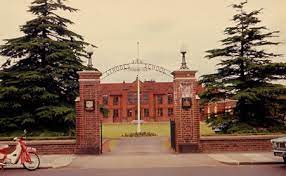
The day my world stood still [part two] : 7 October 1971 : Kings Ride, Camberley

 Had I been born a century earlier, I suspect my parents would have bundled me off to climb up the insides of neighbourhood chimneys for a few farthings. Things then would have turned out much worse for me, as my mother’s guidance for childrearing was apparently forged by her half-dozen visits accompanying me to 1964’s ‘Mary Poppins’ at the Camberley Odeon. As Julie Andrews had seen nothing immoral about grubby children being pressganged into Dick van Dyke’s happy posse of sweeps, the film seemed to convince my mother that offspring were meant to be seen (working) rather than heard (playing).

Some kids embark upon a paper round once they have learnt to ride a bike. Others help out in the neighbourhood shop for pocket money. Visiting a mini-mart to pay your newspaper bill, you would rightly be surprised to find a child of single-digit age and less than three feet tall stocking shelves. Apparently not my parents! As soon as I could walk, my father was taking me with him in his ostentatious American car to survey local properties whose owners required renovations or extensions. Initially I was charged with holding the end of his long roll-out, wind-up tape measure at the far end of large rooms [see blog]. Before long, I was sketching out on paper the floorplan of buildings and noting their dimensions. Later on, I was calculating floor areas using the long multiplication my father had evidently failed to pay attention to before quitting his education aged fourteen from a Dickensian school he would show me on School Lane, just along from Ron Francis’ long-time photographic studio.

Thanks to an apprenticeship and ‘night school’, my father became a qualified quantity surveyor who passed as an architect by appending ‘AFS ARIBA’ to his name on business cards printed by Southwell Press [see blog]. In his school-hut office in the back garden behind our garage, my first administrative task was to maintain his professional periodicals such as ‘Architects Journal’ in strict date order. Soon he would teach me how to transfer Letraset from large sheets onto architectural drawings. I could calculate the relevant scale for plonking images of furniture, white goods and American-styled human figures onto the tracing paper plans masking-taped to his drawing board. If we did not have the necessary sheet, I would locate it within the huge, well-thumbed ring-bound Letraset catalogue and my father would then walk down to ‘Camberley Stationers’ on the High Street to buy it on account.

Whilst my father was self-employed at home, my mother worked as bookkeeper for a local garage 290 yards away that serviced vehicles, hired out a fleet of coaches and owned the town’s only petrol station on the busy A30 London Road. She would regularly bring her wide accounts ledgers home, set them out on our kitchen table alongside a paper-roll adding machine and require my services to help ‘balance the books’ and calculate the weekly payroll [see blog]. At my school, some classmates were still struggling with basic addition whilst I was already adept at calculating Income Tax and National Insurance deductions for a local company’s workforce.

After leaving school at sixteen without a Certificate, my mother had enrolled for some kind of local secretarial course which led to our home having a manual typewriter and shorthand texts. I taught myself to type and was soon faster and more accurate than my mother. If my parents had to fill out a form, I would type it for them. After my brother was born, his name had to be added to their passports alongside mine, so I typed the application form to be mailed to the Passport Office in Little Venice. When the passports were returned, I was so proud to see that the civil servants had merely cut out the paper on which I had typed my brother’s details and glued it onto a spare page. My handiwork!

Without realising what was happening, I became our family’s ‘administrator’ merely because I excelled at reading, writing and arithmetic. When there were Christmas cards to send to my father’s clients, it was my job to write addresses on dozens of envelopes. When there were letters to be sent to the Council, Inland Revenue or DHSS, I was tasked with typing them and their respective envelopes. After my parents gave me a ‘Kodak Instamatic 126’ camera for my birthday in 1964, I also became the family’s photographer, carefully sticking hundreds of square pics in a photo album and labelling them with precise dates, locations and names. (Decades later, my brother stole this treasured album from our mother’s home before emigrating [see blog], leaving me now without a single family photo, despite having been our family’s only photographer then.)

If I had been a teenager when pressganged into this family work, perhaps I could be accused of some collusion. But I was still under ten years old when all this happened. Other kids in my class went home to spend evenings playing worry-free games in their back gardens, while I returned home to yet another round of administrative tasks. My cleverness was being mercilessly exploited by two un-clever parents who had left school without an examination pass between them. I had no idea why I was clever. I often wondered whether I was truly the offspring of the adults I was being forced to live with. Had I been swapped, accidentally or deliberately, at birth? However, my birth certificate said I had been born at home. How was my DNA related to theirs? During my early years, I had a mop of blonde hair. But neither parent was blonde. I had blue eyes. But neither of my parents had blue eyes. Having watched 1960’s American sci-fi series screened on British television, I even pondered whether aliens had planted me with this suburban family. Was I the boy who fell to earth?

As the years progressed, my parents’ grip over my life tightened. At age eleven, having passed the compulsory ‘Eleven Plus’ exam, I was entitled to join the one grammar school in Camberley, adjacent to the infant/junior school I had attended for six years. Instead, my parents chose to send me to a grammar school twelve miles away at the opposite end of the county, the outcome of my father’s desire to impress a potential business partner [see blog]. I was not even consulted for my opinion before being condemned to spend hours travelling on public transport for the next seven years. I would never again see my many junior school friends.

After my father switched to renting a town centre office, I was additionally charged with calculating, typing and sending out client invoices, statements and reminders on his newly purchased ‘IBM 72’ electric typewriter. I was also required to spend days making photocopies and dyeline prints for my fathers’ clients in a darkened unventilated room, damaging my health irreparably [see blog]. When my father diversified into property speculation with a new business partner, my expertise in maths was required to figure out the potential profits of buying local businesses and redeveloping them with blocks of flats [see blog]. Though not yet a teenager, my calculations would determine whether projects worth millions could prove viable for my father’s latest business, which I had been required to name (‘IMIC Properties Limited’) even though I was still too young to be one of its directors. It was crazy.

The upside of all this work for my ‘family business’ was that, once their tasks were completed, my parents left me alone to pursue my own interests without interference. My mother could not be bothered to divert to Camberley’s only Post Office at the far end of the London Road from the town centre so, while she shopped, I would walk there and cash her fortnightly ‘Family Allowance’ vouchers from the booklet sent by the government. The postal staff knew me by sight because, from the time I could barely peer over their counter, I had been sending and receiving many more letters than my parents. My ‘pocket money’ comprised this useful cash that my mother would let me keep.

During childhood, I developed a wide range of interests that I maintained … until the fateful day in 1972 when my father deserted his family and abandoned his three children, leaving us to grow up in chaotic deprivation [see blog]. After that, I had neither the time nor the money to pursue anything beyond day-to-day survival. After that, I lived an even more isolated existence away from friends and extended family. These unwelcomed losses were initiated in 1968 when my parents relocated to a new housing estate on the edge of town. I was now three miles from my grandparents who, having lived next door almost my entire life, had generously provided the childrearing skills to which my parents seemed oblivious. I was now three miles away from the neighbourhood kids on our street with whom I had played regularly on the roads leading to Barossa Common [see blog]. I was now three miles away from the junior school I would attend for one further year which, until then, had been a short solo ride away on buses 1, 2 or 3c of the Aldershot & District Traction Company Limited. I now had no friends living within miles. I needed a lift to get to school.

In our home on Kings Ride, my parents had bought me a metal full-size pedal-powered go-kart with a handbrake that could travel so fast that it would have proven dangerous to meet a pedestrian on our narrow pavements. Instead, I would drive it along the road outside our house when there was little traffic around, pursued by my neighbourhood mates on their bikes. Sometimes a double decker bus would unexpectedly pass in the opposite direction and you could see the passengers stare out its windows in disbelief. My parents never told me not to play in the traffic and not once was I stopped or told off by passing adults.

My earliest hobby was ten-pin bowling. My parents’ plan since their marriage was to emigrate to Canada, despite knowing nobody there nor having visited the country [see blog]. That was the reason my brother and I were given what they believed were common North American names. That was why my father taught himself to ice skate by practising surreptitiously each winter on the frozen lake of the Sandhurst Royal Military Academy. That was why, every Saturday morning, my parents drove to the nearest bowling alley in Wokingham to practice, accompanied by me. I was tall for my age and soon became sufficiently accomplished to be asked to join Wokingham’s junior bowling team. Every Saturday morning, I would don my team bowling shirt and either compete at Wokingham or our team would be driven from there by coach to an away match at Heathrow, Brighton or one of the few towns that had a bowling alley. One birthday, my parents bought me my own bowling ball with my name engraved next to the finger holes and a ‘mod’ black and white bowling bag in which to carry it.

I became a manic stamp collector, initially steaming off the stamps on my family’s incoming mail and later visiting the regular Stampex exhibition in the Central Hall at Westminster. My weekly visits to the local library were useful to consult the Stanley Gibbons stamp catalogues in the reference section upstairs. Before long, I had saved enough pocket money to buy my own copies, along with a special stamp album that had spaces to mount every British stamp ever issued. I would write to a stamp dealer in Much Wenlock, enclosing a Postal Order bought from the Post Office to purchase all sorts of strange and wonderful stamps from countries around the world. Every occasion a new set of commemorative stamps was issued, I would traipse down to the Post Office, stick them on the associated special envelope and send it to myself as a ‘First Day Cover’. I even saved up to buy Britain’s first stamp, the 1840 ‘Penny Black’.

My maternal grandfather had sown the seeds of my fascination with the radio medium. I loved listening to music radio stations and discovered I could hear stations from all over Europe on an ordinary portable radio. In my early years, I would comb my parents’ and grandparents’ daily newspapers for any stories about radio, cut them out and stick them in a series of scrapbooks I maintained. Then I would enter every competition I heard announced on radio and, as my knowledge of popular music was good, send in postcard entries. I won quite a few contests on ‘BBC Radio London’ after it opened in 1970, usually with prizes of vinyl albums (such as the debut of the amazing group Batti Mamzelle). Despite my dozens of entries, I never won anything from national ‘BBC Radio One’ after its launch in 1967. However, I did win some albums (including ‘King Tubby Meets The Upsetter At The Grass Roots Of Dub’) from Tommy Vance’s Saturday ‘TV On Reggae’ show with Raymondo (alias Ray Edwards) on London’s ‘Capital Radio’ in the early 70’s. 

I badgered my parents into buying me a Trio 9R59DS radio receiver so I could listen to more radio stations from further away on the shortwave band. Due to my fear of heights, I persuaded schoolfriend Jeremy Mitchell to climb trees at each end of our garden to hang as an antenna a long piece of copper wire I had bought from my grandfather in the ironmonger shop ‘Dolton Bournes & Dolton’ on the High Street, his workplace following the closure of Camberley’s timber yards [see blog]. I bought the thick annual ‘World Radio & Television Handbook’ so that I could find the address of every radio station I heard in order to write to them. I was sending off dozens of letters a month and receiving all sorts of packages in return – programme schedules, postcards, badges, playlists, magazines, books and pennants. The postman often was carrying so much mail to deliver to me alone that he would knock on our front door rather than try and fit it all in our wall-mounted post-box.

I subscribed to monthly Roneo-ed newsletters that shared information about distant radio stations that could be heard and I would send the editors my lists for publication of new ones I had heard recently. I even travelled by train on my own to a meeting organised by some of these radio fans (‘DX-ers’) held in Reading one weekend but, sat amongst men who were twice and three times my age, I was too intimidated to utter a word. However, my listening taught me to identify languages from around the world and to understand the geography of continents. I can still recall the names of many of the oddball radio stations I heard, such as Austria’s ‘Der Schulungssender des Österreichischen Bundesheeres’ on 6221kHz. I think this global knowledge was the reason I managed an ‘A’ grade for my Geography O-level. It also gave me motivation to one day visit some of the faraway places whose radio I had listened to and whose citizens I had corresponded with.

As well as being an enthusiastic radio listener, I was also interested in the technical aspects of the medium. One Christmas in the 1960’s, I asked my parents for a junior home electronic kit that taught me about resistors, capacitors, circuit boards and to build basic projects. A few years later, I would accompany my aforementioned school friend Jeremy on trips to ancient Edgware Road shops to buy second-hand electronic parts so that we could build our own valve-powered radio transmitter to launch an AM pirate radio station. We possessed some suitable circuit diagrams from hobby magazines and were inspired by weekend London pirate stations we had heard.

Starting with technical books held in the upstairs reference section of Camberley library, I studied the theories of how radio transmitters, receivers and antennas functioned and their practical applications. This led me to a correspondence course to take the ‘RAE’ radio amateur examination that would allow me to communicate on the airwaves with other radio ‘hams’. For a small charge, I was mailed study notes by post, learnt them, wrote answers to a set of questions and sent them back. If my responses were correct, I would be mailed the next unit of the course. It could be a rather laborious process at times, but there was nowhere locally I could undertake the necessary training to take this exam.

One of my less technical interests was launching helium-filled balloons from our back garden, attached to postcards asking the finder to write to me with the location it had landed. Most of these efforts disappeared without a trace but occasionally I would receive a card from somewhere in West Europe that one had reached, a few of whom I started writing to regularly as pen pals. I think it reflected my early notion that there must be a bigger world out there beyond the suburban town where my mother’s family had lived for generations. It was a symptom of my alienation from my parents and the quest for an existence that promised more than small-town living. I already felt I did not belong there and I was seeking somewhere else where I might feel more at home (“going where the weather suits my clothes”).

One of the properties my father had insisted I help him measure to prepare for some rebuilding work was the future Lakeside Country Club in Frimley Green to be launched in 1971. We met its owner, musician Bob Potter, to whom I explained my interest in learning music studio production. He also ran the Bob Potter Studio in nearby Mytchett and invited me to attend a forthcoming recording session there by jazz duo John Dankworth and Cleo Laine whom I had seen on television. Although I was not (yet) a fan of jazz, this seemed to be a great opportunity to understand the basics of music recording techniques. I enthusiastically accepted the invitation and looked forward to that visit.

I was a regular customer of the large toy shop on Princess Street where I saved up to buy Airfix plastic model kits and multiple little pots of Humbrol paint, taking them home to assemble whilst trying not to glue my fingers together. Aircraft models appealed most, perhaps because my parents occasionally took me to Heathrow Airport on weekends to stand on the open observation platform of the new Queen’s Building with a free map showing airline logos so that we could identify planes taking off and landing. I built and carefully painted a Fokker DR1, Harrier ‘Jump Jet’ and Gloster Whittle, adding the transfer markings provided with each kit. I was yet to travel on a plane so aircraft seemed exciting and other-worldly.

I had started buying soul and reggae records in 1969, initially from Dykes record shop on the corner of Park Street and Princess Street where a line of soundproofed listening booths along the right-hand wall permitted visitors to request from the shop assistant an audio preview of a single or album before deciding whether to purchase it. Within a few years, I was making Saturday solo trips to London to buy imported soul records unavailable in Camberley from Contempo Records on Hanway Street and imported reggae from the many stalls in and around Granville Arcade in Brixton [see blog]. Though my termly green cardboard train season ticket to commute to school only reached as far east as Egham [see blog], I would continue on the same line to Waterloo station, flash my pass hurriedly at the gate and then only have to pay the minimal Tube fares to travel around London. Sometimes I might go further to visit the many reggae shops in Harlesden or to Lord Koos’ outlet for hard-to-find releases.

In early 1972, My father impulsively booked a holiday in Jamaica for our whole family so I made plans to explore its reggae haunts I knew about while the rest of them would be lounging on the beach [see blog]. We had recently visited Spain for a short family holiday which had proven an unmitigated disaster [see blog] so I considered it more productive for me to set personal objectives to achieve on this holiday, putting as much distance as possible between me and my troublesome father.

A significant reason I had developed so many interests was because, throughout my years at infant and junior schools, no classmates lived anywhere near our home. As the eldest child, neither did I have siblings with whom to play. Then, for two years, my parents spent every weekend on the plot of land the opposite side of town where they were building their dream house. They took my younger brother with them but always left me at home alone the entire weekend. I was never bored as I had developed so many interests that I could pursue. I was perfectly happy in my own company, particularly as my parents demonstrated little interest in me even when they were present. If I wanted interaction, I would go next door and play dominoes for hours with my grandfather on his wooden dining table, notching up our scores with matchsticks on his ancient cribbage board.

Two subsequent events ruined this equilibrium in which I had existed during my early years. Firstly, the move to our new house on the edge of town two miles from Camberley town centre. Until then, I had been only a short unaccompanied walk away from the shops, municipal library and railway station. Now I needed a lift from my parents because the two bus routes 39b and 34a from our new location ran only hourly and two-hourly respectively during peak times. Neither was there a single shop near our new home.

Secondly, my father’s departure four years later left my mother without a car [see blog] or the resources initially to buy one. The impact was two-fold: I was stranded on an outlying housing estate without transport; and the money to support my interests was no longer available. I still visited the Post Office, though less regularly than before, as it was now three miles away instead of a brisk walk. I would cash the Family Allowance vouchers there but now the money had to be passed to my mother to support us because my father was deliberately denying his family any financial help.

It was not just the lack of money that changed my life going forward. Having unexpectedly had additional responsibilities as our family’s ‘eldest child’ thrust upon me, I could no longer find sufficient hours in the day to pursue my own interests. Until then, I had spent most of my childhood in my own company whilst my siblings were under the eye of one or other of my parents. From now on, because my mother was at work every weekday from morning ‘til night, I was left with my younger brother and sister whenever I was home from school. I had become the family babysitter, supervising a nine-year old and one-year old for hours on end. This was not how I had anticipated my teenage years would be spent from age thirteen to eighteen.

There was no gradual change in my life. In the weeks before my father left us, I was still busy with my own interests. Then, suddenly, everything had to be dropped. My go-kart was never used again. My bowling ball remained in its 1960’s two-tone bag to this day, kept as a reminder of a now distant past when I once scored over 200 in a competition game. I was not given the chance to say farewell to my bowling team friends because I never returned to Wokingham bowling alley. My various stamp albums were placed in a large plastic shopping bag, never to be examined again. My plans to build a radio transmitter with school friend Jeremy came to nothing, as did our electronics buying trips to Edgware Road. Although I was close to completing the radio amateur correspondence course, I abruptly ended the monthly correspondence because now I would never have been able to afford the equipment even if I gained a licence.

Correspondence with overseas pen pals came to a sudden halt due to my lack of time. Bob Potter’s invitation to attend a recording session would never be fulfilled because my father now disowned me and was hellbent on doing everything he could to disrupt my future, despite my childhood having been spent working for his various businesses. I never again bought or assembled another Airfix model kit, let alone visited Camberley’s toy shop. Regular record-buying trips to London had to be curtailed because, without parental transport, buses from our home to the railway station were unreliable outside of weekday daytime hours. Besides, my pocket money had all but disappeared, sacrificed to more essential needs. My much-anticipated visit to Jamaica was scotched when my father changed the names on our family’s four tickets to that of his new mistress and unknown flunkies [see blog].

What activities was I left with? My radio listening continued because I already had the equipment and it was a free pastime. As a much-needed escape from my family responsibilities, at weekends I would sometimes stay up all night listening to faraway stations. I tried for months to receive a North American station on Medium Wave and my perseverance paid off during the early hours when I distinctly heard ‘CJON 930’ in St John’s, Newfoundland. Encouraged, I soon heard ‘Radio Demerara 760’ from British Guyana and ‘Radio Rebelde 670’ from Cuba. I knew even then that I wanted a career in radio.

I also continued my long running passion for music. I discovered that, instead of visiting London to buy reggae records, I could save money by writing directly to the UK record companies that issued them, claiming to be a record shop named ‘Channel One’ (copied from the recording studio I idolised in Maxfield Avenue, Kingston, Jamaica). Whereas in shops an album would cost £2.15, I could buy the same record ‘wholesale’ for a little over half that price. A typed letter and accompanying Postal Order proved sufficient to convince them to send me the desired albums, often accompanied by marketing materials, their catalogues, additional album sleeves and free promotional copies of singles. I was never asked difficult questions about my fake record shop bizarrely located on a suburban Camberley housing development.

There was no time then to think too deeply about these myriad changes to our family’s existence. We just had to cope with the way things were now. I never complained. It is only in retrospect that I understand how much of my youth was taken away from me by my parents. I never spoke to anyone at school about these changes or the responsibilities foisted upon me at such an early age. I tried to carry on as if everything was fine and that nothing significant had changed. But it had. I was no longer the youthful kid with diverse interests that I had been until now. I had been forced to become an adult though I was only just a teenager. Worse, I felt I would never have complete control over my destiny now that I was tied inextricably to my family’s immediate needs, but continuing into the longer term as well. My life had undergone significant change soon after the day in 1971 when my sister was born … a change that would unexpectedly impact my life from then on.

[to be continued…]

[Originally published at https://peoplelikeyoudontworkinradio.blogspot.com/2026/08/the-day-my-world-stood-still-part-two-7.html ]

The day my world stood still [part one] : 7 October 1971 : Speech Day, Strode’s School, Egham

 Thursdays meant a trip to the newsagent to purchase that week’s ‘New Musical Express’ and a dash back to my college room to read the issue cover-to-cover and then tackle the latest ‘NME crossword’. It was a weekly head-to-head contest between me and fellow Collingwood first-year student Keith Miller to prove our superior knowledge of popular music. I was no crossword fanatic. I had no competitive streak. However, I was sufficiently motivated to demonstrate there was one subject in which I had expertise, my university academic course and student life having quickly proven a major personal disappointment.

Both my friend Keith and I were fish out of water. We had both arrived at Durham University from state schools, me from Surrey and Keith from Essex. 95% of our fellow students had arrived from private schools and looked down their posh noses at us, just as they probably did their nannies, servants and chauffeurs [see blog]. We were invisible to them. We were not worth the time of day. They were loud, arrogant and domineering. We were the little people that they had been put on earth to lord it over. It must have proven a worse experience for Keith than for me. He appeared to be the only visible minority in our college of three hundred students. He was regularly ribbed by colleagues for having achieved a GCE certificate in ‘African Drumming’ at school.

Aside from my NME crossword years (1976-1978), I have never been a competitive person. In secondary school classes, I never shot my hand up in the air in order to prove to teachers or my mates how superior I must be. Graham Taylor, our Physical Education teacher, resented me because I had no interest in ‘winning’ at the ‘Games’ he forced upon us every Wednesday afternoon for seven years [see blog]. I tried to avoid his team sports. He once sent me to race in a Surrey County athletics championship where I demonstrated no interest in winning against other schools. My termly school reports criticised me for not participating more in class and not speaking up at the slightest opportunity. Was ‘taciturn’ an appropriate adjective for our headmaster to write about a boy whose results in many subjects were amongst the top five of his year of sixty students? Feeling under attack from such judgemental adults, I responded by engaging even less.

At the time, I failed to comprehend that my secondary school’s objective was not to turn its boy students into well rounded individuals, as experienced previously at my wonderful primary school on a Camberley council estate [see blog]. Although this grammar school operated within the state education sector, it emulated the British private school system, aiming to produce self-important ‘leaders’ who could confidently dominate any room they entered and shout loudly amongst their peers about their breeding and supposed superiority. In that endeavour, I was already a lost cause. It was not that I lacked self-confidence. One school report had even labelled me “a tower of strength”. It was just that I felt no need to wear my abilities loudly on my sleeve. Perhaps that was because my parents showed no interest in whether I performed well or badly at school. I was never called upon to show off at home that I was ‘clever’. Besides, I thought actions were supposed to speak louder than words. On that score, my term and exam results spoke for themselves. My motivation to do well came purely from inside me, not from my parents, family or peers.

At the end of my first year at Strode’s School, I was somewhat surprised to be awarded three School Prizes. As if to prove that British society was not founded on meritocracy, these book token prizes [see blog] were rarely given to students who had scored the highest examination or classwork results. Rather, they seemed to be determined by the whim of each subject teacher. This was proven by me being awarded the first-year ‘Religious Knowledge’ prize, despite having never read the Bible, having no belief in God and having attended church only once in my life [see blog]. During the first term of my second year, an event was held in the school hall to formally award boys the prizes they had won, dragging them onto the stage to receive a book token. It was called ‘Speech Day’ even though it was only the staff who made speeches. Parents were invited to watch their bright young things be acclaimed as ‘special’. That year, neither I nor my disinterested parents chose to attend.

One year later, things turned out different. I had been awarded no second-year School Prize. This outcome did not bother me. It merely confirmed my suspicion that the prize criteria were wholly subjective since my exam and classwork rankings in some subjects had improved over the previous year. Exactly how could I have achieved first place in Mathematics during the academic year but fail to be awarded that subject prize? Maybe the school was displeased with my demonstrated deficit of competitive spirit. Maybe me and my parents’ absence from last year’s ceremony had been grudgefully noted. Maybe the school had merely concluded that I was an ‘unworthy’ student as, during my remaining five years, I was awarded no prize.

The other difference that second year was that, despite my lack of prize, I attended Speech Day with my father. There was no compulsion for us to be present. I was confused that a father who took zero interest in his son’s education had unilaterally decided we both attend. I had explained to him that I was not receiving a prize that year but he remained firm. It felt very strange. This was the only occasion on which my father visited my school during my entire seven years there. He parked his ridiculously ostentatious American sports car [see blog] on the playground outside the main hall in which we sat together during a ceremony lasting several hours, me completely befuddled about why we were both there.

I had absolutely no inkling then that this one day would change the rest of my life. Not because of Speech Day. Not because of my school. Not because of me. Not even because of my father. Or even the silly car he had driven frighteningly fast and dangerously to and from the event. So what happened? The clue was in the absence of my mother that day at that event. Where was she and what was she doing?

To understand her absence, it proves necessary to go back in time thirteen years and 173 days to the occasion my mother gave birth to her first child in a semi-detached council house on the Old Dean Estate. I have no knowledge about the circumstances of that arrival because my mother refused to elucidate, except to accuse her husband of absenteeism because he was visiting a mistress due to give birth imminently to his child. Within months, my parents and their new baby were evicted for non-payment of rent, due to my father having unilaterally purchased an unaffordable car to impress his mistress. If my mother’s father had not bailed them out with accommodation, they would have become homeless.

Five years and 217 days later, my mother gave birth to her second child in Farnham Hospital, a facility Camberley (population 33,770) still lacked. During her absence, she entrusted childcare of her firstborn to her husband, despite him having never shown any paternal feelings for his offspring. Luckily, my mother’s parents now lived next door and ended up feeding and entertaining their grandson during his mother’s absence. Did her husband drive his son daily to the state infant school on Old Dean Estate he had started three months earlier, as asked? No, but he did warn his son not to admit this absenteeism to his mother when she returned a week later. Did he visit his wife in hospital? Not once. Was he busy with yet another mistress? Who knows.

Take a further leap forward in time to where my story started – Speech Day at my school in 1971 and the absence of my mother. Where was she? She was in hospital giving birth to her third child that day. My father would have done anything to avoid being alongside her in hospital, even if it meant him attending a function at my school for the first and last time. It proved convenient for him to be 21 miles and a 53-minute drive away from his wife on that day, armed with a suitably fatherly excuse, having demonstrated a sudden interest in my schooling. In retrospect, my two parents were already moving along divergent paths, that day merely widening the gulf between them and soon leading to the breakup of our now three-child family.

My mother had grown up during the War in a two-up, two-down suburban semi-detached house, sharing a bedroom with two older sisters in a loving working-class family. Together, the three children had shared homemade girly pastimes in an era before they had radio or television. They lived on a quiet residential street in a house with a large back garden, surviving the War with produce grown in their father’s well-maintained allotment at the top end of Barossa Road where he raised chickens. It had been an idyllic childhood, despite having to occasionally hide under the wooden dining table when the German bombers arrived to attack adjacent Sandhurst Royal Military Academy [see blog].

My father was raised in a household filled with anger and violence. His brutal father beat his wife and his two sons, for none of whom he ever demonstrated love or affection. He knocked his wife down the stairs which killed her. A significant part of my father’s attraction to my mother and her family was that they were everything that he was not. She had loving parents, she had attended grammar school, she was beautiful and radiated a youthful, confident optimism. He had left school at age fourteen with few prospects and was desperate to escape the hell of his parents’ home. When the couple eventually married, once my father returned from Army conscription to the Suez Canal, my mother’s father refused to attend their Registry Office ceremony, believing that his much-loved youngest daughter deserved a partner with better prospects from a less abusive family.

When my mother became pregnant the first time in 1957, she hoped to have a girl with whom she could relive all the girly activities she had enjoyed with her sisters. She was disappointed to give birth to a boy. She persevered anyway, teaching me to knit, to sew, to bake cakes in the kitchen with her and to cut out clothes patterns with pinking shears. She passed down to me her and her sisters’ 1930’s childhood books such as ‘Heidi’, ‘Black Beauty’ and ‘Anne of Green Gables’. But I showed no interest in dressing up, sculpting elaborate hair-do’s or playing with makeup. I was a disappointment. As the youngest of three sisters, she had never experienced a baby in her household. She had no idea how to raise a boy, so she left me to my own devices most of the time, failing to instruct me in personal hygiene [see blog] or the three R’s. Our home possessed few books, but I consumed cover-to-cover the huge piles of 1960’s women’s magazine titles my mother bought, teaching myself to read and write. Once old enough to walk out by myself, the nearby local municipal library in Knoll Road became my saviour [see blog].

Five years later, after my mother gave birth to another boy, her sense of disappointment was even more self-evident. She committed even less effort to raising him than she had her firstborn, allowing him to grow up barely literate or numerate. He ran away regularly from primary school, showed destructive/self-destructive, violent tendencies and barely spoke to his older brother, despite them sharing a bedroom for six years. Much later in life, he was treated for addiction and was divorced by his wife. In the words of the song [Epic EPC7632]:

“One child grows up to be somebody who just loves to learn.
Another child grows up to be somebody who just loves to burn.”

Eight years later, my mother unexpectedly became pregnant for a third time. I learned this from hearing my parents arguing at night in their bedroom adjacent to mine. My mother wanted to keep the baby, hoping finally to have the girl she had always desired (there now being an 87% chance). My father was insisting she have an abortion. The arguments became more heated. Soon my mother refused to leave the house for a week due to a huge bruise across the right side of her face. On another occasion, she locked herself in the toilet, only for her husband to kick a hole in the wooden toilet door. The door remained that way for the next decade as a visual reminder of his violent behaviour.

My mother eventually won the argument and her third child, a girl, was born whilst I was sat with my father in the school hall, enduring Speech Day presentations. He took no interest in his newly arrived daughter nor, by extension, in her mother. Approaching the age of forty, he was riding a middle-age wave of selfish indulgence, fuelled by cash profits from dodgy property deals he was making with his new business partner, a local second-hand car dealer not afraid to employ mafia-style pressure tactics [see blog]. Flush with money for the first time since leaving school, he could at last satisfy his craving for fast sports cars, dinner parties, restaurant meals and foreign holidays. He took me with him on a flimsy pretext to Florida for a week, only to abandon me alone in a motel whilst he practiced a playboy lifestyle [see blog].

Within months, after increasingly unexplained and lengthening absences, my father walked away from his family altogether to pursue the hedonistic lifestyle he had evidently desired all along [see blog]. I did not miss him because he had played almost no role in my upbringing. He no longer had to pretend publicly that he loved his family. Instead, he decided to do everything possible to cause us pain and suffering, just as his parents had done to each other, to him and his brother. He now took zero responsibility for his former family, fighting in the courts not to provide financial support. He broke into our house and stole everything of value, including the car he had given my mother and most of her jewellery [see blog]. Our lives would never be the same.

During the months leading up to his departure, my father had been regularly playing on the living room stereo a vinyl single he had bought by The Fifth Dimension called ‘One Less Bell to Answer’ [Bell BLL1137] whose lyrics included:

“I only know that since he left
My life’s so empty
Though I try to forget
It just can’t be done
Each time the doorbell rings
I still run
I don’t know how in the world
To stop thinking of him
‘Coz I still love him so
I end each day the way I start out
Crying my heart out”

Only in retrospect did I realise these words represented the pain my father had been planning for some time to inflict upon his wife. During the previous two decades, she had ignored his regular philandering. Now, having finally gained the daughter she had long desired, he was determined to make her pay. He secretly visited each of her relatives and friends to convince them that his wife had done something heinous that had forced him to leave her and their three children. Most ignored his pleas but some, notably my mother’s older sister Sheila, bought his lies and refused contact with my mother for decades [see blog]. The outcome was that my mother became isolated, lacking moral support she should have received from the people in Camberley she had known her entire life. Meanwhile, my father set up home on an affluent private estate with a runaway teenage bride who had lived only a few doors away from us [see blog].

My mother could not adjust to our changed circumstances. Until the day she died half a century later (or, more accurately, until the day my father died eight years before her), she continued to believe that her husband would one day knock on her front door and come back to her. He never did. Her father having disapproved so publicly of her marriage choice, she had tried to do everything to prove him wrong, even ignoring the mistresses my father had accumulated over many years and the unknown children he had sired. The remainder of my mother’s life was lived in a sad, darkened interregnum in which she awaited a resumption of her pre-1971 ‘happy family’ married lifestyle. It never happened.

Although her daughter was not yet one year old, my mother was forced to take two jobs to generate income to feed her family because her spiteful husband was paying nothing. Her full-time day job was as bookkeeper for British Car Auctions in Frimley. Her evening job was cleaning offices in Yorktown. Her retired parents, who stuck by her, looked after my baby sister during weekday daytimes. Year after year from that moment, all my mother seemed to do was work to try and make ends meet. Having lost her own car to her husband’s new mistress, she had to borrow her father’s 1963 Austin Cambridge car just to get to work. Fortunately, my eight-year-old brother’s school was within walking distance of our home.

Although she possessed the skills to administer her new single-parent life, the result of having previously been employed in bank and accounts offices, my mother now abdicated all responsibility for her affairs. Almost all of the mail she now received were bills, red reminders and threats of court action. Not only did she refuse to open them, she would stuff them all into a drawer in the living room, never to be retrieved. Out of sight, out of mind. Neither was this a temporary reaction to her struggling situation. Until the day she died half a century later, she refused to deal with any paperwork she received or was required to action. It was a blatant refusal to adapt to a life in which her household budgets and accounts needed to be balanced, paradoxically the very work she performed for her employer five days a week.

Not once did my mother ever ask me to take on the responsibility of managing her affairs. She could not have cared less. I realised that her strategy was irresponsible and would doubtless drive our family into disaster. Unopened letters stuffed into a drawer would inevitably lead to court actions, debt collectors and bailiffs. My mother would lose her jobs. We would lose our home. Me and my siblings would be placed into care. We would all have to change schools. Perhaps that was the exact outcome that my cruel father wanted. I was the oldest child of our family. I was clever. I had already received more formal education than any of our relatives. I was barely fourteen. By default, I had become the ‘head’ of the family, a role I had never wanted but which was now thrust upon me.

Within months of my attendance at my school’s Speech Day alongside my father, my whole world was turned upside down. My supposedly carefree teenage years and adolescence were taken away from me. I was suddenly a young adult. Never again would I observe my life as similar to that of my peers. I had responsibilities. Huge responsibilities. My own personal ambitions had to be subsumed to the struggle for mere survival of our family unit. There was nobody with whom I could share this responsibility or even explain the tasks I now had to do. My schoolfriends would never have understood. School staff were already unsympathetic towards me, having sent me home occasionally for wearing the wrong colour socks, the wrong colour shoes, slip-on’s instead of lace-ups and having hair touching my collar [see blog].

Events that took place on that one day, 7 October 1971, events over which I had no control would impact the entirety of my life. I did not realise it then. At the time, I thought I was simply doing ‘the right thing’ whilst those around me seemed hellbent on doing ‘the wrong thing’. I had no idea that a life of making small personal sacrifices as a teenager would lead to making bigger and bigger sacrifices as the years passed and end up stealing away so many opportunities to satisfy my own life.

After my father walked out and disowned his family, I could have just ignored the consequences and retreated into my own world, as my younger brother chose to do. But I was old enough and wise enough to understand the outcome of that route. Our circumstances would fall into irreparable disaster and we might all be split up and sent to children’s homes. Our mother might be imprisoned for unpaid debts. I decided to do my best to stop those disasters happening. Nobody else was there to help. It was me alone who had to try and keep us all together. So I tried.

[to be continued…]

[Originally published at https://peoplelikeyoudontworkinradio.blogspot.com/2026/08/the-day-my-world-stood-still-7-october.html ]

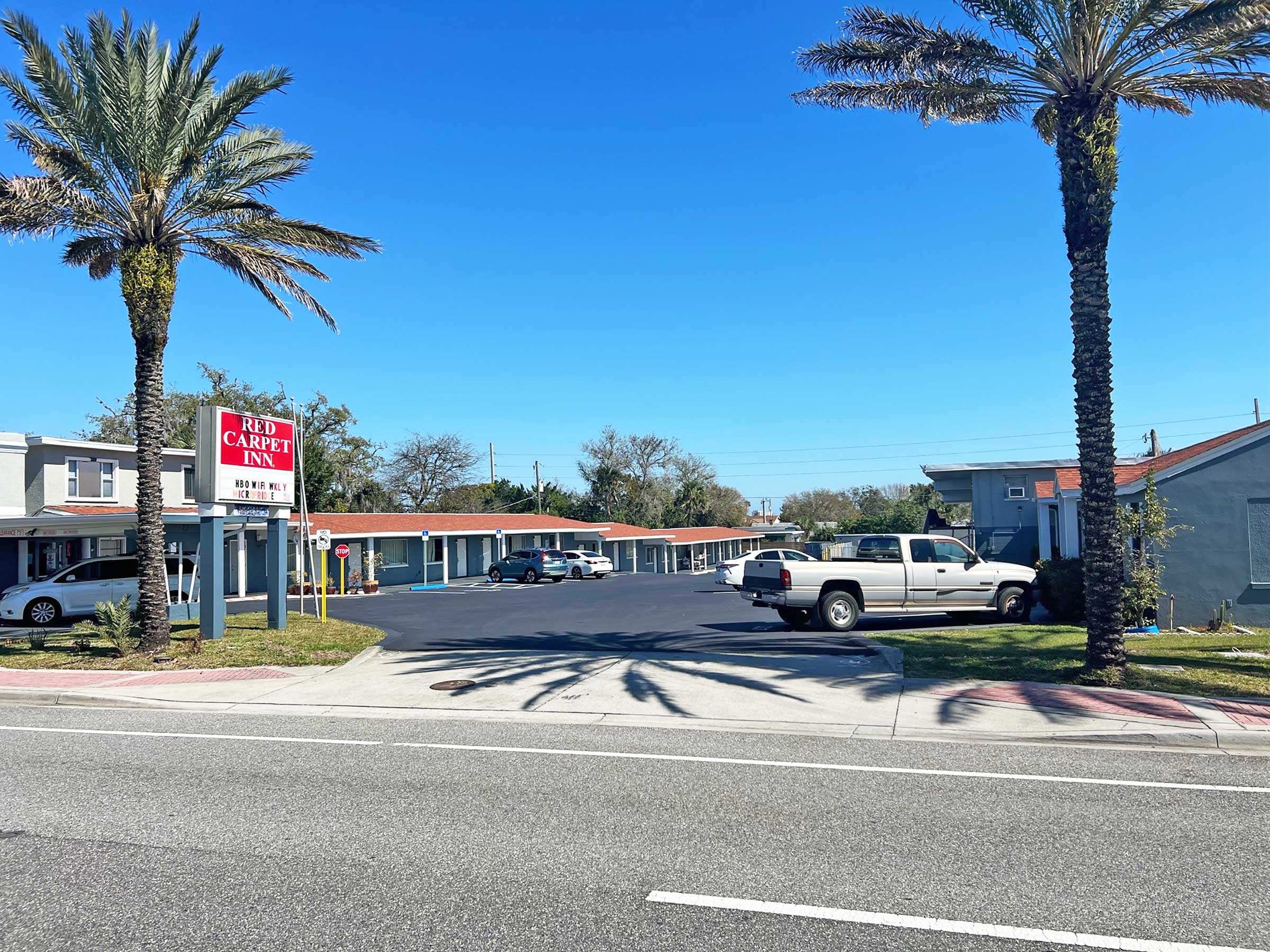
I don’t want to be like my daddy : 1972 : Red Carpet Inn, Daytona Beach & ‘Baby Sitter’ by Betty Wright

 Having answered the front door, its frame was filled by the 11pm silhouette of a large black man wearing overalls and carrying a toolbox. The only words I could discern from his Southern drawl were ‘air con’. Aha! He must have arrived to fix the air conditioning malfunction of which I had alerted the reception desk an hour earlier. He lumbered in and set to work while I continued to watch television.

“You on your own here, sir?” he asked whilst precariously balancing on a chair to grope the insides of the wall-mounted unit. Nobody had ever called me ‘sir’ before. I was a fourteen-year-old boy. He was at least three times my age.

“I am staying here with my dad,” I replied matter-of-factly. Was I meant to call him ‘sir’ too? He looked at me quizzically, seemingly not having comprehended my response. It suddenly dawned that, though Brits know American vocabulary from their TV and movies, Americans understand almost no British English.

“My father,” I clarified. “I am staying here with my father. But he has gone out this evening.”

“D’ya know when your pa gonna return, sir?” the man asked. I shook my head. I was not being coy. I did not know.

It took about a quarter-hour for the man to persuade the air conditioning to function again. Now, whenever I watch Robert De Niro fighting air ducts in ‘Brazil’, I am reminded of that maintenance man. Before he left, he kindly warned me:

“You’s be careful now, sir. And don’t you answer the door to anyone tonight as long as you is alone.”

I thanked him and continued watching television. My parents had raised me on the numerous 1960’s American shows broadcast in Britain, many of which were years old, so it was heavenly to binge on new episodes of familiar shows and those unknown to me. I had bought that week’s ‘TV Guide’ from the reception desk and was thrilled to discover shows like ‘Love American Style’ and ‘Room 222’ on ABC that made me laugh out loud, stretched out on my motel bed.

The late film that night was ‘The Magus’, a baffling watch despite the presence of Michael Caine and Anthony Quinn. Because American TV networks cut off movie credits, I had no idea that it was a critically mauled adaptation of a 1965 John Fowles novel. Back home, a female librarian at Camberley Civic Library had suggested I borrow Fowles’ 1963 debut ‘The Collector’, perhaps not realising from my height that I was only ten years old then, not a suitable age to read a harrowing account of a lonely young man kidnaping a girl and locking her in his cellar until she dies. For years after, I could not supress regular nightmares about this scenario … in which I was the young man.

A decade hence, university friend and housemate John Chandler would insist I read the paperback of ‘The Magus’. Despite the disappointment of the film, Fowles’ book proved to be riveting and not to give me nightmares. It remains one of my favourite reads, alongside another of John’s recommendations, Ursula Le Guinn’s 1974 novel ‘The Dispossessed’. I digress.

So where was my father that evening? I had no idea. He had left me in our motel room and driven away our hire car, promising to be back later. I eventually crawled into bed. He did not reappear until the next morning, offering neither explanation nor apology. As a teenage boy accustomed to parental indifference [see blog], I failed to recognise how irresponsible was his behaviour. Had the ‘Red Carpet Inn’ in Daytona Beach burnt to the ground that night with me inside, how would he have explained his decision to abandon me overnight 4,286 miles from home?

This whole father/son trip had been a bizarre undertaking from its outset. Unencumbered by prior discussion with me or my mother, he had visited a travel agency in Egham and booked a package tour to Florida for me and he alone, omitting our three other family members. My mother was understandably furious. My form tutor at school was furious as it meant me missing lessons for a week during term time and, henceforth, I was never awarded another School Prize [see blog]. Our first long-haul trip was ostensibly booked to witness the launch of the final Apollo rocket from Cape Kennedy. For years I had been a fanatic of the ‘space race’, following every event in detail and even corresponding with NASA for a primary school project. But my father was not.

Our father/son relationship could best be described as ‘business-like’. As soon as I could walk, my father had pressganged me into his one-man quantity surveyor business [see blog], me initially holding the end of his lengthy roll-out tape measure at properties, but more recently calculating returns on potential property developments [see blog]. Was this trip meant to be the reward for my decade’s unpaid service? My father had never seemed, er, fatherly to me. I do not recall him ever sitting me on his knee, holding my hand, hugging me or even reading me a book. When there was something he wanted to do that disinterested my mother, I was merely a handy substitute. Hence, despite my few years, I accompanied him to Camberley Odeon to watch ‘One Million Years B.C.’ in 1966 (aged eight), ‘2001: A Space Odyssey’ and ‘Planet of The Apes’ in 1968 (ten) and ‘Vanishing Point’ in 1971 (thirteen), the latter supported by a violent B-movie western in which a woman is stalked and raped by cowboys. Parental guidance, what’s that?

In the months between my father booking this trip and our departure, his behaviour had become more and more erratic, abandoning our family home for days on end without explanation. At the same time, he had become increasingly violent towards my mother, then caring for my months-old sister whom he had never wanted. Even though he had already indulged in purchasing a new American Motors Javelin sports car, he replaced it with an even more expensive and ostentatious two-seater ‘AMX’ model that resembled the drag racing cars he insisted on taking me to watch on weekends at nearby Blackbushe Airport. Was he experiencing some kind of mid-life crisis?

Whilst driving around Daytona Beach, I had noticed us pass a record shop which I wanted to visit. Having purchased my first soul single in 1969, I since had used pocket money to regularly buy imported American soul records from ‘Record Corner’ in Balham and ‘Contempo Records’ in Hanway Street. We stopped by the store and I bought some recent soul singles I had heard played on ‘American Forces Network’ Frankfurt, audible evenings in the UK on 873kHz AM, songs which had not yet been released at home: ‘Me and Mrs Jones’ by Billy Paul [Philadelphia International ZS7 3521], ‘One Life To Live’ by The Manhattans [Deluxe 45-139] and ‘Baby Sitter’ by Betty Wright [Alston A-4614].

After witnessing the delayed but spectacular night-time launch of Apollo 17 from the bonnet of our hire car, parked amongst hundreds of similar spectators, we caught our flight home from Melbourne airport. I felt sick and delirious that entire journey, unaware I was suffering sunstroke, my father having never considered providing me ‘sun creme’ or a hat during hours spent strolling together along the Florida shoreline for him to ogle bikini girls. Before our arrival home, he told me not to tell my mother about his unexplained overnight disappearances, our day of arrival having been the only night he had slept in his motel bed.

My silence made no difference because, only weeks later, my father left his family for good, similarly without explanation. Had the Florida trip been his clumsy way of bidding me farewell? Or had it been an experiment for him to explore a potential alternate lifestyle unencumbered by his wife and three children? Whatever it was, I did not miss him for one minute. All he had ever done was utilise my skills for his own ends. I did not shed one tear. For the previous fourteen years, he had only been present in my life when there had been some task I could do for him … rather than with him. Never had he demonstrated a genuine interest in his children.

Before he finally left, the few times he was at home, my father would play repeatedly the ‘Baby Sitter’ single we had brought back from Daytona Beach. It was a song in the Southern soul storytelling mould in which singer Betty Wright hires a teenage babysitter to look after her child, later discovering the girl has ‘stolen’ her man. The lyrics relate:

“This sixteen-year-old chick walked in

With her skirt up to her waist

She had a truckload of you-know-what

And all of it in place.”

Wright learnt the lesson after her man left:

“I should have been aware

Of the babysitter

I should have known from the junk, yeah

She was a man-getter.”

I felt it was a bit of a novelty song, nowhere near as classy as Wright’s 1971 ‘Clean Up Woman’ single [Alston A-4601] which I had purchased as an import single and loved. I had no idea why her new song seemed to resonate so strongly with my father until …

The day after my father left us, there was an unexpected knock on our front door. It was our friendly neighbour Mark Anthony who lived three houses along our cul-de-sac. He was visibly upset because his young bride had disappeared the day before without explanation. Had she contacted my mother, since we were the only family she knew on our street, the couple having only recently moved there? No, explained my mother, but my father had disappeared the same day. Oh dear! It seemed that my forty-one-year-old father had run away with Mark’s nineteen-year-old wife Suzie. She may never have been our family’s babysitter but she did resemble the girl in the song. I suddenly realised why my father had identified with its lyrics. He had abandoned us for a teenager. Was that how he had spent his nights in Florida?

During the months that followed, my father tried his utmost to destroy his family. While we were out, he would break into our home and steal as much as he could drive away of our possessions [see blog]. I lost a large number of soul records I had bought with my pocket money, many of which were irreplaceable and in which he had shown no previous interest. Amongst them was the ‘Baby Sitter’ single.

Years later, on the run from Court Orders requiring back-payment of thousands of pounds to my mother for the maintenance of his children, he fled to America. Eventually, the US Immigration Service caught up with him and expelled this ‘illegal alien’ back to the UK from Everton (population 133) in Arkansas where he had been confident/stupid enough in 1985 to register a business named ‘Andre Associates Inc’ with an address there at ‘Route 3, Box 68’, as well as a corporation of the same name in 1986 at ‘1608 Avalon Place, Fort Myers, Florida’. Extradited back to home soil, he disappeared again to Wales and then Christchurch. He never did pay his debts to us.

Upon his death in 2013, following who knows how many more failed marriages, my father left a handwritten will that bequeathed the bulk of his estate to my younger brother, along with his “collection of soul LP, CD, cassette music”. This was my apparent non-reward for having passed a decade working in my father’s business, whereas my brother had contributed not one day. I hope my brother has enjoyed listening to old records I had eked out of my teenage pocket money. Oh, I almost forgot, he had never shown any interest in soul music. To add insult to injury, my brother did not invite me to my father’s funeral, nor my sister, nor our mother. Evidently, he is the son of his father!

[I was reminded of these events whilst compiling my Spotify playlist of 2000+ 1970’s soul, funk and disco recordings from the catalogue of Miami’s ‘T.K. Records’, home to Betty Wright, George McCrae and KC & The Sunshine Band, amongst others. Naturally, it includes ‘Baby Sitter’.]

[First published at https://peoplelikeyoudontworkinradio.blogspot.com/2025/09/i-dont-want-to-be-like-my-daddy-1972.html ]

Teach your children well? : 1960s-1970s : vegetable-free adolescence, Camberley

 “How often do you wash your face?” asked the doctor.

“Like how?” I responded, uncertain about what he was enquiring.

“You know, with soap and water,” he clarified.

“Er, never,” I replied truthfully.

“Why not?” he demanded.

“Because nobody ever told me I needed to,” I said, somewhat embarrassed.

The doctor regarded me pitifully, imagining I must belong to a tribe of itinerant gypsies or have been raised by wolves. To the casual observer, my suburban home life appeared quite normal. Scratch the surface and you would have discovered that my parents had given me few of the ‘life skills’ that are supposed to be demonstrated to children. On this occasion, my mother had sent her teenage son to the family doctor in Frimley Road because his face had become progressively covered in spots. But neither she nor my father had ever instructed me how or when to wash. Once a week, I stood under the water in our modern home’s shower cubicle. If my face became wet while shampooing my hair, I merely dabbed it dry with a towel.

The doctor wrote a prescription for a liquid called ‘Phisohex’ which came in a large green bottle. After a few weeks washing my face twice daily with this cleanser, my spots magically disappeared, following more than a decade of cheeks shamefully having been untouched by soap. Did my mother acknowledge this shortfall in her parental duties? Of course not. This was but one aspect of her ‘hands-off’ approach to childrearing. She had enjoyed a good post-war education at Camberley’s girls’ grammar school in Frimley Road where she was likely taught conventional housekeeping and domestic skills in preparation for marriage. She was goodlooking and always dressed immaculately in the latest trends. Her parents had raised her and her two sisters impressively. So where had her own parenting regime gone awry?

Most of the basic skills I developed – writing, reading, arithmetic – I learned from books and television rather than parental instruction. However, one ability that proved impossible to appropriate in that way was tying shoelaces. As a result, at junior school, after ‘PE’ (Physical Education) lessons that required us to change into slip-on plimsolls, I always had to seek out my cousin Deborah in the year below mine to ask her to retie the laces on my shoes. Once I progressed to grammar school, my skill deficit became more difficult to hide. The mandated school uniform required black lace-up shoes. My mother acknowledged my ‘shoelace’ issue but, instead of simply demonstrating how to do it, she bought me slip-on ‘Hush Puppies‘ shoes for school which resulted in regular disciplinary action. Finally, I had to draft an embarrassing letter from my mother to the school, asking for her son to be excused from the dress code due to difficulty finding suitable lace-up shoes for his high in-step feet.

Like many 1960’s housewives, my mother regularly cut out recipes from magazines and stuffed them in a kitchen drawer. She was particularly proud of a plastic box with transparent lid holding two rows of Marguerite Patten recipe cards that she had sent for to ‘Family Circle’ magazine and which I was tasked with keeping in correct order. She loved making cakes and had a sweet tooth that probably promoted the development of diabetes in her later life. However, her skills with main meals were limited and she preferred to rely upon ‘instant’ foods like fish fingers that were heavily marketed to ‘busy’ housewives at the time. This was probably why I remained as thin as a rake during my childhood, despite teenage years spent scoffing two bowls of cereal both morning and night.

I had been a regular visitor to the family dentist on Middle Gordon Road due to the dreadful state of my teeth. Even at a tender age, I was being gassed for extractions. On one occasion, the stern dentist accused me of not brushing my teeth sufficiently firmly to prevent decay. I resolved to use the state-of-the-art electric toothbrush in our family bathroom with greater pressure during twice-daily cleanings. I returned to the dentist six months later, only for him to inform me that I had rubbed away most of the enamel from my remaining teeth. The outcome of his ‘advice’ was merely more extractions. Not once did this dentist question my mother about her children’s diet. Even if he had, she would have been unlikely to respond honestly.

My mother had an inexplicable lifelong aversion to vegetables. Only the humble potato would accompany our meals, usually in the form of Cadbury’s ‘Smash’. Carrots? Never. Peas? Nope. Broccoli? Unseen. There were other foodstuffs we never experienced – spaghetti, yoghurts, condiments, rice – because my mother had a preference for jellies, custard and blancmange, but it was the lack of vegetables that must have impacted our health growing up the most. I never understood how, despite the piles of women’s magazines around our home, she somehow studiously avoided taking their practical advice regarding suitable family diets. Such behaviour could have been excused earlier in the twentieth century when literacy and knowledge were less prevalent, but surely not by the 1960’s.

Much of my childhood during weekends and school holidays was spent at my maternal grandparents’ adjoining house where I helped prepare ingredients for their meals. Instructed by my wonderful grandmother, I would sit on the backdoor step with a bowl between my knees, shucking peas from their pods. I would use a peeler to remove the skins from various vegetables whose names I did not know. I would carefully place dozens of apples in rows within cardboard boxes, separating each layer with old ‘Daily Sketch’ newspapers before carrying them into the recesses of the house’s darkened larder under the stairs. My grandmother loved to make jams with these fruits, for which I carefully wrote out white adhesive labels carrying the manufacture date and type. Bizarrely, none of these vegetables or jams were ever served in our own house next door.

From the day she left school at twelve until the day she finally retired, my grandmother worked in fruit and vegetable shop ‘H.A. Cousins & Son’ at 11 High Street on the corner of St George’s Road in Camberley. During all those decades, her ‘sales assistant’ job never changed, standing all day on the shop’s bare floorboards, putting requested items in brown paper bags, weighing them on old-style scales against combinations of various brass weights, calculating the cost in her head and then the correct change to return to the customer.

Shop owner Mr Cousins would daily travel thirty miles to the fruit, vegetable and flower markets in London at the crack of dawn, returning with a van of produce to sell. Once a day’s stocks were sold, that was it. Any produce left over would be given to the shop staff. My grandmother regularly brought home quantities of all sorts of fruit and vegetables which she shared with us, though my mother always refused the vegetables. Thankfully, she did accept the fruit which became the sole source of my necessary five portions per day.

Cousins advertised its shop locally as “by appointment to Staff College” (Sandhurst Royal Military Academy), providing “Dessert Fruit and Flowers for Dinner Parties, etc.” Its upper-class customers and Sandhurst’s foreign residents necessitated it stock a variety of exotic fruits, the excess of which ended up in my family’s fruit bowl. Visitors to our house in the 1960’s were shocked to see pineapples, mangoes and lychees on our dining table, delicacies that I enjoyed as ‘normal’ long before their availability in supermarkets.

My mother insisted that fruit always be eaten covered in sugar, her favourite ingredient. Cups of tea required two spoons of white sugar, coffee two lumps of Demerara sugar, stewed apples or pears served frequently as our dessert had to be sprinkled with granulated ‘Tate & Lyle’. Even when I visited my mother in her final years, she would buy in a banana to offer me (she refused to eat them), accompanied by a plate of sugar in which to dip it. Thanks, mum. Banana yes, sugar no.

When my grandmother reached the statutory retirement age of the time, we all went round to her house for a little celebration of her departure from a lifetime of work on Cousins’ shop floor. She was pleased to be able to retire before Britain switched to decimalisation in 1971 as she feared metric calculations that no longer involved farthings, florins, half-crowns and guineas. Months later, the shop asked if she would return and work part-time because it was short-staffed. Of course she agreed. In total, she clocked up more than half a century working for that one employer in that one location, a 400-metre walk from her sole marital home.

In 1976, on arrival at university, the bulk of my Surrey County Council grant had to be paid in advance for one term of accommodation and three meals per day within college. Having never taken school dinners and rarely eaten out in restaurants, I was unfamiliar with the canteen system where you line up and tell the kitchen servers which food you want. I hardly recognised any of the foodstuffs on offer and would often merely opt for two identical desserts, skipping main courses entirely. Most intimidating were twice-weekly ‘formal dinners’ lasting an hour, during which more than a hundred students remained seated at long benches in the huge dining room to be served by staff a succession of courses completely foreign to me. The table places were laid with radiating lines of various cutlery, none of which I knew their specific purpose. My fellow students seemed to find all this ‘etiquette’, including ritual table-banging and foot-stomping, perfectly normal because 90%+ of them had grown up around such ‘practises’ at elitist private schools. I often avoided these ghastly events and sat in my room munching a packet of biscuits.

My parents having never taught me how to use cutlery, I had developed my own system whereby I always used my right hand to hold the fork. Only when I had to cut up some food would I transfer the fork to my left hand and then simultaneously use the knife in my right hand. The rest of the time, I placed the knife down on the table. Nobody had ever corrected me. Not until sitting in that university dining room, surrounded by loud toffs with posh accents and double-barrel surnames, did I have to learn to eat holding the fork in my left hand. To this day, my default way of eating is to grab the fork with my right hand. Old habits die hard.

In 1986, my little sister was offered a Saturday job on the till of a small self-serve fruit and vegetable shop in Camberley town centre. She was worried that she would not recognise the produce she would be expected to ring up, since our mother had never fed us veg other than potatoes. By then, I had spent a decade living away from our vegetable-free home and was able to accompany my sister on a ‘Secret Squirrel’ mission to the shop, during which we walked slowly around its one central aisle and tried to identify the varieties of common vegetable on sale. ‘Common’ to everyone else, particularly to our beloved late grandmother, but weirdly not at all to us!

In retrospect, my childhood must have been quite unusual because, although I lacked some basic life skills, I was steeped in other abilities beyond my age. By junior school, I had taught myself to type, to read music and play the piano (despite having non-musical parents). Having recruited me into his business once I could walk, my father taught me how to survey a property, create architectural plans on a drawing board, use Letraset, calculate floor areas and room volumes, prepare client invoices and statements on an electric typewriter, photocopy and make dyeline prints. Meanwhile, my mother enrolled me into reconciling her employer‘s accounts and calculating its staff’s pay packets, pinning and cutting dress patterns to materials, basic knitting stitches, using her sewing machine and threading multiple yarns on her knitting machine. I was eight when typing the forms for my parents’ passport renewals, testing my mother’s knowledge for her driving test and testing my father for his pilot licence. By the time I started secondary school, I was holding the fort at my father’s town centre office, learning shorthand from my mother’s discarded 1950’s text books and calculating potential profits of deals for my father’s new property business. What a strangely un-childlike childhood it was!

[Originally published at https://peoplelikeyoudontworkinradio.blogspot.com/2024/06/teach-your-children-well-1960s-1970s.html ]

You can’t tell me what I’m doing wrong… : 1976 : And Mother Makes Four, Camberley

 “Why are you choosing a university so far away?” aunt Sheila demanded of me. “You should commute from home to Guildford so you can help your mum.”

I was seething. It was the first time we had spoken in years and THIS was her ‘advice’ to me? How dare she! It was three years since my middle-aged father had walked out on our family to shack up with a runaway teenage bride. Following his departure, he had apparently visited Sheila and poisoned her mind against her younger sister, my mother, so that the pair exchanged not one word for decades thereafter. Just when my mother had needed sisterly support to survive a difficult breakup and resultant hardship, Sheila had frozen her out. But she still felt able to tell me how to run my life?

There had been a time, between 1967 and 1969, when I had walked round to Sheila’s home every afternoon after school. My parents had moved house, now too far away for me to simply catch a bus, so I would wait at Sheila’s between four and six o’clock until one of them arrived after work to pick me up. My lovely older cousin Keith would play me his Jimi Hendrix records on their living room stereogram until the arrival of his father from work at Solartron, a defence contractor in Farnborough. Suddenly, us children would be quickly ushered out into the garden (“Quick! I can hear his car,” Sheila would shout), or the kitchen if it was raining, because taciturn uncle Fred apparently required domestic solitude without the distraction of his three children (plus me). Even as a nine-year old, I viewed this household’s behaviour as bizarrely disciplinarian.

According to my mother, in the early 1950’s her father had forced a pregnant Sheila to marry Fred. That rift evidently never healed. Even by the 1970’s, when the couple and their children gathered with us at our grandparents on family occasions such as Christmas, Fred remained sat in his parked car on the street outside for hours, like a vampire uninvited to cross the threshold. A dozen of us relatives would be sat scoffing our dinner around my grandparents’ old wooden dining table, extended once a year by me pulling out its two extra leaves, while Fred was abandoned outside literally in the cold. It was a family feud that had started before I was born and which everybody since had politely ignored and refused to explain. Ours was a family at (passive aggressive) war.

How dare Sheila lecture me about my education choice! I had already been impacted by my parents having selfishly selected a secondary school at the opposite end of the county, saddling me for seven years with a horrendous commute that took at least two hours daily to journey home. I had been denied a voice in that decision and paid the price, marooned so far from my school that I had not one local friend. Now this was MY time to determine MY future. Besides, nobody in our family had gained a school certificate, let alone attended university. Sheila worked as a ‘dinner lady’ at my former primary school. Upon marriage, Sheila and Fred were offered a post-war semi-detached council house on the Old Dean Estate where they remained their entire lives. I wanted more for my future than that.

When Sheila told me I should stay home to ‘help’ my mother, she had no idea what that ‘help’ had entailed during recent years or the toll it had already taken on my teenage life. As the eldest of three children in a newly single-parent household, I had to be the first to rise every weekday morning and the last to go to bed, usually after midnight. On top of a lengthy school commute requiring bus and train connections, teachers gave two homework subjects to fulfil every weekday night. My mother held down a full-time day job and an evening office cleaning job, requiring me to babysit my two siblings after school, as well as undertake ‘parental’ duties such as teaching my baby sister to read and write, along with hours of play on our living room floor. I thoroughly enjoyed providing her with the attentions that my parents had failed to offer me as a child, but my homework had to remain untouched until she fell asleep. (Daytimes during term time, while my brother and I attended school, our retired maternal grandparents generously looked after my sister at their house.)

The other aspect of my ‘help’ was the task of managing my mother’s financial and legal problems. When household bills and reminders arrived by post, she refused to acknowledge them, preferring to stuff them unopened into a drawer. To her, out of sight literally meant out of mind. I had to organise all her paperwork into folders, challenge incorrect charges, negotiate overdue payments and stave off court appearances and bailiffs. I corresponded with the government’s Inland Revenue tax authority, claimed benefits to which I discovered low-income families were entitled and visited the Post Office fortnightly to cash the ’Family Allowance’ voucher book. The volume of correspondence meant I soon became adept at forging my mother’s signature on letters and forms I prepared.

At the same time, I had to tackle the fallout from my parents’ separation and subsequent divorce. Without consulting me, my mother stupidly had decided, for the division of the couple’s assets, to appoint a local solicitor who had previously been used by my father in his erstwhile property business. The outcome was predictably disastrous. The court awarded her significantly less than half the value of the family home the couple had built themselves brick-by-brick in the mid-1960’s, along with no interest in her husband’s self-employed business in which she had undertaken all the bookkeeping for decades. It rested with me to sit in libraries, searching through legal texts until I could prove her solicitor had failed to adequately represent my mother’s interest. I then made after-school appointments with a brace of legal practices nearby, meeting each puzzled solicitor in my bottle green blazer, until I found one who was prepared to initiate action against a fellow lawyer for breach of Law Society rules.

This was the ‘help’ I had been providing my mother the last three years. Although aunt Sheila had been invisible during that time, her eldest daughter Lynn had volunteered to be fairy godmother to me and my siblings, virtually living at our house, cooking meals and looking after us while our mother worked. I had recently been forced into my first ill-fitting suit to attend her church marriage to a salesman for ‘Smith’s Crisps’ (proud of his company car!). Having no children and no longer working, Lynn became the sensible adult sister our hard-up family had never had and made an immense difference by keeping us alive and together during those difficult times. Her invaluable contribution during our hours of need has never been forgotten.

Aunt Sheila had failed to understand that my reason for going away to university was to reduce the burden on my mother’s precarious finances. At the moment, her earnings were having to pay for my upkeep. My father had been ordered by the court to provide maintenance payments for his children but he was forever in massive arrears. Another of my jobs was to phone Farnham County Court once a month (which necessitated arriving late for school) to remind its clerk that my father’s payments were months’ behind and he needed to be threatened. It was a fruitless task. Worse, on my sixteenth birthday, my cruel father had petitioned the court to reduce my maintenance payments to £1 per annum on the grounds that I should take a job. The stupid court agreed, oblivious of my goal to obtain the education my parents had never had.

I had already made attempts to reduce the financial burden. The local council was now paying for my termly railway season ticket to travel to school (but not for the buses). My mother had always prepared sandwiches for me to take in a Tupperware box for my lunch. To cut this cost, I applied for free school lunches, something I had never eaten before. Eventually the school agreed, I entered the dining room for the first time but the staff forbade me to sit on the benches with my classmates. Instead, I was ordered to sit at a tiny table in the corner of the room with three other boys from lower years (out of a school of 300) who were similarly entitled to ‘free school meals.’ I argued that this policy was discriminatory against us ‘poor’ students. I was told where to go. That became my first and last school dinner. I had to return to taking sandwiches.

Attending university away from home meant that I would receive a ‘full grant’ from Surrey County Council that included my costs of accommodation and travel there and back each term. I realised how expensive living costs would be in London so I had to rule out applying to universities there. That left plenty of institutions across the rest of the country. There would be downsides to moving away. I knew I would miss my family terribly, particularly my little sister whom I had looked after from a baby to become a smart, lively four-year old. There had been a time earlier in her development when she had invented her own non-English words for everything and my presence had been required by our family to ‘translate’ what she meant. My mother had even taken her to the doctor, fearing a speech problem, but she eventually grew out of that habit.

Speaking to me the way she had, aunt Sheila appeared oblivious to our family issues. She was equally oblivious to the fact that universities had to choose YOU, not the other way around. To me, at that time she seemed to inhabit a safe suburban bubble. Whereas, since my father’s departure, our family was being tossed around by circumstance, never certain of what further calamity might arrive around the corner. I could not explain all this to Sheila. I was livid with what she had said but I just walked away. Despite me having had to assume domestic responsibilities beyond my teenage years, she had chosen to address me in such a condescending adult tone. Why did she seem in thrall to my dreadful father who was so eager to make life as difficult as possible for his former family? I never understood.

Once I had completed my first term at university, I bought a Kenwood food mixer for my mother for Christmas, to replace the broken one she had been gifted in the 1950’s and treasured. As a small child, she would offer me its ‘K’ shaped mixing element to lick off the excess cake mix. This was the most expensive present I had given her, having saved up through miserliness with my initial student grant. I was pleased to be contributing financially to our household for the first time, rather than being a financial burden. Now, at the end of each term, I would arrive at my mother’s home and have to spend the first few days answering all the bills, demands and legal threats she had ignored and hidden away during previous months. Somebody had to do it. Sometimes it felt as if my life might never be my own.

These days, on the rare occasion I hear the brilliant number thirteen pop chart hit ‘Captain of Your Ship’ by ‘Reparata & The Delrons’, I am transported back to 1968 when I would sing along with the kitchen radio tuned to ‘BBC Radio One’ in Sheila’s house after school. Good times never seemed so good.

[Originally published at https://peoplelikeyoudontworkinradio.blogspot.com/2024/03/you-cant-tell-me-what-im-doing-wrong.html ]