The day my world stood still [part one] : 7 October 1971 : Speech Day, Strode’s School, Egham

 Thursdays meant a trip to the newsagent to purchase that week’s ‘New Musical Express’ and a dash back to my college room to read the issue cover-to-cover and then tackle the latest ‘NME crossword’. It was a weekly head-to-head contest between me and fellow Collingwood first-year student Keith Miller to prove our superior knowledge of popular music. I was no crossword fanatic. I had no competitive streak. However, I was sufficiently motivated to demonstrate there was one subject in which I had expertise, my university academic course and student life having quickly proven a major personal disappointment.

Both my friend Keith and I were fish out of water. We had both arrived at Durham University from state schools, me from Surrey and Keith from Essex. 95% of our fellow students had arrived from private schools and looked down their posh noses at us, just as they probably did their nannies, servants and chauffeurs [see blog]. We were invisible to them. We were not worth the time of day. They were loud, arrogant and domineering. We were the little people that they had been put on earth to lord it over. It must have proven a worse experience for Keith than for me. He appeared to be the only visible minority in our college of three hundred students. He was regularly ribbed by colleagues for having achieved a GCE certificate in ‘African Drumming’ at school.

Aside from my NME crossword years (1976-1978), I have never been a competitive person. In secondary school classes, I never shot my hand up in the air in order to prove to teachers or my mates how superior I must be. Graham Taylor, our Physical Education teacher, resented me because I had no interest in ‘winning’ at the ‘Games’ he forced upon us every Wednesday afternoon for seven years [see blog]. I tried to avoid his team sports. He once sent me to race in a Surrey County athletics championship where I demonstrated no interest in winning against other schools. My termly school reports criticised me for not participating more in class and not speaking up at the slightest opportunity. Was ‘taciturn’ an appropriate adjective for our headmaster to write about a boy whose results in many subjects were amongst the top five of his year of sixty students? Feeling under attack from such judgemental adults, I responded by engaging even less.

At the time, I failed to comprehend that my secondary school’s objective was not to turn its boy students into well rounded individuals, as experienced previously at my wonderful primary school on a Camberley council estate [see blog]. Although this grammar school operated within the state education sector, it emulated the British private school system, aiming to produce self-important ‘leaders’ who could confidently dominate any room they entered and shout loudly amongst their peers about their breeding and supposed superiority. In that endeavour, I was already a lost cause. It was not that I lacked self-confidence. One school report had even labelled me “a tower of strength”. It was just that I felt no need to wear my abilities loudly on my sleeve. Perhaps that was because my parents showed no interest in whether I performed well or badly at school. I was never called upon to show off at home that I was ‘clever’. Besides, I thought actions were supposed to speak louder than words. On that score, my term and exam results spoke for themselves. My motivation to do well came purely from inside me, not from my parents, family or peers.

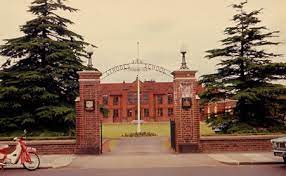
At the end of my first year at Strode’s School, I was somewhat surprised to be awarded three School Prizes. As if to prove that British society was not founded on meritocracy, these book token prizes [see blog] were rarely given to students who had scored the highest examination or classwork results. Rather, they seemed to be determined by the whim of each subject teacher. This was proven by me being awarded the first-year ‘Religious Knowledge’ prize, despite having never read the Bible, having no belief in God and having attended church only once in my life [see blog]. During the first term of my second year, an event was held in the school hall to formally award boys the prizes they had won, dragging them onto the stage to receive a book token. It was called ‘Speech Day’ even though it was only the staff who made speeches. Parents were invited to watch their bright young things be acclaimed as ‘special’. That year, neither I nor my disinterested parents chose to attend.

One year later, things turned out different. I had been awarded no second-year School Prize. This outcome did not bother me. It merely confirmed my suspicion that the prize criteria were wholly subjective since my exam and classwork rankings in some subjects had improved over the previous year. Exactly how could I have achieved first place in Mathematics during the academic year but fail to be awarded that subject prize? Maybe the school was displeased with my demonstrated deficit of competitive spirit. Maybe me and my parents’ absence from last year’s ceremony had been grudgefully noted. Maybe the school had merely concluded that I was an ‘unworthy’ student as, during my remaining five years, I was awarded no prize.

The other difference that second year was that, despite my lack of prize, I attended Speech Day with my father. There was no compulsion for us to be present. I was confused that a father who took zero interest in his son’s education had unilaterally decided we both attend. I had explained to him that I was not receiving a prize that year but he remained firm. It felt very strange. This was the only occasion on which my father visited my school during my entire seven years there. He parked his ridiculously ostentatious American sports car [see blog] on the playground outside the main hall in which we sat together during a ceremony lasting several hours, me completely befuddled about why we were both there.

I had absolutely no inkling then that this one day would change the rest of my life. Not because of Speech Day. Not because of my school. Not because of me. Not even because of my father. Or even the silly car he had driven frighteningly fast and dangerously to and from the event. So what happened? The clue was in the absence of my mother that day at that event. Where was she and what was she doing?

To understand her absence, it proves necessary to go back in time thirteen years and 173 days to the occasion my mother gave birth to her first child in a semi-detached council house on the Old Dean Estate. I have no knowledge about the circumstances of that arrival because my mother refused to elucidate, except to accuse her husband of absenteeism because he was visiting a mistress due to give birth imminently to his child. Within months, my parents and their new baby were evicted for non-payment of rent, due to my father having unilaterally purchased an unaffordable car to impress his mistress. If my mother’s father had not bailed them out with accommodation, they would have become homeless.

Five years and 217 days later, my mother gave birth to her second child in Farnham Hospital, a facility Camberley (population 33,770) still lacked. During her absence, she entrusted childcare of her firstborn to her husband, despite him having never shown any paternal feelings for his offspring. Luckily, my mother’s parents now lived next door and ended up feeding and entertaining their grandson during his mother’s absence. Did her husband drive his son daily to the state infant school on Old Dean Estate he had started three months earlier, as asked? No, but he did warn his son not to admit this absenteeism to his mother when she returned a week later. Did he visit his wife in hospital? Not once. Was he busy with yet another mistress? Who knows.

Take a further leap forward in time to where my story started – Speech Day at my school in 1971 and the absence of my mother. Where was she? She was in hospital giving birth to her third child that day. My father would have done anything to avoid being alongside her in hospital, even if it meant him attending a function at my school for the first and last time. It proved convenient for him to be 21 miles and a 53-minute drive away from his wife on that day, armed with a suitably fatherly excuse, having demonstrated a sudden interest in my schooling. In retrospect, my two parents were already moving along divergent paths, that day merely widening the gulf between them and soon leading to the breakup of our now three-child family.

My mother had grown up during the War in a two-up, two-down suburban semi-detached house, sharing a bedroom with two older sisters in a loving working-class family. Together, the three children had shared homemade girly pastimes in an era before they had radio or television. They lived on a quiet residential street in a house with a large back garden, surviving the War with produce grown in their father’s well-maintained allotment at the top end of Barossa Road where he raised chickens. It had been an idyllic childhood, despite having to occasionally hide under the wooden dining table when the German bombers arrived to attack adjacent Sandhurst Royal Military Academy [see blog].

My father was raised in a household filled with anger and violence. His brutal father beat his wife and his two sons, for none of whom he ever demonstrated love or affection. He knocked his wife down the stairs which killed her. A significant part of my father’s attraction to my mother and her family was that they were everything that he was not. She had loving parents, she had attended grammar school, she was beautiful and radiated a youthful, confident optimism. He had left school at age fourteen with few prospects and was desperate to escape the hell of his parents’ home. When the couple eventually married, once my father returned from Army conscription to the Suez Canal, my mother’s father refused to attend their Registry Office ceremony, believing that his much-loved youngest daughter deserved a partner with better prospects from a less abusive family.

When my mother became pregnant the first time in 1957, she hoped to have a girl with whom she could relive all the girly activities she had enjoyed with her sisters. She was disappointed to give birth to a boy. She persevered anyway, teaching me to knit, to sew, to bake cakes in the kitchen with her and to cut out clothes patterns with pinking shears. She passed down to me her and her sisters’ 1930’s childhood books such as ‘Heidi’, ‘Black Beauty’ and ‘Anne of Green Gables’. But I showed no interest in dressing up, sculpting elaborate hair-do’s or playing with makeup. I was a disappointment. As the youngest of three sisters, she had never experienced a baby in her household. She had no idea how to raise a boy, so she left me to my own devices most of the time, failing to instruct me in personal hygiene [see blog] or the three R’s. Our home possessed few books, but I consumed cover-to-cover the huge piles of 1960’s women’s magazine titles my mother bought, teaching myself to read and write. Once old enough to walk out by myself, the nearby local municipal library in Knoll Road became my saviour [see blog].

Five years later, after my mother gave birth to another boy, her sense of disappointment was even more self-evident. She committed even less effort to raising him than she had her firstborn, allowing him to grow up barely literate or numerate. He ran away regularly from primary school, showed destructive/self-destructive, violent tendencies and barely spoke to his older brother, despite them sharing a bedroom for six years. Much later in life, he was treated for addiction and was divorced by his wife. In the words of the song [Epic EPC7632]:

“One child grows up to be somebody who just loves to learn.
Another child grows up to be somebody who just loves to burn.”

Eight years later, my mother unexpectedly became pregnant for a third time. I learned this from hearing my parents arguing at night in their bedroom adjacent to mine. My mother wanted to keep the baby, hoping finally to have the girl she had always desired (there now being an 87% chance). My father was insisting she have an abortion. The arguments became more heated. Soon my mother refused to leave the house for a week due to a huge bruise across the right side of her face. On another occasion, she locked herself in the toilet, only for her husband to kick a hole in the wooden toilet door. The door remained that way for the next decade as a visual reminder of his violent behaviour.

My mother eventually won the argument and her third child, a girl, was born whilst I was sat with my father in the school hall, enduring Speech Day presentations. He took no interest in his newly arrived daughter nor, by extension, in her mother. Approaching the age of forty, he was riding a middle-age wave of selfish indulgence, fuelled by cash profits from dodgy property deals he was making with his new business partner, a local second-hand car dealer not afraid to employ mafia-style pressure tactics [see blog]. Flush with money for the first time since leaving school, he could at last satisfy his craving for fast sports cars, dinner parties, restaurant meals and foreign holidays. He took me with him on a flimsy pretext to Florida for a week, only to abandon me alone in a motel whilst he practiced a playboy lifestyle [see blog].

Within months, after increasingly unexplained and lengthening absences, my father walked away from his family altogether to pursue the hedonistic lifestyle he had evidently desired all along [see blog]. I did not miss him because he had played almost no role in my upbringing. He no longer had to pretend publicly that he loved his family. Instead, he decided to do everything possible to cause us pain and suffering, just as his parents had done to each other, to him and his brother. He now took zero responsibility for his former family, fighting in the courts not to provide financial support. He broke into our house and stole everything of value, including the car he had given my mother and most of her jewellery [see blog]. Our lives would never be the same.

During the months leading up to his departure, my father had been regularly playing on the living room stereo a vinyl single he had bought by The Fifth Dimension called ‘One Less Bell to Answer’ [Bell BLL1137] whose lyrics included:

“I only know that since he left
My life’s so empty
Though I try to forget
It just can’t be done
Each time the doorbell rings
I still run
I don’t know how in the world
To stop thinking of him
‘Coz I still love him so
I end each day the way I start out
Crying my heart out”

Only in retrospect did I realise these words represented the pain my father had been planning for some time to inflict upon his wife. During the previous two decades, she had ignored his regular philandering. Now, having finally gained the daughter she had long desired, he was determined to make her pay. He secretly visited each of her relatives and friends to convince them that his wife had done something heinous that had forced him to leave her and their three children. Most ignored his pleas but some, notably my mother’s older sister Sheila, bought his lies and refused contact with my mother for decades [see blog]. The outcome was that my mother became isolated, lacking moral support she should have received from the people in Camberley she had known her entire life. Meanwhile, my father set up home on an affluent private estate with a runaway teenage bride who had lived only a few doors away from us [see blog].

My mother could not adjust to our changed circumstances. Until the day she died half a century later (or, more accurately, until the day my father died eight years before her), she continued to believe that her husband would one day knock on her front door and come back to her. He never did. Her father having disapproved so publicly of her marriage choice, she had tried to do everything to prove him wrong, even ignoring the mistresses my father had accumulated over many years and the unknown children he had sired. The remainder of my mother’s life was lived in a sad, darkened interregnum in which she awaited a resumption of her pre-1971 ‘happy family’ married lifestyle. It never happened.

Although her daughter was not yet one year old, my mother was forced to take two jobs to generate income to feed her family because her spiteful husband was paying nothing. Her full-time day job was as bookkeeper for British Car Auctions in Frimley. Her evening job was cleaning offices in Yorktown. Her retired parents, who stuck by her, looked after my baby sister during weekday daytimes. Year after year from that moment, all my mother seemed to do was work to try and make ends meet. Having lost her own car to her husband’s new mistress, she had to borrow her father’s 1963 Austin Cambridge car just to get to work. Fortunately, my eight-year-old brother’s school was within walking distance of our home.

Although she possessed the skills to administer her new single-parent life, the result of having previously been employed in bank and accounts offices, my mother now abdicated all responsibility for her affairs. Almost all of the mail she now received were bills, red reminders and threats of court action. Not only did she refuse to open them, she would stuff them all into a drawer in the living room, never to be retrieved. Out of sight, out of mind. Neither was this a temporary reaction to her struggling situation. Until the day she died half a century later, she refused to deal with any paperwork she received or was required to action. It was a blatant refusal to adapt to a life in which her household budgets and accounts needed to be balanced, paradoxically the very work she performed for her employer five days a week.

Not once did my mother ever ask me to take on the responsibility of managing her affairs. She could not have cared less. I realised that her strategy was irresponsible and would doubtless drive our family into disaster. Unopened letters stuffed into a drawer would inevitably lead to court actions, debt collectors and bailiffs. My mother would lose her jobs. We would lose our home. Me and my siblings would be placed into care. We would all have to change schools. Perhaps that was the exact outcome that my cruel father wanted. I was the oldest child of our family. I was clever. I had already received more formal education than any of our relatives. I was barely fourteen. By default, I had become the ‘head’ of the family, a role I had never wanted but which was now thrust upon me.

Within months of my attendance at my school’s Speech Day alongside my father, my whole world was turned upside down. My supposedly carefree teenage years and adolescence were taken away from me. I was suddenly a young adult. Never again would I observe my life as similar to that of my peers. I had responsibilities. Huge responsibilities. My own personal ambitions had to be subsumed to the struggle for mere survival of our family unit. There was nobody with whom I could share this responsibility or even explain the tasks I now had to do. My schoolfriends would never have understood. School staff were already unsympathetic towards me, having sent me home occasionally for wearing the wrong colour socks, the wrong colour shoes, slip-on’s instead of lace-ups and having hair touching my collar [see blog].

Events that took place on that one day, 7 October 1971, events over which I had no control would impact the entirety of my life. I did not realise it then. At the time, I thought I was simply doing ‘the right thing’ whilst those around me seemed hellbent on doing ‘the wrong thing’. I had no idea that a life of making small personal sacrifices as a teenager would lead to making bigger and bigger sacrifices as the years passed and end up stealing away so many opportunities to satisfy my own life.

After my father walked out and disowned his family, I could have just ignored the consequences and retreated into my own world, as my younger brother chose to do. But I was old enough and wise enough to understand the outcome of that route. Our circumstances would fall into irreparable disaster and we might all be split up and sent to children’s homes. Our mother might be imprisoned for unpaid debts. I decided to do my best to stop those disasters happening. Nobody else was there to help. It was me alone who had to try and keep us all together. So I tried.

[to be continued…]

[Originally published at https://peoplelikeyoudontworkinradio.blogspot.com/2026/08/the-day-my-world-stood-still-7-october.html ]

Teach your children well? : 1960s-1970s : vegetable-free adolescence, Camberley

 “How often do you wash your face?” asked the doctor.

“Like how?” I responded, uncertain about what he was enquiring.

“You know, with soap and water,” he clarified.

“Er, never,” I replied truthfully.

“Why not?” he demanded.

“Because nobody ever told me I needed to,” I said, somewhat embarrassed.

The doctor regarded me pitifully, imagining I must belong to a tribe of itinerant gypsies or have been raised by wolves. To the casual observer, my suburban home life appeared quite normal. Scratch the surface and you would have discovered that my parents had given me few of the ‘life skills’ that are supposed to be demonstrated to children. On this occasion, my mother had sent her teenage son to the family doctor in Frimley Road because his face had become progressively covered in spots. But neither she nor my father had ever instructed me how or when to wash. Once a week, I stood under the water in our modern home’s shower cubicle. If my face became wet while shampooing my hair, I merely dabbed it dry with a towel.

The doctor wrote a prescription for a liquid called ‘Phisohex’ which came in a large green bottle. After a few weeks washing my face twice daily with this cleanser, my spots magically disappeared, following more than a decade of cheeks shamefully having been untouched by soap. Did my mother acknowledge this shortfall in her parental duties? Of course not. This was but one aspect of her ‘hands-off’ approach to childrearing. She had enjoyed a good post-war education at Camberley’s girls’ grammar school in Frimley Road where she was likely taught conventional housekeeping and domestic skills in preparation for marriage. She was goodlooking and always dressed immaculately in the latest trends. Her parents had raised her and her two sisters impressively. So where had her own parenting regime gone awry?

Most of the basic skills I developed – writing, reading, arithmetic – I learned from books and television rather than parental instruction. However, one ability that proved impossible to appropriate in that way was tying shoelaces. As a result, at junior school, after ‘PE’ (Physical Education) lessons that required us to change into slip-on plimsolls, I always had to seek out my cousin Deborah in the year below mine to ask her to retie the laces on my shoes. Once I progressed to grammar school, my skill deficit became more difficult to hide. The mandated school uniform required black lace-up shoes. My mother acknowledged my ‘shoelace’ issue but, instead of simply demonstrating how to do it, she bought me slip-on ‘Hush Puppies‘ shoes for school which resulted in regular disciplinary action. Finally, I had to draft an embarrassing letter from my mother to the school, asking for her son to be excused from the dress code due to difficulty finding suitable lace-up shoes for his high in-step feet.

Like many 1960’s housewives, my mother regularly cut out recipes from magazines and stuffed them in a kitchen drawer. She was particularly proud of a plastic box with transparent lid holding two rows of Marguerite Patten recipe cards that she had sent for to ‘Family Circle’ magazine and which I was tasked with keeping in correct order. She loved making cakes and had a sweet tooth that probably promoted the development of diabetes in her later life. However, her skills with main meals were limited and she preferred to rely upon ‘instant’ foods like fish fingers that were heavily marketed to ‘busy’ housewives at the time. This was probably why I remained as thin as a rake during my childhood, despite teenage years spent scoffing two bowls of cereal both morning and night.

I had been a regular visitor to the family dentist on Middle Gordon Road due to the dreadful state of my teeth. Even at a tender age, I was being gassed for extractions. On one occasion, the stern dentist accused me of not brushing my teeth sufficiently firmly to prevent decay. I resolved to use the state-of-the-art electric toothbrush in our family bathroom with greater pressure during twice-daily cleanings. I returned to the dentist six months later, only for him to inform me that I had rubbed away most of the enamel from my remaining teeth. The outcome of his ‘advice’ was merely more extractions. Not once did this dentist question my mother about her children’s diet. Even if he had, she would have been unlikely to respond honestly.

My mother had an inexplicable lifelong aversion to vegetables. Only the humble potato would accompany our meals, usually in the form of Cadbury’s ‘Smash’. Carrots? Never. Peas? Nope. Broccoli? Unseen. There were other foodstuffs we never experienced – spaghetti, yoghurts, condiments, rice – because my mother had a preference for jellies, custard and blancmange, but it was the lack of vegetables that must have impacted our health growing up the most. I never understood how, despite the piles of women’s magazines around our home, she somehow studiously avoided taking their practical advice regarding suitable family diets. Such behaviour could have been excused earlier in the twentieth century when literacy and knowledge were less prevalent, but surely not by the 1960’s.

Much of my childhood during weekends and school holidays was spent at my maternal grandparents’ adjoining house where I helped prepare ingredients for their meals. Instructed by my wonderful grandmother, I would sit on the backdoor step with a bowl between my knees, shucking peas from their pods. I would use a peeler to remove the skins from various vegetables whose names I did not know. I would carefully place dozens of apples in rows within cardboard boxes, separating each layer with old ‘Daily Sketch’ newspapers before carrying them into the recesses of the house’s darkened larder under the stairs. My grandmother loved to make jams with these fruits, for which I carefully wrote out white adhesive labels carrying the manufacture date and type. Bizarrely, none of these vegetables or jams were ever served in our own house next door.

From the day she left school at twelve until the day she finally retired, my grandmother worked in fruit and vegetable shop ‘H.A. Cousins & Son’ at 11 High Street on the corner of St George’s Road in Camberley. During all those decades, her ‘sales assistant’ job never changed, standing all day on the shop’s bare floorboards, putting requested items in brown paper bags, weighing them on old-style scales against combinations of various brass weights, calculating the cost in her head and then the correct change to return to the customer.

Shop owner Mr Cousins would daily travel thirty miles to the fruit, vegetable and flower markets in London at the crack of dawn, returning with a van of produce to sell. Once a day’s stocks were sold, that was it. Any produce left over would be given to the shop staff. My grandmother regularly brought home quantities of all sorts of fruit and vegetables which she shared with us, though my mother always refused the vegetables. Thankfully, she did accept the fruit which became the sole source of my necessary five portions per day.

Cousins advertised its shop locally as “by appointment to Staff College” (Sandhurst Royal Military Academy), providing “Dessert Fruit and Flowers for Dinner Parties, etc.” Its upper-class customers and Sandhurst’s foreign residents necessitated it stock a variety of exotic fruits, the excess of which ended up in my family’s fruit bowl. Visitors to our house in the 1960’s were shocked to see pineapples, mangoes and lychees on our dining table, delicacies that I enjoyed as ‘normal’ long before their availability in supermarkets.

My mother insisted that fruit always be eaten covered in sugar, her favourite ingredient. Cups of tea required two spoons of white sugar, coffee two lumps of Demerara sugar, stewed apples or pears served frequently as our dessert had to be sprinkled with granulated ‘Tate & Lyle’. Even when I visited my mother in her final years, she would buy in a banana to offer me (she refused to eat them), accompanied by a plate of sugar in which to dip it. Thanks, mum. Banana yes, sugar no.

When my grandmother reached the statutory retirement age of the time, we all went round to her house for a little celebration of her departure from a lifetime of work on Cousins’ shop floor. She was pleased to be able to retire before Britain switched to decimalisation in 1971 as she feared metric calculations that no longer involved farthings, florins, half-crowns and guineas. Months later, the shop asked if she would return and work part-time because it was short-staffed. Of course she agreed. In total, she clocked up more than half a century working for that one employer in that one location, a 400-metre walk from her sole marital home.

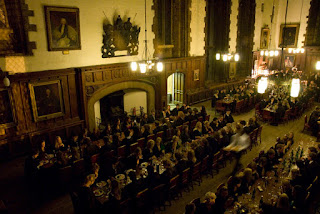
In 1976, on arrival at university, the bulk of my Surrey County Council grant had to be paid in advance for one term of accommodation and three meals per day within college. Having never taken school dinners and rarely eaten out in restaurants, I was unfamiliar with the canteen system where you line up and tell the kitchen servers which food you want. I hardly recognised any of the foodstuffs on offer and would often merely opt for two identical desserts, skipping main courses entirely. Most intimidating were twice-weekly ‘formal dinners’ lasting an hour, during which more than a hundred students remained seated at long benches in the huge dining room to be served by staff a succession of courses completely foreign to me. The table places were laid with radiating lines of various cutlery, none of which I knew their specific purpose. My fellow students seemed to find all this ‘etiquette’, including ritual table-banging and foot-stomping, perfectly normal because 90%+ of them had grown up around such ‘practises’ at elitist private schools. I often avoided these ghastly events and sat in my room munching a packet of biscuits.

My parents having never taught me how to use cutlery, I had developed my own system whereby I always used my right hand to hold the fork. Only when I had to cut up some food would I transfer the fork to my left hand and then simultaneously use the knife in my right hand. The rest of the time, I placed the knife down on the table. Nobody had ever corrected me. Not until sitting in that university dining room, surrounded by loud toffs with posh accents and double-barrel surnames, did I have to learn to eat holding the fork in my left hand. To this day, my default way of eating is to grab the fork with my right hand. Old habits die hard.

In 1986, my little sister was offered a Saturday job on the till of a small self-serve fruit and vegetable shop in Camberley town centre. She was worried that she would not recognise the produce she would be expected to ring up, since our mother had never fed us veg other than potatoes. By then, I had spent a decade living away from our vegetable-free home and was able to accompany my sister on a ‘Secret Squirrel’ mission to the shop, during which we walked slowly around its one central aisle and tried to identify the varieties of common vegetable on sale. ‘Common’ to everyone else, particularly to our beloved late grandmother, but weirdly not at all to us!

In retrospect, my childhood must have been quite unusual because, although I lacked some basic life skills, I was steeped in other abilities beyond my age. By junior school, I had taught myself to type, to read music and play the piano (despite having non-musical parents). Having recruited me into his business once I could walk, my father taught me how to survey a property, create architectural plans on a drawing board, use Letraset, calculate floor areas and room volumes, prepare client invoices and statements on an electric typewriter, photocopy and make dyeline prints. Meanwhile, my mother enrolled me into reconciling her employer‘s accounts and calculating its staff’s pay packets, pinning and cutting dress patterns to materials, basic knitting stitches, using her sewing machine and threading multiple yarns on her knitting machine. I was eight when typing the forms for my parents’ passport renewals, testing my mother’s knowledge for her driving test and testing my father for his pilot licence. By the time I started secondary school, I was holding the fort at my father’s town centre office, learning shorthand from my mother’s discarded 1950’s text books and calculating potential profits of deals for my father’s new property business. What a strangely un-childlike childhood it was!

[Originally published at https://peoplelikeyoudontworkinradio.blogspot.com/2024/06/teach-your-children-well-1960s-1970s.html ]

Attempted murder on the Waterloo express? : 1971 : Bagshot railway station

 Kapow! There was an explosion. Before I even grasped what had just happened, I could see I was covered with shards of glass. What was that noise? The train window I was sat next to had suddenly vanished and was in pieces on me and the seat. Luckily, I had not been looking towards the window at the time, otherwise my face would have been injured. Luckily, because it was winter, I was wearing an army surplus hat with furry earflaps that had protected my head and ears. Luckily, I was wearing a coat over my school blazer, gloves and long trousers that had shielded me, these winter woollies necessary because trains’ heating systems rarely functioned adequately.

I caught the ten-past-eight number 28 train every day for seven years from Camberley station to my school half-an-hour away in Egham. It was part of a commuter route propelling workers on the one-hour journey into London’s busy Waterloo terminus. Travelling to school this way felt like stepping into Narnia through the wardrobe door of our suburban British Rail station. Journeys were populated by strange characters not present in my normal day-to-day homelife. The station platform was awash with bowler-hatted, suited gentlemen carrying leather briefcases and rolled-up umbrellas. Women were a rare sight. Humourless station staff in uniforms shouted announcements about delays in the tone of army drill sergeants. Bumptious Terry-Thomas ticket inspectors walked through train carriages, looking down their noses at our thick green cardboard season tickets as if we were interlopers on their Orient Express.

At least the trains on our line were relatively modern electric rolling stock. As a small child, I recall standing at the top of the open footbridge over Camberley station, looking down at the signal box beside the level crossing and feeling clouds of smoke envelope me from a steam train passing underneath. Or was that a ‘Railway Children’-inspired false memory, acquired from reminiscences by my grandfather who had worked unloading timber for local building firm ‘Dolton, Bournes & Dolton’ in the goods yard beside the station? He had been made redundant in the early 1960’s for the yard to be replaced by a new ring road and Camberley ‘bus station’, in reality no more than a line of bus stops and tiny shelters without a waiting room. After my afternoon arrival in Camberley by train to await the hourly 39B (40 minutes past every hour) or two-hourly 34A bus (15 minutes past even hours) for the final two-mile journey home, I would have to walk over to the railway station lobby and sit opposite the ticket window to keep warm and dry.

My schoolfriends and I were the Pevensie children of Camberley, rendezvousing every morning at the very rear of the station’s eastbound platform that could accommodate only four carriages, despite our train normally being eight. When the train driver pulled up close to the signal at the top of the platform, we could just about clamber up to open the first door of the fifth carriage from the platform’s sloping end. Those rear four carriages became our playground because, until the train reached Ascot station’s longer platform, we had that section entirely to ourselves. No other passengers, no train staff. We could be as loud and unruly as we wanted. We would walk down the corridor to sit at the very rear of the train because, eventually alighting at Egham station’s full-length platform, we would be right next to the exit gate.

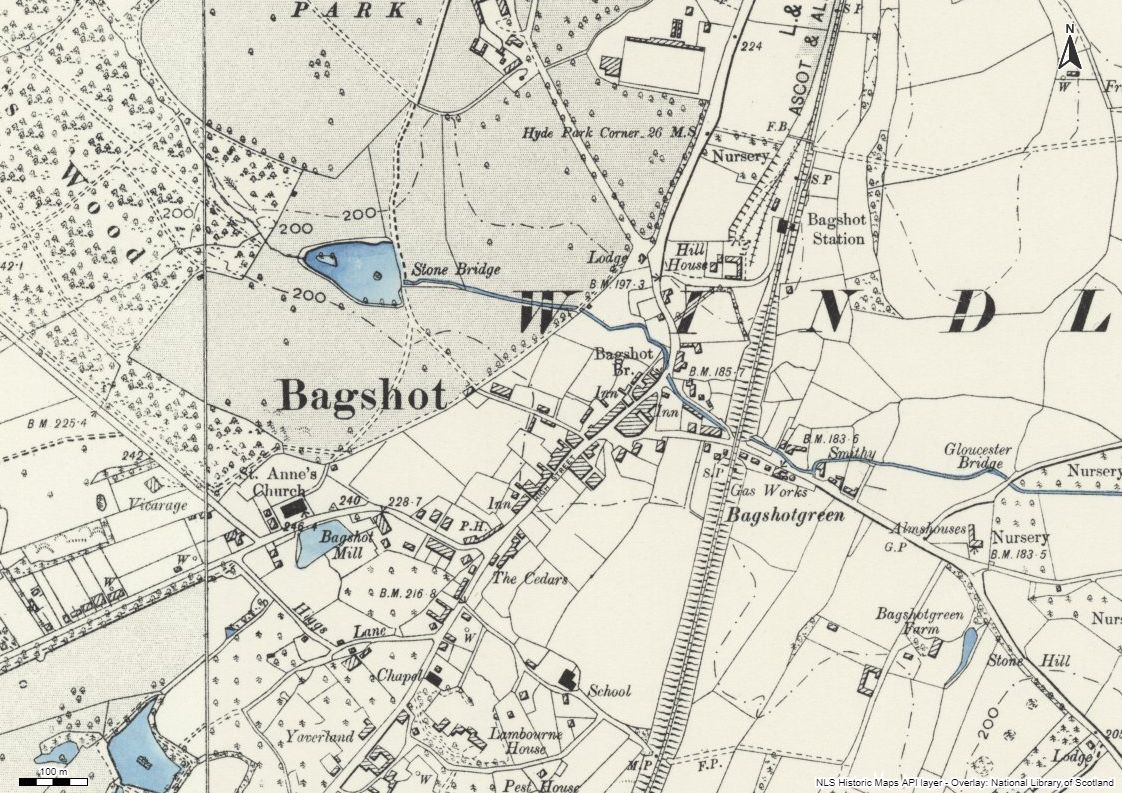
When the incident happened that morning, the train had slowed down to pull into Bagshot station and was about to cross the Guildford Road viaduct, a massively tall structure of four arches built in 1878. On either side of this bridge carrying dual train tracks were high embankments with steep, near vertical sides. On the north side, below the railway, was a vast tract of land owned by ‘Waterers Nurseries’ since 1829 to grow and sell plants. Before reaching that was Bagshot Infant School, set back from the embankment, on School Lane that ended in a footpath passing under the embankment towards Bagshot Green farm on the south side. At the time, undeveloped land stretched on both sides and (unlike now) the embankment was not bordered by trees.

Could a person have thrown a stone from the north side to make the train window next to me shatter? Unlikely because the embankment on which the train passed was too steep to stand upon. If the culprit had stood further away, below the embankment, a rock could not have reached the height necessary to make contact with the train, nor would it have retained sufficient momentum to smash the window with enough force for it to have not merely cracked, but to have shattered in its entirety.

What kind of projectile could have caused such damage? A powerful gun of some kind could have generated the necessary velocity and momentum for its bullet to shatter the thick glass window. A gunman (or woman?) would have needed practiced skill to aim upwards from the land below the embankment, or possibly to have lain half-way up the embankment adjacent to the footpath (now ‘School Lane Field’). In either case, it would have required planning and experience to succeed in such a challenging topography next to the train route. Since only two trains per hour travelled in either direction, this act could not have been a spur-of-the-moment impulse.

Why was the window I had sat beside targeted? As the train decelerated to enter Bagshot station, the rear carriages would have passed at a slower speed, making them an easier moving target than the front ones. Us schoolboys were habitually the only passengers anywhere in those rear four carriages, making my head the one visible sign of on-board life amongst dozens of otherwise empty train windows. That implies that my window must have been purposefully selected as the intended target. It was a dark winter morning and the internal carriage lighting would have made my outline visible from outside the train.

So where did the bullet land? Only one thing was certain: it had not hit me, otherwise I would not be here to tell the tale. Did we look to see if a bullet had passed over my head and become embedded in the carriage’s structure? No. In that pre-‘CSI’ era, forensic science remained an unknown foreign land. From watching weekly television detective shows, all we understood was that ‘McCloud’ cracked cases by riding his horse down Broadway, ‘Columbo’ used his raincoat and ‘McMillan’ solved crimes by getting into bed with sweatshirt-wearing wife Sally. In the aftermath, I had not even deduced that I had likely been targeted by somebody shooting a gun. That is how unworldly I must have been, though I had always enjoyed the pellet-gun target shooting stall at the fair’s bi-annual visits to Camberley Recreation Ground.

So how DID I react to this dramatic event? Did I scream? Cry? Sob uncontrollably? No, I simply stood up, brushed off the glass fragments that had covered me, and our little group moved to an adjoining carriage where the breeze through the vacant window would not make us feel colder. Even had we wanted to, there was nothing we could have done immediately. There were no train staff in those rear carriages and, once the train stopped in Bagshot station, its platform was too short to get out. Only once we reached Ascot was the platform long enough to deboard. So, did we? No, because if we had raised the alarm, we realised the fickle finger of fate might have pointed to us bunch of schoolboys for having broken the window. Which British Rail jobsworth would have believed our story that someone laying on a grassy knoll in Bagshot must have targeted me for assassination?

Leaving the train at Egham twenty-five minutes later, we could see the void where the window had exploded in front of our eyes. Nobody else seemed to have noticed the gaping hole or had bothered to halt the train to investigate. If they had, we might have arrived late for school that day. That would have been a fate worse than death. We had already brushed aside the incident and were more concerned with the school day ahead of us. Once I returned home that evening, I did not even bother mentioning to my parents what had happened. Only years later would I realise what a close call I had experienced that winter morning at the age of thirteen.

For us kids, trekking from one end of Surrey to the other every weekday on public transport, strange events would occur regularly in this otherworld. Our trains were sometimes cancelled, or rerouted through stations that were unknown to us, or suspended when someone jumped to their death off the footbridge at Egham station. In the latter case, some of us would watch morbidly for the arrival of emergency services whose crew had to scoop up the person’s bloodied remains spread along the tracks by a speeding train. Our unspoken attitude was: almost anything could happen on our way to and from school … and often did. It was a daily expedition into a world beyond ours, populated by weird adults to whom we appeared to be invisible.

Once a year, during ‘Royal Ascot’ week in June, our train would fill with bizarrely overdressed racegoers with strange toff accents and extremely loud voices who carried bottles of alcohol, swayed precariously and occasionally were sick on the carriage floor. They were much worse behaved than we had ever been, their conversations often ribald and filled with profanities. Did anyone chastise them, force them off the train or tell them to act respectfully in front of us children? Not at all! They did precisely what the upper classes are wont to do with their own children: they ignored us totally and appeared completely unembarrassed by their own behaviours.

I recalled the Bagshot train incident when, half a century later, I went for a run through rural France on a bright summer morning. There was no traffic and no visible human activity as I ran down the middle of a tarmacked road flanked on both sides by flat agricultural land. The only noise was birdsong until … a high velocity bullet whizzed above my head from left to right. I stopped running, turned in the direction from which it had come and shouted profanities (in English) at the top of my voice. Without my glasses, I was unable to see far enough into the distance to spot the culprit. This was no accident. I could not have been mistaken by a hunter for an animal. I was clearly visible on a ‘departmental’ road, not in the middle of woodland. But I had been the only object moving in this static landscape and that seemed sufficient to unwittingly make me a target.

If I were superstitious, I might be worried about ‘third time lucky’.

[Originally published at https://peoplelikeyoudontworkinradio.blogspot.com/2024/04/attempted-murder-on-waterloo-express.html ]

The day the (reggae) music died : 1981 : Bob Marley, Linton Kwesi Johnson, Matumbi

 “Bob Marley has died!” I exclaimed. Having switched on the car radio before starting the engine, one of Marley’s songs was playing on John Peel’s ‘BBC Radio One’ ten-to-midnight show. I knew immediately what that meant. Peel was a longtime reggae fan, though I had not heard him play a Marley track for years. There was no need to await Peel’s voice announcing the sad news. I had read that Marley was ill but had not understood the terminal gravity of his health.

Peterlee town centre was dark and desolate at that late hour. I had walked to my little Datsun car across a dark, empty car park adjacent to the office block of Peterlee Development Corporation, accompanied by my girlfriend who was employed there on a one-year government job creation scheme. We had attended a poetry reading organised by Peterlee Community Arts in the building, an event she had learnt of from her marketing work. It was my first poetry reading. Only around a dozen of us were present, everyone else at least twice our age. But what we heard was no ordinary poetry.

Linton Kwesi Johnson had coined his work ‘dub poetry’ in 1976 and already published three anthologies and four vinyl albums, voicing his experiences as a Jamaican whose parents had migrated to Britain in 1962. Peterlee new town seemed an unlikely venue for a ‘dub poet’, a deprived coal mining region with no discernible black population, but working class Tyneside poet Keith Armstrong had organised this event as part of his community work there to foster residents’ creative writing. Johnson read some of his excellent poems and answered the group’s polite questions. It was an intimate, quiet evening of reflection.

https://open.spotify.com/embed/playlist/0NjIxvry79Svr0G4Qzb5NR?utm_source=generator

Due to my enthusiasm for reggae, I was familiar with Johnson’s record albums as one strand of the outpouring of diverse innovation that Britain’s homegrown reggae artists had been pioneering since the early 1970’s. Alongside ‘dub poetry’ (poems set to reggae), there was ‘lovers rock’ (soulful reggae with love themes sung mostly by teenage girls), UK ‘roots reggae’ (documenting the Black British experience) and a distinctly British version of ‘dub’ (radical mixes using studio effects). One name that was playing a significant writing/producing role spanning all these sub-genres was Dennis Bovell, alias ‘Blackbeard’, of the British group ‘Matumbi’. His monumental contributions to British reggae are too often understated.

Until then, there had been plenty of reggae produced in British studios and released by UK record labels such as ‘Melodisc’, ‘Pama’ and ‘Trojan’, but most efforts had been either a rather clunky imitation of Jamaican reggae (for example, Millie’s 1964 UK hit ‘My Boy Lollipop’ [Fontana TE 17425]) or performed by ‘dinner & dance’-style UK groups such as ‘The Marvels’. I admit to having neglected Matumbi upon hearing their initial 1973 releases, cover versions of ‘Kool & The Gang’s ‘Funky Stuff’ [Horse HOSS 39] and ‘Hot Chocolate’s ‘Brother Louie‘ [GG 4540]. It was not until their 1976 song ‘After Tonight’ [Safari SF 1112] and the self-released 12-inch single ‘Music In The Air’/’Guide Us’ [Matumbi Music Corp MA 0004] that my interest was piqued as a result of the group’s creative ability to seamlessly bridge the ‘lovers rock’, ‘roots reggae’ and ‘dub’ styles. Both sides of the latter disc remain one of my favourite UK reggae recordings (sadly, these particular mixes have not been reissued).

In 1978, Matumbi performed at Dunelm House and, after attending the gig, it was my responsibility as deputy president of Durham Students’ Union to sit in my office with the band, counting out the cash to pay their contracted fee. They were on tour to promote their first album ‘Seven Seals’ self-produced for multinational ‘EMI Records’ [Harvest SHSP 4090]. It included new mixes of the aforementioned 12-inch single plus their theme for BBC television drama ‘Empire Road’, the first UK series to be written, acted and directed predominantly by black artists. Sensing my interest in reggae, the group invited me to join them for an after-gig chat, so I drove to their motel several miles down South Road and we sat in its bar for a thoroughly enjoyable few hours discussing music.

As part of my manic obsession with the nascent ‘dub’ reggae genre, I had bought albums between 1976 and 1978 credited to ‘4th Street Orchestra’ entitled ‘Ah Who Seh? Go Deh!’ [Rama RM 001], ‘Leggo! Ah Fi We Dis’ [Rama RM 002], ‘Yuh Learn!’ [Rama RMLP 006] and ‘Scientific Higher Ranking Dubb’ [sic, Rama RM 004]. They were sold in blank white sleeves with handwritten marker-pen titles and red, gold and green record labels to make them look similar to Jamaican-pressed dub albums of that era. However, it was self-evident that most tracks were dub mixes of existing UK recordings by Matumbi backing various performers, engineered and produced by Bovell for licensing to small UK labels. I also had bought and worn two of their little lapel badges, one inscribed ‘AH WHO SEH?’, the other ‘GO DEH!’, from a London record stall. During our conversation in the bar, Bovell expressed surprise that I owned these limited-pressing albums, and even more surprise that I recognised Matumbi as behind them. They remain prime examples of UK dub.

It was Bovell who had produced Linton Kwesi Johnson’s albums, and it was Matumbi who had provided the music. Alongside a young generation of British roots reggae bands such as ‘Aswad’ and ‘Steel Pulse’, Johnson’s poetry similarly tackled contemporary social and political issues with direct, straightforward commentaries. It was a new style of British reggae, an echo of recordings by American collective ‘The Last Poets’ whose conscious poems/raps had been set to music (sometimes by ‘Kool & The Gang’) since 1970, and whose couplets had occasionally been integrated into recordings by Jamaican DJ ‘Big Youth’ in the 1970’s. Of course, MC’s (‘Masters of Ceremonies’) had been talking over (‘toasting’) records at ‘dances’ in Jamaica since the 1960’s, proof that the evolution of ‘rap’ owed as much to the island’s sound system culture as it did to 1970’s New York house parties.

In Peterlee, Johnson read his poems to the audience without music, his usual performance style. It was fascinating to hear his words without any accompaniment. For me, the dub version of Johnson’s shocking 1979 poem ‘Sonny’s Lettah’ (retitled ‘Iron Bar Dub’ on ‘LKJ In Dub’ [Island ILPS 9650]) is brilliantly effective precisely when the music is mixed out to leave his line “Me couldn’t stand up there and do nothin’” hanging in silence. Sadly, memories of Johnson’s performance that night were suddenly eclipsed by the news of Marley’s death. I drove the eight miles to our Sherburn Village home in stunned silence. I was sad and shocked. It was only then that his sudden loss made me realise how much Marley had meant to me.

Despite having listened to reggae since the late 1960’s, I admittedly arrived late to Bob Marley’s music. Though I had heard many of his singles previously, it was not until his 1974 album ‘Natty Dread’ [Island ILPS 9281] that I understood his genius. At that time, I was feeling under a lot of personal pressure which I tried to relieve by listening to this record every day for the next two years. At home, my father had run off, leaving our family in grave financial difficulties. At school, I was struggling with its inflexibility, not permitted to take two mathematics A-levels, not allowed to mix arts and science A-levels, not encouraged to apply to Cambridge University. Back in my first year at that school, I had been awarded three school prizes. However, once my parents separated and then divorced, I was never given a further prize and the headmaster’s comments in my termly school reports became strangely negative, regardless of my results.

Feeling increasingly like an unwanted ‘outsider’ at grammar school, Marley’s lyrics connected with me and helped keep my head above encroaching waters rising in both my home and school lives. I knew I was struggling and needed encouragement from some source, any source, to continue. For me, that came from Marley’s music. While my classmates were mostly listening to ‘progressive rock’ albums with zany song titles (such as Genesis’ ‘I Know What I Like In Your Wardrobe’), I was absorbed by reggae and soul music that spoke about the daily struggle to merely survive the tribulations of life. After ‘Natty Dread’, I rushed out to buy every new Marley release.

During the months following Marley’s death, I was absorbed by sadness. It felt like the ‘final straw’. The previous year, I had landed a ‘dream job’, my first permanent employment, overhauling the music playlist for Metro Radio. Then, after successfully turning around that station’s fortunes, I had unexpectedly been made redundant. I was now unemployed and my every job application had been rejected. That experience had followed four years at Durham University which had turned out to be a wholly inappropriate choice as it was colonised by 90%+ of students having arrived from private schools funded by posh families. I felt like ‘a fish out of water’. I loved studying, I loved learning, I desired a fulfilling academic life at university … but it had proven nigh on impossible at Durham.

“This is what I need
This is where I want to be
But I know that this will never be mine”

Months later, my girlfriend awoke one morning and told me matter-of-factly that she was going to move out and live alone. She offered no explanation. We had neither disagreed nor argued. We had been sharing a room for three years, initially as students in a horribly austere miners’ cottage in Meadowfield whose rooms had no electrical sockets, requiring cables to be run from each room’s centre ceiling light-fitment. Now we were in a better rented cottage in Sherburn, though it had no phone, no gas and no television. Her bombshell announcement could not have come at a more vulnerable time for me. I had already felt rejected by most of my university peers and then by my first employer. At school previously, I had passed the Cambridge University entrance exam but had been rejected by every college. At Durham, I had stood for election as editor of the student newspaper, but its posh incumbent had recommended a rival with less journalistic experience. A decade earlier, my father had deserted me and his family, and now the person I loved the most had done the same.

I just could not seem to navigate a successful path amidst the world of middle- and upper-class contemporaries into which I had been unwittingly thrown, first at grammar school, then at Durham, and now in my personal life too. Most of those years, I felt that circumstances had forced me to focus on nothing more than survival, whilst my privileged contemporaries seemed able to pursue and fulfil their ambitions with considerable ease. I had to remind myself that I had been born in a council house and had attended state schools, initially on a council estate. My girlfriend had not. I had imagined such differences mattered not in modern Britain. I had believed that any ‘socio-economic’ gap between us could be bridged by a mutual feeling called ‘love’. I now began to wonder if I had been mistaken. I felt very much marooned and alone. My twenty-three-year-old life was in tatters.

Fast forward to 1984. I had still not secured a further job in radio. I was invited to Liverpool for a weekend stay in my former girlfriend’s flat. We visited the cathedral and attended a performance at the Everyman Theatre. It felt awkward. I never saw her again. It had taken me months to get over the impact of Bob Marley’s death. It took me considerably longer to get over my girlfriend ending our relationship. 

“That clumsy goodbye kiss could fool me
But looking back over my shoulder
You’re happy without me”

https://open.spotify.com/embed/playlist/291PlBjtQIVyEzOPeXNSyD?utm_source=generator

[Originally published at https://peoplelikeyoudontworkinradio.blogspot.com/2024/04/the-day-reggae-music-died-1981-bob.html ]

Around the British Rail network in eight hundred minutes : 1976 : Durham University challenge

 “Which bus goes to the University, please?” I asked. The man replied helpfully, but I could not understand a word he had said. He spoke English, though not an English I had heard before. I was confused by all the bus stops, having just exited Lancaster railway station. At which one did I need to wait? There was no bus map. There were no obvious students to ask. I had never been north of Luton until then. I had never watched ‘Coronation Street’. I was a southerner who barely understood a word that was being said to me there, hundreds of miles from home.

I had left the house that morning at the crack of dawn to make a day trip to check out Lancaster University. It was one of five universities I had selected on my UCCA form, all of which had offered me a place, conditional upon A-level results, without requesting an interview. However, if I was going to spend three years far away from home, I wanted to go see each one to help me choose. I had never visited a university before. Aside from my teachers, I had never met anyone who had attended university. That year, I hoped to be one of the 6% of school leavers who would go on to university, a proportion that had multiplied from 2% the year I had been born.

My state school had provided no useful advice how to choose a university or course. Our designated ‘careers counsellor’ was actually a moonlighting English teacher who would merely direct us to a row of dogeared university prospectuses on his office shelf. Some were out-of-date, many were missing. We were offered no ‘careers’ seminars. Surrey County Council had compelled each sixth-former to complete a multiple-choice questionnaire and then informed us for which career we were supposedly suited. Further studies were never suggested. You were on your own when it came to an academic future.

I understood that my choice of university could be a life-changing decision, one that required me to review the maximum amount of available information. If neither my family nor my school could provide useful advice, I would research all the options myself. I wrote a letter to every UK university outside London (where I realised accommodation was unaffordable), requesting their current prospectus and details of their economics courses. I chose that subject simply because it had provided my best academic results at school. I had known for a decade that I desired a career in ‘radio’, though university courses in media or broadcasting did not exist. If I had known then that Britain’s first ‘media studies’ degree had been launched at the Polytechnic of Central London (later renamed the University of Westminster) in 1975, I might have rethought my plans.

Seven years earlier, at my council estate junior school, I had been one of three children out of my class of thirty (10%) to have passed the ’11-Plus’ examination, necessary to progress to ‘grammar school’. However, at that time, around 20% of UK pupils attended these ‘selective’ secondary schools, the difference attributable to the substantial numbers of privately educated children who were crammed intensively at fee-paying ‘preparatory schools’ to pass the exam and who then dominated grammar schools’ intakes. From my ‘year’ of sixty students at Strode’s School, only around ten of us progressed to university, an indication that the ’11-Plus’ was less a successful method of identifying Britain’s brightest children, and more a route for middle-class parents to secure their offsprings an elitist secondary education paid for by the state. Has this situation since improved? In 2008, the Sutton Trust reported that grammar schools were enrolling “…half as many academically able children from disadvantaged backgrounds as they could do”.

I was fortunate that Surrey County Council would pay my train fares for visits to five universities, whether an interview was required or not. I had to determine when each institution offered ‘open days’, book my place, arrange train tickets and inform the school of my impending absence. It required considerable organisation, particularly as these visits necessitated train connections in London. These were days when I would not return home until almost midnight and would have to go to school the following day. I had never travelled so many miles on public transport or seen so much of England from a train window.

I must have been the only student at my school to own a copy at home of almost every UK university’s current prospectus. My request for economics course information proved less successful. Many sent me nothing, the remainder provided a single sheet outlining a course that merely encompassed all aspects of the subject. I read absolutely everything I was sent and concluded that every university claimed to be absolutely perfect and their courses the best. I had merely filled my bedroom bookshelf with marketing propaganda. Instead, I decided to select four universities that already operated student radio stations as this was my long-term career objective … plus Durham.

Although Durham University had no radio station, I learned it was apparently thought of highly. If I were rejected by Cambridge, I considered it might be a reputational substitute. Due to the 300-mile distance, my trip to Durham required an overnight stay in Collingwood College which was offered free to those attending ‘open days’. After a long train journey followed by an uphill walk, I was given an undergraduate bedroom within the college and met several other visitors who were there for the same reason. We took the university’s guided tours together the next day and ate as a group in the college’s dining room, offering us a first taste of undergraduate life.

The following morning, we packed our bags and met together for the thirty-minute walk to Durham railway station on the opposite side of town to catch our trains back to ‘the south’. However, we found the platforms deserted and, eventually locating a member of staff, we were told that a strike had started that morning and there were no trains departing in any direction. Returning to the college with our tails between our legs, we explained our problem and it kindly offered to extend its hospitality until we could depart. Each of us changed our banknotes into piles of ten-pence coins and queued at the college’s one public phone in the basement to contact our parents and schools to explain that we did not yet know when we could return. A quick visit had unexpectedly transformed into something longer.

I took the opportunity to wander around Durham’s compact town centre and explore more places, particularly the ‘Musicore’ record shop. The university library and the cathedral were both impressive, as was the brutalist concrete student union building ‘Dunelm House’ and adjoining ‘Kingsgate Bridge’ constructed by architect Ove Arup in 1963. The other universities I had visited were campus-based, requiring a bus journey to the nearest town. I quite liked Durham’s integration into the city and the ability to walk from one end to the other without need of transport.

The next morning, before breakfast in the college dining room, I phoned Durham railway station, to be informed that no trains would be running for the second consecutive day. This was the only method to obtain information in those days. I met the others and we phoned our families with our disappointing update. We spent most of that day sat together in the Junior Common Room chatting, sharing our university visit experiences and our hopes for the future. For me, it was particularly interesting to meet young people for the first time who shared my situation.

I made another call to the railway station the next morning, anticipating more bad news, but was told a single train was expected that day. It would be heading north, the opposite direction to what we required. I asked if there was any alternative route to London and it was explained that, although the east coast route was still on strike, we could try travelling via the west coast on the opposite side of the country. When was this one train expected? In an hour, I was told. Action stations!

I located my fellow visitors and, without taking breakfast, we all signed out of college and rushed off to the station. There was no information available there about the time of the train, on which platform it would arrive or where it would be heading. While we waited, we examined a British Rail route map in the ticket office which showed a cross-country route from east to west coast that started in Newcastle, the next major stop north of Durham. We were the only people awaiting a train and did wonder whether we had been sent on a wild goose chase, only to have to return to the college for yet another night.

Then the day’s promised one train appeared and pulled into the station. Unsurprisingly, it was almost empty. Who would have known it would be running in the midst of a crippling strike? We boarded and waved farewell to Durham, not knowing if any of us would ever return. Within a quarter-hour, we alighted in Newcastle. It was the first of many times that day that we were required to explain to confused railway staff that, although our tickets to London were dated days earlier, the unanticipated strike had forced us to take the only train available … in the opposite direction.

Next, to cross England to the west coast, we discovered we had to take a less regular, slower train that would depart in an hour. The wait gave us an opportunity to walk out of Newcastle railway station, buy some breakfast and wander around the city. Compared to Durham, it appeared a huge, busy scruffy city centre with huge Victorian stores and old-fashioned shopping arcades. Even the clothes people wore seemed dated and dowdy, particularly seeing many men wearing flat caps. It was an industrial city where time seemed to have stood still fifty years earlier.

Our ninety-minute journey in a local train from Newcastle to Carlisle took us across the bleak terrain of the North Pennine hills, stopping only at tiny towns with strange, unfamiliar names like Prudhoe, Corbridge, Hexham and Haltwhistle. Once again, we were required to explain to the train’s on-board ticket inspector why we were travelling in the wrong direction with out-of-date tickets. He knew about the strike and laughed heartily at our story, wishing us well on our journey home. It began to feel like a kind of ‘expedition’ where, at every step, it proved necessary to explain why our little group of seventeen-year-olds were taking a route no sane person would choose to follow.

The train terminated at Carlisle, a two-thousand-year-old city on the border between England and Scotland, fifty-five miles west and north of Durham. It was midday by now and, from there, we could now take a west coast ‘Intercity’ train southbound. We did not venture outside the station as this would have entailed having to explain our tickets once more and we feared not being allowed entry back into the station. This region was unaffected by the strike and trains seemed thankfully to be running as scheduled.

Our four-hour journey to London was comfortable until a ticket inspector arrived. We explained our story but he seemed unaware of the rail strike on the east coast and disbelieved our narrative. Initially, he demanded we pay for new tickets. We refused because we each held a valid, paid-for British Rail ticket that we had been prevented from using by the strike. The argument continued and he demanded we write down our names and addresses in order that the police could be contacted so that we would be fined for travelling without valid tickets. He was a ridiculous ‘jobsworthy’ who showed no sympathy for our plight. His attitude ruined the longest, most gruelling part of that day’s journey.

Reaching London’s Euston station, our small group split up to head different directions home. It was a sad parting of ways as we had no idea if we would ever see each other again or even which university each of us might attend (no social media or mobile phones then!). The last few days had required us to bond in the face of adversity, forcing us to make a round-Britain trip we had never imagined. It would be quite a story to tell our classmates.

I crossed London by Tube, caught a train from Waterloo station to Camberley and then a bus, reaching home more than twelve hours after having left Collingwood College in Durham. My school might not have been happy about my extended absence but, later that year, those awaydays would play a major role in my decision to study in Durham. I felt as if I was already sufficiently familiar with the college and the town as a result of that elongated visit. I imagined that my fellow Durham students would be similar to those with whom I had travelled the length and breadth of England.

Did I receive correspondence from British Rail or the police as a result of the unfriendly ticket inspector we had encountered? Thankfully, no. Did I ever see my newfound friends again? Sadly, no.

[Originally published at https://peoplelikeyoudontworkinradio.blogspot.com/2024/03/around-british-rail-network-in-eight.html ]

You can’t tell me what I’m doing wrong… : 1976 : And Mother Makes Four, Camberley

 “Why are you choosing a university so far away?” aunt Sheila demanded of me. “You should commute from home to Guildford so you can help your mum.”

I was seething. It was the first time we had spoken in years and THIS was her ‘advice’ to me? How dare she! It was three years since my middle-aged father had walked out on our family to shack up with a runaway teenage bride. Following his departure, he had apparently visited Sheila and poisoned her mind against her younger sister, my mother, so that the pair exchanged not one word for decades thereafter. Just when my mother had needed sisterly support to survive a difficult breakup and resultant hardship, Sheila had frozen her out. But she still felt able to tell me how to run my life?

There had been a time, between 1967 and 1969, when I had walked round to Sheila’s home every afternoon after school. My parents had moved house, now too far away for me to simply catch a bus, so I would wait at Sheila’s between four and six o’clock until one of them arrived after work to pick me up. My lovely older cousin Keith would play me his Jimi Hendrix records on their living room stereogram until the arrival of his father from work at Solartron, a defence contractor in Farnborough. Suddenly, us children would be quickly ushered out into the garden (“Quick! I can hear his car,” Sheila would shout), or the kitchen if it was raining, because taciturn uncle Fred apparently required domestic solitude without the distraction of his three children (plus me). Even as a nine-year old, I viewed this household’s behaviour as bizarrely disciplinarian.

According to my mother, in the early 1950’s her father had forced a pregnant Sheila to marry Fred. That rift evidently never healed. Even by the 1970’s, when the couple and their children gathered with us at our grandparents on family occasions such as Christmas, Fred remained sat in his parked car on the street outside for hours, like a vampire uninvited to cross the threshold. A dozen of us relatives would be sat scoffing our dinner around my grandparents’ old wooden dining table, extended once a year by me pulling out its two extra leaves, while Fred was abandoned outside literally in the cold. It was a family feud that had started before I was born and which everybody since had politely ignored and refused to explain. Ours was a family at (passive aggressive) war.

How dare Sheila lecture me about my education choice! I had already been impacted by my parents having selfishly selected a secondary school at the opposite end of the county, saddling me for seven years with a horrendous commute that took at least two hours daily to journey home. I had been denied a voice in that decision and paid the price, marooned so far from my school that I had not one local friend. Now this was MY time to determine MY future. Besides, nobody in our family had gained a school certificate, let alone attended university. Sheila worked as a ‘dinner lady’ at my former primary school. Upon marriage, Sheila and Fred were offered a post-war semi-detached council house on the Old Dean Estate where they remained their entire lives. I wanted more for my future than that.

When Sheila told me I should stay home to ‘help’ my mother, she had no idea what that ‘help’ had entailed during recent years or the toll it had already taken on my teenage life. As the eldest of three children in a newly single-parent household, I had to be the first to rise every weekday morning and the last to go to bed, usually after midnight. On top of a lengthy school commute requiring bus and train connections, teachers gave two homework subjects to fulfil every weekday night. My mother held down a full-time day job and an evening office cleaning job, requiring me to babysit my two siblings after school, as well as undertake ‘parental’ duties such as teaching my baby sister to read and write, along with hours of play on our living room floor. I thoroughly enjoyed providing her with the attentions that my parents had failed to offer me as a child, but my homework had to remain untouched until she fell asleep. (Daytimes during term time, while my brother and I attended school, our retired maternal grandparents generously looked after my sister at their house.)

The other aspect of my ‘help’ was the task of managing my mother’s financial and legal problems. When household bills and reminders arrived by post, she refused to acknowledge them, preferring to stuff them unopened into a drawer. To her, out of sight literally meant out of mind. I had to organise all her paperwork into folders, challenge incorrect charges, negotiate overdue payments and stave off court appearances and bailiffs. I corresponded with the government’s Inland Revenue tax authority, claimed benefits to which I discovered low-income families were entitled and visited the Post Office fortnightly to cash the ’Family Allowance’ voucher book. The volume of correspondence meant I soon became adept at forging my mother’s signature on letters and forms I prepared.

At the same time, I had to tackle the fallout from my parents’ separation and subsequent divorce. Without consulting me, my mother stupidly had decided, for the division of the couple’s assets, to appoint a local solicitor who had previously been used by my father in his erstwhile property business. The outcome was predictably disastrous. The court awarded her significantly less than half the value of the family home the couple had built themselves brick-by-brick in the mid-1960’s, along with no interest in her husband’s self-employed business in which she had undertaken all the bookkeeping for decades. It rested with me to sit in libraries, searching through legal texts until I could prove her solicitor had failed to adequately represent my mother’s interest. I then made after-school appointments with a brace of legal practices nearby, meeting each puzzled solicitor in my bottle green blazer, until I found one who was prepared to initiate action against a fellow lawyer for breach of Law Society rules.

This was the ‘help’ I had been providing my mother the last three years. Although aunt Sheila had been invisible during that time, her eldest daughter Lynn had volunteered to be fairy godmother to me and my siblings, virtually living at our house, cooking meals and looking after us while our mother worked. I had recently been forced into my first ill-fitting suit to attend her church marriage to a salesman for ‘Smith’s Crisps’ (proud of his company car!). Having no children and no longer working, Lynn became the sensible adult sister our hard-up family had never had and made an immense difference by keeping us alive and together during those difficult times. Her invaluable contribution during our hours of need has never been forgotten.

Aunt Sheila had failed to understand that my reason for going away to university was to reduce the burden on my mother’s precarious finances. At the moment, her earnings were having to pay for my upkeep. My father had been ordered by the court to provide maintenance payments for his children but he was forever in massive arrears. Another of my jobs was to phone Farnham County Court once a month (which necessitated arriving late for school) to remind its clerk that my father’s payments were months’ behind and he needed to be threatened. It was a fruitless task. Worse, on my sixteenth birthday, my cruel father had petitioned the court to reduce my maintenance payments to £1 per annum on the grounds that I should take a job. The stupid court agreed, oblivious of my goal to obtain the education my parents had never had.

I had already made attempts to reduce the financial burden. The local council was now paying for my termly railway season ticket to travel to school (but not for the buses). My mother had always prepared sandwiches for me to take in a Tupperware box for my lunch. To cut this cost, I applied for free school lunches, something I had never eaten before. Eventually the school agreed, I entered the dining room for the first time but the staff forbade me to sit on the benches with my classmates. Instead, I was ordered to sit at a tiny table in the corner of the room with three other boys from lower years (out of a school of 300) who were similarly entitled to ‘free school meals.’ I argued that this policy was discriminatory against us ‘poor’ students. I was told where to go. That became my first and last school dinner. I had to return to taking sandwiches.

Attending university away from home meant that I would receive a ‘full grant’ from Surrey County Council that included my costs of accommodation and travel there and back each term. I realised how expensive living costs would be in London so I had to rule out applying to universities there. That left plenty of institutions across the rest of the country. There would be downsides to moving away. I knew I would miss my family terribly, particularly my little sister whom I had looked after from a baby to become a smart, lively four-year old. There had been a time earlier in her development when she had invented her own non-English words for everything and my presence had been required by our family to ‘translate’ what she meant. My mother had even taken her to the doctor, fearing a speech problem, but she eventually grew out of that habit.

Speaking to me the way she had, aunt Sheila appeared oblivious to our family issues. She was equally oblivious to the fact that universities had to choose YOU, not the other way around. To me, at that time she seemed to inhabit a safe suburban bubble. Whereas, since my father’s departure, our family was being tossed around by circumstance, never certain of what further calamity might arrive around the corner. I could not explain all this to Sheila. I was livid with what she had said but I just walked away. Despite me having had to assume domestic responsibilities beyond my teenage years, she had chosen to address me in such a condescending adult tone. Why did she seem in thrall to my dreadful father who was so eager to make life as difficult as possible for his former family? I never understood.

Once I had completed my first term at university, I bought a Kenwood food mixer for my mother for Christmas, to replace the broken one she had been gifted in the 1950’s and treasured. As a small child, she would offer me its ‘K’ shaped mixing element to lick off the excess cake mix. This was the most expensive present I had given her, having saved up through miserliness with my initial student grant. I was pleased to be contributing financially to our household for the first time, rather than being a financial burden. Now, at the end of each term, I would arrive at my mother’s home and have to spend the first few days answering all the bills, demands and legal threats she had ignored and hidden away during previous months. Somebody had to do it. Sometimes it felt as if my life might never be my own.

These days, on the rare occasion I hear the brilliant number thirteen pop chart hit ‘Captain of Your Ship’ by ‘Reparata & The Delrons’, I am transported back to 1968 when I would sing along with the kitchen radio tuned to ‘BBC Radio One’ in Sheila’s house after school. Good times never seemed so good.

[Originally published at https://peoplelikeyoudontworkinradio.blogspot.com/2024/03/you-cant-tell-me-what-im-doing-wrong.html ]

An elite academy for aspiring rent-a-gob politicians : 1976 : Durham Union Society

“I’m sorry but you must wear appropriate attire to attend,” the usher told me sternly.

I thought I had been dressed normally enough, but apparently not. I was waving my club membership card, having paid the annual subscription during Freshers’ Week. Only then did I learn that it was insufficient merely to be a paid-up member. Nobody had told me I needed additionally to wear an academic gown to be admitted, one of those flimsy black material things belonging to previous centuries or ghost movies. Since my arrival at university, I had spotted a few students wafting around the streets wearing such gowns and I had considered their fashion sense preposterous, particularly in the ‘Year of Punk’. Why would I waste £37 of my Surrey County Council student full grant on such an anachronistic garment? Now, to my frustration, I was being refused entry to the society’s first debate of the academic year and had to walk the mile back to my college in autumnal darkness.

I was unaware then that Durham University was so normalised to its elite status that it even labelled its relationship with the local population ‘town and gown’. Evidently it never had considered itself an integral part of Durham, one of Britain’s poorest working-class regions, because its students were not drawn from the locality but from some of Britain’s poshest families whose offspring had proven insufficiently academic to gain admission to Oxbridge. I recall my shock during a party at fellow student John Cummins’ town centre flat when I learnt that his parents had purchased that property for the duration of his studies. Whilst processing my astonishment, I rudely fell asleep on his sofa in the midst of the revelling. Only later did I discover that such investments by rich parents were commonplace. (Despite showing little interest in the pop music with which I was obsessed, later John landed a job at ‘The Tube’ music TV show and was then appointed Channel 4’s launch head of youth television.)

Clubs had never been for me. At school, the only one I had joined was ‘Strode’s Film Club’, a sixth-form wheeze by classmate and film buff Martin Nichols to legally screen in the main hall X-rated movies such as ‘Straw Dogs’, ‘Lord of The Flies’, ‘Canterbury Tales’, ‘North by Northwest’, ‘Celine and Julie Go Boating’ and ‘Closely Observed Trains’. Now, as a naïve fresher at university, I had been told it was essential to join numerous clubs, particularly the debating society, so I had paid my money, only to be turned away from its first event. A historian had written in 1952:

“When a young man comes into residence in Durham, in seven cases out of ten he decides to become a member of the Union Society. […] And he is then in the succession of many whose first experience in oratory and official administration, gained in the Union Debating Hall and clubrooms, has stood them in good stead for the rest of their lives.”

I was unable to benefit from this ‘experience in oratory’ until later in the year when I discovered the club held one annual debate where neither membership nor a gown were necessary to attend in the Great Hall of Durham Castle. It seemed bizarre that the town’s castle operated as neither a tourist attraction nor the home of some wealthy bigwig, but as a college of the university in which 150 students had lived and studied from 1837. Apparently, between the thirteenth and fifteenth centuries, its oversized dining room had been renowned as Britain’s largest ‘Great Hall’. I sat at the back in my usual student-wear to quietly observe a debate dominated by white males wearing gowns.

What I witnessed stunned me. It was difficult to decide what impacted me the most. Adolescents of my age acting as if they were already middle-aged men, seemingly in imitation of their family’s upper-class characteristics. Boys confident enough to stand up and talk loudly and at length on global issues about which they displayed only the most basic understanding. Conversely, their peers not replying with factual corrections because they too were eagerly awaiting a chance to stand up and mouth their own ignorance. Overloud voices and theatrical flourishes as if the debater were the lead actor in a school play. Mob-like cheering and jeering at speakers as if it were some medieval tournament. Rude audience comments shouted out during speeches, eliciting rumbustious laughter. Loud banging of fists on tables and foot stomping like a mob of noisy yobo’s.

What proved most baffling were the moments when a participant whom I vaguely knew would stand up to argue a point of view that I had thought was the opposite of their personal beliefs. It appeared that, in this playground, moral certitude had to be sacrificed to the altar of argument purely for argument’s sake. It was an intellectual game whose purpose was to impress one’s peers with wit and verbosity rather than facts or evidence. The medium WAS the message, not the content that was being spoken … or more often bellowed. During an evening of insufferably posh accents, visions of fencing, guns at dawn and gloves smacked across opponents’ cheeks crossed my mind. It was evident that many of my fellow students must have already practised this parlour game for years in ‘debating societies’ at their private schools … while, in my parallel state school universe, I had been occupied presenting pop music programmes on London pirate radio stations.

At the event’s conclusion, I stumbled outside into the night air, reeling as if I had been returned to Earth after abduction by an alien civilisation. Perhaps you required blue blood to feel at home in there. I resolved not to renew my club membership nor to attend further debates. The academic Sir Walter Moberly had commented in 1950: “Undergraduate debates are not conducted at the deep level at which convictions are really formed.” This notion that an individual can lack personal conviction to debate or argue a point forcefully was a foreign land to me. I could frame an argument for my principles, but why would one propose a point of view that is not one’s own? Unless you never bother with ‘convictions’ and follow a path of merely blowing with the prevailing wind.

It was not until 1990 that Britain’s primary legislature, the House of Commons, allowed its proceedings to be permanently televised, following its eleventh vote on the issue during the preceding twenty-two years. The motion was opposed by then prime minister Margaret Thatcher because “my concern is for the good reputation of this House.” Initially, only close-up shots of the politician holding the floor were permitted because a wider view would have shown the public the faces of their elected representatives jeering, hectoring, desk banging and rabble-rousing during many speeches. This restriction was later relaxed, allowing the rest of the world to witness for the first time the childish habits of grown men who had never moved on from ‘bunfights’ in oak-panelled dining rooms during ‘High Tea’.

Watching those early televised broadcasts vividly recalled the one debate I had attended more than a decade earlier. I suddenly understood that Durham Union Society had been established in 1842 as ‘A Nursery of the [House of] Commons’, as noted a headline in ‘The Guardian’ newspaper. My privileged contemporaries had been in training to become politicians since an early age. Durham had merely been the latest stop on their route to the elevated roles to which they had forever been told they were entitled. Articulating this notion of ‘power’, Sir Winston Churchill had once observed at the Oxford Union: “If you can speak in this country, you can do anything.”

House of Commons rules strictly forbid members to call each other ‘a liar’ or to make an accusation of ‘lying’. As a result, just as I had witnessed in Durham, speakers are permitted to spout any old tosh that comes into their heads and get away with it. How can a critic ‘speak truth to power’ in a forum where the currency of ‘truth’ is not merely devalued but prohibited? Politicians know they can say whatever is expedient in the moment without any recourse, while the rest of us would be sacked from our jobs for what our world considers to be lying.

In my own field, the lack of, ahem, ‘conviction’ of politicians responsible for the British government’s media policy has been evident often. In March 2010 whilst in opposition, Ed Vaizey MP said “the government has set a provisional target date of 2015 [for digital radio switchover] and we are sceptical about whether that target can actually be met.” However, by July that same year and after an election had appointed him the new government’s culture minister, Vaizey conversely said that “2015 is an achievable target date and we will work to support that ambition.” Ho hum.

During the period when I seemed to be the only City analyst covering the radio broadcast industry, I would occasionally be contacted by the BBC to be interviewed for a programme. Before sunrise one day, a BBC car collected me from home to take me to the studios of the ‘Today’ programme on ‘Radio 4’ for a live item about digital radio switchover. On arrival, I was told that I would be answering the presenter’s questions and then the government minister would be introduced and quizzed. However, the minister had insisted that I not be permitted to follow up or respond to what he would be saying. It was obvious that my presence in the studio would suggest a semblance of ‘balance’ whilst not actually allowing genuine debate or argument.

I had arrived at the BBC early and spent an age waiting in the show’s ‘green room’. The minister arrived late, accompanied by a flunky, entered the room and said to me: “So you are the person they have brought here to tell me that everything I am about to say is wrong.”

Just as I had witnessed in Durham, patronising privileged toffs like him function in a world where they insist upon immunity from contradiction or correction to the drivel they shout. Despite my anger at his comment, I followed the instructions for that morning’s appearance, but have refused every BBC invitation since. Where there is purposefully no genuine debate, what would be the point?

Is this the “honourable tradition” maintained by graduates of debating societies like Durham Union Society, the phrase attributed to the club in 1952 by its historian who suggested it:

“… should always retain at least some its present rooms as a gentlemen’s club. There may it long offer to future generations those opportunities for the making of friendships, for argument, and for training in life and thinking …”?

‘Training’ for a ‘life’ as a conviction-free politician?

[Originally published at https://peoplelikeyoudontworkinradio.blogspot.com/2023/11/an-elite-academy-for-aspiring-rent-gob.html]

I can't dance to that music you're playin' : 1970 : Emperor Rosko, The Paris Theatre, London

 “Would you like to dance?” the girl asked.

I was dumbfounded. Nobody had ever asked me to dance. Particularly a girl!

“Er, no thanks,” I mumbled pathetically.

“Oh, go on, please,” she chivvied. Anyone else would have been flattered. But me? I was terrified. 

“Sorry, but I can’t dance,” I tried to explain. The girl looked disappointed but gave up and walked back to the stage. It might have been the beginning of a beautiful friendship. But I blew it.

It was true. I have never been able to dance. Too self-conscious. Too buttoned-up in that English way. The last occasion I recall dancing wildly was the 1977 Trevelyan College Summer Ball to which fellow student Zena Carter had generously invited me and whom I must have embarrassed immensely with my feeble attempt at ‘Saturday Night Fever’ moves I had just seen at Durham’s cinema. All the posh male students in attendance wore black tuxedos, while I looked completely out-of-place in a borrowed white suit, jigging around to the local live band ‘No Exit’ featuring a certain ‘Sting’. I still cringe. Three years later, my job would be adding hit songs by his next band ‘The Police’ to local station ‘Metro Radio’s playlist.

But that was in the future. Back in 1970, another reason I turned down the girl’s invitation to dance was that I had become terribly shy. At primary school I had considered myself no different from my classmates. Then, after moving to grammar school in 1969, I was developing a creeping sense of inferiority, not comprehending why my termly school reports criticised me for not being sufficiently vocal in class. Achieving classwork and exam results near the top of my year of sixty students was seemingly judged insufficient unless you flaunted your cleverness by regularly sticking up your hand in class and pushing yourself in front of teachers. In my new ‘streamed’ school, populated by many privately educated ‘prep school’ protegees, it appeared a boy might inexplicably be considered deficient for simply being ‘quiet’ and demonstrating no interest in blowing his own trumpet. I responded to my school’s reproaches by retreating into shyness in company … which dogged me for decades to come.

I might have felt less self-conscious about the girl walking up to me in the end seat of the fourth row on the left side of the centre aisle, had my mother not been sat right next to me. I was embarrassed. I was twelve years old, though I appeared older because of my height. I had written to the BBC Ticket Unit to request a pair of tickets to attend the live broadcast of Emperor Rosko’s Saturday lunchtime ‘BBC Radio One’ show at London’s Paris Theatre. None of my new schoolfriends appeared to be interested in the music I followed, so my mother had accompanied me on the train from Camberley.

The Paris Theatre had been an art-house cinema showing French films in Lower Regent Street until the BBC acquired it in 1946 and equipped it with a radio studio to record concerts and live comedy shows before a seated audience of around 400. From 1968, the weekday lunchtime ‘Radio One Club’ show had been broadcast live from the venue, hosted by a station DJ and showcasing a live band in front of an audience who had all sent to the BBC for their ‘Club’ membership cards. It was the station’s earliest attempt at outreach to its listeners and, by the 1970’s, was extended from London to cities around the country. In 1974, it was replaced by the touring ‘Radio One Roadshow’ whose format was similar to the large summer outdoor events Rosko had been organising independently since the 1960’s.

I was a huge fan of Rosko’s weekly radio show because he played reggae and new American soul records as yet unreleased in Britain. At that time, when around 100 new singles were released a week in the UK, record companies would wait to see which American singles proved successful in North American charts before committing to a British release date. This delay could be months, often allowing British pop artists to ‘cover’ American soul hits before the original was available in shops. My parents owned Julie Grant’s single of ‘Up On The Roof’ which had reached number 33 in 1962, but they had never heard the original by The Drifters which failed to chart in Britain. Grant successfully parlayed her chart success into several television appearances and a concert tour with The Rolling Stones, another British act recycling American black music at the time.

Each week I would record Rosko’s 90-minute Saturday show onto an audiocassette and listen to it repeatedly on headphones while I did my homework, before recording the next show over it the following weekend. This was the first occasion I heard James Brown’s ‘Sex Machine’ single, Rosko playing the A-side one week and its B-side the next. It changed my life! Many outstanding tracks like this recorded onto my cassette I went on to buy as imported American singles from ‘Contempo’ at 42 Hanway Street or ‘Record Corner’ in Balham, the main retailers for new American black music as yet unreleased in the UK. Many of those songs first heard on Rosko’s show I still know by heart and treasure to this day. Without the benefit of a black music radio station in Britain (London soul pirate ‘Radio Invicta’ did not launch until December 1970), Rosko was the nearest experience available, even though he mixed reggae and soul with some pop and rock tracks.

What marked Rosko’s shows out from the rest of ‘Radio One’s output was that he simultaneously operated a mobile discotheque (the ‘Rosko International Roadshow’) and compered concerts by American soul artists touring the UK. That gave him a unique insight into the specific music British audiences wanted to hear, something that many of his studio-bound radio colleagues did not understand. The other factor was that Rosko was allowed to choose his own records to play on the radio, whereas the music in most shows was selected by ‘Radio One’ producers, the majority of whom preferred twee British novelty acts to ‘foreign’ reggae and soul. These ‘gatekeepers’ could determine through national airplay whether a record was to become a hit or not in Britain, so the charts inevitably reflected their value judgements.

I was fascinated when analysing the British singles charts from this period to discover the volume of chart-topping pop songs that are never played as ‘oldies’ nowadays because they sound embarrassingly quaint or sentimental. Compare that to the significantly lower chart positions achieved by many black music recordings considered now to be ‘classic’ or ‘standards’ [documented in my book ‘KISS FM’]. It is forgotten just how ‘white’ the BBC’s popular music station sounded overall, despite valiant attempts to play more soul by daytime DJ’s Tony Blackburn and Dave Lee Travis. My appreciation of reggae was sparked by Rosko but had to be developed by evenings tuned to ‘Radio Luxembourg’ which Trojan Records paid to play their latest reggae releases. In 1971, singer Nicky Thomas even recorded the song ‘BBC’ to chastise ‘Radio One’ for not playing enough reggae, its release accompanied by a protest march to Broadcasting House. This had no evident impact on the station’s producers who were almost exclusively recruited from the white middle-classes and who moulded ‘Radio One’ in their own image.

This was why my visit (without dancing) to the Paris Theatre that Saturday was to become such a memorable experience, having enjoyed some of my favourite soul and reggae tunes played loudly through Rosko’s enormous sound system loudspeakers. When the girl asked me to dance, Rosko had been playing Edwin Starr’s ‘War’, a remarkably innovative Motown production by Norman Whitfield recorded to protest the Vietnam War with its chorus: “war … what is it good for? … absolutely nothing!”

A few years ago, I created a Spotify playlist of several hundred Whitfield productions, such remains my unbridled enthusiasm for his work (often with songwriting partner Barrett Strong). At the beginning of October this year, something prompted me to return to this playlist and update it with songs Whitfield subsequently recorded for his own label, notably by Rose Royce. I spent the following days listening non-stop to songs from my enlarged playlist such as ‘War’, ‘Stop The War Now’, ‘Friendship Train’, ‘Unite The World’ and ‘You Make Your Own Heaven And Hell Right Here On Earth’ all recorded half a century ago, all explicitly criticising violence and promoting peace. This was the music I was listening to only days later when news broke of atrocities committed in Israel. The music was appropriate … but the timing was inexplicably spooky.

[Originally published at https://peoplelikeyoudontworkinradio.blogspot.com/2023/10/i-cant-dance-to-that-music-youre-playin.html]

The trophy son : 1969 : Charles Church & IMIC Properties Limited, Camberley

 It was the summer of ’69. My father had insisted I accompany him to his meeting. He had driven us to a wooden gateway on the south side of Lightwater Road that led into fenced farmland. He pulled in, parked our Rambler station wagon on the roadside where, on that warm sunny morning, the man we had come to meet was already waiting. My father introduced himself and then me:

“This is my son, Grant, who will be starting at Strode’s School in September.”

My father had heard stories about this local man and his wife having bought a house, moved in, then repaired, modernised it in contemporary style and furnished it stylishly before selling it a year later at a handsome profit. They had then repeated this process … twice. The strategy Americans call ‘flipping’ was unknown in Britain at the time, but this story had fascinated my parents during recent years, being a practical route to amass capital when mortgages were difficult to obtain for self-employed professionals. My parents might have enthusiastically copied this tactic, had they not already two school-age children. Finally, my father had requested an initial meeting with Charles Church.

In 1965, Australian state-owned airline Qantas had bought twenty plots of land in Camberley out of more than 200 for sale that had formed the grounds of Copped Hall, the estate of retired Captain Vivien Loyd. Between the Wars, in a small factory on Frimley Road, he had manufactured tanks sold to twenty foreign armies, as well as an ultralight plane known as ‘The Flying Flea’. Loyd even produced an engine-powered lawnmower called ‘The Motor Sickle’ that was exhibited at the 1950 Smithfield Show. Qantas built modern detached houses with large gardens in a generously landscaped development named ‘Copped Hall Estate’ intended for occupation by its pilots flying from Heathrow Airport, a twenty-mile drive away. However, for reasons unknown, its houses were never used.

One of these properties, at 18 Green Hill Road, served as the location for the 1969 film ‘Three Into Two Won’t Go’ directed by (Sir) Peter Hall, starring Rod Steiger and Claire Bloom. Scenes of the street showed overgrown front gardens of empty houses on this ‘ghost’ estate, seemingly ideal for a movie shoot. Except that filming was disturbed by noise from tanks driving around the Ministry of Defence’s vast 18-hectare wooded, hilly tank testing ground a mere hundred yards away on the other side of ‘The Maultway’ main road, a legacy of Captain Loyd’s enterprise. Sandwiched between Camberley and Lightwater, the land is still used for this purpose but is now shared with local dogwalkers and bikers.

Eventually, Qantas decided to appoint a local estate agent to try and sell its unused houses, despite their location on the periphery of Camberley, three miles from its town centre and lacking a regular bus service. This was an ideal opportunity for Church and his wife to purchase one, and then another, to transform them into more marketable homes with ‘all mod cons’ that were demanded during the 1960’s. We lived three-quarters of a mile away from the entrance to this estate, on the opposite side of Upper Chobham Road, enabling my curious parents to observe goings-on there.

Church had been born more than a decade after my father and was very smart, having attended grammar school and studied civil engineering at university before starting his first construction contracting business, Burke & Church, in 1965. My father’s background could not have been more different, having left school at age fourteen and taken an apprenticeship with Redland Cement in Bracknell. He had studied quantity surveying at ‘night school’ and eventually started his own home-based business, producing drawings for renovations and extensions to local houses, offices and factories. By 1967, he had created ‘Architectural Drawing Services Limited’ in a small Camberley High Street office where he had ‘graduated’ to designing entire buildings. His business stationery appended the initials ‘AFS, ARIBA’ to his name even though he held no architectural qualification.

What Church and my father did have in common was that both had been building their first houses, both unusually modern for Camberley, simultaneously in 1967. Both had wives who were intimately involved in their businesses. Both aspired to modern interior designs. Indeed, I seemed to have spent much of my childhood sat on Heals of Tottenham Court Road’s wooden rear staircase that curled around one of those old ‘cage’ lifts, awaiting my parents to finish their endless perusal of state-of-the-art furniture. The two men’s skills were complimentary. Church knew how to build houses. My father knew how to design them.

So why had I been dragged along to the pair’s initial meeting? It was because my father lacked the formal education of Church but was desperate to portray himself as an equal. I had passed the ‘Eleven Plus’ examination that summer though my parents had decided not to send me to Camberley Grammar School, located opposite the infant and junior schools I had attended the last six years and the obvious, most local choice. Instead, I was to be sent to a grammar school in Egham that required a two-mile journey from our house to Camberley station, followed by a thirty-minute train ride. I was offered no say in their decision. Why was my school journey about to be made so arduous for the next seven years? Because Church too had attended Strode’s School and my father had waited to arrange this meeting until my parallel future there had been secured.

In addition to his design skills, my father could prove helpful to Church because he had amassed significant experience over the years ensuring his renovation designs were approved by the local council’s planning committee. He had joined ‘The Camberley Society’ and was attending their monthly meetings to hobnob with the local ‘great & good’, much to the disdain of my mother. Somewhere in his life, my father had adopted a neutral middle-class accent which, along with his smart suits, seemed sufficient proof to convince people he was indeed an ‘architect’. His speech contrasted starkly with that of his older brother who spoke like a character from ‘East Enders’, though success in the building industry had rewarded him with a detached house in Farnborough that had separate in and out driveways. On the handful of occasions I accompanied my father to visit his brother, I was sent up to his daughter Janet’s room, the first person I met who attended a private school. Although the same age, we had absolutely nothing in common.

After that summer’s initial introduction, Church and his wife Susanna became regular visitors to our bungalow which my father had designed and built in a Frank Lloyd Wright style with much glass and bare brickwork. The two couples became friends and my father set up a company to formalise their partnership. I was told to find a suitable name. I leafed through my copies of ‘Billboard’ magazine, the voluminous American weekly music industry publication I bought from a newsstand on the corner of Oxford Street and Regent Street whenever we visited London. I spied an advertisement for the International Music Industries Conference organised in Cannes (forerunner of ‘MIDEM’) which was abbreviated to ‘IMIC’. The company was to be named ‘IMIC Properties Limited’.

Houses were designed. Houses were built. Houses were sold. Profits were shared. My father bought an American Motors Javelin sports car. Both he and Church started flying lessons separately at nearby Blackbushe Airport. I accompanied my father on one occasion and hated the experience. Nevertheless, it remained my task to regularly test my father’s knowledge necessary to obtain his pilot licence, which is the reason I can recite the NATO phonetic alphabet to this day. For a short while, life was good.

In 1971, our family started to fall apart. My mother had terrible bruises on her face and the toilet door of our house had been kicked in as a result of my father’s temper. By 1972, he had left us for good. After an entire childhood having been required to work in his business, providing skills in mathematics, finance and administration that he lacked, I no longer wanted to even talk to him. He responded by making his family’s life as difficult as possible, stealing back every gift he had ever bought us, starving us of funds and dispossessing me and my baby sister.

Evidently, my father’s business partnership with Church must have disintegrated at around the same time though, to their credit, both he and his wife maintained contact with my mother, offering her support and practical assistance. Charles Church Developments Limited was launched by the couple in 1972 and became one of Britain’s most successful housebuilding enterprises. IMIC Properties Limited was forcibly dissolved in 1980. By then, my father had disappeared, owing thousands in unpaid court-ordered maintenance to our family. He was eventually found by US Immigration to be living illegally in Arkansas and deported. His debts to us were never paid.

On 1 July 1989, at the age of forty-four, Charles Church was killed when, after broadcasting a mayday call, the Spitfire [G-MKVC] he had restored crash landed near Blackbushe Airport. By then, he was reportedly one of the richest two-hundred people in Britain with a fortune of £140m. My mother attended his funeral. It was a tragic conclusion to the beginnings of an exciting business opportunity for my father that I had witnessed at that roadside rendezvous two decades previously … but which had ultimately impoverished the rest of our family.

[Originally published at https://peoplelikeyoudontworkinradio.blogspot.com/2023/09/the-trophy-son-1969-charles-church-imic.html]

If you go down to the lemon groves today, you’re sure of a big surprise : 2017 : Mar Menor, Spain

 The motionless car stood sideways across the road with its four doors wide open. A road accident? Moving nearer, nobody was visible either in the car or on the roadway. The engine was running and its headlights were bright, but there was no sign of another vehicle or an obstruction the car could have hit. If not a traffic accident, then what had happened?

I was taking my daily early morning run, normally uneventful, along a straight, flat tarmacked ‘agricultural road’ that led three kilometres out of the Spanish village as far as the shore of the Mar Menor inland sea. When the summer heat became this oppressive, runs proved feasible only during the darkest hour just before dawn. Other than an occasional farmer on his tractor, the roads were empty at that time of day as village life did not awaken until ten o’clock. Something about the car up ahead of me was definitely not right.

Wherever I found myself in the world, my morning constitutional involved an outdoor run. This exercise regime had been thwarted only in Moscow where, after several attempts, I was choked by engine fumes and endangered by cars driven along pavements; and in Cambodia where even a short walk in its humid heat immersed you in a sauna-like furnace. I had started running regularly forty years ago as a university student to relieve stress, initially circling the little used 400-metre Maiden Castle racetrack alongside the River Wear a few times, then having built up my regime daily until it reached dozens of laps.

At school, a weekly three-mile cross-country run had felt akin to punishment during Wednesday afternoon ‘Games’ in winter for the thirty of us disinterested in playing team football. Regardless of what the weather might throw at us, PE teacher Graham Taylor would send us out on the footpath up Coopers Hill, passing the John F Kennedy Memorial, the site of the Runnymede signing and Langham Pond, to return to our school Playing Fields more than an hour later. For a cheap thrill at the outset, boys would hold hands in a line and the end one touch the electrified fence alongside the A30 Egham By-Pass, awaiting the periodic pulse that sent a shock through each of us in turn. I am grateful to Taylor for having unwittingly initiated my fitness regime, despite his indifference in the face of my disdain for competitive sport. When I visited his office on my final school day after seven years to purchase a yellow ‘Strode’s’ sweatshirt, he scoffed: “Why would you want that now?” I still have it almost half a century later!

Not that I was wearing it in Spain that morning as, even before dawn, it was already way too hot. As I ran closer towards the car in the darkness, I could see it positioned across the roadway to shine its headlights into the neat rows of the unfenced lemon groves that stretched for miles on both sides. I was close enough now to make out that the car’s back seat and passenger seat were piled high with … lemons. Aha! Even Clouseau would have deduced that I had stumbled across a lemon thief operating under cover of darkness in the middle of nowhere. Despite my temptation to stick around and view the perpetrator, I had no desire to be shot at dawn. Instead, I ran on into the darkness, reached my end-point where sunrise was emerging over the sea, paused and returned along the same route to find the thief long gone as daylight was starting to seep across the landscape.

Friday was ‘street market day’ along the village’s ‘High Street’ where, that week, I spotted a stall with a man selling loose lemons, rather than those from marked agricultural crates. Was he the fruit bandit whose nocturnal handiwork I had witnessed? I never knew and, apparently, neither did the pair of municipal police who ambled through the market. It was an example of the combination of audacity and pettiness apparent in Spain. In the centre of another village, already I had watched an old woman nonchalantly rip out plants from a municipal flowerbed in broad daylight and carry them home, apparently unconcerned who might be watching. Do the Spanish even have a word for ‘shame’?

During another early morning run on the same route, I was surprised to find a woman’s matching check bra and knickers on the ground at the edge of the lemon grove in the middle of nowhere. My initial instinct was to leave the road and walk into the grove to convince myself this was not a horrific crime scene. Then I realised it might not be construed as civic duty for the police to find me possibly standing over the remains of one of the five thousand women murdered annually in Spain. So, yet again, I simply ran on … after photographing the evidence.

The only regular sign of life I saw on my route out of the village during daily runs was a group of men who stood outside the ‘Sport Bar’ at six in the morning on weekdays. They would await the arrival of minivans whose drivers shouted out the number of men required for that day’s work in the surrounding fields. As I passed the group, they would jeer and shout at me as if the notion of an old man running in order to maintain his health was a completely alien concept to them … which in rural Spain it probably was.

There was a memorable morning when, following their usual taunts, one man emerged from the crowd and started to run alongside me. I was not intimidated. I imagined he might continue a short distance, tire quickly and return to his mates. However, once we reached the limit of the village’s lit streets, he continued into the darkness of the lemon grove. Now I began to feel intimidated, particularly as he insisted on running so close beside me that our elbows touched, despite the unlit road being sufficiently wide for two vehicles. If I were to stop running, or to say anything, I was worried that he might turn on me, so I continued and ignored him.

After a while, he switched to running behind me, but so close that I could feel his breath on the back of my neck. It was a stupid and dangerous move, as he could have easily tripped me up, so I responded by picking up my pace to pull away. This must have been misunderstood as a challenge rather than self-preservation, as he caught up, then ran closely beside me once again, then switched to running inches in front of me. If I had maintained my speed, I would have been in danger of stepping on his heels and tripping up both of us. I slowed my pace and watched as he continued to run on ahead into the darkness beyond. He must have felt so proud that day to brag to his mates how, during a quarter-hour, he had run faster than a foreigner three times his age. Angry and upset, I cut short my usual routine, turned around and re-entered the village on a longer route to avoid the ‘Sport Bar’. After that, I ensured that my morning run never passed there again.

Even everyday village life proved a challenge. Each occasion my wife and I shopped in its supermarket, we would be the only customers in the checkout queue humiliated by having to empty out the contents of our knapsack and handbag. We observed locals in its aisles pocket items from shelves with apparent impunity because it seemed self-evident that only foreigners were thieves. We also aroused ire because we paid by debit card, which the checkout person would insist on grabbing from us, inspecting this strange technology and ramming it into a prehistoric machine that only functioned sporadically and required a wait of several minutes to display ‘approved’.

Having spied a poster for an ‘open day’ at the village’s modern theatre building, we thought it would make an interesting diversion. However, before our visit inside had even reached the auditorium, we were confronted by an angry group of women who ordered us out of their building. Many such municipal projects become ‘white elephants’ created by the mayor’s ego simply to impress his chums and the electorate, regardless of practicality or cost. Belonging to neither category, we were evidently not welcome. From its published schedule, this particular theatre only staged productions on about a dozen days per year.

To make explicit this village’s unfriendliness to outsiders, it would have been an easy task to simply stick two huge posters on the outside of their building that state in big red lettering ‘DO NOT ENTER FOR NO MEMBER OF THE SOCIAL CLUB’ in English. That is exactly what the village’s social centre had done to ensure that no foreign tourist dared to cross its threshold, pointedly warning in a language we found no local spoke.

Scuttling back to our rented terraced house near the village centre, we were left to the mercy of our neighbours. On one side was a couple in their fifties who argued and watched television late at maximum volume. Friday evenings, a minibus would arrive to unload a group of primary school age children into their tiny house. Group sing-songs at high volume ensued … continuously. In pyjamas, I knocked on their front door at two o’clock in the morning to ask politely if the tuneless singing could be curtailed. The door was slammed in my face. At three o’clock, I knocked again as the noise had continued regardless. Nobody answered. Their ‘party’ ended at dawn. By afternoon, the minibus would return and take away the children. Some kind of cult?

The first we knew of our opposite neighbour’s business was our living room filling with smoke from an unidentifiable non-tobacco drug. I traced it to the electricity meter on the party wall, built so thinly that smoke from next door seeped through holes made for cables connecting the adjoining houses. Thick insulation tape had to be purchased to block the gaps around the meter and prevent us suffering involuntary highs. Noises from this neighbour’s kitchen, audible through the wafer-thin wall, sounded as if he was chopping vegetables all afternoon … but then it continued through the night. Eventually it dawned on us that he was a drug dealer cutting up supplies for customers. Why else would he drive a black sports car with gold wheel rims, darkened windows and a windscreen inscribed ‘PSAddicted’ that was parked out front? Not the kind of delinquent with whom to raise a neighbourly complaint, even though we often passed him sat outside on his front doorstep during daylight, openly smoking drugs.

One day there was a flurry of activity outside his house, including a brief visit from a local policeman. Later, a smartly dressed, middle aged man arrived and we could hear loud discussions inside the house surprisingly in French, a language never previously heard there. We could make out the lawyer instructing the dealer that he had a stark choice: negotiate with the family of the young girl he had hit while driving his car outside the local school and pay them an amount sufficiently persuasive to drop a prosecution; or flee to his native North Africa. We did not stick around long enough to learn of Kid Charlemagne’s fate.

Had we been staying in Sodom or Gomorrah? God may not have inflicted a plague of locusts on this village but he had dispatched its inhabitants a stern warning by infesting the whole place, not just the odd house, with cockroaches. You could exit your home in the heat of the noonday sun and see large bugs scuttling up the exterior walls and along the streets, totally oblivious to daylight or humans. Because household drains had been constructed without U-bends, the vermin could travel with ease through the sewers into buildings. Everything that we witnessed there resembled a biblical tableau … of a godforsaken village that was determinedly stuck in feudal times.

[Originally published at https://peoplelikeyoudontworkinradio.blogspot.com/2023/09/if-you-go-down-to-lemon-groves-today.html]