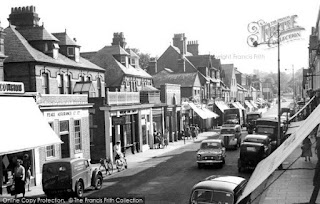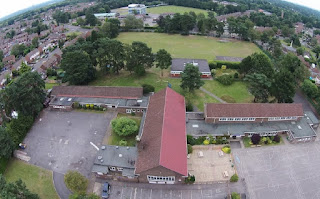
Remember the days of the old schoolyard : 1963-1969 : Cordwalles Junior School, Camberley

 “I don’t wanna go,” I was shouting as I struggled to hang on to the car door for dear life. I was being kidnapped and forced into a vehicle outside my home that was wanting to carry me away … to my first day at infant school. My mother was trying her gentlest to push inside the family car her five-year-old son who was usually well behaved and never angry or upset. Passers-by on their way to work in town were gazing. Passengers were pointedly staring out of a passing double-decker bus. What was wrong with that belligerent child? My mother was equally horrified to witness my first tantrum.

I enjoyed being at home. I had plenty of activities to occupy myself there. I never found myself at a loose end. My parents had a remarkably hands-off attitude to my upbringing, letting me put on records, listen to the radio, watch television or play in the back garden whenever I wanted. There was no regime to follow. I was perfectly content organising my own life and did not require a school to instruct me what I should do and when. During the past year, my mother had been sending me to Mrs Potten’s ‘Gay Tree’ nursery school on Grand Avenue in order to mix with other children because I was an only child. I had found most of my peers there to be noisy and bossy, whereas I was quiet and calm. To seek acceptance, I must have adopted their rather posh accents, committed to immortality when my father recorded me on his Uher reel-to-reel tape machine reciting the two ‘Winnie-the-Pooh’ books that I knew by heart.

My mother already harboured an aspiration for me to marry ‘above my station’. Whenever we walked into the town centre, on passing Bath Road, she would suggest I call on ‘Wooty’ who lived at the far end of that cul-de-sac in a large house backing onto the grounds of Sandhurst Royal Military Academy. I had met Alexandra Wooten at nursery school but had not developed a particularly close friendship with her, preferring the company of more down-to-earth Liam who lived only four doors away from our home … until his Irish parents moved away to Blackwater. Despite my mother’s persistence, I may have only visited Alexandra’s house once to ‘play’ because, unsurprisingly, I found we had no common interests.

My reluctance to attend primary school was due to anticipation that a new set of peers would be similar to Mrs Potten’s charges, the only children of my age I had so far encountered. I was mistaken! My fee-paying, town centre nursery school had been dominated by the offspring of Camberley’s middle class, whereas my state primary school was located on the peripheral council estate where I had been born, built to rehouse South Londoners whose homes had been destroyed by bombing during the War and subsequent slum clearance. Patronisingly, the council had named the estate’s streets ‘Kingston Road’, ‘Mitcham Road’, ‘Surbiton Road’, ‘Wimbledon Road’ and ‘Carshalton Road’, as if newcomers would feel more at home by eulogising their former hometowns some twenty miles away. Naturally, none of those roads led to the places after which they had been named.

I quickly discovered how wrong my expectations about school had been. My new classmates seemed perfectly normal. Unlike Mrs Potten, teachers did not require us to dress up in costumes and repeat archaic speeches for Biblical reenactments, or to watch violent ‘Punch & Judy’ puppet shows. Instead, we were given interesting creative activities to do and treated with respect and encouragement. Teachers addressed us by our first names. I loved school. I quickly retired my quasi-posh accent. I had already mastered the reading and writing skills with which some of my peers were struggling and was now teaching myself to type. One day at home, my mother had asked me to put away her electric iron and, without realising it was still plugged in, I picked it up by its plate and screamed, burning my right hand. She had to bandage my thumb and index finger for a while, so I continued to learn to type at home using my middle finger … the way I type to this day. I had wondered if my erased fingerprints would ever return, but they did eventually.

After two years, we all moved to the adjoining primary school where teaching was more structured. I attended my first morning assembly in the main hall but was baffled when the principal instructed us to recite something called the ‘Lord’s Prayer’. Everyone around me bowed their heads and recited a kind of mantra I had never heard. It felt unnervingly as if I had mistakenly been invited into some kind of cult in which all the teachers and children had already been indoctrinated … except me. I had no understanding of what was going on around me, more so because next we were told to sing strange songs from a thick book of incomprehensible ancient lyrics I had never heard played on the radio. It was impossible to sing when you had no idea what the tune should be.

Afterwards, having observed my bafflement, a teacher asked why I had not participated in the religious part of our school assembly. She seemed shocked that I had never heard of ‘hymns’ or ‘prayers’, asking whether my family was ‘Christian’. I had no idea what that word meant, so I returned home and asked my mother, who replied that we were not religious. She wrote a brief note to my teacher explaining that simple fact and, thereafter, I was excused from the section of daily assembly devoted to hymns and the like. Every day for the next four years, I would sit in a nearby small side-room alongside several children including classmate Jacqueline Dixon, a Hindu who initially asked me what was my religion. I had to tell her and the other non-Christians sequestered there that I did not seem to have one. I was an oddity.

Although my aunt Sheila worked as a ‘dinner lady’ at the school, I always returned home to take lunch. I would stand alone at the bus stop at the top end of Upper College Road, staring across at the modernist St Martin’s church on the opposite side of the roundabout, puzzled as to what might go on inside. I had heard classmates talk about attending something called ‘Sunday School’ there, next door to the home of classmate Annette van Hartaan Veldt. This church must have been where almost everyone else at school had been indoctrinated into their cult. It seemed to take an age until Aldershot & District Traction Company Limited’s number 1, 2 or 3C bus arrived to carry me one mile home for a halfpenny fare. (Once I had grown to be amongst the tallest in my class, the bus conductor insisted I pay the adult one penny fare despite me still being a child.) Arrived home, I would have just enough time to snack something and then catch the bus back for afternoon classes.

After school finished at four, if it was not raining, I could save the bus fare by walking home alone the length of Upper College Ride. This downhill route passed through a 400-yard stretch of Ministry of Defence woodland, a natural barrier intended to isolate the council estate from private housing around the town centre. It was always a lonely journey bereft of fellow pedestrians and scary on dark winter afternoons, me worrying an escapee from Broadmoor might jump out from behind a tree. The money saved I would blow in the sweet shop near my school on ‘Batman’ bubble gum packets, ‘Flying Saucers’, ‘Swizzels Love Hearts’, ‘Lemon Sherberts’ or a ‘Lucky Bag’. I was obsessed with the ‘Batman’ TV show and, as well as requesting my mother fabricate the superhero’s ‘utility belt’ for me to wear, I saved enough sweet wrappers to send for a ‘Batman’ poster that would grace my bedroom wall.

My favourite school activities were summer days when the teacher would take our class outside, thirty of us sat cross-legged in the shade of a huge tree behind the main building, writing essays in exercise books balanced on our laps. Those remain some of the happiest days of my life, before homework and exams impinged on my childhood, and before my parents sent me to a faraway school stuffed with posh boys and requiring a bottle-green uniform.

My least favourite school activity was ‘swimming’ in the newly constructed, unheated rectangular above-ground pool on the playing field. Alongside were two tiny windowless wooden huts in which girls and boys were shepherded separately to change into their costumes, and where I hated my mates spying me naked. I was so rake-thin that the bottom of my rib cage protruded, making me imagine I had some kind of physical deformity not evident in my schoolmates. My acute embarrassment destroyed any enjoyment and inhibited my capacity to learn to swim … which sadly I never overcame.

In my final year at Cordwalles, teacher Mr Hales encouraged us to open savings accounts with Trustee Savings Bank [TSB]. Once a week after class registration, he would ask if we had coins to deposit, record their value in our individual bank books and update our balances. It was a great way to make us understand the value of money, particularly as the monetary system was about to convert to ‘new pence’ from shillings. Would a school today actively encourage ten-year-olds to manage their first bank accounts in class?

I made some really good friends – including Paul Rowell, Michael Heinrich and Martin Bell – who would invite me to their houses on the estate after school. I was surrounded by peers of both sexes, of various religions and diverse races. I feel very lucky to have been educated in such a safe, sympathetic and uncompetitive environment, full of stimulation and encouragement that immensely shaped my attitudes and life thereafter. Unfortunately, it made my subsequent education and career make me feel all the more like a fish out of water, forced to navigate pathways amongst privileged, entitled people who seemed to have had very different childhoods that had fostered their cold, cutthroat, self-centred outlook on life.

I was sad to leave my primary school in 1969, after which I no longer saw the classmates with whom I had spent the previous six years. My parents failed to appreciate that their decision to continue my education at a distant school tore me away from roots I had forged on Old Dean Estate and isolated my social life by forcing me to travel daily to the other end of the county. At Cordwalles, I had felt like a normal boy living a normal life. I was never again made to feel that I fitted in so comfortably.

Postscript. The first time I went to church was in 1967 to accompany my mother to the final service of St George’s, built by the local Middleton family in the 1890’s on St George’s Road at Knoll Road, prior to its demolition to create a car park adjacent to Herman Solomon’s Garage. Despite never having known my mother attend any church, she was annoyed that our nearest one had been sold off as part of Camberley town centre’s modernisation. 

More than two decades later, having recalled that I had once opened a savings account at school, I walked into the TSB Camberley branch in London Road and asked if I could withdraw the balance. It took several weeks for the staff to locate my details and obligingly add years of interest to my balance before I could withdraw a small sum that I had almost forgotten I had.

Virtual Tour of Cordwalles Classrooms

[Originally published at https://peoplelikeyoudontworkinradio.blogspot.com/2023/12/remember-days-of-old-schoolyard-1963.html]

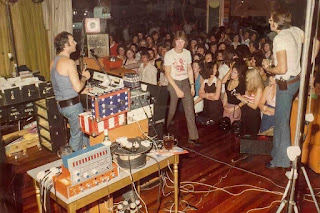
Things you say you love, you’re gonna lose : 1973 : the curse of The Blue Pool, Camberley

The couple put the huge dog in the back of their car and, before setting off down our driveway, smiled and waved at us. We did not smile. We did not wave back. My mother was weeping. Uncontrollably. I had never seen her so upset. She had just said goodbye to her beloved pet dog. For the last time. I hugged her. But that day’s heartbreak consumed her … for years to come.

It seemed like a lifetime ago that we had excitedly carried that dog home as a tiny puppy in a cardboard box. It had been smaller than a cat then. Now it had grown heavier than a human. One cold, dark winter’s afternoon years earlier, we had brought back our new pet on the train from Waterloo. Thick fog had enveloped our route, prolonging our usual one-hour journey home to more than two hours, and rendering the suburban landscape spookily invisible through the train windows. Stopped at Bagshot station, the guard walked down the carriages’ central corridor carrying a bright torchlight and explained that our train would be held there for quite a while. Because the double-track railway narrowed to a single line beyond Frimley, the British Rail timetable regularly disintegrated into chaos in both directions when even a single train was delayed. I pulled down the window of the carriage door, peered outside but could make out only a pinprick of the red stop light at the top of the westbound platform entirely masked by thick fog.

That day the scary darkness through which our train had clickety-clacked had been unable to spoil the delight of having collected our new puppy from London. Now, years later, we were having to fight a route through a different abstract kind of foggy darkness that was undeniably dampening our spirits. No longer able to afford to feed the dog who had been her loyal companion for years, my mother had become resigned to placing a ‘dog for sale’ advertisement in the ‘Camberley News’. It was the hardest thing she had ever had to do. It felt like selling a member of her tightly-knit family. But she had recently become a single mother with three children aged between two and fifteen to support and had to accept her budget could no longer stretch to the expense of the huge volume of meat our pet required.

That dog was the last in a line of Saint Bernard’s that had been our pets since I was small. The first had been named ‘Samantha’ after the lead character in the ‘Bewitched’ TV series. I had chosen the name ‘Suna’ for its successor. They had died of old age but, on each occasion, my mother had combatted her sadness by promising herself to buy a similar puppy and transfer her unconditional love to it, which she did. This occasion was very different. A lifetime of big shaggy dogs had been brought to an abrupt end, not by death but by austerity. As children, the three of us had grown up around a Saint Bernard that had been taller than us in our earliest years and, despite drooling over us and our furniture, had been as gentle and friendly as any family could want. Why did my mother have such an affinity for this particular breed of dog, which was so unconventional in that era?

Her trip to Switzerland in 1953 or 1954 had had a long-lasting impact. My mother had returned with three things: a large rusty metal cowbell, a love of Lindt chocolate and her first encounter with a Saint Bernard. For someone from her ‘modest’ background who had never before had an opportunity to travel abroad, the trip proved an eyeopener, particularly after her mother had vetoed her post-school ambition to study agriculture in Denmark. Back then, international travel remained the privilege of the elite and Switzerland was a destination reserved for those attending private ‘finishing schools’ or wealthy skiers.

My mother always claimed that she had made the trip with ‘work colleagues’, though I have always considered it more likely that she was accompanied by a manager (the manager?) in her workplace, Peter, who was providing her with a daily lift to her first workplace, the Elizabeth Shaw chocolate manufacturer recently relocated to Camberley. In earlier years’ annual roll photographs from Camberley Girls’ Grammar School, portraying long rows of its entire student and staff body, my mother was easily identifiable in the back row by her bouffant hair and radiant smile among a sea of rather dowdy girls who looked browbeaten by the War. She had the air of someone who aspired to a brighter future. Maybe it was during this trip to Switzerland, ostensibly to view how chocolate was manufactured at the Lindt factory, that Peter had made his marriage proposal … which she rejected.

A keen swimmer, my mother had managed to persuade her parents to buy her a season ticket during school summer holidays for the Blue Pool, a large outdoor lido-like pool on the London Road adjacent to Portesbery Hill Drive, a half-mile bike ride from her home. This was the only place in Camberley for young people to meet then, there being no youth club or coffee bar to fraternise. Boys and girls thronged to the pool during its summer season, unguarded by parents or chaperones, indulging in fizzy drinks and snacks of which their parents might not have approved. This is where my mother first met my father, who was almost two years older than her and had already left school to work as an apprentice. Like her, he looked more glamorous than his peers with his sleek jet-black hair and olive skin. She was rather reserved while he had the gift of the gab and a roving eye. It was a match made in …

My mother’s family refused to attend the couple’s Registry Office wedding because my grandfather knew the reputation for roughness of my father’s family and considered they and their youngest son no match for his smart youngest daughter with whom he had enjoyed such a close bond, particularly during wartime. He considered no good would come of their relationship … and he was eventually proven right! The day a few years later when I was born at home, my father was nowhere to be seen because, my mother alleged, he was with his ‘girlfriend’ who was simultaneously pregnant by him. Soon afterwards, instead of paying the rent on their council house, my father unilaterally purchased an unaffordable car, resulting in their eviction. My maternal grandfather was generous enough to help the couple buy the semi-detached house adjoined to his home (after evicting his tenants there!), an arrangement permitting my mother’s parents to assist with childcare, in which her husband showed no interest.

My father’s philandering continued until 1972 when he finally decided to walk out on our family and start a ‘new life’ elsewhere with a recently married teenage girl from our street. Not only did he remove his own possessions from our house when he left, but he would return unannounced while we were out and take whatever he wanted. My mother stubbornly hung on to the belief that her husband would one day return to her (as he had done previously) and so failed to safeguard her own future by changing the house locks or hiding our valuables. This immunity only encouraged him to return and take time picking and choosing what he desired.

What did he steal? My mother’s car, an American Motors ‘Gremlin’, one of Detroit’s first compact hatchbacks which we had only recently travelled to an M1 service station to collect new. My father then gifted this car to his new ‘girlfriend’ before discovering that she was too young to be insured to drive it. My mother’s extensive jewellery collection that she had built since the 1950’s and comprised unusual, artistic pieces. Thousands of pounds of cash in plastic bags stashed in the top right cupboard of our white, Hygena living room storage unit, my father’s cut of dodgy property deals with his newest business partner Bill Beaver. Artwork and paintings hung in our hallway and living room. Imported soul records I had bought with my pocket money. The list went on and on.

My mother took two jobs to try and make ends meet, daytimes as bookkeeper for British Car Auctions at their site opposite Frimley gravel pits, evenings cleaning offices in Yorktown. My aunt Pam generously paid for a coastal summer holiday for our diminished family of four. However, we returned home to find even more of our belongings had vanished while we had been enjoying the seaside. To add insult to injury, my mother later found photographic evidence that my father had even organised a party for his ‘friends’ at the house during our absence. It appeared that he had been informed about the dates we were to be away by my younger brother who was the only one of us to maintain a close relationship with his father … until the day he died.

As a result, aged fourteen, that was to be my final ever holiday with my family. Pam continued to fund UK summer vacations for my mother and siblings, during which I had to stay alone at home to guard what remained of our possessions. Occasional nights, I was awoken by noises outside and got up to see the inside door handle being turned in darkness. It was as scary as a horror film, even though I was now protected by interior door bolts and I would switch on the lights to show someone was at home. For many years afterwards, we lived in that house in perpetual fear of losing what little was left of our possessions to an embittered father who demonstrated only cruelty and vengefulness towards his former family.

That was why the necessary sale of our family’s dog proved the last straw for my mother. She would never again be the same optimistic person evident in her old school photos. It was not just that the family life she had nurtured since her Blue Pool days had finally crashed to the ground and burnt her fingers. It was not just that the warnings two decades earlier from her father about the unsuitability of her husband had proven correct. Moreso it was that her Saint Bernard dog had been a reminder of the ‘time of her life’ she had enjoyed in Switzerland and the possible future she might have enjoyed with Peter if she had only accepted his marriage proposal. It was too late now to turn back the clock. She had three children, for whom she had tried her hardest to provide a better life, but who were now growing up in much reduced circumstances with a mother who was forever at work. During the intervening period, Peter had married someone else.

Life for me became more difficult too. In 1969, my parents had promised to drive me every weekday two miles to Camberley station to catch the 8:10 train to the faraway grammar school they had selected for me. Now, the only replacement car my mother could afford was a tiny second-hand ‘NSU Prinz’ that we called ‘the sewing machine’ because of its engine noise and which regularly failed to start. My mother needed it to reach work so I was forced to make my own way to the station and back by infrequent bus or, more often, walking. To achieve this, on weekdays I was always the first to get up and leave home, but the last to go to bed, usually after midnight as I never returned home from school before six o’clock and had considerable homework to complete. Additionally, I had to look after my baby sister during school holidays while our mother was at work.

When our home’s central heating failed, local tradesmen came and looked blank as the gas air system my father had imported from America was then unknown in Britain. I wrote enquiry letters to dozens of heating specialists listed in the local library’s Yellow Pages directories, none of whom replied positively. I even wrote to the manufacturer in the United States but it had no agent in Europe. As each winter approached, I would once again dissemble the boiler mechanism myself and spend hours trying to discern the problem, to no avail. We were forced to live for years in that unheated, uninsulated house with its swathes of glass sliding doors, a factor that has forever made our bodies vulnerable to cold weather illnesses.

Somehow, we struggled through this terrible period in our lives and kept our family together with much practical and financial help from my maternal grandparents, my aunt Pam and my older cousin Lynn. Sadly, my father somehow poisoned my other aunt Sheila’s opinion of my mother so that the two sisters never spoke for decades afterwards. If this narrative appears one-sided, understand that my father’s parents, also resident in Camberley, were conspicuous by their complete absence from our family’s life. When I was young, my paternal grandfather pushed his wife down the staircase of their council house, resulting in her death. I had visited the couple only once previously with my father, purely because my mother refused to go. I visited the remaining widower only once after he was moved to a tiny old people’s flat on the London Road opposite Gibbet Lane. My father alone attended their funerals.

They say that ‘once is an accident, but twice …’ In the 1990’s, I returned to my mother’s house to retrieve several large cardboard boxes I had packed into the attic of my treasured childhood books, school projects, toys and personal items. When I climbed into the roof space, they appeared to have gone from where I had left them on the left side of the attic hatch. However, on the right side were many similar boxes. I opened them and was baffled to find they contained magazines and papers belonging to my younger brother. I could only presume that, when he had emigrated in the 1980’s, he must have taken with him MY boxed possessions but bizarrely left HIS behind. I now have almost nothing from my childhood, particularly the precious family photo album that I started in 1964 when I had been given my ‘Kodak Instamatic 25’ camera and which I had maintained religiously with dates, personnel and locations of each shot. Had my brother inherited from his father some kind of ‘cruelty to family’ gene?

During the winter of 1996, the central heating failed in the large Victorian house in Toronto where I was renting the top floor. I inspected the gas air system in the basement and was astounded to find it identical to the mechanism I had dismantled and tried to repair so many times in our Camberley house, installed three decades earlier. Bad memories came flooding back of our cold lives.

In her old age, my mother received a phone call from her former chocolate factory boss Peter informing her of his wife’s death, so she attended the funeral and visited him on the South Coast. Could have? Should have? In some kind of parallel universe, my mum might have enjoyed a longer lasting, more fulfilled married life … with somebody else.

[Originally published at https://peoplelikeyoudontworkinradio.blogspot.com/2023/11/things-you-say-you-love-youre-gonna.html]

I can't dance to that music you're playin' : 1970 : Emperor Rosko, The Paris Theatre, London

 “Would you like to dance?” the girl asked.

I was dumbfounded. Nobody had ever asked me to dance. Particularly a girl!

“Er, no thanks,” I mumbled pathetically.

“Oh, go on, please,” she chivvied. Anyone else would have been flattered. But me? I was terrified. 

“Sorry, but I can’t dance,” I tried to explain. The girl looked disappointed but gave up and walked back to the stage. It might have been the beginning of a beautiful friendship. But I blew it.

It was true. I have never been able to dance. Too self-conscious. Too buttoned-up in that English way. The last occasion I recall dancing wildly was the 1977 Trevelyan College Summer Ball to which fellow student Zena Carter had generously invited me and whom I must have embarrassed immensely with my feeble attempt at ‘Saturday Night Fever’ moves I had just seen at Durham’s cinema. All the posh male students in attendance wore black tuxedos, while I looked completely out-of-place in a borrowed white suit, jigging around to the local live band ‘No Exit’ featuring a certain ‘Sting’. I still cringe. Three years later, my job would be adding hit songs by his next band ‘The Police’ to local station ‘Metro Radio’s playlist.

But that was in the future. Back in 1970, another reason I turned down the girl’s invitation to dance was that I had become terribly shy. At primary school I had considered myself no different from my classmates. Then, after moving to grammar school in 1969, I was developing a creeping sense of inferiority, not comprehending why my termly school reports criticised me for not being sufficiently vocal in class. Achieving classwork and exam results near the top of my year of sixty students was seemingly judged insufficient unless you flaunted your cleverness by regularly sticking up your hand in class and pushing yourself in front of teachers. In my new ‘streamed’ school, populated by many privately educated ‘prep school’ protegees, it appeared a boy might inexplicably be considered deficient for simply being ‘quiet’ and demonstrating no interest in blowing his own trumpet. I responded to my school’s reproaches by retreating into shyness in company … which dogged me for decades to come.

I might have felt less self-conscious about the girl walking up to me in the end seat of the fourth row on the left side of the centre aisle, had my mother not been sat right next to me. I was embarrassed. I was twelve years old, though I appeared older because of my height. I had written to the BBC Ticket Unit to request a pair of tickets to attend the live broadcast of Emperor Rosko’s Saturday lunchtime ‘BBC Radio One’ show at London’s Paris Theatre. None of my new schoolfriends appeared to be interested in the music I followed, so my mother had accompanied me on the train from Camberley.

The Paris Theatre had been an art-house cinema showing French films in Lower Regent Street until the BBC acquired it in 1946 and equipped it with a radio studio to record concerts and live comedy shows before a seated audience of around 400. From 1968, the weekday lunchtime ‘Radio One Club’ show had been broadcast live from the venue, hosted by a station DJ and showcasing a live band in front of an audience who had all sent to the BBC for their ‘Club’ membership cards. It was the station’s earliest attempt at outreach to its listeners and, by the 1970’s, was extended from London to cities around the country. In 1974, it was replaced by the touring ‘Radio One Roadshow’ whose format was similar to the large summer outdoor events Rosko had been organising independently since the 1960’s.

I was a huge fan of Rosko’s weekly radio show because he played reggae and new American soul records as yet unreleased in Britain. At that time, when around 100 new singles were released a week in the UK, record companies would wait to see which American singles proved successful in North American charts before committing to a British release date. This delay could be months, often allowing British pop artists to ‘cover’ American soul hits before the original was available in shops. My parents owned Julie Grant’s single of ‘Up On The Roof’ which had reached number 33 in 1962, but they had never heard the original by The Drifters which failed to chart in Britain. Grant successfully parlayed her chart success into several television appearances and a concert tour with The Rolling Stones, another British act recycling American black music at the time.

Each week I would record Rosko’s 90-minute Saturday show onto an audiocassette and listen to it repeatedly on headphones while I did my homework, before recording the next show over it the following weekend. This was the first occasion I heard James Brown’s ‘Sex Machine’ single, Rosko playing the A-side one week and its B-side the next. It changed my life! Many outstanding tracks like this recorded onto my cassette I went on to buy as imported American singles from ‘Contempo’ at 42 Hanway Street or ‘Record Corner’ in Balham, the main retailers for new American black music as yet unreleased in the UK. Many of those songs first heard on Rosko’s show I still know by heart and treasure to this day. Without the benefit of a black music radio station in Britain (London soul pirate ‘Radio Invicta’ did not launch until December 1970), Rosko was the nearest experience available, even though he mixed reggae and soul with some pop and rock tracks.

What marked Rosko’s shows out from the rest of ‘Radio One’s output was that he simultaneously operated a mobile discotheque (the ‘Rosko International Roadshow’) and compered concerts by American soul artists touring the UK. That gave him a unique insight into the specific music British audiences wanted to hear, something that many of his studio-bound radio colleagues did not understand. The other factor was that Rosko was allowed to choose his own records to play on the radio, whereas the music in most shows was selected by ‘Radio One’ producers, the majority of whom preferred twee British novelty acts to ‘foreign’ reggae and soul. These ‘gatekeepers’ could determine through national airplay whether a record was to become a hit or not in Britain, so the charts inevitably reflected their value judgements.

I was fascinated when analysing the British singles charts from this period to discover the volume of chart-topping pop songs that are never played as ‘oldies’ nowadays because they sound embarrassingly quaint or sentimental. Compare that to the significantly lower chart positions achieved by many black music recordings considered now to be ‘classic’ or ‘standards’ [documented in my book ‘KISS FM’]. It is forgotten just how ‘white’ the BBC’s popular music station sounded overall, despite valiant attempts to play more soul by daytime DJ’s Tony Blackburn and Dave Lee Travis. My appreciation of reggae was sparked by Rosko but had to be developed by evenings tuned to ‘Radio Luxembourg’ which Trojan Records paid to play their latest reggae releases. In 1971, singer Nicky Thomas even recorded the song ‘BBC’ to chastise ‘Radio One’ for not playing enough reggae, its release accompanied by a protest march to Broadcasting House. This had no evident impact on the station’s producers who were almost exclusively recruited from the white middle-classes and who moulded ‘Radio One’ in their own image.

This was why my visit (without dancing) to the Paris Theatre that Saturday was to become such a memorable experience, having enjoyed some of my favourite soul and reggae tunes played loudly through Rosko’s enormous sound system loudspeakers. When the girl asked me to dance, Rosko had been playing Edwin Starr’s ‘War’, a remarkably innovative Motown production by Norman Whitfield recorded to protest the Vietnam War with its chorus: “war … what is it good for? … absolutely nothing!”

A few years ago, I created a Spotify playlist of several hundred Whitfield productions, such remains my unbridled enthusiasm for his work (often with songwriting partner Barrett Strong). At the beginning of October this year, something prompted me to return to this playlist and update it with songs Whitfield subsequently recorded for his own label, notably by Rose Royce. I spent the following days listening non-stop to songs from my enlarged playlist such as ‘War’, ‘Stop The War Now’, ‘Friendship Train’, ‘Unite The World’ and ‘You Make Your Own Heaven And Hell Right Here On Earth’ all recorded half a century ago, all explicitly criticising violence and promoting peace. This was the music I was listening to only days later when news broke of atrocities committed in Israel. The music was appropriate … but the timing was inexplicably spooky.

[Originally published at https://peoplelikeyoudontworkinradio.blogspot.com/2023/10/i-cant-dance-to-that-music-youre-playin.html]

If you can’t stand accounts, get out of the kitchen : 1966 : Whites of Camberley payroll & the pink fridge

 “Grant, why haven’t you written anything? What did you do yesterday evening?”

Our teacher had walked along the row of desks in the classroom and noticed that I had yet to start writing. I had been staring at a blank page in my exercise book, trying to imagine a way to pen two sentences and crayon an accompanying picture. I had to draw a deep breath to explain:

“Yesterday I helped my mum in our kitchen, calculating the Income Tax and National Insurance on an adding machine for the fifty people where she works, updating their record cards for Inland Revenue and then writing those amounts on their pay packets.”

The teacher looked thoughtful for a while. What on earth was this eight-year-old boy talking about? He had a wild imagination! After some reflection, she said:

“Just write that you went out to play with your friends and draw a picture of them.”

I did not relish the idea of lying but, if even my teacher could not find a way to summarise what I had really been doing the previous evening, I would follow her suggestion. This was the first (and last) occasion I tried to explain to anyone the work I did once a week with my mother in our home kitchen. Classmates remained oblivious to the range of administrative duties I performed regularly for my mother’s employer and my father’s business. While they were playing with their Sindy or Action Man dolls, I was busy reconciling accounting entries in a financial ledger.

The kitchen was a rear extension to our suburban, two-up two-down, semi-detached house. Downstairs had been transformed into one massive room since my father had removed the dividing wall. From the front of the house, you could now look through the window and see straight through to the rear garden. Visitors would gasp and enquire why the ceiling had not fallen down as ‘knock-throughs’ were unheard of in the early 1960’s. I remember the dust clouds when builders installed an iron girder in the ceiling to replace the wall they had just demolished.

The kitchen had once been of adequate size but now was somewhat cramped following the arrival of our latest ‘mod con’ – a fridge. Before then, milk bottles had been stored precariously on the rear window’s outdoor sill. Two years earlier, my father had been intrigued by a private ‘for sale’ advertisement in his favourite journal ‘Exchange & Mart’ (think ‘eBay’ on paper) and had arranged a viewing. We drove miles to locate the U.S. Air Force base and suddenly entered a parallel, colourful 3D world only previously viewed in 405-line, black and white location shots of ‘I Dream of Jeannie’ and ‘Bewitched’. It was a miniature slice of modern-day America incongruously tucked into a hidden, rural corner of bleak, post-war Britain.

My father had to switch to the right side of the road to drive our pink and white ‘Rambler Classic 770’ station wagon along the base’s wide roads lined with identical, single-story chalets built on spacious plots around which was a complete absence of fences. This was the North America to which my parents had long dreamed of emigrating and why they had embraced all things American since the 1950’s, including their children’s names, the oversized American Motors cars they drove, the pop music they loved and their ‘Life’ magazine subscription. Three decades later, when I glimpsed the neighbourhood in ‘Edward Scissorhands’, I was transported back to my first childhood impression of American suburbia on that day.

We located the house of the lovely American couple selling the fridge who explained they were about to be posted ‘back home’ at the conclusion of their tour of duty and were selling their household contents. The fridge was a huge American ‘Kelvinator’ and, to our amazement, was bright ‘Bermuda Pink’. It had a huge horizontal chrome door handle, a foot pedal to open the door if your hands were full and a freezer compartment which I was already scheming to fill with ‘Zoom’, ‘Fab’ and ‘Funny Faces’ ice lollies or blocks of ‘Neapolitan’ ice cream, on sale in the corner shop yards from our home. Smitten, my parents needed no convincing to purchase the fridge with cash they had brought.

The Americans asked if my parents wanted a foot-high stack of DC Comics which they were happy to throw in for free. Although the fridge would not fit in our car, we could take the comics home with us. Before we left the base, we popped into its ‘grocery store’ which was filled with American brands of cookie, breakfast cereal and sweets that, until then, we had only seen in American magazine advertisements. Having spent ages selecting a variety of items, we were disappointed at the checkout to be told that the shop only accepted American dollars or credit cards, neither of which my parents possessed. We would just have to wait a little longer to sample such delights once our emigration had been realised.

A fortnight later, a truck delivered the fridge to our home. However, because everything in America was genuinely ‘bigger and better’, it was found to be too wide to fit through the house’s backdoor. My parents’ unbridled enthusiasm had overshadowed the practicality of measuring their purchase, as the fridge had appeared perfectly scaled inside the American-style kitchen we had visited on the base. Now it had to remain outside unused (houses had no outdoor power points) for more weeks until a solution was executed. The old sash window at the back of our living room had to be replaced with a modern double-glazed version and, during this building work, the wall below it would be unbricked to carry in the oversized fridge and then replaced (floor-length ‘French windows’ were unknown then).

This operation successfully moved the fridge into the living room but, once again, my parents had failed to measure the internal doorway to the kitchen extension. It was too narrow. The door was removed from its hinges. It still did not fit. The door frame had to be removed. Only then, accompanied by my father’s considerable vocabulary of swear words, did the fridge just fit with tenths of an inch to spare. Finally, the object was inside the kitchen. Our home now had not only an enlarged living room but also a door-free walk-in kitchen, both of which were unusual. It may have contravened building safety regulations but it had accidentally created a large, unified downstairs space which we loved. There still remained one problem. The fridge operated on America’s 110-volt system so a large transformer box had to be found and bought before it would function.

We now had a huge fridge but a considerably smaller kitchen space. This is where, once a week, my mother would bring her adding machine home from work and all the paperwork necessary to calculate and record the wages to be paid to the staff of Whites (Camberley) Limited where she worked as bookkeeper. Founded by Percy White in 1908 and now managed by his son Peter, the family business had diversified from bicycles into car sales and repairs, a service station and coach hire from its plum town centre location at the corner of London Road and Knoll Road.

At the beginning of each tax year and after a government budget announcement, telephone-directory-like books were mailed to every employer in the country, filled with tables to calculate how much Income Tax and National Insurance contributions were to be deducted from pay, according to the worker’s tax code and whether they were paid weekly or monthly. The skill I perfected was in looking up the appropriate amounts for each member of staff every week, entering these figures on the employee’s blue card and then writing these amounts on small brown ‘wage packet’ envelopes. My mother took these to work the following day and counted out cash from the company safe to insert in each. I always wondered if Whites’ staff ever wondered why their pay details appeared in an eight-year old’s handwriting.

I learnt to be nimble on the adding machine, keying in amounts that my mother would read out, producing totals that could be torn off from a roll of paper. At the end of each ‘tax year’ in April were additional tasks of totalling up each employee’s contribution card, reconciling these amounts with the ledger entries and sending all the cards to Inland Revenue. We also had to handwrite P60 end-of-year certificates for each employee and, if a worker left their job during the year, we had to write out a P45 form in triplicate. Only a small table would now fit in the kitchen so we had to cram the ledger, adding machine and documents there, plus lay paperwork out on the worktop area and even on top of the fridge. As no homework was set by my school, these evenings proved no distraction from my education. Instead, I became an expert in double-entry bookkeeping and the intricacies of the British taxation system at an early age.

I adored the DC comics that had accompanied our pink fridge and handled them with the utmost care, keeping them in pristine condition under my bed. They were as yet not on sale in Britain, so I was looking forward to buying more once we emigrated. However, for reasons never understood, my parents decided to give up their long-held plan to move to Canada and instead they bought a plot of land locally to build their own house. Although their obsession with Americana remained unabated, it was tinged with the sadness of a shared dream that had failed to materialise. Within a few years, their marriage disintegrated and our family broke up for good. My mother cancelled her decade-long subscription to ‘Life’ magazine. After the 1973 oil crisis, American cars became too expensive to run, particularly when she was now a single parent.

When we moved out of our house in 1968, we sadly left the pink fridge behind. I always wondered what transpired as the new owners would have had to knock a hole in an external wall to remove it from the house if they no longer wanted it. That huge pink fridge was as indestructible as Captain Scarlet!

Two decades later, I returned home to retrieve my treasured DC comic collection, only to discover that my younger brother had crayoned all over them and torn out pages while I had been away. Our 1960’s dreams had all turned to dust.

[Originally published at https://peoplelikeyoudontworkinradio.blogspot.com/2023/10/if-you-cant-stand-accounts-get-out-of.html]

The trophy son : 1969 : Charles Church & IMIC Properties Limited, Camberley

 It was the summer of ’69. My father had insisted I accompany him to his meeting. He had driven us to a wooden gateway on the south side of Lightwater Road that led into fenced farmland. He pulled in, parked our Rambler station wagon on the roadside where, on that warm sunny morning, the man we had come to meet was already waiting. My father introduced himself and then me:

“This is my son, Grant, who will be starting at Strode’s School in September.”

My father had heard stories about this local man and his wife having bought a house, moved in, then repaired, modernised it in contemporary style and furnished it stylishly before selling it a year later at a handsome profit. They had then repeated this process … twice. The strategy Americans call ‘flipping’ was unknown in Britain at the time, but this story had fascinated my parents during recent years, being a practical route to amass capital when mortgages were difficult to obtain for self-employed professionals. My parents might have enthusiastically copied this tactic, had they not already two school-age children. Finally, my father had requested an initial meeting with Charles Church.

In 1965, Australian state-owned airline Qantas had bought twenty plots of land in Camberley out of more than 200 for sale that had formed the grounds of Copped Hall, the estate of retired Captain Vivien Loyd. Between the Wars, in a small factory on Frimley Road, he had manufactured tanks sold to twenty foreign armies, as well as an ultralight plane known as ‘The Flying Flea’. Loyd even produced an engine-powered lawnmower called ‘The Motor Sickle’ that was exhibited at the 1950 Smithfield Show. Qantas built modern detached houses with large gardens in a generously landscaped development named ‘Copped Hall Estate’ intended for occupation by its pilots flying from Heathrow Airport, a twenty-mile drive away. However, for reasons unknown, its houses were never used.

One of these properties, at 18 Green Hill Road, served as the location for the 1969 film ‘Three Into Two Won’t Go’ directed by (Sir) Peter Hall, starring Rod Steiger and Claire Bloom. Scenes of the street showed overgrown front gardens of empty houses on this ‘ghost’ estate, seemingly ideal for a movie shoot. Except that filming was disturbed by noise from tanks driving around the Ministry of Defence’s vast 18-hectare wooded, hilly tank testing ground a mere hundred yards away on the other side of ‘The Maultway’ main road, a legacy of Captain Loyd’s enterprise. Sandwiched between Camberley and Lightwater, the land is still used for this purpose but is now shared with local dogwalkers and bikers.

Eventually, Qantas decided to appoint a local estate agent to try and sell its unused houses, despite their location on the periphery of Camberley, three miles from its town centre and lacking a regular bus service. This was an ideal opportunity for Church and his wife to purchase one, and then another, to transform them into more marketable homes with ‘all mod cons’ that were demanded during the 1960’s. We lived three-quarters of a mile away from the entrance to this estate, on the opposite side of Upper Chobham Road, enabling my curious parents to observe goings-on there.

Church had been born more than a decade after my father and was very smart, having attended grammar school and studied civil engineering at university before starting his first construction contracting business, Burke & Church, in 1965. My father’s background could not have been more different, having left school at age fourteen and taken an apprenticeship with Redland Cement in Bracknell. He had studied quantity surveying at ‘night school’ and eventually started his own home-based business, producing drawings for renovations and extensions to local houses, offices and factories. By 1967, he had created ‘Architectural Drawing Services Limited’ in a small Camberley High Street office where he had ‘graduated’ to designing entire buildings. His business stationery appended the initials ‘AFS, ARIBA’ to his name even though he held no architectural qualification.

What Church and my father did have in common was that both had been building their first houses, both unusually modern for Camberley, simultaneously in 1967. Both had wives who were intimately involved in their businesses. Both aspired to modern interior designs. Indeed, I seemed to have spent much of my childhood sat on Heals of Tottenham Court Road’s wooden rear staircase that curled around one of those old ‘cage’ lifts, awaiting my parents to finish their endless perusal of state-of-the-art furniture. The two men’s skills were complimentary. Church knew how to build houses. My father knew how to design them.

So why had I been dragged along to the pair’s initial meeting? It was because my father lacked the formal education of Church but was desperate to portray himself as an equal. I had passed the ‘Eleven Plus’ examination that summer though my parents had decided not to send me to Camberley Grammar School, located opposite the infant and junior schools I had attended the last six years and the obvious, most local choice. Instead, I was to be sent to a grammar school in Egham that required a two-mile journey from our house to Camberley station, followed by a thirty-minute train ride. I was offered no say in their decision. Why was my school journey about to be made so arduous for the next seven years? Because Church too had attended Strode’s School and my father had waited to arrange this meeting until my parallel future there had been secured.

In addition to his design skills, my father could prove helpful to Church because he had amassed significant experience over the years ensuring his renovation designs were approved by the local council’s planning committee. He had joined ‘The Camberley Society’ and was attending their monthly meetings to hobnob with the local ‘great & good’, much to the disdain of my mother. Somewhere in his life, my father had adopted a neutral middle-class accent which, along with his smart suits, seemed sufficient proof to convince people he was indeed an ‘architect’. His speech contrasted starkly with that of his older brother who spoke like a character from ‘East Enders’, though success in the building industry had rewarded him with a detached house in Farnborough that had separate in and out driveways. On the handful of occasions I accompanied my father to visit his brother, I was sent up to his daughter Janet’s room, the first person I met who attended a private school. Although the same age, we had absolutely nothing in common.

After that summer’s initial introduction, Church and his wife Susanna became regular visitors to our bungalow which my father had designed and built in a Frank Lloyd Wright style with much glass and bare brickwork. The two couples became friends and my father set up a company to formalise their partnership. I was told to find a suitable name. I leafed through my copies of ‘Billboard’ magazine, the voluminous American weekly music industry publication I bought from a newsstand on the corner of Oxford Street and Regent Street whenever we visited London. I spied an advertisement for the International Music Industries Conference organised in Cannes (forerunner of ‘MIDEM’) which was abbreviated to ‘IMIC’. The company was to be named ‘IMIC Properties Limited’.

Houses were designed. Houses were built. Houses were sold. Profits were shared. My father bought an American Motors Javelin sports car. Both he and Church started flying lessons separately at nearby Blackbushe Airport. I accompanied my father on one occasion and hated the experience. Nevertheless, it remained my task to regularly test my father’s knowledge necessary to obtain his pilot licence, which is the reason I can recite the NATO phonetic alphabet to this day. For a short while, life was good.

In 1971, our family started to fall apart. My mother had terrible bruises on her face and the toilet door of our house had been kicked in as a result of my father’s temper. By 1972, he had left us for good. After an entire childhood having been required to work in his business, providing skills in mathematics, finance and administration that he lacked, I no longer wanted to even talk to him. He responded by making his family’s life as difficult as possible, stealing back every gift he had ever bought us, starving us of funds and dispossessing me and my baby sister.

Evidently, my father’s business partnership with Church must have disintegrated at around the same time though, to their credit, both he and his wife maintained contact with my mother, offering her support and practical assistance. Charles Church Developments Limited was launched by the couple in 1972 and became one of Britain’s most successful housebuilding enterprises. IMIC Properties Limited was forcibly dissolved in 1980. By then, my father had disappeared, owing thousands in unpaid court-ordered maintenance to our family. He was eventually found by US Immigration to be living illegally in Arkansas and deported. His debts to us were never paid.

On 1 July 1989, at the age of forty-four, Charles Church was killed when, after broadcasting a mayday call, the Spitfire [G-MKVC] he had restored crash landed near Blackbushe Airport. By then, he was reportedly one of the richest two-hundred people in Britain with a fortune of £140m. My mother attended his funeral. It was a tragic conclusion to the beginnings of an exciting business opportunity for my father that I had witnessed at that roadside rendezvous two decades previously … but which had ultimately impoverished the rest of our family.

[Originally published at https://peoplelikeyoudontworkinradio.blogspot.com/2023/09/the-trophy-son-1969-charles-church-imic.html]

Give them a foot and they’ll take a metre : 1972 : Bill Beaver, Camberley & Alicante

 It was the summer of rock’n’roll. Bill Haley. Buddy Holly. Chuck Berry. Fats Domino. The Big Bopper. Now, every time I hear one of their songs, I am reminded of a summer vacation never to be forgotten … for all the wrong reasons! Certainly, much of it had been spent lazing on a lounger beside a swimming pool, immersed in an interesting book I had brought along. However, my ears had been battered for days by continuous rock’n’roll, blasted at maximum volume from a tinny cassette machine leant against the wall of a Spanish villa’s veranda. This was not the preferred soundtrack of my teenage years.

At age fourteen, ‘oldies’ from a decade earlier already belonged to a bygone generation. I was obsessed with contemporary pop music and, since the occasion Jim Morrison had dropped his leather pants onstage, every Thursday a slice of my pocket money crossed the counter of a Frimley High Street newsagent for ‘Disc & Music Echo’, ‘Record Mirror’, ‘Sounds’, ‘NME’, ‘Melody Maker’ and ‘Blues & Soul’. I devoured their every word cover-to-cover, as well as teen magazine ‘Fab 208’ that my grandparents bought for older cousin Lynn but offered me a sneaked read. These publications’ preoccupation with the newest music (aligning perfectly with their most lucrative advertisers, the major record companies) reinforced my youthful music snobbery, as dismissive of rock’n’roll as I was of The Andrews Sisters.

Our family’s summer sojourn read like a rejected script for ‘Benidorm’. Following his impulsive visit to a Camberley travel agent to book a package holiday to Spain for the five of us, my father had handed me a pocket guide to Spanish, anticipating my fluency by the time we arrived. Although I shouldered the mantle of family administrator, this expectation proved unrealistic considering my recent struggle at school to learn French, where I had come bottom of the class during my first two years. As the teacher insisted on seating us in his classroom in rank order of our most recent termly exam result, I was placed in the front row due to my consistently dismal performances. By the time our charter flight touched down in Alicante, I had just about mastered Spanish numbers, greetings, shopping etiquette and the ordering of ‘steak and chips’.

Arrived at our hotel in the Albufereta district, the receptionist confessed that the promised restaurant and swimming pool were still ‘under construction’. Our two adjacent bedrooms on an upper floor lacked air conditioning and offered a view of only the hotel’s ongoing noisy building works. Daily pills my father took for high blood pressure had insufficient efficacy to stop him raising hell with the hotel’s management, to no avail, tipping his mood into a very un-holiday rage. To escape the confines of our half-finished accommodation, one hot afternoon we all trooped down to the beach, only for my months-old sister to put a handful of sand in her mouth. She cried, my mother panicked, my father shouted, screaming that he would never take his family to a beach again … a threat he kept.

After that incident, my father decided to hire a small Seat car so that we could explore Spain beyond the coast. One day he drove us inland to a random small village where we disembarked and wandered around in the heat of the blazing sun. It resembled a sand-blown ghost town from a television Western where everything was closed up, my parents having no knowledge of Spain’s daily siesta. The odd elderly person we encountered stopped what they were doing to stare pointedly at us, as if we resembled aliens arrived from another galaxy. They understood that only mad Brits and package holiday families came out in the midday sun. Feeling somewhat intimidated and having found nothing to do there, we retreated to the hire car to return to the ‘civilisation’ of our hotel.

My father tried to rescue our totally unedifying village visit by driving back along the picturesque Alicante seafront. Confronted by a small roundabout, he drove around it at his usual excessive speed in the wrong direction and collided with a car headed towards us. Nobody was hurt but the encounter caused visible damage to the front of both cars. The Spanish driver jumped out and understandably raged at my father, whose short fuse had been smouldering since the hour of our arrival. My translation skills were demanded, unrealistically as the pocket guide lacked a chapter on Spanish expletives. While the two drivers locked in verbal combat, the four of us sat on the low wall along the edge of the brightly tiled Alicante promenade. Passers-by stared. My baby sister was screaming. My mother was crying. The sun was baking us.

After a while, a police car arrived. My father was offered two choices. Either he could be arrested and taken to the police station to face a charge of dangerous driving, or he could pay the other driver to repair his car. While we remained sat on the promenade, my father accompanied a policeman to the nearest money exchange bureau to swap our remaining British ‘Travellers’ Cheques’ for Spanish pesetas. In the heat, it seemed like an eternity until he returned, paid the driver and we could all depart the scene of the crime. Our hire car was damaged but fortunately driveable, though there remained the problem of what to explain to the hire company at the end of our holiday from hell.

Our more immediate problem was how to survive the remainder of our fortnight now that almost all our money had been used to pay the angry driver. British credit cards might have launched in 1966 but had not been offered to families like ours. Debit cards would not exist until 1987. The limited amount of cash or Travellers’ Cheques you were permitted to take abroad had to be inscribed on the last page of your passport. Transferring funds from a British bank account to Spain, while you were in Spain, was an impossibility. During the following days, I escaped the worsening parental arguments at our hotel by finding a nearby newsagent where I would sit cross-legged on the floor for hours, looking through piles of imported DC comic titles never seen at home. I also found a record shop where I used pocket-money I had secreted to buy a Spanish 1971 James Brown picture-sleeve single (‘I Cried’) unreleased in the UK.

That summer’s rock’n’roll soundtrack was a consequence of my father’s solution to our predicament. While we would continue to sleep in our package holiday’s half-finished hotel, he had hustled an invitation to spend our remaining vacation daytimes at the nearby villa of one of his business associates. We lounged beside an Olympic-size outdoor swimming pool whose shallow end was bizarrely three times my height. The towering villa’s doorways were big enough to drive through a truck. Its rooms were the height of a church and the living room resembled a ballroom. We had traded our building-site hotel for a newly built mansion that could have easily served as a set for ‘Land of The Giants’ or the inspiration for a new ‘The Borrowers Abroad’ sequel.

The owner had purchased the plot of land, ordered a custom plan for a villa from an architect in Britain, brought the designs on paper to Spain and given them to local builders to construct during his absence. Returning only once it had been finished, he was astonished to realise that his plan’s dimensions in ‘feet’ had been misinterpreted as ‘metres’, resulting in the building and pool being three times their intended size. It was too late to remedy the error and too expensive to demolish it and rebuild. Planning regulations? What were they? The accidentally gigantic villa was there to stay … and we were now its guests.

It was the owner’s two sons, around a decade older than me, who had wired up a cassette machine outdoors to play their favoured rock’n’roll music. Though our three hosts hung around the villa and pool all day, they mostly ignored me quietly reading my book in the shade. Even the pool’s shallow end was too scary for a non-swimmer like me, however much they tried to persuade me to dive in. They were plainly enjoying their lazy, hazy days of summer on the ‘Costa del Dodgy’. I must have appeared quite a joyless nerd to them.

Our ebullient host Bill Beaver owned a successful car and truck dealership in Camberley, located on an expansive near-derelict triangle of land at the town’s western extreme. He lived in an old-style mansion named ‘Badgers’ Sett’ opposite ‘The Cricketers’ pub on Bracknell Road in nearby Bagshot. His accent was ‘Eastenders’ and his patter was pure Del Boy. My father had lately begun to forge local property redevelopment deals for which Beaver provided the cash, while he ensured local council planning approval for architectural schemes he drafted. My parents had uncharacteristically started hosting dinner parties for Beaver and his wife, despite my mother not warming to the couple’s brash ostentatiousness. My father probably hoped Beaver’s wealth would rub off on him … and, for a while, some of it did.

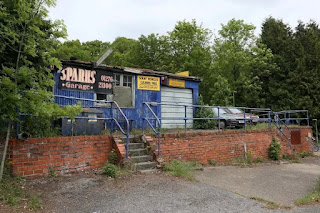
I had been pressganged into their joint enterprise to calculate the potential ‘return on investment’ of their projects, using my O-level maths studies to amortise the costs over varying numbers of years. One such development site was an anachronistic one-pump petrol station and car repair workshop that occupied a valuable rectangular plot on the busy London Road at Maultway North between Camberley and Bagshot. Owner John Sparks had inherited the business in 1966 upon the death of his father Arthur, though neither had updated its blue corrugated iron shack since 1926 when Arthur’s mother had purchased this large corner plot from the adjacent secondary school sportsground for her son to launch his one-man business.

Once I had calculated the viability of replacing the ramshackle building with flats, including the cost of removing the underground petrol tank and cleansing the polluted soil, the project was determined a ‘go’. However, we had not reckoned on Sparks’ stubborn refusal to sell. Beaver visited him. My father visited him. The Beaver sons visited him. Sparks remained intransigent. Their ‘persuasion’ techniques were evidently not working. Beaver purchased the Jolly Farmer pub on the roundabout opposite the Sparks site. One night it suffered a large unexplained fire. Sparks still refused to sell. In the end, the project had to be abandoned.

Like my mother, I was less in thrall of Beaver’s ‘entrepreneurship’ style than was my wide-eyed father, so the end of our disastrous two-week holiday in Spain and our farewells to his oversized villa came as a welcomed relief. On the flight home, I was seated next to larger-than-life Trinidadian bandleader Edmundo Ross. Despite already loving reggae and Brazilian music, my youthful snobbery regarded Ross as old-school due to his regularity on ‘BBC Radio 2’. Unaware of his fascinating life, I now regret not having chatted with him more.

A short time after our return to Britain, my father left us permanently to set up a new home with a teenage girl only a few years older than me. Our Spanish holiday seemed to have proven his last straw playing ‘happy families’. Children just got in his way. I had no further contact with the Beaver family … and I disowned my father.

In 1986, Tesco and Marks & Spencer jointly purchased a huge 76-acre site on the western fringe of Camberley to build two massive superstores (‘The Meadows’). The adjacent four-acre site, bounded by the London Road, Laundry Lane and Tank Road housed Bill Beaver’s open-air vehicle sales operation and was necessary to developers for a revised traffic flow system that included a new Sainsbury’s Homebase superstore. This plot on the far edge of town had suddenly become Camberley’s most valuable piece of land … to the benefit of its wily owner.

In 1990, John Sparks applied to Surrey Heath council for permission to build a bungalow (for his retirement?) on empty land at the back of his one-man garage. It was granted but never built. In 2014, seventy-eight-year-old Sparks retired, closed his business and sold the land to developer North Maultway Limited which demolished the workshop to build ten flats, for which planning permission was approved the following year. By 2017, the land had been sold to Seville Developments Limited which reapplied for planning permission to build nine flats. Two years later, this permission expired … leaving the former ‘Sparks Garage’ site derelict to this day.

[Originally published at https://peoplelikeyoudontworkinradio.blogspot.com/2023/08/give-them-foot-and-theyll-take-metre.html]

Economics! Economics! Read all about it! : 1974 : Mr Hodges, Strode’s College

 “Each of you will subscribe to ‘The Times’ newspaper and read it every day,” Mr Hodges told us. “In class, we will discuss one of its news stories about economics.”

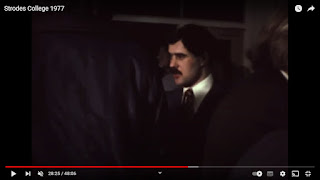
What?? It was my first lesson of a two-year Economics A-level course taught by a newly appointed young teacher wearing a dapper suit that could have been hiding a Che Guevara T-shirt underneath. His thick moustache signified the educational wind of change in the air. A revolution had torn through our school during the summer holidays and life for us students would never be the same. Ye olde buildings remained intact but events within had unexpectedly fast-forwarded to the late twentieth century.

A modest name-change from ‘Strode’s School’ to ‘Strode’s College’ failed to communicate the extent of the transformation. When I had arrived five years earlier, it was a grammar school whose calendar seemed to be set in 1869. The all-male teaching staff wafted around in faded black gowns as if momentarily materialised from the staff room of the University of Transylvania. Girls had ne’er been enrolled since Henry Strode founded the school in 1704. Latin lessons were compulsory. Boys wore bottle-green blazers, shorts and caps that were not permitted to be removed until we reached home. Pupils had to choose ‘arts’ or ‘science’ A-levels but not mix the two.

Headmaster James ‘Jock’ Brady would cane the bare backsides of boys in his office without the inconvenience of parental pre-approval. When carpeted for my first minor demeanour, as neither my parents nor my primary school teachers had ever laid a hand on me, I refused point blank to bend over and submit to Brady’s corporal punishment. Thereafter I was sanctioned with detentions, mediocre termly school reports and passed over for school prizes. Some of Brady’s staff seemed to be competing with him in a Strode’s league table of sadism. Writing on the blackboard, our biology teacher would suddenly spin around and hurl the wooden board eraser like a missile at the head of a student he suspected was not paying sufficient attention.

Our raised-from-the-dead English Literature tutor seemed to both teach and dwell in a dimly lit cobwebbed outbuilding that daylight had never touched, a hovel straight out of ‘Tom Brown’s School Days’. He would pace along our aisles of Victorian wooden desks, eager to whack his cane across our hands if we failed to recite our homework word-perfect. I can still reel off passages from ‘Henry V’ without the faintest notion of their meaning because the school never contemplated showing us a production. Neither were my parents of assistance since the only theatres I had been dragged to were a West End pantomime with Cliff Richard playing Buttons and appearances at Camberley Civic Hall by Lenny the Lion and Pinky & Perky.

For the first five years, my school ‘short break’ had passed standing beneath the window of the enigmatic Sixth Form Common Room hut at the edge of the Playing Field, hearing records played at extreme volume and banging on the window to be handed down a chilled bottle of Coke in exchange for some pocket money. Sixth-form prefects randomly picked on us younger students for minor infractions and handed out after-school detentions like confetti. I was once sent home by a teacher for wearing brown, instead of regulation black, socks. My slip-on Hush Puppies were deemed unlawful because shoes were required to have laces. My long journey home would result in missing an entire day of classes, and for what educational purpose? ‘Discipline over learning’ should have been the school motto … in Latin, of course.

I passed those years daydreaming of being chosen as a Prefect once I reached the Sixth Form. But the revolution denied me that power. Prefects were abolished. The Head Boy position was abolished. Girls were admitted. Uniforms were abolished. Morning and afternoon registration ended. Students were only required on-site when their timetable required attendance for a class. The Sixth Form Common Room was closed. A new teaching block was built for girls to learn Domestic Science. A host of new teachers, including women (gasp!), were employed for previously unknown subjects. Female toilets were built. Headmaster Mr Brady retired to his mansion in the nineteenth century from whence he had come. The canes were put away. One entire century of enlightened progress had been compressed into a single school summer holiday.

In our first Economics lesson, Mr Hodges gave each of us a text book but insisted the economic news stories we would read in ‘The Times’ were equally important. A discount student subscription enabled it to be delivered by a local newsagent every morning. My parents had always read ‘The Daily Express’ which I skimmed but found unedifying, exemplified by its anti-Common Market ‘Back Britain, Buy British’ masthead. However, ‘The Sunday Times’ had been my parents’ weekend preference since the 1960’s for its ground-breaking ‘Magazine’ colour supplement, permitting me to devour the newsprint sections they discarded unread and which introduced me to investigative journalism on topics such as the thalidomide scandal.

My daily journey to Strode’s by bus and train was one hour in the morning, but two hours in the afternoon that included a half-hour wait at Egham railway station and forty minutes at Camberley bus station. Though this travel elongated my school day to ten hours, it offered me the ideal opportunity to read newspapers thoroughly. Even before Mr Hodges introduced me to ‘The Times’, I had been purchasing ‘The Evening News’ at Egham station to read on my way home, it being unavailable as far out of London as Camberley. I recall once pushing open the waiting room door on Egham station’s westbound platform, only to be confronted by a couple wearing the uniforms of the adjacent Catholic girls’ and boys’ schools noisily engaged in sex on the wooden bench seat. After that graphic shock, I always waited outside on the platform.

Mr Hodges’ revolutionary teaching method stimulated my fierce appetite for the daily news cycle by reading ‘The Times’ cover-to-cover (except for the sports pages). Initially, it proved challenging to grasp the detail of British government machinations and the influence of global developments on the economy. However, significant events such as the 1973 oil crisis, ‘winter of discontent’ and ‘three-day week’ provided plenty of real-world material to discuss and analyse what ‘Economics’ was all about. I loved learning about the interaction of economic policy with politics and international news stories.

In the Lower Sixth form, some of my closest school friends decided to apply to study at Cambridge University, which encouraged me to do likewise. Tim, Martin and Philip planned to first complete their A-levels and then focus during a ‘year out’ solely on their applications. This avenue was not available to me as my family’s dire financial situation meant my single-parent mother could not afford to support my studies for a further year. Despite his substantial arrears, my absent father had already persuaded Farnham court on my sixteenth birthday to reduce his maintenance obligation for me to £1 per year. I had tried desperately to find a summer job in 1974 to assist my family but to no avail.

As a result, I was required to sit Cambridge’s entrance examination papers at the same time as studying for my A-levels, with extracurricular one-to-one tutorials generously fitted around my timetable by Mr Hodges and a maths teacher. Somehow, I managed to pass by a slim margin and was called for interview. I travelled to Cambridge alone, wearing the one stiff grey suit that my mother had bought for me to attend my cousin Lynn’s church wedding. On the train, I read the day’s papers thoroughly to ensure I could confidently discuss the British government’s economic policies and the latest international affairs. After all, I had applied to study economics.

“What sort of school is Strode’s?” my elderly interviewer asked.

“It’s a sixth form college,” I replied, “that used to be a grammar school.”

“Of which school sports teams have you been captain?” he asked.

“None,” I replied.

“What positions of responsibility, such as Head Boy, have you held at school?” he asked.

“None,” I replied. “Our college does not have a Head Boy or Prefects.”

“What does your father do?” he asked.

“I don’t know,” I replied truthfully.

“What do you mean you don’t know?” he immediately shot back at me.

“My parents are divorced and I haven’t seen my father for several years, which is why I don’t know what he is doing presently.”

“But he must have a profession, like a doctor or a banker or a barrister. What is his profession? Who employs him?”

“He qualified as a quantity surveyor and used to be self-employed.”

He seemed unsatisfied by my response. My father had left school at age fourteen. What could I do? I was not my father’s keeper! My interviewer waved towards a corner of the dingy interview room.

“There’s a piano over there,” he said. “Can you play something for me?”

“Sorry but I can’t,” I admitted. In my head, I was reflecting that I could name every minister in the present British government cabinet, if asked, and every aspect of its economic policy. However, my interviewer seemed convinced I was destined to be another Jane Fairfax.

“Did you not learn piano at school?” he asked.

“No. My school is focused on academic subjects, which is how I passed nine O-levels,” I replied.

The ‘interview’ continued in this same baffling style for half-an-hour. Not a single question was asked of me about economics, current affairs, news or, indeed, anything relating to the real world in which I lived. Enquiries were wholly about my success at making myself noticed by my peers and being appointed to team responsibilities by schoolteachers. There was no opportunity for me to mention having been male head of my family for the last few years, visiting solicitors, phoning courts, responding to Final Demands, writing endless letters to the tax office, utility companies and benefit agencies. Even if I had desired, I had insufficient free time to glorify my ego because I had all these responsibilities at the same time as passing three hours a day commuting to and from school.

On the long train journey home, I was not upset because I had no understanding of what had just happened. From an early age, I had had to invest and believe in the concept of ‘meritocracy’. Otherwise, I would never have bothered struggling to succeed in life. It was only years later I fully understood that my application, having lacked the benefit of wholehearted support from my school, had been made to a Cambridge college that accepted only around a hundred new undergraduates a year. Probably between zero and five of those accepted that year would arrive from state schools such as mine, regardless of how many had applied. My answers to the interviewer had merely reinforced a prevalent belief that boys like me were unsuited to aspire to study alongside the favoured elite from private schools. It had never been about academic ability alone. It required proof that you longed to be accepted by ‘them’ as ‘one of us’.

Unsurprisingly, the college I had applied to rejected me. My name was then placed in a ‘pool’ of applicants, probably filled with young people like me who had failed to prove at interview that they were ‘gentleman’ or ‘deb’ material. Eventually, I was informed that every other Cambridge college had similarly rejected me. The dream was over. It’s just one of those things you put down to experience.

What did not end was my insatiable appetite for reading newspapers, stimulated by the amazing Mr Hodges, that led me to ravenously consume a broadsheet daily for decades to come. For that I remain eternally grateful to a teacher who broke away from our school’s usual text book rote learning and opened the door to me understanding the big world beyond.

[8mm film of Mr Hodges by classmate & dear friend Martin Nichols]

[Originally published at https://peoplelikeyoudontworkinradio.blogspot.com/2023/08/economics-economics-read-all-about-it.html]

The unmagical mystery tour : 1973 : Piggott’s Manor, Letchmore Heath

 There was a loud knock on the front door. Who could be visiting unannounced after dark? Certainly not Mr Dickinson from ‘The Pru’ who always called during daylight hours to collect monthly premiums in cash for our insurance policy. The opened door revealed two men in uniform whose van parked outside had a strange aerial on its roof. What had my father done? Was he about to be forcibly dragged away from our suburban Orgonon? No. The men said they were from the Post Office’s Radio Interference Service and were investigating a recent spate of complaints from residents in surrounding streets of strange patterns interrupting their television viewing. Could they come in and inspect our equipment?

My parents’ enthusiasm for modern gadgets had equipped our living room with one of Camberley’s first state-of-the-art Bush colour televisions to receive the ‘BBC2’ service launched earlier in 1964. It had required the installation of a different aerial on the roof and an amplifier to successfully receive the UHF signal from a far transmitter. Although our own television reception had been fine, the men from the ministry believed that the amplifier must be faulty, transmitting interference instead of receiving signals, a problem they had sleuthed to our house. We were required to switch off the amplifier and temporarily refrain from watching BBC2. Hullabaloo and Custard had sold us a technicolour dream though I was now to be deprived of my daily look through the square or round window with Big Ted and Jemima.

The technical problem was eventually fixed and our BBC2 viewing resumed, even after the annual Licence Fee was doubled to £10 in 1968 for the 20,428 UK households that owned a colour TV, a dismal figure that betrayed the initial failure of the technology’s launch. We missed the first black-and-white BBC1 transmission of ‘Magical Mystery Tour’ on Boxing Day 1967 because we always spent the holiday at my grandparents’ house next door, stoically without a television. Instead, we gathered in our living room expectantly on 5 January to watch BBC2 repeat the programme in colour. This film premiere had been trailed as an artistic triumph for the world’s biggest pop group.

My parents owned all The Beatles’ albums to date and had watched their films at the Camberley Odeon. Earlier that decade, my father had bought a second-hand Uher reel-to-reel tape machine and had recorded the group’s performances broadcast live on the BBC Light Programme with a microphone held to the speaker, while his family was ordered to remain silent. The resultant tapes were played repeatedly in our house at high volume, years before homemade audiocassette compilations became possible and decades before Spotify would offer the same outcome at the press of a mouse button.

Once the 52-minute film of embarrassingly indulgent pop icons acting sillily in and around a bizarre coach trip had ended, we looked around to gauge each other’s reactions. It had been an incomprehensible and barely entertaining viewing experience, we agreed. The next day at school I wrote a short account of our evening in my ‘day book’ and drew an accompanying colour picture. No classmates had watched the film. My female teacher likely presumed my parents to be hippies. Our home’s complete collection of Beatles albums came to an abrupt halt. My mother transferred her musical affections to non-stop Herb Alpert.

After this artistic disappointment, The Beatles faded from my childhood. I learned that John Lennon had moved into a mansion (‘Tittenhurst Park’) in nearby Ascot when one of my father’s clients was appalled to discover the identity of his new neighbour. I recall our family being dragged along by my father to walk around Bruce Forsyth’s house on Wentworth Drive as a possible home, the estate agent spouting that a Beatle lived nearby (Tittenhurst Park is 1.6 miles away). I was excited by our potential neighbour but appalled to contemplate a home adjacent to a golf course in the middle of nowhere. Luckily it never happened.

Years passed during which our family circumstances changed irreversibly. One morning in 1973, my father turned up unexpectedly at our home and insisted I accompany him on a trip. I adamantly refused but my mother insisted I go, hoping I might learn something about my father’s current ‘circumstances’. Only months earlier, he had quit our home for good and since had done his best to humiliate and impoverish his former family. He had even gone to court to demand regular access to his two-year-old daughter whom he had never wanted in the first place. One Friday a month, he would turn up and drive off with my baby sister, leaving my mother fretting inconsolably the whole weekend as to whether we might ever see her again. What ‘childcare’ my father provided at weekends we never learned, as he had been notably absent in his other children’s upbringing and his new lover was a mere teenager.

There was no conversation during our car journey. Not LITTLE conversation, NO conversation. My father talked though I said absolutely nothing. He still drove his left-hand-drive American Motors Javelin AMX sports car as fast and recklessly as he ever had, breaking speed limits, overtaking on blind corners and generally terrifying me. Only the air conditioning kept me cool. I hated being there. Since leaving our home, my father had ignored me, ignored my birthday, ignored Christmas and sustained his total disinterest in my life. I had no respect for him because he had never done anything to earn respect from me. He seemed not to have the faintest idea of what a father should say or do for his children. Tellingly, after he had left, I never missed my father at all. Rather than tears, I felt relief. Why would I miss someone who had only ever used my talents to further his own greedy ambitions?

After an hour and a half of stoney silence, we had travelled past Elstree and arrived before a huge mock-Tudor mansion in extensive grounds. He parked facing the front of the house and its luxurious lawns, telling me he had to go inside for a meeting and would leave me in the car for a while. I was just pleased not to have to suffer any more of my father’s dangerous driving and not to have to be in the company of someone who had always felt like a stranger to me. I switched on the car radio and listened to music.

I saw lots of people all dressed in similar orange medieval-style robes coming and going from the mansion and walking along its driveway in singles and in groups. I had never seen anything like it. Not in Britain anyway. I had seen photos of Buddhist monks in picture albums of faraway lands. But it felt eerie to be seated in a car in deepest rural Hertfordshire, surrounded on its driveway by people who looked as if they had materialised en masse from another dimension and a different time. What was I doing here and, more to the point, what was my father doing here?

Only later did I learn that Beatles member George Harrison had recently purchased this property with its seventeen acres of land, then known as Piggott’s Manor, and donated it to the Hare Krishna religious movement that had outgrown its Hindu temple in central London. The property was renamed Bhaktivedanta Manor and immediately attracted a huge volume of visiting devotees, the religion’s membership having been boosted by Harrison’s very public advocacy since The Beatles years. In the present day, 60,000 visitors annually are reported to attend its religious festivals.

For me, the irony of our visit that day was that my father’s life could not have been further from the altruistic philosophies of the Hare Krishna movement. I knew he had no interest in religion and had probably never even visited a church. If he was here, it must have been for his professional advice as a quantity surveyor. Perhaps modifications were necessary to this mansion as it had functioned as a nurses’ training college since 1957, owned by St Bartholomew’s Hospital in London. How could he have hustled this appointment? We knew from my father’s court papers that he claimed now to be living in the gated, 420-property St George’s Hill estate in Weybridge, home to many pop and entertainment celebrities, including John Lennon (before his move to Ascot) and Ringo Starr.

Did I meet George Harrison? No. Was I invited inside the mansion to hold the end of my father’s tape measure, a task required of me since I could walk? I honestly cannot remember. What happened next? I know he drove me home … again in silence. I was so consumed by the pointlessness of our father/son ‘road trip’ that almost everything else that had occurred was immediately eclipsed in my mind. Why had he insisted I accompany him? Was he trying to impress me? Was he trying belatedly to demonstrate his credential as a father? Or had he imagined I could help him secure a new client? I have no answers. It became our final day spent (un)together.

Half a century later, I was watching the 1969 Beatles footage in the fascinating 2021 ‘Get Back’ documentary when I noticed a Hare Krishna member who had accompanied George Harrison sat cross-legged on the floor of the group’s recording session. Memories of one of the strangest and most unrewarding days spent with my father came flooding back.

[Originally published at https://peoplelikeyoudontworkinradio.blogspot.com/2023/07/the-unmagical-mystery-tour-1973.html]

Blinded by the light : 1967 : Architectural Drawing Services, 27b High Street, Camberley

 It was a mystery. Questions were asked. Answers were not forthcoming. Nobody could understand what had happened. Evidently something must have occurred. But what? And how? The professionals were stumped. I could not help. I had no answers either. Had I been in an accident? No. Had I hit my head? No. Had my face been hurt? No. I remained as baffled as were they. I had no answers. The whole thing was to remain a complete mystery … for decades.

Once a year, we were told to stand in line in the corridor in our underwear. Boys in the morning, girls in the afternoon. I hated standing around near-naked in public. One by one we were ushered into an office where a nurse rushed through an eye test, a hearing test and pinged our underpants’ elastic for a gender check. It was the result of my eye test that held up the ‘production line’ for processing my classmates. The record card had logged my vision as 20/20 one year ago. How come, now, I was so short-sighted that I could read no further than the second line on the eye chart? It was a complete mystery.

Children tend to join a ‘family business’ once they have finished their education. I was put to work by my father before I started school. Once I could walk, I accompanied him on appointments to measure houses, shops, offices and factories where I held the end of a long tape measure marked in feet-and-inches, wound out from a brown holder the size and shape of a discus. Once I could read, I ensured copies of design periodicals including ‘Architects Journal’ were returned to his office shelves in strict chronological order. Once I could write, I used Letraset sheets to transfer stylised, appropriately scaled men or women pushing pushchairs onto his ‘artist’s impression’ building elevation plans. Such was the volume of graphics and lettering I used that the well-thumbed, thick, ring-bound Letraset catalogue became the closest we had to a Bible in our house.

My father’s office was a Portacabin behind the garage in our back garden. As our house was only 300 yards from the town centre, clients could visit him easily. However, my parents were about to move to a house they had been building two miles on the opposite side of town that was reached by an unmade road. It would prove useless for a business. The solution was the rental of a town centre office at 27b High Street on a busy pedestrian alleyway connecting to the Knoll Road public car parks. It had three rooms: a small lobby, a main room large enough for two drawing boards and a desk with an electric typewriter, plus a smaller back room. My father registered a company named ‘Architectural Drawing Services’ and ordered letterheads, invoices, statements and business cards with an olive-green border from Southwell Press in Park Street.

The office windows faced the wall of the Midland Bank building on the other side of the alley. My mother had applied to work there in the early 1950’s, desiring a job closer to home than the administrative role at Elizabeth Shaw’s chocolate factory she had taken after leaving the grammar school on Frimley Road. Thrilled to learn that her application had been successful, she was disappointed to be told she could not work there because no women’s toilet existed in the building where only men were employed. Instead, she was offered the same job at the Midland branch in Farnborough where she could use the female public toilet in the newly built Queensmead shopping plaza … which she accepted and had to commute.

In my father’s new office, I was given three additional tasks. At the end of each month, I typed the invoices, statements and their envelopes. If clients’ payments were overdue, I had a box of green, yellow and red warning stickers I would lick and attach to their statements, printed with progressively strident threats. I handwrote details of each invoice into a large accounting ledger, the opposite page of which my mother updated with bill payments she had made.

Secondly, once school finished at four o’clock, I would pay a halfpenny to catch the number 1 or 2 or 3C bus to the town centre and wait in my father’s office until he was ready to drive us home for ‘tea’ at our new house. He would regularly ‘pop out’ and leave me alone in order to (I learned much later from my mother) spend an hour or so with his current mistress. Clients and potential clients visiting the office late afternoon might find it manned only by a polite nine-year old boy, banging out documents on an IBM Selectric typewriter he had mastered years earlier. It must have seemed bizarre.

Things could have been worse. If I had been born a hundred years earlier, I might have been sent up chimneys as I was appropriately thin and tall (only Pamela Munroe and Marina Hirons were taller in my class of thirty). As it was, I was made familiar with most aspects of running a small business by the time I finished primary school. These were skills that schools (and even university) failed to consider worthwhile imparting, and why girls like my mother had to be sent subsequently to ‘secretarial school’ to learn the practical aspects of commerce about which their male bosses would never need to worry their unpretty big heads.

My third task was to work in the rear office that was off-limit to clients, kept darkened by a venetian blind across its window and contained two printing machines. One was an absolutely massive dyeline printer that used ammonia solution and photosensitive paper to reproduce paper copies of 36- by 48-inch architectural plans drawn onto tracing paper. There was no ventilation from the room as the door to the main office had to be kept shut to keep out the light, as did the one window to prevent a breeze blowing the blind. The second machine was a Rank Xerox monochrome photocopier that used ultraviolet light to print onto photosensitive A4 paper.

During term time, I would regularly do small copying jobs for my father after school on both machines. I hated the smell of the ammonia, the heat generated by the machines and the bright light emitted by the photocopier. During this era, such machines were uncommon outside cities and my father soon realised he could subsidise their cost by offering copying services to non-clients. He was approached by the Associated Examining Board [AEB], the only GCE examination board not linked to a university, which had moved from London to nearby Aldershot in 1966 and was seeking a business to contract for photocopying services. It would mean taking on a lot of seasonal work but the returns would prove significant. The deal was done.

Schools in the UK and former colonies took GCE exams every June, sent them directly to the persons appointed to mark them, who then sent them to AEB. A percentage of papers for each subject were then forwarded by AEB to a different academic whose job was to check that the initial marking was appropriate and consistent. They were sent a photocopy of the student’s marked work to ensure the original would not be lost. Turnaround time for these tasks was critical as exam boards notified students of their results in August before the new school year started the following month.

My mother was occupied at home caring for my younger preschool brother so it fell upon me to fulfil this contract. Most of my school summer holiday had to be spent in the darkened back room of my father’s office, photocopying thousands of examination scripts for days on end. It was hot work and the ultraviolet light flashed around the edges of the document plateau thousands of times. AEB were pleased with the results and renewed the contract to execute the same work for their less busy December exam retakes. Bang went my Christmas holidays too!

The outcome, which everyone had apparently failed to anticipate, was my mother taking me to Leightons opticians at the top of the High Street to purchase my first pair of NHS glasses with thick lenses in tortoiseshell frames. I refused to wear them at school, not because I feared being bullied (something never witnessed at Cordwalles Junior School) but because it was so rare then for children of my age to wear glasses. My stubbornness perplexed teacher Mr Hales who struggled to comprehend why I could no longer copy down things he wrote on the blackboard. Had one of 4H’s brightest students suddenly become illiterate?

Subsequent eye tests proved just as baffling to opticians who could not understand why my eyesight had deteriorated so suddenly during one year, but then remained static for years afterwards. It confounded me too for a long time until I finally understood the havoc wreaked on eyesight by lengthy unfiltered exposure to UV light. The only positive side effect was that, in every workplace I have since worked, I have been the one person in the office who can be relied upon to fix a malfunctioning photocopier!

Once I progressed to secondary school in 1969, I became too busy completing mountains of homework to continue the monthly office tasks. Besides, my father was about to upgrade my ‘help’ to evaluating the potential profitability of local property deals for a considerably more lucrative sideline he had discovered. I also suspect he preferred I spend less time at his office because, the older I was, the more difficult it became for him to disguise his dalliances with women.

In 1972, my father left our family forever to run off with recent teenage bride Suzie Anthony who lived a few doors away. The courts ordered him to pay the mortgage on our house and maintenance to my mother and her three children. He avoided payment, claiming he was unemployed despite living in salubrious, gated St Georges Hill, Weybridge. He broke into our house while we were out and stole almost everything he had ever provided for us, including some of my treasured vinyl records purchased with pocket money. My mother had to take both a day job and an evening cleaning job to try and make ends meet.

On my sixteenth birthday in 1974, my father applied to Farnham court to reduce my maintenance payment to £1 per year, arguing that I was now old enough to take a job. The court agreed, despite him already owing thousands in arrears and me about to take eight O-level exams and hoping to continue my education with A-levels and university. I received a letter from the court informing me of its decision at a hearing of which neither I nor my mother had prior knowledge. When the amount owing mounted even further, he fled abroad. Farnham court said it was our responsibility to trace his whereabouts.

In 1976, entirely coincidentally, my first paying job was processing examination papers at AEB in Aldershot. Almost a decade had passed since I had similarly handled thousands of students’ handwritten GCE scripts from all over the world in my father’s office. It was difficult not to believe in some kind of ‘fate’.

My father died in 2013 though I was not invited to his funeral. A handwritten will bequeathed the majority of his assets to my younger brother whose contribution to my father’s business in Camberley had been … zero.

[Originally published at https://peoplelikeyoudontworkinradio.blogspot.com/2023/07/blinded-by-light-1967-architectural.html]

Just my imagination running away … to Australia : 1972 : Eric Hall, Strode’s School

 A schoolboy babysitting two infant-school-age girls at night? Quick, call the police! Notify child protection services! … But wait! This was the 1970’s. That boy was fourteen-year-old me. Back then, few would have jumped to the (mistaken) conclusion that anything untoward was happening. How naïve we seemed to be!

My mother had few close friends and I fail to recall how she had come to know Cathy Bingham, who had recently moved into a new-build house at the far end of Byron Avenue, less than a kilometre away within our suburban housing development. Seeking a means to supplement my meagre pocket money, my mother had suggested to Cathy I could babysit her two young daughters if she and her husband wished to go out for an evening. I could only help out on Friday or Saturday as my school set two homework subjects each weekday and required my efforts to be submitted the following weekday. The resultant babysitting arrangement worked well and I was grateful for Cathy’s generous compensation which funded my purchase of more reggae and soul records.

Cathy was a genuinely lovely person who had moved to Camberley from Peru where her husband had apparently been posted by his employer. Prior to the birth of her daughters, she had had a job driving new cars from their Detroit production line down the Pan-American Highway for delivery to dealerships in Lima. I considered this a ‘dream job’ since my father had already stimulated my interest in American cars and I longed for the day I would be able to drive long distances myself.

One babysitting evening, once the girls had been put to bed upstairs, I spent the remainder of my time sat on the sofa in front of the television. I watched a recent British movie named ‘Walkabout’ about a father who suddenly abandons his two children in the middle of the Australian outback. The scenery was spectacular and the story fascinating of the children’s chance meeting with an Aboriginal boy who demonstrates his traditions to them and saves their lives. It made a huge impression as my first television experience of Australia beyond the formulaic ‘Skippy’ series.

I had already leafed through many large-format photo books of faraway lands, including Australia, whilst sat at a desk in the first-floor reference section of the local public library. I had been impressed by the mud-brick high-rise buildings in Yemen, the desert libraries of Timbuktu and the Ayers Rock sandstone monolith. Along the same Dewey Decimal shelf, I had recently discovered the first ‘Lonely Planet’ guide as a Roneo-ed set of booklets hand stapled together. All these readings had stimulated my desire to travel abroad, since most of our family holidays to date had been taken within Britain.

Australia was also on my mind after a recent chance meeting with a young Australian girl who was working in the bookshop on Station Road in Egham. I had made an earlier visit to the shop in 1970 to order a book (that changed my life) documenting American black music, ‘The Sound of The City’, which I had seen mentioned in its author Charlie Gillett’s weekly column in ‘Record Mirror’ magazine. My second visit was to exchange several ‘book tokens’ that had been awarded me as ‘School Prizes’. On that occasion, shop assistant Jan Somerville spent considerable time helping me choose paperbacks that might interest me, including ‘Exodus’, ‘Dune’ and ‘Topaz’. Her advice was particularly useful as I had no idea what to buy, my parents having almost no adult books at home.

I was instantly smitten with Jan as she was the first interesting girl around my age (well, she must have been two years older) I had met and, to my lusty adolescent eyes, she resembled heartthrob Susan Dey from ‘The Partridge Family’. She explained that her family had temporarily moved to Britain and she had found a job for a year in Egham’s large, well-stocked independent bookshop. After that, during my school lunch-hour, I would pop into the shop and chat with her regularly. When she finally returned to Australia with her parents, she gave me a slip of paper with her address in Clontarf, New South Wales. I was sad to lose my first ‘schoolboy crush’ but we wrote to each other for a while and she sent me a small toy koala which I have kept since. I had hoped to visit her one day … but life intervened.

All this explains why, on the occasion that English Language homework required me to write an essay about a landscape I had never visited, I naturally chose Australia. My teacher, Eric Hall, was a young man (relative to the majority of ancients that taught us) who wore tweed suits and was eager to show off what he probably believed was his sardonic wit. However, I read his attitude as sarcasm, a quality I found less than endearing after having arrived at the school wholly ignorant of his subject. Many of my classmates had previously attended private ‘prep’ schools and already knew what a noun, adjective, verb and tense were. I had never heard these terms because my state junior school had been keen to develop our creative skills rather than grammatic pedantry. I faced a steep learning curve at Strode’s School.

When I started my third year, I had been disappointed to be told that Mister Hall would be our ‘form master’, with whom we were required to register our attendance twice a day. My already poor rapport with him deteriorated considerably when, without prior consultation, my father impulsively booked a package holiday at an Egham travel agency for me and him to visit Florida during school term to witness the launch of an Apollo space mission. As a result, my mother was angry that her husband had not discussed this indulgence beforehand and had apparently demonstrated no desire to be accompanied by her and my two siblings. Mister Hall was outraged to be informed of my impending absence as a fait accompli and insisted that my trip be cancelled, which my father refused. Subsequently, my relationship with not only Mister Hall but most of the school administration was soured. I was never to be awarded a further School Prize.

At the end of our English Language period, Mister Hall walked around our desks, handing back each of our essay books … except for mine. After returning to his seated position at the front of our classroom, he said:

“You can all go now. Except for Goddard, who I want to see afterwards.”

Now what I had I done wrong? He opened my workbook to the page of my latest essay and pointed at it disparagingly.

“Your essay about Australia was very descriptive and incredibly detailed. Have you ever visited Australia?”

“No,” I replied.

“Well, I just do not understand how you could have written about somewhere you have never experienced with so much detail about its landscape and features,” he commented sourly.

I had no idea what he was trying to imply. I had worked very hard to produce a good essay and now he was trying to say obliquely that my work was too good? How was I expected to explain that?

“I’m interested in Australia,” I said. “I have seen films and read books about it, which is the reason I chose to write my essay about it.”

“Well, I am afraid I do not believe that you wrote this essay,” said Mister Hall angrily. “I have come to the conclusion that you must have copied it from some book. That is the reason that I have had to give you a fail mark for this piece of work and, naturally, this will be reflected in your end-of-term report.”

I was horrified. How could Mister Hall be so cruel? I understood he had never liked me, but I had never contemplated he could be so nasty to a student who had worked as hard as they could in order to be successful in his subject. From then on, despite my regular ranking as one of the top five students within my year of sixty pupils, Mister Hall’s comments in my termly school reports were consistently negative. His and a few other teachers’ similar attitudes to me during my seven years at Strode’s coloured my entire secondary school experience. For the first time, I learnt what it meant to be despised by an adult in a position of authority. It was an incomprehensible change from my previous positive experiences at Cordwalles Primary School, where my incredible teachers had been generous to a fault with their mentoring of me and my classmates.

I had no choice but to soldier on at school under the tutelage of Mister Hall. I took the GCE ‘O level’ exam in English Language the following year and achieved an ‘A’ grade. Three years later, I passed the ‘Use of English’ exam required of entrants to Oxford and Cambridge universities.

Before those subsequent academic successes, my life was changed irrevocably later in 1972 when my father deserted our family to run off with a newly married teenage bride who lived a few doors away on our street. The brief trip to Florida was the final occasion I spent time with my father until the day he died. Not only did he unknowingly negatively impact my school life for the remaining four years, but he knowingly impacted my family’s lives forever. The evening that I had chanced to watch the father in ‘Walkabout’ maroon his children in the outback was paralleled only months later in my own life when my father walked away from his three children, condemning them to an unexpectedly different future.

Despite these personal setbacks, Cathy Bingham’s experience of driving through the American continent in the 1960’s continued to inspire my ambitions. In 1984, I hatched a plan to hitchhike from the United States down the Pan-American Highway to Nicaragua to visit my friend Tony Jenkins who was there providing news reports to ‘The Guardian’ and ‘BBC World Service’. I visited the London embassies of all the countries I would pass through and obtained the necessary visas. However, this plan was stymied by a six-month wait for the BBC to inform me whether my second-round interviews for separate producer jobs at ‘Radio One’ and ‘Radio Two’ had been successful. In the end, I was rejected for both. Angry that my travel plans had been thwarted by the excessive wait, I enquired why to BBC Personnel, only to be informed by its employee that in future I would need to prove to interviewers that “you are one of us”.

Evidently, I never was.

[8mm film of Eric Hall by classmate & dear friend Martin Nichols]

[Originally published at https://peoplelikeyoudontworkinradio.blogspot.com/2023/05/just-my-imagination-running-away-to.html]