Digital radio switchover: amendment to ‘consider the needs’ of listeners and small stations

Clause 30 of the government’s Digital Economy Bill sets out the process for determining the date for radio ‘digital switchover’:

97A: Date for digital switchover
(1) The Secretary of State may give notice to OFCOM nominating a date for
digital switchover for the post-commencement services specified or
described in the notice.
(2) When nominating a date, or considering whether to nominate a date,
the Secretary of State must have regard to any report submitted by
OFCOM or the BBC under section 67(1)(b) of the Broadcasting Act 1996
(review of digital radio broadcasting).

An amendment has been tabled by Lord Howard of Rising and Lord de Mauley which would require the government additionally to consider:

• the needs of local and community radio stations
• the needs of analogue listeners

as well as any reports submitted by Ofcom and the BBC. This amendment will be considered, along with many others not concerned with radio, when the Bill is debated by a House of Lords committee on 6 January 2010.

Although this amendment does not suggest a specific mechanism for canvassing the opinions of listeners or local radio stations, it nevertheless acknowledges implicitly that the consumer and small commercial/community radio stations need to have a voice in the process. It is about time.

From its earliest formulation, the proposal for radio broadcasting to be switched from FM/AM to DAB seemed to have been intended to create:
• a ‘walled garden’ under the control of the UK’s largest commercial radio owners and the BBC who, between them and transmission provider Arqiva, not only own the entire DAB infrastructure but also act as ‘gatekeeper’, deciding which station has access to the platform.
• a ‘walled garden’ on DAB that would hopefully stop consumers listening to content not produced or approved by the BBC or the largest commercial radio companies, such as online radio (most of which originates or is owned overseas), pirate radio, community radio and small independent stations.

Massive consolidation in commercial radio since then has resulted in a more divided industry than ever, in which the biggest commercial players are eager to ‘nationalise’ or ‘regionalise’ what had been licensed as local radio stations, whereas most of the smaller commercial and community owners want to keep local radio as local as they can.

There is no longer likely to be a single organisation that can embrace the full range of stakeholders in the radio sector. Even government agencies such as Ofcom and DCMS seem wilfully to be ignoring the wider picture, as if seduced by notions that ‘DAB must happen’, ‘bigger must be better’, ‘Britain must lead the way’ and ‘consumers don’t know what’s good for them’.

Inevitably, it will end in tears. You can pass all the laws you want but, if you cannot get the consumer interested in DAB, it will fail. And, to date, the consumer seems largely disinterested and could not care less that manufacturers of DAB radios are mostly British (though they manufacture outside the UK) or whether they listen to British radio content.

Ofcom’s most recent market research shows the stark reality: 64% of households say they are unlikely to buy a DAB radio in the next 12 months, and a further 20% say they don’t know.

You ignore consumer opinion at your peril.

FRANCE: Digital radio postponed until at least year-end 2010

After a period of uncertainty about a timetable for the launch of digital terrestrial radio in France, the regulator has finally admitted that the first transmissions, which had been scheduled to take place this month, will be postponed until at least year-end 2010.

During an online chat yesterday, Michel Boyon, president of the CSA [France’s media regulator], said: “While everyone recognises the need to act quickly, despite the current economic challenges, it will be year-end 2010.” He argued that “if radio does not go digital, It will slowly decline” and noted that “internet radio is very good, but it is totally inadequate to meet the demands of listeners.”

Nevertheless, the French press seems unconvinced that digital radio will ever happen.

Digital radio silence is delayed!” said the headline in trade magazine SatMag, which commented: “After having been delayed for years in favour of digital television, digital radio is taking too long and is being overtaken by other technologies.”

Too expensive, digital radio postponed indefinitely,” said the headline of Agence France-Presse the day before Boyon’s announcement. It added: “The latest figures from Mediametrie confirm the change in radio listening habits: almost 50% of listening takes place on the move, and a quarter of the population has already listened to radio via the internet. During the last year, the numbers listening to radio via mobile phones has increased by 50%.”

Has the internet killed the digital radio proposal?” asked the headline in rue89. Francoise Benhamou, professor of economics at the University of Paris 13, commented: “Consider that a cost of 600m to 1bn Euros [to implement digital terrestrial radio] over ten years is viable only if [radio] advertising revenues increase by 20 to 25%. Such a forecast would be very risky given the uncertain economic background and the competition from the internet for advertising revenues.” She added: “Many of us already receive radio broadcasts, live and on-demand covering a wide range of content, as well as associated interactive services, by connecting via broadband. Do we really have a need for digital terrestrial radio?”

Professor Benhamou concluded: “This situation does not please everyone, particularly the CSA [media regulator] who saw [digital radio] as an opportunity to extend their domain …”

It sounds all too familiar to us in the UK.

BBC radio: endangering commercial radio's 'heartland audience'

Dear David Liddiment

I was interested to see your article in The Guardian, on behalf of the BBC Trust, defending Radio Two from accusations made by the commercial radio sector that the station has deliberately sought a younger audience. You say:

“What about the challenge that Radio 2 is getting younger? We found that Radio 2’s under-35 audience did grow significantly between 1999/00 and 2004/5 (albeit from a low base). However, over the past five years, the age profile of the station has remained stable and there’s been no increase in reach to under-35s.”

Your analysis here focuses on two specific metrics – under 35’s and Radio 2’s ‘reach’ – whereas the important issues raised by commercial radio rightly concentrate on:
• Commercial radio’s ‘heartland audience’ of 15 to 44 year olds, which it has pursued for many years as a result of advertiser demand to reach this segment of the population;
• ‘Share of listening’ as the appropriate metric because there is a direct correlation between this figure (how many hours are listened to commercial radio) and how much revenue the sector generates.

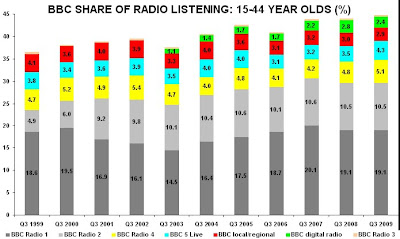
The graph below, taken from RAJAR data, shows the ‘share of listening’ attracted by BBC radio stations amongst 15-44 year olds since 1999.

It is evident that the listening share of most BBC stations has remained relatively static over this period. The exception is Radio Two, whose share of listening amongst 15-44 year olds has more than doubled from 4.9% to 10.5% over the last decade. It is true that this growth has started to level out in recent years, as your article asserts, but there is no denying that the damage has already been done.

The graph shows clearly that this significant increase in listening has not been achieved by migration from competing BBC radio services to Radio 2. On the contrary, the BBC’s overall share of listening amongst 15-44 year olds has increased from 36.5% to 44.7% during the last decade and, most importantly for commercial radio, is continuing to grow year-on-year.

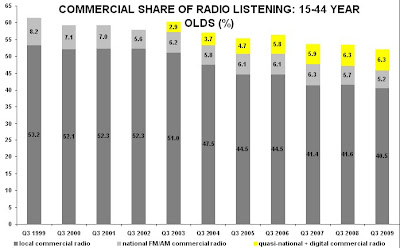
The graph below demonstrates clearly that it is commercial radio which has lost listening share, from both its local and national stations, that has migrated to the BBC. As a result, commercial radio’s listening share amongst 15-44 year olds has fallen from 61.7% to 52.1% over the last decade.

 
The danger for the commercial radio sector is that, if its market share falls below 50%, potential advertisers might no longer consider radio to be the ‘powerhouse’ delivery platform amongst 15-44 year olds that it used to be. The impact will not simply be a proportional loss in advertising revenues, but a significant loss of confidence in radio as an advertising medium to reach 15-44 year olds.

This is why, inside the BBC and Radio Two, a change in strategic policy might look as if it only results in an increase in BBC market share of a percentage point or two. For the commercial sector, not only does that single percentage point lead directly to a proportional loss of revenue but, sustained in the longer term, it can potentially undermine the medium’s ability to convince advertisers to use radio rather than, say, digital TV or the internet.

This is why the promise you make that “Radio 2 listeners won’t get any younger” is little comfort to a sector that has already been damaged by BBC strategic policies and which is continuing to lose market share year-on-year amongst its ‘heartland audience’ to BBC radio as a whole.

Of course, some of this listening loss can be attributed to commercial radio’s own competitive (in)ability to compete with the BBC – I would be first in line to argue that case – but unless its downward spiral of diminishing listening and diminishing revenues can be reversed, commercial radio could be decimated to the point where it can no longer be a financially viable business.

I write to you not to criticise Radio Two, which is a remarkable station, nor to apologise for the commercial radio sector, which has to shoulder considerable blame for losing touch with its audience. I write to illustrate that the industry’s own data clearly shows the BBC continuing to eat away at commercial radio’s ‘heartland audience’, and I write so that the BBC Trust might understand the consequences if the migration of radio listening to the BBC continues at its current rate.

Yours,
Grant Goddard

30 November 2009

Radio in the Digital Economy Bill: House of Lords Second Reading

Digital Economy Bill
2 Dec 2009 @ 1539
Second Reading, House of Lords [excerpts]

The First Secretary of State, Secretary of State for Business, Innovation and Skills and Lord President of the Council (Lord Mandelson):
We have also set out our vision for the future of digital radio, which will see the country shift to digital, when transmission coverage and audience numbers are wide enough, by the end of 2015.

The Lord Bishop of Manchester:
The switchover to digital radio may produce more problems than expected. Of course there is much to welcome in the creation of platforms for new content to meet the needs of specialist audiences. I think, for example, of Premier Christian Radio’s recent acquisition of a national DAB licence. However, there may be much to be concerned about over the plan to cut off national stations and many local services as early as 2015. While the Government have indicated that that will not be finalised until digital services account for 50 per cent of all radio listening and can reach 90 per cent of the population, it is also clear that without an early deadline, sufficient pressure may not build on radio manufacturers and retailers to shift to selling DAB sets only for cars as well as homes. The radio switchover again underlines the risk of creating another two-tier system where significant swathes of the country could lose their favourite national stations from the FM dial, including the BBC stations they pay for through the licence fee. Surely that cannot be right.
What government support will there be for the switchover to digital radio, which is likely to be not only more problematic but, generally, more expensive across the population than the TV switchover has been? Will the Minister accept that over-rushing towards analogue switch-off will not allow proper time for the Government, this House and the other place to think through the unintended consequences? Is there anything that the Government can learn from the German Government’s experience and their postponements of switchover plans?
….. On voluntary supported broadcasting, do the Government intend to keep some of the analogue spectrum going, for example, for hospital radio?
This country must, of course, embrace the opportunities offered by a digital economy, but the advantages must be shared by the widest possible number of citizens. Some, if not all, of the unintended consequences that could unfairly disadvantage people might be avoided by not being trapped in too rigid a timetable. If that happens, I fear that this country will not benefit from the best rewards that a digital economy offers.

Lord Carter of Barnes:
Secondly, in the critical areas of investment, infrastructure, spectrum liberalisation and the digitalisation and deregulation of sound radio, it provides a framework for innovation, development and investment.

Baroness Howe of Idlicote:
My Lords, when the noble Lord, Lord Carter of Barnes, introduced Digital Britain a little while ago we all recognised that things were beginning to happen and there were some very welcome realisations, for example, on the need to move forward with digital radio…….
I welcome those parts of the Bill which incorporate the Digital Britain promise to speed up delivery of a fully operational DAB digital radio platform. I spend a lot of time in cars and have had hearing difficulties since the arrival of my first child, so it is a real pleasure to enjoy the quality and clarity of digital sound, especially when listening to music-whether it is Radio 3 or Classic FM, both of which are excellent stations. The plank for Ofcom to be able either to terminate analogue licences without consent, subject to a minimum two years’ notice, or where appropriate to extend analogue licences up to and beyond switchover, on condition that digital services are also provided, will no doubt help to build in the much-needed flexibility to enable radio switchover. I very much hope and have confidence in the plans that have been outlined that it will happen by 2015. It is important that it does.

Lord Roberts of Llandudno
Today, I looked at the figures for radio listeners in Wales who have ever listened to digital audio broadcasting. I shall not go through the whole list, but in Cardiff, it was 27 per cent, while in the valleys, it was only 4 per cent. That is the difference. The most needy areas will not have the opportunity to benefit from these new high-tech developments. There is a pressing need for an extension of broadband, not least because of the commitment already made by the Government that fibre optic broadband should be prioritised in “notspots”, where other technologies have also failed.

Lord Clement-Jones:
I move on again, to independent radio services. We broadly welcome the provisions for digital switchover. Of course, full switchover will only happen on a specified date if certain criteria for uptake are met, and the only way that one will get further adoption is by setting a firm date. I hope that the Minister will confirm that we are currently working off a 2015 date, but there are concerns among smaller radio stations that the digital multiplex regions that have been defined are too large. Small, local stations will be broadcast across the whole of a large region covered by a multiplex, and may be expected to pay a rental reflecting that. That would be unfair on some of those small stations. Many of them are arguing for DAB Plus, a technology which would be, I believe, much more in tune with their requirements. I would be grateful to hear what the Minister says in that respect.

Lord Howard of Rising:
While we on these Benches support the switch from analogue to digital radio, it is a sensitive area. It would be good if the Government could give some assurances of what criteria will be used to decide when will be the appropriate time for the changeover. Will the Government be guided by the criteria set out in the Digital Britain White Paper, referred to by the right reverend Prelate the Bishop of Manchester? If so, we remain unconvinced that the 2015 target date is realistic and worry that millions of listeners and hundreds of local stations will be disadvantaged.
There are many for whom the digital switchover will cause problems: the elderly or the lonely, who may have had a wireless for many years which has become almost a companion; the blind person who will not be able to work the digital radio because the instructions are on a screen that they will not be able to see. I hope that the Secretary of State can reassure the House that proper care and attention will be paid to the needs of those who will encounter difficulties with the transition.

Lord Davies of Oldham:
The right reverend Prelate the Bishop of Manchester indicated the issues that arise with the digital switchover. I emphasise that we will not make the switchover for radio until there is already 90 per cent coverage in the United Kingdom and until 50 per cent of hours of radio are listened to via digital stations. We have criteria before we actually make the move. This follows on from points about the switch from analogue to digital television. I take on board his point that it is important that any changes that are made benefit people and do not shock them with a possible loss of services and extra cost. That point has to be addressed.

[next stage: House of Lords Committee, 6 January 2010]

DAB radio UK sales: 10m in 10 years is “an incredible achievement”?

The Digital Radio Development Bureau [DRDB] published a press release yesterday trumpeting the “incredible achievement” that 10 million DAB receivers had been sold to date in the UK which, it said, “proves that digital radio is here to stay”. The press release was notable not for what it said, but for what it omitted.

Ten million radios sounds like a big number until you realise that this has been achieved over more than a decade of DAB product sales in the UK. There are 51.3 million adults (aged 15+) in the UK. So, averaged over the decade, roughly one out of every fifty adults bought a DAB radio each year. Not so impressive.

Revisit the DRDB’s own forecasts for DAB receiver sales. In 2004, it forecast 13.15m DAB radios would be sold by year-end 2008 (the reality was 8.53m). In 2005, it forecast 19.96m to be sold by year-end 2009. In 2006, it forecast 17.2m sold by year-end 2009. In 2007, it was too embarrassed to revise its year-end 2009 forecast (but even its year-end 2008 forecast of 9.16m was overstated, as the reality was 8.53m). In 2008 and 2009, understandably, the DRDB did not publish its forecasts. The DRDB forecasts of the very consumer market in which it is specialising have consistently been shown to be wildly inaccurate.

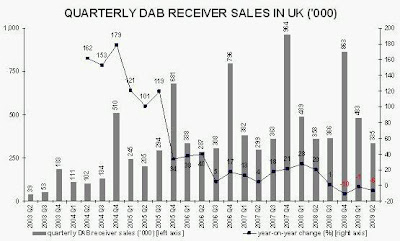
The DRDB press release also claimed that “for the past three years, sales of digital radio sets have remained solid”. ‘Solid’ is an interesting choice of word to describe the present situation of declining sales. Sales in Q2 2009 were the lowest in two years and were down 6% year-on-year. Sales in the previous two quarters, Q1 2009 and Q4 2008, were also down 1% and 10% respectively year-on-year. Three consecutive quarters of negative sales growth can hardly be described as ‘solid’.

As the graph above shows, the rot set in at the end of 2005, when year-on-year DAB radio sales growth fell from triple to double digit figures. Both 2006 and 2007 included quarters of single digit growth. Now, in 2009, growth has been negative all the way. This is no temporary blip caused by the recession. The writing was already on the wall by 2006 – the DAB party is over. Now we are merely waiting for the last few guests to leave.

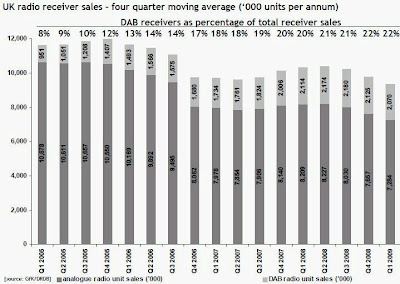
The other remarkable statement in the DRDB press release is its satisfaction that sales of “all categories of analogue radio showed significant decline”. As I have pointed out previously (see graph below), sales of radio receivers generally are in long-term decline in the UK. Is this a fact that a stakeholder within the radio broadcast industry should be crowing about? It’s like two passengers on the Titanic fighting over which has the bigger cabin – does it really matter if the whole ship is slowly going down?

It should be pointed out that the DRDB data excludes sales of mobile phones, despite the fact that the majority of current models sold in the UK include FM radios, whilst not one model includes a DAB radio. More than 30m mobile phones were sold in the UK in 2008, which puts the 2m DAB radios sold in stark perspective (see recent blog entry).

Also, it should be pointed out that the vast majority of what the DRDB calls ‘DAB radios’ on sale in the UK also incorporate analogue FM. It is increasingly difficult to find a DAB-only radio to purchase in UK shops. This renders the DRDB’s proclaimed digital versus analogue victory completely hollow. For every ‘DAB radio’ sold that the DRDB hopes will automatically lead us to some kind of digital heaven, in probably 90%+ of purchases, yet another FM radio is also being added to the millions already in UK households (see recent blog entry).

Finally, recall that 8m analogue radios (without DAB) are still being sold annually in the UK. Now add to that the 30m mobile phones purchased, most of which include FM radio. Then compare it with the “incredible achievement” of 2m DAB radios sold per year, most of which include analogue radio anyway. The future of radio is looking less and less like a DAB world. Rather, analogue radios are probably multiplying faster in the UK marketplace than they have ever done, thanks to mobile phone manufacturers. This is good news for radio, bad news for investors in DAB.

These facts might not conveniently fit the DRDB ‘story’. But they are the facts.

DAB radio: the customer is always wrong?

Politicians, government, civil servants, regulators. We pay their wages. They work for us, don’t they? So why does the voice of the consumer, the citizen, the customer so often seem to be ignored or become lost when the government makes new policies or passes new legislation. DAB radio seems to be a case in point.

The government had convened the Digital Radio Working Group [DRWG] in 2007 to consider:
• what conditions would need to be achieved before digital platforms could become the predominant means of delivering radio?
• what are the current barriers to the growth of digital radio?
• what are the possible remedies to those barriers?

The Group met for a year and published its Final Report six days before Christmas 2008. It had created a number of sub-groups to examine specific aspects of digital radio. One of these, the Consumer Impact Group, submitted its own report to the Working Group in November 2008 to inform its Final Report.

The Consumer Impact Group’s recommendations about DAB radio make sober reading and carry as much gravitas, maybe more, now as when they were written a year ago. To quote directly and extensively from its report:

“The group is concerned that the case for digital [radio] migration has not been made clearly enough from the point of view of the consumer. While it is clear what the rationale is for the radio industry, the group would like to see a compelling argument as to why digital migration is desirable for consumers and what its benefits would be for consumers.”

“The group also considers that the proposed migration criteria of 50% of all listening through digitally enabled devices is too low, and disproportionately affects disadvantaged groups who are less likely to be represented in the first 50% to take up digital radio. The group would therefore like to see the 50% figure analysed in more detail and a stronger case made for it, before it is adopted by the full DRWG, to ensure this is not the case.”

“The group notes that neither the market nor consumers are currently prepared for migration at this stage. Information provided to the group shows that take-up varies from region to region and amongst demographic groups. Therefore, the group recommends that if digital migration proceeds, a help scheme will be essential to assist those where the cost of migration is significantly greater than the benefit. The information provided by the cost benefit analysis for the more vulnerable social groups will be an essential element in considering where and how a help scheme is best delivered.”

“The group believes that further research should be undertaken to examine the extent of ownership and usage of analogue and digital radio particularly amongst disabled people, older people, people whose first language is not English and consumers from low income households. The research must be structured and use appropriate methodology to capture information on those over 65 and those over 75. The findings should be fed into plans to protect the consumer interests, i.e. for a help scheme, for effective labelling, for information and education campaigns and for the development of easy-to use products.”

“The group urges caution with migration to digital radio should the uptake amongst older people, disabled people and low-income households be found to be low or should the costs be found to be prohibitive for these groups.”

Commenting on DAB radio take-up and the proposed digital migration criteria, the report said:

“The RadioCentre was asked to present figures, drawn from the existing Rajar and DRDB figures, setting out the current information on the number of DAB sales, household penetration and listening, defined by region, age and social class.”

“The figures, which are annexed to this report at B [but excluded from the published version], show a number of interesting trends. For example sales, penetration and listening to DAB vary across the UK. Generally speaking, listening and awareness of DAB is highest in London and the South East, and the English Midlands. These have been the areas of longest DAB broadcasts and the widest choice of stations.”

“When awareness and penetration are broken down by Socio-Economic Group and age, there does appear to be a divide. The figures show that consumers in lower income groups are considerably less likely to own a DAB set than other social groups. Even when owning a DAB, in some areas weekly listening to DAB by the over 65s is very low at less than 10%.”

“The main conclusions to be drawn from this research is the general low level of ownership and listening by the over 65s compared to other age groups, and the low listening figures for consumers in the lower socio economic groups. This perhaps reflects that financially lower income groups are finding the price of sets a barrier, whilst for older groups, despite having sets, over 65’s may find DAB radio’s less easy to use than analogue sets, or perhaps prefer the traditional use of their analogue sets.”

“Whilst recognising that universal DAB coverage is not achievable, the group considered that after migration, DAB coverage for UK-wide stations and stations for the nations should be equivalent or better than that available for analogue radio at present.”

“The group stressed the importance of encouraging availability and use in cars, and noted that it would be virtually impossible to meet any listening criteria without addressing the issue of take up in cars. The group feels this should be a priority for the full DRWG.”

On the topic of research, the Consumer Impact Group commented:

“More and wider research is required, particularly about the ownership and usage of analogue and digital radio amongst those people with disabilities, people whose first language is not English, older people (both over 65s and over 75s) and those in low income groups. This additional research, when used together with the RadioCentre research and Rajar figures should be used to guide future work in this area, particularly around take-up, equipment features, programming and a help scheme. The group feels that there is an opportunity here to ensure that future work is based on comprehensive and reliable evidence and analysis. The findings should be fed into plans for any help scheme, for effective labelling, for information and education campaigns and for developing easy-to use products. Where it doesn’t already, this research should also take into account ways of listening to digital radio other than through a DAB enabled set, for example via the internet, digital terrestrial and satellite television, which may provide a significant proportion of the growth in the future.”

The Consumer Impact Group’s recommendations included:

• “We believe, that before migration could begin, additional research into radio users who are disabled, older people (both over 65 and over 75) and consumers from low income households is essential, since these people are likely to require particular assistance with migrating to DAB. This research should inform the development of plans for a help scheme, for effective labelling, for information and education campaigns and for developing easy to use products.”
• “In the absence of the finalised cost benefit analysis at this point in time, the group recommends that the cost of converting to digital radio for the average household, as well as the affordability for low income groups should be investigated. In addition, the current take-up amongst older people, disabled people and low-income households needs to be investigated. The group urges extreme caution with migration to digital radio should the uptake in these groups be found to be low or should the costs be considered to be prohibitive by any of these groups, unless an appropriate help scheme is in place.”

Analysis. Research. Cost benefit analysis. Comprehensive and reliable evidence. All were considered to be very important by the Consumer Impact Group.

However, when the 26-page Final Report of the Digital Radio Working Group was published in December 2008, it did not include a single graph, a single numerical table or the results of any commissioned consumer research. Neither were such data attached in appendices.

The Final Report of the Digital Radio Working Group did recommend that “the government should conduct a cost benefit analysis of digital migration”. The government accepted this recommendation. One might think that this would be an urgent imperative, given that proposed legislation on DAB radio in the Digital Economy Bill is about to be debated in Parliament.

Wrong! The government has stated explicitly that it is “committed to a full cost benefit analysis of the Digital Radio Upgrade programme before any Digital Radio Upgrade is set” which would include “the timings and costs to consumers”. But the government has stated that “this is likely to begin in 2011”.

What? The government wants a huge (some would say impossible) commitment from the UK radio sector and from the British public to forge ahead with migration of radio listening to DAB, even though its own full cost benefit analysis of pursuing that policy will not be STARTED until 2011.

Is this not mad? Are our public servants working for us? Does the consumer viewpoint on these issues count for nothing?

FRANCE: digital radio “already dead”?

“Digital terrestrial radio: already dead?” enquired the headline of a French news web site early on Thursday morning 26 November 2009. It proved to be prophetic.

Only hours later, a press release was published by the Bureau de la Radio (a radio trade group comprising the largest commercial radio owners) which effectively hammered another nail into the digital radio coffin in France. It stated: “As it stands, the Bureau de la Radio estimates that the cost of the [digital radio] project is not compatible with the economics of the radio medium and does not allow plans for the launch of digital radio to proceed under positive conditions”.

On Monday 23 November, more than 70 stakeholders from the radio sector had met at the offices of the CSA [France’s media regulator] to discuss digital radio. Afterwards, the CSA had issued a press statement which claimed that, during the meeting, all those present had endorsed the launch of digital terrestrial radio in France. The meeting had decided to establish four working groups to examine: resource planning, the rollout timetable, transmission signals and data content. A further meeting was planned for February 2010.

However, the Bureau de la Radio has now stated its “regret that the question of the [digital radio] economic model is not being addressed centrally” and has called on the CSA to pursue more detailed work on this issue with stakeholders.

Reflecting the seriousness of this announcment, Agence France-Presse headlined its news story “Digital Radio: commercial radio opposes the launch of digital terrestrial radio”.

There are some interesting parallels between developments in France and the situation in the UK, even though we are already ten years further down the digital terrestrial radio road. Just as in France, the UK government (through its DCMS department) and media regulator (Ofcom) have both been insistent that digital terrestrial radio must replace FM/AM radio broadcasting, without seeming to pay sufficient attention to the pre-requisite for an economic model to make it work.

In the UK:
• industry data points to minimal consumer demand for DAB, which I documented two months ago in this blog entry
• industry data points to minimal revenues from digital commercial radio stations, which I documented three months ago in this blog entry
• industry data suggests that the faster the take-up of DAB radio is accelerated, the faster commercial radio will lose more listening share to the BBC, which I documented recently in this blog entry
• the development of DAB has already proven disastrous for the financial health of the UK commercial radio industry.

After ten years of DAB radio development in the UK, precisely the same question needs to be answered here as is being asked in France this week:

Why has nobody published a realistic economic model for digital terrestrial radio which demonstrates convincingly that it is financially worthwhile?

Perhaps because one does not exist?

Digital Economy Bill: radio industry reaction

The Digital Economy Bill was published by the government last Friday. Press headlines about the radio provisions in the Bill included:

Media Week: “Radio Bill creates deep divisions among industry”
Radio Today: “Digital Bill inflames industry”
The Telegraph: “Digital Economy Bill: no date for radio digital switchover”

Below is a selection of initial reactions from stakeholders in the commercial radio sector:

Scott Taunton, Managing Director, UTV Media, said: “What radio really needs is some meaningful deregulation and licensing reform to enable it to thrive and adapt in the multimedia age. The Digital Economy Bill shows that government is out of tune with listeners, who are delighted with the broad choice and accessibility that radio already offers.”

William Rogers, Chief Executive, UKRD and The Local Radio Company, said: “Where is the fairness in a proposal to permit 100 per cent of the BBC’s local radio stations a digital future and deny over 100 local commercial radio stations the same opportunities? The Bill is fundamentally unfair and dishonest and I hope the Peers give it the going over it thoroughly deserves.” He added: “We need to inject some honesty and fairness into this debate. What is honest about suggesting to millions of listeners in the country that they will be delivered a wonderful digital listening future when the results will be to deny them the opportunity to listen to their favourite local radio station?”

Andrew Harrison, Chief Executive of RadioCentre, said: “There was no permanently set date in the Digital Britain report – 2015 was just a target. This is a clever and enabling piece of legislation as it allows the Secretary of State to set a date for switchover without having to create more legislation. Based on annual progress reports from Ofcom and BBC, they can set a date when the circumstances are rights for which at least two years notice must be given”.

Travis Baxter, Managing Director of radio at Bauer, said: “There is always a difference between setting out objectives and actually having government’s support. This piece of legislation has created a mechanism to create a date when consumer demand for digital radio is great enough.

Two days before the Bill was published, a spokesperson for Digital Radio UK said: “Whilst the target date of 2015 may be ambitious, the consumer-led criteria are achievable for operators who are committed to a digital future. Without an ambitious target date, the alternative is to condemn the industry to an indefinite period of dual transmission, a financial burden that commercial radio cannot continue to bear and that represents a poor use of public funds for the BBC.”

A few weeks earlier, a spokeswoman for Digital Radio UK had said: “The Digital Britain report does not set annual targets and we do not have a specific target to meet in terms of total share beyond the two criteria for upgrade. It has only been a matter of months since the publication of the Digital Britain report and all stakeholders in digital radio have galvanised their activity.”

There are numerous ways that a graph could plot a path to growth and we anticipate that take-up will accelerate as a result of the excellent foundations we are currently building. There is clearly some way to go but the industry is confident that with the formation of Digital Radio UK, the provisions in the Digital Economy Bill and the collective will of all stakeholders, we will successfully deliver the benefits of digital radio upgrade to listeners.”

Andrew Harrison [AH], Chief Executive, RadioCentre
interviewed on Today, BBC Radio 4, 20 November 2009 @ 0837

Q: Everybody is really worried about this and can’t quite see the point of why we are pushing ahead [with digital switchover], even if it is a target, by 2015.

AH: “Well, I think that why there is a need is fairly straightforward. The truth is that Britain loves its radio services. About 40 million of us tune into the radio every week. But the way we receive our news and entertainment is changing all around us in a digital world. It’s changing in television, it’s changing for films and music and newspapers. So it’s very important that radio, which is at the heart of British daily life, has its own chance to look forward and face the future in a digital sense, rather than being trapped in a sort of analogue environment while the rest of the entertainment world goes digital.”

Q: But we love to hear our radio in decent quality and the problem with digital [DAB] at the moment is it doesn’t work very well in cars, indoors or in rural Britain.

AH: “That’s absolutely right. That’s why we need some time as an industry to roll up our sleeves and improve the coverage for digital and improve the listener experience so that, when we actually get to the stage of contemplating actually switching over services, it will be a service for listeners with more choice and better functionality, but with the transmission quality that would be absolutely imperative.”

Q: And you can guarantee that you can solve the problems that currently exist by 2015?

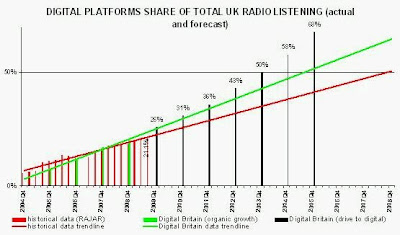
AH: “Well, the Bill doesn’t set out 2015 as a date. What the Bill sets out is the two key criteria which will be important to set a switchover date. That is that consumers or listeners can hear the service, so that they can get a digital transmission where they can currently get an FM transmission, and that they are actually listening to those services, so one of the criteria will be that over 50% of listening is via digital. Once those two thresholds have been crossed, then I think we’ll be very confident that we can deliver the services fit for a digital age.”

Q: When do you think that those thresholds can be crossed?

AH: “Well, our target is to try to hit the thresholds by the end of 2013 to then start the two-year window to switchover. It remains to be seen whether the industry collectively can work together – that’s the commercial sector, the BBC and Arqiva, our transmission provider – very hard across the next four years to get on with the job.”

[Second Reading of the Digital Economy Bill in the House of Lords on 2 December 2009]

Commercial radio and DAB: turkeys voting for Christmas

Significant players in the UK commercial radio industry, along with Digital Radio UK, the Digital Radio Development Bureau, DCMS and Ofcom are all lobbying for DAB receiver take-up to be accelerated and for consumers to migrate their radio listening to DAB as quickly as possible. However, the industry’s own data suggest that the pursuit of these strategies will simply reduce even further commercial radio’s already declining share of radio listening versus the BBC.

The commercial radio sector’s diminishing success in competing for listeners against the BBC remains one of its most pressing problems. In 1998, commercial radio’s share of listening was 51.1%, but that figure is now down to 42.4% [RAJAR Q2 1998 versus Q3 2009]. Conversely, the BBC’s share has increased from 46.8% to 55.0% over the same period. The long-term decline in commercial radio’s market power looks like this in recent quarters [see graph below]:

However, if we examine listening solely on digital radio platforms, we see that commercial radio is losing listening share much more sharply [see graph below]. In 2007, commercial radio’s share of listening via digital platforms had been above the average for all platforms and so was ‘helping’ the overall fight against the BBC for market share. However, in two of the last three quarters, commercial radio’s share via digital platforms has been lower than for all platforms, and so is now dragging down the sector’s overall market share.

Worse, with each new quarter, radio listening via digital platforms is growing as a proportion of total radio listening, so that the ‘contribution’ of digital platforms to the overall picture is becoming greater. In Q2 2007 (the earliest point on the timescale of these graphs), digital platforms accounted for only 12.9% of total listening. In the latest quarter, that proportion has increased to 21.1%.

Now, if we extract listening via DAB from the total for all digital platforms, we observe two phenomena [see graph below]. Firstly, commercial radio is badly losing the battle for DAB platform usage to the BBC by a ratio of 1:2. Secondly, commercial radio’s performance on the DAB platform is worsening over time. It is the combination of these two trends which is dragging down not only the commercial sector’s share of digital platforms, but also its overall competitive performance against the BBC.

To make matters worse, DAB is the largest element of radio listening via digital platforms (up from 54.4% in Q2 2007 to 62.9% in Q3 2009 of listening via all digital platforms), and the DAB platform’s contribution to total radio listening is similarly growing (up from 7.0% in Q2 2007 to 13.3% in Q3 2009). DAB is the focus of the radio industry’s digital platform marketing campaigns, so the commercial sector’s current poor performance on this platform is disastrous.

The data suggests that, far from the DAB platform helping the commercial radio sector compete more effectively against the BBC, the absolute opposite holds true:
• The average adult with a newly acquired DAB radio uses it for listening in a way that effectively reduces the commercial radio sector’s overall share of listening versus the BBC
• Acceleration of DAB usage will only serve to accelerate the decline in commercial radio’s share of radio listening versus the BBC.

These outcomes are hardly surprising when one considers industry data which show that:
• DAB radios are purchased predominantly by older people (the average age of a DAB radio receiver owner is 46, according to RAJAR)
• Older people listen to BBC radio much more than to commercial radio (BBC radio accounts for 63% of radio listening amongst over-45s, according to RAJAR).

The paradox is that stakeholders in commercial radio continue to push for DAB to be adopted by consumers as quickly as possible, even though the inevitable outcome will be to reduce further the commercial sector’s listening share, handing the BBC even more of a competitive advantage.

So why exactly does the notion continue to be voiced by significant players in commercial radio that the DAB platform is itself the answer to the sector’s present lack of competitiveness with the BBC?

[Data source: RAJAR. Statistical note: The graphs above to do not sum to 100% because the minimal amount of platform data released by RAJAR is ‘rounded’ (hours listened to 1,000,000 per week; listening shares to 0.1%) and the listening apportioned to the BBC and commercial radio sometimes does not sum to the total for a platform. Part of this shortfall may be accounted for by ‘other’ listening (neither the BBC nor commercial radio) which is not itemised by platform. Data for individual quarters are therefore somewhat inconsistent, though the trend over several quarters is likely to be indicative.]

“It is only in recent months … that digital radio has been a real focus and priority for the [UK radio] industry”

Campaign magazine, 6 November 2009 [excerpts]:

KS: Karen Stacey, director of broadcast sales and brand solutions, Bauer Radio
MG: Mike Gordon, group commercial director, Global Radio

Why has the take-up of digital radio been so slow?

KS: I don’t think take-up necessarily has been slow given that it is only in recent months, since the publication of the Digital Britain report [June 2009], that digital radio has been a real focus and priority for the industry.

MG: Until recently, digital has been viewed as a complementary, rather than a primary, platform. Now that the industry is unified and the Government has given clear targets, I’m absolutely convinced take-up will accelerate.

How realistic is the government’s analogue radio switch-off target?

KS: As an industry, we’re aware that we’ve got a lot of work to do – coverage needs to be improved, the cost of sets needs to come down and more cars need digital radios installed. But the vision and commitment is now in place to make that happen.

MG: 2015 is a target that we are focused on and working towards, and the fact of the matter is that, without it, a lot less would be happening. There’s been a huge amount of activity since the Government gave us a target. Earlier this month, for instance, we called a summit with the motoring industry and other stakeholders to progress take-up in cars. If we keep up this kind of momentum, then I believe it is achievable. It’s still more than six years away.

How has your company invested in digital radio?

MG: We have invested more in digital radio than any other radio group. Global also took the lead in supporting the call for a target date to galvanise the industry and will continue to be a pioneer in commercial radio on all distribution. [sic]