Having answered the front door, its frame was filled by the 11pm silhouette of a large black man wearing overalls and carrying a toolbox. The only words I could discern from his Southern drawl were ‘air con’. Aha! He must have arrived to fix the air conditioning malfunction of which I had alerted the reception desk an hour earlier. He lumbered in and set to work while I continued to watch television.
“You on your own here, sir?” he asked whilst precariously balancing on a chair to grope the insides of the wall-mounted unit. Nobody had ever called me ‘sir’ before. I was a fourteen-year-old boy. He was at least three times my age.
“I am staying here with my dad,” I replied matter-of-factly. Was I meant to call him ‘sir’ too? He looked at me quizzically, seemingly not having comprehended my response. It suddenly dawned that, though Brits know American vocabulary from their TV and movies, Americans understand almost no British English.
“My father,” I clarified. “I am staying here with my father. But he has gone out this evening.”
“D’ya know when your pa gonna return, sir?” the man asked. I shook my head. I was not being coy. I did not know.
It took about a quarter-hour for the man to persuade the air conditioning to function again. Now, whenever I watch Robert De Niro fighting air ducts in ‘Brazil’, I am reminded of that maintenance man. Before he left, he kindly warned me:
“You’s be careful now, sir. And don’t you answer the door to anyone tonight as long as you is alone.”
I thanked him and continued watching television. My parents had raised me on the numerous 1960’s American shows broadcast in Britain, many of which were years old, so it was heavenly to binge on new episodes of familiar shows and those unknown to me. I had bought that week’s ‘TV Guide’ from the reception desk and was thrilled to discover shows like ‘Love American Style’ and ‘Room 222’ on ABC that made me laugh out loud, stretched out on my motel bed.
The late film that night was ‘The Magus’, a baffling watch despite the presence of Michael Caine and Anthony Quinn. Because American TV networks cut off movie credits, I had no idea that it was a critically mauled adaptation of a 1965 John Fowles novel. Back home, a female librarian at Camberley Civic Library had suggested I borrow Fowles’ 1963 debut ‘The Collector’, perhaps not realising from my height that I was only ten years old then, not a suitable age to read a harrowing account of a lonely young man kidnaping a girl and locking her in his cellar until she dies. For years after, I could not supress regular nightmares about this scenario … in which I was the young man.
A decade hence, university friend and housemate John Chandler would insist I read the paperback of ‘The Magus’. Despite the disappointment of the film, Fowles’ book proved to be riveting and not to give me nightmares. It remains one of my favourite reads, alongside another of John’s recommendations, Ursula Le Guinn’s 1974 novel ‘The Dispossessed’. I digress.
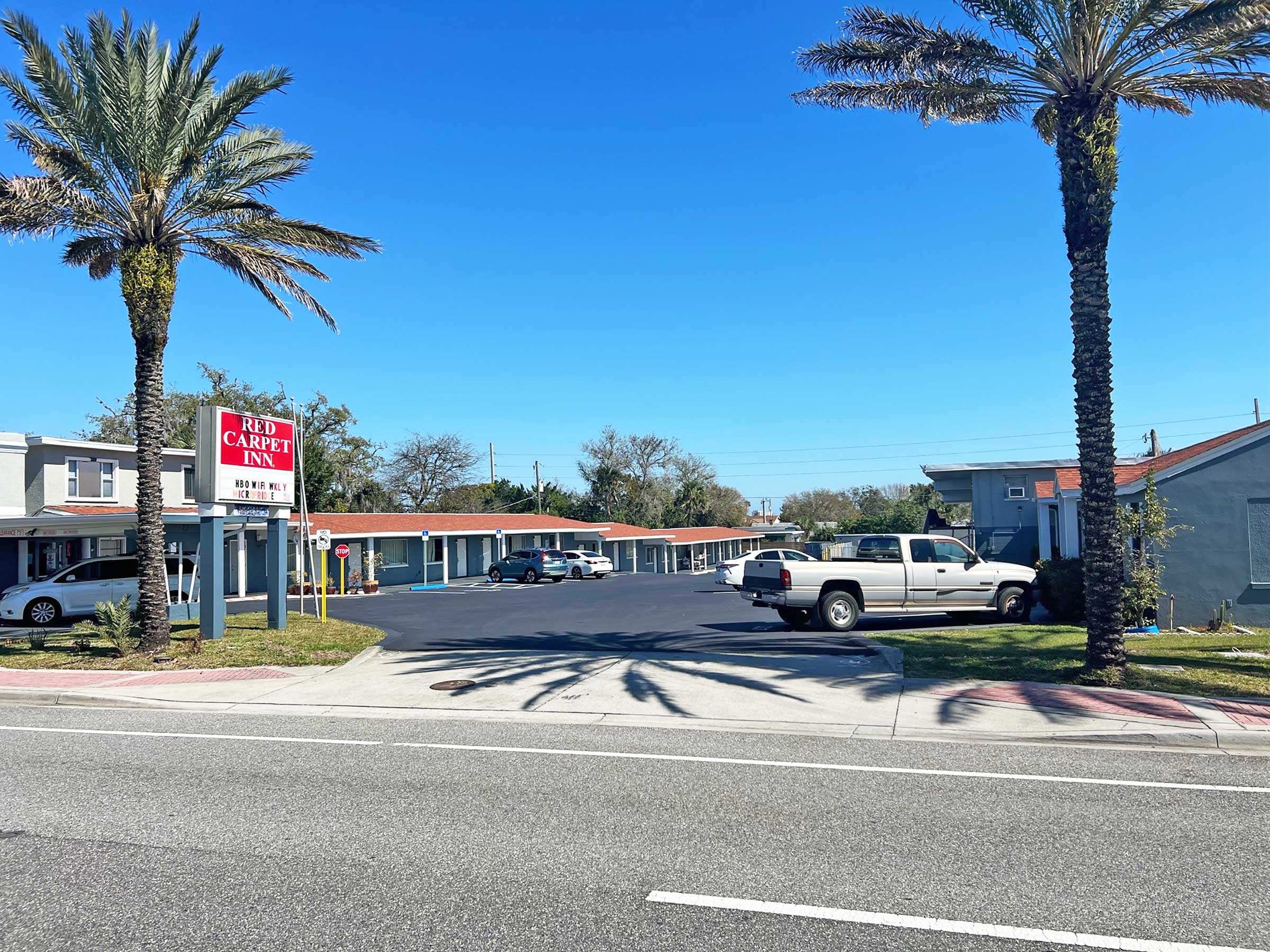
So where was my father that evening? I had no idea. He had left me in our motel room and driven away our hire car, promising to be back later. I eventually crawled into bed. He did not reappear until the next morning, offering neither explanation nor apology. As a teenage boy accustomed to parental indifference [see blog], I failed to recognise how irresponsible was his behaviour. Had the ‘Red Carpet Inn’ in Daytona Beach burnt to the ground that night with me inside, how would he have explained his decision to abandon me overnight 4,286 miles from home?
This whole father/son trip had been a bizarre undertaking from its outset. Unencumbered by prior discussion with me or my mother, he had visited a travel agency in Egham and booked a package tour to Florida for me and he alone, omitting our three other family members. My mother was understandably furious. My form tutor at school was furious as it meant me missing lessons for a week during term time and, henceforth, I was never awarded another School Prize [see blog]. Our first long-haul trip was ostensibly booked to witness the launch of the final Apollo rocket from Cape Kennedy. For years I had been a fanatic of the ‘space race’, following every event in detail and even corresponding with NASA for a primary school project. But my father was not.
Our father/son relationship could best be described as ‘business-like’. As soon as I could walk, my father had pressganged me into his one-man quantity surveyor business [see blog], me initially holding the end of his lengthy roll-out tape measure at properties, but more recently calculating returns on potential property developments [see blog]. Was this trip meant to be the reward for my decade’s unpaid service? My father had never seemed, er, fatherly to me. I do not recall him ever sitting me on his knee, holding my hand, hugging me or even reading me a book. When there was something he wanted to do that disinterested my mother, I was merely a handy substitute. Hence, despite my few years, I accompanied him to Camberley Odeon to watch ‘One Million Years B.C.’ in 1966 (aged eight), ‘2001: A Space Odyssey’ and ‘Planet of The Apes’ in 1968 (ten) and ‘Vanishing Point’ in 1971 (thirteen), the latter supported by a violent B-movie western in which a woman is stalked and raped by cowboys. Parental guidance, what’s that?
In the months between my father booking this trip and our departure, his behaviour had become more and more erratic, abandoning our family home for days on end without explanation. At the same time, he had become increasingly violent towards my mother, then caring for my months-old sister whom he had never wanted. Even though he had already indulged in purchasing a new American Motors Javelin sports car, he replaced it with an even more expensive and ostentatious two-seater ‘AMX’ model that resembled the drag racing cars he insisted on taking me to watch on weekends at nearby Blackbushe Airport. Was he experiencing some kind of mid-life crisis?
Whilst driving around Daytona Beach, I had noticed us pass a record shop which I wanted to visit. Having purchased my first soul single in 1969, I since had used pocket money to regularly buy imported American soul records from ‘Record Corner’ in Balham and ‘Contempo Records’ in Hanway Street. We stopped by the store and I bought some recent soul singles I had heard played on ‘American Forces Network’ Frankfurt, audible evenings in the UK on 873kHz AM, songs which had not yet been released at home: ‘Me and Mrs Jones’ by Billy Paul [Philadelphia International ZS7 3521], ‘One Life To Live’ by The Manhattans [Deluxe 45-139] and ‘Baby Sitter’ by Betty Wright [Alston A-4614].
After witnessing the delayed but spectacular night-time launch of Apollo 17 from the bonnet of our hire car, parked amongst hundreds of similar spectators, we caught our flight home from Melbourne airport. I felt sick and delirious that entire journey, unaware I was suffering sunstroke, my father having never considered providing me ‘sun creme’ or a hat during hours spent strolling together along the Florida shoreline for him to ogle bikini girls. Before our arrival home, he told me not to tell my mother about his unexplained overnight disappearances, our day of arrival having been the only night he had slept in his motel bed.
My silence made no difference because, only weeks later, my father left his family for good, similarly without explanation. Had the Florida trip been his clumsy way of bidding me farewell? Or had it been an experiment for him to explore a potential alternate lifestyle unencumbered by his wife and three children? Whatever it was, I did not miss him for one minute. All he had ever done was utilise my skills for his own ends. I did not shed one tear. For the previous fourteen years, he had only been present in my life when there had been some task I could do for him … rather than with him. Never had he demonstrated a genuine interest in his children.
Before he finally left, the few times he was at home, my father would play repeatedly the ‘Baby Sitter’ single we had brought back from Daytona Beach. It was a song in the Southern soul storytelling mould in which singer Betty Wright hires a teenage babysitter to look after her child, later discovering the girl has ‘stolen’ her man. The lyrics relate:
“This sixteen-year-old chick walked in
With her skirt up to her waist
She had a truckload of you-know-what
And all of it in place.”
Wright learnt the lesson after her man left:
“I should have been aware
Of the babysitter
I should have known from the junk, yeah
She was a man-getter.”
I felt it was a bit of a novelty song, nowhere near as classy as Wright’s 1971 ‘Clean Up Woman’ single [Alston A-4601] which I had purchased as an import single and loved. I had no idea why her new song seemed to resonate so strongly with my father until …
The day after my father left us, there was an unexpected knock on our front door. It was our friendly neighbour Mark Anthony who lived three houses along our cul-de-sac. He was visibly upset because his young bride had disappeared the day before without explanation. Had she contacted my mother, since we were the only family she knew on our street, the couple having only recently moved there? No, explained my mother, but my father had disappeared the same day. Oh dear! It seemed that my forty-one-year-old father had run away with Mark’s nineteen-year-old wife Suzie. She may never have been our family’s babysitter but she did resemble the girl in the song. I suddenly realised why my father had identified with its lyrics. He had abandoned us for a teenager. Was that how he had spent his nights in Florida?
During the months that followed, my father tried his utmost to destroy his family. While we were out, he would break into our home and steal as much as he could drive away of our possessions [see blog]. I lost a large number of soul records I had bought with my pocket money, many of which were irreplaceable and in which he had shown no previous interest. Amongst them was the ‘Baby Sitter’ single.
Years later, on the run from Court Orders requiring back-payment of thousands of pounds to my mother for the maintenance of his children, he fled to America. Eventually, the US Immigration Service caught up with him and expelled this ‘illegal alien’ back to the UK from Everton (population 133) in Arkansas where he had been confident/stupid enough in 1985 to register a business named ‘Andre Associates Inc’ with an address there at ‘Route 3, Box 68’, as well as a corporation of the same name in 1986 at ‘1608 Avalon Place, Fort Myers, Florida’. Extradited back to home soil, he disappeared again to Wales and then Christchurch. He never did pay his debts to us.
Upon his death in 2013, following who knows how many more failed marriages, my father left a handwritten will that bequeathed the bulk of his estate to my younger brother, along with his “collection of soul LP, CD, cassette music”. This was my apparent non-reward for having passed a decade working in my father’s business, whereas my brother had contributed not one day. I hope my brother has enjoyed listening to old records I had eked out of my teenage pocket money. Oh, I almost forgot, he had never shown any interest in soul music. To add insult to injury, my brother did not invite me to my father’s funeral, nor my sister, nor our mother. Evidently, he is the son of his father!
[I was reminded of these events whilst compiling my Spotify playlist of 2000+ 1970’s soul, funk and disco recordings from the catalogue of Miami’s ‘T.K. Records’, home to Betty Wright, George McCrae and KC & The Sunshine Band, amongst others. Naturally, it includes ‘Baby Sitter’.]
Pop music had been outlawed by the British government. Twiddle the dial of an AM transistor radio and you would not have found a single UK radio station playing the hits of the day. It was crazy. Contemporary popular music, along with the latest fashions and art, had become Britain’s biggest cultural exports. The ‘British Invasion’ had taken America by storm a few years earlier. Liverpool’s Beatles were the most popular pop group in the world. Yet none of this music could be heard on radio in Britain. It was so crazy.
The British establishment, populated by the upper classes, had always looked down their monocled noses at popular culture. It had never touched their lives because they inhabited a world of people just like themselves who valued classical music, opera and English literature. Not only did pop music appear entirely frivolous to them, but it was an artform they found difficult to completely control. Not only did pop music’s lyrics (‘Lucy In The Sky With Diamonds’?) baffle their sensibilities, but they suspected songs were laced with messages (‘Won’t Get Fooled Again’?) that might incite rebellion against their rightful position at the apex of British society.
The radio waves of Britain had been tightly controlled by the British government almost since the earliest invention of the medium. Although commercial radio stations playing pop music had existed in the United States since 1920, Britain’s elite remained doggedly determined to maintain a firm grip on every item broadcast to a heathen population that needed to be managed and patronised. From its beginnings until the present day, our government-controlled BBC has been stuffed with Oxbridge graduates who resolutely uphold the class status quo.
Despite the birth of rock’n’roll in 1954, BBC radio had remained determined throughout the 1960’s to ignore the resultant resurgence of British popular music that held unprecedented appeal amongst the young generation. Though The Beatles had sold more records than any other musicians in history, you would never know it from listening to BBC radio. The Fab Four’s songs were mostly confined to occasional live guest appearances on the ‘BBC Light Programme’ that my father anxiously recorded on his second-hand Uher reel-to-reel tape recorder so that we could replay their beloved pop music ad nauseum. Otherwise, the BBC’s lone music radio station remained firmly stuck in a bygone era.
On 14 August 1967, the United Kingdom parliament had passed ‘The Marine Broadcasting Offences Act’ whose outcome was to ban the British population from listening to pop music on the radio. From the early 1960’s, to the annoyance of the country’s elite, smart entrepreneurs from the US, Canada and Ireland had filled the yawning gap in the British radio market for pop music by anchoring ships off its coast, transmitting unscripted North American disc jockeys playing chart hits from beyond Britain’s territorial waters. Whenever we journeyed in our family car, I was always sat on the front bench seat of our Rambler between my parents, in charge of the volume and tuning dials of its American-made AM radio. Our favourite listening since its arrival in 1964 had been pirate radio ‘Big L’ on 266 metres that played lots of Motown soul and pop songs.
At midnight on 14 August 1967, Big L and its offshore companions closed forever, all made illegal by the new legislation. Suddenly and unexpectedly, the pop music radio station we adored had been eradicated from our lives. Pirate radio ships had enjoyed immense audiences, too popular for bigwigs at the non-commercial BBC and the stuffy British establishment to control, and (shock horror) they had used advertising revenues to fund their unlicensed activities. Commercial radio would remain outlawed in Britain until the following decade. Our household was reduced to listening to the multiple reel-to-reel tapes my father had previously recorded with a microphone from radio and television shows, though we already knew the songs’ running order by heart.
Weeks passed until 30 September 1967, the memorable day that pop music returned to the British airwaves when the BBC launched a new national station it named ‘Radio One’. The British government had implemented a ‘stick and carrot’ strategy by having banned the popular pirate stations whilst simultaneously forcing a reluctant BBC to initiate a replacement pop music service. This was a repeat of the 1945 fiasco when the government had had to force the BBC not to close its much-loved temporary wartime radio service of popular entertainment, the ‘BBC General Forces Programme’, and instead maintain transmissions to motivate Britain’s post-war weary working class [see blog]. Ironically, both these stations, BBC Radio 1 and the renamed ‘Radio 2’, would attract considerably larger audiences by playing recorded music than the BBC’s more expensive networks of original drama, discussions, classical music and news (‘Radio 3’ and ‘Radio 4’) that targeted the chattering classes predominantly in the Home Counties.
To those of us who had been committed fans of Big L, the BBC’s new pop station sounded like a pale carbon copy, even employing many presenters who were already household names from their pirate days. ‘Innovation’ at the BBC has long been the outcome of it copying someone else’s ideas that had already proven successful (viz BBC launched ‘1Xtra’ only after the success of my ground-breaking black music format at ‘KISS 100 FM’). Not desiring its new team of young, long-haired, non-Oxbridge presenters to spoil the refined atmosphere so carefully cultivated in Broadcasting House, the BBC installed these recruits in an out-building across the road named Egton House.
Bizarrely, the BBC made no attempt to ensure Radio 1 possessed brand integrity, frustrating its intended young audience by making the new station ‘share’ some daytime shows with long-time Radio 2 old fogey presenters (such as former 1950’s crooner Jimmy Young), and by not broadcasting at all during evenings when teenagers were most readily available to listen. The resulting junctions were jarring. I recall the Number One pop chart single unveiled before seven o’clock every Sunday by Alan Freeman on Radio 1’s ‘Pick of the Pops’ show, then immediately switching to Radio 2’s anachronistic ‘Sing Something Simple’ show of post-war karaoke tunes that ran for 42 years from 1959. I can still sing its dreadful theme tune that signalled my rush to the radio’s ‘off’ button.
From his very first Radio 1 programme, for years to come I would wake every weekday to Tony Blackburn’s breakfast show on my bedside radio alarm clock. I already knew him from his pirate Big L days, but the national exposure on the new station’s most listened to show catapulted him into national celebrity status. He went on to present the weekly BBC TV pop music show ‘Top of the Pops’, to appear on Mike Read’s ‘Pop Quiz’ TV game show and to host the ITV series ‘Time for Blackburn’. When he split from his actress wife Tessa Wyatt, the tabloid newspapers had a field day. His radio shows were always upbeat, optimistic and entertaining, accompanied by the barking of his fake pet dog Arnold.
Blackburn was an unabashed fan of soul music and was able to slip in the odd personal favourite amongst the playlisted pop records mandated by his staid BBC producer, Johnny Beerling. His persistent airplay of the song ‘Remember Me’ from the Diana Ross album ‘Surrender’ persuaded EMI Records to release it as a UK-only single that reached chart position seven in 1971. He wrote sleeve notes for several UK soul albums including the ‘Motown Chartbusters’ series and live albums by The Temptations and The O’Jays.
In 1973, the BBC put thirty-year old Blackburn out to pasture on Radio 2’s mid-morning show, replacing him on the Radio 1 breakfast show with twenty-four-year-old clever clogs Noel Edmonds, much heralded as the station’s ‘rising star’ since joining in 1969 rather than accepting his university place. It was time to retune my morning radio alarm to new offshore pirate radio station ‘RNI’. Although Radio 1 had been broadcasting a weekly soul show on Saturday afternoons, Blackburn was inexplicably never its presenter. However, in 1980 Blackburn did return to Radio 1 as host of the weekend breakfast show which would abandon its previous, child-centric ‘Junior Choice’ identity under which posh presenter Ed ‘Stewpot’ Stewart had played almost the same ‘comedic’ records week in week out for the last twelve years.
In 1981, Blackburn joined local station ‘BBC Radio London’ where, freed from the musical straightjacket exerted by Radio 1 producers, he could play soul music to his heart’s content on its weekday afternoon show. Fellow soul music fans Robbie Vincent and Dave Simmons had already played much black music there since its launch in 1970. Blackburn’s arrival, followed by Dave Pearce in 1984, cemented the station’s reputation amongst London’s black music fans as the only legal station worth a listen alongside the capital’s multiple pirate broadcasters.
In a masterstroke of mismanagement, this soul music ‘beacon’ on London’s airwaves was destroyed at a stroke in 1988 when the BBC decided to transform its predominantly music station into an all-talk station, sacking existing presenters and appointing Matthew Bannister from Capital Radio’s daily evening news show ‘The Way It Is’ to manage the renamed ‘GLR’. I attended the Corporation’s overhyped launch press conference (everyone arriving by Thames ferry) where it was self-evident that disaster loomed, Bannister having an excellent track record as journalist but no experience managing a radio station, let alone marketing a new brand image. Despite much bollocks propagated in the media that ‘GLR’ was the face of a revolutionary style of radio, the ratings testified otherwise. The station’s share of London radio listening nosedived from 5.0% in 1987 to 1.6% by 1992 (source: JICRAR) when it had become the second least listened to of the city’s fourteen licensed stations. The BBC had deliberately abandoned London’s soul music fans and sent us hordes back to pirate radio listening.
Immediately, Blackburn joined Capital Radio’s newly launched all-oldies ‘Capital Gold’ London AM station (previously programmes had always been simulcast on FM and AM), presenting its weekday breakfast show of pop music plus a Sunday soul music show syndicated to Capital’s co-owned UK stations outside London. This new station attracted 10.2% of London radio listening in its launch year (source: JICRAR), surpassing earlier ratings achieved during Blackburn’s seven-year tenure at BBC Radio London. His national profile was raised by television appearances on Channel 4’s ‘After Dark’ show in 1987 and Sky One’s weekday morning show ‘Sky by Day’ in 1989. I purchased his 1985 autobiography ‘Living Legend: The Tony Blackburn Story’ in an ex-library book sale and enjoyed reading it as a fan who had spent thousands of hours listening to his radio shows since the 1960’s.
When the government announced in 1988 the opening of bids for new commercial radio licences for London, the first since 1973, there was substantial hope amongst the capital’s myriad pirate stations that a black music station would be selected. Alliances were forged between existing commercial radio owners greedy for more licences so as to eliminate competitors, moneybags who had witnessed commercial radio become a ‘licence to print money’, music enthusiasts and contemporary pirate station owners. I teamed up with London pirate ‘KISS FM’ which, although not the longest running black music broadcaster, nor the most pervasive (on-air only during weekends, rather than 24 hours per day like others), had the greatest potential to win a licence.
‘Blues & Soul’ magazine published a rumour that Tony Blackburn was considering a licence bid in association with former ‘Radio Luxembourg’ DJ Tony Prince. In his autobiography, Blackburn had written that “if the [Controller] job at [BBC] Radio One is filled, I would like to open a twenty-four hour a day soul music station in London.”
In the KISS FM open plan basement room at Blackstock Mews, a planning meeting attended by more than a dozen people was held to report on progress of the licence application that would be submitted to the broadcasting regulator. Introduced to us was Dave Cash who had been hired to co-ordinate the production of the document. To this day, I have no idea how he came to be involved, how much he was paid or by whom. He had had no prior involvement in KISS FM’s pirate activities and had demonstrated no particular interest in black music during a radio career remarkably similar to Blackburn’s: presenting for pirate ship Big L, joining BBC Radio 1 at launch in 1967 to present a weekday daytime show, then defecting in 1973 to become launch production manager of London’s Capital Radio where he presented shows for the next 21 years.
The resultant KISS FM licence application submitted by Cash was weak, lacked relevant market research, offered a flimsy business plan and failed to argue a convincing case. The bid failed despite Cash’s experience from two decades in the radio industry. Whether any application would have won up against the government’s preferred bevy of old jazz music chums we will never know [see blog]. Cash’s involvement in KISS FM ended the day the licence outcome was announced. Maybe he was busy clinking champagne glasses with Capital Radio’s directors in their boardroom at Euston Tower. A jazz station would prove no competition to Capital’s fifteen-year commercial monopoly over music radio in London. Maybe even more champagne would be gulped the following year after the launch of the ‘Jazz FM’ station proved to be a ratings and commercial disaster (1% share of London listening, 1990 JICRAR).
Tony Blackburn had been moved to comment to ‘Music Week’ trade magazine: “I was amazed that the new London FM was a jazz station. I think KISS FM should have got the licence. I would have thought it would have been a soul station. If I’d been the IBA [broadcast regulator], that’s the one I would have given. The problem is, if they don’t give a proper legalised soul station soon, there’s going to be more and more pirate radio stations.”
To cut a long story short [see book], following Dave Cash’s rejected application, the government eventually offered two further London radio licences as the consequence of a lobbying campaign by Heddi Greenwood and myself at KISS FM. I co-ordinated, researched and wrote the second KISS FM licence application which won [see blog]. I then launched the newly legal station ‘KISS 100’ on 1 September 1990 [see blog] as its programme director, the sole management team member with prior UK commercial radio experience.
Tony Blackburn wrote in ‘Jocks’ magazine: “Now that KISS FM are legal, it will be interesting to see how they face up to the challenge of broadcasting for the first time on a truly competitive basis. Gone are the days when they paid nothing for playing records. Gone are the days when a truly amateur DJ, sitting in a makeshift studio in someone’s bedroom, was tolerated because he was a ‘pirate.’ And gone are the days when DJs on the station was [sic] paid little or nothing for their services. Now that KISS FM is legit, it will have to put out a truly professional sound to attract audience and advertisers alike.”
‘Blues & Soul’ magazine correctly responded that it had been the pioneering work of the many soul pirate stations, from ‘Radio Invicta’ in 1970 onwards [see blog], that had spearheaded the long running campaign for a legal black music station in London. Despite Blackburn’s evident affinity for soul music, there was nothing he had done personally to further that particular cause.
Asked his opinions about KISS FM’s launch by ‘Radio & Music’ magazine, Blackburn responded: “I’m pleased KISS FM is coming on air. I think it’s good for radio, but it isn’t guaranteed to get an audience. It’s not enough to play the right music any more – it has to be presented well.”
However, following the station’s launch, Blackburn wrote in Jocks magazine: “KISS FM didn’t so much open up on September 1st, it staggered onto the air with all the professionalism of a British Rail station announcement, infact [sic] I think some of the station announcers have better voices than a lot of the KISS FM DJs. For a whole weekend, we were subjected to humourless, badly spoken amateurs thanking the management and telling us all that they were now legal, something we’d all worked out for ourselves. At least every half hour, I was told how much the DJ loved me and that everything was ‘crucial.’ At one stage on the first day, I heard a DJ actually play a record for ‘everyone who knows me’ and then invited listeners to send in ‘fax messages on a fax ‘cause our phones ain’t workin’.’“
Blackburn continued in this vein for a further three paragraphs before concluding: “On radio, a good voice is important and the ability to use it properly, a lot of the DJs on KISS talk on a monotone, all sound the same and are not a bit entertaining. These people might be very good in clubs but make the station sound so bad I would go as far as to say it is not professionally acceptable. Naturally these remarks don’t apply to the professionals they have on the station such as Robbie Vincent, David Rodigan and a few others.”
A profile of Blackburn also appeared in the ‘Sunday Telegraph’ newspaper, in which he said: “When you listen to those new stations like KISS FM, it shows up how good these old guys are.” The interviewer noted, with understatement, that Blackburn “has a bit of a bee in his bonnet about KISS FM.”
Every Monday morning at nine o’clock, the heads of each KISS FM department met in its upstairs boardroom. At our next meeting, managing director Gordon McNamee insisted upon playing in its entirety from VHS cassette a five-minute commentary Tony Blackburn had broadcast on ‘Channel 4’. He seemed to take Blackburn’s criticisms very personally and asked me what was to be done. I expressed the opinion that this commentary, along with Blackburn’s similar press articles, had been cleverly staged by Capital Radio, but gave KISS FM nothing to worry about. After Blackburn had left BBC Radio One, he had criticised the station in the harshest tones. Then, after he had left BBC Radio London, he had criticised that station too. Blackburn was highly self-opinionated and conveniently seemed happy to damn any station that was not his current employer.
I suggested that, if Blackburn’s main criticism of KISS FM was that it sounded very different from Capital Radio, then it should be taken as a compliment. The huge volume of market research I had commissioned pre-launch demonstrated conclusively that, if KISS FM had launched sounding the same as every other music radio station, it would fail. It was our station’s very differences from its competitors that would make us successful. In fact, Blackburn’s stance in criticising KISS FM should only demonstrate to us that he had no idea what young people wanted from a radio station. His criticisms might even encourage more young people to listen to KISS FM than if he had said that he loved the station.
McNamee seemed unconvinced by my arguments. He was wounded by Blackburn’s comments and suddenly seemed filled with self-doubt about the station’s ‘different’ sound. I was reminded of the accusations he had lobbed in my direction late one night before the station’s launch – that it was I who would be personally responsible for the station’s failure. Now, at this management meeting, I was feeling that McNamee was too eager to blame me for Blackburn’s criticisms. Neither did I feel I was receiving support from the other heads of department present.
I could not understand what was going on inside my boss’ head. Had McNamee lost the courage of his convictions about the radio station he had co-founded? Rather than be a strong leader who demonstrated commitment to his loyal staff, McNamee already seemed to be floundering, only days after the station had launched. Through its employee Tony Blackburn’s criticisms, Capital Radio had scored a direct hit on the managing director of its first ever competitor in the London commercial radio market. It seemed to be left to me now to hold the ship steady and to demonstrate that KISS FM would only succeed if it refused to follow Tony Blackburn’s ‘advice.’
Already, I was becoming used to hearing highly critical opinions expressed publicly about KISS FM. The station was being targeted by the DJs of radio stations competing with KISS FM, and by people who were themselves probably outside of the youth audience the station was seeking to attract. For me, the fact that long established radio stations were bothering to criticise KISS FM on national television must have meant that our new, little London radio station was worrying them considerably. They had not made similar comments when Jazz FM or ‘Melody Radio’ had launched. I felt that this validated what we were doing. However, these issues would not go away and, if anything, they had started to become more significant within the station.
At the beginning of October 1990, Gordon McNamee showed me a two-page letter that KISS FM non-executive director Tony Prince had written to him, criticising the station’s unprofessionalism and expressing doubts about the daytime music policy. I met with McNamee and head of marketing Malcolm Cox and, together, we drafted a detailed response for McNamee to send back to Prince. It explained that KISS FM sounded this way not because we were sloppy or unprofessional, but because all the pre-launch market research that the station had commissioned demonstrated that this was the style of broadcasting that would prove popular with young people. KISS FM’s potential audience had stated categorically that they would not tune to a new radio station that sounded like a pale imitation of BBC Radio One or Capital Radio.
Having received McNamee’s reply, Prince still expressed reservations about the station’s direction, so I was asked to meet him in the boardroom to discuss the matter. This was a rare occasion for me to chat with one of the station’s directors. Prince’s main criticism was that there were insufficient features in KISS FM’s daytime programmes, something that, he believed, made successful radio. Why, he asked me, were there not more competitions in the morning show aimed at housewives? Could not the station introduce recipes or features that would specifically attract housewives to listen? I explained to Prince that the notion that housewives constituted the majority of radio’s daytime audience was a myth. I had painstakingly analysed the radio industry audience data to determine KISS FM’s likely listenership during the day, and it was certainly not housewives. The commercial radio industry had propagated the myth of the ‘housewife’ listener since its inception in 1973. I was programming KISS FM to appeal to the agreed target audience of fifteen- to thirty-four-year-olds. I did not believe that they wanted silly competitions or recipes. Forty-six-year-old Prince listened to me, but still seemed unconvinced.
I knew that the only incontrovertible proof of the appropriateness of KISS FM’s current programming policy would be statistics that showed the station was attracting a significant audience. Fortunately, only a few days later, the station received the results of a market research survey that its advertising agency, BBDO, had commissioned. It showed that the station had just over 750,000 listeners between 19 and 25 September. These numbers were a solid indication that KISS FM was already on target to achieve the one million listeners it had promised advertisers by the following September. The figures also showed that 96% of listeners were within the ten- to thirty-four-year-old demographic that the station was targeting. McNamee called a meeting in the boardroom to inform the staff of this good news, and the station issued a press release the same day. More than anything, this press release helped calm the internal rumblings from Tony Prince.
Whilst I was pleased with the 750,000 figure, I knew that the only data that mattered were the official JICRAR radio industry numbers that would not be published until January 1991. Neither did I want the programming staff to think that the battle for listeners had already been won and that they could work less hard from now on. I circulated a note to all fifty-seven personnel in my department:
“Many thanks for all the hard work you’ve put in to help achieve these impressive results. We all need to keep it up so that we reach our ultimate goal of getting one million listeners tuned in … In the meantime, it’s worth remembering that that our first full-scale audience research is underway. JICRAR started last month and continues into December. Thousands of people all over London are filling in diaries right now every day with what they listen to on the radio hour by hour … So, we’ve come a long way in the first month. Let’s carry on in the knowledge that we’re on the right course and can turn KISS into the most successful new radio station ever heard in London.”
The target demanded of me by the business plan was to attract one million listeners per week by the end of KISS FM’s first year on-air. I achieved 1,078,000 listeners within the first few months (2.7% of London listening, 1990 JICRAR; growing to 3.4% in 1991), while the proportion of housewives listening to our daytime shows was proven to be a mere 9%. If I had failed, I would have been sacked. Once I succeeded, I was sacked anyway by a boss desperate to take the credit and my job [see blog]. I took no pleasure observing him then lead the station on a downward ratings spiral to a low of 2.3% (1993 JICRAR).
I never met or heard from Tony Prince again. I never met Tony Blackburn. Both had frustrated my work. Neither had managed the launch of a new radio station, let alone one with a ground-breaking music format that truly became “the most successful new radio station ever heard in London” … since Capital Radio’s arrival on 16 October 1973.
31 March 1990 was the memorable day when London‘s first licensed [South Londoncommunity of interest] black music station, ‘Choice 96.9 FM’, arrived on-air. Until then, the availability of black music on legal radio had been limited to a handful of specialist music shows, even though about half of the singles sales chart was filled with black music. The decision by then regulator the Independent Broadcasting Authority [IBA] to license a London black music station was part of a huge government ‘carrot and stick’ campaign to rid the country of pirate radio. On the one hand, new draconian laws had been introduced that made it a criminal offence even to wear a pirate radio tee-shirt or display a pirate radio car sticker. On the other hand, the establishment knew that some kind of olive branch had to be offered to the pirate stations and their large, loyal listenership.
Many pirate stations, having voluntarily closed down in the hope of becoming legitimate, were incensed when the IBA instead selected Choice FM for the new South London FM license. Its backers had no previous experience in the London pirate radio business, but had previously published ‘Root’ magazine for the black community in the 1970’s. Although it was impossible for one station to fill the gap left by the many pirates, Choice FM tried very hard to create a format that combined soul and reggaemusic with news for South London’s black community, which was precisely what its licence required. The station attracted a growing listenership and it brought a significant new audience to commercial radio that had hitherto been ignored by established stations. With Choice FM, the regulator succeeded in fulfilling two aspects of public broadcasting policy: widening the choice of stations available to the public; and filling gaps in the market for content that only pirate radio had supplied until then.
In 2000, Choice FM won a further licence to cover North London with an additional transmitter. For the first time, the station was now properly audible across the whole capital and had access to more listeners and more potential advertisingrevenues. Its listening doubled and, at its peak in 2006, Choice FM achieved a 2.8% share, placing it ahead of ‘TalkSport’ and ‘BBC London’ in the capital. Choice FM had no direct competitor in London, although indirectly some of its music had always overlapped ‘KISS FM’. The station’s future looked rosy.
However, the Choice FM shareholders must have realised just how much their little South London station was worth, at a time when commercial radio licences were being acquired at inflated prices. Already, in 1995, Choice FM shareholders had won a second licence in Birmingham, but had then sold the station in 1998 for £6m to the Chrysalis plc group, who turned it into another local outlet for its network dance music station ‘Galaxy FM’. At a stroke, the black community in Birmingham had lost a station that the regulator had awarded to serve them. Black radio in Birmingham was dead. The die was cast.
The then regulator, the Radio Authority, had rubber-stamped this acquisition, stating that it would not operate against the public interest. The Authority requested some token assurances: at least one Afro-Caribbean member on the station’s board; an academy for training young people, especially from the black community, in radio skills; and market research about the impact of the format change on the black community. None of these made any difference to what came out the loudspeaker. Birmingham’s black community was sold down the river.
Changes in UKmedia ownership rules were on the horizon that would soon allow commercial radio groups to own many more stations within a local market. As a result, in 2001, the UK’s then largest radio group, Capital Radio plc, acquired 19% of Choice FM’s London station for £3.3m with an option to acquire the rest. In 2003, it bought the remaining 81% for £11.7m in shares, valuing the London station at £14.4m. The Choice FM shareholders had cashed in their chips over a five-year period and had generated £21m from three radio licences. What would happen to Choice FM London now?
Graham Bryce, managing director of Capital Radio’s London rock station ‘Xfm’ (which Capital had acquired in 1998 for £12.6m), said then:
“Our vision is to build Choice into London’s leading urban music station, becoming the number one choice for young urban Londoners. Longer term, we intend to fully exploit the use of digital technology to build Choice nationally into the UK’s leading urban music station and the number one urban music brand.”
Capital Radio and subsequent owners seemed to want to turn Choice FM into a station that competed directly with KISS FM (owned by rival EMAP plc). But they never seemed to understand that KISS FM was now a ‘dance/pop’ station, whereas Choice FM had always been firmly rooted in the black music tradition of soul, reggae and R&B. Such semantics seemed to be lost on Choice FM’s new owners and on the regulator, but certainly not on Choice FM’s listeners, who had no interest in Kylie Minogue songs.
In 2004, Capital Radio moved Choice FM out of its South London base and into its London headquarters in Leicester Square. The station’s final link with the black community of South London it had been licensed to serve was discarded. In 2005, Capital Radio merged with another radio group, GWR plc, to form GCap Media plc. In March 2008, [offshore] Global Radio Ltd bought GCap Media for £375m. In July 2008, Choice FM managing director Ivor Etienne was suddenly made redundant. One of the station’s former founder shareholders commented:
“I’m disappointed that the new management decided to relieve Ivor Etienne so quickly. My concern is that I hope they will be able to keep the station to serve the community that it was originally licensed for.”
However, from this point forwards, it was obvious that new owner Global Radio had no interest in developing Choice FM as one of its key radio brands. In the most recent quarter, the station’s share of listening fell to an all-time low of 1.1% (since its audience has been measured Londonwide). Sadly, the station is now a shadow of its former self, even though it holds the only black music commercial radio licence in London (BBCdigital black music station ‘1Xtra’ has failed to dent the London market, with only a 0.3% share).
This week, news emerged from Choice FM that its reggae programmes, which have been broadcast during weekdayevenings since the station opened, will be rescheduled to the middle of the night (literally). One of the UK’s foremost reggae DJ‘s, Daddy Ernie, who has presented on Choice FM since its first day, will be relegated to the graveyard hours when nobody is listening. From 2003, after the Capital Radio takeover, reggae songs have been banished from the 0700 to 1900 daytime shows on Choice FM. Now the specialist shows will be removed from evenings, despite London being a world centre for reggae and having more reggae music shops than Jamaica.
Station owner Global Radio responded to criticism of these changes in ‘The Voice’ newspaper: “Choice [FM] has introduced a summer schedule which sees various changes to the station including the movement of some of our specialist shows.”
Once again, the regulator will roll over obligingly and rubber-stamp these changes. For Global Radio, the endgame must be to transform the standalone Choice FM station into a London outlet for its Galaxy FM network. At present, London-based advertisers and agencies can only listen to Galaxy on DAB or via the internet. A London Galaxy station on FM would bring in more revenue for the brand as a result of more listening hours and its higher profile in the advertising community. It would also provide a direct competitor to KISS FM London (ironic, because Galaxy FM had been launched in 1990 by an established commercial radio group as an out-of-London imitation of successful, London-only KISS FM). Global Radio’s argument to persuade the regulator will probably be that Choice FM’s audience has fallen to uneconomic levels. And whose fault was that?
Already, Global Radio’s website tells us that “Choice FM is also included as part of the Galaxy network” which “consists of evolving mainstream music supported by entertaining and relatable presenters.” And yet, according to Ofcom, Choice FM’s licence is still for “a targeted music, news and information service primarily for listeners of African and Afro-Caribbean origin in the Brixton area but with cross-over appeal to other listeners who appreciate urban contemporary black music.” How can both these assertions be true of a single station?
For the black community in London, and for fans of black music, this will be the final straw. Just as happened in Birmingham, the new owner and the regulator will have collectively sold Choice FM’s listeners down the river. Another station that used to broadcast unique content for a unique audience will have been wilfully destroyed in order to make it almost the same as an existing station, playing almost the same content. We have many commercial radio stations, but less and less diversity in the music they play. Radio regulation has failed us.
For Choice FM, the writing was on the wall in 2003 when Capital Radio bought the station and one (unidentified) former DJ commented:
“Choice [FM] was there for a reason [to be a black music station for black people], but that reason changed [since] 13 years ago. That’s why you’ve got over 30 pirate stations in London. If Choice FM kept to the reason why they started, you wouldn’t need all them stations. But Choice has become a commercial marketplace. They’ve sold the station out and they should just say they’ve sold the station out. What’s wrong with that? They have sold the station that was set up for the black community and they know they’ve done the black community wrong. But they’ve made some money and they’ve sold it. Why not let your listeners know?”
For me personally, as a black music fan and having listened to Daddy Ernie for twenty years, I am much saddened. In the 1970’s and 80’s, I had found little on the radio that interested me musically, so I listened to pirate stations and my own records. During those two decades, I actively campaigned for a wider range of radio stations to be licensed in the UK and, by the 1990’s, I had played a direct role in making that expansion of new radio services happen successfully. Where did it get us? Now, years later, I have gone back to listening mostly to pirate radio and my own records (and internet radio). I am sure I am not the only one.
The radio industry and the regulator seem not to understand one important reason why radio listening and revenues have been declining for most of the last decade. They need to examine how, through their decisions, they have consistently sold down the river their station audiences and the very citizens whom their radio licenses were specifically meant to serve. Listeners vote with their ‘off’ buttons when station owners renege on their licence promises and the regulator lets them. Choice FM is sadly just one example.
“Is there room to bring the content of illegal stations into the fold? One way or another, whether we like it or not, we have a large population out there listening to illegal radio. Why do they listen? We are trying to find out. But, if you listen to the stations, they are producing slightly different content and output [from licensed stations]. Some of it is very high quality. Some of it is very interesting. So, what options are there for bringing some of that content into mainstream radio?”
Seemingly, none. The last FM commercial radio licence the regulator offered in London was more than a decade ago. Last year, when two small South London FM stations (one licensed for a black music format) were closed by their owner, the regulator unilaterally decided not to re-advertise their commercial radio licences (see my story here). A pirate radio station has not been awarded a commercial radio licence by the regulator for two decades.
Why do pirate radio stations still exist? Because, just as in the 1970’s and 1980’s, there are huge gaps in the market for radio content that – in spite of BBC radio, commercial radio and their regulators – remain unfilled. It is no coincidence that the share of listening to ‘other’ radio stations (i.e. not BBC radio and not commercial radio) in London is near its all-time high at 3.1%.
Farewell, Choice FM. I knew you well for twenty years.
I only knew ‘Roger Tate’ (real name Bob Tomalski) through listening to his programmes on the radio. He was a DJ on ‘Radio Invicta‘, London’s first soul music radio station, launched in 1970. Invicta was a pirate radio station. Back then, there were no legal radio stations in the UK other than the BBC.
The notion of a campaign for a soul music radio station for London had been a little premature, given that no kind of commercial radio had yet existed in Britain. But that is exactly what Radio Invicta did. As Roger Tate explained on-air in 1974:
“Who are Radio Invicta? You may well be asking. Well, we’re an all-soul music radio station. We’re more of a campaign than a radio station, I suppose. We believe in featuring more good soul music on the radio.”
By 1982, ‘Black Echoes‘ music paper reported that Radio Invicta was attracting 26,000 listeners each weekend for its broadcasts. By 1983, Radio Invicta had collected a petition of 20,000 signatures in support of its campaign for a legal radio licence. There was sufficient space on the FM band for London to have dozens more radio stations. By then, local commercial radio had existed in the UK for a decade. But nobody in power wanted to receive the station’s petition and Invicta’s Mike Strawson commented:
“I have tried to speak to the Home Office about it, but it shuts the door.”
Radio Invicta eventually closed for good on 15 July 1984, the date that the new ‘Telecommunications Act’ had dramatically increased the penalties for getting caught doing pirate radio to a £2,000 fine and/or three months in jail. By then, ‘Capital Radio’ had enjoyed its licence as London’s only commercial radio music station for eleven years. Its monopoly reign was still to run for a further six years.
It might have seemed in 1984 that Radio Invicta’s fourteen-year struggle to play soul music on the radio in London had come to absolutely nothing. The Invicta team went their separate ways after the pirate station’s closure. Roger Tate continued his career as a successful technology journalist. After his death in 2001, aged only forty-seven, one of his friends, Trevor Brook, spoke of Tate’s determination to play soul music on the radio in the face of opposition from the government and the radio ‘establishment.’ His eulogy at the funeral of his friend included these comments:
“The government told the story that there were no frequencies available. Now Bob was not stupid. He had enough technical knowledge to know that this was simply not true. So, either government officials were too dim to realise the truth of the situation … or they were just lying. Nowadays, we have 300 independent transmitters operating in those same wavebands, so you can probably work out which it was. Anyway, in Britain, the result was that any proper public debate about the possible merits of more radio listening choice was sabotaged by this perpetual claim that it was impossible anyway.
So, we had pirates. Other countries which had not liberalised the airwaves had pirates as well, but some of them took the refreshingly realistic approach that no harm was being caused, and they permitted unlicensed operations to continue until they got round to regularising the situation. Ambulances still reached their destinations and no aeroplanes fell out of the sky. Not so in this country though. The enforcement services here were too well funded and the established orthodoxy too well entrenched. That ‘frequency cupboard’ was going to be kept well and truly locked!
Bob had thrown himself into running a regular soul station, Radio Invicta. He built a studio, tore it apart and built a better one. He eventually sectioned off part of the flat as a separate soundproofed area. He built transmitters – and got them working. But Bob was nothing if not multi-skilled, and he excelled in producing the programmes themselves. Using nothing more impressive than an old four-track reel-to-reel tape recorder, Bob would create highly polished jingles and station identifications. ‘Roger Tate, super soul DJ.’ Other stations, both official and unofficial, listened to what Bob and his colleagues did and their ideas were copied or imitated.
Faced with the authorities, Bob was remarkable, because he was absolutely fearless. He was certain they were in the wrong and, given enough time, were going to lose the battle. It was a war of attrition and only perpetual piracy was ever going to bring about change. And he was quite right about that. The government kept winning the battle in the courts but began to lose the moral one. Eventually the law was changed.
Do we have free radio now? In the sense that anybody can decide to start up a new magazine, find the finance and get on with it, no, we don’t have that for radio. The process is bound up with a longwinded regulation and approval process involving a statutory body which has had its fingers burnt in the past by the odd bankruptcy and the odd scandal. So they play safe and issue more licences to those who already have stations. The consequence is that originality and creativity get crushed into blandness and mediocrity. My own teenagers constantly flip between stations in the car, but they don’t care enough about any of them to listen indoors. Fresh people don’t get to control stations. Behind boardroom doors, they might think it privately, but in what other industry would the chairman of the largest conglomerate in the market dare to say publicly that even the present regime was too open and, I quote, ‘was out of date and was letting inexperienced players into the market’? That is a disgraceful statement. Where would television, theatre, comedy, the arts, and so on be, if new and, by definition, inexperienced people didn’t get lots of exposure? The industry is stale, complacent and rotten. Bob, there are more battles out there and we needed you here.”
Ten years later, these words are just as pertinent. It is hard to believe that a bunch of enthusiastic soul music fans who wanted to play their favourite music to their mates could have posed such a threat to the established order. But the history of radio broadcasting in the UK has demonstrated repeatedly that ‘the great and the good’ consider the medium far too important to let control fall out of their hands. Their arguments, however ridiculous, were taken completely seriously because they were the establishment.
Peter Baldwin, deputy director of radio at the ‘Independent Broadcasting Authority’ [regulator], said in 1985:
“We wouldn’t want to be dealing with two current local stations [in one area]. If it’s Radio Yeovil [operating as the only commercial station in Yeovil], well, that’s okay … But we couldn’t subscribe to competition [for existing local commercial pop music station Swansea Sound] from Radio Swansea, unless it was in Welsh or concentrated on jazz – and there probably wouldn’t be sufficient demand for that kind of service.”
James Gordon (now Lord Gordon), then managing director of ‘Radio Clyde‘, wrote in ‘The Independent‘ newspaper in 1989:
“It has to be asked whether there is really evidence of pent-up demand from listeners for more localised neighbourhood stations … Eight to ten London-wide stations would be enough to cater for most tastes.”
David Mellor MP told the House of Commons in 1984:
“The government do not believe that it would be sensible or fair to issue pirate broadcasters with licences to broadcast. To do so, on the basis suggested by the pirate broadcasters, would be progressively to undermine the broadcasting structure that has evolved over the years.”
However, within five years, the government did indeed license a pirate radio station to broadcast in London. Once Invicta had disappeared in 1984, it was superseded by newer, more commercially minded, more entrepreneurial pirate radio stations – ‘JFM’, ‘LWR’, ‘Horizon’ – that played black music for Londoners. In 1985, a new pirate station called ‘KISS FM’ started, quite hesitantly at first. Its reign as a London pirate proved to be much shorter than Invicta’s but, by the time KISS closed in 1988, it was probably already better known than Invicta.
KISS FM went on to win a London radio licence in 1989 and re-launched legally in 1990. It carried with it the debt of a twenty-year history of black music pirate radio in London started by Radio Invicta and then pushed forward by hundreds of DJ’s who had worked on dozens of London black music stations. KISS FM would never have existed or won its licence without those pirate pioneers.
Sadly, the importance of KISS FM’s licence as the outcome of a twenty-year campaign seemed to be quickly forgotten by its owners and shareholders. The lure of big bucks quickly replaced pirate ideology during a period of history when ‘get rich quick’ was peddled by government as the legitimate prevailing economic philosophy. KISS FM lost the plot rapidly and soon became no more than a money-making machine for a faceless multimedia corporation.
Right now, there remains as big a gap between pirate radio and the licensed radio broadcasters as existed twenty years ago or even forty years ago. London’s supposedly ‘black music’ stations, KISS FM and ‘Choice FM‘, now sound too much of the time like parodies of what they could be. Whereas pirate radio in London still sounds remarkably alive, unconventional and creative. More importantly, only the pirates play the ‘tunes’ that many of us like to hear.
The issue of how black music was ignored by legal radio in London, and then betrayed by newly licensed black music radio stations, is on my mind because of my new book ‘KISS FM: From Radical Radio To Big Business.’ It documents a small part of the history of black music pirate radio in London, and it charts the transformation of KISS FM from a rag tag group of black music fanatics into a corporate horror story. I was on the inside of that metamorphosis and it was an experience that, even twenty years later, remains a sad and terrible time to recall.
In 1974, Roger Tate had wanted more black music to be heard on the radio in London. Ostensibly, that objective has been achieved. But the black music I hear played on white-owned stations in London (there is no black-owned station) is a kind of vanilla ‘K-Tel‘ ‘black music’ that is inoffensive and unchallenging.
If Croydon is the dubstep capital of the world, how come there is no FM radio station playing dubstep in Croydon, or even in London? How come I never hear reggae on the radio when London is one of the world cities for reggae? How come I had to turn to speech station ‘BBC Radio Four‘ to hear anything about the death of Gil Scott-Heron in May? Why is it that Jean Adebambo’s suicide went completely unremarked by radio two years ago?
Legitimate radio in London seems just as scared of contemporary cutting-edge black music as it was in the 1970’s when Roger Tate was trying to fill the gaping hole with Radio Invicta. Nothing has really changed. Except now there exists the internet to fill that gaping hole. And FM pirate radio in London continues to satisfy demands from an audience that legitimate radio has demonstrated time and time again that it doesn’t give a shit about. Is it any surprise that young people are deserting broadcast radio?
Forty years ago, I listened to Roger Tate and London pirates like Radio Invicta because they played the music I wanted to hear. Forty years later, I find it absolutely ridiculous that I am still listening to a new generation of London pirates because they still play the music I want to hear. As Trevor Brook suggested at Roger’s funeral, our radio system is so consumed by “blandness and mediocrity” that “the industry is stale, complacent and rotten.”
Roger Tate R.I.P. You may be gone, but you and your campaign at Radio Invicta are as necessary as ever today. Sad but true.



 Grant Goddard : radio broadcasting expert : media analyst : writer/author