The cost of upgrading DAB radio: why it will never happen

The current DAB radio transmission system in the UK is presently not robust enough to rival old fashioned, but more reliable, FM. All parties are agreed on that point. To get DAB up to FM standard, a huge amount of work needs to be done, which would cost a lot of money. How much money? Nobody seems to agree upon that point. Sums have been suggested in Parliamentary debates and in reports that vary wildly.

What information is in the public domain about the costs of DAB transmission? In the UK, not a lot. The BBC owns one of the two national DAB radio multiplexes, for which only a small amount of data about costs has been published.

By 2011, the BBC national DAB multiplex will cover 90% of the population at an estimated transmission cost of £11m per annum. The technical challenge of DAB is that you need more additional transmitters than FM (because of DAB’s characteristics) to improve coverage. To achieve 95% population coverage increases the cost of DAB to £38m per annum (the BBC said in 2008). To achieve 99% coverage increases the cost to £40m per annum (the BBC said in 2007).
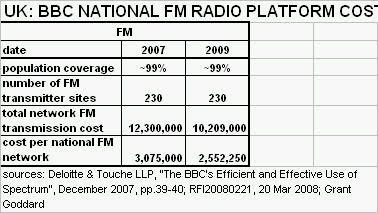
Compared to the existing FM transmission system (which the BBC said in 2007 offered around 99% population coverage), DAB will be more expensive. Not at present, because DAB is only covering 86% of the population, but increasing that percentage to the same as FM will be costly for DAB. Very costly. By comparison, the existing national FM transmission network had cost the BBC £12m in 2007. This should have reduced to £10m in 2009 after transmission contractor Arqiva agreed to discount its existing contracts (following its acquisition of rival NGW). The same discount may have lowered the cost of existing DAB transmission agreements, but not of future contracts for build-out to 99% coverage.

The BBC broadcasts only four national stations on FM whereas, on DAB, it broadcasts more channels. How many more? The number of BBC stations on DAB varies because one station is part-time and because two full-time stations are proposed for closure next year. To take an example of a music station using 128kbps of DAB bandwidth, it would cost £1.6m per annum to cover 90% of the population, £5.6m to cover 95% and £5.9m to cover 99%. Compare that to a national FM station that currently costs the BBC £2.6m per annum. It seems that DAB may be cheaper at present, but is certainly not cheaper once it is required to achieve equivalent FM coverage.

The second national DAB multiplex in the UK is owned by Arqiva (formerly ‘Digital One’) and covers 90% of the population. Does it publish a price list for commercial customers wanting DAB carriage? Seemingly not. However, in September 2009, Premier Christian Radio had said it was paying £650,000 per annum for national DAB carriage, using 64kbps of spectrum. The pro rata cost for a 128kbps music station would be £1.3m per annum, close to the previously estimated BBC cost for population coverage of 90%. Arqiva says it “is working on a transmitter roll out plan to further extend coverage,” having added four new transmitter sites in 2009.

In Germany, the transmission provider, Media Broadcast, has published a price list for commercial stations interested in broadcasting on its planned DAB platform. It anticipates that German stations will use the more spectrum efficient DAB+ system, whereas the UK is wedded to the older DAB system. The prices quoted below (in Euros) require a radio station to take a minimum 10-year contract and are based on two multiplexes operating at each transmitter location (if that were not to happen, the costs would be higher).
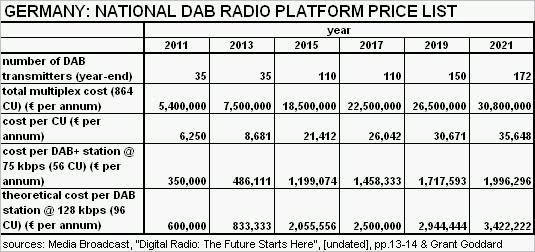
By 2015, Media Broadcast anticipates that its 110 DAB transmitters will provide coverage to 78% of the population indoors and 92% of the population outdoors. There seems to be no commitment in Germany for DAB to achieve the 95% to 99% population coverage that is planned in the UK. Nevertheless, the transmission cost of a (hypothetical) DAB station using 128kbps would be as high as E3.4m (£2.8m) per annum by 2021. As in the UK, the cost escalates rapidly as the DAB network is built out to reach more of the German population. Whereas, in 2011, the initial E0.6m (£0.5m) per annum might not seem prohibitive to cover a country that has a third larger population than the UK, that annual cost is multiplied six-fold by the end of the 10-year contract.

In both the UK and Germany, the cost of DAB roll-out to ensure that reception is as robust as FM will add significantly to the platform’s costs. Without this roll-out, DAB can never replace FM, and the burdensome cost of simulcasting on both DAB and FM will continue. With this roll-out, DAB seems to end up costing more than FM to achieve similar coverage. So what is the point?

In the UK, neither Ofcom nor the government’s DCMS department have published analyses of the costs of DAB roll-out. Their pursuit of the DAB platform has had absolutely nothing to do with the real world economics of the UK radio industry. Their numerous published reports and consultations deal with a virtual reality of the radio industry that exists solely in their minds, perhaps a reflection of the fact that none of them have ever worked in the radio sector they try to regulate.

Ofcom’s plans for upgrading DAB, to be published imminently, merely prolong the regulator’s fantasy that the DAB platform is ‘the future of radio’. Ofcom’s apparent determination to run the radio industry into the ground economically through its insistence upon implementing a misguided ‘digital strategy’ for the sector has already proven a disaster, helping reduce the commercial sector’s profitability to nil. Even more disastrous is the radio industry’s seeming inability to confront Ofcom collectively, to insist that ‘enough is enough’, and to demand that Ofcom goes back to the drawing board in its whole strategy for radio’s future.

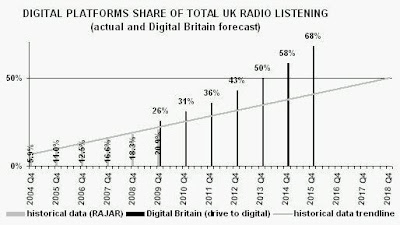
How can Ofcom retain an ounce of credibility when it had forecasted publicly (as recently as November 2006) that digital platforms would account for 42% of all radio listening by year-end 2009? The actual figure was 21%. As a result, all those radio operators who had based their business plans for digital radio upon Ofcom’s ‘professional’ forecast have faced financial ruin. Instead of reaching for the tissue box, these businesses should be reaching for their lawyer.

Practical action is what is needed now, not yet another Ofcom fantasy plan for radio’s DAB future.
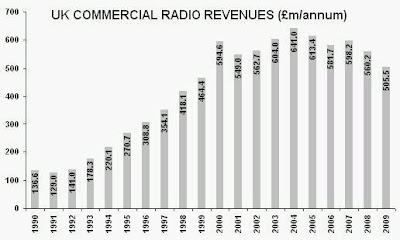
Commercial radio revenues: always look on the bright side of less

Last week’s press release from the Radio Advertising Bureau was ecstatic about the commercial radio sector’s revenues. It told us that, in 2009, radio’s share of total display advertising had increased to 5.9% from 5.8% the previous year. It told us that this was the radio sector’s first growth in share since 2004. It told us that this was “terrific” news:

“To see the first annual share growth for five years, during the worst recession in living memory, is a terrific achievement for the commercial radio sector, and one that is unmatched by any other traditional media. It is a strong signal that the sector has turned a corner and not only halted decline, but moved into renewed growth, and is further evidence that the commercial radio industry’s on-going investment into programming, talent and marketing is paying dividends in both audience and revenue performance.”

I was stunned by this fantastic success story. So stunned that I had to check the industry’s own revenue numbers to make sure I had not been mistaken. A quick look at the figures reminded me of what I had thought I already knew. In 2009, commercial radio revenues had been down 10% year-on-year. That is ‘down’ as in ‘less’, not ‘down’ as in ‘more’. The only reason that radio’s share of all media display advertising increased at all in 2009 was that, whilst radio lost 10% of its revenues, media in aggregate lost 13%. In other words, radio’s performance in 2009 was less worse than the average. This is much like boasting you are top of a school remedial class.


The Radio Advertising Bureau press release tried to position radio’s revenue performance in terms purely of cyclical ‘credit crunch’ factors. In fact, commercial radio’s problems with revenues are largely structural and started in 2005 (see graph), well before the ‘credit crunch’:
• 2009 revenues: down 10% year-on-year
• 2008 revenues: down 6% year-on-year
• 2007 revenues: up 3% year-on-year
• 2006 revenues: down 5% year-on-year
• 2005 revenues: down 4% year-on-year

As a result, radio revenues, which totalled £505.5m in 2009, are now:
• At their lowest level since 1999
• At their lowest level, in real terms, since 1997 (adjusted for inflation)

It is difficult to understand how commercial radio’s largest ever year-on-year revenue decline gives “a strong signal that the sector has turned a corner and not only halted decline, but moved into renewed growth”, as the Radio Advertising Bureau would have it.

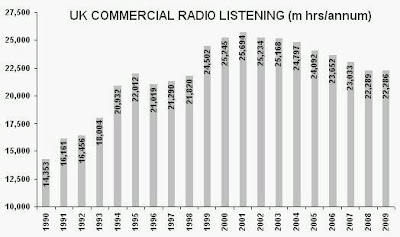
It would be great to see the commercial radio sector give a “strong signal” that it has turned a corner, any corner. But sector revenues are falling in the long term because the volume of listening to commercial radio is declining in the long term, having peaked in 2001 (see graph). Less listening inevitably leads to lower revenues.

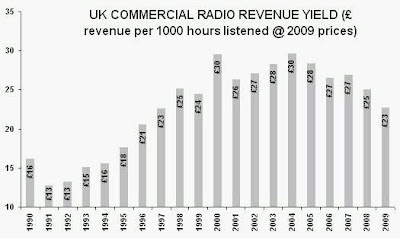
Worse, not only are commercial radio revenues and listening both going down, but the amount of money the sector is able to generate from each 1,000 hours of radio listening is also going down. In real terms (adjusted for inflation), commercial radio’s ‘revenue yield’ fell to £23 per 1,000 hours in 2009, which is where it had been in 1997 (see graph). This is probably the outcome of fewer radio advertising spots, or lower radio advertising rates, or a combination of both. Reduced yields inevitably lead to lower revenues.

To combat these structural issues, the major challenge for the sector must be to attract more listening to commercial radio. That will require a strategy that is pragmatic and focused on listener needs. Pumping out press releases that try to gloss over the commercial radio sector’s largest ever year-on-year revenue decline with phrases like “terrific achievement” is part of the problem, not part of a solution.

The DAB radio scrappage scheme – much too little, much too late

The BBC started DAB radio transmissions in the UK twenty years ago and then, ten years later, DAB was implemented commercially. During all that time, DAB radio has failed to ignite the interest of most British consumers. Neither has this European technology been successfully exported to all corners of the globe, as had been anticipated. Countries where DAB is working commercially can be counted on one hand. The end result – warehouses full of unsold DAB radios, billions of pounds of investment unlikely to ever show a return, apathetic consumers and potentially disgruntled venture capitalists.

The one-month DAB ‘scrappage’ scheme announced this week smacks of desperation. In 2009, fewer DAB radio receivers were sold than in 2007. Consumers have voted with their wallets and remain unconvinced. This downward sales trend started before the credit crunch but no action has been taken to stop it. The window of opportunity for DAB radio mass market take-up would seem to have come and gone.

During the first decade of DAB, a scrappage scheme would have been unthinkable. All parties involved in launching DAB were too busy rubbing their hands at the very anticipation of the profits that would be coming their way. High-priced DAB receivers, monopoly control of DAB airwaves and cheap, DJ-free jukebox digital radio stations. You could almost see the pound signs in the eyes of DAB stakeholders.

How times have changed. The DAB radio industry is now a salvage operation. It is a passé technology and the current objective is simply to shift as many of those brick-shaped DAB radios out of storage warehouses as possible, almost at any price. The present period before DAB is finally pronounced DOA is time limited. After that, DAB radios will become the Tamagotchi of the broadcast sector.

The most damning part of all this is the boldness with which the radio industry is still prepared to foist a technology on the public that, in many listening situations, is so technically inadequate. Instead of fixing the problems with DAB reception (which would cost a fortune), the industry just persists in maintaining its stance that DAB radio is fine. But trying to dupe your customers (particularly when radio is the most ‘trusted’ medium, according to Ofcom) must be counterproductive. Crime doesn’t pay if your business model requires loyal listeners.

Just as damning is the industry’s refusal to accept that it is ‘content’ that drives radio listening. Why would anyone buy a relatively expensive DAB radio when it offers so little content over and above what can already be accessed via AM/FM, digital TV, mobile phones and the internet? Commercial radio’s closure of most of its digital stations, followed this year by BBC proposals to axe two of its digital stations, hardly inspire consumer confidence in DAB.

Complicit in this is the radio industry’s willingness to endorse DAB radio set manufacturers’ increasingly desperate measures to shift their products. Pure, the biggest UK brand of DAB radio receivers, is circulating a booklet for consumers to pick up in-store that purportedly “dispels digital radio switchover myths”. Rather than itemise all of the booklet’s assertions that are either untrue (“AM services will either move to FM or to digital only”) or which distort the truth (“Digital radio … crystal-clear, interference-free listening”), I suggest you read it yourself here.

On the one hand, it will make you laugh with incredulity. On the other hand, if you love the radio medium, it will make you cry. Sorry, but when exactly was it that snake oil salesmen took over this industry?

What is RAJAR’s function? Cheerleader or research bureau?

This week’s publication of the latest UK radio listening figures begs the question as to what RAJAR’s function is:

• Is RAJAR a cheerleader for radio, to convince Licence Fee payers and advertisers how successful radio is? Or,
• Is RAJAR a serious research agency providing objective data to advertisers and advertising agencies about radio audiences?

I ask because this week’s media coverage of the latest RAJAR results seemed to result entirely from the cheerleader role, while the objective data role was nowhere to be seen.

The Guardian headline said: “Radio’s booming”. The BBC News headline said: “Radio listening soars”. The Media Week headline said: “Radio industry buoyed by strong Q1”. The Drum headline said: “All time radio high”.

So the radio sector is apparently performing better than ever? Well, if you believe the opening statements of the RAJAR press release:
• “Radio listening reaches an all time high as 46.5 million adults tune in to radio”
• “Radio listening in the UK has reached an all time high as 46.5 million adults, or 90.6% of the UK population (15+), tuned in to their favourite radio station each week”

The question is: who is this press release for? Certainly, it is not for the people who use RAJAR data for their work – buyers in advertising agencies and advertisers – who know from their daily examination of the detailed numbers that “radio listening” is certainly not at all at an all-time high. Rather, the volume of radio listening has been in decline since 2003, a long-term trend that shows no sign of abating.

The RAJAR press release is deliberately misleading in its use of wording. This is by no means the first time. Previous RAJAR press releases have claimed that radio listening has hit some kind of high. In RAJAR-land, every day seems to be a sunny day. This is the kind of PR puff we come to expect from commercial companies. But RAJAR is not selling anything. It is meant to be providing objective radio listening data to the media sector. It is funded jointly by the BBC Licence Fee and commercial radio.

In fact, the “all time high” assertion in the RAJAR press release derives solely from the fact that more people are listening to radio than ever before. This is good news, but the number of people listening to radio is at an “all time high” for the same reason that hospitals have more patients than ever, schools have more children than ever, and public transport has more users than ever. The adult population of the UK is increasing by around 1% per annum. More people = more people using things.

So from where does the RAJAR assertion “radio listening reaches an all time high” derive? It is nothing more than hot air. If, in using the phrase “radio listening”, RAJAR had meant to imply “the volume of radio listening”, then it is a plain lie.

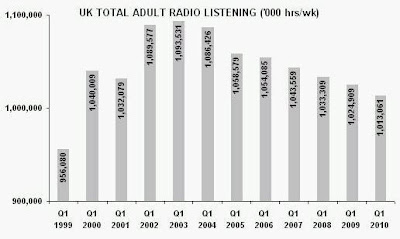
More people are listening to the radio, but they are listening for less and less time. The volume of radio listening, the total number of hours that all UK adults spend listening to the radio, has been declining since 2003. Here is a graph of RAJAR’s own data that shows it:

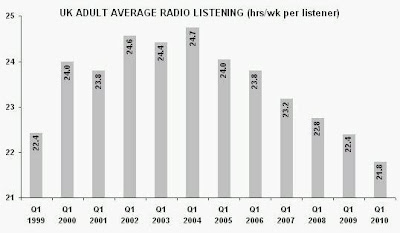
The average amount of time adult radio listeners spend listening to the radio has been declining dramatically over the same period. Here is a graph of RAJAR’s own data that shows it:

Are either of these facts, from the same research, mentioned in the latest RAJAR press release? Of course not. Why? Because RAJAR’s cheerleader role seems to require it to publicise a metric for radio listening that shows an increase: the absolute number of people listening, in this press release.

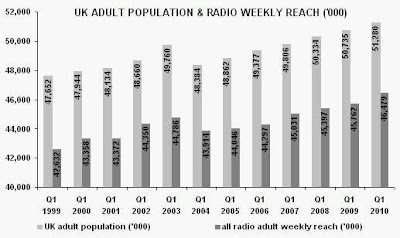
Here is a graph that shows the increase in the UK adult population and the number of people listening to radio. When the estimated population goes up, the estimated number of radio listeners goes up!

The airtime buyers in advertising agencies who have to use RAJAR data on a day-to-day basis probably chuckle at the preposterousness of the RAJAR press releases, laugh at how gullible the media are to simply reprint their headlines, and then go back to their work.

For some people (like me, having analysed radio audience data for 30 years), it creates market confusion. Clients are understandably puzzled and baffled when they see a presentation that clearly shows radio listening is in decline in the UK. They inevitably ask with suspicion: “But didn’t RAJAR just say that radio listening is at an all-time high?”

So why is RAJAR hell bent on this policy of trying to pull the wool over people’s eyes? Why does it need to be a public cheerleader for radio when we already have RadioCentre, the Radio Advertising Bureau and the BBC Press Office, each issuing their own PR puff on the RAJAR results? The RAJAR press releases might convince journalists, but they certainly don’t fool the media industry players. Instead, the opposite effect is probably the case.

How can the radio industry expect to be treated seriously within the wider media sector when its industry ratings body, charged with publishing objective listening data, insists upon grabbing headlines with misleading facts about radio audiences?

Digital radio station listening: a blip in time saves 6?

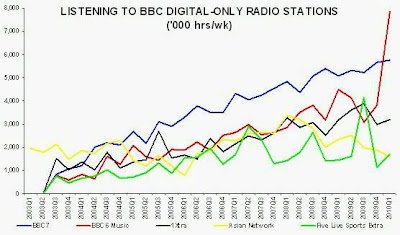
The dramatic upswing in BBC 6 Music’s listening during the first quarter of 2010 did not appear to have a knock-on effect on the BBC’s other digital stations [see graph]. 1Xtra was up slightly but still lower than it was in 2009. Asian Network dropped further and is now listened to less than part-time station Five Live Sports Extra.

In the commercial radio sector, Planet Rock recorded its best quarter yet and cemented its lead over all its digital-only competitors (BBC 6 Music excepted) [see graph]. Its continuing success only confirms that consumers prefer real programme content to the digital music jukeboxes whose performances are little more than limping along.

Even with this most recent quarter’s boost from BBC 6 Music and Planet Rock, total listening to digital-only stations has still shown almost no growth for three years [see graph]. Without the coincidence of those two successes, the latest quarter would have proven another disaster.

The question is what the next quarter will look like. We have seen listening to BBC 6 Music rise temporarily before at times when the channel has been in the press. Attracting listeners is only half the job. Keeping listeners is the much harder part.

Does the BBC 6 Music listening blip change the bleak outlook for digital radio stations? Not at all. Why? Because, even after this sudden upswing, 6 Music still attracts only two-thirds of the volume of listening to Radio 3, the BBC’s least listened to analogue national network. 207% of almost nothing still equals very little.

UK commercial radio’s growing reliance on public sector funds

The UK radio industry divides into two main sectors: BBC radio and commercial radio. BBC radio is funded by the Licence Fee, whereas commercial radio is funded by advertising and sponsorship. Each adult (aged 15+) pays around £13 per annum for BBC radio via the household Licence Fee. What is not so obvious is that each adult also contributes financially to commercial radio by around £2 per annum via their taxes, which are then used by government and public bodies to buy advertising time on commercial radio stations.

Commercial radio’s largest advertiser is neither BT (ranked second), nor Sky TV (third), Specsavers (fourth) or Unilever (fifth). It is the Central Office of Information [COI], the government’s marketing and communications arm, which spent £58m on radio advertising (25% of its budget) on UK commercial radio in the 12 months to February 2010. To illustrate just how significant the COI has become to the revenue base of commercial radio, it now spends twice as much on radio advertising as the aforementioned BT, Sky TV, Specsavers and Unilever added together. In 1999, COI expenditure had accounted for only 2% of commercial radio revenues whereas, by 2009, it was 10%.

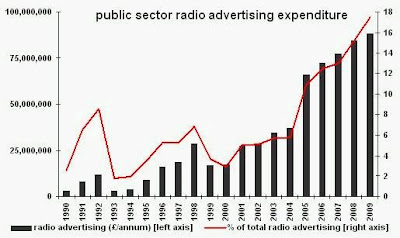
The COI’s financial support of commercial radio is not the whole story. Additionally, other public bodies such as local authorities, health authorities and development corporations also spend money on radio advertising. In 2009, the public sector in aggregate spent £88m with commercial radio, 18% of sector revenues [see graph]. The growth over the last decade has been enormous – in 1999, public sector spend was only £17m or 4% of commercial radio revenues.

This massive increase in public expenditure on commercial radio advertising during the last decade creates three issues:
• The commercial radio sector has become more dependent on the continuing input of public funds: public bodies now spend more on commercial radio than the car industry, or retailers, or the finance sector
• It becomes harder for commercial radio to argue about the public funding of BBC radio, when the commercial radio sector itself has become increasingly reliant upon public funds
• Governments change, government budgets change, government policies change, making this revenue stream more unreliable for commercial radio in the long term than commercial advertising.

The issue with revenue reliability is particularly pertinent now. The Conservative Party pledged in its manifesto to reduce advertising expenditure by government departments, if elected. The planned cuts would be significant, 40% of the COI 2008/9 budget of £540m, according to one press report.

This policy is nothing new. In 2008, Conservative Shadow Chancellor George Osborne promised at the Party Conference that he would more than half the COI budget from £391m to £163m. In 2005, then Conservative Shadow Chancellor Oliver Letwin promised to cut the COI advertising and marketing budget by more than half from £308m to £108m.

For commercial radio, the impact of such cuts would prove disastrous in the wake of its recent structural and cyclical revenue declines. A 50% budget cut to COI expenditure on radio would lose commercial radio £26m to £29m per annum, 6% of total sector revenues. A 50% budget cut to all public sector expenditure on radio would lose commercial radio £44m to £48m per annum, 9% of total sector revenues.

In 2009, commercial radio revenues were down 10% year-on-year. A year earlier, commercial radio revenues had been down 6% year-on-year. A further 9% cut to sector revenues would reduce them to the level they were ten years ago. Already, once prices are adjusted for inflation, commercial radio revenues are at their lowest annual level since 1997 in real terms.

Commercial radio’s growing reliance on national advertisers, of which government advertising is now the most significant part, has increased the sector’s economic vulnerability. In 1993, local advertisers had still constituted the majority of commercial sector revenues. By 2009, local advertising was down to 29% of total revenues.

Furthermore, if a government were to return to the post-War COI policy of using public broadcasters to air its Public Service Announcements, rather than paying commercial rates for airtime, up to 18% of commercial radio revenues would disappear at a stroke.

It must be a major concern that, in these times of inevitable government budget cuts (whichever political party is in power), the commercial radio sector’s reliance on public funds has never been so great.

Benefits of DAB radio “insufficient compared to its cost per user” warned EU report … in 2002

Sometimes it proves useful to take a look backwards to try and understand where you are now. In 2002, a 236-page report was produced for the European Commission on the topic of ‘Digital Switchover In Broadcasting’ by BIPE Consulting. Re-reading it is a stark reminder that the current problems with DAB radio implementation in Europe had been anticipated at least eight years ago.

Firstly, the BIPE report admitted that a significant motivation for introducing DAB radio was so that existing licensed European broadcasters could maintain market control in the face of competition from IP-delivered radio content produced by pesky foreigners:

“Some radio broadcasters consider digital radio as a question of survival in the long term … digitisation of content, transmission and multipurpose receivers could squeeze out the possibility of having a dedicated radio platform with its own players, services and listeners. The fact of having a dedicated [DAB] platform could maintain the existing value chain. If not, alternative, third-party digital platform operators will enter the game, and this could reduce radio specificity as it is understood today or even break the radio business model.”

Many of the problems of implementing DAB were identified then:

“New frequencies have to be found to simulcast analogue programmes and new expected ones (which is not the case with digital TV that can be simulcast in the same bands); very high digital receivers prices create a chicken-and-egg situation; while pay TV is a strong driver of TV digital migration, a pay-radio business model seems not to be sustainable so far; RDS, data services and free-to-air multi-channel FM reduce the attractiveness of digital radio.”

And the huge challenge of convincing consumers was made very clear:

“Analogue radio receivers are low cost devices offering numerous, free-to-air channels and with FM audio quality. In this context, the benefits of digital radio as presented by the DAB model so far are insufficient compared to its cost per user.”

The long period of consumer migration from AM to FM broadcasting in Europe was recognised:

“More than 30 years of simulcast AM/FM were necessary to substitute nearly completely AM by FM listening. This lengthy duration covered network deployment, frequency release, launch of music channels (the killer application), and diffusion of FM functionality through the installed base of all the receivers.”

The report identified the “major obstacles to digital radio migration” as:
• Receiver cost
• Low consumer awareness
• No pressure to release the FM band (“DAB is costly in terms of bandwidth used and difficult to insert in existing radio bands. … But the quantity of spectrum released by terminating analogue radio services is much less significant than the potential release of spectrum following the turn-off of analogue terrestrial television broadcasting.”)
• No pay model driver
• No clear killer application (“Together, FM and RDS already combine a certain degree of quality with important data services.”)
• Lack of interest for higher quality sound
• Lack of interest from carmakers
• Necessity of a European market (“Low cost receivers require addressing mass markets. Different national timing in the digitisation of radio does not create the conditions or incentives for achieving critical mass.”)
• The installed base of receivers (“There are between 3 to 5 radio receivers per household, many of them being lower cost receivers. To replace such an installed base means achieving low costs and/or to supply attractive, new services.”)
• Other standards than DAB are possible (“This competition may reduce the mass-market achievement in Europe.”)
• Lack of radio spectrum capacity for DAB (“The DAB multiplex is much larger than one FM channel: insertion in the FM band is not possible, spectrum efficiency is poor.”)
• Multi-channel is already a feature of analogue FM radio (“Additional services will have a marginal effect.”)
• DAB licences have sometimes been delayed.

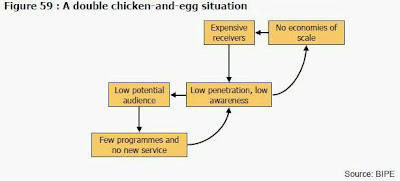
Finally, the report identified what it called “a chronic chicken-and-egg situation” whereby:
• “Receivers remain expensive because there are no scale effects. This reduces audience and revenues of radio broadcasters who demand that manufacturers decrease receiver prices in order to provoke a mass-market and to trigger mass audiences ;
• There is no specific advantages [sic] in digital radio, no killer application, nobody buys digital receivers, the audience remains negligible, and prices stay high.”

There was even a graphic to illustrate the problem:


This all feels very much like DAB in Europe … eight years on. And, to hammer home the impending fragmentation of radio delivery platforms, the report’s recommendations noted that:

“Digital radio will probably be delivered through a much larger variety of technologies and platforms than analogue radio, which is essentially terrestrial. These will involve broadcasting or point-to-point, online or on-air, satellite, terrestrial or cable delivery, DAB, DVB or DRM technologies. These techniques will be competitors but very complementary for consumers and broadcasters.”

The questions all of this raises are:
• How did the UK government’s Digital Radio Working Group spend one year (2007-2008) considering how to make DAB radio a success in the UK but not reference this 2002 report?
• How did the UK government’s Digital Britain consultation spend much of a year (2008-2009) looking for the answers to DAB radio implementation but not reference this 2002 report?
• Did DAB stakeholders in the UK read this report in April 2002? And, if so, did they simply choose to ignore it?

[thanks to Eivind Engberg]

DENMARK: state radio axes DAB radio ‘jukebox’ music channels

Danish state radio, ‘DR’, is cutting the number of DAB channels it broadcasts, many of which are ‘jukebox’ music stations, in order to focus on presenter-led programmes. At the same time, it plans to develop more and better on-demand and mobile content, particularly aimed at young people.

These changes were part of the DR programming strategy for 2011 of ‘quality over quantity’ announced by director general Kenneth Plummer, who said:

“The intention is not to create more, but better and more focused content for the Danish people. This is the recurring theme within our plans for the coming year.

Announcing the policy changes for DAB radio, DR media director Mikael Kamber said:

“We will get to see more ‘real’ content-focused channels on DAB and fewer pure music channels.”

The DR plan is to re-position its DAB radio channels in order to offer genuine public service content aimed at three specific segments of the audience: children, teenagers and the elderly.

One press report said that the number of DR digital radio channels was to be cut from 29 to 10.

The DR digital radio channels collectively had a weekly reach (via DAB and the internet) of 20.1% in 2009, up from 17.1% in 2008. The DR DAB channels attract a 2.5% share of listening in aggregate, low compared to the DR analogue radio channels P4 (46%), P3 (18.3%), P1 (6.9%) and P2 (4.3%). As in the UK, radio listening in Denmark is in slight decline, down by 4 minutes year-on-year to 2 hours 7 minutes per day in 2009.

DAB radio was launched in Denmark by state radio in October 2002, following trials that started in 1995.

Selling the UK DAB radio ‘success’ story overseas

In amongst all the jubilant public statements from media stakeholders following Assent of the Digital Economy Act 2010 this month, one press release stood out for taking wild optimism to new heights. It said:

“The Digital Economy Bill is linked to the government’s Digital Britain report which defines a digital radio switchover plan lasting two years. The migration start date for this is triggered when DAB coverage reaches the same as today’s FM and when 50% of all radio listening is via a digital platform. Based on current digital listening projections from Rajar, and the roll out of new DAB transmitters from Arqiva and the BBC, the UK market is set to achieve both of these milestone [sic] in 2013 …”

Will 50% of radio listening in the UK be delivered via digital platforms by 2013? Not a chance. Even our politicians have admitted this will not happen. Look at the graph below.

The government’s Digital Britain report, published in mid-2009, had forecast that digital listening would be 26% by year-end 2009, which proved to be wide of the mark. The actual figure was 20.9%. What is the chance of 50% being reached by 2013? Zero.

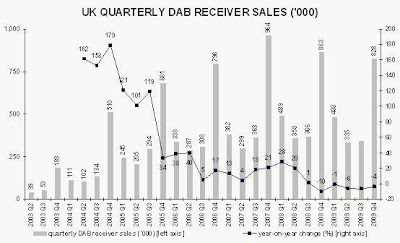
So why is this press release so determined to tell us that “the UK market is set to achieve” a milestone that is so obviously impossible? The answer lies in this next graph which shows that DAB radio receiver sales in the UK were lower in 2009 than in 2008, and lower in 2008 than in 2007.

The market for DAB radio receivers in the UK has been slowing since the end of 2007. DAB radio unit sales are now less than 2m per annum, a volume last seen in 2006. For financial stakeholders in the UK DAB radio receiver sector, this is very bad news.

Frontier Silicon is one of those main stakeholders, a private UK-based semiconductor company that supplies 70% of the global DAB receiver market. With the UK market for DAB drying up, and the European market never having really developed at all, companies such as Frontier Silicon are having to look further overseas for DAB sales. Trade shows such as last week’s Hong Kong Electronics Fair become significant events to convince new territories of the advantages of DAB radio.

So the Frontier Silicon press release quoted earlier, though datelined “London”, is not intended for domestic consumption at all. Yes, it might seem laughable in the UK to believe that digital listening will reach 50% by 2013. But, for Frontier Silicon, this ‘success’ story will help convince overseas markets that DAB is already a raging success in the company’s homeland. This is ‘sales patter’, not fact.

Who at the Hong Kong event would want to learn that the commercial radio industry in the UK has been brought financially to its knees by its decision more than a decade ago to pursue the DAB dream?

Digital Economy Act 2010: a smokescreen for backroom radio ‘deal’

On 8 April 2010 at 1732, the Digital Economy Act was given Royal Assent by Parliament. Who exactly will benefit from the radio clauses in the Act? Certainly not the consumer.

“The passing of the Digital Economy Bill into law is great news for receiver manufacturers,” said Frontier Silicon CEO Anthony Sethill. As explained by Electronics Weekly: “Much of the world DAB industry revolves around decoder chips and modules from UK companies, in particular Frontier Silicon. These firms can expect a bonanza as consumers replace FM radios with DAB receivers.” Frontier Silicon says it supplies semi-conductors and modules for 70% of the global DAB receiver market.

Sadly, the Bill/Act was not really about digital radio at all. For the radio sector lobbyists, it was all about securing an automatic licence extension for Global Radio’s Classic FM, the most profitable station in commercial radio, so as to avoid its valuable FM slot being auctioned to allcomers. The payback on this valuable asset alone easily justified spending £100,000’s on parliamentary smooching. It was interesting to see one Labour MP acknowledge the true purpose for all this parliamentary lobbying in the House of Commons debate when he congratulated “[Classic FM managing director] Darren Henley for making a cause of the issue.”

The clauses in the Digital Economy Bill on the planned expansion of DAB radio and digital radio switchover were simply promises that Lord Carter had insisted upon as the radio industry’s quid pro quo for government assistance to Global Radio’s most profitable asset. The existence of this ‘deal’ between Lord Carter and Global Radio was confirmed by Digital Radio Working Group chairman Barry Cox in his evidence to the House of Lords:

“Lord Carter did not like to do [the deal] immediately. As I understand, he wanted to get something more back from the radio industry. I think there is a deal in place on renewing these licences, yes.”

However, the quid pro quo promise to develop DAB radio will never come to fruition. Now that Global Radio has got what it wanted, over the coming months, the radio industry’s commitment to continue with DAB will inevitably be rolled back. Every excuse under the sun will be wheeled out – the economy, the expense, the lack of industry profitability (having spent nearly £1bn on DAB to date), consumer resistance, the regulator, the Licence Fee, the government (old and new), the car industry, the French, the mobile phone manufacturers, whatever …….

The reasons that digital radio migration/switchover will never happen are no different now than they were before the Digital Economy Bill was passed into law. For the consumer, who seems increasingly unconvinced about the merits of DAB radio, this legislation changes nothing at all. Those reasons, as itemised in my written submission to the House of Lords in January 2010, are:

• The characteristics of radio make the logistics of switchover a very different proposition to the television medium
• The robustness of the existing analogue FM radio broadcasting system
• Shortcomings of the digital broadcast system, ‘Digital Audio Broadcasting’ [DAB], that is intended to replace analogue radio broadcasting in the UK.

More specifically:

1. Existing FM radio coverage is robust with close to universal coverage
• 50 years’ development and investment has resulted in FM providing robust radio coverage to 98.5% of the UK population

2. No alternative usage is proposed for FM or AM radio spectrum
• Ofcom has proposed no alternate purpose for vacated spectrum
• There is no proposed spectrum auction to benefit the Treasury

3. FM/AM radio already provides substantial consumer choice
• Unlike analogue television, consumers are already offered a wide choice of content on analogue radio
• 14 analogue radio stations are available to the average UK consumer (29 stations in London), according to Ofcom research

4. FM is a cheaper transmission system for small, local radio stations
• FM is a cheaper, more efficient broadcast technology for small, local radio stations than DAB
• A single FM transmitter can serve a coverage area of 10 to 30 miles radius

5. Consumers are very satisfied with their existing choice of radio
• 91% of UK consumers are satisfied with the choice of radio stations in their area, according to Ofcom research
• 69% of UK consumers only listen to one or two different radio stations in an average week, according to Ofcom research

6. Sales of radio receivers are in overall decline in the UK
• Consumer sales of traditional radio receivers are in long-term decline in the UK, according to GfK research
• Consumers are increasingly purchasing integrated media devices (mp3 players, mobile phones, SatNav) that include radio reception

7. ‘FM’ is the global standard for radio in mobile devices
• FM radio is the standard broadcast receiver in the global mobile phone market
• Not one mobile phone is on sale in the UK that incorporates DAB radio

8. The large volume of analogue radio receivers in UK households will not be quickly replaced
• Most households have one analogue television to replace, whereas the average household has more than 5 analogue radios
• The natural replacement cycle for a radio receiver is more than ten years

9. Lack of consumer awareness of DAB radio
• Ofcom said the results of its market research “highlights the continued lack of awareness among consumers of ways of accessing digital radio”

10. Low consumer interest in purchasing DAB radio receivers
• Only 16% of consumers intend to purchase a DAB radio in the next 12 months, according to Ofcom research
• 78% of radio receivers purchased by consumers in the UK (8m units per annum) are analogue (FM/AM) and do not include DAB, according to GfK data

11. Sales volumes of DAB radio receivers are in decline
• UK sales volumes of DAB radios have declined year-on-year in three consecutive quarters in 2008/9, according to GfK data

12. DAB radio offers poorer quality reception than FM radio
• The DAB transmission network was optimised to be received in-car, rather than in-buildings
• Consumer DAB reception remains poor in urban areas, in offices, in houses and in basements, compared to FM

13. No common geographical coverage delivered by DAB multiplexes
• Consumers may receive only some DAB radio stations, because geographical coverage varies by multiplex owner

14. Increased content choice for consumers is largely illusory
• The majority of content available on DAB radio duplicates stations already available on analogue radio

15. Digital radio content is not proving attractive to consumers
• Only 5% of commercial radio listening is to digital-only radio stations, according to RAJAR research
• 74% of commercial radio listening on digital platforms is to existing analogue radio stations, according to RAJAR research

16. Consumer choice of exclusive digital radio content is shrinking
• The majority of national commercial digital radio stations have closed due to lack of listening and low revenues
• After ten years of DAB in the UK, no digital radio station yet generates an operating profit

17. Minimal DAB radio listening out-of-home
• Most DAB radio listening is in-home, and DAB is not impacting the 37% of radio listening out-of-home
• Less than 1% of cars have DAB radios fitted, according to DRWG data

18. DAB radio has limited appeal to young people
• Only 18% of DAB radio receiver owners are under the age of 35, according to DRDB data
• DAB take-up in the youth market is essential to foster usage and loyalty

19. DAB multiplex roll-out timetable has been delayed
• New DAB local multiplexes licensed by Ofcom between 2007 and 2009 have yet to launch
• DAB launch delays undermine consumer confidence

20. Legacy DAB receivers cannot be upgraded
• Almost none of the 10m DAB radio receivers sold in the UK can be upgraded to the newer DAB+ transmission standard
• Neither can UK receivers be used to receive the digital radio systems implemented in other European countries (notably France)

21. DAB/FM combination radio receivers have become the norm
• 95% of DAB radio receivers on sale in the UK also incorporate FM radio
• 9m FM radios are added annually to the UK consumer stock (plus millions of FM radios in mobile devices), compared to 2m DAB radios, according to GfK data

22. DAB carriage costs are too high
• Carriage costs of the DAB platform remain too costly for content owners to offer new, commercially viable radio services, compared to FM
• Unused capacity exits on DAB multiplexes, narrowing consumer choice

23. DAB investment is proving too costly for the radio industry
• The UK radio industry is estimated to have spent more than £700m on DAB transmission costs and content in the last ten years
• The UK commercial radio sector is no longer profitable, partly as a result of having diverted its operating profits to DAB

24. DAB is not a globally implemented standard
• DAB is not the digital radio transmission standard used in the most commercially significant global markets (notably the United States)

These factors make it unlikely that a complete switchover to DAB digital terrestrial transmission will happen for radio in the UK.

With television, there existed consumer dissatisfaction with the limited choice of content available from the four or five available analogue terrestrial channels. This was evidenced by consumer willingness to pay subscriptions for exclusive content delivered by satellite. Consumer choice has been extended greatly by the Freeview digital terrestrial channels, many of which are available free, and the required hardware is low-cost.

Ofcom research demonstrates that there is little dissatisfaction with the choice of radio content available from analogue terrestrial channels, and there is no evidence of consumer willingness to pay for exclusive radio content. Consequently, the radio industry has proven unable to offer content on DAB of sufficient appeal to persuade consumers to purchase relatively high-cost DAB hardware in anywhere near as substantial numbers as they have purchased Freeview digital television boxes.

Additionally, it has taken far too long to bring DAB radio to the consumer market, and its window of opportunity for mass take-up has probably passed. Technological development of DAB was started in 1981, but the system was not demonstrated publicly in the UK until 1993 and not implemented for the consumer market until 1999. In the meantime, the internet has expanded to offer UK consumers a much wider choice of radio content than is available from DAB.

In this sense, DAB radio can be viewed as an ‘interim’ technology (similar to the VHS videocassette) offering consumers a bridge between a low-tech past and a relatively high-tech future. If DAB radio had been rolled out in the early 1990s, it might have gained sufficient momentum by now to replace FM radio in the UK. However, in the consumer’s eyes, the appeal of DAB now represents a very marginal ‘upgrade’ to FM radio. Whereas, the wealth of radio content that is now available online is proving far more exciting.

The strategic mistake of the UK radio industry in deciding to invest heavily in DAB radio was its inherent belief in the mantra ‘build it and they will come.’ Because the radio industry has habitually offered content delivered to the consumer ‘free’ at the point of consumption, it failed to understand that, to motivate consumers sufficiently to purchase relatively expensive DAB radio hardware would necessitate a high-profile, integrated marketing campaign. Worse, the commercial radio sector believed that compelling digital content could be added ‘later’ to DAB radio, once sufficient listeners had bought the hardware, rather than content being the cornerstone of the sector’s digital offerings from the outset.

In my opinion, the likely outcome is that FM radio (supplemented in the UK by AM and Long Wave) will continue to be the dominant radio broadcast technology. For those consumers who seek more specialised content or time-shifted programmes, the internet will offer them what they require, delivered to a growing range of listening opportunities integrated into all sorts of communication devices. In this way, the future will continue to be FM radio for everyday consumer purposes, with personal consumer choice extended significantly by the internet.