I just looked around and he was gone : 1979 : Jerry Dennis, Palatinate editor, Durham University

 “I am here for the Accommodation Office, please,” I said with trepidation to the uniformed man behind the huge wooden reception desk in the lobby of the Old Shire Hall. On the front of the desk, elaborately carved nineteenth century working-class scenes from Durham’s coalmining industry seemed to clash with this building’s present users – high-flying academics and the children of Britain’s upper classes.

The man behind the desk looked at me with a suspicion seemingly reserved for the occasional long-haired student who ventured into his domain wearing crumpled denim clothes and platform shoes … like me.

“You will have to leave a message,” he eventually replied in a bored tone that conveyed the regularity with which he was required to offer such a response. He did not bother to elucidate whether the Accommodation Office was presently unmanned, temporarily closed or existed in any physical form. Instead, he gestured towards an open hard-backed ledger laid at one end of his mighty desk, beside which was a chained Biro.

I was made to feel so small and insignificant in the foyer of that hugely imposing town centre monolith constructed in 1898 as the headquarters of Durham County Council but, since 1963, used as the administrative centre of Durham University. (Years later, when I watched Lowry approach the front desk of The Ministry of Information Retrieval in the movie ‘Brazil’, I instantly recalled my sentiment). I wrote in the visitors’ book that I was requesting information urgently about landlords presently offering accommodation to rent. 

I was homeless, secretly spending my nights in a sleeping bag on the floor of an office in the Students’ Union building, Dunelm House. Student ‘digs’ around Durham were advertised but landlords were demanding rents way beyond my budget. Extortion proved no barrier to the 95%+ of undergraduates who had arrived from private schools, receiving only the minimum student grant from their local authority, but whose parents were sufficiently wealthy to uncomplainingly pay such rents through their noses. Some students I met lived in accommodation their parents had even bought for them as an investment within this English county so poor that miners’ cottages could be acquired for £1,000.

I was not amongst this privileged majority of students. Since arriving in Durham in 1976, a chunk of my full student grant from Surrey County Council and my vacation earnings had been diverted to pay the utility, property ‘rates’ bills and overheads of my family’s home in Camberley. After my father had deserted his family four years earlier and then ignored court-ordered maintenance payments, my mother had been struggling to raise my two younger siblings in austere circumstances. During my first two undergraduate years, I had opted for subsidised college rooms but then had been forced out onto the ‘open market’ by university policy. Additionally, I had waived my vacation earnings during the summer of 1978 by choosing to remain in Durham to edit (unpaid) the annual ‘Durham Student Handbook’ with the hope it might benefit my career in media. Whereas, the previous two summers, I had worked twelve hours a day, seven days a week continuously for two months in a basement office in Aldershot, maximizing available overtime to help fund my family’s expenses.

Weeks after having left my message for the university’s Accommodation Office, I received by internal mail sent to my college’s basement pigeonholes a photocopied A4 page listing about a dozen local landlords. This document was of no practical use, lacking basic, accurate and timely information that could have helped me. I wondered whether the university’s ‘Accommodation Office’ really even existed since Durham’s posh students scarcely appeared to require practical assistance when their parents were still organising their education. Who was the university’s ‘Accommodation Officer’ Catrin Prydderch-Jones, a 1977 graduate of Durham University with a 2:2 in music who had been appointed in September that year to the post of “Administrative Assistant in the University Office”?

I was not her only unsatisfied customer. In January 1979, a letter from archaeology undergraduate Jeanette Ratcliffe published in Durham student newspaper Palatinate had complained:

  • “Miss Prydderch-Jones sent out to students looking for accommodation next year a list of landlords and their respective houses and flats” that was “incomprehensible, grossly out of date and of little constructive use”
  • “A considerable number of landlords no longer wished to be on the list and students who contacted them became the subject of their anger at receiving numerous phone calls a day enquiring about their property.”
  • One listed house “according to the landlord has not been standing for six years”
  • “What exactly does Miss Prydderch-Jones do to retain her position in the Accommodation Office?”
  • “… I suggest she give up her position as Accommodation Officer”.

In a follow-up front-page article in February 1979, the student newspaper reported that “doubts have been expressed in Durham Student Union council [meetings] about the efficiency of an Old Shire Hall-based Accommodation Office.” It explained that “complaints about the way that the [Accommodation] Office is working led Palatinate to talk to Ms. Prydderch-Jones” who was pictured sat at a desk. Her quoted responses proved to be wholly evasive and she ended by assuring readers “there is no crisis at the moment about finding places to live!”, apparently oblivious to the notion that the high prices of available accommodation might prove a barrier for those students having to survive without parental support.

In the same issue of Palatinate that had published the letter from Ratcliffe, a front-page expose had criticised the financial management of the Durham University Athletic Union [DUAU], provider of the university’s “excellent” sporting facilities, under the headline ‘DUAU Foul Play’. Beneath a photo of DUAU treasurer Ian Graham sat at his Old Shire Hall desk, the article explained that the £38 annual ‘Composition Fee’ paid by the local government authorities of each of Durham’s 4,000 students was divided by the university between its athletic union, student union and college ‘Junior Common Rooms’. DUAU audited accounts showed that:

  • In 1977/8, 42% of the Composition Fee had been spent on sport, compared to the 18% national average (the DUAU share increased to 52% the following year)
  • When Durham colleges’ expenditure was included, £20 of the £38 per head Composition Fee was spent on sport.

DUAU accounts documented a surplus greater than £4,000 during each of the previous three years, a situation that “should lead to a cut in their grant, as showing a surplus is interpreted as meaning that too much money has been given”. Surpluses of £5,200 in 1976/7 and £10,000 in 1977/8 were said to have been allocated to “reserve funds”. Questioned about these reserves, Graham “evaded the fundamental points by talking at some length about the rather vague uses of these funds” which the article concluded “does not alleviate Palatinate’s concern[s] which were:

  • “One of the complaints that the [government] Department of Education & Science is making is that there is not enough public accountability for student unions”
  • “DUAU, by claiming large sums of money for their FUTURE but, as yet, UNSPECIFIED capital expenditure, is effectively avoiding any sort of accountability whatsoever.”

Some of Ian Graham’s unverified arguments in the interview to justify DUAU’s dominant share of the per capita funding appeared bizarre:

  • “It is much easier for a student who has been actively involved in university sport to get a job”
  • “Many parents have sent their children here because of its fine sporting reputation”
  • “There was a correlation between the increase in good A-level results of Durham students and the growth and success of DUAU”.

Confusingly, although DUAU was constituted as a student organisation, just like Durham Students’ Union, Graham was no student but rather the university registrar responsible for managing the entire institution’s administration. This would be like having a school principal in charge of its students’ council! It was no wonder that DUAU could appropriate the greater part of each student’s Composition Fee with impunity, to the detriment of the student union, because each year it was the university administration, led by the very same Ian Graham, that determined the division of funds. Conflict of interest or what?

These separate anonymous front-page articles appeared in Palatinate within weeks, criticising two Durham University administrators, Catrin Prydderch-Jones and Ian Graham. However, a link existed between these two that had not been published. It was Graham who had appointed Prydderch-Jones to the accommodation job for which she appeared to be poorly qualified. It was also Graham who allegedly had invited Prydderch-Jones amongst a bevy of posh, female undergraduate first-years to stay in the expansive university flat at 71 Saddler Street that accompanied his job.

Whether the Palatinate editor of the day knew of this connection I know not. What I divine is that the student newspaper’s simultaneous critical coverage of Graham and his ‘protegee’ must have embarrassed and infuriated the registrar who ran our university with an iron rod. Having served in the British Army and been wounded at Anzio during “the Italian campaign”, he had joined Durham University in 1950 as assistant registrar. Promoted to registrar in 1963, Graham devised and drafted a new constitution and statutes for the university that were reported to be “almost entirely Ian’s work.” His objective was said to be “to provide for the North of England a Collegiate University, one in which the undergraduate experience would be essentially the same, though simpler (and less expensive) than that afforded by Oxford and Cambridge in the South.”

A lifelong bachelor, Graham was said to have given “to the University the time which most people spend with their families” and to have “sought out also a large number [of students] whose names were known to him through his acquaintances in the schools or among previous generations of students.” In this way, he perpetuated the institution’s old (private) school tie connections, making Durham University a natural social repository for posh people’s children not smart enough to attend ‘Oxbridge’. Apparently, “all of these people were welcome in [Graham’s flat at] 71 Saddler Street, not only for the crowded parties which regularly took place there, but on frequent more private occasions.”

Whoa! This 50-something year old bureaucrat was organising student ‘parties’ for newly arrived teens in his flat? It would be easy to characterise Graham as the Hugh Heffner of Durham University, an aged man with a gammy limb, surrounded by a bevy of good-looking, posh-sounding, double-barrelled debutantes prancing around his flat in their underwear. The truth is rather more insidious. Graham had been the architect in 1963 of Durham University’s ‘divorce’ from its considerably less posh partner Newcastle University and had accumulated more power to control the organisation he had created during thirty years in the job than anyone else employed in Old Shire Hall. Any perceived threat to Graham’s eco-system would have to be eradicated. And so it was.

The elected editor of Palatinate at the time was Jerry Dennis, an English Literature undergraduate who was not at all the typical upper-class student that Graham desired at ‘his’ university. Despite a posh accent, Dennis appeared somewhat hippy-like with a tall rake-thin body and long straight brown hair falling to his shoulders. He spoke languorously and purposefully with a keen wit and an analytical mind. He was fearless and unafraid to challenge the status quo, hence the investigative articles concerning Prydderch-Jones and Graham published in a fortnightly student newspaper that, until his appointment, had been more a gossip sheet and CV builder for adolescent essays by aspiring upper-crust authors.

Graham required revenge. Unfortunately for him, Dennis’ two-year academic record at Durham had been positive as he had passed all mandatory exams. Instead, Graham had to scour ancient statutes within the 1832 Act of Parliament and 1837 Royal Charter that had created England’s third-oldest university. There he discovered that a student accused of holding the university ‘in contempt’ could be expelled by a specially convened committee. This procedure had never been used in Durham’s century and a half history, though Graham was undaunted given the power he wielded. He set about convening the requisite brand-new committee of university personnel upon whom he could rely to do his bidding.

Weeks later, I was startled to find in my college pigeonhole an official letter from Ian Graham inviting me to be the one student that the statute required to attend the meeting of this committee which would be considering Dennis’ case. Out of the university’s 4,000 students, it was against all odds that I had supposedly been chosen randomly to consider a verdict on a fellow student with whom I was already acquainted. I could read between the letter’s lines. In reality, it had been sent as a warning shot across my bows, hinting that I might soon follow Dennis and be dispatched into the wilderness. Why?

That year, I had been tasked with writing the annual Durham Students’ Union submission to the university to request the following year’s Union funding through the aforementioned Composition Fee. My application was the most voluminous and forensic ever compiled, documenting why a substantial year-on-year increase proved necessary. The chair of the university Finance Committee, finance officer Alec McWilliam, seemed to appreciate my expertise in accountancy (the result of my mother having taught me double-entry bookkeeping and accounts reconciliation at the age of seven). The outcome was that McWilliam’s committee awarded Durham Students’ Union its largest ever year-on-year increase in funding.

However, for every winner, there has always to be a loser. My personal success meant that Ian Graham’s competing bid for additional funds for the Athletics Union had been rebuffed at the same committee meeting. For once, Graham was not getting all his own way and was probably not enamoured of this outcome. That was my reading of the reason I had received his letter. My suspicions were confirmed when I called the confirmation phone number in the letter and was told by a woman administrator at Old Shire Hall that my receipt of the invitation letter had been an ‘administrative error’. In fact, I had never been randomly selected to witness the ‘Inquisition’ against Jerry Dennis … who Graham’s committee agreed to expel at the end of his second year.

Palatinate subsequently published a front-page story beneath a photo of Dennis that noted “a considerable degree of shock and dismay at the apparently unsympathetic attitude taken by the University authorities towards this case, an attitude which several students believe to be almost vindictive.” It commented somewhat hesitantly that “the paper did adopt a particularly critical stance under the editorship of Mr Dennis, and many feel that it is not beyond the bounds of possibility that the difficulties he created for the University may not be totally unconnected with his present predicament.”

Incensed by Dennis’ expulsion, I wrote Palatinate a signed letter it published in October 1979:

“It is frightening to think that any students at this University can be sent down for not ‘keeping term’, which could mean:

  • Not attending a course of instruction (which could be a subsidiary [subject]) to the satisfaction of the Chairman of the Board of Studies concerned.
  • Not attending ‘academic engagements to the satisfaction of the Board of Studies concerned.
  • Not presenting written work as and when required unless excused in advance.

Is it really fair to leave such vague definitions to the interpretation of the Chairman of the Board of Studies? How clearly are these conditions communicated to new students? How many students treat their lectures as ‘optional’?

It is a sobering thought that if YOU do not get on the right side of the Chairman of your Board of Studies (do you know who he/she is?) and you:

  • Miss a lecture because your alarm clock fails to go off
  • Miss a tutorial because you muddle the date
  • Hand in an essay late because you could not get the books

YOU could be accused of not keeping term …. Sweet dreams.”

If Ian Graham’s letter to me the previous term had been an oblique personal warning, this publication of my opinions ensured that there was now an oversized target on my back. That is a story for another day.

Despite this realisation, I was determined to persevere with investigating Ian Graham for a potential further article in Palatinate. Each new academic year, Graham distributed invitations for a ‘fresher’ party held in his flat to first-year female students arriving from the private schools he favoured. My then student girlfriend had a friend who was prepared to pose as one of these targeted young women. ‘KT’ was suitably talkative, pretty and had a posh accent. Although she was in her second year, she would attend using a ticket we wrangled from a new student who had no interest in taking up the offer.

KT arrived at Ian Graham’s flat the evening of the party with my Sony TCM-3 cassette recorder under her clothing, attached to a hidden lapel microphone. She was sufficiently bold to strike up conversation with Graham who, as hoped, suggested she return on her own for one of his “more private occasions.” However, after reviewing the tape recording, there was nothing substantial enough from their dialogue with which to craft an article. After much discussion, and in light of Jerry Dennis’ expulsion, we decided regrettably that a further ‘mission’ to follow up Graham’s invitation would prove too dangerous for KT’s academic future. His annual recruitment of ‘pretty young things’ would continue regardless.

I had been upset, angry and horrified by Jerry Dennis’ expulsion. I still am. It was me who had analysed the audited financial data for the article Dennis published about DUAU’s finances. I was partly responsible for the ructions caused with Ian Graham. However, it frustrates me that, whenever Palatinate is mentioned now in the media, its former student editors Hunter Davies and Harold Evans are frequently vaunted for their subsequent glittering journalistic careers. From my perspective, it was Dennis who introduced investigative journalism into the formerly staid student newspaper … and paid a terrible price. The Jerry Dennis I recall remains an inspiration.

On 27 December 1984, Ian Graham was returning to Durham from Edinburgh by car when he was involved in an accident in which he died from his injuries. His official university obituary mentioned his “happy and congenial social life” and noted that, for many Durham graduates, “the name of Ian Graham has been something of a legend.”

In March that year, the British government had announced the initial closure of twenty coalmines, including one in County Durham, with the loss of 20,000 jobs. It was the cornerstone of a deliberate strategy by then prime minister Margaret Thatcher to destroy the strong trade unions within traditional North of England industries, the dominant employer of working-class people there. This annihilation was enabled by financial and electoral support for Thatcher’s Conservative Party provided by successive generations of the very same privileged, wealthy class of (mostly) southerners with whom Ian Graham had successfully populated Durham University. Their ideological objective destroyed the surrounding County Durham local economy and created mass unemployment on a hitherto unseen scale.

The figurines of miners carved into the front of that huge wooden Edwardian reception desk in Old Shire Hall would have wept at the ease with which their new owner’s affluent cohorts had so casually succeeded in destroying their centuries-old livelihoods. Before long, coalmining disappeared altogether from Durham.

[Originally published at https://peoplelikeyoudontworkinradio.blogspot.com/2024/12/i-just-looked-around-and-he-was-gone.html ]

You little trust-maker, you’re a heart-breaker : 2006 : Claire Enders, Enders Analysis

 I was seated in the London Coliseum in St Martin’s Lane watching a performance, hardly my usual weekday evening entertainment. It was my first time ‘at the opera’ and I had absolutely no comprehension of the storyline unfolding on-stage. Instead, my mind was wandering to a recent rewatch of the 1976 horror film ’The Omen’. It was ostensibly about the cruel, devilish offspring of a United States ambassador to London who delights in plotting terrible ends for the adults around him, his elevated status immunising him from scrutiny. Viewing it again, I had wondered if the movie had been written by American screenwriter David Seltzer as an allegory for the subset of wealthy, privileged heirs who zealously execute their destructive ambitions to make life hell for the ‘little people’ around them. In Hollywood? In London?

During my career in a media industry dominated by the privileged, I have observed many such ‘fortunates’ seemingly glide effortlessly through their gilded lives, exercising a steely determination to wreak havoc and mayhem on us ‘unfortunates’. One colleague at a London ‘indie’ record company was driven to suicide by his manipulative, lying boss who subsequently was promoted to the top of the industry with impunity. I had mentored an excellent daytime radio presenter with incredible ratings who was sacked by a new station boss lacking any radio production experience, ostensibly because the DJ in question was black. Sadly, he never worked in radio again. I have witnessed the ease with which talented Brits’ careers and lives have been destroyed by managers wielding their power of destruction in a sad indictment of Britain’s rotten class system.

The British political system stinks in exactly the same way. Think chancellor George Osborne’s imposition of a wholly unnecessary ‘austerity’ policy in 2010-2016 that reduced so many to poverty in order to further enrich the already rich. Think the entire ‘Brexit’ scam dreamt up by Old Etonians to wilfully impoverish the entire non-privileged nation. While the rest of us lose sleep fretting about how to pay our red reminders, those lacking such money worries are granted sufficient time and energy to plan and plot ways to destroy others’ lives. I have no idea why some who inherit so much wealth seem to delight in destroying the lives of those of us lacking silver spoons.

Why was I at the opera? I was three weeks into a new media analyst job in London when my boss kindly offered me and a work colleague two tickets each to attend English National Opera’s performance of Monteverdi’s ‘Orfeo’, described by the ‘Financial Times’ as “so entrancing that analysis can only belittle its impact.” This unexpected invitation to such a posh event had necessitated the hasty purchase of a designer formal jacket for me, my most costly clothing purchase ever, and a smart dress for my wife, rendering the invitation not as ‘free’ as it had initially appeared. I had never had to dress up like this to skank beside the speaker columns of Jah Shaka’s reggae sound system nights! However, having just started with my latest employer, it seemed churlish not to accept such an apparently generous offer.

So, there we were, my wife and I sat together for two hours (without interval) on the venue’s plush front row seats in our finery, accompanied by my work colleague and her partner. I had no inkling my boss would be attending too, but there she was, sat between us two couples as if an enthroned queen flanked by loyal courtiers. It was all very civilised. A night at the opera! How innocent the occasion appeared. I wondered whether there would be further ‘refined’ cultural events I might be invited to attend, their expense normally off-limits during two decades living in London. At the end of the performance, we said our goodbyes and headed home our separate ways. For one night, I had been a guest in posh peoples’ world. I was not reflecting upon why my new workmate and I alone out of the larger analyst team had been offered invites.

My young female colleague had arrived at Enders Analysis unannounced soon after me. ‘HT’ was likewise employed as a media analyst, having just relocated from a plum job at the German office of a global entertainment business in order to join her boyfriend in London. Until her appearance, I had been hastily installed at a spare desk in a cramped, noisy upstairs office shared with other analysts. It was less than ideal to be in such close proximity to the incessant banter of loud, patronising former private schoolboys. Then, Claire Enders instructed HT and me to work together in a previously unoccupied large basement office that was eerily spacious and quiet. We were given our first client project that would utilise our combined knowledge of the music industry and copyright systems.

We quickly found other things we had in common. We were both ‘outsiders’ compared to the company’s all-male all-Brit analyst staff that, mostly toff, appeared to have scant hands-on industry experience. HT was North American, while I had relocated there for six years and had worked for a large American media public corporation. We set to work on our first little client project which pleasingly necessitated little contact with our colleagues sat two floors above us. Our basement room felt like a private oasis of calm compared to the strident, booming male voices prevalent upstairs. 

For lunch, the men upstairs would frequent a local ‘greasy spoon’ café whose food had made me ill after accepting an invitation to accompany them during my first week, or they visited a ‘Spaghetti House’ restaurant. Cooked lunches had never been my thing. I preferred a sandwich or wrap, so I would accompany HT to the local ‘Pret A Manger’ or ‘Eat’ to buy takeaways. Frankly, after my initial attempt at social lunching with the lads upstairs, during which they had grilled me about which school I had attended thirty years ago, enquiring whether it was a ‘private’ grammar school, I was relieved to have an excuse to escape their company.

London’s Mayfair district proved a bizarre place to work. Not only is it the most expensive square on the ‘Monopoly’ board, it remains home to the city’s richest residents, costliest townhouses and most exclusive shops. Around the corner from our office was the shop window of ‘The Spy Shop’ in South Audley Street, displaying secret camera apparel and surveillance equipment hitherto only seen in James Bond movies. Shopfronts with beautifully lit showrooms had inordinately expensive huge shiny new cars inside to tempt a passing resident to pop in impulsively one lunchtime and casually lay down a volume of cash that could have bought me my first house.

HT and I would regularly walk past the Millennium Hotel in Grosvenor Square where former KGB spy Alexander Litvinenko would be poisoned later that year. When the weather allowed, we sat in the Square on a bench to eat our takeaways, overlooked by the United States Embassy and opposite the statue of American wartime president Franklin Roosevelt. HT laughed when, reading the plaque beneath the monument, I pronounced his middle name as ‘Del-AH-no’. The only person I had come across before with that name was Jamaican singer Delano Stewart whose song ‘Stay A Little Bit Longer’ had been one of my first reggae purchases in 1970.

Other days, we would walk further to the ‘Eat’ shop on Berkeley Square, sit inside if it was wet or otherwise find a bench in the calming Square, chatting about our working lives before having been thrown together by our present employer. On one occasion, we walked after lunch to the Myanmar embassy on Charles Street to pick up visitor visas for HT and her boyfriend to take a vacation booked there. I kept my opinion to myself about supporting an oppressive regime through international tourism. These carefree lunchtimes made my job bearable at a time when I was already finding our employer’s master/servant management style worryingly reminiscent of ‘Upstairs Downstairs’.

After a few weeks in the basement office, we completed our first project successfully and I was hoping that we would be asked to work together in the service of a further client, given how successful and productive we had been. However, it was not to be. I was sent to the offices of a law firm to work on a project that would occupy the rest of my year. Despite her expertise on the issues with which I was now tasked, HT was elsewhere working on other projects. At my new location in an office block above City Thameslink station, I now ate lunch alone in a cheap nearby takeaway. Those carefree spring and summer days munching our food together became a distant memory. I no longer had a lunchtime respite from the oppressive work environment in which I was immersed.

Months later, on a rare occasion when I returned to the Mayfair office, HT buttonholed me and asked if we could chat privately. She seemed uncharacteristically worried and upset. She told me about two distinct issues that had understandably shocked her. Our boss, Claire Enders, had contacted her boyfriend after the opera event we had attended and the two had talked without her prior knowledge. Secondly, her boyfriend had come to believe that HT and I were having some kind of workplace affair. I was astonished. This was all unknown to me, I explained. I had certainly done nothing to propagate such a falsehood. Whether she believed me or not, I never discovered. Mine was an innocent friendship with a woman who was closer to the age of my daughter than to old-man me. What could I do to rescue this situation? Apparently, nothing.

Weeks later, I learnt indirectly that HT had quit work, though there had been no goodbye or official announcement. She had simultaneously broken up with her boyfriend and returned to her home city in North America, presumably to rebuild her upended career. I was shocked and saddened. What had precisely happened I would never know, but it might appear to an observer that my positive working relationship with HT, unbeknownst to me, had proven a catalyst for forces that I had neither anticipated nor understood. Nobody else in our workplace seemed the least concerned about HT’s disappearance after her few months there.

Much later, in March 2007, Claire Enders asked me to contact HT to request some information about a project she had done during her time in our office. I refused, explaining that I did not feel HT would want ever again to hear from anybody at Enders Analysis. I did wonder why I was being singled out for this task rather than any one of my colleagues. It felt like a concerted effort to rub salt into the fatally wounded relationship between myself and HT. Enders persisted and so I eventually did write a cringingly inappropriate email begging for information. I received no reply and understandably so. I never heard from HT again.

Perhaps this was just a strange workplace misunderstanding into which I might have read too much, you could be thinking. Mmmm. Later that year, a young female intern was given a temporary desk in our now crowded basement office of all-male analysts in Mayfair. Such interns were usually the offspring of high-flying media owners whom Claire Enders had befriended and they often displayed almost zero interest in our work. This one was unusual because she was a student friend of Claire Enders’ daughter at St Andrews University, the alma mater of British royalty and the rich.

Everyone else in the office rudely ignored her presence so I chatted with her and discovered she was a big music fan. I lent her my ‘C86’ NME cassette, a compilation of my original Scottish ‘Postcard Records’ singles that I treasure, and a reissued Ella Washington CD of soul recordings for ‘Sound Stage 7’. When she admitted she had no record player in her rented London accommodation, I lent her one of my vinyl turntables, barely touched since my pirate radio days. We chatted regularly in the office environment and that was it. She was around the age of my daughter.

After a few weeks’ work, the intern confided that Claire Enders had started to allege she was self-harming. I had seen no evidence to support such an accusation and was shocked that such a serious assertion had been made. I could offer no explanation as to why this was happening. Then, at home in my kitchen one evening after work, I received a call from the intern’s parents who asked if I could elucidate why their daughter was being falsely accused of self-harm. I could not. Then the parents alleged that they had received numerous unprompted calls from Claire Enders insisting they act to resolve their daughter’s supposedly poor mental health. They told me they were considering a referral to the police to stop these unwanted calls. Their daughter left our workplace immediately afterwards and later returned by post the articles she had borrowed from me.

By now, I had witnessed sufficient strange behaviours in that workplace to understand that the environment there was not what I considered ‘normal’. I hung on to the job for almost three years before being edged out myself in similarly bizarre circumstances. Afterwards, I discovered that Claire Enders is the offspring of a former United States ambassador born “into a family of wealthy patricians” who, attending Yale, was “a member of one of the secret societies which are said to guarantee success in life”, according to ‘The Independent’. His 1996 ‘New York Times’ obituary said his “career was highlighted by cold war intrigues in tropical climes”, having survived three assassination attempts whilst stationed in Cambodia. Why was I reminded of ‘The Omen’?

During 2008, I was given so much work at Enders Analysis that I only managed to take a single day’s holiday the entire year to attend my daughter’s graduation ceremony. Having explained the reason for my absence, Claire Enders regularly suggested she could find employment for my daughter through her contacts. No enquiry seemed necessary about her studied subject or what might be her interests or ambitions. This is how the job market appears to work amongst the privileged. You can always be found a highly paid job bossing around ‘little people’ in some workplace, regardless of having no relevant experience or understanding of the industry. Admittance requires only proof that you too are proposed by one of the chosen few. After the things I had witnessed in my workplace, I would have preferred my daughter be unemployed than participate in the ‘gravy train’ of the upper classes. No interloper will be infiltrating my harmonious family!

After my first night at the opera, I was never invited by Enders to another social event. Neither have I had occasion to wear my expensive jacket again.

[First published at https://peoplelikeyoudontworkinradio.blogspot.com/2024/12/you-little-trust-maker-youre-heart.html ]

My application wins our tiny black music pirate station a valuable London-wide radio licence : 1989 : KISS 100 FM

 It was only just daylight when I suddenly realised that the phone was ringing. It seemed to take me ages to drag my weary body out of bed, as the phone continued to ring long and hard. Who on earth would want to phone me at this early hour on a Saturday morning? I toyed with the notion that it might be my former girlfriend, who seemed determined to inflict as much hurt on me as possible, despite our relationship having ended abruptly through her own infidelity and lies.

But it was not her. It was [‘KISS FM’ managing director] Gordon McNamee, calling me from his mobile phone. He said he was standing in the middle of his local park, walking his dog, accompanied by his mother. I could hear in the background that it was pouring with rain. McNamee asked if I had the home phone number of any of the Independent Broadcasting Authority [media regulator IBA] staff so that he could find out whether KISS FM had won the licence. I asked him why he was so anxious to find out at such an early hour in the morning. McNamee told me that ‘Music Week’ magazine’s radio correspondent, Bob Tyler, had rung him at home at around eight o’clock that morning to find out if he knew who had won the licences. McNamee admitted that he had heard nothing, despite knowing that the decisions had been made by the IBA at its Thursday meeting and should be announced imminently. McNamee told me that he had stayed at the KISS FM office [in Finsbury Park] all day Friday, but there had still been no phone call from the IBA, so he assumed that KISS FM had lost the licence for the second time, and had returned home.

Bob Tyler had phoned McNamee a second time at around nine o’clock that morning to say that he had just heard a rumour that KISS FM had won a licence, though there was still no means of official confirmation. McNamee, feeling agitated and frustrated, had decided to get out of bed and take his dog for a walk in the local park. Halfway across the park, it had started to pour with rain. Then, just as he, his mother and his dog had run for shelter, McNamee’s mobile phone had rung again. This time it was Richard Brooks, media editor of ‘The Observer’ newspaper, offering his congratulations to McNamee on KISS FM’s win of one of the two licences, and asking for a comment to include in the next day’s issue. McNamee thanked Brooks for his call, but emphasised that he himself had not been told the news and so would have to obtain official confirmation from the IBA before he could say anything publicly. Brooks assured him that he had seen a letter sent to one of the losing applicants which definitely stated that KISS FM and easy listening applicant ‘Melody Radio’ were the two winners. McNamee promised to ring him back as soon as possible.

There was jubilation in the park, despite the torrential rain. McNamee and his mother leapt up and down with excitement, watched by an astonished old man who was also sheltering from the storm. The old man asked them what all the fuss was about and, when McNamee told him he had just won a hotly contested radio licence, the old man offered him a celebration roll-your-own cigarette and apologised for not having a cigar. Now, McNamee needed to find out from the IBA if the news was true, and why it had been broken to him by a journalist, rather than in an official IBA communication. That was when he had rung me. I told McNamee that I probably had the home phone number of one of the IBA officers, if the paperwork had not disappeared from my flat, so I would find it and try to obtain official confirmation. I quickly found the home phone number of the IBA press officer, Stuart Patterson, on the top of an old press release he had sent me. I called him and, although he himself refused to confirm or deny whether KISS FM had won, he promised to arrange for someone from the IBA radio division to call me as soon as possible.

It was only a few minutes later that David Vick, the IBA’s principal radio development officer, called me. At first, he was pre-occupied with explaining to me the protocol of the IBA announcement, and did not tell me outright that KISS FM had won:

“Hi, it’s David Vick from the IBA. I gather you’re the only people who haven’t got the news officially yet … I’ve just had a quick word with Stuart, obviously … We’ve told the winners that they might expect calls from journalists. What we’re anxious not to happen, and maybe it’s a false hope now, is for journalists to ring losers before they’ve got their letters. But clearly, the Christmas post is so unpredictable that our best laid plans have fallen apart this morning.”

“I didn’t ring Stuart as a journalist,” I interrupted. “It was the KISS FM side … Did we get it or didn’t we?”

“Yes, of course you did,” answered Vick.

“Oh, brilliant,” I screamed. I was elated. Until now, I and the rest of the KISS FM team could only have dreamed of this moment when the IBA would ring us to say that we had won a radio licence. Now, it had really happened. I was very tired. I was still shattered from the long journey home [from a holiday in The Gambia the previous evening]. I had only just woken up, but I was also incredibly happy that my hard work on the licence application had won out in the end.

“Congratulations,” said Vick, while I gasped with joy at the other end of the call. He remained far more composed than I was right now, and he continued to explain the detail of the announcement: “I don’t know how The Observer got hold of it. Clearly, one of the losers has talked to The Observer fairly early on this morning, because they’ve been hot on the trail from quite early on. So congratulations on that.”

I was still laughing and whooping at my end of the conversation, as Vick continued: “We normally do ring winners on Saturday morning but, this time, we’ve been playing it so laid back and ultra cool that I hadn’t actually planned to do that. All the letters seem to have got through, but clearly some of the most serious applicants have given business addresses, and they’re the ones who haven’t actually got the letters. You’re not unique. We’ve had a vexed Lord Hanson [of Melody Radio, the other licence winner] ring us this morning, asking what’s going on and why is he being rung by journalists.”

Vick continued: “You and Lord Hanson have been in the identical situation this morning of being rung by The Observer and others at the crack of dawn, and not known what was going on … What we didn’t want was for losers who haven’t got their letters this morning to find out from the newspapers either on Sunday or ideally on Monday … We had a terrible botch-up with the Post Office on one of the previous months. And, this time, I rang the district postmaster yesterday afternoon and said ‘look, we’ve got another run of letters going through.’ And he said he’d do his best to catch them the moment they arrived at the sorting office and hustle them straight through for us. And he’s clearly done the job with unfailing skill and everything’s arrived this morning. But the ones going to business addresses, yours and Hanson’s and some of the other quite serious applicants, have ended up hearing about it through the grapevine as a result.”

“Oh, this is brilliant,” I gasped. I was still far from composed and I was barely taking in Vick’s pre-occupation with the minor points of the procedure. We had won! That was all that was important to me right there and then. We had won! Vick continued regardless: “We told everybody our press release would be [published] Tuesday morning. But I’ve spoken to Peter Baldwin [IBA director of radio] and Stuart [Patterson], and that’s clearly crazy now, so we’re going to issue the press release early Monday morning. So, if you could bear to at least smile inwardly and say as little as you can to the press until then …”

I was muttering words of agreement without really taking in all the detail that Vick was relating. He could tell my excitement was getting the better of me, so he suddenly changed gear: “Well done. We’ll obviously have a lot to do with each other in the months ahead. One of the things we’ve said in the letter is that, if you could come in [to the IBA office] and meet us all in the next couple of weeks, that would be super.”

“We would love to,” I replied, still giggling uncontrollably. Once more, Vick was keen to discuss the nitty gritty, right here and now on a Saturday morning: “Very well done. It was an excellent application. The trouble is that you’re going to get a lot of griping comment now from people saying that they [the IBA] only did it to keep the pirate lobby happy. The fact was that it was a bloody good application that got it on merit, because we certainly wouldn’t have given it to you if the application hadn’t been deserving of it.”

It was incredibly pleasing to hear Vick credit the KISS FM application after all the hard work I had put into it. I felt that, finally, I had been vindicated for my insistence to McNamee that the whole licence application had to be as perfectly presented as possible on this occasion. I thanked Vick for his kind comments, and he continued: “I think, to be honest, that the extra six months actually did you a lot of good. Not that the first application was bad or anything but, in this one, you had clearly learnt so much over the last six months, and you had strengthened it in so many ways. And, fortunately, by majoring on the new release aspect of the daytime [music] playlist, you’ve given us a very solid peg to hang the ‘diversity’ point on. Because, when ‘Capital [Radio]’ and others predictably start complaining, we can actually point to the fact that you are going to be playing the music before it gets in the charts, and they will play it after it gets in the charts, which gives greater diversity.”

Since its launch in 1973, Capital Radio had been London’s one and only commercial pop music station, and it was still eager to defend what it considered to be its own rightful territory – a monopoly over playing pop music in the capital. The IBA was charged with widening the choice of radio stations available to listeners, whilst not duplicating the existing output of Capital Radio. The emphasis I had placed in the KISS FM application on the station’s championing of new music had proven to be precisely the argument the IBA could use to defend a decision to award KISS FM the licence. Admittedly, Capital Radio did play dance music within its programmes, but it only played songs that were already in the ‘Top Forty’ singles chart. KISS FM would be playing mostly new releases, before they gained widespread popularity. My strategy for the KISS FM application had worked exactly as I had intended, which Vick confirmed as he continued to relate the detail: “The press release actually says that KISS FM has been chosen as a station that will be in the forefront of music tastes and that’s your market position, as we define it.”

McNamee must have returned home by now, so I gave his home telephone number to Vick and thanked him for calling me so promptly. It was absolutely brilliant news and I was still utterly ecstatic. I tried to phone McNamee straight away, but Vick must have managed to get through to him first. I continued re-dialling for several minutes, until the phone eventually rang. McNamee was shouting down the phone to me over the top of a loud conversation I could hear in the background:

“Grant, you c*nt,” he greeted me, in his typically perverse way. “We’ve got it! I can’t believe it! David Vick just phoned me and we went through the whole lot. I can’t fucking believe it.”

There was loud laughter in the background and McNamee already sounded drunk on the news, in spirit, if not in reality: “You’ve got a job! Your gamble worked out. We’ve all got a job. Fucking wonderful! It’s wonderful! It’s just unbelievable. I’m going to be down at Dingwalls [nightclub in Camden] tonight and the whole world will be, I should think. I’m going to phone everyone today. I’ll talk to you later on. I’ve got to phone all the bosses, and I’ll talk to you later.”

McNamee was right. My gamble had paid off. I had believed that KISS FM could win the licence, if only someone was prepared to work hard on the application this time around. Then, when McNamee had failed to take up the challenge, I had decided to take on the task myself. While McNamee had been pre-occupied with his initial failure, I had been determined to turn KISS FM’s second application into a winner. Asked subsequently what had persuaded the IBA to award KISS FM a radio licence, David Vick answered: “A well-researched application and musical knowledge.”

It was pleasing to know that my strategies had been proven correct. It was my detailed research and my belief in KISS FM’s musical expertise that had swung the licence bid. Now, here I was, having learnt the good news only hours after arriving back in the country. If KISS FM had lost its licence bid this second time around, I would have had no job to return to. Plus, my flat had been deliberately and spitefully emptied [by my former girlfriend whilst I had been away]. But these things did not matter to me anymore. The dream I had cherished for so many years of a legal black music radio station in London was about to become a reality at last. I had played my part in turning that dream into reality. I was absolutely thrilled. For me, it was literally a dream come true.

[Excerpt from ‘KISS FM: From Radical Radio To Big Business: The Inside Story Of A London Pirate Radio Station’s Path To Success’ by Grant Goddard, Radio Books, 2011, 528 pages]

[Originally blog published at https://peoplelikeyoudontworkinradio.blogspot.com/2024/09/the-day-my-application-won-our-tiny.html ]

The customer is always “a crazy, crazy man” : 2000 : Indian Consulate visa office, Toronto

 India? I might have loved the 1980 song of that name by ‘The Psychedelic Furs’ but had never entertained going there. Then an email arrived from John Catlett, who had hired me the previous decade to assist him rebooting radio stations in Russia and East Europe, informing me that he had just been contracted for three years to launch and manage India’s first local commercial FM radio stations. Did I want to join him on a six-month on-site consulting contract? Desperation made that decision for me.

I had moved to Toronto in 1996 whilst working for huge American public corporation Metromedia International Inc. Within a year of that relocation, my job had suddenly and unexpectedly come to an abrupt end. ‘Suddenly’ because I had been invited down to its New York City office supposedly to finalise my appointment as vice president (promised by Metromedia International Group president Carl Brazell), only to be told to my face by recently appointed marketing president Bill Hogan that I was to be replaced immediately by a newly recruited American. ‘Unexpectedly’ because, during the previous four years, I had implemented very successful strategies that relaunched radio stations Metromedia had acquired in Russia, Hungary and Latvia.

Since that setback, I had spent three years making approaches and job applications to Toronto’s dozens of radio stations, none of which cared to reply. The industry there turned out to be incredibly insular, dominated by national media groups and family businesses who had no interest in hiring an ‘outsider’. I had already had to leave Britain after having failed to secure a radio job there, despite having managed the most successful station launch of the decade at London’s ‘KISS FM’. Now I was having to relocate temporarily to India because Toronto had proven an equally impossible nut to crack. By then, I was desperate for radio work after a gap of three years.

On 11 October 2000, I brought my completed visa application form to the Indian Consulate in Toronto at the 9.30am opening time, took a numbered ticket from the dispenser and waited patiently for two hours until my number was called. I passed my documents to the clerk at the window, who told me the visa charge was $120. I asked her why, when the form itself stated the fee was $78 for a one-year visa. She waved me to an office at the end of the counter to see someone else.

I waited my turn to enter this small office, where a male officer asked me what my problem was. I explained that there was no problem, but that the form said the visa was $78. “This is an old form,” he said, “the price has changed.” I showed him that my form, printed by the Toronto Consulate, was dated August 2000 and I had collected it only a few days ago. The officer quickly became very angry and told me: “What does it matter to you how much it is? We give you a receipt.” I explained that I had brought with me my budgeted cash amount of $78. The officer slammed my passport and papers down on his desk and shouted at me: “Either you want a visa, or you don’t want a visa.” So I picked up my papers and exited his office.

I returned to the line of visa windows and waited for a clerk to become free again. But the officer had followed me out of his office and now stood right in front of me, pushing me back from the windows and shouting in my face: “You are a crazy man. You are a crazy, crazy man. Who do you think you are, coming in here and demanding preferential treatment? What makes you so special? You must wait your turn, just like everybody else. Why do you want to be treated so special? You are a crazy, crazy man.” Then he stormed off. I was dumbstruck. The only thing I had done was ask why the price had suddenly increased by $42. The crowd of more than a hundred people in the waiting room looked at me in astonishment. I patiently waited my turn again and the same clerk at the same window I had visited earlier charged me $130, a further increase of $10 within only a few minutes.

Er, welcome to India?

[Originally published at https://peoplelikeyoudontworkinradio.blogspot.com/2024/09/the-customer-is-always-crazy-crazy-man.html ]

Congratulations on the birth of music genre ‘world music’! : 1987 : The Empress of Russia, London

 WORLD MUSIC? The phrase is used with such regularity by the media in recent times that you might think the term had existed forever. But ‘world music‘ was in fact a name artificially created by a small group of music industry people who met monthly during 1987 in a public house in London, England (somewhat appropriately named ‘The Empress Of Russia’). ‘World music’ was devised as an appropriate answer to a simple problem.

Since the early 1980’s, a handful of small, independent record labels had sprung up in Britain that were releasing music recorded in Africa, East Europe, Asia and Latin America. These record companies were not interested in the traditional music or quaint ‘ethnic’ recordings from these continents that western record companies had dabbled in since the earliest days of the phonograph. Instead, upstart labels such as EarthworksGlobestyle and Sterns were interested in bringing the vibrant, contemporary, popular music from other continents to the attention of music fans in Europe and North America. The problem was that record stores throughout the western world had no obvious place to display or file such recordings in their inventory. A record-buyer looking for an album by, for example, The Super Rail Band in music stores had no obvious place to find it. It could be in the ‘folk’ section, though it was not folk music. It might be in the soul section (“well, the musicians are black, aren’t they?”) but the music certainly was not soul. So The Super Rail Band was most likely to end up in the ‘S’ division of the huge ‘rock/pop’ alphabet, lost in a sea of pouting, preening third-rate mediocrity.

The independent record companies were frustrated by this situation and hurting financially. The potential buyers of their releases were failing to find these albums in record stores. And the record stores were caught in the middle of the situation. If they ordered this type of music product, where should they file it to maximise sales? It was a real problem for all parties. By 1987, a label such as Globestyle had developed an extensive catalogue of 25 album titles, and there needed to be an obvious single point in every record store where potential buyers could find its releases.

The result was a series of regular meetings in ‘The Empress of Russia’ attended by the managers of twelve pioneering British record labels, as well as DJ’s of the few radio shows that played this music, and representatives of record distributors that specialised in this music. By the third meeting, the ad hoc group had agreed upon the name ‘world music’ as descriptive of all their releases, and each record company contributed £50 per album title towards a jointly funded generic marketing campaign.

Twelve-inch plastic divider cards with the words ‘WORLD MUSIC’ emblazoned across the top were distributed to every record store across Britain, enabling each to establish a brand new section in its display of album sleeves (this was the pre-CD era). 25,000 copies were distributed of a single-sheet, monochrome leaflet that listed 73 albums available from the twelve record companies. Press releases explaining and describing this new genre called ‘world music’ were sent to everyone on a media list created by pooling the contacts of the individual record companies.

The interest from all sections of the British media was overwhelming. Many magazines and newspapers ran feature articles about the campaign, as well as spotlights on individual artists whose recordings were being promoted. In October 1987, the popular weekly music newspaper ‘NME‘ produced a special ‘NME World Music Cassette‘ which acted as a sampler for all the record labels’ individual releases. By the end of the year, the term ‘world music’ had been adopted as a new genre of music, not only in Britain, but across Europe.

And what exactly did the phrase ‘world music’ mean? One of the press releases produced in the marketing campaign explained: “Trying to reach a definition of ‘world music’ provoked much lengthy discussion [within the committee], and finally it was agreed that it means practically any music that isn’t, at present, catered for by its own category e.g.: reggae, jazz, blues, folk. Perhaps the common factor unifying all these world music [record] labels is the passionate commitment of all the individuals to the music itself.”

Eleven years later, the debate about the meaning of ‘world music’ continues to ignite much passion, but the original campaign succeeded beyond its participants’ wildest dreams. A section of ‘world music’ – whatever it is – can now be found in music stores across the western world.

[First published in ‘Toronto World Arts Scene’ magazine, August 1998(??)]

POSTSCRIPT: How do I know? Because I was there.

[Original blog published at https://peoplelikeyoudontworkinradio.blogspot.com/2024/08/congratulations-on-birth-of-music-genre.html ]

Caribbean drubbing on such an “Armageddon-like” day : 2024 : Hurricane Beryl, Carriacou

 “Clackety-clack clackety-clack, from Kalamazoo to Timbuctoo, from Timbuctoo and back!”

As a young reader, I learned these words by heart from a favourite children’s book, ‘The Train to Timbuctoo’ written in 1951 by Margaret Wise Brown. I daydreamed about the journey between these two strangely-named railway stations, evoked so perfectly by the author’s prose and accompanying illustrations. Decades later, I discovered I had been sold a fantasy, it being as improbable to take a train from Kalamazoo (a city in Michigan) to Timbuktu (an ancient city in Mali) as it would to line up at Marrakesh station ticket office behind Graham Nash. Only recently did I learn that Timbuctoo (a different spelling from the Mali one) is in fact the name of: a ghost town in California; a small settlement in New Jersey; and a failed farming community in upstate New York, none of which boast a railway station. Whichever were the book’s fantasy locations, I never did manage to travel there … by train or other means. But it had stimulated dreams of foreign sojourns.

Although I never read the book, the haunting instrumental theme music to the French dramatisation of ‘Robinson Crusoe’ remains embedded in my memory, half a century after having watched its thirteen black-and-white dubbed episodes repeated ad nauseum on BBC children’s television. Seven-year-old suburban me was enthralled by the prospect of living beside the sandy beach of a sunny tropical island, despite my aversion to spiders and snakes. Scenic landscapes filmed on Gran Canaria looked picture-postcard remarkable in the era before ‘package holidays’ and ‘charter flights’ opened up international travel. The series fomented a childhood dream of one day relishing a ‘simple’ life beside a gently lapping sea … perhaps accompanied by a ‘Girl Friday’ such as Tuesday Weld whom I had just ogled alongside ‘Richard Kimble’ in ‘The Fugitive’, my parents’ favourite TV serial. It was ‘Robinson Crusoe’ that fostered dreams of island-living.

For a month during early 2004, much of my time was wasted sat at a desk in the air-conditioned open-plan BBC office in Phnom Penh with a workload stymied by disagreements with management over the danger of fulfilling my contract in the crumbling Radio National Kampuchea headquarters, following the recent workplace death of a staff member. Seeking escapism from these frustrations, I listened to the few extant streaming reggae music stations of the time, but found none were playing the selection of ‘roots’ oldies I desired. My fruitless search had identified a gap in the global online market for listeners like me who had grown up during reggae’s most fertile and creative period between the 1960’s and 1980’s.

On my return to the UK later that year, I spent months awaiting the follow-up BBC work contracts I had been promised, but which never materialised. Without employment, I busied myself creating an automated online music station ‘rootsrockreggae’, digitising 15,000 reggae recordings I had collected since childhood. Broadcast from servers in Jamaica, I managed the operation remotely, generating revenue from a few local advertisers and commissions from listeners buying compact discs of music they had heard. It started small but, using an early iteration of ‘Google Ads’ to target North American reggae fans, the audience grew quickly. Within a few years, Winamp/Shoutcast ranked it amongst the five most listened to online reggae radio stations in the world, attracting an audience of tens of thousands each day. Its online player displayed constantly updated headlines from Jamaica, reggae news and weather reports, using my computer programming skills first learnt in the 1970’s. Like most online start-ups, sadly it never turned a profit.

Out of the blue, I received an email from the engineer of an FM radio station ‘Kyak 106’, asking if it could re-broadcast rootsrockreggae’s online overnight stream of dub and DJ music when no live presenters were available. I found the station’s website, listened and loved its enthusiasm for reggae, broadcasting to an island called Carriacou of which I knew absolutely nothing. I responded positively. This random communication prompted me to find out more about the location where my online station was suddenly being broadcast on 106.3 FM.

I discovered that Carriacou is a 12-square-mile island in the southeast Caribbean Sea with a population of 9,000. It is part of the former British colony of Grenada, independent since 1974 but retaining King Charles III as head of state. Physically, it is closer to Saint Vincent & The Grenadines (another independent former British colony, population 110,000, 4 miles away) than to the main island of Grenada (population 120,000, 17 miles away). Reading what little I could find online, I was quickly charmed by Carriacou’s old-style, friendly, relaxed way of life. It was not a resort island for rich Americans, its single airstrip too small for commercial planes, its colourful buildings were low-rise and its capital Hillsborough (population 1,200) had the feel of a quaint village with a short ‘High Street’.

Such was my enthusiasm, buoyed by regular listening to Kyak 106’s live shows, that I started to sketch a budget holiday plan for Carriacou, taking a Monarch Airlines flight from the UK to Grenada, a ferry to the island and staying at ‘Ades Dream Guesthouse’. Initially, it was time constraints that delayed such a visit because my workload had permitted only a single day off that year (to attend my daughter’s graduation). Then, having unexpectedly and suddenly lost my over-demanding job and unable to find another, finance became the restricting factor.

Inevitably, life moved on. Although the listenership to my reggae station had continued to grow, revenues fell precipitously when the dollar commissions earned from compact disc sales were replaced by mere cents generated by newly legalised MP3 download sales. Lacking a job, I reluctantly closed rootsrockreggae in 2009, even though it was now regularly ranked the most-listened online reggae station in the world after five years continuously on-air. It was a disappointing and frustrating time. Without access to development funds, life had to be focused on survival above all else. I promised myself to retire to Carriacou as soon as I won the lottery.

Kyak 106 closed in 2014, the product of a falling-out between two of its three directors that escalated as far as a 2022 High Court judgement. Station engineer Michael Ward, having been summarily sacked by presenter Kimberlain ‘Kim D King‘ Mills, proceeded to commandeer the radio station and continue broadcasting from its Belair studio in Carriacou, until Mills called time and unilaterally shut the operation. Subsequently, Ward transformed Kyak 106 into an automated online reggae music station, adopting a slogan ‘Roots Rock Reggae from Carriacou’ that sounded remarkably familiar!

28 August 2008. When tropical storm Gustav arrived in Jamaica, I was listening for news to FM talk radio station ‘Power 106’ where presenter Althea McKenzie remained barricaded in its Bradley Avenue studio in Half Way Tree for hours on end. You could hear the wind and the rains aggressively pounding the building as she valiantly relayed information updates for residents and took phone calls from listeners, her voice sometimes wracked with dread and emotion. It produced some of the most impressive (but frightening) live radio I have ever heard, for which she should have won some broadcasting award. Gustav resulted in fifteen deaths and US$210m in damages on the island. McKenzie is still heard daily from 5am on this excellent station. I still dreamt of living on a Caribbean island, despite weather disasters such as this.

October 2017. I had accompanied my daughter for a meal in a Wokingham pizzeria when my sister asked me: “If you could live anywhere in the world, where would you want to be?” Without hesitation, repetition or deviation, I responded: “Carriacou.” The dream was still alive.

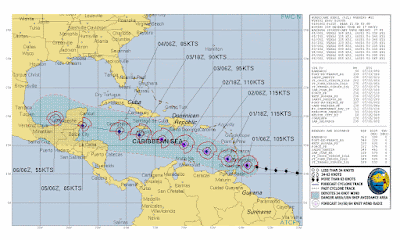
1 July 2024. Category 4 Hurricane Beryl tore through Carriacou on Monday morning, destroying 98% of its buildings, cutting its electricity, water supply and mobile phone coverage. Houses were reduced to matchsticks. Huge trees were uprooted. All vegetation was stripped away, turning the island from luscious green to brown. Several people (number still unconfirmed) died. Roads became impassable. All communication with the outside world was lost. To discover what had happened there, I turned to YouTube. There I discovered award-winning American journalist and ‘storm chaser’ Jonathan Petramala who had arrived on the island the previous day with colleague Brandon Clement to document the hurricane’s passage. His videos provided an absolutely remarkable record of the devastation.


Two decades earlier, when I had first sought information about Carriacou, YouTube was yet to launch. Today there are dozens of videos about the island. Petramala captured the ‘calm before the storm’ mere hours before the hurricane struck, incorporating drone footage illustrating the charm of its colourful buildings and its ‘paradise’ sandy beaches. His impassioned commentary heralded the calamity that was to come and, although the island’s one petrol station had closed after a run on fuel and the mini-mart was busy, there was no evident panic. “It’s going to be horrific,” he said … and it was.


The following day’s video was a bleak testament to the destruction Carriacou had endured. “This island is shredded,” Petramala commented. “These people are in desperate need of help.” A resident said: “Right now, Carriacou is finished for a couple of years.” I had never seen anything weather-related as shocking as the complete devastation shown here. It resembled a war-zone. The drone shots were heartbreaking. Another shell-shocked resident said: “The thing is: we have three [storm] systems right behind it. What about the people who don’t have the time to recover, who don’t have a roof over their head, who don’t have the resources to rebuild?”

This video was unique because communications (mobile, internet, radio) had been completely lost on the island in the hurricane’s aftermath. Carriacou has no TV station and its two local FM radios (‘Vibes 101.3’ and ‘Sister Isles 92.9’) had been knocked out. Using a vehicle battery, Petramala uploaded his video via the Starlink satellite. That Tuesday, there was no other footage online. Residents could be seen filming on their mobile phones but there was no signal coverage to share or upload videos and no electricity to keep their phones charged. The island’s population was in an evident state of shock. Petramala’s footage, in which he made repeated appeals for outsiders to help the population, was used in weather stories broadcast by television stations the world over to illustrate the disaster, deservedly garnering millions of views.

The next day, Wednesday, roads in the capital had been partially cleared by residents, allowing Petramala to explore beyond by vehicle. His next video showed the ‘Dover Government School’, designated as one of eight emergency shelters on the island, entirely reduced to rubble. Those who were sheltering there had to evacuate to its tiny library outbuilding completed in April 2023 that remained standing. In March 2023, the 40-bed Princess Royal Smart Hospital had reopened in Belair with fanfare as the island’s sole hospital after having been “retrofitted to improve [its] resistance to disasters like hurricanes”, using funds from the UK government and Pan American Health Organization. This video showed all its facilities unusable due to water damage.

Then, arriving at the government’s Emergency Operations Centre on Carriacou, also in Belair, Petramala explained to its seemingly baffled staff:

“I’m the only journalist on the island. We have a Starlink [satellite terminal] so we’ve been able to get in touch with the government down in Grenada. I think we’re the only people who have contact with the outside [world]. They want to be able to get in touch with you guys but nothing is working. … We can set [Starlink] up outside and give you guys ten minutes if you want to call down to the government in Grenada and communicate what has happened here.”

Surprisingly, the Centre did not appear to be a hive of activity after such total devastation. We did learn that only five of the island’s eight emergency shelters had survived (for 9,000 population?). Although the building’s generator was powering lighting, its “communications hub” (as promised by the US Charge d’Affaires) had not survived the hurricane, despite this “fantastic facility” having only been completed in 2021 with US$3m funding from the US Embassy. Did we see a basic radio transceiver (even a retail amateur radio set) to provide SOME two-way inter-island communication? No. Did we see walkie-talkies used by emergency staff for intra-island communication? No. An apparent dependence on commercial mobile phone networks (operators Digicell and Flow) was, er, unwise when their towers prove so vulnerable to weather and power issues.

Set up in their vehicle, Petramala and Clement allowed nearby traumatised residents to use their Starlink satellite link to contact their loved ones overseas, leading to emotional scenes. Later that day, a helicopter landed at Carriacou’s airport, Grenada prime minster Dickon Mitchell emerged and, interviewed by Petramala, resembled a deer caught in headlights (commented my wife). He promised aid “from tomorrow” but proposed recruitment of volunteers from the mainland and assistance from other countries over guaranteeing immediate assistance from his government. For islanders who had no homes, no water, no electricity, no food and no petrol, with vehicles destroyed and roads blocked, the unfortunate impression was of a lack of urgency two days after the hurricane had hit. (Excellent silent drone footage of the devastation recorded by Clement fills six YouTube videos.)

While Petramala and Clement had been arriving in Carriacou on the eve of the hurricane, Belair resident Rina Mills had been similarly filming from her vehicle the calm that reined that Sunday before the storm (accompanied by Belair youth worker Shem ‘Ambassador’ Quamina). Employed by the Carriacou office of the ‘Grenada Tourism Authority’, Mills’ warnings about the impending disaster were stark and serious. With hindsight, this video (like her many others) was a testament to the beauty of the island though, within a few hours, it sadly became a historic record of how much habitat and infrastructure were about to be destroyed. Her exceptional knowledge of the geography, history and culture of Carriacou, combined with her informal conversations, made her videos compelling. She promised: “After the storm, we’ll do an update as well.”

However, the next day’s destruction of mobile phone masts prevented Mills from updating viewers until Friday, when her 24-minute live feed was managed only by climbing to a high point on the south of the island to connect over the horizon to an antenna on the mainland. Mills and her partner had lost their home, like many other islanders, and appeared in an understandable state of shock whilst cataloguing the “total devastation” of their island and five known associated deaths. It was a sad, upsetting video that acknowledged how precarious is our day-to-day existence, whilst also demonstrating the resilience of the population and its sense of community in the face of unprecedented disaster. The contrast with Mills’ chatty pre-disaster videos could not have been starker. Coincidentally, I heard Mills interviewed that weekend on the BBC World Service show ‘Newshour’ about Beryl’s impact on Carriacou.

Once partial mobile communication was restored on the island, Mills uploaded video previously recorded in the aftermath of the hurricane. In the centre of the capital Hillsborough, next to the destroyed Post Office, a mobile water desalination plant had been set up to offer free drinking water to residents. This vital resource had been provided by American religious charity ‘Samaritan’s Purse’ which amazingly had dispatched a DC-8 cargo plane to Grenada (video of landing) the day after the hurricane, loaded with materials (video) to establish a field hospital, desalination plants around the island, foodstuffs, tarpaulins, clothing and bedding. Two dozen of its volunteers were airlifted to Carriacou and a barge was chartered the following day to bring the equipment there from Grenada. It was a much-needed vital resource at a time when Grenada government assistance was still not visible. “Hats off to Samaritan’s Purse,” commented Mills’ partner. “They were the first to get here, in my opinion.”

I had never heard of Samaritan’s Purse but was incredibly impressed by the scale and urgency of its work, operating a fleet of 24 aircraft and two helicopters from North Carolina. Video of a public tour of this DC-8 plane at the Dayton Air Show only days earlier demonstrated the huge volume of supplies it had carried. Its volunteers quickly spread across the island, distributing materials to residents from churches (Pastor Happy Akasie’s church in Brunswick in this video). By the following week, it had set up its second field hospital in Carriacou with doctors, nurses, medications and counsellors (video). Despite the island’s hotels/B&B’s having been destroyed, the charity operates self-sufficiently, building its own accommodation and bringing food and water for staff. It seems to embody the fictional Tracy family’s ‘International Rescue’.

Towards the end of this video, Mills understandably rails against sightseers arriving by ferry from Grenada merely to video the destruction in order to attract ‘hits’ to their social media channels. One example of this was bizarre ‘Coleen AKA Bright Diamond’ from the mainland who appeared to enjoy her ‘day out’ on the destroyed island, travelling on the back of an aid truck, making inappropriate comments, drinking from a wine bottle in the back of a car and buying bottled beer. Afterwards, the Grenada government introduced vetting of ferry travellers to Carriacou to prevent further ‘disaster tourists’ consuming the island’s scarce resources. Fortunately, these self-promoting types were in a minority, overshadowed by the many people and organisations who arrived on Carriacou to genuinely help out.

British solicitor and author Nadine Matheson had been visiting her parents’ house on Carriacou when the hurricane struck and recorded this scary video of its almost total destruction. Once back home, she is recording informative updates on her parents’ situation and a fundraising effort to replace the house’s roof. The structure is now covered by a temporary blue tarpaulin which, like so many other properties, was donated by Samaritan’s Purse.

Meanwhile, videos published by the Grenada government since the disaster have proven a quite surreal soft-focus experience after the stark wholesale destruction visible in locally-made videos. After its prime minister (who is additionally minister for disaster management) visited the island, one video showed him standing on the wreckage of a resident’s home, looking wistfully into the distance, accompanied by soft tinkling music. Its editor seems to be a big fan of 1980’s Lionel Ritchie music videos. There is lots of footage of government officials in fluorescent vests talking to each other, pointing at the destruction and being interviewed explaining what WILL happen but – dare I say? – not much footage of action IMMEDIATELY to tackle this humanitarian crisis. Initially, the government’s media focus (including its partly owned GBN television channel) was much more on the relatively minor damage suffered on the main island, rather than the total destruction of ‘sister isle’ Carriacou.

Watching hours and hours of government press conferences uploaded online, I was struck by the preoccupation with ‘process’ they exhibit, talking endlessly about which department and which officers are responsible, which meetings WILL take place and who reports to whom. This habitual use of the future tense is alarming when what should be stated was what had ALREADY happened and what was happening RIGHT NOW. The government’s adoption of the slogan ‘Carriacou and Petite Martinique Will Rise Again!’ for the disaster seems symptomatic of this somewhat wishful thinking. It raises the big question: WHEN? Electricity is unlikely to be restored to the whole island for many months. Petrol remains in short supply. The situation on-the-ground for islanders remains dire.

The government press briefing on 9 July, eight days after the hurricane had hit, promised: a 2,000-gallon water truck loaned by a company on St Lucia “will commence distribution to residents starting Wednesday July 10th 2024”; then “a second 1,800-gallon water truck loaned by the Barbados Water Authority is expected to arrive on Carriacou during the coming week.” Does Grenada not own one water truck? How have 9,000 people on Carriacou been expected to survive without government-supplied fresh water for more than a week? Why does the co-ordinator of Grenada’s ‘National Disaster Management Agency’ (whose last web site news update was three weeks ago), Dr Terence Walters, seem to consider in this press conference that distributing 2,000 food packages to residents (who number 9,000) five days after the hurricane hit was a satisfactory response?

Coincidentally, a mere four days before Hurricane Beryl hit Carriacou, a 120-page report entitled ‘Grenada: National Disaster Preparedness Baseline Assessment’ had been published by the ‘Pacific Disaster Center’. It concluded that:

“… results for Grenada showed significant multi-hazard exposure including hurricane winds, earthquakes, and volcanoes with nearly the entire population exposed. […] The assessment pointed to vulnerabilities due to Environmental Stress, Information Access, and Gender Inequality and significant deficiencies in coping capacity areas such as Air Support and Transportation Capacity indicating enhancements are necessary to bolster Grenada’s disaster response capabilities. Addressing these gaps, alongside targeted efforts to mitigate the identified vulnerabilities, will strengthen the nation’s overall resilience to disasters. […] Strengthening communication and information management systems is essential to support effective disaster response and comprehensive risk reduction strategies.” [emphasis added]

In 2019, the World Bank had allocated US$20m to be drawn down by Grenada to address natural catastrophes, but had noted in its report:

[Grenada’s] Institutional capacity for implementation [risk] is rated Substantial due to weak inter-institutional coordination and the lack of technical expertise. Implementing the proposed operation will require the integrated work of several actors at the national and local levels to move the proposed policy actions forward. This could result in scattered, low impact, and/or uncoordinated actions.” [emphasis added]

Estimated damages and losses to Grenada’s economy from its most significant disasters suffered between 1975 and 2018 were estimated by the World Bank to have totalled US$967m (at 2017 prices). Hurricane Beryl’s financial impact is likely to be greater than these prior disasters combined, eclipsing the island’s annual GDP several times. Evidently, the fiscal catastrophe of accelerating climate change not only decimates small economies such as Grenada’s but cumulatively will precipitate a global diversion of resources away from consumption towards mitigation and repair of weather, temperature and sea level changes. 

It was evident in videos posted online that aid had quickly arrived from diverse sources: generous individuals, volunteers and groups on mainland Grenada, other Caribbean islands, the United Nations, France providing boats of supplies and troops on the ground (Grenada has no army), global charities. I watched a video of the French ambassador to Grenada interviewed whilst off-loading aid. Have I similarly seen the British high commissioner or governor general on Carriacou? Maybe I missed them. On 5 July, the UK provided £0.5m of immediate aid to Grenada and St Vincent, but will more substantial longer term assistance be forthcoming from the island’s former colonial power?

In 1983, the United States had sent 7,300 troops to invade and occupy Grenada because president Reagan chose to believe its newly built airport, funded partially by the British government, would be used to land Soviet bombers. 45 Grenadians were killed and 358 wounded. Today, if a major power were to devote similar resources to rebuild Carriacou quickly, its population might be able to endure the hardship it currently faces. However, despite residents suffering no electricity, water, food or a roof over their heads and with several emergency shelters destroyed, the government in Grenada has no current plan for significant evacuation of the island, preferring to remove only pregnant women, residents of old people’s homes and the hospitalised. How long are its citizens expected to survive when no cash is available from destroyed banks or ATM’s, forcing residents to make a four-hour round trip to the mainland? In 2024, these generous and stoic island people have been marooned in a hellish medieval landscape.

My dream of island-living is over for now. Carriacou can never be the same again. What will happen there is difficult to fathom. Its economy, seemingly reliant on retirees from the diaspora and small-scale tourism (independent travellers and two marinas of yachts) is ruined, forcing its people to make lifechanging decisions. Nowhere have I read that Grenada main island’s schools and sports halls have been opened to Carriacou refugees who have lost everything. At a time when thousands of its residents remain sat amongst the ruins of their dwellings, the Grenada government announced precipitously that:

“… the [Cayman Islands] Premier is extending an invitation to Grenadians who wish to work in the Cayman Islands, to return with her on Tuesday July 16 2024.”

The premier of this British Overseas Territory (population 85,000) was due to deliver aid relief to Grenada that day, but not before a further press statement had to hurriedly clarify that “no such offer was made during the courtesy call made to the Prime Minister of Grenada by the Premier of the Cayman Islands” and withdraw the implied invitation to potential economic migrants. Oh dear. (I recall when 8,000 refugees out of a population of 13,000 left the decimated Caribbean island of Montserrat following its 1995 volcanic eruption.)

I never got to visit Carriacou but, compared to the suffering endured presently by its resilient people, my regrets are insignificant. Watching the news from Carriacou engenders a sense of helplessness in the face of such overwhelming humanitarian need. I am highlighting Carriacou here only because it has been on my mind for two decades since receiving that fateful email from Kyak 106. The neighbouring islands of Petit Martinique and Union Island have been just as badly devastated by Hurricane Beryl. Though I am continuing to follow events in Carriacou, the mainstream media has inevitably moved on swiftly to other disasters elsewhere.

Observing the aftermath of this catastrophic event since 1 July has merely reinforced the devastating impact of ‘climate change’ us humans have foisted upon populations who have done nothing to cause it. Nobody on Earth can afford to ignore this issue because its effects will inevitably be coming to your corner of the world soon. Nobody will be immune. It is coming to get you, whether or not you choose to believe it is real. Voicing this eloquently was an emotional call-to-arms video (initially at https://youtu.be/oYn-XarQM3M but mysteriously deleted since) by United Nations climate change executive secretary Simon Stiell who is seen hugging his grandmother amongst the ruins of her home on Carriacou, his homeland.

After having viewed Beryl’s immediate impact from a helicopter, Grenada prime minister Dickon Mitchell had described the destruction as “Armageddon-like” in a press briefing and promised:

“We know it is not something that will happen overnight, but we certainly believe that in the next week to two and a half weeks we should have a complete clean up.”

Weeks later, new videos from Carriacou continue to show a post-Armageddon catastrophe that could last months and years for its beleaguered population.

POSTSCRIPT

On 27 Jul, this blog entry had suggested “Hurricane Beryl’s financial impact [on Grenada’s economy] is likely to be greater than these prior disasters [1975 to 2018] combined, eclipsing the island’s annual GDP several times.” The World Bank had previously documented that “damages and losses” from Hurricane Ivan in 2008 had amounted to 148% of Grenada’s then GDP.

On 30 Jul, Grenada prime minister Dickon Mitchell, closing the 47th CARICOM heads of state meeting he hosted and chaired there, suggested that the country’s early estimated losses from Hurricane Beryl would amount to EC$ 1,000,000,000 = US$ 370,000,000.

A back-of-the envelope calculation of this assertion:

  • Grenada GDP = US$ 1,320,000,000 (source: World Bank)
  • 98% of buildings destroyed or damaged in Carriacou & Petit Martinique (source: Grenada government)
  • estimated population of Carriacou & Petit Martinique =  9,000estimated number of buildings (homes + businesses + public buildings) = 5,000 (wild guess)
  • estimated impact on GDP = 28%
    • estimated impact per building on GDP = US$ 75,500

However, the destroyed buildings included public schools, emergency shelters, Carriacou’s hospital, post office and police station, each likely to cost millions to rebuild/repair. Additional costs include destroyed infrastructure such as island-wide overhead electric cabling, ports, marinas, airport, beaches, agriculture, fishing, environment plus lost tourism income (14% of Grenada GDP in 2019, source: UN).

[Originally published at https://peoplelikeyoudontworkinradio.blogspot.com/2024/07/caribbean-drubbing-on-such-armageddon.html ]

Sacked by a boss desperate to steal my success : 1991 : Gordon McNamee, KISS 100 FM, London

 It was a little after seven o’clock in the morning when the phone rang. Normally, I would already have been out of bed by that hour on a weekday. However, the previous night’s ‘DJ meeting’ [open to all 44 KISS FM presenters] had tired me out. I was awake, but I was still trying to urge my body to get out of bed. The mobile phone stationed beside my bed rang noisily and forced my brain into action far faster than it wanted.

It was [KISS FM personal assistant to managing director] Rosee Laurence on the line, asking if I could schedule a meeting that morning with [KISS FM managing director] Gordon McNamee. I scrambled out of bed to retrieve my diary from the battered ‘WH Smith’ black plastic briefcase I always took to work. Requests for meetings at such short notice were common although, during the last few days, McNamee had had no contact with me. Laurence suggested ten o’clock. I explained that I already had an editorial meeting [of my programming department] scheduled for half past ten, but I could fit it in as long as the meeting was not going to last too long. She assured me that it would not. I scribbled “10am – Gordon” in my diary, replaced the mobile phone in its charger and got on with the business of waking up properly.

My diary told me that I had two further meetings that afternoon – a weekly sponsorship get-together at one o’clock with [KISS FM finance director] Martin Strivens and the sponsorship manager, Gordon Drummond, followed by a debriefing session in the boardroom at three o’clock with KISS FM’s partners in the Pepsi promotion. During the drive from my flat to the office, I reflected on the possible reason for the early morning phone call. Was McNamee going to tell me what had happened at the previous day’s board meeting? Was he going to pretend that nothing untoward had happened and that the board had approved all his [unachievable] targets for Year Two?

I was already running late when I became caught up in the worst of the rush-hour traffic along Holloway Road. Although my work day officially started at half past nine, I liked to arrive at work earlier so that I could snatch a little time to myself before the inevitable mayhem started in the department. However, that day, there was only time to down a quick cup of tea before walking up to the top floor in time for my ten o’clock appointment. Gordon McNamee was sat in his corner office when Laurence ushered me in. After exchanging morning greetings, I sat facing McNamee across his huge wooden desk. He shuffled from side to side in his chair a few times, avoiding looking directly into my eyes, and he sighed unusually heavily. Several times, he looked up at me as if he was going to say something, but then stopped short.

I stared at him blankly, not knowing what to expect. Eventually, he started mumbling something apologetically, but still he was making little sense. I knew then that McNamee had bad news to break to me. He had always been excellent at whipping his team into a frenzy of enthusiasm when something good was happening, but he was almost incapable of breaking negative news to anyone. He started speaking slowly and managed to explain that he had been “extremely vexed” by the memo I had delivered to him two days earlier. ‘Vexed’ was one of McNamee’s favourite words to use in situations when somebody had done something that displeased him. Anyone else might have been angry, but McNamee was always ‘vexed.’

As he reflected upon the contents of my memo and how ‘vexed’ it had made him, McNamee seemed better able to talk to me directly and to break the bad news. He explained that the board had met the previous afternoon and had decided that the company no longer needed my services. He muttered something about this being the hardest thing he had ever had to do and how he regretted the decision, but I was barely listening to his words. Instead, I was thinking how cowardly was this man sitting in front of me. I was thinking that, even now, he had no intention of telling me the truth of what had taken place at the board meeting, or how he had probably acted to save his own skin. What I wanted to know was what he had told the board about my dissent and what he had told the board of my contributions to the station’s success.

But there seemed little point in saying anything at all to the cowering figure sat in front of me, with whom I had worked so closely for more than two years. I got up to leave the room. McNamee had failed to deliver my promised rewards on so many occasions that I did not need to hear another fabricated story about why I was not getting things to which I felt I was entitled. As I left his office, McNamee said that it would be necessary for me to leave the building immediately, and he thrust some documents into my hand. I walked straight out of his office, shocked that, even at this stage in our relationship, McNamee was still incapable of telling me truthfully why I had to go.

Before I could reach the staircase to return to my office, McNamee had caught up with me and was asking me to stop. For a second, I felt as if I should ignore him totally and just carry on walking, but I turned towards him at the very top of the building’s stairwell.

“We could say that you had resigned, to make it easier for you, if you wanted,” McNamee suggested to me.

I stared at him coldly with a combination of anger and hatred that I could feel welling up inside me.

“Gordon, that’s a fucking insult,” I spat at him. Then I turned and walked down the staircase leading to my office on the next floor.

I was incensed. After all the sweat, blood and toil I had poured into this company. After all the personal sacrifices I had made to ensure that KISS FM succeeded. After my hard work had produced the required results more quickly than had ever been anticipated [Year One target of one million listeners per week achieved within first six months on-air]. Now, I was being asked to resign from a job in which I had achieved nothing but success. McNamee’s cheek to even suggest such a thing had made me really angry. I was in a rage as I stormed into my office. The programming floor was starting to fill up, as staff trickled into work. My first thought was the speed with which McNamee had insisted I must leave the station. Rather than suffer the indignity of being forcibly removed from the building by the station’s security guard, I started to pack up my possessions.

[KISS FM head of music] Lindsay Wesker caught my attention as he walked onto the floor from the staircase. He was one of my senior team members, so I felt I should break the bad news to him personally. The only private place I could think of to talk was the men’s toilet in the stairwell of the floor, so we crowded into the tiny cubicle.

“I’ve just been sacked,” I said to Wesker, “and I’ve been told to leave the building immediately.”

Wesker looked thoughtful, but did not seem particularly shocked. I suddenly understood that Wesker must have been the only member of my team to know what was going to happen to me, before I did.

“Just as you’ve said before,” said Wesker calmly, “it’s always the programming department that gets the chop.”

These were the very words I had shared with Wesker more than a year earlier, during the first programme planning meeting I had convened at [former KISS FM office] Blackstock Mews. Wesker had mulled over my words carefully then and, now, I realised why he had found those words so interesting. In Wesker’s eyes, he had got rid of me at last. I exited the men’s toilet without saying another word.

Having received no sympathy from Wesker for my predicament, I walked back to my office and continued assembling my personal effects. I had spent far more of my waking hours in that building during the last year than I had at home, so many of my own possessions were intermingled with that of the company. There was the portable television I had brought to the office when the Gulf War had started, there was a portable cassette player I used, the records I had used to make station jingles, and unread magazines that were cluttering the floor. These were all mine. I started gathering them together into a manageable pile to take away with me. Other staff on the floor noticed me through the clear plastic partition of my office and started to wonder what was going on.

I told Philippa Unwin, who had worked with me closely as the department administrator since the Blackstock Mews days, what had just happened to me. She became visibly upset. As I told other members of my team, they stood around the floor in disbelief and shock.

[KISS FM head of talks] Lorna Clarke said to me: “They can’t sack you just like that. You’re the only one who knows how this whole station works.”

I felt pressured by the urgency to get out quickly, so I started carrying boxes of my things down three flights of stairs to put in my company car parked at the back of the building. I suddenly realised that my hasty and unexpected departure from KISS FM could be explained away to the staff on any pretext, unless I could make some kind of statement myself. The memo that had ‘vexed’ Gordon so much had recorded all the significant events of the previous week, as well as having stated my unambiguous position on wanting KISS FM to adopt a realistic strategy for its future.

After less than a year on-air, one of the staff’s major criticisms was the lack of information about company decisions that trickled down to them from the senior management. Only those staff working most closely with me in the programming department understood that I was just as ill-informed about what was going on at board level as everybody else was in the building. Using a Prit-Stick from the top drawer of my desk, I glued a copy of my memo to Gordon McNamee onto the clear plastic partition of my office. My room opened onto the floor’s entrance lobby and the partition could be seen by everyone passing through the department. Alongside the memo, I glued the document detailing the programming policy changes I had been ordered by McNamee to devise.

While I continued to gather together my possessions, staff in the department started to read my two memos, all the while expressing outrage that my dismissal could be so abrupt. Then, Wesker burst into my office and handed me a sheet of ledger paper.

“Rosee [Laurence] upstairs says these things are KISS property which you have to give back before you go,” said Lindsay sheepishly.

Inscribed in red ink was a list:

“1) security tag 13-92 + ID pass.
2) office & studio keys.
3) car keys.” 

It was evident that Wesker had been anticipating my dismissal and was acting as messenger boy for the management staff on the top floor who were too cowardly to talk to me directly. I snatched the piece of paper from him, but ignored it. I asked him, rhetorically, how I was expected to take home all my personal possessions without being able to use the company car?

Before leaving the station for the last time, I walked around the programming department and said my hurried goodbyes to the few staff who were already at their desks. Because the majority of my team worked shifts, there were only a few people there. In the DJs’ office, [daytime presenter] David Rodigan was sat at his desk, facing the front windows that looked out over Holloway Road. His back was towards the office door, so I had to interrupt his preparations for that day’s lunchtime show to bid him farewell. He expressed outrage at my sacking and seemed bewildered by the speed with which I was being forced to leave.

There was nothing left to do except thank everyone who was in the department for the good times we had spent together and to give many of them one last hug. Some of the staff were crying, others were visibly angry, and some did not seem to believe the events that were unfolding right in front of their eyes. Wesker was the only person who seemed unmoved by the whole scene. He was busy protesting that I had not left the company’s property that he had been given responsibility to collect. I could not have cared less.

I got into my company car, half expecting someone to rush out and stop me driving it away. But they did not, and I drove away from the station’s car park for the very last time. I had arrived at work barely two hours ago. Now, I was already on my way home again. It felt as if some ghastly mistake had happened, some chance mishap over which I had been able to exert no control. I could not believe that this would really be the very last day I ever worked at KISS FM. The traffic was much lighter on the roads, now that the rush hour was over, so I reached home within half an hour. By then, I was feeling neither upset nor angry about my dismissal. More, I was stunned that the end could have come so abruptly, and without McNamee having offered any gratitude for my significant contributions to KISS FM’s success.

[Excerpt from ‘KISS FM: From Radical Radio To Big Business: The Inside Story Of A London Pirate Radio Station’s Path To Success’ by Grant Goddard, Radio Books, 2011, 528 pages]

[Originally blog published at https://peoplelikeyoudontworkinradio.blogspot.com/2024/05/sacked-by-boss-so-desperate-to-steal-my.html ]

Welcome to the terrordome : 2006 : Enders Analysis at Denton Wilde Sapte, City of London

 The first of April proved not such an innocuous date on which to have started my new job. Within weeks, I began to wonder if I was the fool to take on a position as ‘media analyst’ that I had never known existed, let alone submitted a job application. The previous year, I had been minding my own business, providing a steady stream of stories as uncredited news editor to weekly print publication ‘The Radio Magazine’, when an e-mail arrived from (unknown to me) Claire Enders asking if I wanted to write an analysis of Britain’s largest commercial radio owner ‘GCap Media plc’. Having tabulated radio industry data for myself since 1980, I was happy to pen six pages demonstrating that this group had already hit the rocks, ending my report:

“Someone should have done [GCap chief executive Ralph] Bernard a big favour and bought him a sign that Christmas to hang in his office that said: ‘It’s all about the content, stupid!’”

Published by ‘Enders Analysis’ that November, I was left to presume the response to my critical analysis had been positive because I was asked if I desired a full-time office position writing similar reports about the media industries. My employment would replace radio industry veteran Phil Riley who had anonymously freelanced occasional radio reports for the company until then. It was an offer too good to refuse as the salary for working in a comfy central London office was considerably greater than my pay from American public corporation ‘Metromedia International Inc’ had been a decade earlier for having schlepped around Russia, Hungary, Latvia, Berlin and Prague for several years. Persuasion proved unnecessary as funds were required for my daughter attending a London university.

Having agreed the April start date, the prior month I started to receive emails from Enders Analysis requesting my help with radio industry information it needed for a tribunal case it had taken on. I thought this was rather cheeky but, not wanting to appear unenthusiastic about the job I had yet to start, I responded helpfully. Then I received a further message from Claire Enders asking me to drive to the office for a library of legal documents concerning the tribunal to take home, read and analyse. I had to apologise that this task was not possible … but only much later did I realise this request as a harbinger of things to come.

Why my refusal? Firstly, I was still employed full-time (in addition to my freelance work for ‘The Radio Magazine’) by ‘Laser Broadcasting Ltd’, managing applications to regulator Ofcom for local commercial radio licences, a job from which I had given notice but which did not terminate until the end of March. Secondly, my rented semi-detached London home lacked a spare room in which to store a document library. Finally, I did not own a vehicle, let alone one large enough to transport thousands of documents. Only months later, once the tribunal was in session and its documents could be seen filling an entire wall of a courtroom did I realise an assumption might have been made earlier that I too resided in some inherited multi-bedroom castle, country pile or stately home … and owned a truck.

Come April, I started work in Enders Analysis’ cramped Mayfair office but was soon assigned full-time to the tribunal project which occupied me until the end of that year. During those long months, I continued to follow radio industry developments in order to write weekly news stories for ‘The Radio Magazine’ though, disappointingly, there was no opportunity for me to pen a single radio analysis for publication by my new employer. I joined a subset of Enders’s dozen staff deployed to work on the tribunal case from conference room 9.16 at the City offices of law firm ‘Denton Wilde Sapte’ (established 1785) that was representing Enders’ client in the tribunal. For several months, I hardly visited the Mayfair office, instead commuting to the lawyers on a direct rail route from home.

I had been diverted into this project once Claire Enders discovered I understood the complex system of payments made by UK commercial radio stations for playing music within their programmes, as well as the multiple agreements that had applied since the broadcast sector’s launch in 1973. At ‘Metro Radio’ in Newcastle, my work responsibilities had included ensuring accurate reports were submitted regularly to music royalty collection agencies PPL, PRS and MCPS. A decade later, planning the launch of ‘KISS FM’ in London, I had created the entire music reporting system and hired personnel to collate and submit the required paperwork in an era before usage could be tracked digitally.

The Denton Wilde Sapte lawyers with whom we worked were courteous, professional and demanding because they needed to understand how these systems functioned both theoretically and in reality. I was the only person there with experience of having been responsible for their administration or of having worked in commercial radio, requiring me to respond to multiple queries and to analyse radio industry data and documentation that I had collected during the previous two decades of my career. Those lawyers would have been earning more in a single day than I was being paid in a month, sending me emails at all hours of the day and night requesting data, but there was never any friction as they had been steeped in ‘client service’.

Although the Enders team in the conference room were contributing to a common project, it quickly became apparent that ‘teamwork’ was a somewhat alien concept. Had there been a ubiquitous whiteboard in that room, it might have shown the clear hierarchy between Claire Enders and each employee, but nothing between members of our group. Not only was there no apparent camaraderie but, at times, it appeared that some colleagues believed they were in competition with each other for the attention and approval of their boss. It felt like some kind of video wargame where the objective is to crush your opponent, where the individual is ‘king’ and where ‘collaboration’ has been outlawed. This atmosphere was worsened by Enders’ tendency to bark orders verbally to her staff, rather than negotiate tasks with them to guarantee they remained ‘onside’.

Until then, I had not realised that projects in which I had been involved and previous jobs I had performed had all required productive teamwork, without which they would have failed. Whether it was a student newspaper, a student union, a commercial radio station, a community radio station or a magazine, all had forced those of us involved to discuss, agree and focus jointly on common objectives to be achieved. Yes, I had come across the odd team member who had not prioritised the group’s success above their own. Yes, I could cite examples of projects I watched fail because of the selfishness of a manager who had pursued purely egotistical objectives. However, this was the first occasion that I felt like a complete outsider to my ‘colleagues’ who seemed happy functioning as individuals.

Whilst enjoying the work I was being asked to do because it tapped into my specialist knowledge, I disliked the working environment into which I had been dropped. Everyone else present seemed to view it as perfectly normal. I did not. I could not complain. I was the ‘new boy’ amongst men who viewed themselves differently from me, something they had communicated on my first day, interrogating as to which private school I had attended three decades earlier. Er, none. Now, each morning, I was having to steel myself to go to the office. I had never had a job at which I hated arriving as much as this one. It was a struggle to get through the day. At lunchtime, a local sandwich shop would provide respite to sit alone in a less febrile environment.

At the end of the day, I would rush down to ‘City Thameslink’ railway station in the basement of the law firm’s tower block, sit on an uncomfortable wooden bench on the southbound platform and cry, sometimes for a few minutes, sometimes for half an hour. Trains regularly came and went, though I stayed put until I knew I could make the journey home, crammed like sardines against fellow commuters, without sobbing uncontrollably. Sat there in that barely lit underground world, nobody approached to ask if I was okay, a forty-eight-year-old suited man in tears. Perhaps other commuters felt the same way about their workplaces but dared not let their emotions escape. Perhaps they assumed I had just lost my job. Whatever it was, I was always left alone on that bench.

I needed to arrive home in one piece. Occasionally, on the final leg, I would walk the route from the station down my suburban street with tears on my cheeks, but these had to be wiped away before I entered the front door. Nobody needed to know what I felt. There were bills to pay. We hoped to purchase our first home. I would get up at six each weekday morning and check ‘Google News’ for radio stories before heading to work. Often, I would not return home until late evening, after which I would eat and go to bed. I spent Sunday writing up news stories for submission to ‘The Radio Magazine’ on Monday morning. It did not feel much of a life but I convinced myself it must be better than the years I had spent unemployed.

It was a huge personal disappointment to feel this way about my new job. The office environment at Denton Wilde Sapte was pristine and its staff were courteous. Their ‘tea lady’ pushed a glimmering trolley around the office suites, freely offering an expanse of snacks such as salmon sandwiches and hot drinks ‘silver service’ style on exquisite porcelain crockery with immaculately polished cutlery. Many evenings after work, the firm hosted drinks receptions to celebrate a ‘win’ or an internal promotion or to welcome a new client. As portrayed in American television legal dramas, a short speech by one of the firm’s partners would be followed by wine and delicate snacks offered generously to all present on the floor, including us visitors. Some evenings, I would partake and sit on the building’s fire escape staircase, sipping my drink and looking down on London landmarks like St Paul’s Cathedral’s illuminated dome. It might have seemed an idyllic existence “but I know that this will never be mine.”

During the tribunal’s early stages, Claire Enders expressed concern that our number was insufficient to sort the huge volume of legal documents into a coherent filing system we could then reference. I thought I was being helpful by suggesting that her personal assistant could be drafted in to provide an additional pair of hands. Next moment, I was ordered to meet the assistant at London’s Victoria railway station and bring her to the lawyers’ office by Tube. Strangely, the assistant only ever worked for Enders from her own home in Brighton and, meeting me for the first time, appeared unhappy to be suddenly relocated to London for several days. I was henceforth blamed for this inconvenience, ensuring our relationship remained frosty during the years I had to communicate with her.

Why this assistant could not have travelled by Tube from Victoria to 1 Fleet Place on her own initiative I had no comprehension. A pattern later became apparent whereby Claire Enders seemed to regard us analysts as her London ‘help’ who could be dispatched at the drop of a hat for errands such as picking up prescriptions from her doctor or buying a birthday present for her daughter. Was our status that much different from her parallel household staff in Scotland who could be ordered to collect and drive her home to the family seat? Evidently, we were all ‘Parker’s, ready to be summoned by a tinkling bell. “Yes, m’lady?”

Working at the lawyers’ office one Friday, I sent an email to Enders Analysis colleague Ian Maude, asking him to write something for submission to our boss by an urgent deadline we had been given. Over the weekend, having received no response from him, I presumed this task was in hand. Until … Monday morning when Claire Enders stormed into our conference room and immediately tore a strip of me in front of the others for not having informed Maude to complete this work. Once the shouting ended, she stormed out without even asking my version of events or giving me space to respond. I realised how easy the ‘new boy’ must have been to blame for my colleague having missed our deadline.

Later that day, Maude unusually suggested the two of us go for “a drink” after work, implying he wished to recompense my betrayal. I refused. I was still furious. Never before in any job had I been addressed so disrespectfully by a boss for a wrong that was not even mine. Never before had I felt what it must be like to be employed in servitude to the privileged elite. During the following months, Maude regularly repeated his invitation. I always refused. I had learnt that it was ‘every man for himself’ in this workplace.

Months later, after another sub-group of Enders Analysis staff had completed a different project for ‘HMV Records’, it was suggested we go for a celebratory drink after work. Although by now I was wary of some of my co-workers, I felt it would appear anti-social to refuse. We stood together outside a busy bar in a pedestrianised alleyway off Park Lane. Ian Maude offered to buy the first round. I requested a ‘Bacardi & Coke’. When it arrived, my first sip tasted strange. I had favoured this drink since 1976 when the girls in my summer job workplace ‘Associated Examining Board’ had taken me one lunchtime to a huge darkened basement bar in Aldershot and insisted I drink the same as them at our trestle table. Three decades later, stood in Mayfair, after my second sip had made me unexpectedly dizzy, I realised my drink had likely been spiked.

“Some will eat and drink with you …”

[Originally published at https://peoplelikeyoudontworkinradio.blogspot.com/2024/05/welcome-to-terrordome-2006-enders.html ]

Walking on the Chinese glass ceiling : 2004 : FM 102 Radio, Women’s Media Centre of Cambodia

 I was standing over the motionless body of my line manager. He was dead to the world, naked under the sheet on his bed. Neither my arrival in his studio apartment through its wide-open front door, nor the chatter of little ‘street boys’ passing up and down the building’s internal staircase, nor the morning sunshine streaming through the open windows, nor the noise of rush hour traffic on the road below seemed to have stirred him. Should I call out? Should I nudge him? Since the limit of my responsibilities to the BBC had already been sorely tested by a recent health & safety ‘issue’, I decided that playing butler to my boss would stretch my patience one step too far. I turned around, leaving him asleep, walked out and descended the stairs to rejoin the driver waiting out front in the BBC SUV.

It was the ‘big day’ in March when my trainees were to interview candidates for two radio presenter jobs. Charles ‘Chas’ Hamilton had asked to attend too, so I had arranged a detour at eight o’clock to pick him up en route from my hotel to the radio station. This was unusual because, to date, he had demonstrated scant interest in my 28 hours per week of sessions training teams at two Phnom Penh radio stations in production skills, apparently preferring to remain at his desk in the air-conditioned, open-plan BBC office. On my arrival in Cambodia, rather than having furnished a training plan or schedule, Hamilton had invited me for an evening meal in his apartment, bending my ear with gossip about the BBC World Service Trust’s recently arrived Canadian manager. Now I was having to spend what remained of my seven-day working week determining which skills I needed to demonstrate to my teams and how to instruct them when I understood not one word of Khmer. 

Hamilton was oblivious to the supreme irony of my bedside presence that morning. Before departing London, BBC management had confided that, only after having signed contracts in December 2003 to supply radio training to two Cambodian stations, had it understood that its prior internal appointee to head the country’s radio projects had no experience producing live radio programmes. Having been hurriedly headhunted as a result of my international track record in radio production and presentation during three decades, my latest mission was necessary solely to bail out a consequence of the Corporation’s arcane appointment system. Meanwhile, in spite of my radio experience, my own applications over two decades for 43 BBC vacancies had resulted in thirteen interviews but not a single job offer.

Although the BBC contract required me primarily to train in radio production, it quickly became evident that, in order for my young but enthusiastic trainees to appoint inexperienced presenters for the station’s new youth phone-in programme, I needed to teach them how to word a job vacancy advertisement, shortlist applicants, interview candidates and take personnel decisions. They were fortunate that, after a decade assisting in my father’s self-employed architectural business, I had taken my first management post in 1978, hiring and firing people since then and managing teams of more than fifty. In Cambodia, my role became necessarily upgraded to informal ‘management consultant’ despite having had to accept a BBC freelance pay rate lower than the mediocre job at Ofcom from which I had just resigned in the UK … and undoubtedly lower than Hamilton’s pensioned salary as head of radio.

On arrival at the Women’s Media Centre that morning, I found my trainees already assembled in the first-floor radio studio to commence job interviews. I waited in the downstairs lobby to greet the candidates (a bow accompanying ‘hello’ the limit of my Khmer communication skills) and usher them upstairs. However, as Hamilton had yet to arrive, the schedule soon started to run over and resulted in successive applicants seated together in the reception area, a situation I had hoped to avoid. Eventually appearing apologetically an hour late, Hamilton would never be told about that morning’s ‘sleeping beauty’ encounter. It was more important to proceed with the tasks at hand.

During previous weeks’ sessions, the trainees had agreed upon three candidate tasks: an interview by the production team with a prepared list of questions allocated to each member; a script I had written and had translated, to be read into a studio microphone for recording; and a faked phone conversation recorded with a production member pretending to be a caller, to test each potential presenter’s spontaneity and improvisation skills. None of the candidates had prior radio experience, which it why it was imperative to identify ‘potential’ rather than ‘accomplishment’. The planned radio show was destined to become Cambodia’s first live youth phone-in, for which we needed one male and one female presenter.

Having completed the interview round, we broke for the mandatory two-hour lunch, me and Hamilton returning to the BBC office by car. I shared lunch with local staff at the kitchen table, while Hamilton took his usual sojourn with the ex-pat employees to a local restaurant. Afterwards, he did not accompany my return to the radio station for the afternoon session in which my trainees discussed and contrasted the candidates’ performances, assisted by BBC translator Keo Sothearith. I was incredibly impressed by the professionalism with which they ranked the candidates against criteria we had previously decided and then unanimously agreed upon the most suitable pair of applicants.

I was pleased that the whole interview process had been done and dusted so competently and quickly. However, just as I was ready to pat myself on the metaphorical back, a passionate conversation broke out amongst my trainees that the translator seemed reluctant to explain in English. I had to press him repeatedly to tell me what new issue had arisen, since there had been undivided agreement only a few minutes earlier.

“They say it is not possible to employ the woman because she is Chinese,” he explained embarrassedly. “They agree she is the most competent … but the job has to be given to a Khmer woman.”

I was shocked. Clarification was necessary for me to understand this issue. Though I could not discern the distinction, I was told the woman was ethnically Chinese (0.6% of Cambodia’s population) though not a recent immigrant, apparently speaking Khmer perfectly. Wikipedia explains:

“Most Chinese are descended from 19th–20th-century settlers who came in search of trade and commerce opportunities during the time of the French protectorate.”

I had read about ethnic tensions in Cambodia, but primarily involving neighbouring Thailand with which there had long been territorial disputes. In January 2003, following an alleged remark by Thai actress Suwanna Konying that Cambodia’s Angkor Wat temple actually belonged to Thailand, a mob in Phnom Penh had burnt down the Thai embassy and attacked Thai businesses, forcing the evacuation by military aircraft of 400 Thai citizens to their homeland. I had recently passed Thailand’s newly opened replacement embassy in Phnom Penh, surrounded by high walls for improved security.

A 2021 academic paper reported:

“Although anti-Chinese riots are rare in Cambodia, the ethnic Chinese in Cambodia during the Khmer Rouge era experienced some of the most severe repression in the world. The situation had improved by the 1990s, following the Hun Sen government’s abolishment of discriminatory policies towards them.”

The Minority Rights Group noted:

“After 1990, [the Chinese] were allowed to celebrate Chinese festivals and religious practices, then to re-establish Chinese associations and conduct business activities. They subsequently started operating their own schools…”

For the next hour, I felt compelled to argue that it was morally wrong to discriminate against a job applicant purely on the grounds of their ethnicity. It was essential to appoint the best candidate for the job. I told my trainees that the BBC would never countenance such behaviour and, since the BBC was funding their training, it was essential to follow guidelines set out within the BBC editorial handbook (a copy of which I usefully brandished from my briefcase). The trainees had already written a sign that said ‘BBC office’ (in Khmer) on their production room within the radio station, even though they were not BBC employees (as neither was freelance me).

However, I was internally conflicted by my own argument. As a 43-time applicant to the BBC who had been rejected 43 times, I was well aware from personal experience that discrimination was alive and well and living inside the Corporation. Following one of my post-interview rejections at the end of a three-month wait, I had phoned the BBC to ask precisely why I had been rejected yet again and was informed that it would be necessary for me to prove to interviewers that I was “one of us”. The unspoken implication was that I could not join the BBC ‘club’ unless either I was posh, spoke a certain way, had attended private schools or been educated at Oxford or Cambridge. Perhaps I needed a relative who was already employed there. None of the above qualified me.

Even BBC director general Greg Dyke had commented in 2001:

“I think the BBC is hideously white. […] The figures we have at the moment suggest that quite a lot of people from ethnic backgrounds that we do attract to the BBC leave. Maybe they don’t feel at home, maybe they don’t feel welcome.”

Though I had the advantage of being white, it was evident that the BBC discriminated on multiple levels. During the decades since my love of radio had blossomed at primary school, my ambition had always been to work in BBC radio. Apart from my current freelance contract, dispatched to the opposite side of the world due to the Corporation’s ineptitude, my dream was never to be realised.

In the end, I had to give up arguing with my trainees. Cambodia was not my country. I could not pretend to understand its culture or heritage. Its history was turbulent. The people’s identity was complex. I gave in to their desire to appoint the second-best female candidate for the job. I hated myself for giving in. I had been on the receiving end of discrimination on too many occasions over too long a period in several countries. But I had lost the argument. I returned to the BBC office with the names of the two presenters whom the team had chosen. Yes, I confirmed, they were the best candidates (cringe). Both quickly became astoundingly competent radio presenters.

Later that month, Charles Hamilton arrived in our Phnom Penh office one morning and explained that he had lost a BBC laptop computer on the journey from home. It would need to be replaced. Within the hour, the number of laptops he said he had lost that day had increased to two. His comments, combined with the memory of my early morning visit to his apartment, made me contemplate that the BBC staff induction programme should be appended with an additional topic: ‘How to close and lock the front door of your accommodation’.

https://drive.google.com/file/d/1glfc6ziCi-9bWg4buIj-29rSK-1hV88f/preview

During the decade following my extended mission in Cambodia, I applied for a further twenty BBC job vacancies and was rejected for all.

[Originally published at https://peoplelikeyoudontworkinradio.blogspot.com/2024/04/walking-on-chinese-glass-ceiling-2004.html ]

The day the (reggae) music died : 1981 : Bob Marley, Linton Kwesi Johnson, Matumbi

 “Bob Marley has died!” I exclaimed. Having switched on the car radio before starting the engine, one of Marley’s songs was playing on John Peel’s ‘BBC Radio One’ ten-to-midnight show. I knew immediately what that meant. Peel was a longtime reggae fan, though I had not heard him play a Marley track for years. There was no need to await Peel’s voice announcing the sad news. I had read that Marley was ill but had not understood the terminal gravity of his health.

Peterlee town centre was dark and desolate at that late hour. I had walked to my little Datsun car across a dark, empty car park adjacent to the office block of Peterlee Development Corporation, accompanied by my girlfriend who was employed there on a one-year government job creation scheme. We had attended a poetry reading organised by Peterlee Community Arts in the building, an event she had learnt of from her marketing work. It was my first poetry reading. Only around a dozen of us were present, everyone else at least twice our age. But what we heard was no ordinary poetry.

Linton Kwesi Johnson had coined his work ‘dub poetry’ in 1976 and already published three anthologies and four vinyl albums, voicing his experiences as a Jamaican whose parents had migrated to Britain in 1962. Peterlee new town seemed an unlikely venue for a ‘dub poet’, a deprived coal mining region with no discernible black population, but working class Tyneside poet Keith Armstrong had organised this event as part of his community work there to foster residents’ creative writing. Johnson read some of his excellent poems and answered the group’s polite questions. It was an intimate, quiet evening of reflection.

https://open.spotify.com/embed/playlist/0NjIxvry79Svr0G4Qzb5NR?utm_source=generator

Due to my enthusiasm for reggae, I was familiar with Johnson’s record albums as one strand of the outpouring of diverse innovation that Britain’s homegrown reggae artists had been pioneering since the early 1970’s. Alongside ‘dub poetry’ (poems set to reggae), there was ‘lovers rock’ (soulful reggae with love themes sung mostly by teenage girls), UK ‘roots reggae’ (documenting the Black British experience) and a distinctly British version of ‘dub’ (radical mixes using studio effects). One name that was playing a significant writing/producing role spanning all these sub-genres was Dennis Bovell, alias ‘Blackbeard’, of the British group ‘Matumbi’. His monumental contributions to British reggae are too often understated.

Until then, there had been plenty of reggae produced in British studios and released by UK record labels such as ‘Melodisc’, ‘Pama’ and ‘Trojan’, but most efforts had been either a rather clunky imitation of Jamaican reggae (for example, Millie’s 1964 UK hit ‘My Boy Lollipop’ [Fontana TE 17425]) or performed by ‘dinner & dance’-style UK groups such as ‘The Marvels’. I admit to having neglected Matumbi upon hearing their initial 1973 releases, cover versions of ‘Kool & The Gang’s ‘Funky Stuff’ [Horse HOSS 39] and ‘Hot Chocolate’s ‘Brother Louie‘ [GG 4540]. It was not until their 1976 song ‘After Tonight’ [Safari SF 1112] and the self-released 12-inch single ‘Music In The Air’/’Guide Us’ [Matumbi Music Corp MA 0004] that my interest was piqued as a result of the group’s creative ability to seamlessly bridge the ‘lovers rock’, ‘roots reggae’ and ‘dub’ styles. Both sides of the latter disc remain one of my favourite UK reggae recordings (sadly, these particular mixes have not been reissued).

In 1978, Matumbi performed at Dunelm House and, after attending the gig, it was my responsibility as deputy president of Durham Students’ Union to sit in my office with the band, counting out the cash to pay their contracted fee. They were on tour to promote their first album ‘Seven Seals’ self-produced for multinational ‘EMI Records’ [Harvest SHSP 4090]. It included new mixes of the aforementioned 12-inch single plus their theme for BBC television drama ‘Empire Road’, the first UK series to be written, acted and directed predominantly by black artists. Sensing my interest in reggae, the group invited me to join them for an after-gig chat, so I drove to their motel several miles down South Road and we sat in its bar for a thoroughly enjoyable few hours discussing music.

As part of my manic obsession with the nascent ‘dub’ reggae genre, I had bought albums between 1976 and 1978 credited to ‘4th Street Orchestra’ entitled ‘Ah Who Seh? Go Deh!’ [Rama RM 001], ‘Leggo! Ah Fi We Dis’ [Rama RM 002], ‘Yuh Learn!’ [Rama RMLP 006] and ‘Scientific Higher Ranking Dubb’ [sic, Rama RM 004]. They were sold in blank white sleeves with handwritten marker-pen titles and red, gold and green record labels to make them look similar to Jamaican-pressed dub albums of that era. However, it was self-evident that most tracks were dub mixes of existing UK recordings by Matumbi backing various performers, engineered and produced by Bovell for licensing to small UK labels. I also had bought and worn two of their little lapel badges, one inscribed ‘AH WHO SEH?’, the other ‘GO DEH!’, from a London record stall. During our conversation in the bar, Bovell expressed surprise that I owned these limited-pressing albums, and even more surprise that I recognised Matumbi as behind them. They remain prime examples of UK dub.

It was Bovell who had produced Linton Kwesi Johnson’s albums, and it was Matumbi who had provided the music. Alongside a young generation of British roots reggae bands such as ‘Aswad’ and ‘Steel Pulse’, Johnson’s poetry similarly tackled contemporary social and political issues with direct, straightforward commentaries. It was a new style of British reggae, an echo of recordings by American collective ‘The Last Poets’ whose conscious poems/raps had been set to music (sometimes by ‘Kool & The Gang’) since 1970, and whose couplets had occasionally been integrated into recordings by Jamaican DJ ‘Big Youth’ in the 1970’s. Of course, MC’s (‘Masters of Ceremonies’) had been talking over (‘toasting’) records at ‘dances’ in Jamaica since the 1960’s, proof that the evolution of ‘rap’ owed as much to the island’s sound system culture as it did to 1970’s New York house parties.

In Peterlee, Johnson read his poems to the audience without music, his usual performance style. It was fascinating to hear his words without any accompaniment. For me, the dub version of Johnson’s shocking 1979 poem ‘Sonny’s Lettah’ (retitled ‘Iron Bar Dub’ on ‘LKJ In Dub’ [Island ILPS 9650]) is brilliantly effective precisely when the music is mixed out to leave his line “Me couldn’t stand up there and do nothin’” hanging in silence. Sadly, memories of Johnson’s performance that night were suddenly eclipsed by the news of Marley’s death. I drove the eight miles to our Sherburn Village home in stunned silence. I was sad and shocked. It was only then that his sudden loss made me realise how much Marley had meant to me.

Despite having listened to reggae since the late 1960’s, I admittedly arrived late to Bob Marley’s music. Though I had heard many of his singles previously, it was not until his 1974 album ‘Natty Dread’ [Island ILPS 9281] that I understood his genius. At that time, I was feeling under a lot of personal pressure which I tried to relieve by listening to this record every day for the next two years. At home, my father had run off, leaving our family in grave financial difficulties. At school, I was struggling with its inflexibility, not permitted to take two mathematics A-levels, not allowed to mix arts and science A-levels, not encouraged to apply to Cambridge University. Back in my first year at that school, I had been awarded three school prizes. However, once my parents separated and then divorced, I was never given a further prize and the headmaster’s comments in my termly school reports became strangely negative, regardless of my results.

Feeling increasingly like an unwanted ‘outsider’ at grammar school, Marley’s lyrics connected with me and helped keep my head above encroaching waters rising in both my home and school lives. I knew I was struggling and needed encouragement from some source, any source, to continue. For me, that came from Marley’s music. While my classmates were mostly listening to ‘progressive rock’ albums with zany song titles (such as Genesis’ ‘I Know What I Like In Your Wardrobe’), I was absorbed by reggae and soul music that spoke about the daily struggle to merely survive the tribulations of life. After ‘Natty Dread’, I rushed out to buy every new Marley release.

During the months following Marley’s death, I was absorbed by sadness. It felt like the ‘final straw’. The previous year, I had landed a ‘dream job’, my first permanent employment, overhauling the music playlist for Metro Radio. Then, after successfully turning around that station’s fortunes, I had unexpectedly been made redundant. I was now unemployed and my every job application had been rejected. That experience had followed four years at Durham University which had turned out to be a wholly inappropriate choice as it was colonised by 90%+ of students having arrived from private schools funded by posh families. I felt like ‘a fish out of water’. I loved studying, I loved learning, I desired a fulfilling academic life at university … but it had proven nigh on impossible at Durham.

“This is what I need
This is where I want to be
But I know that this will never be mine”

Months later, my girlfriend awoke one morning and told me matter-of-factly that she was going to move out and live alone. She offered no explanation. We had neither disagreed nor argued. We had been sharing a room for three years, initially as students in a horribly austere miners’ cottage in Meadowfield whose rooms had no electrical sockets, requiring cables to be run from each room’s centre ceiling light-fitment. Now we were in a better rented cottage in Sherburn, though it had no phone, no gas and no television. Her bombshell announcement could not have come at a more vulnerable time for me. I had already felt rejected by most of my university peers and then by my first employer. At school previously, I had passed the Cambridge University entrance exam but had been rejected by every college. At Durham, I had stood for election as editor of the student newspaper, but its posh incumbent had recommended a rival with less journalistic experience. A decade earlier, my father had deserted me and his family, and now the person I loved the most had done the same.

I just could not seem to navigate a successful path amidst the world of middle- and upper-class contemporaries into which I had been unwittingly thrown, first at grammar school, then at Durham, and now in my personal life too. Most of those years, I felt that circumstances had forced me to focus on nothing more than survival, whilst my privileged contemporaries seemed able to pursue and fulfil their ambitions with considerable ease. I had to remind myself that I had been born in a council house and had attended state schools, initially on a council estate. My girlfriend had not. I had imagined such differences mattered not in modern Britain. I had believed that any ‘socio-economic’ gap between us could be bridged by a mutual feeling called ‘love’. I now began to wonder if I had been mistaken. I felt very much marooned and alone. My twenty-three-year-old life was in tatters.

Fast forward to 1984. I had still not secured a further job in radio. I was invited to Liverpool for a weekend stay in my former girlfriend’s flat. We visited the cathedral and attended a performance at the Everyman Theatre. It felt awkward. I never saw her again. It had taken me months to get over the impact of Bob Marley’s death. It took me considerably longer to get over my girlfriend ending our relationship. 

“That clumsy goodbye kiss could fool me
But looking back over my shoulder
You’re happy without me”

https://open.spotify.com/embed/playlist/291PlBjtQIVyEzOPeXNSyD?utm_source=generator

[Originally published at https://peoplelikeyoudontworkinradio.blogspot.com/2024/04/the-day-reggae-music-died-1981-bob.html ]