The invisible manager : 1993 : Bud Stiker, Radio Juventus, Hungary

 Nazi soldiers were everywhere. Battalions of Nazis marching down wide boulevards. Nazis standing on convoys of tanks, waving flags. Row upon row of Nazis saluting speeches by their leader. Nazis fighting on battlefields. It was exhausting to watch for too long and nothing like ‘Indiana Jones’. In fact, it was a little bit frightening.

I had viewed so many hours of ‘MTV’ that I knew Stina Nordenstam’s song ‘Little Star’ by heart. Seeking alternative entertainment, I manually retuned the hotel room’s television and was shocked to discover a grainy black-and-white channel that was broadcasting Nazi propaganda twenty-four hours a day. I was like Dennis Quaid in the movie ‘Frequency’, pulling signals from the ether transmitted several decades earlier. This bizarre television service must have been a sideshow of the civil war raging on European soil only a hundred miles from my present location, atop a Budapest hill 479 metres above sea level.

My life under ‘hotel arrest’ was proving extremely tedious. To be accurate, I could leave any time I wished but my accommodation was hardly ‘Hotel California’. I was stranded alone, five miles from the city centre in countryside popular for walking holidays in summer but dead as a dodo mid-winter. No buses, no taxis, no shops, no mobile phone, no laptop, no internet access. It felt like sensory deprivation to be cooped up in a hotel room for days with absolutely nothing to do. My sole consolation was that I would be charging the client my daily rate.

My task had been to interview each of the staff of tiny ‘Radio Juventus’ in Siófok to determine their role, their skills and their future potential. The station had been launched in 1989 by a local newspaper to serve German tourists who summered at Lake Balaton. It was about to be acquired by American public corporation Metromedia, owned by billionaire John Kluge, and I had been hired to discover precisely what he was buying and to plan its transformation into Hungary’s first national commercial radio station. I had completed a fortnight’s work when…

Three soldiers in military uniform suddenly burst into the underground bunker where I was installing computer programmes, talking loudly and waving around their guns. I was surprised but not initially alarmed as I knew they guarded the gate of the compound. Every day it took them ten minutes to inspect and approve my passport before they would let me enter. Maybe today they were simply bored. However, events quickly turned nasty when station staff translated the soldiers’ demands into basic English:

“They say: ‘you must go.’ They say: ‘go now and no stop.’”

Sorry? They mean me? But I work here! I am just doing my job! The staff were adamant. The soldiers had received orders. All foreigners (which meant only me) had to leave the compound immediately. I asked if I could telephone Metromedia’s office, a one-hour drive away in Budapest. While the soldiers glared at me, seemingly eager to make an arrest, the phone just rang and rang and rang. Where was the office secretary? In her absence, there was usually an answering machine on the end of the line. But now there was nothing.

I collected my belongings and the soldiers escorted me up the narrow stairs and out of the building. The bright sunlight made my eyes squint but the fresh air was invigorating. The bunker housing the radio station received no natural light, no fresh air and was always thick with cigarette smoke. Dust lay everywhere because it had served as an underground coal store during Soviet times. The soldiers stood in a line, holding their guns menacingly, and watched as I searched for my car keys. Above us loomed huge transmitter masts that the Soviets had built during the Cold War to jam broadcasts from West European radio stations. I drove the car slowly out of the compound and gave a friendly wave to the soldiers as I passed their checkpoint. They did not respond. In the rearview mirror, I saw them lock the gates behind me and put down their guns. This must have been the most action they had seen in months.

An hour later, I was sat in the Budapest ‘office’ of Metromedia, in reality a converted bedroom within the Normafa Hotel owned by the Americans’ Hungarian business partner György Wossala. There was no sign of Bud Stiker, imported from Maine to manage this operation. No sign either of his harassed Hungarian secretary. I called Stiker’s mobile phone but it was switched off. The remainder of the afternoon, I stayed in the office but nobody came. The office phone rang regularly, which I had to ignore as I spoke no Hungarian. It had been a baffling day. I returned to my room, watched MTV and fell asleep to the sounds of loud revelry in the hotel grounds.

The next morning, I was eating breakfast in the hotel’s deserted dining room when Wossala appeared, so I asked if he knew what was happening with his American business partner. He was evasive and wanted only to talk about the wedding party that had hired his hotel the previous evening for a huge banquet and, when presented with their invoice, had drawn guns on his staff, then fled in their fleet of Mercedes.

“This is not good business,” he suggested to me.

I sat in the office again. Nothing happened until late afternoon when the secretary finally appeared, looking flustered. She had been trying to find Stiker the last two days, visiting downtown bars he was known to frequent.

“Everybody is looking for him,” she told me, “but he has just – pouf – disappeared.”

Stiker had worked for Metromedia in the 1980’s, managing radio stations in Colorado and Maryland. Prior to his arrival in Budapest, he had been executive vice president of Bonneville Broadcasting System, the US radio network owned by the Church of Jesus Christ of Latter-day Saints. I recognised that Stiker would understandably be unfamiliar with the European radio industry, probably the reason I had been hired as consultant. More puzzlingly, he appeared somewhat uninterested in visiting the business Metromedia was acquiring in Hungary, meeting the staff he was nominally managing, or creating a plan to transform the radio station … all of which was delegated to me, leaving him ‘hands off’.

Stiker’s mobile phone remained switched off and we found he had left no information about his whereabouts. The secretary checked with the hotel which confirmed he had not returned to his bedroom for two days. We were both totally confused.

The next day, the secretary arrived for work and told me she was quitting her job. She had checked her bank account and found that her wages had not been paid. Neither had the expenses she had rung up on behalf of Metromedia. I helped her carry the contents of her desk to her car outside. It did not seem to matter anymore whether the office items she was taking really belonged to her or to her former employer. I was on my own now and starting to get a little worried.

The next day, Wossala told me he was repossessing Metromedia’s office to convert back into a hotel room, despite the fact that I had observed no more than five guests staying in his hotel that mid-winter. He insisted I return the keys of the tiny Hungarian car I had been using to drive to the radio station, as he claimed it belonged to the hotel rather than Metromedia. That left me completely stranded.

My anxiety intensified the next morning when I found a hotel bill had been slipped under my door during the night, demanding I pay for my stay immediately, an expense that should have been taken care of by Metromedia. I told Wossala (truthfully) that I did not have sufficient funds to pay his bill, and neither could I change the date of my charter flight back to London, still several weeks away. The situation turned into a stalemate – he grudgingly let me continue my stay in his near-empty hotel, but now refused to serve me further meals.

I had to find food. I walked out of the hotel and turned left. There was nothing but a miniature railway, closed in winter, that would take hikers further into the forest hills. I walked back the opposite direction. About a mile from the hotel was a tiny roadside kiosk where I would point to dry biscuits, cola drinks and imported chocolate bars that I purchased with the limited amount of local currency I had previously changed. I had to eke out this basic diet the rest of the week.

Ten days after his disappearance, Bud Stiker suddenly reemerged at the hotel. Amazingly, he had almost nothing to say about his sudden absence. He barely apologised for the inconvenience he had caused me and explained only that he had been “attending to important business” elsewhere. He said that there had been a “misunderstanding” between Metromedia and its Hungarian partner. I was more shocked by his lack of candour than I was by my treatment at the hands of the Hungarian soldiers ten days earlier. I half-heartedly completed my work and counted off the remaining days longingly until I could fly home.

Back in London, I wrote and submitted my report. Stiker queried my invoice, claiming I was overcharging because he believed the rate we had agreed was ‘per month’ rather than ‘per week.’ I found insulting his attempt to cut my fee by 75%, particularly after the experience I had just endured in Budapest. It seemed a bit rich coming from one of Metromedia’s old-timers whom my colleagues later alleged were being offered US$1,000,000 per year to manage one of its newly acquired stations in Europe as a kind of pre-retirement reward for earlier corporate loyalty (Metromedia had sold all of its 27 US radio stations by 1986). I resisted vociferously and was eventually paid in full. I hoped for more consulting work like this, though I wished Metromedia would not assign me to Stiker again … but it did.

That bleak winter month spent in a Budapest hotel room, watching ‘Nazi TV’, was the closest I had come to a war zone and the scary propaganda it produced.

[Originally published at https://peoplelikeyoudontworkinradio.blogspot.com/2023/06/the-invisible-manager-1993-bud-stiker.html]

My life as a seadog : 1985 : The Voice of Peace, Tel Aviv

 The prostitute was perched on the edge of my bed. Using the elementary Hebrew I had learned from children’s television, we chatted about her young daughter and the disastrous economic situation in Israel (inflation nearing 1,000%) that had forced her into this profession. I had been asleep in bed when the room door had opened, the light was abruptly turned on and I opened my tired eyes to see a ‘Little & Large’ couple framed in the doorway. Having ordered her client to take a shower before starting ‘work’, she had ample time for a conversation with me.

Was this another chapter of my punishment, to share a hotel room with a fat drunken Dutch sailor whose mission was evidently a missionary position in every port? I had come ashore after spending a week of nights sat alone on the ship’s bridge as ‘lookout’, tossed from side to side by the stormy Mediterranean. This was the sentence handed down by a Dutch captain angered by my point-blank refusal to enter the anchor chain locker alone and clean it of seabed debris. I cared not a jot that other DJs on board had accepted his prior orders to execute this task. I was adamant that I had not signed up as a seaman. I was there as a radio DJ. Neither the captain nor his crew had ever been required to assist us in the radio studios, so why was I expected to take on ship duties? Besides which, I suffered from claustrophobia.

Well, how did I get here? I had spent 1984 living at my mother’s house, unemployed and submitting applications for every UK radio production job I could find, none of which proved successful. All I had been offered was a six-month contract to work as a volunteer DJ on pirate radio station ‘The Voice of Peace’ in Israel. I promised myself that, if no proper job turned up by year-end, I would pursue this as a last resort. That was why, in the New Year, I was on a flight to Tel Aviv with two suitcases. It was sheer desperation. I had to convince myself that ‘doing radio’, almost any sort of radio, would be better for my career than trying to get work in radio but failing.

The deal on offer was that, for each month’s work on board the ship, I would receive US$100 in cash and be granted one week’s shore leave in paid Tel Aviv hotel accommodation. However, the seas proved too rough for crew transfers during my first three months on board, depriving me of returning my feet to land until April. It was particularly frustrating during that period to be able to clearly see the twinkling lights of Tel Aviv city at night from the ship but to have only spent a few hours there between my airport arrival and having been ferried on board.

The only ship I had experienced before was a cross-Channel ferry, so my first few weeks were spent being seasick and adjusting to the meals served by amiable cook Radha who professed he had pretended to be a chef to land this job. Initially there were plenty of DJs on board and my shifts presenting on-air were reasonable. However, as the months went on, most of my colleagues either completed their six months or quit early and were not replaced. There were occasions when I was required to present programmes for more than twelve hours a day when our number was reduced to two. I consoled myself that, detained in a floating prison, it was better to be kept occupied than to spend time reflecting on the notion of freedom.

Nominally in charge of the station’s programmes on the ship was the genial Daevid Fortune who, I seem to recall, had previously worked on Twickenham AM pirate ‘Radio Sovereign’, a station that had existed for eight months in 1983 playing only oldies. At the ripe age of twenty-seven, I was older than most of my colleagues and more experienced, having previously worked full-time for UK commercial local stationMetro Radio’ not only as a presenter but as a manager who had implemented an innovative playlist system to reverse its dwindling audience. However, within the ship’s radio team, I maintained a low profile as there was no incentive to propose improvements or seek additional responsibilities without decent compensation.

The many hours of off-air boredom were relieved by listening to previously unheard stations from Lebanon, Cyprus and Egypt. There was a television room on-deck where I would watch the afternoon post-war American movie of the day on Jordan TV. I would write letters to my thirteen-year-old sister back in the UK. I would read cover-to-cover all the English-language music magazines, including heavyweight weekly ‘Billboard’, that we received. I would comb the small record library and listen to previously unheard discs in the second production studio. Once the weather became calmer in the summer, it was an idyllic existence to live without day-to-day responsibilities. My hair grew longer than it had ever been, my skin turned dark brown and my body became even thinner as a result of seasickness and Radha’s meals.

The station’s Persian founder and owner, Abie Nathan, was a peace activist who had been making grand publicity-seeking gestures in Israel to promote his cause since the 1960’s. He bought the ship second-hand in 1973, allegedly with the financial assistance of John Lennon, and had installed the radio broadcasting equipment. However, after more than a decade continuously anchored a few kilometres off Tel Aviv, the ship and its facilities had seen better days by the time I arrived.

Like many station owners, Nathan was given to flights of fancy, calling up on ship-to-shore radio to demand airtime for content that interrupted our on-air routines. During my stint, Nathan hired a duo of British ‘radio consultants’ to improve the station. Their big idea was to split the station into two different services on FM and AM during certain dayparts, requiring both studios to be used simultaneously for live programmes. This proved not such a practical idea when the station was so regularly short-staffed. I was allocated the evening FM show, for which I used Steely Dan’s ‘FM’ track as theme music and selected soft rock songs. I was rewarded with a letter from a listener in Finland who had heard my show and sent me a cassette recording postmarked the following day to prove it (remember this was pre-internet).

If there was one lesson I learned from my six months at sea, it was the first occasion I had worked with self-styled ‘radio consultants’ who seemed to talk endlessly about their successes, obviously possessed the gift of the gab, but who were revealed as less knowledgeable than they might appear. In those pre-digital times, I was surprised to be the person on-board who was asked to explain which of a quarter-inch reel-to-reel tape machine’s three heads has to be used for marking up edits. In future years, I was to meet more ‘consultants’ who promised to deliver radio ‘success’ but who seemed to lack the requisite skills to achieve anything more than talking about it.

My experience presenting programmes for hours every day on-air confirmed my thinking that being a DJ was not my ambition in radio. I was told I possessed a good ‘radio voice’, I could operate the equipment and loved playing music, but I much preferred a production role in which I could contribute creatively beyond just opening my mouth. One of the most enjoyable programmes I created on ‘The Voice of Peace’ was a ‘special’ to mark the twenty-fifth anniversary of the Sharpeville Massacre with a selection of pertinent African and American music. I wish I had put a cassette in the studio tape machine to record it!

After having been denied shore leave during my first three months, I now had to endure an hour of bonking noises from the second bed on the other side of our small shared hotel room until the lady of the night slipped away, leaving the seaman to snore loudly until daylight. The hotel turfed us out during daytime, so I regularly retreated to the nearby White House café where office staff, hangers on and the station’s most loyal listeners would sit at a roadside patio table and chat ‘radio’. I came to love Tel Aviv during my total three weeks of shore leave … despite the ongoing war, the terrible economy and random acts of terrorism.

Once my six months were completed, I visited the station’s Tel Aviv office to collect my final wages. I reminded Abie Nathan that I had worked an additional three weeks beyond my contract as a result of having been denied shore leave during my first three months on board. Would he pay me an additional US$75? He adamantly refused. Unlike some of my DJ colleagues, I harboured no intention of returning for a further six-month stint. Rather, I never wanted to work or live on a ship again. Surely there must be a radio job I could secure that did not necessitate me being sick in a bucket after eating unidentifiable meals.

In 1993, I was working in East Europe when I read that the ‘Voice of Peace’ ship had been deliberately scuttled at sea by its owner after two decades’ broadcasts, the final day having comprised non-stop Beatles songs. I have never mustered the enthusiasm to attend subsequent ‘offshore radio’ nostalgia events but my experience of Israel left an indelible mark on me. Pass the halva!

[Originally published at https://peoplelikeyoudontworkinradio.blogspot.com/2023/06/my-life-as-seadog-1985-voice-of-peace.html]

A little radio knowledge is a dangerous thing : 2003 : Neil Romain, The Radio Authority

 It was a hostage situation. I was sat on a chair in a large, empty room. An angry man was pacing in circles around me, shouting questions: “What have you done?” and “Why did you do that?” and “Who told you to do what you did?”

Were my family about to receive a ransom note? Unlikely. The room I was in was not some dirty disused dockside warehouse but the plush boardroom of the British government quango where I was employed. My captor was the organisation’s finance and personnel director Neil Romain. Had he mistaken his well-worn DVD of ‘Reservoir Dogs’ for a textbook such as ‘Introduction to Personnel Management’? Was his qualification for this job an earlier life as a school prefect?

My transgression was to have written a ten-page paper analysing the degree of competition between commercial radio stations in Britain’s twenty largest local markets. Qualified in maths and economics, in 1980 I had started to tabulate data about the British radio industry on A3 accountancy sheets which I then transferred to digital spreadsheets in the 1990’s. Prior to this job at The Radio Authority, I had spent most of the previous decade working overseas, hence my UK industry datasets were rather outdated. As no work tasks were given me for the first few months, I used that time to sit at my desktop computer updating my knowledge base.

At lunchtimes, management were regularly being wined and dined by commercial radio bosses at The Ivy restaurant, while I would be searching the stacks of the London School of Economics library for papers in academic economic journals that analysed the American radio industry. What I found inspired me to write my own paper contrasting the significant competitiveness evident in American local radio markets with the high levels of market concentration in Britain. I was not surprised. The United States system of radio had embraced listener choice and commercial competition from its inception in 1920, while the British system of commercial radio had been founded in 1973 upon the notion of monopoly power. My paper demonstrated these divergent outcomes by analysing UK data using a technique favoured by the US Department of Justice. In December 2002, I sent my finished paper to managers in my workplace, hoping for feedback. Zilch.

In January 2003, the government’s Competition Commission announced an investigation into the £12.5m acquisition of Bristol-based local commercial radio station ‘Galaxy 101’ by a joint venture of two large UK radio groups, one of which (GWR Group plc) already had a significant presence in the area. The Commission requested relevant evidence concerning competitiveness within local radio markets. I emailed my paper and received a response requesting my appearance before the Commission to discuss my paper. That was when all hell broke loose around me at work.

At that time, 13 companies owned 177 of Britain’s 259 commercial radio stations. The largest radio groups were lobbying politicians for the ownership law to be changed to allow them to gobble up even more stations, a notion to which The Radio Authority appeared to raise no objection. However, my paper showed that 15 of the UK’s 20 largest local radio markets already exhibited ‘highly concentrated’ ownership. Such a change in the law would only worsen this situation, reducing choice for listeners and advertisers. However, the commercial radio industry and, more surprisingly, the government were keen to argue that even greater concentration of ownership would be a positive change:

“Listeners will be the real winners, with companies like GWR being able to build local centres of excellence offering local output of greater range and quality,” said GWR Group chairman Ralph Bernard.

“A certain amount of consolidated ownership can help to create ‘localness’ by committing the necessary investment,” said Chris Smith MP (and Disney consultant).

The UK government Department for Culture, Media & Sport wrote: “Without any consolidation of ownership, the risk is that a number of small companies will all tend to aim their content at the same middle ground, all seeking the largest possible share of the mass audience…”

These statements would be understood as bollocks by anyone possessing a modicum of economics knowledge, but maybe MP’s and civil servants too had enjoyed free lunches at The Ivy. The reason my little paper created so much anger was that it challenged this bizarre avalanche of propaganda intended to persuade that the fewer companies owned Britain’s commercial radio system, the better the outcomes. Between 1973 and 1990, commercial stations in all local markets (except London) had enjoyed monopoly status. Owners were now demanding the clock be turned back to those uncompetitive times.

This is why Neil Romain had transformed into The Inquisitor, demanding to know why I had written a paper that nobody had asked me to and, then, why I had sent it to the Competition Commission when nobody had asked me to. I explained that it was a personal paper that only analysed publicly available data and which I had submitted individually, not on Radio Authority letterhead. The Commission had asked for evidence and, to the best of my knowledge, nobody else had written a recent analysis of competition issues and market concentrations in British commercial radio.

The subtext of Romain’s angry tirade was me having published incontrovertible evidence that contradicted the prevailing ‘industry’ view that further consolidation would prove more beneficial for radio listeners, rather than less. I was the fly in the ointment. I had refused to drink the Kool-Aid. I had already been given a minor job at The Radio Authority. I was meant to demonstrate gratitude by just sitting at my desk doing absolutely nothing.

This sense of absurdity was underlined after I was pushed into the office of my manager, David Vick, for a further dressing down. I was on the receiving end of another mad outburst which eventually ended with Vick demanding that I should not talk to anyone about radio, nor write anything about radio that had not been requested of me. I felt compelled to point out that I was studying an MA in media management (paid for by my employer) that required me to write and talk about the media.

“I forbid you,” he shouted. “You are not to talk to anyone about radio while you are employed here.”

It was apparently a crime to be an authority on radio at The Radio Authority. Was this ‘1984’? Rather, the situation recalled the absurd bureaucracy in the 1985 film ‘Brazil’, with me cast as Sam Lowry, the man who knew too much; Vick playing Lowry’s boss Mr Kurtzmann, the man who stymied Sam’s career; and Romain as Jack Lint, the family man who enjoyed a dose of mundane torture in his office. All that Vick and Romain’s actions confirmed was that I was working in an organisation that pretended to be a public regulator but whose levers were being pulled by commercial interests. Their reaction to my paper revealed once again the real men behind the curtain. I vowed to ignore their ridiculous posturing and continue writing papers about radio.

In April 2003, The Radio Authority funded Romain to attend the annual National Association of Broadcasters convention in Las Vegas. I asked him beforehand if he could purchase a short list of books about radio that I knew would be on sale at the convention book stall, me having attended the same event a decade earlier. Unavailable online, these materials would assist my research. On his return, I asked Romain if he had managed to purchase my requested books, to which he answered simply “no” without apology or explanation. He was subsequently promoted to deputy CEO. I had been exiled to the naughty step.

In May 2003, the Competition Commission announced that the conclusion of its investigation was to block the sale of ‘Galaxy 101’ to new owners on the grounds that GWR Group already dominated the local radio markets in Bristol and Bath. This outcome forced GWR to sell its half-share in the joint venture. I was pleased that my analysis had informed the Commission’s decision-making, though I was realistic that my chance now of ever finding employment within a large commercial radio group in the UK would be zero … and so it was.

At the end of 2003, as the Authority merged into new regulator Ofcom, Romain was appointed managing director of commercial radio group London Media Company Ltd. This was surprising on two counts: to the best of my knowledge, Romain had not previously managed a radio station; and the company he joined was owned by Avtar Lit whose activities in the radio industry were already, er, notorious. ‘The Sunday Times’ newspaper in Sri Lanka alleged that Lit had accrued 177 convictions for fraud and petty crime by 1998.

I had had occasional contact with Lit since the late 1980’s when he had claimed to run a West London pirate station ‘Sina Radio’ whose broadcasts I had never found, despite living only a few miles away. He would phone me at home for free advice on his imminent application for a legal ‘incremental’ radio licence, and I attended some of his public meetings where I heard all sorts of crazy talk.

In 1998, Avtar Lit and Radio Authority employee Janet Lee had been arrested on charges of alleged corruption in connection with Lit’s successful licence application for new London Asian station ‘Sunrise Radio’. Was Lee sacked by disciplinarian personnel director Neil Romain? No, she clung on to her management post at the Authority until it was dismantled five years later. Was Lit’s licence revoked? On the contrary, the Authority renewed it in 2000 for a further eight years because its “application for licence renewal complies with the statutory requirements”.

Only months later, The Radio Authority fined Lit’s station £10,000 for having broadcast propaganda supporting his (unsuccessful) campaign to be elected Southall’s MP. The regulator inexplicably provided Lit with the licence to operate London’s first and sole Asian commercial radio station from 1989 to 2003, enriching him sufficiently by 2005 to be lauded as one of the “twenty most powerful Asians in British media.” In 2007, ‘Forbes’ magazine profiled Lit’s success at building a global business empire, without mention of its foundation on a monopoly radio licence that allegedly had been awarded corruptly by the regulator.

The tiny local radio stations acquired by Lit’s London Media Company, managed by Neil Romain, proved to be unmitigated commercial disasters. In 2009, I wrote a 6,000-word essay analysing the abject failure and closure of two of them. In 2010, Sunrise Radio’s accounts declared a loss of £10m. In 2013, the station was prosecuted for £390,000 in unpaid taxes. In 2014, Lit was declared bankrupt by the High Court and Sunrise Radio was placed into administration. Lit’s radio group was then acquired by Ketan Somaia whose interests, ‘The Guardian’ reported at the time, “once included hotels, banking, motoring and media, [and who] is being prosecuted [at the Old Bailey] for fraudulently taking £14m in a series of deals dating back to 1999”.

Corners of the UK commercial radio industry can appear to resemble a ‘pass the parcel’ game in a pawn shop.

[Originally published at https://peoplelikeyoudontworkinradio.blogspot.com/2023/06/a-little-radio-knowledge-is-dangerous.html]

Watch out! Watch out! There’s a Houdini about : 1980 : Metro Radio record library

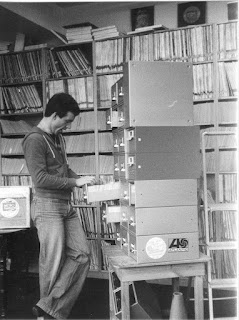
[presenter Stephen Ayres in Metro Radio record library, 1980]

 Do you believe in destiny? Not the Bardot-like Angels squadron leader Destiny who battled evil-ised Captain Black and the mysterious Mysterons. No, destiny as in fate. The notion that our futures are determined long before we realise it ourselves.

My earliest job, having just learned to write, was to take it upon myself to sort my parents’ two-dozen albums and two-score singles into some kind of order and to biro sequential numbers on their covers and labels. Nobody had told me to. Then I instructed my parents to always put their vinyl records back in the correct sleeves and return them to the shelf in the correct order.

Almost two decades later, my first full-time job required me to instruct my colleagues to always put the vinyl records back in the correct sleeves and return them to the shelves in the correct order. Destiny? Or was it fate? My office desk was located in the first-floor record library of local commercial stationMetro Radio’ in Newcastle. It was not strictly MY desk. It belonged to my line manager, Malcolm Herdman, who had just been seconded to record a jingle package in the station’s ground-floor studio. I had been appointed to perform Malcolm’s tasks as head of music, albeit as his deputy, and to create a new daytime playlist system that could reverse the station’s ratings decline.

Two other staff worked in the same room: at one end, young librarian Liz Elliott who was enthusiastic, helpful, chatty and a music fan; and, at the other, middle-aged Ann who was not. They faced each other with my desk positioned midway like a tennis referee. Liz catalogued newly arrived records, returned items to their shelves and maintained the card catalogue index. Ann was busy doing, er … mostly chatting with the station’s presenters or on the office phone to her friends. Colleagues alleged that she enjoyed a close personal relationship with the station’s managing director, Neil Robinson, who just happened to be paying her husband to write a computerised library programme … that never made an appearance while I was working there. I attempted small-talk with Ann but her preferred communication was to glare at me in silence.

Just inside the record library was a grey metal, two-door, six-foot tall stationery cupboard. It held spare copies of currently playlisted singles and valuable albums autographed by visiting pop and rock musicians that awaited mail-out to listeners as competition prizes. Soon after starting work, I found that records I had locked in this cupboard seemed to disappear overnight. The first occasion, I thought I must have been mistaken. However, on the second occasion, I was convinced that items I had secured had somehow been stolen. To replace them, I had to drive to the nearest record shop and buy multiple copies of our playlisted singles. The problem started to reoccur regularly. I was somewhat baffled.

When I told my colleagues about the suspected thefts, they described an event that had happened before I joined the station. The lone key to this stationery cupboard had disappeared (I cannot recall how), then was allegedly found several days later by helpful daytime DJ Giles Squire on the carpet immediately in front of the cupboard. This surprised my colleagues who had hunted high and low throughout the library for the key over several days, without success. How could it have suddenly appeared days later exactly where it had been lost? It was as if the key had been temporarily hidden by some kind of ‘Star Trek’ cloaking device. I was told that, after the key reappeared, things had started to go missing from inside the cupboard.

Theft from the library was a wider problem. Some library shelves of catalogued albums had visible gaps where items had not been returned. Behind Liz’s desk was a pigeonhole A-to-Z system where newly released seven-inch vinyl singles were filed by artist name. The station received multiple copies of around sixty newly released singles each week, most of which were stored there openly. So how come the pigeonholes rarely became overcrowded? It seemed that hundreds of new records were disappearing. I had the embarrassing task of having to phone record companies and ask for further copies of records that had already been delivered to us by post or by visiting reps. There were only so many occasions you could blame the Post Office.

The library had to be left open at night and over weekends because presenters were required to select records to play within their programmes. A security person was present twenty-four hours a day inside the station’s front door but their responsibility was apparently only to stop unwanted persons entering the building, not to frisk those leaving. Thus, theoretically it would have been easy for a presenter to exit to their truck in the car park carrying boxes of the radio station’s vinyl records that could then be exchanged for animal feed to use on their farm in Northumberland.

I embarked upon a ‘good cop’ strategy, sticking post-it notes on the most valuable items inside the cupboard with a handwritten message: ‘Dear Thief. Please leave this record which is essential to the running of the station and is needed for […]. Thank you, Grant.’ It made no difference. These items would still disappear overnight and the post-it notes would be left behind without any kind of riposte from the thief. Back to the drawing board.

I went to my manager, programme controller Mic Johnson, and informed him what had been happening. I always wondered if he was stuck with Velcro to his office chair as he was so rarely seen on the station’s ‘shop floor’. If he wanted to meet someone, rather than simply approaching them for a chat, his secretary would place a typed ‘docket’ in their pigeonhole. Sometimes I would see several presenters waiting in the corridor outside his office door, as if he were headmaster of Xavier’s School for Gifted Wafflers, where DJ’s whose latest ratings were sub-par should expect a good spanking to improve their superpowers. Did Mic wish to do anything about the thefts? No.

I switched to a ‘bad cop’ strategy. I visited a hardware shop and bought a thick metal chain that I wrapped tightly around the door handles of the stationery cardboard and secured with a large padlock. I was the only person with the key. For a few weeks, nothing disappeared from the cupboard. I no longer wrote post-it notes for the thief. Some staff laughed at my chain which admittedly looked hideous but, for a while, it worked until … records started disappearing once again. I was angry and frustrated. How could that happen? There were no signs that the chain had been cut or that the padlock had been replaced. Could the thief have tracked down the padlock I had purchased and found one that used exactly the same key? Had the culprit recently attended a GCSE evening class in lockpicking at a local den of thieves?

It was hard to accept that I had failed. However, the atmosphere within the station had recently turned icy as the result of a strike for increased pay by staff who were union members. Management had bigger fish to fry than my problem of vinyl records being pilfered by some Houdini. Presenters began to keep discs they wanted to use (or had used) inside the security of their personal lockers. Producer John Coulson stashed records he wanted to play on his weekend rock show behind the snack machine in the station canteen. If I needed Van Morrison’s latest album, he showed me, this is where I could find it.

Six months into my job, Malcolm Herdman was excited to play me the station identification jingles he had just finished producing. I went downstairs to the station’s recording studio for the first time and listened. Oh dear! Whereas ‘jingles’ are meant to be of only a few seconds’ duration to be used between records and adverts, Malcolm’s efforts were short ‘songs’ that lasted a minute, sometimes longer. How do I tell my boss, particularly when he has been so generous to me, that his last six months’ work was wasted? I tried to offer constructive criticism but had to point out that, if these longform jingles were played regularly, then fewer playlisted songs would be heard each hour … the very content for which listeners tuned in to the station.

This jingle project had been the outcome of an agreement with the Musicians’ Union, made seven years earlier upon the launch of commercial radio in Britain, requiring each local station to spend 3% annually of its net advertising revenues on Union members’ performances. For most stations, this translated into them paying local music acts to either perform at events or record songs for airplay. However, Metro Radio decided to blow the whole of that year’s budget on recording identification jingles by local band Lindisfarne who were already signed to a major label and since 1972 had achieved four Top Forty singles, including two in the Top Five. Hardly a struggling local band! The outcome was that, as long as Metro Radio paid its 3% to Union members, it mattered not a jot whether the results were ever broadcast.

If I had been asked earlier, I could have offered some advice. As a teenager, I had recorded jingles on my two-track tape machine initially for one London pirate radio station, only to be asked by other stations to produce similar work. Had the ill-fated Metro Radio jingles been some kind of reverse destiny where, sat only one floor away from this impending disaster, I might have rescued the project if only I had known?

Destiny quickly transformed into fate when I was called into managing director Neil Robinson’s office. It was the first occasion we had met because he and his fellow managers kept their distance from the rest of the staff and took lunches from the station canteen to their separate dining room. He told me I was being made redundant. So long and no thanks for all the fish.

[Originally published at https://peoplelikeyoudontworkinradio.blogspot.com/2023/06/watch-out-watch-out-theres-houdini.html]

Just my imagination running away … to Australia : 1972 : Eric Hall, Strode’s School

 A schoolboy babysitting two infant-school-age girls at night? Quick, call the police! Notify child protection services! … But wait! This was the 1970’s. That boy was fourteen-year-old me. Back then, few would have jumped to the (mistaken) conclusion that anything untoward was happening. How naïve we seemed to be!

My mother had few close friends and I fail to recall how she had come to know Cathy Bingham, who had recently moved into a new-build house at the far end of Byron Avenue, less than a kilometre away within our suburban housing development. Seeking a means to supplement my meagre pocket money, my mother had suggested to Cathy I could babysit her two young daughters if she and her husband wished to go out for an evening. I could only help out on Friday or Saturday as my school set two homework subjects each weekday and required my efforts to be submitted the following weekday. The resultant babysitting arrangement worked well and I was grateful for Cathy’s generous compensation which funded my purchase of more reggae and soul records.

Cathy was a genuinely lovely person who had moved to Camberley from Peru where her husband had apparently been posted by his employer. Prior to the birth of her daughters, she had had a job driving new cars from their Detroit production line down the Pan-American Highway for delivery to dealerships in Lima. I considered this a ‘dream job’ since my father had already stimulated my interest in American cars and I longed for the day I would be able to drive long distances myself.

One babysitting evening, once the girls had been put to bed upstairs, I spent the remainder of my time sat on the sofa in front of the television. I watched a recent British movie named ‘Walkabout’ about a father who suddenly abandons his two children in the middle of the Australian outback. The scenery was spectacular and the story fascinating of the children’s chance meeting with an Aboriginal boy who demonstrates his traditions to them and saves their lives. It made a huge impression as my first television experience of Australia beyond the formulaic ‘Skippy’ series.

I had already leafed through many large-format photo books of faraway lands, including Australia, whilst sat at a desk in the first-floor reference section of the local public library. I had been impressed by the mud-brick high-rise buildings in Yemen, the desert libraries of Timbuktu and the Ayers Rock sandstone monolith. Along the same Dewey Decimal shelf, I had recently discovered the first ‘Lonely Planet’ guide as a Roneo-ed set of booklets hand stapled together. All these readings had stimulated my desire to travel abroad, since most of our family holidays to date had been taken within Britain.

Australia was also on my mind after a recent chance meeting with a young Australian girl who was working in the bookshop on Station Road in Egham. I had made an earlier visit to the shop in 1970 to order a book (that changed my life) documenting American black music, ‘The Sound of The City’, which I had seen mentioned in its author Charlie Gillett’s weekly column in ‘Record Mirror’ magazine. My second visit was to exchange several ‘book tokens’ that had been awarded me as ‘School Prizes’. On that occasion, shop assistant Jan Somerville spent considerable time helping me choose paperbacks that might interest me, including ‘Exodus’, ‘Dune’ and ‘Topaz’. Her advice was particularly useful as I had no idea what to buy, my parents having almost no adult books at home.

I was instantly smitten with Jan as she was the first interesting girl around my age (well, she must have been two years older) I had met and, to my lusty adolescent eyes, she resembled heartthrob Susan Dey from ‘The Partridge Family’. She explained that her family had temporarily moved to Britain and she had found a job for a year in Egham’s large, well-stocked independent bookshop. After that, during my school lunch-hour, I would pop into the shop and chat with her regularly. When she finally returned to Australia with her parents, she gave me a slip of paper with her address in Clontarf, New South Wales. I was sad to lose my first ‘schoolboy crush’ but we wrote to each other for a while and she sent me a small toy koala which I have kept since. I had hoped to visit her one day … but life intervened.

All this explains why, on the occasion that English Language homework required me to write an essay about a landscape I had never visited, I naturally chose Australia. My teacher, Eric Hall, was a young man (relative to the majority of ancients that taught us) who wore tweed suits and was eager to show off what he probably believed was his sardonic wit. However, I read his attitude as sarcasm, a quality I found less than endearing after having arrived at the school wholly ignorant of his subject. Many of my classmates had previously attended private ‘prep’ schools and already knew what a noun, adjective, verb and tense were. I had never heard these terms because my state junior school had been keen to develop our creative skills rather than grammatic pedantry. I faced a steep learning curve at Strode’s School.

When I started my third year, I had been disappointed to be told that Mister Hall would be our ‘form master’, with whom we were required to register our attendance twice a day. My already poor rapport with him deteriorated considerably when, without prior consultation, my father impulsively booked a package holiday at an Egham travel agency for me and him to visit Florida during school term to witness the launch of an Apollo space mission. As a result, my mother was angry that her husband had not discussed this indulgence beforehand and had apparently demonstrated no desire to be accompanied by her and my two siblings. Mister Hall was outraged to be informed of my impending absence as a fait accompli and insisted that my trip be cancelled, which my father refused. Subsequently, my relationship with not only Mister Hall but most of the school administration was soured. I was never to be awarded a further School Prize.

At the end of our English Language period, Mister Hall walked around our desks, handing back each of our essay books … except for mine. After returning to his seated position at the front of our classroom, he said:

“You can all go now. Except for Goddard, who I want to see afterwards.”

Now what I had I done wrong? He opened my workbook to the page of my latest essay and pointed at it disparagingly.

“Your essay about Australia was very descriptive and incredibly detailed. Have you ever visited Australia?”

“No,” I replied.

“Well, I just do not understand how you could have written about somewhere you have never experienced with so much detail about its landscape and features,” he commented sourly.

I had no idea what he was trying to imply. I had worked very hard to produce a good essay and now he was trying to say obliquely that my work was too good? How was I expected to explain that?

“I’m interested in Australia,” I said. “I have seen films and read books about it, which is the reason I chose to write my essay about it.”

“Well, I am afraid I do not believe that you wrote this essay,” said Mister Hall angrily. “I have come to the conclusion that you must have copied it from some book. That is the reason that I have had to give you a fail mark for this piece of work and, naturally, this will be reflected in your end-of-term report.”

I was horrified. How could Mister Hall be so cruel? I understood he had never liked me, but I had never contemplated he could be so nasty to a student who had worked as hard as they could in order to be successful in his subject. From then on, despite my regular ranking as one of the top five students within my year of sixty pupils, Mister Hall’s comments in my termly school reports were consistently negative. His and a few other teachers’ similar attitudes to me during my seven years at Strode’s coloured my entire secondary school experience. For the first time, I learnt what it meant to be despised by an adult in a position of authority. It was an incomprehensible change from my previous positive experiences at Cordwalles Primary School, where my incredible teachers had been generous to a fault with their mentoring of me and my classmates.

I had no choice but to soldier on at school under the tutelage of Mister Hall. I took the GCE ‘O level’ exam in English Language the following year and achieved an ‘A’ grade. Three years later, I passed the ‘Use of English’ exam required of entrants to Oxford and Cambridge universities.

Before those subsequent academic successes, my life was changed irrevocably later in 1972 when my father deserted our family to run off with a newly married teenage bride who lived a few doors away on our street. The brief trip to Florida was the final occasion I spent time with my father until the day he died. Not only did he unknowingly negatively impact my school life for the remaining four years, but he knowingly impacted my family’s lives forever. The evening that I had chanced to watch the father in ‘Walkabout’ maroon his children in the outback was paralleled only months later in my own life when my father walked away from his three children, condemning them to an unexpectedly different future.

Despite these personal setbacks, Cathy Bingham’s experience of driving through the American continent in the 1960’s continued to inspire my ambitions. In 1984, I hatched a plan to hitchhike from the United States down the Pan-American Highway to Nicaragua to visit my friend Tony Jenkins who was there providing news reports to ‘The Guardian’ and ‘BBC World Service’. I visited the London embassies of all the countries I would pass through and obtained the necessary visas. However, this plan was stymied by a six-month wait for the BBC to inform me whether my second-round interviews for separate producer jobs at ‘Radio One’ and ‘Radio Two’ had been successful. In the end, I was rejected for both. Angry that my travel plans had been thwarted by the excessive wait, I enquired why to BBC Personnel, only to be informed by its employee that in future I would need to prove to interviewers that “you are one of us”.

Evidently, I never was.

[8mm film of Eric Hall by classmate & dear friend Martin Nichols]

[Originally published at https://peoplelikeyoudontworkinradio.blogspot.com/2023/05/just-my-imagination-running-away-to.html]

It ain’t what you do, it’s the way that you hobnob : 1980 : Durham University Careers Advisory Service

“The Treasury,” said one.

“Banking,” responded another.

“The Civil Service,” replied another. It was my turn.

“Radio,” I said.

There was stunned silence. I felt all eyes turn toward me. Time seemed to pause while my colleagues processed their apparent incomprehension.

“What do you mean by ‘radio’?” eventually enquired the Economics professor in whose dark, dingy Old Elvet office our tutorial group was meeting.

I was somewhat taken aback. Who does not understand the word ‘radio’? Had he never read about Marconi? I grappled to maintain my decorum. I looked around at my fellow students dressed in three-piece suits or dress shirts or lavender cardigans with slacks over shiny black shoes. They appeared to have already been moulded into mini-me versions of their fathers (naturally there were no women). Their appearances were as dull and middle-aged as the careers they had said they desired. I was sporting my usual cheesecloth shirt, flared jeans and platform shoes, de rigueur 1970’s student-wear. Evidently, I inhabited a different dimension from my colleagues. Had Ann MacGregor twiddled the dials of her SAGE computer and sent me back a whole century to an era before radio had been invented? Where were Doug and Tony? I hoped they had not landed the other side of the street, inside Durham Prison.

“’Radio’ as in ‘broadcasting’,” I answered, struggling to control my patience, “where I want to produce programmes for a radio station.”

“Oh … kay,” said the tutor with the weariness of a grizzled academic attempting to explain monetarism to the village idiot. “So why are you here studying economics?”

“Because economics interests me,” I replied.

That was my second faux pas of the day. I looked around again and realised that my fellow students were not there primarily because of any enthusiasm for the subject. They were simply fulfilling their destiny, determined from the day they had been born into families who had then spent huge sums over two decades on their private education. For my colleagues, a job within the top echelons of government or commerce was not a career ambition. It was a birth right. It was simply the ‘payback’, the ‘return on investment’ expected as reward for the six-figure sum that Tarquin’s parents had spent to secure his social status. He and his former school chums felt entitled to their guaranteed shiny futures.

In the 1970’s there was no degree course in radio. No degree course in media. I was amongst Britain’s 94% of children who had attended state schools. Now I was amongst the 14% of the population to attend one of the country’s 45 universities. I had been forced to choose the academic subject in which I performed best at my school … and in which I was interested. With minimal career guidance, I had selected the university which I believed offered the best reputation. What nobody had advised me was that Durham was stuffed to the gills with toffs whose academic record at private schools had not proven exemplary enough to win them a place at Oxford or Cambridge. As someone who was certainly not ‘privileged’, had I wished to spend three years in a ‘Chariots of Fire’ theme park?

In my tutorial group, when one fellow student had spoken for the first time, I failed to understand a single word he had said. I assumed he must have been speaking some unidentifiable foreign language. Then I looked around and noticed my fellow students nodding in agreement as if they had understood him perfectly. I was confused. The next time he spoke, I struggled harder to comprehend his speech and managed to pick out the odd word in English. Only then did I realise that he habitually spoke in an upper-class accent so cut-glass as to prove almost incomprehensible to someone like me. Hand on heart, I am not exaggerating. I would have understood every word spoken by The Queen, but this young man’s speech was so stilted as to be easily mistaken for a parody of an upper-class twit.

I cannot recall a single conversation about economics with a fellow student on my course. Our academics never asked us to work in project groups. The toffs were being groomed to assume their rightful place as ‘captains’ of industry or government, for which there was no apparent necessity for them to converse with someone from the lower classes. It was evident to them from my accent, dress sense and demeanour that I resembled the servants or the ‘help’ their families employed at their mansions. I was similarly invisible to them, not having the ‘right stuff’ conferred by a private education, as had more than 90% of students at Durham. Worse, I betrayed no ambition to try and join their ‘club’. Unlike them, my parents had paid nothing toward my education, which made my chosen career very much my own affair.

I already subscribed to ‘Broadcast’ magazine and bought ‘The Guardian’ on Monday for its media job advertisements. Now it was time to visit the university’s Careers Advisory Service to locate suitable job vacancies. Its one-room office in a modern two-story building in Palmers Garth was filled with standalone shelf units of file holders, each collecting documents from one employer. I made an appointment to talk with an advisor but the earliest date was more than a month away. During the waiting period, I worked my way along every file on every shelf, searching for any employer within the media. What surprised me then was how few of the 4,000 Durham students seemed to require the facility. What I failed to understand was that most jobs for the upper classes were the outcome of who they knew or who their family socialised with, rather than requiring the bother of a formal application.

On the day of my appointment, I brought along my articles published in the student newspaper in a portfolio I had created from sheets of thick A3 black card stitched together. The advisor I met was an elderly woman with grey hair and John Lennon-style wire-frame glasses, like Granny from ‘The Beverly Hillbillies’. Asked about my career choice, I replied it was ‘radio’.

“We cannot offer you any help if you choose to pursue a career in the media,” she said sternly, staring at me over the top of her spectacle frames. What? I felt outrage that I had waited more than a month for her so-called ‘advice’.

“But I started producing radio programmes seven years ago in London and …” I told her.

“I’m sorry, but getting a job in the media is all about the people you know,” she interrupted and then stood up to go.

I was abruptly left alone, not even having been offered the opportunity to show her my portfolio. Or explain to her the details of my prior radio experience. Or my election as editor of the student newspaper. Or my election as editor of the annual student handbook. Or my election as deputy president of the students’ union. Or my success arguing with the University for an unprecedented increase in the student union’s subscription income. Or my success turning around the student food shop from loss to profit. None of that seemed to matter. I was appalled by the ‘careers advice’ I had just been given. My long awaited ‘interview’ had lasted less than a minute.

Eight months later, I received a letter from the Careers Advisory Service. I presumed it must be a circular sent to former students to update its records. But no! It was a personal letter requesting my help to advise an undergraduate who desired a career in radio and asking me to show him around my workplace. My initial thought was to tear this letter into little pieces and throw it on the living room fire. How very dare they! … However, a few days later, my benevolence got the better of me and I realised I should help a student who might be in a similar situation to mine not so long ago, regardless of how much contempt I felt for the letter’s sender.

I now had a full-time job at Metro Radio, the commercial music radio station in Newcastle, which I had achieved by responding to an on-air announcement I had heard asking for candidates. The vacancy had not been advertised in either ‘Broadcast’ magazine or ‘The Guardian’. I resolved to contact the student and arrange to chat and show him around the station’s premises. Whether he went on to pursue a career in radio I never discovered.

By then, I had learnt precisely how ‘selective’ the university was about recruiting students. In 1978/9, I had been the student representative attending Durham University’s ‘Admissions & Matriculation Committee’ where statistical reports showed that some years certain of its colleges had accepted not a single student educated in a state school. These data were never published.

Four decades later, surely things must have changed? Er, maybe not. A 2022 headline in the Durham student newspaper screamed ‘Durham has lowest state school intake of any UK university’ and quoted student Keely Brown:

“… many [Durham University students from state schools] have no prior knowledge of what awaits them at university, let alone experiences of classism or discrimination and, alongside feelings of imposter syndrome, it can feel like Durham isn’t the place for them.”

[Originally published at https://peoplelikeyoudontworkinradio.blogspot.com/2023/05/it-aint-what-you-do-its-way-that-you.html]

Sit-in here in limbo : 1986 : Community Service Volunteers & Radio Thamesmead

 “It’s just like the multinational pharmaceutical businesses deliberately designing toothpaste tubes so that you cannot squeeze out the last bit of toothpaste,” I blurted.

There was stunned silence while my colleagues seated on a circle of chairs in the middle of a low-ceiling conference room stared at me blankly. Was this young man mad? Perhaps I was. I cannot recall to which discussion topic my poorly chosen conspiracy theory analogy was intended to refer, but I clearly remember the reaction. I was present because a letter from Ric, our manager, had instructed me to attend. I had no comprehension what this meeting was intended to achieve. By the time I opened my mouth, the gathering had seemed somewhat pointless.

I had already been employed for several months of a one-year contract by the two-decade old charity Community Service Volunteers [‘CSV’], but this half-day event was the first time I had visited its sprawling offices in King’s Cross. Like me, each of the dozen people present was supervising a job creation scheme within a local radio station. Their ‘Action Desks’ were funded by government and sponsored by CSV, each employing a couple of low-wage staff to answer phone enquiries from the public about lost dogs, community events and volunteering opportunities. Unlike me, every invitee present was female because, in the pre-desktop-computer dark ages, scripts had to be prepared by Action Desk staff on a typewriter in order to be read on-air by professional radio presenters. In essence, CSV offered broadcasters its staff at zero cost to generate the ‘community’ content required by their stations’ broadcast regulations.

I was different, not just because I was male and talked crazy ideas, but because it quickly emerged that I was the only person present with prior radio experience, and I was not operating one of these ancillary Action Desks. Instead, I was supervising a larger team of paid CSV staff who worked alongside non-professional volunteers managing London’s only legal community radio station, ‘Radio Thamesmead’. Although ‘history’ (a.k.a. Wikipedia) records Britain’s ‘first’ community radio station as not having launched until 2002, significant but little-known antecedents did exist. In 1976, many of Britain’s 28 post-war ‘new towns’ had been resourced with a community radio station, initially funded by each location’s New Town Development Corporation to broadcast on a then state-of-the-art analogue cable system.

However, by 1986, only two of those pioneering radio stations had survived. Why? Having myself lived/worked in these new towns, I witnessed first-hand the grand objectives of the 1946 New Towns Plan having never been completed, leaving residents without the promised shopping centres, community facilities and sportsgrounds. Their local cable systems suffered poor maintenance and many households now subscribed to satellite TV delivery instead. In the 1980’s, Development Corporations were wound up by government and their funded projects, including community radio, were abandoned. Did the Cable Authority, which inherited regulation of the remaining community radio stations, publish an evaluation of the evident failure of the 1970’s ‘cable radio experiment’? If so, I never saw one. Its sole statement on the subject was that “community cable radio stations tended to be longer-lived than the [cable] television stations, and two still survive”.

Radio Thamesmead had endured only as a result of its job creation staff and partial funding of overheads provided by CSV. A government agency named Manpower Services Commission operated the station’s ‘Community Enterprise Programme’ for which staff were recruited from the ranks of the unemployed and contracted to CSV, whose expenses it then reimbursed monthly. In this way, money flowed from government to the Commission, then to CSV which then paid me and my team’s monthly salaries in arrears. However, there was one month when our pay failed to arrive on time. I phoned CSV which explained there had been a temporary problem and it would come soon. One week later, still none of us had been paid. This created a practical problem because our low pay was barely sufficient to cover our work expenses. I had to endure a daily commute of more than two hours each direction by coach and train which ate up the majority of my salary. I phoned CSV again and was offered only more excuses.

The following Monday morning, instead of commuting to Thamesmead, I arrived unannounced at the CSV office and demanded to meet its finance director. How could I manage a team of staff who were essential for keeping this little community radio station on-air if they were not being paid for their work? After initially being offered further excuses, it was eventually confided in me that the CSV staff member responsible for managing the finances of these job creation schemes had disappeared from its headquarters along with the funds received from government to pay our wages. I was angry. I had a responsibility to ensure my team was paid. CSV had a responsibility to fulfil its employment contracts by paying me and my team. Otherwise, it would breach those contracts and open itself to legal action.

I told the finance director that I intended to stay in his office until a solution was organised in order for us to be paid. Mine was a one-man sit-in protest. I made myself comfortable in the low chair for guests in his office, listening to my Walkman and reading a book I had brought along. Due to my long daily commutes, I was familiar with sitting for hours alone, entertaining myself with cassette recordings of the ‘John Peel Show’ from ‘BBC Radio One‘. That day, as every weekday, at daybreak I had caught the first scheduled coach into London from the London Road bus stop in Camberley. After a further two hours having sat in this office, which had been unoccupied after my tirade, I needed to use the toilet. I rose from the chair …

The next thing I remembered was opening my eyes, feeling the carpet beside my face and realising I was laid out on the floor of the office. I had no idea what had happened. My head was hurting like crazy. I felt very dizzy. I managed to crawl along the floor on all fours into the corridor where I could hear voices talking. I headed in their direction and crawled through the doorway of an office where my sudden appearance at floor level must have shocked the two women sat inside at their desks. Something catastrophic must have happened, but what exactly?

It transpired that, when I had risen from my chair in the finance office, my head had hit a bookshelf drilled into the wall directly above me which, in my initial anger, I had not noticed when starting my sit-in several hours earlier. I must have suffered concussion, though it was unknown how long I had been unconscious because nobody seemed to have entered or passed the office despite its open door. All I could recall was a vision in my head of my spirit travelling through space with bright lights passing rapidly to left and right, similar to a sequence in the film ‘2001: A Space Odyssey’. I could now feel a large bump on the top of my head and I remained dizzy and incoherent. An ambulance was called and I was whisked away for tests in a London hospital. Following several hours under observation, I was released in late afternoon.

CSV had offered to pay for a taxi to take me home from the hospital. When I told them my destination would be my mother’s house thirty miles away in Surrey, they initially told me they could only deliver me to “my home”, not to a relative’s. I had to insist that I was commuting that distance daily as a result of having failed to find an affordable home to rent in London. They were putting up resistance but finally paid for my long £50 black cab ride all the way to Camberley. I rested the next day and took the painkillers prescribed by the hospital. When I phoned my workplace to explain my absence, my team were somewhat shocked and surprised to learn the bizarre outcome of my sit-in.

A few days later I felt well enough to return to work and, by Friday that week, my team were belatedly paid our overdue salaries by CSV. The problem never repeated. I never revisited the CSV office.

[Originally published at https://peoplelikeyoudontworkinradio.blogspot.com/2023/05/sit-in-here-in-limbo-1986-community.html]

The Best Man for the job : 2003 : Neil Stock, The Radio Authority

 When someone leaves their job, what are the chances that the ‘best man’ to replace them will be:

  •  the groom at whose wedding their predecessor was Best Man, AND
  •  a contemporary at the same university, AND
  •  a volunteer at the same student radio station?

Wielding my four mathematics GCE’s and a pound-shop calculator, I sat at my desk calculating the probability of such an alignment of coincidences for a job appointment within my workplace. If this had been an internet start-up of Cambridge science graduate nerds, no eyebrow would have been raised. But in a British government quango? My calculator produced a gibberish result from the very first calculation. But when I turned around its display, the characters appeared to spell out ‘NEPOTISM’. I switched to an Excel spreadsheet but it too crashed. Microsoft made contact, suggesting I lease processing time on its supercomputer to complete my calculation of a ‘1 in …..’ probability that would require several zillion zeros. I gave up.

After an unexplained rush to appoint me, The Radio Authority had left me alone, twiddling my thumbs at my desk for three months. There were no team meetings or supervisor get-togethers to attend, so nobody remarked upon my ongoing inactivity. Had my colleagues even browsed the ‘management’ section of a bookstore? Work tasks were assigned by way of someone with a supreme confidence in their own superiority marching up to your desk and barking orders, before turning around and marching away again. It began to feel as if I had been press-ganged into the Civil Service as deckhand on a ship of pen-pushing fools.

Finally, by month four, I was given a project by the manager who had appointed me, David Vick. The local commercial radio licence for West Lothian in Scotland had been advertised and my task was to write a paper to be presented at a Members’ Meeting, recommending to which applicant the licence should be awarded. No problem, I thought. A decade earlier, I had regularly spent a morning in the broadcast regulator’s library, reading multiple applications for a particular licence and then summarising them during the afternoon in an article of several thousand words for the weekly ‘Broadcast’ magazine. I was thinking that a more detailed paper might take me a week to write. Then Vick told me that I had … two months. Oh, and there was only one applicant.

I was offered no guidelines, no style sheet, no system to follow, no advice. Just “write a paper – you have two months.” I executed what I considered to have been a thorough job. I researched the local media market, the radio market, the applicant’s business plan, everything I could find. This was my first project. I wanted to impress my boss. There were days when Vick asked me why I was using the office printer so much, seemingly oblivious to the demands of evidential research. After six weeks, I gave him my draft document and asked him to mark it up so that I could understand which parts he wanted to keep or discard. He invited me into his office to discuss my work. Had I done well? Er, no. He went ballistic. He screamed and shouted at me.

“This isn’t what I wanted,” Vick yelled. “This isn’t an Authority Paper. What do you think this is? Can’t you write?”

He stormed out of his office and marched down the corridor shouting “Shit! Shit! Shit!” at the top of his voice. It was left to me to presume that our meeting must have ended, without me having uttered a word.

I was shocked. And very confused. I believed that I could write … and write quite well. Vick had read my CV and knew my articles about the radio and music industries had been published in trade and consumer publications, some of which had employed me as sub-editor or editor. My job application here had even required me to submit a one-page essay entitled ‘The London Radio Scene’. During my job interview, Vick had not critiqued my supposed inability to write. Why would I have been appointed?

Later that day, Vick’s deputy marched up to my desk and requested a meeting. In their rehearsed good cop/bad cop roleplay, Vick apparently judged Neil Stock the best man to ‘offer’ to bang my report into the requisite, undefined shape and style of ‘Authority Papers’. I did not bother to argue. Stock was eminently qualified by having studied American Literature, having never worked in commercial radio and, to the best of my knowledge, having never published an article about the radio industry. Visually, he was Beaker to Vick’s Doctor Bunsen Honeydew. Stock’s frigid demeanour recalled the android Bishop in the movie ‘Aliens’ whose ‘humanity’ module might never have been activated.

Stock occupied a spacious office on the opposite side of the corridor that resembled one of those IKEA showrooms where everything looks too perfectly arranged to be real and the desk computer turns out to be fake. I sat facing him across a desk ring-fenced with multiple stationery pots filled with over-sharpened pencils of varying hardness and a row of staplers, holepunches, paperclips and elastic bands. Stock’s patronising spiel, instructing someone twice his age how to write, floated off into the ether above my head. My eyes were scanning the office carpet for evidence of vomit stains where my colleagues had alleged his predecessor had been found unconscious following an over-liquid lunch. After that incident, Stock’s Best Man had been shoehorned into a board-level job in a commercial radio group, a responsibility which had proven so successful that I had overheard Vick on the phone to the CEO trying to save his prodigy’s bacon.

One week later, Stock gave me back the document. It still had my name on the front but almost nothing within remained of my six weeks’ graft. Every single table, graph and map had been expelled. Every reference to a specific number (such as Census population data) had been rounded and referred to as ‘approximately’ or ‘about’. All evidential sources such as media and radio market data had been expunged. My sentences had been conjoined with ‘and’ or commas until each contained at least seventy words. Some paragraphs filled almost a whole A4 page. Subjective adjectives had been attached to references to individuals, tainting them with judgement as to whether they were in or out of favour with The Radio Authority. This was writing, Jim, but not as we journalists know it.

I asked Stock to remove my name from his revised document as it no longer resembled anything that I had written. He refused. I asked that his name be added to mine as joint author. He refused. We may have been sitting opposite each other at his desk, but each of us had landed there from different worlds. My quarter-century in journalism had been spent explaining facts. His few years in this civil service madhouse seemed to have been spent obscuring facts. If his university had offered a module titled ‘Using Words as A Weapon: How to Write Baffling Prose’, he would certainly have scored an ‘A’.

Naturally, Stock’s boss David Vick was happy with the result. It looked and read just like something he would have written himself. I was required to present the paper to a monthly Members’ Meeting, reading a pre-approved two-minute script from which I was forbidden to deviate. Neither was I allowed to use audio-visual aids in my presentation. Vick had instructed me not to contribute to the ensuing debate unless a specific, factual question was addressed to me directly. I saw absolutely no point to my presence at the meeting. It achieved only what the organisation’s officers had carved up beforehand. The licence was awarded to the sole applicant. My ‘work’ in The Radio Authority was merely to keep up its appearance of objectively regulating the radio industry.

Months later, an uncharacteristic silence broke out amongst my colleagues in our crowded office. We had already been told that our regulator was about to be merged into a new, bigger government organisation. What we had not learnt until then was that our new manager was to be … Neil Stock. There was stunned silence as the news sunk in.

This was the Neil Stock who, on arrival at work each day, would email his ‘team’ a ‘Pop Quiz’ question that required an emailed response within the hour. When I refused to play this childish game, he complained that I was not a team-player. But I had no interest in flaunting my encyclopaedic knowledge of pop music earned from having created radio station formats over several decades. Mike Read was not my hero.

This was the Neil Stock who refused to attend the quarterly team-building, afterwork social visits to a local pub or restaurant that our employer mandated. Management apparently thought it was insufficient that we already spent forty hours every week in each other’s company in one cramped office. During one such social evening, my colleagues expressed astonishment that I had not been made to take a UK geography test before my appointment, which had been required of them. It was as if knowing the county town of Rutland proved a perfect substitute for non-existent knowledge of the radio industry that a new employee would be regulating.

This was the Neil Stock who only popped into our office briefly if there was something specific that he wanted to address to one of us. Watercooler chat, small talk, even casual morning greetings or afternoon farewells were apparently foreign concepts. Enter his office at 4.30 and he would be enthusiastically sharpening his huge pencil collection on a desk uncluttered by a single folder or sheet of paper. Enter his office at 4.50 and he was already being whisked by train back to his IKEA showroom house and wife in Cambridgeshire.

This was the Neil Stock who chose not to inform his own underlings that he had been appointed their new manager. Neither did we learn it from our then manager, David Vick. The news reached us that fateful day as part of a general personnel update email from the new regulator Ofcom. Once again, our managers were demonstrating their non-communication skills.

Our office was not the only one rendered speechless by the news. A hush spread over the whole floor as our colleagues digested that Stock would not just be managing our team, but most of the 40-odd staff about to be transferred from The Radio Authority to Ofcom. What a meteoric rise through the ranks for someone so, er … inexperienced? In 2000, Stock had been judged the best man to replace his Best Man. By 2003, somebody somewhere considered Stock the best man to manage Britain’s commercial radio licensing system, a job that had not been advertised publicly.

We were left to presume that Vick must have decided to take retirement since it was plainly evident that his nineteenth-century style of management – writing everything longhand, never touching a computer keyboard, bellowing from his office at his two full-time administrative assistants whenever he needed to send/receive/print an email – would have proven awkwardly Luddite within the determinately twenty-first century Ofcom.

The pair’s Hawkins/Harker partnership was about to be dissolved. Meet the new boss …

[Originally published at https://peoplelikeyoudontworkinradio.blogspot.com/2023/05/the-best-man-for-job-2003-neil-stock.html]

This is your early morning trunk call : 2004 : BBC World Service Trust, Cambodia

[Malene, BBC World Service Trust, Phnom Penh, 2004]

 I pull back the bedroom curtains and, from my window, see a huge elephant ambling along the promenade above the Mekong River. I know it must be 6:30 a.m. Every day at this time Sam Bo, the only elephant in Phnom Penh, walks to his day-job giving rides to children around the base of the city’s only hill. The street beside him is already filled with rush-hour traffic, since most shops and offices open daily at seven. Weaving in and out between huge chrome-clad and tinted windscreen four-by-fours driven by NGO staff and government officials are hundreds of motorbikes, which have totally replaced the humble bicycle as Cambodians’ preferred mode of transport. If there is a Highway Code, nobody seems to have read it. Confusingly, traffic travels in both directions on both sides of the road and often on the pavement too.

You see young schoolchildren riding motorbikes to school, and parents carrying three or four children precariously on a single bike. I have seen a motorbike carrying a full-size palm tree, another loaded with an iron girder which could easily have decapitated someone, and a bike carrying three dogs, one of which had its paws on the handlebars. Few people wear crash helmets, but most wear surgical masks (available in various colours from market stalls) to keep the dust, pollution and bugs out of their mouth and nose. Phnom Penh is the L.A. of Asia – nobody walks. What were once pavements are now clogged with parked cars, row upon row of parked bikes, impromptu shops, and families sat on plastic patio chairs selling petrol in old soft drink bottles from the kerb. The few people who walk around this city – the very poor and foreigners – are forced to negotiate the gutter, where we risk being hit by bikes coming at us from all directions.

In the morning, I work at the Women’s Media Centre of Cambodia where I am training four enthusiastic staff to produce a youth phone-in show that launches in May. They are very excited that the Centre has just been nominated for this year’s One World Broadcasting Trust Special Award for Development Media. The team share an office in the Centre which they have proudly designated the ‘BBC Office’, even though they are not BBC staff. The only drawback to working in this beautifully airy, purpose-built broadcast centre is that we are shadowed by a massive transmitter mast in the car park that broadcasts the Centre’s radio station ‘FM 102’ to 60% of Cambodia’s population. Although the custom is to remove one’s shoes before entering the building, staff have to don flip-flops to use electrical equipment such as the photocopier, or risk electrocution from the mast’s 10kW electrical field (as I found out to my peril).

At lunchtime, almost everyone goes home for a two-hour siesta that offers slight relief from the constant 35-degree daytime heat. I take lunch at the real BBC office – a villa whose walled garden includes luscious banana and mango trees – with the handful of the thirty local staff who live too far away to return home. Malene, one of two BBC housekeepers, purchases our food from the plethora of nearby pavement snack stalls, according to our culinary preferences, at a cost of less than a dollar each. Dishes are always accompanied by boiled rice or noodles, though Malene once glowed with pride when she presented me with a plate of chips procured from who knows where.

After a productive afternoon working at the Women’s Media Centre, I walk home past a school when a girl, aged about eleven and dressed in regulation white blouse and navy skirt, rushes out of the school gates, runs across the road and, without a hint of self-consciousness, starts a conversation with me in perfect English. After a minute, she sees a motorbike taxi stop outside her school gates, bids me farewell, jumps on the back (side-saddle, as is customary for girls) and waves goodbye as she disappears down the street. She inspires confidence that the future of this country will be bright in her generation’s hands.

[First published in ‘Ariel’, 11 May 2004, p.3]

[Originally published at https://peoplelikeyoudontworkinradio.blogspot.com/2023/04/this-is-your-early-morning-trunk-call.html]

Gonna make you a star/czar : 2001 : James Murdoch, Star TV

 “I am sorry, sir, but you are not allowed in the tea room,” the head chai-wallah said to me politely but firmly. “It is OUR job to bring you cups of tea when you request them.”

I was learning that, in India, self-service was a social crime and servitude was still alive and well. I had wandered into this tiny room from my desk a few steps away in my quest for an alternative to the thick, sugary tea I had been served, reminiscent of the disgusting, syrupy ‘Camp Coffee’ my mother always drank in the 1960’s. In the ‘tea room’ was only one big aluminium machine on which there was a single large red button. Press it holding your cup underneath and it delivered ready-sugared, ready-milked tea. No options. Henry Ford would have been proud. Admonished, I skulked back to my desk, visions dancing in my head of unavailable herbal teas and a former existence in which I was allowed to make my own beverages.

My desk was on the edge of an open-plan space occupied by ‘Channel [V]’, a music video station whose ratings were failing to compete with ‘MTV Asia’. It was not hard to see why. Peeking over my desk divider I would observe the young, educated, urban team’s enthusiasm for American and European rock music which, for India’s largely rural audience, probably sounded as if it came from another solar system. At one nearby desk, a hip young man spent most of his day quietly strumming an acoustic guitar as if he were Dylan (the rabbit). This wing of the top floor of ‘Star TV’s building in Mumbai was as laid back as I imagined the Hunter Thompson-period ‘Rolling Stone’ magazine office to have been.

Why was I there? The team creating India’s first commercial FM radio network was so nascent that we had no office space of our own as yet and had to be squeezed into other channels’ unused corners. On the opposite side of my work station usually sat my young colleague, Sandeep Kapur. He was absent today sorting out paperwork that would prove he was not dead. This required him to purchase classified advertisements in several newspapers stating that he was, in fact, very much alive. After the stated period during which he hoped no objections would be lodged, he could then apply to the government for a ‘Life Certificate’, necessary for transactions such as a mortgage. In India it was insufficient to BE alive; you required a piece of paper to prove it.

At the end of every morning, the tiffin-wallahs arrived to deliver hot homemade lunches in circular metal lunchboxes to male workers at their desks. Each box was colour-coded, numbered and inscribed with symbols to designate a particular desk on a specific floor of our office building in the Andheri district. All had been collected from homes and conveyed long distances by bicycle, train and car within the previous few hours. Those of us unlucky enough not to have wives at home, or to be one of the organisation’s few female staff, could buy subsidised cooked lunches in the building’s ground floor canteen, at its busiest on Friday when the weekly Chinese fare was sufficiently admired to persuade men to forgo their wives’ home cooking.

Today had been designated a special day because the several hundred staff working in the building were to be addressed by the Great Leader via a live television satellite link. At the appointed time, I pulled up a chair alongside the hip Channel [V] dudes in a semi-circle around one of the many television sets affixed high on the corridor walls of every floor. There was an air of anticipation because we had been promised/warned that a major corporate announcement was about to be made. Reorganisation? Closures? Would a pink-slipped Dylan have to find another gig where he could continue killing his workmates softly with his songs?

The satellite connection flickered and we could see a fixed camera focused on a young man sat behind an ordinary office desk in Hong Kong. It was the very moment he started talking inanimately to the camera that the event started to become somewhat surreal. This man was chairman and chief executive of a huge media conglomerate broadcasting multiple television channels by satellite across most of Asia. He apparently had important developments to share with his workforce of thousands. So why did he have the air of a wayward son forced by his father to smile for the annual family group Christmas photo? Why was he oozing the reluctance of a boy ordered to attend his stepmother’s birthday bash and to bring a suitably expensive present that had not been manufactured in China?

I could not supress a snigger. My young Indian colleagues turned and stared at me as if it were heretical not to show the utmost respect to our ultimate boss. I realised then that they probably knew next to nothing about the twenty-eight-year-old James Murdoch who was addressing us or how he had been appointed to this job. His track record hinted at his posting to the furthest reaches of the Murdoch galaxy. Aged fifteen, daddy Rupert had given him an internship on his Sydney newspaper, only to find him photographed by a competitor asleep on a sofa at a press conference. Later on, how disappointing it must have been to buy your son’s education at Harvard to study film and history, only for him to drop out in order to launch a rap music company … which later you have to bail out.

Murdoch’s Star TV operation based in Hong Kong had been losing US$200m a year by 2000 so, naturally, it was decided to send a boy to do a man-sized turnaround job. What was the son’s new strategy to stem these losses? We learned from the television address that Murdoch Junior had come up with the amazing idea of changing the business’ name from ‘Star TV’ to … ‘Star’. I kid you not. This was apparently necessary because ‘TV’ was an outdated, fuddy duddy business while the ‘internet’ was the medium of the future, despite it having already existed for almost two decades. So it required us all to wave goodbye to the ‘TV’ brand and say hello to ‘….’.

This sounded remarkably like a rehash of Murdoch Junior’s lobbying of Pops three years earlier with his strategy that the internet was where it was at, resulting in News Corporation having submitted a $450m bid for online startup ‘Pointcast’. I had been an enthusiastic early adopter in 1996 of its application which downloaded news stories using ‘push technology’ onto a computer about topics and from leading global newspapers personalised by each user. Working months on end in Russian isolation, I would spend evenings redialling hundreds of times until my laptop’s modem connected to a landline good enough to receive the latest news stories to devour. The phrase ‘never look a Murdoch horse in the mouth’ must have eluded the Pointcast board who stupidly rejected Junior’s vastly inflated offer. Two years later, it sold the business for a meagre $7m to a different company that shut the news service after one further year of operation. Pops had been miraculously saved from a half-billion sinkhole dug by Junior on that occasion.

Quite why Junior’s ongoing affair with the internet demanded us to interrupt our work schedule for half-an-hour I had no idea, but we watched until the screens went blank again and then walked away … totally underwhelmed. I returned to my desk and found that fairies had magic-ed a hardback notebook with the new ‘Star’ logo onto every desk in the building. The change made absolutely no difference to my work. We were planning to launch our radio network with the brand ‘Star FM’ (though this plan failed once we found a competitor had already bagged the name). When I left the building that evening, I had to avoid a crew with a crane who were busy swapping the huge illuminated logo over the front door to one with the new name. Apart from losing the ‘TV’, the logo still looked much the same to me.

Less than three years after having banished Junior to Hong Kong, Pops called him back to manage a different part of his empire in Britain, claiming that his son had executed a hugely successful turnaround strategy during his posting to Asia. One Australian newspaper ran this story in 2003 under the headline ‘James Murdoch didn’t shine at Star’.

[Originally published at https://peoplelikeyoudontworkinradio.blogspot.com/2023/04/gonna-make-you-starczar-2001-james.html]