SWITZERLAND: five of eight DAB+ radio licences expire unused

Yesterday, five out of eight broadcast licences issued in Switzerland for DAB+ radio expired without their owners having launched the promised digital stations. According to the Klein Report, only three DAB+ stations – Open Broadcast, Radio Eviva and Swiss Mountain Holiday Radio – are now on-air, the latter having launched on yesterday’s deadline.

Two stations, Radio.ch and SoundCity, had already handed back their unused licences to Swiss media regulator Bakom. Now, Energy Zurich’s licence to provide a service named Radio For Youngsters, aimed at 10 to 14 year olds, has also expired. Egon Blatter, owner of Radio 105, said he had hoped that Energy Zurich’s proposed switch from FM to DAB in 2010 would have changed the whole audience for digital radio. He has “reluctantly” let the DAB+ licence expire of his proposed station DJ Radio Deluxe, as has Oliver Fluckiger’s RadioJay.

FM radio in mobile phones: the universal standard

Although some politicians and civil servants might try to convince us that the UK can lead Europe and the world in technological innovation, new broadcast standards and electronic hardware, the reality is that the sun set on the British Empire a long time ago. Almost none of the gadgets we use are manufactured in the UK, and even those that have British corporate logos glued on the front are inevitably assembled in China or Korea. When global commercial forces make a decision on the adoption of a new consumer mass technology, the best Britain can do is follow in the slipstream and make the most of innovations that the rest of the world is pioneering.

Right now, the new broadcast standard for mobile radio reception is being decided in the corridors of power in Washington DC and in the boardrooms of the mobile phone manufacturers. That standard will be FM radio. This inevitably means that FM radio delivered to on-the-go consumers via mobile devices will become the universal standard for years to come. Please, Ofcom and DCMS [the Department of Culture, Media & Sport], do not bother getting uppity just because you were not consulted by Congress, Nokia, Samsung or Apple. Neither were several hundred other countries around the globe. And please, DCMS and Ofcom, do not even think about committing the UK to going its own sweet way unilaterally on this issue. All it will do is create more embarrassment.

Recall the DCMS-led Digital Radio Working Group which spent a year deliberating on the digital radio issue and included in its Final Report published in December 2008 a note that “consumer groups believe that, once an announcement [of digital radio switchover] is made, no equipment should be sold that does not deliver both DAB and FM”. In the margin, at the time, I had scribbled “in your dreams!” After ten years of DAB broadcasting, there is still not one mobile phone currently on sale in the UK that incorporates DAB radio.

Recall the report from Ingenious Consulting published in January 2009 which suggested that, in order for the DAB platform to succeed for commercial radio, it would need a “commitment [from radio stakeholders] not to pursue alternative technologies to DAB”. So, is the only way to drive consumers’ use of DAB to prevent them from listening to radio on other competing platforms? Will ‘DAB police’ be storming some West Country town next year and taking all the residents’ analogue radios away from them?

Whereas the UK has too often pursued these sort of fundamentally impractical strategies to achieve its aims (and thus usually fails), the US is adopting a much more practical and sensible approach. Almost everyone in the US carries a mobile phone. Therefore, mobile phones should all have FM radios in them. An FM chip costs next to nothing for a mobile phone manufacturer. The benefit to the consumer is that FM radio is free at the point of access and its usage is only limited by the battery power of the phone.

This week, Homeland Security Secretary Janet Napolitano and FCC chairman Julius Genachowski received a cross-party letter, signed by 60 members of the House of Representatives, encouraging FM radio capability to be included in mobile phones sold in the US. The letter noted that the Warning Alert & Response Network Act of 2006 requires the mobile phone industry to create an emergency alerting system in the US, and it stated:

“There are well over seven hundred million cell phones with FM radios globally. Currently, only a handful of FM radio enabled cell phones are in the U.S. market. There is no excuse for American consumers’ access to advanced technology to lag behind that available worldwide.”

In June 2008, the commercial broadcasters’ trade body, NAB, had published a report which outlined the potential benefits from including FM radios in mobile phones. “Radio is a service that already reaches 235 million American listeners every week,” said NAB president & CEO David Rehr. “With 257 million cell phones currently in service, we’re confident that implementation of a new FM-radio feature would result in rapid penetration, benefiting not only the radio business and American consumers, but the cell phone, electronics manufacturing, and music industries as well.”

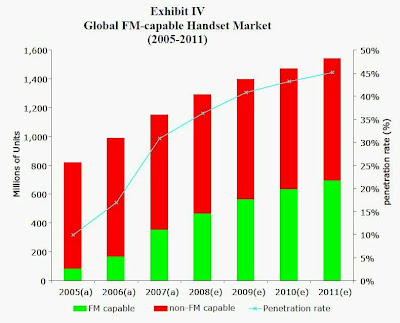
The NAB report included a graph (see below) which displays data supplied by iSuppli Corporation forecasting that, by 2011, 45% of all mobile handsets globally will incorporate FM radio.

It is noteworthy that the US, in this case, seems totally happy to ‘follow’ the rest of the world in incorporating FM radios in its mobile phones, a feature that is already widely available in many other countries (including the UK). The US is not trying to argue that some new proprietary broadcast standard (such as HD Radio) be adopted in phones to further the objectives of a particular commercial US business.

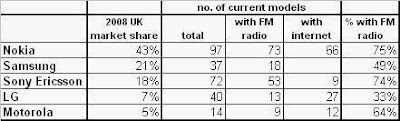
In the UK, we are in a somewhat different position. Mobile phones with FM radios are already out there and being purchased by most consumers. My survey earlier this year of mobile phones available in the UK found that more than half the available models included FM radio (see table below).

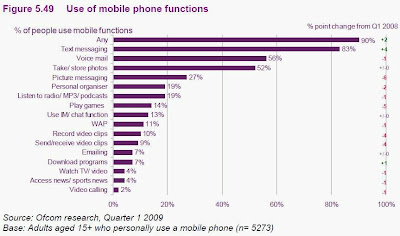
It is remarkable that the hardware is already sitting in millions of UK citizens’ pockets with the capability to listen to FM radio. And it costs them nothing (but battery power) to listen. The only disappointment is that people do not seem to be using their phones much to listen to the radio, according to Ofcom data (see graph below):

Most industries would kill to achieve the kind of penetration levels that FM radio has already achieved in the UK with mobile handsets. Yet the commercial radio industry in the UK, unlike in the US, appears to see little advantage to directing listeners to the mobile phone platform. Why?

Maybe because:
• RAJAR, the radio audience metric, does not publish listening data separately for the mobile phone platform in its quarterly survey [confusingly, it presently seems to lump respondents’ reported mobile phone listening to live radio into its ‘digital unspecified’ platform category, even though FM radio received via mobiles is, in fact, analogue]
• DAB is the platform of choice for the commercial radio industry because it (like the BBC) has invested so heavily over a decade in building its expensive infrastructure, so why persuade listeners to go elsewhere? The questions to be asked are: What is your radio company primarily – a content provider or a platform operator? Are ‘hours listened via DAB’ really more important to you than ‘TOTAL hours listened’?
• DAB (like FM) restricts consumers’ listening to BBC and UK commercial radio stations, whereas mobile devices increasingly offer a much wider choice of content (not on FM, but via G3 or broadband). So there is reluctance to promote a mobile platform that could potentially attract a previously loyal listener to, say, Last.fm

As a result, a drive to encourage FM radio listening on mobile phones does not figure in UK commercial radio’s overall strategy, even though it might help maintain the sector’s audiences and revenues (admittedly, some companies such as Global Radio and Absolute Radio have individual initiatives that do push the point). You cannot help but think that opportunities are being lost here because:
• All the industry’s platform eggs have been placed in the DAB basket
• The DAB campaign in the UK seeks to persuade consumers to PURCHASE a new radio receiver, whereas almost everyone already owns a mobile phone, so a campaign to persuade consumers to use its FM radio will involve no additional purchase
• The UK industry wants to maintain its ‘walled garden’ that shields consumers from experiencing non-BBC/non-UK commercial radio content, thus maintaining the cosy content duopoly.

A parallel might be Tesco not wanting to tell customers about its ‘Metro’ stores within petrol stations because it was worried that they might spend their disposable income on forecourt petrol rather than Tesco items. That would be crazy. Tesco simply wants consumers to be offered as many opportunities as possible to buy Tesco goods, wherever that opportunity might arise.

The incongruity is that the US radio industry desperately wants to be at a place where we, in the UK, already are (lots of mobile phones incorporating FM radio). Yet, what are we ourselves doing to promote FM radio listening on mobile phones? Almost nothing.

FRANCE: digital radio rollout hangs in the balance

The much delayed report on digital radio commissioned by the French government from Marc Tessier, former CEO of France Televisions, was published on Monday 9 November 2009. It suggested that the planned launch of France’s first digital radio stations in mid-2010 was “implausible” and it proposed that an economic model for digital radio needed to be identified before an estimated 600m to 1bn Euros is spent over the next ten years on the rollout of digital radio in France.

The 54-page report raised queries concerning almost all the various aspects of digital radio implementation: the funding, the T-DMB standard adopted in France, the date for FM switch-off, and the cost of simulcasting on both analogue and digital spectrum for a ten-year period. It concluded: “There is still time to consider the appropriateness of pursuing digital terrestrial radio, at the point when several players are unwilling to endorse its prerequisites [coverage, reception quality] or to pay for the additional transmission costs for ten years”.

Interviewed in Le Figaro, Tessier was asked if digital radio should be halted altogether. “That’s for the radio bosses to decide. But I believe there is serious doubt over the desirability of a project that will take ten years, at a time when a new radio platform is evolving at great speed via mobile phone networks. Digital terrestrial radio has less to offer now than it did three years ago. Where will we be in five years time?”

Asked what the crucial issues are, Tessier said: “The coverage area and the number of stations available to every citizen would be the main benefits of the project. That is why each radio station owner must commit to covering at least 90% of the population, which involves huge costs at a time when radio advertising revenues are declining under pressure from new media. If we reduced the coverage area to cut the costs, the project would attract little interest”.

Also interviewed in Le Figaro, Rachid Arhab, president of the CSA [France’s broadcast regulator] digital radio working group, was asked if the report threatened the future of digital radio. “I am not bothered”, he responded. “This report is but one part of the digital radio project, and we are now awaiting the Hamelin report on the funding for radio groups. I recall that the letter to Tessier commissioning this report explicitly required it ‘to map out the successful path for digital terrestrial radio’ based on the notion of public funding.”

Asked whether digital terrestrial radio would be overtaken by other radio platforms, Arhab said: “Technology is evolving very quickly. But the longer we wait, the more difficult it will be. In ten years time, perhaps a significant portion of listening will no longer be delivered by radio waves. But that would pose a major problem in terms of platform neutrality. If there is no digital terrestrial radio platform, then public radio will be obliged to negotiate with the internet service providers for distribution. The CSA does not want to take digital radio away from radio receivers. For each new problem, we find a solution”.

Asked when digital radio will launch, Arhab said: “I can no longer give a precise date.”

The commercial radio owners started meeting the evening the report was published to draft their response, which they will deliver to the CSA by 23 November.

L’Express newspaper commented: “Without a huge effort from the radio industry, which right now does not believe in it, digital terrestrial radio is doomed to failure even before it starts”.

Radio in the Digital Economy Bill: the tail wagging the dog

The government’s forthcoming Digital Economy Bill will be the most significant legislation for the UK radio industry since the passage of the Communications Bill in 2002. Published at the end of November 2009, the Digital Economy Bill will propose ‘primary’ legislation that sets out a new regime for the licensing and regulation of commercial radio in all its forms – national analogue stations, local analogue stations and local DAB multiplexes.

The main thrust of the new legislation for commercial radio was contained in the Digital Britain final report published in June 2009. According to the Department of Culture Media & Sport, Lord Carter’s almost year-long consultation was intended to set out “the Government’s strategic vision for ensuring that the UK is at the leading edge of the global digital economy” and would introduce “policies to maximise the social and economic benefits from digital technologies”. Indeed, some of the changes proposed for the radio industry are forward-looking and designed to place the sector in a multimedia future in which it could survive and thrive.

However, some of the recommended changes to existing radio legislation are there only because parts of the commercial radio industry have lobbied for them to be there. At the time, these interested parties might have claimed that such changes would be beneficial to the commercial radio industry as a whole. Increasingly, other parts of that industry have realised that some Digital Britain proposals were lobbied for inclusion only because they suit the interests of a particular player, offering little or no benefit to the wider industry.

Worse, one proposal ties the future of the whole industry to a dangerous poker game with the government which commercial radio is unlikely to win. This is the Digital Britain proposal [page 102, paragraph 44] to automatically extend the existing licenses of the three national commercial radio stations for a further seven years. Why is this proposal there, and what does it have to do with the UK’s digital future? What price is the commercial radio industry being forced to pay for its inclusion?

During the Digital Britain consultation period, Global Radio had lobbied intensively to have the licence of its national analogue station, Classic FM, automatically renewed beyond its 2011 expiry date. In January 2009, I had written:

Classic FM’s licence expires on 30 September 2011 and it cannot be automatically renewed. This is a big problem. Whereas local commercial radio licences are still awarded (and re-awarded) by Ofcom under a ‘beauty contest’ system, national commercial radio licences are not. The system for national commercial radio licences is simple. Sealed bids are placed in envelopes. Ofcom opens the envelopes. The bidder willing to pay the highest price wins the licence. That’s it. This system is enshrined in legislation. Even if Ofcom wants a different system, it cannot change it without legislation.

As Classic FM’s new owner, Global Radio definitely wants a different system that will enable it to hang on to this most valuable asset. Global has been busy bending the ears of anybody and everybody who it might be able to persuade to interpret the broadcasting rules in a way that lets it keep Classic FM after 2011. Even Ofcom has had its lawyers busy examining the legislation to see what flexibility it has to interpret the rules in a way that might maintain the status quo.

Unfortunately, the legislation in the Broadcasting Act 1990 is quite specific:
“[Ofcom] shall, after considering all the cash bids submitted by the applicants for a national licence, award the licence to the applicant who submitted the highest bid.”

The solution for Global Radio was to lobby, lobby and lobby some more for the current legislation detailing the licensing system for national commercial radio to be revoked, changed, amended – whatever needed to be done to ensure that Global could hang on to its valuable Classic FM licence. When Digital Britain was published, it was evident that the phone calls and meetings had paid off handsomely. Lord Carter had listened and offered a solution – a significant change to primary legislation that would allow Global Radio to retain its Classic FM licence for a further seven years, replacing the existing legal requirement that it be re-awarded by Ofcom to the highest bidder in an auction in 2010.

Why exactly is Global Radio so desperate to hang on to Classic FM?

Firstly, Classic FM is a ‘cash cow’ and has always been the most successful of the UK’s three national commercial radio stations launched in the early 1990s. It attracts 40m hours listening per week which, at current sector yields, would earn it around £50m per annum revenues. However, its earning power is further enhanced by the affluence of its audience. Of its hours listened, 66% derive from ABC1 adults, 85% from ‘housewives’, and 68% from adults aged 55+, a target age group that very little commercial radio reaches. As a result, Classic FM is likely to be attracting more than 10% of total UK commercial radio revenues, significant for a single player out of 300 commercial stations. [RAJAR, Q3 2009]

Global Radio overpaid to acquire GCap Media for £375m in 2008. The challenge for Global is that the radio business is dominated by fixed costs. In other words, however many listeners an individual station has within its service area, that station’s costs are relatively static. Many of the stations in Global’s portfolio are medium-sized local operations, whereas Classic FM is a ‘giant’ with national coverage. Its profit margin probably far outstrips every other commercial station in the UK. Classic FM alone probably generates more operating profit than all Global’s other radio stations added together.

Classic FM occupies a unique position in the radio market (the only competitor in the classical music format is BBC Radio Three) and its market power has proven relatively stable over time, with a current listening share of 3.7%, only slightly down from 4.1% a decade ago. By comparison, GCap Media’s prime local radio assets also acquired by Global Radio have lost immense market power over the same period – the market share of London’s Capital FM down from 13.0% to 6.2%, and Birmingham’s BRMB down from 17.1% to 4.8%, for example. Thus, Classic FM is very much a ‘rock’ at a time many local commercial stations occupy a ‘hard place’. [RAJAR, Q3 2009 & Q3 1999]

Global Radio desperately does not want to partake in an auction for the Classic FM licence. It might under-bid and lose. It might over-bid and win. Either outcome would be a disaster, the former losing it the ‘crown jewels’, the latter allowing it to keep the licence but at a price that could lose the station its ‘cash cow’ status. Because there has been no auction of a national commercial radio licence auction since the early 1990s, nobody knows what the winning bid price might be. Worse, in the 1990s, the field had been open only to European Union companies. Legislation since then has opened up the bidding to the global market. Thus, a licence auction would be an extremely dangerous game for Global to play and, if it lost, would force it to write off its entire Classic FM balance sheet valuation only two years after it acquired the station.

Global Radio has a bargain on its hands in the current Classic FM licence. Not only does this one radio station attract more than a tenth of all commercial radio revenues, but its Ofcom-issued broadcast licence costs very little by market standards. The present cost is fixed at £50,000 per annum + 6% of revenues, probably amounting to around £3m per annum, not a huge expense for a station that generates around £50m. Why is the licence fee so little?

It is the regulator (initially the Radio Authority, now Ofcom) that sets the price of the licence, in the first instance according to the amount that the applicant has bid in its licence application to win the right to broadcast. The price of the licence is collected by the regulator but remitted directly to the Treasury in payment for the scarce FM radio spectrum used by the station.

In 1991, when it won the licence at auction, Classic FM had bid £670,000 per annum plus 14% of its revenues. In 1999, the Radio Authority increased this to £1m per annum plus 14% of revenues. However, in 2006, Ofcom reviewed the Classic FM licence payment and slashed it to £50,000 per annum plus only 6% of revenues. As the table below shows (using estimated amounts because the advertising revenues generated by Classic FM are not published), Global Radio purchased Classic FM just at the time when its licence started to cost significantly less than in previous years.
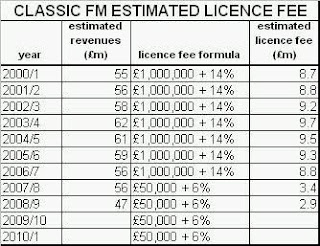
Why did Ofcom decide to reduce the cost of Classic FM’s licence so substantially? Because Ofcom believed that the analogue FM spectrum used by Classic FM would become less and less important with time, as listening via digital platforms, mostly DAB, rapidly replaced FM listening. Ofcom’s own forecast, made in November 2006, anticipated that digital platforms would account for 60% of all radio listening by 2011, the date when Classic FM’s licence expires. Quite how this justified a 95% cut in the licence fee, alongside a 57% cut in the revenue charge, was not explained by Ofcom. Essentially, Ofcom offered Classic FM’s owner the bargain analogue radio licence deal of a lifetime.
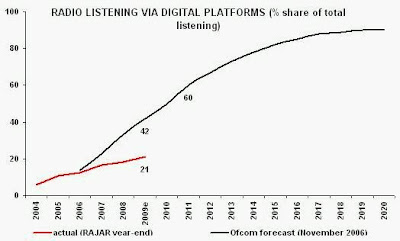
Ofcom’s forecast of digital radio listening turned out to be wildly over-optimistic, appearing to be based more on wishful thinking than on available evidence. Whilst Ofcom had forecast that digital platforms would account for 42% of radio listening by year-end 2009, industry data show the present outcome to be 21% for all radio and 20% for commercial radio. [RAJAR Q3 2009]

The inaccurate Ofcom forecast for consumer uptake of digital radio (never subsequently updated publicly) merely confirmed the belief within a large part of the radio industry that digital radio was about to exhibit exponential growth. This Ofcom forecast, accompanied by supporting comments from the regulator (for example, six months later, Ofcom director of radio Peter Davies said: “we are potentially at a Freeview moment with digital radio”), proved significant in misleading stakeholders into believing that the death of analogue radio was just around the corner. The regulator could not have got it more wrong.

Ofcom’s inability to forecast the radio market it regulated has resulted in a loss of millions of pounds of potential commercial radio licence fees for the Treasury, not only from Classic FM, but from the other two national commercial stations whose licence fees were also reduced. By Ofcom’s own estimate, under the previous formula the three stations combined had paid £7m per annum, but were now being charged less than £1.5m per annum. Over the four-year period until the three stations’ licences expire in 2011/2, the total revenue foregone to the Treasury will be around £22m. The Digital Britain proposal to extend these national radio licences for a further seven years, if the present licensing payment scheme is continued, would increase the total potential revenue lost to the Treasury to more than £50m.

Neither RAJAR nor Classic FM release data publicly showing the proportion of the station’s listening derived from digital platforms, but it presently seems unlikely that the station would voluntarily give up using FM for broadcasts after 2011 (when the present licence expires), and probably not even after 2018 (the revised expiry date if Digital Britain’s proposed seven-year licence extension were legislated). Effectively, the Digital Economy Bill would merely enable the largest player in the commercial radio sector not only to hang on to its ‘cash cow’, but to continue paying its present low licence payments to the Treasury for the FM radio spectrum it uses.

The losers from this arrangement are:
• taxpayers who, thanks to Ofcom’s poor forecasting, are now effectively subsidising the FM spectrum used by the commercial radio sector’s single most profitable asset
• the rest of the commercial radio sector who will never be able to match Classic FM’s operating margin because their own costs and revenues are considerably more constrained
• new entrants to the radio sector who wish to bid for the Classic FM licence when it expires in 2011 and are willing to pay a realistic, market price for the licence, but will be denied the opportunity by the government’s offer of an automatic licence renewal.

Politically, the proposals in the Digital Britain final report could not have isolated Classic FM as the sole commercial radio station to have its licence automatically renewed through new legislation. So the renewal proposal was extended not only to all three national commercial stations, but also to all local analogue stations that are broadcasting on the DAB platform. In July 2009, I suggested that this Digital Britain proposal was still iniquitous to the remaining local commercial stations that cannot or will not broadcast on DAB. It appears now that the Digital Economy Bill is likely to extend the proposed licence extension to all analogue commercial radio stations (whether or not they simulcast on DAB).

So every analogue commercial radio station will now be offered an automatic licence extension! Is that not a universal ‘good thing’? Well, no, because there is rarely a ‘free lunch’. Lord Carter was determined to extract a price from the entire commercial radio sector for bowing to persistent demands from Global Radio for new legislation to renew its Classic FM licence. The strings he attached are related to the government’s insistence that the whole radio industry use DAB as its main broadcast platform. This is why two entirely unrelated issues – Classic FM’s licence and DAB consumer uptake – have now become so intertwined in the proposed legislation.

In the seven-year renewal offered to every commercial radio licence, the government proposes to insert a clause that will allow it (via Ofcom) to terminate that licence extension with two years’ notice if the radio industry as a whole (commercial radio and the BBC) does not achieve these goals:
• 50% of radio listening to be via digital platforms by 2013
• DAB transmission infrastructure to be upgraded significantly.

It is a ‘carrot and stick’ approach: ‘We the government will give you all a free licence extension if you collectively promise to make DAB work. But, if we find you do not succeed in making DAB work, we will take your licences (and hence your businesses) away altogether’. The problem here is that the buck has been passed on to a wide and varied constituency of 300 commercial radio stations, many of whom have very little or no control over whether DAB can be turned into a successful delivery platform.

It is the entire commercial radio industry that will be expected to potentially pay the price with its own lives in exchange for changes to primary legislation that allow Global Radio to hang on to its ‘cash cow’ Classic FM licence. What seems even more unfair is that the entire DAB platform is owned and controlled by a mere handful of the largest UK commercial radio companies who, between them (and the BBC and transmission company Arqiva), wield the power to make DAB a success or failure.

If the largest commercial radio owner, Global Radio, had demonstrated incredible confidence in the DAB platform, maybe it might instil confidence in the rest of the radio sector that DAB could be made a consumer success by 2013. However, although Global Radio has regularly talked the DAB talk, it has hardly walked the DAB walk. Global had been the largest owner of commercial DAB infrastructure until, in April 2009, it sold its 63% stake in the national DAB multiplex and its wholly owned group of local DAB multiplexes. At the same time, it has sold or closed all but two of its digital-only radio stations, which exist now only as music jukeboxes.

Of course, for Global Radio, none of the DAB ‘strings’ really matter. It thinks it has got exactly what it wanted in the forthcoming Digital Economy Bill – to keep its valuable Classic FM licence. This is its significant short-term goal and may be the only thing that can keep the group afloat financially. Who knows? If the media ownership rules are relaxed, Global might be able to sell its entire radio business to Murdoch or RTL or MTG before the 2013 date of judgement on DAB is even reached.

For a while, many in the industry had seemingly been happy to line up behind Global Radio, uncertain of their own futures and relatively uninformed on these complex regulatory and legislative issues. But the truth is dawning on many – what is good for Global Radio is not necessarily good for the rest of the commercial radio industry. The future of commercial radio should remain in the collective hands of the industry itself, not be determined by one individual owner. And the issue of radio licence renewals should not have to be linked to the future performance of the DAB platform.

Digital Britain and the Digital Economy Bill offer a rare opportunity to update the regulatory regime for the entire commercial radio sector, rather than merely to offer one company a ‘phone a friend’ millionaire lifeline.

[For the purpose of transparency, I contributed sector analysis to two documents that were part of the Digital Britain process – a pre-consultation overview and the regulation of local radio.]

[Note to the table: the estimated costs of the Classic FM licence fee are simplified. Firstly, the cash amount paid increases annually from £1,000,000 in 1999 to £1,161,000 in 2006 and subsequently, in line with the Retail Price Index. The £50,000 cash payment will similarly be adjusted. Secondly, the revenue percentage paid is applied only to “advertising and sponsorship revenue attributable to national analogue listening hours”, but this data is not published, so 100% of estimated revenues have been assumed to derive from the FM platform.]

Digital radio in France: T-DMB or not T-DMB?

The question of which digital radio broadcast standard should be adopted in France continues to be an issue of growing concern, even as the proposed launch in 2010 nears. According to l’Humanite, Socialist Party deputy Jean-Marc Ayrault has written to Culture Minister Frederic Mitterand, questioning the risks for local radio owners involved in the Ministry of Culture & Communications choosing a single digital radio standard. According to Ayrault, the decision in 2007 by then Culture Minister Christine Albanel of “T-DMB in Band III as the sole [digital radio] standard is worrying stakeholders more and more of the value to have chosen only one standard between T-DMB and DAB+”. Ayrault noted that tests by local radio groups in Nantes had demonstrated that “the joint implementation of both standards is technically possible”.

L’Humanite commented that “the launch of digital terrestrial radio is being complicated by a real scepticism, almost mistrust, in the notion that it can be started in early 2010”. The Ministry of Culture & Communications is due to present to the government a delayed second report on the proposed rollout of digital radio.

AUSTRIA: media regulator puts DAB radio on hold

On 3 November 2009, the Austrian media regulator RTR presented the results of a study that had been commissioned in December 2008 on the potential for digital radio in Austria. Dr Alfred Grinschgl, managing director of RTR, commented: “The reason we in Austria are not presently digitising radio is that, in neighbouring Germany, there is no unanimous agreement on adopting DAB or DAB+ and therefore no successful large-scale launch.”

ORF, Austrian state radio, technical director Peter Moosmann commented that the time was not yet “ripe” for the introduction of digital radio and he rejected the notion of planned FM switch-off. “In every Austrian household, there are four or five radio sets that would need to be replaced with one blow,” he said. “We do not want to force the listener to switch, but want to entice them to digital radio with the appeal of new radio formats”.

The chairman of the association of Austrian private broadcasters, Christian Stogmuller, said that the successful launch of digital radio in Austria could only happen under a single European-wide technical standard, the existence of sufficient digital radio devices in the market and a significant financial commitment from public funds to launch digital radio.

The Austrian Association of Free Radios, VFRO, said it was sceptical because DAB/DAB+ is designed for large-scale radio services, whereas it suggested alternative technologies such as the DRM+ system be used for expanding local radio.

Michael Wagenhofer, managing director of transmission company ORS (60% owned by ORF), said: “The introduction of a digital radio transmission standard will require simulcasting [broadcasting content on both analogue and digital] for about 15 years because the car industry alone has a six-year implementation cycle”. He estimated the cost of building DAB multiplex infrastructure in Austria would be around 8m Euros.

Dr Grinschgl of RTR said that the anticipated carriage cost of DAB transmission for a local station would be around 100,000 Euros per annum, and that nationwide coverage on DAB would cost 800,000 Euros per annum. He warned that, if individual stations had to bear the costs of broadcasting on both FM and DAB, then DAB would develop only “very slowly”.

Back in June 2008, an ORF article on digital radio had noted: “The reason for the lack of consumer interest in digital radio is that RTR [the regulator] licenses a good range of conventional analogue radio services. The consumer is more than satisfied with the existing diversity of content and the quality of reception”.

Meanwhile, at the Media Days event in Munich this week, Jurgen Doetz, president of VPRT, the German association of private broadcasters, was reported to have proclaimed: “Digital radio is dead, dead, dead”.

DAB radio: "let us get on this horse or get off it"

House of Commons Culture, Media & Sport Committee
“The future for local and regional media”
27 October 2009 in the Thatcher Room, Portcullis House

Andrew Harrison, chief executive, RadioCentre
Travis Baxter, managing director, Bauer Radio
Steve Fountain, head of radio, KM Group

[excerpts]

Mr Tom Watson: Can I ask you about Digital Britain and the Digital Britain Report? Do you think the report gave a good way forward for the commercial sector to journey out of its current troubles?

Mr Baxter: Perhaps I could ask Andrew to give an overview on that and then maybe we can give our respective views?

Mr Harrison: To give an overview, I think the short answer to that is “yes”. One of the fundamental issues the sector faces right now is the appalling cost of dual transmission. Ultimately, right now, this is a small sector and very many of our stations are simultaneously paying for the cost of analogue and digital transmission. That clearly does not make any financial sense. What we advocated for in Digital Britain was a pathway for all stations to end up with a very clear plan of what is the single transmission platform for them. That led, as I said in my opening remarks, to three very complementary tiers of the commercial radio offer. The first tier is a strong national offer on digital to compete with the BBC, and that is critical for the sector because the truth is that the FM spectrum is full. I am sure all of you will know from some of the other conversations we have had before that the BBC dominates the gift of analogue spectrum. It has four national FM stations; we only have one with Classic FM. For the sector to compete and capture its share of national advertising revenue, the ability to have a national digital platform I think is critical. As we then had the conversations with Digital Britain, I think it became very clear to all of us that you cannot just migrate national stations to digital and leave all of the large metropolitan local stations, like City in Liverpool for example or Metro in Newcastle, all the BBC’s local stations, as analogue only. The listeners to those stations will want the functionality, experience and benefits that come with digital. It is then very important that we have a second tier of the large local and regional stations which also migrate to digital. Critically, however, that nevertheless leaves an important third tier, which are the smaller or the rural stations for which either DAB coverage is currently not present – there is just not the transmitter build-out in some of the rural areas – or for which it is likely to be prohibitively expensive going forward. That sector equally needs clarity and that sector being able to stay on FM alongside community radio we feel gives a very balanced ecology where the sector has the most opportunity to compete and the lowest cost base because each station can ultimately choose whether it is on one transmission methodology, i.e. digital, or another, analogue. At the moment, we are in limbo where stations are paying for both but the profitability of the sector is fragile and there is not a plan. So we absolutely welcome the beginnings of that plan, which we recognise is the start of what is going to be a long and difficult journey as stations migrate and decide if their future is on digital only or their future is on analogue. The quicker we can move the industry there, clearly the better for the fragile economics of the sector.

Mr Baxter: Perhaps I can encapsulate some of the things we sent in to the Carter Review. Our business view generally is that the future is digital. There is hardly the need for me to make that clear to you. Our view has been for the last ten years that we will look at all platforms as we develop our business. We have successful radio stations, primarily operating for example off the audio channels on the Freeview digital television system. However, within that we think it is of real value for radio to have a bespoke platform and the one that is available to us that is a bespoke broadcast platform is DAB. It has, however, taken 12 to 13 years of very slow development for that platform to get to its current state. Therefore, our proposition to Carter’s Review was: let us get on this horse or get off it. We think we should get on it and put every possible energy we can over the next view years into getting consensus, direction and pace into the whole process of take-up, like there has not been during the last 12 years. If that can be achieved, it will produce a new resonance for commercial radio as a whole, indeed for the whole of radio. It will help position radio more effectively in the fragmenting media landscape we all have to deal with and give us an opportunity, as Andrew said, of clarifying our investment levels around platforms where currently we are having to pay for two when, in a future where either one is successful, we would only have to pay for one, thereby allowing resource to be put into developing content and other things around our business.

Mr Fountain: KM Group does have a digital platform. It is currently costing us over £100,000 a year and we get absolutely nothing back from it. I think the company at the time, six years ago, took the view that they wanted to be a part of the future. Circumstances since have not really helped them to be able to develop that particular medium. I think we too take the view that we would want to be part of a digital platform going forward, but there are a number of issues that would need to be overcome, not least of all the cost of entry and also in our particular case our DAB coverage and the coverage of our FM stations is not mirrored. We have better coverage right now on our FM platforms than we do on our one single DAB coverage. The problem around the coast, if you take that from Medway right the way round perhaps as far down as Rye, around the Kent coast and just touching into Sussex, is such that DAB does not actually reach into large parts of that coastal area.

Mr Watson: Would DAB+?

Mr Fountain: I could not answer that because I do not actually know.

Mr Harrison: No, there is no difference in terms of the coverage for DAB or DAB+. DAB+ is just a different method of compressing the signal so you can actually get more signal down the pipe, if you like; you tend to get more stations, but it does not actually affect the coverage.

Mr Fountain: You can see that in order for us to extend the coverage of DAB, there is clearly a cost involved, and there is also a conversation to be had between Ofcom and the French communication authorities as well.

Mr Watson: Presumably you are all relatively happy with what is quite a demanding timetable outlined in Digital Britain if your view is that we should just get on with it and do it?

Mr Harrison: I think you have expressed it exactly right. The timetable is demanding. I think it is set deliberately as being demanding. Digital Britain does not set a date for switchover. What it sets are two criteria that it says are axiomatic to be hit before switchover can be contemplated: one on listener levels and one on coverage, both of which we support. The aspiration in Digital Britain is to try and hit those two gates, if you like, by the end of 2013. On what Travis was saying earlier on, we think that is absolutely right, that the industry now works terrifically hard together, alongside the BBC and alongside the Government and the regulator to do our very best to hit those criteria. Once we then hit the criteria, the Digital Britain report identifies that it will probably take a couple of years from the criteria being hit before we could actually contemplate switchover. That is aggressive but we think it is appropriately aggressive against the context of an industry that is clearly struggling financially now, and the vast majority of my members are highlighting the cost of dual transmission as the single biggest cost issue that they face and self-evidently one that could be eliminated the quicker we can get to a decision one way or the other.

Mr Watson: May I ask you a bit of a left field question? You are quite confident that we should move to digital radio quite quickly. How confident are you that consumers will want to make that journey and that they will not migrate to internet, radio or choose to listen to live streaming sites like Spotify?

Mr Harrison: There are two different points there. We are quite confident, as you say, about the movement to digital, but purely because what the Digital Britain Report sets up are consumer-led criteria to drive that change. The criteria are absolutely that we will not move until coverage is built out to match FM. It would be absolutely suicidal for the industry to switch people off who currently listen and enjoy radio services, so it is axiomatic that we have to build coverage out. Secondly, the criterion is that listenership to digital has to be that the majority of all listening has to be to digital before you would contemplate switchover. We are not going to rush into this without being led by the consumer. What we are trying to do, as Travis said earlier, is inject some pace, momentum and energy into the process. If we wait for the natural replacement of sets and the natural progression of DAB – it has taken a long time to get to the listener levels we have right now, we still have all of the BBC’s services for example available on analogue – it is going to be very difficult to kick start the progression. We are very comfortable but we are comfortable because it is led by the consumer. The second part of your question is: are we worried about competing services? We are absolutely. I think there is a whole generation of new entrants into the market – Spotify, Last.fm, Pandora – available on-line, all of which are unregulated and against which we are competing for listeners and for advertising revenue. When you have a small, heavily regulated, constrained local radio sector competing with an unregulated world-wide series of music offerings, that is one of the challenges we have to face. We are, however, absolutely committed to the importance of a broadcast transmission methodology for digital. That is not to say that the internet will not be an important complement to that but our business model is based on a broadcast signal of one signal to a wider audience. There is very little evidence so far that on-line music offerings are in themselves profitable business models. For UK citizens and consumers, for our listeners, we think it is absolutely critical that radio remains free at the point of delivery. That has been one of its great strengths ever since the BBC was founded in the 1920s. Of course at the moment, although as I heard this morning the cost of broadband is potentially down to £6 a month, nevertheless, to access any internet-delivered service, you have to pay an ISP connection. That may change but I suspect we are a long way away from that.

[edit]

Mr Watson: Do you think the car industry is sufficiently prepared for the digital revolution?

Mr Baxter: I think we have had some very encouraging conversations with the motor industry over the last six months. The response to Carter’s work during the beginning of this year has helped galvanise interest in that area quite significantly, so I think there is a very different aura around those discussions than there was 12 months ago.

Mr John Whittingdale, Chairman: Just on the cost of the digital upgrade, what is your best estimate of how much it is going to cost?

Mr Harrison: I was on the working party, the Digital Radio Working Group, that was the forerunner for Digital Britain. That working group identified the cost of build-out, the one-off capital cost, as between £100 million and £150 million. That is quite a spread. The reason for the spread ultimately depends on what degree of coverage build-out you get to from equalling FM to universality and at what signal strength. Of course, you get real diminishing returns as you go to the very rural areas. That is the reason for the spread. There has been a lot of debate about that number. In reality, the way we have tended to look at it is that if you take that spread of £100-£150 million over the 12 year period of a licence, which is typically when a radio station is licensed or a multiplex is licensed, and if you said for round figures it is £120 million, that is £10 million a year for the licence period. I think it was £10 million a year that the Secretary of State quoted for example last week. Funding that we have always felt is actually absolutely critical to the build-out and conversation to Digital Britain. The commercial sector is absolutely happy to pay its way to the extent that the build-out is commercially viable but, after that, there is a clear public policy imperative. If the Government and Parliament decide that it is important to have a dedicated transmission structure for radio, that will be a public policy decision and it will need funding. That said, we believe that funding is very affordable. If you take that £100 million number, we believe that, for example, the BBC would save much more than that over the period of the 12-year licence just on what it will save on FM transmission alone, so there is a straightforward business proposition. Another way to think about the £100 million over a 12-year licence with the current Licence Fee settlement for the BBC at around about £3.5-£3.6 billion a year is that over 12 years that is £43 billion. The £100 million infrastructure cost for DAB radio is less than a quarter of one per cent of what the BBC’s income will likely be over the next 12 years. So it is eminently affordable if there is a public policy decision that it is important to do that build-out.

Chairman: Those two arguments suggest that you are looking for the BBC to pay for this.

Mr Harrison: We have said very clearly and very fairly that we are absolutely happy to pay our fair share in our way to what is commercially viable.

Chairman: What does that mean?

Mr Harrison: That means that we have already put our hands in our pockets substantially to build out coverage on a local and a national basis as far as we judge is affordable. I think realistically, given the state of the sector, the vast majority of the cost going forward, which is primarily designed to meet the BBC’s obligations of universality rather than the commercial sector’s obligations of viability, should rest with the BBC.

Chairman: So whilst RadioCentre is keen to move ahead with the digital upgrade, the economics of your sector at the moment means that you cannot really afford to put any more money into it?

Mr Harrison: We believe that transmission coverage build-out is axiomatic; it is one of the criteria to effect switchover. We cannot afford it but we absolutely believe the BBC can.

Philip Davies: Andrew, on this part can I ask you about how representative your view is of the industry as a whole? It was over this issue it seems more than any other that UTV Radio quit the RadioCentre and said that it felt that it was no longer representing the interests of the wider industry and gave too much power to its biggest member.

Mr Harrison: Yes, UTV did say that. Scott Taunton, the UTV Radio managing director, actually represented the commercial radio industry with me on the Digital Radio Working Group through all the per-work that was done for Digital Britain, and so they have been intimately involved. To be fair to UTV’s position, they have a particular reservation over the date and the timing for digital, but to be fair to the Digital Britain Report, and indeed we await the clauses of any potential Bill because it is not yet written, there has never been a formal switchover date actually agreed. Although, for example, I think Scott in his Guardian article yesterday talked about a 2015 date being farcical, that date has never been set. What have been set are two consumer-led criteria that have to be hit and then a transition period after that before we all migrate. As Travis said earlier, the majority of opinion across the sector, and certainly across my members and representing my board, is that we need now to put our foot on the gas and work hard to deliver the criteria. Inevitably, there is going to be a spectrum of views with different businesses in different places in terms of their own business models as to the urgency or not they see behind that. UTV are absolutely right to have their own position. They are more at the tail end of the timing.

Philip Davies: UTV did not just say that they had a different position to you. They said something a bit more fundamental than that that they felt that you were no longer representing the interests of the wider industry. It was not just as if they had a disagreement. They were indicating that there were others in the sector who shared their view. Do you accept that there are many others or some others in the sector that would share their view?

Mr Harrison: I would absolutely accept that we are a broad church and there is a breadth of opinion. I represent large and small stations, local and national, rural and metropolitan, so there is a breadth of opinion. To give you an example of that, our other major national station member that is on AM is Absolute Radio and they believe that the timing for digital should be sooner rather than later. They already have over 50% of their listening on digital platforms, one way or another, so they would move sooner. I have a number of digital-only stations in membership, stations like Jazz and Planet Rock, which clearly are already digital-only and would like to be in the vanguard. Inevitably, there is a spectrum of opinion and we try our best to reflect the overall views. The truth is that it is very unfortunate that UTV have left membership but we continue to represent the vast majority of the sector and its stations and will continue to try to steer a path, helping Government and helping the regulator through this tension.

CATALONIA: DAB radio in a "coma"

A new 176-page report documenting the current state of radio broadcasting in Catalonia (the autonomous region in Northeast Spain with 7.4m population) says that DAB radio “is in a state that could qualify as a technical coma”, according to infoperiodistas. Of 48 licences awarded by the media regulator for DAB radio, only 23 stations are presently broadcasting and are reported to have no impact on radio audiences.

Digital Radio Upgrade & the Digital Economy Bill

Westminster eForum Parliamentary Reception
Terrace Pavilion, House of Commons, London
28 October 2009 @ 1600

“The informal discussion that takes place can be expected to cross a range of current policy issues but the chosen theme is digital switchover and DAB.”

JOHN WHITTINGDALE MP, Chairman, House of Commons Culture, Media & Sport Select Committee:

The future of radio is very much a topic under debate. My Select Committee is currently conducting an inquiry into the future of local and regional media, of which radio is an absolutely critical part. So yesterday we were hearing evidence from Andrew Harrison of RadioCentre, Travis Baxter [of Bauer Media] who is here somewhere today, and Steve Fountain from KM Group. And we are very much aware of the pressures on commercial radio and the difficulties faced. But, at the same time, there are opportunities. And when Digital Britain came out, much of it had been trailed in advance, a lot of it quite controversial – things like top-slicing and file-sharing legislation – but the one bit which came as something of a surprise, I think, was the announcement of the date for Digital Radio Upgrade. Certainly, when I saw that in the Report, my immediate reaction was rather like the ‘Yes Minister’ Permanent Secretary who said: “That is a very brave decision, Minister”.

It is going to be challenging. It is slightly controversial. Not everybody in the industry is 100% yet signed up to it. Equally, there is a cost attached and we can have interesting debates about who is going to pick up the bill for it. And there will be quite a task to persuade people. In the same way that we had to work hard to persuade people that analogue switch-off of television was going to be beneficial, I think the task to persuade people in the case of radio is going to be even greater, particularly whilst we still have the overwhelming majority of cars with analogue radios in them. So there are challenges, but equally there are going to be benefits.

We heard yesterday about the costs to radio of having to transmit simultaneously in both analogue and digital and, clearly, that is something which would be reduced if we managed to get switchover. So this is a very important debate and I am keen that, when we come to debate the Digital Economy Bill when it is introduced, we should not overlook radio. There is always a danger that everybody focuses on television and there will be a huge argument about whether or not the BBC should be the exclusive recipient of the Licence Fee, and whether or not we should be trying to stop teenagers in bedrooms file-sharing, but it is important we should also debate radio and, certainly, that is something which I will try and do my best to ensure happens. But I think this afternoon is a good start to that and it is good to see so many people from the industry assembled in one room. So that’s enough from me, just to say welcome to the reception this afternoon …..

PAUL EATON, Head of Radio, Arqiva:

I would like to welcome you all as well on behalf of Arqiva and Digital Radio UK. Arqiva is part of Digital Radio UK, with the BBC and commercial radio, and I am very pleased to be joined today by Andrew Harrison, chief executive of RadioCentre, and Tim Davie, director of Audio & Music at the BBC.

Digital Radio UK has been formed by the radio industry to get the UK ready for the Digital Radio Upgrade. That upgrade is vital because radio faces a stark choice – we can either stay in the analogue world or we can move forward into the digital one. Both need considerable investment from all of the players but only one, digital, can give radio that exciting future that listeners deserve. Digital radio will mean more choice, a better quality listening experience and the kind of interactivity that we can only dream about today.

We all know that the road ahead is a difficult one. We know that the coverage is not good enough yet, we know that we haven’t got digital radio in enough cars, and we know that we need to get converters onto the market to turn analogue radios into digital ones – set-top boxes for radio, if you like. We know that there is new content and new services that need to go digital. So there’s a lot to do. But, in creating Digital Radio UK, the radio industry is demonstrating that it is serious about the digital future and is determined to address the issues and, in doing so, give the digital future that listeners deserve.….

SIMON MAYO, Presenter, BBC Five Live:

I had one of those “blimey, you’re old” moments this morning. I was talking about radio with my son – my eldest son is eighteen – and I asked him what he listened to and what his friends listen to. He thought for a moment and then he said “none of my friends have got a radio”. I thought that was quite an astonishing moment. Now, obviously, he is an unrepresentative sample of one, that is true. They kind of know about radio and they might listen online, and it’s on in the kitchen and they hear it in the car and they have an opinion of [BBC Radio One breakfast presenter] Chris Moyles, but that was it. It occurred to me that, really, radio has got a bit of a fight on its hands, which is where the kit here [points to display of DAB radio receivers] comes in, I think.

My parents’ generation didn’t need to be told that radio was fantastic. My father, if he was here, would talk about listening to Richard Dimbleby and Wynford Vaughan-Thomas and The Goons. The Goons generation didn’t need to be told that radio was great. The 60s generation didn’t need to be told that radio was great – they had the pirates, then they had Radio One. My generation fell asleep listening to the Radio Luxembourg Top 40 on a Tuesday night. It finished at 11 o’clock and that was quite daring – I see a few people nodding. That was quite daring staying up to 11 o’clock, and the fact that is was sponsored by Peter Stuyvesant cigarettes was even more dangerous. But we remembered it and we fell in love with radio, and I think there is a job to be done to make future generations fall in love with radio.

So enter digital. Partly that has to be done by the broadcasters in coming up with exciting new stations filling gaps that don’t exist. BBC7 is wonderful. Everybody will have their own particular favourites. Absolute Classic Rock is really rather good. If you want Supertramp and Led Zeppelin any time of the day, that’s the place to go. Really good stuff. There are some really big gaps that need to be filled, but that’s exciting. Analogue is full, so digital is the place to be.

But the kit is really exciting. If you have a radio when you are listening to a piece of music …. and you’re listening to the radio and an Angelic Upstarts track comes on, you press a button and it sends you an e-mail that tells you that they have reformed, you can buy their records and this is where they are playing. Or someone is listening to ‘Yesterday In Parliament’ and they hear a speech from a parliamentarian that they like, and they think “he’s interesting, she’s interesting”, press a button, you get sent an e-mail and it tells you who it is, how you can contact them – this sounds quite exciting. If you are listening to one of [presenter] Mark Kermode’s film reviews on Five Live, and you like the sound of the film, you press a button, and its sends you an e-mail, you go to your in-box and it’s got an e-mail telling you where that film is on, how you can go to see it, maybe a link to the trailer. All of that kind of information means that radio has got an exciting future, but it just means that we have to go out and explain it a bit more because people might not get it the way they used to.

Hopefully, there is still a role for the humble presenter. So you do a little bit as well. Thank you very much indeed for coming…..

[A Digital Radio UK factsheet entitled “A briefing on the digital radio upgrade” was distributed at the event. Click here to view.]

Digital platforms: commercial radio losing share to BBC

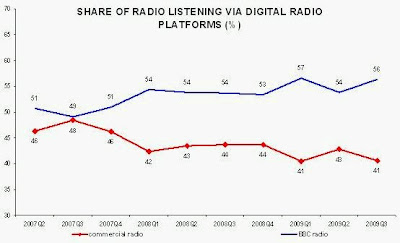
Today’s RAJAR data demonstrates that a gulf is opening up between BBC radio and commercial radio in their ability to attract listening to digital platforms. Over the last year, the BBC is accelerating away from commercial radio in its audience’s usage of DAB, digital television and the internet to listen to live radio programmes. The significance of this growing gulf is reinforced when one remembers that the main RAJAR survey, from which the data below is taken, only measures ‘live’ radio listening and does not incorporate listening to either time-shifted, on-demand radio (‘listen again’) or to downloaded podcasts, both forms in which the BBC offers a much greater volume of content than UK commercial radio.

The danger here is that the BBC is poised to dominate listening on digital radio platforms in the long term, exactly as it already dominates listening on analogue radio platforms. One of the main reasons that the commercial radio sector invested so heavily in digital platforms during the last decade was the opportunity it offered to compete more effectively with the BBC for audiences. In the analogue world, the commercial sector has always argued that the BBC (having been there first) was allocated more and better spectrum for its radio stations. ‘Digital’, particularly DAB, seemed to offer the commercial sector a chance to ‘even the score’ with the BBC. The RAJAR data show that this ambition is not succeeding.

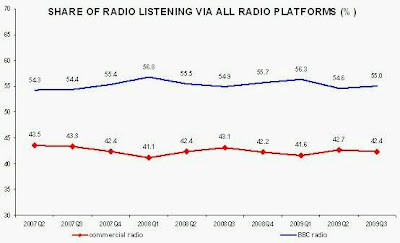
Across all digital platforms aggregated, commercial radio is losing ground, with the latest quarter (Q3 2009) reducing its share of listening to 41%, versus the BBC’s 56% share.

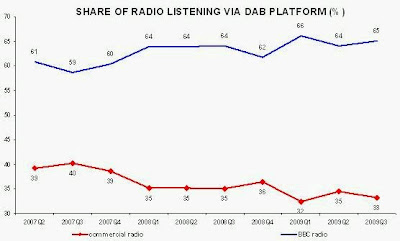
Taking each digital platform in turn, commercial radio’s share of listening on the DAB platform fell to 33% in Q3 2009, compared to the BBC’s 65%. This is not surprising because the age profile of DAB purchasers tends to be older listeners who are statistically more likely to listen to BBC stations. However, it does pose a grave question as to the return that commercial radio can expect from its substantial investment to date in DAB infrastructure, if listening on that platform is dominated so much by the BBC.

The digital TV platform is one that commercial radio has long dominated because of the large amount of spectrum it leased in the early days of Freeview. However, the increasing popularity of digital terrestrial television has already substantially increased the cost of spectrum on Freeview for the radio industry when its contracts come up for renewal. Furthermore, the forthcoming re-ordering of the multiplexes to accommodate HD television and new compression codecs is likely to squeeze commercial radio’s access to Freeview spectrum even more so. Before long, it is likely that the BBC will dominate the digital TV platform, just as it already does on DAB. Presently, the BBC has a 45% share, compared to commercial radio’s 51%.

As might be expected, the BBC’s strong online presence has already put it in the commanding position in terms of its share of listening via the internet platform. The integration of BBC radio into the iPlayer has no doubt helped as well, whereas commercial radio’s offerings are relatively more fractured and less heavily marketed, despite the excellent innovation of the RadioCentre Player. The BBC has a 50% share of listening on the internet platform, compared to commercial radio’s 37%.

The significance of commercial radio’s diminishing share of these three digital platforms is demonstrated when we look at the two sectors’ listening shares achieved on the analogue platform alone. Once one removes the digital platforms from the picture, it is evident that the shares of both the BBC and commercial radio have remained relatively stable in recent years. In other words, it is commercial radio’s declining share of listening on digital platforms that is effectively pulling the sector’s total share of listening (analogue + digital) down, particularly as digital platforms are growing as a proportion of total radio listening (21.1% in Q3 2009).

There is a paradox here. The commercial sector invested heavily in the DAB platform, believing that the new technologies would help it INCREASE its overall share of radio listening versus the BBC. In fact, that investment has recently helped to DIMINISH commercial radio’s overall share of listening. Digital television remains the only platform in which commercial radio dominates, and yet this is the very platform where commercial radio will be forced to cede spectrum and face, once more, losing out to the BBC whose spectrum for radio is guaranteed.

It is important to emphasise that these graphs show only the SHARE of listening on these platforms. The volumes of listening on each of these platforms have demonstrated absolute growth for both commercial radio and for the BBC over the same time period. But, more than any other digital platform, it is significant that the DAB platform is dominated by the BBC which now accounts for almost two-thirds of its usage. Such data is important when making decisions about the potential returns on further investments in DAB infrastructure. Will further investment simply maintain the existing imbalance, or will it really improve commercial radio’s share? Does investment in infrastructure also require parallel investment in new content that will appeal directly to the older age groups who own DAB radios?

Some possible reasons for commercial radio’s diminishing share of listening on digital platforms include:

• Commercial radio’s tendency to invest in DAB infrastructure more significantly than in original digital-only content
• Recent closures of many digital-only radio stations in the commercial sector
• The BBC’s relatively stable resource base, at a time when commercial radio revenues are falling precipitously
• The BBC’s long-held policy to invest simultaneously in multiple platforms, whereas commercial radio has focused on DAB and, to a lesser extent, Freeview
• The BBC’s focus on creating exclusive digital-only content unavailable on the analogue platform
• The BBC’s 360-degree music royalty agreements which allow it to use diverse platforms, whereas commercial radio requires separate (and more restrictive) agreements for time-shifted content and podcasts
• The BBC’s long-term, consistent promotion of content and digital platforms across TV, radio and the internet whereas commercial radio is less willing to cross-promote content or digital platforms that migrate listeners away from its core analogue offerings
• Frequent management changes and ownership changes in some parts of commercial radio, where substantial consolidation has often translated into short-term ‘slash and burn’ rather than ‘invest and build’ policies.

Whatever the reasons, we are not where we were meant to be – that is, we are not where it had been anticipated more than a decade ago commercial radio would be when investment in digital platforms, notably DAB, was expected to produce a beneficial outcome for commercial radio audiences versus the BBC. To put it plainly, the strategy conceived in the 1990’s has not worked. Commercial radio offerings do not dominate digital platforms (yes, they are more numerous, but they do not attract more hours listened than the BBC). DAB has become a largely BBC platform.

So, what can be done? Some of the issues noted above require a more level playing field to be established between commercial radio and the BBC. One such example of a practical solution is the Radio Council plan for a new UK Radio Player that will offer BBC and commercial radio content from a single aggregated access point. Other issues remain mostly in the lap of the gods (revenues, for example). Some issues require the BBC to be less predatory (or more regulated) and for the commercial sector to be more focused on strategic, long-term objectives (such as an online strategy that is more than simulcasting).

There is no single answer to this complex problem, though the commercial radio sector is hobbled by both its present lack of profitability and the regulatory strings that are attached to the majority of its analogue radio licences. What is desperately needed in these difficult times is not minor regulatory tinkering (such as adjusting how many hours of local content a local station is required to broadcast) but a wholesale change in strategy to maintain a commercial radio sector that can thrive in the digital marketplace we now inhabit. Will the imminent Digital Economy Bill prove sufficiently forward-thinking in its radio policy proposals?

[Statistical note: The graphs above to do not sum to 100% because the minimal amount of platform data released by RAJAR is ‘rounded’ (hours listened to 1,000,000; listening shares to 0.1%) and the listening apportioned to the BBC and commercial radio sometimes does not add up to the total for a platform. Some of this shortfall may be accounted for by ‘other’ listening (neither the BBC nor commercial radio) which is not itemised by platform. Data for individual quarters are therefore somewhat inconsistent, though the trend over several quarters is likely to be indicative. Additionally, there is an element of radio listening unattributed to any platform, 12.8% of the total in Q3 2009, but which is roughly equally applicable to BBC radio and commercial radio.]