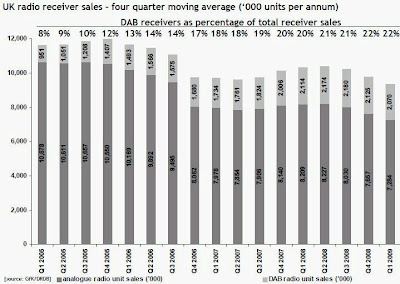
In Germany, the Commission for the Approval & Supervision of State Media Authorities, ZAK, has published a new directive today that attempts to stir interest in resuscitating the country’s DAB radio system. It requires the media authority of each German state to issue a common tender by 22 January 2010, calling for applications by 12 March 2010 from those who want to provide national radio services on DAB.
This new plan involves re-launching DAB radio in Germany in early 2011, but only “if sufficient qualified commercial applicants” show interest in acquiring licences, according to ZAK. Two-thirds of national DAB multiplex capacity has been allocated by the government to commercial radio, with the remainder for state broadcaster Deutschlandradio.
ZAK says it is seeking proposals for new digital stations that “strengthen the diversity of viewpoints in Germany” by offering information, business, sport, religion and specialist music formats. However, this suggestion flies in the face of evidence from other countries where it has not proven commercially viable to offer specialist radio formats on a national DAB platform, even after many years of consumer hardware take-up. For example, in the UK, many radio formats have come and gone on the DAB platform over the last ten years, including:
• news (ITN News 2000-2002)
• business (Talkmoney 2000-2003)
• 50s/60s music (PrimeTime 2000-2006)
• country music (3C 2000-2007)
• teenagers (Capital Disney 2002-2007)
• contemporary pop music (Core 1999-2008)
• soul music oldies (Virgin Groove (2000-2008)
• pop music for young women (Capital Life 1999-2008)
• book readings & talk (OneWord 2000-2008)
• jazz music (TheJazz 2006-2008)
• extreme rock music (Absolute Xtreme 2005-2009)
The worst thing a nascent or potential business can do is fail to learn from the experiences of those who have attempted the same proposition previously and failed. Continually re-inventing the wheel is a waste of human and financial capital. The agencies that are charged with promoting DAB broadcasting could do the global broadcast industry a massive favour by analysing and documenting why each of these stations, and others like them in other countries, failed. There is much more to be learnt from the 95% of business failures than from the 5% of successes.
Propagating the notion globally that DAB radio has been nothing other than a huge success in the UK is horribly irresponsible. More than £600m has been sunk into DAB in the UK over the last decade, but not one content provider has yet generated an operating profit from the platform. Actively encouraging and promoting implementation of DAB radio overseas as a means for broadcast entrepreneurs to emulate the ‘success’ achieved in the UK is as immoral an export as selling cigarettes to developing countries as a ‘luxury’ good.
Judged by their previous rejections of the DAB platform (see my July 2009 blog), radio stakeholders in Germany have demonstrated that they are not so easily duped.