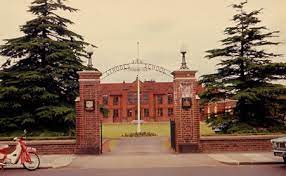
The day my world stood still [part one] : 7 October 1971 : Speech Day, Strode’s School, Egham

 Thursdays meant a trip to the newsagent to purchase that week’s ‘New Musical Express’ and a dash back to my college room to read the issue cover-to-cover and then tackle the latest ‘NME crossword’. It was a weekly head-to-head contest between me and fellow Collingwood first-year student Keith Miller to prove our superior knowledge of popular music. I was no crossword fanatic. I had no competitive streak. However, I was sufficiently motivated to demonstrate there was one subject in which I had expertise, my university academic course and student life having quickly proven a major personal disappointment.

Both my friend Keith and I were fish out of water. We had both arrived at Durham University from state schools, me from Surrey and Keith from Essex. 95% of our fellow students had arrived from private schools and looked down their posh noses at us, just as they probably did their nannies, servants and chauffeurs [see blog]. We were invisible to them. We were not worth the time of day. They were loud, arrogant and domineering. We were the little people that they had been put on earth to lord it over. It must have proven a worse experience for Keith than for me. He appeared to be the only visible minority in our college of three hundred students. He was regularly ribbed by colleagues for having achieved a GCE certificate in ‘African Drumming’ at school.

Aside from my NME crossword years (1976-1978), I have never been a competitive person. In secondary school classes, I never shot my hand up in the air in order to prove to teachers or my mates how superior I must be. Graham Taylor, our Physical Education teacher, resented me because I had no interest in ‘winning’ at the ‘Games’ he forced upon us every Wednesday afternoon for seven years [see blog]. I tried to avoid his team sports. He once sent me to race in a Surrey County athletics championship where I demonstrated no interest in winning against other schools. My termly school reports criticised me for not participating more in class and not speaking up at the slightest opportunity. Was ‘taciturn’ an appropriate adjective for our headmaster to write about a boy whose results in many subjects were amongst the top five of his year of sixty students? Feeling under attack from such judgemental adults, I responded by engaging even less.

At the time, I failed to comprehend that my secondary school’s objective was not to turn its boy students into well rounded individuals, as experienced previously at my wonderful primary school on a Camberley council estate [see blog]. Although this grammar school operated within the state education sector, it emulated the British private school system, aiming to produce self-important ‘leaders’ who could confidently dominate any room they entered and shout loudly amongst their peers about their breeding and supposed superiority. In that endeavour, I was already a lost cause. It was not that I lacked self-confidence. One school report had even labelled me “a tower of strength”. It was just that I felt no need to wear my abilities loudly on my sleeve. Perhaps that was because my parents showed no interest in whether I performed well or badly at school. I was never called upon to show off at home that I was ‘clever’. Besides, I thought actions were supposed to speak louder than words. On that score, my term and exam results spoke for themselves. My motivation to do well came purely from inside me, not from my parents, family or peers.

At the end of my first year at Strode’s School, I was somewhat surprised to be awarded three School Prizes. As if to prove that British society was not founded on meritocracy, these book token prizes [see blog] were rarely given to students who had scored the highest examination or classwork results. Rather, they seemed to be determined by the whim of each subject teacher. This was proven by me being awarded the first-year ‘Religious Knowledge’ prize, despite having never read the Bible, having no belief in God and having attended church only once in my life [see blog]. During the first term of my second year, an event was held in the school hall to formally award boys the prizes they had won, dragging them onto the stage to receive a book token. It was called ‘Speech Day’ even though it was only the staff who made speeches. Parents were invited to watch their bright young things be acclaimed as ‘special’. That year, neither I nor my disinterested parents chose to attend.

One year later, things turned out different. I had been awarded no second-year School Prize. This outcome did not bother me. It merely confirmed my suspicion that the prize criteria were wholly subjective since my exam and classwork rankings in some subjects had improved over the previous year. Exactly how could I have achieved first place in Mathematics during the academic year but fail to be awarded that subject prize? Maybe the school was displeased with my demonstrated deficit of competitive spirit. Maybe me and my parents’ absence from last year’s ceremony had been grudgefully noted. Maybe the school had merely concluded that I was an ‘unworthy’ student as, during my remaining five years, I was awarded no prize.

The other difference that second year was that, despite my lack of prize, I attended Speech Day with my father. There was no compulsion for us to be present. I was confused that a father who took zero interest in his son’s education had unilaterally decided we both attend. I had explained to him that I was not receiving a prize that year but he remained firm. It felt very strange. This was the only occasion on which my father visited my school during my entire seven years there. He parked his ridiculously ostentatious American sports car [see blog] on the playground outside the main hall in which we sat together during a ceremony lasting several hours, me completely befuddled about why we were both there.

I had absolutely no inkling then that this one day would change the rest of my life. Not because of Speech Day. Not because of my school. Not because of me. Not even because of my father. Or even the silly car he had driven frighteningly fast and dangerously to and from the event. So what happened? The clue was in the absence of my mother that day at that event. Where was she and what was she doing?

To understand her absence, it proves necessary to go back in time thirteen years and 173 days to the occasion my mother gave birth to her first child in a semi-detached council house on the Old Dean Estate. I have no knowledge about the circumstances of that arrival because my mother refused to elucidate, except to accuse her husband of absenteeism because he was visiting a mistress due to give birth imminently to his child. Within months, my parents and their new baby were evicted for non-payment of rent, due to my father having unilaterally purchased an unaffordable car to impress his mistress. If my mother’s father had not bailed them out with accommodation, they would have become homeless.

Five years and 217 days later, my mother gave birth to her second child in Farnham Hospital, a facility Camberley (population 33,770) still lacked. During her absence, she entrusted childcare of her firstborn to her husband, despite him having never shown any paternal feelings for his offspring. Luckily, my mother’s parents now lived next door and ended up feeding and entertaining their grandson during his mother’s absence. Did her husband drive his son daily to the state infant school on Old Dean Estate he had started three months earlier, as asked? No, but he did warn his son not to admit this absenteeism to his mother when she returned a week later. Did he visit his wife in hospital? Not once. Was he busy with yet another mistress? Who knows.

Take a further leap forward in time to where my story started – Speech Day at my school in 1971 and the absence of my mother. Where was she? She was in hospital giving birth to her third child that day. My father would have done anything to avoid being alongside her in hospital, even if it meant him attending a function at my school for the first and last time. It proved convenient for him to be 21 miles and a 53-minute drive away from his wife on that day, armed with a suitably fatherly excuse, having demonstrated a sudden interest in my schooling. In retrospect, my two parents were already moving along divergent paths, that day merely widening the gulf between them and soon leading to the breakup of our now three-child family.

My mother had grown up during the War in a two-up, two-down suburban semi-detached house, sharing a bedroom with two older sisters in a loving working-class family. Together, the three children had shared homemade girly pastimes in an era before they had radio or television. They lived on a quiet residential street in a house with a large back garden, surviving the War with produce grown in their father’s well-maintained allotment at the top end of Barossa Road where he raised chickens. It had been an idyllic childhood, despite having to occasionally hide under the wooden dining table when the German bombers arrived to attack adjacent Sandhurst Royal Military Academy [see blog].

My father was raised in a household filled with anger and violence. His brutal father beat his wife and his two sons, for none of whom he ever demonstrated love or affection. He knocked his wife down the stairs which killed her. A significant part of my father’s attraction to my mother and her family was that they were everything that he was not. She had loving parents, she had attended grammar school, she was beautiful and radiated a youthful, confident optimism. He had left school at age fourteen with few prospects and was desperate to escape the hell of his parents’ home. When the couple eventually married, once my father returned from Army conscription to the Suez Canal, my mother’s father refused to attend their Registry Office ceremony, believing that his much-loved youngest daughter deserved a partner with better prospects from a less abusive family.

When my mother became pregnant the first time in 1957, she hoped to have a girl with whom she could relive all the girly activities she had enjoyed with her sisters. She was disappointed to give birth to a boy. She persevered anyway, teaching me to knit, to sew, to bake cakes in the kitchen with her and to cut out clothes patterns with pinking shears. She passed down to me her and her sisters’ 1930’s childhood books such as ‘Heidi’, ‘Black Beauty’ and ‘Anne of Green Gables’. But I showed no interest in dressing up, sculpting elaborate hair-do’s or playing with makeup. I was a disappointment. As the youngest of three sisters, she had never experienced a baby in her household. She had no idea how to raise a boy, so she left me to my own devices most of the time, failing to instruct me in personal hygiene [see blog] or the three R’s. Our home possessed few books, but I consumed cover-to-cover the huge piles of 1960’s women’s magazine titles my mother bought, teaching myself to read and write. Once old enough to walk out by myself, the nearby local municipal library in Knoll Road became my saviour [see blog].

Five years later, after my mother gave birth to another boy, her sense of disappointment was even more self-evident. She committed even less effort to raising him than she had her firstborn, allowing him to grow up barely literate or numerate. He ran away regularly from primary school, showed destructive/self-destructive, violent tendencies and barely spoke to his older brother, despite them sharing a bedroom for six years. Much later in life, he was treated for addiction and was divorced by his wife. In the words of the song [Epic EPC7632]:

“One child grows up to be somebody who just loves to learn.
Another child grows up to be somebody who just loves to burn.”

Eight years later, my mother unexpectedly became pregnant for a third time. I learned this from hearing my parents arguing at night in their bedroom adjacent to mine. My mother wanted to keep the baby, hoping finally to have the girl she had always desired (there now being an 87% chance). My father was insisting she have an abortion. The arguments became more heated. Soon my mother refused to leave the house for a week due to a huge bruise across the right side of her face. On another occasion, she locked herself in the toilet, only for her husband to kick a hole in the wooden toilet door. The door remained that way for the next decade as a visual reminder of his violent behaviour.

My mother eventually won the argument and her third child, a girl, was born whilst I was sat with my father in the school hall, enduring Speech Day presentations. He took no interest in his newly arrived daughter nor, by extension, in her mother. Approaching the age of forty, he was riding a middle-age wave of selfish indulgence, fuelled by cash profits from dodgy property deals he was making with his new business partner, a local second-hand car dealer not afraid to employ mafia-style pressure tactics [see blog]. Flush with money for the first time since leaving school, he could at last satisfy his craving for fast sports cars, dinner parties, restaurant meals and foreign holidays. He took me with him on a flimsy pretext to Florida for a week, only to abandon me alone in a motel whilst he practiced a playboy lifestyle [see blog].

Within months, after increasingly unexplained and lengthening absences, my father walked away from his family altogether to pursue the hedonistic lifestyle he had evidently desired all along [see blog]. I did not miss him because he had played almost no role in my upbringing. He no longer had to pretend publicly that he loved his family. Instead, he decided to do everything possible to cause us pain and suffering, just as his parents had done to each other, to him and his brother. He now took zero responsibility for his former family, fighting in the courts not to provide financial support. He broke into our house and stole everything of value, including the car he had given my mother and most of her jewellery [see blog]. Our lives would never be the same.

During the months leading up to his departure, my father had been regularly playing on the living room stereo a vinyl single he had bought by The Fifth Dimension called ‘One Less Bell to Answer’ [Bell BLL1137] whose lyrics included:

“I only know that since he left
My life’s so empty
Though I try to forget
It just can’t be done
Each time the doorbell rings
I still run
I don’t know how in the world
To stop thinking of him
‘Coz I still love him so
I end each day the way I start out
Crying my heart out”

Only in retrospect did I realise these words represented the pain my father had been planning for some time to inflict upon his wife. During the previous two decades, she had ignored his regular philandering. Now, having finally gained the daughter she had long desired, he was determined to make her pay. He secretly visited each of her relatives and friends to convince them that his wife had done something heinous that had forced him to leave her and their three children. Most ignored his pleas but some, notably my mother’s older sister Sheila, bought his lies and refused contact with my mother for decades [see blog]. The outcome was that my mother became isolated, lacking moral support she should have received from the people in Camberley she had known her entire life. Meanwhile, my father set up home on an affluent private estate with a runaway teenage bride who had lived only a few doors away from us [see blog].

My mother could not adjust to our changed circumstances. Until the day she died half a century later (or, more accurately, until the day my father died eight years before her), she continued to believe that her husband would one day knock on her front door and come back to her. He never did. Her father having disapproved so publicly of her marriage choice, she had tried to do everything to prove him wrong, even ignoring the mistresses my father had accumulated over many years and the unknown children he had sired. The remainder of my mother’s life was lived in a sad, darkened interregnum in which she awaited a resumption of her pre-1971 ‘happy family’ married lifestyle. It never happened.

Although her daughter was not yet one year old, my mother was forced to take two jobs to generate income to feed her family because her spiteful husband was paying nothing. Her full-time day job was as bookkeeper for British Car Auctions in Frimley. Her evening job was cleaning offices in Yorktown. Her retired parents, who stuck by her, looked after my baby sister during weekday daytimes. Year after year from that moment, all my mother seemed to do was work to try and make ends meet. Having lost her own car to her husband’s new mistress, she had to borrow her father’s 1963 Austin Cambridge car just to get to work. Fortunately, my eight-year-old brother’s school was within walking distance of our home.

Although she possessed the skills to administer her new single-parent life, the result of having previously been employed in bank and accounts offices, my mother now abdicated all responsibility for her affairs. Almost all of the mail she now received were bills, red reminders and threats of court action. Not only did she refuse to open them, she would stuff them all into a drawer in the living room, never to be retrieved. Out of sight, out of mind. Neither was this a temporary reaction to her struggling situation. Until the day she died half a century later, she refused to deal with any paperwork she received or was required to action. It was a blatant refusal to adapt to a life in which her household budgets and accounts needed to be balanced, paradoxically the very work she performed for her employer five days a week.

Not once did my mother ever ask me to take on the responsibility of managing her affairs. She could not have cared less. I realised that her strategy was irresponsible and would doubtless drive our family into disaster. Unopened letters stuffed into a drawer would inevitably lead to court actions, debt collectors and bailiffs. My mother would lose her jobs. We would lose our home. Me and my siblings would be placed into care. We would all have to change schools. Perhaps that was the exact outcome that my cruel father wanted. I was the oldest child of our family. I was clever. I had already received more formal education than any of our relatives. I was barely fourteen. By default, I had become the ‘head’ of the family, a role I had never wanted but which was now thrust upon me.

Within months of my attendance at my school’s Speech Day alongside my father, my whole world was turned upside down. My supposedly carefree teenage years and adolescence were taken away from me. I was suddenly a young adult. Never again would I observe my life as similar to that of my peers. I had responsibilities. Huge responsibilities. My own personal ambitions had to be subsumed to the struggle for mere survival of our family unit. There was nobody with whom I could share this responsibility or even explain the tasks I now had to do. My schoolfriends would never have understood. School staff were already unsympathetic towards me, having sent me home occasionally for wearing the wrong colour socks, the wrong colour shoes, slip-on’s instead of lace-ups and having hair touching my collar [see blog].

Events that took place on that one day, 7 October 1971, events over which I had no control would impact the entirety of my life. I did not realise it then. At the time, I thought I was simply doing ‘the right thing’ whilst those around me seemed hellbent on doing ‘the wrong thing’. I had no idea that a life of making small personal sacrifices as a teenager would lead to making bigger and bigger sacrifices as the years passed and end up stealing away so many opportunities to satisfy my own life.

After my father walked out and disowned his family, I could have just ignored the consequences and retreated into my own world, as my younger brother chose to do. But I was old enough and wise enough to understand the outcome of that route. Our circumstances would fall into irreparable disaster and we might all be split up and sent to children’s homes. Our mother might be imprisoned for unpaid debts. I decided to do my best to stop those disasters happening. Nobody else was there to help. It was me alone who had to try and keep us all together. So I tried.

[to be continued…]

[Originally published at https://peoplelikeyoudontworkinradio.blogspot.com/2026/08/the-day-my-world-stood-still-7-october.html ]

Givin’ up Free! for funk (radio) : 1989-1991 : Free! magazine / Touch magazine, KISS FM, London

 August 1989. There was a momentary lull in the usually frenetic activity at the [former London pirate radio station] ‘KISS FM’ office, whilst we awaited the next Independent Broadcasting Authority [IBA] announcement that would give specific details of the application procedure for the two new London FM [commercial radio] licences on offer. [KISS FM co-founder] Gordon McNamee turned his attention to other matters, since he understood that there was still no guarantee of KISS FM winning the licence, even on its second attempt.

On several occasions, I had mentioned to McNamee my belief that there existed significant untapped commercial potential in KISS FM’s magazine, ‘The Written Word.’ A year earlier, the publication had started life as a single A3 sheet newsletter, entitled ‘94,’ that had been produced on a word processor and had been printed without photographs. At that time, it had been intended solely as an update for the station’s fans and its main feature had been the KISS FM programme schedule. As the station’s mailing list increased in size, so too had the content of the magazine. By the final issue of The Written Word, the thirty-two pages had included lots of photos, record reviewsinterviews and information about the London dance music scene. There were also several pages of paid-for advertisements which had helped to defray the increasing costs of printing and postage.

For several years, I had been fascinated by the proliferation of free magazines in London, with weekly titles such as ‘Ms London,’ ‘Girl About Town’ and ‘Midweek’ handed out during the morning rush hour to thousands of commuters at London’s railway and underground stations. For revenue, these magazines depended entirely upon the advertising space they sold, but their distribution costs were low and their print runs were huge. An increasing number of more specialist magazines were being produced and financed in this way. Travelling through Waterloo railway station one day, I had been handed a free entertainment and what’s on magazine that was aimed specifically at high earning commuters living in the suburbs. In my area of Northwest London, I regularly received a free copy of a general interest, colour magazine aimed at homeowners in the locality.

One of the problems KISS FM had encountered with The Written Word was the huge cost of sending out thousands of copies of each issue individually to every person on the station’s growing mailing list. I believed that these expenses could be reduced dramatically by distributing the magazine as a free giveaway to a wider readership that would pick it up from dance music record shops, music venues and clubs in London. Many more copies would have to be printed to circulate the magazine in this way, but the advertising space within it could be sold at a much higher price, since it would be reaching many more readers. Instead of being solely a KISS FM publicity vehicle, the enlarged publication could be London’s first giveaway magazine to be aimed specifically at the city’s dance music community.

McNamee liked my idea and could see the potential it offered him to earn much needed revenue to cover the overheads of running the KISS FM office. After several weeks discussing with him my proposal for the magazine, McNamee asked if I would like to launch the project and be its editor. I had experience in this field, having been editor of the student newspaper [‘Palatinate’] and student handbook whilst at university, and having launched an independent music magazine [‘N.E.’] in Northeast England. I accepted McNamee’s job offer and handed in my notice to the record company where I had worked during the last two years. McNamee said he would pay me £100 for three days’ work each week, plus eight per cent of the net profits generated by the magazine. Although this worked out to be less money than I had earned from the record company, I believed that the new job would improve my career prospects and provide an opportunity to be more closely involved with KISS FM.

Besides, my recent experiences with the record company had left me frustrated and eager to explore a new work opportunity. Back in 1985, whilst working in Israel, I had discovered a female singer named Ofra Haza whose music, a kind of ‘Middle East meets West’ sound, I believed would be marketable in Europe. Since then, I had worked hard promoting her music and had succeeded in achieving airplay on national radio in the UK and positive press coverage. By 1989, one of the Ofra Haza songs I had found in Israel four years earlier had reached number fifteen in the UK singles chart. It was released by the independent record company for which I had been working. I asked the company for some compensation towards all the work I had done to make this artist a success, including a UK artist interview tour I had arranged in early 1989. The directors had met and decided to offer me a cheque for £200. I felt insulted by this amount, particularly as my years of work had given the company its biggest chart hit in a long time. Worse, the credit for Ofra Haza’s chart success was being taken in press interviews by someone else working at the record label. Now, all I wanted to do was quit the company, having earned almost nothing from four years of work having created Israel’s biggest international pop music star, and yet not having even gained any recognition.

I started work at the Blackstock Mews office on 22 August 1989, the first occasion I had earned money from KISS FM, despite having been involved in the business since the beginning of the year. I had been spending more and more time in the office, working with the other staff, but had never been offered remuneration. I looked forward to becoming a proper employee, although the one person in the organisation who did not seem to welcome my appointment as editor of the new publication was Lindsay Wesker [son of playwright Sir Arnold Wesker]. He had been editor of The Written Word, until its recent closure, and he probably felt that this experience, combined with his previous work for the ‘Black Echoes’ music paper, should have made him the ideal candidate for this new post. McNamee told me privately that he was well aware of Wesker’s antipathy towards my appointment, but assured me that he wanted fresh blood to be in charge of the project.

The day after I handed in my notice to the record company, I convened an evening meeting at the KISS FM office to discuss the new magazine. After a considerable amount of brain-storming, [co-worker] Heddi Greenwood suggested it could be titled ‘Free!’ reflecting not only the fact that it was to be a giveaway magazine, but also the notion of personal freedom to which dance music fans would be able to relate. Her suggestion was accepted unanimously. It was agreed that the first monthly issue would be published at the beginning of October 1989, that the print run would be around 30,000, and that the magazine should divorce itself entirely from the KISS FM campaign for a radio licence that had dominated The Written Word. Everyone felt that it was most important for the magazine to be viewed as an authoritative, independent guide to the London dance music scene. Heddi Greenwood would handle the advertising sales for the magazine, and McNamee had appointed Lindsay Wesker its deputy editor in a gesture of reconciliation. I set to work writing a substantial business plan that outlined the magazine’s purpose and ethos, which would also be used in presentations to potential advertisers. Over several pages, I defined the editorial content of Free!, its intended readership and the reasons I believed it would prove so successful.

Now that I had become the fifth paid worker in the KISS FM office, McNamee arranged a second-hand desk and phone extension for my arrival. I was now working at Blackstock Mews on a regular basis, from which I gained a greater insight into the way in which the members of the KISS FM team worked and their respective roles within the organisation.

I was busy putting together the blueprint for the new Free! magazine. I visited a cheap photo-typesetting company in Brighton, commissioned quotes from printing companies, called meetings in the office of potential contributors, and commissioned a logo design. McNamee was becoming increasingly enthused about the potential profit offered by the new magazine, and so he quickly became more involved in its day-to-day running. He had almost stopped talking about KISS FM altogether and, despite our awareness that the new London FM licences were in the pipeline, McNamee directed the whole office’s efforts into this new publishing venture.

One extremely hot and sunny weekend in late August, the KISS FM staff spent the whole of Saturday and Sunday transforming the hitherto unused downstairs room at Blackstock Mews into an office for Free! All the accumulated rubbish was completely cleared out and the dark, dreary room was repainted – ceiling, walls, floor, everything. McNamee bought a job lot of small second-hand desks, which were moved outside to the Mews for us to paint in gloss black. The office stereo system was rigged up outdoors to provide us with musical entertainment, and McNamee dug out some old cassette recordings of programmes from KISS FM’s pirate days, which he had kept in his desk drawers, to entertain everyone.

Some brand-new shelves and storage units were purchased from the IKEA furniture store, which McNamee and I assembled in the new downstairs office. There was one piece of furniture with which McNamee became obsessed: the construction of a huge, rectangular glass-topped table, more than six feet in length. It was the closest he could achieve, for now, to the impressive pieces of furniture he had admired in the opulent boardrooms of KISS FM’s new, corporate shareholders. Between the clear glass table top and its felt underlay, McNamee spent hours carefully positioning press articles about KISS FM and pages from The Written Word magazine, along with some of the station’s publicity materials. Once the glass top had been screwed down to the base, the whole thing looked remarkably like a personal shrine to the KISS FM pirate radio station that McNamee used to run and to the commercial radio business to which he aspired.

One chapter in his business career now having ended, McNamee seemed determined to bury the deep disappointment of the failed [first] KISS FM licence bid and, instead, to put all his energies into turning my idea for Free! magazine into the money-spinner he longed for. The dream of KISS FM radio was very quickly being forgotten.

When I had accepted the job of editor, McNamee had promised that I would also be spending some of my time working on the second licence application, but the launch of Free! was proving to be very demanding and there was still little sign of action within the organisation about the radio licence. 

McNamee hardly ever mentioned KISS FM any more, and the only aspect of the second licence application that seemed to occupy him was satisfying the chairman’s desire to assemble an advisory committee. Since the failure of the first bid, there had not been a single office meeting to discuss what had gone well or badly in the previous campaign, or to analyse what had been the good and bad points of the application. Whenever I broached the subject of the second licence bid with McNamee, he would shrug it off and change the subject to the potential success of Free! magazine, which had overtaken KISS FM as his pet project. This state of affairs frustrated me immensely, because it seemed as if McNamee had lost interest in making a second licence bid at all. He had already discarded KISS FM’s past and the possibility of winning second time around. In fact, McNamee had confided in a close friend, Joe Strong, manager of Dingwalls venue in Camden, that losing the licence had left him “absolutely devastated” and “absolutely inconsolable.”

I was perplexed. I arranged to meet a fellow journalist and radio worker, Daniel Nathan, whom I had known since moving to London in 1986, and with whom I felt I could discuss this problem. As the two of us walked across Blackheath one weekend, I ranted to Nathan about how incredibly close I thought KISS FM was to winning a licence on this second occasion, and how frustrating it was that McNamee seemed intent on wasting the opportunity. I had been the only member of the KISS FM team to attend the IBA press conference announcing ‘London Jazz Radio’s win (Nathan had been there too) and it was obvious to me how much enthusiasm some of the IBA staff had shown towards KISS FM’s bid. This time, there was likely to be a similar number of applicants for the two new licences and, unless KISS FM could submit an almost perfect application, the IBA would feel duty bound to award licences to other groups who proved that they were better organised.

Talking to Nathan clarified, in my own mind, the gravity of the situation. These two new London licences were likely to be the last on offer until sometime in the mid-1990’s. To throw away the chance of winning a black music station for radio listeners in London at this stage would be utterly crazy, particularly after so many people had campaigned for so many years in the hope of just such an eventuality. I decided that, even if McNamee was prepared to remain slumped despondently in his office chair, consigning KISS FM to a space in his glorious past, I certainly was not. If he wanted to wallow in his own despair, that was fine with me. He could carry on playing nostalgic tapes of his old KISS FM shows to everyone in the office, as he had been during recent weeks, but I was determined to do something more positive about winning the station a licence.

On returning to work the following week, at the first opportune moment, I confronted McNamee across his desk in the open plan KISS FM office. Why was he not doing anything about the second licence bid? Did he not believe KISS FM could win? If everyone else still had faith in KISS FM, was he not letting them all down? Was any work being done on a revised application? Was not Free! magazine merely a short-term distraction? Almost anyone could start a new magazine, but how many people could win a radio licence? Why had he slumped into total inaction? As I questioned McNamee, I could sense the other staff at their desks in the office trying to bury their heads in work and look as if they were not listening to our conversation. I explained to McNamee that I thought he was throwing away the biggest business opportunity he was ever likely to encounter in his life. I told him that, of the people within the KISS FM office, I seemed to be the best qualified person to organise and co-ordinate the second licence application [having previously researched and written successful project applications to Durham UniversityManpower Services CommissionNorthern Arts and Princes Trust]. For the moment, that work seemed to me to be a far more appropriate use of my skills than editing Free!, particularly as nobody else seemed to be doing anything about the KISS FM bid.

I suggested to McNamee that someone else should be brought in to edit Free! magazine while I devoted my full attention to re-working the KISS FM licence application. I had already prepared the groundwork for the new magazine during the last month, and the project could easily be handed over to another editor at this stage. On the other hand, if we did not act on the KISS FM bid now, we would never be offered another chance.

During this monologue, McNamee listened to me, smiled a lot, but said virtually nothing in reply. I could sense that, deep inside, he was incredibly angry that anyone should even dare to challenge his authority in this way. I had seen him act this way before, but only when directing his anger towards others who had displeased him. Instead of showing any response of anger or emotion, McNamee just glowered at you and clammed up. It was his usual cold shoulder treatment – ex-communication rather than confrontation – and you had to wonder whether he was already plotting some ghastly revenge to extract upon you in the future for your supposed crime. McNamee continued to be wholly unresponsive to my questions, so I told him that I planned to start work immediately on KISS FM’s application and that, initially, I planned to do some research in the comparative peace of my home. I promised I would willingly explain and hand over all the tasks I had completed on Free! magazine to whomsoever he wished. After all my suggestions, McNamee still offered me no response, so I gathered together my work and left the office.

After that ‘meeting,’ it was almost a week before I heard anything at all from McNamee. I had been busy working at home, as I had planned, and although I had regular telephone conversations with the other staff in the KISS FM office, McNamee had carefully avoided any contact with me. To me, this sort of behaviour appeared incredibly childish – McNamee seemed to be putting the vanity of his own ego above the need for his radio station to win a licence. Then, late one evening, he phoned me from home. He offered no explanation or apology for his attitude towards me that day in the office, and he gave no reason as to why he had failed to contact me at all during the intervening week. Our conversation was unemotional and business-like. He told me that, from now on, he would pay me £100 for spending three days each week working on the KISS FM licence application. He said he wanted more of my time, but I explained that I had other work commitments during the week on which I could not renege. He made it sound as if this arrangement had just come to him in a flash of inspiration, and that his offer was obviously too good for anyone to turn down.

He also told me that I would no longer be involved in Free! magazine in any capacity. He wanted me to visit the office and hand over all my paperwork to the newly appointed editor, who would be Lindsay Wesker. Finally, he disclosed the caveat that must have taken him almost a week to concoct. When my work on the licence application ended in November, I would no longer be paid by KISS FM, and neither could I resume the editorship of Free! magazine. In essence, I was being allowed to have my own way in the short term but, in the end, I had been made to sacrifice a permanent job at KISS FM. I would be forced to look elsewhere for work once the licence application process was over. This did not worry me excessively because I sincerely believed that KISS FM could win the licence this time around, whereas McNamee seemed already to have resigned himself to failing on the second occasion. This new arrangement cut my pay to a basic £100 per week, because I would no longer draw the percentage of profit that McNamee had previously agreed I would derive from Free! magazine. I was not told the details of the deal that McNamee had struck with Wesker to take over editorship of Free!, but Wesker could not hide his delight at assuming the position he must have felt he had always deserved.

However, when the much delayed first issue of Free! was eventually published at the beginning of November, Wesker’s tendency to indulge himself shone from the inside of the magazine. He contributed one page of his own photos and three and a half pages of his record reviews to the beginning of that first edition. These reviews included glowing critiques of a single released by KISS FM’s own label ‘Graphic Records’ and of a track recorded by Wesker’s partner, Claudette Patterson. I was no longer allowed any involvement in Free! and my name was deleted from the magazine’s masthead, in disregard of my work developing the original idea and setting the project in motion. Free! had been my ‘baby’ and I had had to sacrifice it for KISS FM. From then on, Wesker spent most of his time in the downstairs Free! office at Blackstock Mews, while the rest of us continued to work upstairs on the business of KISS FM and Goodfoot Promotions [Limited].

Personally, I was very disappointed to no longer be involved in the launch and organisation of Free! magazine. However, I firmly believed that KISS FM would win the London licence if I could come up with the necessary facts and figures in this second version of the application form. There would always be another opportunity in the future for me to launch a new publishing project. Right now, this might be the last opportunity I would have to win London a black music radio station. The hard work had only just begun, and a lot of responsibility was suddenly resting upon my shoulders.

February 1990. During recent months […], Lindsay Wesker had become totally absorbed in his role as editor of the monthly magazine Free! and he was now spending little time on KISS FM matters. The February 1990 edition of the magazine presented the first opportunity for KISS FM to explain, in its own words, exactly how it had won its [second application for a] radio licence. Wesker wanted to write the article, but McNamee intervened and insisted that I should pen the two-page feature. Despite the magazine having been my original idea, this was the only occasion I was asked to contribute to Free!, and then only because McNamee had insisted. Wesker seemed incredibly territorial about the project he now viewed as ‘his baby,’ and he appeared to like to do as much of the work on the magazine himself as was possible.

June 1990. The next job appointment I needed to make was the station’s record librarian, who would be supervised by KISS FM’s head of music, Lindsay Wesker. Since taking over the editorship of Free! magazine from me the previous year, Wesker had had little involvement in the re-launch of KISS FM. He seemed almost obsessed with the monthly magazine, spending many late nights in the ground floor office writing articles and reviewing records. Since Wesker had no prior commercial radio experience to contribute, I had not been particularly worried by his absence. However, the person appointed as record librarian would report to Wesker, which is why it was vital for him to be involved in their selection. I loaned Wesker a large folder of all the applications I had received for this job [I had advertised in ‘The Guardian’ newspaper] and I asked his opinion of which might be the most suitable to interview.

The next day, Wesker returned the folder to me, having marked the handful of candidates he felt were most suitable. I looked through his selection and was puzzled by his choices. I asked him why he had chosen those particular applicants, none of whom had previous library experience. He explained that there were two qualities he had been looking for – the candidates had to demonstrate knowledge of dance music, and they had to be female. At first, I thought he was joking, but I quickly discovered that he was not. Wesker explained to me his theory that a record librarian had to be a woman, and stated that he was not interested in working with someone who was not a proven expert in dance music. I was shocked that Wesker could be so irrational in choosing a suitable person for the job. His method of appointing staff was proving to be as bizarre as that of McNamee.

February 1991. Gordon McNamee [now KISS 100 FM managing director] suddenly announced that the station would no longer publish Free! magazine after the January 1991 issue. I was proud to have created the idea for the magazine a year and a half earlier. Although I was no longer associated with its editorial team, I was sad to see Free! close just as KISS FM was proving to be a success with listeners. McNamee explained that the magazine was no longer earning sufficient revenues from advertising to cover its printing costs. However, there were rumours of other reasons for the closure. It was alleged that two KISS FM directors wanted to close Free! because it clashed with their publishing interests. Tony Prince owned the monthly ‘MixMag’ magazine which had recently switched from subscription-only to retail sales. Free! would be a direct competitor. It was also alleged that KISS FM shareholder EMAP [plc] planned to launch its own monthly dance music magazine. Free! would be a direct competitor. Fortunately, Free! found an alternative financial backer and was reborn [under new ownership] as ‘Touch’ magazine, which published similar editorial content.

Once Free! had moved out, the large downstairs room on the ground floor of the [KISS 100 FM] Holloway Road building suddenly looked very empty. I spent an evening picking through the debris left in the office of the magazine that had started life as ‘94’ in July 1988, and which had been such an important part of the pirate station’s campaign to win a licence. Free!’s sudden closure was a bad omen. Staff in the building started whispering about further cuts that might be made to save the company money.

FREE!, nos. 1-15 (November 1989 – January 1991), London.

[Excerpt from ‘KISS FM: From Radical Radio To Big Business: The Inside Story Of A London Pirate Radio Station’s Path To Success’ by Grant Goddard, Radio Books, 2011, 528 pages]

POSTSCRIPT

Having purchased my first soul record (‘Time Is Tight’, Booker T & the MG’sStax 119) in 1969, I had been thrilled in 1973 to find a new homegrown monthly colour magazine ‘Black Music’ on the shelves of my local newsagent. I devoured every issue cover-to-cover until its closure in 1984 and wrote to many of its advertisers selling soul and reggae records. I could never have imagined then that, almost two decades hence, I would become the founder of Britain’s longest running monthly black music magazine, created as ‘Free!’ and renamed ‘Touch’ until its closure in 2001.

KISS FM boss Gordon McNamee’s cruel obliteration of my name from the magazine’s history has since empowered his long-time colleague Lindsay Wesker to claim online I created a magazine called free! and to have created free! Magazine and Created free! Magazine and created free! Magazine. I am reminded of the iconic Norman Whitfield soul song ‘It Should Have Been Me’. Evidently, history is written by the vipers.

[First published at https://peoplelikeyoudontworkinradio.blogspot.com/2025/07/givin-up-free-for-funk-radio-1989-1991.html ]

You just keep on using me … until you use me up : 1989 : Brian Davis, Radio & Music magazine, EMAP plc

 In March 1989, an advertisement appeared in the press, seeking staff to work for a new radio industry magazine. There had been several attempts to publish a radio-only trade publication since the launch of commercial radio in 1973, all of which had ended in failure. The industry had still not become large enough to sustain substantial amounts of paid-for advertising, or to build a large enough circulation to make such a publication financially viable. Then, EMAP plc, a major publisher of consumer magazines and regional newspapers, announced plans to launch ‘Radio & Music’, a fortnightly, glossy magazine aimed at the music radio sector. EMAP had established its reputation as one of the twenty fastest growing companies in the UK, with an annual turnover of £189m. It believed the time was right for a radio publication: “The radio industry is undergoing a radical change and deserves a radical voice to reflect the new environment … We will be the sole magazine devoted to the radio industry in all its guises …” 

I was eager to secure further outlets for my writings about the radio industry, so I rang the phone number in the recruitment advert. I spoke to Brian Davis, the magazine’s managing editor, and arranged to meet him at EMAP’s John Street office at 6 pm on 22 March. There, on the top floor of ‘MEED House’, I found a group of advertising executives selling space in EMAP magazines by phone with a ferocity and aggressiveness I had never before witnessed. Davis greeted me warmly and the two of us moved into the penthouse meeting room, where he expanded upon the philosophy behind the magazine’s launch. I ran through my experience in radio [pirate radio presenter/producer since 1972; executed turnaround strategy in 1980-81 of Newcastle’s ‘Metro Radio’ whose “audience figures show[ed] the greatest improvement [of all UK commercial stations] and were “the highest since the station’s establishment” according to the IBA regulator; managed the production team at London community station ‘Radio Thamesmead’ in 1986; project manager at London’s ‘Capital Radio’ in 1986-88], and my writings about the radio industry [Radio Editor at London consumer magazine ‘City Limits’ since 1988; Radio Editor at ‘For The Record’ trade magazine in 1989], and I expressed interest in writing for the magazine in either a full-time or freelance capacity. Davis showed me the draft layout of a pilot issue scheduled for April publication, and he asked my opinion of some of the planned content.

He expressed interest in employing me in some capacity on the magazine, and asked me to submit two examples of my work: an opinion piece on one aspect of the radio industry that I felt was pertinent to the magazine’s readership; and a list of twenty editorial items I felt should be included regularly in the new publication. I obliged by writing an editorial on the conservatism of commercial radio playlists, and I drafted a list of twenty suggested features that included:

  • “sit in on a particular show & examine success/failure
  • pick a city/area & examine the radio market
  • details of artists’ radio promotion tours
  • who’s pushing what – record companies/pluggers’ hitlists
  • giveaway sampler CDs.”

I sent my suggestions to Brian Davis and awaited his response. I was still keen to be more involved in [London pirate station] ‘KISS FM’, but it was not earning me any money. Right now, some additional income from writing about radio would be particularly useful for me. I was hoping that Davis might offer me a post or, at the very least, some freelance work. While I awaited a response to the ideas I had sent to Davis, the competition for the London-wide FM radio licence was intensifying.

In a seemingly unrelated occurrence, I attended the opening ceremony of the fifth ‘UK Music Radio Conference’ on the evening of 4 April 1989, organised by the ‘Radio Academy’ at the ‘HMV Megastore’ record shop in London’s Oxford Street. The event itself was largely an opportunity for the radio industry to indulge in mutual back-slapping, but I was there in the hope that it might provide some source material for a radio article. I bumped into Brian Davis, managing editor of publisher EMAP’s new magazine Radio & Music, to whom I had not spoken since our initial meeting the previous month. I had yet to receive a response from him to the ideas I had submitted. Davis introduced me to his associate publisher, Peter Gould, and we exchanged small talk about the magazine’s impending launch. Recognising me across the crowded room, KISS FM’s Lindsay Wesker came to join our conversation and, once I had introduced him to the others, the topic switched to the ex-pirate station’s prospect of winning a London FM licence. Gould was very enthusiastic about KISS FM’s chances and showed particular interest in learning that the station was seeking a further investor. He suggested that a meeting with his superiors at EMAP could prove productive.

In early April 1989, EMAP launched the pilot issue of Radio & Music magazine although, strangely, its editorial was not particularly positive about KISS FM’s chances of winning the London FM licence. From a personal perspective, I was frustrated to find that, during this and the magazine’s following issues, several feature ideas which I had proposed had been used. The magazine’s managing editor, Brian Davis, had never contacted me again.

[Excerpt from ‘KISS FM: From Radical Radio To Big Business: The Inside Story Of A London Pirate Radio Station’s Path To Success’ by Grant Goddard, Radio Books, 2011, 528 pages]

[Originally blog published at https://peoplelikeyoudontworkinradio.blogspot.com/2025/07/you-just-keep-on-using-me-until-you-use.html ]

Teach your children well? : 1960s-1970s : vegetable-free adolescence, Camberley

 “How often do you wash your face?” asked the doctor.

“Like how?” I responded, uncertain about what he was enquiring.

“You know, with soap and water,” he clarified.

“Er, never,” I replied truthfully.

“Why not?” he demanded.

“Because nobody ever told me I needed to,” I said, somewhat embarrassed.

The doctor regarded me pitifully, imagining I must belong to a tribe of itinerant gypsies or have been raised by wolves. To the casual observer, my suburban home life appeared quite normal. Scratch the surface and you would have discovered that my parents had given me few of the ‘life skills’ that are supposed to be demonstrated to children. On this occasion, my mother had sent her teenage son to the family doctor in Frimley Road because his face had become progressively covered in spots. But neither she nor my father had ever instructed me how or when to wash. Once a week, I stood under the water in our modern home’s shower cubicle. If my face became wet while shampooing my hair, I merely dabbed it dry with a towel.

The doctor wrote a prescription for a liquid called ‘Phisohex’ which came in a large green bottle. After a few weeks washing my face twice daily with this cleanser, my spots magically disappeared, following more than a decade of cheeks shamefully having been untouched by soap. Did my mother acknowledge this shortfall in her parental duties? Of course not. This was but one aspect of her ‘hands-off’ approach to childrearing. She had enjoyed a good post-war education at Camberley’s girls’ grammar school in Frimley Road where she was likely taught conventional housekeeping and domestic skills in preparation for marriage. She was goodlooking and always dressed immaculately in the latest trends. Her parents had raised her and her two sisters impressively. So where had her own parenting regime gone awry?

Most of the basic skills I developed – writing, reading, arithmetic – I learned from books and television rather than parental instruction. However, one ability that proved impossible to appropriate in that way was tying shoelaces. As a result, at junior school, after ‘PE’ (Physical Education) lessons that required us to change into slip-on plimsolls, I always had to seek out my cousin Deborah in the year below mine to ask her to retie the laces on my shoes. Once I progressed to grammar school, my skill deficit became more difficult to hide. The mandated school uniform required black lace-up shoes. My mother acknowledged my ‘shoelace’ issue but, instead of simply demonstrating how to do it, she bought me slip-on ‘Hush Puppies‘ shoes for school which resulted in regular disciplinary action. Finally, I had to draft an embarrassing letter from my mother to the school, asking for her son to be excused from the dress code due to difficulty finding suitable lace-up shoes for his high in-step feet.

Like many 1960’s housewives, my mother regularly cut out recipes from magazines and stuffed them in a kitchen drawer. She was particularly proud of a plastic box with transparent lid holding two rows of Marguerite Patten recipe cards that she had sent for to ‘Family Circle’ magazine and which I was tasked with keeping in correct order. She loved making cakes and had a sweet tooth that probably promoted the development of diabetes in her later life. However, her skills with main meals were limited and she preferred to rely upon ‘instant’ foods like fish fingers that were heavily marketed to ‘busy’ housewives at the time. This was probably why I remained as thin as a rake during my childhood, despite teenage years spent scoffing two bowls of cereal both morning and night.

I had been a regular visitor to the family dentist on Middle Gordon Road due to the dreadful state of my teeth. Even at a tender age, I was being gassed for extractions. On one occasion, the stern dentist accused me of not brushing my teeth sufficiently firmly to prevent decay. I resolved to use the state-of-the-art electric toothbrush in our family bathroom with greater pressure during twice-daily cleanings. I returned to the dentist six months later, only for him to inform me that I had rubbed away most of the enamel from my remaining teeth. The outcome of his ‘advice’ was merely more extractions. Not once did this dentist question my mother about her children’s diet. Even if he had, she would have been unlikely to respond honestly.

My mother had an inexplicable lifelong aversion to vegetables. Only the humble potato would accompany our meals, usually in the form of Cadbury’s ‘Smash’. Carrots? Never. Peas? Nope. Broccoli? Unseen. There were other foodstuffs we never experienced – spaghetti, yoghurts, condiments, rice – because my mother had a preference for jellies, custard and blancmange, but it was the lack of vegetables that must have impacted our health growing up the most. I never understood how, despite the piles of women’s magazines around our home, she somehow studiously avoided taking their practical advice regarding suitable family diets. Such behaviour could have been excused earlier in the twentieth century when literacy and knowledge were less prevalent, but surely not by the 1960’s.

Much of my childhood during weekends and school holidays was spent at my maternal grandparents’ adjoining house where I helped prepare ingredients for their meals. Instructed by my wonderful grandmother, I would sit on the backdoor step with a bowl between my knees, shucking peas from their pods. I would use a peeler to remove the skins from various vegetables whose names I did not know. I would carefully place dozens of apples in rows within cardboard boxes, separating each layer with old ‘Daily Sketch’ newspapers before carrying them into the recesses of the house’s darkened larder under the stairs. My grandmother loved to make jams with these fruits, for which I carefully wrote out white adhesive labels carrying the manufacture date and type. Bizarrely, none of these vegetables or jams were ever served in our own house next door.

From the day she left school at twelve until the day she finally retired, my grandmother worked in fruit and vegetable shop ‘H.A. Cousins & Son’ at 11 High Street on the corner of St George’s Road in Camberley. During all those decades, her ‘sales assistant’ job never changed, standing all day on the shop’s bare floorboards, putting requested items in brown paper bags, weighing them on old-style scales against combinations of various brass weights, calculating the cost in her head and then the correct change to return to the customer.

Shop owner Mr Cousins would daily travel thirty miles to the fruit, vegetable and flower markets in London at the crack of dawn, returning with a van of produce to sell. Once a day’s stocks were sold, that was it. Any produce left over would be given to the shop staff. My grandmother regularly brought home quantities of all sorts of fruit and vegetables which she shared with us, though my mother always refused the vegetables. Thankfully, she did accept the fruit which became the sole source of my necessary five portions per day.

Cousins advertised its shop locally as “by appointment to Staff College” (Sandhurst Royal Military Academy), providing “Dessert Fruit and Flowers for Dinner Parties, etc.” Its upper-class customers and Sandhurst’s foreign residents necessitated it stock a variety of exotic fruits, the excess of which ended up in my family’s fruit bowl. Visitors to our house in the 1960’s were shocked to see pineapples, mangoes and lychees on our dining table, delicacies that I enjoyed as ‘normal’ long before their availability in supermarkets.

My mother insisted that fruit always be eaten covered in sugar, her favourite ingredient. Cups of tea required two spoons of white sugar, coffee two lumps of Demerara sugar, stewed apples or pears served frequently as our dessert had to be sprinkled with granulated ‘Tate & Lyle’. Even when I visited my mother in her final years, she would buy in a banana to offer me (she refused to eat them), accompanied by a plate of sugar in which to dip it. Thanks, mum. Banana yes, sugar no.

When my grandmother reached the statutory retirement age of the time, we all went round to her house for a little celebration of her departure from a lifetime of work on Cousins’ shop floor. She was pleased to be able to retire before Britain switched to decimalisation in 1971 as she feared metric calculations that no longer involved farthings, florins, half-crowns and guineas. Months later, the shop asked if she would return and work part-time because it was short-staffed. Of course she agreed. In total, she clocked up more than half a century working for that one employer in that one location, a 400-metre walk from her sole marital home.

In 1976, on arrival at university, the bulk of my Surrey County Council grant had to be paid in advance for one term of accommodation and three meals per day within college. Having never taken school dinners and rarely eaten out in restaurants, I was unfamiliar with the canteen system where you line up and tell the kitchen servers which food you want. I hardly recognised any of the foodstuffs on offer and would often merely opt for two identical desserts, skipping main courses entirely. Most intimidating were twice-weekly ‘formal dinners’ lasting an hour, during which more than a hundred students remained seated at long benches in the huge dining room to be served by staff a succession of courses completely foreign to me. The table places were laid with radiating lines of various cutlery, none of which I knew their specific purpose. My fellow students seemed to find all this ‘etiquette’, including ritual table-banging and foot-stomping, perfectly normal because 90%+ of them had grown up around such ‘practises’ at elitist private schools. I often avoided these ghastly events and sat in my room munching a packet of biscuits.

My parents having never taught me how to use cutlery, I had developed my own system whereby I always used my right hand to hold the fork. Only when I had to cut up some food would I transfer the fork to my left hand and then simultaneously use the knife in my right hand. The rest of the time, I placed the knife down on the table. Nobody had ever corrected me. Not until sitting in that university dining room, surrounded by loud toffs with posh accents and double-barrel surnames, did I have to learn to eat holding the fork in my left hand. To this day, my default way of eating is to grab the fork with my right hand. Old habits die hard.

In 1986, my little sister was offered a Saturday job on the till of a small self-serve fruit and vegetable shop in Camberley town centre. She was worried that she would not recognise the produce she would be expected to ring up, since our mother had never fed us veg other than potatoes. By then, I had spent a decade living away from our vegetable-free home and was able to accompany my sister on a ‘Secret Squirrel’ mission to the shop, during which we walked slowly around its one central aisle and tried to identify the varieties of common vegetable on sale. ‘Common’ to everyone else, particularly to our beloved late grandmother, but weirdly not at all to us!

In retrospect, my childhood must have been quite unusual because, although I lacked some basic life skills, I was steeped in other abilities beyond my age. By junior school, I had taught myself to type, to read music and play the piano (despite having non-musical parents). Having recruited me into his business once I could walk, my father taught me how to survey a property, create architectural plans on a drawing board, use Letraset, calculate floor areas and room volumes, prepare client invoices and statements on an electric typewriter, photocopy and make dyeline prints. Meanwhile, my mother enrolled me into reconciling her employer‘s accounts and calculating its staff’s pay packets, pinning and cutting dress patterns to materials, basic knitting stitches, using her sewing machine and threading multiple yarns on her knitting machine. I was eight when typing the forms for my parents’ passport renewals, testing my mother’s knowledge for her driving test and testing my father for his pilot licence. By the time I started secondary school, I was holding the fort at my father’s town centre office, learning shorthand from my mother’s discarded 1950’s text books and calculating potential profits of deals for my father’s new property business. What a strangely un-childlike childhood it was!

[Originally published at https://peoplelikeyoudontworkinradio.blogspot.com/2024/06/teach-your-children-well-1960s-1970s.html ]

You can’t tell me what I’m doing wrong… : 1976 : And Mother Makes Four, Camberley

 “Why are you choosing a university so far away?” aunt Sheila demanded of me. “You should commute from home to Guildford so you can help your mum.”

I was seething. It was the first time we had spoken in years and THIS was her ‘advice’ to me? How dare she! It was three years since my middle-aged father had walked out on our family to shack up with a runaway teenage bride. Following his departure, he had apparently visited Sheila and poisoned her mind against her younger sister, my mother, so that the pair exchanged not one word for decades thereafter. Just when my mother had needed sisterly support to survive a difficult breakup and resultant hardship, Sheila had frozen her out. But she still felt able to tell me how to run my life?

There had been a time, between 1967 and 1969, when I had walked round to Sheila’s home every afternoon after school. My parents had moved house, now too far away for me to simply catch a bus, so I would wait at Sheila’s between four and six o’clock until one of them arrived after work to pick me up. My lovely older cousin Keith would play me his Jimi Hendrix records on their living room stereogram until the arrival of his father from work at Solartron, a defence contractor in Farnborough. Suddenly, us children would be quickly ushered out into the garden (“Quick! I can hear his car,” Sheila would shout), or the kitchen if it was raining, because taciturn uncle Fred apparently required domestic solitude without the distraction of his three children (plus me). Even as a nine-year old, I viewed this household’s behaviour as bizarrely disciplinarian.

According to my mother, in the early 1950’s her father had forced a pregnant Sheila to marry Fred. That rift evidently never healed. Even by the 1970’s, when the couple and their children gathered with us at our grandparents on family occasions such as Christmas, Fred remained sat in his parked car on the street outside for hours, like a vampire uninvited to cross the threshold. A dozen of us relatives would be sat scoffing our dinner around my grandparents’ old wooden dining table, extended once a year by me pulling out its two extra leaves, while Fred was abandoned outside literally in the cold. It was a family feud that had started before I was born and which everybody since had politely ignored and refused to explain. Ours was a family at (passive aggressive) war.

How dare Sheila lecture me about my education choice! I had already been impacted by my parents having selfishly selected a secondary school at the opposite end of the county, saddling me for seven years with a horrendous commute that took at least two hours daily to journey home. I had been denied a voice in that decision and paid the price, marooned so far from my school that I had not one local friend. Now this was MY time to determine MY future. Besides, nobody in our family had gained a school certificate, let alone attended university. Sheila worked as a ‘dinner lady’ at my former primary school. Upon marriage, Sheila and Fred were offered a post-war semi-detached council house on the Old Dean Estate where they remained their entire lives. I wanted more for my future than that.

When Sheila told me I should stay home to ‘help’ my mother, she had no idea what that ‘help’ had entailed during recent years or the toll it had already taken on my teenage life. As the eldest of three children in a newly single-parent household, I had to be the first to rise every weekday morning and the last to go to bed, usually after midnight. On top of a lengthy school commute requiring bus and train connections, teachers gave two homework subjects to fulfil every weekday night. My mother held down a full-time day job and an evening office cleaning job, requiring me to babysit my two siblings after school, as well as undertake ‘parental’ duties such as teaching my baby sister to read and write, along with hours of play on our living room floor. I thoroughly enjoyed providing her with the attentions that my parents had failed to offer me as a child, but my homework had to remain untouched until she fell asleep. (Daytimes during term time, while my brother and I attended school, our retired maternal grandparents generously looked after my sister at their house.)

The other aspect of my ‘help’ was the task of managing my mother’s financial and legal problems. When household bills and reminders arrived by post, she refused to acknowledge them, preferring to stuff them unopened into a drawer. To her, out of sight literally meant out of mind. I had to organise all her paperwork into folders, challenge incorrect charges, negotiate overdue payments and stave off court appearances and bailiffs. I corresponded with the government’s Inland Revenue tax authority, claimed benefits to which I discovered low-income families were entitled and visited the Post Office fortnightly to cash the ’Family Allowance’ voucher book. The volume of correspondence meant I soon became adept at forging my mother’s signature on letters and forms I prepared.

At the same time, I had to tackle the fallout from my parents’ separation and subsequent divorce. Without consulting me, my mother stupidly had decided, for the division of the couple’s assets, to appoint a local solicitor who had previously been used by my father in his erstwhile property business. The outcome was predictably disastrous. The court awarded her significantly less than half the value of the family home the couple had built themselves brick-by-brick in the mid-1960’s, along with no interest in her husband’s self-employed business in which she had undertaken all the bookkeeping for decades. It rested with me to sit in libraries, searching through legal texts until I could prove her solicitor had failed to adequately represent my mother’s interest. I then made after-school appointments with a brace of legal practices nearby, meeting each puzzled solicitor in my bottle green blazer, until I found one who was prepared to initiate action against a fellow lawyer for breach of Law Society rules.

This was the ‘help’ I had been providing my mother the last three years. Although aunt Sheila had been invisible during that time, her eldest daughter Lynn had volunteered to be fairy godmother to me and my siblings, virtually living at our house, cooking meals and looking after us while our mother worked. I had recently been forced into my first ill-fitting suit to attend her church marriage to a salesman for ‘Smith’s Crisps’ (proud of his company car!). Having no children and no longer working, Lynn became the sensible adult sister our hard-up family had never had and made an immense difference by keeping us alive and together during those difficult times. Her invaluable contribution during our hours of need has never been forgotten.

Aunt Sheila had failed to understand that my reason for going away to university was to reduce the burden on my mother’s precarious finances. At the moment, her earnings were having to pay for my upkeep. My father had been ordered by the court to provide maintenance payments for his children but he was forever in massive arrears. Another of my jobs was to phone Farnham County Court once a month (which necessitated arriving late for school) to remind its clerk that my father’s payments were months’ behind and he needed to be threatened. It was a fruitless task. Worse, on my sixteenth birthday, my cruel father had petitioned the court to reduce my maintenance payments to £1 per annum on the grounds that I should take a job. The stupid court agreed, oblivious of my goal to obtain the education my parents had never had.

I had already made attempts to reduce the financial burden. The local council was now paying for my termly railway season ticket to travel to school (but not for the buses). My mother had always prepared sandwiches for me to take in a Tupperware box for my lunch. To cut this cost, I applied for free school lunches, something I had never eaten before. Eventually the school agreed, I entered the dining room for the first time but the staff forbade me to sit on the benches with my classmates. Instead, I was ordered to sit at a tiny table in the corner of the room with three other boys from lower years (out of a school of 300) who were similarly entitled to ‘free school meals.’ I argued that this policy was discriminatory against us ‘poor’ students. I was told where to go. That became my first and last school dinner. I had to return to taking sandwiches.

Attending university away from home meant that I would receive a ‘full grant’ from Surrey County Council that included my costs of accommodation and travel there and back each term. I realised how expensive living costs would be in London so I had to rule out applying to universities there. That left plenty of institutions across the rest of the country. There would be downsides to moving away. I knew I would miss my family terribly, particularly my little sister whom I had looked after from a baby to become a smart, lively four-year old. There had been a time earlier in her development when she had invented her own non-English words for everything and my presence had been required by our family to ‘translate’ what she meant. My mother had even taken her to the doctor, fearing a speech problem, but she eventually grew out of that habit.

Speaking to me the way she had, aunt Sheila appeared oblivious to our family issues. She was equally oblivious to the fact that universities had to choose YOU, not the other way around. To me, at that time she seemed to inhabit a safe suburban bubble. Whereas, since my father’s departure, our family was being tossed around by circumstance, never certain of what further calamity might arrive around the corner. I could not explain all this to Sheila. I was livid with what she had said but I just walked away. Despite me having had to assume domestic responsibilities beyond my teenage years, she had chosen to address me in such a condescending adult tone. Why did she seem in thrall to my dreadful father who was so eager to make life as difficult as possible for his former family? I never understood.

Once I had completed my first term at university, I bought a Kenwood food mixer for my mother for Christmas, to replace the broken one she had been gifted in the 1950’s and treasured. As a small child, she would offer me its ‘K’ shaped mixing element to lick off the excess cake mix. This was the most expensive present I had given her, having saved up through miserliness with my initial student grant. I was pleased to be contributing financially to our household for the first time, rather than being a financial burden. Now, at the end of each term, I would arrive at my mother’s home and have to spend the first few days answering all the bills, demands and legal threats she had ignored and hidden away during previous months. Somebody had to do it. Sometimes it felt as if my life might never be my own.

These days, on the rare occasion I hear the brilliant number thirteen pop chart hit ‘Captain of Your Ship’ by ‘Reparata & The Delrons’, I am transported back to 1968 when I would sing along with the kitchen radio tuned to ‘BBC Radio One’ in Sheila’s house after school. Good times never seemed so good.

[Originally published at https://peoplelikeyoudontworkinradio.blogspot.com/2024/03/you-cant-tell-me-what-im-doing-wrong.html ]