Congratulations on the birth of music genre ‘world music’! : 1987 : The Empress of Russia, London

 WORLD MUSIC? The phrase is used with such regularity by the media in recent times that you might think the term had existed forever. But ‘world music‘ was in fact a name artificially created by a small group of music industry people who met monthly during 1987 in a public house in London, England (somewhat appropriately named ‘The Empress Of Russia’). ‘World music’ was devised as an appropriate answer to a simple problem.

Since the early 1980’s, a handful of small, independent record labels had sprung up in Britain that were releasing music recorded in Africa, East Europe, Asia and Latin America. These record companies were not interested in the traditional music or quaint ‘ethnic’ recordings from these continents that western record companies had dabbled in since the earliest days of the phonograph. Instead, upstart labels such as EarthworksGlobestyle and Sterns were interested in bringing the vibrant, contemporary, popular music from other continents to the attention of music fans in Europe and North America. The problem was that record stores throughout the western world had no obvious place to display or file such recordings in their inventory. A record-buyer looking for an album by, for example, The Super Rail Band in music stores had no obvious place to find it. It could be in the ‘folk’ section, though it was not folk music. It might be in the soul section (“well, the musicians are black, aren’t they?”) but the music certainly was not soul. So The Super Rail Band was most likely to end up in the ‘S’ division of the huge ‘rock/pop’ alphabet, lost in a sea of pouting, preening third-rate mediocrity.

The independent record companies were frustrated by this situation and hurting financially. The potential buyers of their releases were failing to find these albums in record stores. And the record stores were caught in the middle of the situation. If they ordered this type of music product, where should they file it to maximise sales? It was a real problem for all parties. By 1987, a label such as Globestyle had developed an extensive catalogue of 25 album titles, and there needed to be an obvious single point in every record store where potential buyers could find its releases.

The result was a series of regular meetings in ‘The Empress of Russia’ attended by the managers of twelve pioneering British record labels, as well as DJ’s of the few radio shows that played this music, and representatives of record distributors that specialised in this music. By the third meeting, the ad hoc group had agreed upon the name ‘world music’ as descriptive of all their releases, and each record company contributed £50 per album title towards a jointly funded generic marketing campaign.

Twelve-inch plastic divider cards with the words ‘WORLD MUSIC’ emblazoned across the top were distributed to every record store across Britain, enabling each to establish a brand new section in its display of album sleeves (this was the pre-CD era). 25,000 copies were distributed of a single-sheet, monochrome leaflet that listed 73 albums available from the twelve record companies. Press releases explaining and describing this new genre called ‘world music’ were sent to everyone on a media list created by pooling the contacts of the individual record companies.

The interest from all sections of the British media was overwhelming. Many magazines and newspapers ran feature articles about the campaign, as well as spotlights on individual artists whose recordings were being promoted. In October 1987, the popular weekly music newspaper ‘NME‘ produced a special ‘NME World Music Cassette‘ which acted as a sampler for all the record labels’ individual releases. By the end of the year, the term ‘world music’ had been adopted as a new genre of music, not only in Britain, but across Europe.

And what exactly did the phrase ‘world music’ mean? One of the press releases produced in the marketing campaign explained: “Trying to reach a definition of ‘world music’ provoked much lengthy discussion [within the committee], and finally it was agreed that it means practically any music that isn’t, at present, catered for by its own category e.g.: reggae, jazz, blues, folk. Perhaps the common factor unifying all these world music [record] labels is the passionate commitment of all the individuals to the music itself.”

Eleven years later, the debate about the meaning of ‘world music’ continues to ignite much passion, but the original campaign succeeded beyond its participants’ wildest dreams. A section of ‘world music’ – whatever it is – can now be found in music stores across the western world.

[First published in ‘Toronto World Arts Scene’ magazine, August 1998(??)]

POSTSCRIPT: How do I know? Because I was there.

[Original blog published at https://peoplelikeyoudontworkinradio.blogspot.com/2024/08/congratulations-on-birth-of-music-genre.html ]

Living on the frontline : 1985 : Dave Asher, 21 Aharonson Street, Tel Aviv

[Dave Asher, 1985]
“There’s a bomb!” someone shouted. “There’s a bomb!” 
I had just collected ‘NME’ from the newsagent that reserved it for me each week and had been lazily staring at a display of the new ‘designer’ stretch jeans in the windows of Gloria Vandebilt’s shop. All had been calm on the city’s main shopping street. Then suddenly it was chaos. People ran in all directions as if their lives depended upon it … which they did. Men, women and children screamed as they fled down side streets, their shopping bags flying behind them like parachutes. I was in amongst them, running at full pelt until I thought I was far enough away from the suspect device. How would I know? I didn’t. Did I hear an explosion? No. Was it really a bomb? I never knew.
On the walk home, I called in at the post office and joined a lengthy queue at the counter for overseas mail. Once I handed over my letter, the man behind the counter inspected it and adopted the withering look of an adult castigating a child … or a new immigrant.
“You cannot send this,” he said, visibly weighing up my ignorance. “We are at war.”
“Oh,” I said sheepishly, taking back my letter. “Okay. Thanks.”
Where I came from, you could send a letter anywhere in the world. I had spent much of my childhood doing just that, writing to radio stations as far away as China, Russia and Syria … and receiving replies. However, I was now learning that life is different during a time of war. I had written a fan letter to ‘Radio One’, an FM station in Beirut, Lebanon with English-speaking DJs who played the latest international hits, interspersed with familiar identification jingles stolen from ‘BBC Radio One’. Since radio transmissions ignore borders and war zones, I had become a committed listener in recent months. Now I had to return home with my unsent letter.
‘Home’ was temporarily a house at 21 Rehov Aharonson in Tel Aviv, where I was sleeping on the living room floor of the lower flat rented by fellow Brit Dave Asher. He was a well-known DJ in Israel from having presented the ‘Voice of Peaceradio station’s breakfast show for several years. There were drawbacks to my accommodation. One morning I awoke to find ants nesting in my hair, while the nocturnal journeys of slugs from behind the adjacent bathroom sink gave me frequent ‘Alien’-type nightmares. But Dave had let me stay for free and I was grateful for his generosity. Weeks turned into months; how quick they pass.
Dave had a job as DJ at a city centre basement lesbian nightclub which he kept inviting me to attend. I did visit on one occasion, but was faced with the challenge of convincing two burly doormen that I wanted to enter a female-only club filled with scantily clad women because I said my male friend was working inside. Dave was also the DJ at a packed concert by American drag queen Divine in a huge former cinema, one of the most entertaining events I have attended. My crazy plan was to remain in Tel Aviv by finding a job in the record industry, for which Dave had helped me make contact with people he knew in the business. Pre-internet and pre-mobiles, this required a lengthy wait for replies to handwritten letters.
As summer was hot inside the flat, at the end of the day I would walk the short distance to the end of the street and sit on one of the public seats along the promenade. I could put my feet up on the sea wall, read the day’s ‘Jerusalem Post’ newspaper, watch the sun set over the Mediterranean and cool down in the onshore breeze. One day, a man seated near me asked if he could read my paper when I had finished with it. He spoke in Hebrew and I replied likewise.
By then, I had learnt enough of the language to hold a basic conversation. The frustration of not even understanding destinations displayed on the front of city buses had forced me to learn the Hebrew alphabet and numbers from a schoolbook. Every afternoon I developed my vocabulary by watching ‘Sesame Street’ (‘Rehov Sumsum’ in Hebrew) on television, where the first word I learnt was the ‘dustbin’ in which Grouch (Moishe Oofnik) lived.
I was suspicious of this man trying to strike up a conversation because, weeks earlier, I had been sunbathing alone on Tel Aviv beach when a man came and sat far too close to me on the sand and propositioned me for sex. He appeared to interpret my indignant refusal as merely ‘playing hard to get’ and continued to pester me, so I now avoided the beach and its potential for further unwanted attentions.
Thankfully this man on the promenade seemed different. Because our initial conversation had been in Hebrew, he found it hard to believe that I was not a recent immigrant to Israel struggling to learn my new language. After several rounds of questioning, he was eventually convinced that: I was not Jewish; I was British; I spoke English; and I was Christian. Only once these facts had been established did he have sufficient confidence to identify himself to me as a Christian Palestinian.
“Meet me here at the same time tomorrow,” he told me. “There is something I want to show you.”
Despite an incendiary device having recently exploded at the end of our street, thankfully with no casualties, I decided to risk meeting this man again the next day on the promenade. We walked to a walled compound a few hundred metres away where he spoke Arabic into the intercom, the gate opened and we walked through a garden into a house. He took me inside and knocked on what appeared to be a bedroom door. When it opened, it was immediately apparent that this was no normal small bedroom.
Bunk beds were butted up against each other on three walls of the room, leaving no space in their midst for other furniture. The small window had been covered so that the room was dark except for a single lightbulb on the ceiling. After my entrance, I was being stared at by six men, each sat on their bunk, their sweat thick in this non-air-conditioned room. My guide explained to them in Arabic why I was there, then he turned to address me.
“I wanted you to see how Palestinians have to live in Israel, the same land in which our families were born,” he told me. “Before dawn every day, we are employed outside to clean the beaches, sweep the streets and collect rubbish but, by the time the sun comes up and the crowds come out, we have to make ourselves invisible by returning to accommodation like this. As a fellow Christian, I wanted you to see how we are forced to live in our own homeland so that you can tell people what life is really like in Israel for those who are not Jews.”
A man arrived with a big bag of takeaway food which he started to dole out to each of the men in the room. I wondered to myself if I was to be included in their evening meal and how that could happen when there was no available space for a guest to sit. My guide quickly quashed that notion.
“The men will not eat their food in front of a stranger,” he explained. “We have to go now.”
It had only required a few minutes in that crowded room for the man to have made his point. He was understandably angry about his people’s situation. He told me that, having seen their conditions myself, I now had evidence to refute the disinformation that most of the world believed. We left the compound, he went his own way and I never saw him again.
After several months of messages, letters and calls from public phone boxes, I was finally offered a meeting with the head of an international record company’s Israeli subsidiary in his penthouse flat. There I explained that I had recently secured airplay on British radio for Israeli pop records through my knowledge of the UK radio industry. I believed I could do more like this to develop Israeli music’s presence overseas.
“You should go home,” he told me sternly. “Israel is not the place for you. There is a war going on. The economy is in bad shape. Things are terrible here. Go home and find yourself a job there.”
I departed Israel on the next available flight, disappointed by my failure to secure a job. I left behind an economy with an annual rate of inflation nearing 1,000% and a currency so devalued that it required a thick wad of banknotes just to buy a loaf of bread. Prices in shops had to be updated daily, written on post-it notes stuck along shelf edges. At checkouts, there were insufficient banknotes in tills to provide change, so customers were given the equivalent value in sweets and candies. Coins had become obsolete because they were worthless. I was carrying around several hundred banknotes stuffed down the front of my underpants because my wallet was now too small.
Back in Britain, within three years I had organised the release and promotion of an Israeli record that reached number 15 in the UK singles chart, accompanied by a ‘Top of the Pops’ television appearance. It became the biggest selling Israeli record in Britain since Esther and Abi Ofarim’s ‘Cinderella Rockefella’ in 1968, coincidentally my very first single purchase. Singer Ofra Haza became an international star, later recording songs for a Disney movie. Despite failing to find a job in Tel Aviv, I had managed to successfully pin music from Israel on the ‘world music’ map of the 1980’s.
It was Dave Asher who had first introduced me to Ofra Haza’s music in 1985. Two decades later, his job was presenting the breakfast show on a radio station … in Beirut!

[Originally published at https://peoplelikeyoudontworkinradio.blogspot.com/2023/04/living-on-frontline-1985-dave-asher-21.html]

Ofra Haza: the making of world music's first international star

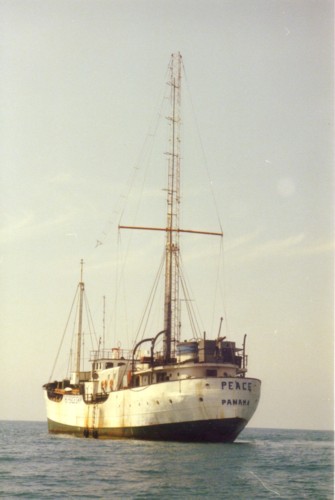
In January 1985, I had arrived in Israel to work as a DJ on a radio station, but this was no ordinary radio. The studios of ‘The Voice of Peace’ were on a ship anchored permanently in the Mediterranean Sea. Aware of my interest in cutting edge music, the station’s popular breakfast DJ Dave Asher (who had been living in Israel for some time) played me a recent 12-inch single by a young Israeli singer of Yemeni origin named Ofra Haza. It was a traditional Yemeni song, re-mixed and cut up into a state-of-the-art club tune that sounded to me like a new, exciting ‘Middle East meets West’ genre. I wanted to find out more, but the terrible winter storms and shortage of staff meant that I was stuck working on the ship for the next three months.

Eventually, during my first shore leave, I visited the Tel Aviv office of the small independent record company, Hed Arzi, that had produced the Ofra Haza single. They were baffled that a British DJ would be so interested in one of their worst selling record releases, and particularly one that seemed to have such minimal mainstream potential. They humoured me and let me sit at a desk in their office, penning handwritten letters to radio DJs and record labels that I knew back in the UK, sent by airmail along with the single and related album ‘Yemenite Songs’.

Within a month, I had received replies from John Peel at Radio One and Charlie Gillett at Capital Radio, both saying that they had played Ofra’s record on their shows and had received enquiries asking where the record could be purchased. During my next shore leave, I returned to Hed Arzi, whose staff were amazed that their song had been played on national radio in the UK. They introduced me to Ofra and her manager for the first time. I wrote again to several UK record companies and one of them, Globestyle, was convinced sufficiently by the airplay to release both the single and the album.

I returned to the UK at the end of 1985 and spent the next two years trying to convince everyone I knew of Ofra’s talent. By 1987, I had given away so many copies of her records to music industry people that the UK record company said I would be given one last free box. By chance, I had recently been invited to attend a monthly staff meeting of London pirate station Kiss FM (at the London School of Economics) and, as a last resort, I distributed copies of Ofra’s records from this last box to some of the station’s DJs.

Kiss FM DJs Jonathan More and Matt Black, recording together as ‘Coldcut’, had already enjoyed underground success with some highly original cut-up singles on their Ahead Of Our Time label. They liked the Ofra Haza songs so much that they cut up one of them into their homemade remix of US rappers Eric B & Rakim’s latest single ‘Paid In Full’. Island Records in the UK released this remix without seeking Eric B’s prior approval, and without clearing the Ofra Haza sample. By the end of 1987, the single had reached number 15 in the chart, giving Eric B his first British hit and earning significant royalties for the Israeli record company because a third of the track featured Ofra’s voice.

More than anything, the chart success of that Eric B remix stimulated huge public interest in Ofra Haza’s voice beyond the narrow market for ‘world music’ (which had just been marketed as a new genre). In early 1988, I organised interviews for a promotional visit to the UK, shepherding Ofra Haza and her manager to Radio 1, the World Service and commercial radio stations. The UK record company re-issued Ofra’s ‘Im Nin Alu’ single, which quickly garnered radio airplay this time, despite it being sung in a strange, foreign language. However, the public demand for the single was so great that the independent label had difficulty fulfilling orders, so it licensed the track to Warner Brothers. After an initial meeting with the major label, my direct involvement with Ofra Haza ended abruptly, just as she was invited back to the UK to perform on ‘Top Of The Pops.’

After the success of this single internationally, the Israeli record label invited me to London’s Sarm Studios, where the follow-up single was being mixed. It was evident that none of the Warner Brothers personnel involved had any understanding of the unique charm of Ofra’s Yemeni music in the international marketplace. Ofra’s manager was far too keen to turn her into a mainstream pop singer, which is exactly how the public perceived her in Israel. As a result, the follow-up single bombed and, sadly, it seemed as if Ofra was consigned to be a one-hit wonder as a result of poor career guidance.

In 2000, I was shocked to learn of Ofra’s death at the age of 42 from AIDS-related organ failure. Two years later, an Israeli television film crew came to London and filmed an interview about my role in creating their country’s most successful international pop star. They had just filmed a similar interview with John Peel at his home, during which he impressed them by producing the handwritten letter that had accompanied the Ofra records I had initially sent him from Israel seventeen years earlier. The interviewer asked me if I had made a fortune from ‘discovering’ Ofra Haza for the international market. All I had received was one cheque for £200 from the UK record company in 1988 to reimburse my expenses for Ofra’s first London promotional visit.

Ofra’s incredible voice lives on through the music she recorded, although I am always reminded of the parts of her life that had been unbelievably tragic. The crucial roles of the late John Peel and Charlie Gillett in her international success should not be forgotten. Ofra Haza’s music arrived in the Western world at a time when the public welcomed sounds that challenged their expectations. We are musically much the poorer for the loss of Ofra, and of John and Charlie, from our world.

‘The Israeli Madonna’
Thursday 30 December 2010
11.30am-12.00noon
BBC Radio 4


[photo: Grant Goddard]