DAB radio take-up in the UK: the 2010 year-end scorecard

“I think that there is great potential for digital radio, as the UK and Danish experiences demonstrate.”
Neelie Kroes, vice president for the digital agenda, European Commission, 3 March 2011

“This milestone is part of building momentum for the transition to digital radio in the UK …”
Digital Radio UK, December 2010

“I think that there has been a transformation in the last twelve months.”
Ford Ennals, chief executive, Digital Radio UK, February 2011

“2010 was a fantastic year for the DAB family, with much encouraging news and positive activity from individual markets …”
Jørn Jensen, president, World DMB, March 2011

“We are seeing increased momentum and activity as digital radio switchover moves from debate to reality …”
Bernie O’Neil, project director, World DMB, March 2011

“2010 had a real sense of forward momentum and activity …”
Caroline Brindle, project office manager, World DMB, March 2011

“Building momentum”? “Transformation”? “Fantastic year”? “Increased momentum”? “Forward momentum”?

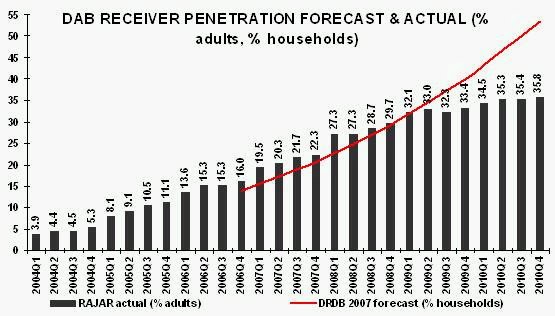
Is this DAB radio that we are talking about? In the UK, at year-end 2010, the picture looked like this:

DAB radio receiver penetration:
· 2010 year-end forecast: 53.4% (Digital Radio Development Bureau, 2007)
· 2010 year-end actual: 35.8%

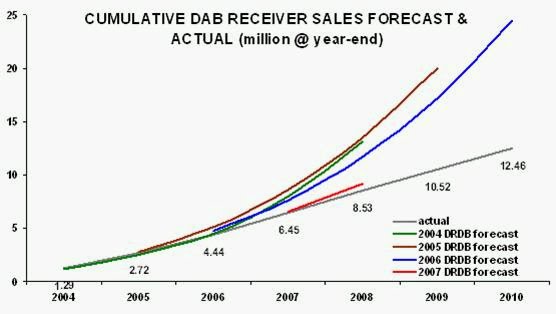
Cumulative DAB radio receiver sales:
· 2010 year-end forecast: 24.5 million (Digital Radio Development Bureau, 2006)
· 2010 year-end actual: 12.5 million

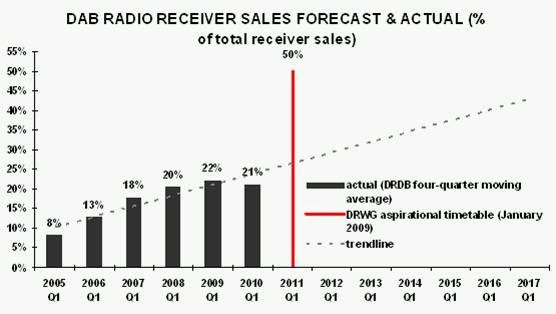
DAB radio receiver sales as % total receiver sales:
· Q1 2011 forecast: 50% (Digital Radio Working Group, 2009)
· Q1 2010 actual: 21%

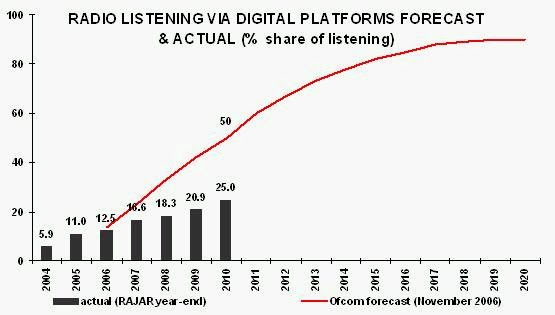
Radio listening via digital platforms:
2010 year-end forecast: 50% (Ofcom, 2006)
2010 year-end actual: 25%

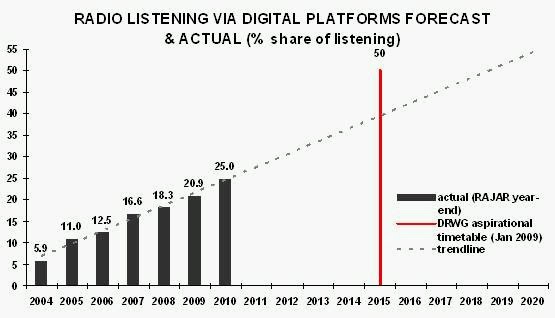
Radio listening via digital platforms:
2015 year-end forecast: 50% (Digital Radio Working Group, 2009)
2010 year-end actual: 25%

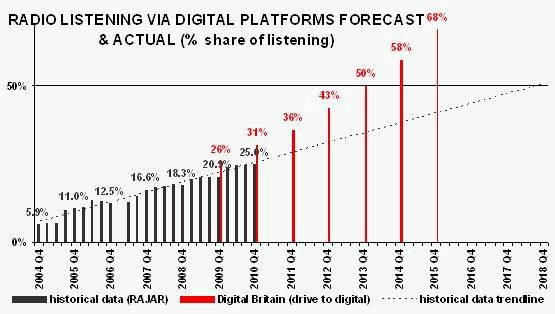
Radio listening via digital platforms:
2010 year-end forecast: 31% (Digital Britain: drive to digital, 2009)
2010 year-end actual: 25%

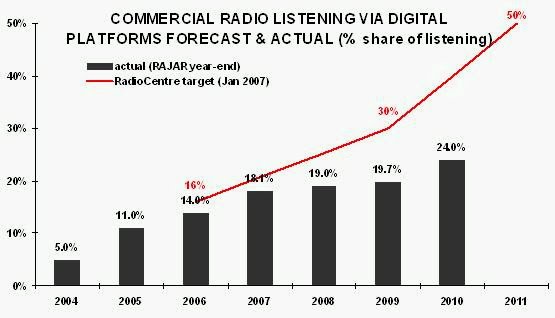
Commercial radio listening via digital platforms:
2010 year-end forecast: 40% (RadioCentre, 2007)
2010 year-end actual: 24%

None of the stakeholder forecasts of DAB take-up in the UK have come to pass. In this respect, 2010 was no better a year than any other.

Neelie Kroes is mistaken. Evidence from the UK experience certainly does not demonstrate the “great potential” for DAB radio.

GERMANY: planned 2011 re-launch of national DAB "solved a problem that did not exist"

On 15 December 2010, five commercial radio stations in Germany – New Wave Radio, Lounge.fm, ERF Medien, Radio Energy in Hamburg and Regiocast Digital – signed contracts with transmission provider Media Broadcast to broadcast on the new national DAB+ platform, scheduled for launch in 2011.

One week earlier, British company Frontier Silicon, “market leading supplier of digital radio technology worldwide”, had announced that, in order to persuade four commercial radio broadcasters in Germany to persevere with DAB, it had promised them it would purchase an unspecified amount of their advertising airtime for the next four years.

Anthony Sethill, Frontier Silicon CEO, put a positive spin on an act that some might perceive as little more than legalised bribery in the face of desperation to sell DAB hardware in Germany: “We are delighted that our innovative approach to supporting the roll out will help everyone working on this new radio service to bring their efforts to fruition.”


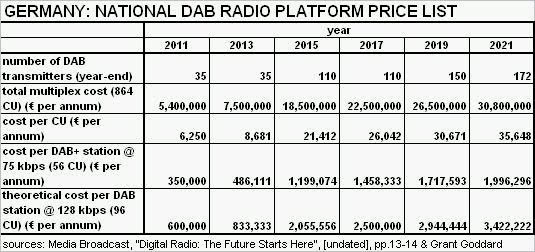
For years, German transmission provider Media Broadcast has been eager to put into action its masterplan to lock new DAB+ broadcasters into minimum 10-year contracts, for which it will be charging €2m per annum per station by 2021. The combination of Media Broadcast’s enthusiasm for the financial returns from DAB transmission contracts, and Frontier Silicon’s enthusiasm for the potential sales in Germany of DAB receivers that incorporate its technology, plus the offer of an amount of cash, persuaded a few commercial broadcasters to take on the risk of using the DAB+ platform.

Helmut Egenbauer, CEO of Media Broadcast, said: “Having introduced Frontier Silicon to the commercial broadcasters, we are delighted to see that their discussions have led to this important commitment to DAB+ radio services.”

Those five German commercial broadcasters should understand that even Frontier Silcon’s subsidy might not prevent them losing money hand over fist for the entire ten years of their transmission contract with Media Broadcast. The evidence is already there from the UK market. Not one commercial digital-only radio station has yet made an annual operating profit from the DAB platform in the UK, even after eleven years, let alone come close to recouping its investment.

Research commissioned by RadioCentre in 2009 found that the average annual revenues of a digital radio station were around £130,000 per annum. By then, 10m DAB receivers had been sold in the UK. Yet Germany is still at Year Zero with DAB+ radio penetration. The same report for RadioCentre had noted that the “annual negative cash flow impact of DAB” on the UK commercial radio industry was around £27m per annum, or 5% of sector revenues. Can German commercial radio afford to deplete its profitability by that sort of amount, year-on-year, for the next decade?

Frontier Silicon’s press release quoted Helmut G. Bauer as a “representative of the commercial broadcasters,” saying what a fantastic deal it was and promising that “2011 will be year that DAB+ is successfully launched in Germany.” However, Bauer is not associated with the German commercial broadcasting trade body, VPRT, which has been outspoken in its condemnation of plans for digital radio switchover in Germany. Bauer is a Cologne-based lawyer who has long made pro-DAB presentations at media conferences, and pro-DAB statements to the press, as a ”consultant.”

In fact, VPRT had
commented: “As we know, DAB failed in the market. Against this background, plans for the closure of FM – originally scheduled for as early as 2015, but now postponed – are absurd from an economic and social perspective and are therefore unacceptable.”

Noting the developments in Germany this week, Berlin-based Christoph Lemmer wrote in Radioszene magazine:

“With this decision, DAB will now actually be introduced by those who have succeeded, smelling a quick buck, in selling Germans a new sort of equipment, with millions to be sunk into to a new transmission network. Our old radios will be useless for DAB. Those who want to continue listening to the radio will need a new receiver.“

“It does not take a prophet to suspect that the private radio industry has shot itself in the foot by agreeing to sign the DAB contracts. A few shekels subsidy from a chip manufacturer who wants to install as many of its chips in DAB receivers – that is what has led to this. You, dear people, were not considered in the end. Do you really believe that devices with DAB will ever be as numerous as FM radios are today?”

“No one will understand what [DAB] is and why it is good. Because, with DAB, you have solved a problem that did not exist. The existing technological distribution of radio programmes is excellent and widely used. You did not have to change anything. The argument that DAB will create new radio channels with lower entry barriers is specious, as long as media regulators continue not to award licences for technically available [analogue] frequencies because they do not want additional competition in the market.”

This week, World DMB, the body marketing DAB radio globally, was so excited by developments in Germany that its web site posted seven news stories about it on 15th, nine on 16th and a further four on 17th. The overkill speaks volumes. Lacking any upturn in DAB receiver sales, the only positive news that DAB lobbyists can muster is this second attempt in Germany to launch a DAB technology that was first developed in 1981.

It is hard to recall a comparable technology whose proponents were still pushing for its launch three decades after its invention. DAB proponents argue that, simply because DAB is ‘digital’, it is inevitable that it will replace analogue radio. History indicates otherwise.

Digital Audio Tape. Introduced 1987. Abandoned 2005.
Digital Compact Cassettes. Introduced 1992. Abandoned 1996.

DAB radio & switchover: the British public speaks its mind

Q. Who will decide if/when digital radio switchover ever happens? The public. Who says so?

In July 2009, BBC ‘head of radio’ Tim Davie had
said:
“… the idea that we would move to formally engaging [digital radio] switchover without talking to listeners, getting listener satisfaction numbers, all the various things we do, would be not our plan in any way.”

In August 2009, BBC Trust chairman Sir Michael Lyons had
said:
“It is an extraordinarily ambitious suggestion, as colleagues have referred to, that by 2015 we will all be ready for [digital radio switchover]. So you can’t move faster than the British public want you to move on any issue.”

In July 2010, Culture Minister Ed Vaizey had
said:
“If, and it is a big if, the consumer is ready, we will support a 2015 switchover date. But, as I have already said, it is the consumer, through their listening habits and purchasing decisions, who will ultimately determine the case for switchover.”

Q. What is the BBC’s strategy for digital radio switchover?

In July 2010, the BBC Trust
told the BBC Executive that it:
“should draw up an overarching strategy for digital radio.”

Q. What is the public’s opinion of DAB radio?

Research published this week by the BBC Trust for the Strategy Review collated opinions voiced in 20 focus groups held in September 2010 in ten locations. Below are excerpts that relate consumers’ experiences with DAB radio and the BBC’s digital radio stations. They make sobering reading ….

Key Findings

The availability of radio services on the move (especially in-car and for those working outdoors) was felt to be of continued high importance. People expect radio to stay portable – at least the range of stations they currently have available on analogue, including local stations which are critically important in-car for their local travel information. In this context especially there was strong resistance to the idea of analogue radio switch-off, and considerable scepticism as to whether or not this will actually happen.

4.2 The range of services provided by the BBC

“Rather than spending money on Radio 57 or whatever, invest more money on the core main programmes.”
35-44, Male, C2DE, Crowthorne

4.3 Attitudes to DAB radio

Many of the distribution issues we set out to discuss in the groups related to the availability of DAB (or of certain stations on DAB). However, what became clear in the groups was that, although we did speak to some real fans of DAB, most licence fee payers we spoke to do not yet view DAB as an essential service in the way they do Freeview, for example. This certainly coloured their reaction to some of the trade-offs they encountered between funding distribution and content.

“I think they should improve the Freeview signal before they start worrying about the radio. Radio is fine.”
18-24, Female, ABC1, Inverness

These attitudes were coloured by a number of factors:
· Limited awareness of what DAB is and what it offers
· Limited awareness and uptake of the BBC’s digital-only radio stations (most digital radio listeners within the groups were using digital radio as a means of listening to stations they would otherwise be able to receive via analogue)
· Most DAB set owners we spoke to had received them as presents – they hadn’t necessarily had a compelling reason to buy one
· Many trialists of DAB in the groups had been frustrated with their experiences – e.g. intermittent/non-existent signals, limited range of their favourite stations available
· Some doubts as to whether DAB technology will be around in the long term

“I did have a DAB radio but I didn’t notice it being any better”
18-24, Female, C2DE, Cheddar

“I find DAB radio can be quite troublesome although that’s not BBC specific. The signal seems to interrupt quite regularly”
45-59, Female, ABC1, Crowthorne

“I don’t find that DAB radio is achieving a lot for me. It’s supposed to be better quality, but because of the size of the set I’ve got, it doesn’t really make any difference.”
55+, C2DE, Derby

“Aren’t we the only ones to use DAB? Europe uses a different system and America too – I don’t see the point of it now so many people have the internet as it’s as cheap to get an internet radio as it is a DAB radio and you can listen to far more stations on it”
25-44, ABC1, Fort William

“You can’t get much [on DAB in the car] – no Radio 1, no Radio 2, no Radio 5 live, no Radio 4, you just get a message saying ‘no reception’. You need to be on top of a mountain to receive it. It’s a complete waste of time.”
55+, C2DE, Derby

There was real confusion and in some cases concern about the idea of a digital switchover for radio, and some debate as to whether the mooted date of 2015 was realistic or not. Certainly in the current circumstances there would be much resistance among participants in these groups to the idea of switching off analogue radio, especially those for whom in-car listening was an important (or the dominant) part of their radio listening.

“They can’t switch off analogue radio – people are really not going to be happy with that”
18-24, Male, C2DE, Belfast

“The idea of making all radios into digital is just ridiculous… It’s not persuading you – it’s just pushing you”
18-24, Female, C2DE, Cheddar

“What about all the car radios – surely we’re not going to replace all those?”
25-34, Female, ABC1, Caernarfon

“Are you telling me my radios will be totally obsolete if they do this? That’s outrageous”
60+, Female, ABC1, Newry

5.1 Availability of services

“I’m going to sound old fashioned but the core product is BBC One, BBC Two and Radios 1 to 5”
35-44, Male, C2DE, Crowthorne

The digital-only radio stations were considered of significantly lesser importance (awareness of these was limited, and listening to them was quite sporadic through the sample). In fact in several groups it was suggested that one solution to the complex problems of making access to digital radio more easily available to people would be to get rid of the stations altogether!

“I don’t think anyone really cares about the digital channels and they won’t until all the non-digital signals have been turned off”
25-34, Male, C2DE, Newry

“It’s limited because digital radio hasn’t really taken off.. they’re talking about changing over in 2015… if it’s half the hassle of the digital [TV] switchover, it will be a dead loss”
45-64, ABC1, Merthyr Tydfil

6.1 Availability of platform choice

There was also a general consensus across the groups that, although the convergence of platforms has started to offer useful additional means of consuming ‘broadcast’ services, as a minimum the BBC’s television services should be available via a television set, and the main radio services via a radio set.

“It’s good enough to be able to get main stations on analogue radio and the others through the TV – I don’t think they need to be able to get all these radio stations on radio only.”
25-34, Female, ABC1, Caernarfon

Lack of availability of BBC Radio Derby on DAB

Local radio was considered to fulfil an important community service, particularly by those in the older group, who remarked that there had been a decline in the range of local media available (local newspapers closing, and the ITV regional television coverage now being focused on Birmingham).

As such, BBC Radio Derby was felt to be important to giving the city a sense of identity. Sports coverage was an integral part of this (for the men especially), and Derby-specific coverage was felt to help ensure that they don’t live in the shadow of nearby Nottingham. Frequently, they felt, Derby is treated like a poor relation next to Nottingham; the availability of BBC Radio Nottingham (but not BBC Radio Derby) on DAB was yet another manifestation of this, they believed.

A number of them had bought DAB radio specifically with the intention of listening to BBC Radio Derby and had thus been extremely disappointed not to be able to find it.

“I asked for a DAB set for Christmas, specifically so I would be able to listen to Radio Derby, nice and clear, around the house – not realising that you can’t get Radio Derby on DAB at all… I only found out when I pressed the ‘auto-scan’ button… Leicester, Nottingham, loud and clear, but no Derby… I felt really let down.”
55+, C2DE, Derby

“My wife bought me one for Christmas. It wouldn’t work next to the bed – we thought it was broken. We ended up just using it as an alarm clock. It never occurred to me that it might not work depending on where you live.”
40-54, ABC1, Derby

There was little awareness or understanding of the reasons why this is the case (the lack of a local commercial multiplex operator), so some participants were upset that the BBC appeared to be viewing Derby as a lower priority than neighbouring areas. Others had assumed that this was a technical issue (reception problems), rather than the station not being broadcast on DAB. (There was some awareness of a promised launch date of July 2010, but they claimed that this date had been and gone with no further update on what was happening.)

“What makes me angry is that Radio Derby comes out as one of the best local news stations in the country, but it’s not available on the latest technology.”
55+, C2DE, Derby

“If you can get the others, you’d just assume that you can get Radio Derby as well. Whose decision is it not to have it?”
40-54, ABC1, Derby

Some of the participants had experimented with some of the BBC’s digital-only stations on DAB. Radio 7 in particular was well-liked by some of the participants in the older group, and some of the younger men had used 5 live Sports Extra, but their overall impression with DAB was one of disappointment. The absence of BBC Radio Derby was a significant contributor to this, along with poor reception quality.

“The way they sell DAB it was going to be the be-all-and-end-all of radio listening, but it’s just been a great disappointment.”
55+, C2DE, Derby

Although many were disappointed with DAB in general, the absence of BBC Radio Derby from DAB was not felt to be a major problem for them as long as the station remains available on analogue (many were listening out of home in any case – traffic reports in the car, or match commentary when out and about at the weekend).

However, in line with most other groups, these participants would be extremely upset if the analogue signal were switched off and BBC Derby only then available online.

Radio Foyle on DAB

Many participants felt that they get a better reception with DAB than on analogue (in the home). Many of the older group in particular claimed to have experienced reception problems with Radio Foyle in particular on analogue, especially in bad weather. However it was not a case of a having had a desperate need to get a digital radio because they got no analogue signal previously, more that the sound was not always great and they sometimes experienced reception problems.

“DAB radio… I got it out of curiosity… everybody said it was better than analogue… the analogue sometimes you can’t tune in because you have got high pressure or rain or wind. The DAB you can pick it up.”
50+, ABC1, Londonderry

Most assumed that Radio Foyle was already on DAB, as they insisted they were listening to it on their DAB radios – it is not entirely clear whether this is confusion between DAB and analogue signals on the same set, or they have been experiencing the ‘dynamuxing’ test.

“No I didn’t know that because when I press it comes up on my DAB radio so I thought it was. I just took it that all the stations I can pick up on my DAB are digital.”
50+, ABC1, Londonderry

“Foyle on an ordinary radio is still poor I think. I am right in Derry. On the digital they do both seem clear to me.”
30-49, C2DE, Londonderry

When it was explained to them that ‘dynamuxing’ the two stations would result in two mono (as opposed to one stereo) stations, reactions were somewhat mixed. Although some participants were adamant that going from stereo to mono would compromise their listening experience, particularly when listening to music, others admitted that they were not sure what mono sound is, and probably wouldn’t be able to tell the difference! It is also worth noting that, from the description they gave of their DAB sets, the majority of participants in the groups were listening to DAB on mono-only sets anyway.

On balance, all participants would prefer both stations to be available, even if this meant mono-only broadcasting. The younger group, who were more loyal Foyle listeners, were happy enough with the availability of Foyle on analogue only, but would be concerned by the prospect of an analogue radio switch-off, in which case continued availability of Foyle would be vital.

Poor DAB coverage (in Fort William)

Most of the participants in the groups are used to struggling with coverage issues. Lack of DAB coverage is just the latest manifestation of issues they have experienced historically with analogue television and radio signals.

“I live over in a rural area completely surrounded by hills so there is no radio reception at all so all our radio listening is done through the TV box or the internet”
25-44, ABC1, Fort William

“I tried a DAB radio but it wasn’t very good – it would go for a bit then completely cut out and we have no FM signal at all out in the glens where I am”
45-64, C2DE, Fort William

As a result, satellite (by which most really meant Sky, as awareness of Freesat was very low) had become the default standard for most to receive television, especially for those outside the main town of Fort William itself, and many were increasingly using the good broadband services that are now available to them as a more reliable means of accessing media content.

“We’ve been up there seven years now and when we first moved we had a reasonable medium wave signal for Radio Scotland but then that tailed off but we get no FM and there was no TV until satellite came on stream… We had very young children at the time and they were happy just watching DVDs… There are about 250 people in our village and many of the surrounding communities have the same issues… There used to be a mast for the TV but that was turned off and now everyone has a satellite dish… satellite has been a godsend for us – especially for the radio – but we are now even more likely to be listening online. Our broadband is excellent – 8Meg – and now we even have wi-fi radios in the house.”
25-44, ABC1, Fort William

Some participants in the groups had been drawn to DAB, but left frustrated by the experience.

“I won a DAB in a Radio Scotland competition and I was really excited about being able to listen to 6 Music but there was absolutely no signal so I gave it to my dad down in Glasgow and he’s really happy with it”
25-44, ABC1, Fort William

Limited availability of Radio Wales and Radio Cymru on DAB

In common with many of the research locations across the country, issues surrounding the lack of availability of Radio Wales and Radio Cymru were caught up in other issues around the quality of DAB signal in general.

While some participants (for example, one lived near a mast) were experiencing extremely good reception via digital, others were having problems based on their location and even the prevailing weather conditions.

“If you get a rain cloud overhead, or worse than that the snow, you might as well chuck it in the bin.”
45-64, ABC1, Merthyr Tydfil

“People who live in the dips – they can’t get any kind of digital radio reception at all… they’ve got to do something to help them.”
25-44, C2DE, Merthyr Tydfil

This frustration was a manifestation of a broader dissatisfaction with digital reception in general. Many were experiencing problems with their television reception (especially, but not exclusively through Freeview). Lack of a reliable television signal was seen by most as a more significant problem than lack of a reliable radio signal.

“They said the digital signal was going to be better – that you’d be able to get S4C and Channel 4 – but it’s actually worse.”
25-44, C2DE, Merthyr Tydfil

“Wales has always got problems, we get worse service with the digital, the broadband, the post… We pay the same, we have a right to the same service.”
25-44, C2DE, Merthyr Tydfil

As a result many in the groups considered themselves to be disgruntled licence fee payers.

Most could understand that there are diminishing returns in terms of building out the transmitter network, and that those in the more mountainous parts of central Wales (for example) might not be able to have access to the same choices as people in more densely populated areas. However, in these groups the argument was most strongly made that people in these areas should have some kind of discount from their licence fee in recognition of the reduced service they receive.

“They [the BBC] can’t please everyone, they’re doing the best they can, but If people can’t get the service, why should they pay the full money.”
45-64, ABC1, Merthyr Tydfil

“You shouldn’t be penalised for living in an area where they can’t provide these services, because we have to pay extra to get Sky, for example, to be able to receive it.”
45-64, ABC1, Merthyr Tydfil

Lobby the EU to mandate Europe-wide digital radio switchover? No chance!

The European Union [EU] has always made its position perfectly clear on radio broadcasting policy for its member states. It will not adopt an EU-wide digital radio strategy. A year ago, Viviane Reding, then EU commissioner for information society & media, reiterated the policy in an interview:

“This issue of EU-wide radio standardisation is still in its infancy. The main reason is that radio, from a political, business and consumer standpoint, is organised primarily as a regional or even local product. This is, in principle, rightly so. The reason the radio landscape in Europe is so fascinating is because it is so diverse and highly innovative. Therefore, EU-wide radio legislation is not advocated.”

“I believe the time is not ripe for a single EU-wide radio FM switch-off, such as we are doing for analogue TV in 2012. I can also well imagine that the 27 EU Member States, given their different levels of development, will want to take their own innovative approaches to digital radio switchover.”

Given this clearly stated EU policy, it was a surprise when World DMB, the lobbying organisation for DAB radio,
announced on 10 November 2010 that one of its three objectives for the coming year was:

“To persuade the European Union to champion switch-over policies at European level …”

Using the forum of the European Broadcasting Union [EBU] Digital Radio Conference 2010 held in Belfast the previous week, World DMB seemed to have persuaded the EBU to endorse a no-hope strategy of challenging existing EU strategy in order that digital switchover be mandated through diktat. This follows the evident failure of World DMB’s bottom-up approach to convince consumers in many EU countries to replace their satisfactorily working FM/AM radios with DAB receivers.

World DMB president Jørn Jensen said in the press release:

“If digital radio is to succeed, then the EBU must show their support for the DAB family, the only technology platform chosen by Germany, UK, France, Italy, Spain and the Nordic countries as the future of digital radio.”

The EBU obliged by issuing its own statement which stressed that its conference had “achieved a significant breakthrough in efforts to accelerate moves towards securing a digital future for radio.” The EBU wording is significant – its public statement talked about ‘digital’ radio but never mentioned the ‘DAB’ platform specifically. Whereas, the World DMB press release went out of its way to interpret ‘digital’ radio narrowly as ‘DAB’, almost to the point of obsession, when Jensen said:

“It’s time to stop talking about less mature standards, EBU needs to promote the Eureka 147 [DAB] family of standards.”

And what exactly did Jensen mean by “less mature standards”? Could he be referring to the platform whose name dare not be spoken amongst DAB lobbyists – THE INTERNET? Coincidentally, five days prior to the World DMB press release, Neelie Kroes, the current EU commissioner for the digital agenda, had admonished content producers who do not adapt their businesses to the internet age in a speech:

“Like it or not, content gatekeepers risk being sidelined if they do not adapt to the needs of both creators and consumers of cultural goods. So who will win the heart of the creators and of the public? It is still too soon to say. Of course, some of the new giants of internet come from another continent. I would wish that more of them were European, but when I see the wealth of creativity gathered in this room, I am optimistic for the future.

I believe that those who will prosper in the digital age are those who understand that convergence is one of the keys. The convergence of media provides an incredible opportunity for the artists and creators of our times, and also for their public – you and me. Just like cinema did not kill theatre, nor did television kill radio. The internet won’t kill any other media either.”

Despite the EU’s enthusiasm for convergence, the internet is still perceived as a competitive threat by some European radio broadcasters, who fear attrition to their audiences from an influx of online audio content from beyond their borders. To them, Last.fm, Spotify and We7 are the antichrists, and they hope that DAB’s walled garden will banish these insurgents from their kingdom. But, although Jensen wants to paint the internet as a “less mature standard”, history books show that it was around long before DAB (I was sending e-mails, before they had that name, across the Atlantic in 1978).

Also, when World DMB promised in its 10 November press release that it would “foster effective partnerships between broadcasters and the automotive sector” over the next year to get DAB radio into cars, it was advocating actions it could and should have taken more than a decade ago. It has long missed the boat. EU commissioner Neelie Kroes had announced on 8 November that IP-connected cars were the current European policy objective:

“Europe leads in wireless communication to and from vehicles. That is critical to improve both safety and efficiency. And to convert this into global market success global cooperation and standardisation will be required. This is where the EU’s Future Internet Public Private Partnership comes in. We need the automotive and ICT communities side-by-side. That way we can seize the opportunities of the next generation of wireless broadband, beyond 3G, to meet the growing demand for connectivity in cars.”

So what chance does World DMB have of achieving these two stated objectives for EU policy during the next year (compulsory digital radio switchover, DAB in cars)? None whatsoever. So why would it set itself objectives that are bound to fail? It can only be sheer desperation at this rapidly deteriorating stage in DAB’s lifecycle.

The third of World DMB’s stated objectives for the next year – “to advance partnerships between public and broadcasters” to make DAB happen – must have been drafted by someone with a wry sense of irony. Such ‘partnerships’ appear to be going nowhere in DAB:
· In the UK, RadioCentre, the commercial radio trade body, has failed in its insistence that publicly funded BBC should pay for the upgrade of commercial radio’s local DAB transmitters
· In Germany, commercial radio has failed to agree with public radio to a new plan to re-launch national DAB radio
· In Spain, commercial radio called DAB “a road to nowhere” despite public radio’s insistence on persevering
· In France, national commercial radio networks have refused to support public radio’s plan to launch digital terrestrial radio
· In Denmark, only one commercial station is broadcasting on DAB, alongside 17 state radio stations (many of which are about to be axed)
· In the Netherlands, national commercial radio stations have had to be forced to broadcast on DAB by the government inserting new clauses in their licence renewals.

World DMB’s rallying call of “let’s just get on with it!” might make more sense if its proposed solutions were practical in any way. Its press release was headlined ‘European Broadcasting Union backs digital radio switch over across Europe.’ Given that all three of its objectives for the next 12 months fly in the face of realpolitik, it would have been more accurate to entitle the press release ‘Three impossible European things before breakfast.’

[with thanks to Michael Hedges at Follow The Media]

DAB radio's slow consumer take-up: lessons not learnt from FM radio 50 years earlier

“Without a knowledge of your history, you cannot determine your destiny”

Misty In Roots, ‘Live At The Counter-Eurovision 1979’
Recent history can teach us important lessons. Efforts to turn dreams into reality come a lot easier if we learn from what has gone before us, what has gone right, and what has gone wrong. This is as true in radio as it is in any human endeavour.
Dr. Stephen Lax, Senior Lecturer in Communications Technology at the University of Leeds’ Institute of Communications Studies, has written an excellent paper entitled ‘A Vision For Radio: Engineering Solutions For Changing Audiences – From FM to DAB’. It was published in a recent anthology ‘Digital Radio In Europe’. The following are excerpts taken directly from Dr. Lax’s work and document what the radio industry should have learnt from the slow consumer take-up of FM radio half a century ago before it embarked upon DAB radio.
“The introduction of FM was itself no straightforward matter of replacing its AM forebear, and neither have innovations in radio technology in the half century that followed been unproblematic. It is in the context of this history that the emergence of DAB should be studied.
Like DAB, FM was widely claimed to offer a significant improvement in sound quality in comparison with the then universal AM modulation system. By the early 1940s, its technical superiority was established. One leading figure amongst US radio engineers, W.R.G. Baker, suggested in 1943 that FM was ‘so much better technically than the present regular broadcast system that it can’t fail of acceptance.’ Yet, despite such advantages, for several decades it did indeed fail to be accepted as a replacement for AM.

[…]
Following a UK launch in 1955, the BBC rolled out the FM service relatively quickly: by the end of 1959, most transmitters had been upgraded and 96.4% of the population was within range of the signals; but, even ten years later, when coverage was over 99%, the corporation noted that only one third of households had any form of FM receiver. A similarly slow rise in the popularity of FM continued in the US: although FM services had begun there on the VHF band some ten years earlier than in the UK, it was not until after 1979 that FM finally achieved a higher share of listening than AM.
[…]
[In 1974], [BBC director of engineering James] Redmond expressed puzzlement at the slow adoption of FM, even for fixed reception in the home. Despite its superior sound quality, he noted that ‘changeover has been slower than anticipated.’ …. [One] reason was the simulcasting of radio programmes on FM and on AM, rather than offering new programmes on the new service: listeners would only be able to hear on FM what their AM receivers already gave them.
[…]
This history serves as an illustration of how an apparently self-evidently superior technology pursued as a solution to a problem of audio quality did not automatically find favour with listeners, who […] were apparently prepared to put up with inferior sound and were less inclined to adopt FM while it offered little new programming or competition with television in the evening.
[…]
A mismatch is revealed between the broadcasters’ and engineers’ beliefs as to what was important to listeners, and the preferences and priorities of the vast majority of those listeners themselves.
[…]
[A group of audio enthusiasts] was contrasted [by Wireless World magazine in 1961] with ‘the most important group of all, the reasonable layman’ who simply wants decent reproduction at a reasonable cost, and it is this far larger group that no doubt hesitated to replace perfectly adequate AM receivers with the more expensive FM variety.
[…]
…. early promotion of DAB by the industry certainly used the phrase ‘CD-quality sound’, and placed this and related phrases at the top of the list of DAB’s advantages.
[…]
However, just as the slow pace of adoption of FM confounded broadcasters, for whom its advantages were self-evident, DAB too has failed to gain an enthusiastic embrace from the audience.
[…]
The exhortation ‘radio must go digital’ has been expressed repeatedly over the years: for example, by the Director General of Audio Visual Policy at the European Union’s Media programme, Spyros Papas, in 1998; by BBC Director of Radio, Jenny Abramsky, in 2003; and, more recently, in 2009 by French National Assembly member Patrice Martin-Lalande and, less surprisingly, by Quentin Howard of World DMB. For these commentators, the logic of this transition is self-evident and so needs little explanation, technical or otherwise, and none is offered – put simply, radio cannot remain an analogue technology when all other consumer technologies are digital. Yet, however compelling the logic might be from a technical point of view, the development of both FM and of DAB have failed to follow it: both have emerged only slowly and, in the case of DAB, its future remains uncertain.
[…]
A further difficulty for DAB was the changing landscape of radio in many countries during the period of its development such that, by the time of its public launch in 1995, it was seen by some as reflecting a view of the radio industry that was out of date.
[…]
Just as, by the time FM was launched, other changes in radio had made its introduction more complex, so too we can observe similar, non-technological reasons for the problems in introducing DAB.
[…]
In the case of digital radio, it is possible to identify a number of intentions behind its development, from an imagined need to compete with other emerging technologies to a macro-economic need to aid a key industry. In contrast to the history of radio technology frequently presented as a straightforward series of technical challenges faced and solutions proffered, we find instead that apparently compelling innovations follow a complex path in which cultural practices and economic interests must be taken into account.”

[reprinted with permission of the author]