Costs/benefits of digital radio switchover: why the government buried the evidence

Digital radio switchover was first mooted in the 1980s and started to gather momentum following the first UK public demonstration of the DAB digital transmission system at the Radio Festival in Birmingham in 1991. New Scientist magazine reported then that DAB radio could be up and running in the UK “by the mid-1990s”. However, it was not until 1999 that DAB radio was launched publicly and DAB radio receivers were made available commercially.

Over this period of decades, it would have been sensible to commission some kind of cost-benefit analysis to assess if there were a potential net benefit to radio listeners, to the radio industry, and to the UK generally of embarking on a plan to convert the whole nation to digital terrestrial radio. If such an analysis was ever published, I must have missed it.

We are now in 2010, an incredible 29 years after research and development first started on DAB radio technology. The issue of digital radio switchover has been the subject of a succession of government initiatives since the end of 2007 (the Digital Radio Working Group, Digital Britain, the Digital Economy Bill). Has the government shared with the public a cost-benefit analysis which demonstrates that the public policy on digital radio pursued over the last 20+ years is somehow worthwhile? No. Does such a cost-benefit analysis exist? Yes. Can we see it? No. Where is it? Apparently, gathering dust on a government or Ofcom shelf.

How do we know this? A parliamentary committee recently delved into these facts during its current investigation into the issues surrounding digital switchover in the television and radio markets (see transcript below). Ofcom has remained remarkably silent on the issue of digital radio switchover in recent years. The regulator’s director of radio, Peter Davies, was last seen speaking publicly about DAB in November 2008 when he admitted that new legislation would be necessary to salvage the DAB platform. A little earlier, in April 2007, Davies had prematurely declared that “we are potentially at a Freeview moment with digital radio.” Three years later, radio’s ‘Freeview moment’ seems as far over the horizon as ever.

The first we knew that the government had commissioned some kind of cost/benefit analysis [CBA] for its proposed digital radio switchover was in November 2009 when the Digital Economy Bill was published. The government’s accompanying Impact Assessment document stated:

“The partial Cost Benefit Analysis conducted by Price Waterhouse Cooper (PWC) for the Digital Radio Working Group, which is available on the DCMS website, suggests the Digital Radio Upgrade could reduce the total transmission costs for the radio industry from £87.9 million to £64 million….”

“First, by supporting greater investment in DAB infrastructure a greater number of consumers will have access to DAB and the quality of reception will improve. Secondly, consumers will benefit from access to a wider range of services, specifically new national stations and functionality, such as pausing and rewinding live radio. Finally, the released analogue spectrum will allow for a greater range of community radio stations, as well as possible non-radio services. The PWC partial CBA for the Digital Radio Working Group suggests the value of these benefits could be in the region of £1.1 billion, over a period from 2009 to 2030…..”

“The significant consumer costs of the Digital Radio Upgrade in the non-voluntary conversion of analogue sets to digital, including the cost of in-car conversion. The PWC report suggested the cost of such conversion to be in the region of £800 million, again over the period from 2009 to 2003.” [typo – “2003” should be “2030”]

Although this document stated that the PWC report was available from the government’s web site, I have searched for three months and still never found it there. Nevertheless, the 91-page report entitled ‘Cost Benefit Analysis of Digital Radio Migration’, prepared for Ofcom by PWC on 6 February 2009, contains a number of very serious reservations that there will be ANY benefit from digital radio switchover, and it states:

“The results suggest that there are relatively few up-sides to the estimates, and several significant downside risks. … To a significant extent, the positive Net Present Value [NPV] of the Cost Benefit Analysis relies on two crucial parameters. The first is the Digital Radio Working Group [DRWG] recommendation that an enlarged regional [DAB] multiplex network should be implemented. Failure to implement would result in a substantial negative NPV. The second critical parameter is the time horizon. The results suggest that there is a very long pay-back from the DRWG policy ‘investment’ – the NPV turns positive after 2026. This result assumes that the existing multiplex licences are extended to 2030, as per the DRWG recommendations. Without the licence extension or any other policy instruments that provide clarity on the long term future of commercial radio, the industry and consumers may fail to see the benefits of digital radio over the longer term. Our analysis suggests that the NPV is negative should either of these two proposals not be implemented.” [emphasis added]

The PWC report explicitly noted for Ofcom the limitations of its analysis, as a result of the lack of consideration it had assigned to external factors. These paragraphs probably explain why the government has been so keen to keep the report away from public scrutiny:

“The scope of this study is limited to the assessment of the DRWG policy. The overall digital radio policy appraisal process would need to take into account other policy options and ‘states of the world’. With this in mind, we highlight three issues in particular:

1.    The impact of recession: We have assumed no change in commercial radio sector structure and health beyond a consensus view of advertising forecasts. As this CBA is conducted for the time period to 2030, short term recessionary impacts may have only a limited impact on the longer term outcome for the industry. On the other hand, the current economic downturn could still affect the short and medium term investments required for marketing or coverage extension, which in turn could delay the desired DRWG policy outcome.

2.    Other policy options: We recognise that to reach a view on this question of how to drive digital radio penetration and listening (which in turn delivers consumers’ and citizens’ objectives) requires a full assessment of the costs and benefits of a number of policy options; this study has examined one, the DRWG policy. This is the only policy assessed in this study and the policy is at an early stage of its development; Government and Ofcom could give consideration to other possible policy options. In addition, we recommend modelling a number of other ‘business-as-usual’ scenarios taking into account different assumptions, and assessing how they affect the CBA of the DRWG policy.

3.    Other digital platforms: This CBA assumes that DAB listening will continue to be the leading platform for digital radio listening. The DRWG has reinforced the view that ‘a radio-specific broadcast platform is an essential part of radio’s future’, and that DAB is the ‘most effective and financially viable way of delivering digital radio’ for the medium to long term. A long term view needs to account for the possibility of technology obsolescence or replacement. At present, there is no consensus view that suggests otherwise. However, there are signs that internet listening may begin to take off if internet radios are more actively promoted and technologies such as WiFi or mobile broadband mature and become universally available. A number of the cost and benefit categories assume an impact from increasing the coverage of DAB (for example, consumer benefits from increased coverage is assumed based upon the incremental benefits to consumers who could not receive digital radio stations). Should these trends continue, or a more structural shift to internet to occur, there would be a smaller benefit from increasing the coverage of DAB; consumers either have alternative access to digital radio even within out-of-coverage areas, or would prefer a non-DAB solution when they receive DAB coverage.” [emphasis added]

In the 12 months since the PWC report was prepared, all three of these assumptions have been undermined by subsequent events:

1.    The health and structure of the commercial radio industry have changed considerably during 2009:
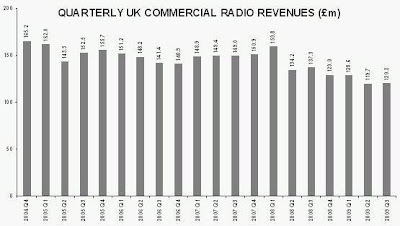
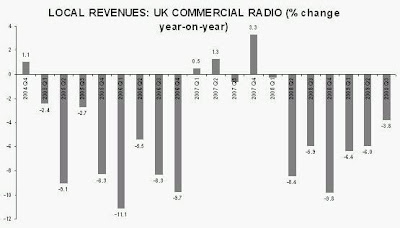
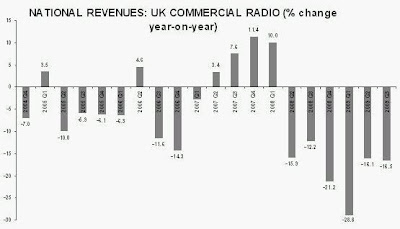
•  Commercial radio’s financial health has been impacted severely by the recession. The sector’s revenues were down 19.5%, 10.8% and 12.5% year-on-year in the first three quarters of 2009. Revenues from national advertisers were down 28.8%, 16.1% and 16.5% respectively
•  In January 2009, an analysis commissioned by RadioCentre found that “the [commercial radio] industry as a whole is now loss making”. Hours listened, revenues and profitability have all fallen further since then
•  At the beginning of 2009, Global Radio was the biggest owner of DAB multiplex infrastructure. Since then, it has disposed of its entire stake in the national DAB multiplex and most of its stakes in local DAB multiplexes to transmission provider Arqiva, demonstrating the radio sector’s inability to generate profits from the DAB platform after 10 years

2.    The policy recommendations for digital radio switchover made by the Digital Radio Working Group have since been amended by the Digital Britain report and the Digital Economy Bill. The recommendations of the Working Group’s Final Report published in December 2008 had included:
•  “Government should agree a set of criteria and timetable for migration to digital”, whereas no criteria or timetable are specified in the Bill
•  “A long term plan should be developed to move all services to digital”, whereas the Bill acknowledges that some local radio stations will never have the opportunity to migrate to digital
•  “The BBC should build out its national [DAB] multiplex across the UK to reach FM comparable levels [of coverage]”, whereas the BBC has acknowledged that such expenditure is constrained by the Licence Fee settlement
•  “The government should consider funding options to enable this important investment [in DAB infrastructure]”, whereas the government has made no financial commitment to the build-out of DAB multiplexes
•  “The government must consider the case for a [import] duty exemption for digital radios”, a proposal that is not mentioned in the Bill
•  “Consumer groups believe that, once an announcement [of digital switchover] is made, no equipment should be sold that does not deliver both DAB and FM”, a proposal that has been dropped

3.    The DAB platform has failed to grow in 2009, as had been forecast by the government, Ofcom and the Digital Radio Development Bureau [DRDB]:
•  Volume sales of DAB radio receivers were down 10%, down 1% and down 6% year-on-year in the three most recent quarters for which data have been released by the DRDB
•  Listening to radio via digital platforms accounted for 20.9% of total radio listening at year-end 2009, compared to the 26% forecast by the government’s Digital Britain report in June 2009 (and compared to the 42% forecast by Ofcom in November 2006)
•  Listening to commercial radio via digital platforms accounted for 19.7% of commercial radio listening at year-end 2009, compared to the target 30% announced by RadioCentre in January 2007
•  Total hours listened to digital-only radio stations at year-end 2009 were at their lowest level since 2007, demonstrating that digital radio content is failing to drive consumer take-up of digital radio
•  Unused capacity on the DAB platform has increasingly been filled during 2009 by non-commercial, government-funded, listener-funded, religious or ethnic radio services, rather than by mainstream, mass appeal stations
•  The commercial radio sector launched no completely new broadcast digital radio stations in 2009 (Absolute Xtreme was replaced by Absolute 80s), and the BBC is expected to announce cuts to its digital radio stations at the end of this month

As a result of these developments during 2009, the minimal, long term benefits from digital radio switchover identified by the PWC report a year ago are likely to have been diminished to the point where there may no longer be any benefit evident at all, even as far into the future as 2030. So how can the government still justify pursuing its policy of digital radio migration? It cannot, which is why it remains so reluctant to engage in an analysis of the facts, the numbers, the data and the evidence, all of which clearly show that this misguided, poorly executed, top-down attempt to switch radio broadcasting in the UK to the DAB platform is likely to become a ‘white elephant’ that has already cost the radio industry getting on for £1 billion.

House of Lords
The Select Committee on Communications
“Digital Switchover Of Television And Radio In The UK”
27 January 2010 [excerpts]

Witnesses:
Mr Stewart Purvis, Partner for Content and Standards, Ofcom
Mr Peter Davies, Director of Radio Policy & Broadcast Licensing, Ofcom
Mr Greg Bensberg, Senior Adviser, Digital Switchover, Ofcom.

Baroness McIntosh of Hudnall: I feel we could get back on to slightly safer territory and the notion of cost and benefit. We understand that you commissioned a report from PWC last year into the costs and benefits of digital switchover in radio, but you didn’t publish it. We know, therefore, what we have learned from the DCMS about what it said. It appears that it found, for example, that the benefits could – and I emphasise the word “could” – outweigh the costs by £437 million after 2026, but that conclusion is hedged about with quite a lot of caveats to do with what would have to happen in order for that good outcome to eventuate, and that if those things didn’t happen, then quite quickly you would get into a position where the costs would outweigh the benefits. Can you tell us a bit about that report? In particular, can you tell us why you haven’t published it? Do you think that, given what it appears to say – I choose my words carefully – about the constraints on potential for benefit, that it should have been available to inform the Government’s digital policy? Can you also tell us about your own impact assessment on radio digital migration, which I believe you have been asked to undertake? Will this include a full cost-benefit analysis? When are you intending to publish it? ….. [edited]

Mr Purvis: There are a lot of questions there. Peter commissioned the piece, so I am going to ask him to talk to them, but let me say that you have talked about informing the Government’s decision and one of the main points of doing this was to help inform the Government’s decision. It was a government decision as to whether this information should be published or not. But, we felt, as part of the ….

Lord Gordon of Strathblane: Sorry, it was your document, though, wasn’t it?

Mr Purvis: No, it was actually a PWC document.

Lord Gordon of Strathblane: It was commissioned by you.

Mr Purvis: Commissioned by us, yes.

Lord Gordon of Strathblane: Surely, it would be your decision to publish.

Mr Davies: We were asked to commission it by the Government. We then commissioned it from PWC with a lot of input from various government departments and then submitted it to the Secretary of State.

Chairman: So you decided not to publish it.

Baroness McIntosh of Hudnall: Who owns it?

Mr Purvis: Whenever you commission a document from an outside source, in a sense the ownership of the detail must lie with the people who actually did the work, but, in a sense, when you commission it, obviously you commission it with a purpose and the purpose was to give it to the Government.

Baroness McIntosh of Hudnall: With respect, that is not necessarily true.

Mr Purvis: No, there are options.

Baroness McIntosh of Hudnall: I have work commissioned from me and it may be, and often is, on the understanding that the ownership of what I produce falls to the person who commissioned it from me.

Mr Purvis: Yes, that’s true, but in terms of the ownership. But in the sense of the responsibility for the detail of the commission, the source of the commission must inevitably take its full share of that. But there are a number of options which apply when these pieces of work are done. On this particular occasion, it was decided in conjunction with the Department that work would be sent to the Department. Perhaps the most important thing is for Peter to respond to your characterisation of the work, but, in a sense, we have not hidden the piece of work. Indeed, I think it is now available to you. Is that right?

Baroness McIntosh of Hudnall: In, as they say, a redacted form.

Chairman: Just to be absolutely clear, the Department asked you to commission the work from PWC. Is that what you are saying?

Mr Purvis: They asked us to commission the work. Did they ask us specifically from PWC?

Mr Davies: Not specifically from PWC.

Chairman: The Department said to Ofcom, “Ofcom, you go and commission this particular work.” Is that the position?

Mr Davies: Yes.

Chairman: You then got the work which then came back to you and then you sent it to the Government and the Government said, “We’re not going to publish this in full.”

Mr Davies: I think they have certainly made it available to various groups. I think consumer groups have had it for some time.

Chairman: Fine. There will be no problem, therefore, in this Committee having the full report.

Mr Davies: I think they have made available the redacted version rather than the full report. The reason for that is some of the numbers in there are commercially sensitive, but there is no reason why the Committee should not have the full report.

Mr Purvis: You certainly have seen the conclusions.

Baroness Howe of Idlicote: I just wonder who has paid for it. Has it come out of your budget?

Mr Davies: Yes.

Baroness Howe of Idlicote: Even more indication of ownership.

Baroness McIntosh of Hudnall: Shall we go back to the questions. We now know why you didn’t publish it. Am I right in thinking that, notwithstanding the fact that you did not publish it, it did influence the Government or is in the process of influencing the Government as far as their policy on digital migration goes?

Mr Davies: I think it is one of the inputs to government thinking, certainly. We were very careful when we sent it to the Secretary of State to make clear what all the caveats were. You are absolutely right, there are a lot of caveats around it. This is a piece of work which is at a very early stage of the process. We were very clear to government that they should not use this as the means of making a decision, but it might help to inform the decision.

Baroness McIntosh of Hudnall: The thing that is slightly troubling – perhaps only to me, but a bit – is that when you see what appears to be evidence that the costs and benefits are, let’s say, finely balanced, or could be, that the drive towards digital migration, one might think, was driven more by the technology than by the needs either of the broadcasters or the consumers. That’s the question that seems to me still to hang in the air. Is this technology-led or is it consumer-led, if we wrap into ‘consumers’ both the people who are the end-users and the people who are using the technology to deliver a service?

Mr Davies: I think that is why there are so many caveats around it, because it needs to be, as you say, consumer-led. So, some of the conditions that would need to be met for the figure to come out positive are that coverage needs to be built out, that the content proposition needs to be right, that a lot of the benefit in there is from additional choice for consumers. That is obviously down to industry to provide. That is not something that either government or Ofcom can do. One of the main caveats was the need to roll out the regional layer [of DAB multiplexes] that we were talking about earlier, to become a new national layer, so providing more choice of mass market stations, if you like. So it is absolutely consumer-driven, but where that leads you, I think it is probably too early to say, and, as you say, it is very finely balanced.

Baroness McIntosh of Hudnall: What about your own impact assessment?

Mr Davies: We haven’t done an impact assessment yet.

Baroness McIntosh of Hudnall: But you have been asked to – correct?

Mr Davies: At some point in the future. I think the Digital Britain report said that we would be asked to do one, but we haven’t been asked to do one yet. Obviously we would need to do that and we would need a much fuller cost-benefit analysis before any final decision was taken.

Baroness McIntosh of Hudnall: So that’s a future thing.

Criteria and a date for digital radio switchover: debated in the House of Lords

The news that the government’s proposed ‘digital radio switchover’ will no longer involve ‘FM switch-off’ was first reported in this blog in June 2009, which stated:

“In the 13-page radio section of the Digital Britain Final Report published yesterday, there was not one mention of the word ‘switchover’ in the context of ‘digital radio switchover’. Neither was there a single mention of the word ‘switch-off’, as in ‘FM radio switch-off’. Throughout the document’s radio section, the new buzz phrase is ‘Digital Radio Upgrade’, meaning a drive to make DAB radio better and improve its consumer take-up. In Digital Britain, the notion of switching off FM radio broadcasting, notably for local stations, has been buried for good.”

However, between June 2009 and now, this issue – that the government will NOT switch off FM broadcasting – has been clouded by continuing statements from some radio lobbyists and in many media outlets which imply that FM radios will no longer work after switchover. If I were cynical, I might think the motivation is to panic citizens into buying DAB radios – a consumer response which would itself help the industry reach the criteria necessary for ‘switchover’ to happen.

As for those criteria, and the government’s favoured switchover date of 2015, I have consistently predicted that the criteria stand absolutely no chance of being reached by 2015. For a long time, the government and large parts of the radio industry loyally stuck with these targets, imagining that somehow, if you say something frequently enough in public, it will come to pass of its own accord. However, in recent months, with 2015 rapidly approaching, there has been a sudden U-turn. Until then, the radio industry had been vociferous in demanding the government fix a ‘switchover’ date as early as possible. Now, suddenly, a date – any date – is no longer deemed desirable.

A blog entry here last month noted that neither the criteria, nor the 2015 date for ‘switchover’, are mentioned anywhere in the Digital Economy Bill:

“Figures. Numbers. Dates. Criteria. This kind of factual evidence or hard data might obstruct a future decision to force consumers to switch to DAB radio.

……… the criteria and the switchover date that had been agreed upon by stakeholders, over two years of deliberations, have now quietly been relegated to oblivion.

When would digital radio switchover have happened if the agreed criteria had been implemented in law? Probably never.

When will digital radio switchover happen now? Whenever those in power want it to.”

A debate on Wednesday night in the House of Lords (see below) considered several amendments to the Digital Economy Bill which would have put specific criteria back onto the legislative table and would have ensured that all radio stations (large and small, BBC and commercial) are given an opportunity to migrate from analogue to DAB transmission. These amendments were eventually withdrawn, after the government Minister offered vague assurances that FM would not be switched off “for the foreseeable future”.

As a result, on paper, if the Digital Economy Bill is ever legislated, ‘digital radio switchover’ (which no longer involves FM switch-off) can be made to happen whenever and however the government wants it to.

In practice, digital radio switchover will inevitably never happen. Consumers appear increasingly disinterested in DAB radio. Besides, we have yet to hear one radio station owner promise they will turn off their analogue transmitters forever and, in that instant, cut their listenership by half just because the other half are thought to be listening via a combination of DAB, digital TV and the internet. You would have to be mad to do that. And, yes, the radio industry could be considered ‘crazy’ for continuing to go along with this bizarre notion that it is prepared to cut off its own nose to spite its face.

Eventually, it will end in tears.

Amendments 238, 239 & 241
Moved by Lord Clement-Jones

238: Clause 30, page 33, line 19, at end insert —
“(2A) The Secretary of State may not nominate a date for switchover —
(a) unless it can be established that all local commercial radio stations will have the opportunity to move to digital audio broadcasting,
(b) until the proportion of homes in each of the four nations of the UK able to receive —
        (i) national BBC services,
        (ii) national commercial radio services,
        (iii) local BBC services, and
        (iv) local commercial radio services,
via digital audio broadcasting is equal to the proportion able to receive them via analogue broadcasting,
(c) until digital audio broadcasting accounts for at least 67 per cent of all radio listening, and
(d) until digital audio broadcasting receivers are installed in 50 per cent of private and commercial vehicles.”

239: Page 33, leave out line 21 and insert —
“( ) must ensure that all commercial and BBC radio services broadcasting in the UK have the opportunity to switchover on the same date,”

241: Page 34, line 1, leave out “2” and insert “4”

Lord Clement-Jones: In moving Amendment 238, I shall speak to Amendment 239 and 241. It is a wonderful thing to make one’s debut at 8.30 pm. I will try to do it with some brio. This amendment is designed for two particular purposes: not only to explore some of the detail of this clause, which seeks to implement a very important part of the Bill, but to test the coherence of the Government’s policies and objectives in this respect. On these Benches we recognise many of the benefits of moving from analogue to digital; of course we do. However, we believe the Government have been fundamentally poor in the way in which they have communicated their objectives and in the way in which they described both those and the processes involved in switching over. We are particularly concerned about the impact on local FM radio and what one might call ultra-local radio in that respect. A great deal of reassurance is needed about the future of FM. It is not just purely about freeing up space on the analogue spectrum for FM by migration from analogue to digital. The Government need to explain other aspects too. Why are we adopting DAB rather than DAB+, which would allow a much more local feel to our radio experience and enable many more ultra-local radio stations to migrate? The Government also need to explain — the Minister has made an attempt to do so — why the target of 2015 has been set. There are other details involved. One of the great forms of reassurance that the Government have tried to give to ultra-local radio FM stations is this notion of a common electronic programme guide. That is a great idea, but what is its practicality? What timescale is envisaged? The Government need to deliver much more clarity in this respect and other aspects. Will there be adequate supplies of radios that enable listeners to tune in to both FM and digital radio? It is fairly basic: will the domestic consumer be able to have access to those, or will most manufacturers switch over to pure digital? The availability of digital car radios is a particular concern. I shall illustrate where I believe there is some incoherence in this regard. It is almost as if two separate hands wrote Chapter 3b of the White Paper. That chapter is headed “Radio: Going Digital”. Paragraph 20 of that chapter states: “However, it has always been our intention that the ultra-local services which remain on FM after the Digital Radio Upgrade should only do so temporarily”. Later on, the paper — I leave the Minister to find his own copy — is written in very different terms. It talks about a much longer-term future for FM. Which is it? Will FM be a permanent or temporary part of the radio landscape? These things need sorting out as part of the Bill. Even if you talk to those intimately involved in the digital switchover, you will not get a precise answer about whether FM is here for the long term. As I understand it, technically, ultra-local radio is far better staying on FM almost in perpetuity, provided the two forms of spectrum can be afforded, and provided the receivers allow the receipt of both FM and digital for the foreseeable future. There is no particular reason why some of these ultra-local stations should indeed switch over. Why should they not be encouraged to stay where they are? That would seem to me to be a very coherent way of expressing government policy. However, of course, many operators want to have a broader canvas for their stations. That is entirely acceptable too. Where they wish to make that investment and have a broader scope for their radio services, that seems to be entirely right and proper. The Digital Britain White Paper talked about the triggers for the switchover to digital radio. In referring to those, the Minister said that it was not simply the case that half of all listening should be to digital and that the relevant date should not be set until national DAB coverage matches that of FM and 90 per cent of the population have access to local DAB. The clause we are discussing — this is what Amendment 238 is designed to do — does not refer to any of that. All it does is talk about the report submitted by Ofcom, to which the noble Lord, Lord Howard, referred. It does not give any direction to Ofcom. One assumes that Ofcom will refer to the government policy as set out in the White Paper, but there seems to be no duty on it to do that. That seems to constitute a gap in the provisions. We on these Benches believe that the Government need at least to give reasons why some conditions are not appropriate. We do not necessarily believe that all of these additional conditions are the right ones, but we do believe that certain of those should be additional to those stated, so that all local stations have digital migration pathways. Currently, more than 120 stations lack viable digital migration pathways. All categories of commercial and BBC stations should be treated equally, creating a level playing field going forward. The switchover date — 2015 — is based on an assessment of DAB listening rather than digital listening, which includes digital television and the internet, as this will replace FM and AM as radio’s broadcast backbone. People are listening more and more to radio over the internet. As regards the whole issue of vehicle reception, I think that less than 1 per cent of cars can receive digital signal at the moment. I think the Government estimate that only 10 per cent of vehicles will be able to receive it in 2015. We are trying to get a more coherent policy and a switchover that accords more to the reality of what listeners are doing. There is absolutely no point in the Government being so far ahead of what listeners want to do that they create a reaction against their own plans. Amendment 239 is another measure designed to test the earnest of the Government. The Government have rather arbitrarily decided that switchover should take place two years after notice of it is given. Amendment 241 seeks to change that. There are concerns about the speed of switchover. Amending the notice period would allow more time to solve the issues around consumer take-up, such as those involving vehicles, and would allow digital solutions to be provided for all stations which want them. A four-year period would be far more realistic in terms of recognising the considerable challenges involved in the digital switchover. Amendment 239 states that the Secretary of State “must ensure that all commercial and BBC radio services broadcasting in the UK have the opportunity to switchover on the same date”. That is another way of testing the Government’s proposals in this respect. Are they saying that, at the end of the day, all these stations need to switch to digital, or are they saying that FM has a future in the long term? What is the purpose behind the switchover? It seems to me that the Government have not expressed their intentions very clearly. I hope that this is an opportunity for them to do so. I beg to move.

The Lord Bishop of Manchester: My Lords, Amendment 238 has been put eloquently by the noble Lord, Lord Clement-Jones, and with all the promised brio. However, he has set in that amendment probably rather an ambitious goal. Some may say that it is too ambitious. It may, of course, have the impact of delaying the switchover date from the much bandied-about year of 2015. However, as we heard from the Minister earlier, that is not a precise date. The amendment may also effectively force something of a reappraisal of how digital radio is rolled out between now and switchover. But, that said, I believe that neither of those consequences would be to the detriment of the well-being of the radio industry. The noble Lord referred to Ofcom. In order to make switchover manageable and help local stations remain viable in these challenging economic times, Ofcom has proposed a series of defined areas within which stations in the same commercial family will have more flexibility to share resources and locations. As your Lordships will know, that has been welcomed as a helpful step by many of the large and small commercial stations. Nevertheless, it throws up anomalies, especially where radio groups would be barred from broadcasting to some of their network from locations that are actually far closer to their listeners than those from which they are allowed to broadcast. I say this not to criticise Ofcom’s sterling efforts in coming up with solutions to try to make life easier for these vital local stations. The regulator is trying to be flexible and responsive in a rapidly changing arena. Yet that is precisely the point. It is almost as if, at the moment, we are rushing towards a finishing line when the course has not even yet been chalked out. This amendment helpfully acknowledges that the route to an appropriate digital platform is not yet entirely clear, especially for many smaller stations. I have concerns over the specific proposal that sets a target of two-thirds of listening on DAB before switchover simply because it does not quite recognise the mixed radio economy that we are moving towards, to which the noble Lord, Lord Clement-Jones, referred. If a growing proportion of us are listening to radio via our computers, mobile phones and digital TV sets, with only a small remnant still listening on analogue, it would be unfortunate if the wording of primary legislation made it such that we could not set a switchover date just because DAB was specified as the only non-analogue platform. But, with those reservations, on the whole I support Amendment 238.

Baroness Howe of Idlicote: My Lords, I will briefly add my support for these amendments. There clearly has to be a rethink on this whole area. There are so many different interests and people who have been hoping and planning. At Second Reading, I remember my enthusiasm for immediate digital switchover as far as radio was concerned. It would be a splendid way for me to be able to enjoy my journeys up and down to Warwickshire without having to fiddle around and change the frequency on the radio, which is presumably a fairly dangerous practice anyhow. So, although one may not agree with every word, this points out to the Government that there is going to have to be a more up-to-date assessment of where we are and how quickly, if at all, we are going to reach the desired goal of switchover and meet the needs of local radio stations, particularly the commercial ones.

Lord Young of Norwood Green: My Lords, the proposed amendment inserts specific switchover criteria into the Bill which must be satisfied before the Secretary of State can nominate a date for switchover. We agree that it is important for the Government to consider a wide range of issues and views before setting a date for digital switchover. We seem to be referring to 2015 as though we have set a date. I reiterate that that is a target. As with TV switchover, the announcement of a target date is essential in uniting the industry in creating the impetus to ensure that progress towards switchover conditions is made. For example, within six months of 2015 being published in the White Paper, progress with car manufacturers had advanced further than in the previous six years. We still believe that 2015 is an achievable deadline and the certainty of a timeframe is in the best interests of listeners and the industry as a whole. However, I stress that it is still a target. We expect broadcasters and network operators to work towards that deadline but a final date will only be set when progress measured against consumer-led criteria is clearly on target. We do not believe it is appropriate to insert the level of detail proposed by this amendment into legislation as it would fail to grant sufficient flexibility to address the inevitable changes in the market over the next five years. As this amendment raises a number of themes, I will take each of the issues raised in turn. It was an omnibus address delivered with brilliant brio. First, the proposed amendment requires a DAB network large enough to accommodate all commercial radio stations before a switchover date is nominated. We believe that this is the right ambition, but impractical in the short term. With over 50 BBC services, nearly 350 commercial stations, and 200 licensed community stations, the current DAB infrastructure cannot support a wholesale move to digital. We believe a mixed landscape of FM and DAB, as set out in the Digital Britain White Paper, is a better solution. It will allow small commercial stations and community radio stations to remain on FM, which was a point of concern expressed by the noble Lord, Lord Clement-Jones. In the case of community radio stations, it will allow for more services to be launched. On the question of whether FM is temporary or permanent, FM is the right technology for community and small local radio stations for the foreseeable future, following switchover.

Lord Clement-Jones: My Lords, it is permanent.

Lord Young of Norwood Green: I feel I am being lured into saying “never say never” or “never say ever”. We certainly see it for the foreseeable future following switchover. That is pretty generous. We are trying to reassure the noble Lord. It is the right technology for community and small local radio stations. We cannot predict exactly how technology will develop for ever and ever, but we are saying “for the foreseeable future, following switchover”. That is a pretty good guarantee. Secondly, this amendment would require DAB networks in the UK to reach the same number of households as analogue. Again, we agree with the principle and we are working with the industry to secure this outcome as quickly as is feasible. However, the definition of analogue coverage is too broad, encompassing long wave, medium wave and FM. It also provides no clarity as to whether it is a high-quality stereo signal or a low-quality mono signal. This amendment would result in multiplex operators and broadcasters bearing the full cost of a near universal DAB network for the longest possible time. Thirdly, the amendment proposes to require that 67 per cent of all radio listening be to DAB before a switchover date can be set. We agree that the digital radio switchover should be market-led and dependent on the take-up and usage of digital radio. However, this criterion places too great an emphasis on DAB over other digital technologies. The issue is not whether listeners choose to consume radio via DAB, the internet or digital TV, but the extent to which they have access to digital radio technology and are using it. Also required in this amendment is that DAB receivers are installed in 50 per cent of private and commercial vehicles. We believe there would be significant challenges in measuring success against such a criterion. In addition, such a legal requirement would fail to take account of the adoption of in-car radio converters or future technological developments. Just as we had the development of the Digibox in relation to enabling analogue TVs to carry on working, so it is obvious that we will see the price of in-car converters come down and that technology developed. All DAB radios include FM: that was another point that was raised. We are working with car manufacturers with the aim that, by 2013, all radios sold with vehicles will be digitally enabled. There are already devices on the market that will convert an FM car receiver so that it can receive DAB, and the market in this area is likely to grow considerably. It is huge: there are millions of analogue car radios. We are trying to cover all the areas of concern. Amendment 239 would also require that all commercial and BBC stations have the opportunity to switch over on the same date. It removes the flexibility granted to the Secretary of State to nominate different switchover dates for different services. Although it remains the Government’s intention that all services specified by the Secretary of State should switch over on the same date, flexibility is needed to ensure that the switchover can be delivered most appropriately for listeners. With TV, the gradual approach is working well, so we are making a plea here for flexibility. Amendments 241 would increase the minimum notice period from two to four years. We believe that this would unnecessarily extend the costs of dual transmission for broadcasters, and slow down the rollout of the DAB network. The noble Lord, Lord Clement-Jones, asked about our motivation. Part of it is the most effective use of the spectrum; another part is to ensure that people are given the best possible service. The noble Baroness, Lady Howe, said she had to fiddle with the knob on her car radio. It is time that she updated it to one with RDS, which will automatically change the frequency for her as she drives along. I cannot guarantee her a government handout, but it is well worth it. The right reverend Prelate was concerned about local radio and defined areas, and made a number of interesting points. We will look carefully at his remarks in Hansard and write to him on the issue. We will make copies available to all noble Lords who have contributed to the debate, because these are points of common interest. I apologise for going on at length, but this is an important debate that encompasses a wide range of issues. I have tried to address all the points raised and understand the concerns, and I hope that, given my response, the noble Lord will withdraw his amendment.

Lord Clement-Jones: My Lords, I thank the Minister for that comprehensive reply, particularly since it was on the run: it was not obvious from the amendments how broad the debate was going to be. He has addressed almost all the issues, except the one that I raised about DAB+. I forgive him for that, although if he does have an answer —

Lord Young of Norwood Green: I do have an answer, but forgot to make a note of the question. The advantage of DAB+ over DAB is the greater capacity that it provides for services on the same frequency, allowing a digital multiplex to broadcast around 20 rather than 10 services, thereby giving more stations the opportunity to move to digital. However, we believe that the benefits of DAB+ are more than outweighed by the negative impact on existing DAB listeners. Only a very small fraction of the 10 million digital receivers that have been sold are capable of receiving DAB+, and any technology change would make these receivers effectively redundant. That would significantly delay the switchover timetable and increase the time during which broadcasters would bear the burden of dual transmission costs. Nevertheless, the Government have been clear about their intention to promote receivers that are capable of receiving DAB+ and other digital technologies that are used across Europe. This will protect receivers against any change of technology in the future. We are trying to take into account the concern in that area. I apologise if I put that over quickly, but it will be on the record.

Lord Clement-Jones: My Lords, I thank the Minister for that suite of answers to the various points raised. I also thank those who took part in the debate; the right reverend Prelate and the noble Baroness, Lady Howe. Not every jot and tittle of the amendment necessarily carries all the weight that it should. We are looking for pointers from the Government. Although some of the White Paper sets out the conditions and criteria, they are not in the Bill and there is uncertainty, albeit among a minority of radio operators. The future of FM has not been made clear. I take the words “foreseeable future” in these circumstances to mean semi-permanent. There is a fear that FM stations “left behind” on analogue will be second-class citizens who will not be there for long — they will be hustled across into digital — when actually, in terms of cost and reception, ultra-local radio is probably best left on FM. It may be that the Government wish to release that spectrum, have a fire sale and flog off FM to the highest bidder — I know not. The Government need to be crystal clear about those issues. The use of the “mixed landscape” wording by the Minister was very healthy; no wholesale move in the circumstances is healthy, as it has been described to us that digital will be a great advantage to the larger national radio stations but not to the smaller ones. I understand what the Minister was saying about the vehicle aspect. I hope that he is correct in saying that the ability to convert to digital by various gizmos, which will not cost the public an arm and a leg, will be increasingly possible. I think he mentioned the 2015 gate but I do not know what percentage of in-car use was associated with that. Clearly, there is some considerable optimism about the switch taking place within the next three or four years. That is ambitious. On two years versus four years, I cannot help reflecting that the two-year period is more, not for the listeners’ or the radio operators’ convenience, but for the Government’s convenience because they want a decision made and they want to be able to consider the future of FM after that. That is the impression given to date. In a sense, two years is a very aggressive period, once the notice has been given, in which to expect that migration to take place. That is the fear behind that short period. Basically it is for the Government’s convenience rather than for allowing things to take place in an orderly fashion. This has been a very useful debate. I thank the Minister for what he has said. Obviously, some reflection is required. We have all had an enormous amount of correspondence from radio operators and no doubt we shall reflect with them between now and Report about whether further tweaks are required to this part of the Bill. In the mean time, I beg leave to withdraw the amendment.

Amendment 238 withdrawn.
Amendment 239 not moved.
Amendment 241 not moved.

[For the purpose of transparency, I was one of the parties invited to present evidence before the House of Lords Select Committee on Communications the morning of this debate.]

Small local stations & the Digital Economy Bill: debated in the House of Lords

The issue of the potential impact on small, local radio stations of the government’s proposed ‘Digital Radio Upgrade’ was first raised in this blog in July 2009, which stated:

“… the potential losers from Digital Radio Upgrade would seem to be:
• commercial stations presently carried on local DAB multiplexes who might have to be bumped because there is no longer the capacity after amalgamation
• local commercial stations presently carried on their local DAB multiplex who will have to quit DAB because they do not wish to serve the enlarged geographical area after amalgamation of multiplexes (for example, the cost of DAB carriage for Kent/Sussex/Surrey is likely to be considerably higher than Kent alone)
• new entrants

In the rush to frame proposals in Digital Britain that respond to the circumstances of the large radio players with substantial investments in DAB infrastructure, it might appear that the voices of the smaller local commercial radio stations have got lost in the stampede of lobbying. These stations might be small in number but many of them remain standalone, so they will not benefit financially from the relaxation of co-location rules. Digital Britain is condemning many of them to remain on FM (or AM), leaving the large radio groups to dominate the DAB platform.

Although the proposals in Digital Britain have been framed to ‘help’ local commercial radio, overwhelmingly they will reduce the financial burden of group radio owners with local station operations in adjacent areas, and of group owners who have invested in DAB infrastructure. There is little in the way of financial benefits for independent local commercial stations, or for potential new entrants, both of whom face being crowded out of the DAB platform.”

Last night, the House of Lords debated three amendments, amongst several, to the Digital Economy Bill which proposed that the voices of small, local FM radio stations and their listeners should be considered before the government commits the UK to digital radio switchover.

These amendments were eventually withdrawn after debate (see below) during which the government minister, Lord Young, made vague assurances that the views of listeners and others would be canvassed.

RadioCentre, the commercial radio trade body, subsequently commented: “Clause 30 (which relates to the switchover powers) was debated in detail, with proposed amendments withdrawn following debate and assurances from Government.”

Amendments 236 & 237
Moved by Lord Howard of Rising

236: Clause 30, page 33, line 17, after “to” insert “ — (a)”
237: Page 33, line 19, at end insert “; and
( ) the needs of local and community radio stations; and
( ) the needs of analogue radio listeners.”

Lord Howard of Rising: My Lords, in moving this amendment, I will also speak to Amendment 237. The amendments are designed to ensure that attention is paid to the local and community radio sectors and the many millions of analogue radio listeners — to which I should add the providers of satellite systems about which the noble Lord, Lord Maxton, spoke. They should all be listened to before any decision is taken about switchover. We on these Benches have not hidden the fact that we remain unconvinced that the Government’s plans to switchover in 2015 are realistic. We do not believe that audiences will be ready by then. The audience must remain at the forefront of all our considerations when we debate these parts of the Bill. As drafted, the Secretary of State will have to pay heed only to Ofcom and the BBC. Despite the BBC’s dominance in the radio industry, there is a strong argument that it would be helpful for community and local radio stations to be consulted. Indeed, the whole commercial radio sector should be included. It does not seem unreasonable to suggest that the Secretary of State consult the other parts of the industry that will be affected. It would also seem both reasonable and important for the Secretary of State to consider the needs of those who listen to analogue radio. The Government stated in their final Digital Britain report that they would start the countdown to switchover once digital listening made up 50 per cent of radio listening. That seems far too low. It would still mean that there were millions of listeners not using digital. Our amendment would ensure that the needs of those listeners were taken into account before the Secretary of State could nominate a switchover date. The amendment is simply an attempt to ensure that all who will be affected by switchover are considered before the Secretary of State nominates a date. As I have said, it does not seem unreasonable to ensure that listeners are placed at the forefront of these considerations. I hope that the Committee will agree. I beg to move.

Lord Gordon of Strathblane: My Lords, I think that I can offer some reassurance to the noble Lord opposite. Unless all those targets were going to be met, virtually the entire commercial radio industry would not support the clause, which it does, with one minor exception. The feeling is that this is an empowering clause that does not oblige the Secretary of State to set a date. Indeed, he can set a date and then withdraw it if precisely those targets mentioned by the noble Lord are not met. The radio industry seems to feel that the Government have got it right. I hope that that reassures him.

The Lord Bishop of Manchester: My Lords, in speaking to the amendment moved by the noble Lord, Lord Howard of Rising, I recall that in an earlier debate this evening, the noble Lord, Lord De Mauley, expressed deep disappointment that I was not supporting an amendment that stood in the names of the noble Lords. I hope that they will now feel slightly happier, because I support this particular amendment. I do so because the Bill as it stands provides very little safeguard for those who are living in remote areas, some of them perhaps still relying on long wave, let alone FM, for their radio reception. I take the point that the noble Lord, Lord Howard, made about the Digital Britain report. If I recall correctly the point was made at Second Reading that, when 90 per cent has been reached, there will still be one in 10 people — some of whom would presumably lose access via their radio to all the national, BBC and commercial radio stations — for whom we really ought to have the greatest concern. Short of listening via the internet — which I know the noble Lord, Lord Maxton, though no longer in his place, would be urging us to do — or Freeview, there is nothing that the 10 per cent would be able to do until the DAB signal catches up with the FM one. Through this and other similar amendments, I hope the Government will come to recognise that there are some very serious reservations about giving the Secretary of State the power to set the switchover date without proper statutory consideration of the wider impact of that decision on those communities who are often disconnected from British society physically, and those small stations that serve them. I am much in sympathy with the amendment.

Baroness Howe of Idlicote: My Lords, we shall come to rather more detail about this aspect shortly. I, too, support the amendment and the basis on which it is being put forward. We spent this morning taking evidence from the commercial radio stations, both from those which disagreed with the main grouping and those which had done some amount of research over time. The more one looks at this whole area, it is quite clear that there is a big problem about when this is going to happen, stretching into the future, causing a considerable number of problems. At the very least, this amendment requires others — those concerned and those involved — to be consulted. So, like the right reverend Prelate, I certainly support the amendment.

Lord Young of Norwood Green: My Lords, Clause 30 states that before nominating a switchover date, the Secretary of State must have regard to any reports submitted by Ofcom or the BBC under the terms of Section 67(1)(b) of the Broadcasting Act 1996. The purpose of these reports is to review how long it would be appropriate for radio services to continue to be broadcast in analogue form. These reports should have regard to the provision of digital radio multiplexes, availability of digital radio services and the ownership of digital receivers. In order to produce these reports, Ofcom is required to consult multiplex licence holders and digital radio service providers. In addition — here I address the concerns of the noble Lord, Lord Howard, the noble Baroness, Lady Howe, and the right reverend Prelate the Bishop of Manchester — the Secretary of State must, on requiring these reports, consult such persons representing listeners and such other persons as he thinks fit, as provided in Section 67(4). The noble Lord, Lord Howard, talked about plans to switchover in 2015. That is a target that we have set, not a precise date, as I hope he will recognise. The experience that we had with the TV switchover, which in some ways was even more fraught with difficulty, has been an outstanding success so far. One of the largest switchovers, in the Manchester area, recently went over without a hitch. We had a lot of preparation, help and assistance. We want to adopt a similar approach. It is not just about the 50 per cent of listeners. We have also talked about DAB achieving the same coverage as FM, which is something like 95 per cent these days. We are well aware of the importance of that. I also point out another factor which I think is important. The prices of reasonable quality DAB radios have been coming further and further down. That is important for less advantaged parts of our population. We are aware of the concerns expressed. We believe that the clauses have got it right. We understand the concerns, which is why I have taken time to give some further assurance. Given the breadth of the requirements to consult already proposed in the draft Bill and our commitment to consult widely before setting a date, we believe that the amendment is unnecessary. With the explicit assurances I have given, I hope that the noble Lord will feel able to withdraw the amendment.

Lord Howard of Rising: I thank the Minister for his remarks. I am grateful to the right reverend Prelate the Bishop of Manchester and to the noble Baroness, Lady Howe, for their support for the amendment and to the noble Lord, Lord Gordon, for his reassurance. All I am doing is asking the Government to pay attention to and listen to the listeners before they take too drastic an action and leave a lot of people very unhappy. From his remarks this would appear to be the case, so I beg leave to withdraw the amendment.

Amendment 236 withdrawn.
Amendment 237 not moved.

Amendment 239A
Moved by The Lord Bishop of Manchester

239A: Clause 30, page 33, line 21, after “services,” insert “while retaining the use of the FM Band for those local and community radio services, including special interest services, for which digital transmission using DAB is not a suitable method due to —
(i) the size of local DAB multiplex areas, or
(ii) the unavailability of capacity on the local DAB multiplex,”

The Lord Bishop of Manchester: This amendment pursues further the issue about retaining the use of the FM band for local and community radio services. I invite your Lordships to put yourselves in the shoes of someone running a small FM radio station, serving a population of 100,000 people in and around, let us say, King’s Lynn. As it stands, that station’s future seems to be to bid for a space on a local multiplex. That would mean that it would begin broadcasting to almost 600,000 people. Such a shift would significantly change the character of that station. Listeners from a much wider area would start to phone in to programmes and would, for instance, start to demand their own slice of news output. The station manager would be forgiven for wishing to stay on the FM band as long as possible, until a better solution was found for smaller stations to find a home on the digital spectrum. Consider then the prospect of the only way of going digital to be to join an even larger regional multiplex which covers the whole of East Anglia and serves well over 1 million listeners. That is the kind of situation that is faced by a number of small commercial radio stations if digital rollout continues as planned. Their pathway towards a digital future seems shrouded in a kind of fog, partly because of the large size of DAB multiplex areas and the lack of capacity on some multiplexes .Forcing those small-scale stations to broadcast to much larger areas than their current coverage would alter their feel and alter their connection with their audience. It would undermine the integrity that they hold as local broadcasters and potentially damage their ability to service platforms which stimulate and reflect local democracy and social action. There is also a danger that counter-intuitively such stations would struggle to attract advertising spend from local businesses which do not wish to market themselves to audiences up to 100 miles away. So, socially and commercially, beaming local stations to regional audiences is, frankly, not in anyone’s interests. As for the lack of space on DAB in some areas of the country, take, for example, the multiplexes currently covering Humberside or, in my own area, of Manchester where there is virtually no space available. Even with just the larger stations currently on board, capacity is running out in some areas. I understand that some stations that gain access are broadcasting in mono rather than in stereo in order to preserve bandwidth. The limitations of DAB for local and community stations are well acknowledged by Ofcom. Indeed, it is already planning for small-scale commercial and community stations to stay on FM in the medium term as the most appropriate technology for those stations in terms of both coverage and cost. The vacation of FM band space by the removal of national and large local stations would free up more capacity for smaller stations. Ofcom sees this as a natural staging post in radio’s digital evolution. Nowhere, however, is this halfway house given a firm legal footing. In case my amendment is misinterpreted as a luddite attempt to hold back the march of progress, let me make clear that it is intended as a temporary but crucial platform to support the transition to digital of small-scale local stations, which not only serve geographically defined areas, but also identity-defined and interest-defined groups. Your Lordships may remember the furore caused when in 1992, BBC Radio 4 proposed to transfer use f its long-wave frequency to a rolling news service. The BBC reckoned that FM reception was good enough and the vast majority of the country could pick it up without a problem. But those living in remote parts of the United Kingdom, and even in exceptionally hilly inland parts, knew different. The determination to push ahead with cutting Radio 4 from the long wave was met with purposeful if well-mannered resistance, as one might expect from Radio 4 listeners. In fact, I am told that the sight of 200 protestors in tweed and twinsets marching down Upper Regent Street was enough to help the BBC to see the error of its ways. Let us not make a similar mistake. After all, FM had at that point been around for almost 40 years. We have had DAB for less than a decade. The future of local radio — which is so crucial to forging community cohesion and identity, and promoting local social action and democracy — should not be left to chance. That must mean embracing a multi-platform ecology which creates a pathway towards digital broadcasting for local radio, retaining space for them on FM until such time as a digital platform offers them the right environment to continue what they do best. I beg to move.

Lord Clement-Jones: My Lords, the right reverend Prelate has said so much of huge value — an absolute tour de force on behalf of ultra-local radio. Of course from the remarks made in the previous amendment, I not only put my name to this amendment, but fully endorse what he said. It is that kind of certainty which is crucial, and this is a very elegant way of keeping it in the Bill. I hope consideration will be given to that, because — and this is not intended as a pun — a signal is needed in this area. We need a very strong signal — not just a digital or political signal — to FM radio, to ultra-local radio, that they have a future which is secure. That is exactly what the right reverend Prelate, whom nobody could accuse of being a luddite, has advocated.

Baroness Howe of Idlicote: My Lords, the right reverend Prelate has put it beautifully: “multi-platform ecology”. I like that and it sets the pattern for the future rather well. Clearly, this amendment hits on the crucial area of what will happen in the mean time and what is to be done concerning FM. We need some reassurance on this point; I think the Minister said that it would be around indefinitely. At the moment, we know that Ofcom grants only short licences. There have been quite a number of complaints from the radio stations that not to have the certainty granted to them by, say, a 10-year licence means that their likelihood of failure is considerable. That side of things would be helped if the Minister could confirm that FM will definitely be there, and that licences can be given as people gradually go over to digital and more space on FM becomes available. We know that there are minimal alternative uses for the FM spectrum besides transmitting radio. It is not therefore likely that the Treasury will want to make vast sums out of it, as it clearly did when it realised its potential. It has already had its fair share from that — or unfair share, depending on how you look at it. Please can we therefore have two assurances from the Minister? We should all try to move as fast as possible and with all encouragement towards the digital switchover, because we can see the disadvantages in having that laggard time that many seem to envisage. Indeed, one person giving us evidence today said that, concerning radio, there was really no possibility of a digital switchover; he was as dispirited as anyone could have been about the process. Any form of encouragement that the Minister can give would be welcome, certainly on the future use of FM and on longer licences. Those two things were very much endorsed by the people who gave evidence this morning to the Select Committee on Communications.

Lord De Mauley: My Lords, it is late and I shall be brief, but when we finally switch over to digital transmission it is important to be sure that the Government stay true to their promise that the FM spectrum will remain available for use by local and community radio stations. The Digital Britain report said that that was the Government’s plan, but it would give a great deal more reassurance if such a promise was contained in the legislation.

Lord Young of Norwood Green: I thank the noble Lord, Lord de Mauley, for his brevity. It is not as if I am not paying attention, or giving this less than its due, but we have already travelled over some of this terrain. However, I shall endeavour to reiterate the assurances. For small, local commercial and community stations, both the coverage area of a digital multiplex and the cost of its carriage are too great at present. That is one reason why we believe that those stations are best served by continuing to broadcast on FM. We have also committed to retaining FM for radio after the digital radio switchover. Of course, the Government will not stop any station that wants to and can move to digital, but we will reserve capacity on FM for those which have no obvious route there. I want to address a couple of the concerns that the right reverend Prelate expressed. How will we support those stations which remain on FM? In order to ensure that stations on FM can operate and compete with services on digital after switchover, the Government have already said that we are committed to establishing a combined electronic programme guide for radio. That will allow listeners to access stations via the station name, irrespective of the platform carrying the service. Listeners will therefore move seamlessly between bands, selecting stations simply by name; that is currently not the case when listening to FM and AM stations on an analogue radio receiver. We are working with the industry on that issue and encouraging its development.

Lord Clement-Jones: We have been given that assurance on a number of occasions. The Minister in the Commons, who recently announced his resignation, sadly, has given that assurance about the electronic programme, but no date was put on it. It is simply that they are working on it. This is a crucial aspect in retaining people’s ability to tune in to FM.

Lord Young of Norwood Green: I will see whether I can find any further information. This is a genuine commitment. It is all part of the backdrop against which this debate is taking place. We have set 2015 as a target, but there is not a headlong rush to it. We are trying to ensure a number of things, and this is one of them. I can give a progress report on where we are: it is a clear commitment. The right reverend Prelate asked about making FM continue to be attractive to advertisers and listeners. The key to the switchover of radio will be establishing three distinct tiers of radio — local, regional and national — which will provide unique content and are sustainable in their markets. The services that will populate FM will have a distinct role in providing very local material and reflecting the communities they cover. Due to the very local nature of their content and the refocusing of the large regional stations, these services will benefit from less competition for local advertising funding. I hope that is of some help. The noble Baroness, Lady Howe, asked whether Ofcom will offer analogue licences for longer than five years. The duration of analogue licences is a matter for Ofcom. However, it has suggested that, subject to the outcome of the Bill, it will consult on this issue. We support this process as there is clearly a strong argument for allowing analogue licences over a longer licence period. I, too, rather like the elegant phrase “multi-platform ecology”. I wish I had thought of it myself. We have not included in the legislation a commitment to retain FM because the Bill is not intended to set out all the details of the digital radio switchover but to enable a switchover to take place how and when that is appropriate. We agree with the right reverend Prelate’s phrase “a multi-platform ecology” — imitation will soon be the sincerest form of flattery on this one. To do this, Clause 30 provides for changes in the licensing terms of those services for which it will no longer be appropriate to continue on analogue once the switchover date is nominated. For those licences where analogue broadcasting is the most appropriate or only means of broadcasting, these powers need not apply and their terms will be unaffected, including the right to broadcast on an analogue frequency. The continuation of FM is therefore already provided for in this legislation and should be read alongside the commitments in Digital Britain. In the interests of time, I shall not say any more. I have tried to give as many assurances as I can. We share noble Lords’ concerns. We want this to be successful. We should take heart from how successfully we have handled the switchover to digital TV. That has been a success story. Lots of concerns were expressed at the beginning, and we had to work to ensure that people who had fears about handling the new technology were assisted. We got it right. I am not saying that that should be a blanket assurance for everything, but we should not forget how well we handled that. It gives us a good background of experience upon which we can build. I thank the right reverend Prelate for this part of the debate. I trust that the assurances that I have given will enable him to withdraw the amendment.

The Lord Bishop of Manchester: I thank the Minister for his response to this debate. I am also grateful to the noble Lords, Lord Clement-Jones and Lord De Mauley, and the noble Baroness, Lady Howe, who made very helpful comments. I welcome the Minister’s assurances about the continued provision for local stations to use the FM band. He said that we had been over this ground several times, but we have done so partly because of the seriousness of the issue and partly, as the noble Lord, Lord Clement-Jones, said later in the debate, because of the need to pin the Government down to get the precise assurance that people need. I am sure that those who run and who listen to these media services will feel encouraged by the general direction in which all this is going. Again, the noble Lord, Lord Clement-Jones, was absolutely right to say — it may have been a parlance, but it is a very good way of saying it — that these people really do need a clear signal from the Government that is very much along the lines of what the Minister has said. Having said that, I suspect that this needs to be repeated and to be made even clearer. As those of us who have the privilege of sitting on the House of Lords Select Committee on Communications know, there is a huge difference between the switchover to digital television — this has indeed gone very smoothly, although it is not without its teething problems — and the digitalisation of radio. It has been made very clear to us in the evidence that we have received that the whole business of the digitalisation of radio is much more complex. While the Government and all the digital facilitators need to be congratulated on what they have done in the switchover to digital television, let us not think that because that went so easily it will be the same for radio. There are some very different and deeper issues that we must look at. That said, I utterly agree with the Minister and all noble Lords who have contributed to the debate that we want to keep up the momentum. We really do want to go along with what the Digital Britain report has said and get ourselves going in the technological direction in which we are set. Unnecessary delays are certainly not welcome. Finally — I think the Minister alluded to this in an earlier debate — there is the issue of manufacturers moving towards products that use a combined station guide, rather as Freeview and satellite television do for television, so that people can choose stations by name, whatever the band they are using. This kind of mixed economy of stations, both analogue and digital, will be the simplest way of getting through the many complexities that are on our path. I am most grateful to the Minister, and I beg leave to withdraw the amendment.

Amendment 239A withdrawn.

[For the purpose of transparency, I was one of the parties invited to offer evidence before the House of Lords Select Committee on Communications yesterday morning.]

Government: agreement to finance DAB radio upgrade “not expected until late 2010”

Recent government correspondence (see below) has confirmed that:
• DAB upgrade is “unlikely to be an easy task”
• DAB upgrade is unlikely “to be resolved quickly”
• DAB upgrade requires agreement about the current levels of FM coverage
• DAB upgrade requires agreement of a plan for building out DAB
• DAB upgrade still requires agreement on the level of investment required
• the government “hopes to have a comprehensive plan by the end of 2010”
• the DAB upgrade funding issue still has to be agreed between the BBC and the commercial radio sector, which is not expected until late 2010.

House of Lords
Delegated Powers & Regulatory Reform Committee
Second Report of Session 2009-10 [excerpt]
re: Digital Economy Bill
17 December 2009

Clause 36
20. Section 58 of the Broadcasting Act 1996 makes provision for the duration and renewal of national and local radio multiplex licences, and in particular specifies the grounds on which an application may be refused. Section 58 is in Part 2 of the 1996 Act.
21. Clause 36 inserts a new section 58A into the 1996 Act enabling the Secretary of State by regulations subject to affirmative procedure to “amend section 58 and make further provision about the renewal of radio multiplex licences” and for that purpose to amend other provisions of Part 2 of the 1996 Act. There is a “sunset” provision preventing the power being exercised after 31 December 2015.
22. It is impossible to tell from the Bill whether the policy is that the licences should or should not be renewable at all, let alone for what period or on what grounds. Indeed, paragraph 56 of the memorandum candidly admits that the relevant policy decision has yet to be made. We draw attention to the skeletal nature of the power in clause 36, to enable the House to examine it further and determine whether it is justifiable in this context.

Attached is the Memorandum by the Department for Culture, Media and Sport and the Department for Business, Innovation and Skills which explained:

Clause 36: Renewal of radio multiplex licences: Amendment of Broadcasting Act 1996
Powers conferred on: Secretary of State
Power exercised by: Regulations
Parliamentary procedure: Affirmative resolution

Clause 36 adds a new section 58A into the Broadcasting Act 1996. That provision contains a power to amend Part 2 of the Broadcasting Act 1996 (and in particular section 58) by regulations for the purpose of making further provision about the renewal of radio multiplex licences. In particular, regulations made under this power may make provision about the circumstances in which OFCOM may renew a licence, the period of such renewal, the information that OFCOM may require from an applicant, the requirements that an applicant must meet, the grounds for refusal of an application, payments to be made and further conditions that may be included in a renewed licence.
The reason for providing for a power to amend Part 2 of the Broadcasting Act 1996 by order in this way, rather than making amendments in the Bill, is that the decisions about whether or not to extend radio multiplex licences are dependent on an agreed industry wide plan for rolling-out DAB to match FM coverage. This planning process can only begin when (a) OFCOM have the power to allow multiplexes to merge, which requires the new powers to change the frequencies allocated to multiplexes set out elsewhere in the Digital Economy Bill, and (b) when funding issues between the BBC and the commercial sector are agreed; which is not expected until late next year. The power conferred on the Secretary of State will be subject to a sunset provision, so that it cannot be exercised after 31 December 2015.
Given that the power provides for amendment of primary legislation relating to the regime for renewals of licences, we consider it appropriate that any order made under this power should be subject to the affirmative procedure.

Letter from the Rt Hon Lord Mandelson, Secretary of State, Department for Business, Innovation and Skills to the Chairman of the Delegated Powers & Regulatory Reform Committee [excerpts]
January 2010

1. I am writing in response to the Committee’s Second Report of Session 2009-10 published on 17 December which addresses the Digital Economy Bill…….

Independent radio services
Report paragraph 22: clause 36: Renewal of radio multiplex licences

22. The Committee considers that it is impossible from the Bill to determine whether the policy is for licences to be renewable and, if so, for what period and on what grounds. The Committee draws attention to the “skeletal nature of the power in clause 36, to enable the House to examine it further and determine whether it is justifiable in this context”.
23. The Department notes that the Committee does not recommend removal or amendment of this provision. The Government intends to further explain the rationale for the clause during the Committee stage of the Bill.
24. It is the Government’s aim to work with broadcasters and multiplex operators to agree how to build out the Digital Audio Broadcasting (DAB) infrastructure to meet FM coverage levels, one of the criterium that needs to be met in setting a date for digital switchover for radio. This is unlikely to be an easy task, or indeed to be resolved quickly. Among other things, it will require agreement about the current levels of FM coverage, the plan for building out DAB and the level of investment required. The Government hopes to have a comprehensive plan by the end of 2010.
25. The Government believes that a key component of this planning will be the ability to alter the terms of multiplex licence renewals. The existing section 58 of the Broadcasting Act 1996 allows OFCOM to renew radio multiplex licences granted prior to 30 September 2006 for periods of 12 or 8 years (depending on when the licence was granted). However, the Government recognises the need to reduce, as much as possible, the impact of infrastructure build-out on digital stations.
26. One way this can be achieved is to allow multiplex operators to spread the cost of any new investment over a longer licence period. This is why the Government has proposed new powers in section 58A to amend the provisions about the renewal of multiplex licences. The reason that the power is not more specific is because it will not be clear exactly how it will be most appropriately applied until the plan for the build-out of DAB is developed.
27. Exercise of the power will, in any event, be subject to parliamentary scrutiny due to the fact that any regulations will require resolutions of both Houses before being made.

Parliamentary debate on local radio: Minister reads from the government DAB script

“The Future Of Local Radio” [excerpts]
Private Members’ Debate
Westminster Hall, House of Commons
12 January 2010 @ 1330

The Parliamentary Under-Secretary of State for Culture, Media and Sport (Mr. Siôn Simon): Local radio is, without question, important to the Government and to communities, playing an important role in binding together the social fabric. We take it very seriously.

Dan Rogerson (North Cornwall) (Liberal Democrat): On the point about the importance the Government place on local radio, it seems that local radio stations, and certainly those in my constituency, Pirate FM and Atlantic FM, do not necessarily feel that they have had the opportunity to get their points across at an early stage. That is why they are now contacting local Members to look at some of the issues when the Digital Economy Bill is debated on the Floor of the House. What sort of consultations are taking place with local radio stations?

Mr. Simon: The hon. Gentleman is quite right; there is undoubtedly some concern in the industry. There has been a bit of a campaign, led by UTV. I recently met, at RadioCentre, representatives of many local commercial local radio stations from across the country, and some of them will have been those he mentioned from his constituency. There was extensive consultation when the Bill was drafted, so we do take it seriously. During my remarks, I hope to allay some of the fears which may have emerged through misunderstanding.

Bob Spink (Castle Point) (Independent): There are genuine fears that the Bill will lead to a two-tier system, so would the Minister address a couple of those fears? Will Clause 34 genuinely lead to deregulation for smaller local radio? Will digital be affordable for smaller local radio, and how can we achieve that? Will smaller local radio get more access to higher-quality FM while it is still around?

Mr. Simon: I am pretty confident that I shall address all those points in my brief remarks. Let me make some progress before I take any more questions. Digital switchover provides new opportunities and increases functionality. It is an essential part of securing the long-term future. The total revenue of the commercial sector has fallen from £750 million in 2000 to £560 million now. At the same time, transmission costs have gone up, with stations now bearing the cost of carriage on FM, DAB, online and digital TV. A market facing such rising costs and falling revenue is unsustainable and puts the health of the entire sector under threat. Although the path to digital may not be easy, we are convinced that it is the only route for securing the long-term future of radio, and that is a view shared by the vast majority of the sector, notwithstanding some of the reservations raised by hon. Members. Therefore, rather than a catalyst for decline, the changes set out in the Digital Economy Bill are essential to secure the survival of local radio. For the first time, we will have three distinct tiers. First, there will be a tier of national services, both commercial and BBC, with a wide range of content. It will allow the commercial sector to compete more effectively with the BBC, employ high-profile presenters and attract high value national advertising and sponsorship. Secondly, a regional or large local tier, again comprising commercial and BBC services, will provide a wide range of programmes, including regional news, traffic and travel. The tier will increase the coverage size and potential revenue of many large local stations which, in turn, will increase the opportunity for linked advertising between regions so that regional commercial operators can benefit from quasi-national advertising. The hon. Member for Orkney and Shetland mentioned the issue of advertising being badly commissioned by the Scottish Government, which I understand. None the less, the benefits of linked advertising for regional radio can be very great if commissioned sensitively. Most important in the context of today’s debate, there will be a tier of local and community radio stations with the specific focus of informing and reflecting the communities they serve. They will be distinct from the national and regional tiers because of the very local nature of their content and they will benefit from less competition for local advertising funding.

Mr. Oliver Letwin (West Dorset) (Conservative): People in my constituency and elsewhere who depend on radios will not be able to get local radio if it is purely digitised.

Mr. Simon: Local radio will not be purely digitised. That tier will stay on FM for the foreseeable future, but it will not be an FM ghetto; it will be an accessible FM, as I shall explain.

Mr. Brian H. Donohoe (Central Ayrshire) (Labour): Given the time constraints, will the Minister agree to meet Members who are interested in the subject?

Mr. Simon: Yes, I am happy to meet Members who are interested. I have another meeting scheduled with local radio operators from all over the country, which will be under the same auspices as my recent meeting with them. (I am not sure whether I have enough time to continue. I do.) So, let me be clear: we see a digital future for all radio eventually. However, with more than 50 BBC services, nearly 350 commercial stations, 200 licensed community stations, the current infrastructure will not support a move to digital for everybody. For small commercial and community stations, the coverage area and the cost of carriage of a digital multiplex are too great. That is one reason why, for the time being, we believe that those stations are best served by continuing to broadcast on FM.

Malcolm Bruce (Gordon) (Liberal Democrat) rose —

Mr. Simon: I am nearly coming to my point, but I give way to the right hon. Gentleman.

Malcolm Bruce: Some of the small stations have already invested in being on digital. Are they not in danger of being kicked off to FM, having made that investment, and would that be a fair outcome?

Mr. Simon: No, small stations are not in such danger. Stations that are already on digital are not in danger of being kicked off digital, but they are suffering the extra cost of running on two platforms. That is one of the reasons why we need an orderly, managed and reasonably speedy transition to an affordable single platform for as many people as can afford to be on it. The idea of stations on more than one platform is not new, which moves us to a key point that has not been widely understood — it is really important. Listeners have for decades moved between FM and Medium Wave, and historically also to Long Wave. The current generation of DAB sets has tended to make that move a rather sharp distinction, which has led to the fear that FM will end up being a second-class ghetto tier. To avoid that, we are committed to ensuring the implementation of a combined station guide, which is similar to an electronic programme guide, that will allow listeners to access all sets will simply have a list of station names. The listener will not distinguish between FM and digital stations, but will simply select the station by name. We are already working with the industry on that system and encouraging its development and introduction as quickly as possible. That is a crucial difference that has not been widely promulgated or understood. It means that people can stay on FM and the new sets can service the same market. Only 5 per cent of the digital radio receivers currently on sale cannot receive FM. It is our intention that all digital receivers should be able to receive FM as well as complying with the World DMB profile, which will ensure that they can support other technologies to accommodate future changes. That crucial distinction has not been widely understood. When I explained it to people in the industry, it made a big difference. The hon. Member for Orkney and Shetland asked whether we could upgrade to DAB+ from the beginning. I understand why he says that, but we are not right at the beginning. There are 10 million DAB sets out there for which people have laid out large amounts of money. The BBC completed a study into the issue last year, and concluded that, on balance, it was not worth writing off that technology because of the impact on the 10 million people who had bought DAB sets. We have said that all new technology should be DAB+ and future compatible so that further change is future-proofed and DAB+ is not excluded. As for the switchover date of 2015, the hon. Gentleman asked whether it was the only way we would get things moving. The Government believe that 2015 is an achievable date. The actual date that switchover happens will depend on the criteria for listenership and coverage being satisfied. We think it can be done by 2015, and that it is important to set a challenging target. The issue of £20 sets was raised. There are already some £30 sets. We have five years to go until 2015, so we remain confident that we will have £20 sets by then.

Miss Anne Begg (Aberdeen, South) (Labour): I am interested to hear what my hon. Friend says about the 2015 date. Can I take it from what he said this morning that 2015 is an aspiration to encourage the industry to move towards digital — to put their house in order and get things ready? However, if the coverage is not there in places such as the constituencies of the hon. Member for Orkney and Shetland (Mr. Carmichael) and the right hon. Member for Gordon (Malcolm Bruce) where there are a lot of hills, will the Government look at the date again? That date is not already fixed.

Mr. Simon: As I said, we believe it is an achievable date. If more than 50 per cent of listeners are not on digital by then, and if coverage is not similar to FM — 98.5 per cent — it will not happen on that date. If for any other unforeseen reason, we are not, as a nation, in good shape to do it by then, we will not do it. We will not switch over at an inappropriate time, but we believe that it can and should be done in 2015. As time ticks on, let me say that a relatively small and cheap piece of hardware will be available to convert in-car sets to something that works in the future as well as the present.

[Sitting adjourned without Question put (Standing Order No. 10(11)).]

Kiss FM: it's the same old songs

London dance music radio station Kiss FM has re-scheduled its specialist shows to slots after midnight, according to The Guardian, and has cut their duration from two hours to one hour. Almost nobody listens to radio on a weekday after midnight, RAJAR audience data show, so the policy change condemns these shows to a radio graveyard that is very close to extinction.

According to Kiss FM specialist DJ Logan Sama: “The shift of focus away from upfront specialist music to more playlisted hours is one which the management feel will enable the station to compete with the likes of Capital and Galaxy FM. All of the genre-specific late-night shows took the brunt of the hit.”

When Kiss FM was launched in 1990, its specialist music shows started at 7.30pm on weekdays, and the preceding half-hour magazine show ‘The Word’ created a watershed between the daytime mainstream playlist and the more radical evening shows. There was a specific commitment in the station’s licence to broadcast these shows so that Kiss FM would give airplay to music unheard anywhere else on the radio in London.

In the intervening years, through attrition, Kiss FM’s owner (EMAP then, Bauer now) has succeeded in ‘persuading’ the regulator to loosen these licence requirements for the station to broadcast specialist music shows. To its discredit, the regulator has seemed happy to go along with such proposals, permitting Kiss FM to be turned into a much more mainstream hit-orientated station than it was ever intended to be.

What the regulator and some radio owners seem to fail to grasp is that, in a crowded radio market such as London, one station can attract a significant (and loyal) audience by doing something deliberately different both from its competitors and from its own daytime mass-market output. This works both commercially and altruistically. In the case of Kiss FM, advertisers can reach a niche audience that daytime shows do not deliver (if I organise a reggae concert, the best place to advertise it is in a reggae radio show); citizens are offered a genuine extension to the ‘listener choice’ that the regulator loves to cite.

This is not just a theory – there is plenty of empirical evidence to demonstrate how it works. Look at Helen Mayhew’s evening ‘Dinner Jazz’ show on the original London Jazz FM, which was almost the only show on the station that delivered 100% jazz music, but also had higher ratings than any of the daytime playlisted output.

Kiss FM itself provides a good example of what can be achieved. In the graph above, the red line shows the current audience of Kiss FM London (RAJAR, Q3 2009) peaking at 147,000 adults at breakfast between 8 and 8.30am, then falling to a minimum of 1,000 adults by the early hours of the next morning. This is the normal pattern of listening for a mainstream music radio station in the UK.

The blue line shows the Kiss FM London audience a decade earlier in 1999 when specialist music shows still occupied the weekday evening hours. Note that, in the evening, during most of the hours from 7pm to midnight, the audience was bigger a decade ago than it is now. Has the subsequent replacement of specialist music shows with mainstream music in the evening improved Kiss FM’s audience at those times? Apparently not.

After the station launched in 1990, the daytime audience was lower than it is now, but the evening specialist music programmes generated huge audiences. Some of the Kiss FM evening shows attracted more listeners than any other London station in these evening timeslots, ranking them #1 in that daypart.

This was not an accident. Kiss FM’s original schedule was deliberately designed to attract significant audiences to each of a wide range of specialist music shows broadcast on weekday evenings. Listeners loved them – individual shows were promoted heavily on-air and in specialist music magazines. Advertisers loved them – the rates were cheaper than daytime and the spots regularly sold out.

Doing something different on-air can reap rewards, if you satisfy genuine listener demand and promote the hell out of it, so that people know the programmes are there. But, if you simply do the same in the evening that you are doing during daytime, your station is going to have much the same declining listening pattern as any other radio station.

If you compare Kiss FM’s current listening pattern to that of its competitors, you can see from the graph above that it delivers much the same weekday shape – a continuous decline from a peak at breakfast. The exception amongst the London commercial stations is Magic’s unusual peak between 10 and 11pm. Why? Because it schedules ‘The Mellow Ten At Ten’ each weekday evening from 10pm, a one-hour feature that breaks from its playlist.

Also noteworthy in the graph is the unusually high evening audiences achieved by Choice, with more listeners than the station attracts during the afternoon. Why? Because Choice schedules specialist music shows during weekday evenings (mixes, reggae, hip hop). Again, being different can pay off for both audiences and advertisers.

This concept – that individual radio stations often struggle to sound the same, even though ‘daring to be different’ pays dividends – has been understood since the earliest days of media theory. American economist Peter Steiner wrote:

“…. the existence of [different] program types and [different] audiences therefor is assumed by the broadcasting industry and forms the basis for [station] program decisions. In this case, it is the assumed size and distribution of listeners’ preferences that is decisive in determining the amount of [programme] duplication that will result. If, as is often suspected, broadcasters exaggerate the homogeneity of audiences and their preferences for certain program stereotypes, the tendencies towards [programme] duplication will be increased.”

Writing in 1951, Steiner already recognised that radio station owners will tend to duplicate each others’ formats and programme scheduling, rather than offering their audiences something different or unique. He wrote:

“The problem, of course, is that a series of competing firms, each striving to maximize its number of listeners, will fail to achieve either the industry or the social good. Here, then, competition is providing a less than desirable result.”

In the UK, our government created a broadcast regulator to intervene in the market to ensure that commercial radio station formats maximise the ‘social good’, as Steiner refers to it. The UK is in a very different situation from the US, where the regulator (FCC) does not interfere in the formats of radio stations. But the UK system will only work if the regulator understands the economic and social imperatives for market intervention and exercises those powers appropriately.

The increasing marginalisation over the years of Kiss FM’s specialist music programmes demonstrates that the regulator is oblivious to the economic and social imperatives to regulate. Instead, it is simply conspiring to deny both listeners and advertisers the programme diversity they should be entitled to. The fact is that ‘light touch’ radio regulation is not regulation at all, any more than driving a car with no hands on the steering wheel would be considered by a court to be ‘driving’.

A regulator that simply allows market forces, in Steiner’s words, to produce “a less than desirable result” is not regulating. The Independent was quick to blame Kiss FM’s owner:

“Once the king of pirate radio, the legendary station Kiss is being dragged into the mainstream by owners Bauer Media, which will today cut back a number of the Kiss specialist music shows and axe several presenters in order to reposition the network to take on Global Radio operations such as Galaxy. Shame.”

However, the blame should fall squarely on the regulator for allowing a station owner to pursue an objective that further restricts consumer and advertiser choice. There is no ‘free market’ for radio in London – the gap in the market created by Kiss FM’s marginalisation of specialist music genres and DJs will not be filled by another licensed radio station …… only by London pirate stations.

Pirate radio stations seem to be the only ones that implicitly understand Steiner’s competition theories perfectly, and they risk the consequences for putting them into action. Pirate radio’s popularity is no accident – it is a direct outcome of the failure of the regulator to regulate.

Radio in the Digital Economy Bill: three more amendments tabled

The following amendments to the Digital Economy Bill will be considered at Committee Stage in the House Of Lords, scheduled for 20 December 2009 and 6, 12 , 18 January 2010.

CLAUSE 30: DIGITAL [RADIO] SWITCHOVER

What does Clause 30 do? According to the government’s Explanatory Notes:

“Clause 30 allows the Secretary of State to give notice to OFCOM of a date by which digital switchover must occur for services specified in the notice. In making a decision to nominate a switchover date, the Secretary of State must take account of any reports by the BBC and OFCOM about the future of analogue broadcasting.
The date for digital switchover is the date after which it will no longer be appropriate for the service in question to be broadcast in analogue form.
The Secretary of State may nominate different switchover dates for different types of radio services and may withdraw a nomination of a switchover date.
After a switchover date has been set, OFCOM are required to vary the licence periods of all licences for the services specified by the Secretary of State so that they end on or before that date. However, OFCOM cannot shorten the duration of a licence so that it would end less than 2 years from the date on which OFCOM give notice of the variation, unless the licence-holder consents.
OFCOM may not vary a licence period so that it ends after the switchover date.”

A.      Lord Clement-Jones and Lord Razzall have proposed an amendment to Clause 30:

Page 33, line 19, at end insert—
“(2A) The Secretary of State may not nominate a date for switchover—
(a) unless it can be established that all local commercial radio stations will have the opportunity to move to digital audio broadcasting,
(b) until the proportion of homes in each of the four nations of the UK able to receive—
(i) national BBC services,
(ii) national commercial radio services,
(iii) local BBC services, and
(iv) local commercial radio radio services [sic],
via digital audio broadcasting is equal to the proportion able to receive them via analogue broadcasting.
(c) until digital audio broadcasting accounts for at least 67 per cent of all radio listening, and
(d) until digital audio broadcasting receivers are installed in 50 per cent of private and commercial vehicles.”

Page 33, leave out line 21 and insert—
“(a) must ensure that all commercial and BBC radio services broadcasting in the UK have the opportunity to switchover on the same date,”

Page 34, line 1, leave out “2” and insert “4”

In (my) plain English, this amendment would prevent the government from announcing a single digital radio switchover date until:
• Listening via DAB accounts for two-thirds of all radio listening
• DAB radios are installed in 50% of cars
• 50% of households in each nation have access to a DAB radio
• All BBC and commercial stations, large and small, have been offered the opportunity to migrate from analogue to DAB.
In practice, none of these criteria could possibly be met within the next decade, which would effectively scupper the notion of a digital switchover date. Additionally, a four-year termination notice period would be inserted into renewed commercial radio licences (instead of the government’s proposed two-year period).

B.      Lord Cotter has proposed a separate amendment to Clause 30:

Page 33, line 33, at end insert—
“97AA Disposal and recycling of domestic analogue radios
(1) Following a decision to give notice to OFCOM under section 97A of a date for digital switchover, the Secretary of State must devise a scheme for the disposal and recycling of domestically owned analogue radios.
(2) The scheme must include provision for a financial incentive for domestic owners of analogue radios to purchase a radio suitable for digital audio broadcasting following disposal and recycling of their analogue radios.
(3) The financial incentive must be based on any profit made from the disposal and recycling of analogue radios and must not be derived from public funds.”

In plain English, consumers will have to be paid something for all those analogue radios they will be expected to no longer use.

CLAUSE 31: RENEWAL OF NATIONAL RADIO LICENCES

What does Clause 31 do? According to the government’s Explanatory Notes:

“Clause 31 allows the further renewal of national analogue licences for a period of up to seven years. All of these licences have already been granted a renewal of 12 years under the powers in section 103A of the Broadcasting Act 1990 (“the 1990 Act”). ……”

Lord Clement-Jones and Lord Razzall have proposed an amendment to Clause 31:

“The above-named Lords give notice of their intention to oppose the Question that Clause 31 stand part of the Bill.”

In plain English, this amendment would delete the proposal in the Bill to automatically renew the three national commercial radio licences for a further seven years. Instead, the licences would have to be auctioned individually to the highest bidder, as required by existing legislation. The greatest impact would be on Classic FM, whose licence would have to be advertised by Ofcom in 2010, if this amendment were passed. Its owner, Global Radio, would be faced with Hobson’s choice – either to bid a significantly higher amount (maybe £10m+ per annum rather than the present £2m+ per annum) to win/retain the licence, thus diminishing its ‘cash cow’ status, or to lose the single most profitable licence in commercial radio. Either option might seriously undermine Global Radio’s ability to trade profitably and to service its debt.

Internet radio: denigrate it, ignore it, marginalise it … consumers will still listen

It was a surprise to find that the entire front page of the most recent issue of the World DMB Forum’s global newsletter (‘Eureka!’) was filled with an article that did not extol the virtues of the DAB/DMB platform, but instead tackled the online radio platform and drew the conclusion that the internet “will NOT replace traditional broadcasting”. The article, entitled “The Future Of Radio”, sought to debunk the assertion that “the internet is the future of radio”.

It stated that the BBC iPlayer “allows the UK public to access almost all of its radio and TV programmes broadcast during the previous seven days”. This is inaccurate. The iPlayer offers nothing like “almost all” the BBC’s radio and TV output. Indeed, for some of the BBC’s radio and TV networks, the selection of content remains remarkably thin (mostly due to rights issues).

The article continued: “Given the outstanding success of the BBC’s iPlayer, it is surprising to learn from RAJAR’s latest audience figures that ‘radio via the Internet’ (in all its forms: live streaming; on-demand services and podcasting) accounts for only 2.2% of radio listening in the UK.

This is untrue. The RAJAR 2.2% share figure ONLY includes simulcast live streams of the BBC and UK commercial broadcasters. It does not include on-demand services; it does not include podcasts; it does not include listening to online radio services such as Last.fm, Spotify and Rhapsody; and it does not include listening to audio from overseas broadcasters. There is a detailed section on the RAJAR web site that explains these facts. RAJAR has never claimed that its data for ‘internet’ listening includes anything other than simulcast live streams of BBC and UK commercial radio stations.

The article then drew the conclusion: “Taking these differences in penetration into account shows that DAB listening in the UK is 10 times more popular than listening via digital TV or via the internet.” However, it is unclear what the phrase “10 times more popular” is trying to imply. Is that ‘10 times more listening’? Or maybe ‘10 times more reach’?

Interestingly, exploring the latter metric, RAJAR’s own research (as part of its MIDAS survey, rather than the main diary survey) found in December 2008 that the weekly reach of all internet-delivered radio content in the UK was 14%, compared to the DAB platform’s weekly reach of 17.8% during the same quarter (see graph below). Ten times more popular? The platforms were almost neck-and-neck in the ‘reach’ metric. I wrote about this research a year ago. It is the closest we have for now to a like-for-like comparison that includes all forms of audio delivered by the internet.


The most recent reach data for the internet platform in the above graph derives from Q3 2008 because RAJAR has not publicly released comparative data derived from its two subsequent MIDAS surveys (which are now only available on subscription).

RAJAR was keen to stress in its press release accompanying this week’s latest MIDAS 5 survey that:

74% of those Listen Again http://on-demand listeners said the service has no impact on the amount of live radio to which they listen, while half said they are now listening to radio programmes to which they did not listen previously”.

Somehow, the Daily Mail managed to mangle this factual statement into something that, yet again, portrayed the internet platform as an aggressor against DAB:

Rajar says the figures do not mean people are abandoning traditional or DAB radio sets but that more Britons are trying and using online stations as well.”


The problem the radio industry faces with the RAJAR audience metric is that it cannot have its cake and eat it. Either it chooses:

• to restrict RAJAR to measuring ‘traditional’, live radio and accepts that, as a result, the data will inevitably show that listening to ‘traditional’ radio is in continuing decline (which is RAJAR today, see graph above); or

• to expand the RAJAR metric to measure ‘audio’ consumption that includes on-demand and podcast content, as well as non-traditional radio such as Spotify and Last.fm, thus demonstrating that total listening is not at all in decline but, on the contrary, has been enhanced by audio content increasingly consumed via non-broadcast platforms and ‘on the go’.

For the BBC, Director of Audio & Music Tim Davie hinted at the last RadioCentre conference that he would be interested to see RAJAR extended to encompass time-shifted and downloaded audio, both of which account for an increasing proportion of BBC radio listening.

For its part, commercial radio has shown no interest in advocating such a re-definition of the RAJAR metric. Not only do its offerings of time-shifted and downloadable audio remain miniscule compared to the BBC, but it is locked into a strategy to maintain its ‘walled garden’. Understandably, it has no desire to demonstrate to the world that it is losing listening to competitors’ time-shifted audio and online ‘radio’. UK commercial radio has enjoyed a nice little over-the-air duopoly from 1973 until recently – best just to pretend that it remains one of only two games in town.

The paradox here is that commercial radio is busy presenting advertising agencies and potential advertisers with RAJAR data that only tell part of the story of how and what audio people are listening to in 2009. However, once their meetings with commercial radio people are over, those same advertisers and agencies will inevitably be busy booking advertising with all sorts of online media, including Last.fm and Spotify. They know precisely what opportunities are out there in the wide world beyond traditional broadcasting.

Simply ignoring new businesses that are competing for your listeners’ attentions is not going to make them go away. Sticking your head in the sand can only have the effect of devaluing RAJAR as a useful and accurate metric in the long term.

Remember King Canute.

Local government unhappy about digital radio switchover

The Local Government Association, representing 424 local government authorities in England and Wales, is backing a campaign to lobby the government to re-think its proposal for digital radio switchover.

I’m urging the Government not to confirm the 2015 switchover date from analogue to digital radio until proposals have been properly rural proofed,” said Peter Phillips, Liberal Democrat councillor for Bishop’s Castle in Shropshire. “The proposed switchover will also have significant carbon footprint implications, as DAB radios consume more power than transistor sets. Waste authorities will be affected in having to dispose of analogue radio sets.”

Phillips presented a report to a September 2009 board meeting of the Local Government Association, at which he “raised a number of important issues for both the Association and Local Authorities to consider in preparing for any switchover to digital radio”, according to the minutes.

The Association is reported to be contacting the government, Ofcom and Digital Radio UK to express its concerns about the proposal in the Digital Economy Bill for digital radio switchover.

UK Commercial Radio Revenues Q3 2009

Commercial radio revenue figures for 2009’s third quarter have been published.

Q3 2009 DATA
£120.2m total revenues
£35.7m local revenues
£59.8m national revenues – lowest quarter since Q1 1998
£24.8m branded content

YEAR-ON-YEAR
Total revenues – down 12.5%
Local revenues – down 3.8%
National revenues – down 16.5%
Branded content – down 13.3%

QUARTER-ON-QUARTER
Total revenues – up 0.4%
Local revenues – up 2.6%
National revenues – down 0.3%
Branded content – no change

FOUR-QUARTER MOVING AVERAGE DATA
£497.5m total revenues – lowest since Q1 2000
Down 14.6% year-on-year (last quarter: down 13.4% year-on-year)

Have we hit the bottom yet? That is the thorny question. The answer is not easy. Yes, this most recent quarter’s revenues have halted their recent terrifying decline, demonstrating a tiny 0.4% improvement over the previous quarter. But one ‘okay’ quarter does not necessarily signal a turnaround. You would be risking your shirt to announce that the radio advertising market is going to improve from now on.

The one bright spot was local advertising, which accounts for 30% of total radio revenues. It improved quarter-on-quarter by 2.6%, although it was still down 3.8% year-on-year. Nevertheless, it is local advertising which has held up better during this recession, exhibiting only single digit percentage declines year-on-year. If you are looking for ‘grass shoots’, you might find them here.

By contrast, national advertising (50% of total radio revenues) continues to be an unmitigated disaster. This was the sixth quarter in succession to record double-digit percentage declines year-on-year. National radio advertising in Q3 2009 was at its lowest point for eleven years (longer, if you factor in inflation). Neither is this a purely cyclical phenomenon – out of the last 20 quarters, only six have exhibited year-on-year growth. In aggregate, during three and a half out of the last five years, radio has suffered declining national revenues.

Where does that leave the UK commercial radio industry? Well, for the small local stations that have continued to fulfil the remit of their original licences by serving local listeners and local businesses, if they have survived this far, they might yet live to see another day. It is impossible to predict that ‘the worst is over’, but it might be that ‘the worst of the worst is over’. Local advertising is never going to migrate wholesale to digital TV or to the internet, and the yields that a successful local radio station can extract remain high.

The outlook is not so good for group owners of local stations who started to spend less on the shoe-leather necessary to secure local advertising contracts in the 1990s, dazzled by the lucrative opportunities presented by big-name national brands. Unfortunately, the national advertising market is fickle and media buyers now have a longer list of options than ever before, at more competitive prices than ever before. It’s all very well for some current owners to be busy ‘transforming’ local radio licences into national brands, but the market for national radio advertising has shrunk by 40% over the last six years. Now, a much smaller cake has to be divided by a greater number of national radio brands.

The revenue data also contradicts the message repeatedly broadcast by Ofcom in recent years that national radio brands represented ‘the future of radio’. Betraying a lack of understanding of the radio advertising market, Ofcom ignored double-digit declines in national advertising revenues that were evident as early as 2005, instead insisting that national brands on digital platforms were what listeners and advertisers wanted. To date, not one commercial digital radio station broadcast on DAB has produced an operating profit, and consumers’ preferred source for national radio remains the BBC. Commercial radio used to be good at genuinely local radio, so deliberately giving it up was never a sensible idea.

One characteristic that too much of UK commercial radio presently lacks is ‘excitement’, for both listeners and advertisers. More so than ever in these days of media overload, you have to create a distinct ‘buzz’ around your product to attract attention. Being in the marketplace is simply not enough. I only realised how much I have missed that kind of radio excitement when I stumbled across a local commercial station this week that entertained me enough to make me stop what I was doing and listen intently. It even played three of my all-time favourite songs in a single hour.

Unfortunately for the financial health of the UK radio industry, that station serves Lafayette, Louisiana – metro population 257,000. Deservedly, it ranks #2 in the market.