The Digital Radio Stakeholders Group: another 'faux consultation'

Did you hear about the inaugural Digital Radio Stakeholders Group meeting held on 1 November 2010 at the government’s DCMS [Department for Culture, Media & Sport] office? Probably not, unless you were one of the couple of dozen people who were in attendance. Otherwise, you were in the majority who were unaware of the event. There was no public pre-announcement of this meeting. Afterwards, there was only one article about it in the media trade press. Google returns ‘no results’ from an internet search for ‘Digital Radio Stakeholders Group’, even though this is the title writ across the top of the agenda circulated for the event.

You have to look in the new government’s Digital Radio Action Plan, published in July 2010, to discover:

“The Government will chair a Stakeholder Group which will be open to a wide range on industry and related stakeholders. The principle purpose of this Group will be to inform external stakeholders of progress against the Action Plan and gather views on emerging findings. We expect that the Group will meet quarterly.”

The government’s project management plan anticipated that, by Q2 2010, it would be able to:

“secure commitment from the Government Digital Radio Group and the Stakeholders Groups to the Action Plan.” [Task 5.1]

This pre-determined outcome was justified on the grounds that:

“Successful implementation of the Digital Radio Switchover programme will only be achieved through close Government-Industry co-operation. […] This will include commissioning and delivery of reports, reviewing progress against key milestones and disseminating information to key stakeholders.”

So, essentially, the Digital Radio Stakeholders Group seems to be an almost non-existent forum that has only been convened to secure some kind of external ‘rubber stamp’ for the government’s proposals on DAB radio. It will allow the government, when challenged as to the democratic basis of its DAB radio policy, to assert confidently: “We convened a stakeholders group and it endorsed our proposals.”

This is cynical government at its worst. A ‘faux consultation’ that pretends to have asked a group of somebodies to endorse a government policy for which no mandate has ever been given by the electorate. It is similar to the manipulation practised by Ofcom in its radio policymaking (viz. Ofcom’s recent decision to permit Smooth Radio to dump its commitment to broadcast 45 hours per week of jazz music, after having acknowledged that 13 of the 15 responses submitted to its public consultation were opposed to this loss of jazz).

According to a government document, the Terms of Reference for the Digital Radio Stakeholders Group are as follows:

“Purpose
To enable a wide range of organisations to contribute to the process of delivering the Digital Radio Action Plan

Objectives
• To inform all stakeholders of progress with the Action Plan
• To seek the views of stakeholders on future progress of the Action Plan
• To provide an opportunity for all stakeholders to share news, views and concerns relevant to the Digital Radio Action Plan

Membership
Any organisation with a valid interest in the objectives of the Digital Radio Action Plan may be a member. Members will include consumer representative bodies, broadcasters, manufacturers, retailers, vehicle manufacturers, transmission network operators, content providers. The Group will be chaired by BIS in the first instance, though in principle the Chair could be any person acceptable to the majority of stakeholders and able to represent the collective views of the stakeholders to the Steering Board.

Mode of operation
The Digital Radio Stakeholders Group will meet quarterly.
The Chair will report the views of the stakeholders, as expressed through the meetings of the Stakeholders Group, to the Steering Board.”

So what happened at the first meeting? Very little, according to some of those who were present. It was a game of two halves. In the first half, the bureaucrats put their case. From the government, Jane Humphreys, head of digital broadcasting & content policy, BIS [Department for Business Innovation & Skills]; John Mottram, head of radio & media markets, DCMS; and Jonny Martin, digital radio programme director, BIS/DCMS. From Digital Radio UK, Ford Ennals, chief executive; Jane Ostler, communications director; and Laurence Harrison, technology & market development director. Then, in the second half, representatives from Age UK, the Consumer Expert Group, Voice of the Listener & Viewer and W4B raised issues on behalf of the consumer.

At the end of it, I guess the government-appointed chairman could return to her government office, tick the box on the government wall planner that says ‘stakeholder commitment’ and be pleased that this ‘rubber stamp’ had cost the taxpayer only an afternoon’s salary plus some tea and biscuits for the ‘stakeholders’. Well worth it!

More interesting than noting those who attended is identifying who was not there:
· No presentation by Ofcom, whose longstanding ‘Future of Radio’ policy has forced the DAB platform upon the public for almost the last decade
· Nobody from the largest commercial radio owners – Global Radio, Bauer Radio and Guardian Media Group – that have considerable investments in DAB multiplex licences

After the meeting, under the headline ‘RadioCentre quits digital radio meeting’, Campaign reported:

“RadioCentre, the commercial radio trade body, has walked out of discussions over the future of digital radio after the BBC licence-fee settlement did not commit BBC funds to roll out DAB radio. The body refused to attend a [Digital Radio Stakeholders] meeting on 1 November after the [BBC Licence Fee] settlement, published last week, included provision only for [BBC] national DAB [upgrade].” [I noted this development in a blog last month]

Whatever RadioCentre’s reason for non-attendance (and the story in Campaign has not been refuted), this kind of stance is a disgrace. Raising two fingers to the people you are supposed to be persuading of your DAB policy is not a clever PR strategy for the commercial radio industry. But I am not surprised. All the organisations pushing for DAB radio have increasingly adopted a ‘bunker’ mentality that precludes any direct contact with the public. What we appear to have now is:
· Ofcom refusing to engage in public discussion about its DAB ‘Future of Radio’ policy
· The government organising a Stakeholder Group to rubber stamp its unrealistic, dictatorial policy on DAB radio
· Digital Radio UK refusing to engage in public explanation of its DAB campaign work, as illustrated by its non-existent web site
· RadioCentre and its members now refusing to attend a meeting to explain just how/why DAB is still being pursued

At the same time, the public – the consumers, the 46,762,000 adults who spend 22.6 hours per week listening to radio – have been omitted altogether from these manoeuvrings that are still focused upon trying desperately to force them to purchase DAB radio receivers. The public had been omitted from the proposals at the very beginning of DAB more than a decade ago, which is precisely why it failed, and they are still being omitted today.

This is not the first time that government ‘stakeholder’ meetings about DAB radio have been organised simply to tick a box. As part of the previous government’s attempts to solve the DAB problem, in 2008 it convened a Digital Radio Working Group with two similar ‘stakeholder meetings’ held at DCMS. I attended and felt they existed purely for the bureaucrats to report back to their superiors that they had done something to ‘disseminate’ their policies. DCMS’ own write-up of the first meeting recounted bluntly:

“A stakeholders meeting was held on 10 March and offered opportunities for a wide range of views to be heard.”

A place where “views” were merely “heard”. The ineffectiveness of these earlier stakeholder meetings is demonstrated by re-visiting the agenda for the first of them. The issues tabled for discussion nearly three years ago (“How to make digital radio the predominant platform for listening to radio in the UK? What are the barriers to this? How can these barriers be overcome?”) still remained the same at this month’s meeting. Worse, none of the DAB technical problems identified then have been solved in the interim. And guess what? All trace of these 2008 meetings ever having happened has been erased from the DCMS website (in 2008, I had had to write to DCMS to get them to add the meeting details to their website).

The next meeting of the Digital Radio Stakeholders Group will be held on 3 February 2011 at DCMS/BSI, 1 Victoria Street, London SW1H 0ET. If you belong to any kind of community group or organisation (even if it is your neighbourhood watch) whose members are likely to be impacted by the government’s policy on digital radio switchover, I suggest you write to Jane Humphreys (e-mail to [first name][dot][second name]@bis.gsi.gov.uk) and ask for an invitation to this next meeting.

‘Stakeholder’ radio listeners should turn up to the February meeting and shout: “I’m mad as hell and I’m not going to take this any more!” … or maybe the DAB plug will already have been pulled by then.
David vs Goliath: commercial radio spends £27 per hour on programmes, BBC Radio 2 spends £4,578

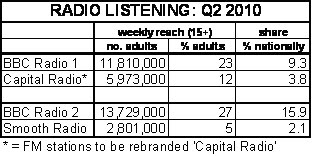
There has been an abundance of fighting talk from the commercial radio sector in the press in recent weeks. Commercial radio seems determined to pick another fight with BBC Radios 1 and 2, two of the three most listened to radio stations in the UK.

Guardian Media Group Radio announced that “by broadcasting on National DAB, Sky, Freeview and Freesat, Smooth Radio will provide a strong commercial alternative to BBC Radio 2.” Chief executive Stuart Taylor said:

“We are still at war with the BBC and we still compete for listeners tooth and nail, as we always will.”

The press headlines affirmed:
· “New national network makes a Smooth attack on Radio 2” (Telegraph)
· “Forget Radio 2: in five years’ time, we’ll all be going Smooth” (
Independent)
· “Smooth Radio takes on Radio 2 in national rollout” (
Marketing Week)
· “Radio Two faces fight, warns new Smooth news chief” (
Press Gazette)

Then, Global Radio announced that its local FM stations will be re-branded ‘Capital Radio’ in 2011. Chief executive Ashley Tabor said:

“With the launch of the Capital network, there will now be a big national commercial brand seriously competing with Radio 1.”

The press headlines responded:
· “Capital Radio will go national in bid to challenge Radio 1” (Evening Standard)
· “Capital Radio set to rival BBC Radio 1 in move to broadcast nationally” (
Daily Mail)
· “Global to take on Radio 1 with Capital Network” (
Marketing Week)
· “Capital Radio to form first national commercial radio station” (
ITN)

Both the GMG and Global Radio statements achieved the intended sabre-rattling headlines in the press though, for me, these sentiments are remarkably hollow. This ongoing phoney war between the BBC and commercial radio is like a war between a one-eyed giant and an over-exuberant mobile phone salesman. The giant will win every time. Commercial radio can huff and puff all it wants, but the BBC knows it is perfectly safe in its house built from Licence Fees. It can afford to chuckle loudly at every challenge like this lobbed at it by commercial radio. Why?

Firstly, you could only ever hope to seriously compete with the existing formats of BBC Network radio stations if you had access to their same abundance of resources. This is something that Channel 4 belatedly realised after having promised for two years that it would invent a new commercial radio station to compete with BBC Radio 4. Then it scrapped its radio plans altogether.


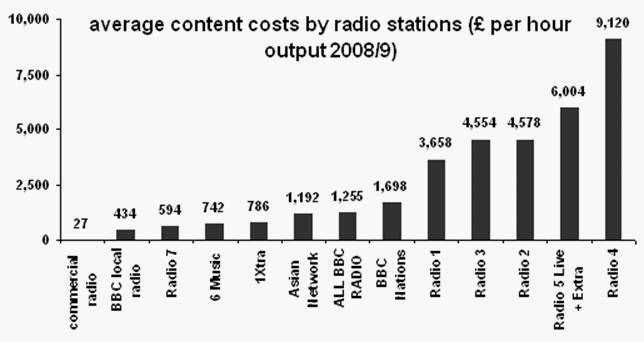
The huge gulf between the funding of commercial radio content and BBC Network Radio content makes direct competition simply pointless. In a recent report for the BBC Trust, I noted that commercial radio spends an average £27 per hour on its content, while BBC Radio spends an average £1,255 per hour. There is no way that commercial radio can make programmes that will sound like Radio 2 on a budget that is 170th of the latter’s £4,578 per hour.

Secondly, what sort of message do these press headlines send to consumers? To me, they say ‘we realise that Radios 1 and 2 are fantastically successful, so we want a slice of their action’. Or maybe even ‘you really like Radios 1 and 2, don’t you? Try us, because we want to be just like them.’ So where is the Unique Selling Point [USP] for your own product? Don’t you have enough faith in it to tell us why it is so good, rather than comparing it to your much bigger, much more successful rival? Or is this the Dannii Minogue method of marketing?

I had always been taught that the cardinal sin of radio was to mention your competitors to your audience. Every reference to your competitor tells the audience how much you respect them and their success. Ignore them! Pretend your competitor does not even exist! Plough your own furrow and concentrate on making a radio station that is genuinely unique. Then you will create a brand that has a genuine USP, rather than being merely a pale imitation of Radio 1 or 2 without their big budgets. ‘I can’t believe it’s not Radio 2’ is not a tagline to which to aspire.

Thirdly, neither Capital Radio nor Smooth will be genuinely ‘national’ stations, as in capable of being received on an analogue FM/AM radio from one end of the country to the other. So why pretend to consumers and advertisers that they are ‘national’? In the case of Capital, its proposed FM network presently covers 57% of the UK adult population. In the case of Smooth, RAJAR tells us that DAB receiver penetration is presently 35%. Just how little of the UK population can you cover and yet still describe yourself as ‘national’?


Fourthly, don’t keep looking at Radio 1 and 2’s huge audience figures and dreaming of how much money you could make if only you could monetise their listenership. Part of the reason older listeners probably like Radio 2 is because there are no advertisements. Accept the fact that Radios 1 and 2 together account for a quarter of all radio listening in the UK. Compared to those mammoths of radio, both Capital and Smooth are mere termites. Live with that fact and, instead, seek out commercial clients who are not merely frustrated because they cannot advertise on BBC Radio, but who actively want to use your radio station because your audience is intrinsically valuable to them.

Finally, invest the time and money to develop your own on-air talent rather than simply hanging on the coattails of others’ successes. Whatever his next gig might be, Chris Moyles will forever be remembered as ‘the saviour of Radio 1’, just as Chris Evans will always be remembered for his Radio 1 breakfast show, not for his subsequent time at Virgin Radio. Find new people who are good at radio and put your faith in them. Why does Smooth’s schedule have to resemble Frankenstein’s monster, stitched together with a bit here from Radio 1 in the 80s, and a bit there from Radio 2 last month?

What your radio station should be doing is not competing with Radio This or Radio That for listeners, but competing directly for consumers to spend time with you because you are ‘you’. Radio is not like selling soap powder or yoghurt pots, where your business model can be built upon undercutting the price of a competitor’s product, however low-quality your own cheapo version might be. There is no price of admission in radio. Your content needs to be ‘different’ rather than ‘the same’ and it needs to create its own unique place in the market.

You should not think of your market competitors as radio stations, but as each and every opportunity a consumer is presented with to pass their leisure time. A winning station must be able to convince a consumer to listen to it, rather than watch television, read a book or simply sit in silence. Because radio is ‘free’, the competition for radio is everything else that is also free to consumers at the point-of-use.

To offer a practical example, when I worked on the launch of India’s first commercial radio network, Radio City, the advertising agency produced an excellent marketing campaign that extolled the virtues of the station over other radio stations. But the campaign had to be rejected and the agency briefed in more detail. Why? Because we were launching the very first radio station on the FM dial in a city such as Bangalore, so the overriding challenge was to persuade people to use ‘radio’ at all, or to persuade people to buy an FM radio for the first time, or to persuade people to switch off their television and turn to radio instead.

This philosophy seems to be a million miles away from the current UK commercial radio strategy which seems to focus on berating BBC radio for being too successful, whilst wanting to somehow achieve part of that success through osmosis. If only half this war effort was put into developing policies to make the commercial sector’s stations successful on their own account, the BBC would soon cease to matter.

Instead, RadioCentre is now demanding that commercial radio be allowed to re-broadcast old Proms concerts recorded by BBC Radio 3. But how many of our 300 commercial radio stations play classical music? One. And which Proms concert do you recall that would fit into Classic FM’s playlist of short musical extracts? What next? Will Capital FM be asking the BBC for the rights to re-broadcast some old Zoe Ball Radio 1 breakfast shows?

In September 2010, the government’s Consumer Expert Group criticised RadioCentre for having proposed a policy for the BBC’s Strategy Review that, it felt, would have “bullied” listeners.

Trying to bully listeners? Trying to bully the BBC? This is the war of the playground, not of a mature media industry that has a strategy of its own making, a plan, a roadmap for its future success. “It’s not fair. Your willy is bigger than mine.” No, it probably isn’t fair, but life deals you a hand, you have to stop whining, get on with it and make the best of what you’ve got.

Just accept this reality: commercial radio’s willy is never going to be as big as the BBC’s. So competing directly on size alone is a complete waste of time when, instead, you should be developing your own individual ‘technique’.

UK commercial radio: Q2 2010 national revenues down 40% since 2003

It seems like only yesterday that the Radio Advertising Bureau [RAB] was telling us that:

“The [commercial radio] sector has turned a corner and not only halted [revenue] decline, but moved into renewed growth …”

In fact, it was 20 May 2010 and the reason for the RAB’s optimism was the sector’s 2009 revenue performance. Yes, revenues in 2009 were down 10% year-on-year and yes, back in 2008, they had already been down 6% year-on-year. But, as I noted at the time, mere numbers never seem to get in the way of the trumpeting of a “terrific achievement.”

Fourteen days prior to the RAB pronouncement, a general election had ousted the Labour government and introduced a new Conservative/Liberal coalition. The writing was clearly on the wall that tougher times were ahead for the commercial radio sector. At the beginning of May 2010, I had
spelled out emphatically the dire implication for commercial radio revenues of an incoming Conservative government:

“The Conservative Party pledged in its manifesto to reduce advertising expenditure by government departments, if elected. The planned cuts would be significant, 40% of the COI 2008/9 budget of £540m, according to one press report. … A 50% budget cut to COI expenditure on radio would lose commercial radio £26m to £29m per annum, 6% of total sector revenues.”

And so it came to pass, even though the Radio Advertising Bureau was still insisting in June 2010:

“We are optimistic that radio’s strengths will be recognised as COI budgets come under ever greater scrutiny.”

But budget cuts of 50% cannot be executed that recognise the radio medium’s strengths. Since May 2010, public funding of commercial radio has fallen sharply from 18% of sector revenues and will not be bouncing back anytime, at least not while the Conservative Party holds the public purse strings. The largest commercial radio owners have been hit the hardest, whilst the smaller local stations (that rely much more on local advertisers) have been little impacted.

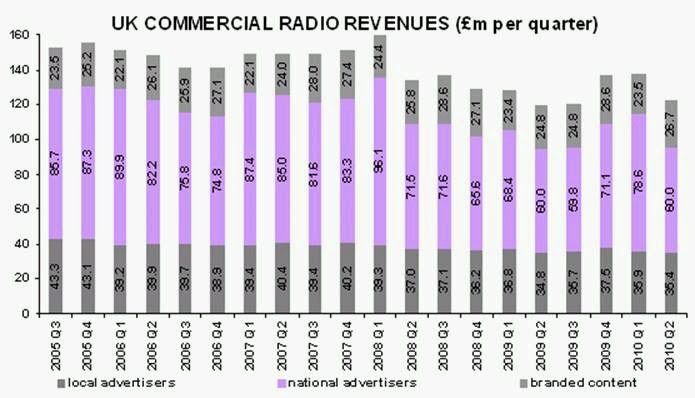
As a result, it was no surprise that commercial radio revenue data for Q2 2010 were released quietly without fanfare or further pronouncements about “renewed growth.” The notion that commercial radio revenues had “turned a corner” looks even more hollow now, a mere four months after the Radio Advertising Bureau had uttered those words.


Q2 2010 TOTAL REVENUES
· Up 1.9% year-on-year, but remember that Q2 2009 had been the sector’s most disastrous
· Q2 2010 total revenues are the third lowest this millennium (after Q2 and Q3 in 2009)


Q2 2010 NATIONAL REVENUES
· No change year-on-year, but remember that Q2 2009 revenues were already down 16.1% year-on-year and, before that, Q2 2008 had been down 15.9% year-on-year
· Q2 2010 national revenues are the second lowest this millennium (after Q3 2009)

Q2 2010 LOCAL REVENUES
· Up 1.7% year-on-year, but remember that Q2 2009 was already down 6.0% year-on-year and, before that, Q2 2008 had been down 8.4% year-on-year
· Q2 2010 local revenues are the lowest since Q2 2009 and, before that, Q1 2002

The most frightening facts about the Q2 2010 data are:
· National revenues have fallen 40% since Q4 2003
· National revenues have fallen to a level the sector had attained in 1998 (earlier, if inflation is considered) when there were about eighty fewer commercial radio stations

If Q2 2010 was bad for commercial radio, then the following quarters are likely to be worse, as the impact of government expenditure cuts will have wreaked havoc across complete quarters of commercial radio’s national revenues. The outlook for the commercial radio sector looks anything but “terrific”, though trade body RadioCentre was still peddling eternal optimism in its September 2010 newsletter:

“Whilst revenue for Q1 2010 was up 7.3% year on year, the best performance and highest growth for 2 years, Q2 proved more of a challenge with the election and subsequent cuts in government expenditure. However, the RAB is working with a wide range of advertisers to bridge the gap, and the current outlook for quarter three is that we’ll see a modest growth, even despite COI cutbacks.”

And, after this week’s Radio Advertising Awards (where, ironically, “government departments and campaigns scooped the most awards,” wrote Marketing Week), the RAB was still proclaiming “… the outstanding work which has seen our [commercial radio] sector return to growth …”

Suffice to remind you that Q2 and Q3 in 2009 witnessed the commercial radio sector’s lowest recorded revenues this millennium, so that any year-on-year increase will have been achieved from a base of absolute ‘rock bottom’. To add to the gloom, Minister for the Cabinet (and the government’s Paymaster General) Francis Maude
told The Times last week:

“We are looking at whether we should be expecting the BBC — when people are paying their Licence Fee — to carry some public information advertisements. It wouldn’t be a propaganda operation but this is public service broadcasting. The taxpayer might say, ‘Should I be paying out my taxpayer’s money for the Government to pay ITV to carry public information advertisements?’”

So the worse news for commercial radio is that it could be about to lose whatever remaining government advertising has survived, if pubic service announcements are to be switched to BBC Radio. After all, not only would such a policy save the government a further £30m per annum, but BBC Radio reaches 67% of the UK adult population per week, greater than commercial radio’s 64%.

In May 2010, I had predicted that the government could adopt just such a policy:

“If a government were to return to the post-War COI policy of using public broadcasters to air its Public Service Announcements, rather than paying commercial rates for airtime, up to 18% of commercial radio revenues would disappear at a stroke.”

I am sufficiently ancient to remember the intriguing, but rather bizarre, Public Information Films that used to grace BBC television. I also remember the Public Service Announcements that local commercial radio stations were required to broadcast for free when the Independent Broadcasting Authority was the sector regulator. So such a policy would be nothing new and should have been anticipated by the sector.

But what can commercial radio do? The key is the word ‘commercial’. The industry was foolish to have ever considered public expenditure on radio advertisements anything more than an ‘extra’ that was bound to disappear some time at the whim of politicians. That time is now. The same way that the government is mounting a war on ‘benefit scroungers’ who are said to have become too reliant on public handouts, the Conservatives are effectively waging a war against ‘COI scroungers’ – commercial broadcasters whose sales teams knew they could rely on government advertising handouts to meet their revenue targets and earn their bonuses.

How did the industry let itself get into this state? ‘Commercial radio’ was always meant to be ‘commercial’, not publicly funded. In exactly the same way, ‘local commercial radio’ was always meant to be ‘local’. It is the very point at which you begin to lose sight of who you really are that you set off down a rocky road that leads to inevitable oblivion.

Local Commercial Radio, know thyself.

UK commercial radio audiences: one swallow doesn’t make “long-term and sustained growth”

UK commercial radio has been in the doldrums for the last decade. Its audiences have been battered by competition from the BBC, revenues have been declining, and some local stations have been forced to close or merge (sorry, ‘co-locate’). So, when a piece of good news comes along, it is natural that it will be celebrated. The latest RAJAR audience survey for Q2 2010 provided just one such fillip of positivity for the commercial radio sector. But, sometimes, what should have been a small private party gets turned into a showy public display of excess by the celebrants.

This appears to have been the case with commercial radio’s take on its latest audience figures. Maybe it was the effects of too much champagne, but the RadioCentre press release stated:

“This is a fantastic set of results for the commercial radio sector showing long-term and sustained growth by every measure.”

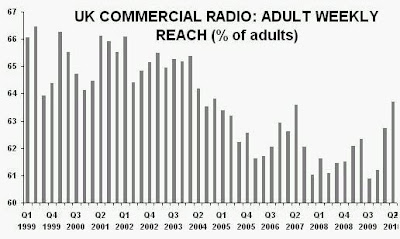
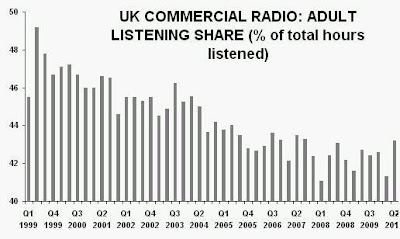
This might have been an appropriate thing to say to a roomful of cheering partygoers but, in the sober light of day, sticking this claim in a press release was bound to invite closer scrutiny. In the following graphs, the main RAJAR metrics for UK commercial radio are put in historical perspective. In these graphs, we are seeking what RadioCentre told us is “long-term and sustained growth” in “every measure.”

UK commercial radio adult weekly reach hit an all-time low of 60.9% as recently as Q3 2009, then subsequently made gains in three consecutive quarters to 63.7% in Q2 2010. Growth? Yes (three consecutive quarters). Sustained growth? Not really. Long-term growth? No.

UK commercial radio total adult listening hit an all-time low the previous quarter (Q1 2010) of 419m hours per week, then bounced back in Q2 2010 to 445m hours per week. Growth? Yes (one quarter). Sustained growth? No. Long-term growth? No.

UK commercial radio average hours listened per adult listener hit an all-time low of 13.0 hours per week the previous quarter (Q1 2010), then bounced back in Q2 2010 to 13.5 hours per week. Growth? Yes (one quarter). Sustained growth? No. Long-term growth? No.

UK commercial radio’s share of adult listening hit an all-time low of 41.1% in Q1 2008 and, since then, has bounced up and down. Last quarter (Q1 2010), it had hit its second lowest level ever (41.3%) before rebounding to 43.2% in Q2 2010. Growth? Yes (one quarter). Sustained growth? No. Long-term growth? No.

UK commercial radio absolute adult reach is the only metric that is presently at an all-time high of 32.9m adults per week in Q2 2010. It jumped up that quarter because once a year, in Q2, RAJAR increases all its adult totals to account for the 1% per annum UK population increase. It is positive that more people are listening to commercial radio but, at the same time, as the result of population growth there are also more people listening to BBC radio, and more people not listening to radio at all. However, commercial radio’s absolute reach has not grown sufficiently in the long term to even keep pace with the increasing UK population.

So, in total, it seems impossible to locate commercial radio’s “long-term and sustained growth” in the latest RAJAR data. I point out these facts because I want to see commercial radio succeed. The sector desperately needs to attract more hours listened in the long term if it is to improve revenues and return to profitability. This has not yet happened. There is no point pretending that it has.

As for RadioCentre, an inaccurate statement of fact is an inaccurate statement of fact is an inaccurate statement of fact. Telling the world that your industry is enjoying “long-term and sustained growth” might be good propaganda for rallying your troops, but surely it must undermine the commercial radio industry trade body’s credibility with the rest of the world if it clearly is not true.

What is to be achieved for the radio sector by the RadioCentre press release crossing that line between hype and untruth?

DAB radio: a national platform that no one wanted

In 1998, the Radio Authority advertised a licence for the “first and only national commercial digital [DAB] multiplex licence.” There was no stampede of applicants. By June 1998, the regulator had to issue a press release with the headline “Radio Authority receives one application ….” The sole applicant was ‘Digital One’, 57% of which was owned by commercial radio’s GWR Group plc, whose chief executive Ralph Bernard later admitted:

“GWR was encouraged to apply for the national [DAB multiplex] licence and was under some pressure to invest in the opportunities for a national licence from the then regulator. Had we not done it, there would be no national DAB platform now. Not only that, [the regulator] did not know what they would have done on the question of national radio stations with regard to the opportunities given by the then government to renew their national licences for a further period of time if they were to commit to going digital. But how can you [do that] if there are no opportunities to go digital because there is no national multiplex? When I put that question to the Radio Authority, I was told that the answer was: ‘We don’t know what would happen – there is no Plan B’. It was just an assumption that someone would go for [the national multiplex].”

Bernard had a hard time convincing his own board that the DAB licence was a worthwhile investment for a radio group that, until then, had owned radio stations rather than transmission infrastructure:

“When we were seduced into believing that this was going to be the only [national DAB] licence, we realised that there would be substantial losses, but the payback would be when you have the opportunity to be the only player in the national market for DAB. When it’s the Radio Authority, an agency of government, you tend to believe what you are told. On that basis, the investment was justified and, at the time, getting it through my Board was not easy. Persuading shareholders, particularly the larger ones, was not easy.”

Now, twelve years later, GWR Group no longer exists, Ralph Bernard is out of the commercial radio business, but the ‘Digital One’ national DAB platform is still there. Nobody really wanted it in 1998, and nobody really seems to want it now. Its ownership has changed hands like pass-the-parcel, GWR Group plc having merged into GCap Media plc, which was then sold to Global Radio which, in 2009, sold its majority stake in Digital One to transmission provider Arqiva. How many millions were thrown at Digital One over the years by GWR, GCap and Global Radio will probably never be known.

The only thing cheap about Digital One was the cost of its initial 12-year licence, a mere £10,000 per annum paid to the regulator for the radio spectrum it uses. The business model was that Digital One would lease space on the DAB platform to radio stations that would pay it rent (about £1m per year, dependent upon audio quality). Since opening for business in 1999, many digital-only stations have tried using the platform but, to date, almost none have stuck around. No digital radio station has yet made a profit.

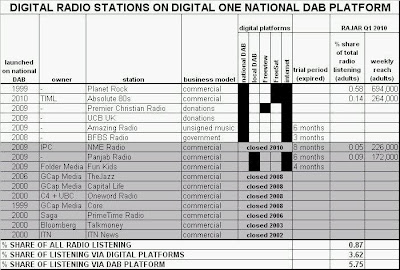
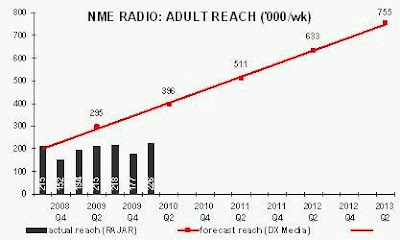
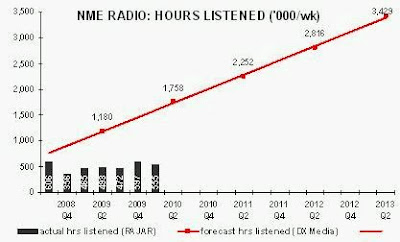
The latest additions to the lengthening list of stations that have failed to make the national DAB platform work for them are NME Radio and Panjab Radio, both of which quit Digital One in June 2010 (see shaded area of table). The reason? Almost no one was listening. Add together the digital-only stations broadcasting on the platform last quarter (and that are measured by RAJAR) and, in total, they accounted for less than 1% of total radio listening.

Yet the radio industry, the receiver manufacturers and their lobby groups are still spending money on campaigns to convince the public that DAB radio is a raging success. Digital One says its radio platform reaches “more than 90%” of the [UK] population,” equivalent to 46m adults. RAJAR tells us that 35% of those adults have a DAB radio. Yet only 226,000 adults per week listened to NME Radio, after nearly two years on-air. If you were in any way persuaded to believe the hype surrounding DAB, your business plan to start a digital radio station might look dangerously over-optimistic.

When NME Radio launched in June 2008, it had forecast that its audience would reach 396,000 adults per week by its second year. For most of its life, the station was broadcast on local DAB multiplexes (and online). Then, from 21 December 2009, NME Radio was made available nationally on DAB for an eight-month trial. Broadcasting to a much bigger potential audience, there should have been a positive uplift to the station’s performance in Q1 2010. However, there was no noticeable impact upon adult reach (226,000) or hours listened.

In its forecasts, NME Radio had projected that DAB would be “53%” by 2010. Maybe this referred to Ofcom’s forecast that, by year-end 2010, digital platforms (not DAB alone) would account for 50% of all radio listening. In fact, in Q1 2010, only 15% of listening to all radio was via DAB, and 24% was via all digital platforms (worse for commercial radio at 12% and 23% respectively). Ofcom’s forecast of how digital radio usage would grow was disastrously inaccurate. NME Radio did not stand a chance of commercial success using DAB.

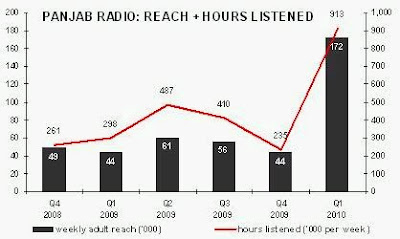
The other digital radio station that quit the national DAB platform in June 2010 was Panjab Radio. Like NME Radio, it had broadcast via local DAB multiplexes (and online), but was then made available nationally on DAB for a six-month trial from 1 December 2009.

There was no lift to Panjab Radio’s audience in Q4 2009, but the following quarter saw a noticeable increase to 172,000 adult reach and 913,000 hours listened per week. This was almost twice the amount of listening that NME Radio recorded on the national DAB platform, a real achievement for an ethnic radio station.

The day Panjab Radio had joined the national DAB platform, Digital One operations director Glyn Jones said:

“Like Premier Christian Radio and UCB UK, Panjab Radio relied on a fund-raising appeal to pay for the launch of the station. It’s interesting to see the growth of listener-supported stations, and the way they’re extending the range and choice of stations on air via digital radio. These are stations that neither a traditional commercial model nor the BBC have chosen to provide, but which listeners value so much that they’re prepared to help pay for them out of their own pockets.”

The sub-text was that the Digital One national DAB platform cannot support a commercial digital-only radio station because the financial returns are simply insufficient to cover the expense for it to lease space on the platform. If Panjab Radio had managed to sell advertising at the average commercial radio sector rate, it should have generated £1m per annum of revenue. However, an industry study in 2009 found that the average digital radio station generated only £130,000 revenue per annum (and Panjab Radio attracted less listening than others).

When Panjab Radio quit the national DAB platform in June 2010, Digital One’s Glyn Jones issued a press release that seemed over-eager to deflect the blame:

“Panjab Radio’s revenues come from a mix of traditional radio advertising plus fund raising among Britain’s Panjabi and Sikh communities. Following a strategic and financial review the station opted to end its national transmissions but to continue to broadcast on DAB digital radio in three parts of the country with significant concentrations of the target audience – the West Midlands, West Yorkshire and London.”

As the table above demonstrates, the national DAB platform’s history is littered with commercial digital radio stations that failed to make it work for them. Most of the stations currently on the national DAB platform are non-commercial and so do not need to meet their costs from advertising revenues. But religious stations, army radio and unsigned artists do not come close to the mass market purpose for which the platform was originally envisaged. Did GWR Group make its substantial investment in national DAB in the expectation that, after a decade, the platform would be filled with subsidised radio stations attracting tiny audiences?

Two years ago, I had written:

“This sudden flowering of ethnic, religious and publicly-funded radio stations on the DAB platform echoes the fate of the ‘AM’ waveband in the 1990s … The ‘DAB’ platform of 2008, particularly in London, is already starting to resemble the ‘AM’ platform of 1998, suggesting that ‘DAB’ might have already been written off by the sector as a means to reach the ‘mass market’ audiences that national advertisers desire from the medium.”

Since then, this desperate filling of DAB multiplex capacity with non-commercial stations has spread from London to the national platform. Bizarrely, given the overwhelming empirical evidence that this “first and only national commercial” DAB platform is not working, even after a decade of operation, Ofcom is keen to create a second quasi-national DAB platform. Its rationale is that:

“This could help to facilitate the creation of national commercial radio stations to create a consumer proposition analogous to that of Freeview: a wide range of popular and niche services, delivered digitally” because “we believe DAB still offers the best solution for the future growth of radio in the UK.”

This nonsense was written in an Ofcom report less than a year ago, when the writing on the wall could not have been larger that the national DAB platform’s future for commercial radio was doomed. Surely, a regulator that refuses to deal with the reality of the here and now could be a regulator that will eventually find it has no future. For years, Ofcom (and its predecessor) have led the commercial radio sector a merry dance down a DAB blind alley that has proven almost fatal to the industry’s economic health.

If Ofcom publishes one more policy document proclaiming (as if it were still 1998) that ‘the future of radio’ is DAB, rather than it working to bang industry heads together to find a practical route out of the present mess, all it will succeed in doing is writing its own epitaph.

Choice FM R.I.P.: the birth and near death of licensed black music radio in London

31 March 1990 was the memorable day when London‘s first licensed black music station, Choice 96.9 FM, arrived on-air. Until then, the availability of black music on legal radio had been limited to a handful of specialist music shows, even though about half of the singles sales chart was filled with black music. The decision by then regulator the Independent Broadcasting Authority [IBA] to license a London black music station was part of a huge government ‘carrot and stick’ campaign to rid the country of pirate radio. On the one hand, new draconian laws had been introduced that made it a criminal offence even to wear a pirate radio T-shirt or display a pirate radio car sticker. On the other hand, the establishment knew that some kind of olive branch had to be offered to the pirate stations and their large, loyal listenership.

Many pirate stations, having voluntarily closed down in the hope of becoming legitimate, were incensed when the IBA instead selected Choice FM for the new South London FM license. Its backers had no previous experience in the London pirate radio business, but had previously published ‘Root’ magazine for the black community in the 1970s. Although it was impossible for one station to fill the gap left by the many pirates, Choice FM tried very hard to create a format that combined soul and reggae music with news for South London’s black community, which was precisely what its licence required. The station attracted a growing listenership and it brought a significant new audience to commercial radio that had hitherto been ignored by established stations. With Choice FM, the regulator succeeded in fulfilling two aspects of public broadcasting policy: widening the choice of stations available to the public; and filling gaps in the market for content that only pirate radio had supplied until then.

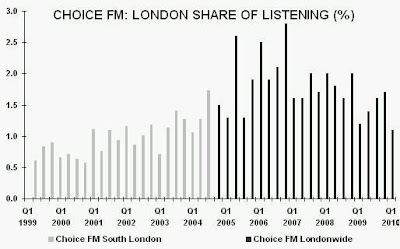
In 2000, Choice FM won a further licence to cover North London with an additional transmitter. For the first time, the station was now properly audible across the whole capital and had access to more listeners and more potential advertising revenues. Its listening doubled and, at its peak in 2006, Choice FM achieved a 2.8% share, placing it ahead of TalkSport and BBC London in the capital. Choice FM had no direct competitor in London, although indirectly some of its music had always overlapped Kiss FM. The station’s future looked rosy.

However, the Choice FM shareholders must have realised just how much their little South London station was worth, at a time when commercial radio licences were being acquired at inflated prices. Already, in 1995, Choice FM shareholders had won a second licence in Birmingham, but had then sold the station in 1998 for £6m to the Chrysalis Radio group, who turned it into another local outlet for its network dance music station Galaxy FM. At a stroke, the black community in Birmingham had lost a station that the regulator had awarded to serve them. Black radio in Birmingham was dead. The die was cast.

The then regulator, the Radio Authority, had rubber-stamped this acquisition, stating that it would not operate against the public interest. The Authority requested some token assurances: at least one Afro-Caribbean member on the station’s board; an academy for training young people, especially from the black community, in radio skills; and market research about the impact of the format change on the black community. None of these made any difference to what came out the loudspeaker. Birmingham’s black community was sold down the river.

Changes in UK media ownership rules were on the horizon that would soon allow commercial radio groups to own many more stations within a local market. As a result, in 2001, the UK’s then largest radio group, Capital Radio plc, acquired 19% of Choice FM’s London station for £3.3m with an option to acquire the rest. In 2003, it bought the remaining 81% for £11.7m in shares, valuing the London station at £14.4m. The Choice FM shareholders had cashed in their chips over a five-year period and had generated £21m from three radio licences. What would happen to Choice FM London now?

Graham Bryce, managing director of Capital Radio’s London rock station Xfm (which Capital had acquired in 1998 for £12.6m), said then:

“Our vision is to build Choice into London’s leading urban music station, becoming the number one choice for young urban Londoners. Longer term, we intend to fully exploit the use of digital technology to build Choice nationally into the UK’s leading urban music station and the number one urban music brand.”

Capital Radio and subsequent owners seemed to want to turn Choice FM into a station that competed directly with Kiss FM (owned by rival EMAP). But they never seemed to understand that Kiss FM was now a ‘dance/pop’ station, whereas Choice FM had always been firmly rooted in the black music tradition of soul, reggae and R&B. Such semantics seemed to be lost on Choice FM’s new owners and on the regulator, but certainly not on Choice FM’s listeners, who had no interest in Kylie Minogue songs.

In 2004, Capital Radio moved Choice FM out of its South London base and into its London headquarters in Leicester Square. The station’s final link with the black community of South London it had been licensed to serve was discarded. In 2005, Capital Radio merged with another radio group, GWR plc, to form GCap Media plc. In March 2008, Global Radio bought GCap Media for £375m. In July 2008, Choice FM managing director Ivor Etienne was suddenly made redundant. One of the station’s former founder shareholders commented:

“I’m disappointed that the new management decided to relieve Ivor Etienne so quickly. My concern is that I hope they will be able to keep the station to serve the community that it was originally licensed for.”

However, from this point forwards, it was obvious that new owner Global Radio had no interest in developing Choice FM as one of its key radio brands. In the most recent quarter, the station’s share of listening fell to an all-time low of 1.1% (since its audience has been measured Londonwide). Sadly, the station is now a shadow of its former self, even though it holds the only black music commercial radio licence in London (BBC digital black music station 1Xtra has failed to dent the London market, with only a 0.3% share).

This week, news emerged from Choice FM that its reggae programmes, which have been broadcast during weekday evenings since the station opened, will be rescheduled to the middle of the night (literally). One of the UK’s foremost reggae DJs, Daddy Ernie, who has presented on Choice FM since its first day, will be relegated to the graveyard hours when nobody is listening. From 2003, after the Capital Radio takeover, reggae songs have been banished from the 0700 to 1900 daytime shows on Choice FM. Now the specialist shows will be removed from evenings, despite London being a world centre for reggae and having more reggae music shops than Jamaica.

Station owner Global Radio responded to criticism of these changes in The Voice newspaper: “Choice [FM] has introduced a summer schedule which sees various changes to the station including the movement of some of our specialist shows.”

Once again, the regulator will roll over obligingly and rubber-stamp these changes. For Global Radio, the endgame must be to transform the standalone Choice FM station into a London outlet for its Galaxy FM network. At present, London-based advertisers and agencies can only listen to Galaxy on DAB or via the internet. A London Galaxy station on FM would bring in more revenue for the brand as a result of more listening hours and its higher profile in the advertising community. It would also provide a direct competitor to Kiss FM London (ironic, because Galaxy FM had been launched in 1990 by an established commercial radio group as an out-of-London imitation of successful, London-only Kiss FM). Global Radio’s argument to persuade the regulator will probably be that Choice FM’s audience has fallen to uneconomic levels. And whose fault was that?

Already, Global Radio’s website tells us that “Choice FM is also included as part of the Galaxy network” which “consists of evolving mainstream music supported by entertaining and relatable presenters.” And yet, according to Ofcom, Choice FM’s licence is still for “a targeted music, news and information service primarily for listeners of African and Afro-Caribbean origin in the Brixton area but with cross-over appeal to other listeners who appreciate urban contemporary black music.” How can both these assertions be true of a single station?

For the black community in London, and for fans of black music, this will be the final straw. Just as happened in Birmingham, the new owner and the regulator will have collectively sold Choice FM’s listeners down the river. Another station that used to broadcast unique content for a unique audience will have been wilfully destroyed in order to make it almost the same as an existing station, playing almost the same content. We have many commercial radio stations, but less and less diversity in the music they play. Radio regulation has failed us.

For Choice FM, the writing was on the wall in 2003 when Capital Radio bought the station and one (unidentified) former DJ commented:

“Choice [FM] was there for a reason [to be a black music station for black people], but that reason changed [since] 13 years ago. That’s why you’ve got over 30 pirate stations in London. If Choice FM kept to the reason why they started, you wouldn’t need all them stations. But Choice has become a commercial marketplace. They’ve sold the station out and they should just say they’ve sold the station out. What’s wrong with that? They have sold the station that was set up for the black community and they know they’ve done the black community wrong. But they’ve made some money and they’ve sold it. Why not let your listeners know?”

For me personally, as a black music fan and having listened to Daddy Ernie for twenty years, I am much saddened. In the 1970s and 80s, I had found little on the radio that interested me musically, so I listened to pirate stations and my own records. During those two decades, I actively campaigned for a wider range of radio stations to be licensed in the UK and, by the 1990s, I had played a direct role in making that expansion of new radio services happen successfully. Where did it get us? Now, years later, I have gone back to listening mostly to pirate radio and my own records (and internet radio). I am sure I am not the only one.

The radio industry and the regulator seem not to understand one important reason why radio listening and revenues have been declining for most of the last decade. They need to examine how, through their decisions, they have consistently sold down the river their station audiences and the very citizens whom their radio licenses were specifically meant to serve. Listeners vote with their ‘off’ buttons when station owners renege on their licence promises and the regulator lets them. Choice FM is sadly just one example.

In 2006, a lone enlightened Ofcom officer, Robert Thelen-Bartholomew, had asked at a radio conference:

“Is there room to bring the content of illegal stations into the fold? One way or another, whether we like it or not, we have a large population out there listening to illegal radio. Why do they listen? We are trying to find out. But, if you listen to the stations, they are producing slightly different content and output [from licensed stations]. Some of it is very high quality. Some of it is very interesting. So, what options are there for bringing some of that content into mainstream radio?”

Seemingly, none. The last FM commercial radio licence the regulator offered in London was more than a decade ago. Last year, when two small South London FM stations (one licensed for a black music format) were closed by their owner, the regulator unilaterally decided not to re-advertise their commercial radio licences (see the story here). A pirate radio station has not been awarded a commercial radio licence by the regulator for two decades.

Why do pirate radio stations still exist? Because, just as in the 1970s and 1980s, there are huge gaps in the market for radio content that – in spite of BBC radio, commercial radio and their regulators – remain unfilled. It is no coincidence that the share of listening to ‘other’ radio stations (i.e. not BBC radio and not commercial radio) in London is near its all-time high at 3.1%.

Farewell, Choice FM. I knew you well for twenty years.

And, irony of ironies, we are in Black Music Month.

[thanks to Sharleen Anderson]

The cost of upgrading DAB radio: why it will never happen

The current DAB radio transmission system in the UK is presently not robust enough to rival old fashioned, but more reliable, FM. All parties are agreed on that point. To get DAB up to FM standard, a huge amount of work needs to be done, which would cost a lot of money. How much money? Nobody seems to agree upon that point. Sums have been suggested in Parliamentary debates and in reports that vary wildly.

What information is in the public domain about the costs of DAB transmission? In the UK, not a lot. The BBC owns one of the two national DAB radio multiplexes, for which only a small amount of data about costs has been published.

By 2011, the BBC national DAB multiplex will cover 90% of the population at an estimated transmission cost of £11m per annum. The technical challenge of DAB is that you need more additional transmitters than FM (because of DAB’s characteristics) to improve coverage. To achieve 95% population coverage increases the cost of DAB to £38m per annum (the BBC said in 2008). To achieve 99% coverage increases the cost to £40m per annum (the BBC said in 2007).

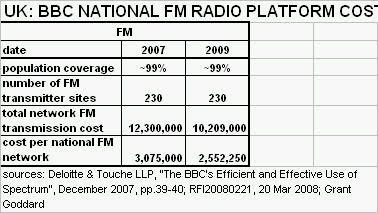
Compared to the existing FM transmission system (which the BBC said in 2007 offered around 99% population coverage), DAB will be more expensive. Not at present, because DAB is only covering 86% of the population, but increasing that percentage to the same as FM will be costly for DAB. Very costly. By comparison, the existing national FM transmission network had cost the BBC £12m in 2007. This should have reduced to £10m in 2009 after transmission contractor Arqiva agreed to discount its existing contracts (following its acquisition of rival NGW). The same discount may have lowered the cost of existing DAB transmission agreements, but not of future contracts for build-out to 99% coverage.

The BBC broadcasts only four national stations on FM whereas, on DAB, it broadcasts more channels. How many more? The number of BBC stations on DAB varies because one station is part-time and because two full-time stations are proposed for closure next year. To take an example of a music station using 128kbps of DAB bandwidth, it would cost £1.6m per annum to cover 90% of the population, £5.6m to cover 95% and £5.9m to cover 99%. Compare that to a national FM station that currently costs the BBC £2.6m per annum. It seems that DAB may be cheaper at present, but is certainly not cheaper once it is required to achieve equivalent FM coverage.

The second national DAB multiplex in the UK is owned by Arqiva (formerly ‘Digital One’) and covers 90% of the population. Does it publish a price list for commercial customers wanting DAB carriage? Seemingly not. However, in September 2009, Premier Christian Radio had said it was paying £650,000 per annum for national DAB carriage, using 64kbps of spectrum. The pro rata cost for a 128kbps music station would be £1.3m per annum, close to the previously estimated BBC cost for population coverage of 90%. Arqiva says it “is working on a transmitter roll out plan to further extend coverage,” having added four new transmitter sites in 2009.

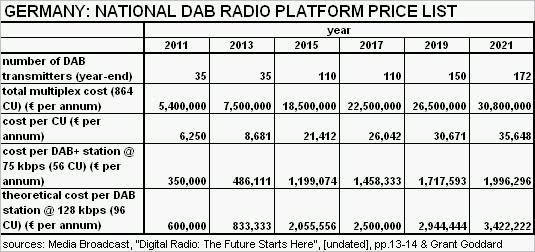
In Germany, the transmission provider, Media Broadcast, has published a price list for commercial stations interested in broadcasting on its planned DAB platform. It anticipates that German stations will use the more spectrum efficient DAB+ system, whereas the UK is wedded to the older DAB system. The prices quoted below (in Euros) require a radio station to take a minimum 10-year contract and are based on two multiplexes operating at each transmitter location (if that were not to happen, the costs would be higher).

By 2015, Media Broadcast anticipates that its 110 DAB transmitters will provide coverage to 78% of the population indoors and 92% of the population outdoors. There seems to be no commitment in Germany for DAB to achieve the 95% to 99% population coverage that is planned in the UK. Nevertheless, the transmission cost of a (hypothetical) DAB station using 128kbps would be as high as E3.4m (£2.8m) per annum by 2021. As in the UK, the cost escalates rapidly as the DAB network is built out to reach more of the German population. Whereas, in 2011, the initial E0.6m (£0.5m) per annum might not seem prohibitive to cover a country that has a third larger population than the UK, that annual cost is multiplied six-fold by the end of the 10-year contract.

In both the UK and Germany, the cost of DAB roll-out to ensure that reception is as robust as FM will add significantly to the platform’s costs. Without this roll-out, DAB can never replace FM, and the burdensome cost of simulcasting on both DAB and FM will continue. With this roll-out, DAB seems to end up costing more than FM to achieve similar coverage. So what is the point?

In the UK, neither Ofcom nor the government’s DCMS department have published analyses of the costs of DAB roll-out. Their pursuit of the DAB platform has had absolutely nothing to do with the real world economics of the UK radio industry. Their numerous published reports and consultations deal with a virtual reality of the radio industry that exists solely in their minds, perhaps a reflection of the fact that none of them have ever worked in the radio sector they try to regulate.

Ofcom’s plans for upgrading DAB, to be published imminently, merely prolong the regulator’s fantasy that the DAB platform is ‘the future of radio’. Ofcom’s apparent determination to run the radio industry into the ground economically through its insistence upon implementing a misguided ‘digital strategy’ for the sector has already proven a disaster, helping reduce the commercial sector’s profitability to nil. Even more disastrous is the radio industry’s seeming inability to confront Ofcom collectively, to insist that ‘enough is enough’, and to demand that Ofcom goes back to the drawing board in its whole strategy for radio’s future.

How can Ofcom retain an ounce of credibility when it had forecasted publicly (as recently as November 2006) that digital platforms would account for 42% of all radio listening by year-end 2009? The actual figure was 21%. As a result, all those radio operators who had based their business plans for digital radio upon Ofcom’s ‘professional’ forecast have faced financial ruin. Instead of reaching for the tissue box, these businesses should be reaching for their lawyer.

Practical action is what is needed now, not yet another Ofcom fantasy plan for radio’s DAB future.

Commercial radio revenues: always look on the bright side of less

Last week’s press release from the Radio Advertising Bureau was ecstatic about the commercial radio sector’s revenues. It told us that, in 2009, radio’s share of total display advertising had increased to 5.9% from 5.8% the previous year. It told us that this was the radio sector’s first growth in share since 2004. It told us that this was “terrific” news:

“To see the first annual share growth for five years, during the worst recession in living memory, is a terrific achievement for the commercial radio sector, and one that is unmatched by any other traditional media. It is a strong signal that the sector has turned a corner and not only halted decline, but moved into renewed growth, and is further evidence that the commercial radio industry’s on-going investment into programming, talent and marketing is paying dividends in both audience and revenue performance.”

I was stunned by this fantastic success story. So stunned that I had to check the industry’s own revenue numbers to make sure I had not been mistaken. A quick look at the figures reminded me of what I had thought I already knew. In 2009, commercial radio revenues had been down 10% year-on-year. That is ‘down’ as in ‘less’, not ‘down’ as in ‘more’. The only reason that radio’s share of all media display advertising increased at all in 2009 was that, whilst radio lost 10% of its revenues, media in aggregate lost 13%. In other words, radio’s performance in 2009 was less worse than the average. This is much like boasting you are top of a school remedial class.


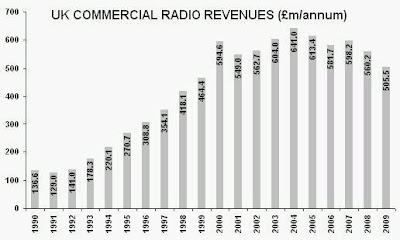
The Radio Advertising Bureau press release tried to position radio’s revenue performance in terms purely of cyclical ‘credit crunch’ factors. In fact, commercial radio’s problems with revenues are largely structural and started in 2005 (see graph), well before the ‘credit crunch’:
• 2009 revenues: down 10% year-on-year
• 2008 revenues: down 6% year-on-year
• 2007 revenues: up 3% year-on-year
• 2006 revenues: down 5% year-on-year
• 2005 revenues: down 4% year-on-year

As a result, radio revenues, which totalled £505.5m in 2009, are now:
• At their lowest level since 1999
• At their lowest level, in real terms, since 1997 (adjusted for inflation)

It is difficult to understand how commercial radio’s largest ever year-on-year revenue decline gives “a strong signal that the sector has turned a corner and not only halted decline, but moved into renewed growth”, as the Radio Advertising Bureau would have it.

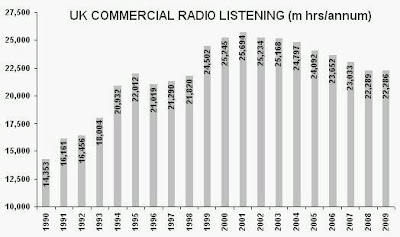
It would be great to see the commercial radio sector give a “strong signal” that it has turned a corner, any corner. But sector revenues are falling in the long term because the volume of listening to commercial radio is declining in the long term, having peaked in 2001 (see graph). Less listening inevitably leads to lower revenues.

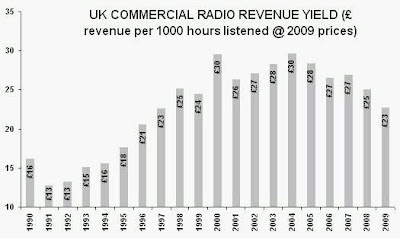
Worse, not only are commercial radio revenues and listening both going down, but the amount of money the sector is able to generate from each 1,000 hours of radio listening is also going down. In real terms (adjusted for inflation), commercial radio’s ‘revenue yield’ fell to £23 per 1,000 hours in 2009, which is where it had been in 1997 (see graph). This is probably the outcome of fewer radio advertising spots, or lower radio advertising rates, or a combination of both. Reduced yields inevitably lead to lower revenues.

To combat these structural issues, the major challenge for the sector must be to attract more listening to commercial radio. That will require a strategy that is pragmatic and focused on listener needs. Pumping out press releases that try to gloss over the commercial radio sector’s largest ever year-on-year revenue decline with phrases like “terrific achievement” is part of the problem, not part of a solution.

Digital radio station listening: a blip in time saves 6?

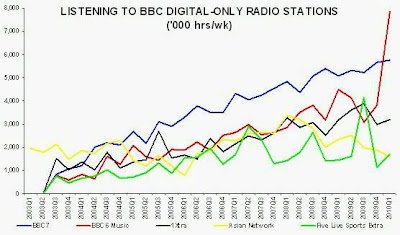
The dramatic upswing in BBC 6 Music’s listening during the first quarter of 2010 did not appear to have a knock-on effect on the BBC’s other digital stations [see graph]. 1Xtra was up slightly but still lower than it was in 2009. Asian Network dropped further and is now listened to less than part-time station Five Live Sports Extra.

In the commercial radio sector, Planet Rock recorded its best quarter yet and cemented its lead over all its digital-only competitors (BBC 6 Music excepted) [see graph]. Its continuing success only confirms that consumers prefer real programme content to the digital music jukeboxes whose performances are little more than limping along.

Even with this most recent quarter’s boost from BBC 6 Music and Planet Rock, total listening to digital-only stations has still shown almost no growth for three years [see graph]. Without the coincidence of those two successes, the latest quarter would have proven another disaster.

The question is what the next quarter will look like. We have seen listening to BBC 6 Music rise temporarily before at times when the channel has been in the press. Attracting listeners is only half the job. Keeping listeners is the much harder part.

Does the BBC 6 Music listening blip change the bleak outlook for digital radio stations? Not at all. Why? Because, even after this sudden upswing, 6 Music still attracts only two-thirds of the volume of listening to Radio 3, the BBC’s least listened to analogue national network. 207% of almost nothing still equals very little.

UK commercial radio’s growing reliance on public sector funds

The UK radio industry divides into two main sectors: BBC radio and commercial radio. BBC radio is funded by the Licence Fee, whereas commercial radio is funded by advertising and sponsorship. Each adult (aged 15+) pays around £13 per annum for BBC radio via the household Licence Fee. What is not so obvious is that each adult also contributes financially to commercial radio by around £2 per annum via their taxes, which are then used by government and public bodies to buy advertising time on commercial radio stations.

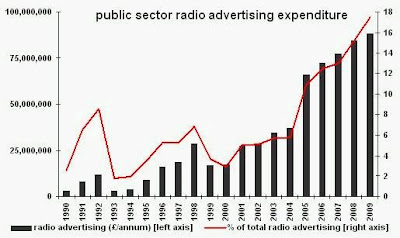
Commercial radio’s largest advertiser is neither BT (ranked second), nor Sky TV (third), Specsavers (fourth) or Unilever (fifth). It is the Central Office of Information [COI], the government’s marketing and communications arm, which spent £58m on radio advertising (25% of its budget) on UK commercial radio in the 12 months to February 2010. To illustrate just how significant the COI has become to the revenue base of commercial radio, it now spends twice as much on radio advertising as the aforementioned BT, Sky TV, Specsavers and Unilever added together. In 1999, COI expenditure had accounted for only 2% of commercial radio revenues whereas, by 2009, it was 10%.

The COI’s financial support of commercial radio is not the whole story. Additionally, other public bodies such as local authorities, health authorities and development corporations also spend money on radio advertising. In 2009, the public sector in aggregate spent £88m with commercial radio, 18% of sector revenues [see graph]. The growth over the last decade has been enormous – in 1999, public sector spend was only £17m or 4% of commercial radio revenues.

This massive increase in public expenditure on commercial radio advertising during the last decade creates three issues:
• The commercial radio sector has become more dependent on the continuing input of public funds: public bodies now spend more on commercial radio than the car industry, or retailers, or the finance sector
• It becomes harder for commercial radio to argue about the public funding of BBC radio, when the commercial radio sector itself has become increasingly reliant upon public funds
• Governments change, government budgets change, government policies change, making this revenue stream more unreliable for commercial radio in the long term than commercial advertising.

The issue with revenue reliability is particularly pertinent now. The Conservative Party pledged in its manifesto to reduce advertising expenditure by government departments, if elected. The planned cuts would be significant, 40% of the COI 2008/9 budget of £540m, according to one press report.

This policy is nothing new. In 2008, Conservative Shadow Chancellor George Osborne promised at the Party Conference that he would more than half the COI budget from £391m to £163m. In 2005, then Conservative Shadow Chancellor Oliver Letwin promised to cut the COI advertising and marketing budget by more than half from £308m to £108m.

For commercial radio, the impact of such cuts would prove disastrous in the wake of its recent structural and cyclical revenue declines. A 50% budget cut to COI expenditure on radio would lose commercial radio £26m to £29m per annum, 6% of total sector revenues. A 50% budget cut to all public sector expenditure on radio would lose commercial radio £44m to £48m per annum, 9% of total sector revenues.

In 2009, commercial radio revenues were down 10% year-on-year. A year earlier, commercial radio revenues had been down 6% year-on-year. A further 9% cut to sector revenues would reduce them to the level they were ten years ago. Already, once prices are adjusted for inflation, commercial radio revenues are at their lowest annual level since 1997 in real terms.

Commercial radio’s growing reliance on national advertisers, of which government advertising is now the most significant part, has increased the sector’s economic vulnerability. In 1993, local advertisers had still constituted the majority of commercial sector revenues. By 2009, local advertising was down to 29% of total revenues.

Furthermore, if a government were to return to the post-War COI policy of using public broadcasters to air its Public Service Announcements, rather than paying commercial rates for airtime, up to 18% of commercial radio revenues would disappear at a stroke.

It must be a major concern that, in these times of inevitable government budget cuts (whichever political party is in power), the commercial radio sector’s reliance on public funds has never been so great.