AM/FM switch-off of national radio stations? An empty threat whose expiry date has long passed

Some of Digital Britain’s radio recommendations were unworkable. However, the notion has remained that FM and AM analogue transmitters of the UK’s national radio stations will be switched off once digital radio listening passes the 50% threshold. This was never practical. It was a ‘threat’ propagated by government to the public in the hope of forcing them into buying more DAB radios, instilling fear that they would otherwise lose their favourite stations. The threat failed.

The problem with any threat is that, once it has failed, it remains difficult for the protagonist to climb down. So the threat continues to be propagated. For what reason now? So as not to make those who issued the threat look completely foolish. The need to save face has locked the government apparatus into a fiction that BBC and commercial radio will willingly throw away half their audiences by closing their FM/AM transmitters. This was never true.

THE BBC

‘Universal’ reception of the BBC’s core public services is mandatory. It would prove impossible to levy the BBC Licence Fee on every UK household if (almost) the entire population could not receive the BBC services for which they pay.

The BBC Charter & Agreement requires:

“12. Making the UK Public Services widely available
(1) The BBC must do all that is reasonably practicable to ensure that viewers, listeners and other users (as the case may be) are able to access the UK Public Services that are intended for them, or elements of their content, in a range of convenient and cost effective ways which are available or might become available in the future.”

Would the BBC switch off analogue transmissions of its national networks once more than 50% of listening was attributed to digital platforms? Of course not. You would be a complete fool to slash your radio audience by half, particularly as such an action would contradict the BBC Charter & Agreement.

Could the government insist that the BBC switched off the analogue transmissions of its national networks? Only if it wanted a revolution on its hands. It would be difficult to think of a policy more likely to lose it the next General Election.

COMMERCIAL RADIO

The revenues of commercial radio are directly related to the sector’s volume of listening. If commercial radio switched off its analogue transmitters once digital listening had passed the 50% threshold, at a stroke it would risk losing 50% of its volume of listening and, subsequently, 50% of its revenues. Would it do that? No, of course not.
RadioCentre’s self-interested ‘policy’ has been to argue that the BBC national networks should turn off their analogue transmitters first, years in advance of commercial radio stations. Radio Chicken, anyone? Naturally, RadioCentre failed to mention that the outcome of this proposal would be likely to significantly increase its member commercial radio stations’ analogue audiences and revenues. There is nothing quite like trying to persuade your competitor to commit joint suicide … first.

Additionally, the value of commercial radio companies is vested in the scarcity of their analogue FM/AM licences. Because no new analogue licences are awarded by the regulator, each existing licence has a significant intrinsic value, even if the business using it is not profitable. The same is not true of DAB licences. Anybody can apply to Ofcom for a DAB licence by filling in a form and paying a relatively small fee.

An example of the value of analogue licences to commercial radio owners is Absolute Radio. In 2008, Times of India paid £53.2m for Virgin Radio, comprising one national AM licence and one London FM licence. Having re-launched the station as Absolute Radio, the company lost £4.3m in 2009, but its balance sheet still retains considerable value because of the scarcity of its two analogue radio licences. If Absolute Radio were put up for sale, someone would be interested in buying it because of that scarcity.

By contrast, when DAB commercial radio services such as Zee Radio, Islam Radio, Muslim Radio, Flaunt and Eurolatina no longer wanted their digital radio licences in 2010, there was no queue of potential buyers. They simply handed their licences back to Ofcom because those licences were not scarce.

This is why it would prove financially suicidal for commercial radio to switch off its FM/AM transmitters. It would have to write down the value of those scarce analogue licences to zero in its balance sheets which, at a stroke, would negate almost the entire value of the licence owners. Not a good company strategy.

So, when headlines such as ‘Absolute Radio mulls AM switch-off’ appear in the trade press, they should be read with a bucket of salt. The headline might as well say: ’Absolute Radio mulls destruction of shareholder value.’

And, when yet another DAB proponent appears on radio or television to persuade you, in all seriousness, that the UK’s most listened to national radio services – both BBC and commercial – will imminently be switching off their AM/FM transmitters, please feel justified to laugh in their face.

This is about as likely to happen as Tesco putting security guards at their store entrances to tell the public to shop elsewhere because they want fewer customers.

FOOTNOTE:

It emerged last week that, after the Norwegian state classical music station ‘Alltid Klassisk’ abandoned FM transmission on 1 July 2009 for DAB transmission, its audience contracted from 25,000 to 10,000 per day.

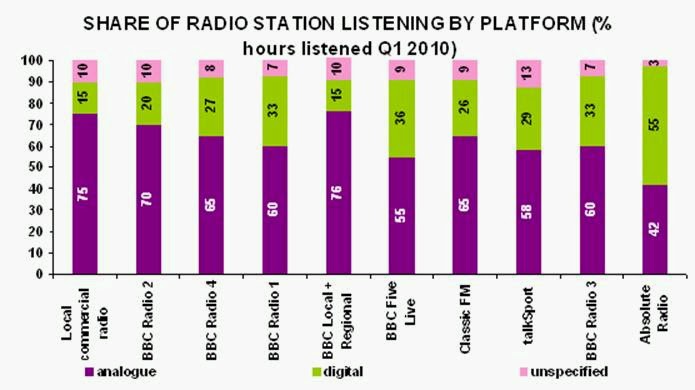
Now, consider that only 20% of listening to BBC Radio 2 is via digital platforms (in Q1 2010), lower than the 24% average for all stations [see Sep 2010 blog]. If that average ever managed to reach the 50% threshold, it might leave 60% of Radio 2’s audience still listening via analogue. That’s 8m listeners that Radio 2 would have to turn its back on as a result of FM switch-off. Time for the BBC to start erecting barricades outside Broadcasting House.
[thanks to Eivind Engberg]
UK commercial radio revenues underperform the 2010 media market

Marketing magazine’s annual survey of the top 100 advertisers announced some good news:

“More than three-quarters of the UK’s top 100 advertisers increased their adspend in 2010, defying predictions that the year would mark a steep decline in marketing budgets. By channel, the biggest year-on-year increase was in TV advertising, with a 17% rise, according to Nielsen; print, outdoor and cinema spend also rose.”

So, good news for radio too? Marketing continued: “The only medium in which spending fell was radio, falling 6% on 2009 levels.” Oh dear.

Why was radio so badly hit in 2010? Partly because of commercial radio’s greater dependency than other media on public expenditure which, as Marketing explained, was cut drastically in 2010:

“The government’s commitment to slashing public-sector spending was reflected in the 50% year-on-year decline in the COI’s [Central Office of Information] adspend to £105.4m.”

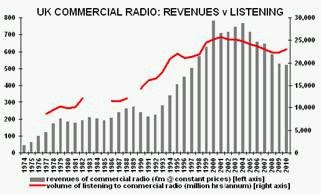
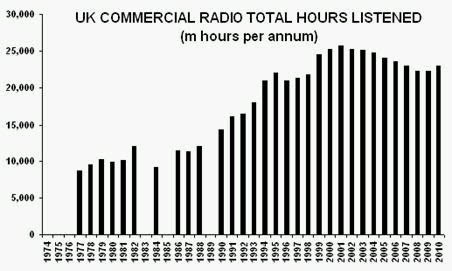
And partly because the volume of commercial radio listening has been in decline for the last decade, and sector revenues are a product of listening:


Encouragingly, 2010 witnessed a 3% year-on-year increase in the total volume of commercial radio listening, the first increase since 2001. However, total radio listening (commercial + BBC) had increased in 2010 by 2%, making commercial radio’s gain only marginally greater than the total market.

As for the other issue of slashed public expenditure on commercial radio, although 2010’s loss of £24m seemed bad [see blog], 2011 could prove to be worse. On Friday, the Cabinet Office recommended the scrapping of the 60-year old Central Office of Information:

“As part of the changes, the COI will be replaced with a new body, the Government Communications Centre, with a wider remit and responsibility for keeping a tight reign on advertising and marketing spend. … The report does not say how much the government might cut from its £1bn annual communications bill, or how much of the £540m spent on everything from TV, radio and posters to sponsorship might be reduced.”

This would prove a further financial blow for commercial radio, since COI expenditure on radio of £30m in 2010 still contributed as much as 11% to the sector’s national advertising revenues, even after having been slashed by the coalition government.

Although Marketing’s (Nielsen) data reported that radio’s national revenues fell by 6% in 2010, the commercial radio sector’s own numbers showed a 6% increase. This discrepancy is puzzling. Nevertheless, analysis of the industry’s dataset tells us:


TOTAL UK COMMERCIAL RADIO REVENUES:
· 2010: £522.6m (£505.5m in 2009)
· Up 3% in absolute terms
· First year-on-year increase since 2007
· Down 1% at constant prices [RPI]

UK COMMERCIAL RADIO NATIONAL REVENUES:
· 2010: £276.2m (£259.4m in 2009)
· Up 6% in absolute terms
· First year-on-year increase since 2007
· Up 2% at constant prices [RPI]

UK COMMERCIAL RADIO LOCAL REVENUES:
· 2010: £144.3m (£144.7m in 2009)
· Down less than 1% in absolute terms
· Lowest value in absolute terms since 2001
· Down 5% at constant prices [RPI]
· Lowest value at constant prices since 1992

This apparent collapse in local advertising revenues would appear to mask a dichotomy that is taking place in the radio sales market. For those stations in small groups or independently owned that rely almost entirely on local revenues, the market for local advertising has already rebounded from the recession. The closure of many local newspapers, the cuts to local council freesheets and the closure of many local radio station offices owned by large radio groups have left these genuinely local stations in an opportune position to hoover up more local advertisers.

On the other hand, local radio stations that have been transformed recently by Global Radio into ‘national brands’ (Heart, Capital) seem to be abandoning their interest in local advertising markets. If I owned a local business in Eastbourne, I would like to know how effective an advertisement would be on the local Heart FM station in my immediate area of Eastbourne & Hastings. This is no longer possible because Global Radio has done away with RAJAR audience data for many local markets. The smallest market that RAJAR can tell me about now is “Sussex,” comprising 1.3m adults – much too big a coverage area for an advert for my one local shop in Eastbourne.

This new strategy seems inconsistent with the Heart FM licence for Eastbourne & Hastings which Ofcom insists is “A LOCALLY ORIENTED CONTEMPORARY AND CHART MUSIC AND INFORMATION STATION…” So, please will Ofcom explain how Heart FM can be a “locally orientated” station if, as a potential advertiser in Eastbourne, I can no longer determine how many people would hear an advertisement broadcast on the station?

RAJAR explained the changes to its data: “Campaigns transferred from Q3 2010 to Q4 2010 will contain the old station definitions and they will be visible Q4, however the data will not be accurate. Please re-plan the campaign using the new regional definitions available in Q4.” In plain English – audience data for local stations have been removed and merged into regional groupings from last quarter.

So, it would seem that the ‘nationalisation’ of the content on Global Radio’s Heart and Capital brands has been accompanied by ‘nationalisation’ of advertising sales. If ever there seemed like a wrong time to be pursuing national advertisers for commercial radio, surely it must be now [see blog]. In real terms, national advertisers spent no more on commercial radio in 2010 than they had in 1997. However, in 1997, there were only 200 commercial radio stations, whereas now there are 300.

I am reminded of a meeting in 2007, just weeks before EMAP was sold, with its chief executive when I asked him if he felt there was anything that the group’s radio division should have done differently. Local advertisers, he told me. We neglected local advertisers in pursuit of the larger amounts we could earn from potential national advertisers. But we turned our backs on previously loyal local advertisers who quickly lost interest in our stations without regular contact from our salespersons.

Here is a lesson to be learnt from the UK’s second largest commercial radio group. Don’t look your local cash cow in the mouth.

DAB radio take-up in the UK: the 2010 year-end scorecard

“I think that there is great potential for digital radio, as the UK and Danish experiences demonstrate.”
Neelie Kroes, vice president for the digital agenda, European Commission, 3 March 2011

“This milestone is part of building momentum for the transition to digital radio in the UK …”
Digital Radio UK, December 2010

“I think that there has been a transformation in the last twelve months.”
Ford Ennals, chief executive, Digital Radio UK, February 2011

“2010 was a fantastic year for the DAB family, with much encouraging news and positive activity from individual markets …”
Jørn Jensen, president, World DMB, March 2011

“We are seeing increased momentum and activity as digital radio switchover moves from debate to reality …”
Bernie O’Neil, project director, World DMB, March 2011

“2010 had a real sense of forward momentum and activity …”
Caroline Brindle, project office manager, World DMB, March 2011

“Building momentum”? “Transformation”? “Fantastic year”? “Increased momentum”? “Forward momentum”?

Is this DAB radio that we are talking about? In the UK, at year-end 2010, the picture looked like this:

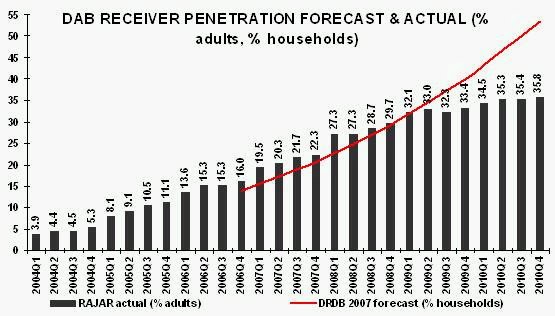
DAB radio receiver penetration:
· 2010 year-end forecast: 53.4% (Digital Radio Development Bureau, 2007)
· 2010 year-end actual: 35.8%

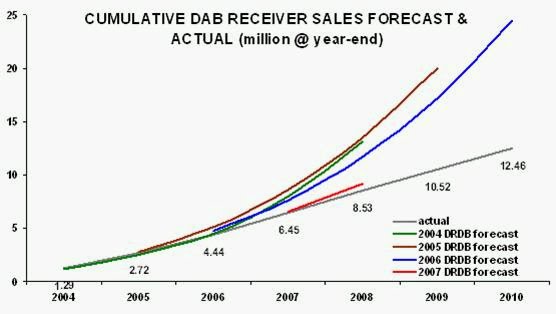
Cumulative DAB radio receiver sales:
· 2010 year-end forecast: 24.5 million (Digital Radio Development Bureau, 2006)
· 2010 year-end actual: 12.5 million

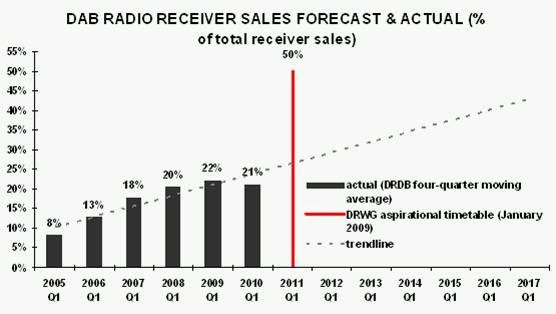
DAB radio receiver sales as % total receiver sales:
· Q1 2011 forecast: 50% (Digital Radio Working Group, 2009)
· Q1 2010 actual: 21%

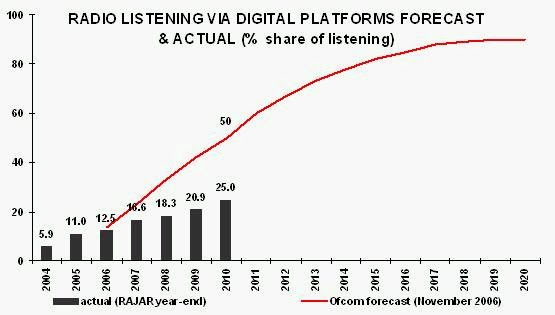
Radio listening via digital platforms:
2010 year-end forecast: 50% (Ofcom, 2006)
2010 year-end actual: 25%

Radio listening via digital platforms:
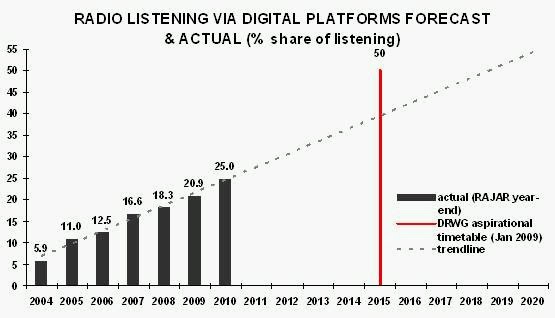
2015 year-end forecast: 50% (Digital Radio Working Group, 2009)
2010 year-end actual: 25%

Radio listening via digital platforms:
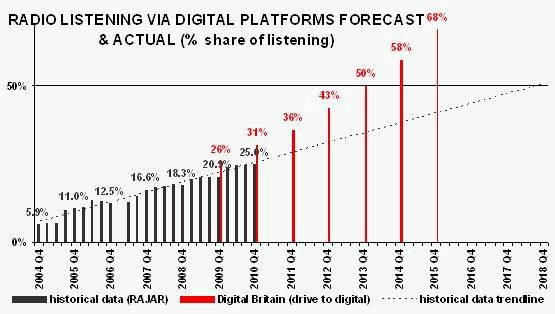
2010 year-end forecast: 31% (Digital Britain: drive to digital, 2009)
2010 year-end actual: 25%

Commercial radio listening via digital platforms:
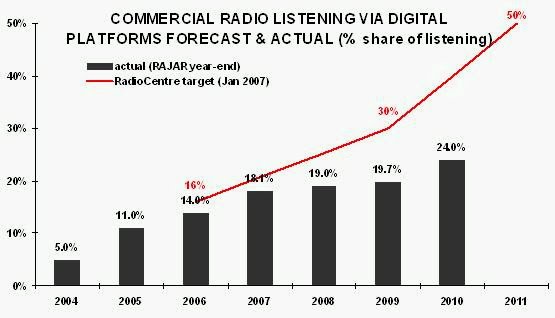
2010 year-end forecast: 40% (RadioCentre, 2007)
2010 year-end actual: 24%

None of the stakeholder forecasts of DAB take-up in the UK have come to pass. In this respect, 2010 was no better a year than any other.

Neelie Kroes is mistaken. Evidence from the UK experience certainly does not demonstrate the “great potential” for DAB radio.

Public spending cuts impacted commercial radio 2010 revenues by £24m

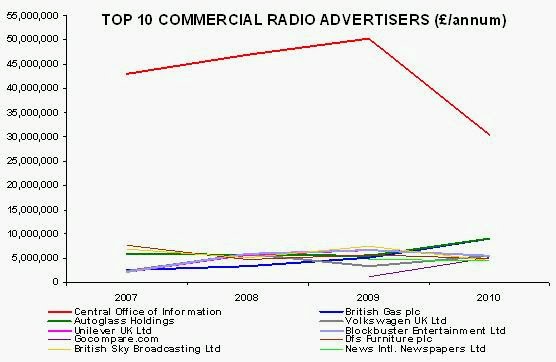
Who was UK commercial radio’s biggest advertiser in 2010? British Gas? No, it was second. Autoglass? No, it came third. Volkswagen? No, it was fourth. Unilever? No, it came fifth.

Radio’s biggest advertiser in 2010 was the government (in the guise of the Orwellian-sounding Central Office of Information [COI]). Not only was the government the biggest advertiser on radio, but it was far and away the biggest advertiser by miles. The government’s £30m expenditure on radio in 2010 exceeded the sum total of British Gas, Autoglass, Volkswagen and Unilever.

After the coalition government was formed in May 2010, it immediately executed Conservative Party strategy to cut public expenditure on commercial advertising by 50%. Before the election, I had predicted that this Conservative policy would have a disastrous impact on commercial radio revenues [see May 2010 blog]. It did.

Although the coalition had been in power for little more than seven months by year-end, COI expenditure on radio was quickly slashed from £50m in 2009 to £30m in 2010. Additional (non-COI) public expenditure cuts reduced radio’s revenues by a further £4m in 2010. This £24m total was a significant loss to commercial radio, and represented 9% of national revenues, or 5% of total revenues.

Did radio suffer greater cuts from the COI than other media? Seemingly not. Radio’s share of COI ad spend was 27% in 2010, slightly higher than the previous year. The reason the impact was so great for radio was the sector’s much greater dependency upon public money than competing media (television, the press, billboards).

In June 2010, the Radio Advertising Bureau had said bravely: “We are optimistic that radio’s strengths will be recognised as COI budgets come under ever greater scrutiny.” Evidently, radio strength’s were not.

By September 2010, the Radio Advertising Bureau said that it was “working with a wide range of advertisers to bridge the gap” left by public expenditure cuts. What was the outcome?

There were some impressive gains for radio from other clients in 2010:
· British Gas increased its expenditure on radio from £5m to £9m year-on-year (particularly impressive since it had only spent £2m on radio in 2007)
· Autoglass increased its expenditure on radio from £5m to £9m year-on-year (50% of its ad budget)
· Gocompare.com increased its expenditure on radio from £1m to £5m year-on-year
· More Than increased its expenditure on radio from £2m to £4m year-on-year
· Mars increased its expenditure on radio from £1m to £4m year-on-year
· Asda multiplied its expenditure on radio eight-fold to £3m year-on-year

The problem was that even these gains combined did not match the loss from government spending cuts. The huge challenge the commercial radio industry still faces is its history of increasing dependency upon one very large advertiser.

Additionally, there were other clients that either spent less in 2010, or might in 2011:
· Blockbuster Entertainment was radio’s sixth biggest advertiser in 2010 (spending 50% of its ad budget on radio), but filed for bankruptcy in the US in September 2010
· Sky TV reduced its expenditure on radio to £4m in 2010 from £7m the previous year
· BT reduced its expenditure on radio to £4m in 2010 from £7m the previous year
· Proctor & Gamble reduced its expenditure on radio to £4m in 2010 from £6m the previous year
· Specsavers had been the second biggest spender on radio in 2009, spending £8m, but dropped out of the top 20 in 2010

However, these single-digit losses were dwarfed by the £24m reduction in public expenditure on radio advertising in 2010.

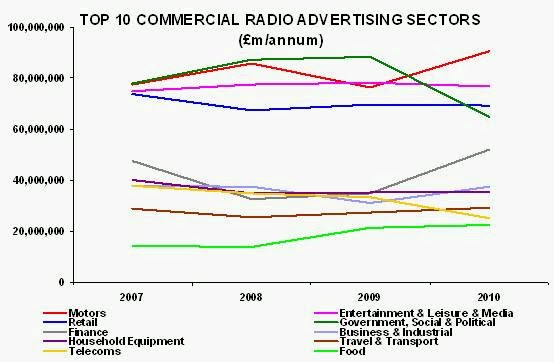
In terms of product sectors, motor vehicles rebounded from the recession and led the field in 2010 with £90m expenditure on radio. The finance sector similarly rebounded to £52m in 2010. On the other hand, the property sector did not rebound and its spending on radio of £8m in 2010 was down 42% compared to two years earlier. Likewise, online retailers spent only £2m on radio in 2010, down 55% from two years earlier.

Public expenditure on radio fell from the number one product sector in 2007, 2008 and 2009 to fourth place in 2010. Inevitably, given that the coalition was only elected mid-2010, the cuts to public expenditure are likely to have as much impact on radio in 2011 as they had in 2010. Neither is there any prospect of these cuts being restored under the present government.

Total radio sector revenues for 2010 are likely to be up slightly year-on-year [see Oct 2010 blog]. This is not something to shout about, given that Q2 and Q3 in 2009 had produced commercial radio’s lowest recorded revenues this millennium. However, it is an achievement in an environment where expenditure by commercial radio’s biggest advertising client fell off a cliff (as the graphs above demonstrate visually).

Unfortunately, in the longer term, unless commercial radio succeeds in improving its performance with listeners, both in absolute terms and in comparison with BBC radio, it cannot expect its revenues to return to levels recorded a decade ago. By 2009, UK commercial radio revenues had fallen by 32% since 2000 in real terms. Radio’s revenues from national advertisers had fallen by 47% during that period. That will be an almost impossible expanse of ground to regain.

[data source: Nielsen Media Research]

Does the nation love its digital radio stations? 86% of UK adults say 'no'

In his perceptive commentary on last quarter’s RAJAR radio audience figures, IPSOS’ research manager Andy Haylett noted:

“18.5 million adults are DAB owners, yet only an estimated 12.6 million are confirmed listeners. What are the other 6 million doing with their DAB sets? Further investigation shows that there are only 7.4 million listeners to digital-only stations, of which under half (3.3m) comes from DAB listening. This suggests that around three quarters of all DAB listeners are tuning to stations readily available on a traditional analogue transistor.”

This reiterates a point I have made previously in this blog [Feb 2009, Aug 2009, Feb 2010]. After more than a decade, it is a sad fact of life that digital radio stations on broadcast platforms have not succeeded in setting listeners’ hearts on fire:
· Only 4.6% of all radio listening is to digital radio stations
· 18.2% of all radio listening via digital platforms is to digital radio stations
· 7.4m adults per week listen to digital radio stations (14.3% of adults)
· 3.3m adults per week listen to digital radio stations via DAB (6.4% of adults)

Of course, the corollary is that digital platforms are being used predominantly for listening to radio stations that are already available to consumers on the analogue platform:
· 95.4% of all radio listening is to analogue radio stations
· 81.8% of all radio listening via digital platforms is to analogue radio stations
· 44.2m adults per week do NOT listen to digital radio stations (85.7% of adults)

These figures might have been understandable during the early years of DAB radio. But now? After more than a decade? Planet Rock launched in 1999; the BBC digital stations in 2002. Compared to the influence that digital terrestrial television stations have had in the UK over a shorter period, digital radio stations have had very little impact on radio listening patterns to date.

The overwhelming use of digital platforms to listen to analogue radio stations begs the question: so what is the point of DAB? There was never anything wrong with FM radio anyway, and there is no proposed alternate use for FM spectrum, so why is the government insisting that consumers and the radio industry both spend huge sums of money to enable the public to listen (on DAB) to exactly what is available already (on FM/AM)?


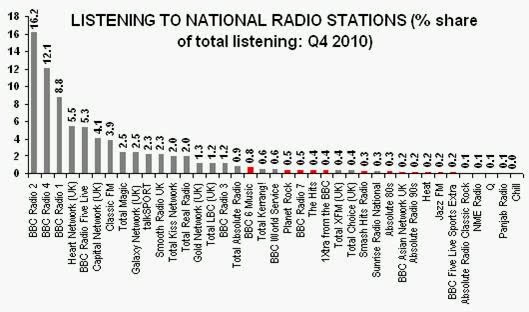
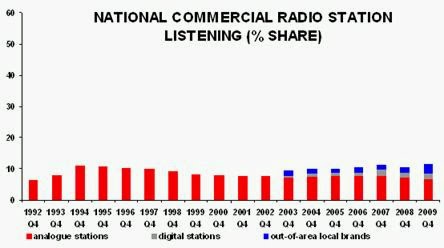
In the graph above, the listening to digital radio stations is shown in red (analogue stations in grey). It remains tiny. Despite BBC Radio 6 Music’s uplift after last year’s consumer campaign, it still languishes as the UK’s 18th most listened to national radio station. Fortunately for the BBC, the funding for its digital radio stations continues to come (for now) from the public purse.

For commercial radio, the funding for digital radio stations has to come from deep pockets. Not one digital radio station has yet made an operating profit. History is littered with commercial digital radio stations that used to be on the national DAB platform: ITN News, Talkmoney, The Storm, PrimeTime Radio, 3C, Capital Disney, Core, Virgin Radio Groove, Oneword, Capital Life, TheJazz, Fun Radio, Virgin Radio Xtreme and Panjab Radio.

Some of these digital radio stations had offered fantastic content unavailable elsewhere (PrimeTime, OneWord). Other digital stations had had very little thought put into their creation. Former GWR staffer Steve Orchard boasted that his company’s strategy for Planet Rock had been conceived in The Lamb Inn, Marlborough: “Going into a pub with Ralph Bernard, my boss, listening to the classic rock jukebox and coming out, several pints later, with Planet Rock sketched out on the back of an envelope.”

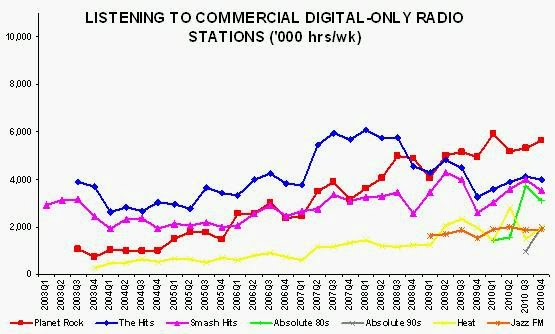
GCap Media sold Planet Rock in 2008 to an ‘outsider’ and it has been the commercial radio industry’s most listened to digital radio station since 2009. It speaks volumes that the entire UK commercial radio sector’s efforts at digital radio stations over more than a decade have been trumped by a music enthusiast with no previous radio sector experience.

However excellent it is, Planet Rock alone cannot save the DAB platform from continuing consumer disinterest. It would require a dozen stations of this calibre to create a portfolio of sufficient interest to stir consumers. Worse, for those consumers who have tried DAB and given up due to the platform’s other issues (poor reception, lack of mobility, lo-fi audio, expensive hardware), even a dozen stations might not tempt them back.

It is understandable, therefore, that Planet Rock’s owner, Malcolm Bluemel, should be frustrated with the rest of the radio industry for not following in his wake. This month, he said:

“I’ve only been in the radio industry about two and a half years now and I’ve never actually come across an industry that has such a collection of self-interest in discussing this matter [digital switchover]. I’m quite amazed at this need for certainty around the future of business. I came from an era where, to get a decent radio [station], I had to stick my AM transistor under the bedclothes and listen to Kid Jensen from Luxembourg at night. Well, now we’ve got people saying ‘Well, I want to know this, I want to know that, I want to know that my radio stations will be this, and I can have that, and I want it all, and I want it all now.’

It’s fairly obvious to me that, as an industry, we should be all sticking together. Digital is here. It’s not a question of a switchover date. Digital is out there. It’s being listened to. There’s 1.1 million people listening to 6 Music, there’s 827,000 people listening to Planet Rock on digital radio NOW. So why don’t we just accept the fact that digital is here and all get together and say ‘Right, how are we going to make this work for the industry?’ For all those people with their self-interest and their stupid press statements over ‘20 years [until digital switchover]’ or whatever it is (how ridiculous is that?), and just get together and have a consensus of opinion about how we are best going to do this, but collectively for the radio industry, and stop fighting amongst ourselves because of our own petty little grievances.”


Planet Rock’s 827,000 weekly reach last quarter is a remarkable achievement. Compare this to the dismal performances of some analogue commercial radio stations. Absolute Radio, with the benefit of a national AM licence and a London FM licence, reached only 1,375,000 adults per week. Xfm reached 938,000 adults nationally with the benefit of a London FM licence. Choice FM reached 734,000 adults nationally with the benefit of a London FM licence.

By comparison, Planet Rock has performed miracles, given that the only broadcast platform it has access to is DAB. As Bluemel identified, paradoxically, the thing that is stopping him from turning Planet Rock into the profitable radio station that it should be is the very industry in which he is working. Whilst (post-GCap Media) Planet Rock is doing all the right things for all the right reasons, the rest of the industry, where DAB is concerned, continues to do all the wrong things for all the wrong reasons.

Unfortunately, the barriers to Planet Rock’s commercial success are the outcomes of the sad history of the DAB platform:
· The commercial radio sector initially invested in DAB to control the platform, not to create successful digital radio stations
· The BBC decided to launch minority interest digital radio stations that would not cannibalise its existing national analogue networks
· The commercial DAB multiplex owners (aka the largest commercial radio groups) did not want upstart independents creating successful digital radio stations on their DAB platform
· The industry’s ‘build it and they will come’ strategy for DAB failed because consumers are driven by content, not by platforms
· If you wanted to persuade consumers to buy relatively expensive DAB radios, you should have inspired them with new content rather than have threatened them with FM switch-off
· Radio listeners are loyal and do not like losing access to content they once enjoyed (the closure of digital radio stations)
· DAB radio reception, for many, is still not as robust as FM or AM

The best solution for Planet Rock would be a national analogue licence. Or, at least, a London FM licence. However, the radio regulatory system we have in the UK militates against that possibility. Why? Because politicians, civil servants and regulators have ensured that those who already own (what were once) commercial radio ‘licences to print money’ get to keep them, seemingly in perpetuity.

It is the existing radio industry itself which is limiting Planet Rock’s opportunities for greater success. We do not enjoy an openly competitive radio market that allows new entrants such as Bluemel to shake up our stagnant radio industry with new, exciting ideas. Instead, ‘outsiders’ have to stand around on the sidelines while the owners of stations such as Absolute Radio, Xfm and Choice FM continue to run them into the ground. So why don’t they just sell them?

Sell their stations? Of course not! When you are part of a commercial radio oligopoly, why would you want to encourage an insurgent, who might actually understand how to create a successful radio station, to camp right on your analogue doorstep? Not only might he show you up, but he might even steal listeners from your other stations. Instead, the current philosophy is to let ‘outsiders’ bleed to death financially on the DAB platform, while the incumbents continue to divide up (what is left of) the spoils of FM/AM radio between them.

So we listeners get the (analogue) mediocrity they think we deserve.

[blog headline adapted from Andy Haylett’s of IPSOS]

Bauer Radio talks the DAB talk, but walks its Magic brand off DAB

Bauer Radio is the second largest commercial radio group in the UK. It publicly supports the government’s plans for DAB radio switchover. Only this month, Paul Keenan, chief executive of Bauer Media, told The Guardian: “What part if any is the BBC going to play on the local DAB level?” He went on to ask:

“Will there be some form of seismic content innovation or intervention that really pulls listeners across [to DAB]?”

Keenan need have looked no further than his own company’s DAB radio strategy to discover a form of “seismic content intervention” that might well result in pushing existing listeners away from DAB, rather than pulling them in. While Keenan was talking to The Guardian, Bauer was busy pulling the plugs on its ‘Magic’ brand from the DAB platform in the following areas:
· Aberdeen
· Ayr
· Birmingham
· Bradford & Huddersfield
· Cambridge
· Dundee & Perth
· Edinburgh
· Glasgow
· Kent
· Northern Ireland
· Norwich
· Peterborough
· Stoke
· Sussex Coast
· Swansea

If you were a loyal listener to Magic in one of these areas, your favourite station simply disappeared from the DAB menu in January 2011 (Magic had 1m out-of-analogue-area listeners per week, contributing 24% of the brand’s total hours listened, according to RAJAR). This change is surprising given that, as recently as May 2008, Bauer Radio decided to add its Magic brand to the DAB platform in the following areas:
· Aberdeen
· Ayr
· Birmingham
· Bradford & Huddersfield
· Cambridge
· Dundee & Perth
· Edinburgh
· Glasgow
· Kent
· Northern Ireland
· Norwich
· Peterborough
· Stoke
· Sussex Coast
· Swansea

In 2008, in most of these areas, Magic had replaced another Bauer brand, ‘Kiss’, which could not have pleased existing Kiss listeners. Now, in 2011, it is the Kiss brand that is replacing the Magic brand in all but three of these areas. Musical chairs, anyone?

In 2009, Bauer had said that it was investing in the “right long-term platforms for the right stations at the right time.” So, in 2008, Kiss was right for DAB whereas, in 2011, now Magic is right?

It is hard to believe that such precipitous content changes inspire consumer confidence in the DAB platform. But, sadly, the DAB platform has never really been about ‘radio’ and ‘listeners’. Loyalty to DAB radio? What’s that? For commercial radio, its pursuit of the DAB platform had been about the exercise of power, the expectation of profit and the promise of automatic renewals for the industry’s most valuable analogue radio licences.

It was also about a much coveted transfer of the power to determine which stations are broadcast to a cartel of commercial DAB multiplex owners, and away from the regulator. This is why station changes on DAB, such as Bauer’s (Kiss to Magic to Kiss) can be executed without a public consultation or impact assessment.* The regulator merely nods its head and makes a quick note in a file. So what role does Ofcom play in ensuring that the DAB radio platform “furthers the interests of citizens and of consumers” as mandated by law? The answer is: absolutely none. We might as well have a scarecrow in charge of digital radio at Ofcom.

The reason that Bauer Radio (with a 25% listening share of commercial radio) made these latest changes to DAB is that it is locked in a war with archrival Global Radio (38%). Neither company has a track record of developing its own successful radio stations from the ground up. Both companies are piled high with acquisitions and mergers of other radio businesses. As a result, the two compete with each other by moving their radio pieces around the chess board, rather than by innovation.

In January 2011, Global Radio extended its ‘Capital’ brand outside London, replacing the former ‘Galaxy’ brand and some local FM stations. Global describes the brand:

“Capital’s target audience of 15-34 year olds are big fans of popular music, they are media savvy and are on trend.”

To compete, Bauer Radio extended its Kiss brand to every available local DAB multiplex (replacing Magic). Bauer describes the brand:

“Kiss evolves around ever changing lifestyles and trends of the UK’s young 15-34 market … Every part of their day revolves around music.”

If, like me, you think that these two brands sound almost identical, understand that this phenomenon is the outcome of long understood business practice in the radio sector. In 1951, American economist Peter Steiner wrote:

“If, as is often suspected, [radio] broadcasters exaggerate the homogeneity of audiences and their preferences for certain program stereotypes, the tendencies towards [programme] duplication will be increased. … The problem, of course, is that a series of competing firms, each striving to maximize its number of listeners, will fail to achieve either the industry or the social good. Here, then, competition is providing a less than desirable result.”

In the UK, this is precisely why we have a regulator for radio broadcasting – to ensure that consumers benefit from a wider choice of content than a free market would provide. However, with its hands tied in DAB policy by the Broadcasting Act 1996, and its laissez-faire ‘do nothing until someone complains about it’ strategy, Ofcom has had no more impact on the DAB station menu than having no regulator at all.

DAB is the Wild West of radio where anything can, and often does, happen. Seemingly, it often happens with little concern for listeners or for those who paid good money for a DAB receiver. Without a sheriff in sight, or a cavalry about to ride over the horizon, the danger is that the public might come to view DAB radio as nothing more than a bunch of cowboys locked in a private war of one-upmanship.

Yet the radio industry wonders why the DAB platform is not stimulating more listening or more receiver sales.

[*NB: There was an Ofcom consultation in November 2010 about a change of format for the Kiss brand, but this did not touch upon Magic being dropped from DAB. Magic continues to be simulcast on DAB in nine areas where it is already available on FM or AM, as a contractual condition of its automatic analogue licence renewals.]

DAB radio receiver sales in 2010: what was the actual number?

On 21 December 2010, a press release from Digital Radio UK announced that “12 million digital radios have been sold in total in the UK” and estimated that:
· “due to strong Christmas sales, over 2m digital radios will be sold during 2010
· A cumulative total of 20 million digital radios will be sold by the end of 2013.”

It takes a brave person to predict in mid-December what a year-end sales figure will be. More so with DAB radio receivers because, in previous years, the month of December alone has accounted for more than a quarter of annual sales.

It takes an even braver person to predict that, by year-end 2013, an additional 8m digital radios will have been sold. Whether or not 2m units were actually sold in 2010, we do know that just under 2m units had been sold in 2009, and just over 2m units in 2008 and in 2007. So please can Digital Radio UK explain what revolutionary change will ensure that sales suddenly spurt during 2011, 2012 and 2013? Buy one, get one free?


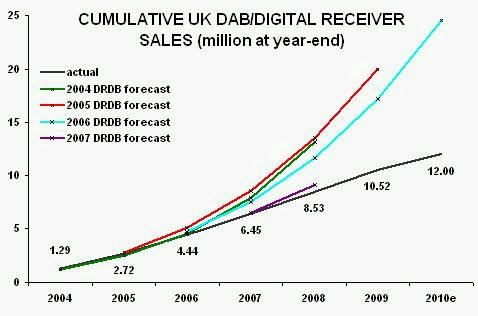
Perhaps this new ‘20m by 2013’ figure was forecast by the same party that produced earlier forecasts for the Digital Radio Development Bureau, the forerunner to Digital Radio UK. As the graph above demonstrates, none of those forecasts made in 2004, 2005, 2006 and 2007 were rooted in an analysis of reality. If they were, then 24.5m digital radios would have been sold by now. Whereas, the actual figure is 12m, less than half the forecast for 2010 the industry had made four years ago.

It is interesting to note that all the recent sales figures offered by DAB lobbyists refer to ‘digital radios’ rather than ‘DAB radios.’ One wonders exactly how many internet radio receivers have been sold in the UK and are being used to prop up the illusion that DAB radio is some kind of success story with consumers. When I have asked for a breakout of internet radio sales, data were not supplied.

If, as the Digital Radio UK press release shouts, a “digital radio landmark” was really achieved in December 2010, then why are the recorded UK monthly and quarterly sales figures for DAB radios not available from the Digital Radio UK web site for the public to admire? (Maybe because the Digital Radio UK web site is completely empty.)

The chief executive of Digital Radio UK was quoted last week saying: “There is now real momentum in the transition to digital radio.”

“Real momentum” is not what the sales data for DAB receivers, even those few estimated figures released by Digital Radio UK, demonstrate to be the reality.

UK commercial radio revenues Q3 2010: still no sign of "renewed growth"

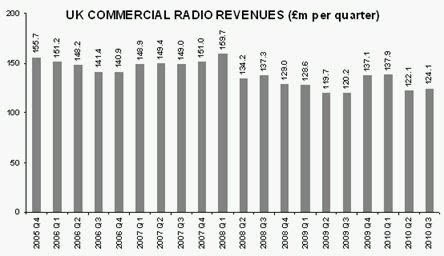
2008 had been a bad year for commercial radio revenues, down 6% year-on-year. 2009 was a worse year, when revenues fell a further 10% year-on-year. So how is 2010 shaping up? Radio Advertising Bureau data for Q3 2010 demonstrate that, although revenues are likely to be up marginally for the calendar year, they have yet to regain the substantial losses suffered during those previous two years.

Why? Because commercial radio’s falling revenues are largely the result of structural decline, something that the ‘credit crunch’ of 2008/9 merely exacerbated. Adjusted for the impact of inflation, commercial radio revenues peaked in 2000 and, by 2009, were down 32% in real terms. The single-digit improvements we might see in 2010 will claw back only a tiny part of these enormous losses.


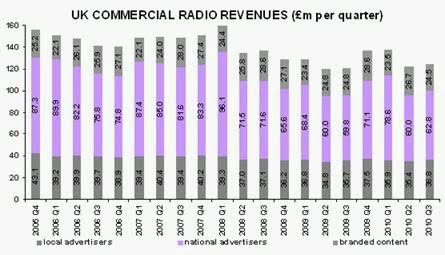
Q3 2010 TOTAL REVENUES
· Up 3.2% year-on-year to £124.1m, but remember that Q3 2009 had been the sector’s second lowest this millennium

In May 2010, the Radio Advertising Bureau had told us that “the [commercial radio] sector has turned a corner and not only halted [revenue] decline, but moved into renewed growth …”

Industry data has yet to validate this assertion. The last two quarters produced the third and fourth lowest revenue totals of the decade, showing that the radio sector is certainly not out of the woods yet. More than anything, the industry’s revenues still seem to be bumping along the bottom. “Renewed growth” is not on the horizon yet.


Q3 2010 NATIONAL REVENUES
· Up 5.0% year-on-year to £62.8m

Q3 2010 LOCAL REVENUES
· Up 3.1% year-on-year to £36.8m

Q3 2010 BRANDED CONTENT REVENUES
· Down 1.2% year-on-year to £24.5m


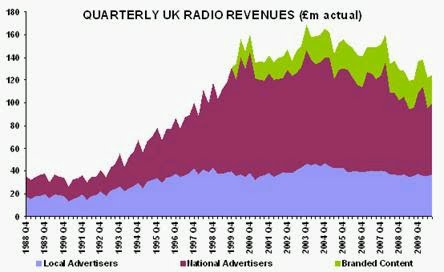
The revenue data for the long term [see graph above] illustrate clearly the transformation of the commercial radio sector from a healthy growth industry in the 1990s to one that stagnated after 2000, and which has subsequently moved into decline. Whilst revenues from local advertisers have simply stalled in recent years, revenues from national advertisers seem unlikely to ever recover from substantial declines suffered since their peak in 2000. This has necessitated significant restructuring of the commercial radio sector in recent years.

For those larger commercial radio stations that depend upon national advertisers the most, the outlook continues to look bleak. Data from Nielsen estimated that advertising spend by the government’s Central Office of Information [COI] fell by 47% in 2010 year-on-year. COI expenditure has been a greater proportion of commercial radio revenues than of any other medium, making radio particularly vulnerable. In May 2010, I had predicted:

“A 50% budget cut to COI expenditure on radio would lose commercial radio £26m to £29m per annum, 6% of total sector revenues. A 50% budget cut to all public sector expenditure on radio would lose commercial radio £44m to £48m per annum, 9% of total sector revenues.”

Not only have these cuts been realised, but the Cabinet Office is continuing to pursue a plan for the BBC to carry public service messages for free, rather than pay commercial broadcasters for airtime [also predicted here in May 2010]. This could lose commercial radio a further 6% to 9% of revenues.

In 2009, even before these drastic cuts to government expenditure on advertising, commercial radio was attracting only 4% of total display advertising expenditure in the UK, one of the lowest proportions globally [see Ofcom report]. What is UK radio doing so wrong that Ireland, Spain and Australia achieve more than double that amount? And why was that percentage already falling before the COI cuts, demonstrating the radio medium’s comparative lack of appeal to potential advertisers?

There could not be a worse time to be a commercial radio station dependent upon national advertising. Yet now is the precise time when several large commercial radio owners are busy transforming their local and regional stations into national ‘brands.’ As a response to the sector’s structural challenges, this is tantamount to cutting off your nose to spite your face. ‘Localness’ has consistently been shown to be the most important Unique Selling Point of local commercial radio, according to Ofcom research. Throw that localness out the window and all that remains is a music playlist which can be generated by any computer application.

UK commercial radio has always been good at making ‘cheap and cheerful’ local radio, but has been rubbish at making national radio that could compete with the BBC’s incredibly well resourced national networks. The recent decisions of commercial radio owners to switch from production of local radio services with a track record of success to production of ‘national’ ones that have a history of relative failure create massive risks for an industry already in decline.


History tells its own story. The launch of the UK’s first three national commercial radio stations between 1992 and 1995 had much less of an impact on radio listening than had been anticipated. By 1997, Richard Branson had decided to sell Virgin Radio (for £115m) – it was obvious that national commercial radio was not going to be a massive moneyspinner. In 1997, Virgin Radio’s listening share had been 2.6%. Last quarter (Q3 2010), it had fallen to 1.2% (renamed Absolute Radio after another sale in 2008 for £53m), while the combined share of the three national stations was 6.8%. [source: RAJAR]


BBC national networks account for almost half of all radio listening. The only time that their share has not exhibited long-term growth was during the early 1990s, when Radio 1 self-destructed under the management of Matthew Bannister. Since that disaster, the BBC’s national networks have been successfully clawing back listening year-on-year.

The current scenario in which the owners of commercial stations that were licensed to serve local audiences have decided to subvert that purpose to take on the might of the BBC national networks is either brave, or madness, depending upon your viewpoint. What I see is a monolithic BBC that has existed continuously for nearly a century, and then I see three national commercial radio stations that have had a succession of at least three owners each during their almost twenty-year struggle to attract listeners.

National commercial radio. Just why are parts of the commercial radio industry so eager to emulate an idea that has only led to well documented failure?

Commercial radio local DAB build-out "not the BBC's responsibility" says BBC Trust chairman

Culture Media & Sport Select Committee, House of Commons
15 December 2010
BBC Annual Report & Accounts 2009-10 [excerpt]

Sir Michael Lyons, Chairman, BBC Trust
Mark Thompson, Director General, BBC

Damian Collins, MP Folkestone & Hythe (Con): Has the [Licence Fee] settlement affected the amount of support you can give to digital radio switchover and the build-out of digital radio in local services within the regions?

Sir Michael Lyons: What you see in yesterday’s announcement is a clear message that the BBC remains committed to DAB and will continue to build out up to FM equivalents. That is clear. It is involved in discussions with the commercial radio industry and Government about local build-out, for which it is not responsible and for which there are not funds currently identified. They were expected to be undertaken by the commercial operators of those Mux [DAB multiplex] licences.

I don’t think I should add very much to that, other than that, clearly, the Government has determined on a switchover date. Whether that can be achieved is, in our view, whether the audience is ready for it to be.

Damian Collins: I suppose whether it can be achieved ought to be linked to the level of coverage as well. The Government has been clear about that, too. In those negotiations you are having with Government and the commercial stations, is the amount of money you have on the table a smaller amount, as a result of the settlement, than it was before?

Mark Thompson: No.

Sir Michael Lyons: It is clearly another one of the pressures that we have to balance in a tighter envelope; that is the important thing.

Mark Thompson: I think it is fair to say that the underlying commitment that we have made and the focus we have on the building out of our own national multiplex, is unchanged by the settlement.

Sir Michael Lyons: Absolutely. It is a reference to local, I think, that I was …

Mark Thompson: Quite. But the BBC’s focus has always been … the issue about local is that we only have in England, and only intend to have, a single BBC local radio station per region. With each local multiplex that has been opened so far, we have taken a place on that multiplex; we decided that we should do that.

I have no reason to believe we would not continue to do that as they are built out. But whereas the national multiplex, obviously, is a way of getting additional BBC services to the public – the digital services – there is no such increase in BBC services that we can offer if you are taking a single station which is analogue and putting it on digital as well. So our focus is on national build-out, and the broad policy and the commitment over time to absolutely keeping pace with the audience, building out nationally, is unchanged by the settlement.

Damian Collins: Your commitment is clear, and you made that again today, but is it going to take longer to get there now, as a consequence of finding some other issues you have to deal with?

Mark Thompson: I don’t think so. If you say something slightly different, which is, “Would some people have liked some level of additional commitment in the settlement?”, perhaps they would, but it is not there.

Damian Collins: But as far as you are concerned, your commitment is the same?

Mark Thompson: It is exactly the same.

Damian Collins: In the document put to us yesterday, you talk about preparing for any potential radio switchover. That does not sound like it is going to happen within the next five years.

Sir Michael Lyons: That is not a judgment for the BBC; that is a judgment for Government. The BBC is very clear that it is doing its bit in these national investments. There remain unresolved issues about where the investment comes from at a local level. That is not the BBC’s responsibility, but we are part of those discussions. And then, very critically, as the Government has conceded, switchover can only take place … I do take your point that audience preparedness will to some extent depend on coverage, but it also depends on choices made about replacement television sets, investment in cars and a whole series of other things, which are not in our gift.

[This is an uncorrected transcript of evidence taken in public and reported to the House. The transcript has been placed on the internet on the authority of the Committee, and copies have been made available by the Vote Office for the use of Members and others. Any public use of, or reference to, the contents should make clear that neither witnesses nor Members have had the opportunity to correct the record. The transcript is not yet an approved formal record of these proceedings.]

BBC head of radio: "I'm not going to give you a date" for digital radio switchover

Feedback, BBC Radio 4, 26 November 2010 @ 1330 [excerpt]

Roger Bolton, interviewer [RB]
Tim Davie, director of BBC audio & music [TD]

RB: Tim Davie is the BBC’s director of audio and music. I asked him if the campaign to get decent DAB coverage in 90% of the country by 2015 is still realistic.

TD: I think 2015, and I’ve said it before, is highly ambitious. The BBC would not want to see any [digital radio] switchover unless you had clear evidence of mass listening to digital, and good penetration of digital devices. I think the idea that we force a lot of listeners to a situation where they have to get rid of FM devices and not have something to listen to on digital is clearly not in the interests of the head of BBC radio [laughs].

RB: When would you say, without doubt, we will have digital switchover …

TD: [interrupts] I’m not going to give you a date. I’m not going to give you a date. I’m …

RB: … not ten years, not fifteen years, not twenty years?

TD: I think there will be a switchover. I think it’s been extremely helpful to put a stake in the ground and say ‘could we get to 2015?’ I say that’s ambitious. I quite like ambitious targets. We’ll see how we go.

RB: And there’s concern about coverage. What about quality? Because there are still a lot of our listeners who are not persuaded that the quality [of DAB] is superior, in that digital is actually sometimes worse than FM.

TD: In terms of the areas that are covered by a digital signal, I would be the first to say that we’re not there yet. So, you know, I know some of the listeners out there will say ‘well, I just can’t get a good signal’. Let’s be clear. Before the radio industry would say to people ‘we’re moving away from FM’, we must have full coverage of a DAB signal …

RB: And yet, despite this, you are running a campaign, or rather supporting a campaign, which says ‘digital radio: more to love’ [and] pushing it hard. You’re pushing something …

TD: [interrupts] Absolutely.

RB: … which you have reservations about.
TD: When you say ‘reservations’, I don’t think it’s quite the right word. I’m saying we’re building out coverage. I would not endorse a switchover unless coverage were as good as FM. At this point, I think it is utterly appropriate for me, as the BBC head of radio, to say: those people in areas of coverage – and it is important, by the way, when people buy radios, they check that they are in an area of coverage, we absolutely say that repeatedly – but, if they are in an area of coverage, I would absolutely say ‘buy a digital radio’ because you can get Radio 7, the joys of 6 Music, etcetera.

RB: But, in terms of this campaign, let me quote something said by William Rogers, the UKRD chief executive – part of the commercial radio network. He says it was ‘fundamentally immoral and dishonest to run the campaign, knowing that DAB infrastructure is not good enough, and knowing full well that when people buy a DAB radio, it may not work when they get it home. The BBC should be ashamed of themselves for running this ad. They are telling their listeners to buy something which they know isn’t ready for us yet.’

TD: Well, I mean, it is one voice, and I say ‘one voice’ among many in commercial radio and …

RB: [interrupts] And there are quite a few others who, again, refuse to run the ad.

TD: Absolutely. And, well, I think their beef is, by the way, slightly different to that articulated by William, but it’s really straightforward. 88% of the people in the country can get a signal. If you can’t get a good signal, I wouldn’t recommend digital radio. If you get that coverage, we would absolutely recommend – I think it’s utterly appropriate – to say to people: ‘go and get a digital radio to enjoy the full range of services.’

RB: But the commercial radio sector, or some of it anyway, is saying ‘this is precisely the thing the BBC should be doing. It should be investing and spending so that everybody can get digital coverage.’

TD: Mmm. We’ve said, in the last few weeks, and part of the BBC [Licence Fee] Agreement with the government was to build out national coverage of DAB services. The debate with local radio – just to be clear, and this is a bit complex, so apologies, but – is around the local layer of DAB. And we are negotiating out those costs at the moment. While that negotiation goes on in pretty tough financial circumstances for the BBC, it’s understandable that people say ‘well, we need a bit more clarity.’ I agree with them.

RB: Can I ask you, though, whether the BBC’s enthusiasm for the potential of digital, in terms of stations, is waning. For example, you did propose the closure of 6 Music and the end of the Asian Network, at least as a national station. Are you still in love with digital?

TD: It’s a fair point. The idea around looking at the line-up of stations was never about taking money off the table for digital. We want to keep investing in digital and, I think, in terms of our commitment to digital, this not just about DAB, this is about internet services. We’ve just said, on Radio 3, we’re launching HD sound, which will be a wider signal through internet radio. I think, as the head of BBC radio, I really want to see radio develop into a more competitive marketplace so that it can grow. The idea that the BBC just sits on FM spectrum, and there’s no growth in radio, to me, seems a pretty limited vision of the future for the industry.

RB: So there’s no doubt about the destination, only the amount of time, the speed of getting there?

TD: Radio’s going digital.