Health & safety & death in the workplace : 2004 : BBC World Service Trust, Phnom Penh

 We were standing in a concert hall designed like a futuristic room on the ‘Discovery One’ spaceship in the film ‘2001’. Every feature was brilliant white. White plastic seats. White walls. White ceiling. When the house lights were switched on, it was a dazzling sight. In 1968, my father had accompanied me to watch that sci-fi movie at our local cinema because my school project concerned the American space race. Simultaneously, maybe an unknown architect somewhere had exited a theatre, sufficiently inspired by Stanley Kubrick’s cinematic vision to design their next project, this room, all-white.

The huge hall appeared little used and surprisingly intact, despite the sprawling two-story concrete headquarters of ‘Radio National Kampuchea’ [RNK] in which it was built exhibiting significant evidence of the raging civil war that had started with the overthrow of Cambodia leader Prince Norodom Sihanouk in March 1970. I wondered to myself whether this concert hall had served as a secret location for the Khmer Rouge leadership to enjoy a Friday night knees-up after a hard week’s work torturing and murdering fellow citizens. There might be ghosts here that would be best undisturbed.

“You will be training our staff here,” ordered Tan Yan, RNK director general, waving his hand around the cavernous hall. 

“Er …,” I replied, on the verge of telling him that this was no suitable venue to train a handful of his staff in radio production. But I managed to restrain myself from contradicting this Cambodia government appointee. I recalled that, only months prior, Chour Chetharith – deputy editor of an independent Phnom Penh radio station ‘Ta Prohm 90.5 FM’ critical of the country’s ruling party – had been shot dead by two gunmen on a motorbike on arrival at his workplace. Like anybody, I would like to live.

From his instruction to me, it was evident that our host likely had never made a radio programme, had scant idea how radio programmes were produced and had never needed to learn. His role, in charge of the government’s one national radio channel, was to ensure that its output caused no problems for his masters. We had just come from an initial meeting in his office, a cramped room awash with paper and lacking any twentieth century technology other than a telephone and an electric fan, but weirdly reminiscent of a North London taxi cab office. Then he had shepherded our delegation into a long narrow room, empty apart from two lines of chairs on opposing walls. Speeches were made in Khmer by government men sat opposite. My BBC colleague said something in English. We all stood up, uncomfortably close together in that small sweaty space, a photograph was taken and printed in the following day’s newspaper, trumpeting the first partnership between the Cambodia government and the BBC to produce radio programmes.

After the concert hall, our guided tour of the radio station took us to a large windowless office crammed with desks piled high with papers and occupied by scribbling staff. Our host explained that this was the nerve centre of his operation where everything had to be ‘checked’. Strangely, there were no signs of radio production equipment. The sign on the office door said ‘CENSORS’. This is where every script written by lowly radio employees was edited by important managers to ensure the words’ suitability for broadcast to the nation. Then it was recorded onto analogue tape in an unseen studio somewhere, to be returned here for checking that the announcer had not inserted any personal inflection or inference into their reading of the approved script. Every item within the station’s output was created this way. Not one minute of ‘live’ content had ever been transmitted. If aliens were to invade, this radio would inform Cambodians a week after their abduction to a distant galaxy.

We were then taken to a large darkened room in the bowels of the building, filled with standalone metal shelf units on which the station’s tape archives were stored. Thousands of items were evident, many in boxes, some not, much seemingly uncatalogued, some unspooling all over the floor. It was an unholy mess. No air conditioning. No organisation. But it was surprising it had survived at all the Khmer Rouge era. Right here, since the station’s launch in 1947 under the supervision of the Ministry of Propaganda, we were told there were priceless recordings of musicians, interviews and news reports spanning the country’s turbulent history … if you could ever find them amongst the chaos. I was awestruck.

Then it was down to work. The BBC had requested interviews with a dozen of RNK’s existing staff, from which we would choose a radio production team whom I would train to create (shock horror!) a live weekly phone-in programme, the first in the station’s history. We decamped to one of several unused rooms whose doors had been removed and that opened onto the compound, where we sat around a group of old desks pushed together in the middle. No air conditioning. Just a bare room and the three of us: the BBC’s radio manager in Cambodia, Chas Hamilton; BBC translator Keo Sothearith; and freelance me. We had a list of staff names and that was all. No CV’s. No idea who we were about to see.

One by one, our candidates arrived and what ensued was the most bizarre round of interviews I have ever encountered. Asked what their present job entailed, what skills they possessed and what they wanted to achieve in their career, most failed to answer anything at all. Some just stared at us as if we were mad. Several answered “I do what my boss tells me”. None appeared enthusiastic about their work or the potential of training with the BBC. Reluctance would be a gross understatement. I wondered to myself how they had secured their jobs in radio in the first place if their communication ‘skills’ were so poor. They seemed to consider our polite enquiries as interrogation, as if we might incarcerate them for any incorrect answer … or worse. Perhaps the government radio station staff were still being managed through ‘fear’, just as the Khmer Rouge had terrorised the population not so long ago.

By the time we reached our last interviewee, we had noticed that all our candidates had been dressed in black. We asked why. Our last man explained that one of their female colleagues at the station had recently been killed by falling masonry from the crumbling war-torn building, so the staff would be attending the funeral that afternoon. We looked at each other open-mouthed. We were sitting in a death trap. Oh dear! What were we doing there? Despite me having interviewed potential candidates for radio jobs in many countries, this selection proved the most difficult to assess because we had elicited almost no relevant information. We remained there a while afterwards to discuss our preferences, deciding to select the marginally least reticent six staff and hope for the best. I felt anxious about how I could train people who appeared so disinterested.

Our morning’s work done, we left the room and headed to the director’s office to thank him and say goodbye. It was empty. We walked out to the front gates of the compound and were astonished to find them locked from the outside. We walked back to the building and wandered around offices on the two floors, shouting ‘hello’. It was completely deserted. Like their former colonial masters, the staff must have left en masse at precisely midday and would not return for two hours. We had been locked in without anyone anticipating that their morning visitors might still be present.

All the three of us could do was walk through foliage around the inside of the high perimeter zinc fence and look for a gap to escape. Eventually we did find a small hole where the metal had suffered damage, we prised it open and, bending down, could just about crawl through. By then, we had been outdoors in the midday sun for a while and, once returned to the BBC office, we desperately needed refreshment. It was a bizarre end to a bizarre morning of meetings at the government radio station.

That afternoon, after reflecting upon our experience, I told my local line manager, Chas Hamilton, and the BBC Cambodia project manager, Giselle Portenier, that I considered the RNK premises a wholly unsuitable venue for me to train staff. Was there a room in the BBC building I could use instead? The local staff showed me a conference room with a boardroom table that seemed ideal. I almost fainted when I realised I had seen this exact space, with its large circular motif embedded in the marble floor, during a dream five years earlier. Not for the first time, ‘déjà vu’ sneaks up out of nowhere to surprise you in the strangest situations.

To me, it seemed self-evident that this room – in a secure, air-conditioned environment with access to a kitchen and toilet facilities – was the perfect solution to hold my training sessions two full days each week for the next few months. I was taken aback to be told that neither Hamilton (who had visited RNK with me) nor Portenier (who had not) agreed. Apparently, the BBC’s contract with the government insisted the training would take place on-site at RNK and that was considered the end of it. Before making that agreement, had anyone from the BBC actually visited the RNK building? This stalemate lasted more than a month. Maddeningly, in January the BBC in London had sent me to Cambodia to start work with the utmost urgency and yet, by March, I was still unable to commence training one of my two radio production teams.

In desperation, I felt forced to send this formal email on 30 March to Hamilton and Portenier:

“I feel I should flag that no specific resolution has yet been agreed to the health and safety issue of the RNK building.

After my visit to RNK on 2 March 2004, I immediately expressed my concern (verbally) to Charles and Giselle about the health and safety risk of undertaking training work at the RNK premises. In subsequent conversations with Charles, Giselle and Lori [McDougall], possible remedies were discussed that involved training RNK staff off-site.

Paragraph 10(5)(a) of the WST [BBC World Service Trust] Freelance Terms Of Trade requires the Freelance to “make an assessment of all risks to health and safety reasonably foreseeable by him/her that may affect the WST or any others arising out of or in any way connected with the performance of the Contract” and to “promptly make and give effect to arrangements to eliminate or adequately control such risks.” The Freelance is made responsible for health and safety issues.

The Freelance is obliged to “notify the WST accordingly,” which I have done (verbally), and I will reiterate (in writing) my assessment: The RNK building is in a terrible state of repair and looks as though it has not been maintained for at least a decade, maybe longer. Most exterior windows have no glass and many of the rooms no longer have doors. Only a few rooms seem to have air conditioning. We learnt that a member of staff has recently been killed by masonry falling from the building. There is little or no visible security, and the large front reception area within the building is completely empty. When we went to leave the premises at noon, we found all exit gates were padlocked, and the building devoid of any staff to assist. We eventually found an exit through a gap in a zinc fence to the rear of the building. We have yet to see any kind of refreshment facility, or inspect the toilet facilities.

I do not feel that this is a safe environment in which to spend several days a week training RNK staff. Such training could be arranged off-site without any loss of relevant radio facilities (since RNK has no live studio/production environment relevant to the training). As you are aware, I suggested that training could instead be conducted at the BBC office and/or ‘FM 102’ (or elsewhere).

I am sure that we can work together to resolve this issue and commence the training of RNK staff.”

Still enduring no local approval, I then had to write a similar email to the BBC office in London which resulted in further queries, more correspondence but, eventually, grudging acceptance that my work could be undertaken in the conference room only metres away from my office desk. The outcome was that training sessions which should have started in January did not commence until April, by which time the plan had been for me to return home. However, having just won such a frustratingly minor victory, I felt it would have been irresponsible to leave immediately, so I offered to extend my time in Cambodia a further few months. Nonetheless, the RNK phone-in programme had still not launched by the time I eventually left, sadly as a direct result of these delays attributable to the BBC. This was the first time I had been employed by the BBC, as well as my first work for an international charity, and my experience with ex-pat managers had proven far from productive.

By contrast, my training sessions in the BBC conference office with the RNK staff, about whom we had harboured such initial doubts, proved to be amazingly positive. They were wonderful people who taught me as much about Cambodia as I hopefully taught them about radio. I was so sad to leave them without having seen through their phone-in programme, which finally launched on-air in October.

I never returned to the RNK building. However, I did run into the station’s director at the press launch of some health project in Phnom Penh that the BBC insisted I attend. We stood together in silence in the garden of the venue, a small high circular table between us on which we placed our free drinks. Conversation was impossible. My knowledge of French proved irrelevant because the language had been effectively extinguished by Khmer Rouge assassinations of anyone vaguely academic in the 1970’s. This middle-aged government man smiled at me friendlily, though I found myself wondering what ‘successes’ he might have achieved in Year Zero to have sufficiently impressed the ruling party.

Once back in London, I wrote an email to UNESCO explaining that I had viewed RNK’s broadcast archives and believed they should be preserved, catalogued and stored in an improved environment because of their historical significance not only to Cambodia, but globally. No reply. I tried my best!

I had had a job to do … flying to Cambodia.

[Originally published at https://peoplelikeyoudontworkinradio.blogspot.com/2023/11/health-safety-death-in-workplace-2004.html]

One good turn deserves a cold shoulder? : 2004 : BBC World Service Trust, Phnom Penh

“I understand you’re an expert in messaging,” said the woman sat behind the desk.

I looked blank. I had absolutely no idea what she was talking about. If she meant SMS text messaging, I did not even own a mobile phone!

“I was told you are experienced in capacity building,” continued the woman, undeterred.

I looked even more blank. What on earth was she talking about? I had just flown half way around the world. This was my first meeting with the boss of the project where I was to work. Yet I had zero understanding of what she had just said. I began to wonder if the office back in London had mistakenly sent the wrong person (me) to the wrong location (Phnom Penh, Cambodia). Did she think I was someone else? I had been sent here to do radio training. Had the international wires become crossed somewhere?

It took me several weeks to understand that Giselle Portenier, manager of Cambodia’s BBC World Service Trust project, had been addressing me in ‘NGO-speak’, an esoteric language I had never before encountered. People working in such ‘Non-Governmental Organisations’ (er, international charities) apparently use terminology that substitutes long words for concepts which the rest of the world refer to with short words. Some might call this professional obscurantism.

During my first week, Portenier insisted I attend a two-day workshop organised by the Centre for Disease Control concerning drama programmes created to communicate health issues to the population. My takeaways were that NGO staff love the sound of their own voices and try their utmost to turn simple tasks into overcomplicated diagrams and flow charts. I strained to stay awake in Cambodia’s oppressive daytime heat and quickly tired of hearing NGO people talk to each other in a language that was apparently English, but might as well have been Mongolian for all I could understand. Luckily, I managed to excuse myself from a similar two-day workshop about ‘messaging’ the following week.

Why was I in Cambodia? In July 2002, I had been unemployed and applied in desperation for an advertised role with the BBC World Service Trust in Ethiopia. The only thing I recall about that interview was sitting alongside dub poet Benjamin Zephaniah (born two days before me!) in the lobby of Bush House. Having neither attended Oxbridge nor benefited from a family member or acquaintance employed in the Corporation, I was hardly surprised to receive my thirty-seventh consecutive BBC rejection letter. The Holy Grail I had coveted since childhood was receding further over my horizon with every CV submitted.

Fast forward to December 2003. I was in a dead-end job at Ofcom where my line manager Neil Stock had met me on Christmas Eve to say “there is nothing for you to contribute to” the media regulator’s work schedule during the first quarter of the next year. I had just discovered a voicemail message on my work phone from the BBC, asking if I was the ‘Grant Goddard’ who had applied for a job the previous year. My contact details had proven a dead-end and it had resorted to contacting a referee in the United States I had listed who advised that I now worked for ‘The Radio Authority’ … which was found to have closed. I phoned back, confirmed it was me and explained that I had since changed address. Would I be interested in a consultancy role lasting two to three months? Though I had accrued eight weeks’ unused holiday at Ofcom, it refused me paid or unpaid leave to pursue this opportunity … so I resigned.

Roy Head, director of the BBC World Service Trust’s health division, explained by phone that a contract had recently been signed between the Cambodia government and the Corporation to train local staff at two radio stations to produce phone-in shows around health issues. A decade earlier, he had managed the United Nations’ radio station ‘UNTAC’ in Cambodia. Head confided that, only after signing this contract had he discovered that the BBC’s ‘executive producer, radio’ in Cambodia, despite having held numerous posts within the Corporation since 1987, apparently had no experience producing a live radio programme. Neither had the Cambodia project manager who had produced television documentaries for the BBC since 1986. I respected Head’s honesty when he admitted my involvement would help him out of a very large hole. The Cambodia government was becoming increasingly impatient for the training to start, necessitating my arrival as quickly as possible. Yes, the pay (£750 plus US$100 pocket money per week) was not great because it had had to be unexpectedly eked out of an existing budget, but Head promised me better paid similar BBC work afterwards if I would solve his pressing problem.

I nearly never made it to Cambodia. The nurse I was mandated to visit at BBC White City could not locate the required ‘BCG’ vaccination on my left arm and threatened to block my departure for several weeks to redo it. Was I born in Britain? Yes. Did I have paperwork proving I had received the vaccine? Er, I was a child. Where did I receive it? In a health clinic, long gone, at the corner of Upper College Ride and Saddleback Road on the Old Dean Estate in Camberley, 200 metres from the house in which I had been born. After an extended interrogation, as a last resort she inspected my right arm and found a faint tell-tale circular mark there, and expressed astonishment that I was the first person she had encountered with it on the ‘wrong’ arm. All I could presume was that some nurse in the 1960’s had decided it would never matter as council estate children were destined to go nowhere anyway.

On arrival in Phnom Penh, my line manager Chas Hamilton invited me to homemade dinner in his flat and filled my head with gossip about his BBC colleagues. He was particularly incensed that his boss Portenier, before her recent arrival, had allegedly demanded her flat be remodelled at considerable public expense to include, shock horror, a sunken bathtub. As a short-term consultant (given BBC contract number WST001), I preferred to avoid such office politicking. I chose to keep my burning question – how is a BBC employee promoted to a radio management role without having produced a live radio programme? – to myself. The Corporation evidently worked in mysterious ways.

After a morning visit to one of the radio stations in Phnom Penh at which I would be working, the Cambodian BBC driver was en route to the office when I requested he stop for me to buy a takeaway lunch.

“I will take you to a hotel for lunch, sir,” he kindly offered.

“No, thank you,” I said. “I can buy something at one of these roadside shacks and eat it at the office.”

“But they only serve noodles, sir,” he explained patiently.

“Yes, and that is what I want for lunch,” I insisted.

Despite his complete puzzlement, he parked the BBC four-wheel-drive alongside a random food stall, translated my order into Khmer and, minutes later, I left clutching a knotted transparent plastic bag containing my freshly stir-fried order for less than a dollar. At the BBC office, I went to the kitchen, requested a plate, emptied out my food and sat at the dining table to eat it, much to the amazement of the Cambodian staff. My new colleagues found it hard to believe that I ate noodles at home all the time.

From that day forward, I joined the local staff for lunch daily in the BBC kitchen, with between five and fifteen of us gathered around the large dining table for the mandatory two-hour break inherited from French colonialists. Each of us paid the BBC kitchen manager a dollar a day to take our preferences and venture out to numerous street stalls to fulfil our orders. The food was always fantastic and the company was excellent, though I could not understand the Khmer chatter. The project’s Cambodian receptionist sidled up to me and explained with awe:

“In all the time we have been here, not one of the foreigners working here has sat down and ate our food with us, except on special occasions such as Chinese New Year.”

So where did all the ‘foreigners’ go every day? On one occasion, sat at the kitchen table ready to eat lunch, Portenier approached me and insisted I accompany her and the other ex-pats ‘out’. We were driven in several cars to an international hotel that appeared completely devoid of guests, where we were offered menus and then waited over an hour in the lobby for our dishes to arrive. The food, the surroundings and the conversation were all mediocre, though I presume that the BBC was picking up the tab for its employees’ daily lunchtime jollies to various Phnom Penh hotels. Thankfully, I was never invited again.

The BBC had initially ordered my air ticket to return to London three months later. As my work was still far from complete, I had to spend three hours sat uncomfortably on a long wooden bench in a tiny Phnom Penh travel agency that attempted to change the date … unsuccessfully. I decided unilaterally to use the ticket (rather than waste it) to fly home for a quick visit, only to discover that Roy Head, having sent me to Cambodia, was no longer with the BBC, reportedly having become ill after a work trip to Brazil. Back in London, I was called to a meeting with his successor at Bush House, a brusque woman who demonstrated little interest in my work but asked me to spy on my line manager Chas Hamilton and report what he was or was not doing. I refused. I had been hired as a consultant solely to train people in radio, not indulge in espionage. The BBC booked my new ticket to return to Cambodia a week later and gave me boxes of radio equipment to transport in my heavily surcharged, overweight suitcases.

Returned to Phnom Penh, when one of my station projects was about to launch its new weekly live youth phone-in show, I drafted a press release and asked Portenier to approve it, transpose it onto BBC notepaper and circulate it through established PR channels. She refused. I was perplexed. Surely it was positive news to herald the successful completion of part of the BBC’s contract with the Cambodia government. Apparently not. In order not to disappoint the radio station’s production team with whom I had worked so closely for months, I was reduced to secretly commandeering a BBC car and driver when Portenier was absent from the office in order to hand deliver to each of Phnom Penh’s newspapers my press releases in Khmer and English that omitted mention of the BBC’s involvement.

This negative response was very dispiriting as it appeared that neither my local project manager, nor my local line manager, nor the replacement BBC manager in London seemed even vaguely appreciative of my success saving their bacon. My second radio station project was almost ready to launch too but I considered now was a good time to return home, having already spent twice as long in Cambodia as my contract had required. The local BBC staff organised a fantastic farewell party for me in the office and gave me presents. Neither Portenier nor Hamilton attended. To be accurate, Hamilton arrived at work after it had finished. At the airport, several of the wonderful Cambodian radio station staff I had trained arrived unexpectedly to see me off. They cried. I cried. They and the lovely local office staff had made my work worthwhile.

By the time I landed in London, my BBC e-mail account had already been cancelled, preventing continuing contact with my colleagues in Cambodia. I sent Portenier an email apologising (ahem!) for not having seen her before I left and thanking her for “all her help”. Her reply lacked a shred of gratitude:

“I know you were planning to do a handover report for David. Did that happen? I know he tried to get in touch in England, but failed.”

My BBC contract had not required me to write a report. Besides, in Cambodia I had been fully occupied each week spending four days from 8am to 5pm training two teams, one day in the radio studio and two days preparing materials for my next sessions, without any BBC input. Meanwhile, the project’s head of radio seemed to have spent most of his time sat in his cosy BBC office. Neither did I know who ‘David’ was. Nevertheless, I offered my services to help out for free in the BBC’s Bush House office, hoping to avail myself of future opportunities. I submitted six applications for advertised vacancies in the BBC World Service Trust during 2004 and 2005, for one of which I was interviewed, but without success. Nobody in the BBC thanked me for my work bailing it out in Cambodia or offered me the better paid, follow-on opportunities I had been promised. I had no idea how to contact Roy Head once he had left the BBC.

When I signed on for Unemployment Benefit, my most recent work in Phnom Penh was viewed suspiciously because, whilst I had been away, British tabloid newspaper front pages had splashed stories about 1970’s pop star ‘Gary Glitter’s exploits with underage boys in Cambodia. The young ‘JobCentre’ officer instructed me to apply for a radiology vacancy in a local hospital, not comprehending it was totally unrelated to radio production.

Giselle Portenier completed one year in charge of the Cambodia project before leaving the BBC and returning to Canada.

In 2006, Chas Hamilton lauded the youth phone-in radio show I and my trainees had created as the project’s “most popular”, noting that “all members of the production team … had no previous media experience before we plucked them from university and trained them.” His invisible ‘executive production’ role while I was there had apparently proven so successful that the BBC promoted him to manage their entire Cambodia project. I hope he enjoyed the accompanying apartment’s sunken bathtub he had seemed to envy so much.

[Originally published at https://peoplelikeyoudontworkinradio.blogspot.com/2023/11/things-you-say-you-love-youre-gonna.html]

If you go down to the lemon groves today, you’re sure of a big surprise : 2017 : Mar Menor, Spain

 The motionless car stood sideways across the road with its four doors wide open. A road accident? Moving nearer, nobody was visible either in the car or on the roadway. The engine was running and its headlights were bright, but there was no sign of another vehicle or an obstruction the car could have hit. If not a traffic accident, then what had happened?

I was taking my daily early morning run, normally uneventful, along a straight, flat tarmacked ‘agricultural road’ that led three kilometres out of the Spanish village as far as the shore of the Mar Menor inland sea. When the summer heat became this oppressive, runs proved feasible only during the darkest hour just before dawn. Other than an occasional farmer on his tractor, the roads were empty at that time of day as village life did not awaken until ten o’clock. Something about the car up ahead of me was definitely not right.

Wherever I found myself in the world, my morning constitutional involved an outdoor run. This exercise regime had been thwarted only in Moscow where, after several attempts, I was choked by engine fumes and endangered by cars driven along pavements; and in Cambodia where even a short walk in its humid heat immersed you in a sauna-like furnace. I had started running regularly forty years ago as a university student to relieve stress, initially circling the little used 400-metre Maiden Castle racetrack alongside the River Wear a few times, then having built up my regime daily until it reached dozens of laps.

At school, a weekly three-mile cross-country run had felt akin to punishment during Wednesday afternoon ‘Games’ in winter for the thirty of us disinterested in playing team football. Regardless of what the weather might throw at us, PE teacher Graham Taylor would send us out on the footpath up Coopers Hill, passing the John F Kennedy Memorial, the site of the Runnymede signing and Langham Pond, to return to our school Playing Fields more than an hour later. For a cheap thrill at the outset, boys would hold hands in a line and the end one touch the electrified fence alongside the A30 Egham By-Pass, awaiting the periodic pulse that sent a shock through each of us in turn. I am grateful to Taylor for having unwittingly initiated my fitness regime, despite his indifference in the face of my disdain for competitive sport. When I visited his office on my final school day after seven years to purchase a yellow ‘Strode’s’ sweatshirt, he scoffed: “Why would you want that now?” I still have it almost half a century later!

Not that I was wearing it in Spain that morning as, even before dawn, it was already way too hot. As I ran closer towards the car in the darkness, I could see it positioned across the roadway to shine its headlights into the neat rows of the unfenced lemon groves that stretched for miles on both sides. I was close enough now to make out that the car’s back seat and passenger seat were piled high with … lemons. Aha! Even Clouseau would have deduced that I had stumbled across a lemon thief operating under cover of darkness in the middle of nowhere. Despite my temptation to stick around and view the perpetrator, I had no desire to be shot at dawn. Instead, I ran on into the darkness, reached my end-point where sunrise was emerging over the sea, paused and returned along the same route to find the thief long gone as daylight was starting to seep across the landscape.

Friday was ‘street market day’ along the village’s ‘High Street’ where, that week, I spotted a stall with a man selling loose lemons, rather than those from marked agricultural crates. Was he the fruit bandit whose nocturnal handiwork I had witnessed? I never knew and, apparently, neither did the pair of municipal police who ambled through the market. It was an example of the combination of audacity and pettiness apparent in Spain. In the centre of another village, already I had watched an old woman nonchalantly rip out plants from a municipal flowerbed in broad daylight and carry them home, apparently unconcerned who might be watching. Do the Spanish even have a word for ‘shame’?

During another early morning run on the same route, I was surprised to find a woman’s matching check bra and knickers on the ground at the edge of the lemon grove in the middle of nowhere. My initial instinct was to leave the road and walk into the grove to convince myself this was not a horrific crime scene. Then I realised it might not be construed as civic duty for the police to find me possibly standing over the remains of one of the five thousand women murdered annually in Spain. So, yet again, I simply ran on … after photographing the evidence.

The only regular sign of life I saw on my route out of the village during daily runs was a group of men who stood outside the ‘Sport Bar’ at six in the morning on weekdays. They would await the arrival of minivans whose drivers shouted out the number of men required for that day’s work in the surrounding fields. As I passed the group, they would jeer and shout at me as if the notion of an old man running in order to maintain his health was a completely alien concept to them … which in rural Spain it probably was.

There was a memorable morning when, following their usual taunts, one man emerged from the crowd and started to run alongside me. I was not intimidated. I imagined he might continue a short distance, tire quickly and return to his mates. However, once we reached the limit of the village’s lit streets, he continued into the darkness of the lemon grove. Now I began to feel intimidated, particularly as he insisted on running so close beside me that our elbows touched, despite the unlit road being sufficiently wide for two vehicles. If I were to stop running, or to say anything, I was worried that he might turn on me, so I continued and ignored him.

After a while, he switched to running behind me, but so close that I could feel his breath on the back of my neck. It was a stupid and dangerous move, as he could have easily tripped me up, so I responded by picking up my pace to pull away. This must have been misunderstood as a challenge rather than self-preservation, as he caught up, then ran closely beside me once again, then switched to running inches in front of me. If I had maintained my speed, I would have been in danger of stepping on his heels and tripping up both of us. I slowed my pace and watched as he continued to run on ahead into the darkness beyond. He must have felt so proud that day to brag to his mates how, during a quarter-hour, he had run faster than a foreigner three times his age. Angry and upset, I cut short my usual routine, turned around and re-entered the village on a longer route to avoid the ‘Sport Bar’. After that, I ensured that my morning run never passed there again.

Even everyday village life proved a challenge. Each occasion my wife and I shopped in its supermarket, we would be the only customers in the checkout queue humiliated by having to empty out the contents of our knapsack and handbag. We observed locals in its aisles pocket items from shelves with apparent impunity because it seemed self-evident that only foreigners were thieves. We also aroused ire because we paid by debit card, which the checkout person would insist on grabbing from us, inspecting this strange technology and ramming it into a prehistoric machine that only functioned sporadically and required a wait of several minutes to display ‘approved’.

Having spied a poster for an ‘open day’ at the village’s modern theatre building, we thought it would make an interesting diversion. However, before our visit inside had even reached the auditorium, we were confronted by an angry group of women who ordered us out of their building. Many such municipal projects become ‘white elephants’ created by the mayor’s ego simply to impress his chums and the electorate, regardless of practicality or cost. Belonging to neither category, we were evidently not welcome. From its published schedule, this particular theatre only staged productions on about a dozen days per year.

To make explicit this village’s unfriendliness to outsiders, it would have been an easy task to simply stick two huge posters on the outside of their building that state in big red lettering ‘DO NOT ENTER FOR NO MEMBER OF THE SOCIAL CLUB’ in English. That is exactly what the village’s social centre had done to ensure that no foreign tourist dared to cross its threshold, pointedly warning in a language we found no local spoke.

Scuttling back to our rented terraced house near the village centre, we were left to the mercy of our neighbours. On one side was a couple in their fifties who argued and watched television late at maximum volume. Friday evenings, a minibus would arrive to unload a group of primary school age children into their tiny house. Group sing-songs at high volume ensued … continuously. In pyjamas, I knocked on their front door at two o’clock in the morning to ask politely if the tuneless singing could be curtailed. The door was slammed in my face. At three o’clock, I knocked again as the noise had continued regardless. Nobody answered. Their ‘party’ ended at dawn. By afternoon, the minibus would return and take away the children. Some kind of cult?

The first we knew of our opposite neighbour’s business was our living room filling with smoke from an unidentifiable non-tobacco drug. I traced it to the electricity meter on the party wall, built so thinly that smoke from next door seeped through holes made for cables connecting the adjoining houses. Thick insulation tape had to be purchased to block the gaps around the meter and prevent us suffering involuntary highs. Noises from this neighbour’s kitchen, audible through the wafer-thin wall, sounded as if he was chopping vegetables all afternoon … but then it continued through the night. Eventually it dawned on us that he was a drug dealer cutting up supplies for customers. Why else would he drive a black sports car with gold wheel rims, darkened windows and a windscreen inscribed ‘PSAddicted’ that was parked out front? Not the kind of delinquent with whom to raise a neighbourly complaint, even though we often passed him sat outside on his front doorstep during daylight, openly smoking drugs.

One day there was a flurry of activity outside his house, including a brief visit from a local policeman. Later, a smartly dressed, middle aged man arrived and we could hear loud discussions inside the house surprisingly in French, a language never previously heard there. We could make out the lawyer instructing the dealer that he had a stark choice: negotiate with the family of the young girl he had hit while driving his car outside the local school and pay them an amount sufficiently persuasive to drop a prosecution; or flee to his native North Africa. We did not stick around long enough to learn of Kid Charlemagne’s fate.

Had we been staying in Sodom or Gomorrah? God may not have inflicted a plague of locusts on this village but he had dispatched its inhabitants a stern warning by infesting the whole place, not just the odd house, with cockroaches. You could exit your home in the heat of the noonday sun and see large bugs scuttling up the exterior walls and along the streets, totally oblivious to daylight or humans. Because household drains had been constructed without U-bends, the vermin could travel with ease through the sewers into buildings. Everything that we witnessed there resembled a biblical tableau … of a godforsaken village that was determinedly stuck in feudal times.

[Originally published at https://peoplelikeyoudontworkinradio.blogspot.com/2023/09/if-you-go-down-to-lemon-groves-today.html]

Flying home for Christmas … eventually : 1995 : Sheremetyevo Airport, Moscow

 “Ground staff have told me our plane is four inches too close to the gate,” the pilot announced in a tone midway between bewilderment and exasperation. “I have had to order a tow truck which will attach to the aircraft to pull it backwards, so I apologise that it will be some time before we can all disembark.”

‘Some time’ turned out to be more than an hour, during which all us passengers could do was wriggle in our seats and wait it out. The British Airways flight from London had passed uneventfully until then. However, once in airspace beyond the former Berlin Wall, absolutely anything could happen … and often did. Foreigners’ time and money proved irresistible commodities dangling like low fruit on a tree labelled ‘FLEECE ME’ that offered easy pickings for ‘communist’ opportunists who post-Glasnost had metamorphosed into ‘biznessmen’.

Welcome to Moscow! If it looks like a metropolis, is busy like a metropolis and makes the noise of a metropolis, then it must be a … but looks are deceiving. Moscow resembled one of those Wild West film sets constructed years ago in the deserts of Spain and Italy where convincing Main Street facades hide the vacuum of an absent third dimension. Some apparatchik in the Kremlin’s Department for Urban Construction must have been ordered by their Great Leader to build Russian cities just like ones he had viewed in ‘King Kong’, without either of them having ever set foot inside an American skyscraper … or airport. From the outside, everything might look normal, but nothing inside actually functioned correctly.

British Airways flights into Moscow transported a mix of world weary ‘road warriors’ who destressed holdups like this by finalising PowerPoint presentations on their laptops, and rich Russians who could afford the luxury of avoiding the discomfort and safety record of their national airline. Whilst the former passengers travelled light, all the better to avoid border guard interrogations, the latter boarded with clutches of overflowing shopping bags stamped with logos of the most expensive shops in Knightsbridge and Bond Street. Cabin crew had apparently given up informing such ‘frequent oligarch flyers’ that their voluminous purchases should be packed into a suitcase for storage in an overhead locker. Those unlucky enough to be seated next to a fur-coat clad, Gucci/Prada clotheshorse made you feel like an impoverished Bob Cratchit half-hidden at the back of a seasonal Harrods shopwindow display.

Without hesitation, Sheremetyevo is the worst airport I have ever encountered. Even Mombasa’s departure ‘lounge’, where you sit cross-legged on hot tarmac under an open canopy, comes a distant second place. During my years shuffling between radio stations owned by Metromedia International Inc at eight locations within five countries, I took an average two flights per week, routed through various European airports, but was required to visit Moscow more frequently than other destinations. Unfortunately. Most airports at least attempt to ensure their travellers’ journeys are as frictionless as possible, whereas Sheremetyevo’s apparent priority objective dreamt up within some arcane Five Year Plan was to inflict as much pain as possible on its customers.

I soon realised that around half a day had to be anticipated just to navigate the few hundred metres between deboarding the plane and the airport exit … on a good day! There were no queues organised for passengers to pass through the twin hurdles of passport control and customs checks, merely a sea of hundreds of people tightly packed into an open concourse, all jostling to exit. Some Russians simply pushed through the crowd to the front. Nobody chastised them. In Russia, those who had the power used it … ruthlessly. Nobody said a word. We all stood in silence, crushed by those around us, some smelling of vodka or BO. Russians pretended you did not exist as they trod on your foot or elbowed you out the way. Sometimes it could take three hours to be pushed along to the front.

To keep my claustrophobia at bay whilst trapped in this sea of inhumanity, I would stare upwards at the arrival hall’s high ceiling. It offered no comfort. The entire roof space had been covered with thousands of identical sliced aluminium tubes to create a vast honeycomb pattern. However, any artistic pleasure from this aesthetic was overshadowed by my observation that several of the tubes were missing. This discovery created a further phobia that, were another of those metal tubes to fall from that significant height onto the waiting crowd, its acceleration would result in serious injury for anyone below. Life in Russia was precarious at the ‘best’ of times, but death by sub-standard Russian glue smeared onto an airport ceiling was not what I wanted on my Death Certificate.

Eventually exiting the terminal building, an awaiting Metromedia driver would always enquire why it had taken me so long to appear, as if he imagined I must have been dawdling for hours in the Duty Free or supping cocktails in the airport bar. If only! All I wanted was to be somewhere where I was not surrounded by an impatient crowd who you feared might shoot you dead if you so much as acknowledged their presence or made eye contact. This ‘airport run’ was the only guaranteed occasion that Metromedia would provide me with a driver because there existed no navigable public transport or marked taxis to travel the 29km route to the city centre, and aggressive freelance drivers accosting travellers outside the terminal were, at best, likely to rob you or, at worst, dump your body in a ditch.

My visits to Moscow would last weeks or months at a time. Every day was stressful, not because of my work, but because the environment was so dangerous and unpredictable. One of my American work colleagues was arrested on a Moscow street and thrown in jail overnight for doing … nothing. Drivers were randomly stopped by uniformed men, often pretending to be officials in cars equipped with flashing blue lights, in order to extract bribes or on-the-spot ‘fines’. Even walking along a city street was unsafe because some vehicles used the pavement to accelerate around traffic jams or red traffic lights. Laws, if they existed at all, were routinely flouted with impunity.

In 1995, I was determined to reach home by Christmas, having booked a British Airways flight from Moscow to London for the morning of 20th December. At the airport, finding it was delayed, I sat in the departure lounge’s transparent plastic walled ‘waiting room’ and plugged my laptop into the power socket to finish some last-minute work tasks. Within minutes, a security guard entered the room, admonished me aggressively for stealing electricity and confiscated my UK/Russia plug adapter. You learnt to bite your tongue in these regular confrontations where exertion of ‘power’ demonstrated neither logic nor reason. Eventually the flight was called, so we handed in our handwritten exit visa forms and walked to the gate. Hours passed. No plane appeared. We were herded to the bar area where we were offered one free drink.

Many more hours passed. By now, it was dark outside and snowing. A British Airways person appeared and finally admitted that the flight had been cancelled for reasons unknown. We were to stay overnight in a hotel and board a replacement flight the following morning. However, before then, three challenges remained. We were herded to a baggage area where we were confronted with a mountain of suitcases from which we had to identify and recover our luggage without assistance or checks. Then we had to wait at immigration control where the day’s exit stamp in our passport had to be identified and cancelled with, you guessed it, a further rubber stamp over the top. Finally, we were confronted with a table on which a cardboard box had been placed, in which had been dumped all our exit visa forms. Without assistance, passengers had to sift through this pile of papers to find their own document to take it back for reuse tomorrow. Only then could we exit the airport.

I had no understanding of where we were meant to be going. I simply followed the person in front of me out of the terminal where I could see a long line of people dragging suitcases, snaking along an uphill pathway in the pitch black, the snow and the minus fifteen temperature. It was a ten-minute trudge until we reached the assigned hotel where, being British, we queued politely at the reception desk for room keys. By now, it was eleven at night and we had wasted twelve hours at the airport, where we had only been offered one drink each. I rang room service and ordered a pizza from the menu which I was told would arrive within thirty minutes. It did not. I rang room service again, only to be told that my order had not been fulfilled because British Airways passengers were not entitled to hotel food. By then, I had discovered that neither were we allowed to make international phone calls from the room’s phone, so our loved ones would have no idea why we had not already arrived home. Gggggggrrrrrrrr! At midnight, tired and hungry, I fell into bed in my clothes as it required too much effort to open and partially unpack my suitcase.

The following morning, we were finally allowed to eat for free from the hotel breakfast buffet bar. In the light of day, we all looked crumpled and exhausted by the interminable wait for a flight that had yet to materialise. Assembled together in the lobby, we were eventually led back out into the snow to snake our way down the narrow pathway to the airport, dragging our luggage. Humiliatingly, we had to repeat all the airport processing formalities already endured the previous day: check-in, luggage weighing, passport control, submission of yesterday’s visa form and customs checks. Would the plane even arrive as promised? Some of us voiced fears that an airport ‘Groundhog Day’ might strand us here through the holidays. Thankfully, the promised plane arrived at the gate, we applauded it with relief and, by the time we were seated on board, it felt as if we were half-way to British firmament. There was much relief when we finally arrived at Heathrow in time for Christmas.

Of the many times I passed through Moscow airport, there was only one occasion that could be called positive. I had coincidentally been booked onto the same incoming flight as an American senior Metromedia executive. The corporate travel department must have assumed that we both warranted some kind of ‘VIP’ service, despite me being a lowly European contractor. Immediately after exiting the plane at Sheremetyevo, we found officials holding up cards with each of our names who took us aside from the other passengers. Led along a separate corridor, we were taken to a large empty room where we were told to sit on huge throne-like chairs around its perimeter. Each of our flight’s handful of VIP’s was assigned an official who took our passport and completed entry visa. After only ten minutes, he returned with our suitcases and our passport that had been stamped appropriately without us even having been interviewed. As we were whisked away swiftly to the terminal exit, I tried to calculate how many dozen occasions I had wasted an additional two or three hours in the midst of the madding crowd just to escape this airport. How the other one percent lives!

[Originally published at https://peoplelikeyoudontworkinradio.blogspot.com/2023/09/flying-home-for-christmas-eventually.html]

Don’t play that song for me : 2004 : unusual FM radio formats, Phnom Penh

 Here in Phnom Penh, there are seventeen radio stations on the FM dial, even though Cambodia’s capital city has a population of less than a million. But you are more likely to hear a song by Britney Spears or Madonna on the ‘BBC World Service’ (100 FM here) than on any of the local FM stations. Only one, ‘Love FM’ 97.5, plays Western music and its playlist stretches solely from the obscure (‘Pretty Boy’ seems to be the most requested song) to the bizarre (New Kids On The Block?). The rest of the local stations play exclusively Cambodian music. It’s radio, Jim, but not as we know it. Several hundred hours of radio listening suggest two Cambodian programme formats that could be adopted in the West:

KARAOKE CALL-IN RADIO

Most stations in Phnom Penh have a daily show or two of karaoke call-in. Each station employs a pair of singers (one male, one female) who sit in the radio studio with a standard karaoke CD machine plugged into the mixing desk. Listeners call in to a mobile phone number which is also routed to the desk. Most stations have no Telephone Balance Units or ‘clean feed’ system, so callers can only hear the presenter by keeping the volume of their radio turned up, which leads to howling feedback (considered normal here) during every call. Stations with Optimod-style audio processing suffer ever worse feedback loops.

There is no pre-screening of callers. There is no delay system. You hear the mobile phone ring in the studio. The presenters answer the phone on-air, ask the caller’s name, where they are calling from, and the song they wish to sing. While one presenter finds and cues the appropriate karaoke CD, the other chats amiably with the caller about the reasons they have chosen the particular song. The song starts, one of seemingly hundreds of Cambodian love songs that are all male/female duets. If the caller is female, the station singer sings the male verses, and prompts the caller to sing the female verses. If the caller is male, the reverse applies.

The karaoke machine adds echo to the singer’s voice. It is no exaggeration to say that most callers have no sense of either melody or rhythm. The majority are absolutely appalling singers and seem to have no sense of shame exhibiting their complete lack of ability on-air. Conversely, all the radio station singers are excellent, not only at singing but also at treating every caller with dignity and respect. Each caller is allowed to complete their selected song, despite their obvious lack of talent, the howling feedback and the poor-quality audio (most callers use analogue mobile phones). At the end of the song, the presenters thank the caller and, as soon as they end one call, you hear the mobile phone ring again, and they move immediately to the next caller.

Because there is no pre-screening, some callers inevitably are put directly on-air who want a different radio programme, a different radio station, or the local pizza delivery service. The presenters treat even the mistaken callers with the same respect. Each karaoke show continues in this fashion for several hours, punctuated only by batches of hideous commercials, each lasting two minutes and using more voice echo than the average King Tubby dub plate. At the end of the show, the two station singers get to sing a song together, without the humiliation of having to duet with an out-of-tune, out-of-sync caller bathed in feedback.

GRIEVANCE DROP-IN RADIO

In a country where the legal system rarely delivers results that resemble natural justice, the majority of the population look elsewhere for ways to resolve their problems. What better medium than a radio station? At the same time, in a country where the news agenda is dominated by ruling politicians’ pre-occupations, what content can journalists safely use to fill time in their news bulletins? The answer for both the people and the journalists is to air relatively minor grievances from the population that in no way threaten the government’s rule.

For state radio, this means sending journalists to distant provinces to interview farmers about agricultural problems or minor disputes with their neighbours. The results are passed off on-air as ‘news’. Imagine if ‘You & Yours’ replaced the ‘Today’ programme on ‘BBC Radio Four’. In Phnom Penh, where hard-pressed commercial radio stations can barely afford to employ journalists, some stations sympathetic to opposition parties operate an open-lobby system. Citizens who have grievances to air simply turn up at the radio station, their complaint is recorded, and then broadcast unedited and without context. The results are startling for a Westerner accustomed to hearing only carefully produced ‘packages’ of balanced opinions or only short sound bites of real people’s voices emanating from cosy UK radio stations.

This week I heard a woman sobbing and moaning her way through an unedited ten-minute monologue, explaining how her husband had allegedly been abducted by a criminal gang and disappeared. Last week, on another station, I heard a widow sobbing uncontrollably and threatening to set fire to herself and her children because ownership of the radio station belonging to her dead husband had just been awarded to another man by the municipal court. Both broadcasts moved me to tears, despite being in a language I cannot understand. Why? Because I cannot remember hearing such raw emotion spilling out of my radio set (except in drama) for a very long time.

The majority of our phone-in shows have become carefully packaged entertainment while our grievances seem trivial compared to the tribulations suffered by people here. Because the majority in Cambodia still have no access to a telephone, the radio station drop-in provides an important forum for aggrieved citizens to voice their anger and emotion. Listening to these raw, unedited voices has reminded me of the potential emotional power embodied in the radio medium, and the need for programme producers back home to play less safe, allowing more real voices on the radio that can move listeners to tears.

——

After several more months on this diet of karaoke and tear-jerking stories, I anticipate that my return home to a menu of ‘BBC Radio One’ and ‘Capital FM‘ will quickly reveal such ‘professional’ stations to be wearing the Emperor’s New Clothes. All faux excitement and faux dialogue with listeners, but nary a raw emotion in sight … or sound.

[First published in ‘The Radio Magazine‘, May 2004]

[Originally published at https://peoplelikeyoudontworkinradio.blogspot.com/2023/08/dont-play-that-song-for-me-2004-unusual.html]

Give them a foot and they’ll take a metre : 1972 : Bill Beaver, Camberley & Alicante

 It was the summer of rock’n’roll. Bill Haley. Buddy Holly. Chuck Berry. Fats Domino. The Big Bopper. Now, every time I hear one of their songs, I am reminded of a summer vacation never to be forgotten … for all the wrong reasons! Certainly, much of it had been spent lazing on a lounger beside a swimming pool, immersed in an interesting book I had brought along. However, my ears had been battered for days by continuous rock’n’roll, blasted at maximum volume from a tinny cassette machine leant against the wall of a Spanish villa’s veranda. This was not the preferred soundtrack of my teenage years.

At age fourteen, ‘oldies’ from a decade earlier already belonged to a bygone generation. I was obsessed with contemporary pop music and, since the occasion Jim Morrison had dropped his leather pants onstage, every Thursday a slice of my pocket money crossed the counter of a Frimley High Street newsagent for ‘Disc & Music Echo’, ‘Record Mirror’, ‘Sounds’, ‘NME’, ‘Melody Maker’ and ‘Blues & Soul’. I devoured their every word cover-to-cover, as well as teen magazine ‘Fab 208’ that my grandparents bought for older cousin Lynn but offered me a sneaked read. These publications’ preoccupation with the newest music (aligning perfectly with their most lucrative advertisers, the major record companies) reinforced my youthful music snobbery, as dismissive of rock’n’roll as I was of The Andrews Sisters.

Our family’s summer sojourn read like a rejected script for ‘Benidorm’. Following his impulsive visit to a Camberley travel agent to book a package holiday to Spain for the five of us, my father had handed me a pocket guide to Spanish, anticipating my fluency by the time we arrived. Although I shouldered the mantle of family administrator, this expectation proved unrealistic considering my recent struggle at school to learn French, where I had come bottom of the class during my first two years. As the teacher insisted on seating us in his classroom in rank order of our most recent termly exam result, I was placed in the front row due to my consistently dismal performances. By the time our charter flight touched down in Alicante, I had just about mastered Spanish numbers, greetings, shopping etiquette and the ordering of ‘steak and chips’.

Arrived at our hotel in the Albufereta district, the receptionist confessed that the promised restaurant and swimming pool were still ‘under construction’. Our two adjacent bedrooms on an upper floor lacked air conditioning and offered a view of only the hotel’s ongoing noisy building works. Daily pills my father took for high blood pressure had insufficient efficacy to stop him raising hell with the hotel’s management, to no avail, tipping his mood into a very un-holiday rage. To escape the confines of our half-finished accommodation, one hot afternoon we all trooped down to the beach, only for my months-old sister to put a handful of sand in her mouth. She cried, my mother panicked, my father shouted, screaming that he would never take his family to a beach again … a threat he kept.

After that incident, my father decided to hire a small Seat car so that we could explore Spain beyond the coast. One day he drove us inland to a random small village where we disembarked and wandered around in the heat of the blazing sun. It resembled a sand-blown ghost town from a television Western where everything was closed up, my parents having no knowledge of Spain’s daily siesta. The odd elderly person we encountered stopped what they were doing to stare pointedly at us, as if we resembled aliens arrived from another galaxy. They understood that only mad Brits and package holiday families came out in the midday sun. Feeling somewhat intimidated and having found nothing to do there, we retreated to the hire car to return to the ‘civilisation’ of our hotel.

My father tried to rescue our totally unedifying village visit by driving back along the picturesque Alicante seafront. Confronted by a small roundabout, he drove around it at his usual excessive speed in the wrong direction and collided with a car headed towards us. Nobody was hurt but the encounter caused visible damage to the front of both cars. The Spanish driver jumped out and understandably raged at my father, whose short fuse had been smouldering since the hour of our arrival. My translation skills were demanded, unrealistically as the pocket guide lacked a chapter on Spanish expletives. While the two drivers locked in verbal combat, the four of us sat on the low wall along the edge of the brightly tiled Alicante promenade. Passers-by stared. My baby sister was screaming. My mother was crying. The sun was baking us.

After a while, a police car arrived. My father was offered two choices. Either he could be arrested and taken to the police station to face a charge of dangerous driving, or he could pay the other driver to repair his car. While we remained sat on the promenade, my father accompanied a policeman to the nearest money exchange bureau to swap our remaining British ‘Travellers’ Cheques’ for Spanish pesetas. In the heat, it seemed like an eternity until he returned, paid the driver and we could all depart the scene of the crime. Our hire car was damaged but fortunately driveable, though there remained the problem of what to explain to the hire company at the end of our holiday from hell.

Our more immediate problem was how to survive the remainder of our fortnight now that almost all our money had been used to pay the angry driver. British credit cards might have launched in 1966 but had not been offered to families like ours. Debit cards would not exist until 1987. The limited amount of cash or Travellers’ Cheques you were permitted to take abroad had to be inscribed on the last page of your passport. Transferring funds from a British bank account to Spain, while you were in Spain, was an impossibility. During the following days, I escaped the worsening parental arguments at our hotel by finding a nearby newsagent where I would sit cross-legged on the floor for hours, looking through piles of imported DC comic titles never seen at home. I also found a record shop where I used pocket-money I had secreted to buy a Spanish 1971 James Brown picture-sleeve single (‘I Cried’) unreleased in the UK.

That summer’s rock’n’roll soundtrack was a consequence of my father’s solution to our predicament. While we would continue to sleep in our package holiday’s half-finished hotel, he had hustled an invitation to spend our remaining vacation daytimes at the nearby villa of one of his business associates. We lounged beside an Olympic-size outdoor swimming pool whose shallow end was bizarrely three times my height. The towering villa’s doorways were big enough to drive through a truck. Its rooms were the height of a church and the living room resembled a ballroom. We had traded our building-site hotel for a newly built mansion that could have easily served as a set for ‘Land of The Giants’ or the inspiration for a new ‘The Borrowers Abroad’ sequel.

The owner had purchased the plot of land, ordered a custom plan for a villa from an architect in Britain, brought the designs on paper to Spain and given them to local builders to construct during his absence. Returning only once it had been finished, he was astonished to realise that his plan’s dimensions in ‘feet’ had been misinterpreted as ‘metres’, resulting in the building and pool being three times their intended size. It was too late to remedy the error and too expensive to demolish it and rebuild. Planning regulations? What were they? The accidentally gigantic villa was there to stay … and we were now its guests.

It was the owner’s two sons, around a decade older than me, who had wired up a cassette machine outdoors to play their favoured rock’n’roll music. Though our three hosts hung around the villa and pool all day, they mostly ignored me quietly reading my book in the shade. Even the pool’s shallow end was too scary for a non-swimmer like me, however much they tried to persuade me to dive in. They were plainly enjoying their lazy, hazy days of summer on the ‘Costa del Dodgy’. I must have appeared quite a joyless nerd to them.

Our ebullient host Bill Beaver owned a successful car and truck dealership in Camberley, located on an expansive near-derelict triangle of land at the town’s western extreme. He lived in an old-style mansion named ‘Badgers’ Sett’ opposite ‘The Cricketers’ pub on Bracknell Road in nearby Bagshot. His accent was ‘Eastenders’ and his patter was pure Del Boy. My father had lately begun to forge local property redevelopment deals for which Beaver provided the cash, while he ensured local council planning approval for architectural schemes he drafted. My parents had uncharacteristically started hosting dinner parties for Beaver and his wife, despite my mother not warming to the couple’s brash ostentatiousness. My father probably hoped Beaver’s wealth would rub off on him … and, for a while, some of it did.

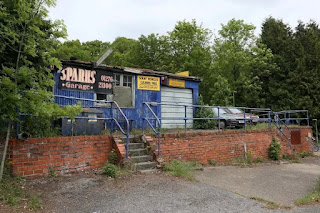
I had been pressganged into their joint enterprise to calculate the potential ‘return on investment’ of their projects, using my O-level maths studies to amortise the costs over varying numbers of years. One such development site was an anachronistic one-pump petrol station and car repair workshop that occupied a valuable rectangular plot on the busy London Road at Maultway North between Camberley and Bagshot. Owner John Sparks had inherited the business in 1966 upon the death of his father Arthur, though neither had updated its blue corrugated iron shack since 1926 when Arthur’s mother had purchased this large corner plot from the adjacent secondary school sportsground for her son to launch his one-man business.

Once I had calculated the viability of replacing the ramshackle building with flats, including the cost of removing the underground petrol tank and cleansing the polluted soil, the project was determined a ‘go’. However, we had not reckoned on Sparks’ stubborn refusal to sell. Beaver visited him. My father visited him. The Beaver sons visited him. Sparks remained intransigent. Their ‘persuasion’ techniques were evidently not working. Beaver purchased the Jolly Farmer pub on the roundabout opposite the Sparks site. One night it suffered a large unexplained fire. Sparks still refused to sell. In the end, the project had to be abandoned.

Like my mother, I was less in thrall of Beaver’s ‘entrepreneurship’ style than was my wide-eyed father, so the end of our disastrous two-week holiday in Spain and our farewells to his oversized villa came as a welcomed relief. On the flight home, I was seated next to larger-than-life Trinidadian bandleader Edmundo Ross. Despite already loving reggae and Brazilian music, my youthful snobbery regarded Ross as old-school due to his regularity on ‘BBC Radio 2’. Unaware of his fascinating life, I now regret not having chatted with him more.

A short time after our return to Britain, my father left us permanently to set up a new home with a teenage girl only a few years older than me. Our Spanish holiday seemed to have proven his last straw playing ‘happy families’. Children just got in his way. I had no further contact with the Beaver family … and I disowned my father.

In 1986, Tesco and Marks & Spencer jointly purchased a huge 76-acre site on the western fringe of Camberley to build two massive superstores (‘The Meadows’). The adjacent four-acre site, bounded by the London Road, Laundry Lane and Tank Road housed Bill Beaver’s open-air vehicle sales operation and was necessary to developers for a revised traffic flow system that included a new Sainsbury’s Homebase superstore. This plot on the far edge of town had suddenly become Camberley’s most valuable piece of land … to the benefit of its wily owner.

In 1990, John Sparks applied to Surrey Heath council for permission to build a bungalow (for his retirement?) on empty land at the back of his one-man garage. It was granted but never built. In 2014, seventy-eight-year-old Sparks retired, closed his business and sold the land to developer North Maultway Limited which demolished the workshop to build ten flats, for which planning permission was approved the following year. By 2017, the land had been sold to Seville Developments Limited which reapplied for planning permission to build nine flats. Two years later, this permission expired … leaving the former ‘Sparks Garage’ site derelict to this day.

[Originally published at https://peoplelikeyoudontworkinradio.blogspot.com/2023/08/give-them-foot-and-theyll-take-metre.html]

From Russia with lawlessness : 1994 : Metromedia, Park Place, Moscow

 “I am a paediatric doctor,” said the young woman cleaning the toilet bowl in the bathroom of my apartment. “I work at the hospital during the day but I cannot live on my salary, so I have to work as a cleaner every evening.”

I was embarrassed. Although the doctor had been cleaning my apartment nightly, this was the first occasion I had attempted to strike up a conversation. I had mistakenly presumed that my ‘cleaner’ spoke no English. How wrong I was! Maybe she assumed I was a snobby American corporate manager who had just been posted overseas. How wrong she was! I was an unemployed Brit forced to take some freelance radio consulting work abroad, having failed to secure a job in my own backyard. Both of us were having to do what we did to survive.

I felt disorientated here. It was my first time in Russia. I would never have chosen to work here. But it could have been worse. My client, American public corporation Metromedia, had initially told me my destination was to be Nizhny Novgorod. I had had to consult a map to even locate that industrial city on the Volga. Thankfully, instead, I was sent to cosmopolitan Moscow. But looks are deceiving. My surroundings gave the semblance of a modern city but almost nothing actually worked as it should. Here was an incomplete facsimile of Western capitalist infrastructure in which the Soviet state had copied the designs without implementing the mechanisms. It recalled the era when a ‘Made in China’ label was a surefire guarantee a product that might look good would quickly fail.

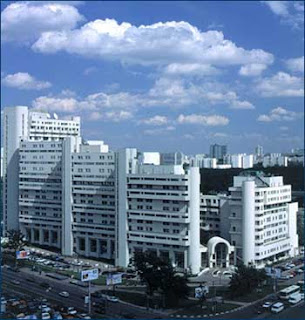
My one-bedroom apartment appeared quite luxurious, about three times the size of my poky second-floor flat in London, with floor-to-ceiling glass windows on an upper floor that looked out over the permanent pollution rising from Moscow’s busy streets. It was inside a huge, newly built trio of linked office blocks containing office spaces and 330 apartments intended for foreign businesses that required a secure location 14 kilometres from the Kremlin. It was like living in one of those vast complexes portrayed in American movies about the self-destructive life of a harassed corporate ‘road warrior’. Maybe it was designed to offer ex-pats that kind of bland fictional familiarity.

In January 1994, Metromedia had bought one of the least popular FM radio stations in Moscow, planning to turn it into one of the most popular. There was a hitch. The Americans were baffled by the radio market not just in Russia, but in the whole of Europe. They could hear 30+ stations broadcasting in Moscow but they could not fathom what they were doing on-air. This was not simply a language problem. It was a challenge because Americans were accustomed to tightly defined music or speech broadcasters in their commercial radio system. You only had to listen to the vast majority of American radio stations for around ten minutes to recognise their ‘format’. Europe was not like that, largely because ‘public service broadcasting’ had been legislated as the bedrock of its broadcast systems since the invention of radio.

Before my flight to Moscow, I had purchased a Sony all-band radio from an electronics shop in Watford for almost £100. It was now put to service all day while I listened hour after hour to a particular Moscow radio station, writing notes about the music played, the talk, the advertisements, the jingles and anything else I heard. I was used to listening to radio stations in languages of which I had no comprehension, having spent so many weekend nights as a schoolboy DX-ing radio stations from all over the world on a Trio 9R59DS radio receiver. I had also analysed local radio markets in the UK for groups applying for new licences, monitoring existing stations’ broadcasts and tabulating the results. It might be boring work but at least I was being paid to do it!

One morning I received an email requesting my presence at an important staff meeting to be held in the Metromedia office within Park Place. This surprised me for several reasons: I was not an employee, I had never previously been invited to such a meeting in Moscow and, most astonishingly, nobody had told me that Metromedia even had an office within the same building where I was living. I had to call the phone number on the message to ask where precisely this office was located within the complex.

After spending so many days alone in the apartment listening to my radio and writing copious observations, it was an adventure to walk through the building’s labyrinth of anonymous floors and numbered doors to eventually locate and knock on the Metromedia office. After weeks of perpetual solitude, it felt like coming out of prison to be greeted by a surprise party. The room was full of Americans of whom I had never been aware, let alone met, all chatting away noisily. None of them had the faintest idea who I was, requiring my explanation that I too had received THE email. They were very welcoming in the American way, despite probably wondering why on earth this unknown, scraggy Englishman was present.

The meeting started soberly with an update on Metromedia’s progress attracting paying subscribers to its broadcast television service ‘Kosmos TV’ and mobile phone system it had apparently launched in 1991 in partnership with the state’s ‘Moscow Television & Transmitter Centre’. I had no idea that Metromedia had been operating in Moscow several years already and had been investing around US$5m annually in that particular joint venture business. The good news was its success in building a growing subscriber base. However, the reason for this meeting was the bad news that the Russian who had been appointed manager of the business had just disappeared with all its funds and had proven untraceable. There were long faces. Oh dear.

Welcoming the variation from my usual lonely routine, I spent the remainder of that day in the office chatting with some of my newly discovered Metromedia colleagues. At that stage, it seemed unclear whether the television business could continue and whether the office would even remain in operation. I met the corporation’s financial analyst Muema Lombe who shared my interest in pirate radio and he generously introduced me to the basics of Excel, the software that has been the mainstay of my analysis work ever since. We remain close friends since that chance introduction in Moscow.

On the way back to my apartment, I called in at the ‘Garden Ring Irish Supermarket’ in the Park Place lobby to buy my regular supplies. It was a smaller satellite branch of the bigger shop in the city centre that had opened in 1992. I was surviving on breakfast cereal, milk, bananas, tea and snacks, particularly American ‘Oreo’ cookies which I had never seen before. There was no cooking equipment in the apartment beyond a kettle, probably to encourage residents to eat in the complex’s vastly overpriced restaurant. Lacking a corporate expense account, I only ate there when my American line manager John Catlett was in Moscow, enduring hour-long waits to be served the simplest meals.

Although the Park Place shop’s range of food was limited, it felt too dangerous to shop outside as a foreigner. Russians bought provisions at kiosks where they could ask for the items they wanted, whereas foreigners like me had to frequent self-serve retailers where they became easily identifiable targets. In 1993, more than 7,000 crimes against foreigners had been reported in Russia, including the editor of the English-language ‘Moscow Times’ newspaper who had been robbed of cash and a laptop by men with knives outside the city centre’s Garden Ring Irish Supermarket. I had watched a ‘CNN’ report that Russia’s murder rate was three times higher than the United States’ and was only surpassed by South Africa.

Due to its success attracting foreign customers, the Irish Supermarket itself soon became a target. After its owners resisted a takeover by their Russian partner Dmitry Kishiev, there were reports of an alleged overnight explosion at its city centre store. The ‘Moscow Times’ reported: “Apparently fearing for their safety, the Irish partners then fled the country, urging their more than two-dozen expatriate employees to do likewise.”

Once Russians took over the ‘Irish’ supermarket, I noticed food on sale in Park Place marked with long gone expiry dates, the prices increased, customers deserted and eventually the shops closed altogether. Like everything else in Russia, ‘business’ was not considered a product of entrepreneurial spirit or managerial prowess. Instead, it was considered a lucky lottery ticket permitting almost anyone lacking relevant skills to intimidate, bully and exert power to enrich themselves over others.

Russia during the 1990’s was frequently referred to as the ‘Wild West’. There was a sense that just about anything you could imagine might happen there … and it frequently did. My corporate apartment felt like a haven of relative ‘normality’ within a crazed parallel universe. I cannot recall anyone being murdered at Park Place during my initial stay, unlike subsequent visits to Russia when I was given accommodation in hotels of variable quality and security. Never did I value boring old Britain so much as the days I would thankfully walk on the tarmac of Heathrow airport after yet another prolonged stay in Russia.

“A powerful bomb blast in the city’s centre on Saturday afternoon took the life of a Moscow student. The bomb which, according to police, had power equivalent to approximately 400 grams of TNT, had been placed inside a large metal dumpster on ul Bolshaya Spasskaya not far from Leningradsky train station. According to eyewitnesses, at the time of the blast, the 23-year-old female student of farming was walking by the dumpster. The strength of the explosion tore off one of her arms and blew out most of the windows in neighbouring buildings … Witnesses reported that just a few moments before the blast, several men had tried forcibly to enter a building next to where the explosion took place, but that after a doorman refused to let them enter the building, they threw a package into the dumpster.”

Small story on PAGE SEVEN of the ‘Moscow Tribune’, 30 January 1996

[Originally published at https://peoplelikeyoudontworkinradio.blogspot.com/2023/07/from-russia-with-lawlessness-1994.html]

The invisible manager : 1993 : Bud Stiker, Radio Juventus, Hungary

 Nazi soldiers were everywhere. Battalions of Nazis marching down wide boulevards. Nazis standing on convoys of tanks, waving flags. Row upon row of Nazis saluting speeches by their leader. Nazis fighting on battlefields. It was exhausting to watch for too long and nothing like ‘Indiana Jones’. In fact, it was a little bit frightening.

I had viewed so many hours of ‘MTV’ that I knew Stina Nordenstam’s song ‘Little Star’ by heart. Seeking alternative entertainment, I manually retuned the hotel room’s television and was shocked to discover a grainy black-and-white channel that was broadcasting Nazi propaganda twenty-four hours a day. I was like Dennis Quaid in the movie ‘Frequency’, pulling signals from the ether transmitted several decades earlier. This bizarre television service must have been a sideshow of the civil war raging on European soil only a hundred miles from my present location, atop a Budapest hill 479 metres above sea level.

My life under ‘hotel arrest’ was proving extremely tedious. To be accurate, I could leave any time I wished but my accommodation was hardly ‘Hotel California’. I was stranded alone, five miles from the city centre in countryside popular for walking holidays in summer but dead as a dodo mid-winter. No buses, no taxis, no shops, no mobile phone, no laptop, no internet access. It felt like sensory deprivation to be cooped up in a hotel room for days with absolutely nothing to do. My sole consolation was that I would be charging the client my daily rate.

My task had been to interview each of the staff of tiny ‘Radio Juventus’ in Siófok to determine their role, their skills and their future potential. The station had been launched in 1989 by a local newspaper to serve German tourists who summered at Lake Balaton. It was about to be acquired by American public corporation Metromedia, owned by billionaire John Kluge, and I had been hired to discover precisely what he was buying and to plan its transformation into Hungary’s first national commercial radio station. I had completed a fortnight’s work when…

Three soldiers in military uniform suddenly burst into the underground bunker where I was installing computer programmes, talking loudly and waving around their guns. I was surprised but not initially alarmed as I knew they guarded the gate of the compound. Every day it took them ten minutes to inspect and approve my passport before they would let me enter. Maybe today they were simply bored. However, events quickly turned nasty when station staff translated the soldiers’ demands into basic English:

“They say: ‘you must go.’ They say: ‘go now and no stop.’”

Sorry? They mean me? But I work here! I am just doing my job! The staff were adamant. The soldiers had received orders. All foreigners (which meant only me) had to leave the compound immediately. I asked if I could telephone Metromedia’s office, a one-hour drive away in Budapest. While the soldiers glared at me, seemingly eager to make an arrest, the phone just rang and rang and rang. Where was the office secretary? In her absence, there was usually an answering machine on the end of the line. But now there was nothing.

I collected my belongings and the soldiers escorted me up the narrow stairs and out of the building. The bright sunlight made my eyes squint but the fresh air was invigorating. The bunker housing the radio station received no natural light, no fresh air and was always thick with cigarette smoke. Dust lay everywhere because it had served as an underground coal store during Soviet times. The soldiers stood in a line, holding their guns menacingly, and watched as I searched for my car keys. Above us loomed huge transmitter masts that the Soviets had built during the Cold War to jam broadcasts from West European radio stations. I drove the car slowly out of the compound and gave a friendly wave to the soldiers as I passed their checkpoint. They did not respond. In the rearview mirror, I saw them lock the gates behind me and put down their guns. This must have been the most action they had seen in months.

An hour later, I was sat in the Budapest ‘office’ of Metromedia, in reality a converted bedroom within the Normafa Hotel owned by the Americans’ Hungarian business partner György Wossala. There was no sign of Bud Stiker, imported from Maine to manage this operation. No sign either of his harassed Hungarian secretary. I called Stiker’s mobile phone but it was switched off. The remainder of the afternoon, I stayed in the office but nobody came. The office phone rang regularly, which I had to ignore as I spoke no Hungarian. It had been a baffling day. I returned to my room, watched MTV and fell asleep to the sounds of loud revelry in the hotel grounds.

The next morning, I was eating breakfast in the hotel’s deserted dining room when Wossala appeared, so I asked if he knew what was happening with his American business partner. He was evasive and wanted only to talk about the wedding party that had hired his hotel the previous evening for a huge banquet and, when presented with their invoice, had drawn guns on his staff, then fled in their fleet of Mercedes.

“This is not good business,” he suggested to me.

I sat in the office again. Nothing happened until late afternoon when the secretary finally appeared, looking flustered. She had been trying to find Stiker the last two days, visiting downtown bars he was known to frequent.

“Everybody is looking for him,” she told me, “but he has just – pouf – disappeared.”

Stiker had worked for Metromedia in the 1980’s, managing radio stations in Colorado and Maryland. Prior to his arrival in Budapest, he had been executive vice president of Bonneville Broadcasting System, the US radio network owned by the Church of Jesus Christ of Latter-day Saints. I recognised that Stiker would understandably be unfamiliar with the European radio industry, probably the reason I had been hired as consultant. More puzzlingly, he appeared somewhat uninterested in visiting the business Metromedia was acquiring in Hungary, meeting the staff he was nominally managing, or creating a plan to transform the radio station … all of which was delegated to me, leaving him ‘hands off’.

Stiker’s mobile phone remained switched off and we found he had left no information about his whereabouts. The secretary checked with the hotel which confirmed he had not returned to his bedroom for two days. We were both totally confused.

The next day, the secretary arrived for work and told me she was quitting her job. She had checked her bank account and found that her wages had not been paid. Neither had the expenses she had rung up on behalf of Metromedia. I helped her carry the contents of her desk to her car outside. It did not seem to matter anymore whether the office items she was taking really belonged to her or to her former employer. I was on my own now and starting to get a little worried.

The next day, Wossala told me he was repossessing Metromedia’s office to convert back into a hotel room, despite the fact that I had observed no more than five guests staying in his hotel that mid-winter. He insisted I return the keys of the tiny Hungarian car I had been using to drive to the radio station, as he claimed it belonged to the hotel rather than Metromedia. That left me completely stranded.

My anxiety intensified the next morning when I found a hotel bill had been slipped under my door during the night, demanding I pay for my stay immediately, an expense that should have been taken care of by Metromedia. I told Wossala (truthfully) that I did not have sufficient funds to pay his bill, and neither could I change the date of my charter flight back to London, still several weeks away. The situation turned into a stalemate – he grudgingly let me continue my stay in his near-empty hotel, but now refused to serve me further meals.

I had to find food. I walked out of the hotel and turned left. There was nothing but a miniature railway, closed in winter, that would take hikers further into the forest hills. I walked back the opposite direction. About a mile from the hotel was a tiny roadside kiosk where I would point to dry biscuits, cola drinks and imported chocolate bars that I purchased with the limited amount of local currency I had previously changed. I had to eke out this basic diet the rest of the week.

Ten days after his disappearance, Bud Stiker suddenly reemerged at the hotel. Amazingly, he had almost nothing to say about his sudden absence. He barely apologised for the inconvenience he had caused me and explained only that he had been “attending to important business” elsewhere. He said that there had been a “misunderstanding” between Metromedia and its Hungarian partner. I was more shocked by his lack of candour than I was by my treatment at the hands of the Hungarian soldiers ten days earlier. I half-heartedly completed my work and counted off the remaining days longingly until I could fly home.

Back in London, I wrote and submitted my report. Stiker queried my invoice, claiming I was overcharging because he believed the rate we had agreed was ‘per month’ rather than ‘per week.’ I found insulting his attempt to cut my fee by 75%, particularly after the experience I had just endured in Budapest. It seemed a bit rich coming from one of Metromedia’s old-timers whom my colleagues later alleged were being offered US$1,000,000 per year to manage one of its newly acquired stations in Europe as a kind of pre-retirement reward for earlier corporate loyalty (Metromedia had sold all of its 27 US radio stations by 1986). I resisted vociferously and was eventually paid in full. I hoped for more consulting work like this, though I wished Metromedia would not assign me to Stiker again … but it did.

That bleak winter month spent in a Budapest hotel room, watching ‘Nazi TV’, was the closest I had come to a war zone and the scary propaganda it produced.

[Originally published at https://peoplelikeyoudontworkinradio.blogspot.com/2023/06/the-invisible-manager-1993-bud-stiker.html]

My life as a seadog : 1985 : The Voice of Peace, Tel Aviv

 The prostitute was perched on the edge of my bed. Using the elementary Hebrew I had learned from children’s television, we chatted about her young daughter and the disastrous economic situation in Israel (inflation nearing 1,000%) that had forced her into this profession. I had been asleep in bed when the room door had opened, the light was abruptly turned on and I opened my tired eyes to see a ‘Little & Large’ couple framed in the doorway. Having ordered her client to take a shower before starting ‘work’, she had ample time for a conversation with me.

Was this another chapter of my punishment, to share a hotel room with a fat drunken Dutch sailor whose mission was evidently a missionary position in every port? I had come ashore after spending a week of nights sat alone on the ship’s bridge as ‘lookout’, tossed from side to side by the stormy Mediterranean. This was the sentence handed down by a Dutch captain angered by my point-blank refusal to enter the anchor chain locker alone and clean it of seabed debris. I cared not a jot that other DJs on board had accepted his prior orders to execute this task. I was adamant that I had not signed up as a seaman. I was there as a radio DJ. Neither the captain nor his crew had ever been required to assist us in the radio studios, so why was I expected to take on ship duties? Besides which, I suffered from claustrophobia.

Well, how did I get here? I had spent 1984 living at my mother’s house, unemployed and submitting applications for every UK radio production job I could find, none of which proved successful. All I had been offered was a six-month contract to work as a volunteer DJ on pirate radio station ‘The Voice of Peace’ in Israel. I promised myself that, if no proper job turned up by year-end, I would pursue this as a last resort. That was why, in the New Year, I was on a flight to Tel Aviv with two suitcases. It was sheer desperation. I had to convince myself that ‘doing radio’, almost any sort of radio, would be better for my career than trying to get work in radio but failing.

The deal on offer was that, for each month’s work on board the ship, I would receive US$100 in cash and be granted one week’s shore leave in paid Tel Aviv hotel accommodation. However, the seas proved too rough for crew transfers during my first three months on board, depriving me of returning my feet to land until April. It was particularly frustrating during that period to be able to clearly see the twinkling lights of Tel Aviv city at night from the ship but to have only spent a few hours there between my airport arrival and having been ferried on board.

The only ship I had experienced before was a cross-Channel ferry, so my first few weeks were spent being seasick and adjusting to the meals served by amiable cook Radha who professed he had pretended to be a chef to land this job. Initially there were plenty of DJs on board and my shifts presenting on-air were reasonable. However, as the months went on, most of my colleagues either completed their six months or quit early and were not replaced. There were occasions when I was required to present programmes for more than twelve hours a day when our number was reduced to two. I consoled myself that, detained in a floating prison, it was better to be kept occupied than to spend time reflecting on the notion of freedom.

Nominally in charge of the station’s programmes on the ship was the genial Daevid Fortune who, I seem to recall, had previously worked on Twickenham AM pirate ‘Radio Sovereign’, a station that had existed for eight months in 1983 playing only oldies. At the ripe age of twenty-seven, I was older than most of my colleagues and more experienced, having previously worked full-time for UK commercial local stationMetro Radio’ not only as a presenter but as a manager who had implemented an innovative playlist system to reverse its dwindling audience. However, within the ship’s radio team, I maintained a low profile as there was no incentive to propose improvements or seek additional responsibilities without decent compensation.

The many hours of off-air boredom were relieved by listening to previously unheard stations from Lebanon, Cyprus and Egypt. There was a television room on-deck where I would watch the afternoon post-war American movie of the day on Jordan TV. I would write letters to my thirteen-year-old sister back in the UK. I would read cover-to-cover all the English-language music magazines, including heavyweight weekly ‘Billboard’, that we received. I would comb the small record library and listen to previously unheard discs in the second production studio. Once the weather became calmer in the summer, it was an idyllic existence to live without day-to-day responsibilities. My hair grew longer than it had ever been, my skin turned dark brown and my body became even thinner as a result of seasickness and Radha’s meals.

The station’s Persian founder and owner, Abie Nathan, was a peace activist who had been making grand publicity-seeking gestures in Israel to promote his cause since the 1960’s. He bought the ship second-hand in 1973, allegedly with the financial assistance of John Lennon, and had installed the radio broadcasting equipment. However, after more than a decade continuously anchored a few kilometres off Tel Aviv, the ship and its facilities had seen better days by the time I arrived.

Like many station owners, Nathan was given to flights of fancy, calling up on ship-to-shore radio to demand airtime for content that interrupted our on-air routines. During my stint, Nathan hired a duo of British ‘radio consultants’ to improve the station. Their big idea was to split the station into two different services on FM and AM during certain dayparts, requiring both studios to be used simultaneously for live programmes. This proved not such a practical idea when the station was so regularly short-staffed. I was allocated the evening FM show, for which I used Steely Dan’s ‘FM’ track as theme music and selected soft rock songs. I was rewarded with a letter from a listener in Finland who had heard my show and sent me a cassette recording postmarked the following day to prove it (remember this was pre-internet).

If there was one lesson I learned from my six months at sea, it was the first occasion I had worked with self-styled ‘radio consultants’ who seemed to talk endlessly about their successes, obviously possessed the gift of the gab, but who were revealed as less knowledgeable than they might appear. In those pre-digital times, I was surprised to be the person on-board who was asked to explain which of a quarter-inch reel-to-reel tape machine’s three heads has to be used for marking up edits. In future years, I was to meet more ‘consultants’ who promised to deliver radio ‘success’ but who seemed to lack the requisite skills to achieve anything more than talking about it.

My experience presenting programmes for hours every day on-air confirmed my thinking that being a DJ was not my ambition in radio. I was told I possessed a good ‘radio voice’, I could operate the equipment and loved playing music, but I much preferred a production role in which I could contribute creatively beyond just opening my mouth. One of the most enjoyable programmes I created on ‘The Voice of Peace’ was a ‘special’ to mark the twenty-fifth anniversary of the Sharpeville Massacre with a selection of pertinent African and American music. I wish I had put a cassette in the studio tape machine to record it!

After having been denied shore leave during my first three months, I now had to endure an hour of bonking noises from the second bed on the other side of our small shared hotel room until the lady of the night slipped away, leaving the seaman to snore loudly until daylight. The hotel turfed us out during daytime, so I regularly retreated to the nearby White House café where office staff, hangers on and the station’s most loyal listeners would sit at a roadside patio table and chat ‘radio’. I came to love Tel Aviv during my total three weeks of shore leave … despite the ongoing war, the terrible economy and random acts of terrorism.

Once my six months were completed, I visited the station’s Tel Aviv office to collect my final wages. I reminded Abie Nathan that I had worked an additional three weeks beyond my contract as a result of having been denied shore leave during my first three months on board. Would he pay me an additional US$75? He adamantly refused. Unlike some of my DJ colleagues, I harboured no intention of returning for a further six-month stint. Rather, I never wanted to work or live on a ship again. Surely there must be a radio job I could secure that did not necessitate me being sick in a bucket after eating unidentifiable meals.

In 1993, I was working in East Europe when I read that the ‘Voice of Peace’ ship had been deliberately scuttled at sea by its owner after two decades’ broadcasts, the final day having comprised non-stop Beatles songs. I have never mustered the enthusiasm to attend subsequent ‘offshore radio’ nostalgia events but my experience of Israel left an indelible mark on me. Pass the halva!

[Originally published at https://peoplelikeyoudontworkinradio.blogspot.com/2023/06/my-life-as-seadog-1985-voice-of-peace.html]

This is your early morning trunk call : 2004 : BBC World Service Trust, Cambodia

[Malene, BBC World Service Trust, Phnom Penh, 2004]

 I pull back the bedroom curtains and, from my window, see a huge elephant ambling along the promenade above the Mekong River. I know it must be 6:30 a.m. Every day at this time Sam Bo, the only elephant in Phnom Penh, walks to his day-job giving rides to children around the base of the city’s only hill. The street beside him is already filled with rush-hour traffic, since most shops and offices open daily at seven. Weaving in and out between huge chrome-clad and tinted windscreen four-by-fours driven by NGO staff and government officials are hundreds of motorbikes, which have totally replaced the humble bicycle as Cambodians’ preferred mode of transport. If there is a Highway Code, nobody seems to have read it. Confusingly, traffic travels in both directions on both sides of the road and often on the pavement too.

You see young schoolchildren riding motorbikes to school, and parents carrying three or four children precariously on a single bike. I have seen a motorbike carrying a full-size palm tree, another loaded with an iron girder which could easily have decapitated someone, and a bike carrying three dogs, one of which had its paws on the handlebars. Few people wear crash helmets, but most wear surgical masks (available in various colours from market stalls) to keep the dust, pollution and bugs out of their mouth and nose. Phnom Penh is the L.A. of Asia – nobody walks. What were once pavements are now clogged with parked cars, row upon row of parked bikes, impromptu shops, and families sat on plastic patio chairs selling petrol in old soft drink bottles from the kerb. The few people who walk around this city – the very poor and foreigners – are forced to negotiate the gutter, where we risk being hit by bikes coming at us from all directions.

In the morning, I work at the Women’s Media Centre of Cambodia where I am training four enthusiastic staff to produce a youth phone-in show that launches in May. They are very excited that the Centre has just been nominated for this year’s One World Broadcasting Trust Special Award for Development Media. The team share an office in the Centre which they have proudly designated the ‘BBC Office’, even though they are not BBC staff. The only drawback to working in this beautifully airy, purpose-built broadcast centre is that we are shadowed by a massive transmitter mast in the car park that broadcasts the Centre’s radio station ‘FM 102’ to 60% of Cambodia’s population. Although the custom is to remove one’s shoes before entering the building, staff have to don flip-flops to use electrical equipment such as the photocopier, or risk electrocution from the mast’s 10kW electrical field (as I found out to my peril).

At lunchtime, almost everyone goes home for a two-hour siesta that offers slight relief from the constant 35-degree daytime heat. I take lunch at the real BBC office – a villa whose walled garden includes luscious banana and mango trees – with the handful of the thirty local staff who live too far away to return home. Malene, one of two BBC housekeepers, purchases our food from the plethora of nearby pavement snack stalls, according to our culinary preferences, at a cost of less than a dollar each. Dishes are always accompanied by boiled rice or noodles, though Malene once glowed with pride when she presented me with a plate of chips procured from who knows where.

After a productive afternoon working at the Women’s Media Centre, I walk home past a school when a girl, aged about eleven and dressed in regulation white blouse and navy skirt, rushes out of the school gates, runs across the road and, without a hint of self-consciousness, starts a conversation with me in perfect English. After a minute, she sees a motorbike taxi stop outside her school gates, bids me farewell, jumps on the back (side-saddle, as is customary for girls) and waves goodbye as she disappears down the street. She inspires confidence that the future of this country will be bright in her generation’s hands.

[First published in ‘Ariel’, 11 May 2004, p.3]

[Originally published at https://peoplelikeyoudontworkinradio.blogspot.com/2023/04/this-is-your-early-morning-trunk-call.html]