Attempted murder on the Waterloo express? : 1971 : Bagshot railway station

 Kapow! There was an explosion. Before I even grasped what had just happened, I could see I was covered with shards of glass. What was that noise? The train window I was sat next to had suddenly vanished and was in pieces on me and the seat. Luckily, I had not been looking towards the window at the time, otherwise my face would have been injured. Luckily, because it was winter, I was wearing an army surplus hat with furry earflaps that had protected my head and ears. Luckily, I was wearing a coat over my school blazer, gloves and long trousers that had shielded me, these winter woollies necessary because trains’ heating systems rarely functioned adequately.

I caught the ten-past-eight number 28 train every day for seven years from Camberley station to my school half-an-hour away in Egham. It was part of a commuter route propelling workers on the one-hour journey into London’s busy Waterloo terminus. Travelling to school this way felt like stepping into Narnia through the wardrobe door of our suburban British Rail station. Journeys were populated by strange characters not present in my normal day-to-day homelife. The station platform was awash with bowler-hatted, suited gentlemen carrying leather briefcases and rolled-up umbrellas. Women were a rare sight. Humourless station staff in uniforms shouted announcements about delays in the tone of army drill sergeants. Bumptious Terry-Thomas ticket inspectors walked through train carriages, looking down their noses at our thick green cardboard season tickets as if we were interlopers on their Orient Express.

At least the trains on our line were relatively modern electric rolling stock. As a small child, I recall standing at the top of the open footbridge over Camberley station, looking down at the signal box beside the level crossing and feeling clouds of smoke envelope me from a steam train passing underneath. Or was that a ‘Railway Children’-inspired false memory, acquired from reminiscences by my grandfather who had worked unloading timber for local building firm ‘Dolton, Bournes & Dolton’ in the goods yard beside the station? He had been made redundant in the early 1960’s for the yard to be replaced by a new ring road and Camberley ‘bus station’, in reality no more than a line of bus stops and tiny shelters without a waiting room. After my afternoon arrival in Camberley by train to await the hourly 39B (40 minutes past every hour) or two-hourly 34A bus (15 minutes past even hours) for the final two-mile journey home, I would have to walk over to the railway station lobby and sit opposite the ticket window to keep warm and dry.

My schoolfriends and I were the Pevensie children of Camberley, rendezvousing every morning at the very rear of the station’s eastbound platform that could accommodate only four carriages, despite our train normally being eight. When the train driver pulled up close to the signal at the top of the platform, we could just about clamber up to open the first door of the fifth carriage from the platform’s sloping end. Those rear four carriages became our playground because, until the train reached Ascot station’s longer platform, we had that section entirely to ourselves. No other passengers, no train staff. We could be as loud and unruly as we wanted. We would walk down the corridor to sit at the very rear of the train because, eventually alighting at Egham station’s full-length platform, we would be right next to the exit gate.
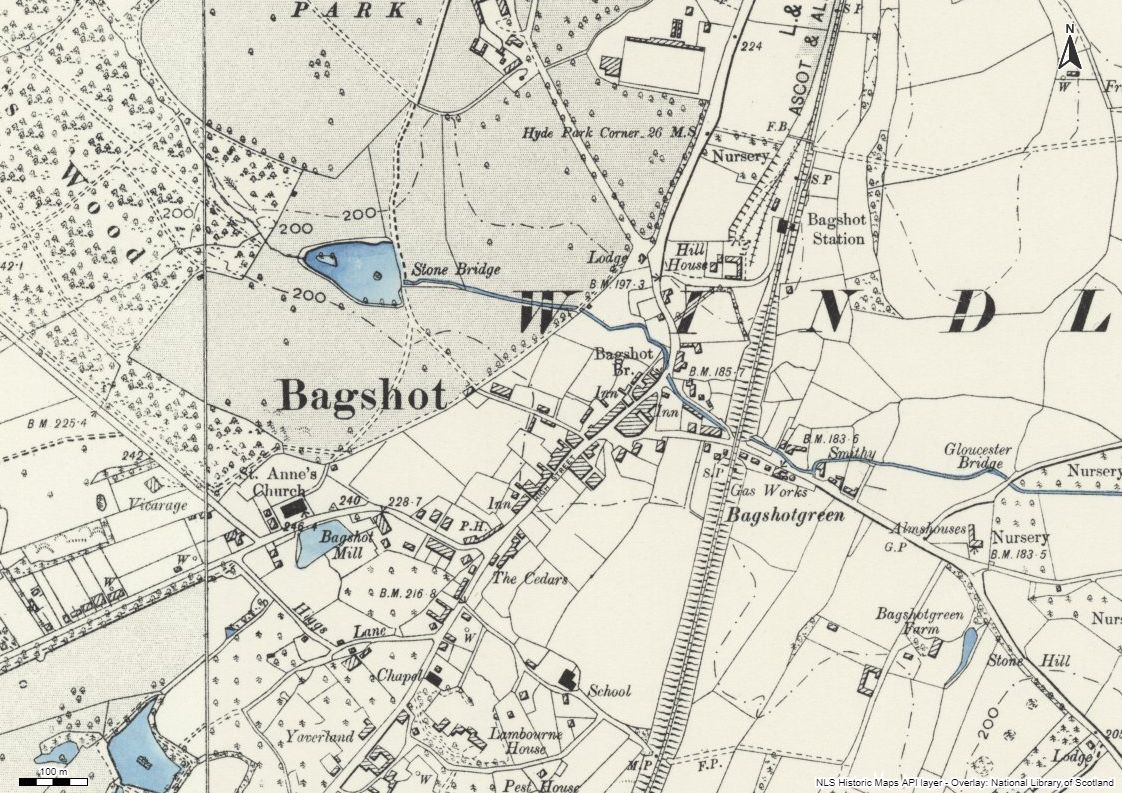
When the incident happened that morning, the train had slowed down to pull into Bagshot station and was about to cross the Guildford Road viaduct, a massively tall structure of four arches built in 1878. On either side of this bridge carrying dual train tracks were high embankments with steep, near vertical sides. On the north side, below the railway, was a vast tract of land owned by ‘Waterers Nurseries’ since 1829 to grow and sell plants. Before reaching that was Bagshot Infant School, set back from the embankment, on School Lane that ended in a footpath passing under the embankment towards Bagshot Green farm on the south side. At the time, undeveloped land stretched on both sides and (unlike now) the embankment was not bordered by trees.

Could a person have thrown a stone from the north side to make the train window next to me shatter? Unlikely because the embankment on which the train passed was too steep to stand upon. If the culprit had stood further away, below the embankment, a rock could not have reached the height necessary to make contact with the train, nor would it have retained sufficient momentum to smash the window with enough force for it to have not merely cracked, but to have shattered in its entirety.

What kind of projectile could have caused such damage? A powerful gun of some kind could have generated the necessary velocity and momentum for its bullet to shatter the thick glass window. A gunman (or woman?) would have needed practiced skill to aim upwards from the land below the embankment, or possibly to have lain half-way up the embankment adjacent to the footpath (now ‘School Lane Field’). In either case, it would have required planning and experience to succeed in such a challenging topography next to the train route. Since only two trains per hour travelled in either direction, this act could not have been a spur-of-the-moment impulse.

Why was the window I had sat beside targeted? As the train decelerated to enter Bagshot station, the rear carriages would have passed at a slower speed, making them an easier moving target than the front ones. Us schoolboys were habitually the only passengers anywhere in those rear four carriages, making my head the one visible sign of on-board life amongst dozens of otherwise empty train windows. That implies that my window must have been purposefully selected as the intended target. It was a dark winter morning and the internal carriage lighting would have made my outline visible from outside the train.

So where did the bullet land? Only one thing was certain: it had not hit me, otherwise I would not be here to tell the tale. Did we look to see if a bullet had passed over my head and become embedded in the carriage’s structure? No. In that pre-‘CSI’ era, forensic science remained an unknown foreign land. From watching weekly television detective shows, all we understood was that ‘McCloud’ cracked cases by riding his horse down Broadway, ‘Columbo’ used his raincoat and ‘McMillan’ solved crimes by getting into bed with sweatshirt-wearing wife Sally. In the aftermath, I had not even deduced that I had likely been targeted by somebody shooting a gun. That is how unworldly I must have been, though I had always enjoyed the pellet-gun target shooting stall at the fair’s bi-annual visits to Camberley Recreation Ground.

So how DID I react to this dramatic event? Did I scream? Cry? Sob uncontrollably? No, I simply stood up, brushed off the glass fragments that had covered me, and our little group moved to an adjoining carriage where the breeze through the vacant window would not make us feel colder. Even had we wanted to, there was nothing we could have done immediately. There were no train staff in those rear carriages and, once the train stopped in Bagshot station, its platform was too short to get out. Only once we reached Ascot was the platform long enough to deboard. So, did we? No, because if we had raised the alarm, we realised the fickle finger of fate might have pointed to us bunch of schoolboys for having broken the window. Which British Rail jobsworth would have believed our story that someone laying on a grassy knoll in Bagshot must have targeted me for assassination?

Leaving the train at Egham twenty-five minutes later, we could see the void where the window had exploded in front of our eyes. Nobody else seemed to have noticed the gaping hole or had bothered to halt the train to investigate. If they had, we might have arrived late for school that day. That would have been a fate worse than death. We had already brushed aside the incident and were more concerned with the school day ahead of us. Once I returned home that evening, I did not even bother mentioning to my parents what had happened. Only years later would I realise what a close call I had experienced that winter morning at the age of thirteen.

For us kids, trekking from one end of Surrey to the other every weekday on public transport, strange events would occur regularly in this otherworld. Our trains were sometimes cancelled, or rerouted through stations that were unknown to us, or suspended when someone jumped to their death off the footbridge at Egham station. In the latter case, some of us would watch morbidly for the arrival of emergency services whose crew had to scoop up the person’s bloodied remains spread along the tracks by a speeding train. Our unspoken attitude was: almost anything could happen on our way to and from school … and often did. It was a daily expedition into a world beyond ours, populated by weird adults to whom we appeared to be invisible.

Once a year, during ‘Royal Ascot’ week in June, our train would fill with bizarrely overdressed racegoers with strange toff accents and extremely loud voices who carried bottles of alcohol, swayed precariously and occasionally were sick on the carriage floor. They were much worse behaved than we had ever been, their conversations often ribald and filled with profanities. Did anyone chastise them, force them off the train or tell them to act respectfully in front of us children? Not at all! They did precisely what the upper classes are wont to do with their own children: they ignored us totally and appeared completely unembarrassed by their own behaviours.

I recalled the Bagshot train incident when, half a century later, I went for a run through rural France on a bright summer morning. There was no traffic and no visible human activity as I ran down the middle of a tarmacked road flanked on both sides by flat agricultural land. The only noise was birdsong until … a high velocity bullet whizzed above my head from left to right. I stopped running, turned in the direction from which it had come and shouted profanities (in English) at the top of my voice. Without my glasses, I was unable to see far enough into the distance to spot the culprit. This was no accident. I could not have been mistaken by a hunter for an animal. I was clearly visible on a ‘departmental’ road, not in the middle of woodland. But I had been the only object moving in this static landscape and that seemed sufficient to unwittingly make me a target.

If I were superstitious, I might be worried about ‘third time lucky’.

[Originally published at https://peoplelikeyoudontworkinradio.blogspot.com/2024/04/attempted-murder-on-waterloo-express.html ]

Around the British Rail network in eight hundred minutes : 1976 : Durham University challenge

 “Which bus goes to the University, please?” I asked. The man replied helpfully, but I could not understand a word he had said. He spoke English, though not an English I had heard before. I was confused by all the bus stops, having just exited Lancaster railway station. At which one did I need to wait? There was no bus map. There were no obvious students to ask. I had never been north of Luton until then. I had never watched ‘Coronation Street’. I was a southerner who barely understood a word that was being said to me there, hundreds of miles from home.

I had left the house that morning at the crack of dawn to make a day trip to check out Lancaster University. It was one of five universities I had selected on my UCCA form, all of which had offered me a place, conditional upon A-level results, without requesting an interview. However, if I was going to spend three years far away from home, I wanted to go see each one to help me choose. I had never visited a university before. Aside from my teachers, I had never met anyone who had attended university. That year, I hoped to be one of the 6% of school leavers who would go on to university, a proportion that had multiplied from 2% the year I had been born.

My state school had provided no useful advice how to choose a university or course. Our designated ‘careers counsellor’ was actually a moonlighting English teacher who would merely direct us to a row of dogeared university prospectuses on his office shelf. Some were out-of-date, many were missing. We were offered no ‘careers’ seminars. Surrey County Council had compelled each sixth-former to complete a multiple-choice questionnaire and then informed us for which career we were supposedly suited. Further studies were never suggested. You were on your own when it came to an academic future.

I understood that my choice of university could be a life-changing decision, one that required me to review the maximum amount of available information. If neither my family nor my school could provide useful advice, I would research all the options myself. I wrote a letter to every UK university outside London (where I realised accommodation was unaffordable), requesting their current prospectus and details of their economics courses. I chose that subject simply because it had provided my best academic results at school. I had known for a decade that I desired a career in ‘radio’, though university courses in media or broadcasting did not exist. If I had known then that Britain’s first ‘media studies’ degree had been launched at the Polytechnic of Central London (later renamed the University of Westminster) in 1975, I might have rethought my plans.

Seven years earlier, at my council estate junior school, I had been one of three children out of my class of thirty (10%) to have passed the ’11-Plus’ examination, necessary to progress to ‘grammar school’. However, at that time, around 20% of UK pupils attended these ‘selective’ secondary schools, the difference attributable to the substantial numbers of privately educated children who were crammed intensively at fee-paying ‘preparatory schools’ to pass the exam and who then dominated grammar schools’ intakes. From my ‘year’ of sixty students at Strode’s School, only around ten of us progressed to university, an indication that the ’11-Plus’ was less a successful method of identifying Britain’s brightest children, and more a route for middle-class parents to secure their offsprings an elitist secondary education paid for by the state. Has this situation since improved? In 2008, the Sutton Trust reported that grammar schools were enrolling “…half as many academically able children from disadvantaged backgrounds as they could do”.

I was fortunate that Surrey County Council would pay my train fares for visits to five universities, whether an interview was required or not. I had to determine when each institution offered ‘open days’, book my place, arrange train tickets and inform the school of my impending absence. It required considerable organisation, particularly as these visits necessitated train connections in London. These were days when I would not return home until almost midnight and would have to go to school the following day. I had never travelled so many miles on public transport or seen so much of England from a train window.

I must have been the only student at my school to own a copy at home of almost every UK university’s current prospectus. My request for economics course information proved less successful. Many sent me nothing, the remainder provided a single sheet outlining a course that merely encompassed all aspects of the subject. I read absolutely everything I was sent and concluded that every university claimed to be absolutely perfect and their courses the best. I had merely filled my bedroom bookshelf with marketing propaganda. Instead, I decided to select four universities that already operated student radio stations as this was my long-term career objective … plus Durham.

Although Durham University had no radio station, I learned it was apparently thought of highly. If I were rejected by Cambridge, I considered it might be a reputational substitute. Due to the 300-mile distance, my trip to Durham required an overnight stay in Collingwood College which was offered free to those attending ‘open days’. After a long train journey followed by an uphill walk, I was given an undergraduate bedroom within the college and met several other visitors who were there for the same reason. We took the university’s guided tours together the next day and ate as a group in the college’s dining room, offering us a first taste of undergraduate life.

The following morning, we packed our bags and met together for the thirty-minute walk to Durham railway station on the opposite side of town to catch our trains back to ‘the south’. However, we found the platforms deserted and, eventually locating a member of staff, we were told that a strike had started that morning and there were no trains departing in any direction. Returning to the college with our tails between our legs, we explained our problem and it kindly offered to extend its hospitality until we could depart. Each of us changed our banknotes into piles of ten-pence coins and queued at the college’s one public phone in the basement to contact our parents and schools to explain that we did not yet know when we could return. A quick visit had unexpectedly transformed into something longer.

I took the opportunity to wander around Durham’s compact town centre and explore more places, particularly the ‘Musicore’ record shop. The university library and the cathedral were both impressive, as was the brutalist concrete student union building ‘Dunelm House’ and adjoining ‘Kingsgate Bridge’ constructed by architect Ove Arup in 1963. The other universities I had visited were campus-based, requiring a bus journey to the nearest town. I quite liked Durham’s integration into the city and the ability to walk from one end to the other without need of transport.

The next morning, before breakfast in the college dining room, I phoned Durham railway station, to be informed that no trains would be running for the second consecutive day. This was the only method to obtain information in those days. I met the others and we phoned our families with our disappointing update. We spent most of that day sat together in the Junior Common Room chatting, sharing our university visit experiences and our hopes for the future. For me, it was particularly interesting to meet young people for the first time who shared my situation.

I made another call to the railway station the next morning, anticipating more bad news, but was told a single train was expected that day. It would be heading north, the opposite direction to what we required. I asked if there was any alternative route to London and it was explained that, although the east coast route was still on strike, we could try travelling via the west coast on the opposite side of the country. When was this one train expected? In an hour, I was told. Action stations!

I located my fellow visitors and, without taking breakfast, we all signed out of college and rushed off to the station. There was no information available there about the time of the train, on which platform it would arrive or where it would be heading. While we waited, we examined a British Rail route map in the ticket office which showed a cross-country route from east to west coast that started in Newcastle, the next major stop north of Durham. We were the only people awaiting a train and did wonder whether we had been sent on a wild goose chase, only to have to return to the college for yet another night.

Then the day’s promised one train appeared and pulled into the station. Unsurprisingly, it was almost empty. Who would have known it would be running in the midst of a crippling strike? We boarded and waved farewell to Durham, not knowing if any of us would ever return. Within a quarter-hour, we alighted in Newcastle. It was the first of many times that day that we were required to explain to confused railway staff that, although our tickets to London were dated days earlier, the unanticipated strike had forced us to take the only train available … in the opposite direction.

Next, to cross England to the west coast, we discovered we had to take a less regular, slower train that would depart in an hour. The wait gave us an opportunity to walk out of Newcastle railway station, buy some breakfast and wander around the city. Compared to Durham, it appeared a huge, busy scruffy city centre with huge Victorian stores and old-fashioned shopping arcades. Even the clothes people wore seemed dated and dowdy, particularly seeing many men wearing flat caps. It was an industrial city where time seemed to have stood still fifty years earlier.

Our ninety-minute journey in a local train from Newcastle to Carlisle took us across the bleak terrain of the North Pennine hills, stopping only at tiny towns with strange, unfamiliar names like Prudhoe, Corbridge, Hexham and Haltwhistle. Once again, we were required to explain to the train’s on-board ticket inspector why we were travelling in the wrong direction with out-of-date tickets. He knew about the strike and laughed heartily at our story, wishing us well on our journey home. It began to feel like a kind of ‘expedition’ where, at every step, it proved necessary to explain why our little group of seventeen-year-olds were taking a route no sane person would choose to follow.

The train terminated at Carlisle, a two-thousand-year-old city on the border between England and Scotland, fifty-five miles west and north of Durham. It was midday by now and, from there, we could now take a west coast ‘Intercity’ train southbound. We did not venture outside the station as this would have entailed having to explain our tickets once more and we feared not being allowed entry back into the station. This region was unaffected by the strike and trains seemed thankfully to be running as scheduled.

Our four-hour journey to London was comfortable until a ticket inspector arrived. We explained our story but he seemed unaware of the rail strike on the east coast and disbelieved our narrative. Initially, he demanded we pay for new tickets. We refused because we each held a valid, paid-for British Rail ticket that we had been prevented from using by the strike. The argument continued and he demanded we write down our names and addresses in order that the police could be contacted so that we would be fined for travelling without valid tickets. He was a ridiculous ‘jobsworthy’ who showed no sympathy for our plight. His attitude ruined the longest, most gruelling part of that day’s journey.

Reaching London’s Euston station, our small group split up to head different directions home. It was a sad parting of ways as we had no idea if we would ever see each other again or even which university each of us might attend (no social media or mobile phones then!). The last few days had required us to bond in the face of adversity, forcing us to make a round-Britain trip we had never imagined. It would be quite a story to tell our classmates.

I crossed London by Tube, caught a train from Waterloo station to Camberley and then a bus, reaching home more than twelve hours after having left Collingwood College in Durham. My school might not have been happy about my extended absence but, later that year, those awaydays would play a major role in my decision to study in Durham. I felt as if I was already sufficiently familiar with the college and the town as a result of that elongated visit. I imagined that my fellow Durham students would be similar to those with whom I had travelled the length and breadth of England.

Did I receive correspondence from British Rail or the police as a result of the unfriendly ticket inspector we had encountered? Thankfully, no. Did I ever see my newfound friends again? Sadly, no.

[Originally published at https://peoplelikeyoudontworkinradio.blogspot.com/2024/03/around-british-rail-network-in-eight.html ]