… and the award for car-crash Olympic flame live TV coverage goes to … : 2024 : La Premiere, French Guyana

 1995. The evening weatherwoman was standing in front of a wall map of the nation, reading the forecast for tomorrow’s conditions. In her hand were symbols for rain, sunshine and cloud that she went to place on relevant locations on the map. The icons remained there for no more than a few seconds before tumbling noisily to the floor. She bent down to pick them up and attempted once again to attach them to the map … with the same outcome. She soldiered on bravely until her script was completed in front of a wholly symbol-free map, then turned towards the camera with a weary farewell gaze that communicated: ‘why do I have to work with this rubbish technology?’

Was this ‘malfunction’ happening every evening on the Kenya government’s national television channel? I recognised her supposedly magnetic symbols from having watched nightly ITV regional weather forecasts during my childhood in Britain. Perhaps her masters had purchased a ‘job lot’ of second-hand apparatus from a classified advert in the back pages of ‘Broadcast’ magazine placed by one of those lazy UK commercial television stations that had eventually had their ‘licence to print money’ removed by the regulator. Wincey Willis, all is forgiven.

2014. I was lodging in a small town in southern Spain over the New Year. Just before midnight on 31 December, I impetuously took a ten-minute walk from the rented apartment to the main square to observe how the noisy Spanish were celebrating the impending change of calendar. There I found … they weren’t. Christmas decorations strung across the streets were fully illuminated, but not a soul was to be seen. In the town square, you would have heard a pin drop. It was eerie in a community of 15,000 to encounter deafening silence on entirely vehicle-free, human-free streets. Did the Spanish’s ‘reluctance’ to exert themselves (long daily siestas, shops closed during summer afternoons, holidays lasting weeks) extend to New Year’s Eve celebrations? I returned home, mystified.

There, switching on Spanish television, I caught a typically abysmal live variety show welcoming the New Year by parading a succession of uninspiring musicians and poorly choreographed dancers in front of a studio audience. Like so much of Spain’s TV, this circus was fronted by a male presenter whose suit seams were suffering immense stress and a young woman dressed like a high-class prostitute who would obligingly laugh loudly at her co-host’s every witticism. At twelve o’clock, the two of them indulged in Spain’s tradition of gulping down one grape at each of the twelve strokes of the midnight bell. For this, you can buy tiny cans of precisely twelve grapes in Spanish supermarkets.

Naturally, both presenters found utterly hilarious their inability to successfully complete this annual task, sat on their over-high bar stools. Then, amongst all the fake joviality, it became evident that the woman had wet herself and it was visibly trickling down her inside legs below an over-short, sparkly dress. What impact did this have on proceedings? None whatsoever. Everyone involved carried on as if nothing at all had happened. It was yet another of those television moments when you begin to question whether you really did see something THAT ‘abnormal’ on your TV. ‘Entertainment’ arrives in strange forms in Spain (The Inquisitions?) so, for all I know, she was probably invited back the following year.

2024. I have been lucky enough to be in France witnessing the run-up to the Paris Olympic Games. On 9 May, as the Olympic flame arrived in Marseille by boat from Greece, the French state broadcaster launched an online television channel dedicated solely to the impending event. Presently, the flame is passing through 68 of France’s 96 geographical ‘departments’, in each of which it is carried through streets of six or seven towns/villages consecutively by a relay of local volunteers walking/jogging around 200 metres each. In total, by the time the Games commence in July, the flame will have been carried during 68 days by 10,000 individuals through 450 of France’s 35,000 ‘communities.’

The new TV channel (confusingly named ‘Paris 24’ like longstanding news station ‘France 24’) offers around eight hours per day of live coverage of the torch as it wends its way up hills and down dales through France. The dominant visuals derive from Ronin Steadicam cameras held by two videographers sat facing backwards on the rear of peddle-powered tricycles, filming the torchbearer running towards them. This is supplemented by two scooter riders with lightweight cameras attached to their handlebars, a roving reporter interviewing people with another Steadicam, and two overhead drones. The vision mixer seems to be in situ (in a van behind the torchbearer?) and has a fondness for abrupt cutaways from the torchbearer, often of no more than a few seconds, as if directing an urgent pop music video. A bored male voiceover reads a script extolling the history of the town/village and the name, age and occupation of each volunteer carrier.

The results are often scrappy but make intriguing viewing. The satellite link occasionally fails, cameras temporarily lose their signals under bridges, inside buildings and when scooter riders collide with obstacles. There seems to be no ‘talkback’ facility, requiring camera operators to occasionally communicate using hand signals in front of their lenses. This coverage initially appeared somewhat amateurish, but quickly became addictive for this armchair viewer. What better way to visit so much of France’s rich land than the view from the back of a slow-moving tricycle? I have already accompanied the flame’s journey to mountain peaks above clouds, to caves of prehistoric art, across magnificently modern bridges, on kayaks down fast-flowing rivers and through historical theme parks. Watching the way France has beautifully maintained and restored its phenomenal history helps you understand why the majority of the French take their annual holiday within their country. There is so much to experience here!

Simultaneously, the sheer humanity on view has proven heartwarming in these ‘challenging’ times. Volunteers chosen to carry the flame have been of all ages, visually diverse and many with disabilities they have overcome to participate. One very elderly man with an arm in a sling shuffled along the route more than walked, taking an age to complete 200 metres, but was patiently accommodated. One torchbearer fell to his knees en route and proposed to his girlfriend as he passed her amongst bystanders. The crowds that have attended each stage of the torch’s journey have been huge and enthusiastic, particularly the hordes of children given the day off school to display the results of their Olympic Games art projects. There have regularly been very moving, spontaneous little moments that pre-scripted, sanitised television can never achieve.

On 9 June, the flame skipped out of mainland France for the first time to travel through the department of French Guyana in South America. I was very much looking forward to watching a travelogue through this little-known, far-flung outpost … until it emerged that, instead of coverage being mixed on-the-ground as usual by ‘France TV’ staff, responsibility had been inexplicably handed to the organisation’s local television station ‘Guyane La Première’. Instead of the focus remaining on the journey of the torch, the dozens of torchbearers and the communities passed, its station management turned this potentially historic outside broadcast into a studio-based programme. Had they not read the memo from head office? Had they not watched online the coverage of the torch journey to date? Or had they merely decided to do what the hell they wanted regardless? The outcome was predictably disastrous.

The TV station’s morning broadcasts omitted any live coverage of the flame arriving by boat in the village of Camopi at 0620 and its 1km journey through the town. The usual cameras and drones were on-site but their raw videography was edited down to an inadequate two-minute roundup repeatedly broadcast later in the day. The thrill of continuous live coverage had been completely lost. When the morning studio programme eventually started, it was led by a well-dressed man and woman (Nikerson Perdius and Geniale Attoumani) sat side-by-side at a desk covered in sheets of paper scripts. They appeared so under-confident that the man constantly shuffled their papers while the woman rung her hands. Occasionally, their eyes would meet with a look of ‘what the hell should we do next’. Instead of simply giving us the live feed of the flame, they viewed their role as interviewing their equally nervous two non-Olympic sportsman studio guests who used the airtime to complain about the lack of professional quality sports facilities locally. The studio presentation continued in this style for 90 minutes, repeatedly reading out the times and locations of the torch’s journey as if it were a radio show, but failing to show us more than sporadic visuals of the flame.

Unbelievably, after a break, the same two presenters returned for a further three-hour studio-based show that still failed to provide much live coverage. The flame’s 800-metre journey at 1110 around the huge high-tech satellite launching pad ‘space station’ at Kourou should have provided a great opportunity to appreciate Guyana’s technological significance. Instead, we saw almost nothing of the event because the presenters decided, at that critical moment, inexplicably to reshow the edited package of the flame’s early morning arrival at Camopi. I was moved to repeatedly shout at the television: “what the hell is the editor doing?” Much more important to the station were more endless studio chats with another set of non-Olympic sports guests. Just as bizarre were the live vox-pops with people on the streets who had observed the flame’s progress … instead of allowing us viewers to watch the flame’s progress first-hand.

Surely, the station’s afternoon coverage could not be worse? Don’t underestimate. Whereas the early shift presenters were under-confident, the afternoon team (Tamo Brasse and Charly Torres) appeared supremely over-confident, particularly in their own self-importance, one inexplicably wearing a ‘Tram Tours, Lisboa, Portugal’ tee-shirt. For 140 minutes, they talked and talked and talked with their sporting studio guests. The station’s on-the-ground contributors providing live commentary on the flame’s passage proved professional but were far too infrequently used. By now, my wife was also shouting at the television for the hosts to shut up because, once again, they seemed to imagine they were on the radio and left no space unfilled by their voices, instead of allowing us view the live images and accompanying ambient sound. Ironically, whilst they chatted interminably, a large-screen TV was visible on the wall behind them in the studio, displaying the live feed of the torch’s progress … a visual they and their editor were preventing us from viewing.

In the evening, when the flame made its final journey of the day through the capital Cayenne, these same presenters returned for a further one-hour show. Now with two on-the-ground live reporters, this should have been a more satisfying viewing experience .. but wasn’t. The only reason they talked less animatedly and, instead, mumbled to each other was the absence of studio guests or their possible exhaustion. Suddenly, just when it seemed possible that we might view some uninterrupted live local coverage, the station inexplicably cut to a live feed of the European Athletics Championships women’s 100m semifinal from Italy in which French athlete Gemima Joseph was competing. By now, we were both screaming at the television: “the Olympic flame happens once in a lifetime in Guyana!”. (Incidentally, Britain’s Dina Asher-Smith won and Joseph came second.)

Could it get worse? Yes. The station was now interrupting its live coverage with pre-recorded packages, each lasting several minutes, about preparations for the Olympic flame’s arrival that had already been broadcast within the station’s two daily local news bulletins on previous days. Why choose this ‘filler’ when there is a once-a-century live event happening in your backyard? The icing on the cake for this unmitigated television disaster happened just as the flame was about to arrive at its final destination in the capital Cayenne where, at 1920, it would light the Olympic cauldron in front of a huge crowd. Twenty minutes before that, the two presenters folded their arms and, looking pleased with their performances, bade their audience a final farewell … BEFORE the flame had reached the crowning glory of its journey. Live coverage terminated. We screamed our heads off.

Had these presenters viewed the event as a once-in-a-lifetime opportunity to show off their chat skills beyond French Guyana on a television channel watched across mainland France? Were their efforts a pitch for some kind of longform chat show? Their station’s mediocre efforts were an insult to the many local volunteers carrying the torch, to the communities in Guyana it passed through, and to the hundreds of Olympic Games staff on the ground who enabled the torch to pass through the landscape. While the broadcasters had sat self-absorbed in their cosy TV studio, the hard work of on-the-ground videographers had been marginalised and mostly discarded. I tuned in wanting to actually see French Guyana and what I got instead were ‘talking heads’ in a studio. It was a disgraceful betrayal of everything the Olympics stands for.

Did nobody from state TV’s Paris HQ phone up and demand to know what the hell their employees in Guyana were doing? We will never know. Will heads roll? Unlikely because employment in France’s public sector is mostly a ‘job for life’. You would have to murder a client to be sacked. Watching television in mainland France, its output is filled with ‘the great and the good’ talking endlessly on studio panel discussion shows about anything and everything. It’s essentially cheap ‘talk radio’ programming parading as ‘television’.

Whenever ‘the system’ screws up in France, there are never apologies, never sanctions. Any problem is passed down to the user, the consumer, the citizen to suffer the consequences. The day after the Guyana station’s contemptuous Olympic flame coverage, ‘France TV’ HQ in Paris suddenly blocked online viewers from watching that local station’s live output. The many Guyanese living in France are now denied the ability to keep up with news from ‘home’, paying the price for their public servants’ failures.

Should you think my criticism is unfair on tiny French Guyana (population 295,385) for its efforts, six days later I watched the Olympic flame pass through Caribbean island Guadeloupe (population 378,561) where coverage by its own outpost of the state television station ‘La Premiere’ proved absolutely excellent. Somebody there had evidently read and understood the memo.

[Sadly, links here to ‘France TV’ content may not work outside France.]

[Originally published at https://peoplelikeyoudontworkinradio.blogspot.com/2024/06/and-award-for-car-crash-olympic-games.html ]

My elderly mother, secret deregulated telecoms entrepreneur? : 2014 : Virgin Mobile

 “Just putting you through, dear.” Thousands of calls received each day demanding telephone numbers of businesses and individuals across the country. Shelves of phone directories and ‘Yellow Pages’ for every area of the UK. Banks of phones with operators wearing headsets sat at desks, staring into flickering screens. An impending deal with the Caribbean island of Nevis to ‘offshore’ customer service to a new call centre opened by the country’s premier where staff could be paid as little as £300 per month. My mother was doing all this?

From the early days of telephony, Britain’s ‘directory enquiries’ service had been a successful ‘public service’ available free by dialling ‘192’ to speak with a helpful human being until … Tory government dogma forced privatisation of the country’s phone system in 1984. You can tell Sid that Thatcher’s promise to Britain’s financially illiterate population that they could sit on their sofa and ‘get rich quick’ by merely purchasing a few shares in former public utilities was an outright lie. In 1991, users of ‘192’ started to be charged for the service, despite British taxpayers having contributed billions since 1912 to build the country’s public telegraphy system. Why were we now required to pay shareholders for the privilege of using a service that generations had already paid for?

A Labour government in 2003 opened up the previously singular ‘192’ service to ‘entrepreneurs’ who were permitted to charge an arm and a leg for a brief call to request a phone number. The government regulator did nothing to control this legalised extortion until 2015, by which time there were 200 competing private ‘directory enquiry’ services, all allocated phone numbers that started ‘118’. How on earth were the public expected to choose between so many companies charging varying prices for exactly the same information? What had once been a universal free ‘192’ service had been transformed into a costly logistical nightmare for consumers in the name of ‘market choice’. Unsurprisingly, the number of callers to directory services fell by 38% PER ANNUM after 2014.

Visiting my mother’s home, I saw no signs of a ‘directory enquiries’ start-up business in her tiny terraced house in the Home Counties. In fact, her landline phone rarely rang at all and quarterly bills I received listed few calls. Neither was there space in her postage-stamp back garden for a ’home office’ shed. No computer was visible in the house either because, in the 1980’s, her workplace accounts department’s upgrade from handwritten ledgers to huge concertinaed computer printouts had traumatised her, necessitating me to help interpret and reconcile them on our kitchen table. Despite this overwhelming lack of evidence, nothing could convince Virgin Mobile that my mother was not operating a ‘directory enquiries’ business on her phoneline … whose number happened to begin ‘0118’, as did all landlines in the Reading area. It started like this:

• 6 December 2014 @ 1600. I phoned my mother’s landline on my Virgin Mobile phone, its roaming function enabled, to let her know I had arrived safely in Spain. We spoke for 11 minutes.
• 7 December 2014 @ 2004. I phoned my mother again. We spoke for 3 minutes.
• 9 December 2014 @ 1841. I phoned my mother again. We spoke for 13 minutes.
• 14 December 2014 @ 1708. I phoned my mother again. We spoke for 16 minutes.

I tried to use my mobile phone later that week and found my account had been suspended. I logged in online and was surprised to find that Virgin Mobile believed my maximum monthly credit limit had already been exceeded. The four calls to my mother were bizarrely billed as “Roaming Directory Enquiries” with amounts of £30.15, £9.30, £36.90 and £44.76 respectively (plus VAT at 20%). I had regularly called my mother from abroad, where I often worked, and never encountered this problem previously. Her phone number had not changed. Evidently, a fault must recently have been introduced into Virgin Mobile’s billing system. I expected it to be quickly fixed once I explained the mistake. For heaven’s sake, who would call a ‘directory enquiries’ number and talk for 16 minutes?

I was so so wrong. I am sufficiently ancient to recall a long-gone era when ‘customer service’ meant listening to a client’s problem and then doing the utmost to bring it to a satisfactory conclusion. I am evidently a dinosaur. Call a helpline now and you might speak with someone in the Philippines whose purpose is to never admit corporate liability for any mistake, to direct you to a non-existent web page and to read a lengthy on-screen script (pre-approved by lawyers) that has zero pertinence to your issue. Having been a customer of Virgin Media for more than a decade, I had already suffered pain trying to get the simplest problems fixed. On one occasion, my wife became so angry with its ‘customer service’ that she had demanded the mobile number of its departmental boss and, phoning it, he answered only to explain he was presently aboard his yacht. How the other half live!

I persevered anyway, phoning Virgin’s customer service to complain twice on 18 December and again on 5 January, calls for which I was charged £12.62 because I was abroad. I was attempting to avoid my impending 6 January invoice being mistakenly inflated. I was lied to, told that my query would be investigated and I would be called back within 24 hours. I was disbelieved, told that I must have forgotten that I had used ‘directory enquiries’ to call my mother, even though her landline is ex-directory. I was fobbed off, told that the issue could not be investigated until Virgin had dispatched my next monthly invoice. I was told I could pay the overcharged amounts immediately so as to restore my credit limit, enabling me to make further calls. I was even told that, because my mother’s UK phone number started with ‘0118’, she MUST be a ‘directory enquiries’ service. Remarkably, one customer services person admitted that a previous customer services person I had spoken to had lied to me when having promised to resolve the problem.

Virgin’s invoice arrived and included the overcharges, forcing me to submit an online complaint on 9 January. I received an automated confirmation but no response. I sent the same complaint by letter to Virgin’s complaints department in Swansea. I received no response. I was forced to let Virgin take the £145 overcharge from my bank account or my mobile service would never be resumed.

Now I was unable to call my mother for fear of incurring further crazy charges. Though she had a mobile phone my sister had bought for her, she habitually left it in a drawer uncharged. I added cash to my Skype account but 99% of attempts to call her landline failed as I was told her number did not exist, had been disconnected or was permanently ‘busy’, none of which were true. I had to resort to using phone booths in Spanish internet cafés or calling my sister’s mobile when I knew she was visiting my mother, neither of which enabled frequent communication. To my frail mother, it must have seemed like sudden ‘radio silence’ from her eldest son.

By March 2015, having received no response from Virgin, I registered a formal complaint with ‘CISAS’, the organisation arbitrating customer complaints against Virgin Mobile. In April, it responded that “we have received confirmation from the communications provider that they are settling your claim in full” and it “now has 20 working days to provide you with everything you claimed”. That should have been the end of the four-month affair … except that Virgin Mobile did not pay!

You might imagine CISAS would chase Virgin Mobile for payment on behalf of the customer. You would be wrong. My subsequent correspondence with CISAS to inform that Virgin had still not paid was met with indifference: “We note the points and concerns you have raised and will be contacting the company. We will revert back to you promptly…” Except it never did.

In June 2015, I wrote to CISAS again: “You have failed to “revert back to [me] promptly”, as stated in your correspondence below. It is more than a month since I sent my e-mail to you noting that Virgin Mobile had failed to execute any of the agreed remedies from April 2015. It is more than three months since I submitted my complaint about Virgin Mobile to CISAS. You have failed to address the questions raised in my e-mail of 13 May. I continue to be making expenditures as a direct result of Virgin Mobile failing to remedy the billing problem I initially raised with them in December 2014…”

By July 2015, having received no response, I lodged a complaint about CISAS’ inaction to a related organisation named ‘IDRS’. Although I had been informed in March by CISAS that Virgin Mobile had agreed to settle my claim in full, it appeared that, after refusing to pay, Virgin wished to open up a new attack front on my complaint which it suddenly wanted to pursue to the bitter end. There followed a completely bizarre, intense correspondence in which I had to provide a detailed ‘defence’ to Virgin’s accusations in correspondence with an IDRS employee named “Jean-Marie Sadio BA (Hons) Bsc ( Hons) ACIarb” [sic].

https://drive.google.com/file/d/1lQjLAX94FhMbaRHWDvrtmi3gP07b4qsa/preview

Tellingly, Virgin Mobile now claimed to have sent me a letter dated 10 March 2015 in which it had mentioned the value of compensation I was seeking, a value I had not calculated until nine days later when my complaint to CISAS was submitted. Perhaps Virgin’s litigator had been dozing during Law School lectures, daydreaming that ‘Hot Tub Time Machine’ was a reality movie. The reason I had never received Virgin’s letter was because it was evidently a work of post factum fiction.

Another of Virgin’s fictions in March was its assurance that it had “take[n] action to prevent future overcharges” when I called my mother’s landline. Strange because a short test call I made to my mother on 4 April 2015 was still charged at the exorbitant ‘directory enquiries’ rate. At any point during this gigantic waste of time, all it needed was for one of Virgin’s thousands of employees to have called my mother’s phone number in order to verify that it was not in fact a ‘directory enquiries’ service. I am certain my mother would have been happy to give the Virgin staffer a forthright piece of her mind, had they requested the phone number of the nearest pizza takeaway.

Happy ending? Not really. Later in 2015, I did eventually receive the compensation amount from Virgin Mobile I had been promised in March, but only after this ridiculously long and exhausting struggle. What a way to run a railroad!

However, what was not returned to me was the ability to call my mother’s home phone from my mobile without incurring further massive expenses. Skype was still rejecting 99% of my calls to her number, despite attempts every few days. In Spain, the waiting time to install a home landline was more than a year. As a result, between December 2014 and the tragic episode when my mother contracted COVID whilst waiting to be discharged from hospital after a successful minor operation then died at home in March 2021, my ability to communicate with her from overseas had been reduced to almost zero.

In my mind, Virgin Mobile looms large over memories of the final years of my mother’s life. In this brave new world where global communication is supposed to have been made so straightforward, nothing can replace the loss of personal contact I suffered during her last days. COVID travel restrictions conspired against my presence during her final months on Earth and at her funeral.

[Correspondence from Virgin, CISAS and IDRS not reproduced here due to long ‘confidentiality’ warning paragraphs]

[Originally published at https://peoplelikeyoudontworkinradio.blogspot.com/2024/02/my-elderly-mother-secret-deregulated.html ]

If you go down to the lemon groves today, you’re sure of a big surprise : 2017 : Mar Menor, Spain

 The motionless car stood sideways across the road with its four doors wide open. A road accident? Moving nearer, nobody was visible either in the car or on the roadway. The engine was running and its headlights were bright, but there was no sign of another vehicle or an obstruction the car could have hit. If not a traffic accident, then what had happened?

I was taking my daily early morning run, normally uneventful, along a straight, flat tarmacked ‘agricultural road’ that led three kilometres out of the Spanish village as far as the shore of the Mar Menor inland sea. When the summer heat became this oppressive, runs proved feasible only during the darkest hour just before dawn. Other than an occasional farmer on his tractor, the roads were empty at that time of day as village life did not awaken until ten o’clock. Something about the car up ahead of me was definitely not right.

Wherever I found myself in the world, my morning constitutional involved an outdoor run. This exercise regime had been thwarted only in Moscow where, after several attempts, I was choked by engine fumes and endangered by cars driven along pavements; and in Cambodia where even a short walk in its humid heat immersed you in a sauna-like furnace. I had started running regularly forty years ago as a university student to relieve stress, initially circling the little used 400-metre Maiden Castle racetrack alongside the River Wear a few times, then having built up my regime daily until it reached dozens of laps.

At school, a weekly three-mile cross-country run had felt akin to punishment during Wednesday afternoon ‘Games’ in winter for the thirty of us disinterested in playing team football. Regardless of what the weather might throw at us, PE teacher Graham Taylor would send us out on the footpath up Coopers Hill, passing the John F Kennedy Memorial, the site of the Runnymede signing and Langham Pond, to return to our school Playing Fields more than an hour later. For a cheap thrill at the outset, boys would hold hands in a line and the end one touch the electrified fence alongside the A30 Egham By-Pass, awaiting the periodic pulse that sent a shock through each of us in turn. I am grateful to Taylor for having unwittingly initiated my fitness regime, despite his indifference in the face of my disdain for competitive sport. When I visited his office on my final school day after seven years to purchase a yellow ‘Strode’s’ sweatshirt, he scoffed: “Why would you want that now?” I still have it almost half a century later!

Not that I was wearing it in Spain that morning as, even before dawn, it was already way too hot. As I ran closer towards the car in the darkness, I could see it positioned across the roadway to shine its headlights into the neat rows of the unfenced lemon groves that stretched for miles on both sides. I was close enough now to make out that the car’s back seat and passenger seat were piled high with … lemons. Aha! Even Clouseau would have deduced that I had stumbled across a lemon thief operating under cover of darkness in the middle of nowhere. Despite my temptation to stick around and view the perpetrator, I had no desire to be shot at dawn. Instead, I ran on into the darkness, reached my end-point where sunrise was emerging over the sea, paused and returned along the same route to find the thief long gone as daylight was starting to seep across the landscape.

Friday was ‘street market day’ along the village’s ‘High Street’ where, that week, I spotted a stall with a man selling loose lemons, rather than those from marked agricultural crates. Was he the fruit bandit whose nocturnal handiwork I had witnessed? I never knew and, apparently, neither did the pair of municipal police who ambled through the market. It was an example of the combination of audacity and pettiness apparent in Spain. In the centre of another village, already I had watched an old woman nonchalantly rip out plants from a municipal flowerbed in broad daylight and carry them home, apparently unconcerned who might be watching. Do the Spanish even have a word for ‘shame’?

During another early morning run on the same route, I was surprised to find a woman’s matching check bra and knickers on the ground at the edge of the lemon grove in the middle of nowhere. My initial instinct was to leave the road and walk into the grove to convince myself this was not a horrific crime scene. Then I realised it might not be construed as civic duty for the police to find me possibly standing over the remains of one of the five thousand women murdered annually in Spain. So, yet again, I simply ran on … after photographing the evidence.

The only regular sign of life I saw on my route out of the village during daily runs was a group of men who stood outside the ‘Sport Bar’ at six in the morning on weekdays. They would await the arrival of minivans whose drivers shouted out the number of men required for that day’s work in the surrounding fields. As I passed the group, they would jeer and shout at me as if the notion of an old man running in order to maintain his health was a completely alien concept to them … which in rural Spain it probably was.

There was a memorable morning when, following their usual taunts, one man emerged from the crowd and started to run alongside me. I was not intimidated. I imagined he might continue a short distance, tire quickly and return to his mates. However, once we reached the limit of the village’s lit streets, he continued into the darkness of the lemon grove. Now I began to feel intimidated, particularly as he insisted on running so close beside me that our elbows touched, despite the unlit road being sufficiently wide for two vehicles. If I were to stop running, or to say anything, I was worried that he might turn on me, so I continued and ignored him.

After a while, he switched to running behind me, but so close that I could feel his breath on the back of my neck. It was a stupid and dangerous move, as he could have easily tripped me up, so I responded by picking up my pace to pull away. This must have been misunderstood as a challenge rather than self-preservation, as he caught up, then ran closely beside me once again, then switched to running inches in front of me. If I had maintained my speed, I would have been in danger of stepping on his heels and tripping up both of us. I slowed my pace and watched as he continued to run on ahead into the darkness beyond. He must have felt so proud that day to brag to his mates how, during a quarter-hour, he had run faster than a foreigner three times his age. Angry and upset, I cut short my usual routine, turned around and re-entered the village on a longer route to avoid the ‘Sport Bar’. After that, I ensured that my morning run never passed there again.

Even everyday village life proved a challenge. Each occasion my wife and I shopped in its supermarket, we would be the only customers in the checkout queue humiliated by having to empty out the contents of our knapsack and handbag. We observed locals in its aisles pocket items from shelves with apparent impunity because it seemed self-evident that only foreigners were thieves. We also aroused ire because we paid by debit card, which the checkout person would insist on grabbing from us, inspecting this strange technology and ramming it into a prehistoric machine that only functioned sporadically and required a wait of several minutes to display ‘approved’.

Having spied a poster for an ‘open day’ at the village’s modern theatre building, we thought it would make an interesting diversion. However, before our visit inside had even reached the auditorium, we were confronted by an angry group of women who ordered us out of their building. Many such municipal projects become ‘white elephants’ created by the mayor’s ego simply to impress his chums and the electorate, regardless of practicality or cost. Belonging to neither category, we were evidently not welcome. From its published schedule, this particular theatre only staged productions on about a dozen days per year.

To make explicit this village’s unfriendliness to outsiders, it would have been an easy task to simply stick two huge posters on the outside of their building that state in big red lettering ‘DO NOT ENTER FOR NO MEMBER OF THE SOCIAL CLUB’ in English. That is exactly what the village’s social centre had done to ensure that no foreign tourist dared to cross its threshold, pointedly warning in a language we found no local spoke.

Scuttling back to our rented terraced house near the village centre, we were left to the mercy of our neighbours. On one side was a couple in their fifties who argued and watched television late at maximum volume. Friday evenings, a minibus would arrive to unload a group of primary school age children into their tiny house. Group sing-songs at high volume ensued … continuously. In pyjamas, I knocked on their front door at two o’clock in the morning to ask politely if the tuneless singing could be curtailed. The door was slammed in my face. At three o’clock, I knocked again as the noise had continued regardless. Nobody answered. Their ‘party’ ended at dawn. By afternoon, the minibus would return and take away the children. Some kind of cult?

The first we knew of our opposite neighbour’s business was our living room filling with smoke from an unidentifiable non-tobacco drug. I traced it to the electricity meter on the party wall, built so thinly that smoke from next door seeped through holes made for cables connecting the adjoining houses. Thick insulation tape had to be purchased to block the gaps around the meter and prevent us suffering involuntary highs. Noises from this neighbour’s kitchen, audible through the wafer-thin wall, sounded as if he was chopping vegetables all afternoon … but then it continued through the night. Eventually it dawned on us that he was a drug dealer cutting up supplies for customers. Why else would he drive a black sports car with gold wheel rims, darkened windows and a windscreen inscribed ‘PSAddicted’ that was parked out front? Not the kind of delinquent with whom to raise a neighbourly complaint, even though we often passed him sat outside on his front doorstep during daylight, openly smoking drugs.

One day there was a flurry of activity outside his house, including a brief visit from a local policeman. Later, a smartly dressed, middle aged man arrived and we could hear loud discussions inside the house surprisingly in French, a language never previously heard there. We could make out the lawyer instructing the dealer that he had a stark choice: negotiate with the family of the young girl he had hit while driving his car outside the local school and pay them an amount sufficiently persuasive to drop a prosecution; or flee to his native North Africa. We did not stick around long enough to learn of Kid Charlemagne’s fate.

Had we been staying in Sodom or Gomorrah? God may not have inflicted a plague of locusts on this village but he had dispatched its inhabitants a stern warning by infesting the whole place, not just the odd house, with cockroaches. You could exit your home in the heat of the noonday sun and see large bugs scuttling up the exterior walls and along the streets, totally oblivious to daylight or humans. Because household drains had been constructed without U-bends, the vermin could travel with ease through the sewers into buildings. Everything that we witnessed there resembled a biblical tableau … of a godforsaken village that was determinedly stuck in feudal times.

[Originally published at https://peoplelikeyoudontworkinradio.blogspot.com/2023/09/if-you-go-down-to-lemon-groves-today.html]

Give them a foot and they’ll take a metre : 1972 : Bill Beaver, Camberley & Alicante

 It was the summer of rock’n’roll. Bill Haley. Buddy Holly. Chuck Berry. Fats Domino. The Big Bopper. Now, every time I hear one of their songs, I am reminded of a summer vacation never to be forgotten … for all the wrong reasons! Certainly, much of it had been spent lazing on a lounger beside a swimming pool, immersed in an interesting book I had brought along. However, my ears had been battered for days by continuous rock’n’roll, blasted at maximum volume from a tinny cassette machine leant against the wall of a Spanish villa’s veranda. This was not the preferred soundtrack of my teenage years.

At age fourteen, ‘oldies’ from a decade earlier already belonged to a bygone generation. I was obsessed with contemporary pop music and, since the occasion Jim Morrison had dropped his leather pants onstage, every Thursday a slice of my pocket money crossed the counter of a Frimley High Street newsagent for ‘Disc & Music Echo’, ‘Record Mirror’, ‘Sounds’, ‘NME’, ‘Melody Maker’ and ‘Blues & Soul’. I devoured their every word cover-to-cover, as well as teen magazine ‘Fab 208’ that my grandparents bought for older cousin Lynn but offered me a sneaked read. These publications’ preoccupation with the newest music (aligning perfectly with their most lucrative advertisers, the major record companies) reinforced my youthful music snobbery, as dismissive of rock’n’roll as I was of The Andrews Sisters.

Our family’s summer sojourn read like a rejected script for ‘Benidorm’. Following his impulsive visit to a Camberley travel agent to book a package holiday to Spain for the five of us, my father had handed me a pocket guide to Spanish, anticipating my fluency by the time we arrived. Although I shouldered the mantle of family administrator, this expectation proved unrealistic considering my recent struggle at school to learn French, where I had come bottom of the class during my first two years. As the teacher insisted on seating us in his classroom in rank order of our most recent termly exam result, I was placed in the front row due to my consistently dismal performances. By the time our charter flight touched down in Alicante, I had just about mastered Spanish numbers, greetings, shopping etiquette and the ordering of ‘steak and chips’.

Arrived at our hotel in the Albufereta district, the receptionist confessed that the promised restaurant and swimming pool were still ‘under construction’. Our two adjacent bedrooms on an upper floor lacked air conditioning and offered a view of only the hotel’s ongoing noisy building works. Daily pills my father took for high blood pressure had insufficient efficacy to stop him raising hell with the hotel’s management, to no avail, tipping his mood into a very un-holiday rage. To escape the confines of our half-finished accommodation, one hot afternoon we all trooped down to the beach, only for my months-old sister to put a handful of sand in her mouth. She cried, my mother panicked, my father shouted, screaming that he would never take his family to a beach again … a threat he kept.

After that incident, my father decided to hire a small Seat car so that we could explore Spain beyond the coast. One day he drove us inland to a random small village where we disembarked and wandered around in the heat of the blazing sun. It resembled a sand-blown ghost town from a television Western where everything was closed up, my parents having no knowledge of Spain’s daily siesta. The odd elderly person we encountered stopped what they were doing to stare pointedly at us, as if we resembled aliens arrived from another galaxy. They understood that only mad Brits and package holiday families came out in the midday sun. Feeling somewhat intimidated and having found nothing to do there, we retreated to the hire car to return to the ‘civilisation’ of our hotel.

My father tried to rescue our totally unedifying village visit by driving back along the picturesque Alicante seafront. Confronted by a small roundabout, he drove around it at his usual excessive speed in the wrong direction and collided with a car headed towards us. Nobody was hurt but the encounter caused visible damage to the front of both cars. The Spanish driver jumped out and understandably raged at my father, whose short fuse had been smouldering since the hour of our arrival. My translation skills were demanded, unrealistically as the pocket guide lacked a chapter on Spanish expletives. While the two drivers locked in verbal combat, the four of us sat on the low wall along the edge of the brightly tiled Alicante promenade. Passers-by stared. My baby sister was screaming. My mother was crying. The sun was baking us.

After a while, a police car arrived. My father was offered two choices. Either he could be arrested and taken to the police station to face a charge of dangerous driving, or he could pay the other driver to repair his car. While we remained sat on the promenade, my father accompanied a policeman to the nearest money exchange bureau to swap our remaining British ‘Travellers’ Cheques’ for Spanish pesetas. In the heat, it seemed like an eternity until he returned, paid the driver and we could all depart the scene of the crime. Our hire car was damaged but fortunately driveable, though there remained the problem of what to explain to the hire company at the end of our holiday from hell.

Our more immediate problem was how to survive the remainder of our fortnight now that almost all our money had been used to pay the angry driver. British credit cards might have launched in 1966 but had not been offered to families like ours. Debit cards would not exist until 1987. The limited amount of cash or Travellers’ Cheques you were permitted to take abroad had to be inscribed on the last page of your passport. Transferring funds from a British bank account to Spain, while you were in Spain, was an impossibility. During the following days, I escaped the worsening parental arguments at our hotel by finding a nearby newsagent where I would sit cross-legged on the floor for hours, looking through piles of imported DC comic titles never seen at home. I also found a record shop where I used pocket-money I had secreted to buy a Spanish 1971 James Brown picture-sleeve single (‘I Cried’) unreleased in the UK.

That summer’s rock’n’roll soundtrack was a consequence of my father’s solution to our predicament. While we would continue to sleep in our package holiday’s half-finished hotel, he had hustled an invitation to spend our remaining vacation daytimes at the nearby villa of one of his business associates. We lounged beside an Olympic-size outdoor swimming pool whose shallow end was bizarrely three times my height. The towering villa’s doorways were big enough to drive through a truck. Its rooms were the height of a church and the living room resembled a ballroom. We had traded our building-site hotel for a newly built mansion that could have easily served as a set for ‘Land of The Giants’ or the inspiration for a new ‘The Borrowers Abroad’ sequel.

The owner had purchased the plot of land, ordered a custom plan for a villa from an architect in Britain, brought the designs on paper to Spain and given them to local builders to construct during his absence. Returning only once it had been finished, he was astonished to realise that his plan’s dimensions in ‘feet’ had been misinterpreted as ‘metres’, resulting in the building and pool being three times their intended size. It was too late to remedy the error and too expensive to demolish it and rebuild. Planning regulations? What were they? The accidentally gigantic villa was there to stay … and we were now its guests.

It was the owner’s two sons, around a decade older than me, who had wired up a cassette machine outdoors to play their favoured rock’n’roll music. Though our three hosts hung around the villa and pool all day, they mostly ignored me quietly reading my book in the shade. Even the pool’s shallow end was too scary for a non-swimmer like me, however much they tried to persuade me to dive in. They were plainly enjoying their lazy, hazy days of summer on the ‘Costa del Dodgy’. I must have appeared quite a joyless nerd to them.

Our ebullient host Bill Beaver owned a successful car and truck dealership in Camberley, located on an expansive near-derelict triangle of land at the town’s western extreme. He lived in an old-style mansion named ‘Badgers’ Sett’ opposite ‘The Cricketers’ pub on Bracknell Road in nearby Bagshot. His accent was ‘Eastenders’ and his patter was pure Del Boy. My father had lately begun to forge local property redevelopment deals for which Beaver provided the cash, while he ensured local council planning approval for architectural schemes he drafted. My parents had uncharacteristically started hosting dinner parties for Beaver and his wife, despite my mother not warming to the couple’s brash ostentatiousness. My father probably hoped Beaver’s wealth would rub off on him … and, for a while, some of it did.

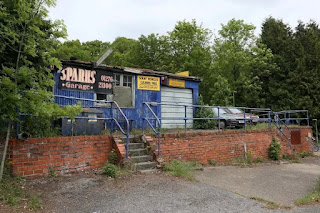
I had been pressganged into their joint enterprise to calculate the potential ‘return on investment’ of their projects, using my O-level maths studies to amortise the costs over varying numbers of years. One such development site was an anachronistic one-pump petrol station and car repair workshop that occupied a valuable rectangular plot on the busy London Road at Maultway North between Camberley and Bagshot. Owner John Sparks had inherited the business in 1966 upon the death of his father Arthur, though neither had updated its blue corrugated iron shack since 1926 when Arthur’s mother had purchased this large corner plot from the adjacent secondary school sportsground for her son to launch his one-man business.

Once I had calculated the viability of replacing the ramshackle building with flats, including the cost of removing the underground petrol tank and cleansing the polluted soil, the project was determined a ‘go’. However, we had not reckoned on Sparks’ stubborn refusal to sell. Beaver visited him. My father visited him. The Beaver sons visited him. Sparks remained intransigent. Their ‘persuasion’ techniques were evidently not working. Beaver purchased the Jolly Farmer pub on the roundabout opposite the Sparks site. One night it suffered a large unexplained fire. Sparks still refused to sell. In the end, the project had to be abandoned.

Like my mother, I was less in thrall of Beaver’s ‘entrepreneurship’ style than was my wide-eyed father, so the end of our disastrous two-week holiday in Spain and our farewells to his oversized villa came as a welcomed relief. On the flight home, I was seated next to larger-than-life Trinidadian bandleader Edmundo Ross. Despite already loving reggae and Brazilian music, my youthful snobbery regarded Ross as old-school due to his regularity on ‘BBC Radio 2’. Unaware of his fascinating life, I now regret not having chatted with him more.

A short time after our return to Britain, my father left us permanently to set up a new home with a teenage girl only a few years older than me. Our Spanish holiday seemed to have proven his last straw playing ‘happy families’. Children just got in his way. I had no further contact with the Beaver family … and I disowned my father.

In 1986, Tesco and Marks & Spencer jointly purchased a huge 76-acre site on the western fringe of Camberley to build two massive superstores (‘The Meadows’). The adjacent four-acre site, bounded by the London Road, Laundry Lane and Tank Road housed Bill Beaver’s open-air vehicle sales operation and was necessary to developers for a revised traffic flow system that included a new Sainsbury’s Homebase superstore. This plot on the far edge of town had suddenly become Camberley’s most valuable piece of land … to the benefit of its wily owner.

In 1990, John Sparks applied to Surrey Heath council for permission to build a bungalow (for his retirement?) on empty land at the back of his one-man garage. It was granted but never built. In 2014, seventy-eight-year-old Sparks retired, closed his business and sold the land to developer North Maultway Limited which demolished the workshop to build ten flats, for which planning permission was approved the following year. By 2017, the land had been sold to Seville Developments Limited which reapplied for planning permission to build nine flats. Two years later, this permission expired … leaving the former ‘Sparks Garage’ site derelict to this day.

[Originally published at https://peoplelikeyoudontworkinradio.blogspot.com/2023/08/give-them-foot-and-theyll-take-metre.html]

SPAIN: DAB enters the last chance saloon

DAB radio in Spain has been a disaster, not least for those commercial broadcasters who invested in new technology and distribution contracts, but who have generated no additional listeners or revenues. “Zero,” said Agustin Ruiz de Aguirre, technical director of Cadena SER. “The audience is zero.” He explained that a non-existent audience generates no revenues or profits because “who would want to advertise on a medium that does not deliver any consumers?”

Spanish broadcasting law requires stations that embarked upon DAB to continue broadcasting for the duration of their licences, regardless of whether anyone is listening or not. Ruiz de Aguirre said that all the commercial broadcasters are united with a single goal: to stop having to broadcast on DAB. To date, the government has not relented, though the current licences end in 2010 and 2011.

“I do not think analogue radio switch-off will happen in either the short or medium term,” said Xosé Ramón Pousa, professor in the Faculty of Communication Sciences at the University de Santiago de Compostela. “In this scenario, DAB is at a dead end.”


“We are a rarity”,
said Pere Vilas, who heads Spain’s drive for digital radio (and is the managing director of technology at state broadcaster RTVE). State radio has been simulcasting on DAB since 1998. Spanish broadcasting law has required a technical plan for DAB radio to be in place for the last year and a half, though nothing exists as yet. Such a plan is seen as DAB’s last chance to redeem itself in Spain.

“Work began a long time ago, even before digital television switchover,” admitted Xavier Redón, product marketing manager of transmission infrastructure provider Abertis Telecom. “But it is about to begin again.” Like DAB lobbyists elsewhere, Redón was quick to claim that the rest of Europe was already well down the road to DAB radio switchover. He asserted that, in France, all radios would have to be digital by 2013, and that Germany was creating a national DAB+ network in 2011.

Redón predicted that 2011 would be “key” to laying the groundwork for the re-launch of DAB in Spain. A glance at the website for DAB radio in Spain elicits a similarly optimistic stance. It states boldly: “Digital radio is a fact. It is not the future. It is the present.”

Until you realise that this latest news item was posted in April 2008.