Lord Fowler: “There will be a public outcry if we get the radio digital switchover wrong. There could be a very big row indeed about this.”

The Digital Economy Bill was debated in the House of Lords this week in its ‘Report Stage’. Once again, amendments that had been proposed specifically to take into account the views of listeners and small radio stations were rejected by the government. As it stands, the Bill only requires Ofcom and the BBC to be consulted before the government can take a decision about switchover from analogue to DAB radio.

Parallel with the progress of the Bill through the House, Lord Fowler has been chairing a separate Select Committee on Communications inquiry into digital switchover. Through its weekly meetings, where it has collected copious evidence from witnesses, it must be becoming increasingly obvious to the Committee that the government plan for digital radio switchover is an undignified mess. Lord Fowler’s growing displeasure with this situation surfaced during Debate of the Bill:

“I do not intend to pre-empt our [Committee] report, but I must say that it is generally a very important issue with the public and that there will be a public outcry if we get the radio digital switchover wrong. There could be a very big row indeed about this. …. I think I probably speak for the committee when I say that there is public confusion at the moment about what exactly the plans mean to the individual consumer, and I cannot believe that that is a sensible way of proceeding.”

The government’s frosty response, delivered by Lord Davies, conveys everything:

“[Lord Fowler] told me, as if I did not know, that there could be the most enormous row if this switchover went wrong.”

The government simply refuses to listen to commonsense on this issue, even from the chairman of the Lords Communications Committee. As a result, a “very big row” about digital radio switchover is indeed inevitable, probably at Easter, and more so following publication of the BBC Strategy Review.

Here is the ‘radio’ part of the debate in full:

The House of Lords
Parliamentary Debate
3 March 2010

Digital Economy Bill
Clause 30 : Digital [radio] switchover

Amendment 137
Clause 30, page 36, line 33, after “to” insert —
“(a) ”

Amendment 138
Page 36, line 35, at end insert —
“( ) the needs of local and community radio stations; and
( ) the needs of analogue radio listeners”

Lord Howard of Rising: My Lords, I tabled Amendments 137 and 138 again simply to get more detail from the Minister, as his assurances about these points were not wholly convincing. The amendments would give the Government an explicit requirement to take into account the views of radio listeners and local and community stations. The Minister argued that this was unnecessary because of the breadth of the requirements to consult that are already proposed and the commitment to consult widely. The problem with such vague assurances is that they can be quickly forgotten. The [Bill] currently states that the views of the BBC and Ofcom should be given due regard before the Secretary of State nominates a date for the digital switchover. It does not say too much about consulting widely or taking into account in any way those who are most affected by the switchover — the listeners. I hope the Minister can give more encouragement that the listener will not be forgotten in this whole process. I beg to move.

Lord Clement-Jones: My Lords, I commend the amendments, which are a very constructive way of seeking further assurance from the Minister. Indeed, they very much reflect the concerns that I expressed from these Benches in the Clause 30 stand part debate in Committee. Assurances about the future of analogue radio in particular are so important. The noble Lord, Lord Young, and I engaged in a slightly semantic conversation about whether FM’s existence would be perpetual or whether it would simply be there for the long term. I think the assurances were that it would be there for the long term, which did provide some reassurance. However, the interests of the ultra-local stations and the consumers of the product of those stations are extremely important, and I very much hope that the Minister can cast more light on the future of analogue in the face of the digital switchover.

Lord Fowler: My Lords, I congratulate my noble friend on the amendment — I am now rowing back frantically — on a very important issue. It is so important, in fact, that the Select Committee on Communications is currently engaged in an inquiry on precisely this — the digital switchover — although a number of reasons have been adduced as to why it should be called not a switchover but various other names. I do not intend to pre-empt our report, but I must say that it is generally a very important issue with the public and that there will be a public outcry if we get the radio digital switchover wrong. There could be a very big row indeed about this. My only reservation about the amendments is that I can think of quite a number of other issues on which I would like the Government’s assurance. There are, for example, 20 million car radios out there. What will happen to those? How will they be converted? What are the plans? There are so many issues here that either we will have a totally comprehensive list or we will simply have to ask the Minister at this stage for his current views. I think I probably speak for the committee when I say that there is public confusion at the moment about what exactly the plans mean to the individual consumer, and I cannot believe that that is a sensible way of proceeding. My noble friends on the Front Bench have raised a crucial issue to which we will have to return again, and very soon.

Baroness Howe of Idlicote: My Lords, I absolutely agree with what has been said so far. This is one of the greatest eye-openers. As we have proceeded with this Bill — particularly as it has run parallel to the deliberations of the Select Committee which the noble Lord, Lord Fowler, is chairing so ably — we have come to realise just how important radio is to so many people, whether to the disabled or to all of us, listening as we do for a vast amount of our time to the radio. However, this is clearly one of the areas in which there is still a need to reassure people locally. The idea was that analogue transmission could be switched off once 50 per cent of listening is to digital radio. Then there was the business of how long FM would be available once it is more or less accepted that there will be a change. As regards the production and selling of cars, the issue is when there will be sufficient technology to convert radios already in cars and to convert some DAB radios to the right level. No one is trying to argue for a moment that the quality of digital radio will not be valued. But getting to that point will need a lot of reassurance to citizens. I would be grateful, as would I am sure other noble Lords, for further reassurance from the Minister that FM will be available ad infinitum, but certainly well beyond the point of switchover. That would do a great deal to reassure noble Lords who have looked into all this. But much more importantly, the citizens and the consumers — I come back to them because I am looking at this issue from both viewpoints — are crucial. I hope that the Minister will be able to give that reassurance.

Lord Gordon of Strathblane: My Lords, I do not have any problem with the sentiments behind the amendments. The only problem is that if those points are listed, it would look as though that is what the Government or Ofcom should give priority to, but they are only three of a myriad number of conditions to which they must give attention. Specifying that is almost counterproductive.

The Lord Bishop of Manchester: My Lords, I rather echo that point. In Committee, I expressed, as did many noble Lords, concerns about local and community radio stations and about the extension of FM. These are very important matters, but as other noble Lords have indicated in this short debate, there are other areas as well. In all this, I hope that we will continue to recognise that, while it has often been said that the switchover for television has gone very smoothly, the complexities in relation to radio are far greater. While supporting so much that lies behind these amendments, it would be a great shame, in a sense, to wreck it by omitting rather than being inclusive.

Lord Davies of Oldham: My Lords, I am grateful to all noble Lords who have spoken in this short debate, particularly the right reverend Prelate the Bishop of Manchester and my noble friend Lord Gordon, for identifying the weaknesses of the amendment and the nature of the issue on which the Government need to take care. Perhaps I might say that if I was not going to take care after the Opposition Front Bench and the noble Lord, Lord Clement-Jones, had spoken in support of the amendment, I certainly was after listening to the noble Lord, Lord Fowler. First, he told me, as if I did not know, that there could be the most enormous row if this switchover went wrong. I could not agree with him more and I accept entirely what the right reverend Prelate has said. The switchover from analogue to digital for television is much easier than this exercise because of the diversity of radio opportunities and provision. But the noble Lord, Lord Fowler, produced an even greater anxiety for me when he mentioned car owners. He is right that we would not dare to get that wrong. I know that we are not far from a general election, but the idea that the Government are about to alienate 20 million car owners by telling them that their radios are defunct, out of date and will not work is somewhat unrealistic. The conversion of car radios is an important point that has to be established before a digital switchover could conceivably be considered a success. We have been clear that an affordable in-car converter is key to the success of digital radio switchover. There are already devices on the market which will convert an FM car receiver to receive DAB. One would predict that this market will expand very rapidly. Very few markets move quite as quickly as the car accessories market, which helps to guarantee the sale of cars. That point therefore will be taken into account, as will the other points about the importance for the Government of effective consultation before such a switchover could take place. We have made clear that, for the foreseeable future, the Government will consider FM radios to be part of the broadcasting firmament. Radio stations will want to combine to broadcast on FM to take account of the points that the right reverend Prelate drew to the attention of the House. What date will all this be effected? That is a pointed and precise, but nevertheless very difficult, question. We have indicated that 2015 is ambitious, although it is achievable. If we do not set a target, there is no stimulus to all those who can make a contribution to effecting this successfully to get to work and do so. So we want a date and have identified 2015, but we recognise that it is a challenge. However, we accept the concept behind the amendments; namely, that the fullest consultation will be necessary. Otherwise, the almighty row anticipated by the noble Lord, Lord Fowler, will descend upon the Government who get it wrong. Why do I resist the amendments, as we did in Committee? It is simply because consultation is written into the Bill already. We could not dream of going forward or of proposing that the Government could go forward with an issue of such significance to our people without the fullest consultation in order to guarantee that we do not fall into those dreadful traps to which noble Lords have called attention. Again, I am grateful to the Opposition Front Bench for drawing our attention to the necessity for care and consultation. That is part of the Bill and the amendments are unnecessary. Having stimulated a further debate, after the extensive one we had in Committee, I hope that the noble Lord will withdraw his amendment.

Baroness Howe of Idlicote: My Lords, can the Minister clarify the point about which a lot of people are concerned; namely, that whenever the point of switchover occurs, FM will continue beyond that point? A lot of small operators are very concerned about that.

Lord Davies of Oldham: My Lords, I wanted to indicate that. If I did not make it clear enough in my reply, we see FM continuing, but we also see the kind of criteria that will be necessary before we begin the process of significant switchover. As I have indicated, the Government will move with the greatest care with regard to this issue, as we have with television switchover. Noble Lords will know of the care that we have taken to make sure that groups who might not be able to make that switchover effectively because of limited resources are given support. Radio is much more complex and difficult, as the right reverend Prelate made clear. The Government are fully seized of that, which is why consultation is written into the Bill on this issue.

Lord Howard of Rising: I thank the Minister for his comments, and I thank my noble friend Lord Fowler for his support. I was delighted to hear some support from the noble Lord, Lord Clement-Jones, after the sandbagging that I received from the noble Baroness, Lady Bonham-Carter. Having raised the issue and heard how sympathetic the Minister is to the potential problems — even though he dodged with his customary skill committing himself specifically to consulting listeners — I beg leave to withdraw the amendment.

Amendment 137 withdrawn.
Amendment 138 not moved.

[the Report Stage of the Digital Economy Bill continues in the House of Lords on 8 March 2010]

Small local stations & the Digital Economy Bill: debated in the House of Lords

The issue of the potential impact on small, local radio stations of the government’s proposed ‘Digital Radio Upgrade’ was first raised in this blog in July 2009, which stated:

“… the potential losers from Digital Radio Upgrade would seem to be:
• commercial stations presently carried on local DAB multiplexes who might have to be bumped because there is no longer the capacity after amalgamation
• local commercial stations presently carried on their local DAB multiplex who will have to quit DAB because they do not wish to serve the enlarged geographical area after amalgamation of multiplexes (for example, the cost of DAB carriage for Kent/Sussex/Surrey is likely to be considerably higher than Kent alone)
• new entrants

In the rush to frame proposals in Digital Britain that respond to the circumstances of the large radio players with substantial investments in DAB infrastructure, it might appear that the voices of the smaller local commercial radio stations have got lost in the stampede of lobbying. These stations might be small in number but many of them remain standalone, so they will not benefit financially from the relaxation of co-location rules. Digital Britain is condemning many of them to remain on FM (or AM), leaving the large radio groups to dominate the DAB platform.

Although the proposals in Digital Britain have been framed to ‘help’ local commercial radio, overwhelmingly they will reduce the financial burden of group radio owners with local station operations in adjacent areas, and of group owners who have invested in DAB infrastructure. There is little in the way of financial benefits for independent local commercial stations, or for potential new entrants, both of whom face being crowded out of the DAB platform.”

Last night, the House of Lords debated three amendments, amongst several, to the Digital Economy Bill which proposed that the voices of small, local FM radio stations and their listeners should be considered before the government commits the UK to digital radio switchover.

These amendments were eventually withdrawn after debate (see below) during which the government minister, Lord Young, made vague assurances that the views of listeners and others would be canvassed.

RadioCentre, the commercial radio trade body, subsequently commented: “Clause 30 (which relates to the switchover powers) was debated in detail, with proposed amendments withdrawn following debate and assurances from Government.”

Amendments 236 & 237
Moved by Lord Howard of Rising

236: Clause 30, page 33, line 17, after “to” insert “ — (a)”
237: Page 33, line 19, at end insert “; and
( ) the needs of local and community radio stations; and
( ) the needs of analogue radio listeners.”

Lord Howard of Rising: My Lords, in moving this amendment, I will also speak to Amendment 237. The amendments are designed to ensure that attention is paid to the local and community radio sectors and the many millions of analogue radio listeners — to which I should add the providers of satellite systems about which the noble Lord, Lord Maxton, spoke. They should all be listened to before any decision is taken about switchover. We on these Benches have not hidden the fact that we remain unconvinced that the Government’s plans to switchover in 2015 are realistic. We do not believe that audiences will be ready by then. The audience must remain at the forefront of all our considerations when we debate these parts of the Bill. As drafted, the Secretary of State will have to pay heed only to Ofcom and the BBC. Despite the BBC’s dominance in the radio industry, there is a strong argument that it would be helpful for community and local radio stations to be consulted. Indeed, the whole commercial radio sector should be included. It does not seem unreasonable to suggest that the Secretary of State consult the other parts of the industry that will be affected. It would also seem both reasonable and important for the Secretary of State to consider the needs of those who listen to analogue radio. The Government stated in their final Digital Britain report that they would start the countdown to switchover once digital listening made up 50 per cent of radio listening. That seems far too low. It would still mean that there were millions of listeners not using digital. Our amendment would ensure that the needs of those listeners were taken into account before the Secretary of State could nominate a switchover date. The amendment is simply an attempt to ensure that all who will be affected by switchover are considered before the Secretary of State nominates a date. As I have said, it does not seem unreasonable to ensure that listeners are placed at the forefront of these considerations. I hope that the Committee will agree. I beg to move.

Lord Gordon of Strathblane: My Lords, I think that I can offer some reassurance to the noble Lord opposite. Unless all those targets were going to be met, virtually the entire commercial radio industry would not support the clause, which it does, with one minor exception. The feeling is that this is an empowering clause that does not oblige the Secretary of State to set a date. Indeed, he can set a date and then withdraw it if precisely those targets mentioned by the noble Lord are not met. The radio industry seems to feel that the Government have got it right. I hope that that reassures him.

The Lord Bishop of Manchester: My Lords, in speaking to the amendment moved by the noble Lord, Lord Howard of Rising, I recall that in an earlier debate this evening, the noble Lord, Lord De Mauley, expressed deep disappointment that I was not supporting an amendment that stood in the names of the noble Lords. I hope that they will now feel slightly happier, because I support this particular amendment. I do so because the Bill as it stands provides very little safeguard for those who are living in remote areas, some of them perhaps still relying on long wave, let alone FM, for their radio reception. I take the point that the noble Lord, Lord Howard, made about the Digital Britain report. If I recall correctly the point was made at Second Reading that, when 90 per cent has been reached, there will still be one in 10 people — some of whom would presumably lose access via their radio to all the national, BBC and commercial radio stations — for whom we really ought to have the greatest concern. Short of listening via the internet — which I know the noble Lord, Lord Maxton, though no longer in his place, would be urging us to do — or Freeview, there is nothing that the 10 per cent would be able to do until the DAB signal catches up with the FM one. Through this and other similar amendments, I hope the Government will come to recognise that there are some very serious reservations about giving the Secretary of State the power to set the switchover date without proper statutory consideration of the wider impact of that decision on those communities who are often disconnected from British society physically, and those small stations that serve them. I am much in sympathy with the amendment.

Baroness Howe of Idlicote: My Lords, we shall come to rather more detail about this aspect shortly. I, too, support the amendment and the basis on which it is being put forward. We spent this morning taking evidence from the commercial radio stations, both from those which disagreed with the main grouping and those which had done some amount of research over time. The more one looks at this whole area, it is quite clear that there is a big problem about when this is going to happen, stretching into the future, causing a considerable number of problems. At the very least, this amendment requires others — those concerned and those involved — to be consulted. So, like the right reverend Prelate, I certainly support the amendment.

Lord Young of Norwood Green: My Lords, Clause 30 states that before nominating a switchover date, the Secretary of State must have regard to any reports submitted by Ofcom or the BBC under the terms of Section 67(1)(b) of the Broadcasting Act 1996. The purpose of these reports is to review how long it would be appropriate for radio services to continue to be broadcast in analogue form. These reports should have regard to the provision of digital radio multiplexes, availability of digital radio services and the ownership of digital receivers. In order to produce these reports, Ofcom is required to consult multiplex licence holders and digital radio service providers. In addition — here I address the concerns of the noble Lord, Lord Howard, the noble Baroness, Lady Howe, and the right reverend Prelate the Bishop of Manchester — the Secretary of State must, on requiring these reports, consult such persons representing listeners and such other persons as he thinks fit, as provided in Section 67(4). The noble Lord, Lord Howard, talked about plans to switchover in 2015. That is a target that we have set, not a precise date, as I hope he will recognise. The experience that we had with the TV switchover, which in some ways was even more fraught with difficulty, has been an outstanding success so far. One of the largest switchovers, in the Manchester area, recently went over without a hitch. We had a lot of preparation, help and assistance. We want to adopt a similar approach. It is not just about the 50 per cent of listeners. We have also talked about DAB achieving the same coverage as FM, which is something like 95 per cent these days. We are well aware of the importance of that. I also point out another factor which I think is important. The prices of reasonable quality DAB radios have been coming further and further down. That is important for less advantaged parts of our population. We are aware of the concerns expressed. We believe that the clauses have got it right. We understand the concerns, which is why I have taken time to give some further assurance. Given the breadth of the requirements to consult already proposed in the draft Bill and our commitment to consult widely before setting a date, we believe that the amendment is unnecessary. With the explicit assurances I have given, I hope that the noble Lord will feel able to withdraw the amendment.

Lord Howard of Rising: I thank the Minister for his remarks. I am grateful to the right reverend Prelate the Bishop of Manchester and to the noble Baroness, Lady Howe, for their support for the amendment and to the noble Lord, Lord Gordon, for his reassurance. All I am doing is asking the Government to pay attention to and listen to the listeners before they take too drastic an action and leave a lot of people very unhappy. From his remarks this would appear to be the case, so I beg leave to withdraw the amendment.

Amendment 236 withdrawn.
Amendment 237 not moved.

Amendment 239A
Moved by The Lord Bishop of Manchester

239A: Clause 30, page 33, line 21, after “services,” insert “while retaining the use of the FM Band for those local and community radio services, including special interest services, for which digital transmission using DAB is not a suitable method due to —
(i) the size of local DAB multiplex areas, or
(ii) the unavailability of capacity on the local DAB multiplex,”

The Lord Bishop of Manchester: This amendment pursues further the issue about retaining the use of the FM band for local and community radio services. I invite your Lordships to put yourselves in the shoes of someone running a small FM radio station, serving a population of 100,000 people in and around, let us say, King’s Lynn. As it stands, that station’s future seems to be to bid for a space on a local multiplex. That would mean that it would begin broadcasting to almost 600,000 people. Such a shift would significantly change the character of that station. Listeners from a much wider area would start to phone in to programmes and would, for instance, start to demand their own slice of news output. The station manager would be forgiven for wishing to stay on the FM band as long as possible, until a better solution was found for smaller stations to find a home on the digital spectrum. Consider then the prospect of the only way of going digital to be to join an even larger regional multiplex which covers the whole of East Anglia and serves well over 1 million listeners. That is the kind of situation that is faced by a number of small commercial radio stations if digital rollout continues as planned. Their pathway towards a digital future seems shrouded in a kind of fog, partly because of the large size of DAB multiplex areas and the lack of capacity on some multiplexes .Forcing those small-scale stations to broadcast to much larger areas than their current coverage would alter their feel and alter their connection with their audience. It would undermine the integrity that they hold as local broadcasters and potentially damage their ability to service platforms which stimulate and reflect local democracy and social action. There is also a danger that counter-intuitively such stations would struggle to attract advertising spend from local businesses which do not wish to market themselves to audiences up to 100 miles away. So, socially and commercially, beaming local stations to regional audiences is, frankly, not in anyone’s interests. As for the lack of space on DAB in some areas of the country, take, for example, the multiplexes currently covering Humberside or, in my own area, of Manchester where there is virtually no space available. Even with just the larger stations currently on board, capacity is running out in some areas. I understand that some stations that gain access are broadcasting in mono rather than in stereo in order to preserve bandwidth. The limitations of DAB for local and community stations are well acknowledged by Ofcom. Indeed, it is already planning for small-scale commercial and community stations to stay on FM in the medium term as the most appropriate technology for those stations in terms of both coverage and cost. The vacation of FM band space by the removal of national and large local stations would free up more capacity for smaller stations. Ofcom sees this as a natural staging post in radio’s digital evolution. Nowhere, however, is this halfway house given a firm legal footing. In case my amendment is misinterpreted as a luddite attempt to hold back the march of progress, let me make clear that it is intended as a temporary but crucial platform to support the transition to digital of small-scale local stations, which not only serve geographically defined areas, but also identity-defined and interest-defined groups. Your Lordships may remember the furore caused when in 1992, BBC Radio 4 proposed to transfer use f its long-wave frequency to a rolling news service. The BBC reckoned that FM reception was good enough and the vast majority of the country could pick it up without a problem. But those living in remote parts of the United Kingdom, and even in exceptionally hilly inland parts, knew different. The determination to push ahead with cutting Radio 4 from the long wave was met with purposeful if well-mannered resistance, as one might expect from Radio 4 listeners. In fact, I am told that the sight of 200 protestors in tweed and twinsets marching down Upper Regent Street was enough to help the BBC to see the error of its ways. Let us not make a similar mistake. After all, FM had at that point been around for almost 40 years. We have had DAB for less than a decade. The future of local radio — which is so crucial to forging community cohesion and identity, and promoting local social action and democracy — should not be left to chance. That must mean embracing a multi-platform ecology which creates a pathway towards digital broadcasting for local radio, retaining space for them on FM until such time as a digital platform offers them the right environment to continue what they do best. I beg to move.

Lord Clement-Jones: My Lords, the right reverend Prelate has said so much of huge value — an absolute tour de force on behalf of ultra-local radio. Of course from the remarks made in the previous amendment, I not only put my name to this amendment, but fully endorse what he said. It is that kind of certainty which is crucial, and this is a very elegant way of keeping it in the Bill. I hope consideration will be given to that, because — and this is not intended as a pun — a signal is needed in this area. We need a very strong signal — not just a digital or political signal — to FM radio, to ultra-local radio, that they have a future which is secure. That is exactly what the right reverend Prelate, whom nobody could accuse of being a luddite, has advocated.

Baroness Howe of Idlicote: My Lords, the right reverend Prelate has put it beautifully: “multi-platform ecology”. I like that and it sets the pattern for the future rather well. Clearly, this amendment hits on the crucial area of what will happen in the mean time and what is to be done concerning FM. We need some reassurance on this point; I think the Minister said that it would be around indefinitely. At the moment, we know that Ofcom grants only short licences. There have been quite a number of complaints from the radio stations that not to have the certainty granted to them by, say, a 10-year licence means that their likelihood of failure is considerable. That side of things would be helped if the Minister could confirm that FM will definitely be there, and that licences can be given as people gradually go over to digital and more space on FM becomes available. We know that there are minimal alternative uses for the FM spectrum besides transmitting radio. It is not therefore likely that the Treasury will want to make vast sums out of it, as it clearly did when it realised its potential. It has already had its fair share from that — or unfair share, depending on how you look at it. Please can we therefore have two assurances from the Minister? We should all try to move as fast as possible and with all encouragement towards the digital switchover, because we can see the disadvantages in having that laggard time that many seem to envisage. Indeed, one person giving us evidence today said that, concerning radio, there was really no possibility of a digital switchover; he was as dispirited as anyone could have been about the process. Any form of encouragement that the Minister can give would be welcome, certainly on the future use of FM and on longer licences. Those two things were very much endorsed by the people who gave evidence this morning to the Select Committee on Communications.

Lord De Mauley: My Lords, it is late and I shall be brief, but when we finally switch over to digital transmission it is important to be sure that the Government stay true to their promise that the FM spectrum will remain available for use by local and community radio stations. The Digital Britain report said that that was the Government’s plan, but it would give a great deal more reassurance if such a promise was contained in the legislation.

Lord Young of Norwood Green: I thank the noble Lord, Lord de Mauley, for his brevity. It is not as if I am not paying attention, or giving this less than its due, but we have already travelled over some of this terrain. However, I shall endeavour to reiterate the assurances. For small, local commercial and community stations, both the coverage area of a digital multiplex and the cost of its carriage are too great at present. That is one reason why we believe that those stations are best served by continuing to broadcast on FM. We have also committed to retaining FM for radio after the digital radio switchover. Of course, the Government will not stop any station that wants to and can move to digital, but we will reserve capacity on FM for those which have no obvious route there. I want to address a couple of the concerns that the right reverend Prelate expressed. How will we support those stations which remain on FM? In order to ensure that stations on FM can operate and compete with services on digital after switchover, the Government have already said that we are committed to establishing a combined electronic programme guide for radio. That will allow listeners to access stations via the station name, irrespective of the platform carrying the service. Listeners will therefore move seamlessly between bands, selecting stations simply by name; that is currently not the case when listening to FM and AM stations on an analogue radio receiver. We are working with the industry on that issue and encouraging its development.

Lord Clement-Jones: We have been given that assurance on a number of occasions. The Minister in the Commons, who recently announced his resignation, sadly, has given that assurance about the electronic programme, but no date was put on it. It is simply that they are working on it. This is a crucial aspect in retaining people’s ability to tune in to FM.

Lord Young of Norwood Green: I will see whether I can find any further information. This is a genuine commitment. It is all part of the backdrop against which this debate is taking place. We have set 2015 as a target, but there is not a headlong rush to it. We are trying to ensure a number of things, and this is one of them. I can give a progress report on where we are: it is a clear commitment. The right reverend Prelate asked about making FM continue to be attractive to advertisers and listeners. The key to the switchover of radio will be establishing three distinct tiers of radio — local, regional and national — which will provide unique content and are sustainable in their markets. The services that will populate FM will have a distinct role in providing very local material and reflecting the communities they cover. Due to the very local nature of their content and the refocusing of the large regional stations, these services will benefit from less competition for local advertising funding. I hope that is of some help. The noble Baroness, Lady Howe, asked whether Ofcom will offer analogue licences for longer than five years. The duration of analogue licences is a matter for Ofcom. However, it has suggested that, subject to the outcome of the Bill, it will consult on this issue. We support this process as there is clearly a strong argument for allowing analogue licences over a longer licence period. I, too, rather like the elegant phrase “multi-platform ecology”. I wish I had thought of it myself. We have not included in the legislation a commitment to retain FM because the Bill is not intended to set out all the details of the digital radio switchover but to enable a switchover to take place how and when that is appropriate. We agree with the right reverend Prelate’s phrase “a multi-platform ecology” — imitation will soon be the sincerest form of flattery on this one. To do this, Clause 30 provides for changes in the licensing terms of those services for which it will no longer be appropriate to continue on analogue once the switchover date is nominated. For those licences where analogue broadcasting is the most appropriate or only means of broadcasting, these powers need not apply and their terms will be unaffected, including the right to broadcast on an analogue frequency. The continuation of FM is therefore already provided for in this legislation and should be read alongside the commitments in Digital Britain. In the interests of time, I shall not say any more. I have tried to give as many assurances as I can. We share noble Lords’ concerns. We want this to be successful. We should take heart from how successfully we have handled the switchover to digital TV. That has been a success story. Lots of concerns were expressed at the beginning, and we had to work to ensure that people who had fears about handling the new technology were assisted. We got it right. I am not saying that that should be a blanket assurance for everything, but we should not forget how well we handled that. It gives us a good background of experience upon which we can build. I thank the right reverend Prelate for this part of the debate. I trust that the assurances that I have given will enable him to withdraw the amendment.

The Lord Bishop of Manchester: I thank the Minister for his response to this debate. I am also grateful to the noble Lords, Lord Clement-Jones and Lord De Mauley, and the noble Baroness, Lady Howe, who made very helpful comments. I welcome the Minister’s assurances about the continued provision for local stations to use the FM band. He said that we had been over this ground several times, but we have done so partly because of the seriousness of the issue and partly, as the noble Lord, Lord Clement-Jones, said later in the debate, because of the need to pin the Government down to get the precise assurance that people need. I am sure that those who run and who listen to these media services will feel encouraged by the general direction in which all this is going. Again, the noble Lord, Lord Clement-Jones, was absolutely right to say — it may have been a parlance, but it is a very good way of saying it — that these people really do need a clear signal from the Government that is very much along the lines of what the Minister has said. Having said that, I suspect that this needs to be repeated and to be made even clearer. As those of us who have the privilege of sitting on the House of Lords Select Committee on Communications know, there is a huge difference between the switchover to digital television — this has indeed gone very smoothly, although it is not without its teething problems — and the digitalisation of radio. It has been made very clear to us in the evidence that we have received that the whole business of the digitalisation of radio is much more complex. While the Government and all the digital facilitators need to be congratulated on what they have done in the switchover to digital television, let us not think that because that went so easily it will be the same for radio. There are some very different and deeper issues that we must look at. That said, I utterly agree with the Minister and all noble Lords who have contributed to the debate that we want to keep up the momentum. We really do want to go along with what the Digital Britain report has said and get ourselves going in the technological direction in which we are set. Unnecessary delays are certainly not welcome. Finally — I think the Minister alluded to this in an earlier debate — there is the issue of manufacturers moving towards products that use a combined station guide, rather as Freeview and satellite television do for television, so that people can choose stations by name, whatever the band they are using. This kind of mixed economy of stations, both analogue and digital, will be the simplest way of getting through the many complexities that are on our path. I am most grateful to the Minister, and I beg leave to withdraw the amendment.

Amendment 239A withdrawn.

[For the purpose of transparency, I was one of the parties invited to offer evidence before the House of Lords Select Committee on Communications yesterday morning.]

Parliamentary debate on local radio: Minister reads from the government DAB script

“The Future Of Local Radio” [excerpts]
Private Members’ Debate
Westminster Hall, House of Commons
12 January 2010 @ 1330

The Parliamentary Under-Secretary of State for Culture, Media and Sport (Mr. Siôn Simon): Local radio is, without question, important to the Government and to communities, playing an important role in binding together the social fabric. We take it very seriously.

Dan Rogerson (North Cornwall) (Liberal Democrat): On the point about the importance the Government place on local radio, it seems that local radio stations, and certainly those in my constituency, Pirate FM and Atlantic FM, do not necessarily feel that they have had the opportunity to get their points across at an early stage. That is why they are now contacting local Members to look at some of the issues when the Digital Economy Bill is debated on the Floor of the House. What sort of consultations are taking place with local radio stations?

Mr. Simon: The hon. Gentleman is quite right; there is undoubtedly some concern in the industry. There has been a bit of a campaign, led by UTV. I recently met, at RadioCentre, representatives of many local commercial local radio stations from across the country, and some of them will have been those he mentioned from his constituency. There was extensive consultation when the Bill was drafted, so we do take it seriously. During my remarks, I hope to allay some of the fears which may have emerged through misunderstanding.

Bob Spink (Castle Point) (Independent): There are genuine fears that the Bill will lead to a two-tier system, so would the Minister address a couple of those fears? Will Clause 34 genuinely lead to deregulation for smaller local radio? Will digital be affordable for smaller local radio, and how can we achieve that? Will smaller local radio get more access to higher-quality FM while it is still around?

Mr. Simon: I am pretty confident that I shall address all those points in my brief remarks. Let me make some progress before I take any more questions. Digital switchover provides new opportunities and increases functionality. It is an essential part of securing the long-term future. The total revenue of the commercial sector has fallen from £750 million in 2000 to £560 million now. At the same time, transmission costs have gone up, with stations now bearing the cost of carriage on FM, DAB, online and digital TV. A market facing such rising costs and falling revenue is unsustainable and puts the health of the entire sector under threat. Although the path to digital may not be easy, we are convinced that it is the only route for securing the long-term future of radio, and that is a view shared by the vast majority of the sector, notwithstanding some of the reservations raised by hon. Members. Therefore, rather than a catalyst for decline, the changes set out in the Digital Economy Bill are essential to secure the survival of local radio. For the first time, we will have three distinct tiers. First, there will be a tier of national services, both commercial and BBC, with a wide range of content. It will allow the commercial sector to compete more effectively with the BBC, employ high-profile presenters and attract high value national advertising and sponsorship. Secondly, a regional or large local tier, again comprising commercial and BBC services, will provide a wide range of programmes, including regional news, traffic and travel. The tier will increase the coverage size and potential revenue of many large local stations which, in turn, will increase the opportunity for linked advertising between regions so that regional commercial operators can benefit from quasi-national advertising. The hon. Member for Orkney and Shetland mentioned the issue of advertising being badly commissioned by the Scottish Government, which I understand. None the less, the benefits of linked advertising for regional radio can be very great if commissioned sensitively. Most important in the context of today’s debate, there will be a tier of local and community radio stations with the specific focus of informing and reflecting the communities they serve. They will be distinct from the national and regional tiers because of the very local nature of their content and they will benefit from less competition for local advertising funding.

Mr. Oliver Letwin (West Dorset) (Conservative): People in my constituency and elsewhere who depend on radios will not be able to get local radio if it is purely digitised.

Mr. Simon: Local radio will not be purely digitised. That tier will stay on FM for the foreseeable future, but it will not be an FM ghetto; it will be an accessible FM, as I shall explain.

Mr. Brian H. Donohoe (Central Ayrshire) (Labour): Given the time constraints, will the Minister agree to meet Members who are interested in the subject?

Mr. Simon: Yes, I am happy to meet Members who are interested. I have another meeting scheduled with local radio operators from all over the country, which will be under the same auspices as my recent meeting with them. (I am not sure whether I have enough time to continue. I do.) So, let me be clear: we see a digital future for all radio eventually. However, with more than 50 BBC services, nearly 350 commercial stations, 200 licensed community stations, the current infrastructure will not support a move to digital for everybody. For small commercial and community stations, the coverage area and the cost of carriage of a digital multiplex are too great. That is one reason why, for the time being, we believe that those stations are best served by continuing to broadcast on FM.

Malcolm Bruce (Gordon) (Liberal Democrat) rose —

Mr. Simon: I am nearly coming to my point, but I give way to the right hon. Gentleman.

Malcolm Bruce: Some of the small stations have already invested in being on digital. Are they not in danger of being kicked off to FM, having made that investment, and would that be a fair outcome?

Mr. Simon: No, small stations are not in such danger. Stations that are already on digital are not in danger of being kicked off digital, but they are suffering the extra cost of running on two platforms. That is one of the reasons why we need an orderly, managed and reasonably speedy transition to an affordable single platform for as many people as can afford to be on it. The idea of stations on more than one platform is not new, which moves us to a key point that has not been widely understood — it is really important. Listeners have for decades moved between FM and Medium Wave, and historically also to Long Wave. The current generation of DAB sets has tended to make that move a rather sharp distinction, which has led to the fear that FM will end up being a second-class ghetto tier. To avoid that, we are committed to ensuring the implementation of a combined station guide, which is similar to an electronic programme guide, that will allow listeners to access all sets will simply have a list of station names. The listener will not distinguish between FM and digital stations, but will simply select the station by name. We are already working with the industry on that system and encouraging its development and introduction as quickly as possible. That is a crucial difference that has not been widely promulgated or understood. It means that people can stay on FM and the new sets can service the same market. Only 5 per cent of the digital radio receivers currently on sale cannot receive FM. It is our intention that all digital receivers should be able to receive FM as well as complying with the World DMB profile, which will ensure that they can support other technologies to accommodate future changes. That crucial distinction has not been widely understood. When I explained it to people in the industry, it made a big difference. The hon. Member for Orkney and Shetland asked whether we could upgrade to DAB+ from the beginning. I understand why he says that, but we are not right at the beginning. There are 10 million DAB sets out there for which people have laid out large amounts of money. The BBC completed a study into the issue last year, and concluded that, on balance, it was not worth writing off that technology because of the impact on the 10 million people who had bought DAB sets. We have said that all new technology should be DAB+ and future compatible so that further change is future-proofed and DAB+ is not excluded. As for the switchover date of 2015, the hon. Gentleman asked whether it was the only way we would get things moving. The Government believe that 2015 is an achievable date. The actual date that switchover happens will depend on the criteria for listenership and coverage being satisfied. We think it can be done by 2015, and that it is important to set a challenging target. The issue of £20 sets was raised. There are already some £30 sets. We have five years to go until 2015, so we remain confident that we will have £20 sets by then.

Miss Anne Begg (Aberdeen, South) (Labour): I am interested to hear what my hon. Friend says about the 2015 date. Can I take it from what he said this morning that 2015 is an aspiration to encourage the industry to move towards digital — to put their house in order and get things ready? However, if the coverage is not there in places such as the constituencies of the hon. Member for Orkney and Shetland (Mr. Carmichael) and the right hon. Member for Gordon (Malcolm Bruce) where there are a lot of hills, will the Government look at the date again? That date is not already fixed.

Mr. Simon: As I said, we believe it is an achievable date. If more than 50 per cent of listeners are not on digital by then, and if coverage is not similar to FM — 98.5 per cent — it will not happen on that date. If for any other unforeseen reason, we are not, as a nation, in good shape to do it by then, we will not do it. We will not switch over at an inappropriate time, but we believe that it can and should be done in 2015. As time ticks on, let me say that a relatively small and cheap piece of hardware will be available to convert in-car sets to something that works in the future as well as the present.

[Sitting adjourned without Question put (Standing Order No. 10(11)).]

Radio in the Digital Economy Bill: House of Lords Second Reading

Digital Economy Bill
2 Dec 2009 @ 1539
Second Reading, House of Lords [excerpts]

The First Secretary of State, Secretary of State for Business, Innovation and Skills and Lord President of the Council (Lord Mandelson):
We have also set out our vision for the future of digital radio, which will see the country shift to digital, when transmission coverage and audience numbers are wide enough, by the end of 2015.

The Lord Bishop of Manchester:
The switchover to digital radio may produce more problems than expected. Of course there is much to welcome in the creation of platforms for new content to meet the needs of specialist audiences. I think, for example, of Premier Christian Radio’s recent acquisition of a national DAB licence. However, there may be much to be concerned about over the plan to cut off national stations and many local services as early as 2015. While the Government have indicated that that will not be finalised until digital services account for 50 per cent of all radio listening and can reach 90 per cent of the population, it is also clear that without an early deadline, sufficient pressure may not build on radio manufacturers and retailers to shift to selling DAB sets only for cars as well as homes. The radio switchover again underlines the risk of creating another two-tier system where significant swathes of the country could lose their favourite national stations from the FM dial, including the BBC stations they pay for through the licence fee. Surely that cannot be right.
What government support will there be for the switchover to digital radio, which is likely to be not only more problematic but, generally, more expensive across the population than the TV switchover has been? Will the Minister accept that over-rushing towards analogue switch-off will not allow proper time for the Government, this House and the other place to think through the unintended consequences? Is there anything that the Government can learn from the German Government’s experience and their postponements of switchover plans?
….. On voluntary supported broadcasting, do the Government intend to keep some of the analogue spectrum going, for example, for hospital radio?
This country must, of course, embrace the opportunities offered by a digital economy, but the advantages must be shared by the widest possible number of citizens. Some, if not all, of the unintended consequences that could unfairly disadvantage people might be avoided by not being trapped in too rigid a timetable. If that happens, I fear that this country will not benefit from the best rewards that a digital economy offers.

Lord Carter of Barnes:
Secondly, in the critical areas of investment, infrastructure, spectrum liberalisation and the digitalisation and deregulation of sound radio, it provides a framework for innovation, development and investment.

Baroness Howe of Idlicote:
My Lords, when the noble Lord, Lord Carter of Barnes, introduced Digital Britain a little while ago we all recognised that things were beginning to happen and there were some very welcome realisations, for example, on the need to move forward with digital radio…….
I welcome those parts of the Bill which incorporate the Digital Britain promise to speed up delivery of a fully operational DAB digital radio platform. I spend a lot of time in cars and have had hearing difficulties since the arrival of my first child, so it is a real pleasure to enjoy the quality and clarity of digital sound, especially when listening to music-whether it is Radio 3 or Classic FM, both of which are excellent stations. The plank for Ofcom to be able either to terminate analogue licences without consent, subject to a minimum two years’ notice, or where appropriate to extend analogue licences up to and beyond switchover, on condition that digital services are also provided, will no doubt help to build in the much-needed flexibility to enable radio switchover. I very much hope and have confidence in the plans that have been outlined that it will happen by 2015. It is important that it does.

Lord Roberts of Llandudno
Today, I looked at the figures for radio listeners in Wales who have ever listened to digital audio broadcasting. I shall not go through the whole list, but in Cardiff, it was 27 per cent, while in the valleys, it was only 4 per cent. That is the difference. The most needy areas will not have the opportunity to benefit from these new high-tech developments. There is a pressing need for an extension of broadband, not least because of the commitment already made by the Government that fibre optic broadband should be prioritised in “notspots”, where other technologies have also failed.

Lord Clement-Jones:
I move on again, to independent radio services. We broadly welcome the provisions for digital switchover. Of course, full switchover will only happen on a specified date if certain criteria for uptake are met, and the only way that one will get further adoption is by setting a firm date. I hope that the Minister will confirm that we are currently working off a 2015 date, but there are concerns among smaller radio stations that the digital multiplex regions that have been defined are too large. Small, local stations will be broadcast across the whole of a large region covered by a multiplex, and may be expected to pay a rental reflecting that. That would be unfair on some of those small stations. Many of them are arguing for DAB Plus, a technology which would be, I believe, much more in tune with their requirements. I would be grateful to hear what the Minister says in that respect.

Lord Howard of Rising:
While we on these Benches support the switch from analogue to digital radio, it is a sensitive area. It would be good if the Government could give some assurances of what criteria will be used to decide when will be the appropriate time for the changeover. Will the Government be guided by the criteria set out in the Digital Britain White Paper, referred to by the right reverend Prelate the Bishop of Manchester? If so, we remain unconvinced that the 2015 target date is realistic and worry that millions of listeners and hundreds of local stations will be disadvantaged.
There are many for whom the digital switchover will cause problems: the elderly or the lonely, who may have had a wireless for many years which has become almost a companion; the blind person who will not be able to work the digital radio because the instructions are on a screen that they will not be able to see. I hope that the Secretary of State can reassure the House that proper care and attention will be paid to the needs of those who will encounter difficulties with the transition.

Lord Davies of Oldham:
The right reverend Prelate the Bishop of Manchester indicated the issues that arise with the digital switchover. I emphasise that we will not make the switchover for radio until there is already 90 per cent coverage in the United Kingdom and until 50 per cent of hours of radio are listened to via digital stations. We have criteria before we actually make the move. This follows on from points about the switch from analogue to digital television. I take on board his point that it is important that any changes that are made benefit people and do not shock them with a possible loss of services and extra cost. That point has to be addressed.

[next stage: House of Lords Committee, 6 January 2010]

"Above all else, Durham FM will be local" …. a promise is a comfort to a fool

Durham must be unique in Britain in that it once had its own local radio station and then had it taken away. BBC Radio Durham closed down in 1973 when the BBC, then limited to just twenty local radio services around the country moved the station in its entirety to Carlisle. It was reasoned that Durham could be adequately served from the north by Radio Newcastle and from the south by the then Radio Teesside. The same arguments can be heard today when, despite the proliferation of electronic media over the past thirty years, all the mass media serving the Durham area are based on Tyneside, on Teesside, in Darlington or in London. Our research and consultations confirm an almost universal desire for Durham to have its own radio station – for Durham and from Durham.

These words are taken from the winning licence
application submitted to Ofcom by The Local Radio Company in January 2005 for the new Durham FM licence. The application continued:

There is an unduly low level of contact between the City of Durham and the many towns and villages which surround it. Those representing the towns and villages in the Districts away from the City also point to a reluctance to travel between those towns and villages. Local people feel marginalised by the existing media. When most local news and information comes from media dominated by out-of-area conurbations is it surprising that local awareness and pride starts to suffer? We see this as a major opportunity for Durham FM to provide an entertaining and informative local radio service which will have wide appeal…..

Durham FM will broaden the range of local commercial radio services by offering the only programming to focus exclusively on Durham City and the surrounding districts. In addition to the full range of national services, the proposed TSA is served by local radio stations based around Tyneside and Teesside. From the BBC there are BBC Radio Newcastle and BBC Radio Cleveland, while from commercial radio Metro Radio, Magic 1152, Century FM and Galaxy 105-106 all broadcast from Tyneside with TFM and Magic 1170 having their studios in Stockton-on-Tees…..

Only 8% of total news time on Metro Radio was devoted to stories drawn
from the proposed Durham FM editorial area…. With slightly more time devoted to news bulletins than on Metro, local news [on Magic 1152] about the Durham area featured a little more frequently, but still only 10% of news bulletin time was devoted to material directly relevant to the Durham FM TSA…. [On Century FM] our independent monitoring agency failed to identify a single reference to anywhere within the proposed Durham FM TSA…. There was no locally relevant news [on Galaxy FM] for the Durham FM area….

Durham FM will focus entirely on Durham and the districts surrounding it. Our programmes will be locally produced and presented from studios in Durham by people who know and understand the area. This independent monitoring of the existing services shows that no other ILR station in the area provides anything approaching the level of relevant local news and information which are demanded by the local population and will be offered by Durham FM. During the period monitored very few local news stories were included and there were very few locally relevant programme items on any of the four ILR services. Durham FM will become established as the only dependable, independent and up-to-the-minute source of information about what’s happening in the towns and villages of the Durham area….

Local material is vitally important to the success of Durham FM. Our detailed quantitative research, detailed later in this application, confirms that a gap exists in the Durham radio market for a greater quantity of Durham city and county news and local information. Whether expressed in terms of speech items that listeners would like to hear or those that they consider ‘essential’ listening it is local Durham and North East regional news, along with local weather forecasts and traffic and travel news for the Durham county area, that head the list of requirements….

All programmes on Durham FM will be locally produced and presented with the exception of a nationally networked chart show during three hours on a Sunday afternoon/evening and one latenight ‘phone-in of three hours duration each week. A limited further amount of appropriate network programming may be added outside weekday daytime once our local audience is established, after the second year on-air, but a minimum of 18 hours per day will always be locally produced and presented.

Following up this written application, Ofcom asked The Local Radio Company explicitly:
Are there any cost-saving sharing of resources planned arising from Durham FM’s close geographical proximity to both Alpha 103.2 and Sun FM?

The written answer from The Local Radio Company was:
It is our intention to operate Durham FM as a separate radio station with its own facilities, staff and objectives.

At its meeting on 7 April 2005, Ofcom’s Radio Licensing Committee [RLC] considered
three competing applications for the new Durham FM licence and decided to award it to The Local Radio Company. Ofcom explained that this decision was made because:

…the speech commitments contained in Durham FM’s Format (such as a seven-day local news service) would improve Durham-specific news and information provision in the area, and that the overall programming proposals contained in the Format were both deliverable and would cater for local tastes and interests, as demonstrated by the group’s research. The RLC considered that, in relation to Section 314 of the Communications Act 2003, Durham FM’s programming proposals contained a suitable proportion of local material and locally-made programmes. The station will offer locally-made output for 18 hours per day, and the Format includes commitments to delivering a range of local material. The Committee noted that, after two years on air, the station’s Format gives it the ability to air networked programming at off-peak times, if it so chooses. [emphasis added]


Durham FM launched on 5 December 2005. The station failed to come anywhere close to the audience forecasts made in its licence application (see table). A radio station’s revenues are closely proportionate to the total hours listened to it. On that assumption, Durham FM must have been around 74% below its revenue target for Year Three – a catastrophic performance for a business that is operated on largely fixed costs. So how come The Local Radio Company’s forecasts in its licence application were so wildly optimistic? The application had said:

We have no doubt that these audience projections are realistic and achievable in the light of our experience of comparable services throughout Britain…. We have every confidence that Durham FM’s locally focussed programming, backed by a significant launch budget, will establish a substantial audience within a relatively short period of time.

And how come Ofcom was so confident that the Local Radio Company could meet these targets? Ofcom said:

Durham FM’s audience and revenue forecasts were considered to be achievable, and in this context RLC members noted the excellent ratings performance and track record of both Sun and Alpha in nearby areas which have a line-up of competitor stations very similar to that which the new Durham service will face.

So just how “excellent” were the performances of the neighbouring Sun and Alpha stations owned by the same applicant?


When Ofcom’s Radio Licensing Committee met in April 2005 to consider the Durham licence, it was becoming evident that Sun and Alpha were losing listening at an alarming rate, both stations having peaked in 2002 under previous owner Radio Investments Ltd. Similar audience losses were experienced across most stations owned by The Local Radio Company, following its disastrous decision in 2004 to homogenise the branding and content of its portfolio under the slogan “music:fun:life”. Essentially, the group sucked the quirky ‘localness’ out of its local stations and, unsurprisingly, listeners subsequently turned off in droves.

The end result? Durham FM presently has a 4.0% share of listening in its local market of 201,100 adults. By comparison, Galaxy has a 9.5% share, Magic 6.4%, Century/Real 6.5% and Smooth 4.8%. Metro FM and TFM together probably take 7.5% (Durham FM chooses not to itemise these two stations in its RAJAR report). BBC local radio takes a significant 8.8% share, even though Durham is only on the periphery of both BBC Radio Newcastle and BBC Radio Tees. [RAJAR Q1 2009]

In December 2008, The Local Radio Company submitted an application to Ofcom to move Durham FM’s studios to Sunderland, effectively closing the Durham location, but continuing to provide ‘local’ programmes for Durham from Sun FM in Sunderland. It argued that “the losses for Durham FM are significant”, the details of which had “been provided, in confidence, to Ofcom”. It argued that “this co-location will allow the station to build its audience on a more stable and secure financial basis” because “it has a poor financial history” and that “the proposals will be imperceptible to listeners in the local market place”.

At its meeting on 23 February 2009, following a five-week public consultation, Ofcom’s Radio Licensing Committee refused this request to move Durham FM to Sunderland because it decided that “the case for the existence of exceptional circumstances had not been made”. However, Ofcom did suggest that it could reconsider this request “later in the year” following publication of the Digital Britain final report. Interestingly, Ofcom noted that a previously approved request in March 2008 to allow the Durham station to share programming with Alpha FM in Darlington “has been scrapped by the licensee [so as] to secure all-local programming output on Durham FM”.

With an immediate move to Sunderland now off the agenda, The Local Radio Company moved on to Plan B. Next, it applied to Ofcom to effectively merge the output of Durham FM and Alpha in Darlington into one station to be called “Alpha”. So what would remain of the promised local programming for Durham? “Weekday breakfast programming and four-hour daytime shows on Saturday and Sunday will remain separately and locally produced in Durham….”, said the application. “At all other times, local programming will originate from Darlington”. Boldly, the application argued that “the character of the [radio] services will remain substantially unchanged” and “the essentially local nature of the [radio] services will remain”.

Suddenly, Durham and Darlington were to become a single local radio market:
We believe there is considerable editorial justification in combining much of the local programming of Durham FM and Alpha, and in originating the shared programmes from Darlington. Until 1997, when it became a unitary authority, Darlington was part of County Durham and still very much leans culturally towards the county. Equally, for listeners and advertisers in the county, the attraction of a local radio service focusing on Durham is greatest for those more remote from the Tyneside conurbation, particularly those in the towns nearer to Darlington. The general public, listeners and advertisers are accustomed to the County Durham local press being substantially based in Darlington.

Am I the only one who finds this line of argument totally unbelievable? Firstly, it directly contradicts the opposite assertions made in The Local Radio Company’s application for the licence four years earlier that Durham was not well served by other media in the region. Secondly, the licence application had demonstrated there were few community links between Durham and either Tyneside or Teesside. Thirdly, my personal experience is that, having lived in Durham for seven years, I never visited Darlington (which is 19 miles away by road), though I did go to Newcastle (16 miles) and Sunderland (13 miles) regularly. However, Ofcom barely blinked at the contradictions and was so eager to go along with the story that it approved this proposal without any kind of public consultation, stating:

Durham has already regionalised four of those hours, and the request sets out clearly the affinities between the two areas [Durham and Darlington]…. This is not seen a major change to the stations’ output, and the request is granted.

So, for the second time, Durham has effectively lost its local radio station and now retains only a local breakfast show hanging by the barest thread. I am not trying to argue that Durham must have a local commercial radio station, regardless of how much money it might lose. But, once again, the outcome for radio listeners in Durham seems to raise questions about the robustness of our system of local radio licensing:
· Before advertising the Durham licence in 2004, did Ofcom properly evaluate the potential for local radio advertising revenues in the market?
· How carefully did Ofcom scrutinise the application by The Local Radio Company, before awarding it the licence, in order to separate the ‘spin’ from the reality?
· Did Ofcom monitor and assess the Durham station to ensure that the promises made in its licence application were executed on the ground?
· Why is a ‘promise’ explicitly made in a radio licence application not a contractual promise? Or are the proposals promised in an application simply disregarded by Ofcom once an applicant has been awarded the licence?

The local station in Durham must have failed because either/and:
· It was licensed to fail – no commercial radio station could survive in too small and too poor a local market – in which case Ofcom should never have advertised the Durham licence
· The Local Radio Company did not paint a truthful picture in its licence application of the economics of opening a Durham station, and Ofcom did not critique it sufficiently
· The Local Radio Company’s execution of its business plan for the Durham radio station was badly flawed

In any of these cases, somebody needs to put up their hand and simply admit ‘we got it wrong’. What galls is that both The Local Radio Company and Ofcom appear to have almost connived to come up with a ridiculous new storyline – Durham is a lot closer to Darlington than we realised – which simply contradicts everything that had been said previously, but conveniently glosses over any notion that the present predicament was the result of poor judgement.

To be fair to The Local Radio Company, its latest submission to Ofcom did reiterate:
The present proposal to simply add two further hours of daily weekday sharing is made in the light of the difficult financial situation facing all stations such as these. Relevant financial information has been supplied to Ofcom in confidence.

It might engender much more respect for the parties if, instead of these economic vagaries cloaked in confidentiality, the application to Ofcom to request deconstruction of the Durham station had simply said:
We screwed up as a station owner, you screwed up too as a regulator, and all we can do now is the two of us try and salvage the situation to ensure that the citizens of Durham can at least retain the shell of a local radio service, even if not the substance. Between us, we recognise that all we have done is add insult to injury, repeating the BBC’s unwarranted removal of a local radio service for Durham in 1973. Our sincere apologies to the people of Durham. All we can hope is that, by both of us learning from our mistakes, this travesty will not be repeated either for a third time here in Durham or elsewhere.


What Northeast England now has in the enlarged ‘Alpha’ is the makings of yet another regional radio station that could (if Sun FM were included) cover the huge area stretching from Tyneside down to Yorkshire. It would then become the fifth regional station in the area, adding to Galaxy, Smooth, Magic and Real. As for genuinely local radio serving the Durham area, The Local Radio Company’s licence application already demonstrated very clearly that neither Metro Radio nor TFM cover Durham editorially. This leaves Durham, whose population seriously lacks economic mobility, back out in the local radio wilderness once again. If that isn’t public policy failure, then what is?

Durham must be unique in Britain in that it once had its own local radio station and then had it taken away. ….

Once is an accident, twice is a ……..?

Digital Radio Switchover: Parliamentary Question

20 July 2009 : Column 561
House of Commons
Monday 20 July 2009
The House met at half-past Two o’clock
Prayers
[Mr. Speaker in the Chair]
Oral Answers to Questions
Culture, Media and Sport
The Secretary of State was asked—
Digital Radio Switchover

1. Sir Nicholas Winterton (Macclesfield) (Con): What his most recent assessment is of progress on digital radio switchover; and if he will make a statement. [287437]

The Parliamentary Under-Secretary of State for Culture, Media and Sport (Mr. Siôn Simon): The “Digital Britain” White Paper set out the Government’s vision for the delivery of the digital radio upgrade by the end of 2015. We have committed to a review of the progress towards that timetable in spring 2010, and we have also asked Ofcom to review and publish progress against the upgrade criteria at least once a year, starting next year.

Sir Nicholas Winterton: Is the Minister not aware that “Digital Britain” has in fact failed to address the inadequacies of digital radio broadcasting coverage? I am sure that he will agree with that comment. Representations made to me so far suggest that the idea of a switchover is currently very unpopular. Instead of rushing ahead with the switchover, will he take positive action to allow people to see some tangible benefits?

Mr. Simon: I am disappointed that the hon. Gentleman thinks that we are rushing ahead. We have said that we will move Britain to digital by 2015. That gives consumers and the industry six years to make the upgrade, which we are doing because we are committed to radio, we believe in radio and we love radio, and radio will not have a future unless it goes digital. We are not switching off FM, and we are putting new services on the FM spectrum that is vacated by the services which move to digital audio broadcasting, because we want to see radio prosper and grow in the digital age.

Mr. Barry Sheerman (Huddersfield) (Lab/Co-op): Is my hon. Friend aware that switchover is affecting valued services on both radio and television? I have been lobbied by Teachers TV, which fears that it will lose an enormous part of its audience because the Department for Children, Schools and Families is stipulating that it must switch over totally to digital.

Mr. Simon: We are ensuring with radio switchover that community organisations and small community radio stations, which might currently be able to broadcast for only two weeks a year, will inherit the FM spectrum currently taken up by big regional and national FM broadcasters. Precisely such small, commercial, local community organisations will be able to flourish in the digital future in a way that they are technologically constrained from doing now.

Adam Price (Carmarthen, East and Dinefwr) (PC): The Minister is a Welsh speaker, so is he aware of the fears for the future of Radio Cymru, the BBC’s Welsh language national service? It is not currently available on digital and will not be available in large swathes of western Wales for reasons of topography.

Mr. Simon: I have, with personal regret, to tell the hon. Gentleman that I am not really a Welsh speaker. [Hon. Members: “Ah!”] Dwi’n dysgu, ’de? I should have been a Welsh speaker. We are alive to the particular problems of Wales. There are serious problems with coverage, not just with respect to Radio Cymru but with digital coverage throughout Wales. We have made it clear that the nations and regions that are furthest behind in digital coverage will be the first priority for the most serious intervention, to ensure that they are not left behind when we move to digital. We have made it clear also that we will not move to digital unless 90 per cent. coverage at the very least is achieved.

Mr. Jeremy Hunt (South-West Surrey) (Con): I start by welcoming you to your post, Mr. Speaker—an elevation that was only marginally more likely than man walking on the moon, which happened 40 years ago today. I offer you my congratulations. I am sure that you will want to join me in offering the congratulations of the whole House to the England cricket team, which won an historic victory today—their first victory over the Australians at Lord’s for 75 years. We would also like to congratulate the Minister on taking up his post in the DCMS team. The Government’s own figures state that there are 65 million analogue radios in circulation, and they hope that the cost of digital radios will fall to £20 a set. That means that the cost of upgrading the nation’s analogue radio stock will surpass £1 billion. Who will pay that £1 billion? Will it be the Government, or will it be consumers?

Mr. Simon: Mr. Speaker, I should apologise for having forgotten to congratulate you; I thought that we were taking your position for granted by now, but it is my first time speaking under your chairmanship. I offer my very sincere congratulations. I never thought that your elevation was unlikely.

Mr. Edward Vaizey (Wantage) (Con): What about cricket?

Mr. Simon: The hon. Gentleman shouts “cricket” from a sedentary position. I can tell him that the Under-Secretary of State for Culture, Media and Sport, my hon. Friend the Member for Bradford, South (Mr. Sutcliffe), was at the cricket, which almost certainly accounts for the first English victory at Lord’s since, I believe, 1934. In response to what we might call the “Tory sums” of the hon. Member for South-West Surrey (Mr. Hunt)— [Interruption.] No, Tory sums. We do not know how many analogue radios are in circulation; it may be 65 million. The first point to make is that those sets will not become redundant. The FM spectrum will be well used for new services that are currently squeezed out. We are working with industry to come up with sets that are consistently priced at £20 or less. That will enable consumers to add to the 9 million digital sets—

Mr. Speaker: Order. May I gently say to the hon. Gentleman, who has been extremely generous in his remarks, that I do not want to have to press the switch-off button, but I am a bit alarmed that he has a second point in mind? It might be better if he kept it for the long winter evenings.

Mr. Hunt: The point is that if people use their analogue sets, they will be able to listen to new radio stations, but not the radio stations that they have been listening to for a very long time. Was it not the height of irresponsibility to announce the phasing out of analogue spectrum without announcing any details or any funding for a help scheme, similar to the one that was in place for TV switchover? Will that not cause widespread concern among millions of radio listeners, who will feel that they are faced with the unenviable choice of either paying up or switching off?

Mr. Simon: I shall try to squeeze in my answer at the end of that extraordinarily long question. We will do exactly the same with radio as we did with television: we will carry out a full cost-benefit analysis of exactly what kind of help scheme might or might not be required, and we will proceed accordingly. There are 9 million digital sets in use already. Consumers have six years to decide how much they want to pay, for what equipment, to receive which services.

http://www.publications.parliament.uk/pa/cm200809/cmhansrd/cm090720/debtext/90720-0001.htm

Digital Radio Upgrade: everyone's a winner?

For every winner, there is inevitably a loser (or three). The ‘Digital Radio Upgrade’ proposals contained in the Digital Britain Final Report are no exception. It is relatively easy to see who the winners will be from its proposals, as some of these are made explicit in the accompanying Impact Assessment:
• “the beneficiaries of these proposals are primarily [DAB] multiplex operators” (p.12)
• “benefits of £38.9m per annum [to broadcasters] for each year after dual transmission on analogue and DAB ceases” (p.12)
• “cost savings to [commercial radio] national broadcasters of licence extensions approximately £10m” (p.12)
• “cost savings [to local commercial radio stations] of co-location and increased networking £23m” (p.12)

However, the losers are made far less explicit in the fine print of the Impact Assessment:
• “merging [DAB] multiplexes will reduce the overall capacity available for DAB services, therefore reducing the potential for new services” (p.117)
• “reduced capacity on local multiplexes might result in some services losing their current carriage on DAB” (p.117)
• “extending the licence period of existing analogue services would reduce the opportunities for new entrants” (p.119)

There would appear to be a degree of contradiction here. Digital Britain also insisted that:
• “DAB should deliver new niche services, such as a dedicated jazz station …. The radio industry has already begun to agree a pan-industry approach to new digital content …” (p.98 main report)

However, the Impact Assessment admits that amalgamation of existing local DAB multiplexes will reduce their capacity, “therefore reducing the potential for new services”. Worse, it states that some existing stations broadcasting on DAB will have to be bumped off as a result of local multiplex amalgamation.

So the potential losers from Digital Radio Upgrade would seem to be:
• commercial stations presently carried on local DAB multiplexes who might have to be bumped because there is no longer the capacity after amalgamation
• local commercial stations presently carried on their local DAB multiplex who will have to quit DAB because they do not wish to serve the enlarged geographical area after amalgamation of multiplexes (for example, the cost of DAB carriage for Kent/Sussex/Surrey is likely to be considerably higher than Kent alone)
• new entrants

The local commercial radio stations bumped from DAB will fall into two types:
• digital-only stations (such as Yorkshire Radio) whose current regional multiplex will be transformed into a national (or quasi-national) multiplex under Digital Britain proposals – such stations have no analogue broadcast licence and could lose their radio broadcast platform altogether
• analogue local stations who were simulcasting on DAB, but whose multiplex has either bumped them post-amalgamation, or who are not in the market to pay more for increased coverage across a much larger area – many of these stations have had their Ofcom analogue licences renewed on condition that they simulcast on DAB. If they are now forced off DAB, will Ofcom take their licences away?

In the rush to frame proposals in Digital Britain that respond to the circumstances of the large radio players with substantial investments in DAB infrastructure, it might appear that the voices of the smaller local commercial radio stations have got lost in the stampede of lobbying. These stations might be small in number but many of them remain standalone, so they will not benefit financially from the relaxation of co-location rules. Digital Britain is condemning many of them to remain on FM (or AM), leaving the large radio groups to dominate the DAB platform.

Although the proposals in Digital Britain have been framed to ‘help’ local commercial radio, overwhelmingly they will reduce the financial burden of group radio owners with local station operations in adjacent areas, and of group owners who have invested in DAB infrastructure. There is little in the way of financial benefits for independent local commercial stations, or for potential new entrants, both of whom face being crowded out of the DAB platform.

Radio in Digital Britain – sense and sensibleness

In the 13-page radio section of the Digital Britain Final Report published yesterday, there was not one mention of the word ‘switchover’ in the context of ‘digital radio switchover’. Neither was there a single mention of the word ‘switch-off’, as in ‘FM radio switch-off’. Throughout the document’s radio section, the new buzz phrase is ‘Digital Radio Upgrade’, meaning a drive to make DAB radio better and improve its consumer take-up. In Digital Britain, the notion of switching off FM radio broadcasting, notably for local stations, has been buried for good.

Not that you would have realised this fundamental policy shift by reading some of the press reports. “FM radio switched off by 2015”, said the headline in The Telegraph. “Government sets 2015 as digital radio switchover date”, said the headline in Media Week. “Digital radio switchover set for 2015”, said the headline in Broadcast. “Analogue radio switch-off set for 2015”, said the headline in The Guardian. These bold press assertions are contradicted by the Report’s recommendations that “FM spectrum is to be re-planned to accommodate the current MW services” (paragraph 43) and that “a new tier of ultra-local radio [which] will occupy the FM spectrum” (paragraph 39). The report is perfectly clear that FM is not to be switched off (at least, not in my lifetime).

It was almost as if the lobbyists for FM switch-off – the large commercial radio groups, most notably Global Radio – had written the press headlines the way they had wanted the outcome, regardless of the actuality. This was reinforced by an article that appeared in Media Week yesterday morning – only hours before Digital Britain was published – in which “a well-placed source” predicted “a schedule for the shutdown of FM radio” under the headline “Digital Britain to give radio licensees guaranteed protection”. That source proved not to be so well-placed.

The Media Week headline referred to the owners of the three national commercial stations who had been lobbying to have their licences extended by another term in order to avoid the impending auction of their frequencies, as required by existing legislation. I have written previously about Global Radio’s determination to seek an automatic renewal of its Classic FM licence, which otherwise expires in September 2011. So did Digital Britain give Global, TIML and UTV the renewals that they wanted?

The answer appears to be both ‘yes’ and ‘no’. Digital Britain will:
· extend all commercial radio licences, national and local, “up to a further seven years” for stations that simulcast on DAB
· insert a two-year termination clause into all new licences
· review all licences in future and determine whether the Digital Radio Upgrade is likely to be achieved by the end of 2013
· terminate licences if the Digital Radio Upgrade is not achieved
· then re-advertise the national licences under the existing auction scheme.

Not only does this add considerable strings to licence extensions of “up to” seven years, not only does it allow those extended licences to be terminated at two years’ notice, but it also puts the onus squarely on the licensees to make sure that the DAB platform succeeds (something which has not been achieved in the last decade). If the Digital Radio Upgrade does not hit its targets, the licensees lose their stations. This is a poker game that, whilst offering national stations a potential second life, also threatens to take that life away not so far down the line. For an owner trying desperately to convince its bank lender of the long-term value of its national commercial radio licence, Digital Britain has not offered anything in the way of future guaranteed revenue streams. As a result, indebted radio owners now have two guns pointed at their head – one from their bank manager and the other from Lord Carter.

Worse, even the licence renewals proposed by Digital Britain require new legislation to be enacted. If there is renewed turbulence in government, and with the ever-present threat of a snap general election, it is looking doubtful whether media legislation will be a priority in a Parliamentary timetable that will be rushing to legislate more significant political issues during this government’s final days. If new legislation doesn’t happen soon, then Ofcom will have to rush to advertise the Classic FM licence in an auction by early 2010 at the latest.

Furthermore, even if digital platforms do succeed in accounting for more than 50% of radio listening by the end of 2013, which station owner (either commercial or BBC) is going to be prepared to switch off their analogue signal and lose 50% of their listening at a stroke? In the case of a commercial station, losing 50% of listening would mean losing 50% of revenues, an idea that nobody will entertain. In this way, regardless of the speed with which the 50% criterion is reached, the outcome is the same – stations will have to simulcast on both analogue and digital broadcast spectrum for many years to come, a necessity that is almost doubling transmission costs during a period when sector revenues are falling precipitously.

For smaller local analogue radio stations, the future remains rather unclear. Another Digital Britain proposal (paragraph 26) to amalgamate local DAB multiplexes into bigger geographical units makes sense in order to bring economies of scale to multiplex owners, but unequivocally transforms DAB into a large-scale broadcast platform for national or regional operators. A local analogue station in Bridlington, for example, will find it even more expensive and inefficient to be on a ‘Yorkshire’ multiplex, thus restricting that local station’s future distribution platforms to FM broadcast and online. Neither will such a local station benefit from the automatic analogue licence renewal promised only to stations simulcasting on DAB. If anything, such stations’ predicament will ensure that FM continues to be the consumer platform for local radio, which still accounts for 40.7% of all radio listening [RAJAR Q1 2009].

Digital Britain’s acceptance of the important citizen benefits of local radio broadcasting is underlined by its (unexpected) proposal to license “a new tier of ultra-local radio” on FM and to re-plan the FM waveband if existing stations (ever) migrate from FM to DAB. Although the report is at pains to explain that it does not intend to “blur the lines between commercial and community stations”, it makes sense in the long run to consolidate a third tier of radio with the flowering of a whole new set of radio stations that genuinely want to serve local communities. With many small local commercial stations now barely breaking even, it might make sense to turn some of them into companies limited by guarantee and thus let them seek public subsidy from local councils and regeneration schemes.

Such an expansion of radio content in local markets could potentially invigorate the entire radio medium, making ‘local radio’ more of a ‘must have’, particularly following cutbacks in local news provision by local newspapers and regional television. It is also a potential antidote to the continuing transformation of many of our former local commercial radio stations into regional or quasi-national services (see the example of Radio 210 in my previous article on ‘Heart-ification’). As Digital Britain commented: “Today’s radio industry has been shaped more by the scarcity of the analogue spectrum than by market demand” (paragraph 4).

On the issue of public subsidy, the biggest disappointment for commercial DAB radio owners/operators must be Digital Britain’s insistence that “the investment needed to achieve the Digital Radio Upgrade timetable will, on the whole, be made by the existing radio companies” (paragraph 44). The report acknowledges that “this will require a significant contribution from the commercial operators” (paragraph 21) but suggests it should be funded by:
· savings from the negotiated 17% reduction in transmission charges as a result of the Arqiva/National Grid Wireless merger (paragraph 22)
· future savings from the ending of simulcast analogue and DAB transmission (paragraph 22)
· cost savings from the anticipated relaxation of co-location rules and the automatic extension of analogue licences (paragraph 25).

Although there is a brief mention of “residual access” to some of the funds left over from the BBC’s Digital Switchover Help Scheme being used to support DAB infrastructure build-out, the overwhelming message is ‘you guys are on your own to make DAB work’. The worry is that, when times were relatively good in the late 1990s/early 2000s, commercial radio did not manage to develop sufficient traction for the DAB platform. How is it ever going to succeed now in an environment where sector revenues are falling so rapidly?

So the conundrum continues, same as it ever was. Everybody wants DAB to work. Nobody except the BBC wants to pay for it. Commercial radio simply isn’t making a profit anymore. We can argue about how/why it got to that desperate situation, but nothing changes the fact that there is no surplus cash slopping around ready to invest in either DAB infrastructure or exclusive digital content. Without an ongoing commitment to both, even the limited migration of national radio services from analogue to digital transmission proposed in Digital Britain is unlikely to ever happen. Consumers follow content, not platforms (or, as Digital Britain says: “consumers will adopt new technologies when they are affordable and the benefits are clear” (paragraph 8)).

This is not at all to imply that Digital Britain does not offer a lot of sensible recommendations. Whereas the outcome of the Digital Radio Working Group in December 2008 was a remarkably theoretical report that appeared to bypass the harsh economic realities of the radio sector, the Digital Britain document is realistic and pragmatic, telling the radio sector that much of what it needs to do to make the DAB platform a success is in its own hands. How the radio sector moves forward with these issues in the coming weeks will determine how much further we continue to plod along the long DAB road. There is an increasingly stark choice for commercial radio – to give up now and accede the DAB platform to the BBC and Arqiva, or to press on and further endanger the viability of the entire commercial radio sector.

Lord Carter proffered a lot of home truths in Digital Britain and he threw down this gauntlet: “Any good business will invest in its future if it understands that future and the potential returns from its investment” (paragraph 8). What he did not do was throw commercial radio a map to get it to the buried treasure.

——————————-
On a purely personal level, I was pleased to see Digital Britain embracing several policies I had advocated for the radio sector:
· the two-year pilot scheme for an output focused radio regulatory regime takes up the idea of the Local Impact Test I proposed in November 2007
· the proposal to use the surplus from the Digital Switchover Help Scheme and the savings from the Arqiva/NGW merger for DAB infrastructure build-out was a strategy I
suggested in October 2008
· the notion that ‘localness’ will prove a commercial radio station’s Unique Selling Point in the future global media village is a scenario I have included in client briefings and conference presentations for several years.

For the purpose of transparency, I contributed radio sector analysis to two documents that were part of the Digital Britain process – a pre-consultation overview and the regulation of local radio.

First Love Radio (aka South London Radio) R.I.P.

Two local commercial radio stations in London – South London Radio 107.3 and Time 106.8 FM – closed forever on 3 April 2009 with little fanfare. South London Radio had launched in 1999, initially to serve the Borough of Lewisham, but its roots were in South London’s black music pirate radio stations of the 1980s. Time 106.8 had launched in 1990, serving the Thamesmead area of Southeast London, but it had been part of the cable community radio experiment of the 1970s. The closure of these two stations leaves London with only two local FM/AM radio stations based south of the River Thames (Radio Jackie in Kingston, Spectrum Radio in Battersea). Even Choice FM, launched in 1990 specifically to serve the Afro-Caribbean community in Brixton, is now relocated to Leicester Square, its latest owner having closed the station’s studios that had always been located south of the river in Borough High Street.

At first glance, the closures of South London Radio and Time might seem simply an expected outcome of the current pressures faced by many local media, particularly radio and newspapers, particularly in the UK’s largest and most crowded media marketplace. More local commercial radio stations have gone out of business in the last month than in the previous two years, with the Credit Crunch inevitably blamed for declining local advertising revenues. However, if you scratch a little deeper, the recent closures of these two stations were horribly inevitable, almost from the day they opened. What surprises me is that they managed to last this long, having struggled with a succession of owners who failed to turn them into successful businesses, and under a radio regulatory system that failed to ensure that South London’s population was offered the local radio services it had been promised.

I must declare a personal (non-financial) interest in both stations. I live within the coverage area of South London Radio and listened to it on the last occasion only days before it suddenly closed; and I had worked a one-year contract at Time’s forerunner, Radio Thamesmead, as Head of Programmes in 1986 when it was still a community cable radio station. Before they closed this month, each of these two stations was losing more than £100,000 per annum. Their accumulated losses since launch ran into millions. Yet, only five years ago, their combined market value was over £1m. How does that make sense? Their closures speak volumes about the UK commercial radio system and its inability to satisfy consumer demand for radio content via a regulated licensing system that seems to fail listeners again …. and again …. and again. Although these two legal local commercial stations are truly dead and buried, the FM airwaves of South London nevertheless remain alive with the sound of dozens of unlicensed ‘pirate’ radio stations, many of which seem to know exactly what content their audiences want and know how to give it to them.

‘Pirate radio’ had been the starting point of South London Radio, though it might have been hard to believe if you had listened to the station in its final years. Between 1986 and 1990, a pirate station named Rock 2 Rock had broadcast from the roof of the three 24-story tower blocks behind New Cross station. Its programmes of soul, reggae and community information attracted a loyal following in South London and, although the station might not have been as well known as competitors such as LWR, Horizon or Solar, its signal reached across the capital, and its DJ roster exhibited a love of the music they played at a time when legal radio continued to shun black music almost totally. “Most of the people who were involved in [Rock 2 Rock] lived or worked in the Lewisham Borough,” DJ Inspector Scratch-It told me in 1992. “I don’t even really know what the secret [of our success] was. It was just something [indefinable].”

In the late 1980s, local resident Stella Headley had walked into her local reggae record shop, Sound City in Deptford, and asked if she could present a show on pirate radio. Despite having no radio experience, but armed with a passion for jazz music, Stella was offered a show on Rock 2 Rock where she called herself Lady X. The station quickly became ubiquitous in the area. “The way that we had broadcast was so down-to-earth and friendly,” Stella recalled when I interviewed her in 1992 [Radio Scan, City Limits #562, 16 July 1992]. “It was something that everyone could relate to.”

In late 1990, the government of the day introduced draconian laws that made it a criminal offence to be involved in the promotion or broadcast of pirate radio, with the possibility of a prison sentence even just for wearing a pirate station T-shirt or having a pirate radio sticker on your car. Rock 2 Rock, along with dozens of other pirate stations of the time, decided voluntarily to close down. “It was pressure,” explained Inspector Scratch-It, “realising that things could really start getting bad if we did get caught”. Some of the station’s twenty DJs moved on to work at new, legal ‘incremental’ stations that had just been licensed to satisfy previously unfilled gaps in the radio market – Mistri, one of the most popular club DJs of the era, joined short-lived WNK in North London; and I recruited Angie Dee to the launch of the legalised London ex-pirate KISS FM. Ten others, including Stella, started a new venture called First Love Radio which went on to campaign for Southeast London to be given its own commercial radio station.

A £5,000 grant from South Thames TEC enabled the group to organise formal radio training for local residents. A temporary, one-month FM licence (under the Radio Authority’s Restricted Service Licence scheme) showcased to residents of the Borough of Lewisham the content which the station wanted to be able to broadcast legally. Inspector Scratch-It explained: “We’ll be doing things we would have liked to have done when we were a pirate. Now we can plan ahead and use more people from the community, without fear of being arrested. I know how hard it was to maintain the [Rock 2 Rock] station. Every time there was a knock on the door, your heart was going thump, thump, thump”.

First Love Radio completed several, successful one-month local broadcasts, and by 1997 the Radio Authority was sufficiently impressed to advertise a small-scale commercial radio licence for Southeast London. To be sure of winning the licence, Stella involved commercial radio group UKRD as a partner and majority shareholder who, in turn, recruited community radio consultant Des Shepherd to write the licence application. In January 1998, the Radio Authority announced that it had selected First Love Radio as the winner from amongst eight applicants. The Authority noted proudly that “this is the 22nd ILR [Independent Local Radio] service to be awarded covering Greater London or parts of the capital”.

However, the station’s winning licence application promised, somewhat surprisingly, that its output would “represent the diverse tastes and interests of its target audience by providing a dynamic music mix from the 60s through to the 90s with high quality local news and information for the Borough of Lewisham”. Gone was any specific commitment to serving the substantial Afro-Caribbean community within the Borough. Gone was any specific commitment to playing soul and reggae music. It seemed that, while the Radio Authority was busy congratulating itself that it had licensed its 22nd station in London, it had condemned First Love Radio to become simply another tiny little station in the UK’s biggest radio market that would be playing the same pop music hits that everyone else was. The eventual fate of First Love was sealed there and then.

Whereas Rock 2 Rock had embodied a quite Unique Selling Point in its music format, First Love Radio was destined to be ‘all things to all people’. As one writer noted of its music policy, “this is perhaps as diverse as a radio station can get”. Owner UKRD was not really interested in the business of operating a black music station for Lewisham. UKRD was in the business of collecting local radio licences. A London licence held intrinsic value, whatever you did with it, and the cost of a licence application was probably no more than the low tens of thousands of pounds, while the scarcity value of any London licence made it worth millions. UKRD was an investment machine, turning paper licence applications into valuable licences, rather than a turnaround specialist turning poorly performing radio stations into success stories.

First Love Radio launched as a full-time station in 1999 but achieved dismal ratings so, in 2000, UKRD sold it to Fusion Radio Holdings, a new company established by radio salesman Nigel Reeve to acquire local radio licences. Stella Headley tendered her resignation from the Board little more than a year after her station had launched, abruptly bringing to an end her decade of hard work to secure a local station for Lewisham. The ideals of First Love Radio were already dead. Veteran radio presenter Roger Day was appointed Programme Controller of the station, whose name was quickly changed to Fusion 107.3. Reeve said: “We are delighted to have acquired two radio stations [Lewisham and Oxford] with huge growth potential. Plans are in place to build revenue and increase audience figures….”

In 2001, Fusion Radio Holdings and its three stations (Lewisham, Thamesmead and Oxford) were acquired in a deal worth £4.1m by another corporate collector of local licences, the Milestone Radio Company, which was run by former radio presenter Andy Craig. Media Business reported that the deal “puts an end to industry speculation concerning the demise of Fusion Radio [Holdings], following the move from its West End location to Lewisham”.

In 2002, Fusion 107.3 was instructed by the Advertising Standards Authority to withdraw a poster campaign that featured “a photograph of the naked torso of a woman” whose “nipples were airbrushed out and radio dials were positioned at the bottom right-hand side of her breasts”. Complainants had objected that the poster was “sexist and demeaning to women”, though the station’s owner argued that “the poster was designed as a high-impact campaign to attract new listeners” and that the model’s “radio dials [were] pointing south east to emphasize the geographical range of their broadcast”.

Three owners in three years were still failing to make First Love Radio/Fusion 107.3 a success. In 2003, Milestone raised £8m from an AIM share listing, despite admitting that it had “limited revenues to date and … accumulated net losses”. The pre-AIM company had suffered pre-taxes losses of £5m in 2001 and £4m in 2002, on turnover of £0.6m and £1.7m respectively. By 2003, Fusion 107.3 was still only attracting 6,000 listeners per week in a local market of 322,000 adults. The station was already losing more than £300,000 per annum, so Milestone put it up for sale.

In February 2004, after a year on the market, Sunrise Radio acquired both the Lewisham and Thamesmead stations for £1.2m. Sunrise (coincidentally an ex-pirate station) had run a successful, legal Asian radio station in London since 1989 and wanted to diversify into mainstream radio formats. In January 2004, former Radio Authority finance director Neil Romain had been recruited to head new Sunrise subsidiary London Media Company which would manage these stations.

Once again, the station’s new owner appeared to miss the opportunity to imbue the station with a Unique Selling Point to differentiate it from its many competitors in the London market. The station was renamed South London Radio and its web site was branded “All Time Favourites”, a radio format similar to that already offered in London by Heart FM, Magic FM, Gold London and Smooth Radio, amongst others. As a result, in 2006, the station was given a ‘Yellow Card’ sanction by Ofcom because it was found to be failing its mandated music format. Ofcom said the station “should have a distinct musical sound” whereas “over 50% of the daytime output fell within the Hits/Pop genre”.

As well as the change in station name, the new owner asked Ofcom’s approval in 2006 to temporarily move the station’s studio out of its Lewisham service area to share premises with co-owned Time 106.8 in Thamesmead. There was a subsequent period when the station operated from a business centre in Croydon. At the same time, it appears that improvements to the station’s transmitter were granted that enabled the station to be heard across a wider area that included parts of the Croydon and Bexley boroughs for the first time, extending the potential audience to 645,000 adults. Eventually, the station returned to co-location in Thamesmead.

During this whole period, the station’s music policy continued to be a bizarre mish-mash of current hits and the oddest selection of ‘black music’ that seemed scheduled purely to satisfy Ofcom’s prescribed Format requirement to appeal to “listeners with a preference for soul/Motown, R’n’B, reggae and dance hits”. So the daytime output might make transitions straight from Nat King Cole to Lily Allen, or from Dionne Warwick to the Pussycat Dolls. Whilst I personally like eclectic mixes of music styles, South London Radio ended up sounding particularly schizophrenic. Five years under the same owner should have provided plenty of time to make the station at least sound consistent and instil it with a sense of purpose. Neither Romain, without prior radio management experience, nor Sunrise, without experience in black music formats, achieved a successful turnaround of the Lewisham station.

In 2008, a notice appeared on the consumer-facing homepages of the Lewisham and Thamesmead stations, informing interested parties that both were up for sale and inviting bids. Sunrise Radio’s Avtar Lit explained: “They are good local businesses but they do not fit in with our portfolio. Traditionally these stations have always made losses but we have reduced those losses dramatically. The days of large companies running a number of local radio stations are gone, simply because the decision-making process is too far removed.” There was at least one bid lodged for South London Radio, but the offer deadline passed and no transactions were reported. Precisely what happened next is open to interpretation…………

The official web site of South London Radio includes a message which explains (in part):
“Both stations were sold on 22 February [2009] to an individual who, after seven days of ownership, informed staff that he could not afford to fund the stations and would need to sell one station to fund the other. At this point, staff had already not been paid for the month of February. Since the announcement, staff have been working at the station free of charge in the hopes a new buyer would be found. After a lot of work, a potential buyer was found who was very keen to acquire the stations and take them forward. Several obstacles were put into their way which saw the sale of both stations put on hold……”

The Radio Today web site initially reported on 4 April 2009 that both stations had closed because they had been “up for sale but no suitable buyer was found”, though its storyline was later amended to match the explanation on the stations’ web sites.

According to the Company Register, on 22 February 2009, Sunrise Radio’s Avtar Lit, London Media Company’s Neil Romain and Company Secretary Sonia Daggar resigned as directors of South London Radio. On the same date, Arvind Kumar Audit was appointed sole director of South London Radio, and a loan to the value of £1,029,704.61 was made from Sunrise Radio to South London Radio which gave Sunrise first call on the station’s assets. Staff at the stations have suggested that a relative of Lit was brought in to manage the Thamesmead operation, though this allegation remains unsubstantiated. For the brief period the two stations remained on-air, Audit was listed in their Public Files as Station Manager. However, Ofcom did not publish a Change of Control review for these transactions.

In legal terms, it would appear that Sunrise Radio/London Media Company sold the stations weeks before they closed, though why someone would decide to purchase a loss-making station that had a £1m loan outstanding to its previous owner remains a mystery. Nevertheless, the circumstances make it impossible to suggest that Sunrise Radio/London Media Company themselves closed these stations (as Radio Today had initially stated) because the stations were not officially under their control when the plugs were pulled. This subtlety might hold some importance to Sunrise or Ofcom, but it remains wholly irrelevant to the local people of South London who no longer have a local commercial radio station, whatever did or did not happen.

Admittedly, listeners to South London Radio were few in number as a result of the station’s consistent failure to connect with an audience. Its market share only surpassed 1% during two quarters of its decade on-air, though most of the time it registered less than 0.5%. In the station’s launch year, its listeners numbered less than 1,000 adults per week although, by the time it closed, that number had risen to 19,000 within its significantly enlarged coverage area. These numbers would still prove too low to adequately finance a local radio business in London. The station had never stood a chance from the time that UKRD saddled it with a pop music format in its licence application.
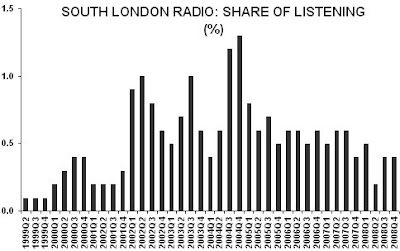
South London Radio never made an operating profit from airtime sales, not even in its earliest days. The only period of positive cashflow occurred in 2004 and 2005 when £1.7m compensation was received from its landlord when the station was forced to vacate its premises, presumably before its tenancy had expired. Ironically, this windfall was twice the size of the advertising revenues received by the station during its entire lifetime. Although, in recent years, its owner had managed to substantially reduce the station’s overheads, revenues had fallen to as little as £1,000 per week by then. There are pirate stations in South London that earn more money than that.

South London Radio’s final owner (or ‘penultimate’ owner legally) seemed to know where the blame lied for the station’s failure. In one set of Annual Accounts, its directors said:
“Despite significant investment by the management, the station has continued to perform below expectations. The impact of illegal broadcasters compromising the transmissions of this station is the main reason for the poor financial performance. The Directors are continuing to lobby the regulators in an attempt to find a solution”.

It was this lobbying by Sunrise Radio (a former pirate) of Ofcom which led to the transmitter power increase that significantly extended the station’s coverage area. Its owner then increased the survey area for the station’s RAJAR audience ratings from 304,000 to 1,472,000 adults, but the station’s weekly reach stubbornly remained at around 1%. Perhaps the owner thought that a station which claimed to reach 1.5m people across South London was more likely to find a buyer than a station that served only the relatively poor Borough of Lewisham. Whatever, South London Radio eventually closed with accumulated losses estimated at almost £2m, a figure that would have been twice the size, had it not been for the windfall settlement the station received from its previous landlord.

So it’s all over now, a sad end to Stella Headley’s dreams and also the death of what was supposed to be my local radio station. Hopefully, some lessons can be learned from this sorry tale. Some of these ‘lessons’ seem so glaringly obvious that it is almost embarrassing to point them out, but the 36-year history of commercial radio in the UK is so littered with repeated failures that it is worth spelling out some of the things that evidently went wrong. First Love Radio is just one of many local stations that have failed with both audiences and advertisers because of structural and procedural faults within the UK’s commercial radio system.

POSSIBLE LESSONS

1. CAN A DESIGNATED LOCAL MARKET SUPPORT AN ADVERTISING-FUNDED COMMERCIAL RADIO STATION?
Before advertising a new licence for a specific geographical area, the radio regulator did not evaluate whether there were sufficient local advertising revenues to support a commercial radio station for that area. This was true of Lewisham when the Radio Authority advertised this licence in 1997. A decade later, it was probably just as true of Ofcom when it awarded new licences for a talk station in Edinburgh (now closed), a rock music station in Plymouth (never opened), a station serving a population of 65,000 adults in Barrow (now closed), or a station serving a population of 30,000 adults in Northallerton (now annexed). Whether it was the Radio Authority or Ofcom, the regulator was issuing ‘licences to fail’ that never stood a chance of being successful, standalone businesses.

2. LOCAL RADIO GROUPS ARE FODDER FOR THE AMBITIONS OF COMMERCIAL RADIO GROUPS
First Love Radio is not the first local radio group to have organised short-term broadcasts in their area, organised training, raised public funds and raised local awareness of it campaign for a local station. Then, when it comes to writing the licence application, many such groups jump into bed with a commercial radio group that has no understanding of the group’s aims, the proposed station’s format, or the local marketplace. The radio group is interested in the licence, and the local group believe that such an alliance will ensure that licence will be won. An outside ‘consultant’ is brought in to write an application that is likely to win the licence, rather than an application that tells the truth.

3. NEW LOCAL COMMERCIAL RADIO LICENCES ARE AWARDED TO APPLICANTS THAT ALREADY HAVE COMMERCIAL RADIO LICENCES
To those that already have shall be given …. again and again and again. How many of Ofcom’s 39 new local radio licences between 2004 and today were awarded to applicants that did not already own a radio station? Ony one. It’s a regulatory gravy train of licence awards, which works great for those lucky few who already have a seat on the train. For those genuinely local radio groups who simply have a desire to run a radio station in their local area, the message is – you don’t stand a chance of winning a licence on your own.

4. MOST LOCAL RADIO GROUPS’ EXPERTISE IS IN COLLECTING LICENCES, NOT IN TURNING AROUND LOCAL RADIO STATIONS
As noted previously, the cost of making a licence application is usually a five-figure amount, whereas the balance sheet value of a radio licence is either a six- or seven-figure sum. The ‘business’ skill of most local radio groups has been based upon turning paper radio licence applications into valuable intangible assets to add to their balance sheets. Sadly, it has not been based upon launching successful local radio stations (‘successful’ meaning profitable), or upon turning around unsuccessful stations.

5. RADIO LICENCE APPLICATIONS ARE GENERALLY NOT GROUNDED IN REALITY
The promises made in most licence applications are mostly over-optimistic ‘waffle’. The lavish programming, the potential profitability, the audience targets – most of these are written purely to fit what the applicant radio group thinks the regulator wants to hear. Almost every licence applicant promises that its business will break-even within three years, despite evidence that there are very, very few newly-launched stations that have achieved such a performance in the last 20 years. Rule Number One of licence applications – never let the facts get in the way of a good story. As a result, the performance of most start-up stations is more than dismal. The graph below shows the percentage plus/minus achieved in hours listened versus the forecast hours listened in the station’s licence application for new local stations licensed during the last five years. Only four stations managed to beat their targets. (The crosses represent stations that have closed.)
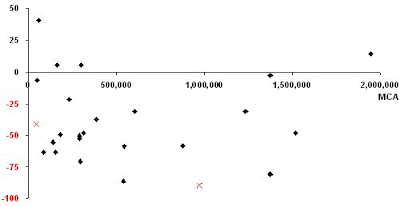
Because of the untruthfulness of most licence applications, if you were to submit a more realistic assessment of your business plan within a licence application, it would look very gloomy compared to your competitors. Do you get any credit for being realistic (i.e. honest)? No, you are unlikely to be awarded the licence.

6. THE REGULATOR DOES NOT ‘POST MORTEM’ ITS LICENSING DECISIONS
When the Independent Broadcasting Authority licensed the ‘incremental’ stations, did it publish a report to show why so many of them went out of business within their first year? No, it didn’t. When the Radio Authority licensed the ‘regional’ stations, did it publish a report to show why these stations had no impact on enabling commercial radio to be more competitive for audiences against the BBC? No, it didn’t (I did my own research). Now that Ofcom has licensed so many new local stations, has it published research to show why so many are already proving unviable and whether awarding new licences to existing licensees had proven the appropriate regulatory policy? No, it hasn’t (see research in John Myers report). In all these cases, there seems to have been no attempt to learn from past experience, and thus no attempt to assess the positives and negatives of regulatory policy. To an observer, the attitude might look remarkably like ‘OK, that didn’t really work, so let’s try something different now’.

7. A LOCAL RADIO LICENCE ONLY ACQUIRES INTRINSIC VALUE IF YOU DO SOMETHING CONSTRUCTIVE WITH IT
Local radio groups can play the game of putting inflated values for their local radio licences on their balance sheets. But unless you can actually find someone who is willing to pay that inflated price, your licence in reality is worth nothing at all. After an era of crazy acquisition prices during the 1990s, we are now in a period where there have never been so many station sellers, but almost no buyers for the majority of small local radio licences. The ‘house of cards’ that was carefully constructed over the last two decades is already falling down. The radio licence gravy train bears some similarities to the vulnerability of a Ponzi scheme. Now that Ofcom is no longer offering new local radio licences, the ability of radio groups to continue to improve their balance sheet valuations through more licence wins has ended abruptly. As a result, their existing stations are now revealed to be worth a lot on paper, but worth almost nothing in reality because there are no buyers (i.e. other local radio groups with similarly over-inflated balance sheets). The underlying fallacy of the licence award system is now revealed.

8. THE TRACK RECORD OF MOST SMALL LOCAL RADIO GROUPS IS NOT GOOD
There is simply no money to be made from owning a number of small local radio licences, unless you have proven turnaround skills. Plenty of companies have raised millions of shareholder funds, promising to return them a profit from a cluster of loss-making local radio stations. The profits never arrived. Laser Broadcasting went bust. Forever Broadcasting went bust. The Wireless Group sold out. Golden Rose sold out. Milestone sold out. The Local Radio Company is on its knees financially. You might think that this history of failures would be sufficient warning to future investors that adding X number of loss-making local commercial radio stations to Y number of loss-making local commercial radio stations does not equal profits. Apparently not.

9. THERE IS A WIDENING ‘REALITY GAP’ BETWEEN WHAT THE REGULATOR IS REGULATING ON PAPER, AND WHAT IS ACTUALLY HAPPENING IN LOCAL RADIO MARKETS
On paper, each of the UK’s 300 commercial radio stations has a distinct ‘Format’ it has to follow, theoretically offering it a unique position in its local market. In this highly regulated system, Ofcom is supposedly ensuring that a diverse range of consumer demands for radio content are being simultaneously satisfied in each market. Even a casual radio listener realises that this system is a fiction. London has a large number of local commercial stations, and many of them sound remarkably similar, despite on paper them being meant to be different from their competitors. If South London Radio had offered different content and satisfied local demand for content, it might have thrived. Despite its Yellow Card sanction, Ofcom failed to ensure that South London Radio was satisfying the demand in South London for a local, black music station.

10. THE CLOSURE OF A LOCAL STATION IS THE FAULT OF BOTH ITS OWNER AND THE REGULATOR
It is very easy for the regulator to step back and say that the commercial failure of a specific local radio station is not its responsibility because it does not interfere in the business operations of its licensees. Frankly, this is a cop-out. Eight applicants applied for the Lewisham licence awarded to South London Radio. Seven were never even given the opportunity by the regulator to create a successful local radio station. Our public servants in the regulator were supposed to use their knowledge and expertise to select the applicant that was most likely to ‘win’. Ofcom even has a web page where it explains why it selected one applicant above the others for each licence. If the regulator’s choice was misguided, mistaken or ill-informed, it should have to explain what went wrong (a bit like this blog entry?). Surely, the regulator owes such an explanation to the listeners the station was supposed to serve and also to the unsuccessful licence applicants who, as a result of the regulator’s judgement, have no ‘second chance’ to put their own proposals for a radio station into action.

11. RADIO STATION OWNERS ARE NOT REQUIRED TO SELL STATIONS, RATHER THAN CLOSE THEM
I have heard several radio group executives say that they would rather close down one of their loss-making stations than sell it for £1. There are several issues at play here. Firstly, closing a company creates an opportunity to move some liabilities from elsewhere in the group before the station is made insolvent. Secondly, radio owners don’t want the embarrassment of someone else successfully turning around a station that they had not managed to make profitable over several years. Thirdly, if an owner paid £1m for a station, it is embarrassing for the CEO to have to tell their Board that it had to be sold for £1. The end result, as in South London, is that listeners no longer have a local radio station at all, rather than the baton being passed on to someone else to try and make the business work. Again, it is the listeners and the unsuccessful licence applicants who lose out.

12. THE SCARCITY OF LOCAL RADIO LICENCES HAS TURNED THEM INTO TROPHY ASSETS
If you want to start a local newspaper, you simply start it. You don’t need a licence. If you want to start a local radio station, you cannot. You have to wait for Ofcom to decide to offer a licence for your area, then you have to apply for it, and then you have to win it. In this case, Ofcom is unlikely to offer another South London FM licence to replace South London Radio. That opportunity came and went in 1997. As a result, there are far too many owners coveting local radio licences because of their scarcity, hoping that at some point in the future a ‘white knight’ will still ride over the horizon and pay an outrageous sum for it, regardless of the fact it is losing money every year and has accumulated losses of millions. After the Communications Bill opened up UK radio ownership to non-European Union stakeholders, there were several radio owners who were waiting for a global media company such as Clear Channel to ride into town and offer them a small fortune for their failing businesses. It never happened, and sadly there was no ‘Plan B’.

13. THE LACK OF CREATIVITY IN COMMERCIAL RADIO
There is a terrible lack of creativity within the commercial radio sector that is severely holding back its ability to compete with the BBC, let alone to compete with the flood of audio content available via the internet. It is far easier for radio companies to simply do either the type of content that they have always done and/or the content that everybody else is doing, rather than to be innovative or creative. In the case of South London Radio, I understand that its owner was approached last year by at least one radio consultant (not me) with a plan to resuscitate the station by returning it to its original roots as a black music outlet. That proposal was rejected.

14. THE REGULATOR PRETENDS TO ADOPT A ‘LIGHT TOUCH’ APPROACH TO COMMERCIAL RADIO REGULATION
If the regulation of commercial radio in the UK were genuinely ‘light touch’, then it would be appropriate that the regulator makes no attempt to intervene in the failure of individual stations. However, the system of radio regulation (even under Ofcom) intervenes heavily in almost every aspect of the commercial radio landscape, down to such detail as whether a particular station can play a specific song within its output. In such a highly regulated market where Ofcom exercises such a high degree of control, the regulator should surely have a responsibility to the citizen/consumer to ensure that the relatively small number of stations it selects to license (compared to the total number of applicants) continue to exist in some shape or form. It is not consistent to intervene at every moment of a station’s existence, except when it is finally threatened with closure as a direct/indirect result of the regulatory system.

15. NO CONSULTATION WITH LOCAL STAKEHOLDERS
Ofcom makes a big noise about its consultation system and its willingness to listen to the opinions of a wide range of stakeholders. However, when a station is threatened with closure, has the regulator ever consulted with local advertisers to consider the impact on them, with local community organisations who used the station to inform the local population of their activities, or with the local population itself? Would it not be useful to talk to Stella Headley now and canvas her opinion of what precisely had gone wrong with First Love Radio since 1990 (I tried to locate her for this blog entry but failed)?

The irony of South London Radio’s closure is that, over a ten-year period, things have already gone full circle. South London Radio was born from the experiences of pirate radio in the Borough of Lewisham, and now it is the pirate stations once again that are carrying the torch for those of us living in this area of South London. There is presently a great pirate station in Lewisham that sounds like the natural successor to1980s pirate Rock 2 Rock, playing reggae and soul music for ‘big people’. I can listen to this station on FM or via the internet (telling you its name would break the law) and it entertains me in a way that the latter day South London Radio never achieved. I used to listen to Rock 2 Rock in the 1980s, and now I am listening to its successor.

First Love Radio R.I.P.

It appears that our highly regulated and interventionist commercial radio system has:
* completely failed the people who originally put the idea together for First Love Radio
* completely wasted the public money invested in training people from the local community in Lewisham to make radio programmes
* has completely failed the population of Lewisham and beyond who should have their own radio service.

These failures in public policy will continue to have to be filled (though not fully because of the threat to those involved of criminal prosecution) by the efforts of unlicensed radio stations in Lewisham. A document published by the publicly funded Creative Lewisham Agency lamented that “television and radio is a very small Creative Industries sub-sector” in the north of the Borough ….. but then it noted that pirate radio is “a contributor to the Creative economy” and “is certainly vital for networking and showcasing”. When you find public bodies extolling the citizen value of pirate radio, you know for sure that something in our radio licensing system has gone very badly wrong.

As Inspector Scratch-It recalled of his Rock 2 Rock days: “We even had links with the police and [Lewisham] Council. They used to send us information that was relevant to read out, even though we were a pirate.” Twenty years on, it is still pirate radio filling that gap.

Abbey FM – the tip of an iceberg

Nobody likes to see radio stations close. Nobody likes to see committed radio staff thrown out of their jobs. Nobody likes to see the population of a town deprived of having their own local radio station. Nobody likes to see local businesses of any type disappear.

Abbey FM in Barrow closed at 3pm yesterday after two years on-air, with six full-time staff and six freelancers made redundant. The station was jointly owned by The Local Radio Company [TLRC] (35%), CN Group (30%), and Martyn Rose Ltd. (35%).

Station manager Amanda Bell said yesterday:
This also means that Barrow will never again have its own radio station. There won’t be another licence issued for Barrow. It was very, very sudden. We had the support and backing of all three shareholders until three weeks ago, when TLRC withdrew their support, which forced the hand of the other shareholders. I was only told of their decision at 12.30pm today. We were doing extremely well and heading towards making profits until July last year and then the economic situation got worse……”

Robin Burgess, CN Group chief executive, said yesterday:
Abbey started broadcasting in late 2006 but unfortunately has never been profitable. In the present economic climate and, in particular, the effect the recession is having on media revenues, the directors saw no realistic prospect of the station getting into profit in the foreseeable future.”

But can this closure so easily be credited solely to the advertising downturn? Or is its closure a symptom of a much wider issue concerning the licensing of small commercial radio stations in the UK? Both Amanda and Robin mentioned the station’s lack of profitability – what is the real problem?

Abbey FM served an area of only 84,000 adults. It was one of the 21 local commercial radio licences that Ofcom has awarded to date which serve populations of 250,000 or fewer adults. Ofcom’s own research found that local stations serving between 50,000 and 150,000 adults make an average annual loss of £20,000. However, by continuing to licence new stations serving populations as little as 39,000 adults, Ofcom has created even more local stations that are mostly condemned never to make an operating profit. Worse, new stations tend to cannibalise the audiences of existing local commercial stations heard in the same area.

The problem is that, in its radio licensing system, both Ofcom and most of the applicants for its licences embark upon a merry dance together that has little basis in real world radio economics. Ofcom appears to advertise new licences such as Abbey FM’s without any prior analysis of whether the local economy, Barrow in this case, can produce enough new advertising revenues to support a new local station.

Licence applicants submit to Ofcom a business plan (in confidence) and the imperative is almost always to make the figures fit so that the station looks as if it will break even by the end of its third year on-air. This is the greatest stress point for truthfulness. The smaller the station, the less likely it will be (in reality) to break even in Year Three. To make this breakeven work ‘on paper’, the smaller the station, proportionately the greater its projected audience has to be (because radio is largely a fixed cost medium).


Abbey FM acknowledged in its
application that “a long-term investment strategy is what is required for this station; there are no short cuts to sustainable profitability”. However, its forecasts for the station’s performance were the outcome of market research which concluded that “66% of all radio listening adults in Barrow would be definitely, very likely or fairly likely to tune in to a new station….” The application then asserted that “a combination of experience and prudence has dictated that we forecast reach of 17% in year 1 rising to 23% by year 3”.

This is voodoo forecasting, where the audience figures are often calculated as the last part of the puzzle to be solved (after profits, revenues and costs), rather than making them the cornerstone of the business plan. This is not intended as a specific criticism of the Abbey FM application. It is an inherent failing of most radio licence applications submitted to Ofcom. The bigger problem is that, if you were to honestly appraise the potential audience of such a small station, the financial forecasts would be unlikely to ever show an operating profit. Put simply, a radio station this small is often not a going concern. Yes, Abbey FM had failed to achieve its targets, but those targets were probably fictional anyway.

However, the merry dance continues because Ofcom exists to licence new stations (even if they are likely to fail), and most radio groups think they exist to win radio licences (even if they are likely to fail). As a consequence, by opening more loss-making stations, the overall profitability of the UK commercial radio sector becomes increasingly eroded, until the profitability of an entire group is weighed down by the number of loss-making stations it is trying to support.

Ofcom often comes close to acknowledging that these small local stations are destined to fail when it explains why it has awarded their licences. For Abbey FM, Ofcom said that:
“…..the committee felt that the backing of three shareholders with, collectively, extensive and current experience of operating smaller radio stations enhanced the likely ability of Abbey FM to maintain its proposed service. The group’s business plan was considered to demonstrate a good understanding of the local market and of the issues that the new station may face, and the ability to save costs through resource-sharing with nearby stations was felt to further enhance the strength of Abbey FM’s financial proposition.”

In other words, this new station will need to be subsidised for an indeterminate number of years by other, profitable stations owned by the same group(s). This is why, almost on every occasion, new small, local stations are awarded by Ofcom to owners that already have radio stations, often in a nearby area. In Abbey FM’s case, CN Group’s station The Bay already enveloped the entire Abbey FM area. Would it not have made more sense for Ofcom to offer the citizens of Barrow a local opt-out of The Bay, so they at least would benefit from some of their own local programming? As it is, they are now left with nothing at all.

So who is to blame? Firstly, Ofcom for having advertised small local licences in the first place which are condemned never to be profitable. A business is not a business unless it covers its costs. Secondly, radio groups who (collectively) have applied for every radio licence advertised by Ofcom. There has not been a single licence, however small, that has not attracted at least one applicant. Thirdly, Ofcom (again) for not having the guts to NOT award a licence to any applicant in an area, where it is plainly obvious that none of the applicants are telling the truth in their business plans and stand almost no chance of ever making a profit. Fourthly, radio groups (again) for seeing each licence win as a way to enhance their balance sheets, regardless of whether those licences can ever be made into profitable businesses.

So the merry dance between radio owners and Ofcom (and its predecessor) has led us to where we are today. Sadly, Abbey FM is merely the first of many local stations that will have to close in 2009. This is not the way it should be. I did not spend the 1970s and 1980s campaigning for MORE local radio stations (ComCom, CRA, etc) to see them close down like this. However, I don’t know of a single, small radio group that is presently not willing to discuss selling some or all of its stations. In my own backyard, there is a local station which is likely to sell soon for £1, or close. Never before have there been so many sellers and yet a complete lack of buyers for local radio.

Abbey FM, RIP. The losers are the citizens of Barrow. The UK radio licensing system has failed them. Why does it appear that no one is willing to step forward and take responsibility (just like the financial sector) for such institutional failures?