UK listening growth demonstrates radio's strengths in a multi-tasking world

The latest RAJAR ratings data for Q2 2011 demonstrate the continuing strength of the radio medium in recession Britain. Maybe if your TV or mobile subscriptions are having to be pruned, you turn to radio instead. In times of austerity, one of radio’s greatest attributes is that it appears to consumers to be available ‘free’ at the point-of-use.

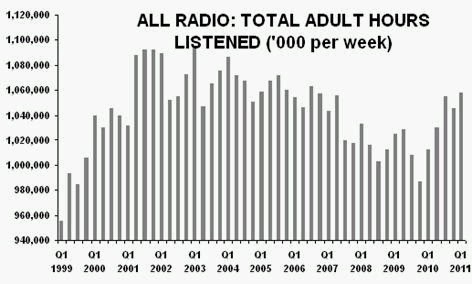
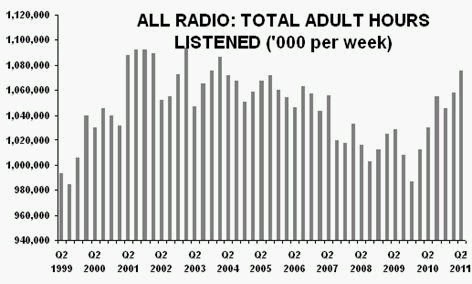
‘All radio’ listening (1,076m hours per week) is at its highest since 2003. Adult weekly reach is 91.7%. Each listener spends an average 22.6 hours per week with ‘radio.’ These are impressive numbers. In this respect, it is important to remind ourselves that the RAJAR definition of ‘radio’ excludes:
• ‘listen again’ consumption of broadcast radio (online catch-ups of ‘The Archers’, for example)
• all podcasts
• listening to pure online radio stations
• listening to online music streaming services or personalised online radio (Last.fm, Spotify, etc).

If these additional ‘radio’ consumption sources could somehow be added to the RAJAR data, it looks likely that, using a wider definition, ‘radio’ would be performing at an all-time high. This is not at all surprising in our time-precious, multi-tasking world. Radio proves the perfect aural accompaniment to online social activities, whereas it is nigh impossible to watch television or read a newspaper at the same time as you browse the internet. Radio is a secondary medium – it never monopolises your time.

Commercial radio has benefited from this uplift in total radio listening. Total hours listened to commercial radio (470m per week) have risen from what is beginning to look like a nadir in early 2010.

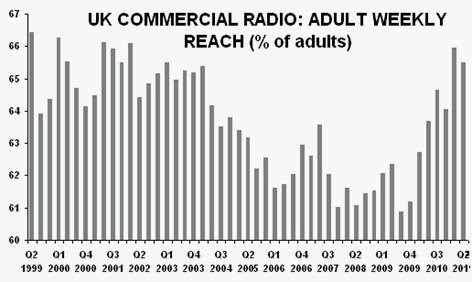
During the last two quarters, commercial radio’s adult weekly reach has jumped above the 65% threshold (65.5% in Q2 2011) that had not been breached since 2003.

In absolute terms, commercial radio’s adult weekly reach has almost caught up with the UK population growth experienced since 1999, rising to 34m in Q2 2011, marginally below its all-time high the previous quarter.

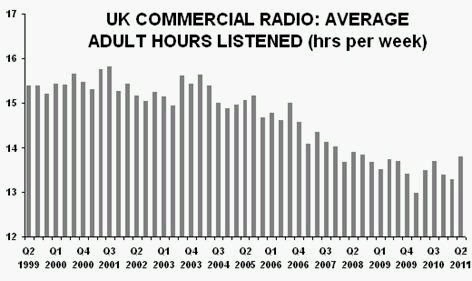
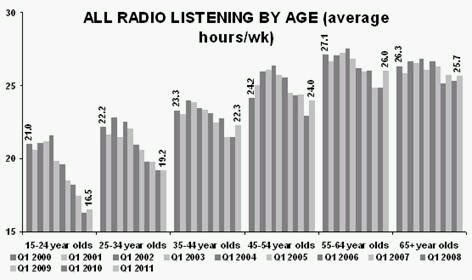
The remaining stumbling block for commercial radio is that its average hours consumed per listener remain stubbornly low (13.8 in Q2 2011). As noted previously, young people are spending less time with radio [see blog]. Commercial radio’s audence is considerably more youth-orientated than BBC radio, which is why the average length of time for all adults listening to commercial radio remains in the doldrums.

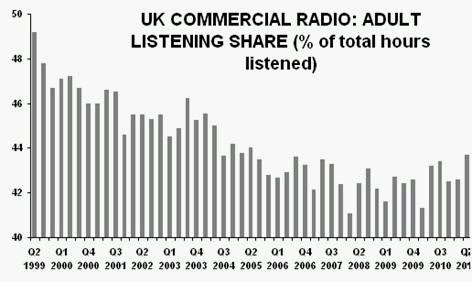
With all this good news for the commercial radio sector, you might imagine that its share of total radio listening had started gaining in leaps and bounds at the expense of the BBC. Unfortunately, this is not the case. The BBC has benefited just as much as commercial radio has from the overall increases in radio listening. As a result, everyone’s volumes are ‘up’ and the share of commercial radio versus BBC radio has remained relatively constant. In Q2 2011, commercial radio’s 43.7% share was certainly an improvement on the situation in 2008, when it had looked as if the 40% barrier might be plumbed for the first time.

In fact, the BBC’s sustained strength in radio is becoming increasingly understated as more and more ‘radio’ listening is attributable to ‘listen again’ on-demand usage and podcasts. The BBC dominates the content available on both these platforms, whilst commercial radio’s offerings remain relatively sparse. At present, neither platform is measured within RAJAR. If they were, commercial radio’s share would undoubtedly be diminished further.

At present, this status quo (using RAJAR’s anachronistic definition of ‘radio’ as purely live and broadcast) suits both parties. The BBC does not wish to be seen to be even more dominant than it already is (54.0% of radio listening in Q2 2011). Commercial radio does not wish to be seen to be weaker than it already is (43.7%) in comparison to the BBC.

And who pays for RAJAR? The BBC and commercial radio. So we are stuck with an old fashioned metric that does not measure radio consumption in the 21st century sense of what we now call ‘radio,’ but which keeps both its paymasters happy … particularly as neither the BBC nor commercial radio would currently wish to demonstrate publicly the increasing popularity of online ‘radio’ consumption – which remains the biggest long-term external threat to them both.

Andy Parfitt leaves BBC Radio 1 on a high: separating the man from the myth

Andy Parfitt’s departure from the station controller job at BBC Radio 1 after thirteen years marks a significant event for the UK radio sector. Parfitt’s accomplishments during his tenure were many, but did not extend to significantly turning around the station’s audience ratings.

At the time Parfitt took on the controller job in March 1998 at Radio 1:
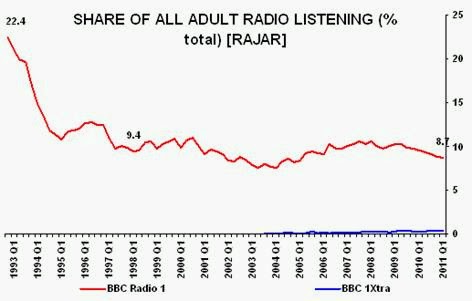
• its share of listening was 9.4%, compared to 8.7% in Q1 2011
• its adult weekly reach was 20%, compared to 23% in Q1 2011
• its average hours per listener per week were 8.1, compared to 7.8 in Q1 2011.

One metric did demonstrate a healthy increase – Radio 1’s absolute weekly reach was up from 9.7m adults in Q1 1998 to 11.8m in Q1 2011. However, part of that increase is attributable to the UK adult population having grown by 9% in the interim. Certainly, more adults listen to Radio 1 now than in 1998, but for shorter periods of time, and so the station’s share of total radio listening has declined.

Given this impasse to the improvement of Radio 1’s ratings, I was surprised to read in the BBC press release announcing Parfitt’s departure that:
“Appointed Controller, BBC Radio 1, in March 1998, Andy has led Radio 1 and 1Xtra to record audience figures …”

… and surprised to read Parfitt’s boss, Tim Davie, declaring that:
“Andy has been a fantastic Controller and leaves Radio 1 in rude health – with distinctive, high quality programmes and record listening figures …”

The one person still working at Radio 1 who should know for sure that “record audience figures” had not been achieved during the last quarter, last year, the last decade or during Parfitt’s entire tenure is Andy Parfitt. Why? Because, between 1993 and 1998, Parfitt had been chief assistant to then Radio 1 controller Matthew Bannister, a turbulent period during which the station’s audience was decimated by a misguided set of programme policies that failed miserably to connect with listeners.

Between the end of 1992 and March 1998, when Parfitt took over from Bannister (whom the BBC had promoted to director of radio), Radio 1’s:
• share of listening fell from 22.4% to 9.4%
• adult weekly reach fell from 36% to 20%
• average hours listened per week fell from 11.8 to 8.1
• absolute adult reach fell from 16.6m to 9.7m.

Radio 1 lost an incredible 58% of its listening, and 7m listeners, within that five-year period, a calamitous disaster from which the station has never recovered [see graph above]. Since then, Parfitt has kept the ship relatively steady, having been appointed in 1998 as a safe pair of BBC hands for Radio 1 after the tragedy of Bannister (who had come from Capital Radio via BBC GLR and had a fantastic track record in news radio, but not in music radio).

Never again will Radio 1 achieve a weekly audience of 17 million adults, as it had done in 1992. Those days are long gone. In recent years, fewer young people are listening to broadcast radio, and they are listening for shorter periods of time. Sadly, radio does not prove as exciting for them as the internet, games or social networking.

Of course, it would have been nice for any incumbent to leave the Radio 1 job on a ‘high.’ But, unfortunately, it was never going to happen with Parfitt, or probably with any successor. Radio 1’s ‘golden age’ was wilfully destroyed twenty years ago. Nevertheless, somewhere, somebody in the BBC must have decided to invoke the notion of Parfitt’s “record audience figures,” regardless or not of whether they were a fact.

What surprises me is that every BBC press release must have to pass through endless approvals – within the originating department, in the press office and in the lawyers’ office – before it reaches the public. Did nobody out of the dozens of people that must have checked this particular press release ask the simple question: can you substantiate this “record audience figures” claim?

RAJAR radio audience data are publicly available for all to see. Anyone from the BBC could have checked and found that, using every radio listening metric known to man, Radio 1’s “record audience figures” were all achieved two decades ago, rather than at any time during Parfitt’s tenure. Maybe they didn’t check. Or maybe they did, but pressed ahead anyway.

The ability to play fast and loose with numbers and statistics, particularly those that can be said to be at an ‘all time high,’ might appear to be endemic within the UK radio industry. I have highlighted similar instances of the industry’s abuse of statistics in other claims. Now that the consumer press only seems interested in ‘radio’ stories involving celebrities, and now that the media trade press has been reduced to recycling radio press releases, ‘myth’ can quite easily be propagated as ‘fact.’

I am reminded of a passage in my new book about KISS FM when, two decades ago, I had asked my station boss why an Evening Standard profile of him and his car had featured a vehicle that was not the one he owned or drove.

“It seemed to make a better story,” he told me.

When UK radio listening figures are this good, why does RAJAR need to fib?

It is good to know that radio is still an extremely popular medium in the UK, something borne out by the latest radio audience metrics published by industry body RAJAR for Q1 2011. However, in its determination to make every quarter’s results newsworthy, RAJAR has a track record of bending the truth to achieve press headlines [see blog May 2010]. This latest quarter was no exception.

According to the RAJAR headline:
• “Total radio listening hours reach 1,058 million per week – new record.”^

RAJAR explained:
• “The total number of radio listening hours broke all previous records to reach 1,058 hours per week …”^

Fantastic news! Except that this is not at all true. RAJAR’s own historical data tell a different story:
• 1,088 million hours per week in Q2 2001
• 1,092 million hours per week in Q3 2001
• 1,092 million hours per week in Q4 2001
• 1,090 million hours per week in Q1 2002
• 1,072 million hours per week in Q4 2002
• 1,094 million hours per week in Q1 2003
• 1,066 million hours per week in Q3 2003
• 1,076 million hours per week in Q4 2003
• 1,086 million hours per week in Q1 2004
• 1,072 million hours per week in Q2 2004
• 1,068 million hours per week in Q3 2004
• 1,059 million hours per week in Q1 2005
• 1,068 million hours per week in Q2 2005
• 1,072 million hours per week in Q3 2005
• 1,060 million hours per week in Q4 2005
• 1,063 million hours per week in Q3 2006

During sixteen quarters between 2001 and 2006, total hours listened to radio were greater than they were last quarter. “New record?” No. “Broke all records”? Er, no.

The reality is that total radio listening has not yet returned to the level it had achieved in 2001. Except that, ten years ago, the UK adult population was 48.1 million, whereas now it is 51.6 million. So the population has increased by 7% over the last decade. Yet total UK radio listening is still less than it was then.

Most statisticians I know would refer to that as a like-for-like 7%+ decline in total hours listened to radio. However, to RAJAR, it is evidently a “new record” that “broke all previous records.”

Why does any of this matter? Because radio broadcasters have been progressively losing usage over most of the last decade. Initially, it was 15-24 year olds that were spending less time with radio. Increasingly, it is also 25-34 year olds. For a decade, the UK radio industry has desperately needed a coherent strategy to reverse this loss of listening. The decline in young adult listening to broadcast radio does not merely impact the NOW. If these consumers do not find anything in their youth worth listening to on the radio, they will grow old without the radio habit. Their radio listening patterns NOW are likely to influence radio listening for the next half-century.

This is why RAJAR’s continuing efforts to achieve yet another headline in the Daily Mail proclaiming “Radio listening at an all time high” are ultimately redundant. Those headlines do not impact the reality of the data collected from tens of thousands of radio listeners every month. Those data show incontrovertibly that listening is in significant long-term decline amongst younger demographics. And radio will be in mortal danger if it does not re-invent itself for the next generation.

You only have to listen to any pirate radio station in London to understand that the gulf between what young people are actually listening to and what the old fogies who run UK radio are giving them has never been wider. Chris Moyles is as passé as Dave Lee Travis was twenty years ago.

So, yes, RAJAR’s fibs and the resulting Daily Mail headline will be another opportunity for champagne corks to pop in radio boardrooms across the land. But if radio doesn’t start making itself exciting and relevant to young people, broadcast radio’s future role will be relegated to a soundtrack in old people’s homes. Complacency such as that propagated by RAJAR will only make many radio businesses redundant in the long run.

^ in a footnote this small, the RAJAR press release admits the caveat “since new methodology was introduced in Q2, 2007.”

DAB radio usage: going nowhere slowly

Sometimes it seems as if the UK radio industry operates in two parallel universes. On the one hand, there is the virtual world of the DAB radio lobbyists, a reality that only seems to exist within the confines of their Soho office and its funders. On the other hand, there is the real world of the 47 million people in the UK who listen to the industry’s radio stations each week, spread far and wide across this green and still largely analogue land.

It was only last week that Ford Ennals, chief executive of Digital Radio UK, was telling anybody who would listen that:

· “There is now real momentum in the transition to digital radio…”
· “… significant progress towards building momentum for digital radio…”
· Digital radio switchover is a “matter of when, not if”
· “We have set a course to double listening and expand coverage by 2013, and to switchover by the end of 2015”
· “We do believe it is possible to get there in the four- to five-year time period…”

Yet, today, RAJAR published the latest listening figures for UK radio. None of Ennals’ statements are in any way supported by the official radio listening data. “Momentum”? No. “Real momentum”? No. “To double [digital] listening by 2013”? You have to be joking.


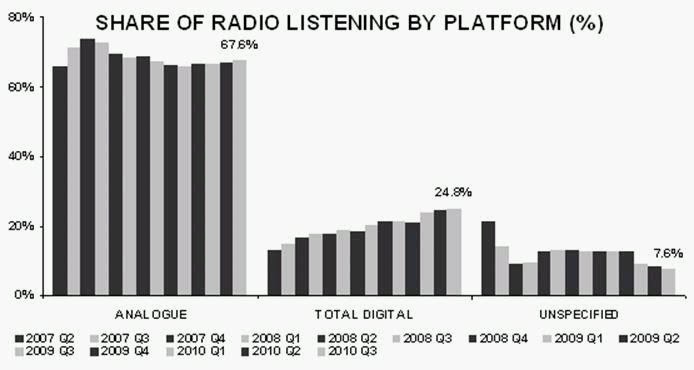
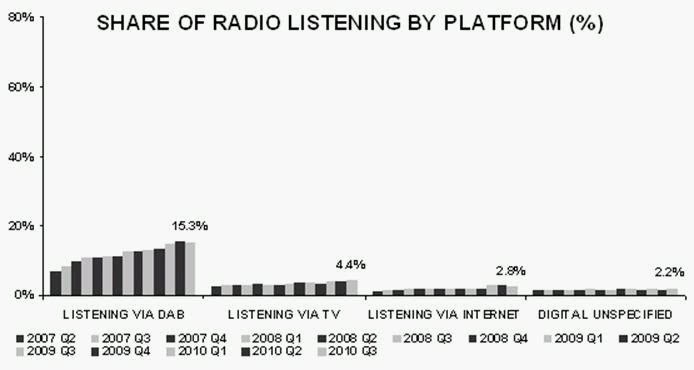
The headlines for all radio listening via platforms in Q3 2010 were:
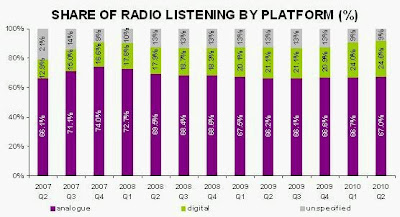
· Analogue radio’s share of listening up from 67.0% to 67.6% quarter-on quarter
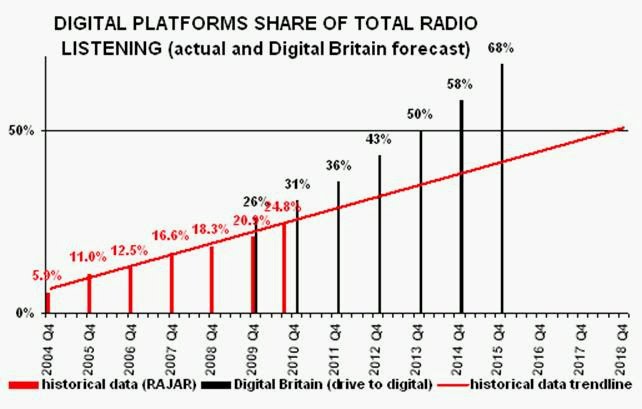
· Digital radio’s share of listening up from 24.6% to 24.8% quarter-on-quarter
· DAB radio’s share of listening down from 15.8% to 15.3% quarter-on-quarter.


At its current long-term growth rate, the government criterion of 50% of radio listening via digital platforms would not be achieved until year-end 2018. The statistical probability of that 50% threshold being reached by 2013, the achievement of which Ennals is supremely confident, is zero. Even Derren Brown could not pull off that stunt.


And so these two radio worlds continue on their parallel paths. Digital Radio UK continues to insist that everything in the digital radio switchover garden is sweetness and light, whilst wilfully oblivious to the fact that the majority of radio listeners simply could not care less about DAB – even after more than a decade of being told by the government, Ofcom and the largest broadcasters that DAB is ‘the future of radio’.

The verdict of UK radio listeners on DAB seems perfectly transparent in the RAJAR data, though many in the radio industry still refuse to listen. On the other hand, the activities of Digital Radio UK, still trying to persuade us of DAB’s virtues, are anything but transparent. After 10 months of existence, its web site remains empty. And the web site of its forerunner, the Digital Radio Development Bureau, has been conveniently deleted so that all the empty promises, inaccurate forecasts and ridiculous propaganda that were generated about DAB over the last eight years are no longer publicly available.

Those with experience in the radio industry understand perfectly what happens to radio stations that refuse to listen to their listeners, radio stations that refuse to engage in truthful dialogue with their audience, and radio stations that are still broadcasting exactly the same tired messages as they did a decade ago. They die … and nobody misses them when they are gone.

Without local commercial radio, switchover to DAB will not happen

I am often asked why I believe that digital radio switchover will never happen in the UK. My answer is always this – the available statistics and data on consumer take-up of DAB radio fail to demonstrate that it will grow sufficiently to become the mass medium for radio broadcasting. I can see nothing in more than a decade of figures to offer an inkling that DAB radio will ever become anything more than a minority interest, compared to FM/AM.

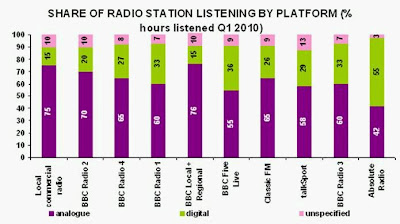
Audience data published by Ofcom in its latest Communications Market report (page 219, Figure 3.34) help us to understand the current roadblock with DAB consumer take-up. Ofcom divulged the proportion of listening to individual stations by platform, data that has not been made public by RAJAR (see graph below).

The information demonstrates that a few stations, notably AM broadcasters BBC Five Live and Absolute Radio, are making significant headway with attracting audiences on digital platforms. However, in order to put these data in a market perspective, it is necessary to understand the relative importance of each of these stations.

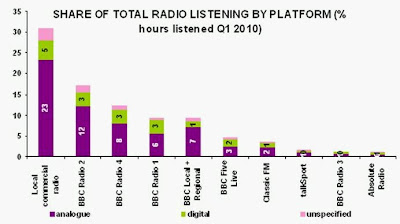
The above graph helps put the planned transition from analogue to digital in a proper market perspective. For example, Absolute Radio has made much of the fact that more than 50% of its listening is already attributed to digital platforms. However, in the context of digital radio switchover, its audience is so small that it has little overall impact. The volume of listening to some local London stations is greater than to national Absolute Radio.

The government has stated that it will not consider ‘switchover’ until at least 50% of radio listening is via digital platforms. Digital listening to the ten stations and station types shown in the above graph add up to only 20%, even after ten years of DAB (digital-only stations bring the total to 24%). There is a reason that it will prove an impossible challenge to get this up to the 50% government target.

Around 300 local commercial radio stations account for 31% of all radio listening. Their success in convincing audiences to migrate to digital platforms will be a vitally important part of the aim to achieve the 50% criterion. However, only 15% of local commercial radio listening is attributed to digital platforms, the lowest proportion (along with BBC local radio) of the ten stations/types in the graph. The task to improve this performance from 15% to the 24% national average is likely to prove impossible, let alone to grow it to the 50% criterion.

This is because many stations in the local commercial radio sector cannot and will not ever be available on DAB because:
• The economics of DAB transmission make it too costly
• The unavailability of any local DAB multiplex in some areas
• The unavailability of space for stations on some local DAB multiplexes
• The industry grand plan to amalgamate existing local multiplexes into regional multiplexes makes DAB transmission, for small local radio stations, more irrelevant and more costly.

These issues had been identified by the government in its Digital Britain consultation in June 2009:
• “merging [DAB] multiplexes will reduce the overall capacity available for DAB services, therefore reducing the potential for new services”
• “reduced capacity on local multiplexes might result in some services losing their current carriage on DAB.”

The government’s decision to ignore these outcomes is now coming back to bite it on the bum. Not having a plan to ensure that all local commercial radio stations can be made available on DAB will only ensure that the government’s 50% criterion can never be met.

At the same time, the determination of the largest players in the commercial radio sector to forge ahead with DAB, regardless of these unresolved issues, has created a serious schism between them and the smaller local radio groups and independent local stations who have no digital future. These issues were raised in parliamentary debate of the Digital Economy Act but were ignored and trivialised by the DAB lobbyists.

Some local commercial radio owners are seriously alienated by the way their predicaments have been ignored by large radio groups and their trade organisations – RadioCentre, Digital Radio Development Bureau and Digital Radio UK. One such group owner, UKRD, has taken direct action by running a campaign on-air and on its stations’ websites against the government’s proposed switchover to DAB.

A page entitled ‘Love FM’ on the Wessex FM website says:

“As you probably know Wessex FM proudly broadcasts to this area on the FM frequencies 96 & 97.2, and had been hoping to for many years to come. However, recent developments mean that we may not be able to broadcast in this way for much longer. In fact, the current plan from parliament is to switch off the use of FM for many stations in 2015. That means, soon, you may not be able to listen to us on FM.”

William Rogers, UKRD Group chief executive officer explained:

“We are not prepared to encourage any of our listeners to go and replace their perfectly satisfactory analogue radio set with a DAB one which may not be able to pick up a DAB signal at all and if it can, it may be a signal which may be wholly inadequate. Even worse, the very station that the listener may have heard the [DAB marketing] advertisement on may not be on DAB or even have a DAB future.”

Pam Lawton, managing director of another UKRD-owned station, KL.FM in King’s Lynn, said:

“We are not on DAB at the moment and currently most of the DAB digital platforms have been snapped up. As things stand, West Norfolk does not have a digital platform because there are limitations about how many there can be and there will only be one station that will serve Norfolk. That station will probably be based in Norwich so once the government decides to turn off FM, we will have to switch off for good.”

The paradox is that the radio sector stakeholders who have been pushed aside and ignored by the DAB movers and shakers are some of the very ones who hold the key to enabling digital radio switchover to happen. Unless the huge audience for local commercial radio can be persuaded to migrate its listening to DAB, the 50% criterion cannot be achieved.

At the same time, some stakeholders who are making the most noise about DAB switchover matter the least in the scheme of things. Absolute Radio can trumpet its individual success with digital listening, but it is contributing less than 1% to the 50% criterion that has to be reached, despite being a national station. It is the hundreds of local commercial radio stations that, collectively, matter the most. Yet, many of these have been denied any seat at the DAB table.

As politicians have learnt through the ages, unless you can convince the little guys (the local radio station owners) and the ‘man in the street’ (the radio listener) to endorse your grand scheme, a scheme is all it will remain. Fancy words in boardrooms, lengthy documents from corporate consultants and detailed project management timelines will inevitably come to nothing, without involving and bringing on board the people who really matter.

It is the radio industry data, particularly for local radio, that tell the real story of DAB and why it can never become the mass radio medium for UK consumers. That is why digital radio switchover will not happen.

[all RAJAR data are Q1 2010, as used by Ofcom]

Back to the future of radio – the FM band

Help seemed to have arrived for those consumers who are confused by the contradictory messages they are receiving about DAB radio, digital switchover and the future of FM/AM radio. The government created a ‘hot topic’ web page that addresses these issues in the form of a ‘FAQ’. Does it help clarify things?

The government FAQ states:
“We support 2015 as a target date for digital radio switchover” but, in the next sentence, it says that 2015 is “not the date for digital radio switchover”
“FM will not be ‘switched off’ … and will continue for as long as it is needed and viable” but then it fails to explain the reason the government is calling it ‘switchover’
“We believe digital radio has the potential to offer far greater choice and content to listeners” but then it asserts that “quite simply the listener is at the heart of this [switchover] process”
“11 million DAB sets [have] already [been] sold” but, in the next sentence, it deliberately confuses ‘DAB radio’ with ‘digital radio’ which, it states, “accounts for around a quarter of all radio listening” [DAB accounts for only 16% of all radio listening]
“Car manufacturers have committed to fit DAB as standard in all new cars by 2013” but it does not explain that only 1% of cars currently have DAB radio
“Some parts of the country are not served well by DAB” but it then admits that “switchover can only occur when DAB coverage matches [existing] FM [coverage].”

Well, that makes everything crystal clear now. Switchover is not switchover. 2015 is the date but is not the date. It is the government that is insisting upon digital ‘switchover’ but it is a consumer-led process. Almost no cars have DAB now but, in 2+ years’ time, magically they all will. In parts of the UK, DAB reception is rubbish or non-existent, but ‘switchover’ will not happen until somebody spends even more money to make DAB coverage as good as FM … even though FM is already serving consumers perfectly well.

Sorry, what was the point of DAB?

While the UK government ties itself in increasingly tighter knots trying to explain the unexplainable, and to justify the unjustifiable, most of the rest of the world carries on regardless, inhabiting reality rather than a fictional radio future. In May 2010, a meeting in St Petersburg of the European Conference of Postal & Telecommunications Administrations considered the future usage of the FM radio waveband [which it refers to as ‘Band II’] in Europe. Its report stated:

“Band II is currently the de facto analogue radio broadcasting band, due to its excellent combination of coverage, quality and low cost nature both in terms of current networks available and receivers in the market. It is well suited to local, regional and national programming and has been successfully used for over forty years now. FM receivers are part of our daily lives and millions of them populate our households. FM radios are cheap to manufacture and for the car industry FM still represents the most important medium for audio entertainment.”

Its report concluded that:
• “Band II is heavily used in all European countries
• For the current situation the FM services are still considered as satisfactory from the point of sound quality but the lack of frequencies hinders further development
• There are no wide-spread plans or strategies for the introduction of digital broadcasting in Band II
• No defined final switch-off dates are given so far.”

Two paragraphs in the 28-page report seemed to sum up the present UK situation:

“The FM band’s ability to provide high-quality stereo audio, the extremely high levels of receiver penetration and the relative scarcity of spectrum in the band combine to make this frequency band extremely valuable for broadcasters.”

“As FM in Band II is currently, and for the foreseeable future, the broadcasting system supporting the only viable business model for radio (free-to-air) in most European countries, no universal switch-off date for analogue services in Band II can be considered.”

In the UK, we have just seen how “extremely valuable” FM radio licences still are to their owners. Global Radio was prepared to promise DAB heaven and earth to Lord Carter to ensure that a clause guaranteeing automatic renewal of its national Classic FM licence was inserted into the Digital Economy Act 2010. It got what it wanted and therefore avoided a public auction of this licence. Then, when expected to demonstrate its faith in the DAB platform, Global sold off its majority shareholding in the national DAB licence and all its wholly-owned local DAB licences.

Now the boot is on the other foot. Having succeeded in persuading the government to change primary legislation to let it keep commercial radio’s most valuable FM licence for a further seven years, Global Radio has now had to argue to Ofcom that analogue licences will become almost worthless in radio’s digital future. Why? In order to minimise the future Ofcom fee for its Classic FM licence. The duplicity is breathtaking.

When it last reviewed its fee for the Classic FM licence in 2006, Ofcom reduced the price massively because, it explained, it took

“the view that the growth of digital forms of distribution meant that the value associated with what was considered to be the principal right attached to the licence – the privileged access to scarce analogue spectrum – was in decline.”

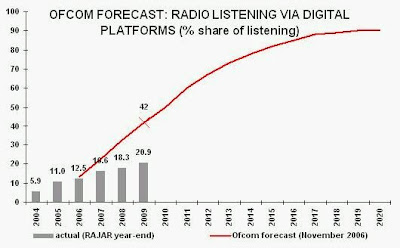
In 2006, Ofcom had published a forecast for the growth of digital radio platforms which has since proven to have been wildly over-optimistic. It had predicted that 42% of listening would be digital by year-end 2009, whereas the outcome was 21%. In 2006, as a result of the steep decline it was forecasting in analogue radio’s usage, Ofcom reduced the cost of Classic FM’s licence fee by 95% from £1,000,000 to £50,000 per annum (an additional levy on the station’s revenues was also reduced from 14% to 6% per annum). The losers were UK taxpayers – the licence fees collected by Ofcom are remitted to the Treasury. The winners were Classic FM’s shareholders, who were gifted a cash cow by Ofcom bureaucrats who misunderstood the radio market.

Fast forward to 2010, and Ofcom is undertaking yet another valuation of how much Classic FM (plus the two national AM commercial stations) will pay during the seven years of its new licence, following the expiry of the current one in September 2011. Has Ofcom apologised for getting its sums so badly wrong in 2006? Of course not. Will it make a more realistic go of it this time around? Well, the signs are not good.

In its consultation document on this issue, Ofcom has repeated the same errors it made in other recent publications about the take-up of digital radio. In Figure 1, Ofcom claims that analogue platforms’ share of all radio listening has fallen from 87% in 2007 to 76% in 2010. This is untrue. As noted in my previous blog entry, listening to analogue radio has remained remarkably static over this time period. Ofcom’s graph has completely ignored the existence of ‘unspecified’ platform listening, the volume of which has varied significantly in different surveys. The graph below plots the actual numbers from industry RAJAR data.

Exactly the same issue impacts the accuracy of Figure 3 in the Ofcom consultation, which purports to show that analogue listening to Classic FM fell from 86% to 72% between 2007 and 2010. Once again, this must be factually wrong. Once again, the volume of ‘unspecified’ listening to Classic FM has simply been ignored and the decline of analogue listening to Classic FM has probably been overstated by Ofcom.

Confusingly, the platform data for Classic FM cited in Figure 3 differ from data in a different Ofcom document [Figure 3.34 on page 33 of The Communications Market 2010] which state that, in Q1 2010, 65% of listening to Classic FM was via analogue, 26% was via digital and 9% was unspecified. In Figure 3, the values for the same quarter are stated as 72%, 28% and 0% respectively. It is impossible for both assertions to be correct.

These inaccuracies have the impact of painting a quite different picture of Classic FM’s transition from analogue to digital listening than the market reality. These matters are not academic. They will have a direct and significant impact on the perceived value of the Classic FM licence over the duration of its next seven-year period. Sensible decisions about the value of the station’s licence cannot be made on the basis of factually inaccurate market data published by Ofcom.

Undeniably, Ofcom is between a rock and a hard place:
• An admittance that, in 2006, Ofcom got its digital radio forecast and its sums badly wrong and, as a result, has already lost the Treasury millions of pounds in radio licence fees, would require humility (and humiliation)
• Not admitting that, in 2006, Ofcom got it wrong would necessitate it to now fix the Classic FM licence fee at the same low rate as in 2006, or even lower, denying the Treasury millions more in lost revenue between 2011 and 2018
• Increasing the cost of Classic FM’s licence fee would be a tacit admittance by Ofcom that its entire DAB ‘future of radio’ policy is simply not becoming reality and that FM spectrum will still remain “extremely valuable for broadcasters”.

In 2006, the low valuation of Classic FM’s licence fee was built upon a top-down bureaucratic strategy which insisted that the UK radio industry was ‘going digital’, whether or not consumers wanted to or not. Now, it is even more evident than it was then that consumers are not taking up DAB radio at a rate that will ever lead to ‘digital switchover’ (whatever that phrase might mean).

However, reading the Ofcom consultation document, it is also evident that the regulator remains wedded to its digital radio policy, however unrealistic:

“We consider that this [Digital Radio] Action Plan is relevant when considering future trends in the amount of digital listening since it represents an ambition on behalf of the industry and Government to increase the amount of digital listening in the next few years.”

In the real world, Classic FM’s owner understands precisely what the international delegations who met in St Petersburg also knew – FM will remain the dominant broadcast platform for radio. Only the UK government and Ofcom seem not to accept this reality, still trying to go their own merry way, while the rest of Europe has already acknowledged at this meeting that:

• The FM band is “extremely valuable for broadcasters”
• The FM band is “currently, and for the foreseeable future, the broadcasting system supporting the only viable business model for radio (free-to-air) in most European countries”
• “No universal switch-off date for analogue services in Band II can be considered.”

[thanks to Eivind Engberg]

UK commercial radio audiences: one swallow doesn’t make “long-term and sustained growth”

UK commercial radio has been in the doldrums for the last decade. Its audiences have been battered by competition from the BBC, revenues have been declining, and some local stations have been forced to close or merge (sorry, ‘co-locate’). So, when a piece of good news comes along, it is natural that it will be celebrated. The latest RAJAR audience survey for Q2 2010 provided just one such fillip of positivity for the commercial radio sector. But, sometimes, what should have been a small private party gets turned into a showy public display of excess by the celebrants.

This appears to have been the case with commercial radio’s take on its latest audience figures. Maybe it was the effects of too much champagne, but the RadioCentre press release stated:

“This is a fantastic set of results for the commercial radio sector showing long-term and sustained growth by every measure.”

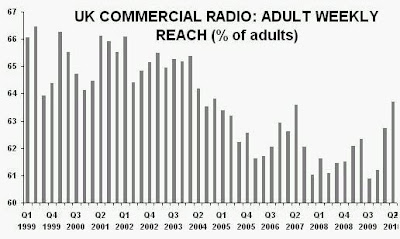
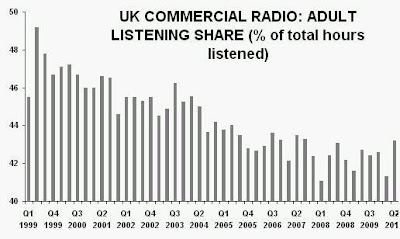
This might have been an appropriate thing to say to a roomful of cheering partygoers but, in the sober light of day, sticking this claim in a press release was bound to invite closer scrutiny. In the following graphs, the main RAJAR metrics for UK commercial radio are put in historical perspective. In these graphs, we are seeking what RadioCentre told us is “long-term and sustained growth” in “every measure.”

UK commercial radio adult weekly reach hit an all-time low of 60.9% as recently as Q3 2009, then subsequently made gains in three consecutive quarters to 63.7% in Q2 2010. Growth? Yes (three consecutive quarters). Sustained growth? Not really. Long-term growth? No.

UK commercial radio total adult listening hit an all-time low the previous quarter (Q1 2010) of 419m hours per week, then bounced back in Q2 2010 to 445m hours per week. Growth? Yes (one quarter). Sustained growth? No. Long-term growth? No.

UK commercial radio average hours listened per adult listener hit an all-time low of 13.0 hours per week the previous quarter (Q1 2010), then bounced back in Q2 2010 to 13.5 hours per week. Growth? Yes (one quarter). Sustained growth? No. Long-term growth? No.

UK commercial radio’s share of adult listening hit an all-time low of 41.1% in Q1 2008 and, since then, has bounced up and down. Last quarter (Q1 2010), it had hit its second lowest level ever (41.3%) before rebounding to 43.2% in Q2 2010. Growth? Yes (one quarter). Sustained growth? No. Long-term growth? No.

UK commercial radio absolute adult reach is the only metric that is presently at an all-time high of 32.9m adults per week in Q2 2010. It jumped up that quarter because once a year, in Q2, RAJAR increases all its adult totals to account for the 1% per annum UK population increase. It is positive that more people are listening to commercial radio but, at the same time, as the result of population growth there are also more people listening to BBC radio, and more people not listening to radio at all. However, commercial radio’s absolute reach has not grown sufficiently in the long term to even keep pace with the increasing UK population.

So, in total, it seems impossible to locate commercial radio’s “long-term and sustained growth” in the latest RAJAR data. I point out these facts because I want to see commercial radio succeed. The sector desperately needs to attract more hours listened in the long term if it is to improve revenues and return to profitability. This has not yet happened. There is no point pretending that it has.

As for RadioCentre, an inaccurate statement of fact is an inaccurate statement of fact is an inaccurate statement of fact. Telling the world that your industry is enjoying “long-term and sustained growth” might be good propaganda for rallying your troops, but surely it must undermine the commercial radio industry trade body’s credibility with the rest of the world if it clearly is not true.

What is to be achieved for the radio sector by the RadioCentre press release crossing that line between hype and untruth?

DAB radio: a national platform that no one wanted

In 1998, the Radio Authority advertised a licence for the “first and only national commercial digital [DAB] multiplex licence.” There was no stampede of applicants. By June 1998, the regulator had to issue a press release with the headline “Radio Authority receives one application ….” The sole applicant was ‘Digital One’, 57% of which was owned by commercial radio’s GWR Group plc, whose chief executive Ralph Bernard later admitted:

“GWR was encouraged to apply for the national [DAB multiplex] licence and was under some pressure to invest in the opportunities for a national licence from the then regulator. Had we not done it, there would be no national DAB platform now. Not only that, [the regulator] did not know what they would have done on the question of national radio stations with regard to the opportunities given by the then government to renew their national licences for a further period of time if they were to commit to going digital. But how can you [do that] if there are no opportunities to go digital because there is no national multiplex? When I put that question to the Radio Authority, I was told that the answer was: ‘We don’t know what would happen – there is no Plan B’. It was just an assumption that someone would go for [the national multiplex].”

Bernard had a hard time convincing his own board that the DAB licence was a worthwhile investment for a radio group that, until then, had owned radio stations rather than transmission infrastructure:

“When we were seduced into believing that this was going to be the only [national DAB] licence, we realised that there would be substantial losses, but the payback would be when you have the opportunity to be the only player in the national market for DAB. When it’s the Radio Authority, an agency of government, you tend to believe what you are told. On that basis, the investment was justified and, at the time, getting it through my Board was not easy. Persuading shareholders, particularly the larger ones, was not easy.”

Now, twelve years later, GWR Group no longer exists, Ralph Bernard is out of the commercial radio business, but the ‘Digital One’ national DAB platform is still there. Nobody really wanted it in 1998, and nobody really seems to want it now. Its ownership has changed hands like pass-the-parcel, GWR Group plc having merged into GCap Media plc, which was then sold to Global Radio which, in 2009, sold its majority stake in Digital One to transmission provider Arqiva. How many millions were thrown at Digital One over the years by GWR, GCap and Global Radio will probably never be known.

The only thing cheap about Digital One was the cost of its initial 12-year licence, a mere £10,000 per annum paid to the regulator for the radio spectrum it uses. The business model was that Digital One would lease space on the DAB platform to radio stations that would pay it rent (about £1m per year, dependent upon audio quality). Since opening for business in 1999, many digital-only stations have tried using the platform but, to date, almost none have stuck around. No digital radio station has yet made a profit.

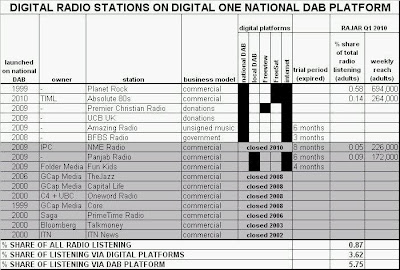
The latest additions to the lengthening list of stations that have failed to make the national DAB platform work for them are NME Radio and Panjab Radio, both of which quit Digital One in June 2010 (see shaded area of table). The reason? Almost no one was listening. Add together the digital-only stations broadcasting on the platform last quarter (and that are measured by RAJAR) and, in total, they accounted for less than 1% of total radio listening.

Yet the radio industry, the receiver manufacturers and their lobby groups are still spending money on campaigns to convince the public that DAB radio is a raging success. Digital One says its radio platform reaches “more than 90%” of the [UK] population,” equivalent to 46m adults. RAJAR tells us that 35% of those adults have a DAB radio. Yet only 226,000 adults per week listened to NME Radio, after nearly two years on-air. If you were in any way persuaded to believe the hype surrounding DAB, your business plan to start a digital radio station might look dangerously over-optimistic.
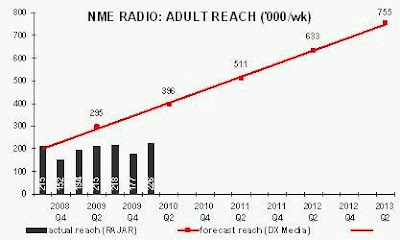
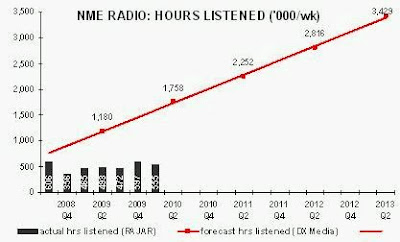
When NME Radio launched in June 2008, it had forecast that its audience would reach 396,000 adults per week by its second year. For most of its life, the station was broadcast on local DAB multiplexes (and online). Then, from 21 December 2009, NME Radio was made available nationally on DAB for an eight-month trial. Broadcasting to a much bigger potential audience, there should have been a positive uplift to the station’s performance in Q1 2010. However, there was no noticeable impact upon adult reach (226,000) or hours listened.

In its forecasts, NME Radio had projected that DAB would be “53%” by 2010. Maybe this referred to Ofcom’s forecast that, by year-end 2010, digital platforms (not DAB alone) would account for 50% of all radio listening. In fact, in Q1 2010, only 15% of listening to all radio was via DAB, and 24% was via all digital platforms (worse for commercial radio at 12% and 23% respectively). Ofcom’s forecast of how digital radio usage would grow was disastrously inaccurate. NME Radio did not stand a chance of commercial success using DAB.

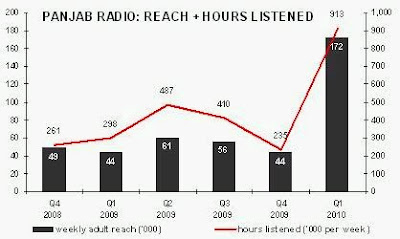
The other digital radio station that quit the national DAB platform in June 2010 was Panjab Radio. Like NME Radio, it had broadcast via local DAB multiplexes (and online), but was then made available nationally on DAB for a six-month trial from 1 December 2009.

There was no lift to Panjab Radio’s audience in Q4 2009, but the following quarter saw a noticeable increase to 172,000 adult reach and 913,000 hours listened per week. This was almost twice the amount of listening that NME Radio recorded on the national DAB platform, a real achievement for an ethnic radio station.

The day Panjab Radio had joined the national DAB platform, Digital One operations director Glyn Jones said:

“Like Premier Christian Radio and UCB UK, Panjab Radio relied on a fund-raising appeal to pay for the launch of the station. It’s interesting to see the growth of listener-supported stations, and the way they’re extending the range and choice of stations on air via digital radio. These are stations that neither a traditional commercial model nor the BBC have chosen to provide, but which listeners value so much that they’re prepared to help pay for them out of their own pockets.”

The sub-text was that the Digital One national DAB platform cannot support a commercial digital-only radio station because the financial returns are simply insufficient to cover the expense for it to lease space on the platform. If Panjab Radio had managed to sell advertising at the average commercial radio sector rate, it should have generated £1m per annum of revenue. However, an industry study in 2009 found that the average digital radio station generated only £130,000 revenue per annum (and Panjab Radio attracted less listening than others).

When Panjab Radio quit the national DAB platform in June 2010, Digital One’s Glyn Jones issued a press release that seemed over-eager to deflect the blame:

“Panjab Radio’s revenues come from a mix of traditional radio advertising plus fund raising among Britain’s Panjabi and Sikh communities. Following a strategic and financial review the station opted to end its national transmissions but to continue to broadcast on DAB digital radio in three parts of the country with significant concentrations of the target audience – the West Midlands, West Yorkshire and London.”

As the table above demonstrates, the national DAB platform’s history is littered with commercial digital radio stations that failed to make it work for them. Most of the stations currently on the national DAB platform are non-commercial and so do not need to meet their costs from advertising revenues. But religious stations, army radio and unsigned artists do not come close to the mass market purpose for which the platform was originally envisaged. Did GWR Group make its substantial investment in national DAB in the expectation that, after a decade, the platform would be filled with subsidised radio stations attracting tiny audiences?

Two years ago, I had written:

“This sudden flowering of ethnic, religious and publicly-funded radio stations on the DAB platform echoes the fate of the ‘AM’ waveband in the 1990s … The ‘DAB’ platform of 2008, particularly in London, is already starting to resemble the ‘AM’ platform of 1998, suggesting that ‘DAB’ might have already been written off by the sector as a means to reach the ‘mass market’ audiences that national advertisers desire from the medium.”

Since then, this desperate filling of DAB multiplex capacity with non-commercial stations has spread from London to the national platform. Bizarrely, given the overwhelming empirical evidence that this “first and only national commercial” DAB platform is not working, even after a decade of operation, Ofcom is keen to create a second quasi-national DAB platform. Its rationale is that:

“This could help to facilitate the creation of national commercial radio stations to create a consumer proposition analogous to that of Freeview: a wide range of popular and niche services, delivered digitally” because “we believe DAB still offers the best solution for the future growth of radio in the UK.”

This nonsense was written in an Ofcom report less than a year ago, when the writing on the wall could not have been larger that the national DAB platform’s future for commercial radio was doomed. Surely, a regulator that refuses to deal with the reality of the here and now could be a regulator that will eventually find it has no future. For years, Ofcom (and its predecessor) have led the commercial radio sector a merry dance down a DAB blind alley that has proven almost fatal to the industry’s economic health.

If Ofcom publishes one more policy document proclaiming (as if it were still 1998) that ‘the future of radio’ is DAB, rather than it working to bang industry heads together to find a practical route out of the present mess, all it will succeed in doing is writing its own epitaph.

What is RAJAR’s function? Cheerleader or research bureau?

This week’s publication of the latest UK radio listening figures begs the question as to what RAJAR’s function is:

• Is RAJAR a cheerleader for radio, to convince Licence Fee payers and advertisers how successful radio is? Or,
• Is RAJAR a serious research agency providing objective data to advertisers and advertising agencies about radio audiences?

I ask because this week’s media coverage of the latest RAJAR results seemed to result entirely from the cheerleader role, while the objective data role was nowhere to be seen.

The Guardian headline said: “Radio’s booming”. The BBC News headline said: “Radio listening soars”. The Media Week headline said: “Radio industry buoyed by strong Q1”. The Drum headline said: “All time radio high”.

So the radio sector is apparently performing better than ever? Well, if you believe the opening statements of the RAJAR press release:
• “Radio listening reaches an all time high as 46.5 million adults tune in to radio”
• “Radio listening in the UK has reached an all time high as 46.5 million adults, or 90.6% of the UK population (15+), tuned in to their favourite radio station each week”

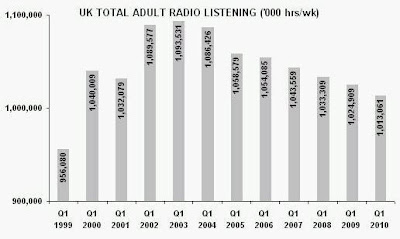
The question is: who is this press release for? Certainly, it is not for the people who use RAJAR data for their work – buyers in advertising agencies and advertisers – who know from their daily examination of the detailed numbers that “radio listening” is certainly not at all at an all-time high. Rather, the volume of radio listening has been in decline since 2003, a long-term trend that shows no sign of abating.

The RAJAR press release is deliberately misleading in its use of wording. This is by no means the first time. Previous RAJAR press releases have claimed that radio listening has hit some kind of high. In RAJAR-land, every day seems to be a sunny day. This is the kind of PR puff we come to expect from commercial companies. But RAJAR is not selling anything. It is meant to be providing objective radio listening data to the media sector. It is funded jointly by the BBC Licence Fee and commercial radio.

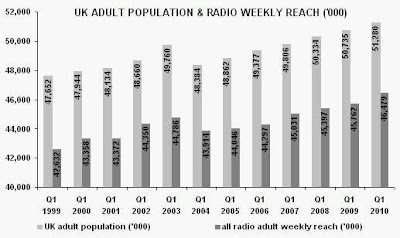
In fact, the “all time high” assertion in the RAJAR press release derives solely from the fact that more people are listening to radio than ever before. This is good news, but the number of people listening to radio is at an “all time high” for the same reason that hospitals have more patients than ever, schools have more children than ever, and public transport has more users than ever. The adult population of the UK is increasing by around 1% per annum. More people = more people using things.

So from where does the RAJAR assertion “radio listening reaches an all time high” derive? It is nothing more than hot air. If, in using the phrase “radio listening”, RAJAR had meant to imply “the volume of radio listening”, then it is a plain lie.

More people are listening to the radio, but they are listening for less and less time. The volume of radio listening, the total number of hours that all UK adults spend listening to the radio, has been declining since 2003. Here is a graph of RAJAR’s own data that shows it:

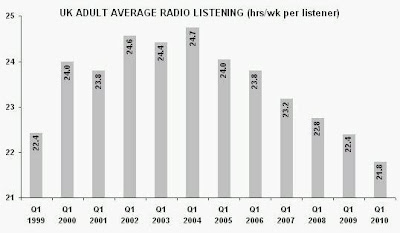
The average amount of time adult radio listeners spend listening to the radio has been declining dramatically over the same period. Here is a graph of RAJAR’s own data that shows it:

Are either of these facts, from the same research, mentioned in the latest RAJAR press release? Of course not. Why? Because RAJAR’s cheerleader role seems to require it to publicise a metric for radio listening that shows an increase: the absolute number of people listening, in this press release.

Here is a graph that shows the increase in the UK adult population and the number of people listening to radio. When the estimated population goes up, the estimated number of radio listeners goes up!

The airtime buyers in advertising agencies who have to use RAJAR data on a day-to-day basis probably chuckle at the preposterousness of the RAJAR press releases, laugh at how gullible the media are to simply reprint their headlines, and then go back to their work.

For some people (like me, having analysed radio audience data for 30 years), it creates market confusion. Clients are understandably puzzled and baffled when they see a presentation that clearly shows radio listening is in decline in the UK. They inevitably ask with suspicion: “But didn’t RAJAR just say that radio listening is at an all-time high?”

So why is RAJAR hell bent on this policy of trying to pull the wool over people’s eyes? Why does it need to be a public cheerleader for radio when we already have RadioCentre, the Radio Advertising Bureau and the BBC Press Office, each issuing their own PR puff on the RAJAR results? The RAJAR press releases might convince journalists, but they certainly don’t fool the media industry players. Instead, the opposite effect is probably the case.

How can the radio industry expect to be treated seriously within the wider media sector when its industry ratings body, charged with publishing objective listening data, insists upon grabbing headlines with misleading facts about radio audiences?

Digital radio station listening: a blip in time saves 6?

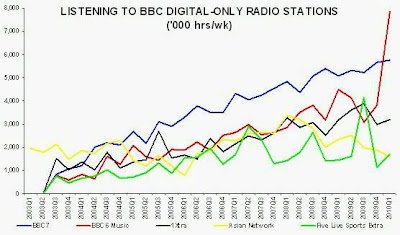
The dramatic upswing in BBC 6 Music’s listening during the first quarter of 2010 did not appear to have a knock-on effect on the BBC’s other digital stations [see graph]. 1Xtra was up slightly but still lower than it was in 2009. Asian Network dropped further and is now listened to less than part-time station Five Live Sports Extra.

In the commercial radio sector, Planet Rock recorded its best quarter yet and cemented its lead over all its digital-only competitors (BBC 6 Music excepted) [see graph]. Its continuing success only confirms that consumers prefer real programme content to the digital music jukeboxes whose performances are little more than limping along.

Even with this most recent quarter’s boost from BBC 6 Music and Planet Rock, total listening to digital-only stations has still shown almost no growth for three years [see graph]. Without the coincidence of those two successes, the latest quarter would have proven another disaster.

The question is what the next quarter will look like. We have seen listening to BBC 6 Music rise temporarily before at times when the channel has been in the press. Attracting listeners is only half the job. Keeping listeners is the much harder part.

Does the BBC 6 Music listening blip change the bleak outlook for digital radio stations? Not at all. Why? Because, even after this sudden upswing, 6 Music still attracts only two-thirds of the volume of listening to Radio 3, the BBC’s least listened to analogue national network. 207% of almost nothing still equals very little.