Commercial radio: "so keen to hold back the BBC?"

House of Lords Select Committee on Communications
Inquiry on Governance & Regulation Of The BBC [excerpt]
22 March 2011 @ 1515

Baroness Deech: Listening to you, I am a bit puzzled about why you are so keen to hold back the BBC. Can’t Virgin Media and the local commercial radio stations stand on their own two feet? Why have they got to hold back the BBC?

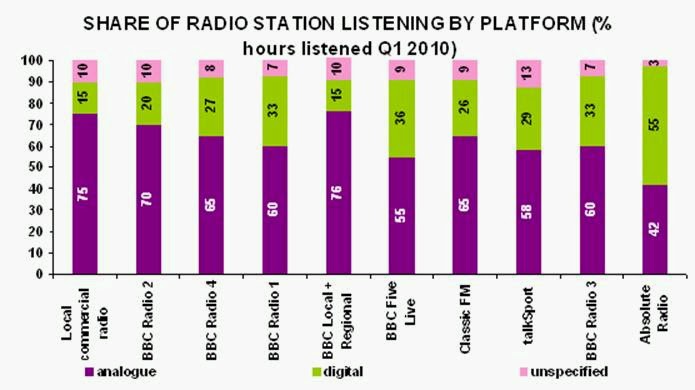
Mr Andrew Harrison [chief executive officer, RadioCentre]: I would not characterise it at all as wanting to hold back the BBC; I would characterise it as wanting a level playing field for the commercial sector to compete. The truth is that, in radio, the BBC is hardly held back. It has 55% national market share, it has the vast majority of national FM spectrum and it has a huge raft of local radio stations, so it is hardly held back. We seek the opportunity to build our own commercial businesses, entrepreneurially and innovatively, without facing the elephant in the room that, every time we try to do something new, there is a BBC service that pops up to squash it before it has time to be established.

Mr Andrew Barron [chief operating officer, Virgin Media]: With great respect, I think we are in slightly different places. I would argue that Virgin Media is one of the companies pushing the BBC forward in many instances.

[This is an uncorrected transcript of evidence taken in public and webcast on http://www.parliamentlive.tv. Any public use of, or reference to, the contents should make clear that neither Members nor witnesses have had the opportunity to correct the record.]

DAB radio sector rubbishes its own digital radio receiver sales figures

When UK companies that had once anticipated they were poised to make a mint out of ‘DAB radio’ realise that things are not going the way they had wanted, they lash out. That seems to be what happened yesterday. ‘Shoot the messenger’ appeared to be the digital radio industry’s reflex response when backed against a wall of facts that tell an unpalatable story.

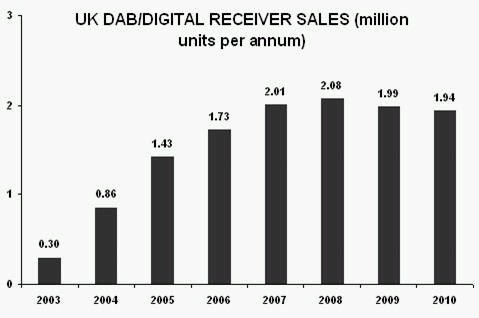
At the Westminster Media Forum conference on digital radio, a graph of DAB/digital radio receiver sales was displayed in a presentation by The Guardian’s Jack Schofield (see below):

The graph clearly showed that 2010 unit sales were down on 2009, and that 2009 unit sales were down on 2008. This data was collected by GfK.

Anthony Sethill, founder and chief executive of Frontier Silicon, took exception to this graph’s narrative of declining consumer interest in DAB radio receivers. He commented:

“My company supplies the chipsets that drive about 80% of digital radios on the market today. So, I think the panel today, with the exception of Andrew [Harrison, RadioCentre chief executive] is a wonderful example of how the minority seem to take the stage and voice the negativity and things. And, if we were to re-run Jack’s presentation again, put some facts in the correct order, and the correct facts, I think we would have a very different read. You know, it’s very difficult, when you have people like Jack that have a national platform in terms of a national newspaper, to voice these views.

So we’ll start with the GfK data. Now, GfK is actually a retail audit and, over the years, has been used by the consumer electronics and the retail trade in the UK to measure the sales of consumer electronic devices. In the last few years, GfK has been dying. The reason it has been dying is that it relies on the data – sales out data – from national retailers such as Dixons and John Lewis and Tesco and so on. Last year, Dixons pulled the plug on supplying data to GfK. That meant the largest retailer in the UK, which accounts for 25% of all sales, actually stopped giving them data. To carry on selling that data, [GfK] then had to formulate panels and most people in the industry know that, statistically, it’s not valid and that, basically, it’s falling apart. Now, you’ve quoted GfK [DAB/digital radio receiver] sales falling and I’ve given you the reasons why that data is not accurate. […]

This is a practical example of discrediting the data, which a number of people use to bash DAB. So this is one small example of how you’re misinterpreting and you’re misleading people. I don’t know if you understand what GfK is, or what it has done, or why it has fallen apart but, if you do, then that’s really poor. And if you don’t, before you quote it, you should learn the facts.”

The graph to which Sethill was referring was created by me and published in this blog last weekend (Jack Schofield had asked before the conference if he could use it in his presentation). I had first published these DAB/digital radio receiver sales data in a blog in January 2011, in which I wrote:

“1.94m digital radios were sold in 2010, compared to 1.99m in 2009 and 2.08m in 2008. Increase? No. Growth? No. Over 2m in 2010? No.”

In March 2011, these same sales figures were reprinted in The Telegraph newspaper, which wrote that “new figures showed that sales of digital radio equipment actually fell last year.”

It should be noted:
• The sales data in my graph were distributed by Digital Radio UK, the radio industry organisation marketing DAB radio in the UK
• Digital Radio UK purchases these data concerning DAB/digital radio receiver sales from GfK
• Digital Radio UK has regularly quoted these GfK data in its press releases (most recently on 23 Dec 2010 and 21 Dec 2010) and in its newsletters
• Digital Radio UK has never publicly challenged the validity of the GfK sales data that it is distributing and using in its marketing campaigns
• Until now, these data on DAB/digital radio receiver sales have been widely reported in the public domain without challenge from the wider digital radio sector.

So what is eating Frontier Silicon? It seemed wholly inappropriate for Anthony Sethill to beat up panellist Jack Schofield in public for using the digital radio industry’s OWN DATA in his presentation. If Frontier Silicon has an issue with the digital radio industry’s sales data, it should take that up with Digital Radio UK, which purchased the data from GfK and distributed them.

Perhaps the real issue is that the rewards from DAB radio have evidently still not materialised for the digital radio industry. By year-end 2009, Frontier Silicon Limited had an accumulated loss of £28m. In financial year 2009, it generated an operating loss of £536,000 on turnover of £22m. Its shareholders include Digital One (owned by Arqiva) and Imagination Technologies (which owns Pure Digital). Imagination owns 9.3% of Frontier Silicon, a stake that it wrote down by £3.4m in 2008, and then finally wrote down by a further £3.6m in 2010. As Imagination’s accounts explained:

“Due to the lower resulting valuation of the business and the impact of Frontier’s capital structure, the Group’s investment [in Frontier Silicon] has been revalued to £nil.”

I guess it must be tough for Frontier Silicon to see a shareholder value its business at “£nil.” That is no reason for its unprovoked attack on Jack Schofield’s presentation which had merely used the industry’s own data.

…………….
 
I contacted GfK for its response to the comments from Frontier Silicon. Its response was (in full):

Date: 6th April 2011

GfK Retail and Technology UK response:

GfK Retail and Technology UK currently track over 100 individual technology product categories and partner with major UK multiple retailers within every single audited channel they report on, to complement this research and to ensure GfK cover the overall market they also have a representative sample of independent retailers working with them. This means GfK are receiving weekly data from over 24,000 individual stores within the UK. The majority of these retailers deliver weekly EPOS data on their complete sales and this allows GfK to report to a detailed level on the performance of all the leading technology categories. If faced with a retailer who is not willing to participate GfK employ a widely used global research methodology to ensure they are representing the overall market.

When challenged on the GfK reported performance of the DAB market Commercial Director Anthony Norman commented “the overall technology markets have all come under increasing pressure in the last 12 months, the austerity measures announced and now being implemented by the coalition government have had a major impact on consumer confidence which has in turn impacted on retail sales of technology areas”. Norman continued in specific reference to the DAB market “the reported data by GfK is based on over 70% live reported sales by retailers, rather than focussing on the downturn of this market it would be more beneficial to put the whole picture in perspective. The overall technology market has experienced only 4 months of growth in the last 33 months. The average decline in this area is 6%, for DAB the market in 2010 declined by only 2%. Given the overall sector performance this is something that should be recognised. As a business GfK are committed to delivering actionable insight to the industries they operate within”

The GfK Group

The GfK Group offers the fundamental knowledge that industry, retailers, services companies and the media need to make market decisions. It offers a comprehensive range of information and consultancy services in the three business sectors of Custom Research, Retail and Technology and Media. The no. 4 market research organization worldwide operates in more than 100 countries and employs over 10,000 staff. In 2009, the GfK Group’s sales amounted to EUR 1.16 billion. For further information visit http://www.gfkrt.com or www.gfkrt.com/uk

AM/FM switch-off of national radio stations? An empty threat whose expiry date has long passed

Some of Digital Britain’s radio recommendations were unworkable. However, the notion has remained that FM and AM analogue transmitters of the UK’s national radio stations will be switched off once digital radio listening passes the 50% threshold. This was never practical. It was a ‘threat’ propagated by government to the public in the hope of forcing them into buying more DAB radios, instilling fear that they would otherwise lose their favourite stations. The threat failed.

The problem with any threat is that, once it has failed, it remains difficult for the protagonist to climb down. So the threat continues to be propagated. For what reason now? So as not to make those who issued the threat look completely foolish. The need to save face has locked the government apparatus into a fiction that BBC and commercial radio will willingly throw away half their audiences by closing their FM/AM transmitters. This was never true.

THE BBC

‘Universal’ reception of the BBC’s core public services is mandatory. It would prove impossible to levy the BBC Licence Fee on every UK household if (almost) the entire population could not receive the BBC services for which they pay.

The BBC Charter & Agreement requires:

“12. Making the UK Public Services widely available
(1) The BBC must do all that is reasonably practicable to ensure that viewers, listeners and other users (as the case may be) are able to access the UK Public Services that are intended for them, or elements of their content, in a range of convenient and cost effective ways which are available or might become available in the future.”

Would the BBC switch off analogue transmissions of its national networks once more than 50% of listening was attributed to digital platforms? Of course not. You would be a complete fool to slash your radio audience by half, particularly as such an action would contradict the BBC Charter & Agreement.

Could the government insist that the BBC switched off the analogue transmissions of its national networks? Only if it wanted a revolution on its hands. It would be difficult to think of a policy more likely to lose it the next General Election.

COMMERCIAL RADIO

The revenues of commercial radio are directly related to the sector’s volume of listening. If commercial radio switched off its analogue transmitters once digital listening had passed the 50% threshold, at a stroke it would risk losing 50% of its volume of listening and, subsequently, 50% of its revenues. Would it do that? No, of course not.

RadioCentre’s self-interested ‘policy’ has been to argue that the BBC national networks should turn off their analogue transmitters first, years in advance of commercial radio stations. Radio Chicken, anyone? Naturally, RadioCentre failed to mention that the outcome of this proposal would be likely to significantly increase its member commercial radio stations’ analogue audiences and revenues. There is nothing quite like trying to persuade your competitor to commit joint suicide … first.

Additionally, the value of commercial radio companies is vested in the scarcity of their analogue FM/AM licences. Because no new analogue licences are awarded by the regulator, each existing licence has a significant intrinsic value, even if the business using it is not profitable. The same is not true of DAB licences. Anybody can apply to Ofcom for a DAB licence by filling in a form and paying a relatively small fee.

An example of the value of analogue licences to commercial radio owners is Absolute Radio. In 2008, Times of India paid £53.2m for Virgin Radio, comprising one national AM licence and one London FM licence. Having re-launched the station as Absolute Radio, the company lost £4.3m in 2009, but its balance sheet still retains considerable value because of the scarcity of its two analogue radio licences. If Absolute Radio were put up for sale, someone would be interested in buying it because of that scarcity.

By contrast, when DAB commercial radio services such as Zee Radio, Islam Radio, Muslim Radio, Flaunt and Eurolatina no longer wanted their digital radio licences in 2010, there was no queue of potential buyers. They simply handed their licences back to Ofcom because those licences were not scarce.

This is why it would prove financially suicidal for commercial radio to switch off its FM/AM transmitters. It would have to write down the value of those scarce analogue licences to zero in its balance sheets which, at a stroke, would negate almost the entire value of the licence owners. Not a good company strategy.

So, when headlines such as ‘Absolute Radio mulls AM switch-off’ appear in the trade press, they should be read with a bucket of salt. The headline might as well say: ’Absolute Radio mulls destruction of shareholder value.’

And, when yet another DAB proponent appears on radio or television to persuade you, in all seriousness, that the UK’s most listened to national radio services – both BBC and commercial – will imminently be switching off their AM/FM transmitters, please feel justified to laugh in their face.

This is about as likely to happen as Tesco putting security guards at their store entrances to tell the public to shop elsewhere because they want fewer customers.

FOOTNOTE:

It emerged last week that, after the Norwegian state classical music station ‘Alltid Klassisk’ abandoned FM transmission on 1 July 2009 for DAB transmission, its audience contracted from 25,000 to 10,000 per day.

Now, consider that only 20% of listening to BBC Radio 2 is via digital platforms (in Q1 2010), lower than the 24% average for all stations [see Sep 2010 blog]. If that average ever managed to reach the 50% threshold, it might leave 60% of Radio 2’s audience still listening via analogue. That’s 8m listeners that Radio 2 would have to turn its back on as a result of FM switch-off. Time for the BBC to start erecting barricades outside Broadcasting House.

[thanks to Eivind Engberg]

David Blunkett's opinion of DAB radio: BBC is "defending the indefensible"

‘You & Yours’
BBC Radio 4
28 March 2011 @ 1200 [FM only]

Julian Worricker, presenter [JW]
Paul Everitt, chief executive, Society of Motoring Manufacturers & Traders [PE]
Laurence Harrison, technology & market director, Digital Radio UK [LH]

JW: Now, car manufacturers have long prided themselves on arming their vehicles with the latest groundbreaking technology, but there’s one in-car gadget which has remained stuck in the twentieth century. Radios in cars, generally speaking, are FM/AM analogue, and not digital. Around 20% of all radio listening takes place in the car, that’s according to RAJAR, the organisation which counts these things. So, if the UK is to go all-digital and the analogue signal switch is turned off – and that, of course, is the plan – cars need to be equipped with digital radios.

JW: Well, car manufacturers are planning that all new vehicles will have digital radios fitted from 2013. And, now, Ford says it will make digital radios available in its cars a year earlier than that. This will all help achieve the target that 50% of all radio listening should be digital, which is one of the pre-conditions for turning off the analogue signal. We can explore this with Paul Everitt, who is the chief executive of the Society of Motoring Manufacturers & Traders, and with Laurence Harrison, the technology & market director from Digital Radio UK, which is the company set up by broadcasters to help with the switchover. Gentlemen, good afternoon. Paul Everitt, why is the car industry pushing ahead with installing digital radios by 2013?

PE: Well, I think there are two key reasons. The first is because that’s the agreement we had with government as part of the Digital [Radio] Action Plan. They recognised that listening in-car was a key part of radio listenership and, therefore, early introduction of vehicles with digital radio was a key part of the package that needed to be achieved. But, I think, increasingly, what we are seeing, and certainly the announcement from Ford that you mentioned slightly earlier, is actually about the consumer saying that this is something that we want. The consumer now has an increasing opportunity to experience both the listening quality of digital in-car, but also the content, the increasing content, and desirability of the content on digital, as well as gradually and increasingly improving coverage. So, it’s a combination here of ….

JW: [interrupts]: Right, right, I just want to ….

PE: …. both something that we have to do, or we have agreed to do. But I think, increasingly, this is a push that is now coming from consumers.

JW: Okay, I just want to scrutinise that a little, because I don’t doubt that Laurence Harrison will say the same thing because we are told this is consumer led. But, surely, the truth of the matter is that the consumer has been led because of what the government requires you and others to do, so consumer choice only goes so far here.

PE: Well, I think we can argue the finer points of this, if you like. But, from an industry point of view, we began to be involved in this discussion during the course of 2008, obviously the conditions during 2009 with the development of the Digital Britain report brought that forward, or conclusions from that report have been built into vehicle manufacturers’ plans. But, as I say, what we are actually seeing today is, you know, increasing interest in digital from consumers.

JW: Okay. Let me bring Laurence Harrison in on coverage because, as I understand it, at least 90% [population] coverage is a target. That’s part of the targets that will only allow the switchover to take place. Now, 90% sounds positive until you then think about the 10% who can no longer hear what they are listening to now.

LH: Well, I think the key thing on coverage is to become the equivalent of FM coverage. So the 90% figure you refer to is around local coverage. Actually, on the coverage of national services, we are already at just over 90%, and the BBC has just recently committed to build that out to 93% by the end of this year. And the target thereafter is to get to FM equivalence as soon as we can, so that programme is well underway.

LH: And, if we are driving from A to B a significant distance, can we be sure that that coverage will remain consistent over that distance?

PE: So, you’re absolutely right. Of course, for the car market, geographical coverage is vitally important. What we do know now is that the vast majority of motorways and A roads have got good coverage, and significant coverage on B roads and smaller roads. But we are working with broadcasters to try and prioritise the road network going forward.

JW: Paul Everett, what about those who can’t afford to buy a new car after 2013 with a smart digital radio inside it? When that switchover eventually happens, what happens to them?

PE: Well, this has always been our biggest – or one of our biggest – concerns, which is that how do we retro-fit the entire vehicle parc? We are currently looking at something between 25 and 30 million vehicles all up, so it’s quite a challenge. What we have seen over the course of the last year – 18 months – is relatively low-cost adaptors. I think now … I mean the prices vary, but certainly less than £100 to adapt your vehicle, and these are sort of a relatively basic unit, so not desirable for everybody …

JW: What does ‘relatively basic’ mean in terms of what it will actually do?

PE: Well, it means you get a digital reception but you have to kind of plug it into the cigarette lighter and have a bit of an aerial up and …

JW: It’s a bit Heath Robinson, isn’t it?

PE: We would agree with that. From our perspective, we’ve been very much focusing on what we would see as an integrated unit. So, something that you can put into your car or have installed in your car which would effectively mean that you could just use your standard radio to receive digital broadcasts. Now, we’ve seen … I’ve seen first kind of trials of that technology. We hope that that’s going to be available from sort of around the end of this year – the beginning of next year – so we’re already seeing a market begin to develop and, as I say, I think we … well, there are two ways of looking at the problem. One is that we must all prepare because this switchover is going to happen. Or the one which we are focused on is: the more consumers have experience of digital, the more they like it and want it and therefore that’s a market driver, rather than sort of an administrative pull.

JW: No, and that’s a fair point because I read some surveys, Laurence Harrison, that I know you were quoted in in recent weeks. But the point that has just emerged from the last comment, surely, to put to you are that whatever we do here, it is going to cost us and we do not have any choice over that.

LH: Well, I think the stage we are at at the moment, as Paul said, is that we have not got a confirmed switchover date now, so what we are trying to do is build momentum.

JW: But it will happen one day.

LH: It will happen one day, but what’s going to drive people towards digital radio is the great content we’ve got. The same happened on TV. So if you look at the offering now on digital radio, you’ve got the soon to be launched BBC Radio 4 Extra on Saturday, 5 Live Sports Extra, 6 Music, Absolute 80s [and] 90s, Planet Rock, Jazz FM has just announced it is going onto the digital network, so the content offering has frankly never been better and what we do know about people that have digital radio is that once they’ve tried it, they love it.

[The programme was followed with a Yours & Yours blog which invited comments from listeners on their experiences with DAB radio in cars. David Blunkett MP submitted a comment to the programme about his experiences with DAB, upon which listeners made further comments.]

……………………………

‘You & Yours’
BBC Radio 4
1 April 2011 @ 1200 [FM only]

Peter White, presenter [PW]
David Blunkett MP [DB]
Lindsey Mack, senior project manager of digital radio, BBC [LM]

PW: Now, you’ve all been writing in, telling us about your frustrations with digital radios, after Monday’s report on how Ford is planning to install DAB radios as standard in some new cars from next year. Steve told us about his A370 journey between Cardiff and North Wales: perfect listening for 30 miles outside the Welsh capital, then nothing for 150 miles. By contrast, over on Anglesey, Steve tells us the only place that silences his DAB car radio is the Conwy Tunnel. Another correspondent was former Home Secretary, David Blunkett. He’s had trouble getting a DAB signal at his home in Derbyshire. So we brought him together with a senior digital manager for the BBC, Lindsey Mack, and David started by challenging the main claim of digital supporters that DAB achieves 90% coverage.

DB: My thrust was that there are not 90% of the population with access to digital [radio], and many of those who claim to have access have intermittent or interference with the access. And I’m a classic [case] because I can just about get digital radio in North Derbyshire, where I rent a cottage, if I hold the radio up to the roof, or I find one particular spot on the kitchen window sill. Get it out of kilter and either the signal goes or, as quite often I get, even in London, it breaks up.

PW: Right, let me at this point bring in Lindsey Mack. A lot of our e-mails mirrored what David had to say, and particularly this point: that the quality isn’t adequate for many people, even if they’re … it’s said they have reception, and in that so to talk of [FM radio] switch-off at this stage, you know, seems wrong.

LM: Over the last sort of two years, the BBC has been very committed to building out its DAB coverage. We actually are at 90% of the UK population, but that doesn’t mean that everyone’s going to always get a very good reception. A lot of it does depend on the device you have, as well. There are some receivers that are a little bit more sensitive than others. And, in fact, we’ve actually just been doing some tests on the last sort of bestselling sort of ten or dozen receivers in the market.

PW: But what a lot of people said to us, and I suspect David will reiterate this, is that FM, which digital is going to replace, that has a much more stable signal and that, even if you start to lose that signal, you don’t lose it altogether in the way you often lose the digital [signal] or it just goes into sort of burble.

LM: Yes, and with DAB, you usually either get it or you don’t. I mean, looking in Derbyshire, we’ve actually got very good coverage, especially North Derbyshire, so perhaps after this we could actually talk to David about the device he’s actually got, as well, just to see which one he’s actually using. Whilst the BBC has been very committed to DAB and extending the coverage, we are now actually having to make the existing coverage more robust, and that’s actually what we haven’t been doing as much before. What we’ve done before, we’ve concentrated on just rolling out DAB. Now we know we’ve got to really look at the whole way we’re measuring DAB. We’re looking at indoor coverage in particular. You know, originally, when we launched DAB, we actually based all our coverage on car listening and then, obviously, car listening didn’t take off the same way as people are actually listening indoors.

PW: Well, it couldn’t because there weren’t [DAB] radios in cars.

DB [laughs]: Absolutely.

LM [laughs]

DB: It is a problem, Peter, actually, that if you can’t get it and you can’t hear it, you can’t appreciate it. I’ve got no problem with the extra reach and the way in which [BBC] Radio 7 is now going to become Radio 4 Plus or, whatever, Extra. My problem is that there’s a big over-claim for this. Let’s take it steadily, let’s try and get it right, let’s not claim that people have got a service when they haven’t and, particularly, let’s not say – which was what the sell for DAB was – that this is going to be higher quality when, as you’ve just described, the burble, the break-up, the lack of a good sound… I have three DAB radios up north. I’ve tried them all in different places, so it’s: please don’t do to me and to the audience what always happens, which is: it is not the fault of the deliverer, it’s the piece of equipment you’ve got, and they’re pretty good pieces of equipment.

PW: But, David, it was your own government who published Digital Britain and it was your own government that set the 2015 date.

DB: Yeah, and I criticised them at the time. Everybody wants everything now. They want it faster, they want to claim it as the greatest quality. I mean, everything is always ‘the best ever.’ And, frankly, it isn’t and if we just accept that and say ‘lets take it steady and lets try and get it right,’ we’ll all be on the same page.

PW: So it isn’t the principle that you’re against. It’s the practice, really.

DB: Yes, it is. I mean, if FM is better than DAB, let us continue for the time being with FM and, in many parts of this country, it is.

PW: Lindsey Mack, 2015 is supposed to be dependent on, you know, the state of digital [radio listening] and the public’s attitude to it. There’s a report in the papers this week that, in fact, digital sales of digital radio have actually fallen, and fallen for the second year running.

LM: They did fall slightly down last year, compared to the year before but, to be very honest, over the last sort of quarter, the consumer electronic market has been hit very badly. Not just in terms of radio sales, but other consumer electronics as well. You know, the BBC is working very closely with commercial radio and doing a lot of sort of joint promotions. We have to get our messaging right on this.

PW: A lot of our listeners said ‘if it ain’t broke,’ you know, ‘don’t fix it.’ In other words, okay, people quite accept that you’ve got, that you should move on, and that digital probably is the next thing, but why get rid of FM before … in some ways, some people said ‘why get rid of it at all’? Why can’t they exist side by side?

LM: But we’re not getting rid of FM totally. What we’re saying is that the BBC services – the national services – are on FM and DAB, and also we have our digital-only stations on DAB. By 2015, we have to … hopefully, we will have reached 50% digital listening. That’s not [just] DAB. It’s digital listening across all platforms. But there’s a lot that has to be done by, you know, at 2015, and beyond that.

PW: Are you happy about that 2015 date?

LM: 2015 is just … is a date that the industry can focus on. It is not a switchover date. What we have to achieve by then, though, if we can, is obviously digital listening up, we have to have good coverage rollout which has to be robust. People have to be able to turn on their radio and it has to work.

DB: Well, just one final message, Peter, which is that Lindsey’s done a pretty good job at defending the indefensible …

LM: [scoffs]

DB: … and I commend her on it, but don’t get carried away by the anoraks. They’ll tell you anything is working, even if it isn’t.

PW: So what would be your … what’s your solution? What would you want the BBC to do, David?

DB: I’d want them to be absolutely clear and honest and to say: there are problems with this, we’re resolving them, we want people to buy the [DAB] radios because they’ll get the extra coverage of different channels, and we want to keep FM as long as it’s necessary for people to be able to listen to Radio 4 properly.

[thanks to Darryl Pomicter & Luke Shasha]

Culture Secretary: "digital radio industry needs to do a lot more work … to carry the public with it"

House of Commons Culture, Media & Sport Committee
30 March 2011 @ 1006 [excerpt]
Committee Room 15

Jeremy Hunt MP, Secretary of State for Culture, Olympics, Media & Sport

Q: What are your expectations now with regard to digital radio switchover?

A: Well, I think the future is digital. I think the future is DAB. But I think the digital radio industry needs to do a lot more work to boost the penetration of DAB and to carry the public with it. And I think that it has not been nearly as successful as that, as the TV industry has been, in persuading the public of the benefits of digital switchover. And that’s why, at the moment, the industry is having to bear the costs of running two systems [analogue and DAB] in parallel. I very much hope that they won’t have to do that. We want to do everything we can to help the industry migrate smoothly, but we would like it to be user-led, so we have said that we are not going to have an arbitrary 2015 deadline. We will make a decision in due course as to whether we can have switchover in 2015, but we want the radio industry to step up to the plate in making sure there are better products and services available, and that consumers really can see the benefit of DAB.

Q: Would your expectation be that the financial commitment of the BBC to expand the radio coverage in rural areas will remain the same or might that be affected by their review of spending?

A: Well, the BBC are committed in the [Licence Fee] Agreement I did to national availability of national DAB channels. There is still a discussion to be had about the funding of local DAB channels, which is an additional cost. And I am closely involved in discussions with the radio industry, and very keen to resolve this as soon as possible because I think it’s a very, very important next step.

NORWAY: government proposes "possible FM [radio] switch-off" and "possible prolongation of FM licences"

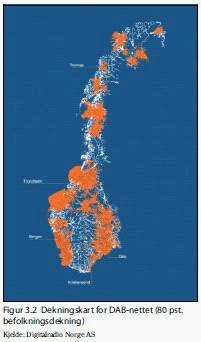
In February 2011, some hysterical reports appeared concerning the White Paper published by the government in Norway on DAB radio. Some of these would have had us believe that Norway had made a definite commitment to switch off all FM radio in 2017. This was not true [as documented by diymedia and Media Network]. In fact, the government had set out several criteria that will have to be met before digital switchover can be sanctioned. The Norwegian criteria are similar to those adopted in the UK which, as commented here previously, are unlikely ever to be fulfilled, making switchover an ‘unreality.’


To make the situation perfectly clear, in the words of Norway’s media regulator:

“The following three conditions are absolute and must be fulfilled regardless of when switch-off takes place:

1. Digital coverage for the NRK’s radio services correspond to that of NRK P1 on FM
2. The multiplex that carries commercial national services (Riksblokka) must cover at least 90 per cent of the population
3. The digital radio offer must represent added value to the listeners

The above three conditions, as well as the two following conditions, must be fulfilled by 1 January 2015 for the switch-off to take place in January 2017:

4. Affordable and technically satisfactory solutions for in-car radio reception must be available
5. At least 50 per cent of daily radio-listeners employ digital platforms, exclusively or in combination with FM-radio

Provided the absolute criteria (1-3) are fulfilled in 2015, switch-off may nevertheless take place in 2019, even if criteria 4 and 5 are not fulfilled.”

Furthermore, far from FM being switched off completely, the regulator said:

“The Report proposes that the majority of local radio stations should have the right to continue transmitting in FM beyond 2017. The Ministry of Culture will determine in 2015 what categories of local radio may maintain the right to do so.”

The milestones anticipated by the government are:

“2011: The Ministry of Culture decides on the possible prolongation of commercial radio-licenses in the FM-network until 2017 (or 2019).

2013: The Ministry of Culture determines:
· Whether the coverage obligation for NRK radio-services shall be attached to the DAB-multiplex alone, or whether it may be fulfilled by employing other technologies in addition to DAB
· What is to be understood by the criterion ‘affordable and technically satisfactory solutions for in-car reception.’

2015: The Ministry of Culture decides whether the following conditions are met:
· The digital coverage of NRK-radio corresponds to that of NRK P1 in FM
· The population coverage of the national, commercial multiplex >90 per cent
· The Digital radio-offer represents added value to the public
· Availability of affordable and technically satisfactory in-car solutions
· Usage of digital platforms >50 % of daily radio-listeners.

2017: Possible FM switch-off
2019: Prospective postponed final switch-off of FM
2011: Decision on possible prolongation of FM-licences
2013: Definition of coverage obligations NRK & in-car solutions
2015: Assessment whether ASO-criteria are met
2017: Possible FM-switch off
2019: Possible postponed FM switch-off.”


In parliament, the Progress Party’s Ib Thomsen challenged the Minister of Culture, Anniken Huitfeldt:

“The closure of FM radio worries the Progress Party, it worries IKT Norway and it worries consumers. To close FM radio, we need to scrap 15 to 20 million radio receivers, including even DAB radios that are not of the most modern type [DAB rather than DAB+]. This will have major consequences for consumers and for the environment.”

Thomsen asked the Minister of Culture: “What will the closure of FM radio cost the country? We know that it will cost consumers billions of krone, but what will it cost the state and society?”

The Minister rejected categorically the notion that consumers would have to pay one billion krone, or that 15 to 20 million radios would have to be scrapped. She responded:

“It is very clear in the White Paper that the digitalisation of radio will be consumer focused. It is typical of the Progress Party to spread fear about something that has already been addressed. These figures are not correct. There are, according to numbers that I have been quoted, 3.5 to 7 million radio receivers in Norway. These devices will not be thrown out. People can buy adapters that will provide access to digital radio.”

“It is the simulcasting [on FM and DAB] that is the most expensive. When we published the White Paper on the digitalisation of radio, P4 responded immediately that it wanted to launch more stations. There will be more competition and more channels. It went very well when we introduced digital television. It is going to go just as well with radio.”

Ib Thomsen was unsatisfied with the Minister’s response. He replied:

“The Progress Party is not the only one that is worried. IKT Norway and the rest of the world is concerned too. Adapters will cost consumers 1,200 krone. It is a pity that the Minister is not taking into account that Norway is locking itself into a technology that has already been scrapped by the European Union.”

The Minister responded:

“The European Commissioner has stated that radio must be at the forefront of the digital revolution and has highlighted DAB. It is not true that no other countries are digitising radio. There is no discussion in Europe as to whether to introduce DAB or not, only discussion about the date for digitalisation. Neither is it correct to say that adapters will cost 1,000 krone. Prices will go down.”

To date, sales figures for DAB radios in Norway have been even less impressive than in the UK. In 2010, only 81,000 DAB radios were sold out of a total of 833,000 radio receivers. The cumulative total of DAB receivers sold is 336,000, although these are DAB rather than DAB+ and will have to be replaced if Norway changes to the latter system.

Year: number of DAB radios sold in Norway
2004: 10,000
2005: 51,000
2006: 55,000
2007: 61,000
2008: 42,000
2009: 66,000
2010: 81,000

IKT Norway has long argued that DAB radio is not appropriate as the digital platform to replace FM radio. After the White Paper was published, its secretary general, Per Morten Hoff, commented:

“Norway becomes the first country in the world to decide to shut down its FM radio networks. This is a bold decision at a time when technological developments are more uncertain than ever. Closing FM radio gives you no route back. NRK has spent several hundred million krone building its DAB network, ‘a killer’, and its owner, the Norwegian state, and the Culture Minister have concluded that there is no going back. The market has said so far that it is not adopting DAB, so forcing them has been the only way forward.”

There would appear to be a number of reasons why DAB is being pursued so doggedly in Norway:
· Norway was one of the first countries to invest in a DAB radio transmission system in 1995
· Jørn Jensen, since 2009 the president of World DMB (the organisation lobbying for the replacement of FM with DAB), is the chief adviser to NRK on platform distribution
· NRK, the state broadcaster, signed DAB transmission contracts with Norkring that do not expire until 2020, so the government cannot pull the plug on DAB without exposing an embarrassing waste of public funds

Some of the issues facing the successful implementation of DAB in Norway would appear to be:
· Only 80 DAB transmitters are currently in service, although at least 650 will be necessary (TV in VHF Band III uses 2,635 transmitters and transponders)
· Achievement of 99.5% DAB coverage (to match FM coverage) will prove very expensive, and Norkring has only guaranteed 90% in its current transmission contract with NRK. The government will be forced to fund the difference
· The government White Paper noted that current FM coverage is 99.5%, although NRK FM coverage is 99.95%, a more expensive penetration for DAB transmission to match
· The high costs of simulcasting about which Arild Hellgren, former NRK director of technology, commented: “Compared to what happened when we digitised TV, we will have a very long period of parallel distribution on FM and DAB. It is very expensive”
· The two national commercial stations will be granted automatic licence renewals ONLY IF they support the DAB platform and pay for DAB coverage up to 90%
· Local stations’ transfer to the DAB platform will be determined by the government in 2015 in a ‘Big Brother’-style elimination contest

So who was the bright spark in the Ministry of Culture who decided to headline its press release: “FM switch-off in 2017 – the radio medium will be digital”?

By 2017, that person could have a large quantity of egg on their face.

[thanks to Bjarne Boen, Darryl Pomicter + others]

UK commercial radio revenues underperform the 2010 media market

Marketing magazine’s annual survey of the top 100 advertisers announced some good news:

“More than three-quarters of the UK’s top 100 advertisers increased their adspend in 2010, defying predictions that the year would mark a steep decline in marketing budgets. By channel, the biggest year-on-year increase was in TV advertising, with a 17% rise, according to Nielsen; print, outdoor and cinema spend also rose.”

So, good news for radio too? Marketing continued: “The only medium in which spending fell was radio, falling 6% on 2009 levels.” Oh dear.

Why was radio so badly hit in 2010? Partly because of commercial radio’s greater dependency than other media on public expenditure which, as Marketing explained, was cut drastically in 2010:

“The government’s commitment to slashing public-sector spending was reflected in the 50% year-on-year decline in the COI’s [Central Office of Information] adspend to £105.4m.”

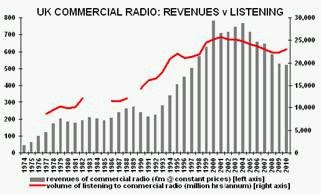
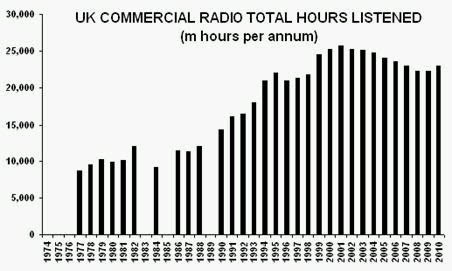
And partly because the volume of commercial radio listening has been in decline for the last decade, and sector revenues are a product of listening:


Encouragingly, 2010 witnessed a 3% year-on-year increase in the total volume of commercial radio listening, the first increase since 2001. However, total radio listening (commercial + BBC) had increased in 2010 by 2%, making commercial radio’s gain only marginally greater than the total market.

As for the other issue of slashed public expenditure on commercial radio, although 2010’s loss of £24m seemed bad [see blog], 2011 could prove to be worse. On Friday, the Cabinet Office recommended the scrapping of the 60-year old Central Office of Information:

“As part of the changes, the COI will be replaced with a new body, the Government Communications Centre, with a wider remit and responsibility for keeping a tight reign on advertising and marketing spend. … The report does not say how much the government might cut from its £1bn annual communications bill, or how much of the £540m spent on everything from TV, radio and posters to sponsorship might be reduced.”

This would prove a further financial blow for commercial radio, since COI expenditure on radio of £30m in 2010 still contributed as much as 11% to the sector’s national advertising revenues, even after having been slashed by the coalition government.

Although Marketing’s (Nielsen) data reported that radio’s national revenues fell by 6% in 2010, the commercial radio sector’s own numbers showed a 6% increase. This discrepancy is puzzling. Nevertheless, analysis of the industry’s dataset tells us:


TOTAL UK COMMERCIAL RADIO REVENUES:
· 2010: £522.6m (£505.5m in 2009)
· Up 3% in absolute terms
· First year-on-year increase since 2007
· Down 1% at constant prices [RPI]

UK COMMERCIAL RADIO NATIONAL REVENUES:
· 2010: £276.2m (£259.4m in 2009)
· Up 6% in absolute terms
· First year-on-year increase since 2007
· Up 2% at constant prices [RPI]

UK COMMERCIAL RADIO LOCAL REVENUES:
· 2010: £144.3m (£144.7m in 2009)
· Down less than 1% in absolute terms
· Lowest value in absolute terms since 2001
· Down 5% at constant prices [RPI]
· Lowest value at constant prices since 1992

This apparent collapse in local advertising revenues would appear to mask a dichotomy that is taking place in the radio sales market. For those stations in small groups or independently owned that rely almost entirely on local revenues, the market for local advertising has already rebounded from the recession. The closure of many local newspapers, the cuts to local council freesheets and the closure of many local radio station offices owned by large radio groups have left these genuinely local stations in an opportune position to hoover up more local advertisers.

On the other hand, local radio stations that have been transformed recently by Global Radio into ‘national brands’ (Heart, Capital) seem to be abandoning their interest in local advertising markets. If I owned a local business in Eastbourne, I would like to know how effective an advertisement would be on the local Heart FM station in my immediate area of Eastbourne & Hastings. This is no longer possible because Global Radio has done away with RAJAR audience data for many local markets. The smallest market that RAJAR can tell me about now is “Sussex,” comprising 1.3m adults – much too big a coverage area for an advert for my one local shop in Eastbourne.

This new strategy seems inconsistent with the Heart FM licence for Eastbourne & Hastings which Ofcom insists is “A LOCALLY ORIENTED CONTEMPORARY AND CHART MUSIC AND INFORMATION STATION…” So, please will Ofcom explain how Heart FM can be a “locally orientated” station if, as a potential advertiser in Eastbourne, I can no longer determine how many people would hear an advertisement broadcast on the station?

RAJAR explained the changes to its data: “Campaigns transferred from Q3 2010 to Q4 2010 will contain the old station definitions and they will be visible Q4, however the data will not be accurate. Please re-plan the campaign using the new regional definitions available in Q4.” In plain English – audience data for local stations have been removed and merged into regional groupings from last quarter.

So, it would seem that the ‘nationalisation’ of the content on Global Radio’s Heart and Capital brands has been accompanied by ‘nationalisation’ of advertising sales. If ever there seemed like a wrong time to be pursuing national advertisers for commercial radio, surely it must be now [see blog]. In real terms, national advertisers spent no more on commercial radio in 2010 than they had in 1997. However, in 1997, there were only 200 commercial radio stations, whereas now there are 300.

I am reminded of a meeting in 2007, just weeks before EMAP was sold, with its chief executive when I asked him if he felt there was anything that the group’s radio division should have done differently. Local advertisers, he told me. We neglected local advertisers in pursuit of the larger amounts we could earn from potential national advertisers. But we turned our backs on previously loyal local advertisers who quickly lost interest in our stations without regular contact from our salespersons.

Here is a lesson to be learnt from the UK’s second largest commercial radio group. Don’t look your local cash cow in the mouth.

GERMANY: government drops FM radio switch-off 2015 date from new legislation

VPRT, the German trade association for commercial media, has welcomed the government’s decision not to include clauses in its new Telecommunications Bill that would have switched off FM radio broadcasts in 2015. In its 9 March 2011 press release, VPRT stated: “FM is and remains the basis for the development of new radio services.”

VPRT described the earlier federal plan to switch off FM radio on 31 December 2015 as a “completely unrealistic statutory requirement” which would have made redundant 300 million FM radio receivers.

Germany is making a second attempt to launch DAB radio with ten national services scheduled to start in August 2011. US broadcaster Radio Disney had been an initial applicant for one of the national commercial DAB radio channels, but subsequently withdrew its proposal in January 2011. Some of the other commercial stations had been offered a financial subsidy by DAB chip manufacturer Frontier Silicon in December 2010 [see blog].

However, as one German publication commented: “So far, consumer interest in digital radio has been extremely low.” Pit Klein from the magazine ‘Sat+Kabel’ explained: “We have estimated from the regional media authorities that only about 500,000 DAB radio devices are in circulation.” Christoph de Leuw from the magazine ‘Audio Video Foto Bild’ said: “In some areas, [DAB radio] receives only two or three stations. No one buys a new radio receiver for €100 to receive two stations … People are satisfied with FM quality. The real, practical benefits to consumers [of DAB] are yet to be determined.”

Experts in Germany agree that the future of radio is digital. “Whether the digitalisation of radio will take place on DAB is questionable,”
said Sven Hansen, editor of the computer magazine ‘c’t’.

[with thanks to Follow The Media]

DAB radio take-up in the UK: the 2010 year-end scorecard

“I think that there is great potential for digital radio, as the UK and Danish experiences demonstrate.”
Neelie Kroes, vice president for the digital agenda, European Commission, 3 March 2011

“This milestone is part of building momentum for the transition to digital radio in the UK …”
Digital Radio UK, December 2010

“I think that there has been a transformation in the last twelve months.”
Ford Ennals, chief executive, Digital Radio UK, February 2011

“2010 was a fantastic year for the DAB family, with much encouraging news and positive activity from individual markets …”
Jørn Jensen, president, World DMB, March 2011

“We are seeing increased momentum and activity as digital radio switchover moves from debate to reality …”
Bernie O’Neil, project director, World DMB, March 2011

“2010 had a real sense of forward momentum and activity …”
Caroline Brindle, project office manager, World DMB, March 2011

“Building momentum”? “Transformation”? “Fantastic year”? “Increased momentum”? “Forward momentum”?

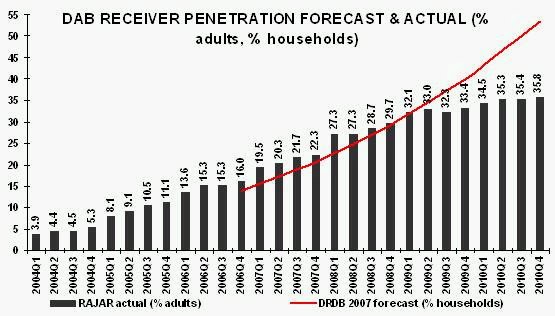
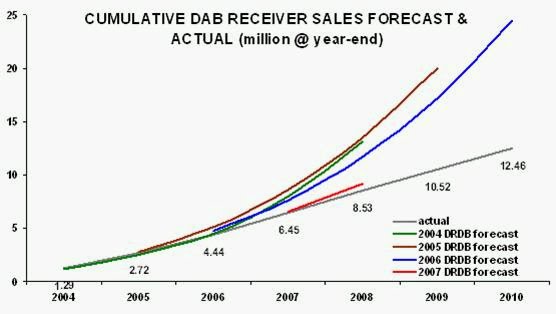
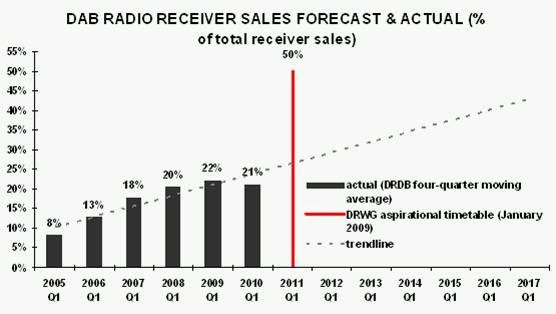
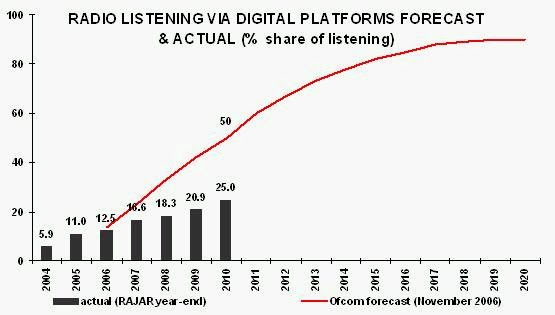
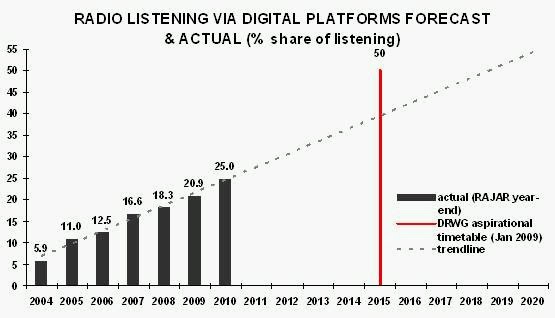
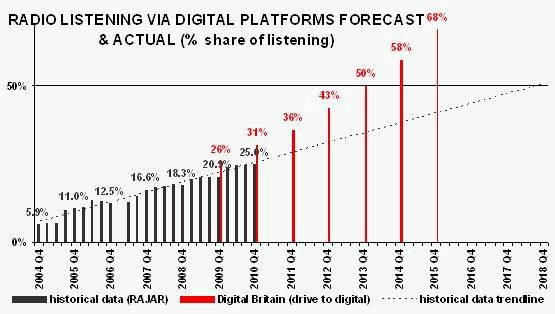
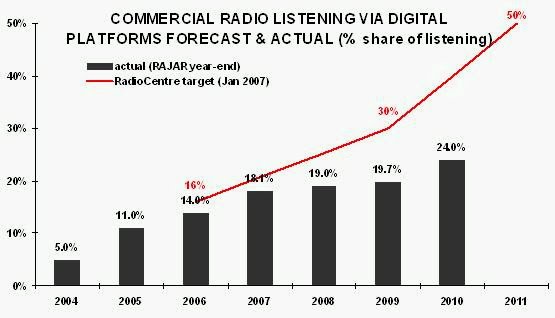
Is this DAB radio that we are talking about? In the UK, at year-end 2010, the picture looked like this:

DAB radio receiver penetration:
· 2010 year-end forecast: 53.4% (Digital Radio Development Bureau, 2007)
· 2010 year-end actual: 35.8%

Cumulative DAB radio receiver sales:
· 2010 year-end forecast: 24.5 million (Digital Radio Development Bureau, 2006)
· 2010 year-end actual: 12.5 million

DAB radio receiver sales as % total receiver sales:
· Q1 2011 forecast: 50% (Digital Radio Working Group, 2009)
· Q1 2010 actual: 21%

Radio listening via digital platforms:
2010 year-end forecast: 50% (Ofcom, 2006)
2010 year-end actual: 25%

Radio listening via digital platforms:
2015 year-end forecast: 50% (Digital Radio Working Group, 2009)
2010 year-end actual: 25%

Radio listening via digital platforms:
2010 year-end forecast: 31% (Digital Britain: drive to digital, 2009)
2010 year-end actual: 25%

Commercial radio listening via digital platforms:
2010 year-end forecast: 40% (RadioCentre, 2007)
2010 year-end actual: 24%

None of the stakeholder forecasts of DAB take-up in the UK have come to pass. In this respect, 2010 was no better a year than any other.

Neelie Kroes is mistaken. Evidence from the UK experience certainly does not demonstrate the “great potential” for DAB radio.

Public spending cuts impacted commercial radio 2010 revenues by £24m

Who was UK commercial radio’s biggest advertiser in 2010? British Gas? No, it was second. Autoglass? No, it came third. Volkswagen? No, it was fourth. Unilever? No, it came fifth.

Radio’s biggest advertiser in 2010 was the government (in the guise of the Orwellian-sounding Central Office of Information [COI]). Not only was the government the biggest advertiser on radio, but it was far and away the biggest advertiser by miles. The government’s £30m expenditure on radio in 2010 exceeded the sum total of British Gas, Autoglass, Volkswagen and Unilever.

After the coalition government was formed in May 2010, it immediately executed Conservative Party strategy to cut public expenditure on commercial advertising by 50%. Before the election, I had predicted that this Conservative policy would have a disastrous impact on commercial radio revenues [see May 2010 blog]. It did.

Although the coalition had been in power for little more than seven months by year-end, COI expenditure on radio was quickly slashed from £50m in 2009 to £30m in 2010. Additional (non-COI) public expenditure cuts reduced radio’s revenues by a further £4m in 2010. This £24m total was a significant loss to commercial radio, and represented 9% of national revenues, or 5% of total revenues.

Did radio suffer greater cuts from the COI than other media? Seemingly not. Radio’s share of COI ad spend was 27% in 2010, slightly higher than the previous year. The reason the impact was so great for radio was the sector’s much greater dependency upon public money than competing media (television, the press, billboards).

In June 2010, the Radio Advertising Bureau had said bravely: “We are optimistic that radio’s strengths will be recognised as COI budgets come under ever greater scrutiny.” Evidently, radio strength’s were not.

By September 2010, the Radio Advertising Bureau said that it was “working with a wide range of advertisers to bridge the gap” left by public expenditure cuts. What was the outcome?

There were some impressive gains for radio from other clients in 2010:
· British Gas increased its expenditure on radio from £5m to £9m year-on-year (particularly impressive since it had only spent £2m on radio in 2007)
· Autoglass increased its expenditure on radio from £5m to £9m year-on-year (50% of its ad budget)
· Gocompare.com increased its expenditure on radio from £1m to £5m year-on-year
· More Than increased its expenditure on radio from £2m to £4m year-on-year
· Mars increased its expenditure on radio from £1m to £4m year-on-year
· Asda multiplied its expenditure on radio eight-fold to £3m year-on-year

The problem was that even these gains combined did not match the loss from government spending cuts. The huge challenge the commercial radio industry still faces is its history of increasing dependency upon one very large advertiser.

Additionally, there were other clients that either spent less in 2010, or might in 2011:
· Blockbuster Entertainment was radio’s sixth biggest advertiser in 2010 (spending 50% of its ad budget on radio), but filed for bankruptcy in the US in September 2010
· Sky TV reduced its expenditure on radio to £4m in 2010 from £7m the previous year
· BT reduced its expenditure on radio to £4m in 2010 from £7m the previous year
· Proctor & Gamble reduced its expenditure on radio to £4m in 2010 from £6m the previous year
· Specsavers had been the second biggest spender on radio in 2009, spending £8m, but dropped out of the top 20 in 2010

However, these single-digit losses were dwarfed by the £24m reduction in public expenditure on radio advertising in 2010.

In terms of product sectors, motor vehicles rebounded from the recession and led the field in 2010 with £90m expenditure on radio. The finance sector similarly rebounded to £52m in 2010. On the other hand, the property sector did not rebound and its spending on radio of £8m in 2010 was down 42% compared to two years earlier. Likewise, online retailers spent only £2m on radio in 2010, down 55% from two years earlier.

Public expenditure on radio fell from the number one product sector in 2007, 2008 and 2009 to fourth place in 2010. Inevitably, given that the coalition was only elected mid-2010, the cuts to public expenditure are likely to have as much impact on radio in 2011 as they had in 2010. Neither is there any prospect of these cuts being restored under the present government.

Total radio sector revenues for 2010 are likely to be up slightly year-on-year [see Oct 2010 blog]. This is not something to shout about, given that Q2 and Q3 in 2009 had produced commercial radio’s lowest recorded revenues this millennium. However, it is an achievement in an environment where expenditure by commercial radio’s biggest advertising client fell off a cliff (as the graphs above demonstrate visually).

Unfortunately, in the longer term, unless commercial radio succeeds in improving its performance with listeners, both in absolute terms and in comparison with BBC radio, it cannot expect its revenues to return to levels recorded a decade ago. By 2009, UK commercial radio revenues had fallen by 32% since 2000 in real terms. Radio’s revenues from national advertisers had fallen by 47% during that period. That will be an almost impossible expanse of ground to regain.

[data source: Nielsen Media Research]