DAB in cars: the straw that will break digital radio switchover's back

Speaking today at the Intellect conference in London, broadcasting Minister Ed Vaizey tried to assure us that digital radio switchover was still “on course” to happen in the year twenty something or other:

“On cars, the move to include digital radio as standard in new vehicles has continued over the last year. Around 14% of new vehicles have DAB as standard, up from 4% a year ago.”

Within hours, this news was misinterpreted by one online news source as Vaizey having said:

Forty per cent of cars have DAB [Digital Audio Broadcasting] radios as standard now, up from just four per cent a year ago.”

From ‘14% of new cars’ to ‘40% of all cars’ in a stroke of a keyboard! No wonder the article went on to assert that “the key driver to the take-up of the [DAB] technology looks like it will come from the car industry as manufacturers start to fit digital radios as standard.”

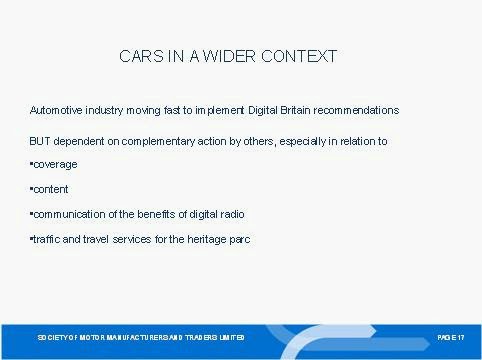
How wrong can this statement be? Fewer than 1% of vehicles on the road currently have a DAB radio. That proportion is not going to increase quickly, even by 2013 or 2015, as the government wants it to. Rather than being “the key driver” for DAB radio take-up, cars will become THE major sticking point for digital radio switchover.

The UK car industry appears to be nearing the end of its tether over the confused information that has been fed to consumers in recent years about the so-called DAB ‘switchover’ and FM ‘switch-off’ date(s). This frustration boiled over at the last government Digital Radio Stakeholders Group meeting on 17 May 2011, when Bob Davis, who heads the Digital Radio Committee of the Society of Motor Manufacturers & Traders [SMMT], stood up to offer what he referred to as a “naughty” comment:

“Jane [Humphreys, Department for Culture, Media & Sport] said earlier ‘around 2015’ for a digital radio switchover. The automotive industry has made it very, very clear, since the process began, that it needs certainty. We’ve got 2013 [as the date for a government decision on switchover] and we think we’re working towards a 2015 switchover date. With respect, Jane, I can already see tomorrow’s headlines that DCMS says ‘digital switchover delayed from 2015’ because you used the phrase ‘around 2015’. That implies a delay. It may be what potentially happens in the market – it may be 2016, it might be a bit later than that – but, for the moment, from an automotive industry perspective, every time there’s a suggestion that 2015 has stopped being the aspirational date – or might stop being an aspirational date – all that happens is [that] the automotive industry, or parts of it, is given another opportunity to say ‘it ain’t going to happen, forget all about it’ and we will end up with the bigger problem of converting vehicles already in the parc to digital, because people will just say ‘if DCMS can’t give us certainty’ – and I accept that, at the moment, you can’t – but if DCMS are saying ‘around 2015’ instead of ‘in 2015’, it reduces the opportunity for SMMT to keep telling its members there’s a deadline, and it’s ‘this’. So please could we have a little bit of caution, from an automotive industry perspective, in (particularly) government references to switchover dates.”

Jane Humpreys: “Thank you, Bob, though I think I’m right in saying that the Minister has never said ‘it will be in 2015’. He too has said that it will be in terms of … that is the target to which we are working, but what is the principal objective is that we have to meet the criteria that have been set out and we have a piece of legislation – unless I’m much mistaken – that says there will be a minimum of two years’ notice. So….”

John Mottram, DCMS: “That’s right. I’m aware of three Daily Mail articles that suggest it’s seven years, two years, five years’ delay depending upon the date, so I think in terms of coverage and it being delayed, I think that delay is already out there. But to Jane’s point, I think the Action Plan and Ed [Vaizey]’s words make it clear that it’s a consumer-led approach. The industry target date is 2015 – we’ve never shifted from that – but that decision is based on the criteria….”

At that point, the meeting was abruptly closed. What had been scheduled to be merely another ‘tick the government box’ faux consultation meeting had suddenly started to spin out of control. The natives had started to get restless. It was time to turn them out onto the street again.

Radio Invicta: the genesis of black music radio in London …. still unfulfilled

I only knew Roger Tate through listening to his programmes on the radio. He was a DJ on Radio Invicta, London’s first soul music radio station, launched in 1970. Invicta was a pirate radio station. Back then, there were no legal radio stations in the UK other than the BBC.

The notion of a campaign for a soul music radio station for London had been a little premature, given that no kind of commercial radio had yet existed in Britain. But that is exactly what Radio Invicta did. As Roger Tate explained on-air in 1974:

“Who are Radio Invicta? You may well be asking. Well, we’re an all-soul music radio station. We’re more of a campaign than a radio station, I suppose. We believe in featuring more good soul music on the radio.”

By 1982, Black Echoes music paper reported that Radio Invicta was attracting 26,000 listeners each weekend for its broadcasts. By 1983, Radio Invicta had collected a petition of 20,000 signatures in support of its campaign for a legal radio licence. There was sufficient space on the FM band for London to have dozens more radio stations. By then, local commercial radio had existed in the UK for a decade. But nobody in power wanted to receive the station’s petition and Invicta’s Mike Strawson commented:

“I have tried to speak to the Home Office about it, but it shuts the door.”

Radio Invicta eventually closed for good on 15 July 1984, the date that the new Telecommunications Act had dramatically increased the penalties for getting caught doing pirate radio to a £2,000 fine and/or three months in jail. By then, Capital Radio had enjoyed its licence as London’s only commercial radio music station for eleven years. Its monopoly reign was still to run for a further six years.

It might have seemed in 1984 that Radio Invicta’s fourteen-year struggle to play soul music on the radio in London had come to absolutely nothing. The Invicta team went their separate ways after the pirate station’s closure. Roger Tate continued his career as a successful technology journalist. After his death in 2001, aged only 47, one of his friends, Trevor Brook, spoke of Tate’s determination to play soul music on the radio in the face of opposition from the government and the radio ‘establishment.’ His eulogy at the funeral of his friend ‘Bob Tomalski’ included these comments:

“The government told the story that there were no frequencies available. Now Bob was not stupid. He had enough technical knowledge to know that this was simply not true. So, either government officials were too dim to realise the truth of the situation … or they were just lying. Nowadays, we have 300 independent transmitters operating in those same wavebands, so you can probably work out which it was. Anyway, in Britain, the result was that any proper public debate about the possible merits of more radio listening choice was sabotaged by this perpetual claim that it was impossible anyway.

So, we had pirates. Other countries which had not liberalised the airwaves had pirates as well, but some of them took the refreshingly realistic approach that no harm was being caused, and they permitted unlicensed operations to continue until they got round to regularising the situation. Ambulances still reached their destinations and no aeroplanes fell out of the sky. Not so in this country though. The enforcement services here were too well funded and the established orthodoxy too well entrenched. That ‘frequency cupboard’ was going to be kept well and truly locked!

Bob had thrown himself into running a regular soul station, Radio Invicta. He built a studio, tore it apart and built a better one. He eventually sectioned off part of the flat as a separate soundproofed area. He built transmitters – and got them working. But Bob was nothing if not multi-skilled, and he excelled in producing the programmes themselves. Using nothing more impressive than an old four track reel to reel tape recorder, Bob would create highly polished jingles and station identifications. ‘Roger Tate, super soul DJ.’ Other stations, both official and unofficial, listened to what Bob and his colleagues did and their ideas were copied or imitated.

Faced with the authorities, Bob was remarkable, because he was absolutely fearless. He was certain they were in the wrong and, given enough time, were going to lose the battle. It was a war of attrition and only perpetual piracy was ever going to bring about change. And he was quite right about that. The government kept winning the battle in the courts but began to lose the moral one. Eventually the law was changed.

Do we have free radio now? In the sense that anybody can decide to start up a new magazine, find the finance and get on with it, no, we don’t have that for radio. The process is bound up with a long winded regulation and approval process involving a statutory body which has had its fingers burnt in the past by the odd bankruptcy and the odd scandal. So they play safe and issue more licences to those who already have stations. The consequence is that originality and creativity get crushed into blandness and mediocrity. My own teenagers constantly flip between stations in the car, but they don’t care enough about any of them to listen indoors. Fresh people don’t get to control stations. Behind boardroom doors, they might think it privately, but in what other industry would the chairman of the largest conglomerate in the market dare to say publicly that even the present regime was too open and, I quote, ‘was out of date and was letting inexperienced players into the market’? That is a disgraceful statement. Where would television, theatre, comedy, the arts, and so on be, if new and, by definition, inexperienced people didn’t get lots of exposure? The industry is stale, complacent and rotten. Bob, there are more battles out there and we needed you here.”

Ten years later, these words are just as pertinent. It is hard to believe that a bunch of enthusiastic soul music fans who wanted to play their favourite music to their mates could have posed such a threat to the established order. But the history of radio broadcasting in the UK has demonstrated repeatedly that ‘the great and the good’ consider the medium far too important to let control fall out of their hands. Their arguments, however ridiculous, were taken completely seriously because they were the establishment.

Peter Baldwin, deputy director of radio at the Independent Broadcasting Authority, said in 1985: “We wouldn’t want to be dealing with two current local stations [in one area]. If it’s Radio Yeovil [operating as the only commercial station in Yeovil], well, that’s okay … But we couldn’t subscribe to competition [for existing local commercial pop music station Swansea Sound] from Radio Swansea, unless it was in Welsh or concentrated on jazz – and there probably wouldn’t be sufficient demand for that kind of service.”

James Gordon (now Lord Gordon), then managing director of Radio Clyde, wrote in The Independent newspaper in 1989: “It has to be asked whether there is really evidence of pent-up demand from listeners for more localised neighbourhood stations … Eight to ten London-wide stations would be enough to cater for most tastes.”

David Mellor MP told the House of Commons in 1984: “The government do not believe that it would be sensible or fair to issue pirate broadcasters with licences to broadcast. To do so, on the basis suggested by the pirate broadcasters, would be progressively to undermine the broadcasting structure that has evolved over the years.”

However, within five years, the government did indeed license a pirate radio station to broadcast in London. Once Invicta had disappeared in 1984, it was superseded by newer, more commercially minded, more entrepreneurial pirate radio stations – JFM, LWR, Horizon – that played black music for Londoners. In 1985, a new pirate station called KISS FM started, quite hesitantly at first. Its reign as a London pirate proved to be much shorter than Invicta’s but, by the time KISS closed in 1988, it was probably already better known than Invicta.

KISS FM went on to win a London radio licence in 1989 and re-launched legally in 1990. It carried with it the debt of a twenty-year history of black music pirate radio in London started by Radio Invicta and then pushed forward by hundreds of DJs who had worked on dozens of London black music stations. KISS FM would never have existed or won its licence without those pirate pioneers.

Sadly, the importance of KISS FM’s licence as the outcome of a twenty-year campaign seemed to be quickly forgotten by its owners and shareholders. The lure of big bucks quickly replaced pirate ideology during a period of history when ‘get rich quick’ was peddled by government as the legitimate prevailing economic philosophy. KISS FM lost the plot rapidly and soon became no more than a money-making machine for a faceless multimedia corporation.

Right now, there remains as big a gap between pirate radio and the licensed radio broadcasters as existed twenty years ago or even forty years ago. London’s supposedly ‘black music’ stations, KISS FM and Choice FM, now sound too much of the time like parodies of what they could be. Whereas, pirate radio in London still sounds remarkably alive, unconventional and creative. More importantly, only the pirates play the ‘tunes’ that many of us like to hear.

The issue of how black music was ignored by legal radio in London, and then betrayed by newly licensed black music radio stations, is on my mind because of my new book ‘KISS FM: From Radical Radio To Big Business.’ It documents a small part of the history of black music pirate radio in London, and it charts the transformation of KISS FM from a rag tag group of black music fanatics into a corporate horror story. I was on the inside of that metamorphosis and it was an experience that, even twenty years later, remains a sad and terrible time to recall.

In 1974, Roger Tate had wanted more black music to be heard on the radio in London. Ostensibly, that objective has been achieved. But the black music I hear played on white-owned stations in London (there is no black-owned station) is a kind of vanilla K-Tel ‘black music’ that is inoffensive and unchallenging.

If Croydon is the dubstep capital of the world, how come there is no FM radio station playing dubstep in Croydon, or even in London? How come I never hear reggae on the radio when London is one of the world cities for reggae? How come I had to turn to speech station BBC Radio Four to hear anything about the death of Gil Scott-Heron in May? Why is that Jean Adebambo’s suicide went completely unremarked by radio two years ago?

Legitimate radio in London seems just as scared of contemporary cutting-edge black music as it was in the 1970s when Roger Tate was trying to fill the gaping hole with Radio Invicta. Nothing has really changed. Except now there exists the internet to fill that gaping hole. And FM pirate radio in London continues to satisfy demands from an audience that legitimate radio has demonstrated time and time again that it doesn’t give a shit about. Is it any surprise that young people are deserting broadcast radio?

Forty years ago, I listened to Roger Tate and London pirates like Radio Invicta because they played the music I wanted to hear. Forty years later, I find it absolutely ridiculous that I am still listening to a new generation of London pirates because they still play the music I want to hear. As Trevor Brook suggested at Roger’s funeral, our radio system is so consumed by “blandness and mediocrity” that “the industry is stale, complacent and rotten.”

Roger Tate R.I.P. You may be gone, but you and your campaign at Radio Invicta are as necessary as ever today. Sad but true.

GERMANY: "DAB [radio] remains a problem child"

On 2 May 2011, a panel convened at the Central Germany Media Conference in Leipzig to discuss the future of digital radio. The panellists were: Gerd Bauer from LMS, Erwin Linnenbach from Regiocast, Christophe Montague from NRJ International Operations and Willi Steul from Deutschlandradio.
The panel felt that one of the main problems around the planned (re-)launch of digital radio in Germany on 1 August 2011 was the lack of DAB+ capable radio receivers in the market. “The left shoe is there, but not the right one,” commented Erwin Linnenbach, who was concerned that it would be difficult to persuade consumers to buy a digital radio if they did not know what they would be able to receive on it.
Willi Steul said that he had had to visit three shops before he had found one that stocked a DAB+ radio. “An ordinary customer would not make that effort, but would have bought an FM radio from the first place,” he suggested. Deutschlandradio would save €12m per annum from being able to shut down its Long Wave and Medium Wave transmitters, said Steul. However, even if DAB+ were available nationwide, he did not believe that FM switch-off was an issue.
Christophe Montague suggested that, where there were already a wide range of FM radio stations, there was no need for new channels. This was the reason why it would prove so hard to launch digital radio in France. Whereas, in many parts of Germany, Montague said that it was a “radio desert.”
The panellists agreed that the biggest problem was the lack of DAB+ radios in shops. Linnenbach did not believe that this issue could be fixed by 1 August because there was not enough time. The objective had to be to make radio listeners understand the benefits offered by DAB+. If that succeeded, he believed the chances were good for a successful launch.
The panel proceedings were reported in the German press under sceptical headlines:
“DAB Plus before launch – an uncertain outlook for success,” said Business-on
“Media conference – success of DAB Plus not guaranteed,” said Digitalfernsehen
“Media conference – DAB remains a problem child,” said Rein-Hoeren
According to the latter publication, Erwin Linnenbach had said that the monopoly of transmission company Media Broadcast was the major obstacle to nationwide digital radio in Germany. He felt that Media Broadcast’s requirements did not offer a sensible business model to potential DAB+ broadcasters [see blog Dec 2010]. Christophe Montague agreed and said he had the impression that Media Broadcast would make the most out of the DAB tender process.
Heinz-Dieter Sommer, director of radio at Hessischen Rundfunks, said that economically viable conditions had to be created to enable commercial radio companies to participate in DAB+ alongside the public service broadcasters. “Otherwise,” he said, “in ten years time, FM will still not be switched off.”
Two British digital radio companies have committed financial support to the roll-out of national DAB+ in Germany in August 2011. This follows the slow-down of DAB radio receiver sales in the UK in 2009 and 2010 [see blog].
In December 2010, Frontier Silicon announced that, in order to persuade four commercial radio broadcasters in Germany to persevere with DAB+, it had promised them it would purchase an unspecified amount of their advertising airtime over the next four years [see blog].
Then, in March 2011, Pure Digital announced that it had forged “a strategic marketing partnership with Germany’s commercial radio stations in advance of the launch of the first nationwide digital radio multiplex.” It said that “the partnership and financial investment” it was providing would ensure that its digital radios would be “heavily promoted in various German media.”
Germany could be under the mistaken impression that DAB radio is already a roaring success in the UK market. It was reported in the German press last week:
“While listening in Germany is still dominated by analogue radio, the British have long joined the digital age. Figures from RAJAR have shown that, in Q1 2011, nearly 92% of the population have listened to digital radio, on average for more than 22 hours per week.” [source]
“Britain remains a pioneer in listening to digital radio via DAB. On Thursday, new RAJAR record figures were recorded. 47.3m listeners (91.6%) in the first quarter listened at least once a week to digital radio.” [source]
In fact, the most recent RAJAR research found that 43% of the UK adult population listened to digital radio in a week, and only 27% listened to DAB radio. The high percentages quoted in the German press are for listening to ALL radio via ALL platforms, not for digital radio or DAB radio alone.
I recall Frontier Silicon chief executive Anthony Sethill having been quoted in his company’s press release in 2008 saying: “Digital radio is here to stay, with DAB sets outselling analogue models by six to one.”
In fact, in the UK, analogue radios outsell DAB radios by four-to-one. Mmmm. It looks as if the DAB propaganda war in Germany has only just begun.

Government expenditure cutbacks clobber UK commercial radio

As soon as the coalition government came to power in May 2010, it implemented Conservative Party policy to make substantial cutbacks to the amount of public money spent on government marketing campaigns. Commercial radio was hit the hardest because, more than any other medium, it had become increasingly dependent upon government expenditure on advertising airtime.

In 2010, before the general election, I had predicted [see blog] that the impact of these cutbacks would prove “disastrous” for the commercial radio sector. I had calculated that a 50% cut in total public expenditure on commercial radio advertising would lose the sector £44m to £48m in revenues, equivalent to 9% of total sector revenues.

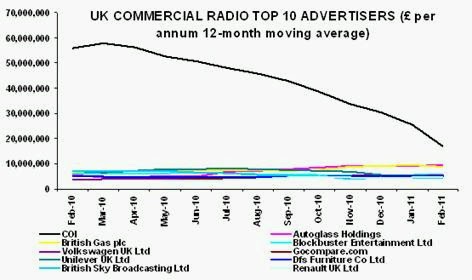
Interviewed by BBC Radio Four, I was asked if my scenario was not overstating the potential impact on commercial radio. I argued that it was not – the amount spent by the government’s Central Office of Information [COI] on commercial radio dwarfed all other radio advertisers by miles. By February 2010, government expenditure on radio commercials was greater than that of the second, third, fourth and fifth largest advertisers combined.

The Radio Advertising Bureau had put a brave face on the losses from its biggest advertiser. In June 2010, it said: “We are optimistic that radio’s strengths will be recognised as COI budgets come under ever greater scrutiny.” In September 2010, it said it was “working with a wide range of advertisers to bridge the gap” left by public expenditure cuts.

However, the latest data from Nielsen show that the impact upon commercial radio has been even greater than I had forecast. In the year to February 2011, COI expenditure on radio advertising was down 70% year-on-year, much greater than the 50% cut that had been anticipated from previous Conservative Party pronouncements. In total, commercial radio lost £44m per annum from all public expenditure on radio, compared to the previous year.

The worse news was that, as the graph above shows, the fall in COI expenditure has become steeper in recent months. As a result, the impact on the sector in 2011 is likely to be just as severe as it was in 2010. The hard fact is that this is not a temporary cyclical loss for commercial radio – these revenues will not rebound for as long as the coalition government remains in power.

The graph shows clearly that no individual or group of advertisers have been able to substitute entirely for the losses caused by government cutbacks, although some gains were made from clients in 2010 [see blog]. No commercial advertiser spends more than £10m per annum on radio, whereas the COI had spent £58m in the year to March 2010 (but was down to £17m by February 2011). This is simply too big a gap to be filled by a few individual commercial advertisers.

Media Week reported recently that “the more optimistic media owners are hoping the COI’s former spend [on radio] can be clawed back by year’s end.” It is hard to see how that can be realistically achieved, given the scale of the £44m per annum loss from public sources to date, particularly in the face of declining consumer disposable incomes.

In an attempt to offer a positive outlook, Media Week suggested: “But the situation is set to improve. From April [2011] onwards, there will no longer be any comparable year-on-year COI spend left in the system, as purdah [sic] kicked in 2010.”

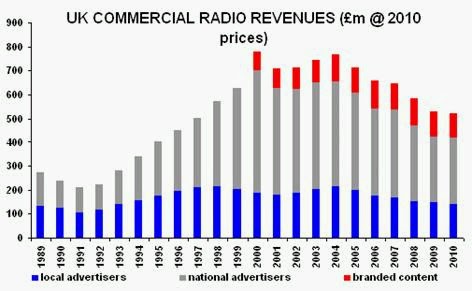
Perhaps what Media Week was trying to say was that COI expenditure will level off this year once the savage cuts have been in situ for more than a year. Yes, inevitably, but that does not in any way help an industry that has just witnessed £44m per annum of revenues disappear into thin air. Remember that total commercial radio revenues in 2010 were only £523m, already down from £641m in 2004. Now a further huge 8% chunk of income has gone.

Another commentator recently noted optimistically: “The [radio] medium took £523 million in revenue in 2010, up 3.3% year-on-year, and 2011 looks like another positive year of growth, not the inevitable management of decline forecast by some.”

However, once inflation is taken into account, 2010 commercial radio revenues fell in real terms [see blog]. Far from a decline being “forecast by some,” the industry’s own data demonstrate that decline has been occurring since 2004 in real terms, long before the recent cuts to government expenditure. Adjusted for inflation, commercial radio revenues in 2010 were lower than they had been in 1998.

This is not the time for spreading unfounded optimism based on ignorance of the facts. If anything, the impact of government cuts has proven to be more than “disastrous” and will necessitate even more restructuring of the commercial radio sector in the short term. This could include the closure of further unprofitable digital ventures and of sector support agencies whose subscriptions will begin to appear increasingly discretionary when the axe has to fall somewhere.

FRANCE: government report recommends 2-3 year "moratorium" before launch of digital radio

A new report on the introduction of digital terrestrial radio (‘DAB radio’ in the UK) in France has recommended to the government that the launch should be delayed by two to three years. In the interim, the French media regulator CSA would be asked to establish a project to investigate the “overseas experiences” of digital radio, according to the government press release.

David Kessler, former head of state radio station France Culture, was commissioned in June 2010 by the government to produce a strategic analysis of the launch of digital radio in France. His interim report, published in November 2010 [see blog], identified the “paradox of DAB radio – it is a sufficiently attractive technology to be launched successfully, but it is insufficiently attractive to successfully allow FM broadcasts to cease.”

In the final report, published this week, Kessler said that not all the conditions had been met from an economic standpoint to permit the widespread launch of digital terrestrial radio. His report identified the significantly different challenges between digital radio switchover and digital television switchover:

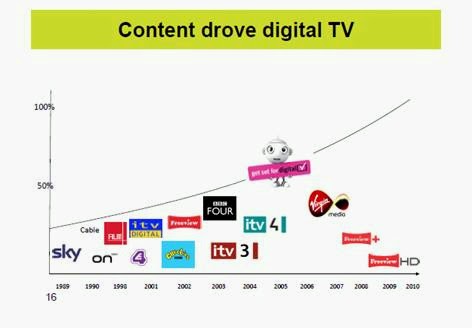
“An error in logic has probably contributed greatly to making the debate [about digital radio] opaque rather than transparent. The error came from having planned digital radio switchover with reference to digital television switchover, which started in 2005 and the success of which has been staggering and immediate, so that the changeover from analogue to digital TV will be completed throughout the land by 2012. Many parties imagined that the route to digital opened up by television would be followed by radio. But this plan was wrong for three reasons.

Firstly, the television market was dominated in 2005 by five channels (TF1, France 2, France 3, France 5/Arte and M6) that attracted 75% of television viewing. The transition to a score of free channels was obviously very attractive. However, as will be discussed later, the situation in radio is quite different – the current choice of stations is one of the richest that exists in the world, after the landscape opened up in the 80s. Even if the choice is not the same in every region, none of them – some near – are in a situation where only five major stations dominate the choice.

Second is the difference in receivers. Even if digital radio switchover had been launched simultaneously with that of television, where the evolution of televisions (flat screen, HD and now 3D) resulted in a faster replacement of equipment than anticipated, digital television was accessible without changing the set through the purchase of a single adaptor at a moderate price. Digital radio switchover requires the replacement of all receivers, and households have multiple radios and the market is sluggish. Without doubt, digital radio switchover could re-invigorate the market with a simple, inexpensive high-end (with screen) radio. At this point, no one can say how quickly take-up of replacement receivers will happen. Examples overseas – particularly Britain – demonstrate a relatively slow rate of replacement, and the different situation in countries where take-up is faster – Korea, Australia – make comparisons difficult.

The third reason is that the history of television demonstrates that it works through ‘exclusive changes’ where one technology replaces another quickly. Colour television pushed out black and white television. Digital television is about to push out analogue television. But experience shows that far from all media work this way. On the contrary, some go through ‘cumulative change’. Over a short or long period of time, different technologies co-exist and content is distributed through several technologies. As Robert Darnton noted about the book, we often forget that the printed word has long co-existed with the manuscript. From this perspective, the history of radio is the opposite of television: different transmission systems are cumulative rather than exclusive. This does not exclude the possibility that, in the long run, some transmission systems will decline and no longer be used, just as printing marginalised the manuscript. But what it means is that one cannot plan the launch of digital radio by imagining that all other transmission systems will be switched off, particularly FM. Even today, despite the success of FM, Long Wave and Medium Wave transmissions are still used because they reach a sufficient number of listeners not be switched off by broadcasters.

In fact, a careful examination of the launch of digital radio in other European countries shows that a ‘cumulative change’ scenario exists that we must anticipate in France too. Indeed, the launch of digital radio in other European countries had been presented as a quick substitute for analogue radio, even though the existing choice of analogue stations was less than in France, and the choice of digital stations seemed more attractive and content-rich than offered by analogue. Even if a proportion of listeners are quickly adopting digital radio, a greater proportion are still sticking with their traditional radios, with the possible exception of Norway, where analogue switch-off seems to be seriously considered at present. This leads to a situation in which the government initially adopts a goal of analogue switch-off but then, given the impossibility of switch-off, drops or postpones the switch-off date by several years. As the choice of existing radio stations is particularly substantial in France, it would appear that this situation is most likely to be repeated if digital radio were to be launched. Radio station owners are not mistaken. Very few want a quick switch-off of FM, and some do not want any switch-off.”

These points echo evidence on digital radio switchover in the UK that I had presented to the House of Lords Select Committee on Communications in January 2010:

“With television, there existed consumer dissatisfaction with the limited choice of content available from the four or five available analogue terrestrial channels. This was evidenced by consumer willingness to pay subscriptions for exclusive content delivered by satellite. Consumer choice has been extended greatly by the Freeview digital terrestrial channels, many of which are available free, and the required hardware is low-cost.

Ofcom research demonstrates that there is little dissatisfaction with the choice of radio content available from analogue terrestrial channels, and there is no evidence of consumer willingness to pay for exclusive radio content. Consequently, the radio industry has proven unable to offer content on DAB of sufficient appeal to persuade consumers to purchase relatively high-cost DAB hardware in anywhere near as substantial numbers as they have purchased Freeview digital television boxes.”

The Kessler document should offer significant food for thought to the British government for its unworkable plans for DAB radio switchover. Whereas Kessler correctly identified that TV and radio digital switchover are two very different undertakings, our public servants working on digital radio policy in the government and in Ofcom have long failed to understand these differences. The appointment of Ford Ennals as chief executive of Digital Radio UK in 2009, on the back of his work between 2005 and 2008 managing digital television switchover, should have been viewed as barely relevant experience to achieve successful digital radio switchover.

Have any of the people managing digital radio switchover for the UK ever actually worked in the radio industry? At DCMS? No. At Ofcom? No. At Digital Radio UK? No. If, like Kessler, they had radio sector experience, they would realise that all their speeches and presentations that repeatedly cite digital TV switchover as the precedent for radio are completely off-target.

Is there any wonder that failure of DAB public policy was inevitable?

When UK radio listening figures are this good, why does RAJAR need to fib?

It is good to know that radio is still an extremely popular medium in the UK, something borne out by the latest radio audience metrics published by industry body RAJAR for Q1 2011. However, in its determination to make every quarter’s results newsworthy, RAJAR has a track record of bending the truth to achieve press headlines [see blog May 2010]. This latest quarter was no exception.

According to the RAJAR headline:
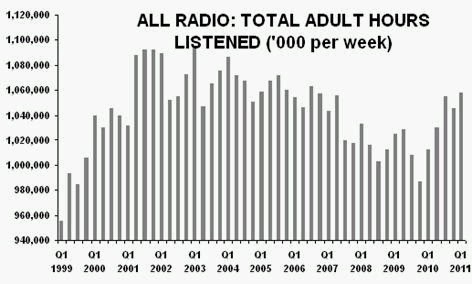
• “Total radio listening hours reach 1,058 million per week – new record.”^

RAJAR explained:
• “The total number of radio listening hours broke all previous records to reach 1,058 hours per week …”^

Fantastic news! Except that this is not at all true. RAJAR’s own historical data tell a different story:
• 1,088 million hours per week in Q2 2001
• 1,092 million hours per week in Q3 2001
• 1,092 million hours per week in Q4 2001
• 1,090 million hours per week in Q1 2002
• 1,072 million hours per week in Q4 2002
• 1,094 million hours per week in Q1 2003
• 1,066 million hours per week in Q3 2003
• 1,076 million hours per week in Q4 2003
• 1,086 million hours per week in Q1 2004
• 1,072 million hours per week in Q2 2004
• 1,068 million hours per week in Q3 2004
• 1,059 million hours per week in Q1 2005
• 1,068 million hours per week in Q2 2005
• 1,072 million hours per week in Q3 2005
• 1,060 million hours per week in Q4 2005
• 1,063 million hours per week in Q3 2006

During sixteen quarters between 2001 and 2006, total hours listened to radio were greater than they were last quarter. “New record?” No. “Broke all records”? Er, no.

The reality is that total radio listening has not yet returned to the level it had achieved in 2001. Except that, ten years ago, the UK adult population was 48.1 million, whereas now it is 51.6 million. So the population has increased by 7% over the last decade. Yet total UK radio listening is still less than it was then.

Most statisticians I know would refer to that as a like-for-like 7%+ decline in total hours listened to radio. However, to RAJAR, it is evidently a “new record” that “broke all previous records.”

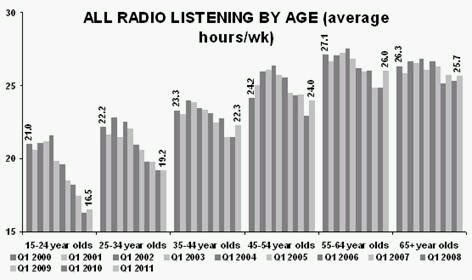
Why does any of this matter? Because radio broadcasters have been progressively losing usage over most of the last decade. Initially, it was 15-24 year olds that were spending less time with radio. Increasingly, it is also 25-34 year olds. For a decade, the UK radio industry has desperately needed a coherent strategy to reverse this loss of listening. The decline in young adult listening to broadcast radio does not merely impact the NOW. If these consumers do not find anything in their youth worth listening to on the radio, they will grow old without the radio habit. Their radio listening patterns NOW are likely to influence radio listening for the next half-century.

This is why RAJAR’s continuing efforts to achieve yet another headline in the Daily Mail proclaiming “Radio listening at an all time high” are ultimately redundant. Those headlines do not impact the reality of the data collected from tens of thousands of radio listeners every month. Those data show incontrovertibly that listening is in significant long-term decline amongst younger demographics. And radio will be in mortal danger if it does not re-invent itself for the next generation.

You only have to listen to any pirate radio station in London to understand that the gulf between what young people are actually listening to and what the old fogies who run UK radio are giving them has never been wider. Chris Moyles is as passé as Dave Lee Travis was twenty years ago.

So, yes, RAJAR’s fibs and the resulting Daily Mail headline will be another opportunity for champagne corks to pop in radio boardrooms across the land. But if radio doesn’t start making itself exciting and relevant to young people, broadcast radio’s future role will be relegated to a soundtrack in old people’s homes. Complacency such as that propagated by RAJAR will only make many radio businesses redundant in the long run.

^ in a footnote this small, the RAJAR press release admits the caveat “since new methodology was introduced in Q2, 2007.”

DAB Radio Downgrade: how is '90% of FM coverage' a sensible target for DAB to replace FM?

“Makin’ a good t’ing bad!”

Moving the goalposts. Governments are adept at doing just that to help them achieve their targets or to make figures look better than they really are. Digital radio switchover is no exception. Given the technical and financial impossibility of the task plotted twenty years ago to completely replace analogue radio broadcasting with DAB radio, it has became necessary in recent months for the civil servants and digital radio lobbyists to move the goalposts.

In a blog in April 2011, I had outlined Ofcom’s latest ruse to deliberately plan to make DAB reception worse than existing FM reception for many radio listeners. Nevertheless, Ofcom will still declare this a victory for the technical superiority of the DAB platform.

The latest proposal under consideration is to make coverage of local DAB transmitters equivalent to 90% of existing FM coverage. On the one hand, this represents a belated admission that DAB radio cannot realistically achieve the same robust coverage as FM. On the other, it is a massive kick in the teeth to radio listeners – an attempt to purposefully replace something good (FM) with something worse (DAB). Madness!

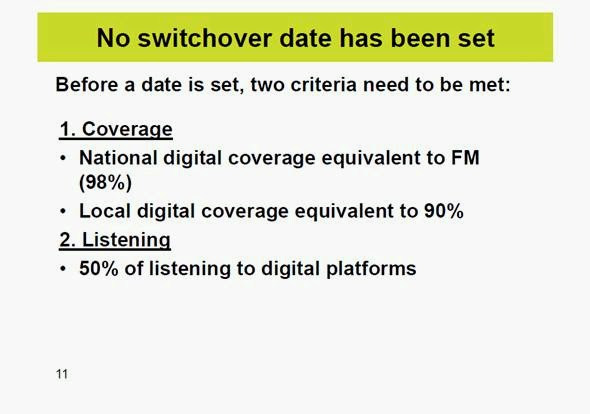
A recent presentation by DAB lobbyist organisation Digital Radio UK invoked a new, vague “local digital coverage equivalent to 90%” criterion [see below]:

“90%” of what? The government’s Digital Britain report in June 2009 had fixed the digital radio switchover criteria as:
• “When 50% of listening is to digital; and
• When national DAB coverage is comparable to FM coverage, and local DAB reaches 90% of the population and all major roads.” [emphasis added]

There was never anything in Digital Britain about achieving “90% of existing FM coverage.” It was always “90% of the population.” The goalposts are being moved to make it easier for the government and DAB lobbyists to declare that DAB has achieved the criteria. Despite this outcome making the consumer experience of radio evidently worse.

We were told that one result of the Digital Radio Summit meeting on 31 March 2011 between government, regulator and the radio industry was:

“It is understood that it will cost around £20-30m to extend the local DAB signal to 90% of the FM signal in the UK…”

At a Westminster Media Forum conference on 5 April 2011, the topic of this newly created “90% of FM” criterion was raised by several speakers:

Jimmy Buckland, director of strategy, UTV Media: “There’s a DCMS [Department for Culture, Media & Sport] plan that’s been referred to today that’s currently on the table that would take local multiplexes to just 90% of what FM already delivers, with no commitment on major roads. If that plan’s agreed, it just about gets us to base camp.”

[…]

Neil Midgley, assistant media editor, The Daily Telegraph: “Now the briefing that we were getting last week was somewhere below £30 million for a build out to about 90% of current FM coverage. “

[…]

Daniel Nathan, director, Brighton & Hove Radio: “Just leading on from that, in Jimmy’s slide we saw the figure being an aspiration of ‘90% of the population’ and I was quite disturbed to hear that now that they are kind of moving away from ‘90% of the population’ to ‘90% FM coverage.’ When was that decided and by whom?”

[…]

Jimmy Buckland: “There were two different figures, there was originally a figure which was the criterion, at which point you would make a decision about switchover which was that the Government said that once we had ‘90% population coverage’ and ‘coverage of all major roads,’ you could make a decision and there were a couple of other criteria that go with that. The second figure which was ‘90% coverage of current FM’ for local DAB concerns what would be delivered by a proposal which is currently on the table. So to tie in with the previous point, what that £30 million delivers is a little bit more coverage at the local level, aggregated to 90% on a UK wide basis, so in some local markets it could be comfortably less than 90%, in other markets it could be higher and it doesn’t get you to the universality that you need for switchover.”

So, two questions remain unanswered:
• Who came up with the idea of ‘90% of FM coverage’ to be sneaked in as an easier criterion?
• Why are large parts of the radio industry (including RadioCentre and the BBC) not publicly campaigning against this ridiculous proposal intended to make reception of their radio stations on DAB WORSE for listeners than existing reception on FM?

It is hard not to conclude that the parties involved in this latest wheeze seem happy to treat the UK’s 46,727,000 radio listeners with utter contempt.

Digital Radio UK on DAB radio switchover: talkin' loud and saying nothin'

DAB radio receiver sales

“Ford Ennals, Digital Radio UK’s chief executive, remains optimistic and says that the DAB [receiver] market will grow by 8-10% this year [2011].” [source]

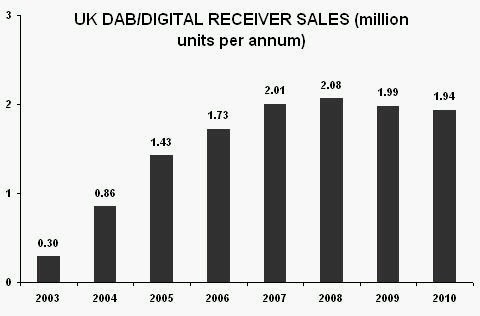
FACTS: DAB/digital radio receiver sales volumes in 2010 were down on 2009, and in 2009 were down on 2008, although stakeholders disagree about the precise volumes and the percentage change:
“2010 was slightly down in digital radio sales volumes (-2.3%) compared to 2009” [Digital Radio UK update]
“’[DAB] volume sales were only marginally lower than the previous year (-0.7%) at 1.92 million units,’ explains Simon Foy, GfK senior account manager, CE.” [source]
• “DAB sales for 2010 were 1.91 million pieces” [source]

Digital radio listening reaching the 50% criterion

Ford Ennals: “I think you can see the listening criteria’s certainly being met in the next five years.” [WMF]

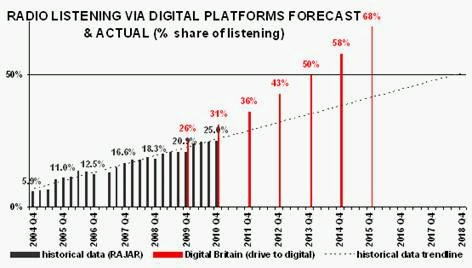
“Despite two thirds of listeners still using analogue radio, Ennals believes that, if you extrapolate digital radio’s recent growth pattern, the 50% target could be achieved by the end of 2014.” [source]

Ford Ennals: “We are likely to hit 50%, you know, in the next five years, I would say.” [DRS]

FACTS: When you extrapolate the radio industry’s RAJAR dataset, the 50% criterion is reached:
• Not by the government’s target of year-end 2013
• Not by Ford Ennals’ new, seemingly variable, targets of “the end of 2014” or “in the next five years”
• By year-end 2018, IF growth in digital listening is maintained at the current rate

Growth in DAB/digital radio listening

Ford Ennals: “We’ve seen overall in this year, in the last 12 months, each quarter, we’ve seen a 20% year-on-year growth of digital listening.” [WMF]

Ford Ennals: “We’ve seen 19 to 20 per cent listening growth in the year [2010].” [DRS]

Ford Ennals: “We see about 20% growth in 19 … sorry, in 2010, it was 14% growth in 2009 and there was about 10% growth the previous year. So, you know, we see solid growth.” [WMF]

FACTS: According to the radio industry’s RAJAR dataset:
• 20%+ growth in digital listening was only evident in the last two quarters of 2010, not in “each quarter”
• Part of this apparent growth spurt in digital listening was the result of a sudden 5% to 6% increase in TOTAL radio listening recorded in the last two quarters of 2010

Consumer satisfaction with analogue radio

“DRUK’s Ennals is not convinced by the argument that most consumers are more than satisfied with analogue radio.” [source]

Ford Ennals: “FM is full and I think almost half of the FM spectrum is taken by 5 national services, there’s only 1 national commercial service, so it’s, you know, in terms of the ability to give consumers more choice, it is somewhat limited …” [WMF]

FACTS: Ofcom research has consistently demonstrated the high level of consumer satisfaction with existing radio services:
• Around 90% of consumers were ‘satisfied’ with the choice of radio stations in their area in 2006, 2007, 2008 and 2009

The 2015 digital radio switchover date

Ford Ennals: “I’m confident [digital radio switchover] is going to happen in the near future but I don’t think there’s a need to have a date and certainly we won’t be communicating a date.” [WMF]

FACTS: Ennals and Digital Radio UK have been busy “communicating a date” for digital radio switchover to anyone who would listen. Just a few of many examples:
• Ford Ennals: “We are confident digital listening can reach 50 per cent by 2013.” [source]
• Ford Ennals: “We have set a course to double listening and expand coverage by 2013, and to switchover by the end of 2015.” [source]
• Ennals stressed that a target date of 2015 was “challenging but achievable” [source]
“Ford Ennals CEO of Digital Radio UK had positive comments for the 2015 switchover date set by government and told guests to Radio Festival that plans were already in motion to meet the ambitious date.” [source]
• Ford Ennals: “The radio industry believes that these two criteria can be met at the end of 2013, for a proposed switchover to take place in 2015.” [source]
“2015 is ‘achievable’ for an analogue-to-digital switchover, according to industry body Digital Radio UK.” [source]

[sources: WMF = Westminster Media Forum, 11 April 2011; DRS = Digital Radio Stakeholders, 3 February 2011] [thanks to Darryl Pomicter]

Which? says: DAB radio switchover must be "consumer led or not at all"

What would have to be done to make DAB radio successful?

“What there does need to be, as Freeview and digital satellite has shown in television, is simply a sufficient combination of services, technology, simplicity and price or discount to provide a value proposition for the consumer,” suggested Stephen Carter in 2004, when he was chief executive of Ofcom.

“….. for the consumer” were the key words. They were also the words that became forgotten. The consumer was ignored in the radio industry’s pursuit of the radio industry’s own agenda for DAB radio. As a consequence, DAB radio has still not succeeded … with consumers. The failings were acknowledged by Quentin Howard, one of the architects of DAB radio in the UK:

“The mistake by broadcasters was in not understanding that ‘build it and they will come’ is no longer practical in this integrated technological age.”

Which?, the UK consumer advocacy, noted the radio industry’s lack of attention to the consumer in a February 2011 briefing paper entitled ‘Digital Radio Switchover in 2015? Consumer Led Or Not At All’:

“The transition to digital radio is currently industry led. The benefits of a transition to digital radio over the current analogue service are not clear to consumers, and the uptake of the technology over the past 10 years reflects this.”

Which? suggested that, before the government can announce a date for digital radio switchover, the following criteria should be met:

• “Uptake should be a minimum of 70% of all FM radio listening transferred to digital, leaving 30% still listening on analogue (FM/LW/MW/SW) (the Government’s Digital Radio Action Plan suggests 50%)
• The transition to digital must not be announced until coverage, including a measure of signal quality, is better than that of FM radio
• DAB must have been fitted as standard in all new cars for at least two years and an effective and affordable solution to in-car conversion must be available prior to the announcement of a switchover (which costs no more than for in-home conversion)
• Government must conduct a full cost-benefit analysis from a consumer perspective as a priority because increasing consumer desire for DAB should not focus on cost alone
• Minimum standards associated with a kite mark must be ambitious and future-proofed and any incentive scheme to switch to DAB should offer only kite marked receivers
• Consumer group representatives must be involved in the development of an information campaign independent from industry to raise awareness of the digital switchover by consumers and ensure guidance and training tools are available to retailers. In this regard, any lessons from the Digital TV switchover should be acted upon
• In its assessment of the environmental impact of a switchover to digital radio, the Government must tackle the full range of issues around recycling of analogue sets and the energy impacts of DAB”

However, in some of these areas of concern, current policy on DAB radio appears to be moving in the opposite direction to that advocated by Which?:

• The 50% criterion (50% of radio listening via digital platforms before switchover can be announced) is not mandatory because it was never included in the Digital Economy Act [see Jan 2010 blog]
• The latest plan for DAB is not to deliver reception even as good as FM, but to make it worse than FM [see recent blog]
• Only 1% of cars have DAB radios fitted and future take-up will inevitably be slow [see recent blog]
• Roberts Radio reported a 35-40% customer return rate for its in-car DAB radio adaptors [see Nov 2010 blog]
• The cost benefit analysis of DAB radio to be considered by the government will also be authored by the government, rather than commissioned independently [see Jan 2011 blog]
• Roberts Radio admitted having had to pull the plug on several DAB receiver projects, including the industry’s promised ‘£25 DAB radio’, because they could not meet Roberts’ minimum quality standards

In July 2010, after the formation of the new coalition government, culture minister Ed Vaizey had said:

“If, and it is a big if, the consumer is ready, we will support a 2015 switchover date. But, as I have already said, it is the consumer, through their listening habits and purchasing decisions, who will ultimately determine the case for switchover.” [see Sep 2010 blog]

So, it might appear that the Minister and Which? are, in fact, both lined up in agreement that digital radio switchover can only happen if it is supported by consumers. So why has the government not yet recognised that consumers already seem to have given the thumbs down to DAB?

Because there are middle men (Ofcom, DCMS, Digital Radio UK, Arqiva, DAB multiplex licence owners) who persist in keeping the DAB dream alive in Whitehall. Yet again, consumers are being drowned out by the clamour of agencies eager to pursue their own narrow objectives. And the mantra of the middle men is: DAB crisis, what crisis?

DAB Radio Downgrade? The new masterplan to deliver DAB radio reception worse than FM

When something works well, it just works. You do not need to analyse why it works. It just works. And nobody asks questions as to why or how. That is the case with FM radio. During half a century of development, more and more FM transmitters have been built across the UK (2,100 currently in operation) so as to reach the point now where almost the entire population receives an FM signal (maybe not always perfect, but some reception rather than none at all).

DAB radio was intended to replace FM radio. However, it must only be worth replacing FM with DAB if DAB is actually better than FM. Why replace a transmission system that has taken 50 years to perfect with something that is going to be worse? Unfortunately, nobody thought to conduct a cost/benefit analysis during the last two decades to determine what the cost would be of making DAB radio reception as good as FM radio, let alone better. As a result, DAB radio was foisted upon the public in 1999 without a roadmap to ensure that reception was even as good as FM radio for consumers.

Twelve years later, DAB reception remains worse than FM reception in many places, or is non-existent. Whereas poor FM reception gives the consumer a poor quality listening experience, poor DAB reception provides no listening experience whatsoever. With DAB, a poor signal is the same as no signal.

Instead of Ofcom valiantly admitting defeat over DAB radio – which might infer that the regulator and its predecessor, the Radio Authority, had screwed up the implementation of DAB in the UK – Ofcom presses ahead with increasingly desperate attempts to try and salvage this technological and regulatory disaster.

Ofcom’s latest ‘project’ is to try and understand why FM radio, more than half a century after its introduction, gives consumers acceptable radio reception. Intrinsically, the work is redundant. If FM works well, why bother to analyse why it works? The answer is: because DAB radio does not work. In order to make DAB work, an understanding is deemed necessary of why the system it was intended to replace – FM radio – does work.

Belatedly, it has been understood by the bureaucrats that the expense of making DAB as good as FM will prove too costly. It requires too many DAB transmitters, too many DAB power increases, at too great a cost for the radio industry. Might this not be a good time for them to back away from the notion of DAB radio REPLACING FM radio because it is simply too costly, even just to make it AS GOOD?

Not for the bureaucrats involved. Instead, the philosophy within Ofcom and the government is a new plan to deliberately make DAB radio NOT AS GOOD as FM radio. But still to persuade consumers that DAB is intended to replace FM radio for national and large local radio stations. Madness? Yes. Self-defeating? Yes. Contempt for radio listeners? Totally.

Peter Davies, who is responsible for radio at Ofcom, explained part of this 1984-style philosophy to replace ‘good’ FM with ‘worse’ DAB to the Digital Radio Stakeholders Group meeting in the calmest of tones on 3 February 2011. Although his presentation is lengthy, I have included Davies’ words in full below so that you too can try and decipher the logic of a solution for DAB radio that is purposefully sub-par.

Perhaps the Digital Radio UK marketing slogan next winter will be: ‘Buy a DAB radio! Worse reception than FM guaranteed. But better than no radio at all.’

Peter Davies, Ofcom: “The Coverage Planning Working Group is chaired by Ofcom, but we have effectively two groups that are feeding into this. There is the actual Working Group that is doing all the sort of hard grind of doing the planning work, and that consists of Ofcom, Arqiva and the BBC. There is also a Planning Advisory Group which consists of all the [DAB] multiplex operators, with Digital Radio UK and RadioCentre as well. So what I’m going to run you through this afternoon, quite quickly because of the time, is just what we’re doing in terms of FM. What is it we are trying to match? Secondly, how you then do that with DAB. Thirdly, looking at what we need to do to the frequency plan in the UK to achieve that. And then just onto the next steps.

So, FM coverage. I should say we are doing this for national services as well as local. So it’s both BBC and commercial national services, as well as the local. But I’m going to focus this afternoon on the local because that’s, in a way, where some of the more difficult issues are. This is a map of Manchester. I know you won’t be able to see the detail on that, but it gives you an impression, at least. So what we’ve done in each part – in fact, in the whole country – is define a set of ‘editorial areas.’ So that’s shown on this map by that dotted line – you can see around the edge, a sort of dark purple dotted line – so that everywhere in the country is covered by one or more areas – there are some overlaps – but at least everywhere is covered by one area. So the editorial areas are areas that have been agreed by the BBC and by the [DAB] multiplex operator and commercial radio operators as being the sort of area that they would, in an ideal world, like to cover. It’s also based on [DAB] multiplex areas, so it’s a bit of a compromise.

So, if you look at the actual coverage of BBC Radio Manchester [GMR] within this, that’s shown in the sort of standard way of measuring – 54 db – is shown in green but, actually, editorially BBC Radio Manchester would like to cover the bits within the dotted line. So there is coverage beyond the editorial area where people can pick up the service, but it’s not really intended for them. And, equally, there are bits within the existing editorial area which aren’t covered terribly well on FM but which, nevertheless, the station would like to think it serves.

In terms of the actual [FM] coverage, it’s been quite difficult to determine what that is. The ‘54db’ is the standard internationally agreed planning measure. So that’s 54db per μv per metre, but I’m not an engineer so don’t ask me any more detail than that. But it’s a definition that was drawn up back in the 1950s and is really about reception 10m above the ground, using a rooftop aerial and it sort of tells you whether you can get a signal on your radiogram, which is not terribly useful [now]. So we know that people use radios in very different ways, but we sort of know that this works, but it has never actually been tested. So it’s a planning definition, which is very old and slightly messy.

So what we’ve been doing as part of this work is drawing up what’s known as a ‘link budget ‘, which is effectively taking the signal strength as it leaves the transmitter and then adjusting it all the way along until it actually gets to the receiver. So, in other words, you adjust it because it’s a distance from the transmitter going over some hilly ground, going down into buildings, loss within the receiver itself and so on. So that you can work out what signal strength you will need to work to get decent FM coverage. So we’ve looked at three different strengths because we know that the 54db is probably a little bit conservative, so we also looked at 48db and 42db, again because conditions vary between what you can receive on a portable kitchen radio and what you can get in your car. We are also looking at coverage not only of households, but also of major roads as well, so it’s not just an indoor measurement we’re looking at.

What we have seen so far is actually that the link budget we have developed is that these numbers are probably about right. So 42db is probably about right for cars. But you can see that there’s not actually very much yellow on that map, so that most places either get a good solid indoor signal, or the signal’s not good at all, basically. So, for each area, we have looked at both the BBC local service – so that’s BBC Manchester – and also the commercial coverage, and we’ve taken the largest commercial station in each area. So, for Manchester, this is ‘Key 103.’ As you can see, the coverage is very different, mainly because they are using different transmitter sites and different powers on FM. But, of course, both of those services and others are on the same multiplex for DAB, so you have to think ‘what exactly is it on FM that we are trying to match?’ It’s no good just matching Key 103, you can’t just match to Key 103 because then you would be missing out BBC Manchester and other services. In this case, commercial [radio coverage] is smaller. In other cases that we have looked at, the commercial [stations] cover one part of the county but not another, but the BBC [station] will do the opposite.

So, what we’ve then done is to look at the composite coverage of both BBC local [radio] and the largest commercial station. So this is what we think people in the area would expect to be able to hear as a local service on FM. So you get either the BBC or the commercial radio [station] or both. So that’s the basis of what we think we should be trying to match. So it would be sort of green or blue for indoor, and the yellow bits for road coverage. As I say, we’ve done that for basically every area in the country, including the Nations services – so Radio Scotland, Radio Wales, etc for the BBC – and for the national services as well.

The question then is ‘how do we match DAB [to FM]?’ So the approach to that again has been to build up a link budget for DAB, starting with the transmitter and going right the way through to the receiver. And we’ve been doing receiver tests as part of that. And what we tried to do – because that sort of coverage is slightly debatable on FM – is [identify] where exactly is that band, and where exactly is that field strength? The approach we have taken is, first of all, to say that, within the editorial area, let’s plan for absolutely universal coverage. So how many transmitters – if you wanted to cover it as near as possible to 100% – how many transmitters would you need, both to get indoor coverage and road coverage as well? And we’ve tried to do that in a sort of commonsense way by starting with where the existing FM transmitters are. So rather than just look for new sites, because actually if coverage from FM is good from that site, so you should get decent coverage from DAB from that site as well. And then we’ve added on transmitters at decreasing levels of coverage until you get as close as we can to 100%.

Then, once we’ve done that, we’ve said ‘okay, actually some of those are now covering areas which aren’t covered by FM’ so actually you might not need them. So then you can then sort of roll back from that full universal coverage. The question then is ‘where do you draw the line?’ So, if you look at Manchester. Again, you’ve got the editorial area, which is a bit hard to see on this, but is the solid purple line around the edge. That is the existing local DAB coverage in Manchester, so you see 66.4% of households at the moment. In terms of households [for FM coverage], we have got 96.2% indoor at the moment, 98.2% (that’s a slightly sort of spurious measurement because it’s not actually a road measurement, but it’s households), so 96.2% for FM. So 66.4% existing [DAB] coverage from the two transmitters which are currently operating from the Manchester multiplex. It is one in central Manchester – sort of there – and there is one at Winter Hill at the top in the northwest corner.

We then looked at ‘okay, what would you do if you just increased the power of the existing transmitters and moved them up the mast a bit?’ And, actually, that gets you, as you can see, quite significantly increased coverage. In order to do that, we need to change the frequency plan, and I’ll come back to that in a minute. So that gets you up to 82% [DAB coverage] and then we keep adding on transmitters until we get as close as we can to 100%. This goes to 99% and that means 15 transmitters which are shown by the crosses dotted all over that map.

But then, as I say, you look at it and you say ‘well, actually, the two smallest of these – which are these two up here – actually have no household coverage at all, and the smallest one only adds 8km of road coverage.’ Now, obviously, if you’re driving and you lose your radio reception, then that’s a problem. But there’s a question as to whether that is essential for local coverage – it might be for national, but is it for local? So the question is ‘where do you draw that line in terms of a sort of cost/benefit analysis,’ if you like? You might decide, actually, you wouldn’t bother with those, but the question is ‘how far down the list of 15 [transmitters] do you go,’ as to what’s commercial viable and what provides an acceptable level of service to consumers?

So that’s the approach that we’ve taken. As I say, in order to do that, we need to change the frequency plan. Those are the big [frequency] blocks we use for DAB at the moment, dotted around the country. And you can see that they – the colours represent frequencies – so you can see that we have to reuse the same frequencies over and over again around the country. And that does cause interference so, at the moment, Manchester uses the same frequency as Birmingham. And, because of that, we can’t increase the power of the Manchester transmitters to get beyond that 66% to the 82% [coverage]. And that problem is repeated around the country. So what we’d like to do is re-draw the frequency map, which means that, as far as consumers are concerned, means doing a re-scan of their radio but does then allow us to boost the coverage quite significantly from existing transmitters and reduces that problem of interference which, in same places, can be quite significant. In order to that, it’s quite a long process – we need international co-ordination – but that part of the planning process we are going through at the moment.

So, the next steps are to finalise that frequency plan and begin the international co-ordination. We’ve got to complete the FM coverage maps and just check that link budget for FM, both for local and national [stations]. And then, for each of the local DAB areas and for the BBC national multiplex and for Digital One, the commercial multiplex, to produce the coverage maps and the household count and the road count as well for all of these existing multiplexes. Once we have done all of that, we plan to publish the whole thing later in the spring or early summer in a consultation so that we can then begin a debate as to whether this approach is actually right or not, and where it gets us.

Obviously, one of the big questions in all of that is actually ‘how much does it cost the broadcasters?’ I should say that that’s not something the Coverage Planning Group is looking at. It’s not something that we’ve been asked to look at, so it’s purely a technical approach at this stage but we think, sort of by the end of April, we should have the answers of how many extra transmitters you would need in order to achieve switchover.”

So the overarching question posed by the forthcoming Ofcom consultation seems to be: how poor can DAB coverage be made but still be accepted by consumers? If Peter Davies’ workplan, as explained here in February 2011, sounds vaguely familiar, it might be because he had addressed the Radio Festival in July 2008 and promised:

“Once we have defined what existing DAB coverage is, we then have to work out what it would take to get existing DAB coverage up to the level of existing FM coverage. Now, we have already done a lot of work on this, and certainly enough to inform the interim report, and the whole thing will be finalised in time for the Digital Radio Working Group final report later this year.” [see Dec 2008 blog]

Incredibly, three years late[r], the promised work is only just being completed. An amazing lack of urgency has been demonstrated by Ofcom, despite DAB radio resulting in more correspondence from angry consumers to the broadcasting minister Ed Vaizey than any other issue.

What most astonishes me is that the digital radio sector is still trying to persuade people living in Manchester to purchase a DAB radio, just as it has for the last twelve years, when it knows that there is a one-in-three chance that a Manchester household will be unable to receive ANY local stations via DAB, according to Davies. I assume a similar situation prevails in other cities.

Time for a class action by disappointed DAB radio receiver buyers?

[no accompanying graphics because DCMS explained: “Peter Davies’ Ofcom presentation is not attached as the content is still work in progress. Ofcom plan to publish all of the data later in the year.”]