Trick or treat? £55m to be spent scaring UK consumers into buying DAB radios

The Daily Mail is the perfect medium to scare middle Britain into reaching for its credit card. So it was no surprise to read in Saturday’s edition that:

“Four out of five car radios are expected to become obsolete in less than five years, experts warn.”

Why? Well, according to the Daily Mail, because “the traditional FM and medium-wave signal is due to be switched off in 2015.” To back up this assertion, the Mail quoted Car magazine associate editor Tim Pollard:

“In four years’ time, 80 per cent of car stereos won’t work and many sat-navs will be unable to receive traffic data. If you’re buying a new car, you must tick the option specifying DAB now.”

Wrong. Wrong. Wrong. As the majority of the 83 Daily Mail readers who commented online about this article pointed out, the facts are:
· FM and AM radio are not going to be switched off
· 2015 has not been agreed as a date by anybody for anything
· FM and AM radios will not become “obsolete.”

So why are these untruths being distributed by Car magazine and the Daily Mail? Because they seem happy to regurgitate propaganda produced by commercial companies who, as a last resort, are reduced to scaring the public into buying DAB radios. UK car audio fitters, UK car radio manufacturers and UK audio retailers would all benefit financially from the public suddenly buying DAB radios en masse. Persuasion has failed as a tactic to grow DAB radio take-up over the last decade … so the strategy now is to scare them into putting their hands in their pockets.
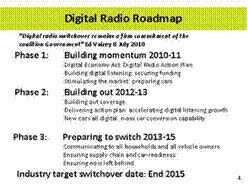
This strategy is all part of a DAB radio ‘roadmap’ developed by lobby group Digital Radio UK. Its ‘Phase 1’ activities for 2010/1 include “stimulating the market: preparing cars” or, in plain English, forcing DAB upon car owners through articles like the Daily Mail’s. Digital Radio UK revels in disinformation, consistently referring to ‘digital radio’ in its recent slide presentation to the Digital Radio Stakeholders Group, when its sole imperative is to push DAB radios.
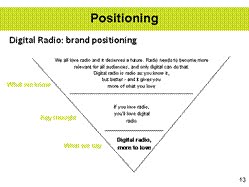
This Digital Radio UK presentation is full of stuff that reads like it was written on the back of an envelope in the pub one lunchtime. The industry has had almost two decades to come up with a powerful ‘brand positioning’ for DAB, yet the best that Digital Radio UK could create is:

· “WHAT WE KNOW. We all love radio and it deserves a future. Radio needs to become more relevant for all audiences, and only digital can do that. Digital radio is radio as you know it, but better – and it gives you more of what you love
· KEY THOUGHT. If you love radio, you’ll love digital radio
· WHAT WE SAY. Digital radio, more to love”

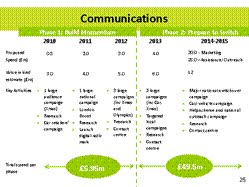
Expect to see these, er, important characteristics of DAB radio espoused in a £0.5m pre-Christmas marketing campaign that will tell consumers: “There’s a digital radio for everyone this Christmas.” Cynics will respond that this is because warehouses are brimming over with crates of unsold DAB radios. 2010 must have been a disastrous year for DAB receiver sales because the industry has kept the figures a closely guarded secret. Pure Digital, which accounts for the lion’s share of DAB receiver sales, said last week that its “revenues are now expected to show a decline compared with the first half of the previous financial year.” In 2009, total UK unit sales of DAB radios had already fallen year-on-year [see my earlier blog].
Between now and 2015, Digital Radio UK plans to spend £55m on campaigns to try and convince consumers once more that DAB radio is a ‘must have.’ At a time when budgets are being slashed in both commercial radio and BBC radio (which fund Digital Radio UK), you might think that somebody somewhere might ask if it is worth throwing more good money after bad. And what is the stated objective of all this effort? According to the final slide of the Digital Radio UK presentation:

“Our ‘destination’ is a healthier radio sector – and that’s good for everyone.”

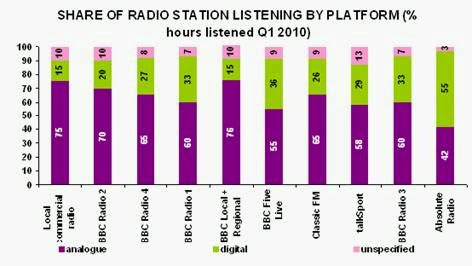
A healthier radio sector? You must mean a more impoverished UK radio industry, it having already thrown £1bn into the DAB black hole. You must mean digital radio stations, none of which generate a profit because, in aggregate, they attract only 5% of radio listening. You must mean consumers who are being lied to that their FM/AM radios will no longer work in 2015. You must mean frustrated car owners (according to Roberts Radio, a 35-40% customer return rate for in-car DAB radio adapters).

How are these outcomes good for anyone other than the lobbyists and radio receiver manufacturers whose shirts will be saved if, and only if, the public complies by rushing out to buy lots of DAB radios?

[Should you remain unconvinced to buy a DAB radio in December, you can look forward to a January marketing campaign that will proclaim: “If you didn’t get a digital radio for Christmas, now’s the time.” This must be my favourite radio sales pitch of 2010.]

Lobby the EU to mandate Europe-wide digital radio switchover? No chance!

The European Union [EU] has always made its position perfectly clear on radio broadcasting policy for its member states. It will not adopt an EU-wide digital radio strategy. A year ago, Viviane Reding, then EU commissioner for information society & media, reiterated the policy in an interview:

“This issue of EU-wide radio standardisation is still in its infancy. The main reason is that radio, from a political, business and consumer standpoint, is organised primarily as a regional or even local product. This is, in principle, rightly so. The reason the radio landscape in Europe is so fascinating is because it is so diverse and highly innovative. Therefore, EU-wide radio legislation is not advocated.”

“I believe the time is not ripe for a single EU-wide radio FM switch-off, such as we are doing for analogue TV in 2012. I can also well imagine that the 27 EU Member States, given their different levels of development, will want to take their own innovative approaches to digital radio switchover.”

Given this clearly stated EU policy, it was a surprise when World DMB, the lobbying organisation for DAB radio,
announced on 10 November 2010 that one of its three objectives for the coming year was:

“To persuade the European Union to champion switch-over policies at European level …”

Using the forum of the European Broadcasting Union [EBU] Digital Radio Conference 2010 held in Belfast the previous week, World DMB seemed to have persuaded the EBU to endorse a no-hope strategy of challenging existing EU strategy in order that digital switchover be mandated through diktat. This follows the evident failure of World DMB’s bottom-up approach to convince consumers in many EU countries to replace their satisfactorily working FM/AM radios with DAB receivers.

World DMB president Jørn Jensen said in the press release:

“If digital radio is to succeed, then the EBU must show their support for the DAB family, the only technology platform chosen by Germany, UK, France, Italy, Spain and the Nordic countries as the future of digital radio.”

The EBU obliged by issuing its own statement which stressed that its conference had “achieved a significant breakthrough in efforts to accelerate moves towards securing a digital future for radio.” The EBU wording is significant – its public statement talked about ‘digital’ radio but never mentioned the ‘DAB’ platform specifically. Whereas, the World DMB press release went out of its way to interpret ‘digital’ radio narrowly as ‘DAB’, almost to the point of obsession, when Jensen said:

“It’s time to stop talking about less mature standards, EBU needs to promote the Eureka 147 [DAB] family of standards.”

And what exactly did Jensen mean by “less mature standards”? Could he be referring to the platform whose name dare not be spoken amongst DAB lobbyists – THE INTERNET? Coincidentally, five days prior to the World DMB press release, Neelie Kroes, the current EU commissioner for the digital agenda, had admonished content producers who do not adapt their businesses to the internet age in a speech:

“Like it or not, content gatekeepers risk being sidelined if they do not adapt to the needs of both creators and consumers of cultural goods. So who will win the heart of the creators and of the public? It is still too soon to say. Of course, some of the new giants of internet come from another continent. I would wish that more of them were European, but when I see the wealth of creativity gathered in this room, I am optimistic for the future.

I believe that those who will prosper in the digital age are those who understand that convergence is one of the keys. The convergence of media provides an incredible opportunity for the artists and creators of our times, and also for their public – you and me. Just like cinema did not kill theatre, nor did television kill radio. The internet won’t kill any other media either.”

Despite the EU’s enthusiasm for convergence, the internet is still perceived as a competitive threat by some European radio broadcasters, who fear attrition to their audiences from an influx of online audio content from beyond their borders. To them, Last.fm, Spotify and We7 are the antichrists, and they hope that DAB’s walled garden will banish these insurgents from their kingdom. But, although Jensen wants to paint the internet as a “less mature standard”, history books show that it was around long before DAB (I was sending e-mails, before they had that name, across the Atlantic in 1978).

Also, when World DMB promised in its 10 November press release that it would “foster effective partnerships between broadcasters and the automotive sector” over the next year to get DAB radio into cars, it was advocating actions it could and should have taken more than a decade ago. It has long missed the boat. EU commissioner Neelie Kroes had announced on 8 November that IP-connected cars were the current European policy objective:

“Europe leads in wireless communication to and from vehicles. That is critical to improve both safety and efficiency. And to convert this into global market success global cooperation and standardisation will be required. This is where the EU’s Future Internet Public Private Partnership comes in. We need the automotive and ICT communities side-by-side. That way we can seize the opportunities of the next generation of wireless broadband, beyond 3G, to meet the growing demand for connectivity in cars.”

So what chance does World DMB have of achieving these two stated objectives for EU policy during the next year (compulsory digital radio switchover, DAB in cars)? None whatsoever. So why would it set itself objectives that are bound to fail? It can only be sheer desperation at this rapidly deteriorating stage in DAB’s lifecycle.

The third of World DMB’s stated objectives for the next year – “to advance partnerships between public and broadcasters” to make DAB happen – must have been drafted by someone with a wry sense of irony. Such ‘partnerships’ appear to be going nowhere in DAB:
· In the UK, RadioCentre, the commercial radio trade body, has failed in its insistence that publicly funded BBC should pay for the upgrade of commercial radio’s local DAB transmitters
· In Germany, commercial radio has failed to agree with public radio to a new plan to re-launch national DAB radio
· In Spain, commercial radio called DAB “a road to nowhere” despite public radio’s insistence on persevering
· In France, national commercial radio networks have refused to support public radio’s plan to launch digital terrestrial radio
· In Denmark, only one commercial station is broadcasting on DAB, alongside 17 state radio stations (many of which are about to be axed)
· In the Netherlands, national commercial radio stations have had to be forced to broadcast on DAB by the government inserting new clauses in their licence renewals.

World DMB’s rallying call of “let’s just get on with it!” might make more sense if its proposed solutions were practical in any way. Its press release was headlined ‘European Broadcasting Union backs digital radio switch over across Europe.’ Given that all three of its objectives for the next 12 months fly in the face of realpolitik, it would have been more accurate to entitle the press release ‘Three impossible European things before breakfast.’

[with thanks to Michael Hedges at Follow The Media]

FRANCE: digital radio report for government identifies 'the paradox of DAB'

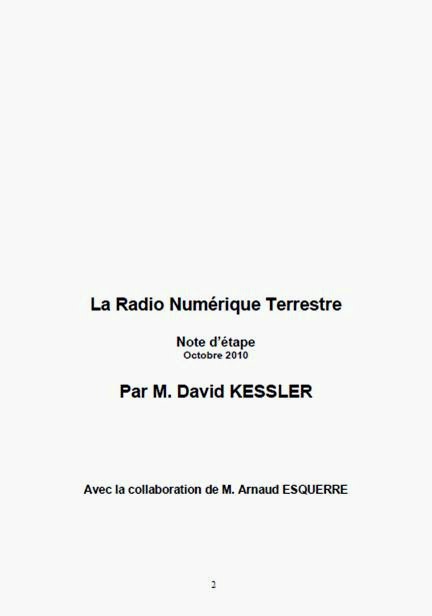
David Kessler, former chief executive of Radio France, submitted a 22-page interim report on the planned launch of digital terrestrial radio in France to the government on 23 October 2010. The report was made public last week. This is the third such report on the topic that the government has commissioned in the last year. Most of Kessler’s report summarised the existing positions of the main players in France (public radio, commercial radio networks, local stations, etc.), but it also outlined some wider market issues. France has yet to launch digital terrestrial radio, despite many start dates having come and gone over the years. The commercial FM radio networks have argued that the cost would be prohibitive and the expected financial returns insufficient.


The following are excerpts from the report:

1.6 Manufacturers
“Both equipment manufacturers (Simavelec and Secimavi) have focused on the renewal of television receivers (digital TV, flat screens, 3D TV, connected TV) and, at this stage, have invested little in radio receivers. This is evidenced by the IFA [consumer electronics trade fair] held in Berlin in September 2010, where radio receivers were virtually absent from the stands of the main manufacturers. Although, at this international show, the big manufacturers are present in markets where DAB has already launched, they do not consider it sufficiently beneficial to manufacture and sell digital radio receivers. Manufacturers consider that the improvement in sound quality offered by digital radio will be harder [for consumers] to appreciate than the improvement in quality for digital television.”

2.3 The situation in other European countries
“A review of the situation overseas illustrates the same problem: many countries have launched DAB and have long experience of it, but none have been able to implement it as the dominant model for terrestrial broadcasting. This demonstrates what could be called ‘the paradox of DAB radio’ – it is a sufficiently attractive technology to be launched successfully, but it is insufficiently attractive to successfully allow FM broadcasts to cease.”

4.0 Conditions to launch DAB
“Difficulties surrounding the launch of DAB:
· Uncertainties about the economic model
· The consumer benefit is uneven between towns and country
· The existence of IP as a competing platform, even if it is discounted, already exists and can appear to be a real alternative
· Finally, little interest by telecom owners to use the FM band – it is too low frequency (unlike the spectrum released by analogue TV) – which makes it very difficult to monetise it and removes any global interest in accelerating towards digital switchover.”

4.1 How could DAB conquer the public?
“For DAB to be a success with consumers, several conditions must be met:
· DAB radio receivers must be widely available, there must be an incentive for consumers to buy them, and they must be installed in vehicles […]
· The sound quality of DAB must be at least equal, or superior, to that of existing FM radio
· DAB radio must be known to the public and must be made attractive. This requires a powerful, dynamic launch campaign.
· Radio offerings to listeners must be enriched. Since the launch has to be a lesson in effective marketing, it must be huge from the outset in those areas where the media regulator has identified that the increase in the number of radio stations is relatively tangible and quite impressive.”

The report noted that the transmission cost for a national radio station to broadcast to 90% of the population in France, using the digital T-DMB standard, will be €4.4m per annum. Some existing national commercial networks have suggested that the cost of digital transmission would only prove economically viable if it were reduced to between €0.5m and €1m per annum and achieved coverage of 90% to 95% of France.

Kessler’s full report to the government will be published by year-end.

[I have used ‘DAB’ as shorthand for ‘digital terrestrial radio’ though France decided to adopt a technical standard other than DAB]

SPAIN: DAB enters the last chance saloon

DAB radio in Spain has been a disaster, not least for those commercial broadcasters who invested in new technology and distribution contracts, but who have generated no additional listeners or revenues. “Zero,” said Agustin Ruiz de Aguirre, technical director of Cadena SER. “The audience is zero.” He explained that a non-existent audience generates no revenues or profits because “who would want to advertise on a medium that does not deliver any consumers?”

Spanish broadcasting law requires stations that embarked upon DAB to continue broadcasting for the duration of their licences, regardless of whether anyone is listening or not. Ruiz de Aguirre said that all the commercial broadcasters are united with a single goal: to stop having to broadcast on DAB. To date, the government has not relented, though the current licences end in 2010 and 2011.

“I do not think analogue radio switch-off will happen in either the short or medium term,” said Xosé Ramón Pousa, professor in the Faculty of Communication Sciences at the University de Santiago de Compostela. “In this scenario, DAB is at a dead end.”


“We are a rarity”,
said Pere Vilas, who heads Spain’s drive for digital radio (and is the managing director of technology at state broadcaster RTVE). State radio has been simulcasting on DAB since 1998. Spanish broadcasting law has required a technical plan for DAB radio to be in place for the last year and a half, though nothing exists as yet. Such a plan is seen as DAB’s last chance to redeem itself in Spain.

“Work began a long time ago, even before digital television switchover,” admitted Xavier Redón, product marketing manager of transmission infrastructure provider Abertis Telecom. “But it is about to begin again.” Like DAB lobbyists elsewhere, Redón was quick to claim that the rest of Europe was already well down the road to DAB radio switchover. He asserted that, in France, all radios would have to be digital by 2013, and that Germany was creating a national DAB+ network in 2011.

Redón predicted that 2011 would be “key” to laying the groundwork for the re-launch of DAB in Spain. A glance at the website for DAB radio in Spain elicits a similarly optimistic stance. It states boldly: “Digital radio is a fact. It is not the future. It is the present.”

Until you realise that this latest news item was posted in April 2008.

NETHERLANDS: government forces DAB upon commercial radio

The Dutch government has adopted a ‘carrot and stick’ approach to its plans to improve the take-up of DAB digital radio. This week, it offered existing national commercial radio stations automatic renewals of their licences for a further six years until 2017, if they agree to broadcast on the DAB platform for the next six years and to cover at least 80% of the country. This renewal will avoid the licences being re-auctioned in 2011, as required by existing law. The industry response? “Commercial radio reluctantly goes digital,” said one headline.

National station Radio 538 director Jan-Willem Brüggenwirth commented: “Our digital [DAB] transmitters have been running at a loss for three years.” Radio 538 reaches 400,000 listeners per week via its internet platform, and Brüggenwirth said he expects an explosion of listening via mobile phones to internet delivered radio stations.

Martin Banga of Vereniging Commerciële Radio, the commercial radio trade body (and chief executive of Sky Radio), said: “You’re talking about millions of [radio] devices in the coming years having to be replaced, not only in homes but also in cars, which is slower than most people think.”

Banga
added: “Digitalisation is costly and offers little benefit, because almost nobody has a digital receiver. It produces no additional listeners yet, so there is no additional advertising revenue. I estimate that 2,000 people have the equipment actually to be able to receive DAB, so it only goes to the handful of people that have digital radios. Compare that to the 40 million listeners who can receive FM. This means that switching to DAB is relatively costly, and produces little income.”

Originally, there had been a government plan to turn off FM radio broadcasts completely by 2015, but this has been dropped. Instead, the government will auction two national FM frequencies that had previously been licensed to failed station Arrow FM. These licences will similarly require a commitment to broadcast on DAB.


The government’s announcement
stated:

“Digital radio has many advantages, such as better quality, more radio stations and the possibly of adding new services to the radio offering. In time, digital radio is intended to replace the current FM radio. To do this, however, the groundwork must first be fulfilled. The existing stations could make an important contribution through this [licence] extension.”

Government commissioned research in May 2010 had determined that the licence of each national FM commercial radio station in Holland was worth around €30 million.

[with thanks to Paul Rusling]

The Digital Radio Stakeholders Group: another 'faux consultation'

Did you hear about the inaugural Digital Radio Stakeholders Group meeting held on 1 November 2010 at the government’s DCMS [Department for Culture, Media & Sport] office? Probably not, unless you were one of the couple of dozen people who were in attendance. Otherwise, you were in the majority who were unaware of the event. There was no public pre-announcement of this meeting. Afterwards, there was only one article about it in the media trade press. Google returns ‘no results’ from an internet search for ‘Digital Radio Stakeholders Group’, even though this is the title writ across the top of the agenda circulated for the event.
You have to look in the new government’s Digital Radio Action Plan, published in July 2010, to discover:

“The Government will chair a Stakeholder Group which will be open to a wide range on industry and related stakeholders. The principle purpose of this Group will be to inform external stakeholders of progress against the Action Plan and gather views on emerging findings. We expect that the Group will meet quarterly.”

The government’s project management plan anticipated that, by Q2 2010, it would be able to:

“secure commitment from the Government Digital Radio Group and the Stakeholders Groups to the Action Plan.” [Task 5.1]

This pre-determined outcome was justified on the grounds that:

“Successful implementation of the Digital Radio Switchover programme will only be achieved through close Government-Industry co-operation. […] This will include commissioning and delivery of reports, reviewing progress against key milestones and disseminating information to key stakeholders.”

So, essentially, the Digital Radio Stakeholders Group seems to be an almost non-existent forum that has only been convened to secure some kind of external ‘rubber stamp’ for the government’s proposals on DAB radio. It will allow the government, when challenged as to the democratic basis of its DAB radio policy, to assert confidently: “We convened a stakeholders group and it endorsed our proposals.”

This is cynical government at its worst. A ‘faux consultation’ that pretends to have asked a group of somebodies to endorse a government policy for which no mandate has ever been given by the electorate. It is similar to the manipulation practised by Ofcom in its radio policymaking (viz. Ofcom’s recent decision to permit Smooth Radio to dump its commitment to broadcast 45 hours per week of jazz music, after having acknowledged that 13 of the 15 responses submitted to its public consultation were opposed to this loss of jazz).

According to a government document, the Terms of Reference for the Digital Radio Stakeholders Group are as follows:

“Purpose
To enable a wide range of organisations to contribute to the process of delivering the Digital Radio Action Plan

Objectives
• To inform all stakeholders of progress with the Action Plan
• To seek the views of stakeholders on future progress of the Action Plan
• To provide an opportunity for all stakeholders to share news, views and concerns relevant to the Digital Radio Action Plan

Membership
Any organisation with a valid interest in the objectives of the Digital Radio Action Plan may be a member. Members will include consumer representative bodies, broadcasters, manufacturers, retailers, vehicle manufacturers, transmission network operators, content providers. The Group will be chaired by BIS in the first instance, though in principle the Chair could be any person acceptable to the majority of stakeholders and able to represent the collective views of the stakeholders to the Steering Board.

Mode of operation
The Digital Radio Stakeholders Group will meet quarterly.
The Chair will report the views of the stakeholders, as expressed through the meetings of the Stakeholders Group, to the Steering Board.”

So what happened at the first meeting? Very little, according to some of those who were present. It was a game of two halves. In the first half, the bureaucrats put their case. From the government, Jane Humphreys, head of digital broadcasting & content policy, BIS [Department for Business Innovation & Skills]; John Mottram, head of radio & media markets, DCMS; and Jonny Martin, digital radio programme director, BIS/DCMS. From Digital Radio UK, Ford Ennals, chief executive; Jane Ostler, communications director; and Laurence Harrison, technology & market development director. Then, in the second half, representatives from Age UK, the Consumer Expert Group, Voice of the Listener & Viewer and W4B raised issues on behalf of the consumer.

At the end of it, I guess the government-appointed chairman could return to her government office, tick the box on the government wall planner that says ‘stakeholder commitment’ and be pleased that this ‘rubber stamp’ had cost the taxpayer only an afternoon’s salary plus some tea and biscuits for the ‘stakeholders’. Well worth it!

More interesting than noting those who attended is identifying who was not there:
· No presentation by Ofcom, whose longstanding ‘Future of Radio’ policy has forced the DAB platform upon the public for almost the last decade
· Nobody from the largest commercial radio owners – Global Radio, Bauer Radio and Guardian Media Group – that have considerable investments in DAB multiplex licences

After the meeting, under the headline ‘RadioCentre quits digital radio meeting’, Campaign reported:

“RadioCentre, the commercial radio trade body, has walked out of discussions over the future of digital radio after the BBC licence-fee settlement did not commit BBC funds to roll out DAB radio. The body refused to attend a [Digital Radio Stakeholders] meeting on 1 November after the [BBC Licence Fee] settlement, published last week, included provision only for [BBC] national DAB [upgrade].” [I noted this development in a blog last month]

Whatever RadioCentre’s reason for non-attendance (and the story in Campaign has not been refuted), this kind of stance is a disgrace. Raising two fingers to the people you are supposed to be persuading of your DAB policy is not a clever PR strategy for the commercial radio industry. But I am not surprised. All the organisations pushing for DAB radio have increasingly adopted a ‘bunker’ mentality that precludes any direct contact with the public. What we appear to have now is:
· Ofcom refusing to engage in public discussion about its DAB ‘Future of Radio’ policy
· The government organising a Stakeholder Group to rubber stamp its unrealistic, dictatorial policy on DAB radio
· Digital Radio UK refusing to engage in public explanation of its DAB campaign work, as illustrated by its non-existent web site
· RadioCentre and its members now refusing to attend a meeting to explain just how/why DAB is still being pursued

At the same time, the public – the consumers, the 46,762,000 adults who spend 22.6 hours per week listening to radio – have been omitted altogether from these manoeuvrings that are still focused upon trying desperately to force them to purchase DAB radio receivers. The public had been omitted from the proposals at the very beginning of DAB more than a decade ago, which is precisely why it failed, and they are still being omitted today.

This is not the first time that government ‘stakeholder’ meetings about DAB radio have been organised simply to tick a box. As part of the previous government’s attempts to solve the DAB problem, in 2008 it convened a Digital Radio Working Group with two similar ‘stakeholder meetings’ held at DCMS. I attended and felt they existed purely for the bureaucrats to report back to their superiors that they had done something to ‘disseminate’ their policies. DCMS’ own write-up of the first meeting recounted bluntly:

“A stakeholders meeting was held on 10 March and offered opportunities for a wide range of views to be heard.”

A place where “views” were merely “heard”. The ineffectiveness of these earlier stakeholder meetings is demonstrated by re-visiting the agenda for the first of them. The issues tabled for discussion nearly three years ago (“How to make digital radio the predominant platform for listening to radio in the UK? What are the barriers to this? How can these barriers be overcome?”) still remained the same at this month’s meeting. Worse, none of the DAB technical problems identified then have been solved in the interim. And guess what? All trace of these 2008 meetings ever having happened has been erased from the DCMS website (in 2008, I had had to write to DCMS to get them to add the meeting details to their website).

The next meeting of the Digital Radio Stakeholders Group will be held on 3 February 2011 at DCMS/BSI, 1 Victoria Street, London SW1H 0ET. If you belong to any kind of community group or organisation (even if it is your neighbourhood watch) whose members are likely to be impacted by the government’s policy on digital radio switchover, I suggest you write to Jane Humphreys (e-mail to [first name][dot][second name]@bis.gsi.gov.uk) and ask for an invitation to this next meeting.

‘Stakeholder’ radio listeners should turn up to the February meeting and shout: “I’m mad as hell and I’m not going to take this any more!” … or maybe the DAB plug will already have been pulled by then.

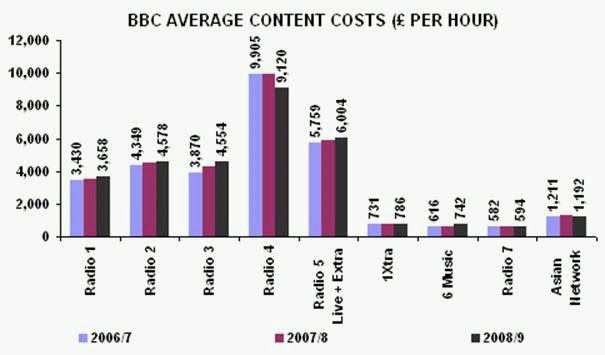
BBC Licence Fee settlement: for radio, where will the axe fall?

Jeremy Hunt, Secretary of State for Culture, Olympics, Media & Sport
20 October 2010

“In the end the deal we got [for the BBC Licence Fee settlement] was tough but fair. Tough because the BBC, like everyone, is going to have to make demanding efficiency savings. But fair because it allows them to continue to make the great programmes that we all love and licence fee payers won’t have to pay any extra for the privilege. The assurances I have secured on magazines, local and online activities will also give some comfort to the BBC’s commercial rivals that the licence fee will not be used to blast them out of the water.”

——————–

Feedback, BBC Radio 4, 21 October 2010 [excerpt]
Roger Bolton, interviewer [RB]
Sir Michael Lyons, chair, BBC Trust [ML]

RB: Does that mean that you would regard any significant cuts in the domestic radio services as something you could not go along with?

ML: I think … that’s rather a sweeping assurance that you’re asking me to give …

RB: Well, it’s people who listen to Radio 4 and to Radio 3 and who value that greatly, and Radios 1 and 2, want to know, as a result of this settlement, will they see major economies made in their networks?

ML: Well, let me be very clear, as I said before. The Trust is clear on the importance to Licence Fee payers of the family of BBC services. The care that we take in reflecting on those radio services is, I think, reflected in the decision that we took on 6 Music – a very careful balancing of the public value that that service provides against its cost. What I can give you assurance on is that the Trust will continue to demonstrate that care across the range of BBC services.

——————–

Tim Davie, Director, BBC Audio & Music
Interviewed by Beehive City, 20 October 2010

“I don’t think anyone is proposing taking £300 million [for the BBC World Service] out of the Audio & Music budget. There wouldn’t be a lot left.”
“Obviously this is a decision taking place at a pan-BBC level rather than just looking at radio services. As the guy in charge of Radio I would say that our portfolio delivers value for money for the licence fee. I think Radio stacks up very well.”
“I don’t want to go into detail about discussions at this point in time. It remains speculation until we see what comes out in the Comprehensive Spending Review.”

——————–

The Tony Livesey show, BBC Radio 5 Live, 28 October 2010 [excerpt]
Stephen Nolan, interviewer (presenter, BBC Radio Ulster) [SN]
Tim Davie, Director, BBC Audio & Music [TD]

SN: Interesting times for the BBC, Tim, aren’t they, because, with the Licence Fee freeze over the next six years, how’s that going to be felt by radio listeners? What are they going to miss, what are they going to lose?

TD: Well, I think it’s too early for me to say ‘oh, we’ve just had a settlement, this is what it affects’. I would say, as an overall principle, the last thing that people want – me or others want to do – is do things that affect the quality of listening. I think that one of the things the BBC has done pretty well over the last few years is: we have taken out quite a lot of costs. But the truth is our radio services, I think, are in fine shape. That’s for the listeners to decide but, actually, the numbers are good, I think the quality of programming is – frankly, it is quite easy to do cheap radio. The issue is that we also want to do the investigative journalism, we want to do the big stuff, and I think listeners care about that stuff. I would say that, of the Licence Fee, radio is only, at most, 20%. So, in terms of good value for money, as the head of radio, I would be arguing our case pretty hard.


SN: You say it’s quite easy to do cheap radio. Do we do cheap radio?

TD: I think, you know, overall, we do good value radio which is – I’m choosing my words carefully there – because, I think, cheap radio, what I meant by that was that it’s quite easy to have one person playing records. We don’t do that. You know. We get people like yourself, who have a point of view….

SN: [interrupts] Yes, we do! We don’t have one person playing records? Chris Moyles plays records. Radio 1 plays records and the commercial sector could do that any day of the week, couldn’t they?

TD: Well, I think Radio 1 is … that’s a big debate. I’m very clear that Radio 1 does something very different to commercial radio. An average commercial radio station would play probably about 200 records a week and Radio 1 … our records … we may get up to 900. We’ll be playing a lot more new music and, actually, we do a lot more speech. Nine million people are listening to news on Radio 1, with something like Newsbeat, and that’s important.

SN: BBC Radio 2 and the commercial sector will argue until the day they die –and I spent ten years working in the commercial sector – that Radio 2 should be given to the commercial sector. Give them a chance because that’s [no more than] very good presenters playing music.

TD: Well, I don’t think they would do what we do. Radio 2 is currently just about 50% speech so, if you listen … on a day in Radio 2, about half of it is speech.

SN: And define ‘speech.’ Are you including presenter links in that? Including monologues and all?

TD: I’m including everything in that. I’m also including Jeremy Vine doing Poetry Week last week. I’m in ….

SN: [interrupts] But it is a bit of a con to suggest that 50% is speech when that includes a presenter saying ‘good morning, it’s ten past ten’, because the commercial sector can do that.

TD: Well, of that, there’s a bit of speech which is those pure links. Point taken. But I think, if you listen to, as I say, Jeremy Vine, you also … It’s not just about music versus speech. You take the Folk Awards, you take Jamie Cullum doing jazz, I think Radio 2 can be pretty proud of what it does, and its playlist versus a commercial station… All I would say – and this is a very simple request, and a strange one by the head of BBC radio – but have a listen to commercial radio for a while and have a listen to us. I think that listeners know the difference.

SN: What is the difference? If someone was listening to commercial radio?

TD: I think we’re a lot less dictated to by a fixed playlist. We do have a playlist but it makes [up] a lot less of our output. I think we give our presenters, as you know, quite free reign and we allow them to do their stuff. And I think … there’s great commercial radio, by the way, and it would be remiss of me to say anything otherwise. But I would say the BBC – the great thing about having fixed income – is that we can do stuff. We can say go and do your stuff and, sometimes, as you know, that can get lively. But, overall, I believe in trusting presenters. The interesting thing as well, by the way, is [that] music services now on the web – you get all these automated recommendations – the one thing I think radio is doing well on is that we don’t kind of do that. We give a presenter the chance to do their stuff.

——————–

House of Lords

debate on media ownership, 4 November 2010 [excerpt]

Lord Myners: I hope that when the BBC licence is next reviewed we start from a presumption that the BBC should not be doing certain things. The BBC should have to prove why it should continue to operate Radio 1 or Radio 2, for instance. It is extraordinarily difficult to explain to a foreign visitor why Radio 1, a popular music station, is a nationalised industry, and why it is necessary for it to be provided by a public service as opposed to a competitive one.

BBC head of radio: DAB not "a clear enough offer to listeners"

The Tony Livesey Show, BBC Radio 5 Live, 28 October 2010 [excerpt]
Stephen Nolan, interviewer (presenter, BBC Radio Ulster) [SN]
Tim Davie, Director, BBC Audio & Music [TD]


SN: There are big problems with the digital spectrum, aren’t there, because we cannot seem to hit any target that we are given for people switching to digital?

TD: I don’t think we’ve had many targets … Let’s be honest, I don’t think we’ve had many targets in the past. Digital stations are doing well. Digital listening – we’ve got to be careful – includes online, which is doing pretty well, there’s more we can do. Then also you’ve got DAB. Now DAB, you’re right, it’s been marginally growing for a while …

SN: Why?

TD: I just don’t think it’s been a clear enough offer, in my language, to listeners. I mean, people love radio. They are very happy with their FM radio. Why on earth would you change? And I think the radio industry has to say: ‘the reason you will change is – here’s a load of content’. And there’s clues like 6 Music, or other …. you know, that people love. And here’s a load of stuff that people love, and here’s a better … this device does something better than the other one.

SN: Or, Tim, it’s for the BBC to take a huge risk, and a controversial risk at that, and to withdraw mainstream programming from the FM spectrum and put it onto DAB. Imagine how the numbers would soar if it had [BBC Radio 1 breakfast DJ Chris] Moyles or …

TD: [interrupts] Imagine my inbox!

SN: Exactly, exactly. It’s a serious point.

TD: Sure.

SN: Imagine if you had Moyles or [BBC Radio 2 breakfast DJ Chris] Evans exclusively on DAB, or a massive programme.

TD: Right! And … we could do that. The issue would be that, with current coverage levels and with the amount of devices – particularly in Northern Ireland – I would basically be saying that you can’t listen to it in your kitchen, and everyone pays the Licence Fee. So I think the strategy for digital, where we are taking things away, is not going to work. My approach would very much be that I do want you to feel a bit of pain for not having a digital radio, but that pain is not about not getting The Archers, or not getting Chris Moyles. It’s about: ‘you could get a bit more over here’, or ‘there’s a bit of [Radio] 4 Extra over here that you could really do with’, and that’s what television did with some of those channels.

SN: Do you think, in terms of the internet, that radio is going to fundamentally change?

TD: I think there will be a lot more on-demand, obviously, so people will expect to be able to call up a programme and …

SN: I’m talking about the [UK] Radioplayer, obviously, which people are describing as the new YouView for radio.

TD: Well, er, yeah. Basically, the Radioplayer is … we’ve got the whole industry together. Only about 3% of listening is online and I can’t understand that, as head of radio. I know I’m biased but, at the end of the day, when I’m shopping and doing my Tesco shop or wherever online, why aren’t I listening to the radio? [to SN] Well, you would relate to this because it means more listeners. I think that one of the things is that I think it’s a bit confusing. You’ve got the BBC on the iPlayer, which is pretty good, and we’ve got other bits and … So we’ve put it all together and there will be a thing called the Radioplayer. Now, it gets a bit complex, but I think the YouView thing that you refer to is when you’ve got an internet connection to your television. Now, when you click your television on, I want one Radioplayer icon where you can go in and listen to all the radio. Now, the …

SN: On the TV?

TD: Yeah. On any screen – sorry to sound ‘new age’ – any screen anywhere, whether it’s a … whatever the size of it, you can go and get all your radio services. We don’t currently have that.

DAB radio usage: going nowhere slowly

Sometimes it seems as if the UK radio industry operates in two parallel universes. On the one hand, there is the virtual world of the DAB radio lobbyists, a reality that only seems to exist within the confines of their Soho office and its funders. On the other hand, there is the real world of the 47 million people in the UK who listen to the industry’s radio stations each week, spread far and wide across this green and still largely analogue land.

It was only last week that Ford Ennals, chief executive of Digital Radio UK, was telling anybody who would listen that:

· “There is now real momentum in the transition to digital radio…”
· “… significant progress towards building momentum for digital radio…”
· Digital radio switchover is a “matter of when, not if”
· “We have set a course to double listening and expand coverage by 2013, and to switchover by the end of 2015”
· “We do believe it is possible to get there in the four- to five-year time period…”

Yet, today, RAJAR published the latest listening figures for UK radio. None of Ennals’ statements are in any way supported by the official radio listening data. “Momentum”? No. “Real momentum”? No. “To double [digital] listening by 2013”? You have to be joking.


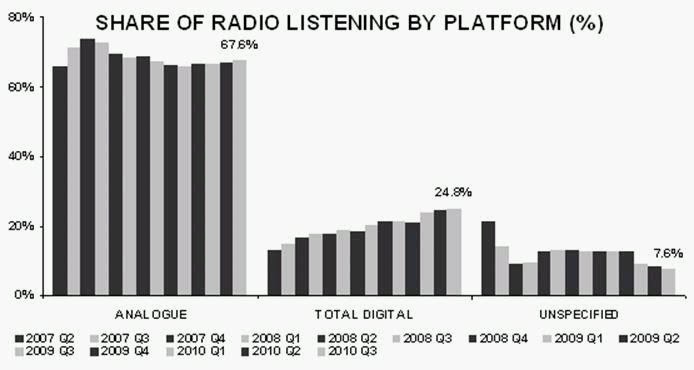
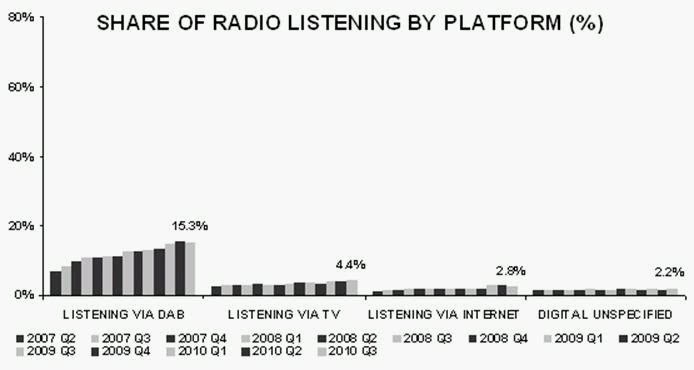
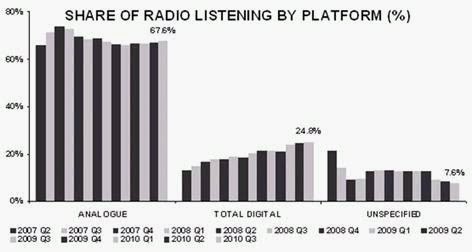
The headlines for all radio listening via platforms in Q3 2010 were:
· Analogue radio’s share of listening up from 67.0% to 67.6% quarter-on quarter
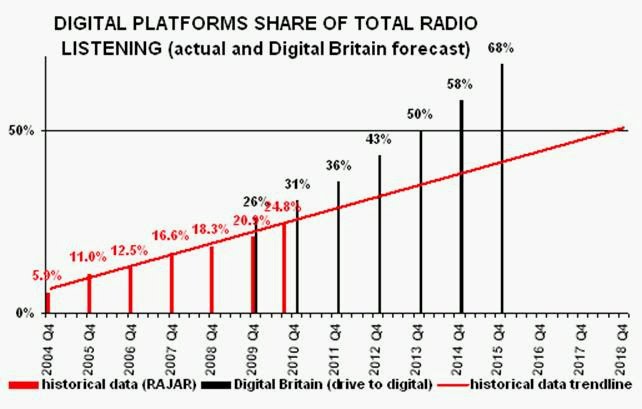
· Digital radio’s share of listening up from 24.6% to 24.8% quarter-on-quarter
· DAB radio’s share of listening down from 15.8% to 15.3% quarter-on-quarter.


At its current long-term growth rate, the government criterion of 50% of radio listening via digital platforms would not be achieved until year-end 2018. The statistical probability of that 50% threshold being reached by 2013, the achievement of which Ennals is supremely confident, is zero. Even Derren Brown could not pull off that stunt.


And so these two radio worlds continue on their parallel paths. Digital Radio UK continues to insist that everything in the digital radio switchover garden is sweetness and light, whilst wilfully oblivious to the fact that the majority of radio listeners simply could not care less about DAB – even after more than a decade of being told by the government, Ofcom and the largest broadcasters that DAB is ‘the future of radio’.

The verdict of UK radio listeners on DAB seems perfectly transparent in the RAJAR data, though many in the radio industry still refuse to listen. On the other hand, the activities of Digital Radio UK, still trying to persuade us of DAB’s virtues, are anything but transparent. After 10 months of existence, its web site remains empty. And the web site of its forerunner, the Digital Radio Development Bureau, has been conveniently deleted so that all the empty promises, inaccurate forecasts and ridiculous propaganda that were generated about DAB over the last eight years are no longer publicly available.

Those with experience in the radio industry understand perfectly what happens to radio stations that refuse to listen to their listeners, radio stations that refuse to engage in truthful dialogue with their audience, and radio stations that are still broadcasting exactly the same tired messages as they did a decade ago. They die … and nobody misses them when they are gone.

Digital Radio Upgrade? More like Digital Radio Groundhog Day.

It was the Radio Festival, the industry’s annual get together. Everyone wanted to talk about how wonderful the DAB future of radio would be. But nobody wanted to explain how ‘Digital Radio Upgrade’, the government policy to make the UK’s DAB transmission system fit for purpose, will be paid for. It is the radio sector’s favourite parlour game: pass the DAB Upgrade parcel.

The first player is the BBC:

Q: “Very briefly, a one-word answer. Do you have any money set aside now to spend on [Digital Radio Upgrade]?”

Tim Davie, director of BBC Audio & Music: “No.”

Second is commercial radio:

Q: “Does commercial radio have any money to spend on [Digital Radio Upgrade]? […] What’s your guess?”

Phil Riley, chief executive of Orion Media: “‘No’ is the answer at the moment.”

Third are the politicians:

Jeremy Hunt MP: “I think the most important thing is not something the government can do, but something the industry can do …”

But hold on. This dialogue came from the Radio Festival in 2009…. We need to fast forward one year.

It was the Radio Festival, the industry’s annual get together. Everyone wanted to talk about how wonderful the DAB future of radio would be. But nobody wanted to explain how ‘Digital Radio Upgrade’, the government policy to make the UK’s DAB transmission system fit for purpose, will be paid for. It is still the radio sector’s favourite parlour game: pass the DAB Upgrade parcel.

The first player is the BBC:

“It remains to be seen who will pick up the £100m tab [for Digital Radio Upgrade], with [Tim] Davie saying he did not have the necessary funds.” [from The Guardian]

Second is commercial radio:

“[Global Group chief executive Ashley] Tabor said the commercial [radio] sector will only pay for the rollout of those local DAB multiplexes that are commercially viable.” [from The Guardian]

Third are the politicians:

Ed Vaizey, Minister for culture, communications & creative industries: “The BBC has to work with me on coverage. I am talking to the BBC and I hope to accelerate the pace of digital radio coverage.”

Déjà vu, anyone? Delegates paid £899 to witness this repeat performance. I have already placed my bet on precisely the same sentiments being made at the Radio Festival in 2011, though the odds offered by the bookie were not at all good. On the coach home from the Festival, everyone must have joined in the usual radio industry singsong:

“When do we want digital radio switchover? Now!
Who do we want to pay for DAB Upgrade?
Somebody else!”

And while we are on the topic of déjà vu, I am reminded of an analyst report about DAB from June 2008, in which I had written:

“The digital switchover of radio is so far into the future as to be intangible.”

I was swiftly rebuked for this viewpoint in an e-mail from a radio sector CEO.

Now fast forward to the 2010 Radio Festival. Andrew Harrison, chief executive of commercial radio trade body Radio Centre, said:

“There is no doubt if [digital take-up] carries on at its current projectory we will never get there.” [sic]

The current RadioCentre strategy remains inexplicably that the BBC should pay not only for improvements to the BBC’s DAB radio transmitters, but also for the commercial radio sector’s (see earlier blogs here and here). The nails seem to have been hammered firmly into that coffin by this week’s speed-axing session between the government and the BBC.

Although subsequent press reports have implied that the cost of the (previous) government’s Digital Radio Upgrade policy will now be underwritten wholly by the BBC, the available evidence says otherwise. The resulting four-page letter from the government to the BBC Trust set out in detail all the new items to which the BBC’s funds will have to be applied in future. The World Service? Yes. BBC Monitoring? Yes. S4C TV? Yes. Local television? Yes. DAB radio? No….

Oh, hold on. In the penultimate paragraph on the final page there is a single sentence about DAB penned by Secretary of State Jeremy Hunt:

“I also welcome the BBC’s plans to enhance its national DAB coverage in the period of this agreement, and to match its national FM coverage as a switchover date draws near.”

But while the rest of the letter is littered with the oft repeated phrase “The BBC will …”, this solitary mention of DAB radio is couched only in terms of “BBC plans” without a hint of compulsion. DAB is an obvious afterthought here and, much to RadioCentre’s chagrin, it refers only to the BBC improving its own DAB transmitter coverage and not to improving commercial radio’s.

In the coming months, when the inevitable axe falls sharply across BBC budgets as a result of this week’s gobsmacking (© Ray Snoddy) agreement between the BBC and the government, DAB radio must be an obvious short straw. Lose BBC local radio, or lose DAB? BBC local/regional radio accounts for 15% of BBC radio listening. BBC digital radio stations account for 4%. Here comes the chopper ….