UK Commercial Radio Revenues Q3 2009

Commercial radio revenue figures for 2009’s third quarter have been published.

Q3 2009 DATA
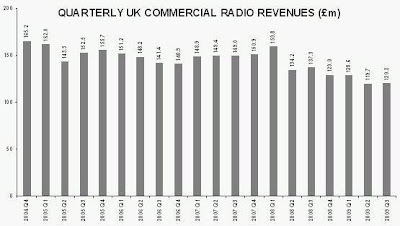
£120.2m total revenues
£35.7m local revenues
£59.8m national revenues – lowest quarter since Q1 1998
£24.8m branded content

YEAR-ON-YEAR
Total revenues – down 12.5%
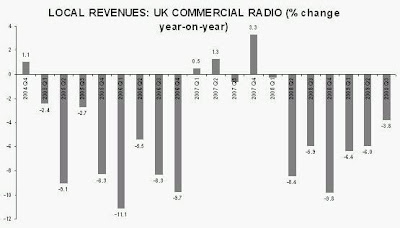
Local revenues – down 3.8%
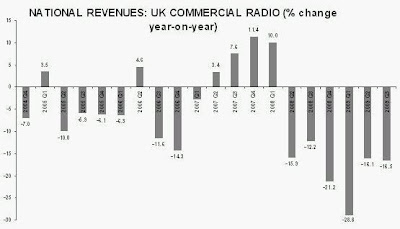
National revenues – down 16.5%
Branded content – down 13.3%

QUARTER-ON-QUARTER
Total revenues – up 0.4%
Local revenues – up 2.6%
National revenues – down 0.3%
Branded content – no change

FOUR-QUARTER MOVING AVERAGE DATA
£497.5m total revenues – lowest since Q1 2000
Down 14.6% year-on-year (last quarter: down 13.4% year-on-year)

Have we hit the bottom yet? That is the thorny question. The answer is not easy. Yes, this most recent quarter’s revenues have halted their recent terrifying decline, demonstrating a tiny 0.4% improvement over the previous quarter. But one ‘okay’ quarter does not necessarily signal a turnaround. You would be risking your shirt to announce that the radio advertising market is going to improve from now on.

The one bright spot was local advertising, which accounts for 30% of total radio revenues. It improved quarter-on-quarter by 2.6%, although it was still down 3.8% year-on-year. Nevertheless, it is local advertising which has held up better during this recession, exhibiting only single digit percentage declines year-on-year. If you are looking for ‘grass shoots’, you might find them here.

By contrast, national advertising (50% of total radio revenues) continues to be an unmitigated disaster. This was the sixth quarter in succession to record double-digit percentage declines year-on-year. National radio advertising in Q3 2009 was at its lowest point for eleven years (longer, if you factor in inflation). Neither is this a purely cyclical phenomenon – out of the last 20 quarters, only six have exhibited year-on-year growth. In aggregate, during three and a half out of the last five years, radio has suffered declining national revenues.

Where does that leave the UK commercial radio industry? Well, for the small local stations that have continued to fulfil the remit of their original licences by serving local listeners and local businesses, if they have survived this far, they might yet live to see another day. It is impossible to predict that ‘the worst is over’, but it might be that ‘the worst of the worst is over’. Local advertising is never going to migrate wholesale to digital TV or to the internet, and the yields that a successful local radio station can extract remain high.

The outlook is not so good for group owners of local stations who started to spend less on the shoe-leather necessary to secure local advertising contracts in the 1990s, dazzled by the lucrative opportunities presented by big-name national brands. Unfortunately, the national advertising market is fickle and media buyers now have a longer list of options than ever before, at more competitive prices than ever before. It’s all very well for some current owners to be busy ‘transforming’ local radio licences into national brands, but the market for national radio advertising has shrunk by 40% over the last six years. Now, a much smaller cake has to be divided by a greater number of national radio brands.

The revenue data also contradicts the message repeatedly broadcast by Ofcom in recent years that national radio brands represented ‘the future of radio’. Betraying a lack of understanding of the radio advertising market, Ofcom ignored double-digit declines in national advertising revenues that were evident as early as 2005, instead insisting that national brands on digital platforms were what listeners and advertisers wanted. To date, not one commercial digital radio station broadcast on DAB has produced an operating profit, and consumers’ preferred source for national radio remains the BBC. Commercial radio used to be good at genuinely local radio, so deliberately giving it up was never a sensible idea.

One characteristic that too much of UK commercial radio presently lacks is ‘excitement’, for both listeners and advertisers. More so than ever in these days of media overload, you have to create a distinct ‘buzz’ around your product to attract attention. Being in the marketplace is simply not enough. I only realised how much I have missed that kind of radio excitement when I stumbled across a local commercial station this week that entertained me enough to make me stop what I was doing and listen intently. It even played three of my all-time favourite songs in a single hour.

Unfortunately for the financial health of the UK radio industry, that station serves Lafayette, Louisiana – metro population 257,000. Deservedly, it ranks #2 in the market.

FRANCE: Digital radio postponed until at least year-end 2010

After a period of uncertainty about a timetable for the launch of digital terrestrial radio in France, the regulator has finally admitted that the first transmissions, which had been scheduled to take place this month, will be postponed until at least year-end 2010.

During an online chat yesterday, Michel Boyon, president of the CSA [France’s media regulator], said: “While everyone recognises the need to act quickly, despite the current economic challenges, it will be year-end 2010.” He argued that “if radio does not go digital, It will slowly decline” and noted that “internet radio is very good, but it is totally inadequate to meet the demands of listeners.”

Nevertheless, the French press seems unconvinced that digital radio will ever happen.

Digital radio silence is delayed!” said the headline in trade magazine SatMag, which commented: “After having been delayed for years in favour of digital television, digital radio is taking too long and is being overtaken by other technologies.”

Too expensive, digital radio postponed indefinitely,” said the headline of Agence France-Presse the day before Boyon’s announcement. It added: “The latest figures from Mediametrie confirm the change in radio listening habits: almost 50% of listening takes place on the move, and a quarter of the population has already listened to radio via the internet. During the last year, the numbers listening to radio via mobile phones has increased by 50%.”

Has the internet killed the digital radio proposal?” asked the headline in rue89. Francoise Benhamou, professor of economics at the University of Paris 13, commented: “Consider that a cost of 600m to 1bn Euros [to implement digital terrestrial radio] over ten years is viable only if [radio] advertising revenues increase by 20 to 25%. Such a forecast would be very risky given the uncertain economic background and the competition from the internet for advertising revenues.” She added: “Many of us already receive radio broadcasts, live and on-demand covering a wide range of content, as well as associated interactive services, by connecting via broadband. Do we really have a need for digital terrestrial radio?”

Professor Benhamou concluded: “This situation does not please everyone, particularly the CSA [media regulator] who saw [digital radio] as an opportunity to extend their domain …”

It sounds all too familiar to us in the UK.

UK Commercial Radio In Numbers: Q1 2009

Click here for my latest presentation containing data for the UK commercial radio industry’s key performance metrics in Q1 2009 for revenues, audiences and radio receiver hardware.

Revenues

Q1 2009 radio revenues were down 19.5% year-on-year, eclipsing the previous quarter’s 14.5% decline (although Q1 2008 had been an exceptionally strong quarter). National advertising continues to weaken, the last four quarters having declined by 15.9%, 12.2%, 21.2% and 28.8% respectively year-on-year. By comparison, local revenues have proven more resilient, down 6.4% in Q1 2009 year-on-year.

The gravity of the downturn is demonstrated by the fact that Q1 2009 was the lowest quarter for revenues since 1999 (at face value – if inflation were factored, the situation would be worse). The size of the industry is likely to continue to contract throughout 2009 and it will have to make further, significant cuts to overheads simply to ensure its survival. Public and parliamentary debate to date has focused upon the economic plight of local newspapers, but local commercial radio is just as endangered.

John Myers’ local radio report for Digital Britain suggested a number of regulatory and legislative changes that would potentially ease the financial burden on the commercial radio sector, but these still remain proposals at present. Until the government’s Digital Britain final report and Ofcom’s consultation exercises potentially turn these recommendations into action, the worsening economic pressures on commercial radio are likely to continue to produce further casualties.

Although some voices are already talking up a future bounce back of revenues after the recession (whenever that might be), it is important to recognise that the recent advertising downturn has only exacerbated a downward trend in radio revenues that was already established. In real terms (removing the impact of inflation), radio revenues peaked in 2000 and had already declined by 25% between 2000 and 2008. The current economic cycle is merely aggravating the structural decline that was already evident.

Audiences

At the root of commercial radio’s structural problem is the public’s declining consumption of its output – hours listened during the last four quarters were down 2.3% year-on-year. Radio as a medium continues to attract significant amounts of listening (22.4 hours per week per listener) and reaches 90% of the population weekly. Within those impressive totals, commercial radio is maintaining most of its reach but is losing listener hours. In Q1 2009, the average commercial radio listener consumed 13.5 hours per week, compared with 15.6 hours per week five years earlier.

It would be easy to lay the blame for this loss of listening at the door of increasingly promiscuous 15-24 year olds spending increasing amounts of time using mobile phone applications, social networking websites and streamed video. Whilst it is true that 15-24 year olds’ average time spent with commercial radio has fallen to 12.4 hours per week in Q1 2009 from 15.2 hours per week eight years ago, blame must also be shouldered by the other constituent demographics within commercial radio’s ‘heartland’ 15-44 year old audience.

Reductions in time spent listening to commercial radio have been almost as substantial amongst 25-34 year olds (12.7 hours per week in Q1 2009, down from 15.5 hours eight years earlier) and 35-44 year olds (14.2 hours per week in Q1 2009, down from 16.6 hours eight years ago). Commercial radio’s share of listening amongst both these demographics fell to 49% in Q1 2009, so that BBC radio listening now dominates all age groups except for 15-24 year olds, in which commercial radio still has a 59% share. Only two quarters ago, commercial radio’s share had been above 50% in all three constituent demographics of its 15-44 ‘heartland’ audience whilst, back in 1999, it had been above 60% in all three. These changes represent the crux of commercial radio’s long-term problem.

Additionally, people under the age of 40 are evidently listening to more ‘audio’ then ever before, assisted by the take-up of portable audio players and the blossoming integration of audio applications into mobile phones. However, listening on these new platforms is not being reflected in the audience data quoted above because the RAJAR radio ratings metric continues to define ‘radio’ listening in the traditional linear way, excluding time-shifted consumption (listen again, podcasts) and non-broadcasters (Last.fm, Spotify). Sooner or later, the industry will have to decide whether RAJAR is to remain merely a marketing tool to demonstrate the two traditional broadcasters’ (BBC and commercial radio) continuing dominance of the shrinking market for linear radio; or whether it is more important for RAJAR to demonstrate that ‘audio’ is a growing consumer medium now shared amongst a widening group of content providers. Comments made recently by the BBC’s Tim Davie at the RadioCentre conference offer encouragement in this respect.

Transactions, Openings & Closures

In May 2009, Global Radio finally sold its eight Midlands stations (an OFT requirement of its acquisition of GCap Media) to former Chrysalis Radio chief executive Phil Riley in a deal reported to be worth £30m and backed by Lloyds TSB. Global’s rival Bauer Radio was long anticipated to be the successful buyer, causing some to comment that the transaction has the hallmarks of a ‘warehousing’ deal that would satisfy current competition issues until media ownership rules are amended by legislation to allow further radio consolidation and cross-ownership.

In May 2009, UKRD succeeded in its acquisition of The Local Radio Company [TLRC] in a deal that valued the latter at £2.88m. UKRD owned six local stations, having closed one and sold three stations during the last year. TLRC owned 20 stations, having sold eight during the last year. Since the acquisition, two further TLRC stations have been sold – Bournemouth’s Fire FM to Westward Broadcasting for £40,001, and Macclesfield’s Silk FM to neighbouring Dee 106.3 for a nominal amount. In the seven months to April 2009, Fire’s operating loss was £129k on revenues of £216k, implying an annual cost base of almost £600k, considerable for a station with a weekly reach of 28,000 adults.

In April 2009, TLRC also sold digital station Jazz FM for £1 to former TLRC chief executive Richard Wheatly and former finance director Alistair Mackenzie, the station having lost £733k in the six months to March 2009. In May 2009, the new owners announced a £500k national poster campaign for the station which broadcasts on Sky, Freesat and regional DAB multiplexes. To date, no digital radio station has generated an operating profit.

Forward Media finally exited the radio business by selling its last remaining stations, Connect FM in Kettering and Lite FM in Peterborough, to Adventure Radio (which owns Chelmsford Radio, Herts Mercury and Southend Radio) for undisclosed amounts.

In March 2009, Midwest Radio sold its two stations, MidWest Shaftesbury and MidWest Yeovil, to South West Radio Ltd, the company that had purchased five stations in the West Country from the administrators last year, following the failure of Laser Broadcasting. Another former Laser station, Fresh Radio in Skipton, was sold in March 2009 by administrators to Utopia Broadcasting which includes some station management.

In April 2009, CN Radio sold Touch FM in Banbury to a management buyout team for an undisclosed amount and the station was relaunched as Banbury Sound. In November 2008, CN had said it would close its Touch FM stations in both Banbury and Coventry if it did not find buyers.

April and May 2009 saw the closure of seven local analogue commercial stations, a greater number than in the previous three years. Ofcom revoked the licence of KCR FM in Knowsley from owner Polaris Media, following failure to comply with its format. Sunrise Radio closed two London stations, Time 106.8 in Thamesmead and South London Radio in Lewisham, which had been up for sale since last year. Pennine FM, purchased by John Harding from TLRC last year, closed in Huddersfield. UTV closed Valleys Radio in South Wales after Ofcom had rejected a co-location request. Jason Bryant closed Radio Hampshire in Southampton and Winchester, stations which he had acquired from Southampton Football Club in 2007 and from Tindle Radio in 2008 respectively.

However, Pennine FM has since been acquired from administration by former station staff Adam Smith and Steve Buck and relaunched in May 2009. Similarly, internet broadcaster Play Radio has expressed interest in acquiring the two Radio Hampshire stations from administration, and a creditors’ meeting is due on 24 June.

On digital platforms, local Stafford station Focal Radio closed in May 2009 with the loss of 23 jobs after local businessman Mo Chaudry, who had invested £80,000 to ‘save’ the station, withdrew his support after being arrested on corruption charges involving Stoke City Council. London DAB station Zee Radio (simulcast on Spectrum AM) closed in April 2009 after a year on-air.

The national DAB multiplex Digital One has three new additions, two temporary. On 20 April 2009, forces radio station BFBS launched a simulcast on the platform, following its earlier trial. On 1 June 2009, Amazing Radio launched a six-month trial service showcasing unsigned UK bands as an extension of its Amazing Tunes website. From 27 June 2009, Folder Media’s Fun Kids station will be simulcasting a 14-week trial, extending its present availability on DAB in London.

In London, black talk/music station Colourful Radio launched on DAB on 2 March 2009, and music station NME Radio added DAB on 13 May 2009.

In the coming months, UKRD/TLRC is likely to divest further local stations from its portfolio. At the top end of the commercial radio business, consolidation has created huge groups of large local stations whilst, at the bottom end of the market, an increasing number of small local stations are now being divested from groups to local owners (or closed down). In a small way, this is returning local commercial radio to its 1970s roots, when it was expected that each station would be owned by local entrepreneurs. It will be instructive to see how each of these divergent strategies succeeds in such tough economic times.

UK Commercial Radio Revenues Q1 2009

Commercial radio revenue figures for 2009’s first quarter have been released. There is no good news.

Q1 2009 DATA
£128.6m total revenues – lowest since Q3 1999
£36.8m local revenues – lowest since previous quarter, then Q1 2002
£68.4m national revenues – lowest since previous quarter, then Q1 1999
£23.4m branded content – lowest since Q3 1999

YEAR-ON-YEAR
Total revenues – down 19.5%
Local revenues – down 6.4%
National revenues – down 28.8%
Branded content – down 4.1%

QUARTER-ON-QUARTER
Total revenues – down 0.3%
Local revenues – up 1.5%
National revenues – up 4.2%
Branded content – down 13.7%


Commercial radio continues to suffer not only from the advertising downturn, not only from the migration of marketing spend away from traditional media towards online, but from a continuing long-term decline in listening to commercial radio content (see earlier

post on Q1 2009 RAJAR results).

The commercial radio industry has not been under so much revenue pressure since the 1991 recession. Then, local advertising contributed 51% of total sector revenues, whereas now it is only 29%. The industry’s increasing reliance on national advertisers (now 53% of the total) has left it particularly vulnerable, much more so now than in 1991, simply because national advertisers have many more media options to choose from than local advertisers.

The most obvious symptom of this is the closure of more local commercial stations. Last week alone, Radio Hampshire’s FM stations in Southampton and Winchester closed, and Stafford digital station Focal Radio closed. Unfortunately, more closures such as these are likely to follow, both of local commercial stations and newer digital stations. Unlike car plants or hospitals, commercial radio stations are not viewed as a vote winner by politicians, making any kind of government bale-out most unlikely.

As a result, the solution to commercial radio’s problems can only come from within the industry itself. It is wholly unproductive to argue to cut off the BBC’s balls, or to use the Licence Fee to improve commercial radio’s DAB infrastructure, or to expect government to subsidise local news, or to insist that radio licences’ expiry dates be extended. Commercial radio is a business (admittedly, fettered by regulation). If you cannot make that business work for you, then get out of the business.

If I enter a game of poker, I know what the written rules are before I start playing. If I then suffer a losing streak, I cannot expect the rules suddenly to be changed to alleviate my bad luck or poor judgement. Either I play the game or I throw in my hand and quit.

The commercial radio industry desperately needs to get on with the business of radio. Perhaps then, at these numerous radio industry conferences, we could sit through some presentations about what people had actually successfully done to their businesses, rather than more speeches about what should be done, could be done or, most infuriatingly, what someone else (usually the BBC, the government, Ofcom, Lord Carter) should do to help the industry.

Radio – your future is in your own hands.

Global Radio and TLRC: a tale of two sickies

Global Radio is the UK’s largest radio group, accounting for around 40% of all commercial radio listening. Each week, its stations are listened to by 37% of the UK adult population (18.5m persons) for an average 9.3 hours per week.

The Local Radio Company [TLRC] is one of the UK’s small radio groups, accounting for around 1% of all commercial radio listening. Its stations are listened to by 1% of the UK adult population (680,000 persons) for an average 7.6 hours per week.

In Global Radio’s accounts filed with Companies House, its auditor noted on 22 April 2009:
“… there is a material uncertainty which may cast significant doubt over the ability of the group and parent company to continue as a going concern”.

In The Local Radio Company’s accounts filed with Companies House, its auditor noted on 5 March 2009:
“…. there remains in existence a material uncertainty which may cast significant doubt about the Company’s ability to continue as a going concern”.

Both Global Radio and The Local Radio Company had lost substantial amounts of listening to their stations over recent years. In commercial radio, there is a close relationship between the amount of listening to radio and the revenue generated by that radio listening.

The graph below shows that, between Q4 2001 and Q4 2008, the majority of stations presently owned by Global Radio lost significant amounts of market share in their local markets, particularly those in smaller markets.

The graph below shows that, between Q4 2001 and Q4 2008, the majority of stations owned by The Local Radio Company lost significant amounts of market share in their local markets, regardless of their size.

Global Radio was created from the acquisition of GCap Media and Chrysalis Radio, whilst GCap Media itself had been created from the earlier merger of GWR Group and Capital Radio Group. The graph below shows the listening accrued by the notional aggregation of these groups over time. The volume of listening in 2008 (8.9bn hours per annum) was down 24% on what it had been five years earlier. The data is not like-for-like, as it includes sundry station launches, closures, acquisitions and sales during this period.
Using sector average yields for each of these years, the Global Radio stations’ estimated revenues from advertising sales were likely to have been around £223m in 2008, down 20% on five years earlier. (The £ amounts are actual and not adjusted for inflation.)

The Local Radio Company was created in 2004. The graph below shows the listening recorded by RAJAR to its stations, which was down to 351m hours per annum in 2008. Again, the data is not like-for-like, as it includes sundry station launches, closures, acquisitions and sales during this period.

Using sector average yields for each of these years, The Local Radio Company stations’ estimated revenues from advertising sales were likely to have been around £9m in 2008. (The £ amounts are actual and not adjusted for inflation.)

Commercial radio is a largely fixed cost industry. This means that the cost of running a radio station is broadly the same whether it is listened to by 1m people or 100,000 people. This creates challenges in times when audiences are falling (as in now). Less listening equals less revenues, but it is much harder to cut costs. As a result, operating margins of radio stations tend to be badly squeezed when listening is falling. The massive investment in DAB infrastructure that the commercial radio industry has made over the last decade has squeezed its margins even more tightly.

Examination of the annual accounts of Global Radio, GCap Media and Chrysalis Radio makes it possible to estimate the revenues and operating profit of what now comprises Global Radio over the last few years. The group revenues are remarkably close to the revenue figures derived from listening data in the earlier graph.

The key assumption that produces the £6m operating profit figure for 2008 is that Global has managed to shave 10% from its operating costs year-on-year (equivalent to about £24m per annum of cuts). That is a very tough challenge in a fixed cost industry. If, in fact, Global has cut its overheads by less than 10%, the operating profit figure for 2008 would be lower (anything less than an 8% cut would transform this £6m estimated operating profit into an operating loss).

For The Local Radio Company, operating losses are de rigueur. Its annual accounts show the company’s diminishing revenues (down to £15m in 2008) and persistent operating losses. The revenue figures in the graph below are greater than the revenues estimated from listening data in the earlier graph because they additionally include revenues from a jointly owned advertising saleshouse (the two income sources are nowhere isolated within the accounts).


For both Global Radio and The Local Radio Company, as their respective auditors noted, there exists doubt about their ability to continue as going concerns. The Local Radio Company accounts, published on 4 March 2009, noted pertinently:
Revenues are down year on year and, within a fixed cost business such as broadcasting, this has a direct impact on the Group’s profitability and cash position.”
Someone had to rescue The Local Radio Company from its predicament. This week, UKRD Group reportedly acquired The Local Radio Company after a protracted struggle.

This is the point where the stories of these two radio groups diverge. By contrast, Global Radio remains remarkably upbeat about its own prospects. A series of press articles appeared this week variously entitled ‘Global Radio anticipates profits’ (Broadcast), ‘Global Radio expects steady profits despite ad slump (The Guardian), ‘Global Radio declares steady profit despite auditor’s warning’ (Brand Republic) and ‘Global Radio shrugs off warning with £31m profit’ (The Times).

In The Times, Global Group chief executive Ashley Tabor said that in the year to 31 March 2008, revenues were £269m and profits were £31m (notionally, if Global had then owned its current assets). He admitted that advertising revenues had fallen “by double digits, between 15% and 20%” in the year to March 2009, but insisted that “underlying earnings will be roughly the same”, even allowing for a fall of about £40m in revenues. This is a remarkable assertion.

If revenues were to fall by £40m year-on-year, but earnings remained the same year-on-year, then costs too would have to fall by £40m. Basic maths. For Global to cut its overheads by £40m would require around a 17% cut to the cost base it inherited from GCap Media and Chrysalis. And this would have to be achieved within a year to maintain earnings at their same level. This is a very tall order.

Ashley insists that, for the year to March 2008, revenues would have been £269m and profits £31m. My estimates for calendar year 2007 (detailed above) were £264m revenues and £24m of operating profit. These figures are relatively close. Then there is a divergence of opinion. For the year to March 2009, Ashley seems to be forecasting revenues of £229m and profits of £31m. My estimates for calendar year 2008 (detailed above) are revenues of £222m and operating profit of only £6m.

My ‘operating profit’ figure excludes any potential, one-off gains made from radio station sales. Ashley’s ‘earnings’ figure is more likely to be pre-tax profit. I am more interested in quantifying the health of the underlying business, which is the running of radio stations. From that perspective, it is difficult to see how the future can look positive for Global Radio. As The Times noted today: “Global probably lost money in the year to March 2009, but we will not see those accounts until next year”.

The elephant in the room is Global Radio’s cost of debt servicing. Chrysalis was acquired using £84m of debt at an interest rate of 6.125%. GCap Media was acquired with £126m of debt at an interest rate of Libor plus 3.4% (equals 4.771% today). Interest payments currently total more than £11m per annum, enough to wipe out the estimated operating profit.

If the advertising market falls further in 2009 (Ofcom forecasts a 20% decline in radio revenues year-on-year), Global Radio will be under immense financial pressure. The Bank of Scotland (now part of Lloyds Bank) has a mortgage over Global’s assets as security for these loans. In the meantime, Global is still hoping to sell some of its local stations in the Midlands (sales required by competition law) to arch-rival Bauer Radio, reportedly for £38.8m cash. Bauer can afford to play a patient, waiting game in a buyer’s market. The longer it holds out, the greater the pressure on Global to sell. If Bauer can wait long enough, it might even be able to acquire these stations (and others) at a knockdown price from the Lloyds Bank bargain bin.

UK Commercial Radio in numbers: Q4 2008

Click here for my latest presentation containing data for the UK commercial radio industry’s key performance metrics in Q4 2008 on revenues, audiences and receiver sales.

Revenues

Commercial radio had started 2008 positively with revenues in Q1 up 7.3% year-on-year. After that, everything slid downhill. Q2 revenues were down 10.1%, Q3 down 7.8% and Q4 down 14.5% year-on-year. 2008 ended with Q4 revenues of £129m, the worst performing quarter since 1999. However, in 1999, only 244 commercial radio stations had been licensed, whereas that total now exceeds 300. The result is a revenue squeeze on commercial radio businesses unseen since the 1990/1 recession.

The present situation is a direct result of a severe contraction in national advertising expenditure on radio, the last three quarters’ totals having been down 15.9%, 12.2% and 21.2% respectively year-on-year. Whereas, in 1990, national advertising had accounted for 47% of commercial radio’s total revenues, by 1999 it was contributing 67%. National advertisers’ enthusiasm for radio had contributed significantly to the commercial sector’s growth in the 1990s, but it has also made the medium more vulnerable to national economic trends and the shifting marketing priorities of the big brands.

Although more concentrated sector consolidation had once been touted as the saviour of the commercial radio industry, the sector is now in grave danger of being crucified by the very policy for which it had lobbied. Two owners now control two thirds of the UK commercial radio industry, which would render the potential failure of one of them a catastrophe of hitherto unseen magnitude. Current economic pressures are likely to create casualties at both ends of the scale, with some smaller radio groups proving just as likely to run out of cash as their larger rivals. Whether your radio group’s bank loan is £2m or £100m, debt servicing has now become your biggest headache.

Audiences

With so much industry attention focused on sharply falling revenues and the necessity to cut group central costs and station overheads, it is inevitable that investment in content has not been a current priority for many players. Total hours listened to commercial radio (427m per week) have continued their long-term decline, with Q4 2008 being marked as the second worst quarter this millennium (Q1 2008 was the worst). Although commercial radio’s audience reach has been maintained, average time listened fell back to 13.7 hours per week in Q4 2008, equal to the all-time low in Q1 2008.

The blame for these declines can be laid at the ears of listeners aged under 35, who are choosing to spend less time with commercial radio. Over the last eight years, 15-24 year olds’ listening to commercial radio has fallen from an average 15.3 to 12.8 hours per week, while 25-34 year olds’ listening has fallen from 16.1 to 13.1 hours per week over the same period. These changes, combined with the declining numbers of these younger demographics within the UK population, can only make commercial radio more susceptible to long-term decline.

At the same time, the BBC continues to chip away at commercial radio’s ‘heartland audience’ of 15-44 year olds, with Radio Two maintaining its position as the UK’s most listened to station. In London, the BBC performed particularly well in Q4 2008, pushing commercial radio’s share of listening below 50% for the first time probably since the early 1990s. As noted previously, commercial stations outnumber BBC stations in London by a factor of three, demonstrating that it is ‘quality’ rather than ‘quantity’ that creates success with listeners.

Digital Radio

The grim figures for digital radio only add to the commercial sector’s woes. Although cumulative sales of DAB receivers passed 8.5m in Q4 2008, unit sales were down 10% year-on-year, the first occasion that the vital Christmas quarter has exhibited negative growth. The danger is that the relatively high price tag of DAB radios will not entice buyers in Credit Crunch UK, particularly when the content offered on the platform is not being expanded or enhanced.

It is ‘content’ that continues to hold back digital platform growth. Only 4.6% of commercial radio listening was attributed to digital-only radio stations in Q4 2008, the lowest level since 2007, and a consequence of several commercial digital station closures in 2008. An increasing proportion of commercial radio listening via digital platforms is to stations already available on analogue (76% in Q4, up from 72% a year earlier) which demonstrates that exclusive digital content is not effectively driving consumer uptake.

Although the radio industry has been busy with discussions about the future of the DAB platform for more than a year now, almost nothing has changed from the perspective of the consumer. In Q4 2008, Bauer closed five-year old Mojo Radio, Sunrise closed five-year old Easy Radio, and Islam Radio in Bradford closed. The revived Jazz FM replaced GMG brands on four regional DAB multiplexes, but owner The Local Radio Company is already seeking a sale of this digital station.

As noted previously, many of the remaining digital-only stations (both commercial and BBC) suffered significant audience losses in Q4 2008.

Commercial Radio Station Transactions

As yet, there has been no announcement from Global Radio as to the sale of its local stations in West and East Midlands that had been required by the Office of Fair Trading in August 2008 as a condition of its acquisition of GCap Media.

On 31 August 2008, Global Radio quietly handed back the AM licence for its Gold brand in Exeter and Torbay. On 23 December 2008, UTV closed its Talk 107 station in Edinburgh. On 30 January 2009, Abbey FM in South Cumbria was closed by joint owners CN Radio, The Local Radio Company and The Radio Business. In November 2008, CN Group had said it would close its Touch FM stations in Coventry and Banbury if it did not find a seller, but nothing further has been reported. Ofcom decided at its November 2008 radio meeting to “start formal licence revocation proceedings” against KCR FM in Knowsley which has been “failing to broadcast in line with its licensed format” since 24 October 2008.

In September 2008, UKRD sold Star Radio in Cheltenham to a local company, and The Revolution in Rochdale to Steve Penk. Tindle Radio sold Dream 107.7 in Chelmsford to Adventure Radio in September 2008, and sold Dream 107.2 in Winchester to Town & Country Broadcasting in November 2008. In January 2009, UTV sold Imagine FM in Stockport to Damian Walsh. In February 2009, UKRD sold Star Radio in Bristol to Tomahawk Radio. No prices were reported for any of these transactions.

The insolvency of Laser Broadcasting in November 2008 resulted in control of five of its licences – Bath FM, Brunel FM in Swindon, 3TR in Warminster and QuayWest in Bridgwater and Minehead – being transferred to Southwest Radio. It appears that control of Laser’s Sunshine FM in Hereford & Monmouth has transferred to Murfin Music.

The Local Radio Company, one of only two remaining plc’s in the radio sector, is seeking to raise £1.51m gross through a share issue. The company’s auditors noted on 5 March 2009 that “until it is successfully completed there remains in existence a material uncertainty which may cast significant doubt about the Company’s ability to continue as a going concern”. These concerns, which could apply equally to several other radio groups, are likely to result in a rash of transactions and an unprecedented number of station closures during the rest of this year.

DAB: there is no alternative?

The most startling suggestion in the recent report on “The Drive to Digital” commissioned by RadioCentre is the part that details the prerequisites for commercial radio to “forge ahead with DAB”:

This requires changes to terms of trade and the active support of the other principal players in radio – the government, Ofcom, the BBC and Arqiva – including commitment not to pursue alternative technologies to DAB” [emphasis added].

In other words, commercial radio considers that the way to make the DAB platform a successful technology is to force the remaining stakeholders – notably the BBC – to stop using other alternative digital delivery platforms (the internet, Freeview, Sky, FreeSat, mobile phones) to distribute radio. This would effectively force consumers who want to listen to, for example, digital station BBC7 to purchase DAB radios whereas, at present, the station can be received on the full range of digital platforms.

This sounds like an extreme solution to a challenging problem, beating consumers with a DAB ‘stick’. After almost a decade, the industry has had to reluctantly admit that its ‘carrot’ approach has failed to convince the public of the value of DAB radio. The RadioCentre report acknowledges that “[DAB] has been plagued by a damaging combination of slow take-up, poor coverage, high costs and uncompelling content” and that “there is not as much DAB-only material as hoped, and very little that’s truly compelling – there’s no ‘must have’ content as with sports & movies on Sky [TV]”.

The notion of forcing, rather than persuading, the public to use the DAB platform had been touched upon in the Final Report of the Digital Radio Working Group published in December 2008. It noted that “many of the consumer groups believe that, once an announcement [of an AM/FM switch-off date] is made, no equipment should be sold that does not deliver both DAB and FM”.

Such a proposal would prove impossible to put into practice. Most consumer electronics hardware is made by global companies whose models benefit from ‘universality’ and not from having to manufacture a special UK-only version that would incorporate the DAB platform. Right now, there is not a single mobile phone on sale in the UK that includes the DAB platform, and that situation is unlikely to change because Nokia, Samsung, Sony, LG and Motorola understandably consider FM radio to be the universal radio platform.

A similarly unrealistic proposal for DAB surfaced in March 2008, when Channel 4 Radio commissioned an independent report that proposed:

to distribute one digital (DAB+) radio set [free of charge] to each household – approximately 26 million sets in total – to stimulate mass take up of digital radio. The sets would be provided over a period of three years, starting in 2010, with 80% distributed over the first two. The total cost of the ‘switch-on’ plan (DAB+ sets, marketing campaign and administration) would be £383m […]. Preliminary thinking is that distribution would use vouchers that would be redeemed in larger retail outlets or via promotional codes online”.

The report anticipated that such a mass consumer giveaway “could result in 60% digital listening by 2012” whereas, without it, “digital listening may not reach 60% until 2017, with analogue switch-off no earlier than 2020”. However, the hypothesis failed to consider that a household given a free DAB radio might not necessarily use it, if there were no radio content of sufficient appeal broadcast on the platform. Given that the average household has six radio receivers, a free distribution such as this might simply result in a glut of unused DAB receivers advertised on E-bay.

Such unrealistic proposals only serve to demonstrate a phenomenon highlighted by a web site that is currently nominating DAB radio for the ‘Fiasco Award 2009’ in Spain:

“The fact that a technology is possible does not necessarily mean that people is willing to pay for it, and the fact that Institutions and Companies support it does not mean they did the necessary previous research: they were probably just thinking that they didn’t want to be left behind.”

In the case of the DAB platform, its forced take-up would be the last opportunity remaining for the largest UK commercial radio owners to throw a protectionist cloak around their assets. Through their joint ownership of the DAB platform infrastructure in the UK, this handful of companies hope to limit UK citizens’ future radio listening to their content broadcast on their stations received via their DAB platform. To make this scenario work, of course it would be essential to eradicate competing digital radio platforms.

And why are radio owners so desperate? An excellent US article this week by Seeking Alpha’s Jeff Jarvis expressed the reasons most eloquently:

“We’ve been wringing hands over newspapers and magazines, but TV and radio aren’t far behind. Broadcast is next. It’s a failure of distribution as a business model. Distribution is a scarcity business: ‘I control the tower/press/wire and you don’t and that’s what makes my business.’ Not long ago, they said that owning these channels was tantamount to owning a mint. No more. The same was said of content. But it’s relationships (read: links) that create value today. Young [Broadcasting, filing for bankruptcy with $1bn debt] tried to build relationships, once upon a time. At WKRN in Nashville, Mike Sechrist did amazing work starting blogs, building relationships with bloggers, training the community in the skills of the TV priesthood. But he left and all that disappeared. Been there, done that, I can imagine executives saying as they try to stuff the hole in the dike with borrowed dollars. Didn’t work. The local TV and radio business, once a privilege to be part of, is next to fall. Timber.”

As if that was not enough, the credit crunch has exposed the flimsy financial arrangements of recent radio acquisition deals. This was perfectly explained by
Jerry Del Colliano’s consistently provocative US blog in an entry entitled ‘Radio: bankrupt in 6 to 12 months’:

“Consolidated radio groups are facing bankruptcy because some will not be able to restructure their massive debt — the debt they acquired in the first place when they paid too much for overvalued radio stations. No one worried about it then. But now, it’s time to pay the piper. Why else do you think radio people who know better are hunkering down for what they know is coming — default.”

“One reader, a radio executive, claims New York money types are not just talking about the possibility of radio groups defaulting, but the probability. Some think it can happen within six months to a year. Radio groups like Cumulus, Univision, Clear Channel, Entercom — in fact, most of them — have structures that make it difficult to survive if debt cannot be restructured. And in case you haven’t noticed, money is hard to come by these days…….”

“Radio groups are more susceptible because they are leveraged to such a high degree. That’s the reason that the stock prices are so low. Shareholder equity is zero as every single penny of cash flow currently goes to servicing debt. Soon, they won’t be able to service the debt and/or they will be in violation of covenants with the banks and/or equity lenders who will seek to take the stations back.”

If this sounds like cross-Atlantic doom-mongering, I assure you that there are UK banks out there already demanding their pound of flesh from more than one indebted UK radio group. 2009 will not be a pretty year. Particularly when Quarter 4 2008 UK radio revenues were down 15% year-on-year, their lowest quarter since 1999.

In these troubled times, proposing radio sector policies to preserve broadcasters’ oligopolies, or to artificially stifle the development of competing delivery platforms, is not what is needed. Sure, you might wish to be the only ship on the ocean but, if your rust bucket has a hole in its hull, you will drown anyway.

[thanks to The Guardian’s Jack Schofield]

UK commercial radio revenues – a shrinking 'pint pot'

The Q3 2008 UK commercial radio revenue data slipped out in mid-December without even a press release and seem to have been largely ignored, so it seems worth a quick note…..

The good news? Q3 2008 revenues of £137.3m were up 2.3% quarter-on-quarter, and both local and national revenues showed increases.

The bad news? This quarter-on-quarter improvement is little comfort, because Q2 2008 had been the worst performing quarter since 2000. Now, Q3 2008 is the worst performing quarter since 2002. Year-on-year, Q3 2008 is down 7.8%. The four-quarter moving average to Q3 2008 is down as little as 1.0% because the first quarter of 2008 and the last quarter of 2007 had shown healthy increases.

The prognosis? The party is well and truly over. The UK commercial radio sector needs to face the fact that its revenues are in long-term decline. As recently as September 2008, RadioCentre chief executive Andrew Harrison said he was “confident that [Q2 2008 revenue] is only a temporary blip following our previous four successive quarters of growth” and that “the signs are that Q3 2008 is already starting to look brighter”. However, the data demonstrate clearly that neither Q2 nor Q3 are a “temporary blip” or statistical error. Once you adjust the revenue figures for inflation, commercial radio revenues peaked in 2000.

The symptom? Listening to commercial radio is in decline. Aggregate adult hours listened to commercial radio are down more than 4% year-on-year (RAJAR, four-quarter moving average Q3 2008). Unless the radio industry can increase its unit price (no – check Capital FM’s disaster), there is no way to squeeze increased revenues from decreased hours listened. These are the basic rules of business. The fact is that hours listened to commercial radio in 2001 exceeded 507m per week, whereas they were 432m in Q3 2008.

The solution? The issue is not so much commercial radio’s reach (which is relatively steady), as it is commercial radio’s average hours listened. Stations must persuade their listeners to stay tuned for longer. Adult female average hours for commercial radio are falling by 3.7% per annum (RAJAR, four-quarter moving average Q3 2008). The average adult female commercial radio listener consumed 13.2 hours per week in Q3 2008, compared to 15.5 hours per week in 2000.

To increase its aggregate hours listened, commercial radio should benefit from the rising UK population and from the fact that it is offering a ‘free good’ in this Credit Crunch time. Stations are lucky they do not have to persuade listeners to part with increasingly scarce cash, but simply their time. The UK commercial radio sector needs to rise to this challenge, and not be content to excuse itself with further talk of ‘blips’.