Digital platforms: commercial radio losing share to BBC

Today’s RAJAR data demonstrates that a gulf is opening up between BBC radio and commercial radio in their ability to attract listening to digital platforms. Over the last year, the BBC is accelerating away from commercial radio in its audience’s usage of DAB, digital television and the internet to listen to live radio programmes. The significance of this growing gulf is reinforced when one remembers that the main RAJAR survey, from which the data below is taken, only measures ‘live’ radio listening and does not incorporate listening to either time-shifted, on-demand radio (‘listen again’) or to downloaded podcasts, both forms in which the BBC offers a much greater volume of content than UK commercial radio.

The danger here is that the BBC is poised to dominate listening on digital radio platforms in the long term, exactly as it already dominates listening on analogue radio platforms. One of the main reasons that the commercial radio sector invested so heavily in digital platforms during the last decade was the opportunity it offered to compete more effectively with the BBC for audiences. In the analogue world, the commercial sector has always argued that the BBC (having been there first) was allocated more and better spectrum for its radio stations. ‘Digital’, particularly DAB, seemed to offer the commercial sector a chance to ‘even the score’ with the BBC. The RAJAR data show that this ambition is not succeeding.

Across all digital platforms aggregated, commercial radio is losing ground, with the latest quarter (Q3 2009) reducing its share of listening to 41%, versus the BBC’s 56% share.

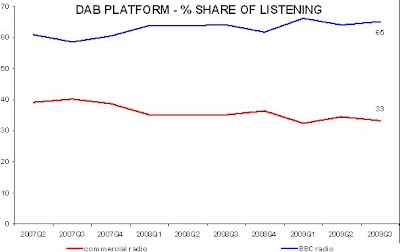
Taking each digital platform in turn, commercial radio’s share of listening on the DAB platform fell to 33% in Q3 2009, compared to the BBC’s 65%. This is not surprising because the age profile of DAB purchasers tends to be older listeners who are statistically more likely to listen to BBC stations. However, it does pose a grave question as to the return that commercial radio can expect from its substantial investment to date in DAB infrastructure, if listening on that platform is dominated so much by the BBC.
The digital TV platform is one that commercial radio has long dominated because of the large amount of spectrum it leased in the early days of Freeview. However, the increasing popularity of digital terrestrial television has already substantially increased the cost of spectrum on Freeview for the radio industry when its contracts come up for renewal. Furthermore, the forthcoming re-ordering of the multiplexes to accommodate HD television and new compression codecs is likely to squeeze commercial radio’s access to Freeview spectrum even more so. Before long, it is likely that the BBC will dominate the digital TV platform, just as it already does on DAB. Presently, the BBC has a 45% share, compared to commercial radio’s 51%.

As might be expected, the BBC’s strong online presence has already put it in the commanding position in terms of its share of listening via the internet platform. The integration of BBC radio into the iPlayer has no doubt helped as well, whereas commercial radio’s offerings are relatively more fractured and less heavily marketed, despite the excellent innovation of the RadioCentre Player. The BBC has a 50% share of listening on the internet platform, compared to commercial radio’s 37%.

The significance of commercial radio’s diminishing share of these three digital platforms is demonstrated when we look at the two sectors’ listening shares achieved on the analogue platform alone. Once one removes the digital platforms from the picture, it is evident that the shares of both the BBC and commercial radio have remained relatively stable in recent years. In other words, it is commercial radio’s declining share of listening on digital platforms that is effectively pulling the sector’s total share of listening (analogue + digital) down, particularly as digital platforms are growing as a proportion of total radio listening (21.1% in Q3 2009).

There is a paradox here. The commercial sector invested heavily in the DAB platform, believing that the new technologies would help it INCREASE its overall share of radio listening versus the BBC. In fact, that investment has recently helped to DIMINISH commercial radio’s overall share of listening. Digital television remains the only platform in which commercial radio dominates, and yet this is the very platform where commercial radio will be forced to cede spectrum and face, once more, losing out to the BBC whose spectrum for radio is guaranteed.

It is important to emphasise that these graphs show only the SHARE of listening on these platforms. The volumes of listening on each of these platforms have demonstrated absolute growth for both commercial radio and for the BBC over the same time period. But, more than any other digital platform, it is significant that the DAB platform is dominated by the BBC which now accounts for almost two-thirds of its usage. Such data is important when making decisions about the potential returns on further investments in DAB infrastructure. Will further investment simply maintain the existing imbalance, or will it really improve commercial radio’s share? Does investment in infrastructure also require parallel investment in new content that will appeal directly to the older age groups who own DAB radios?

Some possible reasons for commercial radio’s diminishing share of listening on digital platforms include:

• Commercial radio’s tendency to invest in DAB infrastructure more significantly than in original digital-only content
• Recent closures of many digital-only radio stations in the commercial sector
• The BBC’s relatively stable resource base, at a time when commercial radio revenues are falling precipitously
• The BBC’s long-held policy to invest simultaneously in multiple platforms, whereas commercial radio has focused on DAB and, to a lesser extent, Freeview
• The BBC’s focus on creating exclusive digital-only content unavailable on the analogue platform
• The BBC’s 360-degree music royalty agreements which allow it to use diverse platforms, whereas commercial radio requires separate (and more restrictive) agreements for time-shifted content and podcasts
• The BBC’s long-term, consistent promotion of content and digital platforms across TV, radio and the internet whereas commercial radio is less willing to cross-promote content or digital platforms that migrate listeners away from its core analogue offerings
• Frequent management changes and ownership changes in some parts of commercial radio, where substantial consolidation has often translated into short-term ‘slash and burn’ rather than ‘invest and build’ policies.

Whatever the reasons, we are not where we were meant to be – that is, we are not where it had been anticipated more than a decade ago commercial radio would be when investment in digital platforms, notably DAB, was expected to produce a beneficial outcome for commercial radio audiences versus the BBC. To put it plainly, the strategy conceived in the 1990’s has not worked. Commercial radio offerings do not dominate digital platforms (yes, they are more numerous, but they do not attract more hours listened than the BBC). DAB has become a largely BBC platform.

So, what can be done? Some of the issues noted above require a more level playing field to be established between commercial radio and the BBC. One such example of a practical solution is the Radio Council plan for a new UK Radio Player that will offer BBC and commercial radio content from a single aggregated access point. Other issues remain mostly in the lap of the gods (revenues, for example). Some issues require the BBC to be less predatory (or more regulated) and for the commercial sector to be more focused on strategic, long-term objectives (such as an online strategy that is more than simulcasting).

There is no single answer to this complex problem, though the commercial radio sector is hobbled by both its present lack of profitability and the regulatory strings that are attached to the majority of its analogue radio licences. What is desperately needed in these difficult times is not minor regulatory tinkering (such as adjusting how many hours of local content a local station is required to broadcast) but a wholesale change in strategy to maintain a commercial radio sector that can thrive in the digital marketplace we now inhabit. Will the imminent Digital Economy Bill prove sufficiently forward-thinking in its radio policy proposals?

[Statistical note: The graphs above to do not sum to 100% because the minimal amount of platform data released by RAJAR is ‘rounded’ (hours listened to 1,000,000; listening shares to 0.1%) and the listening apportioned to the BBC and commercial radio sometimes does not add up to the total for a platform. Some of this shortfall may be accounted for by ‘other’ listening (neither the BBC nor commercial radio) which is not itemised by platform. Data for individual quarters are therefore somewhat inconsistent, though the trend over several quarters is likely to be indicative. Additionally, there is an element of radio listening unattributed to any platform, 12.8% of the total in Q3 2009, but which is roughly equally applicable to BBC radio and commercial radio.]

UK Commercial Radio In Numbers: Q1 2009

Click here for my latest presentation containing data for the UK commercial radio industry’s key performance metrics in Q1 2009 for revenues, audiences and radio receiver hardware.

Revenues

Q1 2009 radio revenues were down 19.5% year-on-year, eclipsing the previous quarter’s 14.5% decline (although Q1 2008 had been an exceptionally strong quarter). National advertising continues to weaken, the last four quarters having declined by 15.9%, 12.2%, 21.2% and 28.8% respectively year-on-year. By comparison, local revenues have proven more resilient, down 6.4% in Q1 2009 year-on-year.

The gravity of the downturn is demonstrated by the fact that Q1 2009 was the lowest quarter for revenues since 1999 (at face value – if inflation were factored, the situation would be worse). The size of the industry is likely to continue to contract throughout 2009 and it will have to make further, significant cuts to overheads simply to ensure its survival. Public and parliamentary debate to date has focused upon the economic plight of local newspapers, but local commercial radio is just as endangered.

John Myers’ local radio report for Digital Britain suggested a number of regulatory and legislative changes that would potentially ease the financial burden on the commercial radio sector, but these still remain proposals at present. Until the government’s Digital Britain final report and Ofcom’s consultation exercises potentially turn these recommendations into action, the worsening economic pressures on commercial radio are likely to continue to produce further casualties.

Although some voices are already talking up a future bounce back of revenues after the recession (whenever that might be), it is important to recognise that the recent advertising downturn has only exacerbated a downward trend in radio revenues that was already established. In real terms (removing the impact of inflation), radio revenues peaked in 2000 and had already declined by 25% between 2000 and 2008. The current economic cycle is merely aggravating the structural decline that was already evident.

Audiences

At the root of commercial radio’s structural problem is the public’s declining consumption of its output – hours listened during the last four quarters were down 2.3% year-on-year. Radio as a medium continues to attract significant amounts of listening (22.4 hours per week per listener) and reaches 90% of the population weekly. Within those impressive totals, commercial radio is maintaining most of its reach but is losing listener hours. In Q1 2009, the average commercial radio listener consumed 13.5 hours per week, compared with 15.6 hours per week five years earlier.

It would be easy to lay the blame for this loss of listening at the door of increasingly promiscuous 15-24 year olds spending increasing amounts of time using mobile phone applications, social networking websites and streamed video. Whilst it is true that 15-24 year olds’ average time spent with commercial radio has fallen to 12.4 hours per week in Q1 2009 from 15.2 hours per week eight years ago, blame must also be shouldered by the other constituent demographics within commercial radio’s ‘heartland’ 15-44 year old audience.

Reductions in time spent listening to commercial radio have been almost as substantial amongst 25-34 year olds (12.7 hours per week in Q1 2009, down from 15.5 hours eight years earlier) and 35-44 year olds (14.2 hours per week in Q1 2009, down from 16.6 hours eight years ago). Commercial radio’s share of listening amongst both these demographics fell to 49% in Q1 2009, so that BBC radio listening now dominates all age groups except for 15-24 year olds, in which commercial radio still has a 59% share. Only two quarters ago, commercial radio’s share had been above 50% in all three constituent demographics of its 15-44 ‘heartland’ audience whilst, back in 1999, it had been above 60% in all three. These changes represent the crux of commercial radio’s long-term problem.

Additionally, people under the age of 40 are evidently listening to more ‘audio’ then ever before, assisted by the take-up of portable audio players and the blossoming integration of audio applications into mobile phones. However, listening on these new platforms is not being reflected in the audience data quoted above because the RAJAR radio ratings metric continues to define ‘radio’ listening in the traditional linear way, excluding time-shifted consumption (listen again, podcasts) and non-broadcasters (Last.fm, Spotify). Sooner or later, the industry will have to decide whether RAJAR is to remain merely a marketing tool to demonstrate the two traditional broadcasters’ (BBC and commercial radio) continuing dominance of the shrinking market for linear radio; or whether it is more important for RAJAR to demonstrate that ‘audio’ is a growing consumer medium now shared amongst a widening group of content providers. Comments made recently by the BBC’s Tim Davie at the RadioCentre conference offer encouragement in this respect.

Transactions, Openings & Closures

In May 2009, Global Radio finally sold its eight Midlands stations (an OFT requirement of its acquisition of GCap Media) to former Chrysalis Radio chief executive Phil Riley in a deal reported to be worth £30m and backed by Lloyds TSB. Global’s rival Bauer Radio was long anticipated to be the successful buyer, causing some to comment that the transaction has the hallmarks of a ‘warehousing’ deal that would satisfy current competition issues until media ownership rules are amended by legislation to allow further radio consolidation and cross-ownership.

In May 2009, UKRD succeeded in its acquisition of The Local Radio Company [TLRC] in a deal that valued the latter at £2.88m. UKRD owned six local stations, having closed one and sold three stations during the last year. TLRC owned 20 stations, having sold eight during the last year. Since the acquisition, two further TLRC stations have been sold – Bournemouth’s Fire FM to Westward Broadcasting for £40,001, and Macclesfield’s Silk FM to neighbouring Dee 106.3 for a nominal amount. In the seven months to April 2009, Fire’s operating loss was £129k on revenues of £216k, implying an annual cost base of almost £600k, considerable for a station with a weekly reach of 28,000 adults.

In April 2009, TLRC also sold digital station Jazz FM for £1 to former TLRC chief executive Richard Wheatly and former finance director Alistair Mackenzie, the station having lost £733k in the six months to March 2009. In May 2009, the new owners announced a £500k national poster campaign for the station which broadcasts on Sky, Freesat and regional DAB multiplexes. To date, no digital radio station has generated an operating profit.

Forward Media finally exited the radio business by selling its last remaining stations, Connect FM in Kettering and Lite FM in Peterborough, to Adventure Radio (which owns Chelmsford Radio, Herts Mercury and Southend Radio) for undisclosed amounts.

In March 2009, Midwest Radio sold its two stations, MidWest Shaftesbury and MidWest Yeovil, to South West Radio Ltd, the company that had purchased five stations in the West Country from the administrators last year, following the failure of Laser Broadcasting. Another former Laser station, Fresh Radio in Skipton, was sold in March 2009 by administrators to Utopia Broadcasting which includes some station management.

In April 2009, CN Radio sold Touch FM in Banbury to a management buyout team for an undisclosed amount and the station was relaunched as Banbury Sound. In November 2008, CN had said it would close its Touch FM stations in both Banbury and Coventry if it did not find buyers.

April and May 2009 saw the closure of seven local analogue commercial stations, a greater number than in the previous three years. Ofcom revoked the licence of KCR FM in Knowsley from owner Polaris Media, following failure to comply with its format. Sunrise Radio closed two London stations, Time 106.8 in Thamesmead and South London Radio in Lewisham, which had been up for sale since last year. Pennine FM, purchased by John Harding from TLRC last year, closed in Huddersfield. UTV closed Valleys Radio in South Wales after Ofcom had rejected a co-location request. Jason Bryant closed Radio Hampshire in Southampton and Winchester, stations which he had acquired from Southampton Football Club in 2007 and from Tindle Radio in 2008 respectively.

However, Pennine FM has since been acquired from administration by former station staff Adam Smith and Steve Buck and relaunched in May 2009. Similarly, internet broadcaster Play Radio has expressed interest in acquiring the two Radio Hampshire stations from administration, and a creditors’ meeting is due on 24 June.

On digital platforms, local Stafford station Focal Radio closed in May 2009 with the loss of 23 jobs after local businessman Mo Chaudry, who had invested £80,000 to ‘save’ the station, withdrew his support after being arrested on corruption charges involving Stoke City Council. London DAB station Zee Radio (simulcast on Spectrum AM) closed in April 2009 after a year on-air.

The national DAB multiplex Digital One has three new additions, two temporary. On 20 April 2009, forces radio station BFBS launched a simulcast on the platform, following its earlier trial. On 1 June 2009, Amazing Radio launched a six-month trial service showcasing unsigned UK bands as an extension of its Amazing Tunes website. From 27 June 2009, Folder Media’s Fun Kids station will be simulcasting a 14-week trial, extending its present availability on DAB in London.

In London, black talk/music station Colourful Radio launched on DAB on 2 March 2009, and music station NME Radio added DAB on 13 May 2009.

In the coming months, UKRD/TLRC is likely to divest further local stations from its portfolio. At the top end of the commercial radio business, consolidation has created huge groups of large local stations whilst, at the bottom end of the market, an increasing number of small local stations are now being divested from groups to local owners (or closed down). In a small way, this is returning local commercial radio to its 1970s roots, when it was expected that each station would be owned by local entrepreneurs. It will be instructive to see how each of these divergent strategies succeeds in such tough economic times.

Exclusive digital radio content: saying it and doing it are two different things

Everyone seems to agree – it is the availability of exclusive radio content on digital platforms that will drive consumer uptake of the hardware and digital listening.

In its Final Report, the Digital Radio Working Group had said in December 2008: “We must present a compelling [DAB] proposition for consumers not only through new content, but in building a whole new radio experience”.

In its Interim Report, Digital Britain had said in January 2009: “We will expect the radio industry to strengthen its [DAB] consumer proposition both in terms of new and innovative content and to take advantage of the technological developments that DAB can offer”.

In its report commissioned for RadioCentre, Ingenious Consulting had said in January 2009: “…. there is not as much DAB-only material as hoped, and very little that’s truly compelling – there’s no ‘must have’ content as with sports and movies on Sky [TV]”.

In its submission to Digital Britain, Ofcom had recommended in March 2009 “the creation of new commercial radio stations to create a consumer proposition analogous to Freeview: a wide range of popular and niche services, delivered digitally”.

The Digital Radio Working Group had spent a year meeting throughout 2008 and made its final recommendations in New Year 2009. Five months later, for the consumer turning on their DAB radio, the choices do not seem much different than they were then. While the industry continues to talk and talk and talk and talk endlessly about what should be done, the consumer proposition for digital radio seems to be disappearing down the tubes. The data from the Q1 2009 RAJAR audience survey demonstrates that.

For commercial radio, its digital stations are now capturing a lower proportion of its listening (4.5%) than a year ago (5.5%). Only 23% of listening to commercial radio via digital platforms is to exclusively digital content, compared to 30% a year ago. These results are not surprising, given the closure of many digital stations during 2008 (Core, Oneword, Life, TheJazz, Virgin Radio Groove, Yarr, Easy, Mojo and Islam Radio). In 2009 so far, Stafford’s Focal Radio and London’s Zee Radio have also closed.

For the BBC, the results are almost as disappointing. Its digital stations have recovered from a poor performance last quarter, but it appears that much of this improvement may have been due to heightened public interest in 6Music following the Ross/Brand affair. BBC digital stations now capture 2.9% of listening to the BBC, compared to 2.7% a year ago. Only 14% of listening to the BBC via digital platforms is to exclusively digital content, compared to 16% a year ago. For the BBC, it is beginning to look as if interest in its digital content is no longer growing as it had been during 2006 and 2007.


The summary graph (below) of hours listened to exclusively digital radio stations demonstrates the trend’s recent tendency to have levelled out, primarily as a result of commercial radio’s performance since 2007, but now also as a result of the BBC’s performance in recent quarters. Whilst commercial radio experienced significant station closures in 2007/8, the BBC’s portfolio has remained constant and is receiving as much cross-promotional marketing exposure as ever.


It is true that some new initiatives to provide exclusive digital radio content have happened in recent months:

* Colourful Radio launched on DAB in London on 2 March 2009.

* BFBS Radio is available nationally on the Digital One DAB multiplex from 20 April 2009. The station is government funded and aimed at British forces and their families. Unfortunately, listening to BFBS by the general public is likely to substitute for either commercial radio listening, reducing its ratings and revenues, or substitute for BBC radio, reducing its ratings. In the end, neither result will help commercial radio or the BBC make DAB a successful platform.

* NME Radio launched on DAB in London on 13 May 2009.

* Amazing Radio is available nationally on the Digital One DAB multiplex from 1 June 2009 on a six-month trial. Amazing Tunes is a UK website showcasing unsigned bands and musicians. This is a great idea for an on-demand internet service but I am not sure this content will prove so appealing as a broadcast station. The problem, as Xfm discovered with its own disastrous experiment two years ago, is that listening to a playlist chosen by listeners can be as entertaining as looking through a relative’s 300 holiday snaps. Out of several million people’s playlists on Last.fm, I find there are no more than a handful of other people’s selections that I can sit through. What works well online for Amazing is not necessarily going to work in the broadcast medium.

However, at the same time:

* Bauer Radio has relocated Q Radio from London to Birmingham, and Heat Radio from London to Manchester, effectively downgrading these digital stations and making redundancies

* Bauer Radio has removed five stations (Kerrang!, The Hits, Q, Heat, Smash Hits) from the Sky platform

These downgrades are significant because Bauer is easily the biggest player in digital radio, now that Global/GCap/Chrysalis has sold/closed all but two of its digital stations, both of which (The Arrow and Chill) survive only as music jukeboxes. Commercial radio’s commitment to exclusive digital content seems to be hanging by the barest of threads. If Lord Carter decides not to respond positively to the commercial radio industry’s demands for some kind of financial support in the Digital Britain report published in a fortnight, that thread is in imminent danger of snapping.

And so the talk about the need for exclusive digital radio content is likely to run and run and run. But, as long as it remains talk rather than significant action, consumers will remain unimpressed and the graphs above will continue their present trajectories. Nobody wants this to be the outcome, but nobody seems to be doing anything concrete to stop it happening.

Commercial radio and RAJAR: the truth is out there (somewhere)

Is it me, or is it becoming increasingly difficult to reconcile the numbers in the latest RAJAR radio ratings data with the write-ups of those numbers in the trade and consumer press?

Commercial radio regains share from BBC”, said the headline in Media Week.

Commercial radio share drops 40%”, said the headline in Broadcast.

Commercial radio’s share of listening still falling”, said the headline in Marketing Week.

Commercial radio’s audience …. grew from 31.2m to 31.5m listeners a week”, said The Telegraph and, using precisely the same wording, said the BBC.

Commercial radio’s market share dipped slightly to 41.6%,” said a different story in The Telegraph.

Commercial radio had an audience of 31.5m adults, increasing its reach and share of the audience compared to the previous year,” said The Independent.

These reports appear contradictory and inconsistent. This is partly due to poor reporting, but it also because there are a number of different metrics used to measure the audience for radio (and thus for commercial radio). These include:

WEEKLY REACH
Commercial radio’s weekly reach amongst adults (15+) is up quarter-on-quarter (from 61.5% to 62.1%) and up year-on-year (from 61.6% to 62.1%). In the long term, the trend still appears to be downward.


AVERAGE HOURS PER LISTENER
Average hours per adult (15+) listener to commercial radio are down quarter-on-quarter (from 13.7 to 13.5 hours per week) and also down year-on-year (from 13.7 to 13.5 hours per week). The long-term trend is downwards.


TOTAL HOURS LISTENED
Total hours listened to commercial radio (adults 15+) are down quarter-on-quarter (from 427m to 426m hours per week) and are up year-on-year (from 424m to 426m hours per week). The long-term trend is downwards.

SHARE OF LISTENING
Commercial radio’s share of total radio listening (15+ adults) is down quarter-on- quarter (from 42.2% to 41.6%) and up year-on-year (from 41.1% to 41.6%). The long-term trend is downwards.

As can be seen from the above graphs, the numbers naturally oscillate across time, regardless of their long-term trends. This makes it easy each quarter to pick out at least one measure that shows a gain, either quarter-on-quarter or year-on-year or both, and highlight that number alone in a

press release. There is always some number, whatever it is, that is going to be ‘up’ rather than ‘down’. Without placing that solitary ‘up’ number in any context, many journalists simply jump upon the press release and proclaim that everything is ‘up’. And so it was this quarter.

It would be great to be able to report that commercial radio in the UK had turned the corner and was bouncing back, attracting more listeners for longer periods of time, and trouncing the BBC. Unfortunately, the facts say otherwise. The only thing that some of these ‘up’ headlines in the press prove is the sector’s ability to spin a good yarn. However, an industry that believes its own PR is an industry in trouble.

Complacency is a large part of the problem that has led the commercial radio industry to where it is today – not a particularly happy place. If all this fake positivity around the RAJAR results simply encourages further complacency in commercial radio, it could hasten the death of the industry.

Everybody likes to hear good news. Nobody wants to be a bad news bear. But for an industry to be taken seriously, it needs to be imparting factual and accurate statements about the state of its health.

To its credit, only The Independent had the temerity to ask: “Why are radio audiences rising, and how come the industry is in crisis?

UK Commercial Radio in numbers: Q4 2008

Click here for my latest presentation containing data for the UK commercial radio industry’s key performance metrics in Q4 2008 on revenues, audiences and receiver sales.

Revenues

Commercial radio had started 2008 positively with revenues in Q1 up 7.3% year-on-year. After that, everything slid downhill. Q2 revenues were down 10.1%, Q3 down 7.8% and Q4 down 14.5% year-on-year. 2008 ended with Q4 revenues of £129m, the worst performing quarter since 1999. However, in 1999, only 244 commercial radio stations had been licensed, whereas that total now exceeds 300. The result is a revenue squeeze on commercial radio businesses unseen since the 1990/1 recession.

The present situation is a direct result of a severe contraction in national advertising expenditure on radio, the last three quarters’ totals having been down 15.9%, 12.2% and 21.2% respectively year-on-year. Whereas, in 1990, national advertising had accounted for 47% of commercial radio’s total revenues, by 1999 it was contributing 67%. National advertisers’ enthusiasm for radio had contributed significantly to the commercial sector’s growth in the 1990s, but it has also made the medium more vulnerable to national economic trends and the shifting marketing priorities of the big brands.

Although more concentrated sector consolidation had once been touted as the saviour of the commercial radio industry, the sector is now in grave danger of being crucified by the very policy for which it had lobbied. Two owners now control two thirds of the UK commercial radio industry, which would render the potential failure of one of them a catastrophe of hitherto unseen magnitude. Current economic pressures are likely to create casualties at both ends of the scale, with some smaller radio groups proving just as likely to run out of cash as their larger rivals. Whether your radio group’s bank loan is £2m or £100m, debt servicing has now become your biggest headache.

Audiences

With so much industry attention focused on sharply falling revenues and the necessity to cut group central costs and station overheads, it is inevitable that investment in content has not been a current priority for many players. Total hours listened to commercial radio (427m per week) have continued their long-term decline, with Q4 2008 being marked as the second worst quarter this millennium (Q1 2008 was the worst). Although commercial radio’s audience reach has been maintained, average time listened fell back to 13.7 hours per week in Q4 2008, equal to the all-time low in Q1 2008.

The blame for these declines can be laid at the ears of listeners aged under 35, who are choosing to spend less time with commercial radio. Over the last eight years, 15-24 year olds’ listening to commercial radio has fallen from an average 15.3 to 12.8 hours per week, while 25-34 year olds’ listening has fallen from 16.1 to 13.1 hours per week over the same period. These changes, combined with the declining numbers of these younger demographics within the UK population, can only make commercial radio more susceptible to long-term decline.

At the same time, the BBC continues to chip away at commercial radio’s ‘heartland audience’ of 15-44 year olds, with Radio Two maintaining its position as the UK’s most listened to station. In London, the BBC performed particularly well in Q4 2008, pushing commercial radio’s share of listening below 50% for the first time probably since the early 1990s. As noted previously, commercial stations outnumber BBC stations in London by a factor of three, demonstrating that it is ‘quality’ rather than ‘quantity’ that creates success with listeners.

Digital Radio

The grim figures for digital radio only add to the commercial sector’s woes. Although cumulative sales of DAB receivers passed 8.5m in Q4 2008, unit sales were down 10% year-on-year, the first occasion that the vital Christmas quarter has exhibited negative growth. The danger is that the relatively high price tag of DAB radios will not entice buyers in Credit Crunch UK, particularly when the content offered on the platform is not being expanded or enhanced.

It is ‘content’ that continues to hold back digital platform growth. Only 4.6% of commercial radio listening was attributed to digital-only radio stations in Q4 2008, the lowest level since 2007, and a consequence of several commercial digital station closures in 2008. An increasing proportion of commercial radio listening via digital platforms is to stations already available on analogue (76% in Q4, up from 72% a year earlier) which demonstrates that exclusive digital content is not effectively driving consumer uptake.

Although the radio industry has been busy with discussions about the future of the DAB platform for more than a year now, almost nothing has changed from the perspective of the consumer. In Q4 2008, Bauer closed five-year old Mojo Radio, Sunrise closed five-year old Easy Radio, and Islam Radio in Bradford closed. The revived Jazz FM replaced GMG brands on four regional DAB multiplexes, but owner The Local Radio Company is already seeking a sale of this digital station.

As noted previously, many of the remaining digital-only stations (both commercial and BBC) suffered significant audience losses in Q4 2008.

Commercial Radio Station Transactions

As yet, there has been no announcement from Global Radio as to the sale of its local stations in West and East Midlands that had been required by the Office of Fair Trading in August 2008 as a condition of its acquisition of GCap Media.

On 31 August 2008, Global Radio quietly handed back the AM licence for its Gold brand in Exeter and Torbay. On 23 December 2008, UTV closed its Talk 107 station in Edinburgh. On 30 January 2009, Abbey FM in South Cumbria was closed by joint owners CN Radio, The Local Radio Company and The Radio Business. In November 2008, CN Group had said it would close its Touch FM stations in Coventry and Banbury if it did not find a seller, but nothing further has been reported. Ofcom decided at its November 2008 radio meeting to “start formal licence revocation proceedings” against KCR FM in Knowsley which has been “failing to broadcast in line with its licensed format” since 24 October 2008.

In September 2008, UKRD sold Star Radio in Cheltenham to a local company, and The Revolution in Rochdale to Steve Penk. Tindle Radio sold Dream 107.7 in Chelmsford to Adventure Radio in September 2008, and sold Dream 107.2 in Winchester to Town & Country Broadcasting in November 2008. In January 2009, UTV sold Imagine FM in Stockport to Damian Walsh. In February 2009, UKRD sold Star Radio in Bristol to Tomahawk Radio. No prices were reported for any of these transactions.

The insolvency of Laser Broadcasting in November 2008 resulted in control of five of its licences – Bath FM, Brunel FM in Swindon, 3TR in Warminster and QuayWest in Bridgwater and Minehead – being transferred to Southwest Radio. It appears that control of Laser’s Sunshine FM in Hereford & Monmouth has transferred to Murfin Music.

The Local Radio Company, one of only two remaining plc’s in the radio sector, is seeking to raise £1.51m gross through a share issue. The company’s auditors noted on 5 March 2009 that “until it is successfully completed there remains in existence a material uncertainty which may cast significant doubt about the Company’s ability to continue as a going concern”. These concerns, which could apply equally to several other radio groups, are likely to result in a rash of transactions and an unprecedented number of station closures during the rest of this year.