FRANCE: digital radio rollout hangs in the balance

The much delayed report on digital radio commissioned by the French government from Marc Tessier, former CEO of France Televisions, was published on Monday 9 November 2009. It suggested that the planned launch of France’s first digital radio stations in mid-2010 was “implausible” and it proposed that an economic model for digital radio needed to be identified before an estimated 600m to 1bn Euros is spent over the next ten years on the rollout of digital radio in France.

The 54-page report raised queries concerning almost all the various aspects of digital radio implementation: the funding, the T-DMB standard adopted in France, the date for FM switch-off, and the cost of simulcasting on both analogue and digital spectrum for a ten-year period. It concluded: “There is still time to consider the appropriateness of pursuing digital terrestrial radio, at the point when several players are unwilling to endorse its prerequisites [coverage, reception quality] or to pay for the additional transmission costs for ten years”.

Interviewed in Le Figaro, Tessier was asked if digital radio should be halted altogether. “That’s for the radio bosses to decide. But I believe there is serious doubt over the desirability of a project that will take ten years, at a time when a new radio platform is evolving at great speed via mobile phone networks. Digital terrestrial radio has less to offer now than it did three years ago. Where will we be in five years time?”

Asked what the crucial issues are, Tessier said: “The coverage area and the number of stations available to every citizen would be the main benefits of the project. That is why each radio station owner must commit to covering at least 90% of the population, which involves huge costs at a time when radio advertising revenues are declining under pressure from new media. If we reduced the coverage area to cut the costs, the project would attract little interest”.

Also interviewed in Le Figaro, Rachid Arhab, president of the CSA [France’s broadcast regulator] digital radio working group, was asked if the report threatened the future of digital radio. “I am not bothered”, he responded. “This report is but one part of the digital radio project, and we are now awaiting the Hamelin report on the funding for radio groups. I recall that the letter to Tessier commissioning this report explicitly required it ‘to map out the successful path for digital terrestrial radio’ based on the notion of public funding.”

Asked whether digital terrestrial radio would be overtaken by other radio platforms, Arhab said: “Technology is evolving very quickly. But the longer we wait, the more difficult it will be. In ten years time, perhaps a significant portion of listening will no longer be delivered by radio waves. But that would pose a major problem in terms of platform neutrality. If there is no digital terrestrial radio platform, then public radio will be obliged to negotiate with the internet service providers for distribution. The CSA does not want to take digital radio away from radio receivers. For each new problem, we find a solution”.

Asked when digital radio will launch, Arhab said: “I can no longer give a precise date.”

The commercial radio owners started meeting the evening the report was published to draft their response, which they will deliver to the CSA by 23 November.

L’Express newspaper commented: “Without a huge effort from the radio industry, which right now does not believe in it, digital terrestrial radio is doomed to failure even before it starts”.

FRANCE: Digital radio launch postponed to mid-2010

The launch of digital terrestrial radio in France has been postponed from December 2009 to mid-2010. “It will take us, I think, until the middle of next year,” said Rachid Arhab, president of the CSA [France’s broadcast regulator] digital radio working group. “I have learnt not to trust dates.” He continued: “What we had not anticipated was the impact of the credit crunch on advertising revenues, particularly in the radio sector, so the particular speeds of the different stakeholders are unknown.”
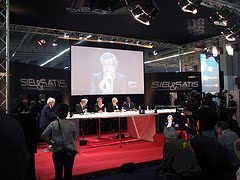
Speaking at the Siel-Satis-Radio event in Paris, Arhab switched on France’s first digital terrestrial radio transmitter and said: “The greatest difficulty is knowing if all the radio groups want to migrate to digital radio at the same speed.” “Today, I feel and I know that some of you are telling us ‘we are ready’. We are delighted. A few months ago, this was not the case.” “One must not be scared of analogue radio switch-off. Digital radio will not be a success if it has to co-exist with analogue radio for fifteen to twenty years.”
According to SatMag, at the beginning of November, there will be ‘round table’ meetings at the CSA with all the licensed digital radio operators, the set manufacturers, the transmission providers, and representatives from the Ministry of Culture & Communication and the Ministry of Finance & Industry. The CSA is awaiting two reports: one from Marc Tessier on the economic conditions for the rollout of digital radio and on competition issues; the other by Emmanuel Hamelin on the funding of community radio.
It is reported that licences have been signed, but it will take two months for the multiplex operating companies to be formalised for the launch of digital radio in the first three areas. The composition of the multiplexes has not yet been determined. The time period between which the multiplex contracts are signed and the content providers launch digital stations still needs to be fixed, probably around six months.
Elsewhere at the Paris event, SatMag reported that the issue of the T-DMB digital radio standard adopted in France was back on the table. Its report said:
“Is it right that, in France, we are using a standard that is different from the rest of Europe? Should we not be offering radio receivers that are compatible with DRM+? Alan Mear [of the CSA] says that this is not a taboo subject and will be revisited, but he also agreed with Mathhieu Quetel of SIRTI [the trade body for independent regional and local stations] that it was essential to launch digital radio and not to revisit the question of the adopted standard. Besides, Rachid Arhab agreed yesterday that the DRM+ standard was expensive and of no interest.”
“There was a big surprise from Michel Cacouault of the Bureau de la Radio which represents the main French commercial radio groups. Remember that it was they who said France had to adopt a particular digital radio standard as it was essential to transmit additional data. Today there was a complete turnaround. Michel Cacoualt reminded us that commercial radio had lost around 18% of its revenues in the credit crunch. Now, the owners want to cut their costs and are willing to choose a different standard that is less expensive. Those in the conference room familiar with this issue were amazed. Well yes! The credit crunch does makes you think. The cost of dual transmission [analogue and digital] for a single national network is estimated to be 2 to 4 million Euros [per annum], though what it will actually be we will only know when it happens.”

FRANCE: “Digital terrestrial radio: now!”

Last week, three trade bodies in the digital radio sector in France jointly wrote this opinion piece published in Radioactu magazine:

“Digital terrestrial radio: now!”

Digital terrestrial radio has been a reality since 27 May 2009. A reality that came about through the decisions of the CSA [France’s media regulator], decisions that had been anticipated for many years by many commercial radio stations and associations who have submitted applications across France and who have made financial investments in the meantime.

These companies and associations were well aware of the digital radio standard that was chosen [T-DMB], despite controversy surrounding this decision, were also conscious of the need to simulcast [FM and T-DMB] during the period of migration to digital and, finally, were aware of radio’s need to digitise in order to quickly take its place in the converged media world, in the face of attempts by television and mobile phones to turn it into a minor player.

However, the reality of digital terrestrial radio is primarily the benefit to listeners of a significantly expanded radio content offering at local, regional and national levels.

In the first three areas selected by the CSA to launch later this year, the number of stations will increase from 48 FM to 55 digital in Paris, from 29 to 41 in Marseille, and from 27 to 40 in Nice.

The reality is also the opportunity offered to radio stations to expand their existing broadcast coverage areas and become, if they wish, multi-city stations or multi-region stations which would make them “new market entrants”, something that the unavailability of FM spectrum had denied them until now.

The reality is the introduction of new listener features unprecedented in FM radio. Sound quality equivalent to CDs. The ability to go back and listen to a whole show that has already been broadcast. The introduction of a visual mini-display on receivers that shows data associated with the show (station logo, photos of the host and guests, the CD sleeve or book cover…). As well as the interactivity offered by digital terrestrial radio in conjunction with internet and mobile phone networks is the ability to offer transactions connected to the broadcast show (music, concert tickets), to access travel information, check share prices, the weather …

Finally, the reality is the choice to offer “podcasts” and to benefit from the radio medium’s mobility to access free and accurate information.

These are all qualities which, like digital terrestrial television before it, will allow millions of French citizens to benefit from new content offerings which will always be free-of-charge.

However, in recent weeks, we note that those who, only yesterday, did everything to frustrate the adoption of DAB and the CSA’s call for licence applicants in 2000 to digitise the Medium Wave; those who refused the good sense to choose a common digital radio standard, preferring ‘multi-standards’ to European harmonisation, the American proprietary IBOC system and, more recently, the Korean T-DMB standard, are carrying on their ‘’ballet”, making incessant demands and all kinds of attacks upon the CSA, using delaying tactics to choose a standard that is anything other than the one they themselves imposed.

The big operators still feel they have an absolute monopoly, as if the radio landscape has not changed since the ‘liberation of the airwaves’ so that the landscape remains frozen, they can reject competition from new entrants, and can maintain the natural order and their enrichment.

But, despite these large players continuing their efforts to maintain their monopoly, they are today showing their weaknesses. They seem almost unable to create new offerings and new content when they know perfectly well that competitors are on their doorstep with new formats, new stations and a new radio spirit which thinks of radio as a multimedia experience which only digital terrestrial radio can make happen. The global radio medium has been born and it is the listener who makes the rules. It is the end of media that are imposed on the listener, as consumption habits are changing quickly (with a capital ‘Q’), but do the big operators get this? Above all, do they have the ability to adapt to this inevitable evolution? Anyway, even if their concerns are legitimate, their attempts to prevent the launch of terrestrial digital radio are not.

Today, it is no longer up to them to decide the future of radio in France. It is up to the public bodies, notably the CSA, to take responsibility for finally launching digital terrestrial radio, which had been decided by a call for licence applicants in March 2008. Many radio owners have been licensed and are ready to open their stations, just as there are many who could be ready to open new stations but who have not been licensed due to lack of spectrum.

We created the Vivement la Radio Numerique organisation in 2002, the Digital Radio Francaises committee in 2003, and the Digital Radio association in 2005. The first two have merged into the third to increase their productivity and to make digital terrestrial radio happen more quickly. All three are a legacy of the Club DAB and pay tribute to its president Roland Faure who, on the subject of DAB, expressed regret “that the processes for the digitisation of radio are blocked, despite the success of the call for licence applicants in 2000”, a subject on which all three organisations have spoken out.

We note with regret that, since 1996, politics has zig-zagged. The call for DAB licence applicants in 2000. The call for Medium Wave licence applicants in 2003. The adoption of a legal framework for the launch of digital radio in 2004. In 2005, Minister of Industry Patrick Devedjian made the statement that “digital radio is a high priority”. Then CSA President Dominique Baudis stated that “the Higher Council for Broadcasting will soon launch a consultation on digital radio, which will be the starting point of its launch”.

The call for digital radio licence applicants made in March 2008 in response to the strong demand (after numerous consultations with stakeholders, public meetings and technical tests). Progress had already been a long and winding road over more than a decade when, in May 2009, the powers that be finally intervened.

Any slowdown, postponement or delay will be very damaging to all existing operators, new entrants and future players who are all awaiting the launch of digital terrestrial radio. We will not tolerate further delays. Any further delay would be seen as a de facto cancellation of the licence awards made on 26 May 2009, which we would totally reject.

We cannot accept that the law can be constantly violated by a handful of players whose positions are constantly changing to turn digital radio into an imaginary illusion at the expense of listeners, our businesses, our organisations and our economy.

Radio is the only medium that has not yet been digitised. Digital terrestrial radio has been promised since 1996. It now exists in law, it has a legal framework, it is on the statute book, and the CSA has called for licence applicants and has selected the winners, all events that are in the public domain.

Everything is now in place for digital terrestrial radio to be launched. The system has been validated by the Ministry of Culture. The first three areas have been selected and the licence awards made. The public utility announced its intention to own and operate digital radio multiplexes. The contracts were sent to multiplex operators and the agreements were returned by the content providers. Commitments have been made to the ‘have nots’. The technical standards have been published for broadcasters and set manufacturers. Broadcasters have announced an incentive scheme for content providers to create multiplex owners. Set manufacturers are announcing their product lines.

Also, neither the current economic crisis, nor the internet, nor the fragmentation of listening habits (which go back more than 20 years) can justify a delay to the launch of digital terrestrial radio.

Any delay or postponement would risk thousands of jobs at a time when France, like many European countries, is trying to exit the crisis.

In these difficult times, only innovation and creativity count, and no lasting victory can be won by not following common sense.

The time is ripe to keep one’s promises and commitments in a spirit of self-discipline, necessity, will and, above all, responsibility or it will be need to be explained officially and publicly why digital radio was not launched, to name those who seek to prevent its launch in France, and to compensate the licensees.

Public broadcasters have been at the forefront of digital radio in Britain and Germany. In our country, it is high time that the public broadcaster comes out of the woods and takes on the responsibility, for which it has rights and duties to all our citizens: the right to pre-empt analogue and digital frequencies and the certainty of having its own multiplex to broadcast all of its channels to cover 90% of the country.

We must start digital terrestrial on time next December because nothing more should stop it and the various operators are ready. Those who do not want digital terrestrial radio have the internet solution. Radio is not only about market share or decades of radio experience, but about a wish to move the medium forward.

For us, digital terrestrial radio is now or never! We need to start with those who want it and they are many.

Those who do not want it, or who have filed applications lightly or by reflex but will not start within the period required by law, must take responsibility and return their licences to the CSA, who will re-advertise them to the benefit of the many operators waiting for digital licences.

Shalak Jamil, President of the Association Digital Radio
Tarek Mami, President of Vivement la Radio Numerique
Joel Pons, President of the Digital Radio Francaises committee

[unabridged]

My post-script:

A digital radio trade show and conference takes place 20 to 22 October at Hall 7.3, VIParis, Porte de Versailles, Paris. The “Siel-Satis-Radio” event is billed as a “series of meetings dedicated to digital terrestrial radio which will take stock of the questions and viewpoints of stations and the aid promised to radio groups”.

France: "Let's not mess up digital radio"

In France, Le Monde newspaper published an opinion piece last week written by Pierre Bellanger, founder and president of commercial radio group Skyrock, and Sylvain Anichini, former director general of state-owned Radio France:

LET’S NOT MESS UP DIGITAL RADIO

The powers that be are asking themselves a question about the transition to digital radio – if digital terrestrial television is a success, why would the transition to digital terrestrial radio not be a similar success?

In reply, experts have suggested there are differences between digital television and digital radio. Digital television is nationally operated and is being introduced nationally, whereas digital radio is being planned region-by-region with no certainty for radio operators who must apply for digital spectrum. Digital television offers three times as many free channels as analogue, whereas digital radio offers only a marginal increase over the wide choice available on analogue. Digital television was launched with a new generation of TV receivers – flat screens and high definition – and with adaptors for existing equipment. This is not the case for digital radio – digital radio receivers are as sexy as bricks and 140 million analogue radios will have to be thrown away.

Furthermore, digital television launched just when the medium was exploiting new sources of advertising revenues – once the preserve of radio – and when purchasing power was growing in line with the economy. Whereas, the transition to digital radio is being implemented just as the radio industry is reeling from the 2008 financial crisis and household spending is in decline. Finally, the television sector received significant financial help to fund its digital switchover. For digital radio, the subject of funding has been mentioned, and even said to be desirable, but there has been no promise to date. Public funding is not there to support the public will.

These facts have not stopped the powers that be, who have promised to overcome these obstacles. Driven by legislation, they have proceeded towards the launch of digital radio by involving key radio industry players in their strategy to select both a digital radio transmission standard and the most appropriate waveband to use. Applications have been submitted by radio opertaors for the first digital radio areas and there will be a selection process, just as for analogue radio, with licences awarded to the candidates of choice.

This process involves a substantial number of declarations of intent as to the magic of ‘digital’ in a concept synonymous with modernity. Perhaps we are forgetting somewhat that the CD, also digital, belongs more to the past than to the future ….

We are where we are. At the moment of truth when ‘poetry’ must give way to number-crunching and it seems that national digital radio transmission will cost at least 3 million Euros per annum, adding up to a total 50 million Euros per annum for the main radio groups. Additional transmitters are likely to need to be added to alleviate pockets of poor reception. And the absence of real competition between transmission providers offers little hope of reducing these costs. Finally, no new tangible sources of radio advertising are anticipated, and broadcasting will begin without a significant body of digital radio receivers in the market …

This kind of investment – more than 250 million Euros over seven years – might be justified if it could be amortised over two future decades that offered technological and economic stability. But we presently live in the midst of a complete revolution: the emergence of mobile internet access. This offers consumers the ability to connect anytime, anywhere, without interruption, to the internet via the airwaves.

The logic of the mobile internet is redefining the physical distribution of information and is disrupting traditional media and telecoms. The fixed internet has already changed our present, and the mobile internet is opening up the future. Radio is fully participating in this mutation, with radio distribution adapting to the internet protocol with ‘IP radio’.

The future is already in our hands: it is the iPhone. This revolutionary handheld device has allowed the internet to break into the mobile environment via existing communications networks. It provides access to thousands of radio stations, personalised music choices, and the user’s own media library.

Access is either through telecoms networks or through free Wi-Fi available at home or from millions of free wireless terminals. The multi-standard chip lets us forget about having to make a choice between network connections. We click and listen to our favourite radio station, that is all there is to do. ‘IP radio’ offers every radio station that is available via a conventional transistor radio.

The internet handset is connected to the car radio, the home hi-fi, the radio alarm clock, and chips that connect us to the internet on the move will be everywhere.

Already one and a half million iPhones have been sold in France. An entire industry, in less than two years, has caught up with touchscreen technology and IP handsets. It is true that the bandwidth, like the handsets, remain expensive, and telecoms networks must gear themselves towards new demands, but the trend is there: prices will fall. Besides, on the horizon is a converged pricing structure combining fixed broadband and mobile internet access in a package that offers unlimited usage. Therefore, how can we possibly build a viable market for digital radio receivers when the replacement cycle for radios is ten years, whilst that for (subsidised) mobile handsets is 18 months?

Unlike digital terrestrial radio, there is a business model for radio delivered by IP – it allows listeners to demand and receive advertisements specifically tailored to specific audience needs. This is internet audio. Listening is measured in real time and advertising space is traded in virtual marketplaces. IP-delivered radio has produced an unprecedented explosion of creative initiatives, supported by new economic models suited to micro-enterprises – look at the success of Radio Paradise.

What had once been little but a visionary thought is now beginning to make headway as a global standard – mobile internet is the new deal. It is the antithesis of the existing strata of broadcast networks specific to each medium (radio, television). In the future fragile economic landscape, where the concerns of preserving energy and the environment are becoming priorities, can we continue as if nothing has happened?

Careful thought by the powers that be should lead them to take account of these facts and to re-focus their administrative processes which risk becoming bogged down without public subsidy. Why not consider better use of digital networks that already exist? Digital terrestrial television which already allows radio, for example? And, whatever the case with radio, promote mobile internet access in the broader context of migration to a ‘digital’ France.

The planned migration to digital terrestrial radio was not a mistake, but a ‘future of delays’ overtaken by a technological revolution which has surprised entire industries. Recognising this does not take anything away from those who have defended their point of view. A change of course is never a mistake when it allows you to avoid hitting the reefs.

[unabridged]

Digital radio in France: cold feet, no funding, sue the regulator

On 10 September, the French secretary of state responsible for the digital economy, Nathalie Kosciusko-Morzet, organised a seminar “Digital: investing now for tomorrow’s growth”. The objective was to lay out to the 1000 attendees the costs and opportunities necessary to create an integrated digital economy.

On 16 September, Jean-Luc Hees, head of state broadcaster Radio France, addressed the National Assembly’s Committee on Finance & Cultural Affairs. He told them that the broadcaster’s advertising revenues were forecast to decline in 2009 by 20 to 30% year-on-year (advertising comprises 8% of revenue, the remainder from the state). He said that the rollout of digital radio in 2010 would require adding 2m to 3m Euros to the budget.

Hees told the National Assembly: “We now know fairly well the timing of the introduction of digital terrestrial radio, with launches in the coming months in three areas – Paris, Marseille and Nice. …. Our goal is to achieve 95% coverage of France by the end of 2013, according to the CSA’s [France’s media regulator] schedule. …. We must understand that everything has a cost, and the impact on Radio France’s finances means that this house will have to fund dual transmission [analogue and digital] for some time. Analogue transmission presently costs Radio France 80m Euros per annum. The rollout of digital radio will entail additional costs and this is one of the things that require funding in our next budget. I want to emphasise this.”

Amongst commercial radio operators, opinions on digital radio appear increasingly ambivalent. Franck Lanoux, deputy director of NextRadioTV said that digital radio “will not affect 95% of radio listening. It’s hard to identify how digital radio will develop – the receivers do not exist, yet the broadcasters are being asked to make significant investments. Consumers have nothing to listen with.”

The publication mediasactu commented this week that digital radio in France has become ensnared in a quagmire and that reservations amongst commercial broadcasters are becoming stronger:

“After putting all their weight behind persuading the government to adopt the T-DMB standard for digital terrestrial radio in December 2007, which is now nearly two years ago, radio broadcasters, particularly those that are members of GRN [France’s Digital Radio Group] and the Bureau de la Radio [France’s newly created radio trade body comprising the four largest commercial owners], are much more dubious about the real chance of succeeding with the transition to digital radio. Although they were unwavering only a few months ago, now major national radio groups, along with SIRTI [the French broadcasting trade union] and the regional stations, seem determined to thwart digital radio, or at least seriously slow down its development. Angered by the CSA’s decision to only select a handful of new markets to launch digital radio, as well as the costs that will be inherent with dual transmission for several years, not to mention the CSA’s cancellation of applications for 16 of the first 19 areas designated for digital radio, the broadcasters are now showing real reluctance.”

“The [radio] sector, already suffering from its current lack of revenues, is still waiting for the financial aid promised by the government to fund the migration to digital radio. Now, it seems clear that the total cost of the implementation of digital radio will be made greater by the choice of the T-DMB standard by the Ministry of Culture, at the request of GRN, and that the rollout will be much more expensive than it would be for the DAB+ standard. Moreover, according to our sources, the major radio groups are now putting all their weight behind challenging the decision of the CSA about the channel composition of the first multiplexes in order to delay their launch and buy extra time. According to our sources, some have already initiated legal action against the CSA.”

At the government seminar on 10 September, CSA president Michel Boyon reportedly took the opportunity to try to ‘save’ digital radio, suggesting that part of a new significant loan raised by the French government should be allocated to the rollout of digital radio. But, as mediasactu commented:

“The problem is whether public funds can be used to finance the construction of radio networks intended to broadcast commercial stations. Will the public agree to fund not only a digital transmitter network for commercial radio, but also the purchase, at great expense, of receiver hardware that offers a range of stations almost identical to what is already offered on FM?”

Interviewed in Le Figaro, RTL president Christopher Baldelli said:
“The timetable [for digital radio] will be respected if the CSA believes it is right, but migration to digital terrestrial radio is not a matter of principle. It involves a different economic issue than digital television. One impact is higher transmission costs, at approximately 3m Euros per channel, costing us 12m Euros for the whole [RTL] network (RTL, RTL2, Fun Radio, RTL-L’Équipe). The economic difficulty must be taken into account. It is a matter for the radio groups, the CSA and the government. It will take a lot of consultation.”

As mediasactu concludes in its article:
“Overtaken by the internet, mobile phones and MP3 players, does digital terrestrial radio still stand any chance of seducing the general public?”