The cost of upgrading DAB radio: why it will never happen

The current DAB radio transmission system in the UK is presently not robust enough to rival old fashioned, but more reliable, FM. All parties are agreed on that point. To get DAB up to FM standard, a huge amount of work needs to be done, which would cost a lot of money. How much money? Nobody seems to agree upon that point. Sums have been suggested in Parliamentary debates and in reports that vary wildly.

What information is in the public domain about the costs of DAB transmission? In the UK, not a lot. The BBC owns one of the two national DAB radio multiplexes, for which only a small amount of data about costs has been published.

By 2011, the BBC national DAB multiplex will cover 90% of the population at an estimated transmission cost of £11m per annum. The technical challenge of DAB is that you need more additional transmitters than FM (because of DAB’s characteristics) to improve coverage. To achieve 95% population coverage increases the cost of DAB to £38m per annum (the BBC said in 2008). To achieve 99% coverage increases the cost to £40m per annum (the BBC said in 2007).
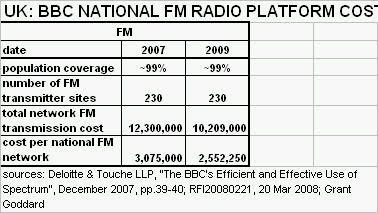
Compared to the existing FM transmission system (which the BBC said in 2007 offered around 99% population coverage), DAB will be more expensive. Not at present, because DAB is only covering 86% of the population, but increasing that percentage to the same as FM will be costly for DAB. Very costly. By comparison, the existing national FM transmission network had cost the BBC £12m in 2007. This should have reduced to £10m in 2009 after transmission contractor Arqiva agreed to discount its existing contracts (following its acquisition of rival NGW). The same discount may have lowered the cost of existing DAB transmission agreements, but not of future contracts for build-out to 99% coverage.

The BBC broadcasts only four national stations on FM whereas, on DAB, it broadcasts more channels. How many more? The number of BBC stations on DAB varies because one station is part-time and because two full-time stations are proposed for closure next year. To take an example of a music station using 128kbps of DAB bandwidth, it would cost £1.6m per annum to cover 90% of the population, £5.6m to cover 95% and £5.9m to cover 99%. Compare that to a national FM station that currently costs the BBC £2.6m per annum. It seems that DAB may be cheaper at present, but is certainly not cheaper once it is required to achieve equivalent FM coverage.

The second national DAB multiplex in the UK is owned by Arqiva (formerly ‘Digital One’) and covers 90% of the population. Does it publish a price list for commercial customers wanting DAB carriage? Seemingly not. However, in September 2009, Premier Christian Radio had said it was paying £650,000 per annum for national DAB carriage, using 64kbps of spectrum. The pro rata cost for a 128kbps music station would be £1.3m per annum, close to the previously estimated BBC cost for population coverage of 90%. Arqiva says it “is working on a transmitter roll out plan to further extend coverage,” having added four new transmitter sites in 2009.

In Germany, the transmission provider, Media Broadcast, has published a price list for commercial stations interested in broadcasting on its planned DAB platform. It anticipates that German stations will use the more spectrum efficient DAB+ system, whereas the UK is wedded to the older DAB system. The prices quoted below (in Euros) require a radio station to take a minimum 10-year contract and are based on two multiplexes operating at each transmitter location (if that were not to happen, the costs would be higher).
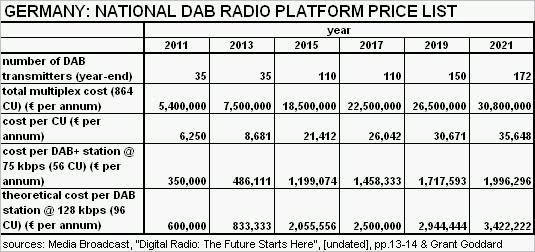
By 2015, Media Broadcast anticipates that its 110 DAB transmitters will provide coverage to 78% of the population indoors and 92% of the population outdoors. There seems to be no commitment in Germany for DAB to achieve the 95% to 99% population coverage that is planned in the UK. Nevertheless, the transmission cost of a (hypothetical) DAB station using 128kbps would be as high as E3.4m (£2.8m) per annum by 2021. As in the UK, the cost escalates rapidly as the DAB network is built out to reach more of the German population. Whereas, in 2011, the initial E0.6m (£0.5m) per annum might not seem prohibitive to cover a country that has a third larger population than the UK, that annual cost is multiplied six-fold by the end of the 10-year contract.

In both the UK and Germany, the cost of DAB roll-out to ensure that reception is as robust as FM will add significantly to the platform’s costs. Without this roll-out, DAB can never replace FM, and the burdensome cost of simulcasting on both DAB and FM will continue. With this roll-out, DAB seems to end up costing more than FM to achieve similar coverage. So what is the point?

In the UK, neither Ofcom nor the government’s DCMS department have published analyses of the costs of DAB roll-out. Their pursuit of the DAB platform has had absolutely nothing to do with the real world economics of the UK radio industry. Their numerous published reports and consultations deal with a virtual reality of the radio industry that exists solely in their minds, perhaps a reflection of the fact that none of them have ever worked in the radio sector they try to regulate.

Ofcom’s plans for upgrading DAB, to be published imminently, merely prolong the regulator’s fantasy that the DAB platform is ‘the future of radio’. Ofcom’s apparent determination to run the radio industry into the ground economically through its insistence upon implementing a misguided ‘digital strategy’ for the sector has already proven a disaster, helping reduce the commercial sector’s profitability to nil. Even more disastrous is the radio industry’s seeming inability to confront Ofcom collectively, to insist that ‘enough is enough’, and to demand that Ofcom goes back to the drawing board in its whole strategy for radio’s future.

How can Ofcom retain an ounce of credibility when it had forecasted publicly (as recently as November 2006) that digital platforms would account for 42% of all radio listening by year-end 2009? The actual figure was 21%. As a result, all those radio operators who had based their business plans for digital radio upon Ofcom’s ‘professional’ forecast have faced financial ruin. Instead of reaching for the tissue box, these businesses should be reaching for their lawyer.

Practical action is what is needed now, not yet another Ofcom fantasy plan for radio’s DAB future.
Benefits of DAB radio “insufficient compared to its cost per user” warned EU report … in 2002

Sometimes it proves useful to take a look backwards to try and understand where you are now. In 2002, a 236-page report was produced for the European Commission on the topic of ‘Digital Switchover In Broadcasting’ by BIPE Consulting. Re-reading it is a stark reminder that the current problems with DAB radio implementation in Europe had been anticipated at least eight years ago.

Firstly, the BIPE report admitted that a significant motivation for introducing DAB radio was so that existing licensed European broadcasters could maintain market control in the face of competition from IP-delivered radio content produced by pesky foreigners:

“Some radio broadcasters consider digital radio as a question of survival in the long term … digitisation of content, transmission and multipurpose receivers could squeeze out the possibility of having a dedicated radio platform with its own players, services and listeners. The fact of having a dedicated [DAB] platform could maintain the existing value chain. If not, alternative, third-party digital platform operators will enter the game, and this could reduce radio specificity as it is understood today or even break the radio business model.”

Many of the problems of implementing DAB were identified then:

“New frequencies have to be found to simulcast analogue programmes and new expected ones (which is not the case with digital TV that can be simulcast in the same bands); very high digital receivers prices create a chicken-and-egg situation; while pay TV is a strong driver of TV digital migration, a pay-radio business model seems not to be sustainable so far; RDS, data services and free-to-air multi-channel FM reduce the attractiveness of digital radio.”

And the huge challenge of convincing consumers was made very clear:

“Analogue radio receivers are low cost devices offering numerous, free-to-air channels and with FM audio quality. In this context, the benefits of digital radio as presented by the DAB model so far are insufficient compared to its cost per user.”

The long period of consumer migration from AM to FM broadcasting in Europe was recognised:

“More than 30 years of simulcast AM/FM were necessary to substitute nearly completely AM by FM listening. This lengthy duration covered network deployment, frequency release, launch of music channels (the killer application), and diffusion of FM functionality through the installed base of all the receivers.”

The report identified the “major obstacles to digital radio migration” as:
• Receiver cost
• Low consumer awareness
• No pressure to release the FM band (“DAB is costly in terms of bandwidth used and difficult to insert in existing radio bands. … But the quantity of spectrum released by terminating analogue radio services is much less significant than the potential release of spectrum following the turn-off of analogue terrestrial television broadcasting.”)
• No pay model driver
• No clear killer application (“Together, FM and RDS already combine a certain degree of quality with important data services.”)
• Lack of interest for higher quality sound
• Lack of interest from carmakers
• Necessity of a European market (“Low cost receivers require addressing mass markets. Different national timing in the digitisation of radio does not create the conditions or incentives for achieving critical mass.”)
• The installed base of receivers (“There are between 3 to 5 radio receivers per household, many of them being lower cost receivers. To replace such an installed base means achieving low costs and/or to supply attractive, new services.”)
• Other standards than DAB are possible (“This competition may reduce the mass-market achievement in Europe.”)
• Lack of radio spectrum capacity for DAB (“The DAB multiplex is much larger than one FM channel: insertion in the FM band is not possible, spectrum efficiency is poor.”)
• Multi-channel is already a feature of analogue FM radio (“Additional services will have a marginal effect.”)
• DAB licences have sometimes been delayed.

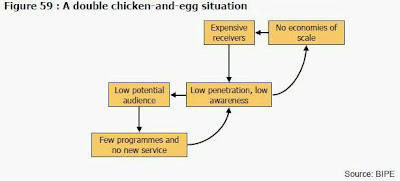
Finally, the report identified what it called “a chronic chicken-and-egg situation” whereby:
• “Receivers remain expensive because there are no scale effects. This reduces audience and revenues of radio broadcasters who demand that manufacturers decrease receiver prices in order to provoke a mass-market and to trigger mass audiences ;
• There is no specific advantages [sic] in digital radio, no killer application, nobody buys digital receivers, the audience remains negligible, and prices stay high.”

There was even a graphic to illustrate the problem:


This all feels very much like DAB in Europe … eight years on. And, to hammer home the impending fragmentation of radio delivery platforms, the report’s recommendations noted that:

“Digital radio will probably be delivered through a much larger variety of technologies and platforms than analogue radio, which is essentially terrestrial. These will involve broadcasting or point-to-point, online or on-air, satellite, terrestrial or cable delivery, DAB, DVB or DRM technologies. These techniques will be competitors but very complementary for consumers and broadcasters.”

The questions all of this raises are:
• How did the UK government’s Digital Radio Working Group spend one year (2007-2008) considering how to make DAB radio a success in the UK but not reference this 2002 report?
• How did the UK government’s Digital Britain consultation spend much of a year (2008-2009) looking for the answers to DAB radio implementation but not reference this 2002 report?
• Did DAB stakeholders in the UK read this report in April 2002? And, if so, did they simply choose to ignore it?

[thanks to Eivind Engberg]

DENMARK: state radio axes DAB radio ‘jukebox’ music channels

Danish state radio, ‘DR’, is cutting the number of DAB channels it broadcasts, many of which are ‘jukebox’ music stations, in order to focus on presenter-led programmes. At the same time, it plans to develop more and better on-demand and mobile content, particularly aimed at young people.

These changes were part of the DR programming strategy for 2011 of ‘quality over quantity’ announced by director general Kenneth Plummer, who said:

“The intention is not to create more, but better and more focused content for the Danish people. This is the recurring theme within our plans for the coming year.

Announcing the policy changes for DAB radio, DR media director Mikael Kamber said:

“We will get to see more ‘real’ content-focused channels on DAB and fewer pure music channels.”

The DR plan is to re-position its DAB radio channels in order to offer genuine public service content aimed at three specific segments of the audience: children, teenagers and the elderly.

One press report said that the number of DR digital radio channels was to be cut from 29 to 10.

The DR digital radio channels collectively had a weekly reach (via DAB and the internet) of 20.1% in 2009, up from 17.1% in 2008. The DR DAB channels attract a 2.5% share of listening in aggregate, low compared to the DR analogue radio channels P4 (46%), P3 (18.3%), P1 (6.9%) and P2 (4.3%). As in the UK, radio listening in Denmark is in slight decline, down by 4 minutes year-on-year to 2 hours 7 minutes per day in 2009.

DAB radio was launched in Denmark by state radio in October 2002, following trials that started in 1995.

GERMANY: No radio interest in DVB-T digital platform

The media regulator for Hamburg and Schleswig-Holstein, MA HSH, has had to re-advertise a licence comprising spectrum for the DVB-T platform, this time to television applicants, after its previous attempt to offer the spectrum for digital radio channels met with disinterest. MA HSH director Thomas Fuchs told Rapid TV: “The response to our tenders of DTT frequencies is clear: There is very strong demand for the distribution of TV channels, but there seems to be little additional value for the radio industry.”

In December 2009, the regulator had invited bids to provide 16 radio channels in spectrum that also offered capacity for ‘Visual Radio’ enhancements. Thomas Fuchs said then: “Now that opportunities for development of the FM band are exhausted, we can invite bids to contribute to the advancement of the radio landscape in Hamburg and Schleswig-Holstein.”

However, in March 2010, the regulator had to report that “the interest on the part of radio broadcasters is so low that the Media Council decided, as a result, not to award any radio allocation.”

French Culture Minister: launch of digital radio not “a priority”

On 29 March 2010, the French Minister of Culture & Communications, Frederic Mitterand, spoke at the monthly luncheon of the Association of Media & Communications Journalists. He was asked about the much delayed launch of digital terrestrial radio in France and replied:

“I note that the cost of the [digital radio] project is significant, that a number of the radio licensees are not at all favourable towards the project, and that it is the CSA [media regulator] that for the moment is escalating the issue. The CSA itself should still submit a report on the [digital radio] issue with recommendations, although I know roughly what will be in such a report. I have the greatest respect for the CSA, and I have the greatest feelings of respect for [CSA president] Michel Boyon, but we are not exactly on the same wavelength.”

“Without organising a funeral with great pomp and ceremony, which would presume a death, I think that everything will inevitably be digital one day. And then radio will be too. Put simply, in today’s economic conditions, in the general context of radio, and with the lack of consensus around this [digital radio] issue, I do not think its resolution is a priority and the launch of digital radio will not happen this year.”

The video is available here.

FRANCE: Digital radio “is not progressing one inch”

A meeting of radio sector stakeholders on Monday 15 March 2010 at France’s media regulator, the CSA, failed to progress the plan to launch digital terrestrial radio this year. According to Le Point, the commercial broadcasters – RTL, Europe 1, NRJ and RMC – demanded a moratorium. State broadcaster Radio France is one of the few continuing to support the CSA’s plan to launch digital radio, delayed from 2009 to mid-2010, using the T-DMB transmission standard.

A member of the Bureau de la Radio trade organisation commented: “There is no economic model [for digital radio]. The choice of the [T-DMB] broadcast standard adopted in Bercy is very expensive. The upside for listeners is not sufficient for us to fund a third broadcast platform to add to the existing Long Wave and FM [platforms]. … We are disappointed because this meeting has not enabled anything to progress. What happens next?”

According to Le Point, the regulator has responded only with “radio silence”. Its headline read: “Digital terrestrial radio is not progressing one inch.”

European commercial radio trade group says ‘no’ to universal FM switch-off date

At the start of its annual conference held in Brussels on 11/12 February 2010, the Association of European Radios [AER], the trade group representing 4,500+ European commercial radio stations (including RadioCentre members in the UK), issued the following press statement:

“AER considers that setting a date for the switch-off of analogue radio services is currently impossible. Indeed, the question of which kind of technology will be used should be solved first. Hence, broadcasting in FM and AM shall remain the primary means of transmission available for radios in all countries, with the possibility to simulcast in digital technology, until market developments enable a potential time-frame for general digitisation of radio. Transition to any digital broadcasting system should benefit from a long time-frame, unless there is industry agreement at national level to move at a faster rate.”

This statement followed on from a policy paper the Association had published a few days earlier, responding to the European Commission’s Radio Spectrum Policy Group plans for its draft Work Programme. The paper said, in part:

“It should be underlined that, in most of Europe, currently and for the foreseeable future, there is only one viable business model: free-to-air FM broadcasting on Band II. Thus, Band II is the frequency range between 87.5-108 MHz and only represents 20.5 MHz. Across Europe, nearly every single frequency is used in this bandwidth. Thanks to the broad receiver penetration and the very high usage by the listeners, this small bandwidth is very efficiently used. On-air or internet-based commercially-funded digital radio has indeed not yet achieved widespread take up across European territories. These two means of transmission will be part of the patchwork of transmission techniques for commercially-funded radios in the future, but it is hard to foresee when.

So no universal switch-off date for analogue broadcasting services can currently be envisaged and decision on standards to be used for digital radio broadcasting should be left to the industry on a country-by-country basis.

Radio’s audience is first and foremost local or regional. Moreover, spectrum is currently efficiently managed by European states and this should remain the case: national radio frequency landscapes and national radio broadcasting markets are different, with divergent plans for digitization, diverse social, cultural and historical characteristics and with distinct market structures and needs…..”

“Finally, AER would like to recall that European radios can only broadcast programmes free of charge to millions of European citizens, thanks to the revenues they collect by means of advertising. These revenues are decreasing all through Europe due to two factors: the shift towards internet-based advertising, and the recent financial crisis. For 2009, radio advertising market shares were forecast to decrease by 3 to 20% all across Europe, compared to 2008.

In some countries (e.g. France and the UK), a part of the revenues derived from the TV digital switchover was supposed to be allocated to the support of digitisation schemes for radio. This is no longer the case. In most countries, it is still unclear who will bear the costs of the digitisation process.

However, any shift towards digital radio broadcasting entails very long-lasting and burdensome investments. Nevertheless, some individual nations may wish to proceed with a move to greater digital broadcasting at a faster rate, as there will be no ‘one-size-fits-all’ approach.

So, any shift towards digital radio broadcasting will most likely require a very long process. Decision on the adequate time-frame should be left to each national industry: as a matter of principle, transition to any improved digital broadcasting system should benefit from a long time-frame, unless there is industry agreement to move at a faster rate.

It should also be recalled that commercially-funded radios are SMEs, and are in no position to compete for access to spectrum with other market players. So, market-based approaches to spectrum (such as service neutrality or secondary trading) should not be enforced in bands where commercially-funded radios broadcast or may broadcast.

To end up with, AER would like to recall that, in most of Europe, currently and for the foreseeable future, there is only one viable business model: free-to-air FM broadcasting on Band II; hence:

• no universal switch-off date for analogue broadcasting services can currently be envisaged
• now and for a foreseeable future, commercially-funded radios need guaranteed access to spectrum, in all bands described above. Besides, no further change to the GE 84 plan [the 1984 Geneva FM radio broadcast frequencies agreement] should be suggested, but the plan should be applied with consideration to the technological development (and its enlarged scope of possibilities) throughout the past 25 years
• any shift towards digital radio broadcasting should benefit from a long and adequate time-frame.”

FRANCE: “2010 will be the last chance” to launch digital radio

2010 will be the last chance for digital terrestrial radio” to launch in France, said Alain Mear, vice chairman of the CSA [media regulator] digital radio working group. “If digital radio does not start in 2010, there will be no digital radio.” He was speaking at a roundtable meeting held 15 January at the Senate to discuss the future of radio, according to RadioActu. Mear argued that the government needed to set a deadline for the ending of radio broadcasting on FM and AM. “This is the moment of truth”, he said.

However, the view of some radio groups represented at the meeting was that radio in future would be delivered to listeners via a mix of platforms. Concern was also expressed about the financial cost of launching a new digital broadcast platform. Michel Cacouault, representing the commercial radio trade body Bureau de la Radio, predicted that there could be “no development without an economic assessment”. He stressed that the sector’s declining advertising revenues in 2009, resulting from the global economic crisis, had required “all the big groups to face re-organisation and downsizing.”

Arnaud Decker, director of corporate relations at media group Lagardere Active, said that “the authorities must ask themselves how the competitiveness of the national music radio networks can be maintained” when the launch of digital radio would increase broadcasters’ costs.

Jacques Donat-Bouillud, director of radio at transmission provider TDF, said that the cost of providing digital terrestrial radio to a population of 40m would be around 500m Euros per annum. For a single station requiring national coverage in France, he said that digital transmission would cost 3m Euros per annum, compared to 6m Euros per annum for FM transmission.

Pierre Bellanger, CEO of commercial station Skyrock, pointed out that “60% of mobile handsets are internet enabled” and cautioned that “there is no single correct answer to the question about the future of radio. The solution is a hybrid and, ultimately, the listener will be the winner.”

Bruno Patino, director of state radio station France Culture, agreed: “[State] Radio France must participate in the digitalisation of broadcasting. Digital radio delivered by IP will be there, but that will not kill the broadcast platform.”

FRANCE: Digital radio postponed until at least year-end 2010

After a period of uncertainty about a timetable for the launch of digital terrestrial radio in France, the regulator has finally admitted that the first transmissions, which had been scheduled to take place this month, will be postponed until at least year-end 2010.

During an online chat yesterday, Michel Boyon, president of the CSA [France’s media regulator], said: “While everyone recognises the need to act quickly, despite the current economic challenges, it will be year-end 2010.” He argued that “if radio does not go digital, It will slowly decline” and noted that “internet radio is very good, but it is totally inadequate to meet the demands of listeners.”

Nevertheless, the French press seems unconvinced that digital radio will ever happen.

Digital radio silence is delayed!” said the headline in trade magazine SatMag, which commented: “After having been delayed for years in favour of digital television, digital radio is taking too long and is being overtaken by other technologies.”

Too expensive, digital radio postponed indefinitely,” said the headline of Agence France-Presse the day before Boyon’s announcement. It added: “The latest figures from Mediametrie confirm the change in radio listening habits: almost 50% of listening takes place on the move, and a quarter of the population has already listened to radio via the internet. During the last year, the numbers listening to radio via mobile phones has increased by 50%.”

Has the internet killed the digital radio proposal?” asked the headline in rue89. Francoise Benhamou, professor of economics at the University of Paris 13, commented: “Consider that a cost of 600m to 1bn Euros [to implement digital terrestrial radio] over ten years is viable only if [radio] advertising revenues increase by 20 to 25%. Such a forecast would be very risky given the uncertain economic background and the competition from the internet for advertising revenues.” She added: “Many of us already receive radio broadcasts, live and on-demand covering a wide range of content, as well as associated interactive services, by connecting via broadband. Do we really have a need for digital terrestrial radio?”

Professor Benhamou concluded: “This situation does not please everyone, particularly the CSA [media regulator] who saw [digital radio] as an opportunity to extend their domain …”

It sounds all too familiar to us in the UK.

FRANCE: digital radio “already dead”?

“Digital terrestrial radio: already dead?” enquired the headline of a French news web site early on Thursday morning 26 November 2009. It proved to be prophetic.

Only hours later, a press release was published by the Bureau de la Radio (a radio trade group comprising the largest commercial radio owners) which effectively hammered another nail into the digital radio coffin in France. It stated: “As it stands, the Bureau de la Radio estimates that the cost of the [digital radio] project is not compatible with the economics of the radio medium and does not allow plans for the launch of digital radio to proceed under positive conditions”.

On Monday 23 November, more than 70 stakeholders from the radio sector had met at the offices of the CSA [France’s media regulator] to discuss digital radio. Afterwards, the CSA had issued a press statement which claimed that, during the meeting, all those present had endorsed the launch of digital terrestrial radio in France. The meeting had decided to establish four working groups to examine: resource planning, the rollout timetable, transmission signals and data content. A further meeting was planned for February 2010.

However, the Bureau de la Radio has now stated its “regret that the question of the [digital radio] economic model is not being addressed centrally” and has called on the CSA to pursue more detailed work on this issue with stakeholders.

Reflecting the seriousness of this announcment, Agence France-Presse headlined its news story “Digital Radio: commercial radio opposes the launch of digital terrestrial radio”.

There are some interesting parallels between developments in France and the situation in the UK, even though we are already ten years further down the digital terrestrial radio road. Just as in France, the UK government (through its DCMS department) and media regulator (Ofcom) have both been insistent that digital terrestrial radio must replace FM/AM radio broadcasting, without seeming to pay sufficient attention to the pre-requisite for an economic model to make it work.

In the UK:
• industry data points to minimal consumer demand for DAB, which I documented two months ago in this blog entry
• industry data points to minimal revenues from digital commercial radio stations, which I documented three months ago in this blog entry
• industry data suggests that the faster the take-up of DAB radio is accelerated, the faster commercial radio will lose more listening share to the BBC, which I documented recently in this blog entry
• the development of DAB has already proven disastrous for the financial health of the UK commercial radio industry.

After ten years of DAB radio development in the UK, precisely the same question needs to be answered here as is being asked in France this week:

Why has nobody published a realistic economic model for digital terrestrial radio which demonstrates convincingly that it is financially worthwhile?

Perhaps because one does not exist?