FRANCE: government report recommends 2-3 year "moratorium" before launch of digital radio

A new report on the introduction of digital terrestrial radio (‘DAB radio’ in the UK) in France has recommended to the government that the launch should be delayed by two to three years. In the interim, the French media regulator CSA would be asked to establish a project to investigate the “overseas experiences” of digital radio, according to the government press release.

David Kessler, former head of state radio station France Culture, was commissioned in June 2010 by the government to produce a strategic analysis of the launch of digital radio in France. His interim report, published in November 2010 [see blog], identified the “paradox of DAB radio – it is a sufficiently attractive technology to be launched successfully, but it is insufficiently attractive to successfully allow FM broadcasts to cease.”
In the final report, published this week, Kessler said that not all the conditions had been met from an economic standpoint to permit the widespread launch of digital terrestrial radio. His report identified the significantly different challenges between digital radio switchover and digital television switchover:

“An error in logic has probably contributed greatly to making the debate [about digital radio] opaque rather than transparent. The error came from having planned digital radio switchover with reference to digital television switchover, which started in 2005 and the success of which has been staggering and immediate, so that the changeover from analogue to digital TV will be completed throughout the land by 2012. Many parties imagined that the route to digital opened up by television would be followed by radio. But this plan was wrong for three reasons.

Firstly, the television market was dominated in 2005 by five channels (TF1, France 2, France 3, France 5/Arte and M6) that attracted 75% of television viewing. The transition to a score of free channels was obviously very attractive. However, as will be discussed later, the situation in radio is quite different – the current choice of stations is one of the richest that exists in the world, after the landscape opened up in the 80s. Even if the choice is not the same in every region, none of them – some near – are in a situation where only five major stations dominate the choice.

Second is the difference in receivers. Even if digital radio switchover had been launched simultaneously with that of television, where the evolution of televisions (flat screen, HD and now 3D) resulted in a faster replacement of equipment than anticipated, digital television was accessible without changing the set through the purchase of a single adaptor at a moderate price. Digital radio switchover requires the replacement of all receivers, and households have multiple radios and the market is sluggish. Without doubt, digital radio switchover could re-invigorate the market with a simple, inexpensive high-end (with screen) radio. At this point, no one can say how quickly take-up of replacement receivers will happen. Examples overseas – particularly Britain – demonstrate a relatively slow rate of replacement, and the different situation in countries where take-up is faster – Korea, Australia – make comparisons difficult.

The third reason is that the history of television demonstrates that it works through ‘exclusive changes’ where one technology replaces another quickly. Colour television pushed out black and white television. Digital television is about to push out analogue television. But experience shows that far from all media work this way. On the contrary, some go through ‘cumulative change’. Over a short or long period of time, different technologies co-exist and content is distributed through several technologies. As Robert Darnton noted about the book, we often forget that the printed word has long co-existed with the manuscript. From this perspective, the history of radio is the opposite of television: different transmission systems are cumulative rather than exclusive. This does not exclude the possibility that, in the long run, some transmission systems will decline and no longer be used, just as printing marginalised the manuscript. But what it means is that one cannot plan the launch of digital radio by imagining that all other transmission systems will be switched off, particularly FM. Even today, despite the success of FM, Long Wave and Medium Wave transmissions are still used because they reach a sufficient number of listeners not be switched off by broadcasters.

In fact, a careful examination of the launch of digital radio in other European countries shows that a ‘cumulative change’ scenario exists that we must anticipate in France too. Indeed, the launch of digital radio in other European countries had been presented as a quick substitute for analogue radio, even though the existing choice of analogue stations was less than in France, and the choice of digital stations seemed more attractive and content-rich than offered by analogue. Even if a proportion of listeners are quickly adopting digital radio, a greater proportion are still sticking with their traditional radios, with the possible exception of Norway, where analogue switch-off seems to be seriously considered at present. This leads to a situation in which the government initially adopts a goal of analogue switch-off but then, given the impossibility of switch-off, drops or postpones the switch-off date by several years. As the choice of existing radio stations is particularly substantial in France, it would appear that this situation is most likely to be repeated if digital radio were to be launched. Radio station owners are not mistaken. Very few want a quick switch-off of FM, and some do not want any switch-off.”

These points echo evidence on digital radio switchover in the UK that I had presented to the House of Lords Select Committee on Communications in January 2010:

“With television, there existed consumer dissatisfaction with the limited choice of content available from the four or five available analogue terrestrial channels. This was evidenced by consumer willingness to pay subscriptions for exclusive content delivered by satellite. Consumer choice has been extended greatly by the Freeview digital terrestrial channels, many of which are available free, and the required hardware is low-cost.

Ofcom research demonstrates that there is little dissatisfaction with the choice of radio content available from analogue terrestrial channels, and there is no evidence of consumer willingness to pay for exclusive radio content. Consequently, the radio industry has proven unable to offer content on DAB of sufficient appeal to persuade consumers to purchase relatively high-cost DAB hardware in anywhere near as substantial numbers as they have purchased Freeview digital television boxes.”

The Kessler document should offer significant food for thought to the British government for its unworkable plans for DAB radio switchover. Whereas Kessler correctly identified that TV and radio digital switchover are two very different undertakings, our public servants working on digital radio policy in the government and in Ofcom have long failed to understand these differences. The appointment of Ford Ennals as chief executive of Digital Radio UK in 2009, on the back of his work between 2005 and 2008 managing digital television switchover, should have been viewed as barely relevant experience to achieve successful digital radio switchover.
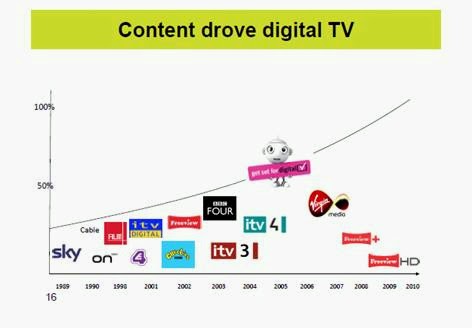
Have any of the people managing digital radio switchover for the UK ever actually worked in the radio industry? At DCMS? No. At Ofcom? No. At Digital Radio UK? No. If, like Kessler, they had radio sector experience, they would realise that all their speeches and presentations that repeatedly cite digital TV switchover as the precedent for radio are completely off-target.

Is there any wonder that failure of DAB public policy was inevitable?
NORWAY: digital radio switchover "postponed indefinitely"

In November 2010, a daily newspaper in Denmark reported that the government’s plan for digital radio switchover had been postponed indefinitely [see earlier blog]. Now, the same is reported to have happened in Norway.

“The transition from analogue to digital radio began more than ten years ago. At the end of 2010, we still have no idea what is going on,” said the headline in Norwegian daily newspaper Aftenposten.

In 2009, then culture minister Trond Giske had promised that the Norwegian government would publish a white paper in 2010 on digital radio switchover [see earlier blog]. It has failed to appear. “Recently, it has become clear that the strategy had to be postponed indefinitely,” said Aftenposten.

Ib Thomsen, cultural affairs spokesman for the Progress party, said: “This is undoubtedly a hot political potato and DAB is, in many ways, a risky sport.” He believes that it is wrong to compare the migration of digital radio with digital television switchover, as many do, because the number of radios in use is much greater. “Nevertheless, we should not set a [switchover] date in order to go out and force people to buy new radios,” Thomsen said.

Olemic Thommsessen, cultural policy spokesman for the Conservative party, said: “I am more concerned with getting the policy on the table so that we can advance work on planning a digital radio future.” He noted that it had been a long time since the government’s last review of digital radio strategy, and that subsequent development of DAB and DAB receiver sales had not lived up to expectations.

Trine Schei Grande, leader of the Liberal party, said: “The time is over when politicians can decide how people will listen to the radio.” She believes that the only way to get listeners to invest in digital radio is to make digital content and stations sufficiently attractive. Until then, she said, FM transmissions must be continued.

Øyvind Vasaasen, distribution manager of state broadcaster NRK, said it would not be a very costly issue for NRK to broadcast DAB+ transmissions, should it be required by the government. He emphasised that NRK had a continuing obligation to serve those who had already bought DAB radios that do not support the newer DAB+ standard. “These can be addressed by broadcasting in both DAB and DAB+ for a period,” he said.

The possibility of the government switching from the DAB to the DAB+ standard was taken up by a commentary in Aftenposten, whose headline asked: “Your new, expensive DAB radio may be useless in a few years. What is really happening?” It explained:

“The problem is that there are already more than 300,000 DAB radios in the country. NRK distribution manager Øyvind Vasaasen had said that NRK has a contract with listeners who have already bought a DAB radio, and which makes it difficult to switch [to DAB+]. What about all those who listen on one of the country’s 15+ million FM radios? Does NRK not have a contract with them? And what of DAB users who feel they had signed the contract without full disclosure?”

The commentary continued: ”When [state broadcaster] NRK had argued for a transition from FM to DAB, it had said that the DAB system would give us CD-quality audio from the radio. It has not. DAB technology does allow very high sound quality, but most stations use lower sound quality than FM, according to University of Oslo professor Sverre Holm. Many people find the [DAB] sound clearer and less harsh, but many also complain of less detail and poorer stereo image. Moreover, no local radio station can afford the investment of over half a million kroner to broadcast on DAB, so that the diversity we were promised has not become a reality.”

Even DAB lobbyists are acknowledging the slow take-up achieved to date. Jørn Jensen, president of World DMB, the international marketing organisation for DAB, told Germany’s Digitalmagazin recently:

“Digital radio is still in its infancy. If we compare the situation to the computer market, we are still in the time of MS-DOS!”

GERMANY: planned 2011 re-launch of national DAB "solved a problem that did not exist"

On 15 December 2010, five commercial radio stations in Germany – New Wave Radio, Lounge.fm, ERF Medien, Radio Energy in Hamburg and Regiocast Digital – signed contracts with transmission provider Media Broadcast to broadcast on the new national DAB+ platform, scheduled for launch in 2011.

One week earlier, British company Frontier Silicon, “market leading supplier of digital radio technology worldwide”, had announced that, in order to persuade four commercial radio broadcasters in Germany to persevere with DAB, it had promised them it would purchase an unspecified amount of their advertising airtime for the next four years.

Anthony Sethill, Frontier Silicon CEO, put a positive spin on an act that some might perceive as little more than legalised bribery in the face of desperation to sell DAB hardware in Germany: “We are delighted that our innovative approach to supporting the roll out will help everyone working on this new radio service to bring their efforts to fruition.”


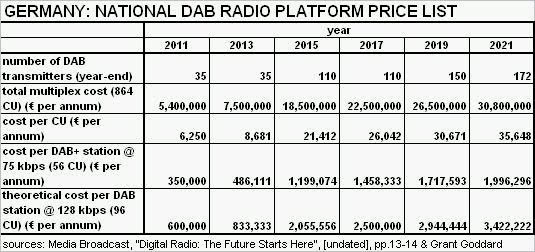
For years, German transmission provider Media Broadcast has been eager to put into action its masterplan to lock new DAB+ broadcasters into minimum 10-year contracts, for which it will be charging €2m per annum per station by 2021. The combination of Media Broadcast’s enthusiasm for the financial returns from DAB transmission contracts, and Frontier Silicon’s enthusiasm for the potential sales in Germany of DAB receivers that incorporate its technology, plus the offer of an amount of cash, persuaded a few commercial broadcasters to take on the risk of using the DAB+ platform.

Helmut Egenbauer, CEO of Media Broadcast, said: “Having introduced Frontier Silicon to the commercial broadcasters, we are delighted to see that their discussions have led to this important commitment to DAB+ radio services.”

Those five German commercial broadcasters should understand that even Frontier Silcon’s subsidy might not prevent them losing money hand over fist for the entire ten years of their transmission contract with Media Broadcast. The evidence is already there from the UK market. Not one commercial digital-only radio station has yet made an annual operating profit from the DAB platform in the UK, even after eleven years, let alone come close to recouping its investment.

Research commissioned by RadioCentre in 2009 found that the average annual revenues of a digital radio station were around £130,000 per annum. By then, 10m DAB receivers had been sold in the UK. Yet Germany is still at Year Zero with DAB+ radio penetration. The same report for RadioCentre had noted that the “annual negative cash flow impact of DAB” on the UK commercial radio industry was around £27m per annum, or 5% of sector revenues. Can German commercial radio afford to deplete its profitability by that sort of amount, year-on-year, for the next decade?

Frontier Silicon’s press release quoted Helmut G. Bauer as a “representative of the commercial broadcasters,” saying what a fantastic deal it was and promising that “2011 will be year that DAB+ is successfully launched in Germany.” However, Bauer is not associated with the German commercial broadcasting trade body, VPRT, which has been outspoken in its condemnation of plans for digital radio switchover in Germany. Bauer is a Cologne-based lawyer who has long made pro-DAB presentations at media conferences, and pro-DAB statements to the press, as a ”consultant.”

In fact, VPRT had
commented: “As we know, DAB failed in the market. Against this background, plans for the closure of FM – originally scheduled for as early as 2015, but now postponed – are absurd from an economic and social perspective and are therefore unacceptable.”

Noting the developments in Germany this week, Berlin-based Christoph Lemmer wrote in Radioszene magazine:

“With this decision, DAB will now actually be introduced by those who have succeeded, smelling a quick buck, in selling Germans a new sort of equipment, with millions to be sunk into to a new transmission network. Our old radios will be useless for DAB. Those who want to continue listening to the radio will need a new receiver.“

“It does not take a prophet to suspect that the private radio industry has shot itself in the foot by agreeing to sign the DAB contracts. A few shekels subsidy from a chip manufacturer who wants to install as many of its chips in DAB receivers – that is what has led to this. You, dear people, were not considered in the end. Do you really believe that devices with DAB will ever be as numerous as FM radios are today?”

“No one will understand what [DAB] is and why it is good. Because, with DAB, you have solved a problem that did not exist. The existing technological distribution of radio programmes is excellent and widely used. You did not have to change anything. The argument that DAB will create new radio channels with lower entry barriers is specious, as long as media regulators continue not to award licences for technically available [analogue] frequencies because they do not want additional competition in the market.”

This week, World DMB, the body marketing DAB radio globally, was so excited by developments in Germany that its web site posted seven news stories about it on 15th, nine on 16th and a further four on 17th. The overkill speaks volumes. Lacking any upturn in DAB receiver sales, the only positive news that DAB lobbyists can muster is this second attempt in Germany to launch a DAB technology that was first developed in 1981.

It is hard to recall a comparable technology whose proponents were still pushing for its launch three decades after its invention. DAB proponents argue that, simply because DAB is ‘digital’, it is inevitable that it will replace analogue radio. History indicates otherwise.

Digital Audio Tape. Introduced 1987. Abandoned 2005.
Digital Compact Cassettes. Introduced 1992. Abandoned 1996.

FRANCE: digital radio report for government identifies 'the paradox of DAB'

David Kessler, former chief executive of Radio France, submitted a 22-page interim report on the planned launch of digital terrestrial radio in France to the government on 23 October 2010. The report was made public last week. This is the third such report on the topic that the government has commissioned in the last year. Most of Kessler’s report summarised the existing positions of the main players in France (public radio, commercial radio networks, local stations, etc.), but it also outlined some wider market issues. France has yet to launch digital terrestrial radio, despite many start dates having come and gone over the years. The commercial FM radio networks have argued that the cost would be prohibitive and the expected financial returns insufficient.


The following are excerpts from the report:

1.6 Manufacturers
“Both equipment manufacturers (Simavelec and Secimavi) have focused on the renewal of television receivers (digital TV, flat screens, 3D TV, connected TV) and, at this stage, have invested little in radio receivers. This is evidenced by the IFA [consumer electronics trade fair] held in Berlin in September 2010, where radio receivers were virtually absent from the stands of the main manufacturers. Although, at this international show, the big manufacturers are present in markets where DAB has already launched, they do not consider it sufficiently beneficial to manufacture and sell digital radio receivers. Manufacturers consider that the improvement in sound quality offered by digital radio will be harder [for consumers] to appreciate than the improvement in quality for digital television.”

2.3 The situation in other European countries
“A review of the situation overseas illustrates the same problem: many countries have launched DAB and have long experience of it, but none have been able to implement it as the dominant model for terrestrial broadcasting. This demonstrates what could be called ‘the paradox of DAB radio’ – it is a sufficiently attractive technology to be launched successfully, but it is insufficiently attractive to successfully allow FM broadcasts to cease.”

4.0 Conditions to launch DAB
“Difficulties surrounding the launch of DAB:
· Uncertainties about the economic model
· The consumer benefit is uneven between towns and country
· The existence of IP as a competing platform, even if it is discounted, already exists and can appear to be a real alternative
· Finally, little interest by telecom owners to use the FM band – it is too low frequency (unlike the spectrum released by analogue TV) – which makes it very difficult to monetise it and removes any global interest in accelerating towards digital switchover.”

4.1 How could DAB conquer the public?
“For DAB to be a success with consumers, several conditions must be met:
· DAB radio receivers must be widely available, there must be an incentive for consumers to buy them, and they must be installed in vehicles […]
· The sound quality of DAB must be at least equal, or superior, to that of existing FM radio
· DAB radio must be known to the public and must be made attractive. This requires a powerful, dynamic launch campaign.
· Radio offerings to listeners must be enriched. Since the launch has to be a lesson in effective marketing, it must be huge from the outset in those areas where the media regulator has identified that the increase in the number of radio stations is relatively tangible and quite impressive.”

The report noted that the transmission cost for a national radio station to broadcast to 90% of the population in France, using the digital T-DMB standard, will be €4.4m per annum. Some existing national commercial networks have suggested that the cost of digital transmission would only prove economically viable if it were reduced to between €0.5m and €1m per annum and achieved coverage of 90% to 95% of France.

Kessler’s full report to the government will be published by year-end.

[I have used ‘DAB’ as shorthand for ‘digital terrestrial radio’ though France decided to adopt a technical standard other than DAB]

BBC head of radio: DAB not "a clear enough offer to listeners"

The Tony Livesey Show, BBC Radio 5 Live, 28 October 2010 [excerpt]
Stephen Nolan, interviewer (presenter, BBC Radio Ulster) [SN]
Tim Davie, Director, BBC Audio & Music [TD]


SN: There are big problems with the digital spectrum, aren’t there, because we cannot seem to hit any target that we are given for people switching to digital?

TD: I don’t think we’ve had many targets … Let’s be honest, I don’t think we’ve had many targets in the past. Digital stations are doing well. Digital listening – we’ve got to be careful – includes online, which is doing pretty well, there’s more we can do. Then also you’ve got DAB. Now DAB, you’re right, it’s been marginally growing for a while …

SN: Why?

TD: I just don’t think it’s been a clear enough offer, in my language, to listeners. I mean, people love radio. They are very happy with their FM radio. Why on earth would you change? And I think the radio industry has to say: ‘the reason you will change is – here’s a load of content’. And there’s clues like 6 Music, or other …. you know, that people love. And here’s a load of stuff that people love, and here’s a better … this device does something better than the other one.

SN: Or, Tim, it’s for the BBC to take a huge risk, and a controversial risk at that, and to withdraw mainstream programming from the FM spectrum and put it onto DAB. Imagine how the numbers would soar if it had [BBC Radio 1 breakfast DJ Chris] Moyles or …

TD: [interrupts] Imagine my inbox!

SN: Exactly, exactly. It’s a serious point.

TD: Sure.

SN: Imagine if you had Moyles or [BBC Radio 2 breakfast DJ Chris] Evans exclusively on DAB, or a massive programme.

TD: Right! And … we could do that. The issue would be that, with current coverage levels and with the amount of devices – particularly in Northern Ireland – I would basically be saying that you can’t listen to it in your kitchen, and everyone pays the Licence Fee. So I think the strategy for digital, where we are taking things away, is not going to work. My approach would very much be that I do want you to feel a bit of pain for not having a digital radio, but that pain is not about not getting The Archers, or not getting Chris Moyles. It’s about: ‘you could get a bit more over here’, or ‘there’s a bit of [Radio] 4 Extra over here that you could really do with’, and that’s what television did with some of those channels.

SN: Do you think, in terms of the internet, that radio is going to fundamentally change?

TD: I think there will be a lot more on-demand, obviously, so people will expect to be able to call up a programme and …

SN: I’m talking about the [UK] Radioplayer, obviously, which people are describing as the new YouView for radio.

TD: Well, er, yeah. Basically, the Radioplayer is … we’ve got the whole industry together. Only about 3% of listening is online and I can’t understand that, as head of radio. I know I’m biased but, at the end of the day, when I’m shopping and doing my Tesco shop or wherever online, why aren’t I listening to the radio? [to SN] Well, you would relate to this because it means more listeners. I think that one of the things is that I think it’s a bit confusing. You’ve got the BBC on the iPlayer, which is pretty good, and we’ve got other bits and … So we’ve put it all together and there will be a thing called the Radioplayer. Now, it gets a bit complex, but I think the YouView thing that you refer to is when you’ve got an internet connection to your television. Now, when you click your television on, I want one Radioplayer icon where you can go in and listen to all the radio. Now, the …

SN: On the TV?

TD: Yeah. On any screen – sorry to sound ‘new age’ – any screen anywhere, whether it’s a … whatever the size of it, you can go and get all your radio services. We don’t currently have that.

Shameless Book Plug

Apologies for the interruption to my normal radio sector analyses, but I wanted to let you know that a book of my writings about DAB radio was published this week. It collects together 99 of the essays that have appeared in this blog over the last two years concerning the digital radio switchover issue in the UK. The period between 2008 and 2010 was a critical ‘make or break’ time for DAB which ended with the legislation of the Digital Economy Act. But have any of the committees, consultations, working groups, reports and recommendations from this period made any difference to the slowing take-up of DAB in the UK? No.

Leslie Burrage, chief executive of Roberts Radio, one of the main UK manufacturers of radio receivers, said recently:

“I’ve been surprised by how many of my peers at the golf club have adopted internet radio and some of those are people who can’t even get a decent FM signal, never mind DAB. The key issue with DAB and the migration to FM is going to be dictated by the speed at which at the motor car can be migrated, and there is no easy solution. If the migrations takes 20 or 25 years to go as it did from FM, the future is just possibly wi-fi.”

Digital radio switchover seems doomed and the only people still talking it up are those who have a direct stake in it, either through their financial investments, or from earning their living from talking it up. Because the UK started on the DAB switchover trail earlier than other European countries, our experiences have relevance to markets that started later on the DAB journey.

This week, it has been interesting to see the interest my book has spurred in markets such as Norway, Denmark and Italy where, like the UK, DAB is still being pursued despite widespread consumer indifference. In Norway, a news story about the local receiver market appeared in the newspaper Aftenposten headlined ‘Customers do not want DAB: FM is still selling like hotcakes’. The buyer at a Norwegian electronics store said that DAB was already a flop and he was quoted: “So far, this year, according to industry sales statistics to which I have access, only one DAB radio has been sold for in-car installation”.

Many countries are awaiting some kind of government decision as to whether digital radio switchover will still be a policy goal. In Norway, a government report on the DAB issue is to be published later this year. In France, a government report on the financial model for digital radio was meant to have been unveiled this week, but was not. In Germany, the 21 September deadline by which state and commercial radio was meant to have submitted a joint plan for government funding to re-launch a national DAB+ multiplex passed without agreement and has had to be extended to 15 December 2010. One German
report said “it is highly doubtful whether the negotiating parties will agree by the [new] deadline.” Another report said: “experts suspect that this is the last chance for DAB+.”

In Italy, radio stations that have started broadcasting in DAB and DRM are angry at the lack of digital radio receivers in their shops and have
turned to UK manufacturer Pure Digital for help. One Italian report asked: “Do people feel the need to replace their old FM radios? Especially in the era of the smartphone, internet radio and applications, the answer seems obvious.” In Spain, the existing DAB radio licences that were initially issued for a ten-year period in 2000 have just been extended to fifteen years, in the face of widespread consumer apathy towards DAB radio.

It is evident that the digital radio switchover issue continues to generate a lively debate in many European countries. My hope is that our experience in the UK can help other countries make an informed decision about the adoption of a realistic plan for ‘the future of radio’ in their own markets.

DAB DIGITAL RADIO: LICENSED TO FAIL
GRANT GODDARD
Radio Books, London
ISBN 978 0 9564963 0 0
paperback 297×210 mm, 314 pages
1 October 2010
book excerpts here
more information http://www.radiobooks.org
available from online book retailers including Amazon

Book plug over.

FRANCE: "In no country is digital terrestrial radio working out"

From 1 September 2010, French law required that every new radio receiver sold in France which includes a multimedia display must offer reception of digital terrestrial radio. The law had been proposed in 2007 when it was envisaged that digital radio would be up and running by now. However, in France, digital radio is barely at the starting block after several launch dates have come and gone without event.

The same French law requires that, from 1 September 2012, new radio receivers (except for car radios) must be capable of receiving digital radio. How realistic is this date when arguments continue in France even about which digital radio transmission system – T-DMB or DAB – to use? SatMag suggested that legislation will need to be amended to account for the delay in launching digital radio.

Then, from 1 September 2013, the law requires that all radios sold in France offer the capability to receive digital terrestrial radio. This date, too, is likely to have to be changed.

French publication RadioActu described the current state of progress:

“Presently, with the exception of experimental broadcasts such as in Nantes, digital terrestrial radio in France is stalled.”

On 30 September 2010, the initial findings of a further government report on ‘the digital future of radio’ will be published, with the detailed report examining the economic model for digital radio anticipated by 30 November 2010.

Just as in Britain, French government predictions that digital radio would be quick to take off have proven misguided. In December 2007, then Minister of Culture Christine Albanel had promised that “Christmas 2008 will be digital radio [season].” It was not. The launch was postponed to December 2009, and then to mid-2010, and now again to 2011.

At the time the law was made a statute in France in 2009, the British government had just published its Digital Britain consultation. Quentin Howard, President of the WorldDMB Forum, said then:

“This ringing endorsement of digital radio from two major governments is a positive move which we hope will encourage other European governments to take similar steps. The bold position taken by the French government recognises the need to ensure universal availability of digital receivers and gives the radio industry a solid foundation and certainty with which to plan its digital future.“

How wrong can you be? All that the “bold” French legislation has proven is that a law is meaningless without the necessary action. This is an obvious truism. However, bureaucrats in France, the UK and elsewhere still seem to believe that merely stating that digital radio switchover will happen in some official document is enough to make it happen. Those who have long been working at the coalface of the radio industry know better. Jean-Paul Baudecroux, chairman and chief executive of French radio group NRJ, said recently:

“In no country is digital terrestrial radio working out.”

Download The First Annual Not ‘The Ofcom Digital Radio Progress Report’ Report

Download this report here

In July 2010, Ofcom had published its first annual report on the progress made in the UK with take-up and usage of digital radio. I criticised the report in this blog for being selective with data and distorting the real picture of the slow take-up of DAB radio.

Ofcom responded to two of my criticisms in a subsequent news article in Media Week. Ofcom explained that it had “categorised ‘unspecified’ listening as ‘analogue’ rather than ‘digital’ listening because it did not want to exaggerate ‘digital’ listening.” What?

This response seems only to confirm my assertion that Ofcom invented the numbers it published. There are two possible scenarios: either Ofcom did not realise that deliberately mis-stating the results of market research breaches the Code of Conduct of the Market Research Society; or Ofcom did realise this but decided to do it anyway. I am uncertain which scenario is scarier. If Ofcom’s invented RAJAR statistics had been included in an advertisement, it would be banned by the Advertising Standards Authority. Adding the ‘don’t know’ answers to either the ‘for’ or the ‘against’ totals in any consumer survey is a crime against statistics.

Secondly, Ofcom responded to my criticism that it had not published historical data to demonstrate how close we are to achieving the 50% digital listening criterion set by government. Ofcom said that it “did not set historical figures next to the forecasts because they are not formal criteria”. What?

I suggest that Ofcom stops daydreaming about a DAB future and starts listening to the words of its government paymasters. To take just one example of dozens, on 8 July 2010, Culture Minister Ed Vaizey said very plainly:

“We will only consider implementing a Digital Radio Switchover once at least 50% of all listening is already on digital or, to put it another way, when analogue listening is in the minority.”

Besides, Ofcom’s report itself had noted (in two places) that:

“A decision on switchover could only made once two criteria had been fulfilled [sic]:
• when 50% of all radio listening is via digital platforms; and
• when national DAB coverage is comparable to FM …”

The Ofcom Digital Radio Progress Report published last month was required by the Digital Economy Act 2010 to inform the government how close the UK is to achieving this 50% criterion. Yet, bizarrely, the very numbers the government wanted to see were missing from the relevant Ofcom graph.

In the spirit of constructive action, I have collated a short collection of graphs and tables in a presentation titled The First Annual Not ‘The Ofcom Digital Radio Progress Report’ Report. It can be downloaded here for free. All of the data within are derived from freely published industry sources to which Ofcom had access.

The first section of the report demonstrates that none of the radio industry forecasts for UK digital radio take-up stand a chance of being achieved, whether those predictions were made by the government, its committees, Ofcom, RadioCentre, Value Partners or whomever. These forecasts were not just wrong – they were wildly wrong.

The inability of forecasters to observe the reality of slowing DAB radio take-up in the UK was underlined by a forecast published in August 2010 by a US company that predicted:

“By 2015, the worldwide installed base of digital radio receivers, excluding handsets, is expected to reach nearly 200 million units. … ‘The adoption of DAB radios in Europe has been led primarily by tabletop radio sales in the UK,’ says [Sam] Rosen. In addition to the US and the UK, Switzerland, Denmark, and Norway all have significant broadcast infrastructure in place, with Australia, Germany and France to complete the majority of their infrastructure in 2011.”

Yes, and pigs will fly. It has taken a decade for 11 million DAB radios to be sold in the UK, and they still only account for 16% of radio listening. Far from the UK’s DAB broadcast infrastructure being almost complete, there is an impasse about who will stump up the money to render it fit for purpose. France is still debating whether to go digital at all. Germany abandoned its first effort and is planning a second attempt. Besides, the US, UK, French and Australian technology systems for digital terrestrial radio are each mutually exclusive. There is no globally agreed standard for digital terrestrial radio, so there is no universal ‘digital radio’ receiver, and nothing like 200 million digital radios (of all types) will be sold by 2015.

But a woefully inaccurate, over-optimistic forecast is always a good excuse for writing fantasy news. In the US, Media Post reported:

“HD digital radio is poised for rapid growth over the next few years … with much of the increase coming abroad, especially in Europe, where various governments have established HD radio as the national standard. … US consumers have purchased 4 million HD radio sets, while European consumers – led by the UK – have purchased about 13.5 million.”

Oh dear. Lie One: the American HD radio system is not a national standard in any European country. Lie Two: not a single HD radio has been sold in the UK. Lie Three: maybe 13 HD radios have been sold in Europe, but certainly not 13 million.

Consequently, US broadcast industry trade body NAB summarised this completely inaccurate news story (“… the real growth is happening overseas, where governments have already established HD [radio] as a standard technology”) and sent it to everyone on its mailing list. The whole of the US radio sector must be amazed that Europe, led by the UK, has embraced American HD radio technology so warmly, while it is failing so dismally in its homeland. Wrong! In reality, no consumer in Europe has even heard of HD radio (except for a few techies testing it in Switzerland).

Closer to home, the continuing failure of the DAB digital radio system to impress European consumers seems to have impacted thinking at the European Broadcasting Union [EBU], which has supported Europe-wide implementation of DAB since 1986. In outlining the agenda of its fourth Digital Radio Conference [DRC10], the EBU came close to acknowledging that DAB is no longer ‘the future of radio’:

“Where previous [conference] editions have focused on the relative merits of the different digital radio platforms and their roll-out across Europe, DRC10 will focus on radio’s position within a pluralistic distribution model. That the discussion of digital radio’s future has, to date, been weighted towards different platforms is understandable given the uneven pace of Eureka 147 (DAB/DAB+/DMB) adoption and the rapid deployment of internet to European homes. Indeed, technical development has now reached something of a plateau. … The debate has moved forward from which platform might ‘win’ to how best to chart a digital future for radio on multiple platforms. … A more fundamental question then is ‘what is the case for digital radio?’. This is about business and social arguments for and against the development of digital radio in all its forms. It involves the economics of radio revenues and costs, the social value, the mix of public and commercial broadcasters, as well as the quality and variety of the offering.”

“Uneven pace”? “Plateau”? “Multiple platforms”? Am I the only one to smell EBU back-peddling here on the DAB issue? At last year’s EBU conference, I seemed to be the only speaker exploring “the economics of radio revenues and costs” amongst a sea of technologists whose enthusiasm for DAB remained unsullied by the constraints of the economics of radio. Maybe the penny has dropped – a platform remains no more than a platform if you cannot afford to fill it with compelling, exclusive radio content, and convince consumers to use it, and generate a profit from it.

Here in the UK, while the biggest commercial radio owners have already baled out of most of their DAB commitments (and the BBC is trying to close two of its digital stations), the digital minnows are left suffering the economic consequences of a platform that has effectively been thrown to the dogs. Passion For The Planet, an independent digital-only station that has persevered on the DAB platform since 2002, announced in August 2010 that it will no longer broadcast on DAB in London. Managing director Chantal Cooke explained:

“DAB is a great medium for radio, but squabbling within the industry and a lack of clarity and direction from Ofcom leaves us worried that radio may well have missed a great opportunity. I believe London has too many stations, and the signal on the ‘London 3’ multiplex has always been, and continues to be, very poor. The lack of a robust signal has hampered independent services from the start, yet neither the multiplex operators nor Ofcom has taken the problem seriously. Passion for the Planet has spent a small fortune broadcasting on ‘London 3’ because we believed in the platform but, while there are still so many issues to be rectified, further investment in DAB in London has become increasingly difficult to support.”

The writing on the wall for DAB’s impending failure is writ so large now that Ofcom staff must have to leave work under cover of darkness not to see it. Large parts of the radio industry evidently have no faith in DAB ever replacing analogue radio. However, over at Ofcom HQ, the futile work continues to try and convince consumers and the government that DAB is still ‘the future of radio’. We will probably never know how much public money and time has been wasted on these foolish endeavours.

[many thanks to John Catlett and Eivind Engberg for their valuable contributions]

Ofcom’s DAB radio strategy: busy doing nothing, trying to find lots of things not to do

In June 2010, the government published its flimsy 5-page response to the House of Lords Communications Committee’s critical 279-page report on digital switchover that had been unveiled three months earlier. The response was a disappointing document that dismissed with little more than one sentence each of the Committee’s carefully worded recommendations, deduced after having considered hours and volumes of evidence.

One of the Communications Committee’s most forceful recommendations, in Paragraph 107, had concerned the necessary improvements to DAB reception:

“Given the importance for the Government’s plans for digital switchover of universal reception of the BBC’s national stations, it is essential that a firm and unambiguous plan and funding for the completion of build-out of the BBC’s national multiplex is put in place as soon as possible.”

The government’s feeble response to this issue was:

“In order to agree a plan for DAB coverage build-out, so that it can ultimately meet the current levels of FM coverage, Ofcom have been asked to form a Coverage and Spectrum Planning Group to make recommendation on the following:
• the current coverage of national and local radio on FM;
• changes to the current multiplex structure and frequency allocation; and
• what new infrastructure is needed so that DAB can match FM.
Ofcom are expected to present their recommendation to Government in Spring 2011.”

Surely it does not need yet another government committee to look into DAB? Had not these issues already been considered by the Digital Radio Working Group two years ago? By Digital Britain a year ago? By Ofcom? By anybody during the last decade of DAB underachievement?

Then I recalled a speech made by Ofcom Director of Radio, Peter Davies, to the Radio Festival in July 2008, in which he had set out his imminent workplan on the DAB issue:

“Increased coverage of DAB will be absolutely essential if it is ever to become a full replacement for FM for most services…… That brings us to the tricky part – defining what existing coverage is and how we improve it. This is still work in progress but we are approaching it in three stages. Firstly, we need to define what existing FM coverage is. That’s not nearly as simple as it might sound. Radio is not like television where you stick an aerial on the roof and you get reception or you don’t. Radio is used in every room in the house, usually with a portable aerial. It’s used outdoors on a wide variety of devices and it’s listened to in cars. So we need to look at geographic coverage as well as population coverage, and we need to look at indoor coverage in different parts of the house. FM coverage gradually fades as you move around, so we need to decide how strong the signal needs to be to be usable. And, surprisingly, this work has never really been done in any kind of consistent manner for the UK as a whole, so it has taken a little while to agree a framework and calculate the numbers.

Having done that, we then have to do the same for existing DAB coverage. Now DAB has all the same issues as FM, but it also has different characteristics. It doesn’t fade in the same way – you either get it or you don’t – so we need a different set of definitions here. Once we have defined what existing DAB coverage is, we then have to work out what it would take to get existing DAB coverage up to the level of existing FM coverage. Now, we have already done a lot of work on this, and certainly enough to inform the interim report, and the whole thing will be finalised in time for the [government’s] Digital Radio Working Group final report later this year.”

This 2008 workplan seems to comprise precisely the same tasks that the government has just told Ofcom to start and complete by Spring 2011. So what happened? Was this work not done by late 2008, as Davies had promised? And if not, why not?

Improvements to DAB reception were considered a critical issue for consumer take-up of DAB radio … in 2008. Now, in 2010, they are probably the main factor likely to sound the death knell of DAB as a mass market consumer platform. So are we to assume that, in the intervening two years, work on this essential issue was never done, or was not completed, by Ofcom?

Why should consumers consider DAB radio to be anything other than a disaster if even our public servants appear to be busy doing little to fix the acute problems with DAB reception that the public has been rightly complaining about for years?

Digital radio switchover: talk is cheap, action will never happen

Politics is the art of flip-flop policymaking (and justifying it convincingly). This is evident in the new UK government’s first statement about DAB radio and digital radio switchover, published this week. What is its new policy? Well, there is no new policy. The Conservatives are simply continuing the previous Labour government’s ill-advised determination to foist digital radio switchover on an increasingly resistant public. A critic might even be so bold as to say of new Secretary of State for Culture, Media & Sport, Jeremy Hunt:

“The Government have ducked sorting out digital radio switchover…. They are giving Ministers the power to switch over in 2015, yes, but without taking any of the difficult measures necessary to make it practical or possible.”

But wait! In fact, these were the words of Jeremy Hunt himself, in April 2010, criticising his predecessor, Ben Bradshaw, during the previous Labour government. Now that the boot is on the Right foot, Hunt seems to have simply dusted off the Labour policy he had previously lambasted, crossed out Bradshaw’s name and written in his own instead.

In his same speech to the House of Commons, Hunt had been scathing about the digital radio switchover clause in the Digital Economy Bill:

“I think that clause is so weak that it is virtually meaningless, as it gives the Secretary of State the power to mandate switchover in 2015 but the Government have not taken the difficult steps that would have made that possible, such as ensuring that the car industry installs digital radios as standard [….] and that there is proper reception on all roads and highways. As a result, a lot of people are very concerned that 110 million analogue radios will have to be junked in 2015.”

That was ‘opposition’ Hunt then. Three months later, ‘government’ Hunt appears to see nothing problematic with the digital radio switchover clause. Indeed, the new government has committed itself to exactly the same fantastical strategy for DAB radio as the old government:

• digital radio listening will somehow reach 50% of the total by 2012
• someone somewhere will pay to upgrade the DAB transmission system to render it as robust as FM
• someone somewhere will launch lots of fab new digital radio stations
• consumers will somehow be persuaded to replace all six or more of their household’s radios with new DAB ones
• analogue radio transmitters will somehow be switched off in 2015
• all cars will somehow be fitted with DAB radios by 2015
• mobile phones and portable devices will somehow all suddenly include DAB, rather than FM, radio receivers.

All these objectives always had been, and still are, pure fantasy. None, and I literally mean ‘none’, of the available evidence and data demonstrate that these things will happen. Definitely not by 2012, certainly not by 2015, and probably never.

A year ago, Hunt was very clear in marking out his party’s strategy for digital radio as more realistic than the ruling Labour government’s:

“I think the most important thing is not something the government can do, but something the industry can do is, which is to develop new services on digital platforms that actually mean there is a real consumer benefit to DAB. At the moment, the benefits are marginal. I mean, there are some benefits in terms of quality, but your batteries get used up a lot more quickly, the reception is a lot more flaky, and a lot of the things that make digital switchover attractive on TV don’t apply to radio in the same way. So I think the industry needs to do a lot more to make it in consumers’ interests to have that switchover…..

We have also got to think about consumer anger. Consumers are people that the radio sector needs. It’s going through a very tough patch. We don’t want to switch off listeners by suddenly saying that we are not going to – that we are going to force you to have a new radio, and there’s a real danger, if we do that, that they might start listening to their iPods and their CD players instead. … At the moment, we seem to be getting into this mindset where we want to force it on the public, even though the public can’t really see what the benefits are.”

So, between then and now, who is it that has convinced Hunt to backtrack and instead to endorse the status quo? The civil servants in his Department who hitched their wagon to the ‘DAB is the future’ train too long ago to let go now? The Ofcom radio staff who were appointed years ago on the strength of their promise to deliver digital radio switchover? The commercial lobbyists who still fantasise about the huge profits to be made (for Britain!) from global exports of their European DAB technology? All of them are nothing more than dreamers.

At the same time, many of these same parties are already distancing themselves from responsibility for DAB so as to save their own skins once DAB’s ‘fall from grace’ inevitably arrives:

• the government is saying that digital radio switchover depends upon the public’s take-up
• the regulator is saying that digital radio switchover depends upon the radio industry’s commitment
• the commercial radio industry is saying that digital radio switchover depends upon the BBC paying
• the BBC is saying that digital radio switchover depends upon its audiences
• the BBC Trust is saying that digital radio switchover depends upon the commercial radio sector’s commitment.

For years now, the stakeholders assembled around the table in those endless DAB committee meetings have been occupied identifying DAB’s problems yet, at the same time, every one of them has expected somebody somewhere else to fix them. But there is no sugar daddy out there. There is no cavalry about to ride over the horizon. It is you stakeholders who created such a mess of DAB and either you must fix it….. or throw in the towel.

This week’s announcement about digital radio switchover demonstrated that the new government does not have the guts to do what many, including the House of Lords Communications Committee chaired by Lord Fowler, had asked of them. To commission an objective analysis of why DAB was introduced in the first place, how close we really are to digital switchover, whether we will ever get there, what the costs have been to the radio sector to date, and to evaluate whether it is still worth pursuing these objectives thirty years after the DAB technology was invented.

Instead, the government has decreed that the present DAB unreality will continue … probably until one of these stakeholders eventually is forced by circumstance to kick the entire digital radio switchover issue into the long grass. In the meantime, the poor consumer is still on the end of misleading campaigns to persuade them that they will need to buy new DAB radios (which are mostly British), throw out their old radios (which are mostly foreign) and somehow get used to the sub-standard quality of DAB radio reception that most of us experience. No wonder they are asking in increasing numbers: ‘What was wrong with FM?’ And the correct answer is: ‘Nothing at all’.

This week’s government statement by Ed Vaizey, the new Culture Minister, was so woolly and vague that the media were able to write it up from wholly contradictory viewpoints.

“Government abandons 2015 target date for switching radio to digital signal,” said the Bloomberg News headline.

“Radio industry welcomes Tory backing for digital switchover in 2015”, said The Guardian headline.

Those two headlines cannot both be true. All the government has done this week is leave everyone more confused than ever. So why did it bother saying anything at all? A critic of Ed Vaizey’s announcement might be moved to say:

“We have got to be concerned that people will be ready before any switchover takes place and that there won’t be literally millions of analogue radios which suddenly become redundant. As you know, the government has set a provisional target date of 2015 and we are sceptical about whether that target can actually be met.”

But wait! In fact, those were the words of Ed Vaizey himself, in March 2010, criticising the then Labour government’s digital switchover plans.

Meet the new boss, same as the old boss.