The birth and near death of licensed black music radio in London : 2010 : Choice FM, London

 31 March 1990 was the memorable day when London‘s first licensed [South London community of interestblack music station, ‘Choice 96.9 FM’, arrived on-air. Until then, the availability of black music on legal radio had been limited to a handful of specialist music shows, even though about half of the singles sales chart was filled with black music. The decision by then regulator the Independent Broadcasting Authority [IBA] to license a London black music station was part of a huge government ‘carrot and stick’ campaign to rid the country of pirate radio. On the one hand, new draconian laws had been introduced that made it a criminal offence even to wear a pirate radio tee-shirt or display a pirate radio car sticker. On the other hand, the establishment knew that some kind of olive branch had to be offered to the pirate stations and their large, loyal listenership.

Many pirate stations, having voluntarily closed down in the hope of becoming legitimate, were incensed when the IBA instead selected Choice FM for the new South London FM license. Its backers had no previous experience in the London pirate radio business, but had previously published ‘Root’ magazine for the black community in the 1970’s. Although it was impossible for one station to fill the gap left by the many pirates, Choice FM tried very hard to create a format that combined soul and reggae music with news for South London’s black community, which was precisely what its licence required. The station attracted a growing listenership and it brought a significant new audience to commercial radio that had hitherto been ignored by established stations. With Choice FM, the regulator succeeded in fulfilling two aspects of public broadcasting policy: widening the choice of stations available to the public; and filling gaps in the market for content that only pirate radio had supplied until then.

In 2000, Choice FM won a further licence to cover North London with an additional transmitter. For the first time, the station was now properly audible across the whole capital and had access to more listeners and more potential advertising revenues. Its listening doubled and, at its peak in 2006, Choice FM achieved a 2.8% share, placing it ahead of ‘TalkSport’ and ‘BBC London’ in the capital. Choice FM had no direct competitor in London, although indirectly some of its music had always overlapped ‘KISS FM’. The station’s future looked rosy.

However, the Choice FM shareholders must have realised just how much their little South London station was worth, at a time when commercial radio licences were being acquired at inflated prices. Already, in 1995, Choice FM shareholders had won a second licence in Birmingham, but had then sold the station in 1998 for £6m to the Chrysalis plc group, who turned it into another local outlet for its network dance music station ‘Galaxy FM’. At a stroke, the black community in Birmingham had lost a station that the regulator had awarded to serve them. Black radio in Birmingham was dead. The die was cast.

The then regulator, the Radio Authority, had rubber-stamped this acquisition, stating that it would not operate against the public interest. The Authority requested some token assurances: at least one Afro-Caribbean member on the station’s board; an academy for training young people, especially from the black community, in radio skills; and market research about the impact of the format change on the black community. None of these made any difference to what came out the loudspeaker. Birmingham’s black community was sold down the river.

Changes in UK media ownership rules were on the horizon that would soon allow commercial radio groups to own many more stations within a local market. As a result, in 2001, the UK’s then largest radio group, Capital Radio plc, acquired 19% of Choice FM’s London station for £3.3m with an option to acquire the rest. In 2003, it bought the remaining 81% for £11.7m in shares, valuing the London station at £14.4m. The Choice FM shareholders had cashed in their chips over a five-year period and had generated £21m from three radio licences. What would happen to Choice FM London now?

Graham Bryce, managing director of Capital Radio’s London rock station ‘Xfm’ (which Capital had acquired in 1998 for £12.6m), said then:

“Our vision is to build Choice into London’s leading urban music station, becoming the number one choice for young urban Londoners. Longer term, we intend to fully exploit the use of digital technology to build Choice nationally into the UK’s leading urban music station and the number one urban music brand.”

Capital Radio and subsequent owners seemed to want to turn Choice FM into a station that competed directly with KISS FM (owned by rival EMAP plc). But they never seemed to understand that KISS FM was now a ‘dance/pop’ station, whereas Choice FM had always been firmly rooted in the black music tradition of soul, reggae and R&B. Such semantics seemed to be lost on Choice FM’s new owners and on the regulator, but certainly not on Choice FM’s listeners, who had no interest in Kylie Minogue songs.

In 2004, Capital Radio moved Choice FM out of its South London base and into its London headquarters in Leicester Square. The station’s final link with the black community of South London it had been licensed to serve was discarded. In 2005, Capital Radio merged with another radio group, GWR plc, to form GCap Media plc. In March 2008, [offshore] Global Radio Ltd bought GCap Media for £375m. In July 2008, Choice FM managing director Ivor Etienne was suddenly made redundant. One of the station’s former founder shareholders commented:

“I’m disappointed that the new management decided to relieve Ivor Etienne so quickly. My concern is that I hope they will be able to keep the station to serve the community that it was originally licensed for.”

However, from this point forwards, it was obvious that new owner Global Radio had no interest in developing Choice FM as one of its key radio brands. In the most recent quarter, the station’s share of listening fell to an all-time low of 1.1% (since its audience has been measured Londonwide). Sadly, the station is now a shadow of its former self, even though it holds the only black music commercial radio licence in London (BBC digital black music station ‘1Xtra’ has failed to dent the London market, with only a 0.3% share).

This week, news emerged from Choice FM that its reggae programmes, which have been broadcast during weekday evenings since the station opened, will be rescheduled to the middle of the night (literally). One of the UK’s foremost reggae DJ‘s, Daddy Ernie, who has presented on Choice FM since its first day, will be relegated to the graveyard hours when nobody is listening. From 2003, after the Capital Radio takeover, reggae songs have been banished from the 0700 to 1900 daytime shows on Choice FM. Now the specialist shows will be removed from evenings, despite London being a world centre for reggae and having more reggae music shops than Jamaica.

Station owner Global Radio responded to criticism of these changes in ‘The Voice’ newspaper“Choice [FM] has introduced a summer schedule which sees various changes to the station including the movement of some of our specialist shows.”

Once again, the regulator will roll over obligingly and rubber-stamp these changes. For Global Radio, the endgame must be to transform the standalone Choice FM station into a London outlet for its Galaxy FM network. At present, London-based advertisers and agencies can only listen to Galaxy on DAB or via the internet. A London Galaxy station on FM would bring in more revenue for the brand as a result of more listening hours and its higher profile in the advertising community. It would also provide a direct competitor to KISS FM London (ironic, because Galaxy FM had been launched in 1990 by an established commercial radio group as an out-of-London imitation of successful, London-only KISS FM). Global Radio’s argument to persuade the regulator will probably be that Choice FM’s audience has fallen to uneconomic levels. And whose fault was that?

Already, Global Radio’s website tells us that “Choice FM is also included as part of the Galaxy network” which “consists of evolving mainstream music supported by entertaining and relatable presenters.” And yet, according to Ofcom, Choice FM’s licence is still for “a targeted music, news and information service primarily for listeners of African and Afro-Caribbean origin in the Brixton area but with cross-over appeal to other listeners who appreciate urban contemporary black music.” How can both these assertions be true of a single station?

For the black community in London, and for fans of black music, this will be the final straw. Just as happened in Birmingham, the new owner and the regulator will have collectively sold Choice FM’s listeners down the river. Another station that used to broadcast unique content for a unique audience will have been wilfully destroyed in order to make it almost the same as an existing station, playing almost the same content. We have many commercial radio stations, but less and less diversity in the music they play. Radio regulation has failed us.

For Choice FM, the writing was on the wall in 2003 when Capital Radio bought the station and one (unidentified) former DJ commented:

“Choice [FM] was there for a reason [to be a black music station for black people], but that reason changed [since] 13 years ago. That’s why you’ve got over 30 pirate stations in London. If Choice FM kept to the reason why they started, you wouldn’t need all them stations. But Choice has become a commercial marketplace. They’ve sold the station out and they should just say they’ve sold the station out. What’s wrong with that? They have sold the station that was set up for the black community and they know they’ve done the black community wrong. But they’ve made some money and they’ve sold it. Why not let your listeners know?”

For me personally, as a black music fan and having listened to Daddy Ernie for twenty years, I am much saddened. In the 1970’s and 80’s, I had found little on the radio that interested me musically, so I listened to pirate stations and my own records. During those two decades, I actively campaigned for a wider range of radio stations to be licensed in the UK and, by the 1990’s, I had played a direct role in making that expansion of new radio services happen successfully. Where did it get us? Now, years later, I have gone back to listening mostly to pirate radio and my own records (and internet radio). I am sure I am not the only one.

The radio industry and the regulator seem not to understand one important reason why radio listening and revenues have been declining for most of the last decade. They need to examine how, through their decisions, they have consistently sold down the river their station audiences and the very citizens whom their radio licenses were specifically meant to serve. Listeners vote with their ‘off’ buttons when station owners renege on their licence promises and the regulator lets them. Choice FM is sadly just one example.

In 2006, a lone enlightened Ofcom officer, Robert Thelen-Bartholomew, had asked at a radio conference:

“Is there room to bring the content of illegal stations into the fold? One way or another, whether we like it or not, we have a large population out there listening to illegal radio. Why do they listen? We are trying to find out. But, if you listen to the stations, they are producing slightly different content and output [from licensed stations]. Some of it is very high quality. Some of it is very interesting. So, what options are there for bringing some of that content into mainstream radio?”

Seemingly, none. The last FM commercial radio licence the regulator offered in London was more than a decade ago. Last year, when two small South London FM stations (one licensed for a black music format) were closed by their owner, the regulator unilaterally decided not to re-advertise their commercial radio licences (see my story here). A pirate radio station has not been awarded a commercial radio licence by the regulator for two decades.

Why do pirate radio stations still exist? Because, just as in the 1970’s and 1980’s, there are huge gaps in the market for radio content that – in spite of BBC radio, commercial radio and their regulators – remain unfilled. It is no coincidence that the share of listening to ‘other’ radio stations (i.e. not BBC radio and not commercial radio) in London is near its all-time high at 3.1%.

Farewell, Choice FM. I knew you well for twenty years.

And, irony of ironies, we are in Black Music Month.

[thanks to Sharleen Anderson]

[Originally published in 2010 at https://grantgoddardradioblog.blogspot.com/2010/06/choice-fm-rip-birth-and-near-death-of.html . Three years subsequently, ‘The Guardian’ published a remarkably similar, shorter article ‘RIP Choice FM‘ authored by Boya Dee.]

[Re-blogged now at https://peoplelikeyoudontworkinradio.blogspot.com/2025/07/the-birth-and-near-death-of-licensed.html ]

My application wins our tiny black music pirate station a valuable London-wide radio licence : 1989 : KISS 100 FM

 It was only just daylight when I suddenly realised that the phone was ringing. It seemed to take me ages to drag my weary body out of bed, as the phone continued to ring long and hard. Who on earth would want to phone me at this early hour on a Saturday morning? I toyed with the notion that it might be my former girlfriend, who seemed determined to inflict as much hurt on me as possible, despite our relationship having ended abruptly through her own infidelity and lies.

But it was not her. It was [‘KISS FM’ managing director] Gordon McNamee, calling me from his mobile phone. He said he was standing in the middle of his local park, walking his dog, accompanied by his mother. I could hear in the background that it was pouring with rain. McNamee asked if I had the home phone number of any of the Independent Broadcasting Authority [media regulator IBA] staff so that he could find out whether KISS FM had won the licence. I asked him why he was so anxious to find out at such an early hour in the morning. McNamee told me that ‘Music Week’ magazine’s radio correspondent, Bob Tyler, had rung him at home at around eight o’clock that morning to find out if he knew who had won the licences. McNamee admitted that he had heard nothing, despite knowing that the decisions had been made by the IBA at its Thursday meeting and should be announced imminently. McNamee told me that he had stayed at the KISS FM office [in Finsbury Park] all day Friday, but there had still been no phone call from the IBA, so he assumed that KISS FM had lost the licence for the second time, and had returned home.

Bob Tyler had phoned McNamee a second time at around nine o’clock that morning to say that he had just heard a rumour that KISS FM had won a licence, though there was still no means of official confirmation. McNamee, feeling agitated and frustrated, had decided to get out of bed and take his dog for a walk in the local park. Halfway across the park, it had started to pour with rain. Then, just as he, his mother and his dog had run for shelter, McNamee’s mobile phone had rung again. This time it was Richard Brooks, media editor of ‘The Observer’ newspaper, offering his congratulations to McNamee on KISS FM’s win of one of the two licences, and asking for a comment to include in the next day’s issue. McNamee thanked Brooks for his call, but emphasised that he himself had not been told the news and so would have to obtain official confirmation from the IBA before he could say anything publicly. Brooks assured him that he had seen a letter sent to one of the losing applicants which definitely stated that KISS FM and easy listening applicant ‘Melody Radio’ were the two winners. McNamee promised to ring him back as soon as possible.

There was jubilation in the park, despite the torrential rain. McNamee and his mother leapt up and down with excitement, watched by an astonished old man who was also sheltering from the storm. The old man asked them what all the fuss was about and, when McNamee told him he had just won a hotly contested radio licence, the old man offered him a celebration roll-your-own cigarette and apologised for not having a cigar. Now, McNamee needed to find out from the IBA if the news was true, and why it had been broken to him by a journalist, rather than in an official IBA communication. That was when he had rung me. I told McNamee that I probably had the home phone number of one of the IBA officers, if the paperwork had not disappeared from my flat, so I would find it and try to obtain official confirmation. I quickly found the home phone number of the IBA press officer, Stuart Patterson, on the top of an old press release he had sent me. I called him and, although he himself refused to confirm or deny whether KISS FM had won, he promised to arrange for someone from the IBA radio division to call me as soon as possible.

It was only a few minutes later that David Vick, the IBA’s principal radio development officer, called me. At first, he was pre-occupied with explaining to me the protocol of the IBA announcement, and did not tell me outright that KISS FM had won:

“Hi, it’s David Vick from the IBA. I gather you’re the only people who haven’t got the news officially yet … I’ve just had a quick word with Stuart, obviously … We’ve told the winners that they might expect calls from journalists. What we’re anxious not to happen, and maybe it’s a false hope now, is for journalists to ring losers before they’ve got their letters. But clearly, the Christmas post is so unpredictable that our best laid plans have fallen apart this morning.”

“I didn’t ring Stuart as a journalist,” I interrupted. “It was the KISS FM side … Did we get it or didn’t we?”

“Yes, of course you did,” answered Vick.

“Oh, brilliant,” I screamed. I was elated. Until now, I and the rest of the KISS FM team could only have dreamed of this moment when the IBA would ring us to say that we had won a radio licence. Now, it had really happened. I was very tired. I was still shattered from the long journey home [from a holiday in The Gambia the previous evening]. I had only just woken up, but I was also incredibly happy that my hard work on the licence application had won out in the end.

“Congratulations,” said Vick, while I gasped with joy at the other end of the call. He remained far more composed than I was right now, and he continued to explain the detail of the announcement: “I don’t know how The Observer got hold of it. Clearly, one of the losers has talked to The Observer fairly early on this morning, because they’ve been hot on the trail from quite early on. So congratulations on that.”

I was still laughing and whooping at my end of the conversation, as Vick continued: “We normally do ring winners on Saturday morning but, this time, we’ve been playing it so laid back and ultra cool that I hadn’t actually planned to do that. All the letters seem to have got through, but clearly some of the most serious applicants have given business addresses, and they’re the ones who haven’t actually got the letters. You’re not unique. We’ve had a vexed Lord Hanson [of Melody Radio, the other licence winner] ring us this morning, asking what’s going on and why is he being rung by journalists.”

Vick continued: “You and Lord Hanson have been in the identical situation this morning of being rung by The Observer and others at the crack of dawn, and not known what was going on … What we didn’t want was for losers who haven’t got their letters this morning to find out from the newspapers either on Sunday or ideally on Monday … We had a terrible botch-up with the Post Office on one of the previous months. And, this time, I rang the district postmaster yesterday afternoon and said ‘look, we’ve got another run of letters going through.’ And he said he’d do his best to catch them the moment they arrived at the sorting office and hustle them straight through for us. And he’s clearly done the job with unfailing skill and everything’s arrived this morning. But the ones going to business addresses, yours and Hanson’s and some of the other quite serious applicants, have ended up hearing about it through the grapevine as a result.”

“Oh, this is brilliant,” I gasped. I was still far from composed and I was barely taking in Vick’s pre-occupation with the minor points of the procedure. We had won! That was all that was important to me right there and then. We had won! Vick continued regardless: “We told everybody our press release would be [published] Tuesday morning. But I’ve spoken to Peter Baldwin [IBA director of radio] and Stuart [Patterson], and that’s clearly crazy now, so we’re going to issue the press release early Monday morning. So, if you could bear to at least smile inwardly and say as little as you can to the press until then …”

I was muttering words of agreement without really taking in all the detail that Vick was relating. He could tell my excitement was getting the better of me, so he suddenly changed gear: “Well done. We’ll obviously have a lot to do with each other in the months ahead. One of the things we’ve said in the letter is that, if you could come in [to the IBA office] and meet us all in the next couple of weeks, that would be super.”

“We would love to,” I replied, still giggling uncontrollably. Once more, Vick was keen to discuss the nitty gritty, right here and now on a Saturday morning: “Very well done. It was an excellent application. The trouble is that you’re going to get a lot of griping comment now from people saying that they [the IBA] only did it to keep the pirate lobby happy. The fact was that it was a bloody good application that got it on merit, because we certainly wouldn’t have given it to you if the application hadn’t been deserving of it.”

It was incredibly pleasing to hear Vick credit the KISS FM application after all the hard work I had put into it. I felt that, finally, I had been vindicated for my insistence to McNamee that the whole licence application had to be as perfectly presented as possible on this occasion. I thanked Vick for his kind comments, and he continued: “I think, to be honest, that the extra six months actually did you a lot of good. Not that the first application was bad or anything but, in this one, you had clearly learnt so much over the last six months, and you had strengthened it in so many ways. And, fortunately, by majoring on the new release aspect of the daytime [music] playlist, you’ve given us a very solid peg to hang the ‘diversity’ point on. Because, when ‘Capital [Radio]’ and others predictably start complaining, we can actually point to the fact that you are going to be playing the music before it gets in the charts, and they will play it after it gets in the charts, which gives greater diversity.”

Since its launch in 1973, Capital Radio had been London’s one and only commercial pop music station, and it was still eager to defend what it considered to be its own rightful territory – a monopoly over playing pop music in the capital. The IBA was charged with widening the choice of radio stations available to listeners, whilst not duplicating the existing output of Capital Radio. The emphasis I had placed in the KISS FM application on the station’s championing of new music had proven to be precisely the argument the IBA could use to defend a decision to award KISS FM the licence. Admittedly, Capital Radio did play dance music within its programmes, but it only played songs that were already in the ‘Top Forty’ singles chart. KISS FM would be playing mostly new releases, before they gained widespread popularity. My strategy for the KISS FM application had worked exactly as I had intended, which Vick confirmed as he continued to relate the detail: “The press release actually says that KISS FM has been chosen as a station that will be in the forefront of music tastes and that’s your market position, as we define it.”

McNamee must have returned home by now, so I gave his home telephone number to Vick and thanked him for calling me so promptly. It was absolutely brilliant news and I was still utterly ecstatic. I tried to phone McNamee straight away, but Vick must have managed to get through to him first. I continued re-dialling for several minutes, until the phone eventually rang. McNamee was shouting down the phone to me over the top of a loud conversation I could hear in the background:

“Grant, you c*nt,” he greeted me, in his typically perverse way. “We’ve got it! I can’t believe it! David Vick just phoned me and we went through the whole lot. I can’t fucking believe it.”

There was loud laughter in the background and McNamee already sounded drunk on the news, in spirit, if not in reality: “You’ve got a job! Your gamble worked out. We’ve all got a job. Fucking wonderful! It’s wonderful! It’s just unbelievable. I’m going to be down at Dingwalls [nightclub in Camden] tonight and the whole world will be, I should think. I’m going to phone everyone today. I’ll talk to you later on. I’ve got to phone all the bosses, and I’ll talk to you later.”

McNamee was right. My gamble had paid off. I had believed that KISS FM could win the licence, if only someone was prepared to work hard on the application this time around. Then, when McNamee had failed to take up the challenge, I had decided to take on the task myself. While McNamee had been pre-occupied with his initial failure, I had been determined to turn KISS FM’s second application into a winner. Asked subsequently what had persuaded the IBA to award KISS FM a radio licence, David Vick answered: “A well-researched application and musical knowledge.”

It was pleasing to know that my strategies had been proven correct. It was my detailed research and my belief in KISS FM’s musical expertise that had swung the licence bid. Now, here I was, having learnt the good news only hours after arriving back in the country. If KISS FM had lost its licence bid this second time around, I would have had no job to return to. Plus, my flat had been deliberately and spitefully emptied [by my former girlfriend whilst I had been away]. But these things did not matter to me anymore. The dream I had cherished for so many years of a legal black music radio station in London was about to become a reality at last. I had played my part in turning that dream into reality. I was absolutely thrilled. For me, it was literally a dream come true.

[Excerpt from ‘KISS FM: From Radical Radio To Big Business: The Inside Story Of A London Pirate Radio Station’s Path To Success’ by Grant Goddard, Radio Books, 2011, 528 pages]

[Originally blog published at https://peoplelikeyoudontworkinradio.blogspot.com/2024/09/the-day-my-application-won-our-tiny.html ]

Some men see things as they are and ask “Why … change?” : 2003 : Neil Stock, Ofcom

 A colleague would arrive at my workplace some Mondays with evident cuts and bruises. A tragic case of domestic violence? No. He was a loyal fan of Millwall Football Club, a team characterised by its “historic association with football hooliganism” (Wikipedia). Did I overhear anyone comment that it might be considered inappropriate to work in a government quango when resembling the runner-up from five rounds with Mick McManus? No. Colleagues alleged that this young buck was untouchable because he held finance qualifications that his boss lacked, despite their requirement to legally sign off public accounts. That same boss was then promoted to personnel director, despite having demonstrated to me a similar skills deficit, and then to deputy chief executive of our organisation. Ho hum.

Relevant qualifications and experience appeared to be non-essential for appointment to the management class at The Radio Authority. If you possessed ‘the right stuff’, prior employment in a Norfolk chicken processing factory could prove appropriate for a job regulating Britain’s commercial radio industry. One woman in my small crowded office talked incessantly, inserting expletives into every other sentence. Did any colleague suggest this to be inappropriate behaviour, particularly when some of us were interrogating radio station managers by phone and recording our conversations? No. Once, an interviewee enquired if I was calling from home, having overheard swearing in our office. Er, no, I just work in a madhouse.

Arriving daily to cross the threshold of our office, I felt like one of those unsuspecting visitors knocking on the front door of ‘The Munsters’ home, only to be invited into a scary otherworld that was bafflingly grotesque. Why did I choose to stay there? Because it was the only job I had been offered after countless rejected applications during months of unemployment. And I knew that my private hell would end soon. In several months’ time, the government would be merging several small regulators, including ours, into one new huge one to which staff would be transferred en masse. Well, with the exception of our only two visible minority colleagues, one of whom was dumped in the new regulator’s basement call centre, the other who was told she would have to apply for advertised vacancies despite her lengthy loyal service to our organisation. Which decisionmaker in our midst did we suspect of having never torn up their dogeared ‘NF’ membership card?

In order to prepare us for employment in a modern state-of-the-art regulator, The Radio Authority’s workforce was sent to a government conference centre to watch our new leader, Stephen Carter, talk us through PowerPoint presentations promising us a bright new future. I left these events finally feeling ‘hope’, though some colleagues seemed to sense ‘tyranny’, preferring the security blanket of a dysfunctional abusive ‘family’ already tainted by a corruption scandal exposed on national television. Preferring paperwork to floppy discs, I suspect nobody in The Radio Authority had even needed to press the ‘PowerPoint’ function on their archaic desktop computers. Why should they bother?

Though I had never witnessed our department required to function as any kind of team, we were all sent on a ‘teambuilding’ awayday organised by one of those faceless global management consultancies. We were told to pull together to solve theoretical problems, to play childish games and express our feelings in ‘breakout’ groups. I was paired with a colleague from my office who admitted her early career objective was to work on ‘BBC Radio Four’s ‘Women’s Hour’ programme, though she had never sought training in radio production. My own ‘learning experience’ from that session was something I had observed before – our privately educated elite expect to succeed in their chosen shiny career without needing to put in any graft as practitioners.

I lacked acting abilities, having always volunteered to organise the sound for school plays, but at our awayday I was picked to roleplay a radio licence hopeful whose latest application had been refused, in dialogue with the officer who had turned me down. Having endured enough of that day’s preposterous exercises, I threw myself into this role, choosing to feign a nasal Northern accent and imitate a persistent applicant from Stoke who felt the Radio Authority was discriminating against him. My colleagues laughed loudly at my desperate attempts to win the argument against my posh counterpart. In fact, my performance was art imitating life. I had heard work colleagues often lampoon the speech of a licence applicant from Stoke, despite his experience in radio broadcasting. Naturally, my play-acting did not dent their snobbishness one iota.

I had not understood how convincing my role had been that day until, during The Radio Authority chairman’s monthly walkabouts round our office, he would greet me using the ‘Wayne’ name of the Stoke persona I had adopted … and neither was he being ironic or witty. I had been renamed. I corrected him each month, but he insisted on addressing me on the next occasion as ‘Wayne’. Though he transferred to the new regulator, the majority of our senior management either were not offered jobs there or decided to accept redundancy, I know not which. Given that some had never used a work computer, preferring to order underlings do the grunt work for them, it was difficult to imagine them integrating within a modern office environment.

Everyone in our department received an email requesting our thoughts on how the radio licence application process could be improved. It had been sent by our team deputy Neil Stock, who had surprisingly been promoted by somebody somewhere to lead the radio division within the new regulator a few months hence. I had lots of ‘thoughts’ on the subject so started banging them out on my desktop computer. I was 875 words into my spiel before suddenly halting, asking myself what the hell I was doing providing free insights from hard-bitten experience. Earlier in my working life, I had spent months writing a radio licence application. Stock had never. That application had won up against 39 competitors. I had started working in commercial radio two decades ago. Stock had never. I had launched a London commercial radio station that had attracted a million listeners per week within its first six months. Stock had never. Might he not be harvesting ideas from his ‘team’ to convince his new paymasters that he possessed some kind of grand plan?

https://drive.google.com/file/d/1RqssQZHe6_lm-Y_d9G1fF55dKhLEKjhG/preview

This suspicion was confirmed when, not having initially responded to his request, Stock reminded me repeatedly that he still required my contribution. He knew I considered the present application system deficient in almost every aspect because I had told him as much in previous conversations. However, I had nothing to gain from assisting his meteoric rise through the regulatory ranks without commercial radio experience. As is evident from the raw stream of consciousness I wrote then and reproduce (uncorrected) here, my verdict on my employer’s licensing system was damning as a result of having watched it contribute to an increasingly disastrous commercial radio sector in Britain. But criticising The Radio Authority meant criticising my new boss, so I never replied.

Months later, we had moved to the modern office environment of Ofcom. At last, it felt as if I was living in the present century. However, I sat at my desk day after day doing nothing, sidelined by Stock. Eventually he invited me to join his sub-committee tasked with updating the paper licence application form, which seemed like continued attrition to divine my insights. We met a couple of times, during which I retained my counsel about the disastrous system, since it was evident that Stock contemplated only minor amendments rather than a full-blown overhaul. At the end of our final meeting, Stock concluded our discussions by announcing that the application form would remain exactly as it already was, with only the old logo on the front page to be replaced by ‘Ofcom’. I was still working in a madhouse!

One day, everyone in the radio section received an email from Stock requiring their presence at a team meeting, a novelty as no such meetings had occurred at The Radio Authority. We all filed into the glass-walled room in the middle of our floor, waiting to be addressed. I wrote a header in my notebook and expected to jot some bullet points, but what followed left me open-mouthed and unable to note a single word. The sole topic of discussion was these former Radio Authority employees’ refusal to update their working methods to support Ofcom’s modernisation plan. Everyone in the room who spoke supported this strategy. I said nothing as my jaw had already hit the ground. My colleagues were a rabble of anti-revolutionaries. They wanted nothing to change. They were working in Ofcom’s office, drawing salaries from Ofcom, using Ofcom’s resources to hold this meeting … but they wanted to pretend they were still working at The Radio Authority. It was bizarre!

I was reminded of the ‘Luddites’ I had studied for economic history: textile workers in Nottingham who, between 1811 and 1817, had opposed factory owners replacing their labour with machinery. The government had sent 12,000 troops to quell their destruction of new equipment and violence against mill owners, after passing ‘The Frame Breaking Act’ that had made “machine breaking” a capital crime. Two centuries later, I was in the midst of a middle-class penpusher uprising where their disobedience was probably limited to not clearing their desks of papers before sneaking out to catch an early train home. Instead of armed troops, the most violent official response might be a polite e-mail etiquette reminder.

I returned to my desk in a state of disbelief. I must have attended hundreds of meetings during my working life, but that was the first where the consensus was to refuse to adapt to twenty-first century working methods. It felt like ‘Back to The Flintstones’. They would have been happier NOT to have computer terminals on their desks and a fast internet connection. I seemed to be in a minority of one, surrounded in our open-plan office by a couple of dozen paid-up members of the ‘Popular Front for the Liberation of Radio Regulation Reactionaries’. I was half-expecting a singsong of ‘Power to The People’ during our afternoon tea break.

I was SO disappointed. I had endured a miserable eighteen months’ employment at The Radio Authority, during which I had been shouted at repeatedly, told not to talk about ‘radio’, denied my yearend bonus and had failed my annual review on every criterion. Despite my successful track record in radio, I had been treated like a troublesome child. The only thing that had kept me arriving daily for work in Holborn was the hope that the situation at the merged regulator would prove different. Yet, within weeks of Ofcom’s launch, I was witnessing the same crazy behaviours that my colleagues had carried across the Thames with them to recreate their own private Transylvania. Like Harker, I needed to escape the clutches of these vampires if I were to retain my sanity. Could I tie together enough bedsheets?

[First published at https://peoplelikeyoudontworkinradio.blogspot.com/2024/02/some-men-see-things-as-they-are-and-ask.html ]

See no evil, hear no evil, speak no regulation : 2003 : Dumfries & Galloway licence, The Radio Authority

 When my wife took a job at the United Biscuits factory in Harlesden, she understood she would be making ‘Digestives’ … and she was correct. When I took a job at The Radio Authority, I anticipated I would be regulating Britain’s commercial radio industry … but I was wrong! Although it was nowhere to be found in my job description, not even hidden in the fine print, my bosses regularly required me to ‘turn a blind eye’. Perhaps this was the underlying modus operandi of government regulators: to sit in cossetted London offices, execute as little ‘regulating’ as possible and await comfortable retirement.

Before taking this job, I was aware of The Radio Authority’s, ahem, ‘chequered’ history. Seven years after it had been demerged from its precursor the Independent Broadcasting Authority [IBA], I had watched open-mouthed a November 1998 BBC2 ‘Newsnight’ report in which The Radio Authority’s former Company Secretary, John Norrington, accused his ex-employer of misconduct in its award of new commercial radio licences to ‘Vibe FM’ and ‘Sunrise Radio’. It took until March 1999 for the Authority to respond publicly that “the independent assessment by Grant Thornton makes clear that there was no abuse of process, no improper conflict of interest, and no bias.” Of course!

Though this denial was deemed sufficient for ‘The Independent’ newspaper to headline its story ‘Quango “not corrupt”’, the article also noted casually that “Janet Lee, the Authority’s programming and advertising director, is on police bail …” following her arrest by the Fraud Squad in November 1998 on corruption charges. What a bam-bam! Having arrived for my new job in 2002, I found that the organisation’s prime objective seemed to have nothing at all to do with radio, but everything to do with avoidance of further public embarrassment at all costs. Janet Lee had kept her job and occupied a huge office, larger than the one opposite that I had to share with five colleagues, but which she shared only with a jungle of huge potted plants.

Having been given few tasks to perform, I had time to conduct my own industry research. One of my papers (‘Tools For Radio Content Regulation #1: Playlist Diversity Analysis’) studied the music played by competing commercial radio stations in the same market to determine whether their formats were truly complementary, as their licences required. I was unsurprised to find my analysis demonstrated that the most played records on London station ‘Heart 106.2’ were by (in descending order) these artists: Westlife, Nelly, Liberty X, Blue, Atomic Kitten, Atomic Kitten (again), Liberty X (again), Kylie Minogue, Darren Hayes and Anastacia. To my knowledge, its music policy had never squared with its licence which required:

“The music will be melodic or soft adult contemporary and will exclude the extremes of dance, rap, teenage pop, indie and heavy rock.”

I circulated my document to managers within The Radio Authority and, not for the first time, received no response. There were evident forces within that workplace which were way above my pay grade. I had apparently become a pesky nuisance by trying to remind the organisation what objective ‘regulation’ of commercial broadcasting in the public interest should have been about. As a result, I was marginalised and belittled, particularly when it came to my year-end appraisal … which I was told I had failed with flying colours. They’ll take your soul if you let them, but don’t you let them!

“That was a good meeting,” my colleague commented as we exited The Radio Authority’s meetings room. My immediate thought was that he was being unnecessarily sarcastic. Our meeting had barely lasted ten minutes and had been completely uncontentious. Then it dawned on me that I was an oddity here who had spent half his working life in meetings within commercial businesses, some of which had lasted six hours or ended in acrimony. However, since joining this governmental organisation, I had never been called to a team, departmental or work meeting. They simply did not exist here because tasks were allocated by bosses approaching their underlings and bellowing at them in the old-fashioned master/servant style. On reflection, I realised my colleague’s comment had been made in seriousness.

My boss had allocated me the task of assessing an application by an existing local radio licensee seeking its renewal, versus a competing bid. I had been instructed that, as a direct result of the auditor’s report concerning ‘the affair whose name was never spoken’, it was now deemed necessary to convene one meeting with two colleagues from other departments about every licence application and to minute it on paper. It did not seem to matter that such meetings served no recognisable purpose or objective, except for each to produce an A4 page that documented they had happened. That was the sole reason I had had to call the meeting. It was a direct outcome of “the auditors [having] recommended that the [Radio] Authority tighten up some of its procedures for awarding licences,” according to ‘The Independent’.

The licence for Dumfries had first been awarded in 1989 by the IBA to ‘South West Sound’ at a time when each geographical area was only permitted one commercial radio station. Since then, the regulator had probably never heard the station’s broadcasts as I found that it interpreted its role narrowly as the award of licences, rather than regularly checking that the terms of those licences were being fulfilled. Being me, I insisted on reviewing the station’s output in a period when almost no UK commercial radio stations streamed on the internet, requiring the Authority to identify someone within the transmission area who would record some of its output. It took a few attempts for me to receive recordings that were even audible.

These recordings were full of regulatory surprises. The breakfast show was being relayed from co-owned station ‘West AM’ in Ayr, complete with incorrect station and frequency identifications. Similarly, its evening show was relayed from co-owned ‘West FM’ in Ayr, complete with different again, but still wrong, station and frequency identifications. The music played in those evening shows also contravened the music styles specified in the licence. Three hours of local programmes required by the licence on both Saturday and Sunday were also absent.

To get to the bottom of these issues, I interviewed managers at the station and recorded our phone conversations. Those staff appeared entirely nonchalant about these breaches of their licence, could not explain how long such practices had been pursued, or promise when these programming errors would be rectified. I was made to feel as if my questions were an undesired intrusion into broadcasting systems that had existed there for years, regardless of the station’s licence, the details of which the staff claimed to be unaware. I felt like the big, bad regulator in London interfering in the running of a little local business that had retreated into its own parochial ways.

Reporting these findings to my manager, rather than being thanked for discovering multiple regulatory breaches, I was vilified for being pedantic. I had unexpectedly opened up a hornets’ nest and my bosses swung into action to ameliorate the ‘damage’ I was apparently doing by being over-scrupulous. Although one competing bid had been submitted for the licence, it quickly became evident that the decision had already been made internally to re-award the licence to the incumbent … regardless of its licence transgressions. I was suddenly thrust into the middle of an internal ‘damage control’ exercise as the result of me having believed my job was ‘to regulate’.

My 17-page report had to be repeatedly edited severely by management to remove what were considered to be my ‘accusations’ that the station had broken the rules, even though its staff had admitted their failures to me in recorded phone conversations. Management finally settled on a careful wording that implied the breaches I had discovered were irrelevant to the re-award of the incumbent’s licence:

“Staff have thus identified two apparent breaches of the station’s Format – too much chart music in the evening and only occasional local programming at weekends. These will be investigated separately by staff, but should not be considered by Members in the context of this licence award as they do not form part of the station’s proposals for the new licence period.”

I was instructed to write a script for pre-approval to present to the ‘Members Meeting’ of the ‘great and good’ that would consider my report and make a decision. I was not permitted to deviate from this script or to mention further details of the licence breaches I had discovered. Unsurprisingly, the Meeting willingly re-awarded the licence to the incumbent, despite a stinging criticism I had managed to sneak into my report:

“Not only has South West Sound failed to give direct answers to many of the questions required within the application process, but it has barely articulated a convincing argument for being re-awarded the licence, save for the obvious benefit that its ratings are extremely high.”

Immediately after the Meeting, it was my responsibility to contact the chairman of the winning applicant, Hal McGhie, by phone to officially confirm the outcome. My call was answered by a woman who told me he was too busy to come to the phone. I had to insist that I needed to converse with him personally, if only briefly, to relay that afternoon’s result of his re-application for the local commercial radio licence. She put me on hold and returned after a while to explain that, after speaking with him, he had insisted that he was far too busy to talk presently and that I would have to call back at some other time.

I suspect he had no need for my phone call to inform him of the result he already knew.

[Originally published at https://peoplelikeyoudontworkinradio.blogspot.com/2024/01/see-no-evil-hear-no-evil-speak-no.html ]

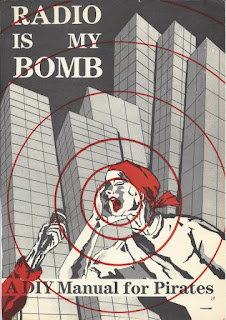
Radio is my bomb? : 2003 : the DAB digital radio customer complaint hotline, The Radio Authority

 The Bomb Squad arrived in vans, ran into the Holborn office block and up its staircase to the eighth floor. We watched events unfold from the car park below, the assembly point to which our organisation of forty-odd people had been evacuated an hour earlier.

That humdrum morning had been interrupted by a large cardboard box delivered by Royal Mail to our office. It was not particularly heavy but had lots of stamps on the outside with a ‘Belfast’ postmark. If you were a celebrity or public figure whose opinions were widely distributed, you might anticipate threats would occasionally be made against your life. If you had a desk job in a little-known British government quango, your greatest work challenge might normally be choosing where to lunch. However, that morning, the box’s addressee Soo Williams was taking no chances. The emergency services were called.

Eventually, the ‘suspicious package’ was removed by ordnance experts and exploded elsewhere. It was found to contain nothing but paper. Printed petitions signed by hundreds of Belfast citizens demanding that religious community radio stations be licensed locally. Williams’ name had been written on the box due to her recent promotion by The Radio Authority to manage the launch of ‘community radio’. Returning to our desks after the false alarm, I ruminated what those god-fearing citizens who had toiled to gather so many signatures might have thought of having been suspected by the recipient of being terrorists.

That morning’s event exemplified the disconnect between the regulator of the radio industry and the public it was supposed to serve. Someone with an interest in the UK community radio movement would have known that tiny unlicensed radio stations had existed for years on both sides of the Irish border, broadcasting church services and information to their communities. Indeed, one history argues that the Catholic Church in Ireland was “the world’s largest pirate radio operator”. However, few of The Radio Authority’s desk-bound administrators demonstrated interest in the medium they were employed to regulate. I was the only employee to have worked in a community radio station (licensed in a 1970’s experiment), having been a founder member of the Community Radio Association two decades previously. But now, within this dysfunctional workplace, I was regarded as the office junior … at the age of forty-four.

Back at my desk, I returned to taking regular phone calls from members of the public dissatisfied with the new-fangled DAB ‘digital radio’ receiver they had just purchased. I never quite understood why the switchboard regularly passed such calls to me, as I bore no responsibility for DAB radio, and my colleagues in the Development office suffered no such impositions. It was already self-evident to me that the rollout of this new radio technology had been disastrous for listeners, though I was expected to defend the system, and worse … to blame the listener for its inadequacies.

Staff were issued with a ‘helpful’ sheet of topics to raise with complainants about DAB. Suggestions to be made to members of the public experiencing difficulties tuning into stations on their new receiver included:

  • move your radio nearer a window
  • listen to the radio in an upstairs room
  • your residence might be constructed of the wrong materials
  • your residence might be located in a valley
  • your residence might be located in a dense urban area
  • your residence might be in an apartment block or a basement
  • you may need to install a rooftop antenna.

Many callers were understandably baffled and annoyed by these ‘answers’ to their problems, proffering a torrent of abuse or hanging up. Many had spent around £90 on a portable DAB receiver and expected it to deliver what the industry’s marketing had promised – ‘crystal clear’ reception of a wide choice of radio stations. The most popular receiver, the ‘Pure Evoke-1’, had been designed to be portable and had no socket to even attach the suggested external antenna, let alone the connectivity to update and improve its software. And why did it resemble a wooden post-war radio in an era when connected mobile phones were looking increasingly futuristic?

One of my callers’ commonest gripes was the result of DAB radios having been marketed and sold nationwide, even though many parts of Britain had yet to be connected to the DAB transmission system. In this instance, all I could suggest was that the consumer return their receiver to the shop and demand a refund because no digital stations were yet audible locally. I too shared this problem because, although The Radio Authority had denied me its Christmas cash bonus in 2002, I had received the DAB radio gifted to all staff. It remained in its box as I was living in Brighton, where DAB transmissions had yet to arrive.

The root of the dissatisfaction with DAB radio was not the technology itself, which had been a smart European innovation, but the way it had been implemented by Britain. Those critical roll-out decisions had been made by people like the ones in my workplace: administrators who had no experience working within the radio industry, encouraged by technologists keen to promote anything ‘digital’ with an evangelical fervour, oblivious as to whether consumer demand was evident. At the top of this unholy group of conspirators were government civil servants who mistakenly believed that Britain and British industry could dominate global markets by adopting a technological standard in which the rest of the world had shown scant interest. Meetings of this cabal seem to have merely intensified their cult-like determination.

The stumbling block their paper plan faced was the disinterest of the commercial radio industry itself which, at that time, was profitable and had expressed no dissatisfaction with its existing, robust FM radio transmission system. When The Radio Authority advertised the first national DAB multiplex licence in 1988, it faced the very real possibility that no radio companies would submit bids. To avoid this embarrassment, the regulator had to ‘strongarm’ Britain’s largest radio group into making the only application. GWR Group plc’s then chief executive Ralph Bernard later admitted:

“GWR was encouraged to apply for the national [digital] licence, and was under some pressure to invest in the opportunities for a national licence from the then regulator [The Radio Authority]. Had we not done it, there would be no national DAB platform now. Not only that, [the regulator] did not know what they would have done on the question of national radio stations with regard to the opportunities given by the then government to renew their national licences for a further period of time if they were to commit to going digital. But how can you [do that] if there are no opportunities to go digital because there is no national multiplex? When I put that question to The Radio Authority, I was told that the answer was: ‘We don’t know what would happen – there is no Plan B’. It was just an assumption that someone would go for [the national DAB multiplex].”

“When we were seduced into believing that this was going to be the only [national digital] licence, we realised that there would be substantial losses, but the payback would be when you have the opportunity to be the only player in the national market for DAB. When it’s The Radio Authority, an agency of government, you tend to believe what you are told. On that basis, the investment was justified and, at the time, getting it through my Board was not easy.”

Having rescued the regulator from potential embarrassment in its ill-judged pursuit of the DAB dream, Bernard naturally now held some sway over The Radio Authority and its decisions. There evidently did exist such a thing as a free lunch for its senior managers when Bernard would invite them to The Ivy restaurant in anticipation of outcomes coincidentally beneficial to his business. On two occasions at the regulator, my actions threw a spanner into this cosy relationship and I suffered consequences (see blogs here and here) from my bosses, despite me having acted in what I believed was the public’s interest. I learnt to my professional cost that I was supposed to be a ‘civil servant’ to commercial interests, not to our citizens.

How did the story end for commercial radio? Badly. GWR Group plc’s subsequent merger with Capital Radio Group plc, both profitable public companies prior to their investment in DAB, proved a financial disaster, their DAB assets were divested for a song, an offshore investor acquired the merged business and Bernard exited the industry. This tragedy was repeated in the lower echelons of the radio business when the entire UK commercial radio industry had to be rescued by private investors. Most local radio stations that had existed since the 1970’s were replaced by national ‘brands’. Local content all but disappeared. Thousands of radio professionals lost their jobs.

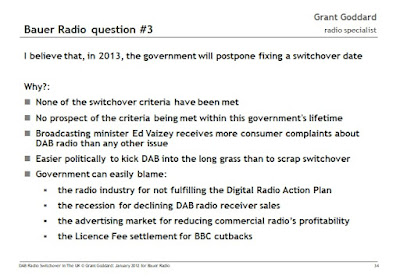
How did the story end for DAB radio? Even worse. In a presentation I was commissioned to make to the board of the second largest radio group in 2012, I predicted that the government would kick the much heralded ‘digital radio switchover’ date into the long grass. I was pooh-poohed by the company’s technologists at the meeting, but my predictions came to pass … while theirs turned to dust. Naturally, I was never invited back. British commercial radio’s enormous investment in the disastrous DAB platform impoverished the entire sector, reducing it to little more than a jukebox music service for listeners who lacked Spotify accounts.

The deluded dream finally died in 2016 when ‘Pure Digital’, the ‘great white hope’ of British designed DAB radio receivers (though manufactured in China), was sold to Austrian company ‘Aventure AB’ for £2.6m, following its £7.9m loss during 2015/6 as a result of declining sales and its “significant stock” of unsold radio inventory so old that it “needs to be assessed for risk of obsolescence.”

With the advantage of hindsight, the entire DAB debacle now seemed like a rehearsal for the similar self-harm caused by Brexit a decade later. Men in suits with little or no experience of working in the real world of commerce pursued a fever dream regardless of its practicality, oblivious to its outcomes but buoyed by their mistaken sense of superiority. Their project was to foist a uniquely ‘British’ solution on the population that would purposefully diverge the UK from the rest of the world (British DAB radios would not even function in France). Their words and documents were stuffed with misinformation and downright lies that supposedly supported their theories. Without their posh accents, they could have been mistaken for used car dealers.

Despite the wilful destruction of the commercial radio sector’s economic value, talent, creativity and public service that they had fomented, many of Britain’s DAB ‘protagonists’ went on to be lauded with industry awards, honours and lucrative jobs. For anyone who followed the Brexit disaster, it will sound like all too familiar a story.

[Originally published at https://peoplelikeyoudontworkinradio.blogspot.com/2023/10/radio-is-my-bomb-2003-dab-digital-radio.html]

The spy who disliked me : 2003 : Eva Koekelbergh, The Radio Authority

 “Do you know who I am?” my workplace colleague shouted down the phone. “Do you know who I work for?”

I suspect customer service personnel at Fortnum & Mason (which promises “everyone remembers their first encounter with us”) endure similarly haughty conversations with their upper crust clientele day in day out and follow a scrupulously polite script such as:

“Yes, madam, I can read your name on the order for wedding guest name cards and I can tell from your posh accent that you are a member of the British elite who since 1707 have purchased ordinary things from our Piccadilly shop at extraordinary prices, BUT …”

Perhaps private school timetables schedule one period per week of ‘Privilege Studies’ during which pampered Torquil’s and Persephone’s confidently acquire the skill of always getting their own way in life by addressing the 95% of Brits who they consider not ‘one of us’ as inferior beings … though I fail to recall my state school reciprocally teaching ‘deference’. Whether the harangued employee at Fortnum & Mason (“committed to delivering a sense of pleasure”) on the other end of the call had heard of The Radio Authority I doubt. Our government quango was so marginal that there were probably people toiling in radio stations who had never heard of it.

My colleague was usually more softly spoken until an issue arose with ‘service’, at which point the inherited gene that had probably balled out ‘the help’ in centuries past suddenly emerged on the radar screen like the tip of an upper-class iceberg. On a previous occasion, a phone charger left permanently plugged in under the same colleague’s desk had burnt out with a bang while she was sat in our crowded, unventilated office, but without injury. No eavesdropping was necessary to overhear how forcibly the manufacturer would be complained to, sued and adequate compensation secured for her having suffered this apparent near-death experience.

Our office proved the ideal place for my colleague to spend most of the year meticulously planning her spectacular wedding in the grounds of a hired West Country mansion. Months could pass without management delegating any work to us ‘development officers’ to do. The pay and conditions in this public sector agency were undeniably rubbish, but never have I been required to do so little work for a salary. If I exited the office even ten minutes after five o’clock, it would be my duty to switch off all the lights and lock the Radio Authority front door. So much time, so little work!

Evidently, no run-of-the-mill wedding was being planned from the desk next to mine. Its scale and lavishness would easily have triumphed in a ‘Radio Industry Wedding of the Year’ awards ceremony. Like all historic royal weddings, this was not a purely personal affair. It celebrated the alliance of two established ‘houses’ that since 1973 had been at war with each other, fighting innumerable battles over every issue known to the broadcast industry’s opposing armies. The bridegroom was a board member and director of a significant British commercial radio group. The bride worked for the government regulator of the very same commercial radio industry. It was a match made in conflict-of-interest heaven.

I had already observed that, as soon as something of even minor significance occurred at The Radio Authority, the bride-to-be would unhook her mobile phone from its charger and march to the ladies’ loo where she might remain a good while. Maybe she just suffered a weak bladder exacerbated by radio industry events. Whatever, by dint of a mysteriously indirect route, such news would magically appear within the pages of the next ‘Radio Magazine’, a weekly publication brimming with insider gossip that naturally was rabidly consumed by The Radio Authority’s staff.

Normally I would have remained coldly detached from such workplace intrigue but, this time, my life was impacted by the whiff of in-house espionage. Bob Tyler, a good friend for as many decades as I have attended radio conferences, was then news editor of the Radio Magazine and had a habit of phoning The Radio Authority switchboard and asking to be put through to me for an innocent chat. Having signed some kind of Official Secrets Act on my first day of work, I told him absolutely nothing confidential. However, his calls may have sowed seeds of doubt with my boss, David Vick, who one day discovered me alone in his office after I had entered to retrieve a document I had mistakenly left on his desk minutes beforehand. As the only employee with hundreds of published articles about the radio industry to my name, the fickle finger of fate appeared to point directly at me and, without explanation, Vick started to lock his office door when he was absent. Subsequently, I was the sole employee not to be awarded a Christmas bonus and my annual review was unremittingly negative.

“My father worked as a spy for the Dutch government,” the bride-to-be would tell the rest of us in the office, as if addressing an interviewer for a place at Oxbridge. I wondered to myself whether such an occupation passed as a ‘family business’ amongst her peers. Could her employment with The Radio Authority be merely an undercover mission in a quiet backwater for an MI5 agent? Suspicions were further aroused when our boss David Vick insisted he vet and approve each of her wedding guests, the list apparently resembling a who’s-who of everyone who presently worked in the British commercial radio industry. Not that I ever saw it. 

As the Big Day approached, it became apparent that all who worked in our office had received an invitation … except me. In fact, everybody in our department had been invited … except me. Indeed, I suspect that just about everyone employed by The Radio Authority had been invited … except me. Not that Eva Koekelbergh ever told me to my face that I would not receive an invitation to her big fat Wessex wedding. My desk was only six feet away from hers so the ‘oh dear, it must have been lost in the post’ excuse would have been wholly redundant. I had endured almost a year of aural torture, forced to listen to every minor detail concerning the biggest day of her life being phoned through to dozens of contractors and then chased up relentlessly from her desk, yet now I was being treated as if I might deliver a homemade bomb as my gift-wrapped present.

Though there may be eight million eligible bachelors in the naked city, the universe of Britain’s 5% appears more akin to the gene pool within a rural Mormon village. The bridegroom just happened to be the former Radio Authority line manager of the bride, and he also just happened to be best man at her present line manager’s wedding, and both men just happened to have attended the same university. For the cherry on top of this cake of coincidence, one of the six people working in our office was the daughter of one of the bride’s teachers at her former private school. When people casually comment ‘it’s a small world’, do they realise what a truism it is for a certain stratum of society?

One week before the Big Day that had necessitated a year of planning, including its own internet domain with gooey photos of the couple and a lengthy wedding gift list, the bride casually asked me if I wanted to attend her post-wedding evening soiree, but not the main event. I was tempted by an appropriately pithy two-word response but instead feebly explained that I was already busy that weekend. The few friendly staff I knew at The Radio Authority had already asked me privately why I had not been invited and all I could do was shrug. I had no idea. Anybody who was anybody in the British radio industry seemed to have been invited. I could only surmise that I must be ‘nobody’, despite having planned and executed London’s most successful large-scale commercial radio station launch during the previous decade.

Naturally, the wedding juggernaut did not come to rest abruptly at the end of the Big Day. Afterwards there were still the communal experiences and the photos to be ooh-ed and ah-ed over by colleagues in the office … and the gossip. Who did what, who saw what and who said what occupied many of the staff for several weeks afterwards. I just sat at my desk pretending to be deaf, dumb and blind. All I learned was that everybody seemed to have had a good time. The wedding had at least not cost me a penny. No present, no card, no car hire, no petrol, no hotel, no tuxedo hire. Even if I had received an invitation, I might have proffered a public explanation that I could not afford all these costs on my meagre salary (particularly as I was commuting to London by train from Brighton), even whilst harbouring the private reason that the wedding’s scale and ostentatiousness seemed to be drawn from the pages of ‘Emma’.

A few months later, The Radio Authority closed and the majority of its staff transferred to a new regulator named Ofcom where we worked in a huge, open plan office overlooking the River Thames. I was relieved that my newly appointed desk was no longer next to the post-honeymoon bride, not because I disliked her, but because during my eighteen months at The Radio Authority she had insisted on running a powerful electric fan on her desk, whatever the season. It might have had the effect of making her feel like Kate Winslet on the bow of ‘The Titanic’ but the airstream had simultaneously played havoc with my sinuses. I had asked her repeatedly to adjust the fan’s angle but somehow it had still subjected me to painful headaches.

I had only transferred to Ofcom in the desperate hope of being offered some proper work tasks to tackle after having been required to do so little at its predecessor. It was not to be. My new boss Neil Stock gave me nothing to do. When the BBC called unexpectedly to offer me contract work in Cambodia, I accepted the challenge. During my last afternoon at Ofcom, I bade a fond farewell to the few lovely colleagues who had been so good to me. On route towards the exit, I passed Eva’s desk. I considered stopping to say farewell but then reflected on my experiences and resolved to walk on by.

[Originally published at https://peoplelikeyoudontworkinradio.blogspot.com/2023/07/the-spy-who-disliked-me-2003-eva.html]

A little radio knowledge is a dangerous thing : 2003 : Neil Romain, The Radio Authority

 It was a hostage situation. I was sat on a chair in a large, empty room. An angry man was pacing in circles around me, shouting questions: “What have you done?” and “Why did you do that?” and “Who told you to do what you did?”

Were my family about to receive a ransom note? Unlikely. The room I was in was not some dirty disused dockside warehouse but the plush boardroom of the British government quango where I was employed. My captor was the organisation’s finance and personnel director Neil Romain. Had he mistaken his well-worn DVD of ‘Reservoir Dogs’ for a textbook such as ‘Introduction to Personnel Management’? Was his qualification for this job an earlier life as a school prefect?

My transgression was to have written a ten-page paper analysing the degree of competition between commercial radio stations in Britain’s twenty largest local markets. Qualified in maths and economics, in 1980 I had started to tabulate data about the British radio industry on A3 accountancy sheets which I then transferred to digital spreadsheets in the 1990’s. Prior to this job at The Radio Authority, I had spent most of the previous decade working overseas, hence my UK industry datasets were rather outdated. As no work tasks were given me for the first few months, I used that time to sit at my desktop computer updating my knowledge base.

At lunchtimes, management were regularly being wined and dined by commercial radio bosses at The Ivy restaurant, while I would be searching the stacks of the London School of Economics library for papers in academic economic journals that analysed the American radio industry. What I found inspired me to write my own paper contrasting the significant competitiveness evident in American local radio markets with the high levels of market concentration in Britain. I was not surprised. The United States system of radio had embraced listener choice and commercial competition from its inception in 1920, while the British system of commercial radio had been founded in 1973 upon the notion of monopoly power. My paper demonstrated these divergent outcomes by analysing UK data using a technique favoured by the US Department of Justice. In December 2002, I sent my finished paper to managers in my workplace, hoping for feedback. Zilch.

In January 2003, the government’s Competition Commission announced an investigation into the £12.5m acquisition of Bristol-based local commercial radio station ‘Galaxy 101’ by a joint venture of two large UK radio groups, one of which (GWR Group plc) already had a significant presence in the area. The Commission requested relevant evidence concerning competitiveness within local radio markets. I emailed my paper and received a response requesting my appearance before the Commission to discuss my paper. That was when all hell broke loose around me at work.

At that time, 13 companies owned 177 of Britain’s 259 commercial radio stations. The largest radio groups were lobbying politicians for the ownership law to be changed to allow them to gobble up even more stations, a notion to which The Radio Authority appeared to raise no objection. However, my paper showed that 15 of the UK’s 20 largest local radio markets already exhibited ‘highly concentrated’ ownership. Such a change in the law would only worsen this situation, reducing choice for listeners and advertisers. However, the commercial radio industry and, more surprisingly, the government were keen to argue that even greater concentration of ownership would be a positive change:

“Listeners will be the real winners, with companies like GWR being able to build local centres of excellence offering local output of greater range and quality,” said GWR Group chairman Ralph Bernard.

“A certain amount of consolidated ownership can help to create ‘localness’ by committing the necessary investment,” said Chris Smith MP (and Disney consultant).

The UK government Department for Culture, Media & Sport wrote: “Without any consolidation of ownership, the risk is that a number of small companies will all tend to aim their content at the same middle ground, all seeking the largest possible share of the mass audience…”

These statements would be understood as bollocks by anyone possessing a modicum of economics knowledge, but maybe MP’s and civil servants too had enjoyed free lunches at The Ivy. The reason my little paper created so much anger was that it challenged this bizarre avalanche of propaganda intended to persuade that the fewer companies owned Britain’s commercial radio system, the better the outcomes. Between 1973 and 1990, commercial stations in all local markets (except London) had enjoyed monopoly status. Owners were now demanding the clock be turned back to those uncompetitive times.

This is why Neil Romain had transformed into The Inquisitor, demanding to know why I had written a paper that nobody had asked me to and, then, why I had sent it to the Competition Commission when nobody had asked me to. I explained that it was a personal paper that only analysed publicly available data and which I had submitted individually, not on Radio Authority letterhead. The Commission had asked for evidence and, to the best of my knowledge, nobody else had written a recent analysis of competition issues and market concentrations in British commercial radio.

The subtext of Romain’s angry tirade was me having published incontrovertible evidence that contradicted the prevailing ‘industry’ view that further consolidation would prove more beneficial for radio listeners, rather than less. I was the fly in the ointment. I had refused to drink the Kool-Aid. I had already been given a minor job at The Radio Authority. I was meant to demonstrate gratitude by just sitting at my desk doing absolutely nothing.

This sense of absurdity was underlined after I was pushed into the office of my manager, David Vick, for a further dressing down. I was on the receiving end of another mad outburst which eventually ended with Vick demanding that I should not talk to anyone about radio, nor write anything about radio that had not been requested of me. I felt compelled to point out that I was studying an MA in media management (paid for by my employer) that required me to write and talk about the media.

“I forbid you,” he shouted. “You are not to talk to anyone about radio while you are employed here.”

It was apparently a crime to be an authority on radio at The Radio Authority. Was this ‘1984’? Rather, the situation recalled the absurd bureaucracy in the 1985 film ‘Brazil’, with me cast as Sam Lowry, the man who knew too much; Vick playing Lowry’s boss Mr Kurtzmann, the man who stymied Sam’s career; and Romain as Jack Lint, the family man who enjoyed a dose of mundane torture in his office. All that Vick and Romain’s actions confirmed was that I was working in an organisation that pretended to be a public regulator but whose levers were being pulled by commercial interests. Their reaction to my paper revealed once again the real men behind the curtain. I vowed to ignore their ridiculous posturing and continue writing papers about radio.

In April 2003, The Radio Authority funded Romain to attend the annual National Association of Broadcasters convention in Las Vegas. I asked him beforehand if he could purchase a short list of books about radio that I knew would be on sale at the convention book stall, me having attended the same event a decade earlier. Unavailable online, these materials would assist my research. On his return, I asked Romain if he had managed to purchase my requested books, to which he answered simply “no” without apology or explanation. He was subsequently promoted to deputy CEO. I had been exiled to the naughty step.

In May 2003, the Competition Commission announced that the conclusion of its investigation was to block the sale of ‘Galaxy 101’ to new owners on the grounds that GWR Group already dominated the local radio markets in Bristol and Bath. This outcome forced GWR to sell its half-share in the joint venture. I was pleased that my analysis had informed the Commission’s decision-making, though I was realistic that my chance now of ever finding employment within a large commercial radio group in the UK would be zero … and so it was.

At the end of 2003, as the Authority merged into new regulator Ofcom, Romain was appointed managing director of commercial radio group London Media Company Ltd. This was surprising on two counts: to the best of my knowledge, Romain had not previously managed a radio station; and the company he joined was owned by Avtar Lit whose activities in the radio industry were already, er, notorious. ‘The Sunday Times’ newspaper in Sri Lanka alleged that Lit had accrued 177 convictions for fraud and petty crime by 1998.

I had had occasional contact with Lit since the late 1980’s when he had claimed to run a West London pirate station ‘Sina Radio’ whose broadcasts I had never found, despite living only a few miles away. He would phone me at home for free advice on his imminent application for a legal ‘incremental’ radio licence, and I attended some of his public meetings where I heard all sorts of crazy talk.

In 1998, Avtar Lit and Radio Authority employee Janet Lee had been arrested on charges of alleged corruption in connection with Lit’s successful licence application for new London Asian station ‘Sunrise Radio’. Was Lee sacked by disciplinarian personnel director Neil Romain? No, she clung on to her management post at the Authority until it was dismantled five years later. Was Lit’s licence revoked? On the contrary, the Authority renewed it in 2000 for a further eight years because its “application for licence renewal complies with the statutory requirements”.

Only months later, The Radio Authority fined Lit’s station £10,000 for having broadcast propaganda supporting his (unsuccessful) campaign to be elected Southall’s MP. The regulator inexplicably provided Lit with the licence to operate London’s first and sole Asian commercial radio station from 1989 to 2003, enriching him sufficiently by 2005 to be lauded as one of the “twenty most powerful Asians in British media.” In 2007, ‘Forbes’ magazine profiled Lit’s success at building a global business empire, without mention of its foundation on a monopoly radio licence that allegedly had been awarded corruptly by the regulator.

The tiny local radio stations acquired by Lit’s London Media Company, managed by Neil Romain, proved to be unmitigated commercial disasters. In 2009, I wrote a 6,000-word essay analysing the abject failure and closure of two of them. In 2010, Sunrise Radio’s accounts declared a loss of £10m. In 2013, the station was prosecuted for £390,000 in unpaid taxes. In 2014, Lit was declared bankrupt by the High Court and Sunrise Radio was placed into administration. Lit’s radio group was then acquired by Ketan Somaia whose interests, ‘The Guardian’ reported at the time, “once included hotels, banking, motoring and media, [and who] is being prosecuted [at the Old Bailey] for fraudulently taking £14m in a series of deals dating back to 1999”.

Corners of the UK commercial radio industry can appear to resemble a ‘pass the parcel’ game in a pawn shop.

[Originally published at https://peoplelikeyoudontworkinradio.blogspot.com/2023/06/a-little-radio-knowledge-is-dangerous.html]

The Best Man for the job : 2003 : Neil Stock, The Radio Authority

 When someone leaves their job, what are the chances that the ‘best man’ to replace them will be:

  •  the groom at whose wedding their predecessor was Best Man, AND
  •  a contemporary at the same university, AND
  •  a volunteer at the same student radio station?

Wielding my four mathematics GCE’s and a pound-shop calculator, I sat at my desk calculating the probability of such an alignment of coincidences for a job appointment within my workplace. If this had been an internet start-up of Cambridge science graduate nerds, no eyebrow would have been raised. But in a British government quango? My calculator produced a gibberish result from the very first calculation. But when I turned around its display, the characters appeared to spell out ‘NEPOTISM’. I switched to an Excel spreadsheet but it too crashed. Microsoft made contact, suggesting I lease processing time on its supercomputer to complete my calculation of a ‘1 in …..’ probability that would require several zillion zeros. I gave up.

After an unexplained rush to appoint me, The Radio Authority had left me alone, twiddling my thumbs at my desk for three months. There were no team meetings or supervisor get-togethers to attend, so nobody remarked upon my ongoing inactivity. Had my colleagues even browsed the ‘management’ section of a bookstore? Work tasks were assigned by way of someone with a supreme confidence in their own superiority marching up to your desk and barking orders, before turning around and marching away again. It began to feel as if I had been press-ganged into the Civil Service as deckhand on a ship of pen-pushing fools.

Finally, by month four, I was given a project by the manager who had appointed me, David Vick. The local commercial radio licence for West Lothian in Scotland had been advertised and my task was to write a paper to be presented at a Members’ Meeting, recommending to which applicant the licence should be awarded. No problem, I thought. A decade earlier, I had regularly spent a morning in the broadcast regulator’s library, reading multiple applications for a particular licence and then summarising them during the afternoon in an article of several thousand words for the weekly ‘Broadcast’ magazine. I was thinking that a more detailed paper might take me a week to write. Then Vick told me that I had … two months. Oh, and there was only one applicant.

I was offered no guidelines, no style sheet, no system to follow, no advice. Just “write a paper – you have two months.” I executed what I considered to have been a thorough job. I researched the local media market, the radio market, the applicant’s business plan, everything I could find. This was my first project. I wanted to impress my boss. There were days when Vick asked me why I was using the office printer so much, seemingly oblivious to the demands of evidential research. After six weeks, I gave him my draft document and asked him to mark it up so that I could understand which parts he wanted to keep or discard. He invited me into his office to discuss my work. Had I done well? Er, no. He went ballistic. He screamed and shouted at me.

“This isn’t what I wanted,” Vick yelled. “This isn’t an Authority Paper. What do you think this is? Can’t you write?”

He stormed out of his office and marched down the corridor shouting “Shit! Shit! Shit!” at the top of his voice. It was left to me to presume that our meeting must have ended, without me having uttered a word.

I was shocked. And very confused. I believed that I could write … and write quite well. Vick had read my CV and knew my articles about the radio and music industries had been published in trade and consumer publications, some of which had employed me as sub-editor or editor. My job application here had even required me to submit a one-page essay entitled ‘The London Radio Scene’. During my job interview, Vick had not critiqued my supposed inability to write. Why would I have been appointed?

Later that day, Vick’s deputy marched up to my desk and requested a meeting. In their rehearsed good cop/bad cop roleplay, Vick apparently judged Neil Stock the best man to ‘offer’ to bang my report into the requisite, undefined shape and style of ‘Authority Papers’. I did not bother to argue. Stock was eminently qualified by having studied American Literature, having never worked in commercial radio and, to the best of my knowledge, having never published an article about the radio industry. Visually, he was Beaker to Vick’s Doctor Bunsen Honeydew. Stock’s frigid demeanour recalled the android Bishop in the movie ‘Aliens’ whose ‘humanity’ module might never have been activated.

Stock occupied a spacious office on the opposite side of the corridor that resembled one of those IKEA showrooms where everything looks too perfectly arranged to be real and the desk computer turns out to be fake. I sat facing him across a desk ring-fenced with multiple stationery pots filled with over-sharpened pencils of varying hardness and a row of staplers, holepunches, paperclips and elastic bands. Stock’s patronising spiel, instructing someone twice his age how to write, floated off into the ether above my head. My eyes were scanning the office carpet for evidence of vomit stains where my colleagues had alleged his predecessor had been found unconscious following an over-liquid lunch. After that incident, Stock’s Best Man had been shoehorned into a board-level job in a commercial radio group, a responsibility which had proven so successful that I had overheard Vick on the phone to the CEO trying to save his prodigy’s bacon.

One week later, Stock gave me back the document. It still had my name on the front but almost nothing within remained of my six weeks’ graft. Every single table, graph and map had been expelled. Every reference to a specific number (such as Census population data) had been rounded and referred to as ‘approximately’ or ‘about’. All evidential sources such as media and radio market data had been expunged. My sentences had been conjoined with ‘and’ or commas until each contained at least seventy words. Some paragraphs filled almost a whole A4 page. Subjective adjectives had been attached to references to individuals, tainting them with judgement as to whether they were in or out of favour with The Radio Authority. This was writing, Jim, but not as we journalists know it.

I asked Stock to remove my name from his revised document as it no longer resembled anything that I had written. He refused. I asked that his name be added to mine as joint author. He refused. We may have been sitting opposite each other at his desk, but each of us had landed there from different worlds. My quarter-century in journalism had been spent explaining facts. His few years in this civil service madhouse seemed to have been spent obscuring facts. If his university had offered a module titled ‘Using Words as A Weapon: How to Write Baffling Prose’, he would certainly have scored an ‘A’.

Naturally, Stock’s boss David Vick was happy with the result. It looked and read just like something he would have written himself. I was required to present the paper to a monthly Members’ Meeting, reading a pre-approved two-minute script from which I was forbidden to deviate. Neither was I allowed to use audio-visual aids in my presentation. Vick had instructed me not to contribute to the ensuing debate unless a specific, factual question was addressed to me directly. I saw absolutely no point to my presence at the meeting. It achieved only what the organisation’s officers had carved up beforehand. The licence was awarded to the sole applicant. My ‘work’ in The Radio Authority was merely to keep up its appearance of objectively regulating the radio industry.

Months later, an uncharacteristic silence broke out amongst my colleagues in our crowded office. We had already been told that our regulator was about to be merged into a new, bigger government organisation. What we had not learnt until then was that our new manager was to be … Neil Stock. There was stunned silence as the news sunk in.

This was the Neil Stock who, on arrival at work each day, would email his ‘team’ a ‘Pop Quiz’ question that required an emailed response within the hour. When I refused to play this childish game, he complained that I was not a team-player. But I had no interest in flaunting my encyclopaedic knowledge of pop music earned from having created radio station formats over several decades. Mike Read was not my hero.

This was the Neil Stock who refused to attend the quarterly team-building, afterwork social visits to a local pub or restaurant that our employer mandated. Management apparently thought it was insufficient that we already spent forty hours every week in each other’s company in one cramped office. During one such social evening, my colleagues expressed astonishment that I had not been made to take a UK geography test before my appointment, which had been required of them. It was as if knowing the county town of Rutland proved a perfect substitute for non-existent knowledge of the radio industry that a new employee would be regulating.

This was the Neil Stock who only popped into our office briefly if there was something specific that he wanted to address to one of us. Watercooler chat, small talk, even casual morning greetings or afternoon farewells were apparently foreign concepts. Enter his office at 4.30 and he would be enthusiastically sharpening his huge pencil collection on a desk uncluttered by a single folder or sheet of paper. Enter his office at 4.50 and he was already being whisked by train back to his IKEA showroom house and wife in Cambridgeshire.

This was the Neil Stock who chose not to inform his own underlings that he had been appointed their new manager. Neither did we learn it from our then manager, David Vick. The news reached us that fateful day as part of a general personnel update email from the new regulator Ofcom. Once again, our managers were demonstrating their non-communication skills.

Our office was not the only one rendered speechless by the news. A hush spread over the whole floor as our colleagues digested that Stock would not just be managing our team, but most of the 40-odd staff about to be transferred from The Radio Authority to Ofcom. What a meteoric rise through the ranks for someone so, er … inexperienced? In 2000, Stock had been judged the best man to replace his Best Man. By 2003, somebody somewhere considered Stock the best man to manage Britain’s commercial radio licensing system, a job that had not been advertised publicly.

We were left to presume that Vick must have decided to take retirement since it was plainly evident that his nineteenth-century style of management – writing everything longhand, never touching a computer keyboard, bellowing from his office at his two full-time administrative assistants whenever he needed to send/receive/print an email – would have proven awkwardly Luddite within the determinately twenty-first century Ofcom.

The pair’s Hawkins/Harker partnership was about to be dissolved. Meet the new boss …

[Originally published at https://peoplelikeyoudontworkinradio.blogspot.com/2023/05/the-best-man-for-job-2003-neil-stock.html]

The rubber stamp men … and women : 2002 : Members Meetings, The Radio Authority

 “Did you enjoy your day off yesterday?” a member of my team asked me one morning.

“Yesterday?” I enquired, slightly confused.

“Yes,” he continued. “You weren’t in your office all day so we guessed you had taken the day off.”

Ah! Now it began to make more sense.

“Unfortunately, I was not off yesterday,” I replied. “I was in meetings all day in the boardroom upstairs.”

That was true. It had been just one of a multitude of similar days when, from my arrival at eight until evening, I had bounced from one meeting to another, and then another. Had I even eaten lunch? We were launching a new London radio station, KISS FM, where I was the only member of the management team with prior commercial radio experience. My page-a-day diary was necessarily crammed with all sorts of meetings. In some I had to make presentations, some I had to chair and some I had to minute. For many months, there never seemed time to do real ‘work’ in my job because of all these meetings.

My initiation into the world of apparently endless meetings had happened a decade earlier. As sabbatical deputy president of a student union, my life was sacrificed to committees, sub-committees, executive committees and student councils, listening to and engaging with student activists who loved nothing more than to talk and talk. I had also been nominated as the student representative on umpteen university committees, in which twenty to thirty grey academics and administrators sat around a massive wooden boardroom table for hours, leafing through the half-ream of agenda papers before them in an effort to stay awake. Much of my life for one year comprised evenings spent punching holes in paperwork and filing it in huge ring binders for posterity.

Two decades later, starting my first job within a government ‘quango’, I anticipated that I would once again be drowned in meetings and sub-committees. I soon discovered that, at The Radio Authority, nothing happened … literally. I was crammed into an office the size of a modest living room with five colleagues sat at trestle tables around the perimeter, obliging each of us to face a wall or the only window. Filling the middle of the room was an overlarge high storage unit with map drawers that nobody seemed to use. This anti-social working arrangement could have been an approximation of the organisation’s management system.

The first day at a new job, you except to be left alone to familiarise yourself with your desktop computer and your new surroundings. However, you do not expect the one hundred subsequent days to repeat like Groundhog Day. For three whole months, I was given nothing to do. There seemed to be no day-to-day workflow system, no meetings, no distribution of tasks amongst members of my department. I could have come to work every day and idly stared at a blank computer screen. Nobody ever asked me what I was doing, or not doing, so I busied myself writing an economic analysis of ownership concentration levels in local radio markets. Before starting, I had asked the finance department if they had already written such a document. They looked at me like I was crazy. I was already wondering why the required start date for this post had proven so urgent.

Then, out of the blue, development director David Vick, who had interviewed me for the job, asked me to attend The Radio Authority’s next ‘Members Meeting’. Once a month, senior managers like him met formally with Members, six men and three women handpicked from ‘the great and the good’ by somebody somewhere as representatives of the ‘public’ whose taxes were funding this regulator. Having drawn my salary for three months but contributed zero so far, I was keen to impress somebody/anybody that I was capable. I read the meeting agenda and accompanying documents, including one written by a Radio Authority colleague recommending the award of a new local radio licence. I researched thoroughly the issues for discussion.

At the meeting in the boardroom, Radio Authority managers were lined up along one side of the oval table, with Members seated along the other. I was not intimidated. I had attended dozens of meetings like this elsewhere over the years. I sat at one end of the table and kept my counsel until the recommendation to award the local radio licence was discussed. Once my colleague had finished presenting his paper, I raised my hand. The Member appointed as chairman, Richard Hooper, was sat at the far end of the table and asked me to speak. There was a look of collective astonishment on the managers’ faces. But I held the belief that we were all in a genuine meeting … together. I simply had some factual information to contribute.

I had brought along my own analysis of government statistics that demonstrated a high level of poverty in the locality for which this local radio licence was about to be awarded. When compared with similar stations, I concluded there would be insufficient advertising revenues to support a standalone licensee within this relatively small and poor locality. I suggested that it made more economic sense to award the new licence to an existing neighbouring radio station that could then expand its coverage area, rather than offer it to a new business that appeared very likely to fail. The lay Members listened and understood my arguments, rejected my colleague’s recommendation to award the licence to a standalone applicant and accepted my alternative solution to reward a competing neighbouring applicant.

After the meeting ended, I felt pleased that I had made a valuable contribution on the first occasion I had been involved in any kind of discussion or meeting within the organisation. I was not feeling smug but I did enjoy the sense that my skills were finally being valued and had influenced decision-making. This sense of positivity lasted less than a minute. Barrelling down the corridor behind me was the manager who had invited me.

“What the hell did you think you were you doing in that meeting?” David Vick demanded.

“I was contributing to the decision-making with a factual analysis that was not in my colleague’s report,” I replied. This appeared to make him even angrier. I will omit the swear words:

“You were not asked to speak. You were not expected to speak. Nobody asked your opinion. Nobody wanted your opinion. That licence was nothing to do with you. Had I asked you to be involved in it? No. So what the hell did you think you were doing?”

Vick was very angry and not afraid to demonstrate it. I had thought I was proving my worth at work, while he seemed to be thinking the opposite.

“What I am going to tell Ralph?” he was shouting at me. “How on earth can I explain to Ralph what just happened?”

I knew immediately that he was referring to Ralph Bernard, chief executive of Britain’s largest commercial radio owner, GWR Group plc, that operated dozens of local licences across the country … awarded by The Radio Authority’s Members Meetings. The paper written by my colleague had recommended awarding this new licence to a local start-up in which GWR had agreed to take a minority shareholding. Over the years, I had witnessed this familiar story play out remarkably often: once a new local radio licensee failed financially, it would receive a buyout offer from its minority shareholder, usually a large radio group such as GWR. A decade earlier, I had watched minority shareholder EMAP plc take over KISS FM this way. The regulator did not like to be seen to be handing new local licences to the same handful of commercial radio groups … but that was the end result anyway.

“I have to phone Ralph now. This is going to be a very difficult conversation.” Vick was still shouting at me. “I hope you realise what you have done.”

I returned to my office, shaken but not upset. I had been invited to that meeting. I was asked to attend. What would have been the point if I had not contributed? When was a meeting not a meeting, according to my understanding of the definition of the word? Was I expected to sit there dumbly, merely observing bad decisions being made due to a lack of information or analysis? Apparently, the answer was yes.

Sat at my desk, I recalled my very first day in the job when David Vick had bizarrely instructed me: “Don’t talk to the people in your office about radio.”

I thought I must have misheard him and asked him to repeat it. No, what I had understood him to have said was totally correct. Vick went on:

“You know far more about radio than the other people in your office, so don’t talk to them about it.”

At the time, I was nonplussed. We were called The Radio Authority and we were responsible for regulating the commercial radio industry. How could I not talk about radio? Three months later, I was beginning to comprehend that I was employed in an organisation where being an ‘authority’ on the topic of radio was apparently not considered a virtue.

Later that fateful day, Vick called me to his office. He was calmer now but I was wary of saying anything that might stoke his rage again. He told me there were new rules that I would have to follow:

“When you are invited to attend another Members Meeting, I want you to submit a script to me in advance of what you are going to say. It must be precisely two minutes long. In the meeting, you must say exactly the words on that script that I approve and absolutely nothing else. You must not talk about any other subject in the meeting and the only reason to speak at all will be if somebody directly asks you a question. Have you got that?”

“Yes, I understand,” I said sheepishly. It was hard not to conclude that the angry man in front of me appeared to be utterly bonkers. I remained grateful that he had offered me a much-needed job, but I now understood that I was employed in a madhouse where the definitions of ‘meeting’ and ‘decision making’ appeared to be completely alien to my own experiences working in commercial businesses. I just hoped I could survive this nightmare.

Only one other person employed at The Radio Authority while I was there had prior experience in the commercial radio industry. It was alleged by my colleagues that he had suffered some kind of nervous breakdown after starting there and had been off work for months. Why was I not at all surprised?

[Originally published at https://peoplelikeyoudontworkinradio.blogspot.com/2023/03/the-rubber-stamp-men-and-women-2002.html]

The 'Fahrenheit 451' of commercial radio history : 2003 : The Radio Authority

“Without a knowledge of your history, you cannot determine your destiny” Misty In Roots, ‘Live At The Counter-Eurovision 1979’

 I love history. I hated History. My Empire-made History GCE text book chronicled world history from the era Neanderthal Man emerged from Milton Keynes up to Britain’s singlehanded success winning the Second World War. Neither the book nor my teacher brought history to life, debated the outcomes or analysed lessons learned. Weekly homework was an essay merely paraphrasing one chapter of the book. Termly tests required regurgitation of these essays, a task I failed as I could not memorise names, dates and events by rote. After two tortuous years, we had just learned of Hannibal opening an elephant sanctuary and Britain’s offer to the Romans of work visas to build its roads and public baths … when I was finally allowed to drop History.

Before grammar school beat History out of me, I had developed my own random interest in the subject. We had few books in our home and my parents had a remarkably hands-off attitude to childrearing, so the local library substituted as my mentor as soon as I could walk. I would stagger along the 500-metre route home weighed down with dozens of fiction and non-fiction books, my borrowing limit enhanced hugely by additional tickets I had registered in the names of my younger brother, parents and grandparents. Junior school set no homework, my schoolfriends all lived a mile away and my parents left me home alone most weekends to build their dream house, so I read voraciously. Combining the librarians’ helpful suggestions with my own casual curiosity, I devoured The Narnia Chronicles by age eight, lost interest in finishing ‘The Lord of The Rings’ at age nine and was given nightmares by John Fowles’ novels at age ten.

Radio broadcasting had emerged as an early interest, stimulated by my parents’ love of ‘Big L’ on their car radio, so I collected any information I found about the industry, clipping news stories from newspapers and Pritt sticking them into scrapbooks. Much later, I combed second-hand book sellers and charity shops for books to add to my growing personal collection. As one of Amazon’s earliest international customers, I had to fax a scan of my credit card to order arcane radio books unseen in Britain. I kept two lists, one of radio books I owned and the other of book titles I wanted, updated by scanning British Books in Print catalogues in libraries. I felt there was much I could learn about radio from its history.

It was not until the 1980’s that I discovered the library of the Independent Broadcasting Authority (IBA) government quango, a little-known haven in its Brompton Road office. Its diligent librarian clipped every story about broadcasting from national and local newspapers and filed them by topic in folders. I spent weeks there, probably months in total, reading commercial radio licence applications and researching the history of commercial radio from its launch in 1973. Cuttings in the library’s ‘pirate radio’ folders proved an essential source for my narrative about the two-decade struggle by London pirate stations for legal status published later in my KISS FM book. Then, in 1991, the government split the IBA into separate regulators for television and radio. The library that had proven so invaluable suddenly vanished.

Years passed until I was reminded of the usefulness of this library when I was researching a report for the BBC Trust. Where was it now? I learnt that it had been stuffed into 1,100 boxes containing a million documents and been donated to Bournemouth University. However, 800 of those boxes remained archived in an off-site storage facility that could not be visited. The University sent me a 10MB file of its ‘IBA Archive’ that detailed its contents, but it had been compiled in Microsoft Access, not a software within reach of a cheapskate non-academic. Dead end. My cherished memories of reading thousands of documents in the air-conditioned comfort of the peaceful IBA library would never be repeated.

The government replaced the IBA with The Radio Authority for the regulation of commercial radio. In 2002, on my first day of employment there in a junior role, I was shown around all the offices of its floor within a Holborn tower block. At the end of the tour, I asked: “Where is the library?”

“Library?”, my guide laughed. “We don’t have a library.” I was nonplussed.

“But you receive hundreds of applications for radio licences,” I replied. “What happens to them?” A decade earlier, I had sat in the IBA library for days reading dozens of radio licence applications. Then I had written the application for London pirate station KISS FM that had won its licence. I knew from experience that applications could be as thick as phone directories and included detailed tables, spreadsheets, budgets, programme plans and market research. They were significant historical documents.

“Once we have read the applications and awarded a particular licence, we send them to an archive somewhere,” replied my guide. “If you want a particular document, you CAN request it. But it can take weeks or months to be delivered from the archive.” I was still reeling. I was thinking to myself: surely the basic day-to-day task of a media regulator is to ensure that a radio station acts upon the promises that it has made in its licence application. But if that document is not at hand, apparently not.

By the end of my first day of work, this conversation was just the first indication of baffling work practises I encountered at The Radio Authority. One year later, the organisation was preparing to be closed and merged into a new regulator named Ofcom. Each of the forty-odd staff was required to join an assigned group that was preparing the merger. I was told to attend meetings of an Ofcom sub-sub-subcommittee that I found had no responsibility for radio. My contribution was nil.

Then, unexpectedly, one of the managers approached me and assigned me a second task. The entire correspondence between commercial radio stations and the IBA, plus its successor The Radio Authority, was kept in a series of packed filing cabinets in the finance office, ordered by sequential chronological licence number. These were effectively the regulator’s master files. Nothing at the organisation was stored digitally. Everything was still on paper. 

What was my new task? I was ordered to look at the paperwork of every licenced radio station and destroy all documents that were not a legal or contractual requirement. Day-to-day correspondence in both directions would be discarded. I was told that Ofcom had requested the records of commercial radio licences be reduced from several overflowing filing cabinets to a single drawer. Everything not legally required had to be destroyed. (Afterwards I was uncertain if this had been a genuine Ofcom order or just a useful excuse to destroy evidence.)

I was conflicted. To this day, I fail to comprehend whether I was given this task because I had a better knowledge of radio history than my colleagues (only one other of whom had worked in a commercial radio station). Or was it an act of deliberate cruelty by a manager who had already screamed at me for having had the temerity to write and circulate documents that analysed the radio industry WITHOUT HAVING BEEN ORDERED TO? Was I being valued … or bullied?

I set to work over the following weeks, glancing at each report and item of correspondence filed during the thirty-year history of Britain’s 267 commercial radio stations. The only exception was KISS FM’s folder which I had been forbidden to handle. I had to discard more than ninety percent of this fascinating history. Other staff were similarly throwing out their own paper records, filling huge fabric sacks that lined both sides of the main corridor. At times the volume of rubbish was so great that it became difficult to navigate until the weekly pick-up. The scene resembled a movie thriller when the bad guys have been tipped about an imminent police raid and then rush hell for leather to destroy all their incriminating evidence. During those few months, we produced dozens of rubbish bags that were to be shredded and burnt.

I was sorely tempted to try and save some of these historical documents but, having signed some kind of Official Secrets Act on my first day of work, I realised I could be prosecuted if any of these discarded documents ever appeared in public. For consolation, I salvaged the contents of the stationery room which bizarrely had also been binned, hid it all under my desk and took home night-by-night sufficient paper, pens, notepads and folders to supply my household for the next decade. Many of The Radio Authority’s senior staff had chosen to retire rather than transfer to the new regulator, so we can only guess how many skeletons in their office closets were burned in the organisation’s bonfire of the vanities.

After decades having researched, read and created a personal library focused on the history of radio broadcasting, it remains difficult to reconcile this crazed episode in my career when I had to incinerate a significant part of that history. I love history. I hated being ordered to destroy so much irreplaceable history at The Radio Authority. Having worked in Germany and Cambodia, I know what horrors sometimes follow such book burnings. 

[Originally published at https://peoplelikeyoudontworkinradio.blogspot.com/2023/02/the-fahrenheit-451-of-commercial-radio.html]