UK commercial radio audiences: one swallow doesn’t make “long-term and sustained growth”

UK commercial radio has been in the doldrums for the last decade. Its audiences have been battered by competition from the BBC, revenues have been declining, and some local stations have been forced to close or merge (sorry, ‘co-locate’). So, when a piece of good news comes along, it is natural that it will be celebrated. The latest RAJAR audience survey for Q2 2010 provided just one such fillip of positivity for the commercial radio sector. But, sometimes, what should have been a small private party gets turned into a showy public display of excess by the celebrants.

This appears to have been the case with commercial radio’s take on its latest audience figures. Maybe it was the effects of too much champagne, but the RadioCentre press release stated:

“This is a fantastic set of results for the commercial radio sector showing long-term and sustained growth by every measure.”

This might have been an appropriate thing to say to a roomful of cheering partygoers but, in the sober light of day, sticking this claim in a press release was bound to invite closer scrutiny. In the following graphs, the main RAJAR metrics for UK commercial radio are put in historical perspective. In these graphs, we are seeking what RadioCentre told us is “long-term and sustained growth” in “every measure.”

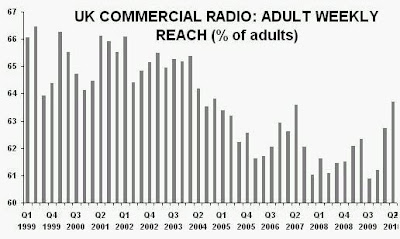
UK commercial radio adult weekly reach hit an all-time low of 60.9% as recently as Q3 2009, then subsequently made gains in three consecutive quarters to 63.7% in Q2 2010. Growth? Yes (three consecutive quarters). Sustained growth? Not really. Long-term growth? No.

UK commercial radio total adult listening hit an all-time low the previous quarter (Q1 2010) of 419m hours per week, then bounced back in Q2 2010 to 445m hours per week. Growth? Yes (one quarter). Sustained growth? No. Long-term growth? No.

UK commercial radio average hours listened per adult listener hit an all-time low of 13.0 hours per week the previous quarter (Q1 2010), then bounced back in Q2 2010 to 13.5 hours per week. Growth? Yes (one quarter). Sustained growth? No. Long-term growth? No.

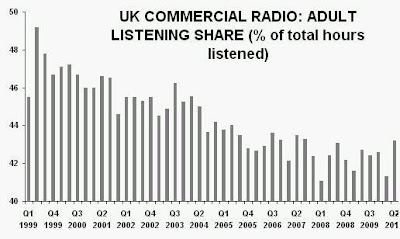
UK commercial radio’s share of adult listening hit an all-time low of 41.1% in Q1 2008 and, since then, has bounced up and down. Last quarter (Q1 2010), it had hit its second lowest level ever (41.3%) before rebounding to 43.2% in Q2 2010. Growth? Yes (one quarter). Sustained growth? No. Long-term growth? No.

UK commercial radio absolute adult reach is the only metric that is presently at an all-time high of 32.9m adults per week in Q2 2010. It jumped up that quarter because once a year, in Q2, RAJAR increases all its adult totals to account for the 1% per annum UK population increase. It is positive that more people are listening to commercial radio but, at the same time, as the result of population growth there are also more people listening to BBC radio, and more people not listening to radio at all. However, commercial radio’s absolute reach has not grown sufficiently in the long term to even keep pace with the increasing UK population.

So, in total, it seems impossible to locate commercial radio’s “long-term and sustained growth” in the latest RAJAR data. I point out these facts because I want to see commercial radio succeed. The sector desperately needs to attract more hours listened in the long term if it is to improve revenues and return to profitability. This has not yet happened. There is no point pretending that it has.

As for RadioCentre, an inaccurate statement of fact is an inaccurate statement of fact is an inaccurate statement of fact. Telling the world that your industry is enjoying “long-term and sustained growth” might be good propaganda for rallying your troops, but surely it must undermine the commercial radio industry trade body’s credibility with the rest of the world if it clearly is not true.

What is to be achieved for the radio sector by the RadioCentre press release crossing that line between hype and untruth?

Choice FM R.I.P.: the birth and near death of licensed black music radio in London

31 March 1990 was the memorable day when London‘s first licensed black music station, Choice 96.9 FM, arrived on-air. Until then, the availability of black music on legal radio had been limited to a handful of specialist music shows, even though about half of the singles sales chart was filled with black music. The decision by then regulator the Independent Broadcasting Authority [IBA] to license a London black music station was part of a huge government ‘carrot and stick’ campaign to rid the country of pirate radio. On the one hand, new draconian laws had been introduced that made it a criminal offence even to wear a pirate radio T-shirt or display a pirate radio car sticker. On the other hand, the establishment knew that some kind of olive branch had to be offered to the pirate stations and their large, loyal listenership.

Many pirate stations, having voluntarily closed down in the hope of becoming legitimate, were incensed when the IBA instead selected Choice FM for the new South London FM license. Its backers had no previous experience in the London pirate radio business, but had previously published ‘Root’ magazine for the black community in the 1970s. Although it was impossible for one station to fill the gap left by the many pirates, Choice FM tried very hard to create a format that combined soul and reggae music with news for South London’s black community, which was precisely what its licence required. The station attracted a growing listenership and it brought a significant new audience to commercial radio that had hitherto been ignored by established stations. With Choice FM, the regulator succeeded in fulfilling two aspects of public broadcasting policy: widening the choice of stations available to the public; and filling gaps in the market for content that only pirate radio had supplied until then.

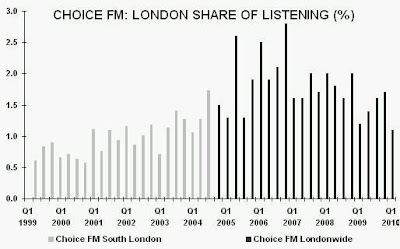
In 2000, Choice FM won a further licence to cover North London with an additional transmitter. For the first time, the station was now properly audible across the whole capital and had access to more listeners and more potential advertising revenues. Its listening doubled and, at its peak in 2006, Choice FM achieved a 2.8% share, placing it ahead of TalkSport and BBC London in the capital. Choice FM had no direct competitor in London, although indirectly some of its music had always overlapped Kiss FM. The station’s future looked rosy.

However, the Choice FM shareholders must have realised just how much their little South London station was worth, at a time when commercial radio licences were being acquired at inflated prices. Already, in 1995, Choice FM shareholders had won a second licence in Birmingham, but had then sold the station in 1998 for £6m to the Chrysalis Radio group, who turned it into another local outlet for its network dance music station Galaxy FM. At a stroke, the black community in Birmingham had lost a station that the regulator had awarded to serve them. Black radio in Birmingham was dead. The die was cast.

The then regulator, the Radio Authority, had rubber-stamped this acquisition, stating that it would not operate against the public interest. The Authority requested some token assurances: at least one Afro-Caribbean member on the station’s board; an academy for training young people, especially from the black community, in radio skills; and market research about the impact of the format change on the black community. None of these made any difference to what came out the loudspeaker. Birmingham’s black community was sold down the river.

Changes in UK media ownership rules were on the horizon that would soon allow commercial radio groups to own many more stations within a local market. As a result, in 2001, the UK’s then largest radio group, Capital Radio plc, acquired 19% of Choice FM’s London station for £3.3m with an option to acquire the rest. In 2003, it bought the remaining 81% for £11.7m in shares, valuing the London station at £14.4m. The Choice FM shareholders had cashed in their chips over a five-year period and had generated £21m from three radio licences. What would happen to Choice FM London now?

Graham Bryce, managing director of Capital Radio’s London rock station Xfm (which Capital had acquired in 1998 for £12.6m), said then:

“Our vision is to build Choice into London’s leading urban music station, becoming the number one choice for young urban Londoners. Longer term, we intend to fully exploit the use of digital technology to build Choice nationally into the UK’s leading urban music station and the number one urban music brand.”

Capital Radio and subsequent owners seemed to want to turn Choice FM into a station that competed directly with Kiss FM (owned by rival EMAP). But they never seemed to understand that Kiss FM was now a ‘dance/pop’ station, whereas Choice FM had always been firmly rooted in the black music tradition of soul, reggae and R&B. Such semantics seemed to be lost on Choice FM’s new owners and on the regulator, but certainly not on Choice FM’s listeners, who had no interest in Kylie Minogue songs.

In 2004, Capital Radio moved Choice FM out of its South London base and into its London headquarters in Leicester Square. The station’s final link with the black community of South London it had been licensed to serve was discarded. In 2005, Capital Radio merged with another radio group, GWR plc, to form GCap Media plc. In March 2008, Global Radio bought GCap Media for £375m. In July 2008, Choice FM managing director Ivor Etienne was suddenly made redundant. One of the station’s former founder shareholders commented:

“I’m disappointed that the new management decided to relieve Ivor Etienne so quickly. My concern is that I hope they will be able to keep the station to serve the community that it was originally licensed for.”

However, from this point forwards, it was obvious that new owner Global Radio had no interest in developing Choice FM as one of its key radio brands. In the most recent quarter, the station’s share of listening fell to an all-time low of 1.1% (since its audience has been measured Londonwide). Sadly, the station is now a shadow of its former self, even though it holds the only black music commercial radio licence in London (BBC digital black music station 1Xtra has failed to dent the London market, with only a 0.3% share).
This week, news emerged from Choice FM that its reggae programmes, which have been broadcast during weekday evenings since the station opened, will be rescheduled to the middle of the night (literally). One of the UK’s foremost reggae DJs, Daddy Ernie, who has presented on Choice FM since its first day, will be relegated to the graveyard hours when nobody is listening. From 2003, after the Capital Radio takeover, reggae songs have been banished from the 0700 to 1900 daytime shows on Choice FM. Now the specialist shows will be removed from evenings, despite London being a world centre for reggae and having more reggae music shops than Jamaica.

Station owner Global Radio responded to criticism of these changes in The Voice newspaper: “Choice [FM] has introduced a summer schedule which sees various changes to the station including the movement of some of our specialist shows.”

Once again, the regulator will roll over obligingly and rubber-stamp these changes. For Global Radio, the endgame must be to transform the standalone Choice FM station into a London outlet for its Galaxy FM network. At present, London-based advertisers and agencies can only listen to Galaxy on DAB or via the internet. A London Galaxy station on FM would bring in more revenue for the brand as a result of more listening hours and its higher profile in the advertising community. It would also provide a direct competitor to Kiss FM London (ironic, because Galaxy FM had been launched in 1990 by an established commercial radio group as an out-of-London imitation of successful, London-only Kiss FM). Global Radio’s argument to persuade the regulator will probably be that Choice FM’s audience has fallen to uneconomic levels. And whose fault was that?

Already, Global Radio’s website tells us that “Choice FM is also included as part of the Galaxy network” which “consists of evolving mainstream music supported by entertaining and relatable presenters.” And yet, according to Ofcom, Choice FM’s licence is still for “a targeted music, news and information service primarily for listeners of African and Afro-Caribbean origin in the Brixton area but with cross-over appeal to other listeners who appreciate urban contemporary black music.” How can both these assertions be true of a single station?

For the black community in London, and for fans of black music, this will be the final straw. Just as happened in Birmingham, the new owner and the regulator will have collectively sold Choice FM’s listeners down the river. Another station that used to broadcast unique content for a unique audience will have been wilfully destroyed in order to make it almost the same as an existing station, playing almost the same content. We have many commercial radio stations, but less and less diversity in the music they play. Radio regulation has failed us.

For Choice FM, the writing was on the wall in 2003 when Capital Radio bought the station and one (unidentified) former DJ commented:

“Choice [FM] was there for a reason [to be a black music station for black people], but that reason changed [since] 13 years ago. That’s why you’ve got over 30 pirate stations in London. If Choice FM kept to the reason why they started, you wouldn’t need all them stations. But Choice has become a commercial marketplace. They’ve sold the station out and they should just say they’ve sold the station out. What’s wrong with that? They have sold the station that was set up for the black community and they know they’ve done the black community wrong. But they’ve made some money and they’ve sold it. Why not let your listeners know?”

For me personally, as a black music fan and having listened to Daddy Ernie for twenty years, I am much saddened. In the 1970s and 80s, I had found little on the radio that interested me musically, so I listened to pirate stations and my own records. During those two decades, I actively campaigned for a wider range of radio stations to be licensed in the UK and, by the 1990s, I had played a direct role in making that expansion of new radio services happen successfully. Where did it get us? Now, years later, I have gone back to listening mostly to pirate radio and my own records (and internet radio). I am sure I am not the only one.

The radio industry and the regulator seem not to understand one important reason why radio listening and revenues have been declining for most of the last decade. They need to examine how, through their decisions, they have consistently sold down the river their station audiences and the very citizens whom their radio licenses were specifically meant to serve. Listeners vote with their ‘off’ buttons when station owners renege on their licence promises and the regulator lets them. Choice FM is sadly just one example.

In 2006, a lone enlightened Ofcom officer, Robert Thelen-Bartholomew, had asked at a radio conference:

“Is there room to bring the content of illegal stations into the fold? One way or another, whether we like it or not, we have a large population out there listening to illegal radio. Why do they listen? We are trying to find out. But, if you listen to the stations, they are producing slightly different content and output [from licensed stations]. Some of it is very high quality. Some of it is very interesting. So, what options are there for bringing some of that content into mainstream radio?”

Seemingly, none. The last FM commercial radio licence the regulator offered in London was more than a decade ago. Last year, when two small South London FM stations (one licensed for a black music format) were closed by their owner, the regulator unilaterally decided not to re-advertise their commercial radio licences (see the story here). A pirate radio station has not been awarded a commercial radio licence by the regulator for two decades.

Why do pirate radio stations still exist? Because, just as in the 1970s and 1980s, there are huge gaps in the market for radio content that – in spite of BBC radio, commercial radio and their regulators – remain unfilled. It is no coincidence that the share of listening to ‘other’ radio stations (i.e. not BBC radio and not commercial radio) in London is near its all-time high at 3.1%.

Farewell, Choice FM. I knew you well for twenty years.

And, irony of ironies, we are in Black Music Month.

[thanks to Sharleen Anderson]

Commercial radio revenues: always look on the bright side of less

Last week’s press release from the Radio Advertising Bureau was ecstatic about the commercial radio sector’s revenues. It told us that, in 2009, radio’s share of total display advertising had increased to 5.9% from 5.8% the previous year. It told us that this was the radio sector’s first growth in share since 2004. It told us that this was “terrific” news:

“To see the first annual share growth for five years, during the worst recession in living memory, is a terrific achievement for the commercial radio sector, and one that is unmatched by any other traditional media. It is a strong signal that the sector has turned a corner and not only halted decline, but moved into renewed growth, and is further evidence that the commercial radio industry’s on-going investment into programming, talent and marketing is paying dividends in both audience and revenue performance.”

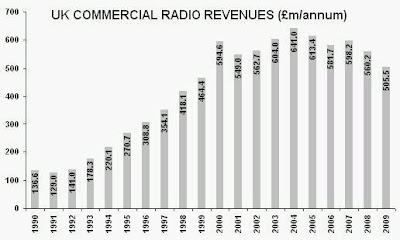
I was stunned by this fantastic success story. So stunned that I had to check the industry’s own revenue numbers to make sure I had not been mistaken. A quick look at the figures reminded me of what I had thought I already knew. In 2009, commercial radio revenues had been down 10% year-on-year. That is ‘down’ as in ‘less’, not ‘down’ as in ‘more’. The only reason that radio’s share of all media display advertising increased at all in 2009 was that, whilst radio lost 10% of its revenues, media in aggregate lost 13%. In other words, radio’s performance in 2009 was less worse than the average. This is much like boasting you are top of a school remedial class.


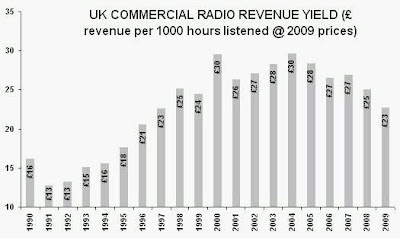
The Radio Advertising Bureau press release tried to position radio’s revenue performance in terms purely of cyclical ‘credit crunch’ factors. In fact, commercial radio’s problems with revenues are largely structural and started in 2005 (see graph), well before the ‘credit crunch’:
• 2009 revenues: down 10% year-on-year
• 2008 revenues: down 6% year-on-year
• 2007 revenues: up 3% year-on-year
• 2006 revenues: down 5% year-on-year
• 2005 revenues: down 4% year-on-year

As a result, radio revenues, which totalled £505.5m in 2009, are now:
• At their lowest level since 1999
• At their lowest level, in real terms, since 1997 (adjusted for inflation)

It is difficult to understand how commercial radio’s largest ever year-on-year revenue decline gives “a strong signal that the sector has turned a corner and not only halted decline, but moved into renewed growth”, as the Radio Advertising Bureau would have it.

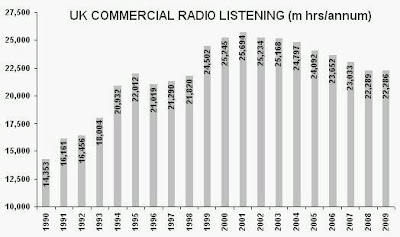
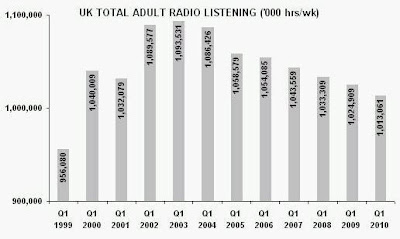
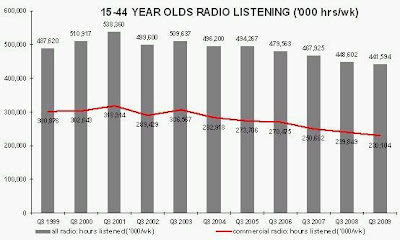
It would be great to see the commercial radio sector give a “strong signal” that it has turned a corner, any corner. But sector revenues are falling in the long term because the volume of listening to commercial radio is declining in the long term, having peaked in 2001 (see graph). Less listening inevitably leads to lower revenues.

Worse, not only are commercial radio revenues and listening both going down, but the amount of money the sector is able to generate from each 1,000 hours of radio listening is also going down. In real terms (adjusted for inflation), commercial radio’s ‘revenue yield’ fell to £23 per 1,000 hours in 2009, which is where it had been in 1997 (see graph). This is probably the outcome of fewer radio advertising spots, or lower radio advertising rates, or a combination of both. Reduced yields inevitably lead to lower revenues.

To combat these structural issues, the major challenge for the sector must be to attract more listening to commercial radio. That will require a strategy that is pragmatic and focused on listener needs. Pumping out press releases that try to gloss over the commercial radio sector’s largest ever year-on-year revenue decline with phrases like “terrific achievement” is part of the problem, not part of a solution.

What is RAJAR’s function? Cheerleader or research bureau?

This week’s publication of the latest UK radio listening figures begs the question as to what RAJAR’s function is:

• Is RAJAR a cheerleader for radio, to convince Licence Fee payers and advertisers how successful radio is? Or,
• Is RAJAR a serious research agency providing objective data to advertisers and advertising agencies about radio audiences?

I ask because this week’s media coverage of the latest RAJAR results seemed to result entirely from the cheerleader role, while the objective data role was nowhere to be seen.

The Guardian headline said: “Radio’s booming”. The BBC News headline said: “Radio listening soars”. The Media Week headline said: “Radio industry buoyed by strong Q1”. The Drum headline said: “All time radio high”.

So the radio sector is apparently performing better than ever? Well, if you believe the opening statements of the RAJAR press release:
• “Radio listening reaches an all time high as 46.5 million adults tune in to radio”
• “Radio listening in the UK has reached an all time high as 46.5 million adults, or 90.6% of the UK population (15+), tuned in to their favourite radio station each week”

The question is: who is this press release for? Certainly, it is not for the people who use RAJAR data for their work – buyers in advertising agencies and advertisers – who know from their daily examination of the detailed numbers that “radio listening” is certainly not at all at an all-time high. Rather, the volume of radio listening has been in decline since 2003, a long-term trend that shows no sign of abating.

The RAJAR press release is deliberately misleading in its use of wording. This is by no means the first time. Previous RAJAR press releases have claimed that radio listening has hit some kind of high. In RAJAR-land, every day seems to be a sunny day. This is the kind of PR puff we come to expect from commercial companies. But RAJAR is not selling anything. It is meant to be providing objective radio listening data to the media sector. It is funded jointly by the BBC Licence Fee and commercial radio.

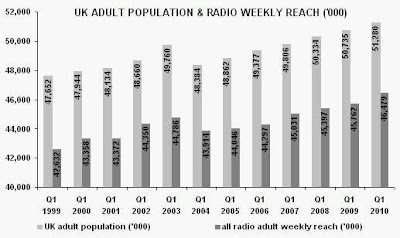
In fact, the “all time high” assertion in the RAJAR press release derives solely from the fact that more people are listening to radio than ever before. This is good news, but the number of people listening to radio is at an “all time high” for the same reason that hospitals have more patients than ever, schools have more children than ever, and public transport has more users than ever. The adult population of the UK is increasing by around 1% per annum. More people = more people using things.

So from where does the RAJAR assertion “radio listening reaches an all time high” derive? It is nothing more than hot air. If, in using the phrase “radio listening”, RAJAR had meant to imply “the volume of radio listening”, then it is a plain lie.

More people are listening to the radio, but they are listening for less and less time. The volume of radio listening, the total number of hours that all UK adults spend listening to the radio, has been declining since 2003. Here is a graph of RAJAR’s own data that shows it:

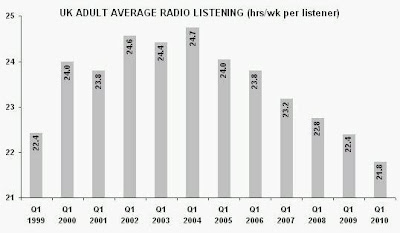
The average amount of time adult radio listeners spend listening to the radio has been declining dramatically over the same period. Here is a graph of RAJAR’s own data that shows it:

Are either of these facts, from the same research, mentioned in the latest RAJAR press release? Of course not. Why? Because RAJAR’s cheerleader role seems to require it to publicise a metric for radio listening that shows an increase: the absolute number of people listening, in this press release.

Here is a graph that shows the increase in the UK adult population and the number of people listening to radio. When the estimated population goes up, the estimated number of radio listeners goes up!

The airtime buyers in advertising agencies who have to use RAJAR data on a day-to-day basis probably chuckle at the preposterousness of the RAJAR press releases, laugh at how gullible the media are to simply reprint their headlines, and then go back to their work.

For some people (like me, having analysed radio audience data for 30 years), it creates market confusion. Clients are understandably puzzled and baffled when they see a presentation that clearly shows radio listening is in decline in the UK. They inevitably ask with suspicion: “But didn’t RAJAR just say that radio listening is at an all-time high?”

So why is RAJAR hell bent on this policy of trying to pull the wool over people’s eyes? Why does it need to be a public cheerleader for radio when we already have RadioCentre, the Radio Advertising Bureau and the BBC Press Office, each issuing their own PR puff on the RAJAR results? The RAJAR press releases might convince journalists, but they certainly don’t fool the media industry players. Instead, the opposite effect is probably the case.

How can the radio industry expect to be treated seriously within the wider media sector when its industry ratings body, charged with publishing objective listening data, insists upon grabbing headlines with misleading facts about radio audiences?

Digital radio station listening: a blip in time saves 6?

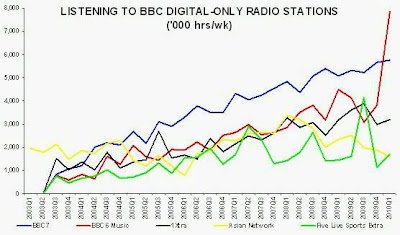
The dramatic upswing in BBC 6 Music’s listening during the first quarter of 2010 did not appear to have a knock-on effect on the BBC’s other digital stations [see graph]. 1Xtra was up slightly but still lower than it was in 2009. Asian Network dropped further and is now listened to less than part-time station Five Live Sports Extra.

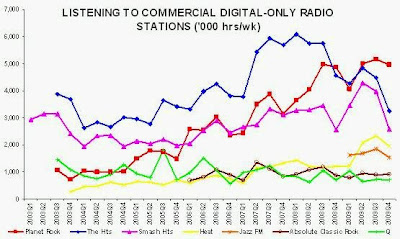
In the commercial radio sector, Planet Rock recorded its best quarter yet and cemented its lead over all its digital-only competitors (BBC 6 Music excepted) [see graph]. Its continuing success only confirms that consumers prefer real programme content to the digital music jukeboxes whose performances are little more than limping along.

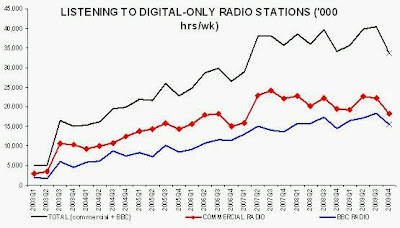
Even with this most recent quarter’s boost from BBC 6 Music and Planet Rock, total listening to digital-only stations has still shown almost no growth for three years [see graph]. Without the coincidence of those two successes, the latest quarter would have proven another disaster.

The question is what the next quarter will look like. We have seen listening to BBC 6 Music rise temporarily before at times when the channel has been in the press. Attracting listeners is only half the job. Keeping listeners is the much harder part.

Does the BBC 6 Music listening blip change the bleak outlook for digital radio stations? Not at all. Why? Because, even after this sudden upswing, 6 Music still attracts only two-thirds of the volume of listening to Radio 3, the BBC’s least listened to analogue national network. 207% of almost nothing still equals very little.

Digital radio stations: listeners abandon ship

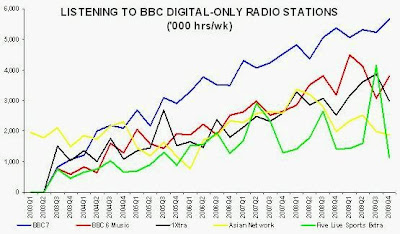
The latest RAJAR radio audience data demonstrated one thing clearly: the UK radio industry’s strategy for its digital stations is in tatters. Audiences for digital radio fell off a cliff during the last quarter of 2009. This did not appear to be the result of any specific strategy shift (no station closures, only one minor format change) but more the result of increasing public malaise about the whole DAB platform and the radio content that is presently being offered on it (plus a little Q4 seasonality) . The figures speak for themselves.

Total listening to digital radio stations is back down to the level it achieved in 2007, following a period of sustained growth between 2000 and 2007. Far from moving towards some kind of exponential growth spurt as the industry had expected, total listening now seems to have plateau-ed. It appears that market saturation has already been reached for much of the content presently available on digital radio platforms, considerably earlier than had been anticipated, and at a level of listening that cannot justify these stations’ existences for their commercial or BBC owners.

In the commercial sector, only Planet Rock has maintained its momentum, probably a reflection of its commitment to offering its listeners genuinely unique content. Elsewhere, the jukebox music stations have suffered massive falls in listening, possibly a result of their ease of substitution by online offerings such as Spotify and Last.fm, and of owner Bauer’s policy to curb investment in digital radio broadcast platforms and content.

Commercial radio has talked the digital talk for years about striving to make DAB a successful platform, vaguely promising new digital radio ‘content’ that it has still not delivered. Instead, it has spent the last few years cutting costs, consolidating, lobbying the government, complaining about the BBC, closing its digital stations and contracting out its DAB capacity to marginalised broadcasters (religious, ethnic, government-funded and listener-supported stations) that will never attract mainstream audiences to the platform (and whose listening is not even measured in the RAJAR audience survey).

From the listener’s perspective, the only thing that has happened to the DAB platform in recent years is the disappearance of commercial digital stations such as OneWord, TheJazz, Core, Capital Life and Virgin Radio Groove. For the average consumer, the arrival of Traffic Radio, Premier Christian Radio or British Forces Broadcasting Service are hardly replacements.

A report commissioned by RadioCentre from Ingenious Consulting in January 2009 concluded:

“Commercial radio is now at a crossroads with respect to DAB. It needs either to accept that the commercial challenges of DAB are insuperable and retreat from it – such a retreat, because of contractual and regulatory commitments, would be slow and painful; or strongly drive to digital.”

In the year since this report was prepared, commercial radio has done neither. Instead, it has spent a small fortune on parliamentary lobbying, not one iota of which has had a direct impact on 10 million increasingly baffled DAB radio receiver owners. These latest RAJAR data convey their clear message that content is their only concern.

For the BBC, the problem is somewhat similar. With the exception of Radio 7, listening to its digital radio stations remains unimpressive, despite them benefiting from massive BBC cross-promotion over many years. Some stations are outright disasters – Asian Network is listened to less now than it was almost seven years ago, when only 158,000 DAB radios had been sold. Some stations are simply not suited to the DAB platform – 1Xtra targets a youth audience who listen to a lot of radio online and via digital TV, but who have little interest in DAB (particularly as DAB is not available in mobile phones). Some stations will become redundant in an increasingly on-demand world – Radio 7 would eventually be little more than a shopfront for the huge pick’n’mix BBC radio archive to be made available to consumers online.

For the BBC, it is becoming increasingly hard to justify spending, for example, £12.1m per annum on the Asian Network when its peak audience nationally is only 31,000 adults. Broadcast platforms such as FM attract huge audiences for a fixed cost, making them the most efficient distribution system for mass market live content. As a result, Radio 1 costs us only 0.6p per listener hour. By comparison, the Asian Network is costing 6.9p per listener hour, probably making it more expensive to ‘broadcast’ than to send each listener a weekly e-mail attaching the five hours of Asian Network shows they enjoy.

The BBC should still be congratulated for creating new digital radio services in 2002 that attempted to fill very specific gaps in the market which commercial radio was unlikely to ever find commercially attractive. This is precisely why we value a public broadcaster in the UK. However, the BBC digital radio strategy over the last decade has suffered from:
•   The BBC’s evident inability to successfully execute the launch of genuinely creative, innovative radio channels that connect with listeners (GLR, the ‘new’ Radio 1, the original Radio 5)
•   The BBC pre-occupation with constantly creating new ‘broadcast channels’ when most niche content is more suited to narrowcasting and delivery to its audience via IP (live, on-demand or downloaded).

For the UK radio industry, its digital ‘moment of truth’ has belatedly arrived. A new strategy now has to be adopted which does not continue to raise the DAB platform to the level of a ‘god’ that has to be worshipped above all others. The future of radio is inevitably multiple-platform and the industry’s focus has to be returned to producing content, rather than trying to control the platforms on which that content is carried.

I suspect that Tim Davie, director of BBC Audio & Music, will eventually lead these winds of change, following in the wake of director general Mark Thompson’s pronouncements at the end of this month as to where the internal financial axe will fall. Where the BBC leads, commercial radio will inevitably (have to) follow.

The future digital radio strategy is likely to be ‘horses for courses’. Rather than all radio content being delivered via all available platforms, it will in future be delivered only where, how and when it is most demanded by listeners. Our economic times make this mandatory. The DAB platform’s mass market failure will make it necessary.

Kiss FM: it's the same old songs

London dance music radio station Kiss FM has re-scheduled its specialist shows to slots after midnight, according to The Guardian, and has cut their duration from two hours to one hour. Almost nobody listens to radio on a weekday after midnight, RAJAR audience data show, so the policy change condemns these shows to a radio graveyard that is very close to extinction.

According to Kiss FM specialist DJ Logan Sama: “The shift of focus away from upfront specialist music to more playlisted hours is one which the management feel will enable the station to compete with the likes of Capital and Galaxy FM. All of the genre-specific late-night shows took the brunt of the hit.”

When Kiss FM was launched in 1990, its specialist music shows started at 7.30pm on weekdays, and the preceding half-hour magazine show ‘The Word’ created a watershed between the daytime mainstream playlist and the more radical evening shows. There was a specific commitment in the station’s licence to broadcast these shows so that Kiss FM would give airplay to music unheard anywhere else on the radio in London.

In the intervening years, through attrition, Kiss FM’s owner (EMAP then, Bauer now) has succeeded in ‘persuading’ the regulator to loosen these licence requirements for the station to broadcast specialist music shows. To its discredit, the regulator has seemed happy to go along with such proposals, permitting Kiss FM to be turned into a much more mainstream hit-orientated station than it was ever intended to be.

What the regulator and some radio owners seem to fail to grasp is that, in a crowded radio market such as London, one station can attract a significant (and loyal) audience by doing something deliberately different both from its competitors and from its own daytime mass-market output. This works both commercially and altruistically. In the case of Kiss FM, advertisers can reach a niche audience that daytime shows do not deliver (if I organise a reggae concert, the best place to advertise it is in a reggae radio show); citizens are offered a genuine extension to the ‘listener choice’ that the regulator loves to cite.

This is not just a theory – there is plenty of empirical evidence to demonstrate how it works. Look at Helen Mayhew’s evening ‘Dinner Jazz’ show on the original London Jazz FM, which was almost the only show on the station that delivered 100% jazz music, but also had higher ratings than any of the daytime playlisted output.

Kiss FM itself provides a good example of what can be achieved. In the graph above, the red line shows the current audience of Kiss FM London (RAJAR, Q3 2009) peaking at 147,000 adults at breakfast between 8 and 8.30am, then falling to a minimum of 1,000 adults by the early hours of the next morning. This is the normal pattern of listening for a mainstream music radio station in the UK.

The blue line shows the Kiss FM London audience a decade earlier in 1999 when specialist music shows still occupied the weekday evening hours. Note that, in the evening, during most of the hours from 7pm to midnight, the audience was bigger a decade ago than it is now. Has the subsequent replacement of specialist music shows with mainstream music in the evening improved Kiss FM’s audience at those times? Apparently not.

After the station launched in 1990, the daytime audience was lower than it is now, but the evening specialist music programmes generated huge audiences. Some of the Kiss FM evening shows attracted more listeners than any other London station in these evening timeslots, ranking them #1 in that daypart.

This was not an accident. Kiss FM’s original schedule was deliberately designed to attract significant audiences to each of a wide range of specialist music shows broadcast on weekday evenings. Listeners loved them – individual shows were promoted heavily on-air and in specialist music magazines. Advertisers loved them – the rates were cheaper than daytime and the spots regularly sold out.

Doing something different on-air can reap rewards, if you satisfy genuine listener demand and promote the hell out of it, so that people know the programmes are there. But, if you simply do the same in the evening that you are doing during daytime, your station is going to have much the same declining listening pattern as any other radio station.

If you compare Kiss FM’s current listening pattern to that of its competitors, you can see from the graph above that it delivers much the same weekday shape – a continuous decline from a peak at breakfast. The exception amongst the London commercial stations is Magic’s unusual peak between 10 and 11pm. Why? Because it schedules ‘The Mellow Ten At Ten’ each weekday evening from 10pm, a one-hour feature that breaks from its playlist.

Also noteworthy in the graph is the unusually high evening audiences achieved by Choice, with more listeners than the station attracts during the afternoon. Why? Because Choice schedules specialist music shows during weekday evenings (mixes, reggae, hip hop). Again, being different can pay off for both audiences and advertisers.

This concept – that individual radio stations often struggle to sound the same, even though ‘daring to be different’ pays dividends – has been understood since the earliest days of media theory. American economist Peter Steiner wrote:

“…. the existence of [different] program types and [different] audiences therefor is assumed by the broadcasting industry and forms the basis for [station] program decisions. In this case, it is the assumed size and distribution of listeners’ preferences that is decisive in determining the amount of [programme] duplication that will result. If, as is often suspected, broadcasters exaggerate the homogeneity of audiences and their preferences for certain program stereotypes, the tendencies towards [programme] duplication will be increased.”

Writing in 1951, Steiner already recognised that radio station owners will tend to duplicate each others’ formats and programme scheduling, rather than offering their audiences something different or unique. He wrote:

“The problem, of course, is that a series of competing firms, each striving to maximize its number of listeners, will fail to achieve either the industry or the social good. Here, then, competition is providing a less than desirable result.”

In the UK, our government created a broadcast regulator to intervene in the market to ensure that commercial radio station formats maximise the ‘social good’, as Steiner refers to it. The UK is in a very different situation from the US, where the regulator (FCC) does not interfere in the formats of radio stations. But the UK system will only work if the regulator understands the economic and social imperatives for market intervention and exercises those powers appropriately.

The increasing marginalisation over the years of Kiss FM’s specialist music programmes demonstrates that the regulator is oblivious to the economic and social imperatives to regulate. Instead, it is simply conspiring to deny both listeners and advertisers the programme diversity they should be entitled to. The fact is that ‘light touch’ radio regulation is not regulation at all, any more than driving a car with no hands on the steering wheel would be considered by a court to be ‘driving’.

A regulator that simply allows market forces, in Steiner’s words, to produce “a less than desirable result” is not regulating. The Independent was quick to blame Kiss FM’s owner:

“Once the king of pirate radio, the legendary station Kiss is being dragged into the mainstream by owners Bauer Media, which will today cut back a number of the Kiss specialist music shows and axe several presenters in order to reposition the network to take on Global Radio operations such as Galaxy. Shame.”

However, the blame should fall squarely on the regulator for allowing a station owner to pursue an objective that further restricts consumer and advertiser choice. There is no ‘free market’ for radio in London – the gap in the market created by Kiss FM’s marginalisation of specialist music genres and DJs will not be filled by another licensed radio station …… only by London pirate stations.

Pirate radio stations seem to be the only ones that implicitly understand Steiner’s competition theories perfectly, and they risk the consequences for putting them into action. Pirate radio’s popularity is no accident – it is a direct outcome of the failure of the regulator to regulate.

Internet radio: denigrate it, ignore it, marginalise it … consumers will still listen

It was a surprise to find that the entire front page of the most recent issue of the World DMB Forum’s global newsletter (‘Eureka!’) was filled with an article that did not extol the virtues of the DAB/DMB platform, but instead tackled the online radio platform and drew the conclusion that the internet “will NOT replace traditional broadcasting”. The article, entitled “The Future Of Radio”, sought to debunk the assertion that “the internet is the future of radio”.

It stated that the BBC iPlayer “allows the UK public to access almost all of its radio and TV programmes broadcast during the previous seven days”. This is inaccurate. The iPlayer offers nothing like “almost all” the BBC’s radio and TV output. Indeed, for some of the BBC’s radio and TV networks, the selection of content remains remarkably thin (mostly due to rights issues).

The article continued: “Given the outstanding success of the BBC’s iPlayer, it is surprising to learn from RAJAR’s latest audience figures that ‘radio via the Internet’ (in all its forms: live streaming; on-demand services and podcasting) accounts for only 2.2% of radio listening in the UK.

This is untrue. The RAJAR 2.2% share figure ONLY includes simulcast live streams of the BBC and UK commercial broadcasters. It does not include on-demand services; it does not include podcasts; it does not include listening to online radio services such as Last.fm, Spotify and Rhapsody; and it does not include listening to audio from overseas broadcasters. There is a detailed section on the RAJAR web site that explains these facts. RAJAR has never claimed that its data for ‘internet’ listening includes anything other than simulcast live streams of BBC and UK commercial radio stations.

The article then drew the conclusion: “Taking these differences in penetration into account shows that DAB listening in the UK is 10 times more popular than listening via digital TV or via the internet.” However, it is unclear what the phrase “10 times more popular” is trying to imply. Is that ‘10 times more listening’? Or maybe ‘10 times more reach’?

Interestingly, exploring the latter metric, RAJAR’s own research (as part of its MIDAS survey, rather than the main diary survey) found in December 2008 that the weekly reach of all internet-delivered radio content in the UK was 14%, compared to the DAB platform’s weekly reach of 17.8% during the same quarter (see graph below). Ten times more popular? The platforms were almost neck-and-neck in the ‘reach’ metric. I wrote about this research a year ago. It is the closest we have for now to a like-for-like comparison that includes all forms of audio delivered by the internet.


The most recent reach data for the internet platform in the above graph derives from Q3 2008 because RAJAR has not publicly released comparative data derived from its two subsequent MIDAS surveys (which are now only available on subscription).

RAJAR was keen to stress in its press release accompanying this week’s latest MIDAS 5 survey that:

74% of those Listen Again http://on-demand listeners said the service has no impact on the amount of live radio to which they listen, while half said they are now listening to radio programmes to which they did not listen previously”.

Somehow, the Daily Mail managed to mangle this factual statement into something that, yet again, portrayed the internet platform as an aggressor against DAB:

Rajar says the figures do not mean people are abandoning traditional or DAB radio sets but that more Britons are trying and using online stations as well.”


The problem the radio industry faces with the RAJAR audience metric is that it cannot have its cake and eat it. Either it chooses:

• to restrict RAJAR to measuring ‘traditional’, live radio and accepts that, as a result, the data will inevitably show that listening to ‘traditional’ radio is in continuing decline (which is RAJAR today, see graph above); or

• to expand the RAJAR metric to measure ‘audio’ consumption that includes on-demand and podcast content, as well as non-traditional radio such as Spotify and Last.fm, thus demonstrating that total listening is not at all in decline but, on the contrary, has been enhanced by audio content increasingly consumed via non-broadcast platforms and ‘on the go’.

For the BBC, Director of Audio & Music Tim Davie hinted at the last RadioCentre conference that he would be interested to see RAJAR extended to encompass time-shifted and downloaded audio, both of which account for an increasing proportion of BBC radio listening.

For its part, commercial radio has shown no interest in advocating such a re-definition of the RAJAR metric. Not only do its offerings of time-shifted and downloadable audio remain miniscule compared to the BBC, but it is locked into a strategy to maintain its ‘walled garden’. Understandably, it has no desire to demonstrate to the world that it is losing listening to competitors’ time-shifted audio and online ‘radio’. UK commercial radio has enjoyed a nice little over-the-air duopoly from 1973 until recently – best just to pretend that it remains one of only two games in town.

The paradox here is that commercial radio is busy presenting advertising agencies and potential advertisers with RAJAR data that only tell part of the story of how and what audio people are listening to in 2009. However, once their meetings with commercial radio people are over, those same advertisers and agencies will inevitably be busy booking advertising with all sorts of online media, including Last.fm and Spotify. They know precisely what opportunities are out there in the wide world beyond traditional broadcasting.

Simply ignoring new businesses that are competing for your listeners’ attentions is not going to make them go away. Sticking your head in the sand can only have the effect of devaluing RAJAR as a useful and accurate metric in the long term.

Remember King Canute.

BBC radio: endangering commercial radio's 'heartland audience'

Dear David Liddiment

I was interested to see your article in The Guardian, on behalf of the BBC Trust, defending Radio Two from accusations made by the commercial radio sector that the station has deliberately sought a younger audience. You say:

“What about the challenge that Radio 2 is getting younger? We found that Radio 2’s under-35 audience did grow significantly between 1999/00 and 2004/5 (albeit from a low base). However, over the past five years, the age profile of the station has remained stable and there’s been no increase in reach to under-35s.”

Your analysis here focuses on two specific metrics – under 35’s and Radio 2’s ‘reach’ – whereas the important issues raised by commercial radio rightly concentrate on:
• Commercial radio’s ‘heartland audience’ of 15 to 44 year olds, which it has pursued for many years as a result of advertiser demand to reach this segment of the population;
• ‘Share of listening’ as the appropriate metric because there is a direct correlation between this figure (how many hours are listened to commercial radio) and how much revenue the sector generates.

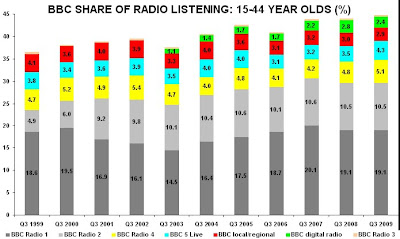
The graph below, taken from RAJAR data, shows the ‘share of listening’ attracted by BBC radio stations amongst 15-44 year olds since 1999.

It is evident that the listening share of most BBC stations has remained relatively static over this period. The exception is Radio Two, whose share of listening amongst 15-44 year olds has more than doubled from 4.9% to 10.5% over the last decade. It is true that this growth has started to level out in recent years, as your article asserts, but there is no denying that the damage has already been done.

The graph shows clearly that this significant increase in listening has not been achieved by migration from competing BBC radio services to Radio 2. On the contrary, the BBC’s overall share of listening amongst 15-44 year olds has increased from 36.5% to 44.7% during the last decade and, most importantly for commercial radio, is continuing to grow year-on-year.

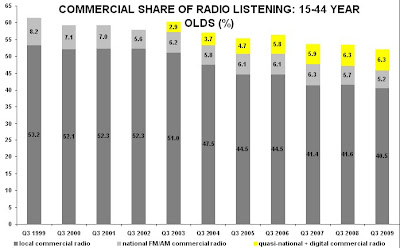
The graph below demonstrates clearly that it is commercial radio which has lost listening share, from both its local and national stations, that has migrated to the BBC. As a result, commercial radio’s listening share amongst 15-44 year olds has fallen from 61.7% to 52.1% over the last decade.

 
The danger for the commercial radio sector is that, if its market share falls below 50%, potential advertisers might no longer consider radio to be the ‘powerhouse’ delivery platform amongst 15-44 year olds that it used to be. The impact will not simply be a proportional loss in advertising revenues, but a significant loss of confidence in radio as an advertising medium to reach 15-44 year olds.

This is why, inside the BBC and Radio Two, a change in strategic policy might look as if it only results in an increase in BBC market share of a percentage point or two. For the commercial sector, not only does that single percentage point lead directly to a proportional loss of revenue but, sustained in the longer term, it can potentially undermine the medium’s ability to convince advertisers to use radio rather than, say, digital TV or the internet.

This is why the promise you make that “Radio 2 listeners won’t get any younger” is little comfort to a sector that has already been damaged by BBC strategic policies and which is continuing to lose market share year-on-year amongst its ‘heartland audience’ to BBC radio as a whole.

Of course, some of this listening loss can be attributed to commercial radio’s own competitive (in)ability to compete with the BBC – I would be first in line to argue that case – but unless its downward spiral of diminishing listening and diminishing revenues can be reversed, commercial radio could be decimated to the point where it can no longer be a financially viable business.

I write to you not to criticise Radio Two, which is a remarkable station, nor to apologise for the commercial radio sector, which has to shoulder considerable blame for losing touch with its audience. I write to illustrate that the industry’s own data clearly shows the BBC continuing to eat away at commercial radio’s ‘heartland audience’, and I write so that the BBC Trust might understand the consequences if the migration of radio listening to the BBC continues at its current rate.

Yours,
Grant Goddard

30 November 2009

Commercial radio and DAB: turkeys voting for Christmas

Significant players in the UK commercial radio industry, along with Digital Radio UK, the Digital Radio Development Bureau, DCMS and Ofcom are all lobbying for DAB receiver take-up to be accelerated and for consumers to migrate their radio listening to DAB as quickly as possible. However, the industry’s own data suggest that the pursuit of these strategies will simply reduce even further commercial radio’s already declining share of radio listening versus the BBC.

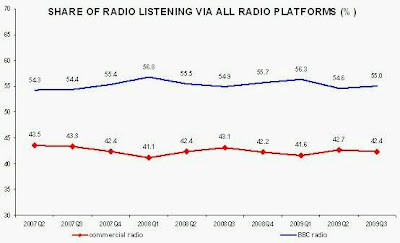
The commercial radio sector’s diminishing success in competing for listeners against the BBC remains one of its most pressing problems. In 1998, commercial radio’s share of listening was 51.1%, but that figure is now down to 42.4% [RAJAR Q2 1998 versus Q3 2009]. Conversely, the BBC’s share has increased from 46.8% to 55.0% over the same period. The long-term decline in commercial radio’s market power looks like this in recent quarters [see graph below]:

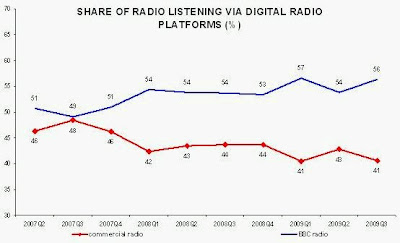
However, if we examine listening solely on digital radio platforms, we see that commercial radio is losing listening share much more sharply [see graph below]. In 2007, commercial radio’s share of listening via digital platforms had been above the average for all platforms and so was ‘helping’ the overall fight against the BBC for market share. However, in two of the last three quarters, commercial radio’s share via digital platforms has been lower than for all platforms, and so is now dragging down the sector’s overall market share.

Worse, with each new quarter, radio listening via digital platforms is growing as a proportion of total radio listening, so that the ‘contribution’ of digital platforms to the overall picture is becoming greater. In Q2 2007 (the earliest point on the timescale of these graphs), digital platforms accounted for only 12.9% of total listening. In the latest quarter, that proportion has increased to 21.1%.

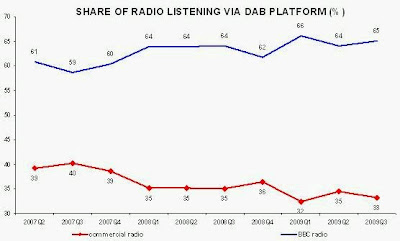
Now, if we extract listening via DAB from the total for all digital platforms, we observe two phenomena [see graph below]. Firstly, commercial radio is badly losing the battle for DAB platform usage to the BBC by a ratio of 1:2. Secondly, commercial radio’s performance on the DAB platform is worsening over time. It is the combination of these two trends which is dragging down not only the commercial sector’s share of digital platforms, but also its overall competitive performance against the BBC.

To make matters worse, DAB is the largest element of radio listening via digital platforms (up from 54.4% in Q2 2007 to 62.9% in Q3 2009 of listening via all digital platforms), and the DAB platform’s contribution to total radio listening is similarly growing (up from 7.0% in Q2 2007 to 13.3% in Q3 2009). DAB is the focus of the radio industry’s digital platform marketing campaigns, so the commercial sector’s current poor performance on this platform is disastrous.

The data suggests that, far from the DAB platform helping the commercial radio sector compete more effectively against the BBC, the absolute opposite holds true:
• The average adult with a newly acquired DAB radio uses it for listening in a way that effectively reduces the commercial radio sector’s overall share of listening versus the BBC
• Acceleration of DAB usage will only serve to accelerate the decline in commercial radio’s share of radio listening versus the BBC.

These outcomes are hardly surprising when one considers industry data which show that:
• DAB radios are purchased predominantly by older people (the average age of a DAB radio receiver owner is 46, according to RAJAR)
• Older people listen to BBC radio much more than to commercial radio (BBC radio accounts for 63% of radio listening amongst over-45s, according to RAJAR).

The paradox is that stakeholders in commercial radio continue to push for DAB to be adopted by consumers as quickly as possible, even though the inevitable outcome will be to reduce further the commercial sector’s listening share, handing the BBC even more of a competitive advantage.

So why exactly does the notion continue to be voiced by significant players in commercial radio that the DAB platform is itself the answer to the sector’s present lack of competitiveness with the BBC?

[Data source: RAJAR. Statistical note: The graphs above to do not sum to 100% because the minimal amount of platform data released by RAJAR is ‘rounded’ (hours listened to 1,000,000 per week; listening shares to 0.1%) and the listening apportioned to the BBC and commercial radio sometimes does not sum to the total for a platform. Part of this shortfall may be accounted for by ‘other’ listening (neither the BBC nor commercial radio) which is not itemised by platform. Data for individual quarters are therefore somewhat inconsistent, though the trend over several quarters is likely to be indicative.]