Growing DAB radio usage in the UK. Confused? You should be!

“Digital listening at an all-time high,” shouted the headline of one online news story. Yes, it was the quarterly RAJAR radio ratings, offering opportunities for some journalists to pitch their stories just about any which way they wanted. The opening sentence of this particular report said:

“The digital revolution shows no signs of slowing down, and not even the radio airwaves are set to maintain their analogue tradition, as a new [RAJAR] study suggests.”

Hardly. This news story was interesting because it achieved two simultaneous feats of confusion:
• ‘DAB radio’ and ‘digital radio’ are two different things. ‘DAB’ is the platform on which the UK radio industry bet the farm in the 1990s. ‘Digital radio’ is radio received on any platform that is not analogue (AM/FM) and includes the internet, smartphones, digital TV … and DAB
• The fact that DAB listening is growing does not necessarily mean that it is replacing analogue listening at a rapid rate of attrition. Why? Because DAB listening, even after 12 years, is still at a remarkably low level.

These confusions are not accidental. At every opportunity, statements made by Digital Radio UK have sought to confuse the public by referring to ‘digital radio’ as if it means precisely the same as ‘DAB radio.’

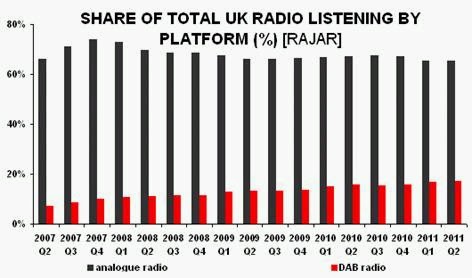
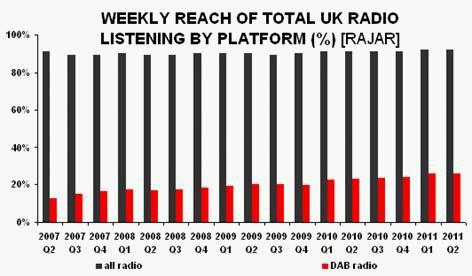
A look at the graphs below of the latest RAJAR data illustrate clearly that the “analogue tradition” in radio remains so dominant that the real question to be asked is: how come DAB usage is still so low after so many years and after so much money has been invested in content, transmission systems and marketing?

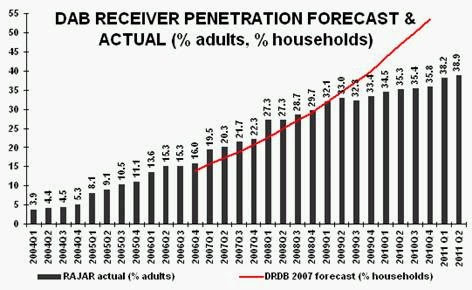
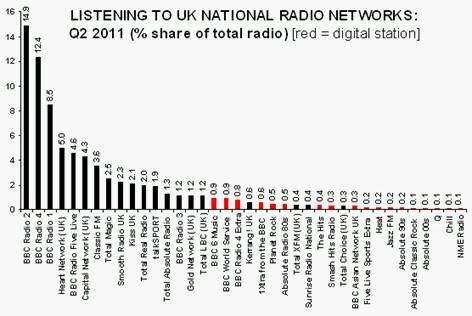
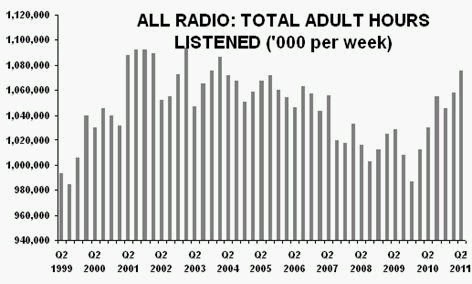
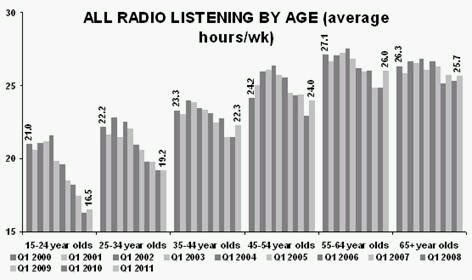
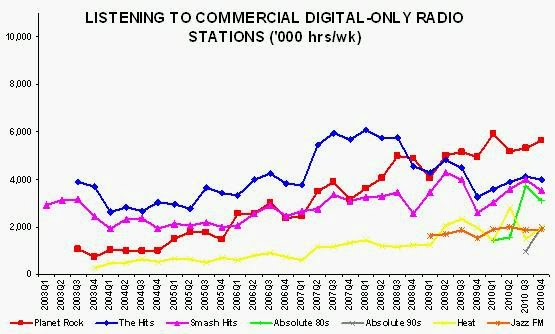
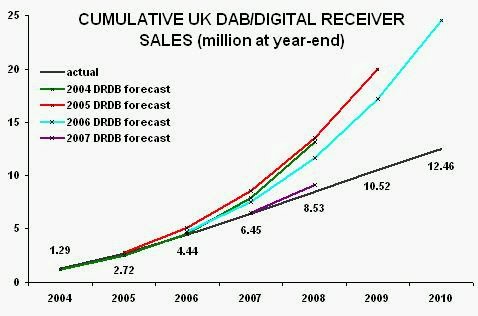
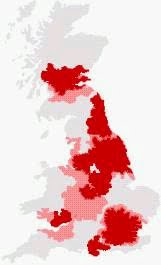
The adage ‘a picture speaks a thousand words’ has never been more true than with DAB/digital radio usage. The four graphs above – all taken from the industry’s latest RAJAR data – say it all by showing:
• how little impact DAB radio has had on analogue radio usage in the UK
• how slow the rate of growth is of DAB receiver take-up and of digital radio station listening.

Far from radio losing its “analogue tradition,” as the news article asserted, the old FM/AM platforms look, from these data, to be as strong as ever in the market.

One hint that some digital radio stations on the DAB platform could be on their way out is the BBC’s latest decision to aggregate listening for Radio 4 and Radio 4 Extra in RAJAR. It had been doing this from the outset for Five Live and Five Live Sports Extra, on the premise that ‘Sports Extra’ was only a part-time broadcast station.

I would not be at all surprised to see the BBC:
• similarly aggregate Radio 2 listening with 6 Music
• similarly aggregate Radio 1 listening with 1Xtra
• downgrade its digital radio stations from full-time DAB broadcast stations to online, on-demand ‘extra content’ available via RadioPlayer, iPlayer and applications.

The problem with national broadcast BBC radio stations, whether analogue or DAB, is that the BBC Charter insists they must be made available universally to all Licence Fee payers. Given the huge cost of extending the BBC’s national DAB transmission multiplex to near-universal coverage equivalent to FM radio, particularly at a time when the BBC is having to cut budgets massively, it would be more sensible to downgrade ‘1Xtra’, ‘2Xtra’ and ‘4Xtra’ to ‘red button’ status whereby they offer additional content on a part-time basis. The consumer would access these Extra ‘stations’ via a complementary platform (IP) rather than the BBC having to shoulder the financial burden of programming them as 24-hour broadcast entities.

It would prove a convenient solution for the BBC. As it found with 6 Music last year, public controversy surrounds any decision to close a radio station, however small its audience in absolute terms. Alternatively, by pursuing the ‘Extra’ route, the digital stations can be re-branded, re-purposed and re-platformed away from expensive, fixed-cost DAB and towards IP, where the cost of delivery varies proportionately with the number of people using it. What better way to deliver value for money to Licence Fee payers? And what better way not to face public wrath for ‘closing’ a digital radio station.

As BBC Radio 2 DJ Steve Wright said on today’s Broadcasting House show:
“Maybe full digitisation [of radio from FM/AM to DAB] may well take thirty years …”

As the graphs above demonstrate, there IS slow growth in DAB usage, but the rate is insufficient to replace analogue radio as the dominant consumer platform any time soon. It’s time for BBC strategy to catch up with that reality.

UK listening growth demonstrates radio's strengths in a multi-tasking world

The latest RAJAR ratings data for Q2 2011 demonstrate the continuing strength of the radio medium in recession Britain. Maybe if your TV or mobile subscriptions are having to be pruned, you turn to radio instead. In times of austerity, one of radio’s greatest attributes is that it appears to consumers to be available ‘free’ at the point-of-use.

‘All radio’ listening (1,076m hours per week) is at its highest since 2003. Adult weekly reach is 91.7%. Each listener spends an average 22.6 hours per week with ‘radio.’ These are impressive numbers. In this respect, it is important to remind ourselves that the RAJAR definition of ‘radio’ excludes:
• ‘listen again’ consumption of broadcast radio (online catch-ups of ‘The Archers’, for example)
• all podcasts
• listening to pure online radio stations
• listening to online music streaming services or personalised online radio (Last.fm, Spotify, etc).

If these additional ‘radio’ consumption sources could somehow be added to the RAJAR data, it looks likely that, using a wider definition, ‘radio’ would be performing at an all-time high. This is not at all surprising in our time-precious, multi-tasking world. Radio proves the perfect aural accompaniment to online social activities, whereas it is nigh impossible to watch television or read a newspaper at the same time as you browse the internet. Radio is a secondary medium – it never monopolises your time.

Commercial radio has benefited from this uplift in total radio listening. Total hours listened to commercial radio (470m per week) have risen from what is beginning to look like a nadir in early 2010.

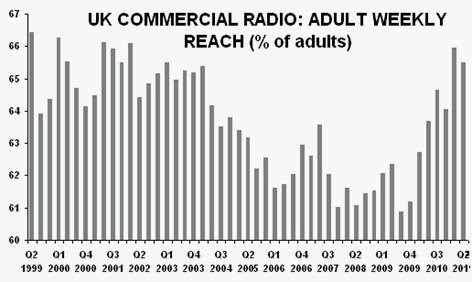
During the last two quarters, commercial radio’s adult weekly reach has jumped above the 65% threshold (65.5% in Q2 2011) that had not been breached since 2003.

In absolute terms, commercial radio’s adult weekly reach has almost caught up with the UK population growth experienced since 1999, rising to 34m in Q2 2011, marginally below its all-time high the previous quarter.

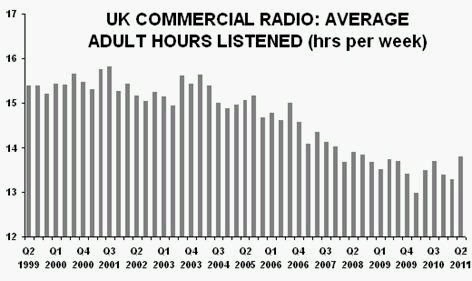
The remaining stumbling block for commercial radio is that its average hours consumed per listener remain stubbornly low (13.8 in Q2 2011). As noted previously, young people are spending less time with radio [see blog]. Commercial radio’s audence is considerably more youth-orientated than BBC radio, which is why the average length of time for all adults listening to commercial radio remains in the doldrums.

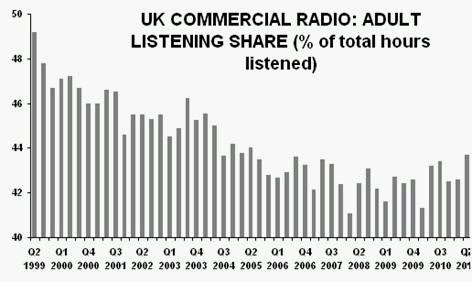
With all this good news for the commercial radio sector, you might imagine that its share of total radio listening had started gaining in leaps and bounds at the expense of the BBC. Unfortunately, this is not the case. The BBC has benefited just as much as commercial radio has from the overall increases in radio listening. As a result, everyone’s volumes are ‘up’ and the share of commercial radio versus BBC radio has remained relatively constant. In Q2 2011, commercial radio’s 43.7% share was certainly an improvement on the situation in 2008, when it had looked as if the 40% barrier might be plumbed for the first time.

In fact, the BBC’s sustained strength in radio is becoming increasingly understated as more and more ‘radio’ listening is attributable to ‘listen again’ on-demand usage and podcasts. The BBC dominates the content available on both these platforms, whilst commercial radio’s offerings remain relatively sparse. At present, neither platform is measured within RAJAR. If they were, commercial radio’s share would undoubtedly be diminished further.

At present, this status quo (using RAJAR’s anachronistic definition of ‘radio’ as purely live and broadcast) suits both parties. The BBC does not wish to be seen to be even more dominant than it already is (54.0% of radio listening in Q2 2011). Commercial radio does not wish to be seen to be weaker than it already is (43.7%) in comparison to the BBC.

And who pays for RAJAR? The BBC and commercial radio. So we are stuck with an old fashioned metric that does not measure radio consumption in the 21st century sense of what we now call ‘radio,’ but which keeps both its paymasters happy … particularly as neither the BBC nor commercial radio would currently wish to demonstrate publicly the increasing popularity of online ‘radio’ consumption – which remains the biggest long-term external threat to them both.

Andy Parfitt leaves BBC Radio 1 on a high: separating the man from the myth

Andy Parfitt’s departure from the station controller job at BBC Radio 1 after thirteen years marks a significant event for the UK radio sector. Parfitt’s accomplishments during his tenure were many, but did not extend to significantly turning around the station’s audience ratings.

At the time Parfitt took on the controller job in March 1998 at Radio 1:
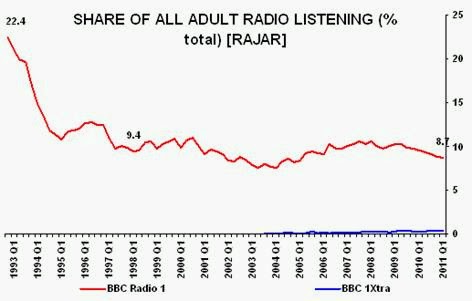
• its share of listening was 9.4%, compared to 8.7% in Q1 2011
• its adult weekly reach was 20%, compared to 23% in Q1 2011
• its average hours per listener per week were 8.1, compared to 7.8 in Q1 2011.

One metric did demonstrate a healthy increase – Radio 1’s absolute weekly reach was up from 9.7m adults in Q1 1998 to 11.8m in Q1 2011. However, part of that increase is attributable to the UK adult population having grown by 9% in the interim. Certainly, more adults listen to Radio 1 now than in 1998, but for shorter periods of time, and so the station’s share of total radio listening has declined.

Given this impasse to the improvement of Radio 1’s ratings, I was surprised to read in the BBC press release announcing Parfitt’s departure that:
“Appointed Controller, BBC Radio 1, in March 1998, Andy has led Radio 1 and 1Xtra to record audience figures …”

… and surprised to read Parfitt’s boss, Tim Davie, declaring that:
“Andy has been a fantastic Controller and leaves Radio 1 in rude health – with distinctive, high quality programmes and record listening figures …”

The one person still working at Radio 1 who should know for sure that “record audience figures” had not been achieved during the last quarter, last year, the last decade or during Parfitt’s entire tenure is Andy Parfitt. Why? Because, between 1993 and 1998, Parfitt had been chief assistant to then Radio 1 controller Matthew Bannister, a turbulent period during which the station’s audience was decimated by a misguided set of programme policies that failed miserably to connect with listeners.

Between the end of 1992 and March 1998, when Parfitt took over from Bannister (whom the BBC had promoted to director of radio), Radio 1’s:
• share of listening fell from 22.4% to 9.4%
• adult weekly reach fell from 36% to 20%
• average hours listened per week fell from 11.8 to 8.1
• absolute adult reach fell from 16.6m to 9.7m.

Radio 1 lost an incredible 58% of its listening, and 7m listeners, within that five-year period, a calamitous disaster from which the station has never recovered [see graph above]. Since then, Parfitt has kept the ship relatively steady, having been appointed in 1998 as a safe pair of BBC hands for Radio 1 after the tragedy of Bannister (who had come from Capital Radio via BBC GLR and had a fantastic track record in news radio, but not in music radio).

Never again will Radio 1 achieve a weekly audience of 17 million adults, as it had done in 1992. Those days are long gone. In recent years, fewer young people are listening to broadcast radio, and they are listening for shorter periods of time. Sadly, radio does not prove as exciting for them as the internet, games or social networking.

Of course, it would have been nice for any incumbent to leave the Radio 1 job on a ‘high.’ But, unfortunately, it was never going to happen with Parfitt, or probably with any successor. Radio 1’s ‘golden age’ was wilfully destroyed twenty years ago. Nevertheless, somewhere, somebody in the BBC must have decided to invoke the notion of Parfitt’s “record audience figures,” regardless or not of whether they were a fact.

What surprises me is that every BBC press release must have to pass through endless approvals – within the originating department, in the press office and in the lawyers’ office – before it reaches the public. Did nobody out of the dozens of people that must have checked this particular press release ask the simple question: can you substantiate this “record audience figures” claim?

RAJAR radio audience data are publicly available for all to see. Anyone from the BBC could have checked and found that, using every radio listening metric known to man, Radio 1’s “record audience figures” were all achieved two decades ago, rather than at any time during Parfitt’s tenure. Maybe they didn’t check. Or maybe they did, but pressed ahead anyway.

The ability to play fast and loose with numbers and statistics, particularly those that can be said to be at an ‘all time high,’ might appear to be endemic within the UK radio industry. I have highlighted similar instances of the industry’s abuse of statistics in other claims. Now that the consumer press only seems interested in ‘radio’ stories involving celebrities, and now that the media trade press has been reduced to recycling radio press releases, ‘myth’ can quite easily be propagated as ‘fact.’

I am reminded of a passage in my new book about KISS FM when, two decades ago, I had asked my station boss why an Evening Standard profile of him and his car had featured a vehicle that was not the one he owned or drove.

“It seemed to make a better story,” he told me.

When UK radio listening figures are this good, why does RAJAR need to fib?

It is good to know that radio is still an extremely popular medium in the UK, something borne out by the latest radio audience metrics published by industry body RAJAR for Q1 2011. However, in its determination to make every quarter’s results newsworthy, RAJAR has a track record of bending the truth to achieve press headlines [see blog May 2010]. This latest quarter was no exception.

According to the RAJAR headline:
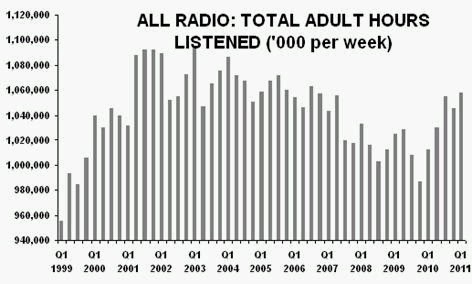
• “Total radio listening hours reach 1,058 million per week – new record.”^

RAJAR explained:
• “The total number of radio listening hours broke all previous records to reach 1,058 hours per week …”^

Fantastic news! Except that this is not at all true. RAJAR’s own historical data tell a different story:
• 1,088 million hours per week in Q2 2001
• 1,092 million hours per week in Q3 2001
• 1,092 million hours per week in Q4 2001
• 1,090 million hours per week in Q1 2002
• 1,072 million hours per week in Q4 2002
• 1,094 million hours per week in Q1 2003
• 1,066 million hours per week in Q3 2003
• 1,076 million hours per week in Q4 2003
• 1,086 million hours per week in Q1 2004
• 1,072 million hours per week in Q2 2004
• 1,068 million hours per week in Q3 2004
• 1,059 million hours per week in Q1 2005
• 1,068 million hours per week in Q2 2005
• 1,072 million hours per week in Q3 2005
• 1,060 million hours per week in Q4 2005
• 1,063 million hours per week in Q3 2006

During sixteen quarters between 2001 and 2006, total hours listened to radio were greater than they were last quarter. “New record?” No. “Broke all records”? Er, no.

The reality is that total radio listening has not yet returned to the level it had achieved in 2001. Except that, ten years ago, the UK adult population was 48.1 million, whereas now it is 51.6 million. So the population has increased by 7% over the last decade. Yet total UK radio listening is still less than it was then.

Most statisticians I know would refer to that as a like-for-like 7%+ decline in total hours listened to radio. However, to RAJAR, it is evidently a “new record” that “broke all previous records.”

Why does any of this matter? Because radio broadcasters have been progressively losing usage over most of the last decade. Initially, it was 15-24 year olds that were spending less time with radio. Increasingly, it is also 25-34 year olds. For a decade, the UK radio industry has desperately needed a coherent strategy to reverse this loss of listening. The decline in young adult listening to broadcast radio does not merely impact the NOW. If these consumers do not find anything in their youth worth listening to on the radio, they will grow old without the radio habit. Their radio listening patterns NOW are likely to influence radio listening for the next half-century.

This is why RAJAR’s continuing efforts to achieve yet another headline in the Daily Mail proclaiming “Radio listening at an all time high” are ultimately redundant. Those headlines do not impact the reality of the data collected from tens of thousands of radio listeners every month. Those data show incontrovertibly that listening is in significant long-term decline amongst younger demographics. And radio will be in mortal danger if it does not re-invent itself for the next generation.

You only have to listen to any pirate radio station in London to understand that the gulf between what young people are actually listening to and what the old fogies who run UK radio are giving them has never been wider. Chris Moyles is as passé as Dave Lee Travis was twenty years ago.

So, yes, RAJAR’s fibs and the resulting Daily Mail headline will be another opportunity for champagne corks to pop in radio boardrooms across the land. But if radio doesn’t start making itself exciting and relevant to young people, broadcast radio’s future role will be relegated to a soundtrack in old people’s homes. Complacency such as that propagated by RAJAR will only make many radio businesses redundant in the long run.

^ in a footnote this small, the RAJAR press release admits the caveat “since new methodology was introduced in Q2, 2007.”

Does the nation love its digital radio stations? 86% of UK adults say 'no'

In his perceptive commentary on last quarter’s RAJAR radio audience figures, IPSOS’ research manager Andy Haylett noted:

“18.5 million adults are DAB owners, yet only an estimated 12.6 million are confirmed listeners. What are the other 6 million doing with their DAB sets? Further investigation shows that there are only 7.4 million listeners to digital-only stations, of which under half (3.3m) comes from DAB listening. This suggests that around three quarters of all DAB listeners are tuning to stations readily available on a traditional analogue transistor.”

This reiterates a point I have made previously in this blog [Feb 2009, Aug 2009, Feb 2010]. After more than a decade, it is a sad fact of life that digital radio stations on broadcast platforms have not succeeded in setting listeners’ hearts on fire:
· Only 4.6% of all radio listening is to digital radio stations
· 18.2% of all radio listening via digital platforms is to digital radio stations
· 7.4m adults per week listen to digital radio stations (14.3% of adults)
· 3.3m adults per week listen to digital radio stations via DAB (6.4% of adults)

Of course, the corollary is that digital platforms are being used predominantly for listening to radio stations that are already available to consumers on the analogue platform:
· 95.4% of all radio listening is to analogue radio stations
· 81.8% of all radio listening via digital platforms is to analogue radio stations
· 44.2m adults per week do NOT listen to digital radio stations (85.7% of adults)

These figures might have been understandable during the early years of DAB radio. But now? After more than a decade? Planet Rock launched in 1999; the BBC digital stations in 2002. Compared to the influence that digital terrestrial television stations have had in the UK over a shorter period, digital radio stations have had very little impact on radio listening patterns to date.

The overwhelming use of digital platforms to listen to analogue radio stations begs the question: so what is the point of DAB? There was never anything wrong with FM radio anyway, and there is no proposed alternate use for FM spectrum, so why is the government insisting that consumers and the radio industry both spend huge sums of money to enable the public to listen (on DAB) to exactly what is available already (on FM/AM)?


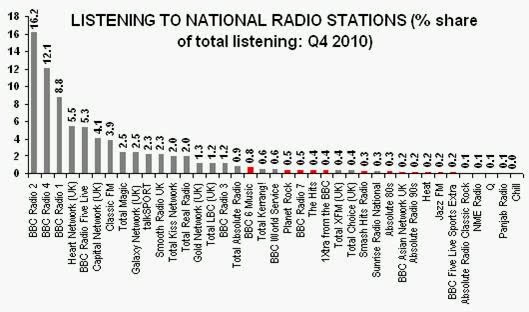
In the graph above, the listening to digital radio stations is shown in red (analogue stations in grey). It remains tiny. Despite BBC Radio 6 Music’s uplift after last year’s consumer campaign, it still languishes as the UK’s 18th most listened to national radio station. Fortunately for the BBC, the funding for its digital radio stations continues to come (for now) from the public purse.

For commercial radio, the funding for digital radio stations has to come from deep pockets. Not one digital radio station has yet made an operating profit. History is littered with commercial digital radio stations that used to be on the national DAB platform: ITN News, Talkmoney, The Storm, PrimeTime Radio, 3C, Capital Disney, Core, Virgin Radio Groove, Oneword, Capital Life, TheJazz, Fun Radio, Virgin Radio Xtreme and Panjab Radio.

Some of these digital radio stations had offered fantastic content unavailable elsewhere (PrimeTime, OneWord). Other digital stations had had very little thought put into their creation. Former GWR staffer Steve Orchard boasted that his company’s strategy for Planet Rock had been conceived in The Lamb Inn, Marlborough: “Going into a pub with Ralph Bernard, my boss, listening to the classic rock jukebox and coming out, several pints later, with Planet Rock sketched out on the back of an envelope.”

GCap Media sold Planet Rock in 2008 to an ‘outsider’ and it has been the commercial radio industry’s most listened to digital radio station since 2009. It speaks volumes that the entire UK commercial radio sector’s efforts at digital radio stations over more than a decade have been trumped by a music enthusiast with no previous radio sector experience.

However excellent it is, Planet Rock alone cannot save the DAB platform from continuing consumer disinterest. It would require a dozen stations of this calibre to create a portfolio of sufficient interest to stir consumers. Worse, for those consumers who have tried DAB and given up due to the platform’s other issues (poor reception, lack of mobility, lo-fi audio, expensive hardware), even a dozen stations might not tempt them back.

It is understandable, therefore, that Planet Rock’s owner, Malcolm Bluemel, should be frustrated with the rest of the radio industry for not following in his wake. This month, he said:

“I’ve only been in the radio industry about two and a half years now and I’ve never actually come across an industry that has such a collection of self-interest in discussing this matter [digital switchover]. I’m quite amazed at this need for certainty around the future of business. I came from an era where, to get a decent radio [station], I had to stick my AM transistor under the bedclothes and listen to Kid Jensen from Luxembourg at night. Well, now we’ve got people saying ‘Well, I want to know this, I want to know that, I want to know that my radio stations will be this, and I can have that, and I want it all, and I want it all now.’

It’s fairly obvious to me that, as an industry, we should be all sticking together. Digital is here. It’s not a question of a switchover date. Digital is out there. It’s being listened to. There’s 1.1 million people listening to 6 Music, there’s 827,000 people listening to Planet Rock on digital radio NOW. So why don’t we just accept the fact that digital is here and all get together and say ‘Right, how are we going to make this work for the industry?’ For all those people with their self-interest and their stupid press statements over ‘20 years [until digital switchover]’ or whatever it is (how ridiculous is that?), and just get together and have a consensus of opinion about how we are best going to do this, but collectively for the radio industry, and stop fighting amongst ourselves because of our own petty little grievances.”


Planet Rock’s 827,000 weekly reach last quarter is a remarkable achievement. Compare this to the dismal performances of some analogue commercial radio stations. Absolute Radio, with the benefit of a national AM licence and a London FM licence, reached only 1,375,000 adults per week. Xfm reached 938,000 adults nationally with the benefit of a London FM licence. Choice FM reached 734,000 adults nationally with the benefit of a London FM licence.

By comparison, Planet Rock has performed miracles, given that the only broadcast platform it has access to is DAB. As Bluemel identified, paradoxically, the thing that is stopping him from turning Planet Rock into the profitable radio station that it should be is the very industry in which he is working. Whilst (post-GCap Media) Planet Rock is doing all the right things for all the right reasons, the rest of the industry, where DAB is concerned, continues to do all the wrong things for all the wrong reasons.

Unfortunately, the barriers to Planet Rock’s commercial success are the outcomes of the sad history of the DAB platform:
· The commercial radio sector initially invested in DAB to control the platform, not to create successful digital radio stations
· The BBC decided to launch minority interest digital radio stations that would not cannibalise its existing national analogue networks
· The commercial DAB multiplex owners (aka the largest commercial radio groups) did not want upstart independents creating successful digital radio stations on their DAB platform
· The industry’s ‘build it and they will come’ strategy for DAB failed because consumers are driven by content, not by platforms
· If you wanted to persuade consumers to buy relatively expensive DAB radios, you should have inspired them with new content rather than have threatened them with FM switch-off
· Radio listeners are loyal and do not like losing access to content they once enjoyed (the closure of digital radio stations)
· DAB radio reception, for many, is still not as robust as FM or AM

The best solution for Planet Rock would be a national analogue licence. Or, at least, a London FM licence. However, the radio regulatory system we have in the UK militates against that possibility. Why? Because politicians, civil servants and regulators have ensured that those who already own (what were once) commercial radio ‘licences to print money’ get to keep them, seemingly in perpetuity.

It is the existing radio industry itself which is limiting Planet Rock’s opportunities for greater success. We do not enjoy an openly competitive radio market that allows new entrants such as Bluemel to shake up our stagnant radio industry with new, exciting ideas. Instead, ‘outsiders’ have to stand around on the sidelines while the owners of stations such as Absolute Radio, Xfm and Choice FM continue to run them into the ground. So why don’t they just sell them?

Sell their stations? Of course not! When you are part of a commercial radio oligopoly, why would you want to encourage an insurgent, who might actually understand how to create a successful radio station, to camp right on your analogue doorstep? Not only might he show you up, but he might even steal listeners from your other stations. Instead, the current philosophy is to let ‘outsiders’ bleed to death financially on the DAB platform, while the incumbents continue to divide up (what is left of) the spoils of FM/AM radio between them.

So we listeners get the (analogue) mediocrity they think we deserve.

[blog headline adapted from Andy Haylett’s of IPSOS]

DAB radio numbers: why do they keep making them up?

I’m a numbers man. I can tolerate a little numerical exaggeration, a few rounding ups, or even the odd ‘nearly x million’. But when people invent numbers and stick them in their press releases, I reach for my calculator. Not for the first time, today Digital Radio UK advanced the concept of ‘mind over mathematics’ to a new level.

In its press release of 21 December 2010, Digital Radio UK estimated “that due to strong Christmas sales, over two million digital radios will be sold in 2010.” I questioned how this could be true in my blog. Turns out that it wasn’t.

In today’s update, Digital Radio UK admitted that the “increase in digital radio sales” it had heralded in December was, in fact, a decrease because “2010 was slightly down in digital radio sales volumes (-2.3%) compared to 2009.”

In plain English, 1.94m digital radios were sold in 2010, compared to 1.99m in 2009 and 2.08m in 2008. Increase? No. Growth? No. Over 2m in 2010? No. Were these sales figures in the Digital Radio UK update? No.

In another numerical nonsense, today’s Digital Radio UK update said:

“If this annual growth rate [in digital radio listening] is sustained, then the Government criterion of 50% of digital listening will be achieved in 2014.”

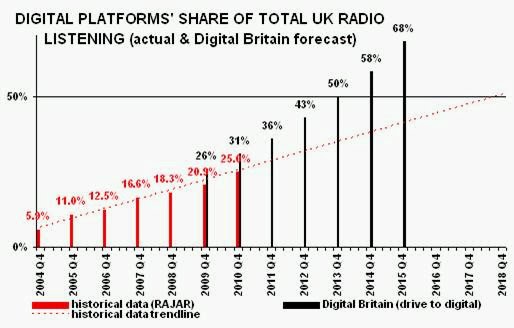
This is mumbo jumbo rubbish from people who like to use numbers to baffle the public and to obscure the truth. The 50% threshold is no more likely to be reached in 2014 than it is in 2013, which had been the original government target. A trendline* through six years of quarterly data (see graph above) shows that the 50% criterion will not be reached until year-end 2018.

So what happened to the original 2013 target for 50% that had been set by the government’s 2009 Digital Britain report? It now seems to have been completely forgotten. No explanation, no apology – just ignored (in June 2009, I had predicted that the 2013 target would prove “impossible”).

So how confident is Digital Radio UK that its new 2014 target is attainable? Enter stage left its CEO, standing next to a PowerPoint chart last week:

“This next chart is the most risky one I have in the pack. I hesitate showing you, particularly given the most recent conversations. But, I think, rather than just looking at a moment in time, there is a value in extrapolating. And all sorts of health warnings around this, you know, you’ve got government economists, you’ve got analysts in the stock market, you know, you can’t ever predict these things correctly. But, just taking the trends of the last three years and of the last year and running them forward – and life won’t be that simple but – just to understand from a mathematical calculation, where would that take you? Well, if we took the three-year compound growth rate, of the last three years, it would run us through to achieving 50% by the end of 2015, if we take the three-year curve. If we took the one-year curve that we’ve seen in 2010, it would take us to the end of 2014. To get to the end of 2013, which was an aspiration of Digital Britain, would require the compound growth rate to rise to 26%. So it needs to take a step change. You could put an argument forward that there are step changes coming, in content, in coverage, in cars, in communications and in consumer electronics. But I think it would be a brave man, or a brave woman, to say that, you know, you are definitely going to hit that grey line, and I wouldn’t say that. What I would say is that, on current trends over the last three or four years, we are likely to hit 50%, you know, in the next five years, I would say.”

So, February 2011 plus five years equals 2016. Well, this does not match the forecast in the ‘real world’ graph above of 50% being attained by year-end 2018. But neither does it match the 2014 date in today’s Digital Radio UK update.

Exactly where that leaves us is unclear. Is it 2014? 2016? Another year? Any old year?

DAB and realism and numbers seem to mix as well as oil and water and … er, more oil.

“Quite where the maths comes from to deliver 2014 is beyond me!” one senior radio executive said to me today. “Why do they put this out when it will surely mean another stick to beat them when it doesn’t happen?”

[* = there is no statistical evidence from historical data to demonstrate that the automated Microsoft Excel trendline is anything other than straight line.]

DAB radio switchover: the view from the government bunker

The government’s second stakeholder consultation on DAB radio switchover happened this afternoon. It was held in what felt like an underground government bunker in Victoria. No windows, long corridors, and lots of seemingly identical numbered rooms hidden by massive doors that had no viewing windows. When I tried to go up a staircase to ground level, a man appeared from nowhere and told me not to.

Even if the bomb had dropped, down there, you might not have known it. The cityscape outside could have transformed into a wasteland but, down there, you can be certain that our civil servants would continue planning digital radio switchover regardless, even if the precise date had to be postponed until the contamination had receded. I imagine that the government staff working there hardly need to go out, even at lunchtime, because a little lady with a trolley probably comes around with salmon sandwiches.

In this cosseted environment, it is easier to understand how you might spend your days (or months or years) of servitude, devising schemes that have so little relevance to the real world above your bunker office. Perhaps this is why the afternoon was filled with PowerPoint presentations that all looked great, slides that had lots of action words, and monologues from grey men that were filled with the current jargon. It was a perfectly unreal world.

What the afternoon lacked was realism. Occasionally I had to pinch myself to make sure that this was not a Lemsip-induced slumber. It wasn’t. However, I did witness the Civil Service suggest that asking consumers their opinion about DAB radio switchover would be a good idea, as if it was a novel thought that had just come to them. Not withstanding that the government has been pursuing the notion of the DAB platform since the 1980s but, in all those decades, somehow omitted the ‘consumer’ (or ‘listener’) from its plans.

The following quotes came from our civil servants this very afternoon. I wrote them down. Reading them now, these lines could have been extracted from the script of a lost episode of ‘Yes Minister’ in which the cast cleverly parody government plans for digital radio switchover. Sadly, they did not. This is what stakeholders were told today (amongst many other things):

“We genuinely have seen more progress [on digital radio switchover] in the last eighteen months than we have in the last six or seven years I’ve worked on this issue. But, as far as the consumer is concerned, we’ve never certainly in any way advocated or used 2015 [switchover date] as a ‘stick.’ It’s always been the industry target. And, certainly, when this government came in, it was adamant and clear that the consumer would make the case for switchover by purchasing habits, by the percentage of listening [on digital platforms], the way it absorbs and consumes radio. Now, will I, at this point, say that there has been a cross-pollination of those two things? Has the 2015 [date], which was an industry date, started to creep into the public consensus and been used by the media as a scare tactic? Yes, of course it has. And do we, as an industry, need to look at that? Yes, I think we do. I would say that I don’t think anyone – I think very few people – in this room would welcome the government standing up tomorrow and saying that the [switchover] date is the 31st December 2015. And I don’t think we have any answers to the questions that we need to have the answers to before any such decision can be made, and whether the consumer genuinely believes that this is something they want to do.”

“I don’t think we know what listeners want. I think part of this [Digital Radio] Action Plan process is absolutely understanding the value people put on various parameters of radio – what they want, how they want to consume it. I think that part of understanding this decision is understanding the listener better. And I think, whilst we all have our own views on that, I don’t think there’s enough evidence based [data] for us to make those assumptions about what listeners want.”

“I don’t think the government has never ever said ‘digital radio switchover will happen in 2015’ but we think we need to go away and look at the messaging around the cross-pollination. The one thing I would say is: 2013 and 2015 is used by both sides of people in the debate, those who like to frighten people into the fear of losing their analogue services, and those who like to sell digital radios. For all of us who believe that certainty and clarity and the consumer is important, I think we all need to look at how we use the threat of 2013 and 2015 and have some consistency ourselves about how we talk to the consumer about it.”

Threat? Are radio listeners so malleable that they must be viewed by government like cattle to be herded to slaughter? Maybe I imagined mistakenly that government was FOR the people. Anyway, I suppose we should be grateful at all that the ‘consumer’ has suddenly been pushed centre stage in the long running DAB drama, even it is so late in the show [see 2009 blog and 2010 blog where I predict it would be ideal for bureaucrats to eventually blame DAB’s failure on the consumer rather than themselves].

Is there any difference between the government forcing the population to buy a DAB radio to listen to The Archers, and Sky persuading them to buy Sky Atlantic to watch their favourite HBO shows that used to be free? Is the government’s DAB switchover drive really a policy for public regulation, or simply capitalist radio (© LBC poster campaign 1989)?

This afternoon, while DAB was being discussed in the government bunker, could anyone have actually achieved satisfactory DAB radio reception down there? I think not. Are those government people listening to DAB in their cubicles? They can design as many PowerPoint presentations as they want but, at the end of the day, if DAB radio don’t work properly now, then it don’t work for the consumer.

Bauer Radio talks the DAB talk, but walks its Magic brand off DAB

Bauer Radio is the second largest commercial radio group in the UK. It publicly supports the government’s plans for DAB radio switchover. Only this month, Paul Keenan, chief executive of Bauer Media, told The Guardian: “What part if any is the BBC going to play on the local DAB level?” He went on to ask:

“Will there be some form of seismic content innovation or intervention that really pulls listeners across [to DAB]?”

Keenan need have looked no further than his own company’s DAB radio strategy to discover a form of “seismic content intervention” that might well result in pushing existing listeners away from DAB, rather than pulling them in. While Keenan was talking to The Guardian, Bauer was busy pulling the plugs on its ‘Magic’ brand from the DAB platform in the following areas:
· Aberdeen
· Ayr
· Birmingham
· Bradford & Huddersfield
· Cambridge
· Dundee & Perth
· Edinburgh
· Glasgow
· Kent
· Northern Ireland
· Norwich
· Peterborough
· Stoke
· Sussex Coast
· Swansea

If you were a loyal listener to Magic in one of these areas, your favourite station simply disappeared from the DAB menu in January 2011 (Magic had 1m out-of-analogue-area listeners per week, contributing 24% of the brand’s total hours listened, according to RAJAR). This change is surprising given that, as recently as May 2008, Bauer Radio decided to add its Magic brand to the DAB platform in the following areas:
· Aberdeen
· Ayr
· Birmingham
· Bradford & Huddersfield
· Cambridge
· Dundee & Perth
· Edinburgh
· Glasgow
· Kent
· Northern Ireland
· Norwich
· Peterborough
· Stoke
· Sussex Coast
· Swansea

In 2008, in most of these areas, Magic had replaced another Bauer brand, ‘Kiss’, which could not have pleased existing Kiss listeners. Now, in 2011, it is the Kiss brand that is replacing the Magic brand in all but three of these areas. Musical chairs, anyone?

In 2009, Bauer had said that it was investing in the “right long-term platforms for the right stations at the right time.” So, in 2008, Kiss was right for DAB whereas, in 2011, now Magic is right?

It is hard to believe that such precipitous content changes inspire consumer confidence in the DAB platform. But, sadly, the DAB platform has never really been about ‘radio’ and ‘listeners’. Loyalty to DAB radio? What’s that? For commercial radio, its pursuit of the DAB platform had been about the exercise of power, the expectation of profit and the promise of automatic renewals for the industry’s most valuable analogue radio licences.

It was also about a much coveted transfer of the power to determine which stations are broadcast to a cartel of commercial DAB multiplex owners, and away from the regulator. This is why station changes on DAB, such as Bauer’s (Kiss to Magic to Kiss) can be executed without a public consultation or impact assessment.* The regulator merely nods its head and makes a quick note in a file. So what role does Ofcom play in ensuring that the DAB radio platform “furthers the interests of citizens and of consumers” as mandated by law? The answer is: absolutely none. We might as well have a scarecrow in charge of digital radio at Ofcom.

The reason that Bauer Radio (with a 25% listening share of commercial radio) made these latest changes to DAB is that it is locked in a war with archrival Global Radio (38%). Neither company has a track record of developing its own successful radio stations from the ground up. Both companies are piled high with acquisitions and mergers of other radio businesses. As a result, the two compete with each other by moving their radio pieces around the chess board, rather than by innovation.

In January 2011, Global Radio extended its ‘Capital’ brand outside London, replacing the former ‘Galaxy’ brand and some local FM stations. Global describes the brand:

“Capital’s target audience of 15-34 year olds are big fans of popular music, they are media savvy and are on trend.”

To compete, Bauer Radio extended its Kiss brand to every available local DAB multiplex (replacing Magic). Bauer describes the brand:

“Kiss evolves around ever changing lifestyles and trends of the UK’s young 15-34 market … Every part of their day revolves around music.”

If, like me, you think that these two brands sound almost identical, understand that this phenomenon is the outcome of long understood business practice in the radio sector. In 1951, American economist Peter Steiner wrote:

“If, as is often suspected, [radio] broadcasters exaggerate the homogeneity of audiences and their preferences for certain program stereotypes, the tendencies towards [programme] duplication will be increased. … The problem, of course, is that a series of competing firms, each striving to maximize its number of listeners, will fail to achieve either the industry or the social good. Here, then, competition is providing a less than desirable result.”

In the UK, this is precisely why we have a regulator for radio broadcasting – to ensure that consumers benefit from a wider choice of content than a free market would provide. However, with its hands tied in DAB policy by the Broadcasting Act 1996, and its laissez-faire ‘do nothing until someone complains about it’ strategy, Ofcom has had no more impact on the DAB station menu than having no regulator at all.

DAB is the Wild West of radio where anything can, and often does, happen. Seemingly, it often happens with little concern for listeners or for those who paid good money for a DAB receiver. Without a sheriff in sight, or a cavalry about to ride over the horizon, the danger is that the public might come to view DAB radio as nothing more than a bunch of cowboys locked in a private war of one-upmanship.

Yet the radio industry wonders why the DAB platform is not stimulating more listening or more receiver sales.

[*NB: There was an Ofcom consultation in November 2010 about a change of format for the Kiss brand, but this did not touch upon Magic being dropped from DAB. Magic continues to be simulcast on DAB in nine areas where it is already available on FM or AM, as a contractual condition of its automatic analogue licence renewals.]

UK commercial radio revenues Q3 2010: still no sign of "renewed growth"

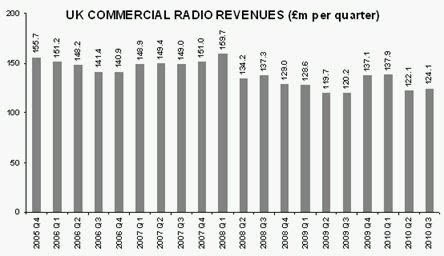
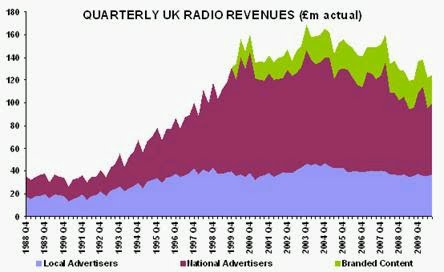
2008 had been a bad year for commercial radio revenues, down 6% year-on-year. 2009 was a worse year, when revenues fell a further 10% year-on-year. So how is 2010 shaping up? Radio Advertising Bureau data for Q3 2010 demonstrate that, although revenues are likely to be up marginally for the calendar year, they have yet to regain the substantial losses suffered during those previous two years.

Why? Because commercial radio’s falling revenues are largely the result of structural decline, something that the ‘credit crunch’ of 2008/9 merely exacerbated. Adjusted for the impact of inflation, commercial radio revenues peaked in 2000 and, by 2009, were down 32% in real terms. The single-digit improvements we might see in 2010 will claw back only a tiny part of these enormous losses.


Q3 2010 TOTAL REVENUES
· Up 3.2% year-on-year to £124.1m, but remember that Q3 2009 had been the sector’s second lowest this millennium

In May 2010, the Radio Advertising Bureau had told us that “the [commercial radio] sector has turned a corner and not only halted [revenue] decline, but moved into renewed growth …”

Industry data has yet to validate this assertion. The last two quarters produced the third and fourth lowest revenue totals of the decade, showing that the radio sector is certainly not out of the woods yet. More than anything, the industry’s revenues still seem to be bumping along the bottom. “Renewed growth” is not on the horizon yet.


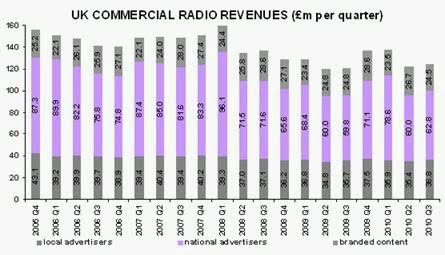
Q3 2010 NATIONAL REVENUES
· Up 5.0% year-on-year to £62.8m

Q3 2010 LOCAL REVENUES
· Up 3.1% year-on-year to £36.8m

Q3 2010 BRANDED CONTENT REVENUES
· Down 1.2% year-on-year to £24.5m


The revenue data for the long term [see graph above] illustrate clearly the transformation of the commercial radio sector from a healthy growth industry in the 1990s to one that stagnated after 2000, and which has subsequently moved into decline. Whilst revenues from local advertisers have simply stalled in recent years, revenues from national advertisers seem unlikely to ever recover from substantial declines suffered since their peak in 2000. This has necessitated significant restructuring of the commercial radio sector in recent years.

For those larger commercial radio stations that depend upon national advertisers the most, the outlook continues to look bleak. Data from Nielsen estimated that advertising spend by the government’s Central Office of Information [COI] fell by 47% in 2010 year-on-year. COI expenditure has been a greater proportion of commercial radio revenues than of any other medium, making radio particularly vulnerable. In May 2010, I had predicted:

“A 50% budget cut to COI expenditure on radio would lose commercial radio £26m to £29m per annum, 6% of total sector revenues. A 50% budget cut to all public sector expenditure on radio would lose commercial radio £44m to £48m per annum, 9% of total sector revenues.”

Not only have these cuts been realised, but the Cabinet Office is continuing to pursue a plan for the BBC to carry public service messages for free, rather than pay commercial broadcasters for airtime [also predicted here in May 2010]. This could lose commercial radio a further 6% to 9% of revenues.

In 2009, even before these drastic cuts to government expenditure on advertising, commercial radio was attracting only 4% of total display advertising expenditure in the UK, one of the lowest proportions globally [see Ofcom report]. What is UK radio doing so wrong that Ireland, Spain and Australia achieve more than double that amount? And why was that percentage already falling before the COI cuts, demonstrating the radio medium’s comparative lack of appeal to potential advertisers?

There could not be a worse time to be a commercial radio station dependent upon national advertising. Yet now is the precise time when several large commercial radio owners are busy transforming their local and regional stations into national ‘brands.’ As a response to the sector’s structural challenges, this is tantamount to cutting off your nose to spite your face. ‘Localness’ has consistently been shown to be the most important Unique Selling Point of local commercial radio, according to Ofcom research. Throw that localness out the window and all that remains is a music playlist which can be generated by any computer application.

UK commercial radio has always been good at making ‘cheap and cheerful’ local radio, but has been rubbish at making national radio that could compete with the BBC’s incredibly well resourced national networks. The recent decisions of commercial radio owners to switch from production of local radio services with a track record of success to production of ‘national’ ones that have a history of relative failure create massive risks for an industry already in decline.


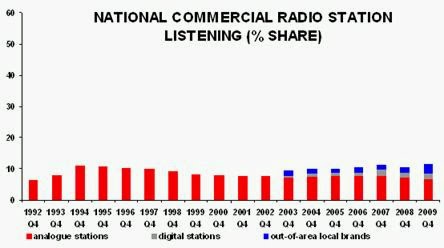
History tells its own story. The launch of the UK’s first three national commercial radio stations between 1992 and 1995 had much less of an impact on radio listening than had been anticipated. By 1997, Richard Branson had decided to sell Virgin Radio (for £115m) – it was obvious that national commercial radio was not going to be a massive moneyspinner. In 1997, Virgin Radio’s listening share had been 2.6%. Last quarter (Q3 2010), it had fallen to 1.2% (renamed Absolute Radio after another sale in 2008 for £53m), while the combined share of the three national stations was 6.8%. [source: RAJAR]


BBC national networks account for almost half of all radio listening. The only time that their share has not exhibited long-term growth was during the early 1990s, when Radio 1 self-destructed under the management of Matthew Bannister. Since that disaster, the BBC’s national networks have been successfully clawing back listening year-on-year.

The current scenario in which the owners of commercial stations that were licensed to serve local audiences have decided to subvert that purpose to take on the might of the BBC national networks is either brave, or madness, depending upon your viewpoint. What I see is a monolithic BBC that has existed continuously for nearly a century, and then I see three national commercial radio stations that have had a succession of at least three owners each during their almost twenty-year struggle to attract listeners.

National commercial radio. Just why are parts of the commercial radio industry so eager to emulate an idea that has only led to well documented failure?

DAB radio & switchover: the British public speaks its mind

Q. Who will decide if/when digital radio switchover ever happens? The public. Who says so?

In July 2009, BBC ‘head of radio’ Tim Davie had
said:
“… the idea that we would move to formally engaging [digital radio] switchover without talking to listeners, getting listener satisfaction numbers, all the various things we do, would be not our plan in any way.”

In August 2009, BBC Trust chairman Sir Michael Lyons had
said:
“It is an extraordinarily ambitious suggestion, as colleagues have referred to, that by 2015 we will all be ready for [digital radio switchover]. So you can’t move faster than the British public want you to move on any issue.”

In July 2010, Culture Minister Ed Vaizey had
said:
“If, and it is a big if, the consumer is ready, we will support a 2015 switchover date. But, as I have already said, it is the consumer, through their listening habits and purchasing decisions, who will ultimately determine the case for switchover.”

Q. What is the BBC’s strategy for digital radio switchover?

In July 2010, the BBC Trust
told the BBC Executive that it:
“should draw up an overarching strategy for digital radio.”

Q. What is the public’s opinion of DAB radio?

Research published this week by the BBC Trust for the Strategy Review collated opinions voiced in 20 focus groups held in September 2010 in ten locations. Below are excerpts that relate consumers’ experiences with DAB radio and the BBC’s digital radio stations. They make sobering reading ….
Key Findings

The availability of radio services on the move (especially in-car and for those working outdoors) was felt to be of continued high importance. People expect radio to stay portable – at least the range of stations they currently have available on analogue, including local stations which are critically important in-car for their local travel information. In this context especially there was strong resistance to the idea of analogue radio switch-off, and considerable scepticism as to whether or not this will actually happen.

4.2 The range of services provided by the BBC

“Rather than spending money on Radio 57 or whatever, invest more money on the core main programmes.”
35-44, Male, C2DE, Crowthorne

4.3 Attitudes to DAB radio

Many of the distribution issues we set out to discuss in the groups related to the availability of DAB (or of certain stations on DAB). However, what became clear in the groups was that, although we did speak to some real fans of DAB, most licence fee payers we spoke to do not yet view DAB as an essential service in the way they do Freeview, for example. This certainly coloured their reaction to some of the trade-offs they encountered between funding distribution and content.

“I think they should improve the Freeview signal before they start worrying about the radio. Radio is fine.”
18-24, Female, ABC1, Inverness

These attitudes were coloured by a number of factors:
· Limited awareness of what DAB is and what it offers
· Limited awareness and uptake of the BBC’s digital-only radio stations (most digital radio listeners within the groups were using digital radio as a means of listening to stations they would otherwise be able to receive via analogue)
· Most DAB set owners we spoke to had received them as presents – they hadn’t necessarily had a compelling reason to buy one
· Many trialists of DAB in the groups had been frustrated with their experiences – e.g. intermittent/non-existent signals, limited range of their favourite stations available
· Some doubts as to whether DAB technology will be around in the long term

“I did have a DAB radio but I didn’t notice it being any better”
18-24, Female, C2DE, Cheddar

“I find DAB radio can be quite troublesome although that’s not BBC specific. The signal seems to interrupt quite regularly”
45-59, Female, ABC1, Crowthorne

“I don’t find that DAB radio is achieving a lot for me. It’s supposed to be better quality, but because of the size of the set I’ve got, it doesn’t really make any difference.”
55+, C2DE, Derby

“Aren’t we the only ones to use DAB? Europe uses a different system and America too – I don’t see the point of it now so many people have the internet as it’s as cheap to get an internet radio as it is a DAB radio and you can listen to far more stations on it”
25-44, ABC1, Fort William

“You can’t get much [on DAB in the car] – no Radio 1, no Radio 2, no Radio 5 live, no Radio 4, you just get a message saying ‘no reception’. You need to be on top of a mountain to receive it. It’s a complete waste of time.”
55+, C2DE, Derby

There was real confusion and in some cases concern about the idea of a digital switchover for radio, and some debate as to whether the mooted date of 2015 was realistic or not. Certainly in the current circumstances there would be much resistance among participants in these groups to the idea of switching off analogue radio, especially those for whom in-car listening was an important (or the dominant) part of their radio listening.

“They can’t switch off analogue radio – people are really not going to be happy with that”
18-24, Male, C2DE, Belfast

“The idea of making all radios into digital is just ridiculous… It’s not persuading you – it’s just pushing you”
18-24, Female, C2DE, Cheddar

“What about all the car radios – surely we’re not going to replace all those?”
25-34, Female, ABC1, Caernarfon

“Are you telling me my radios will be totally obsolete if they do this? That’s outrageous”
60+, Female, ABC1, Newry

5.1 Availability of services

“I’m going to sound old fashioned but the core product is BBC One, BBC Two and Radios 1 to 5”
35-44, Male, C2DE, Crowthorne

The digital-only radio stations were considered of significantly lesser importance (awareness of these was limited, and listening to them was quite sporadic through the sample). In fact in several groups it was suggested that one solution to the complex problems of making access to digital radio more easily available to people would be to get rid of the stations altogether!

“I don’t think anyone really cares about the digital channels and they won’t until all the non-digital signals have been turned off”
25-34, Male, C2DE, Newry

“It’s limited because digital radio hasn’t really taken off.. they’re talking about changing over in 2015… if it’s half the hassle of the digital [TV] switchover, it will be a dead loss”
45-64, ABC1, Merthyr Tydfil

6.1 Availability of platform choice

There was also a general consensus across the groups that, although the convergence of platforms has started to offer useful additional means of consuming ‘broadcast’ services, as a minimum the BBC’s television services should be available via a television set, and the main radio services via a radio set.

“It’s good enough to be able to get main stations on analogue radio and the others through the TV – I don’t think they need to be able to get all these radio stations on radio only.”
25-34, Female, ABC1, Caernarfon

Lack of availability of BBC Radio Derby on DAB

Local radio was considered to fulfil an important community service, particularly by those in the older group, who remarked that there had been a decline in the range of local media available (local newspapers closing, and the ITV regional television coverage now being focused on Birmingham).

As such, BBC Radio Derby was felt to be important to giving the city a sense of identity. Sports coverage was an integral part of this (for the men especially), and Derby-specific coverage was felt to help ensure that they don’t live in the shadow of nearby Nottingham. Frequently, they felt, Derby is treated like a poor relation next to Nottingham; the availability of BBC Radio Nottingham (but not BBC Radio Derby) on DAB was yet another manifestation of this, they believed.

A number of them had bought DAB radio specifically with the intention of listening to BBC Radio Derby and had thus been extremely disappointed not to be able to find it.

“I asked for a DAB set for Christmas, specifically so I would be able to listen to Radio Derby, nice and clear, around the house – not realising that you can’t get Radio Derby on DAB at all… I only found out when I pressed the ‘auto-scan’ button… Leicester, Nottingham, loud and clear, but no Derby… I felt really let down.”
55+, C2DE, Derby

“My wife bought me one for Christmas. It wouldn’t work next to the bed – we thought it was broken. We ended up just using it as an alarm clock. It never occurred to me that it might not work depending on where you live.”
40-54, ABC1, Derby

There was little awareness or understanding of the reasons why this is the case (the lack of a local commercial multiplex operator), so some participants were upset that the BBC appeared to be viewing Derby as a lower priority than neighbouring areas. Others had assumed that this was a technical issue (reception problems), rather than the station not being broadcast on DAB. (There was some awareness of a promised launch date of July 2010, but they claimed that this date had been and gone with no further update on what was happening.)

“What makes me angry is that Radio Derby comes out as one of the best local news stations in the country, but it’s not available on the latest technology.”
55+, C2DE, Derby

“If you can get the others, you’d just assume that you can get Radio Derby as well. Whose decision is it not to have it?”
40-54, ABC1, Derby

Some of the participants had experimented with some of the BBC’s digital-only stations on DAB. Radio 7 in particular was well-liked by some of the participants in the older group, and some of the younger men had used 5 live Sports Extra, but their overall impression with DAB was one of disappointment. The absence of BBC Radio Derby was a significant contributor to this, along with poor reception quality.

“The way they sell DAB it was going to be the be-all-and-end-all of radio listening, but it’s just been a great disappointment.”
55+, C2DE, Derby

Although many were disappointed with DAB in general, the absence of BBC Radio Derby from DAB was not felt to be a major problem for them as long as the station remains available on analogue (many were listening out of home in any case – traffic reports in the car, or match commentary when out and about at the weekend).

However, in line with most other groups, these participants would be extremely upset if the analogue signal were switched off and BBC Derby only then available online.

Radio Foyle on DAB

Many participants felt that they get a better reception with DAB than on analogue (in the home). Many of the older group in particular claimed to have experienced reception problems with Radio Foyle in particular on analogue, especially in bad weather. However it was not a case of a having had a desperate need to get a digital radio because they got no analogue signal previously, more that the sound was not always great and they sometimes experienced reception problems.

“DAB radio… I got it out of curiosity… everybody said it was better than analogue… the analogue sometimes you can’t tune in because you have got high pressure or rain or wind. The DAB you can pick it up.”
50+, ABC1, Londonderry

Most assumed that Radio Foyle was already on DAB, as they insisted they were listening to it on their DAB radios – it is not entirely clear whether this is confusion between DAB and analogue signals on the same set, or they have been experiencing the ‘dynamuxing’ test.

“No I didn’t know that because when I press it comes up on my DAB radio so I thought it was. I just took it that all the stations I can pick up on my DAB are digital.”
50+, ABC1, Londonderry

“Foyle on an ordinary radio is still poor I think. I am right in Derry. On the digital they do both seem clear to me.”
30-49, C2DE, Londonderry

When it was explained to them that ‘dynamuxing’ the two stations would result in two mono (as opposed to one stereo) stations, reactions were somewhat mixed. Although some participants were adamant that going from stereo to mono would compromise their listening experience, particularly when listening to music, others admitted that they were not sure what mono sound is, and probably wouldn’t be able to tell the difference! It is also worth noting that, from the description they gave of their DAB sets, the majority of participants in the groups were listening to DAB on mono-only sets anyway.

On balance, all participants would prefer both stations to be available, even if this meant mono-only broadcasting. The younger group, who were more loyal Foyle listeners, were happy enough with the availability of Foyle on analogue only, but would be concerned by the prospect of an analogue radio switch-off, in which case continued availability of Foyle would be vital.

Poor DAB coverage (in Fort William)

Most of the participants in the groups are used to struggling with coverage issues. Lack of DAB coverage is just the latest manifestation of issues they have experienced historically with analogue television and radio signals.

“I live over in a rural area completely surrounded by hills so there is no radio reception at all so all our radio listening is done through the TV box or the internet”
25-44, ABC1, Fort William

“I tried a DAB radio but it wasn’t very good – it would go for a bit then completely cut out and we have no FM signal at all out in the glens where I am”
45-64, C2DE, Fort William

As a result, satellite (by which most really meant Sky, as awareness of Freesat was very low) had become the default standard for most to receive television, especially for those outside the main town of Fort William itself, and many were increasingly using the good broadband services that are now available to them as a more reliable means of accessing media content.

“We’ve been up there seven years now and when we first moved we had a reasonable medium wave signal for Radio Scotland but then that tailed off but we get no FM and there was no TV until satellite came on stream… We had very young children at the time and they were happy just watching DVDs… There are about 250 people in our village and many of the surrounding communities have the same issues… There used to be a mast for the TV but that was turned off and now everyone has a satellite dish… satellite has been a godsend for us – especially for the radio – but we are now even more likely to be listening online. Our broadband is excellent – 8Meg – and now we even have wi-fi radios in the house.”
25-44, ABC1, Fort William

Some participants in the groups had been drawn to DAB, but left frustrated by the experience.

“I won a DAB in a Radio Scotland competition and I was really excited about being able to listen to 6 Music but there was absolutely no signal so I gave it to my dad down in Glasgow and he’s really happy with it”
25-44, ABC1, Fort William

Limited availability of Radio Wales and Radio Cymru on DAB

In common with many of the research locations across the country, issues surrounding the lack of availability of Radio Wales and Radio Cymru were caught up in other issues around the quality of DAB signal in general.

While some participants (for example, one lived near a mast) were experiencing extremely good reception via digital, others were having problems based on their location and even the prevailing weather conditions.

“If you get a rain cloud overhead, or worse than that the snow, you might as well chuck it in the bin.”
45-64, ABC1, Merthyr Tydfil
“People who live in the dips – they can’t get any kind of digital radio reception at all… they’ve got to do something to help them.”
25-44, C2DE, Merthyr Tydfil

This frustration was a manifestation of a broader dissatisfaction with digital reception in general. Many were experiencing problems with their television reception (especially, but not exclusively through Freeview). Lack of a reliable television signal was seen by most as a more significant problem than lack of a reliable radio signal.

“They said the digital signal was going to be better – that you’d be able to get S4C and Channel 4 – but it’s actually worse.”
25-44, C2DE, Merthyr Tydfil

“Wales has always got problems, we get worse service with the digital, the broadband, the post… We pay the same, we have a right to the same service.”
25-44, C2DE, Merthyr Tydfil

As a result many in the groups considered themselves to be disgruntled licence fee payers.

Most could understand that there are diminishing returns in terms of building out the transmitter network, and that those in the more mountainous parts of central Wales (for example) might not be able to have access to the same choices as people in more densely populated areas. However, in these groups the argument was most strongly made that people in these areas should have some kind of discount from their licence fee in recognition of the reduced service they receive.

“They [the BBC] can’t please everyone, they’re doing the best they can, but If people can’t get the service, why should they pay the full money.”
45-64, ABC1, Merthyr Tydfil
“You shouldn’t be penalised for living in an area where they can’t provide these services, because we have to pay extra to get Sky, for example, to be able to receive it.”
45-64, ABC1, Merthyr Tydfil