Andy Parfitt leaves BBC Radio 1 on a high: separating the man from the myth

Andy Parfitt’s departure from the station controller job at BBC Radio 1 after thirteen years marks a significant event for the UK radio sector. Parfitt’s accomplishments during his tenure were many, but did not extend to significantly turning around the station’s audience ratings.

At the time Parfitt took on the controller job in March 1998 at Radio 1:
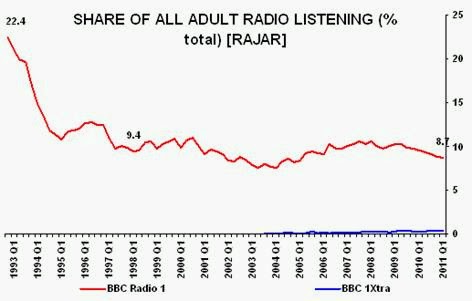
• its share of listening was 9.4%, compared to 8.7% in Q1 2011
• its adult weekly reach was 20%, compared to 23% in Q1 2011
• its average hours per listener per week were 8.1, compared to 7.8 in Q1 2011.

One metric did demonstrate a healthy increase – Radio 1’s absolute weekly reach was up from 9.7m adults in Q1 1998 to 11.8m in Q1 2011. However, part of that increase is attributable to the UK adult population having grown by 9% in the interim. Certainly, more adults listen to Radio 1 now than in 1998, but for shorter periods of time, and so the station’s share of total radio listening has declined.

Given this impasse to the improvement of Radio 1’s ratings, I was surprised to read in the BBC press release announcing Parfitt’s departure that:
“Appointed Controller, BBC Radio 1, in March 1998, Andy has led Radio 1 and 1Xtra to record audience figures …”

… and surprised to read Parfitt’s boss, Tim Davie, declaring that:
“Andy has been a fantastic Controller and leaves Radio 1 in rude health – with distinctive, high quality programmes and record listening figures …”
The one person still working at Radio 1 who should know for sure that “record audience figures” had not been achieved during the last quarter, last year, the last decade or during Parfitt’s entire tenure is Andy Parfitt. Why? Because, between 1993 and 1998, Parfitt had been chief assistant to then Radio 1 controller Matthew Bannister, a turbulent period during which the station’s audience was decimated by a misguided set of programme policies that failed miserably to connect with listeners.

Between the end of 1992 and March 1998, when Parfitt took over from Bannister (whom the BBC had promoted to director of radio), Radio 1’s:
• share of listening fell from 22.4% to 9.4%
• adult weekly reach fell from 36% to 20%
• average hours listened per week fell from 11.8 to 8.1
• absolute adult reach fell from 16.6m to 9.7m.

Radio 1 lost an incredible 58% of its listening, and 7m listeners, within that five-year period, a calamitous disaster from which the station has never recovered [see graph above]. Since then, Parfitt has kept the ship relatively steady, having been appointed in 1998 as a safe pair of BBC hands for Radio 1 after the tragedy of Bannister (who had come from Capital Radio via BBC GLR and had a fantastic track record in news radio, but not in music radio).

Never again will Radio 1 achieve a weekly audience of 17 million adults, as it had done in 1992. Those days are long gone. In recent years, fewer young people are listening to broadcast radio, and they are listening for shorter periods of time. Sadly, radio does not prove as exciting for them as the internet, games or social networking.

Of course, it would have been nice for any incumbent to leave the Radio 1 job on a ‘high.’ But, unfortunately, it was never going to happen with Parfitt, or probably with any successor. Radio 1’s ‘golden age’ was wilfully destroyed twenty years ago. Nevertheless, somewhere, somebody in the BBC must have decided to invoke the notion of Parfitt’s “record audience figures,” regardless or not of whether they were a fact.

What surprises me is that every BBC press release must have to pass through endless approvals – within the originating department, in the press office and in the lawyers’ office – before it reaches the public. Did nobody out of the dozens of people that must have checked this particular press release ask the simple question: can you substantiate this “record audience figures” claim?

RAJAR radio audience data are publicly available for all to see. Anyone from the BBC could have checked and found that, using every radio listening metric known to man, Radio 1’s “record audience figures” were all achieved two decades ago, rather than at any time during Parfitt’s tenure. Maybe they didn’t check. Or maybe they did, but pressed ahead anyway.

The ability to play fast and loose with numbers and statistics, particularly those that can be said to be at an ‘all time high,’ might appear to be endemic within the UK radio industry. I have highlighted similar instances of the industry’s abuse of statistics in other claims. Now that the consumer press only seems interested in ‘radio’ stories involving celebrities, and now that the media trade press has been reduced to recycling radio press releases, ‘myth’ can quite easily be propagated as ‘fact.’

I am reminded of a passage in my new book about KISS FM when, two decades ago, I had asked my station boss why an Evening Standard profile of him and his car had featured a vehicle that was not the one he owned or drove.

“It seemed to make a better story,” he told me.
BBC Licence Fee settlement: for radio, where will the axe fall?

Jeremy Hunt, Secretary of State for Culture, Olympics, Media & Sport
20 October 2010

“In the end the deal we got [for the BBC Licence Fee settlement] was tough but fair. Tough because the BBC, like everyone, is going to have to make demanding efficiency savings. But fair because it allows them to continue to make the great programmes that we all love and licence fee payers won’t have to pay any extra for the privilege. The assurances I have secured on magazines, local and online activities will also give some comfort to the BBC’s commercial rivals that the licence fee will not be used to blast them out of the water.”

——————–

Feedback, BBC Radio 4, 21 October 2010 [excerpt]
Roger Bolton, interviewer [RB]
Sir Michael Lyons, chair, BBC Trust [ML]

RB: Does that mean that you would regard any significant cuts in the domestic radio services as something you could not go along with?

ML: I think … that’s rather a sweeping assurance that you’re asking me to give …

RB: Well, it’s people who listen to Radio 4 and to Radio 3 and who value that greatly, and Radios 1 and 2, want to know, as a result of this settlement, will they see major economies made in their networks?

ML: Well, let me be very clear, as I said before. The Trust is clear on the importance to Licence Fee payers of the family of BBC services. The care that we take in reflecting on those radio services is, I think, reflected in the decision that we took on 6 Music – a very careful balancing of the public value that that service provides against its cost. What I can give you assurance on is that the Trust will continue to demonstrate that care across the range of BBC services.

——————–

Tim Davie, Director, BBC Audio & Music
Interviewed by Beehive City, 20 October 2010

“I don’t think anyone is proposing taking £300 million [for the BBC World Service] out of the Audio & Music budget. There wouldn’t be a lot left.”
“Obviously this is a decision taking place at a pan-BBC level rather than just looking at radio services. As the guy in charge of Radio I would say that our portfolio delivers value for money for the licence fee. I think Radio stacks up very well.”
“I don’t want to go into detail about discussions at this point in time. It remains speculation until we see what comes out in the Comprehensive Spending Review.”

——————–

The Tony Livesey show, BBC Radio 5 Live, 28 October 2010 [excerpt]
Stephen Nolan, interviewer (presenter, BBC Radio Ulster) [SN]
Tim Davie, Director, BBC Audio & Music [TD]

SN: Interesting times for the BBC, Tim, aren’t they, because, with the Licence Fee freeze over the next six years, how’s that going to be felt by radio listeners? What are they going to miss, what are they going to lose?

TD: Well, I think it’s too early for me to say ‘oh, we’ve just had a settlement, this is what it affects’. I would say, as an overall principle, the last thing that people want – me or others want to do – is do things that affect the quality of listening. I think that one of the things the BBC has done pretty well over the last few years is: we have taken out quite a lot of costs. But the truth is our radio services, I think, are in fine shape. That’s for the listeners to decide but, actually, the numbers are good, I think the quality of programming is – frankly, it is quite easy to do cheap radio. The issue is that we also want to do the investigative journalism, we want to do the big stuff, and I think listeners care about that stuff. I would say that, of the Licence Fee, radio is only, at most, 20%. So, in terms of good value for money, as the head of radio, I would be arguing our case pretty hard.


SN: You say it’s quite easy to do cheap radio. Do we do cheap radio?

TD: I think, you know, overall, we do good value radio which is – I’m choosing my words carefully there – because, I think, cheap radio, what I meant by that was that it’s quite easy to have one person playing records. We don’t do that. You know. We get people like yourself, who have a point of view….

SN: [interrupts] Yes, we do! We don’t have one person playing records? Chris Moyles plays records. Radio 1 plays records and the commercial sector could do that any day of the week, couldn’t they?

TD: Well, I think Radio 1 is … that’s a big debate. I’m very clear that Radio 1 does something very different to commercial radio. An average commercial radio station would play probably about 200 records a week and Radio 1 … our records … we may get up to 900. We’ll be playing a lot more new music and, actually, we do a lot more speech. Nine million people are listening to news on Radio 1, with something like Newsbeat, and that’s important.

SN: BBC Radio 2 and the commercial sector will argue until the day they die –and I spent ten years working in the commercial sector – that Radio 2 should be given to the commercial sector. Give them a chance because that’s [no more than] very good presenters playing music.

TD: Well, I don’t think they would do what we do. Radio 2 is currently just about 50% speech so, if you listen … on a day in Radio 2, about half of it is speech.

SN: And define ‘speech.’ Are you including presenter links in that? Including monologues and all?

TD: I’m including everything in that. I’m also including Jeremy Vine doing Poetry Week last week. I’m in ….

SN: [interrupts] But it is a bit of a con to suggest that 50% is speech when that includes a presenter saying ‘good morning, it’s ten past ten’, because the commercial sector can do that.

TD: Well, of that, there’s a bit of speech which is those pure links. Point taken. But I think, if you listen to, as I say, Jeremy Vine, you also … It’s not just about music versus speech. You take the Folk Awards, you take Jamie Cullum doing jazz, I think Radio 2 can be pretty proud of what it does, and its playlist versus a commercial station… All I would say – and this is a very simple request, and a strange one by the head of BBC radio – but have a listen to commercial radio for a while and have a listen to us. I think that listeners know the difference.

SN: What is the difference? If someone was listening to commercial radio?

TD: I think we’re a lot less dictated to by a fixed playlist. We do have a playlist but it makes [up] a lot less of our output. I think we give our presenters, as you know, quite free reign and we allow them to do their stuff. And I think … there’s great commercial radio, by the way, and it would be remiss of me to say anything otherwise. But I would say the BBC – the great thing about having fixed income – is that we can do stuff. We can say go and do your stuff and, sometimes, as you know, that can get lively. But, overall, I believe in trusting presenters. The interesting thing as well, by the way, is [that] music services now on the web – you get all these automated recommendations – the one thing I think radio is doing well on is that we don’t kind of do that. We give a presenter the chance to do their stuff.

——————–

House of Lords

debate on media ownership, 4 November 2010 [excerpt]

Lord Myners: I hope that when the BBC licence is next reviewed we start from a presumption that the BBC should not be doing certain things. The BBC should have to prove why it should continue to operate Radio 1 or Radio 2, for instance. It is extraordinarily difficult to explain to a foreign visitor why Radio 1, a popular music station, is a nationalised industry, and why it is necessary for it to be provided by a public service as opposed to a competitive one.

Destroying BBC Radio One: it's the same old song

Interviewed for an article in The Sunday Times headlined ‘We’ll sell off Radio 1, say Tories’, Tory shadow broadcasting minister Ed Vaizey said: “Radio 1 is not fulfilling its obligation to its audience. Its median age is those in their thirties when it should aim much more at teenagers and [those in] their twenties. There is then a good argument for the BBC to be rid of Radio 1 and give the commercial sector a chance to use the frequency.”

After attending St Paul’s School and Merton College, Oxford, Vaizey (son of the late Lord Vaizey) worked for the Conservative Party’s Research Department for two years, before training and practising as a barrister. He writes a column for Tatler magazine.

——————–

Poor old Radio 1 is continually misunderstood by the big wigs who never listen to it, but who perpetually want to destroy the appeal of the UK’s only national pop channel. They fail to appreciate that the station is far more than ‘undistinguished Top 40’ radio, as The Sunday Times described it last week.

In its 1986 report on the future of the BBC, the Peacock Committee similarly felt that Radio 1 ‘did not provide a public service in the sense that Radios 3 and 4 very conspicuously do’. More cultural bigots talking rot.

Outside of London, commercial radio stations are as conservative in their choice of pop music as a local church disco. Radio 1 is the only medium to consistently expose new songs, new songwriters and new artists. Where it leads, commercial stations follow like sheep.

Despite no British artist or record company ever being awarded a Queen’s Award for Industry, pop music is undeniably one of this country’s most lucrative exports. Yet subsidies are unheard of for up-and-coming talent to write, record or perform.

Classical music, opera, dance, film, theatre and even jazz are handed untold state grants from so-called ‘arts’ bodies, yet pop music receives nothing. Radio 1 is the closest this country has to a public gallery for new musical talent that would otherwise remain completely unheard. And it manages to attract the biggest radio audience.

As Paul Gambaccini puts it, ‘Radio 1’s strongest claim to legitimacy is that it is the Radio 3 of popular music.’ Even ex-BBC boss Alisdair Milne understands that Radio 1 ‘does things the commercial sector would never do. It has a strong commitment to the creation of new pop music.’ ….. So why are the top cats so determined to destroy the BBC’s most valued asset?

Grant Goddard
City Limits magazine #571, London [excerpt]
17-24 September 1992