Living on the frontline : 1985 : Dave Asher, 21 Aharonson Street, Tel Aviv

[Dave Asher, 1985]
“There’s a bomb!” someone shouted. “There’s a bomb!” 
I had just collected ‘NME’ from the newsagent that reserved it for me each week and had been lazily staring at a display of the new ‘designer’ stretch jeans in the windows of Gloria Vandebilt’s shop. All had been calm on the city’s main shopping street. Then suddenly it was chaos. People ran in all directions as if their lives depended upon it … which they did. Men, women and children screamed as they fled down side streets, their shopping bags flying behind them like parachutes. I was in amongst them, running at full pelt until I thought I was far enough away from the suspect device. How would I know? I didn’t. Did I hear an explosion? No. Was it really a bomb? I never knew.
On the walk home, I called in at the post office and joined a lengthy queue at the counter for overseas mail. Once I handed over my letter, the man behind the counter inspected it and adopted the withering look of an adult castigating a child … or a new immigrant.
“You cannot send this,” he said, visibly weighing up my ignorance. “We are at war.”
“Oh,” I said sheepishly, taking back my letter. “Okay. Thanks.”
Where I came from, you could send a letter anywhere in the world. I had spent much of my childhood doing just that, writing to radio stations as far away as China, Russia and Syria … and receiving replies. However, I was now learning that life is different during a time of war. I had written a fan letter to ‘Radio One’, an FM station in Beirut, Lebanon with English-speaking DJs who played the latest international hits, interspersed with familiar identification jingles stolen from ‘BBC Radio One’. Since radio transmissions ignore borders and war zones, I had become a committed listener in recent months. Now I had to return home with my unsent letter.
‘Home’ was temporarily a house at 21 Rehov Aharonson in Tel Aviv, where I was sleeping on the living room floor of the lower flat rented by fellow Brit Dave Asher. He was a well-known DJ in Israel from having presented the ‘Voice of Peaceradio station’s breakfast show for several years. There were drawbacks to my accommodation. One morning I awoke to find ants nesting in my hair, while the nocturnal journeys of slugs from behind the adjacent bathroom sink gave me frequent ‘Alien’-type nightmares. But Dave had let me stay for free and I was grateful for his generosity. Weeks turned into months; how quick they pass.
Dave had a job as DJ at a city centre basement lesbian nightclub which he kept inviting me to attend. I did visit on one occasion, but was faced with the challenge of convincing two burly doormen that I wanted to enter a female-only club filled with scantily clad women because I said my male friend was working inside. Dave was also the DJ at a packed concert by American drag queen Divine in a huge former cinema, one of the most entertaining events I have attended. My crazy plan was to remain in Tel Aviv by finding a job in the record industry, for which Dave had helped me make contact with people he knew in the business. Pre-internet and pre-mobiles, this required a lengthy wait for replies to handwritten letters.
As summer was hot inside the flat, at the end of the day I would walk the short distance to the end of the street and sit on one of the public seats along the promenade. I could put my feet up on the sea wall, read the day’s ‘Jerusalem Post’ newspaper, watch the sun set over the Mediterranean and cool down in the onshore breeze. One day, a man seated near me asked if he could read my paper when I had finished with it. He spoke in Hebrew and I replied likewise.
By then, I had learnt enough of the language to hold a basic conversation. The frustration of not even understanding destinations displayed on the front of city buses had forced me to learn the Hebrew alphabet and numbers from a schoolbook. Every afternoon I developed my vocabulary by watching ‘Sesame Street’ (‘Rehov Sumsum’ in Hebrew) on television, where the first word I learnt was the ‘dustbin’ in which Grouch (Moishe Oofnik) lived.
I was suspicious of this man trying to strike up a conversation because, weeks earlier, I had been sunbathing alone on Tel Aviv beach when a man came and sat far too close to me on the sand and propositioned me for sex. He appeared to interpret my indignant refusal as merely ‘playing hard to get’ and continued to pester me, so I now avoided the beach and its potential for further unwanted attentions.
Thankfully this man on the promenade seemed different. Because our initial conversation had been in Hebrew, he found it hard to believe that I was not a recent immigrant to Israel struggling to learn my new language. After several rounds of questioning, he was eventually convinced that: I was not Jewish; I was British; I spoke English; and I was Christian. Only once these facts had been established did he have sufficient confidence to identify himself to me as a Christian Palestinian.
“Meet me here at the same time tomorrow,” he told me. “There is something I want to show you.”
Despite an incendiary device having recently exploded at the end of our street, thankfully with no casualties, I decided to risk meeting this man again the next day on the promenade. We walked to a walled compound a few hundred metres away where he spoke Arabic into the intercom, the gate opened and we walked through a garden into a house. He took me inside and knocked on what appeared to be a bedroom door. When it opened, it was immediately apparent that this was no normal small bedroom.
Bunk beds were butted up against each other on three walls of the room, leaving no space in their midst for other furniture. The small window had been covered so that the room was dark except for a single lightbulb on the ceiling. After my entrance, I was being stared at by six men, each sat on their bunk, their sweat thick in this non-air-conditioned room. My guide explained to them in Arabic why I was there, then he turned to address me.
“I wanted you to see how Palestinians have to live in Israel, the same land in which our families were born,” he told me. “Before dawn every day, we are employed outside to clean the beaches, sweep the streets and collect rubbish but, by the time the sun comes up and the crowds come out, we have to make ourselves invisible by returning to accommodation like this. As a fellow Christian, I wanted you to see how we are forced to live in our own homeland so that you can tell people what life is really like in Israel for those who are not Jews.”
A man arrived with a big bag of takeaway food which he started to dole out to each of the men in the room. I wondered to myself if I was to be included in their evening meal and how that could happen when there was no available space for a guest to sit. My guide quickly quashed that notion.
“The men will not eat their food in front of a stranger,” he explained. “We have to go now.”
It had only required a few minutes in that crowded room for the man to have made his point. He was understandably angry about his people’s situation. He told me that, having seen their conditions myself, I now had evidence to refute the disinformation that most of the world believed. We left the compound, he went his own way and I never saw him again.
After several months of messages, letters and calls from public phone boxes, I was finally offered a meeting with the head of an international record company’s Israeli subsidiary in his penthouse flat. There I explained that I had recently secured airplay on British radio for Israeli pop records through my knowledge of the UK radio industry. I believed I could do more like this to develop Israeli music’s presence overseas.
“You should go home,” he told me sternly. “Israel is not the place for you. There is a war going on. The economy is in bad shape. Things are terrible here. Go home and find yourself a job there.”
I departed Israel on the next available flight, disappointed by my failure to secure a job. I left behind an economy with an annual rate of inflation nearing 1,000% and a currency so devalued that it required a thick wad of banknotes just to buy a loaf of bread. Prices in shops had to be updated daily, written on post-it notes stuck along shelf edges. At checkouts, there were insufficient banknotes in tills to provide change, so customers were given the equivalent value in sweets and candies. Coins had become obsolete because they were worthless. I was carrying around several hundred banknotes stuffed down the front of my underpants because my wallet was now too small.
Back in Britain, within three years I had organised the release and promotion of an Israeli record that reached number 15 in the UK singles chart, accompanied by a ‘Top of the Pops’ television appearance. It became the biggest selling Israeli record in Britain since Esther and Abi Ofarim’s ‘Cinderella Rockefella’ in 1968, coincidentally my very first single purchase. Singer Ofra Haza became an international star, later recording songs for a Disney movie. Despite failing to find a job in Tel Aviv, I had managed to successfully pin music from Israel on the ‘world music’ map of the 1980’s.
It was Dave Asher who had first introduced me to Ofra Haza’s music in 1985. Two decades later, his job was presenting the breakfast show on a radio station … in Beirut!

[Originally published at https://peoplelikeyoudontworkinradio.blogspot.com/2023/04/living-on-frontline-1985-dave-asher-21.html]

I’m gonna git you sucka : 1988 : Ace Records, Harlesden NW10

[my pyjama top, 1988 to 2023]

I recognised the tune. Not only did I recognise it, I knew all the words and would have happily rapped along with it. But not here. Definitely not here during rush hour on a crowded Underground train. I was seated in the end carriage on the Metropolitan line at Baker Street station, where the service often paused for around ten minutes before heading northbound. A man had just plonked himself down on the seat next to me, put on headphones and started his cassette player. The volume of his music was not excessive but, sat in close proximity to his headset on a stationary train, I was able to recognise the tune.

We were still awaiting our departure when I overheard my neighbour’s next track. I was even more surprised to recognise that tune. Not only did I recognise it, I was shocked that the two tunes he had just played were in the same order at the start of a cassette compilation I had created only weeks earlier. Once a third tune started, I had absolute certainty. The chance that a stranger would be listening to three tunes in the same order as mine was infinitesimally small. This unknown person must be listening to my cassette. I wanted to turn to him and explain this coincidence, but he would have thought I was a crazed madman. I had no idea who this man was. I had no idea how he possessed my cassette. Instead, I just sat there, smiling to myself that somebody seemed to be enjoying my music choices, until the train moved off and I could overhear his music no longer.

At the time, I had a job working three days a week at Ace Records, a small independent record label that specialised in reissues of American black music from previous decades. My task was to promote its releases to the press and radio by writing press releases, designing marketing materials, maintaining contact lists and sending out sample copies of records (tasks which I enjoyed), as well as cold-calling journalists (which I hated). I had been hired by the company’s co-founder Roger Armstrong, one of the best bosses I have worked for, with whom I shared a huge modern office. The Ace team were friendly and the building was a delight to work in, located on an industrial estate in Harlesden NW10, overlooking the Grand Union Canal. Opposite was the United Biscuits factory where you could determine which biscuit brand was rolling off its production line by the smell that permeated the air.

Harlesden had long been one of the hotspots of London pirate radio as a result of its significant Afro-Caribbean population. Walk along Harlesden High Street and you would see tall FM antenna masts installed atop roofs of the numerous record shops, transmitting live soul and reggae shows across London. All these stations were illegal and had to play cat-and-mouse games with authorities who sporadically shut them down and impounded their equipment. Working at Ace, I would often listen all day to Harlesden’s stations alone in my first-floor office because Roger spent a lot of time in the States copying master recordings from tape archives. I got to know the names of the pirate radio DJs and the styles of black music each of them played.

My colleagues at Ace were fans of the music the company released and we often shared recordings of music we had discovered. Brian Nevill, a musician with a deep knowledge of black music, worked in the ground floor stockroom and generously gave me a cassette of R&B/soul singles issued on the Sue and Chess record labels recorded from his record collection. His tape launched my ongoing search for music released by these companies, many of which are now my favourite tunes from this era. As a return favour, I recorded a 1970s reggae compilation from my record collection that I named ‘DJ’s Choice’, wrapped it in a cassette cover that I had designed and printed on Ace’s photocopier and gave it to Brian.

In my office at Ace, I particularly liked listening to one pirate radio programme of roots reggae oldies from the 1970s, unusually for the time presented by a female DJ. I had a bright idea! Maybe she would enjoy my cassette compilation. I made another copy and mailed it to her at the station. I never knew if she received or even listened to it. What I did know was that, within weeks, the man sat next to me on the Underground train was playing this cassette. For all I knew, copies might already be for sale on somebody’s market stall somewhere. Such was the world of pirate radio.

Then, one day at work, I heard a commotion and shouting from the reception desk at the other end of the corridor. There were loud voices and suddenly, behind me while I was sat at my desk, I heard a man’s loud, angry gruff voice:

“Are you Grant Goddard?”

I turned in my seat to see a large man looming over me, evidently angry in the belief that I had somehow wronged him. In between cursing me, he was shouting that I had refused to send him free copies of records that he had requested for a pirate radio show that he presented. Aha! I knew what this was about. It was true. He had written a letter asking for a long list of Ace Records’ 1950s and 1960s American R&B reissues, informing me that he worked for a Harlesden pirate radio station. I had written back, politely explaining that I was given limited numbers of free records to distribute because Ace was a small company that was forced to carefully select a minimal number of radio DJs to supply. This was all true. But there were additional truths I had not explained to him: Ace Records had a policy of not supplying records to illegal radio stations; the music he was asking for I had never heard played on ANY Harlesden pirate radio station; and I had never heard his name mentioned on ANY of the pirate stations I regularly listened to.

“I’m gonna [expletive] kill you,” he was shouting in my face. This hubbub attracted colleagues from adjacent offices who came to see what was happening. They demanded this stranger leave our building immediately, but he was not finished with me yet.

“How dare you refuse to give me the records I asked for,” he was shouting. “You’re gonna pay for this because I am gonna [expletive] KILL you.”

I realised that if I caved in now and gave him some records, he would simply return here again and again to demand even more from me. It was essential to hold the line. I calmly restated the reasons I had sent him in my written reply. Naturally this had no calming effect on him. He repeated his threat of violence. My colleagues repeated their demand that he leave. I noticed from his clothing that he must have come to our office straight from work. On his lapel was a Royal Mail badge with an identifying number, the type worn by postmen collecting and delivering mail. 

After venting his anger so violently on me, and seeing how many of my colleagues were now present, he thankfully decided not to kill me and eventually stormed out of the building, just the way he had barged his way in. Once my adrenalin subsided, I realised how frightened I had been by this confrontation. My colleagues comforted me and suggested I leave work early that day. I wanted them to call the police and report the incident. I felt that if he knew he had got away with such threats, he would feel encouraged to do the same at some other record company. However, they refused steadfastly to involve the police. My colleague from the adjacent office, Chris Popham, kindly gave me a lift to the nearest railway station.

My journey to/from work at Ace required a one-kilometre walk between Harlesden station and the last building on a cul-de-sac through a sparse industrial estate. During winter months, I walked in darkness along these poorly lit roads. Following the incident, I was scared that this angry man would jump out and attack me as I walked along side roads that had little traffic. Not only could I no longer listen to my Walkman on my walk to work, I would constantly look left and right, and even over my shoulder, to be certain I was not being followed. The incident had transformed my enjoyable working environment at Ace Records into one where I was now living in fear.

It did not take long to decide to quit this job. There was another factor in my decision. After three years’ work promoting world music artist Ofra Haza, whom I had discovered in Israel and persuaded Ace Records to release her recordings, I finally achieved a UK Top Twenty single. I then asked Ace Records’ directors for a bonus because I was receiving no royalty from record sales and such chart success was a rare occurrence within its business. However, all I was eventually offered was a small payment to cover my promotion expenses to date. Furthermore, a colleague at Ace had taken credit in press interviews for Haza’s success. My role had never been mentioned. It felt like the right time to move on. Lesson learnt: the music industry fails to acknowledge or reward those who create success.

Still unsatisfied with Ace Records’ unwillingness to report the incident, I wrote to Music Week, the weekly trade magazine of the music industry, explaining how someone who had claimed to work for a pirate radio station had burst into my record company office and threatened my life. It published my letter anonymously. I was sad to leave Ace Records but it was time for me to start a new job … working for a London pirate radio station!

[My curated Chess Records R&B and soul playlists are on Spotify. A detailed history of London pirate radio is a significant part of my KISS FM book.]

[Originally published at https://peoplelikeyoudontworkinradio.blogspot.com/2023/04/im-gonna-git-you-sucka-1989-ace-records.html]

To win, somebody’s got to lose : 1989 : Martin Strivens, Centurion Press

 It has always been difficult for me to understand how white South Africans who built successful careers under the country’s apartheid regime can live with the guilt and shame. Does their sense of superiority extend to EVERYONE else? Do they harbour an intrinsic cruelty to others? Would they have been merciless playground bullies if they had attended school with ‘normal’ kids? Had the word ‘meritocracy’ been purged from South African dictionaries?

Our Earth has finite resources. For each ‘winner’ within society, there has to be an equivalent ‘loser’. The much-vaunted term ‘wealth creator’ is an oxymoron. No billionaire is lauded by The Financial Times for their success as a ‘poverty creator,’ despite the accelerating transfer of resources from the poor to the rich having widened inequalities. In a South Africa where apartheid legislation rigged the education, social and legal system in their favour, each white colonial who succeeded must have purposefully condemned five black Africans to failure and lifelong poverty.

Nothing could have been further from my own experience growing up in Britain. When ten-year old Jacqueline Dixon came to school one day with a red dot painted on her forehead, our teacher Mr Hales invited her to the front of the classroom to explain to the rest of us what it signified. My school explored, explained and respected the cultural differences of the mixed bunch of kids it taught. I never witnessed anyone being abused or bullied there. I imagined that the grown-up outside world would be like that too. I was wrong.

When I joined London black music pirate radio station KISS FM in 1988, its only non-music policy was rejection of South Africa’s apartheid regime. I wholeheartedly supported this stance, having boycotted South African produce, transferred my account from Barclays Bank and protested at demonstrations since the 1970’s. The majority of KISS FM’s personnel were black, not by design but because the station had attracted the most knowledgeable personnel from London’s vibrant black music scene.

To obtain a legal broadcasting licence, it was necessary to name a person qualified in finance on the application form submitted to government. I was surprised to discover that the person selected for this role at KISS FM had attended school and university in South Africa between 1965 and 1974, then been employed for four years by a Johannesburg accountancy firm. I was baffled as to how this choice squared with the station’s anti-apartheid policy.

Apparently, a family friend of KISS FM’s co-founder was David Evans (now Lord Evans) who had launched a print business named Centurion Press in 1971. It was Evans who had recommended his company’s finance director Martin Strivens, now relocated to London. If the licence application were to prove successful, Evans, Strivens and Centurion Press would become KISS FM shareholders.

From Strivens’ initial visit to the KISS FM office in his smart suit, it was immediately apparent that he was not like the rest of us. His white South African accent, his shiny briefcase and his cold attitude did not seem to fit at all with the station’s ‘Radical Radio’ slogan. Visits from a succession of similarly suited men soon followed.

After KISS FM’s first licence application managed by radio DJ Dave Cash had failed, I volunteered to take on the task of co-ordinating and writing the second application for a London licence. The important financial aspects of our application proved particularly difficult because Strivens possessed no knowledge of radio broadcasting, no knowledge of black music and no understanding of London pirate radio’s two-decade history of creating a huge underground music scene. I found that I had to explain every little requirement of a radio station … and then justify it at length, often in written form.

I never sensed that Strivens respected me or my skills. I had already written successful funding applications to government. I had managed staff. My radio career had started in London pirate radio almost two decades earlier. I was the only member of KISS FM’s management to have worked in commercial radio. I was the only team member to have implemented a successful radio station turnaround strategy. I knew intimately all the elements required to build and run a commercial radio station, yet I found that each of these elements had to be argued interminably with Strivens. He was already insisting that essential components be cut from the budget, despite him not comprehending their purpose.

Additionally, my education in economics, accountancy and law meant that I understood and could challenge the budgets and spreadsheets that Strivens shared with me. Maybe he had been accustomed to presenting swathes of computer printouts to non-financial people who simply stared at the jumble of numbers and nodded their heads. I was different. I had worked with accounts for my family since I was in junior school. I had turned around a university bookshop and food store from loss to profit within a year. Yes, I was involved in KISS FM because I was a huge fan of black music and radio … but I had practised skills in running a business too.

During 1989, out of the blue, I was told to attend a meeting late one afternoon with Strivens in Centurion Press’s office at 52 George Street. This seemed highly unusual as he normally visited the KISS FM office in Finsbury Park to discuss the station’s budget. Entering a deep lobby from the street, Centurion’s offices were located to the left on the ground floor behind two sets of plate glass sliding doors. My discussions with Strivens comprised the usual dialogue of him demanding budget cuts and me having to explain how an item was essential for a functioning commercial radio station. Our talk dragged on past five o’clock and I saw Centurion’s staff leave.

After we finished, Strivens informed me that the KISS FM office had called his receptionist and asked me to call back. I thought this was unusual because, as far as I knew, nobody was aware I was at Centurion’s office. Using one of the desk phones, I called the office and enquired why I had been contacted. While I was in conversation, Strivens interrupted and said he had to rush off.

“How will I get out of your office?” I asked him.

“Go through the first set of sliding doors, then press the button to open the second set. It is all automatic.”

I thanked him. He rushed out and left me alone in the office suite. The KISS FM office could not understand why I had been left a message to call them. Nobody there had needed to contact me that afternoon. I hung up, somewhat baffled. Strivens had left. I packed up and left too. I exited through the first set of sliding doors which closed behind me. I pressed the next button in the ‘airlock’, as instructed. Nothing happened. I pressed again. Still nothing. I turned behind me. There was a button for the doors I had passed through. Nothing happened when I pressed it. I was now trapped in a small space between two sets of thick glass sliding doors.

Despite suffering mild claustrophobia, I was reassured by the fact that the two sets of sliding doors were plate glass, so I could clearly see the office behind me and I could view the rear of the building’s lobby in front of me. There was a tiny gap between each pair of doors, not enough to prise them open, but sufficient to supply air for me not to suffocate. The floor space was about four feet by four feet, too small to lay down in but I could sit on the floor and wait for someone in the lobby to see that I was trapped. Except that nobody ever appeared. It became dark.

It was seven o’clock the next morning when a cleaner arrived, shocked to see me locked inside the small space. Using her keys, she opened the outside door. I thanked her. I had been lucky the meeting had been on a weekday. Tired and cold, I caught the Underground home, had a wash, ate breakfast and headed back into London for a normal day’s work at the KISS FM office. I told nobody what had happened. Strivens never said a word to me about the incident, though I presumed the cleaner must have shared her shock with staff at Centurion. Our budget meetings continued for many months, though I was never asked to visit Centurion’s office again.

My relationship with Strivens failed to improve. The budgets were amended to pay the station’s senior managers (except me) considerably higher salaries, while my budgets for producing the station’s programmes were cut. At the end of 1989, I was thrilled that my licence application proved successful, beating dozens of competing groups with access to many more resources than us. But, for me personally, it was the beginning of the end. I was denied the bonus I had been promised. I was denied the shareholding in the station for which I had already negotiated a bank loan. I was even denied any initial pay, despite having been ordered to give up my other work commitments. Once my KISS FM salary started, it was half the amount paid to Strivens, despite the enormity of my role as programme director, managing the majority of station staff and the largest departmental budget.

Only months after its launch in 1990, KISS FM hit financial problems as a result of its sales and sponsorship directors having failed to come even close to meeting their targets. Everyone was ordered to attend a staff meeting at which redundancies and pay cuts were announced, mostly within my department. At the same time, extra staff were to be recruited within advertising sales. We learned that Strivens would forego a promised pay rise, him having already sacrificed his Porsche company car at Centurion Press for a Jeep at KISS FM. There was anger in the room at the notion that this was a ‘sacrifice’ when DJs had just been told their payments per show would be halved.

Within six months of its launch, KISS FM’s audience exceeded one million listeners per week, the objective I had written into the station’s budget as achievable by the end of Year One. Despite having been the only manager to surpass my target, I was summarily sacked. No bonus. No pay increase. No Jeep. No gratitude. The station’s co-founder purloined my job title. It was evident that this had been his plan all along. If I had failed to achieve my target, I would have been sacked. If I succeeded, he was ready to take the credit. Within weeks, he went on to libel me in The Independent national newspaper, blaming me for the station’s problems. I was on the dole.

Despite (because of?) the drastic cuts that had been implemented, KISS FM continued to under-perform financially. By 1992, media conglomerate EMAP plc had bought out sufficient shareholders, including Strivens, Evans and Centurion Press, to take control of the company. EMAP had previously held a minority stake in the station, the outcome of an introduction I had made back in 1989. Strivens resigned as finance director of KISS FM in 1993 and returned to Centurion Press, promoted to managing director.

Strivens’ LinkedIn profile states that he “played a major role in the successful launch of London radio station Kiss 100 FM.” Rather, he epitomised the dawning of the ‘roots versus suits’ antagonism that bedevilled the station in its transition from illegal pirate station to corporate youth brand. Perhaps unknowingly, Strivens heralded the end of KISS FM’s pirate radio ethos. He and fellow shareholders’ undeclared objective had always been to transform our little black music fan club into a pop music station to rival market leader Capital Radio. Loadsamoney!

Farewell ‘Radical Radio’.

[The story of the pirate station’s transformation is detailed in my KISS FM book]

[Originally published at https://peoplelikeyoudontworkinradio.blogspot.com/2023/02/to-win-somebodys-got-to-lose-1989.html]

Radio Invicta: the genesis of black music radio in London …. still unfulfilled

I only knew Roger Tate through listening to his programmes on the radio. He was a DJ on Radio Invicta, London’s first soul music radio station, launched in 1970. Invicta was a pirate radio station. Back then, there were no legal radio stations in the UK other than the BBC.

The notion of a campaign for a soul music radio station for London had been a little premature, given that no kind of commercial radio had yet existed in Britain. But that is exactly what Radio Invicta did. As Roger Tate explained on-air in 1974:

“Who are Radio Invicta? You may well be asking. Well, we’re an all-soul music radio station. We’re more of a campaign than a radio station, I suppose. We believe in featuring more good soul music on the radio.”

By 1982, Black Echoes music paper reported that Radio Invicta was attracting 26,000 listeners each weekend for its broadcasts. By 1983, Radio Invicta had collected a petition of 20,000 signatures in support of its campaign for a legal radio licence. There was sufficient space on the FM band for London to have dozens more radio stations. By then, local commercial radio had existed in the UK for a decade. But nobody in power wanted to receive the station’s petition and Invicta’s Mike Strawson commented:

“I have tried to speak to the Home Office about it, but it shuts the door.”

Radio Invicta eventually closed for good on 15 July 1984, the date that the new Telecommunications Act had dramatically increased the penalties for getting caught doing pirate radio to a £2,000 fine and/or three months in jail. By then, Capital Radio had enjoyed its licence as London’s only commercial radio music station for eleven years. Its monopoly reign was still to run for a further six years.

It might have seemed in 1984 that Radio Invicta’s fourteen-year struggle to play soul music on the radio in London had come to absolutely nothing. The Invicta team went their separate ways after the pirate station’s closure. Roger Tate continued his career as a successful technology journalist. After his death in 2001, aged only 47, one of his friends, Trevor Brook, spoke of Tate’s determination to play soul music on the radio in the face of opposition from the government and the radio ‘establishment.’ His eulogy at the funeral of his friend ‘Bob Tomalski’ included these comments:

“The government told the story that there were no frequencies available. Now Bob was not stupid. He had enough technical knowledge to know that this was simply not true. So, either government officials were too dim to realise the truth of the situation … or they were just lying. Nowadays, we have 300 independent transmitters operating in those same wavebands, so you can probably work out which it was. Anyway, in Britain, the result was that any proper public debate about the possible merits of more radio listening choice was sabotaged by this perpetual claim that it was impossible anyway.

So, we had pirates. Other countries which had not liberalised the airwaves had pirates as well, but some of them took the refreshingly realistic approach that no harm was being caused, and they permitted unlicensed operations to continue until they got round to regularising the situation. Ambulances still reached their destinations and no aeroplanes fell out of the sky. Not so in this country though. The enforcement services here were too well funded and the established orthodoxy too well entrenched. That ‘frequency cupboard’ was going to be kept well and truly locked!

Bob had thrown himself into running a regular soul station, Radio Invicta. He built a studio, tore it apart and built a better one. He eventually sectioned off part of the flat as a separate soundproofed area. He built transmitters – and got them working. But Bob was nothing if not multi-skilled, and he excelled in producing the programmes themselves. Using nothing more impressive than an old four track reel to reel tape recorder, Bob would create highly polished jingles and station identifications. ‘Roger Tate, super soul DJ.’ Other stations, both official and unofficial, listened to what Bob and his colleagues did and their ideas were copied or imitated.

Faced with the authorities, Bob was remarkable, because he was absolutely fearless. He was certain they were in the wrong and, given enough time, were going to lose the battle. It was a war of attrition and only perpetual piracy was ever going to bring about change. And he was quite right about that. The government kept winning the battle in the courts but began to lose the moral one. Eventually the law was changed.

Do we have free radio now? In the sense that anybody can decide to start up a new magazine, find the finance and get on with it, no, we don’t have that for radio. The process is bound up with a long winded regulation and approval process involving a statutory body which has had its fingers burnt in the past by the odd bankruptcy and the odd scandal. So they play safe and issue more licences to those who already have stations. The consequence is that originality and creativity get crushed into blandness and mediocrity. My own teenagers constantly flip between stations in the car, but they don’t care enough about any of them to listen indoors. Fresh people don’t get to control stations. Behind boardroom doors, they might think it privately, but in what other industry would the chairman of the largest conglomerate in the market dare to say publicly that even the present regime was too open and, I quote, ‘was out of date and was letting inexperienced players into the market’? That is a disgraceful statement. Where would television, theatre, comedy, the arts, and so on be, if new and, by definition, inexperienced people didn’t get lots of exposure? The industry is stale, complacent and rotten. Bob, there are more battles out there and we needed you here.”

Ten years later, these words are just as pertinent. It is hard to believe that a bunch of enthusiastic soul music fans who wanted to play their favourite music to their mates could have posed such a threat to the established order. But the history of radio broadcasting in the UK has demonstrated repeatedly that ‘the great and the good’ consider the medium far too important to let control fall out of their hands. Their arguments, however ridiculous, were taken completely seriously because they were the establishment.

Peter Baldwin, deputy director of radio at the Independent Broadcasting Authority, said in 1985: “We wouldn’t want to be dealing with two current local stations [in one area]. If it’s Radio Yeovil [operating as the only commercial station in Yeovil], well, that’s okay … But we couldn’t subscribe to competition [for existing local commercial pop music station Swansea Sound] from Radio Swansea, unless it was in Welsh or concentrated on jazz – and there probably wouldn’t be sufficient demand for that kind of service.”

James Gordon (now Lord Gordon), then managing director of Radio Clyde, wrote in The Independent newspaper in 1989: “It has to be asked whether there is really evidence of pent-up demand from listeners for more localised neighbourhood stations … Eight to ten London-wide stations would be enough to cater for most tastes.”

David Mellor MP told the House of Commons in 1984: “The government do not believe that it would be sensible or fair to issue pirate broadcasters with licences to broadcast. To do so, on the basis suggested by the pirate broadcasters, would be progressively to undermine the broadcasting structure that has evolved over the years.”

However, within five years, the government did indeed license a pirate radio station to broadcast in London. Once Invicta had disappeared in 1984, it was superseded by newer, more commercially minded, more entrepreneurial pirate radio stations – JFM, LWR, Horizon – that played black music for Londoners. In 1985, a new pirate station called KISS FM started, quite hesitantly at first. Its reign as a London pirate proved to be much shorter than Invicta’s but, by the time KISS closed in 1988, it was probably already better known than Invicta.

KISS FM went on to win a London radio licence in 1989 and re-launched legally in 1990. It carried with it the debt of a twenty-year history of black music pirate radio in London started by Radio Invicta and then pushed forward by hundreds of DJs who had worked on dozens of London black music stations. KISS FM would never have existed or won its licence without those pirate pioneers.

Sadly, the importance of KISS FM’s licence as the outcome of a twenty-year campaign seemed to be quickly forgotten by its owners and shareholders. The lure of big bucks quickly replaced pirate ideology during a period of history when ‘get rich quick’ was peddled by government as the legitimate prevailing economic philosophy. KISS FM lost the plot rapidly and soon became no more than a money-making machine for a faceless multimedia corporation.

Right now, there remains as big a gap between pirate radio and the licensed radio broadcasters as existed twenty years ago or even forty years ago. London’s supposedly ‘black music’ stations, KISS FM and Choice FM, now sound too much of the time like parodies of what they could be. Whereas, pirate radio in London still sounds remarkably alive, unconventional and creative. More importantly, only the pirates play the ‘tunes’ that many of us like to hear.

The issue of how black music was ignored by legal radio in London, and then betrayed by newly licensed black music radio stations, is on my mind because of my new book ‘KISS FM: From Radical Radio To Big Business.’ It documents a small part of the history of black music pirate radio in London, and it charts the transformation of KISS FM from a rag tag group of black music fanatics into a corporate horror story. I was on the inside of that metamorphosis and it was an experience that, even twenty years later, remains a sad and terrible time to recall.

In 1974, Roger Tate had wanted more black music to be heard on the radio in London. Ostensibly, that objective has been achieved. But the black music I hear played on white-owned stations in London (there is no black-owned station) is a kind of vanilla K-Tel ‘black music’ that is inoffensive and unchallenging.

If Croydon is the dubstep capital of the world, how come there is no FM radio station playing dubstep in Croydon, or even in London? How come I never hear reggae on the radio when London is one of the world cities for reggae? How come I had to turn to speech station BBC Radio Four to hear anything about the death of Gil Scott-Heron in May? Why is that Jean Adebambo’s suicide went completely unremarked by radio two years ago?

Legitimate radio in London seems just as scared of contemporary cutting-edge black music as it was in the 1970s when Roger Tate was trying to fill the gaping hole with Radio Invicta. Nothing has really changed. Except now there exists the internet to fill that gaping hole. And FM pirate radio in London continues to satisfy demands from an audience that legitimate radio has demonstrated time and time again that it doesn’t give a shit about. Is it any surprise that young people are deserting broadcast radio?

Forty years ago, I listened to Roger Tate and London pirates like Radio Invicta because they played the music I wanted to hear. Forty years later, I find it absolutely ridiculous that I am still listening to a new generation of London pirates because they still play the music I want to hear. As Trevor Brook suggested at Roger’s funeral, our radio system is so consumed by “blandness and mediocrity” that “the industry is stale, complacent and rotten.”

Roger Tate R.I.P. You may be gone, but you and your campaign at Radio Invicta are as necessary as ever today. Sad but true.

Ofra Haza: the making of world music's first international star

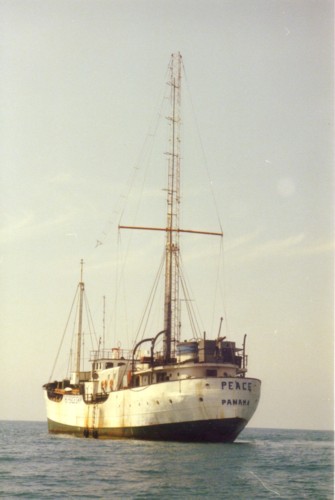
In January 1985, I had arrived in Israel to work as a DJ on a radio station, but this was no ordinary radio. The studios of ‘The Voice of Peace’ were on a ship anchored permanently in the Mediterranean Sea. Aware of my interest in cutting edge music, the station’s popular breakfast DJ Dave Asher (who had been living in Israel for some time) played me a recent 12-inch single by a young Israeli singer of Yemeni origin named Ofra Haza. It was a traditional Yemeni song, re-mixed and cut up into a state-of-the-art club tune that sounded to me like a new, exciting ‘Middle East meets West’ genre. I wanted to find out more, but the terrible winter storms and shortage of staff meant that I was stuck working on the ship for the next three months.

Eventually, during my first shore leave, I visited the Tel Aviv office of the small independent record company, Hed Arzi, that had produced the Ofra Haza single. They were baffled that a British DJ would be so interested in one of their worst selling record releases, and particularly one that seemed to have such minimal mainstream potential. They humoured me and let me sit at a desk in their office, penning handwritten letters to radio DJs and record labels that I knew back in the UK, sent by airmail along with the single and related album ‘Yemenite Songs’.

Within a month, I had received replies from John Peel at Radio One and Charlie Gillett at Capital Radio, both saying that they had played Ofra’s record on their shows and had received enquiries asking where the record could be purchased. During my next shore leave, I returned to Hed Arzi, whose staff were amazed that their song had been played on national radio in the UK. They introduced me to Ofra and her manager for the first time. I wrote again to several UK record companies and one of them, Globestyle, was convinced sufficiently by the airplay to release both the single and the album.

I returned to the UK at the end of 1985 and spent the next two years trying to convince everyone I knew of Ofra’s talent. By 1987, I had given away so many copies of her records to music industry people that the UK record company said I would be given one last free box. By chance, I had recently been invited to attend a monthly staff meeting of London pirate station Kiss FM (at the London School of Economics) and, as a last resort, I distributed copies of Ofra’s records from this last box to some of the station’s DJs.

Kiss FM DJs Jonathan More and Matt Black, recording together as ‘Coldcut’, had already enjoyed underground success with some highly original cut-up singles on their Ahead Of Our Time label. They liked the Ofra Haza songs so much that they cut up one of them into their homemade remix of US rappers Eric B & Rakim’s latest single ‘Paid In Full’. Island Records in the UK released this remix without seeking Eric B’s prior approval, and without clearing the Ofra Haza sample. By the end of 1987, the single had reached number 15 in the chart, giving Eric B his first British hit and earning significant royalties for the Israeli record company because a third of the track featured Ofra’s voice.

More than anything, the chart success of that Eric B remix stimulated huge public interest in Ofra Haza’s voice beyond the narrow market for ‘world music’ (which had just been marketed as a new genre). In early 1988, I organised interviews for a promotional visit to the UK, shepherding Ofra Haza and her manager to Radio 1, the World Service and commercial radio stations. The UK record company re-issued Ofra’s ‘Im Nin Alu’ single, which quickly garnered radio airplay this time, despite it being sung in a strange, foreign language. However, the public demand for the single was so great that the independent label had difficulty fulfilling orders, so it licensed the track to Warner Brothers. After an initial meeting with the major label, my direct involvement with Ofra Haza ended abruptly, just as she was invited back to the UK to perform on ‘Top Of The Pops.’

After the success of this single internationally, the Israeli record label invited me to London’s Sarm Studios, where the follow-up single was being mixed. It was evident that none of the Warner Brothers personnel involved had any understanding of the unique charm of Ofra’s Yemeni music in the international marketplace. Ofra’s manager was far too keen to turn her into a mainstream pop singer, which is exactly how the public perceived her in Israel. As a result, the follow-up single bombed and, sadly, it seemed as if Ofra was consigned to be a one-hit wonder as a result of poor career guidance.

In 2000, I was shocked to learn of Ofra’s death at the age of 42 from AIDS-related organ failure. Two years later, an Israeli television film crew came to London and filmed an interview about my role in creating their country’s most successful international pop star. They had just filmed a similar interview with John Peel at his home, during which he impressed them by producing the handwritten letter that had accompanied the Ofra records I had initially sent him from Israel seventeen years earlier. The interviewer asked me if I had made a fortune from ‘discovering’ Ofra Haza for the international market. All I had received was one cheque for £200 from the UK record company in 1988 to reimburse my expenses for Ofra’s first London promotional visit.

Ofra’s incredible voice lives on through the music she recorded, although I am always reminded of the parts of her life that had been unbelievably tragic. The crucial roles of the late John Peel and Charlie Gillett in her international success should not be forgotten. Ofra Haza’s music arrived in the Western world at a time when the public welcomed sounds that challenged their expectations. We are musically much the poorer for the loss of Ofra, and of John and Charlie, from our world.

‘The Israeli Madonna’
Thursday 30 December 2010
11.30am-12.00noon
BBC Radio 4


[photo: Grant Goddard]

Choice FM R.I.P.: the birth and near death of licensed black music radio in London

31 March 1990 was the memorable day when London‘s first licensed black music station, Choice 96.9 FM, arrived on-air. Until then, the availability of black music on legal radio had been limited to a handful of specialist music shows, even though about half of the singles sales chart was filled with black music. The decision by then regulator the Independent Broadcasting Authority [IBA] to license a London black music station was part of a huge government ‘carrot and stick’ campaign to rid the country of pirate radio. On the one hand, new draconian laws had been introduced that made it a criminal offence even to wear a pirate radio T-shirt or display a pirate radio car sticker. On the other hand, the establishment knew that some kind of olive branch had to be offered to the pirate stations and their large, loyal listenership.

Many pirate stations, having voluntarily closed down in the hope of becoming legitimate, were incensed when the IBA instead selected Choice FM for the new South London FM license. Its backers had no previous experience in the London pirate radio business, but had previously published ‘Root’ magazine for the black community in the 1970s. Although it was impossible for one station to fill the gap left by the many pirates, Choice FM tried very hard to create a format that combined soul and reggae music with news for South London’s black community, which was precisely what its licence required. The station attracted a growing listenership and it brought a significant new audience to commercial radio that had hitherto been ignored by established stations. With Choice FM, the regulator succeeded in fulfilling two aspects of public broadcasting policy: widening the choice of stations available to the public; and filling gaps in the market for content that only pirate radio had supplied until then.

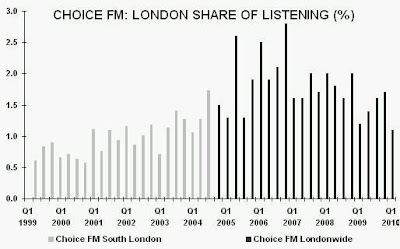
In 2000, Choice FM won a further licence to cover North London with an additional transmitter. For the first time, the station was now properly audible across the whole capital and had access to more listeners and more potential advertising revenues. Its listening doubled and, at its peak in 2006, Choice FM achieved a 2.8% share, placing it ahead of TalkSport and BBC London in the capital. Choice FM had no direct competitor in London, although indirectly some of its music had always overlapped Kiss FM. The station’s future looked rosy.

However, the Choice FM shareholders must have realised just how much their little South London station was worth, at a time when commercial radio licences were being acquired at inflated prices. Already, in 1995, Choice FM shareholders had won a second licence in Birmingham, but had then sold the station in 1998 for £6m to the Chrysalis Radio group, who turned it into another local outlet for its network dance music station Galaxy FM. At a stroke, the black community in Birmingham had lost a station that the regulator had awarded to serve them. Black radio in Birmingham was dead. The die was cast.

The then regulator, the Radio Authority, had rubber-stamped this acquisition, stating that it would not operate against the public interest. The Authority requested some token assurances: at least one Afro-Caribbean member on the station’s board; an academy for training young people, especially from the black community, in radio skills; and market research about the impact of the format change on the black community. None of these made any difference to what came out the loudspeaker. Birmingham’s black community was sold down the river.

Changes in UK media ownership rules were on the horizon that would soon allow commercial radio groups to own many more stations within a local market. As a result, in 2001, the UK’s then largest radio group, Capital Radio plc, acquired 19% of Choice FM’s London station for £3.3m with an option to acquire the rest. In 2003, it bought the remaining 81% for £11.7m in shares, valuing the London station at £14.4m. The Choice FM shareholders had cashed in their chips over a five-year period and had generated £21m from three radio licences. What would happen to Choice FM London now?

Graham Bryce, managing director of Capital Radio’s London rock station Xfm (which Capital had acquired in 1998 for £12.6m), said then:

“Our vision is to build Choice into London’s leading urban music station, becoming the number one choice for young urban Londoners. Longer term, we intend to fully exploit the use of digital technology to build Choice nationally into the UK’s leading urban music station and the number one urban music brand.”

Capital Radio and subsequent owners seemed to want to turn Choice FM into a station that competed directly with Kiss FM (owned by rival EMAP). But they never seemed to understand that Kiss FM was now a ‘dance/pop’ station, whereas Choice FM had always been firmly rooted in the black music tradition of soul, reggae and R&B. Such semantics seemed to be lost on Choice FM’s new owners and on the regulator, but certainly not on Choice FM’s listeners, who had no interest in Kylie Minogue songs.

In 2004, Capital Radio moved Choice FM out of its South London base and into its London headquarters in Leicester Square. The station’s final link with the black community of South London it had been licensed to serve was discarded. In 2005, Capital Radio merged with another radio group, GWR plc, to form GCap Media plc. In March 2008, Global Radio bought GCap Media for £375m. In July 2008, Choice FM managing director Ivor Etienne was suddenly made redundant. One of the station’s former founder shareholders commented:

“I’m disappointed that the new management decided to relieve Ivor Etienne so quickly. My concern is that I hope they will be able to keep the station to serve the community that it was originally licensed for.”

However, from this point forwards, it was obvious that new owner Global Radio had no interest in developing Choice FM as one of its key radio brands. In the most recent quarter, the station’s share of listening fell to an all-time low of 1.1% (since its audience has been measured Londonwide). Sadly, the station is now a shadow of its former self, even though it holds the only black music commercial radio licence in London (BBC digital black music station 1Xtra has failed to dent the London market, with only a 0.3% share).

This week, news emerged from Choice FM that its reggae programmes, which have been broadcast during weekday evenings since the station opened, will be rescheduled to the middle of the night (literally). One of the UK’s foremost reggae DJs, Daddy Ernie, who has presented on Choice FM since its first day, will be relegated to the graveyard hours when nobody is listening. From 2003, after the Capital Radio takeover, reggae songs have been banished from the 0700 to 1900 daytime shows on Choice FM. Now the specialist shows will be removed from evenings, despite London being a world centre for reggae and having more reggae music shops than Jamaica.

Station owner Global Radio responded to criticism of these changes in The Voice newspaper: “Choice [FM] has introduced a summer schedule which sees various changes to the station including the movement of some of our specialist shows.”

Once again, the regulator will roll over obligingly and rubber-stamp these changes. For Global Radio, the endgame must be to transform the standalone Choice FM station into a London outlet for its Galaxy FM network. At present, London-based advertisers and agencies can only listen to Galaxy on DAB or via the internet. A London Galaxy station on FM would bring in more revenue for the brand as a result of more listening hours and its higher profile in the advertising community. It would also provide a direct competitor to Kiss FM London (ironic, because Galaxy FM had been launched in 1990 by an established commercial radio group as an out-of-London imitation of successful, London-only Kiss FM). Global Radio’s argument to persuade the regulator will probably be that Choice FM’s audience has fallen to uneconomic levels. And whose fault was that?

Already, Global Radio’s website tells us that “Choice FM is also included as part of the Galaxy network” which “consists of evolving mainstream music supported by entertaining and relatable presenters.” And yet, according to Ofcom, Choice FM’s licence is still for “a targeted music, news and information service primarily for listeners of African and Afro-Caribbean origin in the Brixton area but with cross-over appeal to other listeners who appreciate urban contemporary black music.” How can both these assertions be true of a single station?

For the black community in London, and for fans of black music, this will be the final straw. Just as happened in Birmingham, the new owner and the regulator will have collectively sold Choice FM’s listeners down the river. Another station that used to broadcast unique content for a unique audience will have been wilfully destroyed in order to make it almost the same as an existing station, playing almost the same content. We have many commercial radio stations, but less and less diversity in the music they play. Radio regulation has failed us.

For Choice FM, the writing was on the wall in 2003 when Capital Radio bought the station and one (unidentified) former DJ commented:

“Choice [FM] was there for a reason [to be a black music station for black people], but that reason changed [since] 13 years ago. That’s why you’ve got over 30 pirate stations in London. If Choice FM kept to the reason why they started, you wouldn’t need all them stations. But Choice has become a commercial marketplace. They’ve sold the station out and they should just say they’ve sold the station out. What’s wrong with that? They have sold the station that was set up for the black community and they know they’ve done the black community wrong. But they’ve made some money and they’ve sold it. Why not let your listeners know?”

For me personally, as a black music fan and having listened to Daddy Ernie for twenty years, I am much saddened. In the 1970s and 80s, I had found little on the radio that interested me musically, so I listened to pirate stations and my own records. During those two decades, I actively campaigned for a wider range of radio stations to be licensed in the UK and, by the 1990s, I had played a direct role in making that expansion of new radio services happen successfully. Where did it get us? Now, years later, I have gone back to listening mostly to pirate radio and my own records (and internet radio). I am sure I am not the only one.

The radio industry and the regulator seem not to understand one important reason why radio listening and revenues have been declining for most of the last decade. They need to examine how, through their decisions, they have consistently sold down the river their station audiences and the very citizens whom their radio licenses were specifically meant to serve. Listeners vote with their ‘off’ buttons when station owners renege on their licence promises and the regulator lets them. Choice FM is sadly just one example.

In 2006, a lone enlightened Ofcom officer, Robert Thelen-Bartholomew, had asked at a radio conference:

“Is there room to bring the content of illegal stations into the fold? One way or another, whether we like it or not, we have a large population out there listening to illegal radio. Why do they listen? We are trying to find out. But, if you listen to the stations, they are producing slightly different content and output [from licensed stations]. Some of it is very high quality. Some of it is very interesting. So, what options are there for bringing some of that content into mainstream radio?”

Seemingly, none. The last FM commercial radio licence the regulator offered in London was more than a decade ago. Last year, when two small South London FM stations (one licensed for a black music format) were closed by their owner, the regulator unilaterally decided not to re-advertise their commercial radio licences (see the story here). A pirate radio station has not been awarded a commercial radio licence by the regulator for two decades.

Why do pirate radio stations still exist? Because, just as in the 1970s and 1980s, there are huge gaps in the market for radio content that – in spite of BBC radio, commercial radio and their regulators – remain unfilled. It is no coincidence that the share of listening to ‘other’ radio stations (i.e. not BBC radio and not commercial radio) in London is near its all-time high at 3.1%.

Farewell, Choice FM. I knew you well for twenty years.

And, irony of ironies, we are in Black Music Month.

[thanks to Sharleen Anderson]

Kiss FM: it's the same old songs

London dance music radio station Kiss FM has re-scheduled its specialist shows to slots after midnight, according to The Guardian, and has cut their duration from two hours to one hour. Almost nobody listens to radio on a weekday after midnight, RAJAR audience data show, so the policy change condemns these shows to a radio graveyard that is very close to extinction.

According to Kiss FM specialist DJ Logan Sama: “The shift of focus away from upfront specialist music to more playlisted hours is one which the management feel will enable the station to compete with the likes of Capital and Galaxy FM. All of the genre-specific late-night shows took the brunt of the hit.”

When Kiss FM was launched in 1990, its specialist music shows started at 7.30pm on weekdays, and the preceding half-hour magazine show ‘The Word’ created a watershed between the daytime mainstream playlist and the more radical evening shows. There was a specific commitment in the station’s licence to broadcast these shows so that Kiss FM would give airplay to music unheard anywhere else on the radio in London.

In the intervening years, through attrition, Kiss FM’s owner (EMAP then, Bauer now) has succeeded in ‘persuading’ the regulator to loosen these licence requirements for the station to broadcast specialist music shows. To its discredit, the regulator has seemed happy to go along with such proposals, permitting Kiss FM to be turned into a much more mainstream hit-orientated station than it was ever intended to be.

What the regulator and some radio owners seem to fail to grasp is that, in a crowded radio market such as London, one station can attract a significant (and loyal) audience by doing something deliberately different both from its competitors and from its own daytime mass-market output. This works both commercially and altruistically. In the case of Kiss FM, advertisers can reach a niche audience that daytime shows do not deliver (if I organise a reggae concert, the best place to advertise it is in a reggae radio show); citizens are offered a genuine extension to the ‘listener choice’ that the regulator loves to cite.

This is not just a theory – there is plenty of empirical evidence to demonstrate how it works. Look at Helen Mayhew’s evening ‘Dinner Jazz’ show on the original London Jazz FM, which was almost the only show on the station that delivered 100% jazz music, but also had higher ratings than any of the daytime playlisted output.

Kiss FM itself provides a good example of what can be achieved. In the graph above, the red line shows the current audience of Kiss FM London (RAJAR, Q3 2009) peaking at 147,000 adults at breakfast between 8 and 8.30am, then falling to a minimum of 1,000 adults by the early hours of the next morning. This is the normal pattern of listening for a mainstream music radio station in the UK.

The blue line shows the Kiss FM London audience a decade earlier in 1999 when specialist music shows still occupied the weekday evening hours. Note that, in the evening, during most of the hours from 7pm to midnight, the audience was bigger a decade ago than it is now. Has the subsequent replacement of specialist music shows with mainstream music in the evening improved Kiss FM’s audience at those times? Apparently not.

After the station launched in 1990, the daytime audience was lower than it is now, but the evening specialist music programmes generated huge audiences. Some of the Kiss FM evening shows attracted more listeners than any other London station in these evening timeslots, ranking them #1 in that daypart.

This was not an accident. Kiss FM’s original schedule was deliberately designed to attract significant audiences to each of a wide range of specialist music shows broadcast on weekday evenings. Listeners loved them – individual shows were promoted heavily on-air and in specialist music magazines. Advertisers loved them – the rates were cheaper than daytime and the spots regularly sold out.

Doing something different on-air can reap rewards, if you satisfy genuine listener demand and promote the hell out of it, so that people know the programmes are there. But, if you simply do the same in the evening that you are doing during daytime, your station is going to have much the same declining listening pattern as any other radio station.

If you compare Kiss FM’s current listening pattern to that of its competitors, you can see from the graph above that it delivers much the same weekday shape – a continuous decline from a peak at breakfast. The exception amongst the London commercial stations is Magic’s unusual peak between 10 and 11pm. Why? Because it schedules ‘The Mellow Ten At Ten’ each weekday evening from 10pm, a one-hour feature that breaks from its playlist.

Also noteworthy in the graph is the unusually high evening audiences achieved by Choice, with more listeners than the station attracts during the afternoon. Why? Because Choice schedules specialist music shows during weekday evenings (mixes, reggae, hip hop). Again, being different can pay off for both audiences and advertisers.

This concept – that individual radio stations often struggle to sound the same, even though ‘daring to be different’ pays dividends – has been understood since the earliest days of media theory. American economist Peter Steiner wrote:

“…. the existence of [different] program types and [different] audiences therefor is assumed by the broadcasting industry and forms the basis for [station] program decisions. In this case, it is the assumed size and distribution of listeners’ preferences that is decisive in determining the amount of [programme] duplication that will result. If, as is often suspected, broadcasters exaggerate the homogeneity of audiences and their preferences for certain program stereotypes, the tendencies towards [programme] duplication will be increased.”

Writing in 1951, Steiner already recognised that radio station owners will tend to duplicate each others’ formats and programme scheduling, rather than offering their audiences something different or unique. He wrote:

“The problem, of course, is that a series of competing firms, each striving to maximize its number of listeners, will fail to achieve either the industry or the social good. Here, then, competition is providing a less than desirable result.”

In the UK, our government created a broadcast regulator to intervene in the market to ensure that commercial radio station formats maximise the ‘social good’, as Steiner refers to it. The UK is in a very different situation from the US, where the regulator (FCC) does not interfere in the formats of radio stations. But the UK system will only work if the regulator understands the economic and social imperatives for market intervention and exercises those powers appropriately.

The increasing marginalisation over the years of Kiss FM’s specialist music programmes demonstrates that the regulator is oblivious to the economic and social imperatives to regulate. Instead, it is simply conspiring to deny both listeners and advertisers the programme diversity they should be entitled to. The fact is that ‘light touch’ radio regulation is not regulation at all, any more than driving a car with no hands on the steering wheel would be considered by a court to be ‘driving’.

A regulator that simply allows market forces, in Steiner’s words, to produce “a less than desirable result” is not regulating. The Independent was quick to blame Kiss FM’s owner:

“Once the king of pirate radio, the legendary station Kiss is being dragged into the mainstream by owners Bauer Media, which will today cut back a number of the Kiss specialist music shows and axe several presenters in order to reposition the network to take on Global Radio operations such as Galaxy. Shame.”

However, the blame should fall squarely on the regulator for allowing a station owner to pursue an objective that further restricts consumer and advertiser choice. There is no ‘free market’ for radio in London – the gap in the market created by Kiss FM’s marginalisation of specialist music genres and DJs will not be filled by another licensed radio station …… only by London pirate stations.

Pirate radio stations seem to be the only ones that implicitly understand Steiner’s competition theories perfectly, and they risk the consequences for putting them into action. Pirate radio’s popularity is no accident – it is a direct outcome of the failure of the regulator to regulate.

First Love Radio (aka South London Radio) R.I.P.

Two local commercial radio stations in London – South London Radio 107.3 and Time 106.8 FM – closed forever on 3 April 2009 with little fanfare. South London Radio had launched in 1999, initially to serve the Borough of Lewisham, but its roots were in South London’s black music pirate radio stations of the 1980s. Time 106.8 had launched in 1990, serving the Thamesmead area of Southeast London, but it had been part of the cable community radio experiment of the 1970s. The closure of these two stations leaves London with only two local FM/AM radio stations based south of the River Thames (Radio Jackie in Kingston, Spectrum Radio in Battersea). Even Choice FM, launched in 1990 specifically to serve the Afro-Caribbean community in Brixton, is now relocated to Leicester Square, its latest owner having closed the station’s studios that had always been located south of the river in Borough High Street.

At first glance, the closures of South London Radio and Time might seem simply an expected outcome of the current pressures faced by many local media, particularly radio and newspapers, particularly in the UK’s largest and most crowded media marketplace. More local commercial radio stations have gone out of business in the last month than in the previous two years, with the Credit Crunch inevitably blamed for declining local advertising revenues. However, if you scratch a little deeper, the recent closures of these two stations were horribly inevitable, almost from the day they opened. What surprises me is that they managed to last this long, having struggled with a succession of owners who failed to turn them into successful businesses, and under a radio regulatory system that failed to ensure that South London’s population was offered the local radio services it had been promised.

I must declare a personal (non-financial) interest in both stations. I live within the coverage area of South London Radio and listened to it on the last occasion only days before it suddenly closed; and I had worked a one-year contract at Time’s forerunner, Radio Thamesmead, as Head of Programmes in 1986 when it was still a community cable radio station. Before they closed this month, each of these two stations was losing more than £100,000 per annum. Their accumulated losses since launch ran into millions. Yet, only five years ago, their combined market value was over £1m. How does that make sense? Their closures speak volumes about the UK commercial radio system and its inability to satisfy consumer demand for radio content via a regulated licensing system that seems to fail listeners again …. and again …. and again. Although these two legal local commercial stations are truly dead and buried, the FM airwaves of South London nevertheless remain alive with the sound of dozens of unlicensed ‘pirate’ radio stations, many of which seem to know exactly what content their audiences want and know how to give it to them.

‘Pirate radio’ had been the starting point of South London Radio, though it might have been hard to believe if you had listened to the station in its final years. Between 1986 and 1990, a pirate station named Rock 2 Rock had broadcast from the roof of the three 24-story tower blocks behind New Cross station. Its programmes of soul, reggae and community information attracted a loyal following in South London and, although the station might not have been as well known as competitors such as LWR, Horizon or Solar, its signal reached across the capital, and its DJ roster exhibited a love of the music they played at a time when legal radio continued to shun black music almost totally. “Most of the people who were involved in [Rock 2 Rock] lived or worked in the Lewisham Borough,” DJ Inspector Scratch-It told me in 1992. “I don’t even really know what the secret [of our success] was. It was just something [indefinable].”

In the late 1980s, local resident Stella Headley had walked into her local reggae record shop, Sound City in Deptford, and asked if she could present a show on pirate radio. Despite having no radio experience, but armed with a passion for jazz music, Stella was offered a show on Rock 2 Rock where she called herself Lady X. The station quickly became ubiquitous in the area. “The way that we had broadcast was so down-to-earth and friendly,” Stella recalled when I interviewed her in 1992 [Radio Scan, City Limits #562, 16 July 1992]. “It was something that everyone could relate to.”

In late 1990, the government of the day introduced draconian laws that made it a criminal offence to be involved in the promotion or broadcast of pirate radio, with the possibility of a prison sentence even just for wearing a pirate station T-shirt or having a pirate radio sticker on your car. Rock 2 Rock, along with dozens of other pirate stations of the time, decided voluntarily to close down. “It was pressure,” explained Inspector Scratch-It, “realising that things could really start getting bad if we did get caught”. Some of the station’s twenty DJs moved on to work at new, legal ‘incremental’ stations that had just been licensed to satisfy previously unfilled gaps in the radio market – Mistri, one of the most popular club DJs of the era, joined short-lived WNK in North London; and I recruited Angie Dee to the launch of the legalised London ex-pirate KISS FM. Ten others, including Stella, started a new venture called First Love Radio which went on to campaign for Southeast London to be given its own commercial radio station.

A £5,000 grant from South Thames TEC enabled the group to organise formal radio training for local residents. A temporary, one-month FM licence (under the Radio Authority’s Restricted Service Licence scheme) showcased to residents of the Borough of Lewisham the content which the station wanted to be able to broadcast legally. Inspector Scratch-It explained: “We’ll be doing things we would have liked to have done when we were a pirate. Now we can plan ahead and use more people from the community, without fear of being arrested. I know how hard it was to maintain the [Rock 2 Rock] station. Every time there was a knock on the door, your heart was going thump, thump, thump”.

First Love Radio completed several, successful one-month local broadcasts, and by 1997 the Radio Authority was sufficiently impressed to advertise a small-scale commercial radio licence for Southeast London. To be sure of winning the licence, Stella involved commercial radio group UKRD as a partner and majority shareholder who, in turn, recruited community radio consultant Des Shepherd to write the licence application. In January 1998, the Radio Authority announced that it had selected First Love Radio as the winner from amongst eight applicants. The Authority noted proudly that “this is the 22nd ILR [Independent Local Radio] service to be awarded covering Greater London or parts of the capital”.

However, the station’s winning licence application promised, somewhat surprisingly, that its output would “represent the diverse tastes and interests of its target audience by providing a dynamic music mix from the 60s through to the 90s with high quality local news and information for the Borough of Lewisham”. Gone was any specific commitment to serving the substantial Afro-Caribbean community within the Borough. Gone was any specific commitment to playing soul and reggae music. It seemed that, while the Radio Authority was busy congratulating itself that it had licensed its 22nd station in London, it had condemned First Love Radio to become simply another tiny little station in the UK’s biggest radio market that would be playing the same pop music hits that everyone else was. The eventual fate of First Love was sealed there and then.

Whereas Rock 2 Rock had embodied a quite Unique Selling Point in its music format, First Love Radio was destined to be ‘all things to all people’. As one writer noted of its music policy, “this is perhaps as diverse as a radio station can get”. Owner UKRD was not really interested in the business of operating a black music station for Lewisham. UKRD was in the business of collecting local radio licences. A London licence held intrinsic value, whatever you did with it, and the cost of a licence application was probably no more than the low tens of thousands of pounds, while the scarcity value of any London licence made it worth millions. UKRD was an investment machine, turning paper licence applications into valuable licences, rather than a turnaround specialist turning poorly performing radio stations into success stories.

First Love Radio launched as a full-time station in 1999 but achieved dismal ratings so, in 2000, UKRD sold it to Fusion Radio Holdings, a new company established by radio salesman Nigel Reeve to acquire local radio licences. Stella Headley tendered her resignation from the Board little more than a year after her station had launched, abruptly bringing to an end her decade of hard work to secure a local station for Lewisham. The ideals of First Love Radio were already dead. Veteran radio presenter Roger Day was appointed Programme Controller of the station, whose name was quickly changed to Fusion 107.3. Reeve said: “We are delighted to have acquired two radio stations [Lewisham and Oxford] with huge growth potential. Plans are in place to build revenue and increase audience figures….”

In 2001, Fusion Radio Holdings and its three stations (Lewisham, Thamesmead and Oxford) were acquired in a deal worth £4.1m by another corporate collector of local licences, the Milestone Radio Company, which was run by former radio presenter Andy Craig. Media Business reported that the deal “puts an end to industry speculation concerning the demise of Fusion Radio [Holdings], following the move from its West End location to Lewisham”.

In 2002, Fusion 107.3 was instructed by the Advertising Standards Authority to withdraw a poster campaign that featured “a photograph of the naked torso of a woman” whose “nipples were airbrushed out and radio dials were positioned at the bottom right-hand side of her breasts”. Complainants had objected that the poster was “sexist and demeaning to women”, though the station’s owner argued that “the poster was designed as a high-impact campaign to attract new listeners” and that the model’s “radio dials [were] pointing south east to emphasize the geographical range of their broadcast”.

Three owners in three years were still failing to make First Love Radio/Fusion 107.3 a success. In 2003, Milestone raised £8m from an AIM share listing, despite admitting that it had “limited revenues to date and … accumulated net losses”. The pre-AIM company had suffered pre-taxes losses of £5m in 2001 and £4m in 2002, on turnover of £0.6m and £1.7m respectively. By 2003, Fusion 107.3 was still only attracting 6,000 listeners per week in a local market of 322,000 adults. The station was already losing more than £300,000 per annum, so Milestone put it up for sale.

In February 2004, after a year on the market, Sunrise Radio acquired both the Lewisham and Thamesmead stations for £1.2m. Sunrise (coincidentally an ex-pirate station) had run a successful, legal Asian radio station in London since 1989 and wanted to diversify into mainstream radio formats. In January 2004, former Radio Authority finance director Neil Romain had been recruited to head new Sunrise subsidiary London Media Company which would manage these stations.

Once again, the station’s new owner appeared to miss the opportunity to imbue the station with a Unique Selling Point to differentiate it from its many competitors in the London market. The station was renamed South London Radio and its web site was branded “All Time Favourites”, a radio format similar to that already offered in London by Heart FM, Magic FM, Gold London and Smooth Radio, amongst others. As a result, in 2006, the station was given a ‘Yellow Card’ sanction by Ofcom because it was found to be failing its mandated music format. Ofcom said the station “should have a distinct musical sound” whereas “over 50% of the daytime output fell within the Hits/Pop genre”.

As well as the change in station name, the new owner asked Ofcom’s approval in 2006 to temporarily move the station’s studio out of its Lewisham service area to share premises with co-owned Time 106.8 in Thamesmead. There was a subsequent period when the station operated from a business centre in Croydon. At the same time, it appears that improvements to the station’s transmitter were granted that enabled the station to be heard across a wider area that included parts of the Croydon and Bexley boroughs for the first time, extending the potential audience to 645,000 adults. Eventually, the station returned to co-location in Thamesmead.

During this whole period, the station’s music policy continued to be a bizarre mish-mash of current hits and the oddest selection of ‘black music’ that seemed scheduled purely to satisfy Ofcom’s prescribed Format requirement to appeal to “listeners with a preference for soul/Motown, R’n’B, reggae and dance hits”. So the daytime output might make transitions straight from Nat King Cole to Lily Allen, or from Dionne Warwick to the Pussycat Dolls. Whilst I personally like eclectic mixes of music styles, South London Radio ended up sounding particularly schizophrenic. Five years under the same owner should have provided plenty of time to make the station at least sound consistent and instil it with a sense of purpose. Neither Romain, without prior radio management experience, nor Sunrise, without experience in black music formats, achieved a successful turnaround of the Lewisham station.

In 2008, a notice appeared on the consumer-facing homepages of the Lewisham and Thamesmead stations, informing interested parties that both were up for sale and inviting bids. Sunrise Radio’s Avtar Lit explained: “They are good local businesses but they do not fit in with our portfolio. Traditionally these stations have always made losses but we have reduced those losses dramatically. The days of large companies running a number of local radio stations are gone, simply because the decision-making process is too far removed.” There was at least one bid lodged for South London Radio, but the offer deadline passed and no transactions were reported. Precisely what happened next is open to interpretation…………

The official web site of South London Radio includes a message which explains (in part):
“Both stations were sold on 22 February [2009] to an individual who, after seven days of ownership, informed staff that he could not afford to fund the stations and would need to sell one station to fund the other. At this point, staff had already not been paid for the month of February. Since the announcement, staff have been working at the station free of charge in the hopes a new buyer would be found. After a lot of work, a potential buyer was found who was very keen to acquire the stations and take them forward. Several obstacles were put into their way which saw the sale of both stations put on hold……”

The Radio Today web site initially reported on 4 April 2009 that both stations had closed because they had been “up for sale but no suitable buyer was found”, though its storyline was later amended to match the explanation on the stations’ web sites.

According to the Company Register, on 22 February 2009, Sunrise Radio’s Avtar Lit, London Media Company’s Neil Romain and Company Secretary Sonia Daggar resigned as directors of South London Radio. On the same date, Arvind Kumar Audit was appointed sole director of South London Radio, and a loan to the value of £1,029,704.61 was made from Sunrise Radio to South London Radio which gave Sunrise first call on the station’s assets. Staff at the stations have suggested that a relative of Lit was brought in to manage the Thamesmead operation, though this allegation remains unsubstantiated. For the brief period the two stations remained on-air, Audit was listed in their Public Files as Station Manager. However, Ofcom did not publish a Change of Control review for these transactions.

In legal terms, it would appear that Sunrise Radio/London Media Company sold the stations weeks before they closed, though why someone would decide to purchase a loss-making station that had a £1m loan outstanding to its previous owner remains a mystery. Nevertheless, the circumstances make it impossible to suggest that Sunrise Radio/London Media Company themselves closed these stations (as Radio Today had initially stated) because the stations were not officially under their control when the plugs were pulled. This subtlety might hold some importance to Sunrise or Ofcom, but it remains wholly irrelevant to the local people of South London who no longer have a local commercial radio station, whatever did or did not happen.

Admittedly, listeners to South London Radio were few in number as a result of the station’s consistent failure to connect with an audience. Its market share only surpassed 1% during two quarters of its decade on-air, though most of the time it registered less than 0.5%. In the station’s launch year, its listeners numbered less than 1,000 adults per week although, by the time it closed, that number had risen to 19,000 within its significantly enlarged coverage area. These numbers would still prove too low to adequately finance a local radio business in London. The station had never stood a chance from the time that UKRD saddled it with a pop music format in its licence application.
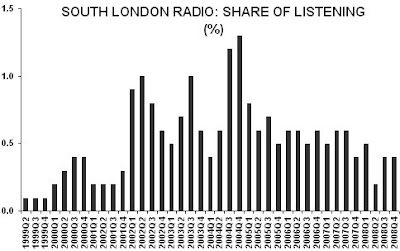
South London Radio never made an operating profit from airtime sales, not even in its earliest days. The only period of positive cashflow occurred in 2004 and 2005 when £1.7m compensation was received from its landlord when the station was forced to vacate its premises, presumably before its tenancy had expired. Ironically, this windfall was twice the size of the advertising revenues received by the station during its entire lifetime. Although, in recent years, its owner had managed to substantially reduce the station’s overheads, revenues had fallen to as little as £1,000 per week by then. There are pirate stations in South London that earn more money than that.

South London Radio’s final owner (or ‘penultimate’ owner legally) seemed to know where the blame lied for the station’s failure. In one set of Annual Accounts, its directors said:
“Despite significant investment by the management, the station has continued to perform below expectations. The impact of illegal broadcasters compromising the transmissions of this station is the main reason for the poor financial performance. The Directors are continuing to lobby the regulators in an attempt to find a solution”.

It was this lobbying by Sunrise Radio (a former pirate) of Ofcom which led to the transmitter power increase that significantly extended the station’s coverage area. Its owner then increased the survey area for the station’s RAJAR audience ratings from 304,000 to 1,472,000 adults, but the station’s weekly reach stubbornly remained at around 1%. Perhaps the owner thought that a station which claimed to reach 1.5m people across South London was more likely to find a buyer than a station that served only the relatively poor Borough of Lewisham. Whatever, South London Radio eventually closed with accumulated losses estimated at almost £2m, a figure that would have been twice the size, had it not been for the windfall settlement the station received from its previous landlord.

So it’s all over now, a sad end to Stella Headley’s dreams and also the death of what was supposed to be my local radio station. Hopefully, some lessons can be learned from this sorry tale. Some of these ‘lessons’ seem so glaringly obvious that it is almost embarrassing to point them out, but the 36-year history of commercial radio in the UK is so littered with repeated failures that it is worth spelling out some of the things that evidently went wrong. First Love Radio is just one of many local stations that have failed with both audiences and advertisers because of structural and procedural faults within the UK’s commercial radio system.

POSSIBLE LESSONS

1. CAN A DESIGNATED LOCAL MARKET SUPPORT AN ADVERTISING-FUNDED COMMERCIAL RADIO STATION?
Before advertising a new licence for a specific geographical area, the radio regulator did not evaluate whether there were sufficient local advertising revenues to support a commercial radio station for that area. This was true of Lewisham when the Radio Authority advertised this licence in 1997. A decade later, it was probably just as true of Ofcom when it awarded new licences for a talk station in Edinburgh (now closed), a rock music station in Plymouth (never opened), a station serving a population of 65,000 adults in Barrow (now closed), or a station serving a population of 30,000 adults in Northallerton (now annexed). Whether it was the Radio Authority or Ofcom, the regulator was issuing ‘licences to fail’ that never stood a chance of being successful, standalone businesses.

2. LOCAL RADIO GROUPS ARE FODDER FOR THE AMBITIONS OF COMMERCIAL RADIO GROUPS
First Love Radio is not the first local radio group to have organised short-term broadcasts in their area, organised training, raised public funds and raised local awareness of it campaign for a local station. Then, when it comes to writing the licence application, many such groups jump into bed with a commercial radio group that has no understanding of the group’s aims, the proposed station’s format, or the local marketplace. The radio group is interested in the licence, and the local group believe that such an alliance will ensure that licence will be won. An outside ‘consultant’ is brought in to write an application that is likely to win the licence, rather than an application that tells the truth.

3. NEW LOCAL COMMERCIAL RADIO LICENCES ARE AWARDED TO APPLICANTS THAT ALREADY HAVE COMMERCIAL RADIO LICENCES
To those that already have shall be given …. again and again and again. How many of Ofcom’s 39 new local radio licences between 2004 and today were awarded to applicants that did not already own a radio station? Ony one. It’s a regulatory gravy train of licence awards, which works great for those lucky few who already have a seat on the train. For those genuinely local radio groups who simply have a desire to run a radio station in their local area, the message is – you don’t stand a chance of winning a licence on your own.

4. MOST LOCAL RADIO GROUPS’ EXPERTISE IS IN COLLECTING LICENCES, NOT IN TURNING AROUND LOCAL RADIO STATIONS
As noted previously, the cost of making a licence application is usually a five-figure amount, whereas the balance sheet value of a radio licence is either a six- or seven-figure sum. The ‘business’ skill of most local radio groups has been based upon turning paper radio licence applications into valuable intangible assets to add to their balance sheets. Sadly, it has not been based upon launching successful local radio stations (‘successful’ meaning profitable), or upon turning around unsuccessful stations.

5. RADIO LICENCE APPLICATIONS ARE GENERALLY NOT GROUNDED IN REALITY
The promises made in most licence applications are mostly over-optimistic ‘waffle’. The lavish programming, the potential profitability, the audience targets – most of these are written purely to fit what the applicant radio group thinks the regulator wants to hear. Almost every licence applicant promises that its business will break-even within three years, despite evidence that there are very, very few newly-launched stations that have achieved such a performance in the last 20 years. Rule Number One of licence applications – never let the facts get in the way of a good story. As a result, the performance of most start-up stations is more than dismal. The graph below shows the percentage plus/minus achieved in hours listened versus the forecast hours listened in the station’s licence application for new local stations licensed during the last five years. Only four stations managed to beat their targets. (The crosses represent stations that have closed.)

Because of the untruthfulness of most licence applications, if you were to submit a more realistic assessment of your business plan within a licence application, it would look very gloomy compared to your competitors. Do you get any credit for being realistic (i.e. honest)? No, you are unlikely to be awarded the licence.

6. THE REGULATOR DOES NOT ‘POST MORTEM’ ITS LICENSING DECISIONS
When the Independent Broadcasting Authority licensed the ‘incremental’ stations, did it publish a report to show why so many of them went out of business within their first year? No, it didn’t. When the Radio Authority licensed the ‘regional’ stations, did it publish a report to show why these stations had no impact on enabling commercial radio to be more competitive for audiences against the BBC? No, it didn’t (I did my own research). Now that Ofcom has licensed so many new local stations, has it published research to show why so many are already proving unviable and whether awarding new licences to existing licensees had proven the appropriate regulatory policy? No, it hasn’t (see research in John Myers report). In all these cases, there seems to have been no attempt to learn from past experience, and thus no attempt to assess the positives and negatives of regulatory policy. To an observer, the attitude might look remarkably like ‘OK, that didn’t really work, so let’s try something different now’.

7. A LOCAL RADIO LICENCE ONLY ACQUIRES INTRINSIC VALUE IF YOU DO SOMETHING CONSTRUCTIVE WITH IT
Local radio groups can play the game of putting inflated values for their local radio licences on their balance sheets. But unless you can actually find someone who is willing to pay that inflated price, your licence in reality is worth nothing at all. After an era of crazy acquisition prices during the 1990s, we are now in a period where there have never been so many station sellers, but almost no buyers for the majority of small local radio licences. The ‘house of cards’ that was carefully constructed over the last two decades is already falling down. The radio licence gravy train bears some similarities to the vulnerability of a Ponzi scheme. Now that Ofcom is no longer offering new local radio licences, the ability of radio groups to continue to improve their balance sheet valuations through more licence wins has ended abruptly. As a result, their existing stations are now revealed to be worth a lot on paper, but worth almost nothing in reality because there are no buyers (i.e. other local radio groups with similarly over-inflated balance sheets). The underlying fallacy of the licence award system is now revealed.

8. THE TRACK RECORD OF MOST SMALL LOCAL RADIO GROUPS IS NOT GOOD
There is simply no money to be made from owning a number of small local radio licences, unless you have proven turnaround skills. Plenty of companies have raised millions of shareholder funds, promising to return them a profit from a cluster of loss-making local radio stations. The profits never arrived. Laser Broadcasting went bust. Forever Broadcasting went bust. The Wireless Group sold out. Golden Rose sold out. Milestone sold out. The Local Radio Company is on its knees financially. You might think that this history of failures would be sufficient warning to future investors that adding X number of loss-making local commercial radio stations to Y number of loss-making local commercial radio stations does not equal profits. Apparently not.

9. THERE IS A WIDENING ‘REALITY GAP’ BETWEEN WHAT THE REGULATOR IS REGULATING ON PAPER, AND WHAT IS ACTUALLY HAPPENING IN LOCAL RADIO MARKETS
On paper, each of the UK’s 300 commercial radio stations has a distinct ‘Format’ it has to follow, theoretically offering it a unique position in its local market. In this highly regulated system, Ofcom is supposedly ensuring that a diverse range of consumer demands for radio content are being simultaneously satisfied in each market. Even a casual radio listener realises that this system is a fiction. London has a large number of local commercial stations, and many of them sound remarkably similar, despite on paper them being meant to be different from their competitors. If South London Radio had offered different content and satisfied local demand for content, it might have thrived. Despite its Yellow Card sanction, Ofcom failed to ensure that South London Radio was satisfying the demand in South London for a local, black music station.

10. THE CLOSURE OF A LOCAL STATION IS THE FAULT OF BOTH ITS OWNER AND THE REGULATOR
It is very easy for the regulator to step back and say that the commercial failure of a specific local radio station is not its responsibility because it does not interfere in the business operations of its licensees. Frankly, this is a cop-out. Eight applicants applied for the Lewisham licence awarded to South London Radio. Seven were never even given the opportunity by the regulator to create a successful local radio station. Our public servants in the regulator were supposed to use their knowledge and expertise to select the applicant that was most likely to ‘win’. Ofcom even has a web page where it explains why it selected one applicant above the others for each licence. If the regulator’s choice was misguided, mistaken or ill-informed, it should have to explain what went wrong (a bit like this blog entry?). Surely, the regulator owes such an explanation to the listeners the station was supposed to serve and also to the unsuccessful licence applicants who, as a result of the regulator’s judgement, have no ‘second chance’ to put their own proposals for a radio station into action.

11. RADIO STATION OWNERS ARE NOT REQUIRED TO SELL STATIONS, RATHER THAN CLOSE THEM
I have heard several radio group executives say that they would rather close down one of their loss-making stations than sell it for £1. There are several issues at play here. Firstly, closing a company creates an opportunity to move some liabilities from elsewhere in the group before the station is made insolvent. Secondly, radio owners don’t want the embarrassment of someone else successfully turning around a station that they had not managed to make profitable over several years. Thirdly, if an owner paid £1m for a station, it is embarrassing for the CEO to have to tell their Board that it had to be sold for £1. The end result, as in South London, is that listeners no longer have a local radio station at all, rather than the baton being passed on to someone else to try and make the business work. Again, it is the listeners and the unsuccessful licence applicants who lose out.

12. THE SCARCITY OF LOCAL RADIO LICENCES HAS TURNED THEM INTO TROPHY ASSETS
If you want to start a local newspaper, you simply start it. You don’t need a licence. If you want to start a local radio station, you cannot. You have to wait for Ofcom to decide to offer a licence for your area, then you have to apply for it, and then you have to win it. In this case, Ofcom is unlikely to offer another South London FM licence to replace South London Radio. That opportunity came and went in 1997. As a result, there are far too many owners coveting local radio licences because of their scarcity, hoping that at some point in the future a ‘white knight’ will still ride over the horizon and pay an outrageous sum for it, regardless of the fact it is losing money every year and has accumulated losses of millions. After the Communications Bill opened up UK radio ownership to non-European Union stakeholders, there were several radio owners who were waiting for a global media company such as Clear Channel to ride into town and offer them a small fortune for their failing businesses. It never happened, and sadly there was no ‘Plan B’.

13. THE LACK OF CREATIVITY IN COMMERCIAL RADIO
There is a terrible lack of creativity within the commercial radio sector that is severely holding back its ability to compete with the BBC, let alone to compete with the flood of audio content available via the internet. It is far easier for radio companies to simply do either the type of content that they have always done and/or the content that everybody else is doing, rather than to be innovative or creative. In the case of South London Radio, I understand that its owner was approached last year by at least one radio consultant (not me) with a plan to resuscitate the station by returning it to its original roots as a black music outlet. That proposal was rejected.

14. THE REGULATOR PRETENDS TO ADOPT A ‘LIGHT TOUCH’ APPROACH TO COMMERCIAL RADIO REGULATION
If the regulation of commercial radio in the UK were genuinely ‘light touch’, then it would be appropriate that the regulator makes no attempt to intervene in the failure of individual stations. However, the system of radio regulation (even under Ofcom) intervenes heavily in almost every aspect of the commercial radio landscape, down to such detail as whether a particular station can play a specific song within its output. In such a highly regulated market where Ofcom exercises such a high degree of control, the regulator should surely have a responsibility to the citizen/consumer to ensure that the relatively small number of stations it selects to license (compared to the total number of applicants) continue to exist in some shape or form. It is not consistent to intervene at every moment of a station’s existence, except when it is finally threatened with closure as a direct/indirect result of the regulatory system.

15. NO CONSULTATION WITH LOCAL STAKEHOLDERS
Ofcom makes a big noise about its consultation system and its willingness to listen to the opinions of a wide range of stakeholders. However, when a station is threatened with closure, has the regulator ever consulted with local advertisers to consider the impact on them, with local community organisations who used the station to inform the local population of their activities, or with the local population itself? Would it not be useful to talk to Stella Headley now and canvas her opinion of what precisely had gone wrong with First Love Radio since 1990 (I tried to locate her for this blog entry but failed)?

The irony of South London Radio’s closure is that, over a ten-year period, things have already gone full circle. South London Radio was born from the experiences of pirate radio in the Borough of Lewisham, and now it is the pirate stations once again that are carrying the torch for those of us living in this area of South London. There is presently a great pirate station in Lewisham that sounds like the natural successor to1980s pirate Rock 2 Rock, playing reggae and soul music for ‘big people’. I can listen to this station on FM or via the internet (telling you its name would break the law) and it entertains me in a way that the latter day South London Radio never achieved. I used to listen to Rock 2 Rock in the 1980s, and now I am listening to its successor.

First Love Radio R.I.P.

It appears that our highly regulated and interventionist commercial radio system has:
* completely failed the people who originally put the idea together for First Love Radio
* completely wasted the public money invested in training people from the local community in Lewisham to make radio programmes
* has completely failed the population of Lewisham and beyond who should have their own radio service.

These failures in public policy will continue to have to be filled (though not fully because of the threat to those involved of criminal prosecution) by the efforts of unlicensed radio stations in Lewisham. A document published by the publicly funded Creative Lewisham Agency lamented that “television and radio is a very small Creative Industries sub-sector” in the north of the Borough ….. but then it noted that pirate radio is “a contributor to the Creative economy” and “is certainly vital for networking and showcasing”. When you find public bodies extolling the citizen value of pirate radio, you know for sure that something in our radio licensing system has gone very badly wrong.

As Inspector Scratch-It recalled of his Rock 2 Rock days: “We even had links with the police and [Lewisham] Council. They used to send us information that was relevant to read out, even though we were a pirate.” Twenty years on, it is still pirate radio filling that gap.