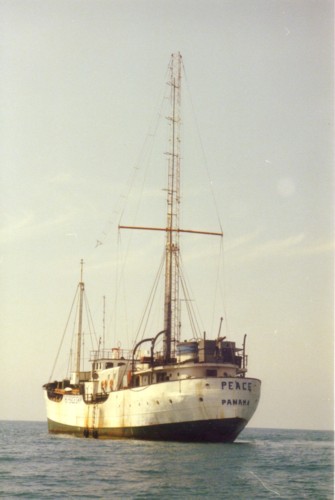
In January 1985, I had arrived in Israel to work as a DJ on a radio station, but this was no ordinary radio. The studios of ‘The Voice of Peace’ were on a ship anchored permanently in the Mediterranean Sea [see blog]. Aware of my interest in cutting edge music, the station’s popular breakfast DJ Dave Asher (who had been living in Israel for some time) [see blog] played me a recent 12-inch single ‘Galbi’ by a young Israeli singer of Yemeni origin named Ofra Haza. It was a traditional Yemeni song, re-mixed and cut up into a state-of-the-art club tune that sounded to me like a new, exciting ‘Middle East meets West’ genre. I wanted to find out more, but the terrible winter storms and shortage of DJ staff meant that I was stuck working on the ship for the next three months.
Eventually, during my first shore leave, I visited the Tel Aviv office of the small independent record company ‘Hed Arzi’ that had produced the Ofra Haza single. They were baffled that a British DJ would be so interested in one of their worst selling record releases, and particularly one that seemed to have such minimal mainstream potential. They humoured me and let me sit at a desk in their office, penning handwritten letters to radio DJ’s and record labels that I knew back in the UK, sent by airmail along with the single and related album ‘Yemenite Songs’.
Within a month, I had received replies from John Peel at ‘BBC Radio One’ and Charlie Gillett at London’s market leader ‘Capital Radio’, both saying that they had played Ofra’s record on their shows and had received enquiries asking where the record could be purchased. During my next shore leave, I returned to Hed Arzi, whose staff were amazed that their song had been played on national radio in the UK. They introduced me to Ofra and her manager for the first time. I wrote again to several UK record labels and one of them, ‘Globestyle’ owned by ‘Ace Records’, was convinced sufficiently by the airplay to release both the single and the album [see blog].
I returned to the UK at the end of 1985 and spent the next two years trying to convince everyone I knew of Ofra’s talent. By 1987, I had given away so many copies of her records to music industry people that Ace Records’ Roger Armstrong said I would be given one last free box. By chance, I had recently been invited to attend a monthly staff meeting of London pirate station KISS FM (at the London School of Economics) [see blog] and, as a last resort, I distributed copies of Ofra’s records from this last box to some of the station’s DJs, mailed from my part-time job with ‘Rough Trade Records’ director Scott Piering. Simultaneously, I attended monthly meetings in a London pub of music industry personnel who created the new genre ‘world music’ and marketed it for the first time in the UK [see blog].
KISS FM DJ’s Jonathan More and Matt Black, recording together as ‘Coldcut’, had already enjoyed underground success with some highly original cut-up singles on their ‘Ahead Of Our Time’ label. They liked the Ofra Haza songs so much that they cut up one of them into their homemade remix of US rappers Eric B & Rakim’s latest single ‘Paid In Full’. ‘Island Records’ in the UK released this remix without seeking Eric B’s prior approval, and without clearing the Ofra Haza sample. By the end of 1987, the single had reached number 15 in the UK singles chart, giving Eric B his first British hit and earning significant royalties for the Israeli record company because a third of the track featured Ofra’s voice, a fact I knew because Roger Armstrong had asked me to time the recording with a stopwatch in order to negotiate his appropriate share of royalties from Island Records.
More than anything, the chart success of that Eric B remix stimulated huge public interest in Ofra Haza’s voice beyond the narrower market for the new ‘world music’ genre. In early 1988, I organised interviews for a promotional visit to the UK, shepherding Ofra Haza and her manager Bezalel Aloni to BBC Radio 1, the BBC World Service and London commercial radio stations. Ace Records re-issued Ofra’s ‘Im Nin Alu’ single, which quickly garnered radio airplay this time, despite it being sung in a strange, foreign language. However, the public demand for the single was so great that the independent label had difficulty fulfilling orders, so it licensed the track to ‘Warner Brothers/WEA’. After an initial meeting with the major label at which I passed on all the press coverage I had achieved to date, my direct involvement with Ofra Haza ended abruptly, just as she was invited back to the UK to perform on BBC1 TV show ‘Top of The Pops.’ I had asked Warner to keep me updated but it never did.
After the success of this single internationally, the Israeli record label invited me to London’s ‘Sarm West’ Studios, where the follow-up single ‘Shaday’ was being mixed. It was evident that none of the Warner Brothers personnel involved had any understanding of the unique charm of Ofra’s Yemeni music in the international marketplace. Ofra’s controlling manager was far too keen to turn her into a mainstream pop singer, which is exactly how the public perceived her in Israel. As a result, the follow-up single bombed and, sadly, it seemed then as if Ofra was consigned to be a one-hit wonder as a result of poor career guidance.
In 2000, I was shocked to learn of Ofra’s death at the age of 42 from AIDS-related organ failure. I emailed the family in Israel, asking to attend the funeral, but received no response. Two years later, an Israeli ‘Channel 2’ television film crew came to London and filmed an interview about my role in creating their country’s most successful international pop star [for 70-minute ‘The Life & Death of Ofra Haza’]. They had just filmed a similar interview with John Peel at his home, during which he impressed them by producing my handwritten letter that had accompanied the Ofra records I had initially sent him from Israel seventeen years earlier. The interviewer asked me if I had made a fortune from ‘discovering’ Ofra Haza for the international market. I laughed. All I had ever received was one cheque for £200 from Ace Records in 1988 to reimburse my expenses for taxis, refreshments and food during Ofra’s initial London promotional visit. Neither Hed Arzi, nor Ace Records, nor Haza’s estate have communicated with me since.
Ofra’s incredible voice lives on through the music she recorded, although I am always reminded of the parts of her life that had been unbelievably tragic. The crucial roles of the late John Peel and Charlie Gillett in her international success should not be forgotten. Ofra Haza’s music arrived in the Western world at a time when the public welcomed sounds that challenged their expectations. We are musically much the poorer for the loss of Ofra, and of John and Charlie, from our world.
[Green Productions in Israel has just completed a video documentary ‘One Song’ in Hebrew that narrates the story in detail for the first time of how ‘In Nin Alu’ became an unlikely pop chart hit.]
August 1989. There was a momentary lull in the usually frenetic activity at the [former Londonpirate radio station] ‘KISS FM’ office, whilst we awaited the next Independent Broadcasting Authority [IBA] announcement that would give specific details of the application procedure for the two new London FM [commercial radio] licences on offer. [KISS FM co-founder] Gordon McNamee turned his attention to other matters, since he understood that there was still no guarantee of KISS FM winning the licence, even on its second attempt.
On several occasions, I had mentioned to McNamee my belief that there existed significant untapped commercial potential in KISS FM’s magazine, ‘The Written Word.’ A year earlier, the publication had started life as a single A3 sheet newsletter, entitled ‘94,’ that had been produced on a word processor and had been printed without photographs. At that time, it had been intended solely as an update for the station’s fans and its main feature had been the KISS FM programme schedule. As the station’s mailing list increased in size, so too had the content of the magazine. By the final issue of The Written Word, the thirty-two pages had included lots of photos, recordreviews, interviews and information about the London dance music scene. There were also several pages of paid-for advertisements which had helped to defray the increasing costs of printing and postage.
For several years, I had been fascinated by the proliferation of free magazines in London, with weekly titles such as ‘Ms London,’ ‘Girl About Town’ and ‘Midweek’ handed out during the morning rush hour to thousands of commuters at London’s railway and underground stations. For revenue, these magazines depended entirely upon the advertising space they sold, but their distribution costs were low and their print runs were huge. An increasing number of more specialist magazines were being produced and financed in this way. Travelling through Waterloo railway station one day, I had been handed a free entertainment and what’s on magazine that was aimed specifically at high earning commuters living in the suburbs. In my area of Northwest London, I regularly received a free copy of a general interest, colour magazine aimed at homeowners in the locality.
One of the problems KISS FM had encountered with The Written Word was the huge cost of sending out thousands of copies of each issue individually to every person on the station’s growing mailing list. I believed that these expenses could be reduced dramatically by distributing the magazine as a free giveaway to a wider readership that would pick it up from dance music record shops, music venues and clubs in London. Many more copies would have to be printed to circulate the magazine in this way, but the advertising space within it could be sold at a much higher price, since it would be reaching many more readers. Instead of being solely a KISS FM publicity vehicle, the enlarged publication could be London’s first giveaway magazine to be aimed specifically at the city’s dance music community.
McNamee liked my idea and could see the potential it offered him to earn much needed revenue to cover the overheads of running the KISS FM office. After several weeks discussing with him my proposal for the magazine, McNamee asked if I would like to launch the project and be its editor. I had experience in this field, having been editor of the student newspaper [‘Palatinate’] and student handbook whilst at university, and having launched an independent music magazine [‘N.E.’] in Northeast England. I accepted McNamee’s job offer and handed in my notice to the record company where I had worked during the last two years. McNamee said he would pay me £100 for three days’ work each week, plus eight per cent of the net profits generated by the magazine. Although this worked out to be less money than I had earned from the record company, I believed that the new job would improve my career prospects and provide an opportunity to be more closely involved with KISS FM.
Besides, my recent experiences with the record company had left me frustrated and eager to explore a new work opportunity. Back in 1985, whilst working in Israel, I had discovered a female singer named Ofra Haza whose music, a kind of ‘Middle East meets West’ sound, I believed would be marketable in Europe. Since then, I had worked hard promoting her music and had succeeded in achieving airplay on national radio in the UK and positive press coverage. By 1989, one of the Ofra Haza songs I had found in Israel four years earlier had reached number fifteen in the UK singles chart. It was released by the independent record company for which I had been working. I asked the company for some compensation towards all the work I had done to make this artist a success, including a UK artist interview tour I had arranged in early 1989. The directors had met and decided to offer me a cheque for £200. I felt insulted by this amount, particularly as my years of work had given the company its biggest chart hit in a long time. Worse, the credit for Ofra Haza’s chart success was being taken in press interviews by someone else working at the record label. Now, all I wanted to do was quit the company, having earned almost nothing from four years of work having created Israel’s biggest international pop music star, and yet not having even gained any recognition.
I started work at the Blackstock Mews office on 22 August 1989, the first occasion I had earned money from KISS FM, despite having been involved in the business since the beginning of the year. I had been spending more and more time in the office, working with the other staff, but had never been offered remuneration. I looked forward to becoming a proper employee, although the one person in the organisation who did not seem to welcome my appointment as editor of the new publication was Lindsay Wesker [son of playwrightSir Arnold Wesker]. He had been editor of The Written Word, until its recent closure, and he probably felt that this experience, combined with his previous work for the ‘Black Echoes’ music paper, should have made him the ideal candidate for this new post. McNamee told me privately that he was well aware of Wesker’s antipathy towards my appointment, but assured me that he wanted fresh blood to be in charge of the project.
The day after I handed in my notice to the record company, I convened an evening meeting at the KISS FM office to discuss the new magazine. After a considerable amount of brain-storming, [co-worker] Heddi Greenwood suggested it could be titled ‘Free!’ reflecting not only the fact that it was to be a giveaway magazine, but also the notion of personal freedom to which dance music fans would be able to relate. Her suggestion was accepted unanimously. It was agreed that the first monthly issue would be published at the beginning of October 1989, that the print run would be around 30,000, and that the magazine should divorce itself entirely from the KISS FM campaign for a radio licence that had dominated The Written Word. Everyone felt that it was most important for the magazine to be viewed as an authoritative, independent guide to the London dance music scene. Heddi Greenwood would handle the advertising sales for the magazine, and McNamee had appointed Lindsay Wesker its deputy editor in a gesture of reconciliation. I set to work writing a substantial business plan that outlined the magazine’s purpose and ethos, which would also be used in presentations to potential advertisers. Over several pages, I defined the editorial content of Free!, its intended readership and the reasons I believed it would prove so successful.
Now that I had become the fifth paid worker in the KISS FM office, McNamee arranged a second-handdesk and phone extension for my arrival. I was now working at Blackstock Mews on a regular basis, from which I gained a greater insight into the way in which the members of the KISS FM team worked and their respective roles within the organisation.
I was busy putting together the blueprint for the new Free! magazine. I visited a cheap photo-typesetting company in Brighton, commissioned quotes from printing companies, called meetings in the office of potential contributors, and commissioned a logodesign. McNamee was becoming increasingly enthused about the potential profit offered by the new magazine, and so he quickly became more involved in its day-to-day running. He had almost stopped talking about KISS FM altogether and, despite our awareness that the new London FM licences were in the pipeline, McNamee directed the whole office’s efforts into this new publishing venture.
One extremely hot and sunny weekend in late August, the KISS FM staff spent the whole of Saturday and Sunday transforming the hitherto unused downstairs room at Blackstock Mews into an office for Free! All the accumulated rubbish was completely cleared out and the dark, dreary room was repainted – ceiling, walls, floor, everything. McNamee bought a job lot of small second-hand desks, which were moved outside to the Mews for us to paint in gloss black. The office stereo system was rigged up outdoors to provide us with musical entertainment, and McNamee dug out some old cassette recordings of programmes from KISS FM’s pirate days, which he had kept in his desk drawers, to entertain everyone.
Some brand-new shelves and storage units were purchased from the IKEAfurniture store, which McNamee and I assembled in the new downstairs office. There was one piece of furniture with which McNamee became obsessed: the construction of a huge, rectangular glass-topped table, more than six feet in length. It was the closest he could achieve, for now, to the impressive pieces of furniture he had admired in the opulent boardrooms of KISS FM’s new, corporate shareholders. Between the clear glass table top and its feltunderlay, McNamee spent hours carefully positioning press articles about KISS FM and pages from The Written Word magazine, along with some of the station’s publicity materials. Once the glass top had been screwed down to the base, the whole thing looked remarkably like a personal shrine to the KISS FM pirate radio station that McNamee used to run and to the commercial radio business to which he aspired.
One chapter in his business career now having ended, McNamee seemed determined to bury the deep disappointment of the failed [first] KISS FM licence bid and, instead, to put all his energies into turning my idea for Free! magazine into the money-spinner he longed for. The dream of KISS FM radio was very quickly being forgotten.
When I had accepted the job of editor, McNamee had promised that I would also be spending some of my time working on the second licence application, but the launch of Free! was proving to be very demanding and there was still little sign of action within the organisation about the radio licence.
McNamee hardly ever mentioned KISS FM any more, and the only aspect of the second licence application that seemed to occupy him was satisfying the chairman’s desire to assemble an advisory committee. Since the failure of the first bid, there had not been a single office meeting to discuss what had gone well or badly in the previous campaign, or to analyse what had been the good and bad points of the application. Whenever I broached the subject of the second licence bid with McNamee, he would shrug it off and change the subject to the potential success of Free! magazine, which had overtaken KISS FM as his pet project. This state of affairs frustrated me immensely, because it seemed as if McNamee had lost interest in making a second licence bid at all. He had already discarded KISS FM’s past and the possibility of winning second time around. In fact, McNamee had confided in a close friend, Joe Strong, manager of Dingwalls venue in Camden, that losing the licence had left him “absolutely devastated” and “absolutely inconsolable.”
I was perplexed. I arranged to meet a fellow journalist and radio worker, Daniel Nathan, whom I had known since moving to London in 1986, and with whom I felt I could discuss this problem. As the two of us walked across Blackheath one weekend, I ranted to Nathan about how incredibly close I thought KISS FM was to winning a licence on this second occasion, and how frustrating it was that McNamee seemed intent on wasting the opportunity. I had been the only member of the KISS FM team to attend the IBA press conference announcing ‘London Jazz Radio’s win (Nathan had been there too) and it was obvious to me how much enthusiasm some of the IBA staff had shown towards KISS FM’s bid. This time, there was likely to be a similar number of applicants for the two new licences and, unless KISS FM could submit an almost perfect application, the IBA would feel duty bound to award licences to other groups who proved that they were better organised.
Talking to Nathan clarified, in my own mind, the gravity of the situation. These two new London licences were likely to be the last on offer until sometime in the mid-1990’s. To throw away the chance of winning a black music station for radio listeners in London at this stage would be utterly crazy, particularly after so many people had campaigned for so many years in the hope of just such an eventuality. I decided that, even if McNamee was prepared to remain slumped despondently in his office chair, consigning KISS FM to a space in his glorious past, I certainly was not. If he wanted to wallow in his own despair, that was fine with me. He could carry on playing nostalgic tapes of his old KISS FM shows to everyone in the office, as he had been during recent weeks, but I was determined to do something more positive about winning the station a licence.
On returning to work the following week, at the first opportune moment, I confronted McNamee across his desk in the open plan KISS FM office. Why was he not doing anything about the second licence bid? Did he not believe KISS FM could win? If everyone else still had faith in KISS FM, was he not letting them all down? Was any work being done on a revised application? Was not Free! magazine merely a short-term distraction? Almost anyone could start a new magazine, but how many people could win a radio licence? Why had he slumped into total inaction? As I questioned McNamee, I could sense the other staff at their desks in the office trying to bury their heads in work and look as if they were not listening to our conversation. I explained to McNamee that I thought he was throwing away the biggest business opportunity he was ever likely to encounter in his life. I told him that, of the people within the KISS FM office, I seemed to be the best qualified person to organise and co-ordinate the second licence application [having previously researched and written successful project applications to Durham University, Manpower Services Commission, Northern Arts and Princes Trust]. For the moment, that work seemed to me to be a far more appropriate use of my skills than editing Free!, particularly as nobody else seemed to be doing anything about the KISS FM bid.
I suggested to McNamee that someone else should be brought in to edit Free! magazine while I devoted my full attention to re-working the KISS FM licence application. I had already prepared the groundwork for the new magazine during the last month, and the project could easily be handed over to another editor at this stage. On the other hand, if we did not act on the KISS FM bid now, we would never be offered another chance.
During this monologue, McNamee listened to me, smiled a lot, but said virtually nothing in reply. I could sense that, deep inside, he was incredibly angry that anyone should even dare to challenge his authority in this way. I had seen him act this way before, but only when directing his anger towards others who had displeased him. Instead of showing any response of anger or emotion, McNamee just glowered at you and clammed up. It was his usual cold shoulder treatment – ex-communication rather than confrontation – and you had to wonder whether he was already plotting some ghastly revenge to extract upon you in the future for your supposed crime. McNamee continued to be wholly unresponsive to my questions, so I told him that I planned to start work immediately on KISS FM’s application and that, initially, I planned to do some research in the comparative peace of my home. I promised I would willingly explain and hand over all the tasks I had completed on Free! magazine to whomsoever he wished. After all my suggestions, McNamee still offered me no response, so I gathered together my work and left the office.
After that ‘meeting,’ it was almost a week before I heard anything at all from McNamee. I had been busy working at home, as I had planned, and although I had regular telephone conversations with the other staff in the KISS FM office, McNamee had carefully avoided any contact with me. To me, this sort of behaviour appeared incredibly childish – McNamee seemed to be putting the vanity of his own ego above the need for his radio station to win a licence. Then, late one evening, he phoned me from home. He offered no explanation or apology for his attitude towards me that day in the office, and he gave no reason as to why he had failed to contact me at all during the intervening week. Our conversation was unemotional and business-like. He told me that, from now on, he would pay me £100 for spending three days each week working on the KISS FM licence application. He said he wanted more of my time, but I explained that I had other work commitments during the week on which I could not renege. He made it sound as if this arrangement had just come to him in a flash of inspiration, and that his offer was obviously too good for anyone to turn down.
He also told me that I would no longer be involved in Free! magazine in any capacity. He wanted me to visit the office and hand over all my paperwork to the newly appointed editor, who would be Lindsay Wesker. Finally, he disclosed the caveat that must have taken him almost a week to concoct. When my work on the licence application ended in November, I would no longer be paid by KISS FM, and neither could I resume the editorship of Free! magazine. In essence, I was being allowed to have my own way in the short term but, in the end, I had been made to sacrifice a permanent job at KISS FM. I would be forced to look elsewhere for work once the licence application process was over. This did not worry me excessively because I sincerely believed that KISS FM could win the licence this time around, whereas McNamee seemed already to have resigned himself to failing on the second occasion. This new arrangement cut my pay to a basic £100 per week, because I would no longer draw the percentage of profit that McNamee had previously agreed I would derive from Free! magazine. I was not told the details of the deal that McNamee had struck with Wesker to take over editorship of Free!, but Wesker could not hide his delight at assuming the position he must have felt he had always deserved.
However, when the much delayed first issue of Free! was eventually published at the beginning of November, Wesker’s tendency to indulge himself shone from the inside of the magazine. He contributed one page of his own photos and three and a half pages of his record reviews to the beginning of that first edition. These reviews included glowing critiques of a single released by KISS FM’s own label ‘Graphic Records’ and of a track recorded by Wesker’s partner, Claudette Patterson. I was no longer allowed any involvement in Free! and my name was deleted from the magazine’s masthead, in disregard of my work developing the original idea and setting the project in motion. Free! had been my ‘baby’ and I had had to sacrifice it for KISS FM. From then on, Wesker spent most of his time in the downstairs Free! office at Blackstock Mews, while the rest of us continued to work upstairs on the business of KISS FM and Goodfoot Promotions [Limited].
Personally, I was very disappointed to no longer be involved in the launch and organisation of Free! magazine. However, I firmly believed that KISS FM would win the London licence if I could come up with the necessary facts and figures in this second version of the application form. There would always be another opportunity in the future for me to launch a new publishing project. Right now, this might be the last opportunity I would have to win London a black music radio station. The hard work had only just begun, and a lot of responsibility was suddenly resting upon my shoulders.
February 1990. During recent months […], Lindsay Wesker had become totally absorbed in his role as editor of the monthly magazine Free! and he was now spending little time on KISS FM matters. The February 1990 edition of the magazine presented the first opportunity for KISS FM to explain, in its own words, exactly how it had won its [second application for a] radio licence. Wesker wanted to write the article, but McNamee intervened and insisted that I should pen the two-page feature. Despite the magazine having been my original idea, this was the only occasion I was asked to contribute to Free!, and then only because McNamee had insisted. Wesker seemed incredibly territorial about the project he now viewed as ‘his baby,’ and he appeared to like to do as much of the work on the magazine himself as was possible.
June 1990. The next job appointment I needed to make was the station’s record librarian, who would be supervised by KISS FM’s head of music, Lindsay Wesker. Since taking over the editorship of Free! magazine from me the previous year, Wesker had had little involvement in the re-launch of KISS FM. He seemed almost obsessed with the monthly magazine, spending many late nights in the ground floor office writing articles and reviewing records. Since Wesker had no prior commercial radio experience to contribute, I had not been particularly worried by his absence. However, the person appointed as record librarian would report to Wesker, which is why it was vital for him to be involved in their selection. I loaned Wesker a large folder of all the applications I had received for this job [I had advertised in ‘The Guardian’ newspaper] and I asked his opinion of which might be the most suitable to interview.
The next day, Wesker returned the folder to me, having marked the handful of candidates he felt were most suitable. I looked through his selection and was puzzled by his choices. I asked him why he had chosen those particular applicants, none of whom had previous library experience. He explained that there were two qualities he had been looking for – the candidates had to demonstrate knowledge of dance music, and they had to be female. At first, I thought he was joking, but I quickly discovered that he was not. Wesker explained to me his theory that a record librarian had to be a woman, and stated that he was not interested in working with someone who was not a proven expert in dance music. I was shocked that Wesker could be so irrational in choosing a suitable person for the job. His method of appointing staff was proving to be as bizarre as that of McNamee.
February 1991. Gordon McNamee [now KISS 100 FM managing director] suddenly announced that the station would no longer publish Free! magazine after the January 1991 issue. I was proud to have created the idea for the magazine a year and a half earlier. Although I was no longer associated with its editorial team, I was sad to see Free! close just as KISS FM was proving to be a success with listeners. McNamee explained that the magazine was no longer earning sufficient revenues from advertising to cover its printing costs. However, there were rumours of other reasons for the closure. It was alleged that two KISS FM directors wanted to close Free! because it clashed with their publishing interests. Tony Prince owned the monthly ‘MixMag’ magazine which had recently switched from subscription-only to retail sales. Free! would be a direct competitor. It was also alleged that KISS FM shareholder EMAP [plc] planned to launch its own monthly dance music magazine. Free! would be a direct competitor. Fortunately, Free! found an alternative financial backer and was reborn [under new ownership] as ‘Touch’ magazine, which published similar editorial content.
Once Free! had moved out, the large downstairs room on the ground floor of the [KISS 100 FM] Holloway Road building suddenly looked very empty. I spent an evening picking through the debris left in the office of the magazine that had started life as ‘94’ in July 1988, and which had been such an important part of the pirate station’s campaign to win a licence. Free!’s sudden closure was a bad omen. Staff in the building started whispering about further cuts that might be made to save the company money.
FREE!, nos. 1-15 (November 1989 – January 1991), London.
Having purchased my first soul record (‘Time Is Tight’, Booker T & the MG’s, Stax 119) in 1969, I had been thrilled in 1973 to find a new homegrown monthly colour magazine ‘Black Music’ on the shelves of my local newsagent. I devoured every issue cover-to-cover until its closure in 1984 and wrote to many of its advertisers selling soul and reggae records. I could never have imagined then that, almost two decades hence, I would become the founder of Britain’s longest running monthly black music magazine, created as ‘Free!’ and renamed ‘Touch’ until its closure in 2001.
“There’s a bomb!” someone shouted. “There’s a bomb!”
I had just collected ‘NME’ from the newsagent that reserved it for me each week and had been lazily staring at a display of the new ‘designer’ stretch jeans in the windows of Gloria Vandebilt’s shop. All had been calm on the city’s main shopping street. Then suddenly it was chaos. People ran in all directions as if their lives depended upon it … which they did. Men, women and children screamed as they fled down side streets, their shopping bags flying behind them like parachutes. I was in amongst them, running at full pelt until I thought I was far enough away from the suspect device. How would I know? I didn’t. Did I hear an explosion? No. Was it really a bomb? I never knew.
On the walk home, I called in at the post office and joined a lengthy queue at the counter for overseas mail. Once I handed over my letter, the man behind the counter inspected it and adopted the withering look of an adult castigating a child … or a new immigrant.
“You cannot send this,” he said, visibly weighing up my ignorance. “We are at war.”
“Oh,” I said sheepishly, taking back my letter. “Okay. Thanks.”
Where I came from, you could send a letter anywhere in the world. I had spent much of my childhood doing just that, writing to radio stations as far away as China, Russia and Syria … and receiving replies. However, I was now learning that life is different during a time of war. I had written a fan letter to ‘Radio One’, an FM station in Beirut, Lebanon with English-speaking DJs who played the latest international hits, interspersed with familiar identification jingles stolen from ‘BBC Radio One’. Since radio transmissions ignore borders and war zones, I had become a committed listener in recent months. Now I had to return home with my unsent letter.
‘Home’ was temporarily a house at 21 Rehov Aharonson in Tel Aviv, where I was sleeping on the living room floor of the lower flat rented by fellow Brit Dave Asher. He was a well-known DJ in Israel from having presented the ‘Voice of Peace’ radio station’s breakfast show for several years. There were drawbacks to my accommodation. One morning I awoke to find ants nesting in my hair, while the nocturnal journeys of slugs from behind the adjacent bathroom sink gave me frequent ‘Alien’-type nightmares. But Dave had let me stay for free and I was grateful for his generosity. Weeks turned into months; how quick they pass.
Dave had a job as DJ at a city centre basement lesbian nightclub which he kept inviting me to attend. I did visit on one occasion, but was faced with the challenge of convincing two burly doormen that I wanted to enter a female-only club filled with scantily clad women because I said my male friend was working inside. Dave was also the DJ at a packed concert by American drag queen Divine in a huge former cinema, one of the most entertaining events I have attended. My crazy plan was to remain in Tel Aviv by finding a job in the record industry, for which Dave had helped me make contact with people he knew in the business. Pre-internet and pre-mobiles, this required a lengthy wait for replies to handwritten letters.
As summer was hot inside the flat, at the end of the day I would walk the short distance to the end of the street and sit on one of the public seats along the promenade. I could put my feet up on the sea wall, read the day’s ‘Jerusalem Post’ newspaper, watch the sun set over the Mediterranean and cool down in the onshore breeze. One day, a man seated near me asked if he could read my paper when I had finished with it. He spoke in Hebrew and I replied likewise.
By then, I had learnt enough of the language to hold a basic conversation. The frustration of not even understanding destinations displayed on the front of city buses had forced me to learn the Hebrew alphabet and numbers from a schoolbook. Every afternoon I developed my vocabulary by watching ‘Sesame Street’ (‘Rehov Sumsum’ in Hebrew) on television, where the first word I learnt was the ‘dustbin’ in which Grouch (Moishe Oofnik) lived.
I was suspicious of this man trying to strike up a conversation because, weeks earlier, I had been sunbathing alone on Tel Aviv beach when a man came and sat far too close to me on the sand and propositioned me for sex. He appeared to interpret my indignant refusal as merely ‘playing hard to get’ and continued to pester me, so I now avoided the beach and its potential for further unwanted attentions.
Thankfully this man on the promenade seemed different. Because our initial conversation had been in Hebrew, he found it hard to believe that I was not a recent immigrant to Israel struggling to learn my new language. After several rounds of questioning, he was eventually convinced that: I was not Jewish; I was British; I spoke English; and I was Christian. Only once these facts had been established did he have sufficient confidence to identify himself to me as a Christian Palestinian.
“Meet me here at the same time tomorrow,” he told me. “There is something I want to show you.”
Despite an incendiary device having recently exploded at the end of our street, thankfully with no casualties, I decided to risk meeting this man again the next day on the promenade. We walked to a walled compound a few hundred metres away where he spoke Arabic into the intercom, the gate opened and we walked through a garden into a house. He took me inside and knocked on what appeared to be a bedroom door. When it opened, it was immediately apparent that this was no normal small bedroom.
Bunk beds were butted up against each other on three walls of the room, leaving no space in their midst for other furniture. The small window had been covered so that the room was dark except for a single lightbulb on the ceiling. After my entrance, I was being stared at by six men, each sat on their bunk, their sweat thick in this non-air-conditioned room. My guide explained to them in Arabic why I was there, then he turned to address me.
“I wanted you to see how Palestinians have to live in Israel, the same land in which our families were born,” he told me. “Before dawn every day, we are employed outside to clean the beaches, sweep the streets and collect rubbish but, by the time the sun comes up and the crowds come out, we have to make ourselves invisible by returning to accommodation like this. As a fellow Christian, I wanted you to see how we are forced to live in our own homeland so that you can tell people what life is really like in Israel for those who are not Jews.”
A man arrived with a big bag of takeaway food which he started to dole out to each of the men in the room. I wondered to myself if I was to be included in their evening meal and how that could happen when there was no available space for a guest to sit. My guide quickly quashed that notion.
“The men will not eat their food in front of a stranger,” he explained. “We have to go now.”
It had only required a few minutes in that crowded room for the man to have made his point. He was understandably angry about his people’s situation. He told me that, having seen their conditions myself, I now had evidence to refute the disinformation that most of the world believed. We left the compound, he went his own way and I never saw him again.
After several months of messages, letters and calls from public phone boxes, I was finally offered a meeting with the head of an international record company’s Israeli subsidiary in his penthouse flat. There I explained that I had recently secured airplay on British radio for Israeli pop records through my knowledge of the UK radio industry. I believed I could do more like this to develop Israeli music’s presence overseas.
“You should go home,” he told me sternly. “Israel is not the place for you. There is a war going on. The economy is in bad shape. Things are terrible here. Go home and find yourself a job there.”
I departed Israel on the next available flight, disappointed by my failure to secure a job. I left behind an economy with an annual rate of inflation nearing 1,000% and a currency so devalued that it required a thick wad of banknotes just to buy a loaf of bread. Prices in shops had to be updated daily, written on post-it notes stuck along shelf edges. At checkouts, there were insufficient banknotes in tills to provide change, so customers were given the equivalent value in sweets and candies. Coins had become obsolete because they were worthless. I was carrying around several hundred banknotes stuffed down the front of my underpants because my wallet was now too small.
Back in Britain, within three years I had organised the release and promotion of an Israeli record that reached number 15 in the UK singles chart, accompanied by a ‘Top of the Pops’ television appearance. It became the biggest selling Israeli record in Britain since Esther and Abi Ofarim’s ‘Cinderella Rockefella’ in 1968, coincidentally my very first single purchase. Singer Ofra Haza became an international star, later recording songs for a Disney movie. Despite failing to find a job in Tel Aviv, I had managed to successfully pin music from Israel on the ‘world music’ map of the 1980’s.
It was Dave Asher who had first introduced me to Ofra Haza’s music in 1985. Two decades later, his job was presenting the breakfast show on a radio station … in Beirut!
In January 1985, I had arrived in Israel to work as a DJ on a radio station, but this was no ordinary radio. The studios of ‘The Voice of Peace’ were on a ship anchored permanently in the Mediterranean Sea. Aware of my interest in cutting edge music, the station’s popular breakfast DJ Dave Asher (who had been living in Israel for some time) played me a recent 12-inch single by a young Israeli singer of Yemeni origin named Ofra Haza. It was a traditional Yemeni song, re-mixed and cut up into a state-of-the-art club tune that sounded to me like a new, exciting ‘Middle East meets West’ genre. I wanted to find out more, but the terrible winter storms and shortage of staff meant that I was stuck working on the ship for the next three months.
Eventually, during my first shore leave, I visited the Tel Aviv office of the small independent record company, Hed Arzi, that had produced the Ofra Haza single. They were baffled that a British DJ would be so interested in one of their worst selling record releases, and particularly one that seemed to have such minimal mainstream potential. They humoured me and let me sit at a desk in their office, penning handwritten letters to radio DJs and record labels that I knew back in the UK, sent by airmail along with the single and related album ‘Yemenite Songs’.
Within a month, I had received replies from John Peel at Radio One and Charlie Gillett at Capital Radio, both saying that they had played Ofra’s record on their shows and had received enquiries asking where the record could be purchased. During my next shore leave, I returned to Hed Arzi, whose staff were amazed that their song had been played on national radio in the UK. They introduced me to Ofra and her manager for the first time. I wrote again to several UK record companies and one of them, Globestyle, was convinced sufficiently by the airplay to release both the single and the album.
I returned to the UK at the end of 1985 and spent the next two years trying to convince everyone I knew of Ofra’s talent. By 1987, I had given away so many copies of her records to music industry people that the UK record company said I would be given one last free box. By chance, I had recently been invited to attend a monthly staff meeting of London pirate station Kiss FM (at the London School of Economics) and, as a last resort, I distributed copies of Ofra’s records from this last box to some of the station’s DJs.
Kiss FM DJs Jonathan More and Matt Black, recording together as ‘Coldcut’, had already enjoyed underground success with some highly original cut-up singles on their Ahead Of Our Time label. They liked the Ofra Haza songs so much that they cut up one of them into their homemade remix of US rappers Eric B & Rakim’s latest single ‘Paid In Full’. Island Records in the UK released this remix without seeking Eric B’s prior approval, and without clearing the Ofra Haza sample. By the end of 1987, the single had reached number 15 in the chart, giving Eric B his first British hit and earning significant royalties for the Israeli record company because a third of the track featured Ofra’s voice.
More than anything, the chart success of that Eric B remix stimulated huge public interest in Ofra Haza’s voice beyond the narrow market for ‘world music’ (which had just been marketed as a new genre). In early 1988, I organised interviews for a promotional visit to the UK, shepherding Ofra Haza and her manager to Radio 1, the World Service and commercial radio stations. The UK record company re-issued Ofra’s ‘Im Nin Alu’ single, which quickly garnered radio airplay this time, despite it being sung in a strange, foreign language. However, the public demand for the single was so great that the independent label had difficulty fulfilling orders, so it licensed the track to Warner Brothers. After an initial meeting with the major label, my direct involvement with Ofra Haza ended abruptly, just as she was invited back to the UK to perform on ‘Top Of The Pops.’
After the success of this single internationally, the Israeli record label invited me to London’s Sarm Studios, where the follow-up single was being mixed. It was evident that none of the Warner Brothers personnel involved had any understanding of the unique charm of Ofra’s Yemeni music in the international marketplace. Ofra’s manager was far too keen to turn her into a mainstream pop singer, which is exactly how the public perceived her in Israel. As a result, the follow-up single bombed and, sadly, it seemed as if Ofra was consigned to be a one-hit wonder as a result of poor career guidance.
In 2000, I was shocked to learn of Ofra’s death at the age of 42 from AIDS-related organ failure. Two years later, an Israeli television film crew came to London and filmed an interview about my role in creating their country’s most successful international pop star. They had just filmed a similar interview with John Peel at his home, during which he impressed them by producing the handwritten letter that had accompanied the Ofra records I had initially sent him from Israel seventeen years earlier. The interviewer asked me if I had made a fortune from ‘discovering’ Ofra Haza for the international market. All I had received was one cheque for £200 from the UK record company in 1988 to reimburse my expenses for Ofra’s first London promotional visit.
Ofra’s incredible voice lives on through the music she recorded, although I am always reminded of the parts of her life that had been unbelievably tragic. The crucial roles of the late John Peel and Charlie Gillett in her international success should not be forgotten. Ofra Haza’s music arrived in the Western world at a time when the public welcomed sounds that challenged their expectations. We are musically much the poorer for the loss of Ofra, and of John and Charlie, from our world.


 Grant Goddard : radio broadcasting expert : media analyst : writer/author