Digital radio switchover – searching for the Credible Plan

Ed Richards, Chief Executive, Ofcom [ER]
Q&A @ Radio 3.0 conference, London (excerpt)
21 May 2009

Q: Isn’ t the big issue with DAB ‘[FM] switchoff’?….

ER: It is one big question but it definitely isn’t the only big question. And the difference with TV is very instructive. One of the profound differences with TV, of course, is that in the case of TV you couldn’t extend Freeview digital television without turning off the analogue spectrum, and that’s a profound difference. One of the other differences, of course, is that the value of the spectrum released by analogue switchoff in television is extremely high. Indeed, people are fighting each other metaphorically to get hold of it and have been ever since we mooted the idea some years ago. So there are some very big differences. The other obvious differences are that people have more radios than they do have TV’s, and so on and so forth. It is a very big question but I don’t think it’s the only one. That is why we put as much emphasis on the inherent sustainability and viability of digital [radio] services. It is always going to be asking people a lot to simply look forward, especially in the context of no switchoff date – and even if there was a switchoff date, it would be some years away – it’s always going to be asking them a lot to take losses for a long period. If only we can get to a point where DAB services are essentially at least breakeven, the better because that gives you a base from which to plan the other more challenging things, which include switchoff, and we want to work quite hard at that alongside the debate about Digital Britain.

Q: Without a date, it feels like it’s almost over the horizon. People I talk to in radio nearly all say ‘what we need is a date’. Is Digital Britain going to give us a date, do you think?

ER: That is a common theme that you hear, it is true. Before answering the thrust of that, I reiterate that I think you need to address the date and the migration issue, but you need to address the underlying economics first and immediately at the same time. And that means a frequency plan, savings in transmission, and so on and so forth, and it means continuing growth and more listeners on DAB. I hear everybody, a lot of people, say that we have to have a date. Will Digital Britain give us a date? I don’t know. There are a number of things we don’t know about Digital Britain yet.

Q: Would it be helpful if it did give us a date?

ER: It depends what the date was. It wouldn’t be helpful if the date was next year. I think the most important thing is … Let me rephrase the question slightly. You can only have a date if you have got a credible plan that delivers that date. So I could give you a date now but it would be meaningless. It would be rather like the television switchover date in one or two countries around the world – which I won’t name because it would get me into trouble – but they name dates, the governments stand up and puff up their chests and name dates but they are meaningless and, as soon as they have left the room, everybody laughs. So a date is meaningless without a credible plan to get there, so I recognise ….

Q: It’s a bit chicken and egg, isn’t it?

ER: Well, you have to have one in order to have the other. I think where people really are on this is, when they say we must have a date, that is another way of saying we must have a credible plan which gives us a date, and I would agree with that ….

Q: But how close are we to a credible plan?

ER: We are getting closer. We are doing a lot of work, as I said in my contribution, around the re-planning and I think the re-planning is very important to it. We need to have a clear set of proposals about quality of service and coverage and all those sorts of things, and those things need to be in place before you can have a credible plan. But there is work actively taking place on that and being driven forward. But better to get that right and to have a sense of urgency and determination, than just to pluck a meaningless date out of the air.

…..

Q: I’m still struggling slightly with [FM] switchoff only because it strikes me that almost everything hinges upon this and what you say is perfectly sensible – you can’t really have switchoff until you have a credible plan – but we know that, in the real world, unless we are forced by one thing or another, we don’t actually face this and businesses are very similar to life and everybody is still hedging their bets on FM. I speak to mobile phone manufacturers who say ‘well, look, we only have room in our phones for so many transmitters and receivers. We have got Bluetooth, we have got infra-red, we have da-da-da-da-da and all our users tell us they really value FM’. So they are not going to switch it until they have to. People with DAB radios in their cars are still a rarity and the manufacturers are not going to start installing them as standard until someone says ‘OK, 2013, 2012, 2011, whatever it is – that’s it’.

ER: Well, that’s the attraction of setting a date and driving everyone to it. But I’m trying to think of something different to say than what I said earlier.

Q: Would you favour it as an option?

ER: If there is a credible plan, yes. You’ve got to have a credible plan. And what you can’t do is just pluck a date out of the air and say ‘we’re all going to get there’ because I know what will happen under those circumstances. What will happen is that it will be fine for about a month and then, going for coffee outside the conference room, everyone will say ‘well, that is not going to happen, is it?’

Q: Except in TV, it has and it is.

ER: In TV, we wrote the original document which said ‘we will push on to digital switchover in this timeframe and here is how you can do it’. We wrote that document and said ‘these are the six of seven things you have to do to deliver it’ and we knew what you had to do to re-plan, we knew what you had to do to lead people across, we knew about the re-tuning, we knew the vast majority of things and there was a plan. That plan was then picked up by the creation of Digital UK, and so on. We’ve got to get to that next step, so I think it’s an exciting prospect but we’ve got to believe that it’s credible and deliverable. So I know that I’m repeating myself and not being particularly helpful but I do genuinely believe that and we need to – senior people in the industry need to sit round, look at this, stare at the steps and say ‘will that deliver it, is it consistent with what is in the audience’s interest?’ There’s no point in doing something which audiences then regard as a disaster. We have to do something that audiences, as it took place, will regard as a good thing. That’s an acid test and I think that’s possible, but there’s a lot of work to do and we’ve got to see if we can get there.

Exclusive digital radio content: saying it and doing it are two different things

Everyone seems to agree – it is the availability of exclusive radio content on digital platforms that will drive consumer uptake of the hardware and digital listening.

In its Final Report, the Digital Radio Working Group had said in December 2008: “We must present a compelling [DAB] proposition for consumers not only through new content, but in building a whole new radio experience”.

In its Interim Report, Digital Britain had said in January 2009: “We will expect the radio industry to strengthen its [DAB] consumer proposition both in terms of new and innovative content and to take advantage of the technological developments that DAB can offer”.

In its report commissioned for RadioCentre, Ingenious Consulting had said in January 2009: “…. there is not as much DAB-only material as hoped, and very little that’s truly compelling – there’s no ‘must have’ content as with sports and movies on Sky [TV]”.

In its submission to Digital Britain, Ofcom had recommended in March 2009 “the creation of new commercial radio stations to create a consumer proposition analogous to Freeview: a wide range of popular and niche services, delivered digitally”.

The Digital Radio Working Group had spent a year meeting throughout 2008 and made its final recommendations in New Year 2009. Five months later, for the consumer turning on their DAB radio, the choices do not seem much different than they were then. While the industry continues to talk and talk and talk and talk endlessly about what should be done, the consumer proposition for digital radio seems to be disappearing down the tubes. The data from the Q1 2009 RAJAR audience survey demonstrates that.

For commercial radio, its digital stations are now capturing a lower proportion of its listening (4.5%) than a year ago (5.5%). Only 23% of listening to commercial radio via digital platforms is to exclusively digital content, compared to 30% a year ago. These results are not surprising, given the closure of many digital stations during 2008 (Core, Oneword, Life, TheJazz, Virgin Radio Groove, Yarr, Easy, Mojo and Islam Radio). In 2009 so far, Stafford’s Focal Radio and London’s Zee Radio have also closed.

For the BBC, the results are almost as disappointing. Its digital stations have recovered from a poor performance last quarter, but it appears that much of this improvement may have been due to heightened public interest in 6Music following the Ross/Brand affair. BBC digital stations now capture 2.9% of listening to the BBC, compared to 2.7% a year ago. Only 14% of listening to the BBC via digital platforms is to exclusively digital content, compared to 16% a year ago. For the BBC, it is beginning to look as if interest in its digital content is no longer growing as it had been during 2006 and 2007.


The summary graph (below) of hours listened to exclusively digital radio stations demonstrates the trend’s recent tendency to have levelled out, primarily as a result of commercial radio’s performance since 2007, but now also as a result of the BBC’s performance in recent quarters. Whilst commercial radio experienced significant station closures in 2007/8, the BBC’s portfolio has remained constant and is receiving as much cross-promotional marketing exposure as ever.


It is true that some new initiatives to provide exclusive digital radio content have happened in recent months:

* Colourful Radio launched on DAB in London on 2 March 2009.

* BFBS Radio is available nationally on the Digital One DAB multiplex from 20 April 2009. The station is government funded and aimed at British forces and their families. Unfortunately, listening to BFBS by the general public is likely to substitute for either commercial radio listening, reducing its ratings and revenues, or substitute for BBC radio, reducing its ratings. In the end, neither result will help commercial radio or the BBC make DAB a successful platform.

* NME Radio launched on DAB in London on 13 May 2009.

* Amazing Radio is available nationally on the Digital One DAB multiplex from 1 June 2009 on a six-month trial. Amazing Tunes is a UK website showcasing unsigned bands and musicians. This is a great idea for an on-demand internet service but I am not sure this content will prove so appealing as a broadcast station. The problem, as Xfm discovered with its own disastrous experiment two years ago, is that listening to a playlist chosen by listeners can be as entertaining as looking through a relative’s 300 holiday snaps. Out of several million people’s playlists on Last.fm, I find there are no more than a handful of other people’s selections that I can sit through. What works well online for Amazing is not necessarily going to work in the broadcast medium.

However, at the same time:

* Bauer Radio has relocated Q Radio from London to Birmingham, and Heat Radio from London to Manchester, effectively downgrading these digital stations and making redundancies

* Bauer Radio has removed five stations (Kerrang!, The Hits, Q, Heat, Smash Hits) from the Sky platform

These downgrades are significant because Bauer is easily the biggest player in digital radio, now that Global/GCap/Chrysalis has sold/closed all but two of its digital stations, both of which (The Arrow and Chill) survive only as music jukeboxes. Commercial radio’s commitment to exclusive digital content seems to be hanging by the barest of threads. If Lord Carter decides not to respond positively to the commercial radio industry’s demands for some kind of financial support in the Digital Britain report published in a fortnight, that thread is in imminent danger of snapping.

And so the talk about the need for exclusive digital radio content is likely to run and run and run. But, as long as it remains talk rather than significant action, consumers will remain unimpressed and the graphs above will continue their present trajectories. Nobody wants this to be the outcome, but nobody seems to be doing anything concrete to stop it happening.

First Love Radio (aka South London Radio) R.I.P.

Two local commercial radio stations in London – South London Radio 107.3 and Time 106.8 FM – closed forever on 3 April 2009 with little fanfare. South London Radio had launched in 1999, initially to serve the Borough of Lewisham, but its roots were in South London’s black music pirate radio stations of the 1980s. Time 106.8 had launched in 1990, serving the Thamesmead area of Southeast London, but it had been part of the cable community radio experiment of the 1970s. The closure of these two stations leaves London with only two local FM/AM radio stations based south of the River Thames (Radio Jackie in Kingston, Spectrum Radio in Battersea). Even Choice FM, launched in 1990 specifically to serve the Afro-Caribbean community in Brixton, is now relocated to Leicester Square, its latest owner having closed the station’s studios that had always been located south of the river in Borough High Street.

At first glance, the closures of South London Radio and Time might seem simply an expected outcome of the current pressures faced by many local media, particularly radio and newspapers, particularly in the UK’s largest and most crowded media marketplace. More local commercial radio stations have gone out of business in the last month than in the previous two years, with the Credit Crunch inevitably blamed for declining local advertising revenues. However, if you scratch a little deeper, the recent closures of these two stations were horribly inevitable, almost from the day they opened. What surprises me is that they managed to last this long, having struggled with a succession of owners who failed to turn them into successful businesses, and under a radio regulatory system that failed to ensure that South London’s population was offered the local radio services it had been promised.

I must declare a personal (non-financial) interest in both stations. I live within the coverage area of South London Radio and listened to it on the last occasion only days before it suddenly closed; and I had worked a one-year contract at Time’s forerunner, Radio Thamesmead, as Head of Programmes in 1986 when it was still a community cable radio station. Before they closed this month, each of these two stations was losing more than £100,000 per annum. Their accumulated losses since launch ran into millions. Yet, only five years ago, their combined market value was over £1m. How does that make sense? Their closures speak volumes about the UK commercial radio system and its inability to satisfy consumer demand for radio content via a regulated licensing system that seems to fail listeners again …. and again …. and again. Although these two legal local commercial stations are truly dead and buried, the FM airwaves of South London nevertheless remain alive with the sound of dozens of unlicensed ‘pirate’ radio stations, many of which seem to know exactly what content their audiences want and know how to give it to them.

‘Pirate radio’ had been the starting point of South London Radio, though it might have been hard to believe if you had listened to the station in its final years. Between 1986 and 1990, a pirate station named Rock 2 Rock had broadcast from the roof of the three 24-story tower blocks behind New Cross station. Its programmes of soul, reggae and community information attracted a loyal following in South London and, although the station might not have been as well known as competitors such as LWR, Horizon or Solar, its signal reached across the capital, and its DJ roster exhibited a love of the music they played at a time when legal radio continued to shun black music almost totally. “Most of the people who were involved in [Rock 2 Rock] lived or worked in the Lewisham Borough,” DJ Inspector Scratch-It told me in 1992. “I don’t even really know what the secret [of our success] was. It was just something [indefinable].”

In the late 1980s, local resident Stella Headley had walked into her local reggae record shop, Sound City in Deptford, and asked if she could present a show on pirate radio. Despite having no radio experience, but armed with a passion for jazz music, Stella was offered a show on Rock 2 Rock where she called herself Lady X. The station quickly became ubiquitous in the area. “The way that we had broadcast was so down-to-earth and friendly,” Stella recalled when I interviewed her in 1992 [Radio Scan, City Limits #562, 16 July 1992]. “It was something that everyone could relate to.”

In late 1990, the government of the day introduced draconian laws that made it a criminal offence to be involved in the promotion or broadcast of pirate radio, with the possibility of a prison sentence even just for wearing a pirate station T-shirt or having a pirate radio sticker on your car. Rock 2 Rock, along with dozens of other pirate stations of the time, decided voluntarily to close down. “It was pressure,” explained Inspector Scratch-It, “realising that things could really start getting bad if we did get caught”. Some of the station’s twenty DJs moved on to work at new, legal ‘incremental’ stations that had just been licensed to satisfy previously unfilled gaps in the radio market – Mistri, one of the most popular club DJs of the era, joined short-lived WNK in North London; and I recruited Angie Dee to the launch of the legalised London ex-pirate KISS FM. Ten others, including Stella, started a new venture called First Love Radio which went on to campaign for Southeast London to be given its own commercial radio station.

A £5,000 grant from South Thames TEC enabled the group to organise formal radio training for local residents. A temporary, one-month FM licence (under the Radio Authority’s Restricted Service Licence scheme) showcased to residents of the Borough of Lewisham the content which the station wanted to be able to broadcast legally. Inspector Scratch-It explained: “We’ll be doing things we would have liked to have done when we were a pirate. Now we can plan ahead and use more people from the community, without fear of being arrested. I know how hard it was to maintain the [Rock 2 Rock] station. Every time there was a knock on the door, your heart was going thump, thump, thump”.

First Love Radio completed several, successful one-month local broadcasts, and by 1997 the Radio Authority was sufficiently impressed to advertise a small-scale commercial radio licence for Southeast London. To be sure of winning the licence, Stella involved commercial radio group UKRD as a partner and majority shareholder who, in turn, recruited community radio consultant Des Shepherd to write the licence application. In January 1998, the Radio Authority announced that it had selected First Love Radio as the winner from amongst eight applicants. The Authority noted proudly that “this is the 22nd ILR [Independent Local Radio] service to be awarded covering Greater London or parts of the capital”.

However, the station’s winning licence application promised, somewhat surprisingly, that its output would “represent the diverse tastes and interests of its target audience by providing a dynamic music mix from the 60s through to the 90s with high quality local news and information for the Borough of Lewisham”. Gone was any specific commitment to serving the substantial Afro-Caribbean community within the Borough. Gone was any specific commitment to playing soul and reggae music. It seemed that, while the Radio Authority was busy congratulating itself that it had licensed its 22nd station in London, it had condemned First Love Radio to become simply another tiny little station in the UK’s biggest radio market that would be playing the same pop music hits that everyone else was. The eventual fate of First Love was sealed there and then.

Whereas Rock 2 Rock had embodied a quite Unique Selling Point in its music format, First Love Radio was destined to be ‘all things to all people’. As one writer noted of its music policy, “this is perhaps as diverse as a radio station can get”. Owner UKRD was not really interested in the business of operating a black music station for Lewisham. UKRD was in the business of collecting local radio licences. A London licence held intrinsic value, whatever you did with it, and the cost of a licence application was probably no more than the low tens of thousands of pounds, while the scarcity value of any London licence made it worth millions. UKRD was an investment machine, turning paper licence applications into valuable licences, rather than a turnaround specialist turning poorly performing radio stations into success stories.

First Love Radio launched as a full-time station in 1999 but achieved dismal ratings so, in 2000, UKRD sold it to Fusion Radio Holdings, a new company established by radio salesman Nigel Reeve to acquire local radio licences. Stella Headley tendered her resignation from the Board little more than a year after her station had launched, abruptly bringing to an end her decade of hard work to secure a local station for Lewisham. The ideals of First Love Radio were already dead. Veteran radio presenter Roger Day was appointed Programme Controller of the station, whose name was quickly changed to Fusion 107.3. Reeve said: “We are delighted to have acquired two radio stations [Lewisham and Oxford] with huge growth potential. Plans are in place to build revenue and increase audience figures….”

In 2001, Fusion Radio Holdings and its three stations (Lewisham, Thamesmead and Oxford) were acquired in a deal worth £4.1m by another corporate collector of local licences, the Milestone Radio Company, which was run by former radio presenter Andy Craig. Media Business reported that the deal “puts an end to industry speculation concerning the demise of Fusion Radio [Holdings], following the move from its West End location to Lewisham”.

In 2002, Fusion 107.3 was instructed by the Advertising Standards Authority to withdraw a poster campaign that featured “a photograph of the naked torso of a woman” whose “nipples were airbrushed out and radio dials were positioned at the bottom right-hand side of her breasts”. Complainants had objected that the poster was “sexist and demeaning to women”, though the station’s owner argued that “the poster was designed as a high-impact campaign to attract new listeners” and that the model’s “radio dials [were] pointing south east to emphasize the geographical range of their broadcast”.

Three owners in three years were still failing to make First Love Radio/Fusion 107.3 a success. In 2003, Milestone raised £8m from an AIM share listing, despite admitting that it had “limited revenues to date and … accumulated net losses”. The pre-AIM company had suffered pre-taxes losses of £5m in 2001 and £4m in 2002, on turnover of £0.6m and £1.7m respectively. By 2003, Fusion 107.3 was still only attracting 6,000 listeners per week in a local market of 322,000 adults. The station was already losing more than £300,000 per annum, so Milestone put it up for sale.

In February 2004, after a year on the market, Sunrise Radio acquired both the Lewisham and Thamesmead stations for £1.2m. Sunrise (coincidentally an ex-pirate station) had run a successful, legal Asian radio station in London since 1989 and wanted to diversify into mainstream radio formats. In January 2004, former Radio Authority finance director Neil Romain had been recruited to head new Sunrise subsidiary London Media Company which would manage these stations.

Once again, the station’s new owner appeared to miss the opportunity to imbue the station with a Unique Selling Point to differentiate it from its many competitors in the London market. The station was renamed South London Radio and its web site was branded “All Time Favourites”, a radio format similar to that already offered in London by Heart FM, Magic FM, Gold London and Smooth Radio, amongst others. As a result, in 2006, the station was given a ‘Yellow Card’ sanction by Ofcom because it was found to be failing its mandated music format. Ofcom said the station “should have a distinct musical sound” whereas “over 50% of the daytime output fell within the Hits/Pop genre”.

As well as the change in station name, the new owner asked Ofcom’s approval in 2006 to temporarily move the station’s studio out of its Lewisham service area to share premises with co-owned Time 106.8 in Thamesmead. There was a subsequent period when the station operated from a business centre in Croydon. At the same time, it appears that improvements to the station’s transmitter were granted that enabled the station to be heard across a wider area that included parts of the Croydon and Bexley boroughs for the first time, extending the potential audience to 645,000 adults. Eventually, the station returned to co-location in Thamesmead.

During this whole period, the station’s music policy continued to be a bizarre mish-mash of current hits and the oddest selection of ‘black music’ that seemed scheduled purely to satisfy Ofcom’s prescribed Format requirement to appeal to “listeners with a preference for soul/Motown, R’n’B, reggae and dance hits”. So the daytime output might make transitions straight from Nat King Cole to Lily Allen, or from Dionne Warwick to the Pussycat Dolls. Whilst I personally like eclectic mixes of music styles, South London Radio ended up sounding particularly schizophrenic. Five years under the same owner should have provided plenty of time to make the station at least sound consistent and instil it with a sense of purpose. Neither Romain, without prior radio management experience, nor Sunrise, without experience in black music formats, achieved a successful turnaround of the Lewisham station.

In 2008, a notice appeared on the consumer-facing homepages of the Lewisham and Thamesmead stations, informing interested parties that both were up for sale and inviting bids. Sunrise Radio’s Avtar Lit explained: “They are good local businesses but they do not fit in with our portfolio. Traditionally these stations have always made losses but we have reduced those losses dramatically. The days of large companies running a number of local radio stations are gone, simply because the decision-making process is too far removed.” There was at least one bid lodged for South London Radio, but the offer deadline passed and no transactions were reported. Precisely what happened next is open to interpretation…………

The official web site of South London Radio includes a message which explains (in part):
“Both stations were sold on 22 February [2009] to an individual who, after seven days of ownership, informed staff that he could not afford to fund the stations and would need to sell one station to fund the other. At this point, staff had already not been paid for the month of February. Since the announcement, staff have been working at the station free of charge in the hopes a new buyer would be found. After a lot of work, a potential buyer was found who was very keen to acquire the stations and take them forward. Several obstacles were put into their way which saw the sale of both stations put on hold……”

The Radio Today web site initially reported on 4 April 2009 that both stations had closed because they had been “up for sale but no suitable buyer was found”, though its storyline was later amended to match the explanation on the stations’ web sites.

According to the Company Register, on 22 February 2009, Sunrise Radio’s Avtar Lit, London Media Company’s Neil Romain and Company Secretary Sonia Daggar resigned as directors of South London Radio. On the same date, Arvind Kumar Audit was appointed sole director of South London Radio, and a loan to the value of £1,029,704.61 was made from Sunrise Radio to South London Radio which gave Sunrise first call on the station’s assets. Staff at the stations have suggested that a relative of Lit was brought in to manage the Thamesmead operation, though this allegation remains unsubstantiated. For the brief period the two stations remained on-air, Audit was listed in their Public Files as Station Manager. However, Ofcom did not publish a Change of Control review for these transactions.

In legal terms, it would appear that Sunrise Radio/London Media Company sold the stations weeks before they closed, though why someone would decide to purchase a loss-making station that had a £1m loan outstanding to its previous owner remains a mystery. Nevertheless, the circumstances make it impossible to suggest that Sunrise Radio/London Media Company themselves closed these stations (as Radio Today had initially stated) because the stations were not officially under their control when the plugs were pulled. This subtlety might hold some importance to Sunrise or Ofcom, but it remains wholly irrelevant to the local people of South London who no longer have a local commercial radio station, whatever did or did not happen.

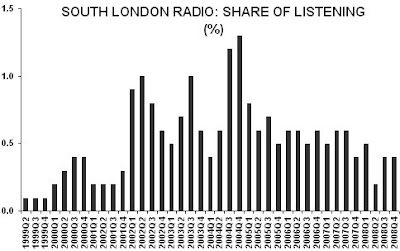
Admittedly, listeners to South London Radio were few in number as a result of the station’s consistent failure to connect with an audience. Its market share only surpassed 1% during two quarters of its decade on-air, though most of the time it registered less than 0.5%. In the station’s launch year, its listeners numbered less than 1,000 adults per week although, by the time it closed, that number had risen to 19,000 within its significantly enlarged coverage area. These numbers would still prove too low to adequately finance a local radio business in London. The station had never stood a chance from the time that UKRD saddled it with a pop music format in its licence application.
South London Radio never made an operating profit from airtime sales, not even in its earliest days. The only period of positive cashflow occurred in 2004 and 2005 when £1.7m compensation was received from its landlord when the station was forced to vacate its premises, presumably before its tenancy had expired. Ironically, this windfall was twice the size of the advertising revenues received by the station during its entire lifetime. Although, in recent years, its owner had managed to substantially reduce the station’s overheads, revenues had fallen to as little as £1,000 per week by then. There are pirate stations in South London that earn more money than that.

South London Radio’s final owner (or ‘penultimate’ owner legally) seemed to know where the blame lied for the station’s failure. In one set of Annual Accounts, its directors said:
“Despite significant investment by the management, the station has continued to perform below expectations. The impact of illegal broadcasters compromising the transmissions of this station is the main reason for the poor financial performance. The Directors are continuing to lobby the regulators in an attempt to find a solution”.

It was this lobbying by Sunrise Radio (a former pirate) of Ofcom which led to the transmitter power increase that significantly extended the station’s coverage area. Its owner then increased the survey area for the station’s RAJAR audience ratings from 304,000 to 1,472,000 adults, but the station’s weekly reach stubbornly remained at around 1%. Perhaps the owner thought that a station which claimed to reach 1.5m people across South London was more likely to find a buyer than a station that served only the relatively poor Borough of Lewisham. Whatever, South London Radio eventually closed with accumulated losses estimated at almost £2m, a figure that would have been twice the size, had it not been for the windfall settlement the station received from its previous landlord.

So it’s all over now, a sad end to Stella Headley’s dreams and also the death of what was supposed to be my local radio station. Hopefully, some lessons can be learned from this sorry tale. Some of these ‘lessons’ seem so glaringly obvious that it is almost embarrassing to point them out, but the 36-year history of commercial radio in the UK is so littered with repeated failures that it is worth spelling out some of the things that evidently went wrong. First Love Radio is just one of many local stations that have failed with both audiences and advertisers because of structural and procedural faults within the UK’s commercial radio system.

POSSIBLE LESSONS

1. CAN A DESIGNATED LOCAL MARKET SUPPORT AN ADVERTISING-FUNDED COMMERCIAL RADIO STATION?
Before advertising a new licence for a specific geographical area, the radio regulator did not evaluate whether there were sufficient local advertising revenues to support a commercial radio station for that area. This was true of Lewisham when the Radio Authority advertised this licence in 1997. A decade later, it was probably just as true of Ofcom when it awarded new licences for a talk station in Edinburgh (now closed), a rock music station in Plymouth (never opened), a station serving a population of 65,000 adults in Barrow (now closed), or a station serving a population of 30,000 adults in Northallerton (now annexed). Whether it was the Radio Authority or Ofcom, the regulator was issuing ‘licences to fail’ that never stood a chance of being successful, standalone businesses.

2. LOCAL RADIO GROUPS ARE FODDER FOR THE AMBITIONS OF COMMERCIAL RADIO GROUPS
First Love Radio is not the first local radio group to have organised short-term broadcasts in their area, organised training, raised public funds and raised local awareness of it campaign for a local station. Then, when it comes to writing the licence application, many such groups jump into bed with a commercial radio group that has no understanding of the group’s aims, the proposed station’s format, or the local marketplace. The radio group is interested in the licence, and the local group believe that such an alliance will ensure that licence will be won. An outside ‘consultant’ is brought in to write an application that is likely to win the licence, rather than an application that tells the truth.

3. NEW LOCAL COMMERCIAL RADIO LICENCES ARE AWARDED TO APPLICANTS THAT ALREADY HAVE COMMERCIAL RADIO LICENCES
To those that already have shall be given …. again and again and again. How many of Ofcom’s 39 new local radio licences between 2004 and today were awarded to applicants that did not already own a radio station? Ony one. It’s a regulatory gravy train of licence awards, which works great for those lucky few who already have a seat on the train. For those genuinely local radio groups who simply have a desire to run a radio station in their local area, the message is – you don’t stand a chance of winning a licence on your own.

4. MOST LOCAL RADIO GROUPS’ EXPERTISE IS IN COLLECTING LICENCES, NOT IN TURNING AROUND LOCAL RADIO STATIONS
As noted previously, the cost of making a licence application is usually a five-figure amount, whereas the balance sheet value of a radio licence is either a six- or seven-figure sum. The ‘business’ skill of most local radio groups has been based upon turning paper radio licence applications into valuable intangible assets to add to their balance sheets. Sadly, it has not been based upon launching successful local radio stations (‘successful’ meaning profitable), or upon turning around unsuccessful stations.

5. RADIO LICENCE APPLICATIONS ARE GENERALLY NOT GROUNDED IN REALITY
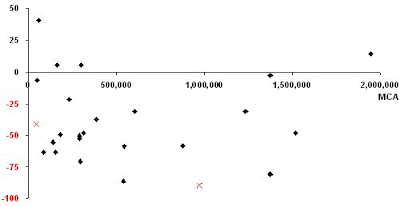
The promises made in most licence applications are mostly over-optimistic ‘waffle’. The lavish programming, the potential profitability, the audience targets – most of these are written purely to fit what the applicant radio group thinks the regulator wants to hear. Almost every licence applicant promises that its business will break-even within three years, despite evidence that there are very, very few newly-launched stations that have achieved such a performance in the last 20 years. Rule Number One of licence applications – never let the facts get in the way of a good story. As a result, the performance of most start-up stations is more than dismal. The graph below shows the percentage plus/minus achieved in hours listened versus the forecast hours listened in the station’s licence application for new local stations licensed during the last five years. Only four stations managed to beat their targets. (The crosses represent stations that have closed.)
Because of the untruthfulness of most licence applications, if you were to submit a more realistic assessment of your business plan within a licence application, it would look very gloomy compared to your competitors. Do you get any credit for being realistic (i.e. honest)? No, you are unlikely to be awarded the licence.

6. THE REGULATOR DOES NOT ‘POST MORTEM’ ITS LICENSING DECISIONS
When the Independent Broadcasting Authority licensed the ‘incremental’ stations, did it publish a report to show why so many of them went out of business within their first year? No, it didn’t. When the Radio Authority licensed the ‘regional’ stations, did it publish a report to show why these stations had no impact on enabling commercial radio to be more competitive for audiences against the BBC? No, it didn’t (I did my own research). Now that Ofcom has licensed so many new local stations, has it published research to show why so many are already proving unviable and whether awarding new licences to existing licensees had proven the appropriate regulatory policy? No, it hasn’t (see research in John Myers report). In all these cases, there seems to have been no attempt to learn from past experience, and thus no attempt to assess the positives and negatives of regulatory policy. To an observer, the attitude might look remarkably like ‘OK, that didn’t really work, so let’s try something different now’.

7. A LOCAL RADIO LICENCE ONLY ACQUIRES INTRINSIC VALUE IF YOU DO SOMETHING CONSTRUCTIVE WITH IT
Local radio groups can play the game of putting inflated values for their local radio licences on their balance sheets. But unless you can actually find someone who is willing to pay that inflated price, your licence in reality is worth nothing at all. After an era of crazy acquisition prices during the 1990s, we are now in a period where there have never been so many station sellers, but almost no buyers for the majority of small local radio licences. The ‘house of cards’ that was carefully constructed over the last two decades is already falling down. The radio licence gravy train bears some similarities to the vulnerability of a Ponzi scheme. Now that Ofcom is no longer offering new local radio licences, the ability of radio groups to continue to improve their balance sheet valuations through more licence wins has ended abruptly. As a result, their existing stations are now revealed to be worth a lot on paper, but worth almost nothing in reality because there are no buyers (i.e. other local radio groups with similarly over-inflated balance sheets). The underlying fallacy of the licence award system is now revealed.

8. THE TRACK RECORD OF MOST SMALL LOCAL RADIO GROUPS IS NOT GOOD
There is simply no money to be made from owning a number of small local radio licences, unless you have proven turnaround skills. Plenty of companies have raised millions of shareholder funds, promising to return them a profit from a cluster of loss-making local radio stations. The profits never arrived. Laser Broadcasting went bust. Forever Broadcasting went bust. The Wireless Group sold out. Golden Rose sold out. Milestone sold out. The Local Radio Company is on its knees financially. You might think that this history of failures would be sufficient warning to future investors that adding X number of loss-making local commercial radio stations to Y number of loss-making local commercial radio stations does not equal profits. Apparently not.

9. THERE IS A WIDENING ‘REALITY GAP’ BETWEEN WHAT THE REGULATOR IS REGULATING ON PAPER, AND WHAT IS ACTUALLY HAPPENING IN LOCAL RADIO MARKETS
On paper, each of the UK’s 300 commercial radio stations has a distinct ‘Format’ it has to follow, theoretically offering it a unique position in its local market. In this highly regulated system, Ofcom is supposedly ensuring that a diverse range of consumer demands for radio content are being simultaneously satisfied in each market. Even a casual radio listener realises that this system is a fiction. London has a large number of local commercial stations, and many of them sound remarkably similar, despite on paper them being meant to be different from their competitors. If South London Radio had offered different content and satisfied local demand for content, it might have thrived. Despite its Yellow Card sanction, Ofcom failed to ensure that South London Radio was satisfying the demand in South London for a local, black music station.

10. THE CLOSURE OF A LOCAL STATION IS THE FAULT OF BOTH ITS OWNER AND THE REGULATOR
It is very easy for the regulator to step back and say that the commercial failure of a specific local radio station is not its responsibility because it does not interfere in the business operations of its licensees. Frankly, this is a cop-out. Eight applicants applied for the Lewisham licence awarded to South London Radio. Seven were never even given the opportunity by the regulator to create a successful local radio station. Our public servants in the regulator were supposed to use their knowledge and expertise to select the applicant that was most likely to ‘win’. Ofcom even has a web page where it explains why it selected one applicant above the others for each licence. If the regulator’s choice was misguided, mistaken or ill-informed, it should have to explain what went wrong (a bit like this blog entry?). Surely, the regulator owes such an explanation to the listeners the station was supposed to serve and also to the unsuccessful licence applicants who, as a result of the regulator’s judgement, have no ‘second chance’ to put their own proposals for a radio station into action.

11. RADIO STATION OWNERS ARE NOT REQUIRED TO SELL STATIONS, RATHER THAN CLOSE THEM
I have heard several radio group executives say that they would rather close down one of their loss-making stations than sell it for £1. There are several issues at play here. Firstly, closing a company creates an opportunity to move some liabilities from elsewhere in the group before the station is made insolvent. Secondly, radio owners don’t want the embarrassment of someone else successfully turning around a station that they had not managed to make profitable over several years. Thirdly, if an owner paid £1m for a station, it is embarrassing for the CEO to have to tell their Board that it had to be sold for £1. The end result, as in South London, is that listeners no longer have a local radio station at all, rather than the baton being passed on to someone else to try and make the business work. Again, it is the listeners and the unsuccessful licence applicants who lose out.

12. THE SCARCITY OF LOCAL RADIO LICENCES HAS TURNED THEM INTO TROPHY ASSETS
If you want to start a local newspaper, you simply start it. You don’t need a licence. If you want to start a local radio station, you cannot. You have to wait for Ofcom to decide to offer a licence for your area, then you have to apply for it, and then you have to win it. In this case, Ofcom is unlikely to offer another South London FM licence to replace South London Radio. That opportunity came and went in 1997. As a result, there are far too many owners coveting local radio licences because of their scarcity, hoping that at some point in the future a ‘white knight’ will still ride over the horizon and pay an outrageous sum for it, regardless of the fact it is losing money every year and has accumulated losses of millions. After the Communications Bill opened up UK radio ownership to non-European Union stakeholders, there were several radio owners who were waiting for a global media company such as Clear Channel to ride into town and offer them a small fortune for their failing businesses. It never happened, and sadly there was no ‘Plan B’.

13. THE LACK OF CREATIVITY IN COMMERCIAL RADIO
There is a terrible lack of creativity within the commercial radio sector that is severely holding back its ability to compete with the BBC, let alone to compete with the flood of audio content available via the internet. It is far easier for radio companies to simply do either the type of content that they have always done and/or the content that everybody else is doing, rather than to be innovative or creative. In the case of South London Radio, I understand that its owner was approached last year by at least one radio consultant (not me) with a plan to resuscitate the station by returning it to its original roots as a black music outlet. That proposal was rejected.

14. THE REGULATOR PRETENDS TO ADOPT A ‘LIGHT TOUCH’ APPROACH TO COMMERCIAL RADIO REGULATION
If the regulation of commercial radio in the UK were genuinely ‘light touch’, then it would be appropriate that the regulator makes no attempt to intervene in the failure of individual stations. However, the system of radio regulation (even under Ofcom) intervenes heavily in almost every aspect of the commercial radio landscape, down to such detail as whether a particular station can play a specific song within its output. In such a highly regulated market where Ofcom exercises such a high degree of control, the regulator should surely have a responsibility to the citizen/consumer to ensure that the relatively small number of stations it selects to license (compared to the total number of applicants) continue to exist in some shape or form. It is not consistent to intervene at every moment of a station’s existence, except when it is finally threatened with closure as a direct/indirect result of the regulatory system.

15. NO CONSULTATION WITH LOCAL STAKEHOLDERS
Ofcom makes a big noise about its consultation system and its willingness to listen to the opinions of a wide range of stakeholders. However, when a station is threatened with closure, has the regulator ever consulted with local advertisers to consider the impact on them, with local community organisations who used the station to inform the local population of their activities, or with the local population itself? Would it not be useful to talk to Stella Headley now and canvas her opinion of what precisely had gone wrong with First Love Radio since 1990 (I tried to locate her for this blog entry but failed)?

The irony of South London Radio’s closure is that, over a ten-year period, things have already gone full circle. South London Radio was born from the experiences of pirate radio in the Borough of Lewisham, and now it is the pirate stations once again that are carrying the torch for those of us living in this area of South London. There is presently a great pirate station in Lewisham that sounds like the natural successor to1980s pirate Rock 2 Rock, playing reggae and soul music for ‘big people’. I can listen to this station on FM or via the internet (telling you its name would break the law) and it entertains me in a way that the latter day South London Radio never achieved. I used to listen to Rock 2 Rock in the 1980s, and now I am listening to its successor.

First Love Radio R.I.P.

It appears that our highly regulated and interventionist commercial radio system has:
* completely failed the people who originally put the idea together for First Love Radio
* completely wasted the public money invested in training people from the local community in Lewisham to make radio programmes
* has completely failed the population of Lewisham and beyond who should have their own radio service.

These failures in public policy will continue to have to be filled (though not fully because of the threat to those involved of criminal prosecution) by the efforts of unlicensed radio stations in Lewisham. A document published by the publicly funded Creative Lewisham Agency lamented that “television and radio is a very small Creative Industries sub-sector” in the north of the Borough ….. but then it noted that pirate radio is “a contributor to the Creative economy” and “is certainly vital for networking and showcasing”. When you find public bodies extolling the citizen value of pirate radio, you know for sure that something in our radio licensing system has gone very badly wrong.

As Inspector Scratch-It recalled of his Rock 2 Rock days: “We even had links with the police and [Lewisham] Council. They used to send us information that was relevant to read out, even though we were a pirate.” Twenty years on, it is still pirate radio filling that gap.

Localness: please, sir, can I have some less?

The government’s announcement that an independent review group will look at the ‘localness’ issues relating to content on commercial radio could re-ignite a war of words between the stakeholders that a year ago ended in a tense ceasefire. Last time, hostilities between the large radio owners and Ofcom became elevated to such an extent that the regulator’s chief executive Ed Richards even used the Annual Ofcom Lecture to chastise the commercial radio industry for its persistent lobbying to loosen its ‘localness’ obligations:

Some [radio owners] have called for a huge relaxation in relation to localness, some in the industry even call for a complete removal of all regulation. They believe that localness is either no longer valued or that its value is significantly outweighed by its cost. The problem is that the evidence is to the contrary. What our research tells us is that people continue to want to hear local programming. …. But we are not convinced that the market alone will deliver this if left to its own devices. We recognise very clearly the significant economic challenges faced by the radio sector, but our forthcoming proposals will not involve eliminating the obligation to deliver local programming or its reduction to a negligible level.”

Ofcom subsequently published its policy statement on localness in February 2008 and although, on the surface, it might have looked as if a ceasefire had broken out between the two sides, behind the scenes the industry’s lobbying for further reductions of its ‘localness’ obligations continued regardless. Ofcom had estimated that its policy changes would save the radio sector £9.4m to £11.7m per annum from a cost base of around £620m. For the radio industry, these potential savings were simply not enough. Andrew Harrison, chief executive of RadioCentre, argued that “the heavy burden of the existing localness regulation and legislation [..] is holding back current profitability and future investment in the sector”. By December 2008, industry lobbying had succeeded in persuading the Digital Radio Working Group to recommend in its Final Report that:

commercial radio must be given greater freedom to shape its digital future to provide a sustainable future for local radio in a digital world through a relaxation of analogue localness requirements………”

and to comment that:

“…. a model which focuses so heavily on where content is made may not be the best way to deliver either what listeners will most want in the future or allow the industry space to grow. We therefore recommend that the commercial radio sector, Ofcom and the government should look closely at the current localness regime in the coming months……..”

What proved interesting about last week’s government announcement of the independent review into ‘localness’ was that it contained no mention of Ofcom whatsoever. Even though the press release noted that the review would examine “to what extent are the current requirements for a pre-determined number of hours of local content, and the locality in which content is produced, appropriate and sustainable”, as implemented by Ofcom, it did not mention the regulator by name. This omission is downright weird. The Communications Act 2003 states clearly that:

It shall be the duty of OFCOM to carry out their functions in relation to local sound broadcasting services in the manner that they consider is best calculated to secure: (a) that programmes consisting of or including local material are included in such services but, in the case of each service, only if and to the extent (if any) that OFCOM consider appropriate in that case; and (b) that, where such programmes are included in such a service, what appears to OFCOM to be a suitable proportion of them consists of locally-made programmes.”

Furthermore, the Act states that “OFCOM must: (a) draw up guidance….” and “OFCOM may revise the guidance from time to time”, but it “must consult” licence holders and stakeholders beforehand. The legislation is crystal clear as to where the responsibility resides. What we are seeing in the government announcement is an intervention at a higher level as a result of perceived dissatisfaction with the way that Ofcom has implemented its responsibilities on this “particularly contentious” issue, as Ed Richards described it

Ofcom’s 2007 consultation on ‘localness’ in radio had elicited 43 responses and the regulator “noted the calls from the commercial radio industry for a reduction of locally-made programming….” Ofcom stated determinedly: “We believe that our proposed guidelines already represent a substantial deregulation of locally-made programming in many cases”. However, it looks as if further lobbying has undermined the Ofcom position, and the regulator is now being sidelined by direct government action on this issue, which could lead to new legislation or to new implementation of existing legislation.

So what precisely does the commercial radio industry want changed by Lord Carter in Ofcom’s localness requirements?

  • local commercial stations required to broadcast no more than 4 hours a day of locally made programming
  • regional commercial stations not required to broadcast locally made programming
  • local news broadcasts on local stations can be produced in centralised newsrooms
  • stations serving populations of less than 750,000 (i.e.: two thirds of the UK’s stations) permitted to locate their studios outside the area they serve
  • the 4 hours a day of ‘local’ programming can be simulcast across co-located stations and still count as locally made programming.

And what concessions would the commercial radio industry offer Lord Carter in return for its newly, co-located, networked content, ‘local’ stations?

  • news bulletins (not all local) 13 hours a day on local stations
  • news bulletins 24 hours a day (not all regional) on regional stations (13 hours a day on specialist music stations)
  • extended news bulletins (of unspecified length)
  • a commitment to safeguarding stations’ remaining local content (weather, traffic, what’s on, charity appeals, community information)

However, these demands and concessions position the ‘localness’ issue strictly in the context of content regulation. In fact, there is a much bigger game being played out, which concerns the further investment required in the DAB platform to try and make it a success with consumers. Essentially, the commercial radio industry is trying to put a gun to Lord Carter’s head and is demanding: ‘we won’t invest any more money in DAB to make it work, unless you stop Ofcom making us do local things we don’t want to do’.

The initial response to the commercial radio lobby was likely to be: ‘you acquired all these local radio stations, knowing that they had localness obligations. If you wanted a national radio station, why didn’t you buy one of those instead?’ It does seem a bit like Stagecoach begging the government to transform its local bus routes into a national coach service. However, Lord Carter is trying to grapple with the issues and forge a compromise whilst still insisting that “government can not, nor should it, be the main driving force for digital radio”.

The biggest danger here is that the ‘localness’ issue becomes a mere sideshow to the much more politically and commercially significant decision over the future of the DAB platform. As such, ‘localness’ risks becoming a mere pawn in a complex set of negotiations that are essentially designed to maintain the balance sheet valuations of the largest radio groups which have already made significant investments over a decade in costly DAB infrastructure.

Sadly, this is not the first time that the ‘localness’ issue has been invoked merely as a quid pro quo within a much bigger game. In the original Bill that became the Communications Act 2003, there was no ‘localness’ clause for local radio, just as there never had been in previous broadcast legislation. It was inserted at the last minute as what the then Minister for Broadcasting, Dr. Kim Howells MP, admitted was “the quid pro quo for greater liberalisation in the radio market”, allowing more concentrated ownership of local radio than the Bill had originally proposed. In the ensuing House of Commons debate, Michael Fabricant MP successfully stoked the flames of fear:

What if Clear Channel – a United States organisation for which I have a considerable respect, but which the [UK commercial radio] industry is rather concerned about – were to acquire a number of radio stations and found that it could pull in large audiences, based in the US, and not be all that local? Its presenters could be based in New York, for example, and it could put in pre-recorded local identifications. Everything could be done on a PC-based system. The stations would sound like local radio, even though they were not; and, because they had a good playlist, they might pull in a big audience. Would we not want back-stop powers in such a case?”

Six years later, neither Clear Channel nor its competitors have bothered to enter the UK radio market. Instead of the then touted prospect of US-financed global radio, we now have Irish-financed Global Radio wanting to run as much of its UK local radio empire as possible from Leicester Square. At the end of the day, for the listener, does the distinction matter whether a local radio station’s studio is in New York or New Bond Street? If I were a listener in NorthEast England, when I choose to listen to local radio, rather than national radio, if it does not fulfil my desire for ‘local’, then it offers me zero utility. If I am digging my car out of a three-foot snowdrift and the jolly ‘local’ radio presenter does not mention the inclement weather from her faraway studio, it simply isn’t local radio.

Surely, a ‘localness’ policy for radio should put the citizen/consumer/listener at the heart of its doctrine, something which Ofcom policies to date have failed to do. But neither does the commercial radio industry come out of this smelling of roses. I have yet to see one UK case study backed with evidential data which demonstrates that a decrease in local content on a local radio station has resulted in audience growth. Reduced costs? Yes. Improved profit margins? Yes. But local commercial radio stations have always been gifted scarce analogue radio spectrum for free, in return for their public service content commitments. A local radio station that is not trying to maximise its audience but, instead, aims to maximise profits by reducing costs, cutting local content and knowing full well that its audience will inevitably decline, would seem to be misusing valuable spectrum.

It remains to be seen whether this latest initiative to review radio’s localness requirements will result in new regulation that finally puts the listener at the centre of its policies, rather than simply responding to the needs of either the box-ticking regulator or the de-localising, large radio groups.

On a personal note, over several years I researched the issue of ‘localness’ and ‘localism’ in local radio, and I wrote an unpublished paper a year ago that examined the issues and suggested a way forward that would reinstate the local radio listener at the heart of localness regulatory policy. If the laws or regulatory regime do have to be changed, my only hope is that they are changed for the better, and not for the worse.

Abbey FM – the tip of an iceberg

Nobody likes to see radio stations close. Nobody likes to see committed radio staff thrown out of their jobs. Nobody likes to see the population of a town deprived of having their own local radio station. Nobody likes to see local businesses of any type disappear.

Abbey FM in Barrow closed at 3pm yesterday after two years on-air, with six full-time staff and six freelancers made redundant. The station was jointly owned by The Local Radio Company [TLRC] (35%), CN Group (30%), and Martyn Rose Ltd. (35%).

Station manager Amanda Bell said yesterday:
This also means that Barrow will never again have its own radio station. There won’t be another licence issued for Barrow. It was very, very sudden. We had the support and backing of all three shareholders until three weeks ago, when TLRC withdrew their support, which forced the hand of the other shareholders. I was only told of their decision at 12.30pm today. We were doing extremely well and heading towards making profits until July last year and then the economic situation got worse……”

Robin Burgess, CN Group chief executive, said yesterday:
Abbey started broadcasting in late 2006 but unfortunately has never been profitable. In the present economic climate and, in particular, the effect the recession is having on media revenues, the directors saw no realistic prospect of the station getting into profit in the foreseeable future.”

But can this closure so easily be credited solely to the advertising downturn? Or is its closure a symptom of a much wider issue concerning the licensing of small commercial radio stations in the UK? Both Amanda and Robin mentioned the station’s lack of profitability – what is the real problem?

Abbey FM served an area of only 84,000 adults. It was one of the 21 local commercial radio licences that Ofcom has awarded to date which serve populations of 250,000 or fewer adults. Ofcom’s own research found that local stations serving between 50,000 and 150,000 adults make an average annual loss of £20,000. However, by continuing to licence new stations serving populations as little as 39,000 adults, Ofcom has created even more local stations that are mostly condemned never to make an operating profit. Worse, new stations tend to cannibalise the audiences of existing local commercial stations heard in the same area.

The problem is that, in its radio licensing system, both Ofcom and most of the applicants for its licences embark upon a merry dance together that has little basis in real world radio economics. Ofcom appears to advertise new licences such as Abbey FM’s without any prior analysis of whether the local economy, Barrow in this case, can produce enough new advertising revenues to support a new local station.

Licence applicants submit to Ofcom a business plan (in confidence) and the imperative is almost always to make the figures fit so that the station looks as if it will break even by the end of its third year on-air. This is the greatest stress point for truthfulness. The smaller the station, the less likely it will be (in reality) to break even in Year Three. To make this breakeven work ‘on paper’, the smaller the station, proportionately the greater its projected audience has to be (because radio is largely a fixed cost medium).


Abbey FM acknowledged in its
application that “a long-term investment strategy is what is required for this station; there are no short cuts to sustainable profitability”. However, its forecasts for the station’s performance were the outcome of market research which concluded that “66% of all radio listening adults in Barrow would be definitely, very likely or fairly likely to tune in to a new station….” The application then asserted that “a combination of experience and prudence has dictated that we forecast reach of 17% in year 1 rising to 23% by year 3”.

This is voodoo forecasting, where the audience figures are often calculated as the last part of the puzzle to be solved (after profits, revenues and costs), rather than making them the cornerstone of the business plan. This is not intended as a specific criticism of the Abbey FM application. It is an inherent failing of most radio licence applications submitted to Ofcom. The bigger problem is that, if you were to honestly appraise the potential audience of such a small station, the financial forecasts would be unlikely to ever show an operating profit. Put simply, a radio station this small is often not a going concern. Yes, Abbey FM had failed to achieve its targets, but those targets were probably fictional anyway.

However, the merry dance continues because Ofcom exists to licence new stations (even if they are likely to fail), and most radio groups think they exist to win radio licences (even if they are likely to fail). As a consequence, by opening more loss-making stations, the overall profitability of the UK commercial radio sector becomes increasingly eroded, until the profitability of an entire group is weighed down by the number of loss-making stations it is trying to support.

Ofcom often comes close to acknowledging that these small local stations are destined to fail when it explains why it has awarded their licences. For Abbey FM, Ofcom said that:
“…..the committee felt that the backing of three shareholders with, collectively, extensive and current experience of operating smaller radio stations enhanced the likely ability of Abbey FM to maintain its proposed service. The group’s business plan was considered to demonstrate a good understanding of the local market and of the issues that the new station may face, and the ability to save costs through resource-sharing with nearby stations was felt to further enhance the strength of Abbey FM’s financial proposition.”

In other words, this new station will need to be subsidised for an indeterminate number of years by other, profitable stations owned by the same group(s). This is why, almost on every occasion, new small, local stations are awarded by Ofcom to owners that already have radio stations, often in a nearby area. In Abbey FM’s case, CN Group’s station The Bay already enveloped the entire Abbey FM area. Would it not have made more sense for Ofcom to offer the citizens of Barrow a local opt-out of The Bay, so they at least would benefit from some of their own local programming? As it is, they are now left with nothing at all.

So who is to blame? Firstly, Ofcom for having advertised small local licences in the first place which are condemned never to be profitable. A business is not a business unless it covers its costs. Secondly, radio groups who (collectively) have applied for every radio licence advertised by Ofcom. There has not been a single licence, however small, that has not attracted at least one applicant. Thirdly, Ofcom (again) for not having the guts to NOT award a licence to any applicant in an area, where it is plainly obvious that none of the applicants are telling the truth in their business plans and stand almost no chance of ever making a profit. Fourthly, radio groups (again) for seeing each licence win as a way to enhance their balance sheets, regardless of whether those licences can ever be made into profitable businesses.

So the merry dance between radio owners and Ofcom (and its predecessor) has led us to where we are today. Sadly, Abbey FM is merely the first of many local stations that will have to close in 2009. This is not the way it should be. I did not spend the 1970s and 1980s campaigning for MORE local radio stations (ComCom, CRA, etc) to see them close down like this. However, I don’t know of a single, small radio group that is presently not willing to discuss selling some or all of its stations. In my own backyard, there is a local station which is likely to sell soon for £1, or close. Never before have there been so many sellers and yet a complete lack of buyers for local radio.

Abbey FM, RIP. The losers are the citizens of Barrow. The UK radio licensing system has failed them. Why does it appear that no one is willing to step forward and take responsibility (just like the financial sector) for such institutional failures?

DAB radio: now you hear it (in-store), now you don't (in-home)

The Digital Radio Development Bureau [DRDB] announced yesterday that, after a one-year trial, Ofcom “has agreed to put in place a permanent licensing regime for all retailers across the country” to install DAB repeaters that will boost the signal in-store. According to DRDB:
“Many electrical retailers suffer from poor analogue and DAB signal strength due to the steel framed infrastructure of the building or their basement location. Installing a DAB repeater on the roof of the store means a signal can be boosted in-store and DAB radios can more easily be demonstrated, thus increasing sales potential.”

Currys owner DSGi’s Trading Manager Amanda Cottrell said:

We know from experience that demonstrating DAB radio in-store is the best way to show consumers the benefits of more station choice, ease of tuning and clean, digital quality sound. Consumers like to get hands-on with new technology and these DAB repeaters will help us to maximise sales in areas where demonstration was a problem.”

I understand the retail sales floor problem, but am I the only one worried that the solution implemented here might not be quite appropriate? I admit it is a very long time since I studied consumer law (1981, Durham Technical College), but my thinking is that these actions could potentially lead to consumer redress under UK legislation. Have the legal eagles at Ofcom considered this fully?

Under Section 15 of the Sale Of Goods Act 1979, when goods are sold by ‘sample’ (ie: consumer sees in-store demonstration sample of DAB radio receiver, but store supplies consumer with sealed, boxed good), “the goods must correspond to the sample in quality”. The law requires “that the goods will be free from any defect, making their quality unsatisfactory, which would not be apparent on reasonable examination of the sample” [my emphasis].

Under the new ‘repeater’ system, when the consumer examines the in-store sample of the DAB receiver, the receiver will be capable of offering ‘perfect’ reception of DAB radio stations. This is due to the installation of special in-store equipment. A fixed antenna has been installed on the roof of the building, pointed directly to the nearest DAB transmitter mast, and its received signal supplies a relay transmitter (transmitting the same stations) placed on the shop floor adjacent to the DAB radio receiver demonstration area.

When the consumer takes the sealed, boxed DAB radio home, they may open it and find that reception of radio stations on their hardware is not as good as it was in-store. This is because their radio is not receiving the DAB signal from a relay transmitter only metres away from the receiver, as it was in-store. Instead, it is receiving signals from the nearest DAB transmitter, probably miles away, and that signal may or may not penetrate the building in which they are using the radio.

The consumer could theoretically apply to Ofcom to install a relay transmitter in their home, in order to replicate the precise conditions in which the sample DAB receiver was demonstrated in-store. Ofcom’s response to the consumer’s application would certainly be ‘no’. Thus, the in-store ‘sample’ DAB receiver was purposefully demonstrated to the consumer under an artificially created environment that cannot ever be reproduced within the consumer’s home.

This would not be the first time that the marketing of DAB radio in the UK has come under legal scrutiny for potentially misleading consumers. In 2004, Ofcom banned an advertisement broadcast on London station Jazz FM which had claimed falsely that DAB radio offers consumers “CD-quality sound”. In 2005, the Advertising Standards Authority upheld a complaint against DAB multiplex owner Switchdigital for a misleading radio advert which had claimed that DAB radio was “distortion free” and “crystal clear”. In its verdict, the ASA said it had “received no evidence to show that DAB digital radio was superior to analogue radio in terms of audio quality”.

The problems concerning the paucity of DAB reception in some circumstances (basements, steel buildings, built-up areas) have been known to the broadcast industry for a long time. At the 2006 TechCon event, Grae Allen, then manager of digital distribution at EMAP Radio, had explained that “[the] Wiesbaden 1995 [radio conference] and all the other DAB planning dealt with mobile reception – in-car and portable outdoors. It made assumptions about aerial heights being just above ground level and, to provide good service to 99% of locations, the conclusion was that it required 58dbųV per metre to maintain that quality of service, and it made some assumptions about the performance of receivers and aerials.” In practice, he said, “some receivers do not quite live up to expectations – some have lossy aerial systems and suffer from self-noise.” Grae said that 2006’s European Regional Radio Conference “[was] moving DAB to become a truly indoor medium. The new planning model has around 10dbųV higher field strength than was envisaged in the original plan.”

In 2006, BT Movio had been about to launch a mobile TV service using DAB spectrum, and Grae said: “That raises a question. We are seeing increasing numbers of hand-held receivers, such as the BT Movio receiver, that do not have an aerial of any significant size. So, in some areas, we may have to go to higher field strengths to deliver to handhelds indoors. So how are we going to improve the coverage? Unfortunately, the people who fill in RAJAR diaries don’t tend to live in large numbers alongside the sheep in the fields [where DAB transmitters are mostly located]. They live in the cities and the urban sprawl, and that’s where we need to deliver the high field strengths that are required for the types of receivers that are becoming popular, and the level of service that is expected. In the future, as I envisage it, we will see a need to put more and more [transmitter] sites inside the cities in areas where we actually need significant power where people are living and working.”

Mark Thomas, then head of broadcast technical policy at Ofcom, admitted at the 2006 TechCon event that the original DAB power allocations had proven too low: “The Radio Authority had no data of how [DAB] receivers performed, so it had to make some very broad-brush assumptions. More recently, now that we have a lot of receivers in the market and we can see how they behave, an industry group has been working under Ofcom’s chairmanship for the last two years to look into the issue in more detail and come up with some modus operandi for new transmitter sites”. Mark concluded: “The Ofcom approach is that the industry co-operates between commercial operators with each other, and with the BBC, in identifying the sites that will improve field strength of DAB services to consumers and will also avoid the issues surrounding Adjacent Channel Interference. ACI also adds to the investment challenge that all of this spectrum development is building.”

Now zoom forward from 2006 to December 2008 and read the Final Report of the Digital Radio Working Group, which said:
“We believe that action is needed to improve the quality and robustness of the existing [DAB] multiplexes’ coverage. We recognise that such a request has significant financial implications for multiplex operators…”

So, it would appear that, from 2004 onwards (when Mark acknowledges Ofcom was aware of the problem), the UK radio industry has continued to market and sell millions of DAB radios to UK consumers, in the full knowledge that its DAB transmission infrastructure requires a significant upgrade to provide consumers with sufficiently robust DAB radio reception in built-up areas and in homes.

The latest DRDB ‘repeater’ sales initiative merely tackles the symptom of poor DAB reception which has existed for years, and the solution is limited entirely to electronics retailers. What is still missing is a solution to the core problem of the “quality and robustness” of DAB radio reception….. for consumers.

Classic FM – always check the expiry date before purchase

When Global Radio paid £375 million for GCap Radio in 2008, the portfolio of stations it acquired included Classic FM, the most listened to and most profitable of the UK’s three national commercial radio stations, and the only one of the three on FM. Classic FM was almost the only jewel remaining in GCap’s tarnished crown, after its management had destroyed the audiences/revenues of Capital FM and its other city FM stations by implementing disastrous content and commercial strategies. Classic FM presently has an 11% reach, a 3.8% share, 66% of its adult hours listened derive from the desirable ABC1 demographic, whilst 85% derive from ‘housewives’. Its only competitor in the classical music format is national BBC Radio Three, which has only a 4% reach and a 1.2% share but, of course, carries no commercials. Classic FM is a cash cow. [ratings: RAJAR]

There is only one problem for Global Radio. Classic FM’s licence expires on 30 September 2011 and it cannot be automatically renewed. This is a big problem. Whereas local commercial radio licences are still awarded (and re-awarded) by Ofcom under a ‘beauty contest’ system, national commercial radio licences are not. The system for national commercial radio licences is simple. Sealed bids are placed in envelopes. Ofcom opens the envelopes. The bidder willing to pay the highest price wins the licence. That’s it. This system is enshrined in legislation. Even if Ofcom wants a different system, it cannot change it without legislation.

As Classic FM’s new owner, Global Radio definitely wants a different system that will enable it to hang on to this most valuable asset. Global has been busy bending the ears of anybody and everybody who it might be able to persuade to interpret the broadcasting rules in a way that lets it keep Classic FM after 2011. Even Ofcom has had its lawyers busy examining the legislation to see what flexibility it has to interpret the rules in a way that might maintain the status quo.

Unfortunately, the legislation in the Broadcasting Act 1990 is quite specific:
“[Ofcom] shall, after considering all the cash bids submitted by the applicants for a national licence, award the licence to the applicant who submitted the highest bid.”

There is one, and only one, caveat in the legislation:
“[Ofcom] may disregard the requirement imposed by subsection (1) [above] and award the licence to an applicant who has not submitted the highest bid if it appears to them that there are exceptional circumstances which make it appropriate for them to award the licence to that applicant; and where it appears to [Ofcom], in the context of the licence, that any circumstances are to be regarded as exceptional circumstances for the purposes of this subsection, those circumstances may be so regarded by them despite the fact that similar circumstances have been so regarded by them in the context of any other licence or licences” [emphasis added].

Nothing more explicit is mentioned in the legislation about these possibly “exceptional circumstances”. The problem facing Ofcom is that, if it were to award the licence to Global Radio in a hypothetical situation where it had not been the highest bidder, whoever was the highest bidder would be likely to seek a judicial review, forcing Ofcom to explain in front of a set of judges the precise nature of the “exceptional circumstances” it had invoked. This would not be a pretty sight. There are no precedents because this part of the legislation has never been used before.

So what is the precise meaning of the ‘cash bid’ that has to be submitted to Ofcom in a sealed envelope? It is an amount to be paid annually by the winner throughout the licence period (increased annually by the rate of inflation). When Classic FM won the licence in 1991, it agreed to pay £670,000 per annum, plus 4% of its revenues as demanded by the regulator.

Later on, the Broadcasting Act 1996 allowed the regulator to extend Classic FM’s licence once, but on new terms, if the station agreed to simulcast its output on DAB. The regulator set Classic FM’s new licence payment as £1 million per annum plus 14% of its revenues from 1999. This new licence would have expired in 2007.

Then, the Communications Act 2003 allowed Ofcom to extend Classic FM’s licence again for a further four years but, once again, it could re-set the terms. Ofcom reduced Classic FM’s licence payment to £50,000 plus 6% of its revenues from 2007. This is the licence that expires in 2011.


Why did Ofcom decide to reduce the payments so substantially in its 2006 decision? It argued that the growth of listening via digital platforms was “leading to a decline in the scarcity value of the analogue spectrum”. Additionally, it argued that the licensee’s “share of advertising, derived as a result of access to the analogue spectrum, is likely to fall.”


Ofcom had forecast in November 2006 that digital platforms would account for 33% of radio listening by 2008, and 50% by 2010. By the time the Classic FM licence was due to expire in 2011, Ofcom anticipated that digital platforms would be responsible for 60% of radio listening overall. In other words, the FM licence would, by 2011, be accountable for only the minority of listening to Classic FM.

Ofcom’s forecast proved to be extremely wide of the mark. By Q3 2008, only 18.7% of radio listening accrued from digital platforms, little more than half of what Ofcom antcipated. The 50% threshold is unlikely to be reached even by 2015, and certainly not by Ofcom’s target of 2010. As a result of these forecasting failures, Classic FM (along with the other two national commercial stations) is now paying Ofcom an amazingly discounted rate for the licence fee to use analogue spectrum. The combined licence fees of the three national licensees would have been £7 million per annum under the previous regime, whereas these were reduced by Ofcom to less than £1.5 million (by Ofcom’s own estimate).

The net result of these changes is that Global Radio has a bargain licence on its books. Classic FM probably generates more than £20 million revenues per annum, but Global now pays only £1.3 million for its licence. The bad news is that Global Radio’s cash cow will end in September 2011. If Global does not win the re-advertised national FM licence, the value of its balance sheet could be up to halved. On the other hand, to keep this prize asset it will have to bid significantly more than the £50,000 annual licence fee it is paying now, so that Classic FM’s future profitability would be impacted anyway, even if Global managed to keep the licence.

However, there are plenty of other media owners out there who would like to have the UK’s only national commercial radio FM licence in their portfolio. The fact that the DAB platform has not grown anywhere near as quickly as anticipated in the UK simply makes this FM licence more valuable. The last time the licence was advertised in 1991, bids were only open to European Union applicants. Since then, legislation has opened up the bidding process worldwide. The licence format does not have to be classical music – the licensee can operate any format of its choice, apart from pop music (this caveat is in the legislation).

The fly in the ointment is that Ofcom adopted a new policy in 2007 that all its analogue local and national radio licences would be scheduled to expire on 31 December 2015, or five years from their commencement, whichever is longer. For Classic FM, this means that its next licence period would theoretically run only from 1 October 2011 to 1 October 2016. If a new bidder won the licence by offering the highest cash bid, five years is hardly enough time for a nascent business to establish itself and become profitable, particularly if it were to adopt a format other than classical music. The Ofcom policy seems unworkable in practice, and also seems biased in the incumbent’s favour.

Now, with an understanding of Global Radio’s desperation to hang on to its Classic FM licence almost at any cost, it is useful to re-read Paragraph 2.3 of the Final Report of the Digital Radio Working Group. Remember that Global Radio owns about 50% capacity of the UK’s commercial radio DAB transmission capacity and Global Radio accounts for 39% of commercial radio listening. The Report said:

“In exchange for its ongoing and future commitment to DAB, we believe the radio industry must have greater certainty and control of its future. Therefore, we propose that the government must relax some of the existing legislative and regulatory burdens placed on the radio industry, which will require parliamentary time, as outlined below and Ofcom should consider how to reduce some of the existing regulatory burdens.

First, the commercial radio industry must be granted a further renewal of its analogue services which are carried on DAB, and of DAB multiplex licences. [emphasis added]”

Now read this quote once more but replace the phrase ‘the radio industry’ or ‘the commercial radio industry’ with ‘Global Radio’. Aha! Wouldn’t it be great for Global Radio if the government could be persuaded to step in and somehow automatically renew its “analogue service” Classic FM licence, thus avoiding a licence auction in 2010? Even moreso if Global could be allowed to continue paying only £50,000 per annum (plus 6% of revenues) for the FM spectrum it uses? If you were Global, would you not be eager to offer the government a deal whereby you maintain your costly DAB infrastructure (and maybe even extend it) as the price you have to pay for securing the future of your most significant balance sheet asset?

From reading its Final Report, it certainly looks as if the Digital Radio Working Group bought into this argument. The next hurdle for Global Radio is to persuade Lord Carter and his Digital Britain team to buy into the same deal, which is: we promise to keep the DAB platform alive, despite it losing us a small fortune, if you ‘arrange’ legislation that enables us to keep the Classic FM licence for another decade. Thus, the government avoids the embarrassment of the DAB platform failing in the UK, and Global Radio might stand a better chance of staying in business.

To date, the other commercial radio owners have seemed happy to go along with this plan. They, like Global, would get to renew their radio licences automatically too (although none of their licences are as individually valuable as Classic FM’s). On the other hand, they too will be burdened with the continued costs of simulcasting their services on the DAB platform, with almost no financial return. However, despite most radio owners’ private dislike of the whole DAB ‘fiasco’, publicly they continue to stress their continuing support. Nobody turns down a ‘free lunch’, and a free licence renewal is an enticing offer for a radio industry still built upon oligopoly power rather than open competition.

The only question now is whether the government considers it politically worthwhile to ‘help’ the commercial radio sector with new legislation that would extend the licence status quo, in return for forcing onto consumers a ‘new’ DAB radio technology that is more than a decade old and has long been superseded by innovation.

Lord Carter’s pronouncements during the next fortnight might give us an idea of how important/unimportant it is to the government to: 1) bale out privately held Global Radio; 2) force further investment in improving/developing the DAB platform.

Ofcom's radio licensing strategy – adding fuel to the unprofitable fire

The closure of Edinburgh station Talk 107 on 23 December almost coincided with the fifth birthday of Ofcom (on 29 December). Talk 107 was the first commercial radio station to be licensed by Ofcom, so its failure and subsequent closure could seem symptomatic of Ofcom’s radio licensing strategy. Over five years, instead of Ofcom playing a significant role in creating a vibrant, profitable and creative UK commercial radio industry, its licensing decisions have often exacerbated the problems of a sector already beset with massive structural and financial challenges.

Ofcom has licensed 39 new commercial radio stations to date, taking the total number of UK licensed commercial radio stations past the 300 mark. This number, in itself, is a large part of the problem. These newly licensed stations each add a whole new set of largely fixed costs to the sector. Even if the average cost of each of these new stations is only £250,000 per annum, Ofcom’s licensing has increased sector costs by almost £10m per annum (in 2007, Ofcom estimated the sector’s aggregate costs as £400m).

At the same time, most newly launched commercial radio stations have failed to attract significant new listening or new revenues to the sector. New stations seem to simply cannibalise the audiences of existing commercial radio stations (I researched the impact of introducing the tier of regional commercial stations and found only one station had not cannibalised commercial radio audiences). As a result, the sector’s aggregate costs have increased whilst its aggregate revenues have not been expanded, and so profit margins are being squeezed further.

Additionally, the formats of many of the winners in Ofcom’s licensing ‘beauty parade’ were inevitably destined for commercial failure, with Ofcom seeming to ignore the empirical evidence. In a market the size of Edinburgh, Talk 107’s talk format could never succeed, given that the same format has been unable to make an operating profit in the UK’s largest local market, London, since the end of the 1980s. Similarly, Ofcom’s idea of introducing a local rock music station in Plymouth would have been a disaster (the station never even launched) given the miserable audiences for Xfm and Virgin Radio. And the three Original stations licensed by Ofcom launched with such esoteric music formats that their failure quickly prompted owner CanWest Global to sell up and quit the UK radio business altogether.

The size of most of the newly licensed stations was insufficient to ever make them profitable. Ofcom’s own research found that the majority of small stations fail to generate an operating profit – stations serving under 50,000 adults make an average annual loss of £3,000; stations serving between 50,000 and 150,000 adults make an average annual loss of £20,000; and stations serving between 150,000 and 250,000 adults make an average annual profit of £65,000. Although 63% of commercial radio stations serve areas of less than 250,000 adults, they collectively generate only 11% of sector revenues.

Knowing the unprofitable economic performance of most small commercial radio stations, it made no commercial sense for Ofcom to choose to licence 21 of its 39 new stations to populations of 250,000 or less. All this has done is increased the number of loss-making commercial radio stations and dragged down the profitability of the entire sector. The roll-call of stations licensed by Ofcom in its first five years includes:

  • Talk 107 Edinburgh, closed by UTV after 15 months on-air
  • Touch FM Banbury, up for sale or closure by CN Group after two years on-air
  • Brunel FM Swindon, sold by The Local Radio Company after 21 months on-air to Laser Broadcasting, forced into administration four months later, acquired by Southwest Radio
  • Original Solent, Original Bristol and Original Aberdeen, sold by Canwest Global which exited its UK radio venture two years after Solent had launched
  • Diamond FM Plymouth, never launched by Macquarie Bank
  • Southend Radio Southend, sold by Tindle Radio to Adventure Radio before it launched
  • Sunshine FM Monmouth, acquired by Murfin Music when Laser Broadcasting forced into administration after 10 months on-air
  • Xfm South Wales sold by GCap Media to Town & Country after six months on-air
  • Minster FM Northallerton, licensed to serve 39,000 adults, annexed to Darlington after eight months on-air
  • Perth FM Perth, eventually launched last month, two years after winning its licence from Ofcom, and ten weeks after owner Mark Page closed L107 Lanarkshire
  • The Severn Shrewsbury and The Wyre Kidderminster, now sharing programmes under co-owner Midland News Association
  • kmfm Ashford, now sharing programmes with co-owned KM Radio stations
  • [a question remains over the control of Andover Sound Andover and whether licence winner Tindle Radio has sold or reduced its 100% stake between the licence award in July 2006 and the station’s launch in May 2008]

Some of the 39 new local stations licensed by Ofcom are only required to broadcast locally-produced content for four hours per day on weekdays (the breakfast show), while the majority are required to broadcast no more than four hours per day of locally-produced content on weekends.

The question has to be asked…. Are the financial losses incurred by these stations worth the marginal amounts of local content offered to the populations in the markets they serve, and the resultant low ratings achieved by most of them?

So what is the point of licensing small local radio stations that barely broadcast local content and are unlikely to break even?

DAB: fiddling while Rome burns?

The planned migration of radio broadcasting from analogue to digital platforms in the UK currently sits on a knife-edge. After a decade of existence, the DAB platform is still struggling. Only 9.2% of commercial radio hours listened are via DAB [RAJAR Q3 2008]; while 79% of new radios sold in the UK are still old-fashioned analogue rather than DAB [DRDB/GfK Q2 2008 four-quarter moving average]. The financial pressures on commercial radio owners are already immense, and the burden of continuing to simulcast on both analogue and digital terrestrial transmitters cannot be borne much longer. When I wrote about this dire situation in October, I noted that “Ofcom [is] threatening to revoke the analogue licence of any [simulcasting] station giving up on DAB” and I asserted that the regulator’s “once carrot-and-stick approach to digital regulation now looks like a hostage situation.” If stations who had accepted an automatic analogue licence renewal are still forced to continue simulcasting on DAB (some at a cost of many times their analogue transmission) by the regulator, many will simply go out of business.

My attention was drawn this morning [thanks, Daniel] to a speech made by Ofcom’s Director of Radio, Peter Davies, at the recent Voice of the Listener & Viewer Conference in London, as quoted in The Radio Magazine (headline: “Ofcom: Hundreds more DAB transmitters needed”):

“We need to build a lot more transmitters than we currently have. The BBC currently has around 100 DAB transmitters. It may need four or five times that number in order to achieve the equivalent coverage of analogue. But, in the end, if it builds those transmitters, the DAB network would probably still be cheaper to run than today’s FM network. It’s just too early to set a [switchover] date and far more needs to be done to improve the service before that can become a reality”.

However, the costs of such a DAB build-out programme are significant. The BBC’s existing single national DAB multiplex network of 96 transmitters covering 86% of the population costs £6m per annum. To extend that multiplex to 230 transmitters covering 90% of the population would cost an additional £5m per annum. To extend the existing multiplex to the 1,000 transmitters necessary to cover 99% of the population would cost an additional £34m per annum. Now remember that the BBC only has one single national DAB network, whereas the commercial radio sector has one national DAB network, plus a separate layer of local DAB multiplexes that cover most of the UK, plus a further layer of regional DAB multiplexes in the most populous areas. Now imagine what the costs to the commercial sector might be to extend and improve coverage in all these areas.

Although Peter was talking explicitly about the BBC situation, the implication is that the commercial sector too should invest even further in DAB transmission infrastructure, and yet Ofcom must be aware that station owners can barely afford the present network of DAB multiplexes that already cover 90% of the population. It might appear that Ofcom is pre-occupied with burdening the commercial radio sector with even more transmission costs, at a time when the industry is already fighting for its life as a result of falling audiences and declining revenues (even before the advertising downturn).

I am reminded of Peter’s speech about DAB to The Radio Festival in July 2008:

“Increased coverage of DAB will be absolutely essential if it is ever to become a full replacement for FM for most services…… That brings us to the tricky part – defining what existing coverage is and how we improve it. This is still work in progress but we are approaching it in three stages. Firstly, we need to define what existing FM coverage is. That’s not nearly as simple as it might sound. Radio is not like television where you stick an aerial on the roof and you get reception or you don’t. Radio is used in every room in the house, usually with a portable aerial. It’s used outdoors on a wide variety of devices and it’s listened to in cars. So we need to look at geographic coverage as well as population coverage, and we need to look at indoor coverage in different parts of the house. FM coverage gradually fades as you move around, so we need to decide how strong the signal needs to be to be usable. And, surprisingly, this work has never really been done in any kind of consistent manner for the UK as a whole, so it has taken a little while to agree a framework and calculate the numbers. Having done that, we then to do the same for existing DAB coverage. Now DAB has all the same issues as FM, but it also has different characteristics. It doesn’t fade in the same way – you either get it or you don’t – so we need a different set of definitions here. Once we have defined what existing DAB coverage is, we then have to work out what it would take to get existing DAB coverage up to the level of existing FM coverage. Now, we have already done a lot of work on this, and certainly enough to inform the interim report, and the whole thing will be finalised in time for the [DCMS] Digital Radio Working Group final report later this year.”


Undoubtedly, these are all important DAB technical issues that (belatedly) demand attention. However, in the grand scheme of things, with the commercial radio sector poised on a precipice of viability, how exactly will this work by Ofcom do anything but add to the sector’s existing financial problems?

[PS: Just a reminder that Ofcom’s own research in 2007 found that 50% of UK commercial radio licensees either made a loss or an annual profit of less than £100,000.]