Ofcom’s DAB radio strategy: busy doing nothing, trying to find lots of things not to do

In June 2010, the government published its flimsy 5-page response to the House of Lords Communications Committee’s critical 279-page report on digital switchover that had been unveiled three months earlier. The response was a disappointing document that dismissed with little more than one sentence each of the Committee’s carefully worded recommendations, deduced after having considered hours and volumes of evidence.

One of the Communications Committee’s most forceful recommendations, in Paragraph 107, had concerned the necessary improvements to DAB reception:

“Given the importance for the Government’s plans for digital switchover of universal reception of the BBC’s national stations, it is essential that a firm and unambiguous plan and funding for the completion of build-out of the BBC’s national multiplex is put in place as soon as possible.”

The government’s feeble response to this issue was:

“In order to agree a plan for DAB coverage build-out, so that it can ultimately meet the current levels of FM coverage, Ofcom have been asked to form a Coverage and Spectrum Planning Group to make recommendation on the following:
• the current coverage of national and local radio on FM;
• changes to the current multiplex structure and frequency allocation; and
• what new infrastructure is needed so that DAB can match FM.
Ofcom are expected to present their recommendation to Government in Spring 2011.”

Surely it does not need yet another government committee to look into DAB? Had not these issues already been considered by the Digital Radio Working Group two years ago? By Digital Britain a year ago? By Ofcom? By anybody during the last decade of DAB underachievement?

Then I recalled a speech made by Ofcom Director of Radio, Peter Davies, to the Radio Festival in July 2008, in which he had set out his imminent workplan on the DAB issue:

“Increased coverage of DAB will be absolutely essential if it is ever to become a full replacement for FM for most services…… That brings us to the tricky part – defining what existing coverage is and how we improve it. This is still work in progress but we are approaching it in three stages. Firstly, we need to define what existing FM coverage is. That’s not nearly as simple as it might sound. Radio is not like television where you stick an aerial on the roof and you get reception or you don’t. Radio is used in every room in the house, usually with a portable aerial. It’s used outdoors on a wide variety of devices and it’s listened to in cars. So we need to look at geographic coverage as well as population coverage, and we need to look at indoor coverage in different parts of the house. FM coverage gradually fades as you move around, so we need to decide how strong the signal needs to be to be usable. And, surprisingly, this work has never really been done in any kind of consistent manner for the UK as a whole, so it has taken a little while to agree a framework and calculate the numbers.

Having done that, we then have to do the same for existing DAB coverage. Now DAB has all the same issues as FM, but it also has different characteristics. It doesn’t fade in the same way – you either get it or you don’t – so we need a different set of definitions here. Once we have defined what existing DAB coverage is, we then have to work out what it would take to get existing DAB coverage up to the level of existing FM coverage. Now, we have already done a lot of work on this, and certainly enough to inform the interim report, and the whole thing will be finalised in time for the [government’s] Digital Radio Working Group final report later this year.”

This 2008 workplan seems to comprise precisely the same tasks that the government has just told Ofcom to start and complete by Spring 2011. So what happened? Was this work not done by late 2008, as Davies had promised? And if not, why not?

Improvements to DAB reception were considered a critical issue for consumer take-up of DAB radio … in 2008. Now, in 2010, they are probably the main factor likely to sound the death knell of DAB as a mass market consumer platform. So are we to assume that, in the intervening two years, work on this essential issue was never done, or was not completed, by Ofcom?

Why should consumers consider DAB radio to be anything other than a disaster if even our public servants appear to be busy doing little to fix the acute problems with DAB reception that the public has been rightly complaining about for years?

Digital radio switchover: talk is cheap, action will never happen

Politics is the art of flip-flop policymaking (and justifying it convincingly). This is evident in the new UK government’s first statement about DAB radio and digital radio switchover, published this week. What is its new policy? Well, there is no new policy. The Conservatives are simply continuing the previous Labour government’s ill-advised determination to foist digital radio switchover on an increasingly resistant public. A critic might even be so bold as to say of new Secretary of State for Culture, Media & Sport, Jeremy Hunt:

“The Government have ducked sorting out digital radio switchover…. They are giving Ministers the power to switch over in 2015, yes, but without taking any of the difficult measures necessary to make it practical or possible.”

But wait! In fact, these were the words of Jeremy Hunt himself, in April 2010, criticising his predecessor, Ben Bradshaw, during the previous Labour government. Now that the boot is on the Right foot, Hunt seems to have simply dusted off the Labour policy he had previously lambasted, crossed out Bradshaw’s name and written in his own instead.

In his same speech to the House of Commons, Hunt had been scathing about the digital radio switchover clause in the Digital Economy Bill:

“I think that clause is so weak that it is virtually meaningless, as it gives the Secretary of State the power to mandate switchover in 2015 but the Government have not taken the difficult steps that would have made that possible, such as ensuring that the car industry installs digital radios as standard [….] and that there is proper reception on all roads and highways. As a result, a lot of people are very concerned that 110 million analogue radios will have to be junked in 2015.”

That was ‘opposition’ Hunt then. Three months later, ‘government’ Hunt appears to see nothing problematic with the digital radio switchover clause. Indeed, the new government has committed itself to exactly the same fantastical strategy for DAB radio as the old government:

• digital radio listening will somehow reach 50% of the total by 2012
• someone somewhere will pay to upgrade the DAB transmission system to render it as robust as FM
• someone somewhere will launch lots of fab new digital radio stations
• consumers will somehow be persuaded to replace all six or more of their household’s radios with new DAB ones
• analogue radio transmitters will somehow be switched off in 2015
• all cars will somehow be fitted with DAB radios by 2015
• mobile phones and portable devices will somehow all suddenly include DAB, rather than FM, radio receivers.

All these objectives always had been, and still are, pure fantasy. None, and I literally mean ‘none’, of the available evidence and data demonstrate that these things will happen. Definitely not by 2012, certainly not by 2015, and probably never.

A year ago, Hunt was very clear in marking out his party’s strategy for digital radio as more realistic than the ruling Labour government’s:

“I think the most important thing is not something the government can do, but something the industry can do is, which is to develop new services on digital platforms that actually mean there is a real consumer benefit to DAB. At the moment, the benefits are marginal. I mean, there are some benefits in terms of quality, but your batteries get used up a lot more quickly, the reception is a lot more flaky, and a lot of the things that make digital switchover attractive on TV don’t apply to radio in the same way. So I think the industry needs to do a lot more to make it in consumers’ interests to have that switchover…..

We have also got to think about consumer anger. Consumers are people that the radio sector needs. It’s going through a very tough patch. We don’t want to switch off listeners by suddenly saying that we are not going to – that we are going to force you to have a new radio, and there’s a real danger, if we do that, that they might start listening to their iPods and their CD players instead. … At the moment, we seem to be getting into this mindset where we want to force it on the public, even though the public can’t really see what the benefits are.”

So, between then and now, who is it that has convinced Hunt to backtrack and instead to endorse the status quo? The civil servants in his Department who hitched their wagon to the ‘DAB is the future’ train too long ago to let go now? The Ofcom radio staff who were appointed years ago on the strength of their promise to deliver digital radio switchover? The commercial lobbyists who still fantasise about the huge profits to be made (for Britain!) from global exports of their European DAB technology? All of them are nothing more than dreamers.

At the same time, many of these same parties are already distancing themselves from responsibility for DAB so as to save their own skins once DAB’s ‘fall from grace’ inevitably arrives:

• the government is saying that digital radio switchover depends upon the public’s take-up
• the regulator is saying that digital radio switchover depends upon the radio industry’s commitment
• the commercial radio industry is saying that digital radio switchover depends upon the BBC paying
• the BBC is saying that digital radio switchover depends upon its audiences
• the BBC Trust is saying that digital radio switchover depends upon the commercial radio sector’s commitment.

For years now, the stakeholders assembled around the table in those endless DAB committee meetings have been occupied identifying DAB’s problems yet, at the same time, every one of them has expected somebody somewhere else to fix them. But there is no sugar daddy out there. There is no cavalry about to ride over the horizon. It is you stakeholders who created such a mess of DAB and either you must fix it….. or throw in the towel.

This week’s announcement about digital radio switchover demonstrated that the new government does not have the guts to do what many, including the House of Lords Communications Committee chaired by Lord Fowler, had asked of them. To commission an objective analysis of why DAB was introduced in the first place, how close we really are to digital switchover, whether we will ever get there, what the costs have been to the radio sector to date, and to evaluate whether it is still worth pursuing these objectives thirty years after the DAB technology was invented.

Instead, the government has decreed that the present DAB unreality will continue … probably until one of these stakeholders eventually is forced by circumstance to kick the entire digital radio switchover issue into the long grass. In the meantime, the poor consumer is still on the end of misleading campaigns to persuade them that they will need to buy new DAB radios (which are mostly British), throw out their old radios (which are mostly foreign) and somehow get used to the sub-standard quality of DAB radio reception that most of us experience. No wonder they are asking in increasing numbers: ‘What was wrong with FM?’ And the correct answer is: ‘Nothing at all’.

This week’s government statement by Ed Vaizey, the new Culture Minister, was so woolly and vague that the media were able to write it up from wholly contradictory viewpoints.

“Government abandons 2015 target date for switching radio to digital signal,” said the Bloomberg News headline.

“Radio industry welcomes Tory backing for digital switchover in 2015”, said The Guardian headline.

Those two headlines cannot both be true. All the government has done this week is leave everyone more confused than ever. So why did it bother saying anything at all? A critic of Ed Vaizey’s announcement might be moved to say:

“We have got to be concerned that people will be ready before any switchover takes place and that there won’t be literally millions of analogue radios which suddenly become redundant. As you know, the government has set a provisional target date of 2015 and we are sceptical about whether that target can actually be met.”

But wait! In fact, those were the words of Ed Vaizey himself, in March 2010, criticising the then Labour government’s digital switchover plans.

Meet the new boss, same as the old boss.

Choice FM R.I.P.: the birth and near death of licensed black music radio in London

31 March 1990 was the memorable day when London‘s first licensed black music station, Choice 96.9 FM, arrived on-air. Until then, the availability of black music on legal radio had been limited to a handful of specialist music shows, even though about half of the singles sales chart was filled with black music. The decision by then regulator the Independent Broadcasting Authority [IBA] to license a London black music station was part of a huge government ‘carrot and stick’ campaign to rid the country of pirate radio. On the one hand, new draconian laws had been introduced that made it a criminal offence even to wear a pirate radio T-shirt or display a pirate radio car sticker. On the other hand, the establishment knew that some kind of olive branch had to be offered to the pirate stations and their large, loyal listenership.

Many pirate stations, having voluntarily closed down in the hope of becoming legitimate, were incensed when the IBA instead selected Choice FM for the new South London FM license. Its backers had no previous experience in the London pirate radio business, but had previously published ‘Root’ magazine for the black community in the 1970s. Although it was impossible for one station to fill the gap left by the many pirates, Choice FM tried very hard to create a format that combined soul and reggae music with news for South London’s black community, which was precisely what its licence required. The station attracted a growing listenership and it brought a significant new audience to commercial radio that had hitherto been ignored by established stations. With Choice FM, the regulator succeeded in fulfilling two aspects of public broadcasting policy: widening the choice of stations available to the public; and filling gaps in the market for content that only pirate radio had supplied until then.

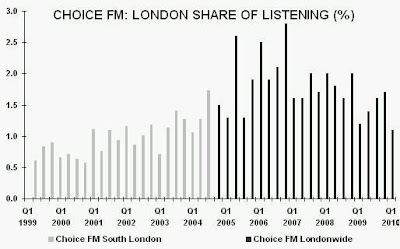
In 2000, Choice FM won a further licence to cover North London with an additional transmitter. For the first time, the station was now properly audible across the whole capital and had access to more listeners and more potential advertising revenues. Its listening doubled and, at its peak in 2006, Choice FM achieved a 2.8% share, placing it ahead of TalkSport and BBC London in the capital. Choice FM had no direct competitor in London, although indirectly some of its music had always overlapped Kiss FM. The station’s future looked rosy.

However, the Choice FM shareholders must have realised just how much their little South London station was worth, at a time when commercial radio licences were being acquired at inflated prices. Already, in 1995, Choice FM shareholders had won a second licence in Birmingham, but had then sold the station in 1998 for £6m to the Chrysalis Radio group, who turned it into another local outlet for its network dance music station Galaxy FM. At a stroke, the black community in Birmingham had lost a station that the regulator had awarded to serve them. Black radio in Birmingham was dead. The die was cast.

The then regulator, the Radio Authority, had rubber-stamped this acquisition, stating that it would not operate against the public interest. The Authority requested some token assurances: at least one Afro-Caribbean member on the station’s board; an academy for training young people, especially from the black community, in radio skills; and market research about the impact of the format change on the black community. None of these made any difference to what came out the loudspeaker. Birmingham’s black community was sold down the river.

Changes in UK media ownership rules were on the horizon that would soon allow commercial radio groups to own many more stations within a local market. As a result, in 2001, the UK’s then largest radio group, Capital Radio plc, acquired 19% of Choice FM’s London station for £3.3m with an option to acquire the rest. In 2003, it bought the remaining 81% for £11.7m in shares, valuing the London station at £14.4m. The Choice FM shareholders had cashed in their chips over a five-year period and had generated £21m from three radio licences. What would happen to Choice FM London now?

Graham Bryce, managing director of Capital Radio’s London rock station Xfm (which Capital had acquired in 1998 for £12.6m), said then:

“Our vision is to build Choice into London’s leading urban music station, becoming the number one choice for young urban Londoners. Longer term, we intend to fully exploit the use of digital technology to build Choice nationally into the UK’s leading urban music station and the number one urban music brand.”

Capital Radio and subsequent owners seemed to want to turn Choice FM into a station that competed directly with Kiss FM (owned by rival EMAP). But they never seemed to understand that Kiss FM was now a ‘dance/pop’ station, whereas Choice FM had always been firmly rooted in the black music tradition of soul, reggae and R&B. Such semantics seemed to be lost on Choice FM’s new owners and on the regulator, but certainly not on Choice FM’s listeners, who had no interest in Kylie Minogue songs.

In 2004, Capital Radio moved Choice FM out of its South London base and into its London headquarters in Leicester Square. The station’s final link with the black community of South London it had been licensed to serve was discarded. In 2005, Capital Radio merged with another radio group, GWR plc, to form GCap Media plc. In March 2008, Global Radio bought GCap Media for £375m. In July 2008, Choice FM managing director Ivor Etienne was suddenly made redundant. One of the station’s former founder shareholders commented:

“I’m disappointed that the new management decided to relieve Ivor Etienne so quickly. My concern is that I hope they will be able to keep the station to serve the community that it was originally licensed for.”

However, from this point forwards, it was obvious that new owner Global Radio had no interest in developing Choice FM as one of its key radio brands. In the most recent quarter, the station’s share of listening fell to an all-time low of 1.1% (since its audience has been measured Londonwide). Sadly, the station is now a shadow of its former self, even though it holds the only black music commercial radio licence in London (BBC digital black music station 1Xtra has failed to dent the London market, with only a 0.3% share).
This week, news emerged from Choice FM that its reggae programmes, which have been broadcast during weekday evenings since the station opened, will be rescheduled to the middle of the night (literally). One of the UK’s foremost reggae DJs, Daddy Ernie, who has presented on Choice FM since its first day, will be relegated to the graveyard hours when nobody is listening. From 2003, after the Capital Radio takeover, reggae songs have been banished from the 0700 to 1900 daytime shows on Choice FM. Now the specialist shows will be removed from evenings, despite London being a world centre for reggae and having more reggae music shops than Jamaica.

Station owner Global Radio responded to criticism of these changes in The Voice newspaper: “Choice [FM] has introduced a summer schedule which sees various changes to the station including the movement of some of our specialist shows.”

Once again, the regulator will roll over obligingly and rubber-stamp these changes. For Global Radio, the endgame must be to transform the standalone Choice FM station into a London outlet for its Galaxy FM network. At present, London-based advertisers and agencies can only listen to Galaxy on DAB or via the internet. A London Galaxy station on FM would bring in more revenue for the brand as a result of more listening hours and its higher profile in the advertising community. It would also provide a direct competitor to Kiss FM London (ironic, because Galaxy FM had been launched in 1990 by an established commercial radio group as an out-of-London imitation of successful, London-only Kiss FM). Global Radio’s argument to persuade the regulator will probably be that Choice FM’s audience has fallen to uneconomic levels. And whose fault was that?

Already, Global Radio’s website tells us that “Choice FM is also included as part of the Galaxy network” which “consists of evolving mainstream music supported by entertaining and relatable presenters.” And yet, according to Ofcom, Choice FM’s licence is still for “a targeted music, news and information service primarily for listeners of African and Afro-Caribbean origin in the Brixton area but with cross-over appeal to other listeners who appreciate urban contemporary black music.” How can both these assertions be true of a single station?

For the black community in London, and for fans of black music, this will be the final straw. Just as happened in Birmingham, the new owner and the regulator will have collectively sold Choice FM’s listeners down the river. Another station that used to broadcast unique content for a unique audience will have been wilfully destroyed in order to make it almost the same as an existing station, playing almost the same content. We have many commercial radio stations, but less and less diversity in the music they play. Radio regulation has failed us.

For Choice FM, the writing was on the wall in 2003 when Capital Radio bought the station and one (unidentified) former DJ commented:

“Choice [FM] was there for a reason [to be a black music station for black people], but that reason changed [since] 13 years ago. That’s why you’ve got over 30 pirate stations in London. If Choice FM kept to the reason why they started, you wouldn’t need all them stations. But Choice has become a commercial marketplace. They’ve sold the station out and they should just say they’ve sold the station out. What’s wrong with that? They have sold the station that was set up for the black community and they know they’ve done the black community wrong. But they’ve made some money and they’ve sold it. Why not let your listeners know?”

For me personally, as a black music fan and having listened to Daddy Ernie for twenty years, I am much saddened. In the 1970s and 80s, I had found little on the radio that interested me musically, so I listened to pirate stations and my own records. During those two decades, I actively campaigned for a wider range of radio stations to be licensed in the UK and, by the 1990s, I had played a direct role in making that expansion of new radio services happen successfully. Where did it get us? Now, years later, I have gone back to listening mostly to pirate radio and my own records (and internet radio). I am sure I am not the only one.

The radio industry and the regulator seem not to understand one important reason why radio listening and revenues have been declining for most of the last decade. They need to examine how, through their decisions, they have consistently sold down the river their station audiences and the very citizens whom their radio licenses were specifically meant to serve. Listeners vote with their ‘off’ buttons when station owners renege on their licence promises and the regulator lets them. Choice FM is sadly just one example.

In 2006, a lone enlightened Ofcom officer, Robert Thelen-Bartholomew, had asked at a radio conference:

“Is there room to bring the content of illegal stations into the fold? One way or another, whether we like it or not, we have a large population out there listening to illegal radio. Why do they listen? We are trying to find out. But, if you listen to the stations, they are producing slightly different content and output [from licensed stations]. Some of it is very high quality. Some of it is very interesting. So, what options are there for bringing some of that content into mainstream radio?”

Seemingly, none. The last FM commercial radio licence the regulator offered in London was more than a decade ago. Last year, when two small South London FM stations (one licensed for a black music format) were closed by their owner, the regulator unilaterally decided not to re-advertise their commercial radio licences (see the story here). A pirate radio station has not been awarded a commercial radio licence by the regulator for two decades.

Why do pirate radio stations still exist? Because, just as in the 1970s and 1980s, there are huge gaps in the market for radio content that – in spite of BBC radio, commercial radio and their regulators – remain unfilled. It is no coincidence that the share of listening to ‘other’ radio stations (i.e. not BBC radio and not commercial radio) in London is near its all-time high at 3.1%.

Farewell, Choice FM. I knew you well for twenty years.

And, irony of ironies, we are in Black Music Month.

[thanks to Sharleen Anderson]

The cost of upgrading DAB radio: why it will never happen

The current DAB radio transmission system in the UK is presently not robust enough to rival old fashioned, but more reliable, FM. All parties are agreed on that point. To get DAB up to FM standard, a huge amount of work needs to be done, which would cost a lot of money. How much money? Nobody seems to agree upon that point. Sums have been suggested in Parliamentary debates and in reports that vary wildly.

What information is in the public domain about the costs of DAB transmission? In the UK, not a lot. The BBC owns one of the two national DAB radio multiplexes, for which only a small amount of data about costs has been published.

By 2011, the BBC national DAB multiplex will cover 90% of the population at an estimated transmission cost of £11m per annum. The technical challenge of DAB is that you need more additional transmitters than FM (because of DAB’s characteristics) to improve coverage. To achieve 95% population coverage increases the cost of DAB to £38m per annum (the BBC said in 2008). To achieve 99% coverage increases the cost to £40m per annum (the BBC said in 2007).

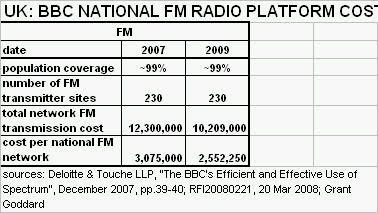
Compared to the existing FM transmission system (which the BBC said in 2007 offered around 99% population coverage), DAB will be more expensive. Not at present, because DAB is only covering 86% of the population, but increasing that percentage to the same as FM will be costly for DAB. Very costly. By comparison, the existing national FM transmission network had cost the BBC £12m in 2007. This should have reduced to £10m in 2009 after transmission contractor Arqiva agreed to discount its existing contracts (following its acquisition of rival NGW). The same discount may have lowered the cost of existing DAB transmission agreements, but not of future contracts for build-out to 99% coverage.

The BBC broadcasts only four national stations on FM whereas, on DAB, it broadcasts more channels. How many more? The number of BBC stations on DAB varies because one station is part-time and because two full-time stations are proposed for closure next year. To take an example of a music station using 128kbps of DAB bandwidth, it would cost £1.6m per annum to cover 90% of the population, £5.6m to cover 95% and £5.9m to cover 99%. Compare that to a national FM station that currently costs the BBC £2.6m per annum. It seems that DAB may be cheaper at present, but is certainly not cheaper once it is required to achieve equivalent FM coverage.

The second national DAB multiplex in the UK is owned by Arqiva (formerly ‘Digital One’) and covers 90% of the population. Does it publish a price list for commercial customers wanting DAB carriage? Seemingly not. However, in September 2009, Premier Christian Radio had said it was paying £650,000 per annum for national DAB carriage, using 64kbps of spectrum. The pro rata cost for a 128kbps music station would be £1.3m per annum, close to the previously estimated BBC cost for population coverage of 90%. Arqiva says it “is working on a transmitter roll out plan to further extend coverage,” having added four new transmitter sites in 2009.

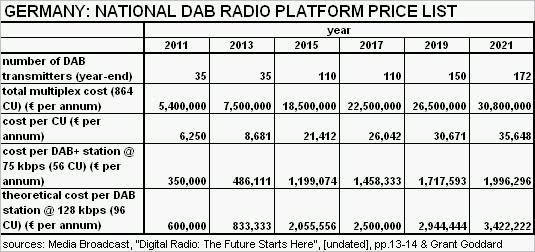
In Germany, the transmission provider, Media Broadcast, has published a price list for commercial stations interested in broadcasting on its planned DAB platform. It anticipates that German stations will use the more spectrum efficient DAB+ system, whereas the UK is wedded to the older DAB system. The prices quoted below (in Euros) require a radio station to take a minimum 10-year contract and are based on two multiplexes operating at each transmitter location (if that were not to happen, the costs would be higher).

By 2015, Media Broadcast anticipates that its 110 DAB transmitters will provide coverage to 78% of the population indoors and 92% of the population outdoors. There seems to be no commitment in Germany for DAB to achieve the 95% to 99% population coverage that is planned in the UK. Nevertheless, the transmission cost of a (hypothetical) DAB station using 128kbps would be as high as E3.4m (£2.8m) per annum by 2021. As in the UK, the cost escalates rapidly as the DAB network is built out to reach more of the German population. Whereas, in 2011, the initial E0.6m (£0.5m) per annum might not seem prohibitive to cover a country that has a third larger population than the UK, that annual cost is multiplied six-fold by the end of the 10-year contract.

In both the UK and Germany, the cost of DAB roll-out to ensure that reception is as robust as FM will add significantly to the platform’s costs. Without this roll-out, DAB can never replace FM, and the burdensome cost of simulcasting on both DAB and FM will continue. With this roll-out, DAB seems to end up costing more than FM to achieve similar coverage. So what is the point?

In the UK, neither Ofcom nor the government’s DCMS department have published analyses of the costs of DAB roll-out. Their pursuit of the DAB platform has had absolutely nothing to do with the real world economics of the UK radio industry. Their numerous published reports and consultations deal with a virtual reality of the radio industry that exists solely in their minds, perhaps a reflection of the fact that none of them have ever worked in the radio sector they try to regulate.

Ofcom’s plans for upgrading DAB, to be published imminently, merely prolong the regulator’s fantasy that the DAB platform is ‘the future of radio’. Ofcom’s apparent determination to run the radio industry into the ground economically through its insistence upon implementing a misguided ‘digital strategy’ for the sector has already proven a disaster, helping reduce the commercial sector’s profitability to nil. Even more disastrous is the radio industry’s seeming inability to confront Ofcom collectively, to insist that ‘enough is enough’, and to demand that Ofcom goes back to the drawing board in its whole strategy for radio’s future.

How can Ofcom retain an ounce of credibility when it had forecasted publicly (as recently as November 2006) that digital platforms would account for 42% of all radio listening by year-end 2009? The actual figure was 21%. As a result, all those radio operators who had based their business plans for digital radio upon Ofcom’s ‘professional’ forecast have faced financial ruin. Instead of reaching for the tissue box, these businesses should be reaching for their lawyer.

Practical action is what is needed now, not yet another Ofcom fantasy plan for radio’s DAB future.

Marketing DAB radio: misleading listeners only damages the medium

The radio medium’s loyalty amongst consumers derives substantially from the trust engendered between the on-air presenter and the listener. Research has demonstrated that radio is trusted more than any other medium, and that its audience feels a much greater affinity than it does with less intimate media such as television and newspapers.

In view of the importance of this ‘trust’ between radio and its audience, it seems a remarkable own-goal for radio to be promoting itself in a misleading way in advertisements carried on its own medium – radio. If listeners cannot trust radio people to be truthful about radio on the radio, then does it not undermine the bond that exists between a radio station and its listenership?

A recent radio advertisement placed on commercial radio stations by the Digital Radio Development Bureau, the agency tasked with persuading the public to buy and use DAB radios, stated:

“This is an advert for DAB digital radio. If you were listening to me on a conventional analogue …” [the sound of radio interference interrupted the speaker momentarily. The voice-over then continued:] “… radio you might very well hear strange noises …” [further sounds of radio interference followed. The voice-over continued:] “… which would ruin your enjoyment of your favourite programme …” [more interference sounds were audible. The voice-over continued:] “… meaning you might miss out on the crucial …” [radio interference sounds could be heard once more] “… but, with a DAB radio, you can enjoy crisp, clear digital sound. To find out more and discover loads more stations, visit getdigitalradio.com. Prices start from £24.99. Digital radio, get more from your radio”.

Listeners complained to the Advertising Standards Authority [ASA] that this advertisement was misleading because, when the DAB radio signal is inadequate, the audible broadcast signal is interrupted.

The Digital Radio Development Bureau responded that:
• because DAB is a digital technology which is either ‘on’ or ‘off’, the signal is always the same right up to the coverage limit
• DAB uses single-frequency networks technology where the same programme is transmitted from a number of sites, and DAB receivers add the signals from all the transmitters together, reducing gaps whereas, in an analogue radio network, gaps between transmitters cause the signal to fade in and out as the listener moves around
• a digital radio receiver is not subject to the background hiss and interference that might be audible with an analogue radio, and it is only when the listener is not in a digital station’s coverage area that the signal drops out
• electrical interference from fridges, thermostats, motors or light switches can cause crackle on analogue radio, whereas digital radio is not susceptible to this
• the other interference referred to in the advert is intrusion of pirate radio broadcasters that listeners might hear on analogue radio. Because there is no low-grade, cheap equipment available for DAB, pirates are not able to broadcast on digital radio
• the advert sought to promote the fact that DAB radio was hiss- and crackle-free, which the Bureau believed was reasonable and responsible.

The ASA believed otherwise. It said it understood that “if listening to digital radio whilst travelling, the digital signal could drop out when entering a built-up area or walking between tall buildings,” whereas the adverts “gave the misleading impression that listeners would never experience any interruption to a DAB signal, when that was not the case.” The ASA banned future use of the advert.

This was not the first occasion on which advertisements promoting DAB radio have been found to be misleading. In 2005, the ASA had similarly banned a radio advert which had stated:

“If you’re someone who thinks an iPod is something you might keep your contact lenses in you probably haven’t heard about DAB digital radio. With a new digital radio costing from as little as 49.99, not only can you hear all your current favourites in crystal clear sound, you can switch on to a dial-full of digital-only stations specialising in everything from classic rock to books that talk. The future is here today with distortion free DAB digital radio: taking the hiss out of the way you listen to the radio. Message provided by TWG Emap Digital.”

On this occasion, the ASA decided that “not all DAB digital radio listeners would receive ‘distortion free’ and ‘crystal clear’ sound and concluded that the claims were misleading,” it having “received no evidence to show that DAB digital radio was superior to analogue radio in terms of audio quality.”

On another occasion, in 2004, Ofcom banned an advertisement broadcast on London station Jazz FM which had claimed falsely that DAB radio offers consumers “CD-quality sound”. Ofcom concluded that “some listeners, in particular listening circumstances, would perceive a difference in sound quality between services using lower bit rates or broadcasting in mono compared to the quality attainable on CDs.”

There is a recurring theme here of DAB radio marketing campaigns repeatedly being found to be misleading listeners. Their response: just try and try and try again. Perhaps there should be a ‘three strikes, then you’re out’ policy. Do not pass go. Do not advertise DAB radio misleadingly on the radio. Do not continue to abuse the trust between the radio medium and its listenership.

Kiss FM: it's the same old songs

London dance music radio station Kiss FM has re-scheduled its specialist shows to slots after midnight, according to The Guardian, and has cut their duration from two hours to one hour. Almost nobody listens to radio on a weekday after midnight, RAJAR audience data show, so the policy change condemns these shows to a radio graveyard that is very close to extinction.

According to Kiss FM specialist DJ Logan Sama: “The shift of focus away from upfront specialist music to more playlisted hours is one which the management feel will enable the station to compete with the likes of Capital and Galaxy FM. All of the genre-specific late-night shows took the brunt of the hit.”

When Kiss FM was launched in 1990, its specialist music shows started at 7.30pm on weekdays, and the preceding half-hour magazine show ‘The Word’ created a watershed between the daytime mainstream playlist and the more radical evening shows. There was a specific commitment in the station’s licence to broadcast these shows so that Kiss FM would give airplay to music unheard anywhere else on the radio in London.

In the intervening years, through attrition, Kiss FM’s owner (EMAP then, Bauer now) has succeeded in ‘persuading’ the regulator to loosen these licence requirements for the station to broadcast specialist music shows. To its discredit, the regulator has seemed happy to go along with such proposals, permitting Kiss FM to be turned into a much more mainstream hit-orientated station than it was ever intended to be.

What the regulator and some radio owners seem to fail to grasp is that, in a crowded radio market such as London, one station can attract a significant (and loyal) audience by doing something deliberately different both from its competitors and from its own daytime mass-market output. This works both commercially and altruistically. In the case of Kiss FM, advertisers can reach a niche audience that daytime shows do not deliver (if I organise a reggae concert, the best place to advertise it is in a reggae radio show); citizens are offered a genuine extension to the ‘listener choice’ that the regulator loves to cite.

This is not just a theory – there is plenty of empirical evidence to demonstrate how it works. Look at Helen Mayhew’s evening ‘Dinner Jazz’ show on the original London Jazz FM, which was almost the only show on the station that delivered 100% jazz music, but also had higher ratings than any of the daytime playlisted output.

Kiss FM itself provides a good example of what can be achieved. In the graph above, the red line shows the current audience of Kiss FM London (RAJAR, Q3 2009) peaking at 147,000 adults at breakfast between 8 and 8.30am, then falling to a minimum of 1,000 adults by the early hours of the next morning. This is the normal pattern of listening for a mainstream music radio station in the UK.

The blue line shows the Kiss FM London audience a decade earlier in 1999 when specialist music shows still occupied the weekday evening hours. Note that, in the evening, during most of the hours from 7pm to midnight, the audience was bigger a decade ago than it is now. Has the subsequent replacement of specialist music shows with mainstream music in the evening improved Kiss FM’s audience at those times? Apparently not.

After the station launched in 1990, the daytime audience was lower than it is now, but the evening specialist music programmes generated huge audiences. Some of the Kiss FM evening shows attracted more listeners than any other London station in these evening timeslots, ranking them #1 in that daypart.

This was not an accident. Kiss FM’s original schedule was deliberately designed to attract significant audiences to each of a wide range of specialist music shows broadcast on weekday evenings. Listeners loved them – individual shows were promoted heavily on-air and in specialist music magazines. Advertisers loved them – the rates were cheaper than daytime and the spots regularly sold out.

Doing something different on-air can reap rewards, if you satisfy genuine listener demand and promote the hell out of it, so that people know the programmes are there. But, if you simply do the same in the evening that you are doing during daytime, your station is going to have much the same declining listening pattern as any other radio station.

If you compare Kiss FM’s current listening pattern to that of its competitors, you can see from the graph above that it delivers much the same weekday shape – a continuous decline from a peak at breakfast. The exception amongst the London commercial stations is Magic’s unusual peak between 10 and 11pm. Why? Because it schedules ‘The Mellow Ten At Ten’ each weekday evening from 10pm, a one-hour feature that breaks from its playlist.

Also noteworthy in the graph is the unusually high evening audiences achieved by Choice, with more listeners than the station attracts during the afternoon. Why? Because Choice schedules specialist music shows during weekday evenings (mixes, reggae, hip hop). Again, being different can pay off for both audiences and advertisers.

This concept – that individual radio stations often struggle to sound the same, even though ‘daring to be different’ pays dividends – has been understood since the earliest days of media theory. American economist Peter Steiner wrote:

“…. the existence of [different] program types and [different] audiences therefor is assumed by the broadcasting industry and forms the basis for [station] program decisions. In this case, it is the assumed size and distribution of listeners’ preferences that is decisive in determining the amount of [programme] duplication that will result. If, as is often suspected, broadcasters exaggerate the homogeneity of audiences and their preferences for certain program stereotypes, the tendencies towards [programme] duplication will be increased.”

Writing in 1951, Steiner already recognised that radio station owners will tend to duplicate each others’ formats and programme scheduling, rather than offering their audiences something different or unique. He wrote:

“The problem, of course, is that a series of competing firms, each striving to maximize its number of listeners, will fail to achieve either the industry or the social good. Here, then, competition is providing a less than desirable result.”

In the UK, our government created a broadcast regulator to intervene in the market to ensure that commercial radio station formats maximise the ‘social good’, as Steiner refers to it. The UK is in a very different situation from the US, where the regulator (FCC) does not interfere in the formats of radio stations. But the UK system will only work if the regulator understands the economic and social imperatives for market intervention and exercises those powers appropriately.

The increasing marginalisation over the years of Kiss FM’s specialist music programmes demonstrates that the regulator is oblivious to the economic and social imperatives to regulate. Instead, it is simply conspiring to deny both listeners and advertisers the programme diversity they should be entitled to. The fact is that ‘light touch’ radio regulation is not regulation at all, any more than driving a car with no hands on the steering wheel would be considered by a court to be ‘driving’.

A regulator that simply allows market forces, in Steiner’s words, to produce “a less than desirable result” is not regulating. The Independent was quick to blame Kiss FM’s owner:

“Once the king of pirate radio, the legendary station Kiss is being dragged into the mainstream by owners Bauer Media, which will today cut back a number of the Kiss specialist music shows and axe several presenters in order to reposition the network to take on Global Radio operations such as Galaxy. Shame.”

However, the blame should fall squarely on the regulator for allowing a station owner to pursue an objective that further restricts consumer and advertiser choice. There is no ‘free market’ for radio in London – the gap in the market created by Kiss FM’s marginalisation of specialist music genres and DJs will not be filled by another licensed radio station …… only by London pirate stations.

Pirate radio stations seem to be the only ones that implicitly understand Steiner’s competition theories perfectly, and they risk the consequences for putting them into action. Pirate radio’s popularity is no accident – it is a direct outcome of the failure of the regulator to regulate.

UK Commercial Radio Revenues Q3 2009

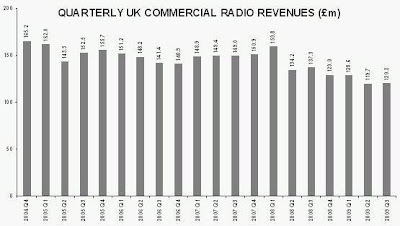
Commercial radio revenue figures for 2009’s third quarter have been published.

Q3 2009 DATA
£120.2m total revenues
£35.7m local revenues
£59.8m national revenues – lowest quarter since Q1 1998
£24.8m branded content

YEAR-ON-YEAR
Total revenues – down 12.5%
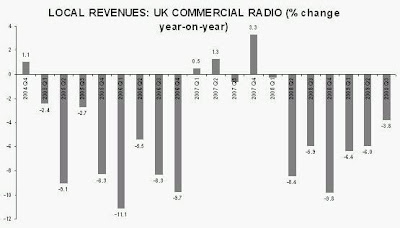
Local revenues – down 3.8%
National revenues – down 16.5%
Branded content – down 13.3%

QUARTER-ON-QUARTER
Total revenues – up 0.4%
Local revenues – up 2.6%
National revenues – down 0.3%
Branded content – no change

FOUR-QUARTER MOVING AVERAGE DATA
£497.5m total revenues – lowest since Q1 2000
Down 14.6% year-on-year (last quarter: down 13.4% year-on-year)

Have we hit the bottom yet? That is the thorny question. The answer is not easy. Yes, this most recent quarter’s revenues have halted their recent terrifying decline, demonstrating a tiny 0.4% improvement over the previous quarter. But one ‘okay’ quarter does not necessarily signal a turnaround. You would be risking your shirt to announce that the radio advertising market is going to improve from now on.

The one bright spot was local advertising, which accounts for 30% of total radio revenues. It improved quarter-on-quarter by 2.6%, although it was still down 3.8% year-on-year. Nevertheless, it is local advertising which has held up better during this recession, exhibiting only single digit percentage declines year-on-year. If you are looking for ‘grass shoots’, you might find them here.

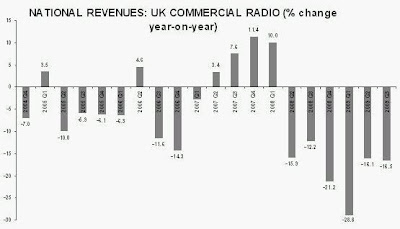
By contrast, national advertising (50% of total radio revenues) continues to be an unmitigated disaster. This was the sixth quarter in succession to record double-digit percentage declines year-on-year. National radio advertising in Q3 2009 was at its lowest point for eleven years (longer, if you factor in inflation). Neither is this a purely cyclical phenomenon – out of the last 20 quarters, only six have exhibited year-on-year growth. In aggregate, during three and a half out of the last five years, radio has suffered declining national revenues.

Where does that leave the UK commercial radio industry? Well, for the small local stations that have continued to fulfil the remit of their original licences by serving local listeners and local businesses, if they have survived this far, they might yet live to see another day. It is impossible to predict that ‘the worst is over’, but it might be that ‘the worst of the worst is over’. Local advertising is never going to migrate wholesale to digital TV or to the internet, and the yields that a successful local radio station can extract remain high.

The outlook is not so good for group owners of local stations who started to spend less on the shoe-leather necessary to secure local advertising contracts in the 1990s, dazzled by the lucrative opportunities presented by big-name national brands. Unfortunately, the national advertising market is fickle and media buyers now have a longer list of options than ever before, at more competitive prices than ever before. It’s all very well for some current owners to be busy ‘transforming’ local radio licences into national brands, but the market for national radio advertising has shrunk by 40% over the last six years. Now, a much smaller cake has to be divided by a greater number of national radio brands.

The revenue data also contradicts the message repeatedly broadcast by Ofcom in recent years that national radio brands represented ‘the future of radio’. Betraying a lack of understanding of the radio advertising market, Ofcom ignored double-digit declines in national advertising revenues that were evident as early as 2005, instead insisting that national brands on digital platforms were what listeners and advertisers wanted. To date, not one commercial digital radio station broadcast on DAB has produced an operating profit, and consumers’ preferred source for national radio remains the BBC. Commercial radio used to be good at genuinely local radio, so deliberately giving it up was never a sensible idea.

One characteristic that too much of UK commercial radio presently lacks is ‘excitement’, for both listeners and advertisers. More so than ever in these days of media overload, you have to create a distinct ‘buzz’ around your product to attract attention. Being in the marketplace is simply not enough. I only realised how much I have missed that kind of radio excitement when I stumbled across a local commercial station this week that entertained me enough to make me stop what I was doing and listen intently. It even played three of my all-time favourite songs in a single hour.

Unfortunately for the financial health of the UK radio industry, that station serves Lafayette, Louisiana – metro population 257,000. Deservedly, it ranks #2 in the market.

The demand for DAB radio: where is it?

Most of the current debate on the challenges facing DAB radio seems to be focused on ‘supply side’ issues, such as upgrading existing DAB transmitters, making DAB radio receivers available in cars and the creation of another national DAB multiplex. Surprisingly little of the talk is about the ‘demand side’ issues facing the DAB platform. What are consumers demanding from DAB radio? And how great is that demand?

There are two types of consumer demand for DAB: the demand for content broadcast on the DAB platform, and the demand for DAB radio receiver hardware. The two are inextricably linked. Consumer demand for DAB hardware is largely a function of demand for DAB content. You will only want to buy a DAB radio if you believe there is something interesting enough to listen to on it. Let’s examine some of the available data on these two issues.
  
Consumer demand for DAB content
  
Nobody is going to be motivated to spend money on a DAB receiver for listening to the radio if the platform only offers the same content already available to them on analogue receivers. Therefore, it must be the exclusive digital-only content available on DAB (and other digital platforms) that will persuade consumers to both use the DAB platform and to purchase a DAB radio receiver.

So how dissatisfied are consumers by the radio content choices (the range of radio stations) available to them on existing analogue radio receivers? Ofcom research shows that 91% of adults are satisfied with the existing choice of radio stations offered to them (see chart below), a proportion that has risen in recent years. This demonstrates that dissatisfaction with existing radio provision is extremely low, making it very difficult for any new platform to attract a substantial audience by offering content that will gratify consumers’ few unsatisfied demands.

[In case you are wondering if the increasing satisfaction with radio stations might be a direct result of the exclusive digital-only stations already offered on the DAB platform, it is worth noting that only 3.9% of hours listened to radio are attributed to digital-only stations [RAJAR 2009 Q2].]

Ofcom data shows that the average consumer listens to very few radio stations. Two thirds of the population listen to only one or two different radio stations in an average week, and the majority of these two-thirds listen to only one station. So, not only are the overwhelming majority of consumers satisfied with their existing choice of radio stations, but most people listen to a very narrow menu of stations.

These phenomena are not the outcome of consumers only being offered a limited choice of radio stations on the analogue platform. Ofcom data demonstrates that, in addition to the 5 BBC radio stations and 3 commercial radio stations available nationally on analogue radio (with near universal coverage) in the UK, there are a significant number of local radio stations available to consumers in most areas of the UK. The average consumer in the UK has a choice of 8 national radio stations and 6 local radio stations.

This existing wide choice of radio stations makes the plan for migration to digital platforms very different for the radio medium than it is for the television medium. In the UK, only four (five in some areas) TV stations are available via analogue, making the wider choice available on digital platforms seem very attractive to consumers. Whereas, in radio, an average 14 stations are available to consumers on analogue, and these are already satisfying the vast majority of consumer demands. As a result, there is only a very tiny untapped consumer market for radio content not already available via analogue.

This is demonstrated by analysis of the largest UK radio market, London, in which consumer choice is at its greatest. There are 29 licensed radio stations available on the analogue platform in London (excluding community radio and out-of-area stations), but the top 3 stations account for just under a third of all radio listening in London, and the top 6 stations account for almost half of all radio listening. The radio market in London, as in most of the UK, is dominated by a tiny number of mainstream stations, whilst the remaining radio offerings comprise a ‘long tail’ that fulfils more specialist consumer needs.

 The dramatic consumer skew towards mainstream radio means that, even in a radio market as developed as London, it proves difficult for incremental, digital-only stations to draw significant amounts of listening. The most listened to exclusively digital radio station in London is BBC 1Xtra, which ranks 22nd and attracts only a 0.5% share of listening in the market [RAJAR 2009 Q2]. 1Xtra’s content (UK black music) is barely duplicated by any other legal radio station available in London, and yet its ‘success’ remains slight in a very multicultural market that is already crowded with myriad radio options for consumers. The recent decision by London station Club Asia to enter administration, combined with the closures earlier this year of South London Radio and Time 106.8, demonstrate the challenge for stations to find a ‘monetisable’ audience in London, even on the analogue platform.

It might be easy to assume that Londoners, offered the widest selection of radio stations on the analogue platform, would be more satisfied with their choice in comparison with consumers in other, less well served parts of the UK. The surprising result from Ofcom research is that Londoners are, in fact, less satisfied with their choice of radio than most other parts of the UK. The chart below (extracted directly from a recent Ofcom report) demonstrates that satisfaction with existing radio provision is almost evenly spread across the whole UK, but consumers in London and Northern Ireland are the least satisfied.

In summary, radio in the UK has been a victim of its own success. The universal availability of a range of both BBC and commercial ‘national’ stations, combined with the extensive choice of local stations available in most markets, mean that consumers are already relatively spoilt for choice on the analogue radio platform. There is very little unsatisfied demand for radio content because the UK already has such a comprehensive choice of radio content on offer. As a result, any new radio platform (DAB, satellite, online, etc) is going to find it hard to compete with the high quality and diverse choice of what is already on offer.

This was always going to make it tough for the DAB platform to entice consumers to purchase DAB receivers as anything other than a ‘replacement’ for their existing analogue radios. Unfortunately, the natural replacement cycle for radio receivers is so slow (maybe ten years or more) that it will never prove sufficient for a complete UK digital switchover to be co-ordinated for radio, as is happening in the television market. The UK has some of the best radio in the world – ironically, this has been our digital downfall.

Consumer demand for DAB radio receivers

As noted earlier, consumer demand for DAB hardware is largely a function of demand for DAB content. You will only want to buy a DAB radio if there is something interesting enough you want to listen to on the DAB platform.

Ofcom research demonstrates clearly the lack of interest amongst consumers in purchasing DAB radio receivers. In this year’s survey, only 16% of consumers (without a DAB radio) say they are likely to purchase a DAB radio within the next 12 months. Two years ago, 19% said they would be likely to purchase a DAB radio within the next 6 months. This is very bad news for manufacturers and retailers of DAB radios. Worse, this year not only do 64% of consumers say they are unlikely to purchase a DAB radio, but 20% say they don’t know – a demonstration that a DAB radio is far from being a ‘must have’ gadget on consumers’ wants lists.

The data for current levels of DAB radio receiver ownership are not very helpful in determining the demand for DAB radio receivers. The quarterly survey by RAJAR found in 2009 Q1 that 32.1% of adult respondents claimed to own a DAB radio. However, the annual Ofcom survey found in the same quarter that 41% of adult respondents claimed to have a DAB radio in their household. This disparity between the results from RAJAR and Ofcom would appear to be widening over time.

The uncertainty in the data regarding ownership levels of DAB receivers is not surprising, given the evident level of consumer confusion. Firstly, many radios on the market have the words “digital” or “digital radio” written on them, meaning that they either incorporate a digital clock (for radio alarm clocks) or that they offer ‘digital’ tuning of analogue wavebands, despite them not offering DAB reception. Secondly, the majority of ‘DAB radios’ presently on sale in the UK offer DAB reception in combination with analogue radio and/or internet radio. When DAB radio receivers were first introduced a decade ago, all the models offered were DAB-only. Nowadays, it is harder to find a DAB-only model in shops. Earlier this year, I surveyed the radio hardware on sale from UK retailers (see chart below) and found that the most common DAB consumer proposition is now an ‘FM + DAB’ radio.

In its latest consumer research on take-up of digital radio, Ofcom said that the result of its survey (see below) “highlights the continued lack of awareness among consumers of ways of accessing digital radio”. Consumers have low awareness of their ability to already access digital radio, and It appears that the words “digital radio”, “digital audio broadcasting” and “DAB” are not yet precisely understood. This uncertainty makes the results of market research about ownership levels of DAB radio hardware somewhat unreliable.

One of the targets set by the Digital Radio Working Group at the end of 2008 for the implementation of digital radio was that DAB radios should reach 50% of radio receiver sales by volume by the end of 2010. However, if the current rate of growth continues, this target is unlikely to be reached until 2016 (see chart below).

Besides, this target is largely irrelevant to digital switchover because it seems to assume that consumers are making a definitive choice between the purchase of a DAB radio or an analogue radio. In fact, as the earlier chart shows, the majority of DAB radios presently offered by retailers also include FM radio. Although the DRDB data states that 22% of radios sold in the UK incorporate DAB, the vast majority of those include FM too. So, for every 100 new radios sold, you are probably adding to the UK’s inventory of receivers between 95 and 98 new FM radios, at the same time as adding 22 new DAB radios. In other words, the household penetration level of analogue radio receivers is barely diminishing at all, a fact that will ensure that FM broadcasting remains as vital to our radio system as it has always been.

In summary, the DAB platform seems to be developing slowly as a supplementary platform to existing analogue radio reception. Far from DAB radios ‘replacing’ analogue radios, the overwhelming majority of new radios purchased in the UK are still analogue-only. The remainder are mostly DAB/analogue combination receivers. In this way, DAB has much in common with ‘Long Wave’ radio, where consumers for a long time were offered a choice of ‘FM+AM’ or FM+AM+Long Wave’ receivers in retail stores. Like Long Wave, for a minority of consumers DAB may be a ‘must have’ when purchasing a new radio, but for the majority it is merely an optional extra whose purchase is likely to be very dependent on the comparative prices of available options.

Conclusion

The publicly available data on the demand for DAB is not particularly encouraging for the platform’s future. Much of the implementation of DAB to date in the UK has focused on ‘supply-side’ issues, without seeming to determine whether there is sufficient demand from consumers for new content, and without determining whether that new content would prove sufficiently attractive to lure consumers into shops to purchase DAB radios. Ironically, it appears that if our existing system of analogue radio broadcasting had been less well developed in terms of both the range of available content and its near universal delivery, DAB might have been better able to address any pent-up demand from consumers. As it is, the majority of consumers seem very content with their existing radio options. Our pursuit of excellence in radio over the last 80 years has created something we can be proud of – but it has also made it hard for it to be bettered by a ‘new’ system such as DAB.

[For more data on the challenges facing digital radio in the UK, check out a presentation I made to the European Broadcasting Union Digital Radio Conference in June 2009]

UK Commercial radio revenues Q2 2009

Commercial radio revenue figures for 2009’s second quarter have been published.

Q1 2009 DATA
£119.7m total revenues – lowest since Q3 1999
£34.8m local revenues – lowest since Q1 2001
£60.0m national revenues – lowest since Q1 1998
£24.8m branded content

YEAR-ON-YEAR
Total revenues – down 10.8%
Local revenues – down 6.0%
National revenues – down 16.1%
Branded content – down 3.7%

QUARTER-ON-QUARTER
Total revenues – down 6.9%
Local revenues – down 5.4%
National revenues – down 12.3%
Branded content – up 6.0%


FOUR-QUARTER MOVING AVERAGE DATA
£514.6m total revenues
Down 13.4% year-on-year (last quarter: down 13.1% year-on-year)


Whatever may be going on elsewhere in the economy, it is hard to see any green shoots of recovery in the UK commercial radio …. yet. Total revenues in Q2 2009 fell by 10.8% year-on-year to £119.7m. Initially, this might look mildly positive compared to the 19.5% year-on-year fall experienced last quarter. But remember that the downturn in UK radio first hit in Q2 2008 and had already reduced that quarter’s revenues 10.1% year-on-year. As a result, Q2 revenues in 2009 are now 20% below what they had been two years ago, a decline so significant that it will prove difficult to recapture even when the economy does improve.

National advertisers remain the weak spot for UK commercial radio, with revenues in Q2 2009 down 16.1% year-on-year. But once again, Q2 in 2008 was the start of the downturn and that quarter showed a 15.9% fall year-on-year. National revenues in Q2 2009 are now 29% below what they had been two years ago. It will be a mighty challenge to recoup such losses.

The notion that UK commercial radio is merely experiencing a cyclical blip and will quickly show recovery once the overall economy improves is a great feelgood story, but one that is not supported by the industry’s own data. Long before the ‘credit crunch’ hit us all, UK commercial radio revenues were already showing structural decline, a trend that the current economic cycle has merely exacerbated.

Nothing demonstrates the long-term trend more starkly than a glance at the year-on-year changes to commercial radio’s total revenues in recent quarters. Of the last 20 quarters, only 7 have demonstrated year-on-year revenue growth (one quarter in 2004, one quarter in 2005, one quarter in 2006, three quarters in 2007 and one quarter in 2008). The most recent quarter’s total revenues were 29% below the peak achieved as long ago as Q4 2003. If these comparisons were adjusted for the effects of inflation, the decline would look even more stark.


For the commercial radio industry, business will never be the same again. The ‘goldrush’ 1990s are never going to happen again, at least not without some kind of radio revolution (such as the BBC wilfully destroying Radio Two’s popularity, as they did with Radio One in the early 1990s). As a result, the commercial radio industry will need to change its modus operandi more substantially than ever before, not to thrive, but in order simply to survive. If it doesn’t change, we won’t have much of a commercial radio industry left at all.

The seemingly widely held belief that commercial radio MUST continue to exist in its present form because it is a highly regulated and licensed industry is simply false. If there was one lesson that should have been learnt from the implementation of DAB radio in the UK, it was that ensuring that a small group of commercial interests control a technology and the access to it counts for nothing if there is almost no demand for it. With DAB, radio broadcasting groups got what they wanted – their cartel became the licensed gatekeeper and owner of DAB. But if nobody wants your DAB, you are left being gatekeeper to a field of nothing.

It’s the same with commercial radio. If advertisers and listeners don’t want your product, there is no reason for it to exist, regardless of you waving around your scarce Ofcom licence. Not so long ago, station owners could still foist crappy radio content on the public because listeners were starved of alternatives, but digital audio and the internet have changed that FOREVER. No longer is there any market for second-rate radio. And, in commercial radio, if unwanted or irrelevant content doesn’t attract listeners, it won’t last long.

In this context, the latest Ofcom radio

consultation (“Radio: the implications of Digital Britain for localness regulation”) is a remarkably disappointing document. At a time when commercial radio is at a crossroads in so many senses (profitability, consolidation, platforms, localness, public service, interactivity, CPM, etc), this latest chapter in Ofcom’s many attempts to map out “The Future Of Radio” is no more than tinkering at the edges of existing radio regulation.

What was needed was a full-blown, courageous effort to overhaul the radio regulatory system in order to ensure that commercial radio continues to exist financially and that the diminishing number of licensees genuinely serves the public’s articulated radio needs. Instead, we have an Ofcom consultation that is no more than a grudging reaction to Lord Carter’s Digital Britain proposals, some of which are now adopted as if they were Ofcom’s own, some of which are watered down, and some of which have been ignored altogether.

The reluctance drips from every page. There are 81 uses of the word ‘if’ in this 82-page document. Almost every one of its proposals is tainted with uncertainty – “if and when new legislation is passed” or “if Parliament decides not to take forward”. Rather than seizing the opportunities that arise from the painful ‘crossroads’ when change is an inevitable necessity rather than a nicety, Ofcom seems happy to sit in the back seat and respond “whatever!” to ideas it receives, rather than grabbing at innovation and pushing it forward. It reads very much as if written by nobody who has ever themselves run a commercial business where painful life and death decisions have to be made, sometimes at breakneck speed and often without the aid of a parachute.

Ofcom continues to treat the commercial radio industry like a naughty child who, although 36 years of age now, cannot be trusted with more than a five pound note. Every Ofcom proposal continues to keep its centralised, London-based decision making about local commercial radio firmly within its own control, without trusting licensees to co-regulate in any meaningful way. For example:
· Proposal 1 requires stations to submit a request every occasion they seek a change
· Proposal 2 will lead to “a short consultation upon receipt of such a request”
· Proposal 3 requires stations to submit a request every occasion they seek a change
· Proposal 4 will lead to “a short consultation in most cases”
· Proposal 5 will lead to “short consultations in most cases”.

Only one thing is certain – Ofcom will be drowning in consultations for the foreseeable future. These five proposals alone (out of eight) multiplied by 300 stations plus DAB multiplexes yields a potential 1,000+ new consultations or requests. And yet the document claims that these Ofcom proposals are “broadly deregulatory”.

Sadly, more than anything else, the Ofcom document completely lacks any kind of vision as to what the commercial radio landscape might look like in the future, the antithesis of what the Digital Britain consultation exercise was trying to achieve. This is a missed opportunity for Ofcom. Not just this latest document, but in 2009 when the whole “what is the future of radio?” debate is probably at the most critical point in commercial radio’s history. It appears to many in the industry that Ofcom has simply disengaged from radio. This is a particular irony for an industry that prides itself on its success in one-to-one communication.

It may seem a stupid question……. If Ofcom still sees itself as the party with the skills necessary to make 1,000 potential individual decisions on the future of individual commercial radio stations, how is commercial radio presently in such a sad state of affairs as a result (partly) of previous regulatory decisions? We tend to respect and trust people who can demonstrate a positive track record. Why would I let a doctor operate on me who had killed almost every patient he had ever consulted?

"Above all else, Durham FM will be local" …. a promise is a comfort to a fool

Durham must be unique in Britain in that it once had its own local radio station and then had it taken away. BBC Radio Durham closed down in 1973 when the BBC, then limited to just twenty local radio services around the country moved the station in its entirety to Carlisle. It was reasoned that Durham could be adequately served from the north by Radio Newcastle and from the south by the then Radio Teesside. The same arguments can be heard today when, despite the proliferation of electronic media over the past thirty years, all the mass media serving the Durham area are based on Tyneside, on Teesside, in Darlington or in London. Our research and consultations confirm an almost universal desire for Durham to have its own radio station – for Durham and from Durham.

These words are taken from the winning licence
application submitted to Ofcom by The Local Radio Company in January 2005 for the new Durham FM licence. The application continued:

There is an unduly low level of contact between the City of Durham and the many towns and villages which surround it. Those representing the towns and villages in the Districts away from the City also point to a reluctance to travel between those towns and villages. Local people feel marginalised by the existing media. When most local news and information comes from media dominated by out-of-area conurbations is it surprising that local awareness and pride starts to suffer? We see this as a major opportunity for Durham FM to provide an entertaining and informative local radio service which will have wide appeal…..

Durham FM will broaden the range of local commercial radio services by offering the only programming to focus exclusively on Durham City and the surrounding districts. In addition to the full range of national services, the proposed TSA is served by local radio stations based around Tyneside and Teesside. From the BBC there are BBC Radio Newcastle and BBC Radio Cleveland, while from commercial radio Metro Radio, Magic 1152, Century FM and Galaxy 105-106 all broadcast from Tyneside with TFM and Magic 1170 having their studios in Stockton-on-Tees…..

Only 8% of total news time on Metro Radio was devoted to stories drawn
from the proposed Durham FM editorial area…. With slightly more time devoted to news bulletins than on Metro, local news [on Magic 1152] about the Durham area featured a little more frequently, but still only 10% of news bulletin time was devoted to material directly relevant to the Durham FM TSA…. [On Century FM] our independent monitoring agency failed to identify a single reference to anywhere within the proposed Durham FM TSA…. There was no locally relevant news [on Galaxy FM] for the Durham FM area….

Durham FM will focus entirely on Durham and the districts surrounding it. Our programmes will be locally produced and presented from studios in Durham by people who know and understand the area. This independent monitoring of the existing services shows that no other ILR station in the area provides anything approaching the level of relevant local news and information which are demanded by the local population and will be offered by Durham FM. During the period monitored very few local news stories were included and there were very few locally relevant programme items on any of the four ILR services. Durham FM will become established as the only dependable, independent and up-to-the-minute source of information about what’s happening in the towns and villages of the Durham area….

Local material is vitally important to the success of Durham FM. Our detailed quantitative research, detailed later in this application, confirms that a gap exists in the Durham radio market for a greater quantity of Durham city and county news and local information. Whether expressed in terms of speech items that listeners would like to hear or those that they consider ‘essential’ listening it is local Durham and North East regional news, along with local weather forecasts and traffic and travel news for the Durham county area, that head the list of requirements….

All programmes on Durham FM will be locally produced and presented with the exception of a nationally networked chart show during three hours on a Sunday afternoon/evening and one latenight ‘phone-in of three hours duration each week. A limited further amount of appropriate network programming may be added outside weekday daytime once our local audience is established, after the second year on-air, but a minimum of 18 hours per day will always be locally produced and presented.

Following up this written application, Ofcom asked The Local Radio Company explicitly:
Are there any cost-saving sharing of resources planned arising from Durham FM’s close geographical proximity to both Alpha 103.2 and Sun FM?

The written answer from The Local Radio Company was:
It is our intention to operate Durham FM as a separate radio station with its own facilities, staff and objectives.

At its meeting on 7 April 2005, Ofcom’s Radio Licensing Committee [RLC] considered
three competing applications for the new Durham FM licence and decided to award it to The Local Radio Company. Ofcom explained that this decision was made because:

…the speech commitments contained in Durham FM’s Format (such as a seven-day local news service) would improve Durham-specific news and information provision in the area, and that the overall programming proposals contained in the Format were both deliverable and would cater for local tastes and interests, as demonstrated by the group’s research. The RLC considered that, in relation to Section 314 of the Communications Act 2003, Durham FM’s programming proposals contained a suitable proportion of local material and locally-made programmes. The station will offer locally-made output for 18 hours per day, and the Format includes commitments to delivering a range of local material. The Committee noted that, after two years on air, the station’s Format gives it the ability to air networked programming at off-peak times, if it so chooses. [emphasis added]


Durham FM launched on 5 December 2005. The station failed to come anywhere close to the audience forecasts made in its licence application (see table). A radio station’s revenues are closely proportionate to the total hours listened to it. On that assumption, Durham FM must have been around 74% below its revenue target for Year Three – a catastrophic performance for a business that is operated on largely fixed costs. So how come The Local Radio Company’s forecasts in its licence application were so wildly optimistic? The application had said:

We have no doubt that these audience projections are realistic and achievable in the light of our experience of comparable services throughout Britain…. We have every confidence that Durham FM’s locally focussed programming, backed by a significant launch budget, will establish a substantial audience within a relatively short period of time.

And how come Ofcom was so confident that the Local Radio Company could meet these targets? Ofcom said:

Durham FM’s audience and revenue forecasts were considered to be achievable, and in this context RLC members noted the excellent ratings performance and track record of both Sun and Alpha in nearby areas which have a line-up of competitor stations very similar to that which the new Durham service will face.

So just how “excellent” were the performances of the neighbouring Sun and Alpha stations owned by the same applicant?


When Ofcom’s Radio Licensing Committee met in April 2005 to consider the Durham licence, it was becoming evident that Sun and Alpha were losing listening at an alarming rate, both stations having peaked in 2002 under previous owner Radio Investments Ltd. Similar audience losses were experienced across most stations owned by The Local Radio Company, following its disastrous decision in 2004 to homogenise the branding and content of its portfolio under the slogan “music:fun:life”. Essentially, the group sucked the quirky ‘localness’ out of its local stations and, unsurprisingly, listeners subsequently turned off in droves.

The end result? Durham FM presently has a 4.0% share of listening in its local market of 201,100 adults. By comparison, Galaxy has a 9.5% share, Magic 6.4%, Century/Real 6.5% and Smooth 4.8%. Metro FM and TFM together probably take 7.5% (Durham FM chooses not to itemise these two stations in its RAJAR report). BBC local radio takes a significant 8.8% share, even though Durham is only on the periphery of both BBC Radio Newcastle and BBC Radio Tees. [RAJAR Q1 2009]

In December 2008, The Local Radio Company submitted an application to Ofcom to move Durham FM’s studios to Sunderland, effectively closing the Durham location, but continuing to provide ‘local’ programmes for Durham from Sun FM in Sunderland. It argued that “the losses for Durham FM are significant”, the details of which had “been provided, in confidence, to Ofcom”. It argued that “this co-location will allow the station to build its audience on a more stable and secure financial basis” because “it has a poor financial history” and that “the proposals will be imperceptible to listeners in the local market place”.

At its meeting on 23 February 2009, following a five-week public consultation, Ofcom’s Radio Licensing Committee refused this request to move Durham FM to Sunderland because it decided that “the case for the existence of exceptional circumstances had not been made”. However, Ofcom did suggest that it could reconsider this request “later in the year” following publication of the Digital Britain final report. Interestingly, Ofcom noted that a previously approved request in March 2008 to allow the Durham station to share programming with Alpha FM in Darlington “has been scrapped by the licensee [so as] to secure all-local programming output on Durham FM”.

With an immediate move to Sunderland now off the agenda, The Local Radio Company moved on to Plan B. Next, it applied to Ofcom to effectively merge the output of Durham FM and Alpha in Darlington into one station to be called “Alpha”. So what would remain of the promised local programming for Durham? “Weekday breakfast programming and four-hour daytime shows on Saturday and Sunday will remain separately and locally produced in Durham….”, said the application. “At all other times, local programming will originate from Darlington”. Boldly, the application argued that “the character of the [radio] services will remain substantially unchanged” and “the essentially local nature of the [radio] services will remain”.

Suddenly, Durham and Darlington were to become a single local radio market:
We believe there is considerable editorial justification in combining much of the local programming of Durham FM and Alpha, and in originating the shared programmes from Darlington. Until 1997, when it became a unitary authority, Darlington was part of County Durham and still very much leans culturally towards the county. Equally, for listeners and advertisers in the county, the attraction of a local radio service focusing on Durham is greatest for those more remote from the Tyneside conurbation, particularly those in the towns nearer to Darlington. The general public, listeners and advertisers are accustomed to the County Durham local press being substantially based in Darlington.

Am I the only one who finds this line of argument totally unbelievable? Firstly, it directly contradicts the opposite assertions made in The Local Radio Company’s application for the licence four years earlier that Durham was not well served by other media in the region. Secondly, the licence application had demonstrated there were few community links between Durham and either Tyneside or Teesside. Thirdly, my personal experience is that, having lived in Durham for seven years, I never visited Darlington (which is 19 miles away by road), though I did go to Newcastle (16 miles) and Sunderland (13 miles) regularly. However, Ofcom barely blinked at the contradictions and was so eager to go along with the story that it approved this proposal without any kind of public consultation, stating:

Durham has already regionalised four of those hours, and the request sets out clearly the affinities between the two areas [Durham and Darlington]…. This is not seen a major change to the stations’ output, and the request is granted.

So, for the second time, Durham has effectively lost its local radio station and now retains only a local breakfast show hanging by the barest thread. I am not trying to argue that Durham must have a local commercial radio station, regardless of how much money it might lose. But, once again, the outcome for radio listeners in Durham seems to raise questions about the robustness of our system of local radio licensing:
· Before advertising the Durham licence in 2004, did Ofcom properly evaluate the potential for local radio advertising revenues in the market?
· How carefully did Ofcom scrutinise the application by The Local Radio Company, before awarding it the licence, in order to separate the ‘spin’ from the reality?
· Did Ofcom monitor and assess the Durham station to ensure that the promises made in its licence application were executed on the ground?
· Why is a ‘promise’ explicitly made in a radio licence application not a contractual promise? Or are the proposals promised in an application simply disregarded by Ofcom once an applicant has been awarded the licence?

The local station in Durham must have failed because either/and:
· It was licensed to fail – no commercial radio station could survive in too small and too poor a local market – in which case Ofcom should never have advertised the Durham licence
· The Local Radio Company did not paint a truthful picture in its licence application of the economics of opening a Durham station, and Ofcom did not critique it sufficiently
· The Local Radio Company’s execution of its business plan for the Durham radio station was badly flawed

In any of these cases, somebody needs to put up their hand and simply admit ‘we got it wrong’. What galls is that both The Local Radio Company and Ofcom appear to have almost connived to come up with a ridiculous new storyline – Durham is a lot closer to Darlington than we realised – which simply contradicts everything that had been said previously, but conveniently glosses over any notion that the present predicament was the result of poor judgement.

To be fair to The Local Radio Company, its latest submission to Ofcom did reiterate:
The present proposal to simply add two further hours of daily weekday sharing is made in the light of the difficult financial situation facing all stations such as these. Relevant financial information has been supplied to Ofcom in confidence.

It might engender much more respect for the parties if, instead of these economic vagaries cloaked in confidentiality, the application to Ofcom to request deconstruction of the Durham station had simply said:
We screwed up as a station owner, you screwed up too as a regulator, and all we can do now is the two of us try and salvage the situation to ensure that the citizens of Durham can at least retain the shell of a local radio service, even if not the substance. Between us, we recognise that all we have done is add insult to injury, repeating the BBC’s unwarranted removal of a local radio service for Durham in 1973. Our sincere apologies to the people of Durham. All we can hope is that, by both of us learning from our mistakes, this travesty will not be repeated either for a third time here in Durham or elsewhere.


What Northeast England now has in the enlarged ‘Alpha’ is the makings of yet another regional radio station that could (if Sun FM were included) cover the huge area stretching from Tyneside down to Yorkshire. It would then become the fifth regional station in the area, adding to Galaxy, Smooth, Magic and Real. As for genuinely local radio serving the Durham area, The Local Radio Company’s licence application already demonstrated very clearly that neither Metro Radio nor TFM cover Durham editorially. This leaves Durham, whose population seriously lacks economic mobility, back out in the local radio wilderness once again. If that isn’t public policy failure, then what is?

Durham must be unique in Britain in that it once had its own local radio station and then had it taken away. ….

Once is an accident, twice is a ……..?