Growing DAB radio usage in the UK. Confused? You should be!

“Digital listening at an all-time high,” shouted the headline of one online news story. Yes, it was the quarterly RAJAR radio ratings, offering opportunities for some journalists to pitch their stories just about any which way they wanted. The opening sentence of this particular report said:

“The digital revolution shows no signs of slowing down, and not even the radio airwaves are set to maintain their analogue tradition, as a new [RAJAR] study suggests.”

Hardly. This news story was interesting because it achieved two simultaneous feats of confusion:
• ‘DAB radio’ and ‘digital radio’ are two different things. ‘DAB’ is the platform on which the UK radio industry bet the farm in the 1990s. ‘Digital radio’ is radio received on any platform that is not analogue (AM/FM) and includes the internet, smartphones, digital TV … and DAB
• The fact that DAB listening is growing does not necessarily mean that it is replacing analogue listening at a rapid rate of attrition. Why? Because DAB listening, even after 12 years, is still at a remarkably low level.

These confusions are not accidental. At every opportunity, statements made by Digital Radio UK have sought to confuse the public by referring to ‘digital radio’ as if it means precisely the same as ‘DAB radio.’

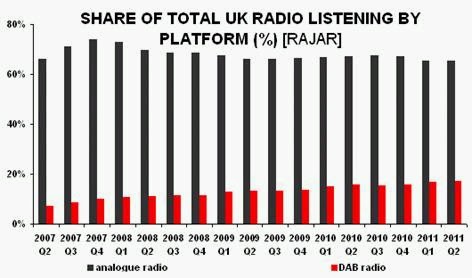
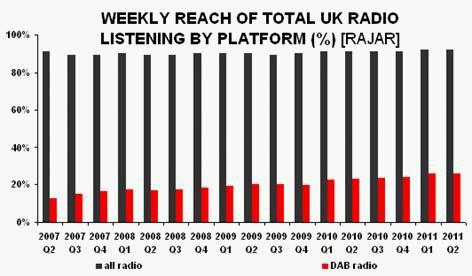
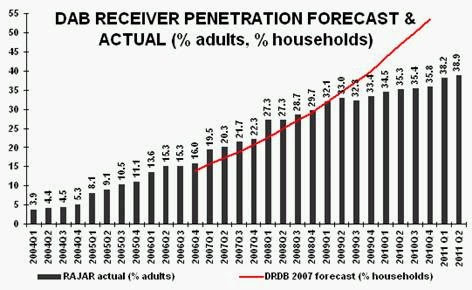
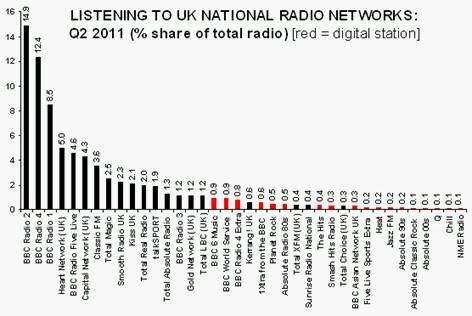
A look at the graphs below of the latest RAJAR data illustrate clearly that the “analogue tradition” in radio remains so dominant that the real question to be asked is: how come DAB usage is still so low after so many years and after so much money has been invested in content, transmission systems and marketing?

The adage ‘a picture speaks a thousand words’ has never been more true than with DAB/digital radio usage. The four graphs above – all taken from the industry’s latest RAJAR data – say it all by showing:
• how little impact DAB radio has had on analogue radio usage in the UK
• how slow the rate of growth is of DAB receiver take-up and of digital radio station listening.

Far from radio losing its “analogue tradition,” as the news article asserted, the old FM/AM platforms look, from these data, to be as strong as ever in the market.

One hint that some digital radio stations on the DAB platform could be on their way out is the BBC’s latest decision to aggregate listening for Radio 4 and Radio 4 Extra in RAJAR. It had been doing this from the outset for Five Live and Five Live Sports Extra, on the premise that ‘Sports Extra’ was only a part-time broadcast station.

I would not be at all surprised to see the BBC:
• similarly aggregate Radio 2 listening with 6 Music
• similarly aggregate Radio 1 listening with 1Xtra
• downgrade its digital radio stations from full-time DAB broadcast stations to online, on-demand ‘extra content’ available via RadioPlayer, iPlayer and applications.

The problem with national broadcast BBC radio stations, whether analogue or DAB, is that the BBC Charter insists they must be made available universally to all Licence Fee payers. Given the huge cost of extending the BBC’s national DAB transmission multiplex to near-universal coverage equivalent to FM radio, particularly at a time when the BBC is having to cut budgets massively, it would be more sensible to downgrade ‘1Xtra’, ‘2Xtra’ and ‘4Xtra’ to ‘red button’ status whereby they offer additional content on a part-time basis. The consumer would access these Extra ‘stations’ via a complementary platform (IP) rather than the BBC having to shoulder the financial burden of programming them as 24-hour broadcast entities.

It would prove a convenient solution for the BBC. As it found with 6 Music last year, public controversy surrounds any decision to close a radio station, however small its audience in absolute terms. Alternatively, by pursuing the ‘Extra’ route, the digital stations can be re-branded, re-purposed and re-platformed away from expensive, fixed-cost DAB and towards IP, where the cost of delivery varies proportionately with the number of people using it. What better way to deliver value for money to Licence Fee payers? And what better way not to face public wrath for ‘closing’ a digital radio station.

As BBC Radio 2 DJ Steve Wright said on today’s Broadcasting House show:
“Maybe full digitisation [of radio from FM/AM to DAB] may well take thirty years …”

As the graphs above demonstrate, there IS slow growth in DAB usage, but the rate is insufficient to replace analogue radio as the dominant consumer platform any time soon. It’s time for BBC strategy to catch up with that reality.

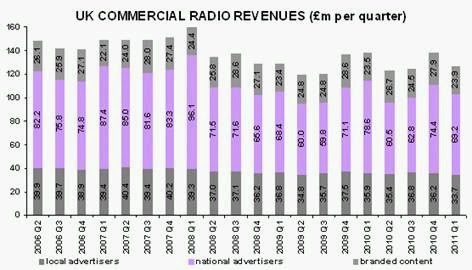
UK commercial radio sector revenues Q1 2011: local advertising hits 10-year low

Data published last week for 2011’s first quarter demonstrate that revenues of the UK commercial radio sector are still struggling to rebound from the previous two years’ ‘credit crunch.’

A large part of the problem is the coalition government’s swingeing cuts to its marketing budget since May 2010, which have afflicted commercial radio advertising much more significantly than other media [see blog]. Additionally, and very worryingly, in Q1 2011, revenues from local advertisers fell to their lowest level for a decade, even at a time when local radio might be thought to be making client gains from the decimation of the local newspaper industry.

As has been suggested here previously [see blog], the strategy of the largest commercial radio owner, Global Radio, to transform its local stations into ‘national’ brands would seem to be a recipe for disaster at a time when:
• the national advertising market for radio is shrinking so rapidly (down 34% in real terms between 2004 and 2010)
• the BBC continues to dominate the national radio marketplace with exceptionally well-funded, ubiquitous brands [see blog]
• Ofcom’s market research points to overwhelming demand from consumers for more local radio rather than more national radio [see chapter 4(d)]
• many local commercial radio offices have been closed just as local newspapers have closed in many local markets.

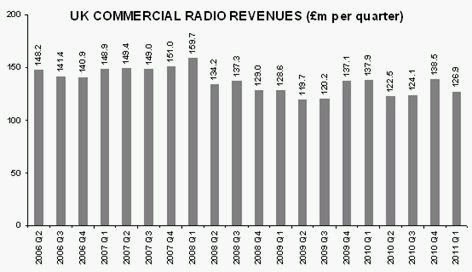
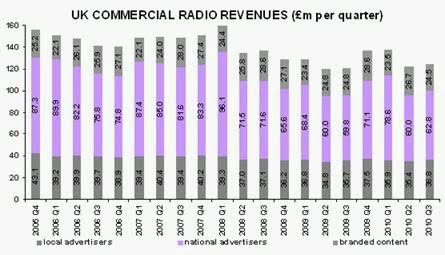
TOTAL UK COMMERCIAL RADIO REVENUES:
• Q1 2011: £126.9m (£137.9m in Q1 2010)
• Down 8.0% year-on-year
• First year-on-year decrease since Q3 2009

UK COMMERCIAL RADIO NATIONAL REVENUES:
• Q1 2011: £69.2m (£78.6m in Q1 2010)
• Down 12.0% year-on-year
• First year-on-year decrease since Q3 2009

UK COMMERCIAL RADIO LOCAL REVENUES:
• Q1 2011: £33.7m (£35.9m in Q1 2010)
• Down 6.1% year-on-year
• Lowest quarter since Q1 2001

Although the quarter-on-quarter trend during the last three years appears to be relatively flat, once the data is viewed in the longer term, it is apparent that the commercial radio sector has been unable to grow its revenues back to the peak achieved in 2004. Adjusted for inflation, the ‘real’ peak occurred in 2000 and, by 2010, commercial radio total revenues had fallen by 33%.

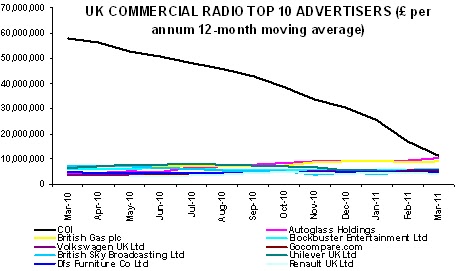
Following the impact of the ‘credit crunch,’ the subsequent blow to the sector caused by the government’s slashed expenditure on commercial radio advertising from its Central Office of Information [COI] has been catastrophic. COI spend on radio in the twelve months to March 2011 was down 80% year-on-year. In the year to March 2010, the COI had been the radio sector’s biggest advertiser by a factor of eight but, only one year later, it had been diminished to almost par with the second biggest radio spender, Autoglass.

In June 2011, the government confirmed that the COI will be axed altogether, offering no respite to the commercial radio sector. According to The Guardian:
“Instead the government intends to run advertising and marketing activity out of the Cabinet Office, hiring about 20 extra staff to complement existing communications teams.”

With local advertising revenues having hit a decade-low in Q1 2011, and national revenues having fallen 34% in real terms between 2004 and 2010, surely it should be time for commercial radio to ask itself:
• is the current local-station-turned-national-network policy the appropriate strategy for the current advertising market?
• is the current local-station-turned-national-network policy the appropriate strategy to satisfy radio listeners?
• how much longer can the ‘slash and burn’ strategy (as pursued by GWR, then by GCap, now by Global Radio) be applied to the commercial local radio industry before there is simply nothing left to cut?
• how much more shareholder value can be destroyed in commercial radio before revenues fall faster than costs can be cut?

A question I was asked by one senior radio executive last week was: how will all this commercial radio ‘slash and burn’ end? I wish I knew. Of one thing I am certain: it must eventually end in tears once the net book values of dozens of commercial radio licences have to be written down by millions of pounds in the accounts of their owners.

This process has already started tentatively:
• Global Radio valued its licences at £333m on 31 March 2010, after having swallowed a £54m ‘impairment’ write-down in 2008/9
• in 2009/10, the Guardian Media Group suffered an ‘impairment’ of its radio licences by £64m and now values them at £68m
• Times of India looks likely to have to take as little as £20m for Absolute Radio, a national station it had acquired for £53m only three years ago.
We have to anticipate more write-downs like these.

At some point, even millionaires must not enjoy watching as their radio assets are reduced to dust by shrinking audiences/revenues. But what can be done when those same owners have already starved the goose that had once laid the golden local commercial radio egg?

[Historical data from some previous quarters have been revised marginally at source]

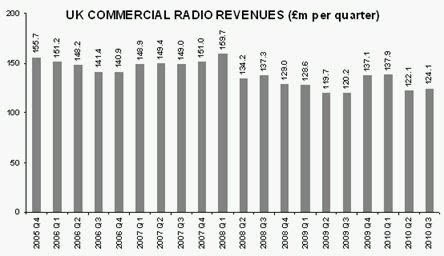
UK commercial radio revenues Q3 2010: still no sign of "renewed growth"

2008 had been a bad year for commercial radio revenues, down 6% year-on-year. 2009 was a worse year, when revenues fell a further 10% year-on-year. So how is 2010 shaping up? Radio Advertising Bureau data for Q3 2010 demonstrate that, although revenues are likely to be up marginally for the calendar year, they have yet to regain the substantial losses suffered during those previous two years.

Why? Because commercial radio’s falling revenues are largely the result of structural decline, something that the ‘credit crunch’ of 2008/9 merely exacerbated. Adjusted for the impact of inflation, commercial radio revenues peaked in 2000 and, by 2009, were down 32% in real terms. The single-digit improvements we might see in 2010 will claw back only a tiny part of these enormous losses.


Q3 2010 TOTAL REVENUES
· Up 3.2% year-on-year to £124.1m, but remember that Q3 2009 had been the sector’s second lowest this millennium

In May 2010, the Radio Advertising Bureau had told us that “the [commercial radio] sector has turned a corner and not only halted [revenue] decline, but moved into renewed growth …”

Industry data has yet to validate this assertion. The last two quarters produced the third and fourth lowest revenue totals of the decade, showing that the radio sector is certainly not out of the woods yet. More than anything, the industry’s revenues still seem to be bumping along the bottom. “Renewed growth” is not on the horizon yet.


Q3 2010 NATIONAL REVENUES
· Up 5.0% year-on-year to £62.8m

Q3 2010 LOCAL REVENUES
· Up 3.1% year-on-year to £36.8m

Q3 2010 BRANDED CONTENT REVENUES
· Down 1.2% year-on-year to £24.5m


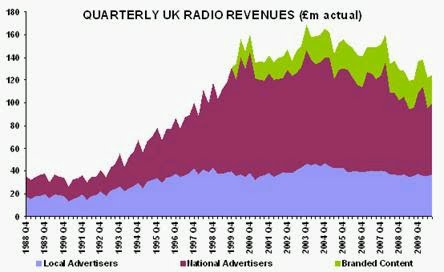
The revenue data for the long term [see graph above] illustrate clearly the transformation of the commercial radio sector from a healthy growth industry in the 1990s to one that stagnated after 2000, and which has subsequently moved into decline. Whilst revenues from local advertisers have simply stalled in recent years, revenues from national advertisers seem unlikely to ever recover from substantial declines suffered since their peak in 2000. This has necessitated significant restructuring of the commercial radio sector in recent years.

For those larger commercial radio stations that depend upon national advertisers the most, the outlook continues to look bleak. Data from Nielsen estimated that advertising spend by the government’s Central Office of Information [COI] fell by 47% in 2010 year-on-year. COI expenditure has been a greater proportion of commercial radio revenues than of any other medium, making radio particularly vulnerable. In May 2010, I had predicted:

“A 50% budget cut to COI expenditure on radio would lose commercial radio £26m to £29m per annum, 6% of total sector revenues. A 50% budget cut to all public sector expenditure on radio would lose commercial radio £44m to £48m per annum, 9% of total sector revenues.”

Not only have these cuts been realised, but the Cabinet Office is continuing to pursue a plan for the BBC to carry public service messages for free, rather than pay commercial broadcasters for airtime [also predicted here in May 2010]. This could lose commercial radio a further 6% to 9% of revenues.

In 2009, even before these drastic cuts to government expenditure on advertising, commercial radio was attracting only 4% of total display advertising expenditure in the UK, one of the lowest proportions globally [see Ofcom report]. What is UK radio doing so wrong that Ireland, Spain and Australia achieve more than double that amount? And why was that percentage already falling before the COI cuts, demonstrating the radio medium’s comparative lack of appeal to potential advertisers?

There could not be a worse time to be a commercial radio station dependent upon national advertising. Yet now is the precise time when several large commercial radio owners are busy transforming their local and regional stations into national ‘brands.’ As a response to the sector’s structural challenges, this is tantamount to cutting off your nose to spite your face. ‘Localness’ has consistently been shown to be the most important Unique Selling Point of local commercial radio, according to Ofcom research. Throw that localness out the window and all that remains is a music playlist which can be generated by any computer application.

UK commercial radio has always been good at making ‘cheap and cheerful’ local radio, but has been rubbish at making national radio that could compete with the BBC’s incredibly well resourced national networks. The recent decisions of commercial radio owners to switch from production of local radio services with a track record of success to production of ‘national’ ones that have a history of relative failure create massive risks for an industry already in decline.


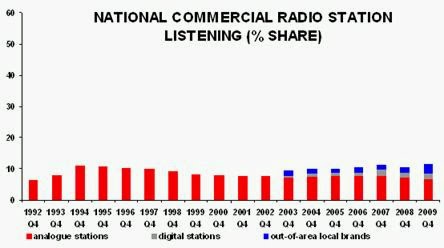
History tells its own story. The launch of the UK’s first three national commercial radio stations between 1992 and 1995 had much less of an impact on radio listening than had been anticipated. By 1997, Richard Branson had decided to sell Virgin Radio (for £115m) – it was obvious that national commercial radio was not going to be a massive moneyspinner. In 1997, Virgin Radio’s listening share had been 2.6%. Last quarter (Q3 2010), it had fallen to 1.2% (renamed Absolute Radio after another sale in 2008 for £53m), while the combined share of the three national stations was 6.8%. [source: RAJAR]


BBC national networks account for almost half of all radio listening. The only time that their share has not exhibited long-term growth was during the early 1990s, when Radio 1 self-destructed under the management of Matthew Bannister. Since that disaster, the BBC’s national networks have been successfully clawing back listening year-on-year.

The current scenario in which the owners of commercial stations that were licensed to serve local audiences have decided to subvert that purpose to take on the might of the BBC national networks is either brave, or madness, depending upon your viewpoint. What I see is a monolithic BBC that has existed continuously for nearly a century, and then I see three national commercial radio stations that have had a succession of at least three owners each during their almost twenty-year struggle to attract listeners.

National commercial radio. Just why are parts of the commercial radio industry so eager to emulate an idea that has only led to well documented failure?

Commercial radio local DAB build-out "not the BBC's responsibility" says BBC Trust chairman

Culture Media & Sport Select Committee, House of Commons
15 December 2010
BBC Annual Report & Accounts 2009-10 [excerpt]

Sir Michael Lyons, Chairman, BBC Trust
Mark Thompson, Director General, BBC

Damian Collins, MP Folkestone & Hythe (Con): Has the [Licence Fee] settlement affected the amount of support you can give to digital radio switchover and the build-out of digital radio in local services within the regions?

Sir Michael Lyons: What you see in yesterday’s announcement is a clear message that the BBC remains committed to DAB and will continue to build out up to FM equivalents. That is clear. It is involved in discussions with the commercial radio industry and Government about local build-out, for which it is not responsible and for which there are not funds currently identified. They were expected to be undertaken by the commercial operators of those Mux [DAB multiplex] licences.

I don’t think I should add very much to that, other than that, clearly, the Government has determined on a switchover date. Whether that can be achieved is, in our view, whether the audience is ready for it to be.

Damian Collins: I suppose whether it can be achieved ought to be linked to the level of coverage as well. The Government has been clear about that, too. In those negotiations you are having with Government and the commercial stations, is the amount of money you have on the table a smaller amount, as a result of the settlement, than it was before?

Mark Thompson: No.

Sir Michael Lyons: It is clearly another one of the pressures that we have to balance in a tighter envelope; that is the important thing.

Mark Thompson: I think it is fair to say that the underlying commitment that we have made and the focus we have on the building out of our own national multiplex, is unchanged by the settlement.

Sir Michael Lyons: Absolutely. It is a reference to local, I think, that I was …

Mark Thompson: Quite. But the BBC’s focus has always been … the issue about local is that we only have in England, and only intend to have, a single BBC local radio station per region. With each local multiplex that has been opened so far, we have taken a place on that multiplex; we decided that we should do that.

I have no reason to believe we would not continue to do that as they are built out. But whereas the national multiplex, obviously, is a way of getting additional BBC services to the public – the digital services – there is no such increase in BBC services that we can offer if you are taking a single station which is analogue and putting it on digital as well. So our focus is on national build-out, and the broad policy and the commitment over time to absolutely keeping pace with the audience, building out nationally, is unchanged by the settlement.

Damian Collins: Your commitment is clear, and you made that again today, but is it going to take longer to get there now, as a consequence of finding some other issues you have to deal with?

Mark Thompson: I don’t think so. If you say something slightly different, which is, “Would some people have liked some level of additional commitment in the settlement?”, perhaps they would, but it is not there.

Damian Collins: But as far as you are concerned, your commitment is the same?

Mark Thompson: It is exactly the same.

Damian Collins: In the document put to us yesterday, you talk about preparing for any potential radio switchover. That does not sound like it is going to happen within the next five years.

Sir Michael Lyons: That is not a judgment for the BBC; that is a judgment for Government. The BBC is very clear that it is doing its bit in these national investments. There remain unresolved issues about where the investment comes from at a local level. That is not the BBC’s responsibility, but we are part of those discussions. And then, very critically, as the Government has conceded, switchover can only take place … I do take your point that audience preparedness will to some extent depend on coverage, but it also depends on choices made about replacement television sets, investment in cars and a whole series of other things, which are not in our gift.

[This is an uncorrected transcript of evidence taken in public and reported to the House. The transcript has been placed on the internet on the authority of the Committee, and copies have been made available by the Vote Office for the use of Members and others. Any public use of, or reference to, the contents should make clear that neither witnesses nor Members have had the opportunity to correct the record. The transcript is not yet an approved formal record of these proceedings.]

NETHERLANDS: government forces DAB upon commercial radio

The Dutch government has adopted a ‘carrot and stick’ approach to its plans to improve the take-up of DAB digital radio. This week, it offered existing national commercial radio stations automatic renewals of their licences for a further six years until 2017, if they agree to broadcast on the DAB platform for the next six years and to cover at least 80% of the country. This renewal will avoid the licences being re-auctioned in 2011, as required by existing law. The industry response? “Commercial radio reluctantly goes digital,” said one headline.

National station Radio 538 director Jan-Willem Brüggenwirth commented: “Our digital [DAB] transmitters have been running at a loss for three years.” Radio 538 reaches 400,000 listeners per week via its internet platform, and Brüggenwirth said he expects an explosion of listening via mobile phones to internet delivered radio stations.

Martin Banga of Vereniging Commerciële Radio, the commercial radio trade body (and chief executive of Sky Radio), said: “You’re talking about millions of [radio] devices in the coming years having to be replaced, not only in homes but also in cars, which is slower than most people think.”

Banga
added: “Digitalisation is costly and offers little benefit, because almost nobody has a digital receiver. It produces no additional listeners yet, so there is no additional advertising revenue. I estimate that 2,000 people have the equipment actually to be able to receive DAB, so it only goes to the handful of people that have digital radios. Compare that to the 40 million listeners who can receive FM. This means that switching to DAB is relatively costly, and produces little income.”

Originally, there had been a government plan to turn off FM radio broadcasts completely by 2015, but this has been dropped. Instead, the government will auction two national FM frequencies that had previously been licensed to failed station Arrow FM. These licences will similarly require a commitment to broadcast on DAB.


The government’s announcement
stated:

“Digital radio has many advantages, such as better quality, more radio stations and the possibly of adding new services to the radio offering. In time, digital radio is intended to replace the current FM radio. To do this, however, the groundwork must first be fulfilled. The existing stations could make an important contribution through this [licence] extension.”

Government commissioned research in May 2010 had determined that the licence of each national FM commercial radio station in Holland was worth around €30 million.

[with thanks to Paul Rusling]

David vs Goliath: commercial radio spends £27 per hour on programmes, BBC Radio 2 spends £4,578

There has been an abundance of fighting talk from the commercial radio sector in the press in recent weeks. Commercial radio seems determined to pick another fight with BBC Radios 1 and 2, two of the three most listened to radio stations in the UK.

Guardian Media Group Radio announced that “by broadcasting on National DAB, Sky, Freeview and Freesat, Smooth Radio will provide a strong commercial alternative to BBC Radio 2.” Chief executive Stuart Taylor said:

“We are still at war with the BBC and we still compete for listeners tooth and nail, as we always will.”

The press headlines affirmed:
· “New national network makes a Smooth attack on Radio 2” (Telegraph)
· “Forget Radio 2: in five years’ time, we’ll all be going Smooth” (
Independent)
· “Smooth Radio takes on Radio 2 in national rollout” (
Marketing Week)
· “Radio Two faces fight, warns new Smooth news chief” (
Press Gazette)

Then, Global Radio announced that its local FM stations will be re-branded ‘Capital Radio’ in 2011. Chief executive Ashley Tabor said:

“With the launch of the Capital network, there will now be a big national commercial brand seriously competing with Radio 1.”

The press headlines responded:
· “Capital Radio will go national in bid to challenge Radio 1” (Evening Standard)
· “Capital Radio set to rival BBC Radio 1 in move to broadcast nationally” (
Daily Mail)
· “Global to take on Radio 1 with Capital Network” (
Marketing Week)
· “Capital Radio to form first national commercial radio station” (
ITN)

Both the GMG and Global Radio statements achieved the intended sabre-rattling headlines in the press though, for me, these sentiments are remarkably hollow. This ongoing phoney war between the BBC and commercial radio is like a war between a one-eyed giant and an over-exuberant mobile phone salesman. The giant will win every time. Commercial radio can huff and puff all it wants, but the BBC knows it is perfectly safe in its house built from Licence Fees. It can afford to chuckle loudly at every challenge like this lobbed at it by commercial radio. Why?

Firstly, you could only ever hope to seriously compete with the existing formats of BBC Network radio stations if you had access to their same abundance of resources. This is something that Channel 4 belatedly realised after having promised for two years that it would invent a new commercial radio station to compete with BBC Radio 4. Then it scrapped its radio plans altogether.


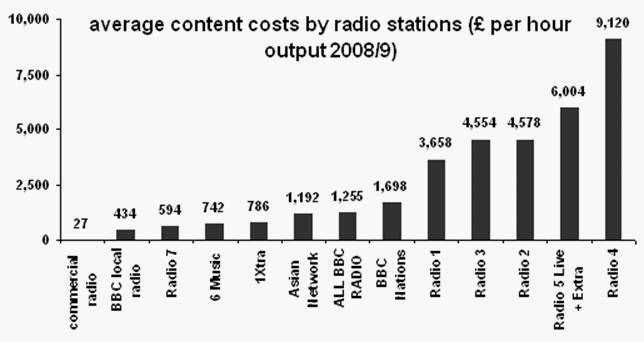
The huge gulf between the funding of commercial radio content and BBC Network Radio content makes direct competition simply pointless. In a recent report for the BBC Trust, I noted that commercial radio spends an average £27 per hour on its content, while BBC Radio spends an average £1,255 per hour. There is no way that commercial radio can make programmes that will sound like Radio 2 on a budget that is 170th of the latter’s £4,578 per hour.

Secondly, what sort of message do these press headlines send to consumers? To me, they say ‘we realise that Radios 1 and 2 are fantastically successful, so we want a slice of their action’. Or maybe even ‘you really like Radios 1 and 2, don’t you? Try us, because we want to be just like them.’ So where is the Unique Selling Point [USP] for your own product? Don’t you have enough faith in it to tell us why it is so good, rather than comparing it to your much bigger, much more successful rival? Or is this the Dannii Minogue method of marketing?

I had always been taught that the cardinal sin of radio was to mention your competitors to your audience. Every reference to your competitor tells the audience how much you respect them and their success. Ignore them! Pretend your competitor does not even exist! Plough your own furrow and concentrate on making a radio station that is genuinely unique. Then you will create a brand that has a genuine USP, rather than being merely a pale imitation of Radio 1 or 2 without their big budgets. ‘I can’t believe it’s not Radio 2’ is not a tagline to which to aspire.

Thirdly, neither Capital Radio nor Smooth will be genuinely ‘national’ stations, as in capable of being received on an analogue FM/AM radio from one end of the country to the other. So why pretend to consumers and advertisers that they are ‘national’? In the case of Capital, its proposed FM network presently covers 57% of the UK adult population. In the case of Smooth, RAJAR tells us that DAB receiver penetration is presently 35%. Just how little of the UK population can you cover and yet still describe yourself as ‘national’?


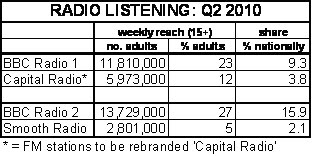
Fourthly, don’t keep looking at Radio 1 and 2’s huge audience figures and dreaming of how much money you could make if only you could monetise their listenership. Part of the reason older listeners probably like Radio 2 is because there are no advertisements. Accept the fact that Radios 1 and 2 together account for a quarter of all radio listening in the UK. Compared to those mammoths of radio, both Capital and Smooth are mere termites. Live with that fact and, instead, seek out commercial clients who are not merely frustrated because they cannot advertise on BBC Radio, but who actively want to use your radio station because your audience is intrinsically valuable to them.

Finally, invest the time and money to develop your own on-air talent rather than simply hanging on the coattails of others’ successes. Whatever his next gig might be, Chris Moyles will forever be remembered as ‘the saviour of Radio 1’, just as Chris Evans will always be remembered for his Radio 1 breakfast show, not for his subsequent time at Virgin Radio. Find new people who are good at radio and put your faith in them. Why does Smooth’s schedule have to resemble Frankenstein’s monster, stitched together with a bit here from Radio 1 in the 80s, and a bit there from Radio 2 last month?

What your radio station should be doing is not competing with Radio This or Radio That for listeners, but competing directly for consumers to spend time with you because you are ‘you’. Radio is not like selling soap powder or yoghurt pots, where your business model can be built upon undercutting the price of a competitor’s product, however low-quality your own cheapo version might be. There is no price of admission in radio. Your content needs to be ‘different’ rather than ‘the same’ and it needs to create its own unique place in the market.

You should not think of your market competitors as radio stations, but as each and every opportunity a consumer is presented with to pass their leisure time. A winning station must be able to convince a consumer to listen to it, rather than watch television, read a book or simply sit in silence. Because radio is ‘free’, the competition for radio is everything else that is also free to consumers at the point-of-use.

To offer a practical example, when I worked on the launch of India’s first commercial radio network, Radio City, the advertising agency produced an excellent marketing campaign that extolled the virtues of the station over other radio stations. But the campaign had to be rejected and the agency briefed in more detail. Why? Because we were launching the very first radio station on the FM dial in a city such as Bangalore, so the overriding challenge was to persuade people to use ‘radio’ at all, or to persuade people to buy an FM radio for the first time, or to persuade people to switch off their television and turn to radio instead.

This philosophy seems to be a million miles away from the current UK commercial radio strategy which seems to focus on berating BBC radio for being too successful, whilst wanting to somehow achieve part of that success through osmosis. If only half this war effort was put into developing policies to make the commercial sector’s stations successful on their own account, the BBC would soon cease to matter.

Instead, RadioCentre is now demanding that commercial radio be allowed to re-broadcast old Proms concerts recorded by BBC Radio 3. But how many of our 300 commercial radio stations play classical music? One. And which Proms concert do you recall that would fit into Classic FM’s playlist of short musical extracts? What next? Will Capital FM be asking the BBC for the rights to re-broadcast some old Zoe Ball Radio 1 breakfast shows?

In September 2010, the government’s Consumer Expert Group criticised RadioCentre for having proposed a policy for the BBC’s Strategy Review that, it felt, would have “bullied” listeners.

Trying to bully listeners? Trying to bully the BBC? This is the war of the playground, not of a mature media industry that has a strategy of its own making, a plan, a roadmap for its future success. “It’s not fair. Your willy is bigger than mine.” No, it probably isn’t fair, but life deals you a hand, you have to stop whining, get on with it and make the best of what you’ve got.

Just accept this reality: commercial radio’s willy is never going to be as big as the BBC’s. So competing directly on size alone is a complete waste of time when, instead, you should be developing your own individual ‘technique’.

Back to the future of radio – the FM band

Help seemed to have arrived for those consumers who are confused by the contradictory messages they are receiving about DAB radio, digital switchover and the future of FM/AM radio. The government created a ‘hot topic’ web page that addresses these issues in the form of a ‘FAQ’. Does it help clarify things?

The government FAQ states:
“We support 2015 as a target date for digital radio switchover” but, in the next sentence, it says that 2015 is “not the date for digital radio switchover”
“FM will not be ‘switched off’ … and will continue for as long as it is needed and viable” but then it fails to explain the reason the government is calling it ‘switchover’
“We believe digital radio has the potential to offer far greater choice and content to listeners” but then it asserts that “quite simply the listener is at the heart of this [switchover] process”
“11 million DAB sets [have] already [been] sold” but, in the next sentence, it deliberately confuses ‘DAB radio’ with ‘digital radio’ which, it states, “accounts for around a quarter of all radio listening” [DAB accounts for only 16% of all radio listening]
“Car manufacturers have committed to fit DAB as standard in all new cars by 2013” but it does not explain that only 1% of cars currently have DAB radio
“Some parts of the country are not served well by DAB” but it then admits that “switchover can only occur when DAB coverage matches [existing] FM [coverage].”

Well, that makes everything crystal clear now. Switchover is not switchover. 2015 is the date but is not the date. It is the government that is insisting upon digital ‘switchover’ but it is a consumer-led process. Almost no cars have DAB now but, in 2+ years’ time, magically they all will. In parts of the UK, DAB reception is rubbish or non-existent, but ‘switchover’ will not happen until somebody spends even more money to make DAB coverage as good as FM … even though FM is already serving consumers perfectly well.

Sorry, what was the point of DAB?

While the UK government ties itself in increasingly tighter knots trying to explain the unexplainable, and to justify the unjustifiable, most of the rest of the world carries on regardless, inhabiting reality rather than a fictional radio future. In May 2010, a meeting in St Petersburg of the European Conference of Postal & Telecommunications Administrations considered the future usage of the FM radio waveband [which it refers to as ‘Band II’] in Europe. Its report stated:

“Band II is currently the de facto analogue radio broadcasting band, due to its excellent combination of coverage, quality and low cost nature both in terms of current networks available and receivers in the market. It is well suited to local, regional and national programming and has been successfully used for over forty years now. FM receivers are part of our daily lives and millions of them populate our households. FM radios are cheap to manufacture and for the car industry FM still represents the most important medium for audio entertainment.”

Its report concluded that:
• “Band II is heavily used in all European countries
• For the current situation the FM services are still considered as satisfactory from the point of sound quality but the lack of frequencies hinders further development
• There are no wide-spread plans or strategies for the introduction of digital broadcasting in Band II
• No defined final switch-off dates are given so far.”

Two paragraphs in the 28-page report seemed to sum up the present UK situation:

“The FM band’s ability to provide high-quality stereo audio, the extremely high levels of receiver penetration and the relative scarcity of spectrum in the band combine to make this frequency band extremely valuable for broadcasters.”

“As FM in Band II is currently, and for the foreseeable future, the broadcasting system supporting the only viable business model for radio (free-to-air) in most European countries, no universal switch-off date for analogue services in Band II can be considered.”

In the UK, we have just seen how “extremely valuable” FM radio licences still are to their owners. Global Radio was prepared to promise DAB heaven and earth to Lord Carter to ensure that a clause guaranteeing automatic renewal of its national Classic FM licence was inserted into the Digital Economy Act 2010. It got what it wanted and therefore avoided a public auction of this licence. Then, when expected to demonstrate its faith in the DAB platform, Global sold off its majority shareholding in the national DAB licence and all its wholly-owned local DAB licences.

Now the boot is on the other foot. Having succeeded in persuading the government to change primary legislation to let it keep commercial radio’s most valuable FM licence for a further seven years, Global Radio has now had to argue to Ofcom that analogue licences will become almost worthless in radio’s digital future. Why? In order to minimise the future Ofcom fee for its Classic FM licence. The duplicity is breathtaking.

When it last reviewed its fee for the Classic FM licence in 2006, Ofcom reduced the price massively because, it explained, it took

“the view that the growth of digital forms of distribution meant that the value associated with what was considered to be the principal right attached to the licence – the privileged access to scarce analogue spectrum – was in decline.”

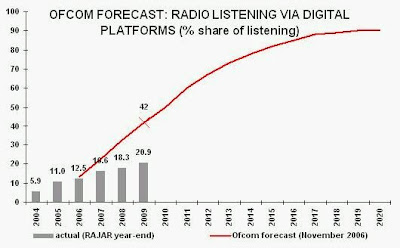
In 2006, Ofcom had published a forecast for the growth of digital radio platforms which has since proven to have been wildly over-optimistic. It had predicted that 42% of listening would be digital by year-end 2009, whereas the outcome was 21%. In 2006, as a result of the steep decline it was forecasting in analogue radio’s usage, Ofcom reduced the cost of Classic FM’s licence fee by 95% from £1,000,000 to £50,000 per annum (an additional levy on the station’s revenues was also reduced from 14% to 6% per annum). The losers were UK taxpayers – the licence fees collected by Ofcom are remitted to the Treasury. The winners were Classic FM’s shareholders, who were gifted a cash cow by Ofcom bureaucrats who misunderstood the radio market.

Fast forward to 2010, and Ofcom is undertaking yet another valuation of how much Classic FM (plus the two national AM commercial stations) will pay during the seven years of its new licence, following the expiry of the current one in September 2011. Has Ofcom apologised for getting its sums so badly wrong in 2006? Of course not. Will it make a more realistic go of it this time around? Well, the signs are not good.

In its consultation document on this issue, Ofcom has repeated the same errors it made in other recent publications about the take-up of digital radio. In Figure 1, Ofcom claims that analogue platforms’ share of all radio listening has fallen from 87% in 2007 to 76% in 2010. This is untrue. As noted in my previous blog entry, listening to analogue radio has remained remarkably static over this time period. Ofcom’s graph has completely ignored the existence of ‘unspecified’ platform listening, the volume of which has varied significantly in different surveys. The graph below plots the actual numbers from industry RAJAR data.
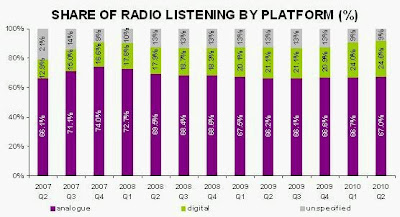
Exactly the same issue impacts the accuracy of Figure 3 in the Ofcom consultation, which purports to show that analogue listening to Classic FM fell from 86% to 72% between 2007 and 2010. Once again, this must be factually wrong. Once again, the volume of ‘unspecified’ listening to Classic FM has simply been ignored and the decline of analogue listening to Classic FM has probably been overstated by Ofcom.

Confusingly, the platform data for Classic FM cited in Figure 3 differ from data in a different Ofcom document [Figure 3.34 on page 33 of The Communications Market 2010] which state that, in Q1 2010, 65% of listening to Classic FM was via analogue, 26% was via digital and 9% was unspecified. In Figure 3, the values for the same quarter are stated as 72%, 28% and 0% respectively. It is impossible for both assertions to be correct.

These inaccuracies have the impact of painting a quite different picture of Classic FM’s transition from analogue to digital listening than the market reality. These matters are not academic. They will have a direct and significant impact on the perceived value of the Classic FM licence over the duration of its next seven-year period. Sensible decisions about the value of the station’s licence cannot be made on the basis of factually inaccurate market data published by Ofcom.

Undeniably, Ofcom is between a rock and a hard place:
• An admittance that, in 2006, Ofcom got its digital radio forecast and its sums badly wrong and, as a result, has already lost the Treasury millions of pounds in radio licence fees, would require humility (and humiliation)
• Not admitting that, in 2006, Ofcom got it wrong would necessitate it to now fix the Classic FM licence fee at the same low rate as in 2006, or even lower, denying the Treasury millions more in lost revenue between 2011 and 2018
• Increasing the cost of Classic FM’s licence fee would be a tacit admittance by Ofcom that its entire DAB ‘future of radio’ policy is simply not becoming reality and that FM spectrum will still remain “extremely valuable for broadcasters”.

In 2006, the low valuation of Classic FM’s licence fee was built upon a top-down bureaucratic strategy which insisted that the UK radio industry was ‘going digital’, whether or not consumers wanted to or not. Now, it is even more evident than it was then that consumers are not taking up DAB radio at a rate that will ever lead to ‘digital switchover’ (whatever that phrase might mean).

However, reading the Ofcom consultation document, it is also evident that the regulator remains wedded to its digital radio policy, however unrealistic:

“We consider that this [Digital Radio] Action Plan is relevant when considering future trends in the amount of digital listening since it represents an ambition on behalf of the industry and Government to increase the amount of digital listening in the next few years.”

In the real world, Classic FM’s owner understands precisely what the international delegations who met in St Petersburg also knew – FM will remain the dominant broadcast platform for radio. Only the UK government and Ofcom seem not to accept this reality, still trying to go their own merry way, while the rest of Europe has already acknowledged at this meeting that:

• The FM band is “extremely valuable for broadcasters”
• The FM band is “currently, and for the foreseeable future, the broadcasting system supporting the only viable business model for radio (free-to-air) in most European countries”
• “No universal switch-off date for analogue services in Band II can be considered.”

[thanks to Eivind Engberg]