The day the (reggae) music died : 1981 : Bob Marley, Linton Kwesi Johnson, Matumbi

 “Bob Marley has died!” I exclaimed. Having switched on the car radio before starting the engine, one of Marley’s songs was playing on John Peel’s ‘BBC Radio One’ ten-to-midnight show. I knew immediately what that meant. Peel was a longtime reggae fan, though I had not heard him play a Marley track for years. There was no need to await Peel’s voice announcing the sad news. I had read that Marley was ill but had not understood the terminal gravity of his health.

Peterlee town centre was dark and desolate at that late hour. I had walked to my little Datsun car across a dark, empty car park adjacent to the office block of Peterlee Development Corporation, accompanied by my girlfriend who was employed there on a one-year government job creation scheme. We had attended a poetry reading organised by Peterlee Community Arts in the building, an event she had learnt of from her marketing work. It was my first poetry reading. Only around a dozen of us were present, everyone else at least twice our age. But what we heard was no ordinary poetry.
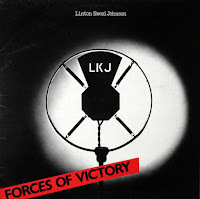
Linton Kwesi Johnson had coined his work ‘dub poetry’ in 1976 and already published three anthologies and four vinyl albums, voicing his experiences as a Jamaican whose parents had migrated to Britain in 1962. Peterlee new town seemed an unlikely venue for a ‘dub poet’, a deprived coal mining region with no discernible black population, but working class Tyneside poet Keith Armstrong had organised this event as part of his community work there to foster residents’ creative writing. Johnson read some of his excellent poems and answered the group’s polite questions. It was an intimate, quiet evening of reflection.

https://open.spotify.com/embed/playlist/0NjIxvry79Svr0G4Qzb5NR?utm_source=generator

Due to my enthusiasm for reggae, I was familiar with Johnson’s record albums as one strand of the outpouring of diverse innovation that Britain’s homegrown reggae artists had been pioneering since the early 1970’s. Alongside ‘dub poetry’ (poems set to reggae), there was ‘lovers rock’ (soulful reggae with love themes sung mostly by teenage girls), UK ‘roots reggae’ (documenting the Black British experience) and a distinctly British version of ‘dub’ (radical mixes using studio effects). One name that was playing a significant writing/producing role spanning all these sub-genres was Dennis Bovell, alias ‘Blackbeard’, of the British group ‘Matumbi’. His monumental contributions to British reggae are too often understated.

Until then, there had been plenty of reggae produced in British studios and released by UK record labels such as ‘Melodisc’, ‘Pama’ and ‘Trojan’, but most efforts had been either a rather clunky imitation of Jamaican reggae (for example, Millie’s 1964 UK hit ‘My Boy Lollipop’ [Fontana TE 17425]) or performed by ‘dinner & dance’-style UK groups such as ‘The Marvels’. I admit to having neglected Matumbi upon hearing their initial 1973 releases, cover versions of ‘Kool & The Gang’s ‘Funky Stuff’ [Horse HOSS 39] and ‘Hot Chocolate’s ‘Brother Louie‘ [GG 4540]. It was not until their 1976 song ‘After Tonight’ [Safari SF 1112] and the self-released 12-inch single ‘Music In The Air’/’Guide Us’ [Matumbi Music Corp MA 0004] that my interest was piqued as a result of the group’s creative ability to seamlessly bridge the ‘lovers rock’, ‘roots reggae’ and ‘dub’ styles. Both sides of the latter disc remain one of my favourite UK reggae recordings (sadly, these particular mixes have not been reissued).

In 1978, Matumbi performed at Dunelm House and, after attending the gig, it was my responsibility as deputy president of Durham Students’ Union to sit in my office with the band, counting out the cash to pay their contracted fee. They were on tour to promote their first album ‘Seven Seals’ self-produced for multinational ‘EMI Records’ [Harvest SHSP 4090]. It included new mixes of the aforementioned 12-inch single plus their theme for BBC television drama ‘Empire Road’, the first UK series to be written, acted and directed predominantly by black artists. Sensing my interest in reggae, the group invited me to join them for an after-gig chat, so I drove to their motel several miles down South Road and we sat in its bar for a thoroughly enjoyable few hours discussing music.

As part of my manic obsession with the nascent ‘dub’ reggae genre, I had bought albums between 1976 and 1978 credited to ‘4th Street Orchestra’ entitled ‘Ah Who Seh? Go Deh!’ [Rama RM 001], ‘Leggo! Ah Fi We Dis’ [Rama RM 002], ‘Yuh Learn!’ [Rama RMLP 006] and ‘Scientific Higher Ranking Dubb’ [sic, Rama RM 004]. They were sold in blank white sleeves with handwritten marker-pen titles and red, gold and green record labels to make them look similar to Jamaican-pressed dub albums of that era. However, it was self-evident that most tracks were dub mixes of existing UK recordings by Matumbi backing various performers, engineered and produced by Bovell for licensing to small UK labels. I also had bought and worn two of their little lapel badges, one inscribed ‘AH WHO SEH?’, the other ‘GO DEH!’, from a London record stall. During our conversation in the bar, Bovell expressed surprise that I owned these limited-pressing albums, and even more surprise that I recognised Matumbi as behind them. They remain prime examples of UK dub.

It was Bovell who had produced Linton Kwesi Johnson’s albums, and it was Matumbi who had provided the music. Alongside a young generation of British roots reggae bands such as ‘Aswad’ and ‘Steel Pulse’, Johnson’s poetry similarly tackled contemporary social and political issues with direct, straightforward commentaries. It was a new style of British reggae, an echo of recordings by American collective ‘The Last Poets’ whose conscious poems/raps had been set to music (sometimes by ‘Kool & The Gang’) since 1970, and whose couplets had occasionally been integrated into recordings by Jamaican DJ ‘Big Youth’ in the 1970’s. Of course, MC’s (‘Masters of Ceremonies’) had been talking over (‘toasting’) records at ‘dances’ in Jamaica since the 1960’s, proof that the evolution of ‘rap’ owed as much to the island’s sound system culture as it did to 1970’s New York house parties.

In Peterlee, Johnson read his poems to the audience without music, his usual performance style. It was fascinating to hear his words without any accompaniment. For me, the dub version of Johnson’s shocking 1979 poem ‘Sonny’s Lettah’ (retitled ‘Iron Bar Dub’ on ‘LKJ In Dub’ [Island ILPS 9650]) is brilliantly effective precisely when the music is mixed out to leave his line “Me couldn’t stand up there and do nothin’” hanging in silence. Sadly, memories of Johnson’s performance that night were suddenly eclipsed by the news of Marley’s death. I drove the eight miles to our Sherburn Village home in stunned silence. I was sad and shocked. It was only then that his sudden loss made me realise how much Marley had meant to me.

Despite having listened to reggae since the late 1960’s, I admittedly arrived late to Bob Marley’s music. Though I had heard many of his singles previously, it was not until his 1974 album ‘Natty Dread’ [Island ILPS 9281] that I understood his genius. At that time, I was feeling under a lot of personal pressure which I tried to relieve by listening to this record every day for the next two years. At home, my father had run off, leaving our family in grave financial difficulties. At school, I was struggling with its inflexibility, not permitted to take two mathematics A-levels, not allowed to mix arts and science A-levels, not encouraged to apply to Cambridge University. Back in my first year at that school, I had been awarded three school prizes. However, once my parents separated and then divorced, I was never given a further prize and the headmaster’s comments in my termly school reports became strangely negative, regardless of my results.

Feeling increasingly like an unwanted ‘outsider’ at grammar school, Marley’s lyrics connected with me and helped keep my head above encroaching waters rising in both my home and school lives. I knew I was struggling and needed encouragement from some source, any source, to continue. For me, that came from Marley’s music. While my classmates were mostly listening to ‘progressive rock’ albums with zany song titles (such as Genesis’ ‘I Know What I Like In Your Wardrobe’), I was absorbed by reggae and soul music that spoke about the daily struggle to merely survive the tribulations of life. After ‘Natty Dread’, I rushed out to buy every new Marley release.

During the months following Marley’s death, I was absorbed by sadness. It felt like the ‘final straw’. The previous year, I had landed a ‘dream job’, my first permanent employment, overhauling the music playlist for Metro Radio. Then, after successfully turning around that station’s fortunes, I had unexpectedly been made redundant. I was now unemployed and my every job application had been rejected. That experience had followed four years at Durham University which had turned out to be a wholly inappropriate choice as it was colonised by 90%+ of students having arrived from private schools funded by posh families. I felt like ‘a fish out of water’. I loved studying, I loved learning, I desired a fulfilling academic life at university … but it had proven nigh on impossible at Durham.

“This is what I need
This is where I want to be
But I know that this will never be mine”

Months later, my girlfriend awoke one morning and told me matter-of-factly that she was going to move out and live alone. She offered no explanation. We had neither disagreed nor argued. We had been sharing a room for three years, initially as students in a horribly austere miners’ cottage in Meadowfield whose rooms had no electrical sockets, requiring cables to be run from each room’s centre ceiling light-fitment. Now we were in a better rented cottage in Sherburn, though it had no phone, no gas and no television. Her bombshell announcement could not have come at a more vulnerable time for me. I had already felt rejected by most of my university peers and then by my first employer. At school previously, I had passed the Cambridge University entrance exam but had been rejected by every college. At Durham, I had stood for election as editor of the student newspaper, but its posh incumbent had recommended a rival with less journalistic experience. A decade earlier, my father had deserted me and his family, and now the person I loved the most had done the same.

I just could not seem to navigate a successful path amidst the world of middle- and upper-class contemporaries into which I had been unwittingly thrown, first at grammar school, then at Durham, and now in my personal life too. Most of those years, I felt that circumstances had forced me to focus on nothing more than survival, whilst my privileged contemporaries seemed able to pursue and fulfil their ambitions with considerable ease. I had to remind myself that I had been born in a council house and had attended state schools, initially on a council estate. My girlfriend had not. I had imagined such differences mattered not in modern Britain. I had believed that any ‘socio-economic’ gap between us could be bridged by a mutual feeling called ‘love’. I now began to wonder if I had been mistaken. I felt very much marooned and alone. My twenty-three-year-old life was in tatters.

Fast forward to 1984. I had still not secured a further job in radio. I was invited to Liverpool for a weekend stay in my former girlfriend’s flat. We visited the cathedral and attended a performance at the Everyman Theatre. It felt awkward. I never saw her again. It had taken me months to get over the impact of Bob Marley’s death. It took me considerably longer to get over my girlfriend ending our relationship. 

“That clumsy goodbye kiss could fool me
But looking back over my shoulder
You’re happy without me”

https://open.spotify.com/embed/playlist/291PlBjtQIVyEzOPeXNSyD?utm_source=generator

[Originally published at https://peoplelikeyoudontworkinradio.blogspot.com/2024/04/the-day-reggae-music-died-1981-bob.html ]

Stoking the star-maker machinery behind the popular song : 1980 : Kate Bush, EMI Records & Metro Radio

 “I’m SO sorry,” I grovelled to the petite musician on whose foot I had just accidentally trodden. We were stood side-by-side in the record library – my ‘office’ – of local commercial station ‘Metro Radio’ in Newcastle. Kate Bush was kindly autographing several copies of the new album she was visiting to promote, which were about to be awarded as competition prizes to listeners. She had just been interviewed live on-air by one of the station’s daytime presenters and was soon to be whisked away by car to visit yet another local station somewhere across the country.

I had been basking in a brief moment of hit-picking glory, feted by Bush’s record company ‘EMI Records’ for having simultaneously added two singles by singer Sheena Easton (‘Modern Girl’ and ‘9 to 5’) to the station’s ‘current hits’ playlist, the shortest list of any UK station following my radical overhaul of its music policy, guaranteeing substantial airplay for the label’s newest rising star. Relationships with record companies were always a rollercoaster ride. Months later, after I had refused to add Queen’s ‘Flash’ single to the playlist, on the grounds that it sounded more an advertising jingle than a proper song, EMI declined to offer further artist interviews and stopped supplying the station with its new releases altogether (requiring me to drive to the nearest record shop with a weekly shopping list). Bribery, blackmail and boycotts were widespread music industry practices.

After having first heard Bush’s debut single ‘Wuthering Heights’ on John Peel’s evening ‘BBC Radio One’ show two years previously, I had loved her 1978 debut album ‘The Kick Inside’ for its clever arrangements of smart songs with unexpectedly frank subject matter. I had considered the same year’s follow-up ‘Lionheart’ rather insubstantial comparatively and over-theatrical. After a two-year wait, the next album ‘Never For Ever’ was a return to form with a more diverse song list and extensive use of brand-new Fairlight sampler technology invented in 1979. Bush had visited ‘Metro Radio’ to promote this album’s release in September, after three singles extracted from it (‘Breathing’, ‘Babooshka’ and ‘Army Dreamers’) had already reached 16, 5 and 16 respectively in the UK charts.

After a further two-year wait, fourth album ‘The Dreaming’ was a revelation with songs referencing even more startling subject matter, produced in a dense soundscape that was the aural equivalent of Brion Gysin’s and William S Burroughs’ ‘cut-up’ techniques, interlacing samples, sound effects and dialogue from the Fairlight (think 1973’s analogue ‘The Dark Side Of The Moon’ on digital steroids). I have always been intrigued by its track ‘Suspended in Gaffa’ as an incredibly outspoken criticism of EMI Records on an album released by … EMI.

This was by no means the first occasion that musicians had criticised their record company within their recordings. During the 1970’s, I recall several reggae artists obliquely criticising Jamaican producer Joe Gibbs for his sharp ‘business practices’ (eventually Gibbs’ business was bankrupted after prosecution in the US for stealing songwriter royalties). Closer to home, reggae DJ ‘Prince Far I’ criticised British company ‘Charisma Records’ explicitly in his track ‘Charisma’ (credited to collective ‘Singers & Players’) after his 1981 deal to release three albums (‘Showcase In A Suitcase’, ‘Sign Of The Star’ and ‘Livity’) on its ‘PRE’ label had been soured by negligible sales. Part of its lyrics were:

“I see no idea in your place, Charisma. […] Wipe them out, Jah!”

Prince Far I also made a recording to criticise Britain’s ‘Virgin Records’ which had released three of his albums (‘Message From The King’, ‘Long Life’ and ‘Cry Tuff Dub Encounter Part 2’ in 1978-1979 on its ‘Frontline’ label), but which had then rejected a further finished album he had delivered. In a track inevitably entitled ‘Virgin’, he rapped:

“You call yourself [Richard, Virgin co-founder] Branson but I know that Branson is a pickle with no place on my plate. You call yourself [Simon, co-founder] Draper but I know draper is known to cover human bodies. You see ‘Frontline’, I see barbed wire. Opportunity to make big money. Irie, Jumbo [Vanreren, Frontline A&R manager]. I won’t forget you take the master tape and hang it up on your shelf. Music has no place in a gallery.”

This ‘lost’ album was finally released in 1998 [Pressure Sounds PSLP18], long after Prince Far I (and his wife) had been tragically murdered in Jamaica in a 1983 house break-in. In 1992, Virgin Records was acquired for a reported £560m by EMI Records which, returning to our story, had signed sixteen-year-old Kate Bush in 1975 to a four-year contract after hearing her three-song demo tape, paying a £3,000 advance. In 1976, Bush created her own company, Novercia Limited (Latin for ‘she who is new’), that she and her family alone controlled in order to manage her career and maintain the copyrights in her recordings and songs.

From the initial contract’s expiry in July 1979, Bush could finally renegotiate a replacement EMI contract which would allow Novercia to retain the copyright (instead of EMI) and henceforth lease her recordings to EMI for release. At that time, it was unusual for such a young artist to insist upon taking control of their career from their record company, particularly when it was as globally huge as EMI. Bush no longer wanted to be contractually required to do promotional tours, such as her visit to Metro Radio, and she was insisting upon complete artistic control. I imagine that these negotiations between opposing lawyers sat around expansive tables in bare conference rooms on an upper floor of EMI headquarters in Manchester Square (immortalised on The Beatles’ 1963 debut album cover photo) must have been tense and lengthy, particularly for twenty-one-year-old Bush.

Not only would these contractual back-and-forth’s have delayed the release of new recordings, but the inordinate time they must have consumed would have eaten into Bush’s ability to compose and record. During this period, Bush’s musical creativity would frustratingly have been put on hold by the ‘red tape’ of legal negotiations, alluded to in the song’s title (‘gaffa’ being a reference to ‘gaffer tape’, the all-important ‘WD40’-like fix-all of musicians in studios and on tour). At the same time, EMI was demanding to hear proof of Bush’s new material to ensure it was sufficiently commercially marketable to guarantee another ‘hit’ single. Her song ‘Suspended in Gaffa’ starts:

“They’ve told us that, unless we can prove that we’re doing it, we can’t have it all. EMI want it all.”

Except that the ‘E’ from ‘EMI’ must have been removed from the mix, either upon EMI lawyers’ insistence or upon the recommendation of Bush’s legal team. Only once you re-imagine that ‘E’ does the song make perfect sense in terms of record label/artist contractual disputes. The role of Bush’s lawyer in the negotiations is referred to:

“He’s gonna wrangle a way to get out of it [the initial EMI contract that had included renewal options].”

The impact of the tedious negotiations upon Bush’s creativity and the impatient EMI’s demands to hear her new songs are referenced in the chorus:

“Suddenly my feet are feet of mud. It all goes slo-mo [slow motion]. I don’t know why I’m crying. Am I suspended in gaffa [caught up in ‘red tape’]? Not ‘til I’m ready for you [EMI] can you have it all [my new recordings].”

EMI (then) managing director Bob Mercer later confirmed that Bush had burst into tears during their business meetings. The record company’s patronising response to her demands is referred to in the lines:

“… that girl in the mirror. Between you and me, she don’t stand a chance of getting anywhere at all. Not anywhere. No, not a thing. She can’t have it all.”

If Bush had not successfully agreed a new contract with EMI, it might have been threatening that she would be jeopardising her future success. I had witnessed the blackmail tactics of EMI in my job at Metro Radio. The significance of concluding these negotiations successfully was imperative for Bush, and she noted the impact it would have on her finally taking total control of her destiny:

“Mother, where are the angels? I’m scared of the changes.” (Bush’s mother appears briefly in the video, comforting her.)

The key to understanding the song’s theme is to recognise that the most telltale line “EMI want it all” was sung eleven times. Record companies almost inevitably want to have their cake and eat it simultaneously, regardless of the fallout for their own artists. Why else would EMI have refused to send its new record releases to Metro Radio if it was not prepared to cut off its nose to spite its face?

If all this speculation sounds farfetched, you have to ask why EMI was happy to license ‘Suspended in Gaffa’ to its partners for release as a single in European countries, but did not similarly release the song as a single in the UK? Would its London executives want to hear a track played on the radio every day that they knew obliquely criticised their own business strategies? As a result, this excellent song languished as a little played album track in Bush’s homeland. Perhaps that was the company men’s notion of ‘revenge’.

At the time of its release in 1982, I was barely watching television so had missed the video for this song, written and directed by Bush herself. Viewing it more than forty years later, I hoped to find hidden references to ‘EMI’ in the visuals. It looks as if Bush (“wearing a designer straightjacket,” interjected my wife) has been kidnapped and locked in a boarded-up wooden shed alongside huge chains and large wheels of (the music?) industry. Outside a huge (legal?) storm is blowing, from which she cannot escape, despite kicking up dust but running nowhere. Is that what it felt like to be under contract to EMI?  Bush was always far too subtle to provide explicit messaging that would explain her songs. Perhaps I am missing something she communicates via her animated hand movements? In one brief section of the video, wrists apparently bound in gaffer tape, Bush tumbles head-over-heals through the vacuum of galactic space, maybe a visualisation of her feelings in the midst of lengthy legal wranglings. Prior to that, the video portrays her ‘head in the clouds’, perhaps how she had sensed her initial teenage success with EMI.

As I discovered from my own job at Metro Radio, EMI want it all. Perhaps that is why I felt I understood Bush’s message within ‘Suspended in Gaffa’ from my first listen. It remains a truly remarkable song.

[Originally published at https://peoplelikeyoudontworkinradio.blogspot.com/2024/04/stoking-star-maker-machinery-behind.html ]

One little indie music show : 1980-1981 : Saturday night 10 to midnight, Metro Radio

“You will present a weekly two-hour rock music show on Saturday night,” my manager informed me.

No if’s or but’s. No offer over which to mull. No demo tape to produce. No question asked about previous experience. Without warning, I was appointed as presenter on one of Britain’s largest commercial radio stations. I had just started a full-time backroom job at ‘Metro Radio’ but had never asked to present a show. This was my first paying job in radio and suddenly I was also to be put on-air. The start of my radio career seemed to be heading in a positive direction.

Some aspiring DJs spend their whole life trying to secure a presenting job on radio, often without success. I felt slightly guilty that this opportunity had fallen into my lap without effort. My employer did not even realise that I had started presenting for various London pirate stations seven years earlier, as such lawbreaking activities were not productive additions to a CV then. A decade into the future, employed as programme director of London’s ‘KISS FM’, one young hopeful desiring a DJ job would sit in the station’s reception area day after day, awaiting his opportunity to buttonhole me on my way to lunch at the ‘greasy spoon’ on Highbury Corner. Little did he know that we already had the largest DJ roster of any British radio station, or that management had just cut payments per show by half, or that several loyal presenters had been made redundant within months of launch. Oblivious, he was not so much ‘networking’ as ‘stalking’.

Management at Metro Radio seemed not to care one jot what was broadcast evenings and overnight because commercial stations then believed their advertisers were only interested in daytime shows and that their most significant audience was housewives. My small additional payment for the rock show was eaten into by the cost of driving twenty miles to the studio on Saturday night and then back again in the early hours of Sunday. Nevertheless, the station would jump at any chance to cut its minor expenses, such as the occasion excellent overnight presenter Tony Crosby was replaced in 1981 by a new DJ who offered to do the same show for free. Never mind the quality, feel the penny-pinching! (Tony went on to train as a solicitor.)

No direction was offered me as to what to do in my show. Whereas daytime presenters were required to wait outside programme controller Mic Johnson’s office for individual appointments to hear his critique whenever a JICRAR ratings book was published, management expressed zero interest in what I was doing on-air. There were already two other rock shows on the station. My line manager Malcolm Herdman played two hours of heavy metal and hard rock. Full-time producer John Coulson used his two hours to play an esoteric mix of mainstream rock and read passages from ‘beat generation’/‘new journalism’ authors. I decided to fill the evident gap for the ‘indie’ music that had emerged after several years of punk.

Music trade weekly ‘Record Business’ had published its first weekly ‘indie’ chart in January 1980, following a suggestion by Iain McNay, founder of London’s ‘Cherry Red Records’. I decided to use one hour of my show to run down this chart, playing the new entries and highest climbing singles. As far as I know, mine was the first ever British radio ‘indie’ chart show and was soon mentioned in the ‘indie’ columns of the music trade press. Most ‘indie’ releases were not supplied to commercial radio stations because there was zero possibility of them being playlisted, necessitating me to establish contact with the main ‘indie’ distributor, ‘Rough Trade’ in London, to receive copies. Each week, I would phone its very helpful director and head of promotions Scott Piering to request records that he would then mail to me (later that decade I worked in Scott’s office).

In the other hour of my show, I would play a selection of newly released album tracks, both indie and mainstream. Working full-time in the station’s record library, I had access to all major label releases that arrived either by post or from weekly visits by record company promotion staff. I would place interesting new albums in a holdall I carried back and forward to the show although, with only time to play around fifteen tracks within an hour, my hoard of unplayed recent releases grew heavier by the week. My running order ranged from ‘Steely Dan’ to ‘Joy Division’ to ‘Crass’, none of which were exposed elsewhere within the station’s output.

Although the Tyneside local band scene then was dominated by heavy metal bands and record labels such as ‘Neat’ and ‘Guardian’, there were a few ‘indie’ bands that were recording good quality demo’s or releasing their records independently. I received a nice letter from Paddy McAloon asking me to play his group ‘Prefab Sprout’s first self-published single. I had already been the lone person not walking straight past the stage when the band had performed at the Durham Miners’ Gala, so I was happy to oblige. There were some excellent local bands, including ‘Dire Straits’ and ‘The Police’ who were quickly signed by major labels, but also many that went largely unnoticed until ‘Kitchenware Records’ launch in Newcastle in 1982. I tried to play any local band recordings I found or received.

Because my two hours on-air were so precious, I talked minimally between records and rarely featured interviews. I recall receiving a telegram at home from the station one day asking me to phone it urgently. Our house had no phone so I had to walk to the one phone box in Sherburn Village and call in. Was I interested in recording an interview for my show with ‘Duran Duran’ who were promoting their first single release ‘Planet Earth’? I turned down this opportunity because the group was not local, were not ‘indie’ (having already signed to ‘EMI’) and their music was audibly more ‘pop’ than ‘rock’. However, I did interview local artists such as Pauline Murray from Ferryhill whose first solo album (after the punk group ‘Penetration’) sounded remarkably innovative and remains one of my favourite recordings.

I spent quite a lot of time each week compiling a local ‘gig guide’ from adverts in local newspapers (pre-internet newsprint) and flyers. I would update it each week, type it out myself, pin it on the radio station’s noticeboard and mail copies to all the local record shops. In my show, I would read out the following week’s concerts though I never heard any other presenter refer to my list because, beyond Malcolm and myself, the station seemed to be disconnected from the local music scene. On occasional visits to ‘Volume Records’, the only ‘indie’ record shop in Newcastle, I would secretly feel proud to see the latest A4 sheet of gigs I had mailed out pinned to its noticeboard. Like my show’s content, the reason for undertaking this research-intensive work was because nobody else seemed to be exposing this information at the time. There was no ‘what’s on’ publication for the region.

Although I had competently operated radio studio equipment myself since my days at school recording pirate radio shows, management at Metro Radio insisted I sat in a soundproofed studio in front of the microphone while a ‘technical operator’ facing me from an adjoining control room played the records, advertisements and mixed the audio. I was unfamiliar with this arrangement, which the station’s managers had brought with them from overstaffed BBC local radio stations at which they had worked previously. I was extremely lucky to have had John Oley assigned as my ‘T.O.’, one of the most professional and enthusiastic people I have had the pleasure to work with in radio. His contribution to my show was enormous and freed me to talk my rubbish on-air and answer the phone line when I occasionally held competitions.

Metro Radio showed no interest in promoting my show so it seemed a miracle when I started receiving letters from listeners who had discovered it. In the days before internet or community stations, each region of Britain was served by only one local BBC station and one commercial music station. Although my show was tucked away in the weekend schedule, it still felt groundbreaking to play music little heard outside of John Peel’s weeknight show on national ‘BBC Radio One’. There were quite a few records lasting only two or three minutes that each required several hours’ work transferring them to quarter-inch tape in order to edit out swear words with a razor blade and white editing tape on a metal block. If only those bands knew how much extra effort was necessary just for them to receive one radio play!

Living in a rural village, there were Saturday nights during winter snows when I was unable to drive to the station. Snowploughs would habitually clear the roads eastward from Durham City as far as the junction with the A1(M) motorway but, frustratingly, not the further one mile beyond to my home. I would have to trudge out in icy temperatures to the public phone box and call either Malcolm Herdman or John Coulson at home, asking if they could reach the studio to fill in for me on those days. Because they lived in Newcastle city, I think they found it hard to believe that I was literally ‘snowed in’. Unfortunately, my salary was insufficient to contemplate a relocation nearer my workplace, meaning I missed out on concerts and the city nightlife which I would have loved to explore.

All good things come to an end. Quickly in my case. Metro Radio made me redundant from my full-time job. I continued to present my Saturday night show for a while through 1981 but the expense of maintaining a car to drive to Newcastle was proving greater than my payments from the station, which had to be subtracted from my Unemployment Benefit. I was applying for any relevant vacancy in the radio and music industries but getting nowhere. In the end, I had to follow Tebbit’s advice and get on my bike (well, in my car to be accurate), leaving the region where I had lived the last five years in order to take a totally different job 218 miles down south. It was disappointing because I had acquired so much knowledge of indie music, the regional music scene and had built an audience for my unique radio show.

The start of my radio career now seemed to be heading in a negative direction. I was unable to secure work in the broadcast industry for a further four years and, only then, by taking a contract in Israel on a pirate radio ship that paid little more than expenses. However, I have always treasured the memories of my time working alongside John Oley and Tony Crosby late on Saturday nights when the only other person in the darkened Metro Radio building on a bleak industrial estate was the security guard downstairs. This was when innovative radio programmes were made … even though Metro Radio probably never realised it.

Postscript: Forty years later, I received a polite email from a member of a former local band enquiring if I still had their demo tape I had been sent and played on my Metro Radio show. Sadly, no.

[Originally published at https://peoplelikeyoudontworkinradio.blogspot.com/2023/11/one-little-indie-music-show-1980-1981.html]

Watch out! Watch out! There’s a Houdini about : 1980 : Metro Radio record library

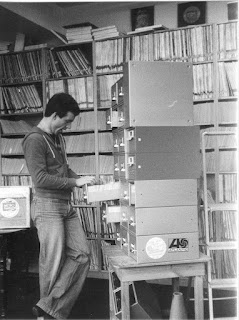
[presenter Stephen Ayres in Metro Radio record library, 1980]

 Do you believe in destiny? Not the Bardot-like Angels squadron leader Destiny who battled evil-ised Captain Black and the mysterious Mysterons. No, destiny as in fate. The notion that our futures are determined long before we realise it ourselves.

My earliest job, having just learned to write, was to take it upon myself to sort my parents’ two-dozen albums and two-score singles into some kind of order and to biro sequential numbers on their covers and labels. Nobody had told me to. Then I instructed my parents to always put their vinyl records back in the correct sleeves and return them to the shelf in the correct order.

Almost two decades later, my first full-time job required me to instruct my colleagues to always put the vinyl records back in the correct sleeves and return them to the shelves in the correct order. Destiny? Or was it fate? My office desk was located in the first-floor record library of local commercial stationMetro Radio’ in Newcastle. It was not strictly MY desk. It belonged to my line manager, Malcolm Herdman, who had just been seconded to record a jingle package in the station’s ground-floor studio. I had been appointed to perform Malcolm’s tasks as head of music, albeit as his deputy, and to create a new daytime playlist system that could reverse the station’s ratings decline.

Two other staff worked in the same room: at one end, young librarian Liz Elliott who was enthusiastic, helpful, chatty and a music fan; and, at the other, middle-aged Ann who was not. They faced each other with my desk positioned midway like a tennis referee. Liz catalogued newly arrived records, returned items to their shelves and maintained the card catalogue index. Ann was busy doing, er … mostly chatting with the station’s presenters or on the office phone to her friends. Colleagues alleged that she enjoyed a close personal relationship with the station’s managing director, Neil Robinson, who just happened to be paying her husband to write a computerised library programme … that never made an appearance while I was working there. I attempted small-talk with Ann but her preferred communication was to glare at me in silence.

Just inside the record library was a grey metal, two-door, six-foot tall stationery cupboard. It held spare copies of currently playlisted singles and valuable albums autographed by visiting pop and rock musicians that awaited mail-out to listeners as competition prizes. Soon after starting work, I found that records I had locked in this cupboard seemed to disappear overnight. The first occasion, I thought I must have been mistaken. However, on the second occasion, I was convinced that items I had secured had somehow been stolen. To replace them, I had to drive to the nearest record shop and buy multiple copies of our playlisted singles. The problem started to reoccur regularly. I was somewhat baffled.

When I told my colleagues about the suspected thefts, they described an event that had happened before I joined the station. The lone key to this stationery cupboard had disappeared (I cannot recall how), then was allegedly found several days later by helpful daytime DJ Giles Squire on the carpet immediately in front of the cupboard. This surprised my colleagues who had hunted high and low throughout the library for the key over several days, without success. How could it have suddenly appeared days later exactly where it had been lost? It was as if the key had been temporarily hidden by some kind of ‘Star Trek’ cloaking device. I was told that, after the key reappeared, things had started to go missing from inside the cupboard.

Theft from the library was a wider problem. Some library shelves of catalogued albums had visible gaps where items had not been returned. Behind Liz’s desk was a pigeonhole A-to-Z system where newly released seven-inch vinyl singles were filed by artist name. The station received multiple copies of around sixty newly released singles each week, most of which were stored there openly. So how come the pigeonholes rarely became overcrowded? It seemed that hundreds of new records were disappearing. I had the embarrassing task of having to phone record companies and ask for further copies of records that had already been delivered to us by post or by visiting reps. There were only so many occasions you could blame the Post Office.

The library had to be left open at night and over weekends because presenters were required to select records to play within their programmes. A security person was present twenty-four hours a day inside the station’s front door but their responsibility was apparently only to stop unwanted persons entering the building, not to frisk those leaving. Thus, theoretically it would have been easy for a presenter to exit to their truck in the car park carrying boxes of the radio station’s vinyl records that could then be exchanged for animal feed to use on their farm in Northumberland.

I embarked upon a ‘good cop’ strategy, sticking post-it notes on the most valuable items inside the cupboard with a handwritten message: ‘Dear Thief. Please leave this record which is essential to the running of the station and is needed for […]. Thank you, Grant.’ It made no difference. These items would still disappear overnight and the post-it notes would be left behind without any kind of riposte from the thief. Back to the drawing board.

I went to my manager, programme controller Mic Johnson, and informed him what had been happening. I always wondered if he was stuck with Velcro to his office chair as he was so rarely seen on the station’s ‘shop floor’. If he wanted to meet someone, rather than simply approaching them for a chat, his secretary would place a typed ‘docket’ in their pigeonhole. Sometimes I would see several presenters waiting in the corridor outside his office door, as if he were headmaster of Xavier’s School for Gifted Wafflers, where DJ’s whose latest ratings were sub-par should expect a good spanking to improve their superpowers. Did Mic wish to do anything about the thefts? No.

I switched to a ‘bad cop’ strategy. I visited a hardware shop and bought a thick metal chain that I wrapped tightly around the door handles of the stationery cardboard and secured with a large padlock. I was the only person with the key. For a few weeks, nothing disappeared from the cupboard. I no longer wrote post-it notes for the thief. Some staff laughed at my chain which admittedly looked hideous but, for a while, it worked until … records started disappearing once again. I was angry and frustrated. How could that happen? There were no signs that the chain had been cut or that the padlock had been replaced. Could the thief have tracked down the padlock I had purchased and found one that used exactly the same key? Had the culprit recently attended a GCSE evening class in lockpicking at a local den of thieves?

It was hard to accept that I had failed. However, the atmosphere within the station had recently turned icy as the result of a strike for increased pay by staff who were union members. Management had bigger fish to fry than my problem of vinyl records being pilfered by some Houdini. Presenters began to keep discs they wanted to use (or had used) inside the security of their personal lockers. Producer John Coulson stashed records he wanted to play on his weekend rock show behind the snack machine in the station canteen. If I needed Van Morrison’s latest album, he showed me, this is where I could find it.

Six months into my job, Malcolm Herdman was excited to play me the station identification jingles he had just finished producing. I went downstairs to the station’s recording studio for the first time and listened. Oh dear! Whereas ‘jingles’ are meant to be of only a few seconds’ duration to be used between records and adverts, Malcolm’s efforts were short ‘songs’ that lasted a minute, sometimes longer. How do I tell my boss, particularly when he has been so generous to me, that his last six months’ work was wasted? I tried to offer constructive criticism but had to point out that, if these longform jingles were played regularly, then fewer playlisted songs would be heard each hour … the very content for which listeners tuned in to the station.

This jingle project had been the outcome of an agreement with the Musicians’ Union, made seven years earlier upon the launch of commercial radio in Britain, requiring each local station to spend 3% annually of its net advertising revenues on Union members’ performances. For most stations, this translated into them paying local music acts to either perform at events or record songs for airplay. However, Metro Radio decided to blow the whole of that year’s budget on recording identification jingles by local band Lindisfarne who were already signed to a major label and since 1972 had achieved four Top Forty singles, including two in the Top Five. Hardly a struggling local band! The outcome was that, as long as Metro Radio paid its 3% to Union members, it mattered not a jot whether the results were ever broadcast.

If I had been asked earlier, I could have offered some advice. As a teenager, I had recorded jingles on my two-track tape machine initially for one London pirate radio station, only to be asked by other stations to produce similar work. Had the ill-fated Metro Radio jingles been some kind of reverse destiny where, sat only one floor away from this impending disaster, I might have rescued the project if only I had known?

Destiny quickly transformed into fate when I was called into managing director Neil Robinson’s office. It was the first occasion we had met because he and his fellow managers kept their distance from the rest of the staff and took lunches from the station canteen to their separate dining room. He told me I was being made redundant. So long and no thanks for all the fish.

[Originally published at https://peoplelikeyoudontworkinradio.blogspot.com/2023/06/watch-out-watch-out-theres-houdini.html]