One door opens, another is closed by someone posh : 2009 : John Myers, Digital Britain

 A posh voice opens doors. Not literally, unless you are royalty, but figuratively. Opportunities seem to fall out of the sky for those who speak in a recognised way that conveys their breeding and their assumed elevated status in British society. I have observed this as someone who has never considered myself posh, as someone who has never been perceived as posh, but as someone who was thrust unprepared into a world of posh people from the age of eleven. Until my first day at grammar school, I had mistakenly believed that ‘people were people’ (to quote Lou Rawls) and that ‘meritocracy’ was a fact rather than a fancy theory. My mum had believed it too, having just bought me a red ‘Harvard’ sweatshirt from Farnborough outdoor market for having passed the eleven-plus exam. I wore it to bed (in the style of Susan Saint James) for the next thirty years until it literally wore out .. but Harvard remained a fantasy.

My claim to have never had a posh, or posh-ish, voice could be challenged by someone who knew me at age four. I was shocked when I revisited a recording of my recital by heart at that age of ‘Winnie The Pooh’, made on a Uher reel-to-reel tape recorder my father had bought second-hand from the pages of ‘Exchange & Mart’ magazine which he would pore over every week. I sounded frighteningly like a distant relative of the Queen and nothing at all like my parents. Maybe I was trying to emulate fellow toddlers at Gay Trees nursery school on Grand Avenue where owner Mrs Potten had insisted I play a reluctant shepherd in the annual Nativity play. In summer, she would lead us all onto the adjacent Recreation Ground to sit on the grass and watch the uncensored violence of her one-woman Punch & Judy show.

During the following seven years, I attended a state school on a council estate where my posh-ish voice must have been modified by a desire to integrate with my new set of peers whose ‘overspill’ families had been relocated there from South London suburbs bombed during the War. From then onwards, the only posh voice evident in our household was my mother habitually answering our phone with “Camberley double one three one”, inexplicably speaking as if she were Mrs Bouquet. Aside from this mannerism, I cannot remember meeting anyone who had a posh voice. It was not until I was aged seventeen that I visited the Ascot home of posh schoolfriend Kate Graves and asked why there was a bell button in every room, only to be told that it was used to call a servant from the scullery. Okay, I thought to myself, I must have passed into a parallel universe.

My first indication that posh people and radio were a match made in heaven arrived when I was sharing a landing with a Durham University final year music student who had heard me regularly rabbit away about my passion for radio. One day he startled me with the news that he had accepted his first job as a producer on BBC radio. I was gobsmacked. Why? Because he had never once shown an interest in radio or demonstrated any understanding of how radio programmes are produced. I was pleased for him … but I was baffled. He had not been hired as a trainee. He had been hired to produce radio programmes without apparently having what might be considered the relevant skills to do the job. Months later, I looked in ‘Radio Times’ and, sure enough, his name was listed as producer of major daytime programmes on BBC Radio Three.

Perhaps this event, which seemed insignificant at the time, had been sent to me as a sign. Perhaps the gods were telling me that I should heed their advice, that I must stop believing in ‘meritocracy’ and that I should find myself a career ambition other than radio. If that was the case, I stupidly ignored their heavenly intervention. As a result, I expended a huge amount of effort during the next three decades, making dozens of applications for BBC radio job vacancies, being interviewed for many of them, but always being rejected. On occasion, I knew the person whom the BBC appointed and I knew the brevity of their CV … but they did possess a posh voice.

Fast forward to 2009. I was crossing London’s Shaftesbury Avenue in the company of John Myers, for whom I was writing a report for the British government’s Digital Britain initiative. Having finished a work meeting together in a nearby café, I was about to catch an Underground train home, whilst John was heading to his chauffeur-driven car. As we stood on the kerb, waiting for the traffic lights to change, John said something casually to me that started with the words: “Posh boys like you …”.

I immediately laughed out loud. Without thinking, my reflex action was to declare to John: “I’m not posh”. The words fell out of my mouth immediately without considering any potential consequences.

“Really?” said John.

“Yes,” I said. “I was born in a council house and went to school on a council estate. I am definitely not posh.”

“Oh,” responded John … and then we moved on to discussing other topics.

On my way home, I reflected on why John might have thought I was posh. He had a broad Lancashire accent and could never himself have been described as posh. He had worked his way up the radio industry from a start as programme assistant in BBC local radio in 1980, ending as chief executive of Guardian Media Group Radio in 2008. I could only guess that most of the people John was meeting at his present level of work were undeniably posh. He had been commissioned by the government, its ministers and its civil servants to produce a significant report on the regulation of the commercial radio industry in the digital age. Almost every one of his contacts for this work must have been posh. Perhaps, to him, I appeared to be just another of these posh ‘boys’.

Whatever the reason for his off-the-cuff comment, I sensed during the weeks and months that followed, that John’s attitude to me altered perceptibly. He continued to hold daily conversations with me by phone, email or in-person, as was necessary for me to ghost-write his report. In parallel, he had regular conversations and meetings with senior people in the radio industry, government and the Civil Service. But I was never invited to meet any of these people, even though it would have proven a lot more productive for me to have taken notes at these meetings rather than having to wait for John to relay me their content and outcomes. John convened and met regularly with a ‘committee’ of seven senior people and with a separate ‘consultation group’, both of which are listed at the end of the written report. I was credited merely with ‘research and support’, despite having transformed John’s handful of pages into a coherent 104-page document.

As a result of the report, John was invited by the radio industry to give the keynote speech at the 2009 Radio Festival event. As with the report, John sent me his drafted notes in advance, which I converted into a speech and an accompanying presentation. He did not invite me to attend the event. One morning, I woke to hear the bedside radio on BBC Radio Four broadcasting a live interview with John concerning the report. Once the written work had been completed, John did not keep me informed of the publicity it was receiving or its impact on government policy.

I was disappointed. John had needed my skills to research and write what came to be known as ‘The Myers Report’. However, after our ‘posh’ conversation, he had been careful to keep me away from the radio industry people who might prove useful contacts for me to find a job in radio, but who might see that it was really me writing the report rather than John himself. I understood how difficult it must be for a significant document bearing your name to be ghosted by someone else who had never been chief executive of a radio business, as he had, and by someone who was not even posh like his peers. 

I consider John an example of how ‘posh’ not only commands respect amongst similarly posh people, but equally from people who are not at all posh. Posh equals clever. Posh equals superior. Posh equals special. Posh equals the ability to make people of every class believe you deserve to be treated as someone who can rule, can manage, can order, can tell the rest of us what we do. Whatever comes out of a posh person’s mouth is believed and, even if evidently untruthful, is retained as ‘gospel’. Posh people maintain their superiority only because the rest of us let them, encourage them and look up to them in the master/servant, upstairs/downstairs deference we have implicitly imbibed since childhood. Posh is superpower.

I had worked with John only as a result of sending him an e-mail attached to an analysis paper for MA studies that I had written earlier about the same regulatory aspect of radio for which his report had been commissioned. He had offered me a £10,000 fee to provide research support. Very quickly, my responsibilities went much further and led to five months full-time work on this report, during which time I had to reject offers of other freelance work. I shared my concerns with John that my work with him had deprived me of income and he promised that, although I was underpaid for this commission, he believed it would lead to further reports on which the two of us could continue to work together. He recognised that we had complementary skills and we worked well together.

The first negative signal arrived when I invoiced John for my fee once the report had been published by the government. I was registered with HMRC for VAT (sales tax) and was legally required to add an additional 17.5% to my invoice. John responded that he was not registered for VAT and therefore could not reclaim any VAT he might pay to me. As a result, he did not want to pay the VAT on my invoice. This response confused me. I had no knowledge of the amount he had been paid by the government to write the report that I had just ghosted for him. I was certain it must be at least ten times the fee he was paying me. He was disputing a payment of £1,750 that was required by tax law, when he had probably earnt one hundred times that sum for the same work. I persisted but he refused steadfastly to pay the VAT of my invoice. I was not at all happy.

In 2010, I read in the news that John had been commissioned by the BBC to write a report about its radio services. This was exactly the kind of further work that John had promised me and which I was hoping to be considerably more lucrative for my contributions. I met him at a café near Broadcasting House to discuss this next project. Initially, he wanted to know about the online blog I had been publishing since 2008.

“How much are you paid for your blog?” John asked me, betraying his lack of understanding of online social media platforms.

I had to explain that a blog pays nothing but its author hopes that their online presence would lead to connections, work and income in the long run. It was a marketing exercise, but intrinsically unprofitable. He still seemed enthusiastic.

“How did you get your book published about DAB?” John asked.

My anthology of blog pieces about DAB radio had just been self-published as a book, so I offered him a free copy and explained the basics of creating a book for sale online and in bookshops. He seemed intrigued by the potential. Finally, our discussion moved on to the BBC report which John had been commissioned to write. My expectations were high. I was excited by the prospect of much needed work.

“You will not be involved in this report,” John said suddenly. “But I hope there will be something we can work on together in future.”

I was in shock. So much shock that I cannot recall the remainder of the meeting. I left feeling disappointed, deflated but mostly … betrayed. I had had to reject work the previous year because of the intensity of work on our last report. I had been paid a pittance. I had been promised work that now had not materialised. Because of the minor contribution with which I had been credited in the last report, I had received no unsolicited approaches to write similar reports. My work had been unacknowledged, unrewarded and now I felt I had been side-lined altogether.

I never received further offers of work from John Myers. But he started publishing his own blog about radio, much like mine. Imitation may be the sincerest form of flattery … but it does not pay the bills. Eventually I noticed that, in his blog, John was citing analyses of radio data that I had done and published in my blog, but he was neither crediting me nor linking to the source. As a result, I stopped publishing further blog entries after August 2011. It seemed pointless offering John further examples of my skills in analysis for him to claim the credit and make money.

In 2011, John Myers was appointed chief executive of The Radio Academy. In 2012 he was appointed visiting professor at the University of Cumbria. He published his own book about radio the same year but did not send me a copy.

At a Tribunal in 2015, John Myers was found guilty of tax evasion on earnings of £6.3m in 2005/6, for which he had paid only £130,000 in tax.

[Originally published at https://peoplelikeyoudontworkinradio.blogspot.com/2023/02/one-door-opens-another-is-closed-by.html]

The year of living namelessly : 1986 : Grant Pearson, Radio Thamesmead

[pic: Lorraine Holloway, The Radio Thamesmead Survivors’ Forum]

 What’s in a name? Well, first impressions are lasting impressions (as The Impressions’ song goes). When our names are usually the first thing that strangers know about us, we are judged solely on the basis of two words. So many people have met me and said “I thought you were American”, a belief based on nothing other than my name. I recall a colleague at The Radio Authority, Janet Lee, confiding that when some people met her for the first time, they would admit “I thought you would be Asian”. All our prejudices and preconceptions are poured into imagining who someone is, even before we know anything about them beyond their name. If you have an unusual or foreign-sounding name, in Britain you are much less likely to be selected for a job interview and your career will be considerably more difficult to pursue in many professions.

In radio broadcasting, your name takes on even more importance. Most radio presenters do not use their real name on-air because it is either too boring, too common or, conversely, too difficult to enunciate easily. Sometimes, like former Metro Radio colleague ‘Giles Squire’, they might choose their on-air name to match a voice that is supposed to convey authority and superiority. So many radio presenters I have worked with have asked me “What is your real name?”, anticipating that I must really be called something quite plain. They are surprised when I respond that ‘Grant Goddard’ is my real name and always has been. The only exception was, as a fourteen-year-old, I had used the name ‘Kid Grant’ when presenting shows on London pirate radio stations, mainly because I thought it would avoid the Post Office tracking me down and prosecuting me. It was also a childish homage to Kid Jensen on Radio Luxembourg, one of my favourite presenters on one of my favourite radio stations of the time.

I have always had difficulty making people understand my name. Grant was an unknown first name in the 1960’s and 1970’s. I never discovered anyone who shared my name until I was amazed to meet another Grant in Durham in 1977, a fellow student with whom I instantly shared a bond of name difficulty. Names I have mistakenly been called include Graham, Grunt, Gram, Gran, Great, Green and Greet. As an adult, I have given up correcting people who call me ‘Mister Grant’ in their belief that it must be my surname. I thought that this identity problem was going to be my life forever. Then, unexpectedly, the landscape changed after February 1990 when Grant Mitchell was introduced as a character on popular British TV soap ‘Eastenders’. The power of television suddenly created an avalanche of people named Grant. I have always wondered why the show’s writers chose this particular name. Was it connected to me having just appeared as the subject of the lead story on the front page of Broadcast magazine, the weekly trade paper for the TV and radio industries?

So why was I named Grant? Once my father had returned from National Service in the Suez, my parents decided they would emigrate to Canada. Had they visited Canada? No. Did they know anyone who had emigrated or visited Canada? No. But, in the 1960’s, no paperwork was required by Canadian authorities. You just booked a flight to Canada and there you were, ready to start a ‘new life’. In preparation for this family adventure, my younger brother and I were both given what my parents believed to be common North American names, thinking it would help their children integrate. However, by 1966, my parents had changed their minds and, instead of emigrating, they decided to buy a plot of land in Britain and build their own Frank Lloyd Wright-style house. Do I mean they contracted builders to construct their house? No. They built their house literally with their own hands. It took years … but that is a story for another day. Anyway, the outcome was that my brother and I were saddled with ‘foreign’ names that would forever elicit “Can you spell that?” in phone calls to customer service staff.

After a lifetime of name difficulties, I was totally resigned to owning a name which had been designed for an existence elsewhere that my parents believed would somehow resemble lifestyles seen in ‘Bewitched’ (our dog had been named Samantha), ‘I Dream of Jeannie’ and ‘The Dick Van Dyke Show’. It was now January 1986. I desperately wanted a job working in radio. My applications to the BBC and commercial radio stations had all been rejected. I took a job as programme manager at a tiny community station called Radio Thamesmead. The pay was so low that I barely broke even. I was living at my mother’s house 30 miles west of London and spent four hours per day commuting to and from its location 10 miles east of London. It was crazy … but it was work.

I arrived for the first day in my new job and was greeted by Radio Thamesmead’s station manager, Grant Pearson. He was only the second person I had ever met with my name. Quite a coincidence, I had thought. Sat behind his desk, this older man explained the basics of my work and then suddenly said something that I could never have anticipated in a million years.

“It would be too confusing to have two Grant’s working here. You will have to choose a different name,” he said. There was a gap of silence. I thought I must have misheard him.

“Sorry?”, I said eventually.

“Your name,” he repeated. “We cannot have two people working here with the same name. Do you have a middle name you can use instead?”

“I have no middle name,” I replied truthfully. I was still baffled. Never in all my years had anyone told me I could not be called by my real name. I stared at him, sitting behind his desk in the former living room of a converted flat on a council estate in one of the most deprived areas of London, managing one of Britain’s smallest radio stations. He was strangely wearing a suit in a community project where everyone else I had seen (including myself) was dressed casually. He resembled a salesman in a Bexley hi-fi shop. I later learnt that this had in fact been his previous job. He apparently had no prior experience in radio. Whereas my resume had shown that my career in radio had started more than a decade earlier, during which time I had worked at stations with audiences measured in millions.

“Do you have a nickname that you can use instead of Grant?” he asked, continuing to press his point.

“No, I have never had a nickname,” I replied. “Everyone has always called me Grant.” In the bafflement of the moment, I believed this to be completely true. I was momentarily too floored to delve so far back as to recall that Mrs Keep, the very elderly lady who lived next door when I was a toddler, insisted on calling me Little Jo. She had heard my father calling “Jo” in our garden and had assumed it must be the baby’s name, whereas it was my mother’s pet name (but not her given name). To this one neighbour, I remained Little Jo until we moved house when I was aged ten. But, now sat opposite this seemingly bizarre man in his smart suit, I was too preoccupied with the here and now to access memories from almost thirty years earlier.

“You will have to choose a name you want to be called,” said the man who evidently enjoyed flexing his powers in this miniscule community project. My new role did not even report to him. My salary was to be paid from a job creation scheme funded by a national charity commissioned by the government, not from the project’s own resources. My line manager, who I had never met, apparently worked in an office located miles away in central London. I reflected that it would not be a good start to this new job to argue with someone in my workplace with whom I would have to work so closely. I could judge in my mind that this was not the day to start a name war.

“I have always been called Grant. How can I choose another name?” I asked him, sounding somewhat desperate but accepting of my fate. I was wondering what other craziness I would have to endure in this job, beyond this jumped-up man in a suit. Should I leave now? No. I knew I needed a job, any job right now, and I would have to suffer the humiliation that he seemed eager to direct my way.

“You need to choose a name right away,” he insisted. “I am about to write a press release to post on our noticeboards. In a few minutes, I will introduce you to each of the team working here and I need to know how I should introduce you.” I considered what name to choose. It was a task I had never imagined I would be required to do in the first hour of my first day. His insistence was so illogical that I decided I would substitute one of the most uncommon first names with the one that was the most common in Britain.

“If I have to change my name,” I replied, “then I will be called John.” My logic was that there must be someone else in this workplace who was named John. Would that prove to be an equally problematic choice in the mind of this evidently crazed man? Would he reject John too? Or was this just a case of him flaunting his egoistic power over his own name?

“Okay,” he said. “Here you will be called John Goddard.” Question answered. It was apparently all about his inflated ego. That day, he went on to introduce me as John to everyone at the radio station. He put my new name on the noticeboard. For that entire year of 1986, I was known at Radio Thamesmead as John Goddard. Nobody else and nowhere else knew me by that name. It was confusing for me. At first, when one of the staff I was managing called “John”, I thought they were addressing someone else. The madness continued until, by December, my one-year contract ended and I left to join what I thought might be a less bizarre employer, London’s Capital Radio. Grant Pearson was still working at Radio Thamesmead when I left. I had moved on, he had not. Did I ever run in to him again in subsequent decades? No, I did not.

During the following three years, I never gave another thought to this strange episode in my career. By 1989, I was involved in London black music pirate radio station KISS FM with whom I was preparing a licence application. I was attending a radio industry conference in Birmingham with some of my new colleagues. After one seminar in a lecture theatre had ended, our group got up and joined the crowd in the aisle headed towards the exit. I noticed that someone who looked familiar was rushing up to us.

“John, it’s good to see you again,” said this person. Close up I recognised him as Cemal Hussein, the chief engineer (and much more) of Radio Thamesmead. He was one of the cleverest people and also one of the friendliest of the wonderful team I had worked with there. We hugged and chatted a little. It was great to see him again. After he left, my colleagues from KISS FM looked at me quizzically.

“John?” one of them asked.

“It’s a long story,” I responded.

This is that story.

[Originally published at https://peoplelikeyoudontworkinradio.blogspot.com/2023/01/the-year-of-living-namelessly-1986.html]

UK commercial radio sector revenues Q1 2011: local advertising hits 10-year low

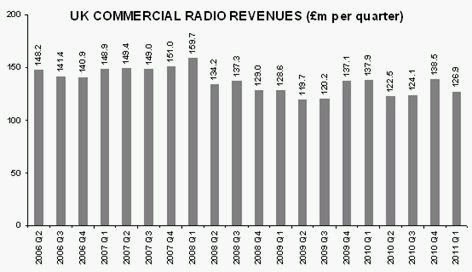
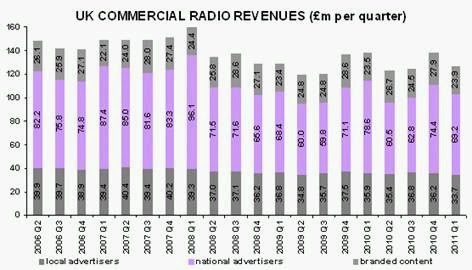
Data published last week for 2011’s first quarter demonstrate that revenues of the UK commercial radio sector are still struggling to rebound from the previous two years’ ‘credit crunch.’

A large part of the problem is the coalition government’s swingeing cuts to its marketing budget since May 2010, which have afflicted commercial radio advertising much more significantly than other media [see blog]. Additionally, and very worryingly, in Q1 2011, revenues from local advertisers fell to their lowest level for a decade, even at a time when local radio might be thought to be making client gains from the decimation of the local newspaper industry.

As has been suggested here previously [see blog], the strategy of the largest commercial radio owner, Global Radio, to transform its local stations into ‘national’ brands would seem to be a recipe for disaster at a time when:
• the national advertising market for radio is shrinking so rapidly (down 34% in real terms between 2004 and 2010)
• the BBC continues to dominate the national radio marketplace with exceptionally well-funded, ubiquitous brands [see blog]
• Ofcom’s market research points to overwhelming demand from consumers for more local radio rather than more national radio [see chapter 4(d)]
• many local commercial radio offices have been closed just as local newspapers have closed in many local markets.

TOTAL UK COMMERCIAL RADIO REVENUES:
• Q1 2011: £126.9m (£137.9m in Q1 2010)
• Down 8.0% year-on-year
• First year-on-year decrease since Q3 2009

UK COMMERCIAL RADIO NATIONAL REVENUES:
• Q1 2011: £69.2m (£78.6m in Q1 2010)
• Down 12.0% year-on-year
• First year-on-year decrease since Q3 2009

UK COMMERCIAL RADIO LOCAL REVENUES:
• Q1 2011: £33.7m (£35.9m in Q1 2010)
• Down 6.1% year-on-year
• Lowest quarter since Q1 2001

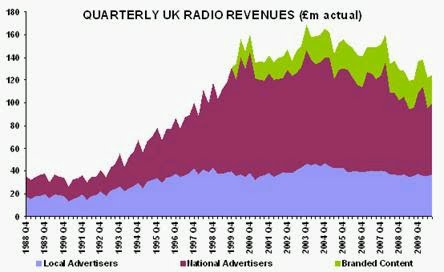
Although the quarter-on-quarter trend during the last three years appears to be relatively flat, once the data is viewed in the longer term, it is apparent that the commercial radio sector has been unable to grow its revenues back to the peak achieved in 2004. Adjusted for inflation, the ‘real’ peak occurred in 2000 and, by 2010, commercial radio total revenues had fallen by 33%.

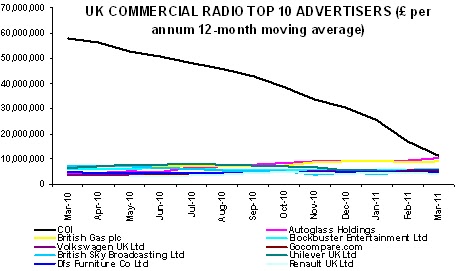
Following the impact of the ‘credit crunch,’ the subsequent blow to the sector caused by the government’s slashed expenditure on commercial radio advertising from its Central Office of Information [COI] has been catastrophic. COI spend on radio in the twelve months to March 2011 was down 80% year-on-year. In the year to March 2010, the COI had been the radio sector’s biggest advertiser by a factor of eight but, only one year later, it had been diminished to almost par with the second biggest radio spender, Autoglass.

In June 2011, the government confirmed that the COI will be axed altogether, offering no respite to the commercial radio sector. According to The Guardian:
“Instead the government intends to run advertising and marketing activity out of the Cabinet Office, hiring about 20 extra staff to complement existing communications teams.”

With local advertising revenues having hit a decade-low in Q1 2011, and national revenues having fallen 34% in real terms between 2004 and 2010, surely it should be time for commercial radio to ask itself:
• is the current local-station-turned-national-network policy the appropriate strategy for the current advertising market?
• is the current local-station-turned-national-network policy the appropriate strategy to satisfy radio listeners?
• how much longer can the ‘slash and burn’ strategy (as pursued by GWR, then by GCap, now by Global Radio) be applied to the commercial local radio industry before there is simply nothing left to cut?
• how much more shareholder value can be destroyed in commercial radio before revenues fall faster than costs can be cut?

A question I was asked by one senior radio executive last week was: how will all this commercial radio ‘slash and burn’ end? I wish I knew. Of one thing I am certain: it must eventually end in tears once the net book values of dozens of commercial radio licences have to be written down by millions of pounds in the accounts of their owners.

This process has already started tentatively:
• Global Radio valued its licences at £333m on 31 March 2010, after having swallowed a £54m ‘impairment’ write-down in 2008/9
• in 2009/10, the Guardian Media Group suffered an ‘impairment’ of its radio licences by £64m and now values them at £68m
• Times of India looks likely to have to take as little as £20m for Absolute Radio, a national station it had acquired for £53m only three years ago.
We have to anticipate more write-downs like these.

At some point, even millionaires must not enjoy watching as their radio assets are reduced to dust by shrinking audiences/revenues. But what can be done when those same owners have already starved the goose that had once laid the golden local commercial radio egg?

[Historical data from some previous quarters have been revised marginally at source]

DAB Radio Downgrade: how is '90% of FM coverage' a sensible target for DAB to replace FM?

“Makin’ a good t’ing bad!”

Moving the goalposts. Governments are adept at doing just that to help them achieve their targets or to make figures look better than they really are. Digital radio switchover is no exception. Given the technical and financial impossibility of the task plotted twenty years ago to completely replace analogue radio broadcasting with DAB radio, it has became necessary in recent months for the civil servants and digital radio lobbyists to move the goalposts.

In a blog in April 2011, I had outlined Ofcom’s latest ruse to deliberately plan to make DAB reception worse than existing FM reception for many radio listeners. Nevertheless, Ofcom will still declare this a victory for the technical superiority of the DAB platform.

The latest proposal under consideration is to make coverage of local DAB transmitters equivalent to 90% of existing FM coverage. On the one hand, this represents a belated admission that DAB radio cannot realistically achieve the same robust coverage as FM. On the other, it is a massive kick in the teeth to radio listeners – an attempt to purposefully replace something good (FM) with something worse (DAB). Madness!

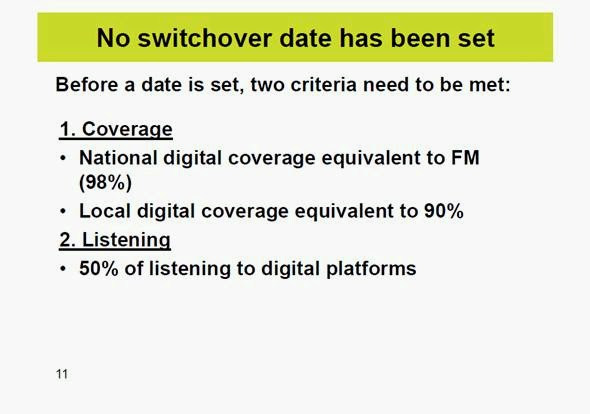
A recent presentation by DAB lobbyist organisation Digital Radio UK invoked a new, vague “local digital coverage equivalent to 90%” criterion [see below]:

“90%” of what? The government’s Digital Britain report in June 2009 had fixed the digital radio switchover criteria as:
• “When 50% of listening is to digital; and
• When national DAB coverage is comparable to FM coverage, and local DAB reaches 90% of the population and all major roads.” [emphasis added]

There was never anything in Digital Britain about achieving “90% of existing FM coverage.” It was always “90% of the population.” The goalposts are being moved to make it easier for the government and DAB lobbyists to declare that DAB has achieved the criteria. Despite this outcome making the consumer experience of radio evidently worse.

We were told that one result of the Digital Radio Summit meeting on 31 March 2011 between government, regulator and the radio industry was:

“It is understood that it will cost around £20-30m to extend the local DAB signal to 90% of the FM signal in the UK…”

At a Westminster Media Forum conference on 5 April 2011, the topic of this newly created “90% of FM” criterion was raised by several speakers:

Jimmy Buckland, director of strategy, UTV Media: “There’s a DCMS [Department for Culture, Media & Sport] plan that’s been referred to today that’s currently on the table that would take local multiplexes to just 90% of what FM already delivers, with no commitment on major roads. If that plan’s agreed, it just about gets us to base camp.”

[…]

Neil Midgley, assistant media editor, The Daily Telegraph: “Now the briefing that we were getting last week was somewhere below £30 million for a build out to about 90% of current FM coverage. “

[…]

Daniel Nathan, director, Brighton & Hove Radio: “Just leading on from that, in Jimmy’s slide we saw the figure being an aspiration of ‘90% of the population’ and I was quite disturbed to hear that now that they are kind of moving away from ‘90% of the population’ to ‘90% FM coverage.’ When was that decided and by whom?”

[…]

Jimmy Buckland: “There were two different figures, there was originally a figure which was the criterion, at which point you would make a decision about switchover which was that the Government said that once we had ‘90% population coverage’ and ‘coverage of all major roads,’ you could make a decision and there were a couple of other criteria that go with that. The second figure which was ‘90% coverage of current FM’ for local DAB concerns what would be delivered by a proposal which is currently on the table. So to tie in with the previous point, what that £30 million delivers is a little bit more coverage at the local level, aggregated to 90% on a UK wide basis, so in some local markets it could be comfortably less than 90%, in other markets it could be higher and it doesn’t get you to the universality that you need for switchover.”

So, two questions remain unanswered:
• Who came up with the idea of ‘90% of FM coverage’ to be sneaked in as an easier criterion?
• Why are large parts of the radio industry (including RadioCentre and the BBC) not publicly campaigning against this ridiculous proposal intended to make reception of their radio stations on DAB WORSE for listeners than existing reception on FM?

It is hard not to conclude that the parties involved in this latest wheeze seem happy to treat the UK’s 46,727,000 radio listeners with utter contempt.

Bauer Radio talks the DAB talk, but walks its Magic brand off DAB

Bauer Radio is the second largest commercial radio group in the UK. It publicly supports the government’s plans for DAB radio switchover. Only this month, Paul Keenan, chief executive of Bauer Media, told The Guardian: “What part if any is the BBC going to play on the local DAB level?” He went on to ask:

“Will there be some form of seismic content innovation or intervention that really pulls listeners across [to DAB]?”

Keenan need have looked no further than his own company’s DAB radio strategy to discover a form of “seismic content intervention” that might well result in pushing existing listeners away from DAB, rather than pulling them in. While Keenan was talking to The Guardian, Bauer was busy pulling the plugs on its ‘Magic’ brand from the DAB platform in the following areas:
· Aberdeen
· Ayr
· Birmingham
· Bradford & Huddersfield
· Cambridge
· Dundee & Perth
· Edinburgh
· Glasgow
· Kent
· Northern Ireland
· Norwich
· Peterborough
· Stoke
· Sussex Coast
· Swansea

If you were a loyal listener to Magic in one of these areas, your favourite station simply disappeared from the DAB menu in January 2011 (Magic had 1m out-of-analogue-area listeners per week, contributing 24% of the brand’s total hours listened, according to RAJAR). This change is surprising given that, as recently as May 2008, Bauer Radio decided to add its Magic brand to the DAB platform in the following areas:
· Aberdeen
· Ayr
· Birmingham
· Bradford & Huddersfield
· Cambridge
· Dundee & Perth
· Edinburgh
· Glasgow
· Kent
· Northern Ireland
· Norwich
· Peterborough
· Stoke
· Sussex Coast
· Swansea

In 2008, in most of these areas, Magic had replaced another Bauer brand, ‘Kiss’, which could not have pleased existing Kiss listeners. Now, in 2011, it is the Kiss brand that is replacing the Magic brand in all but three of these areas. Musical chairs, anyone?

In 2009, Bauer had said that it was investing in the “right long-term platforms for the right stations at the right time.” So, in 2008, Kiss was right for DAB whereas, in 2011, now Magic is right?

It is hard to believe that such precipitous content changes inspire consumer confidence in the DAB platform. But, sadly, the DAB platform has never really been about ‘radio’ and ‘listeners’. Loyalty to DAB radio? What’s that? For commercial radio, its pursuit of the DAB platform had been about the exercise of power, the expectation of profit and the promise of automatic renewals for the industry’s most valuable analogue radio licences.

It was also about a much coveted transfer of the power to determine which stations are broadcast to a cartel of commercial DAB multiplex owners, and away from the regulator. This is why station changes on DAB, such as Bauer’s (Kiss to Magic to Kiss) can be executed without a public consultation or impact assessment.* The regulator merely nods its head and makes a quick note in a file. So what role does Ofcom play in ensuring that the DAB radio platform “furthers the interests of citizens and of consumers” as mandated by law? The answer is: absolutely none. We might as well have a scarecrow in charge of digital radio at Ofcom.

The reason that Bauer Radio (with a 25% listening share of commercial radio) made these latest changes to DAB is that it is locked in a war with archrival Global Radio (38%). Neither company has a track record of developing its own successful radio stations from the ground up. Both companies are piled high with acquisitions and mergers of other radio businesses. As a result, the two compete with each other by moving their radio pieces around the chess board, rather than by innovation.

In January 2011, Global Radio extended its ‘Capital’ brand outside London, replacing the former ‘Galaxy’ brand and some local FM stations. Global describes the brand:

“Capital’s target audience of 15-34 year olds are big fans of popular music, they are media savvy and are on trend.”

To compete, Bauer Radio extended its Kiss brand to every available local DAB multiplex (replacing Magic). Bauer describes the brand:

“Kiss evolves around ever changing lifestyles and trends of the UK’s young 15-34 market … Every part of their day revolves around music.”

If, like me, you think that these two brands sound almost identical, understand that this phenomenon is the outcome of long understood business practice in the radio sector. In 1951, American economist Peter Steiner wrote:

“If, as is often suspected, [radio] broadcasters exaggerate the homogeneity of audiences and their preferences for certain program stereotypes, the tendencies towards [programme] duplication will be increased. … The problem, of course, is that a series of competing firms, each striving to maximize its number of listeners, will fail to achieve either the industry or the social good. Here, then, competition is providing a less than desirable result.”

In the UK, this is precisely why we have a regulator for radio broadcasting – to ensure that consumers benefit from a wider choice of content than a free market would provide. However, with its hands tied in DAB policy by the Broadcasting Act 1996, and its laissez-faire ‘do nothing until someone complains about it’ strategy, Ofcom has had no more impact on the DAB station menu than having no regulator at all.

DAB is the Wild West of radio where anything can, and often does, happen. Seemingly, it often happens with little concern for listeners or for those who paid good money for a DAB receiver. Without a sheriff in sight, or a cavalry about to ride over the horizon, the danger is that the public might come to view DAB radio as nothing more than a bunch of cowboys locked in a private war of one-upmanship.

Yet the radio industry wonders why the DAB platform is not stimulating more listening or more receiver sales.

[*NB: There was an Ofcom consultation in November 2010 about a change of format for the Kiss brand, but this did not touch upon Magic being dropped from DAB. Magic continues to be simulcast on DAB in nine areas where it is already available on FM or AM, as a contractual condition of its automatic analogue licence renewals.]

UK commercial radio revenues Q3 2010: still no sign of "renewed growth"

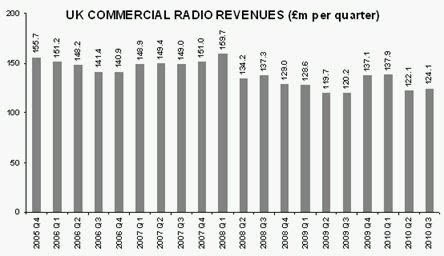
2008 had been a bad year for commercial radio revenues, down 6% year-on-year. 2009 was a worse year, when revenues fell a further 10% year-on-year. So how is 2010 shaping up? Radio Advertising Bureau data for Q3 2010 demonstrate that, although revenues are likely to be up marginally for the calendar year, they have yet to regain the substantial losses suffered during those previous two years.

Why? Because commercial radio’s falling revenues are largely the result of structural decline, something that the ‘credit crunch’ of 2008/9 merely exacerbated. Adjusted for the impact of inflation, commercial radio revenues peaked in 2000 and, by 2009, were down 32% in real terms. The single-digit improvements we might see in 2010 will claw back only a tiny part of these enormous losses.


Q3 2010 TOTAL REVENUES
· Up 3.2% year-on-year to £124.1m, but remember that Q3 2009 had been the sector’s second lowest this millennium

In May 2010, the Radio Advertising Bureau had told us that “the [commercial radio] sector has turned a corner and not only halted [revenue] decline, but moved into renewed growth …”

Industry data has yet to validate this assertion. The last two quarters produced the third and fourth lowest revenue totals of the decade, showing that the radio sector is certainly not out of the woods yet. More than anything, the industry’s revenues still seem to be bumping along the bottom. “Renewed growth” is not on the horizon yet.


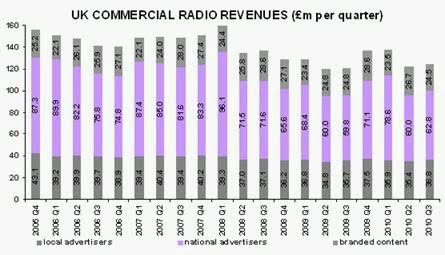
Q3 2010 NATIONAL REVENUES
· Up 5.0% year-on-year to £62.8m

Q3 2010 LOCAL REVENUES
· Up 3.1% year-on-year to £36.8m

Q3 2010 BRANDED CONTENT REVENUES
· Down 1.2% year-on-year to £24.5m


The revenue data for the long term [see graph above] illustrate clearly the transformation of the commercial radio sector from a healthy growth industry in the 1990s to one that stagnated after 2000, and which has subsequently moved into decline. Whilst revenues from local advertisers have simply stalled in recent years, revenues from national advertisers seem unlikely to ever recover from substantial declines suffered since their peak in 2000. This has necessitated significant restructuring of the commercial radio sector in recent years.

For those larger commercial radio stations that depend upon national advertisers the most, the outlook continues to look bleak. Data from Nielsen estimated that advertising spend by the government’s Central Office of Information [COI] fell by 47% in 2010 year-on-year. COI expenditure has been a greater proportion of commercial radio revenues than of any other medium, making radio particularly vulnerable. In May 2010, I had predicted:

“A 50% budget cut to COI expenditure on radio would lose commercial radio £26m to £29m per annum, 6% of total sector revenues. A 50% budget cut to all public sector expenditure on radio would lose commercial radio £44m to £48m per annum, 9% of total sector revenues.”

Not only have these cuts been realised, but the Cabinet Office is continuing to pursue a plan for the BBC to carry public service messages for free, rather than pay commercial broadcasters for airtime [also predicted here in May 2010]. This could lose commercial radio a further 6% to 9% of revenues.

In 2009, even before these drastic cuts to government expenditure on advertising, commercial radio was attracting only 4% of total display advertising expenditure in the UK, one of the lowest proportions globally [see Ofcom report]. What is UK radio doing so wrong that Ireland, Spain and Australia achieve more than double that amount? And why was that percentage already falling before the COI cuts, demonstrating the radio medium’s comparative lack of appeal to potential advertisers?

There could not be a worse time to be a commercial radio station dependent upon national advertising. Yet now is the precise time when several large commercial radio owners are busy transforming their local and regional stations into national ‘brands.’ As a response to the sector’s structural challenges, this is tantamount to cutting off your nose to spite your face. ‘Localness’ has consistently been shown to be the most important Unique Selling Point of local commercial radio, according to Ofcom research. Throw that localness out the window and all that remains is a music playlist which can be generated by any computer application.

UK commercial radio has always been good at making ‘cheap and cheerful’ local radio, but has been rubbish at making national radio that could compete with the BBC’s incredibly well resourced national networks. The recent decisions of commercial radio owners to switch from production of local radio services with a track record of success to production of ‘national’ ones that have a history of relative failure create massive risks for an industry already in decline.


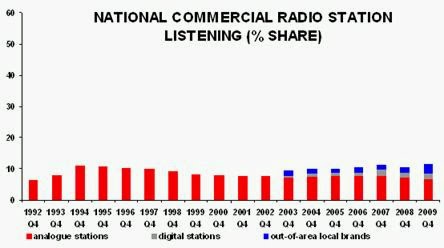
History tells its own story. The launch of the UK’s first three national commercial radio stations between 1992 and 1995 had much less of an impact on radio listening than had been anticipated. By 1997, Richard Branson had decided to sell Virgin Radio (for £115m) – it was obvious that national commercial radio was not going to be a massive moneyspinner. In 1997, Virgin Radio’s listening share had been 2.6%. Last quarter (Q3 2010), it had fallen to 1.2% (renamed Absolute Radio after another sale in 2008 for £53m), while the combined share of the three national stations was 6.8%. [source: RAJAR]


BBC national networks account for almost half of all radio listening. The only time that their share has not exhibited long-term growth was during the early 1990s, when Radio 1 self-destructed under the management of Matthew Bannister. Since that disaster, the BBC’s national networks have been successfully clawing back listening year-on-year.

The current scenario in which the owners of commercial stations that were licensed to serve local audiences have decided to subvert that purpose to take on the might of the BBC national networks is either brave, or madness, depending upon your viewpoint. What I see is a monolithic BBC that has existed continuously for nearly a century, and then I see three national commercial radio stations that have had a succession of at least three owners each during their almost twenty-year struggle to attract listeners.

National commercial radio. Just why are parts of the commercial radio industry so eager to emulate an idea that has only led to well documented failure?

Commercial radio local DAB build-out "not the BBC's responsibility" says BBC Trust chairman

Culture Media & Sport Select Committee, House of Commons
15 December 2010
BBC Annual Report & Accounts 2009-10 [excerpt]

Sir Michael Lyons, Chairman, BBC Trust
Mark Thompson, Director General, BBC

Damian Collins, MP Folkestone & Hythe (Con): Has the [Licence Fee] settlement affected the amount of support you can give to digital radio switchover and the build-out of digital radio in local services within the regions?

Sir Michael Lyons: What you see in yesterday’s announcement is a clear message that the BBC remains committed to DAB and will continue to build out up to FM equivalents. That is clear. It is involved in discussions with the commercial radio industry and Government about local build-out, for which it is not responsible and for which there are not funds currently identified. They were expected to be undertaken by the commercial operators of those Mux [DAB multiplex] licences.

I don’t think I should add very much to that, other than that, clearly, the Government has determined on a switchover date. Whether that can be achieved is, in our view, whether the audience is ready for it to be.

Damian Collins: I suppose whether it can be achieved ought to be linked to the level of coverage as well. The Government has been clear about that, too. In those negotiations you are having with Government and the commercial stations, is the amount of money you have on the table a smaller amount, as a result of the settlement, than it was before?

Mark Thompson: No.

Sir Michael Lyons: It is clearly another one of the pressures that we have to balance in a tighter envelope; that is the important thing.

Mark Thompson: I think it is fair to say that the underlying commitment that we have made and the focus we have on the building out of our own national multiplex, is unchanged by the settlement.

Sir Michael Lyons: Absolutely. It is a reference to local, I think, that I was …

Mark Thompson: Quite. But the BBC’s focus has always been … the issue about local is that we only have in England, and only intend to have, a single BBC local radio station per region. With each local multiplex that has been opened so far, we have taken a place on that multiplex; we decided that we should do that.

I have no reason to believe we would not continue to do that as they are built out. But whereas the national multiplex, obviously, is a way of getting additional BBC services to the public – the digital services – there is no such increase in BBC services that we can offer if you are taking a single station which is analogue and putting it on digital as well. So our focus is on national build-out, and the broad policy and the commitment over time to absolutely keeping pace with the audience, building out nationally, is unchanged by the settlement.

Damian Collins: Your commitment is clear, and you made that again today, but is it going to take longer to get there now, as a consequence of finding some other issues you have to deal with?

Mark Thompson: I don’t think so. If you say something slightly different, which is, “Would some people have liked some level of additional commitment in the settlement?”, perhaps they would, but it is not there.

Damian Collins: But as far as you are concerned, your commitment is the same?

Mark Thompson: It is exactly the same.

Damian Collins: In the document put to us yesterday, you talk about preparing for any potential radio switchover. That does not sound like it is going to happen within the next five years.

Sir Michael Lyons: That is not a judgment for the BBC; that is a judgment for Government. The BBC is very clear that it is doing its bit in these national investments. There remain unresolved issues about where the investment comes from at a local level. That is not the BBC’s responsibility, but we are part of those discussions. And then, very critically, as the Government has conceded, switchover can only take place … I do take your point that audience preparedness will to some extent depend on coverage, but it also depends on choices made about replacement television sets, investment in cars and a whole series of other things, which are not in our gift.

[This is an uncorrected transcript of evidence taken in public and reported to the House. The transcript has been placed on the internet on the authority of the Committee, and copies have been made available by the Vote Office for the use of Members and others. Any public use of, or reference to, the contents should make clear that neither witnesses nor Members have had the opportunity to correct the record. The transcript is not yet an approved formal record of these proceedings.]

Digital Radio UK meets BBC Radio Northampton listeners in a DAB black hole

In October 2007, Ofcom had awarded the DAB local multiplex licence for Northamptonshire to NOWdigital Ltd. and had required “implementation by September 2008” to put it on-air. The multiplex was to carry BBC Radio Northampton along with commercial stations. More than three years after this licence award, the DAB service has still not launched. As a result, BBC Radio Northampton is not yet available on DAB.

NOWdigital Ltd. had been owned by GCap Media, the UK’s largest commercial radio group, which was acquired by Global Radio in 2008. In 2009, NOWdigital Ltd. was sold to Arqiva, the transmission specialist which owns the lion’s share of DAB commercial infrastructure in the UK. In its application for the Northamptonshire licence in 2007, NOWdigital had boasted:

“GCap … has invested more into digital radio than any other UK operator. This investment has driven the industry forward and is helping build radio’s digital future … Having launched and operated multiplexes since 2001, NOWdigital is in an excellent position to successfully launch and operate the Northamptonshire multiplex.”

So what has Ofcom done to make this licensee comply with the stipulation that the Northampton DAB multiplex had to be launched by September 2008? Nothing. Does the commercial radio industry have a masterplan that includes a specific date for the launch of the Northamptonshire DAB multiplex? No. NOWdigital states disingenuously that its on-air date for Northamptonshire is “awaiting launch”.

Northamptonshire is one of 13 local DAB multiplex licences that Ofcom
awarded in 2007 and 2008 that have failed to materialise by their required launch dates. In 2007, Ofcom also awarded a national DAB multiplex licence to a consortium, led by Channel 4 television, that similarly failed to launch (all trace of which has been erased from the Ofcom web site).

Despite three years of broken promises to the people of Northamptonshire by Ofcom, NOWdigital, GCap Media, Global Radio and Arqiva that a local DAB radio multiplex will be launched for their area, they were not excused from this year’s Christmas radio industry campaign to sell more DAB receivers. DAB marketing organisation Digital Radio UK was interviewed by BBC Radio Northampton last week, though it was unable to offer even a vague date when either the local DAB multiplex for Northamptonshire will be launched, or when the signal of the existing DAB national multiplexes will be improved.

Although Digital Radio UK is funded jointly by the BBC, commercial radio and Arqiva, these heavyweight stakeholders could offer nothing more concrete to the people of Northamptonshire than platitudes and more promises about DAB … always in the future tense.


BBC Radio Northampton,
lunchtime show
15 December 2010 @ 1223 [excerpts]

Stuart Linnell, presenter [SL]
Jane Ostler, director of communications, Digital Radio UK [JO]

SL: You said, Jane, that the coverage and the reception is pretty good in most parts of the country. From my experience, and from what I hear people saying, where it’s good, it’s great. Where it’s not so good, it’s blooming awful.

JO: Yes. That is absolutely right, and we know that organisations like the BBC actually have a plan in place to make sure that coverage improves. And that’s not only building more transmitters, but it’s also increasing the power on transmitters, so that you don’t get the drop-out of signal that you will get in some areas. However, we know that when people do have a good signal, they absolutely love digital radio and everything that it brings …

[…]

SL: Rod in Daventry has got a question about the DAB signal in Northampton. It’s not specific to any one radio station, this question, I don’t think. It’s come in on a text. He just says: why is the DAB signal in Northampton so weak?

JO: Yeah, there are variances around the country in the signal. And, as I say, you know, there are plans in place, over the course of the next few years, to improve coverage for national radio stations and local radio stations as well. It’s one of these things that we are used to with other electronic devices like mobile phones and even Freeview signals. You know, there’s a course – an engineering programme – that’s taking place over time that will allow the signal to improve. So, if it is weak at the moment, it will get better.

[…]

JO: We believe that DAB will … is the broadcast backbone for the country. It’s free to air, it’s becoming increasingly available, and the signal is getting better all the time…

[…]

John in Corby [caller]: My question is that I watch this, I’ve been doing radio for sixty years, I’ve watched this very, very carefully, and the thing is that there are some very attractive radios which carry DAB which are available now. I take all the magazines, every magazine that’s related to radio and high fidelity in this country. And the point is this. What the $64,000 question is, dear Stuart, is: when shall DAB radio be available on Radio Northampton? Can the lady guesstimate that? That’s what’s important – all the things that have been broadcast about it – I won’t buy a DAB radio until I can get it in my locality, my local station, which makes commonsense to me.

SL: Okay. We get the point. Jane, do you know the answer to that?

JO: That is a very good question from John because I know that BBC Radio Northampton is not available on a local digital multiplex. Obviously, around the Northampton area, you can get – and Corby, you can get – the national stations but not the local ones. There are plans in place to build local coverage, and that includes BBC services by the time …

John [interrupts]: This is what will be needed and this is what will sell the radio … this is what will sell the radios, in my view. [When] this fine station in this fine county has its own DAB service.

JO: Yeah, we completely support that and we understand that. What’s happening is: there is a plan in place to develop local coverage in time for the digital radio switchover, and these plans are being worked on right now. So I can’t give you an exact date, but it will be over the next few years that local radio will be more available on digital.

SL: Because we must make it clear that John’s question is a valid one, but it’s not just BBC Radio Northampton that’s not on DAB. There are other stations as well who have not yet migrated to that platform.

JO: That’s right. The local stations in your area aren’t available. They are in some, but not in your particular area. But you can, subject to doing a postcode check, you can still get all the national services that are available …

[…]

Peter [caller]: What exactly is going to happen to existing car radios and also hi-fi stereos at home and also alarm clock radios? Is there going to be an adapter?

JO: If I deal with the car question first. That is also a very good question. There are lots of cars, there are lots of lorries and vehicles on the road, and only a small percentage of them today can actually receive digital radio. But you will start to see – and it’s starting already, and over the next few years – an increasing number of adapters coming onto the market, which you can either fit yourself or which you can get fitted by stores such as Halfords, for example. And then that’s with existing vehicles. With new cars, the motor manufacturers who import and make vehicles in the UK have committed that all new cars will have digital radio as standard by the end of the year 2013. So more and more adapters will come onto the market that are available …

SL [interrupts]: Can I just push you on that a little bit, Jane, because I heard – this is going back probably about 18 months now – that one of the largest motor manufacturers in the world, manufacturing two major brands – luxury brands – in this country, had actually withdrawn their DAB digital radios from their cars, as an optional extra even, because they said it just wasn’t working – the technology wasn’t good enough. Have all the manufacturers now signed up?

JO: They have, into the UK, of getting DAB as standard in cars – in new cars – by the end of 2013. And part of this target date that we talked about earlier on has got the motor manufacturers moving, and it’s also got other manufacturers coming up with new devices which you can fit into your existing car alongside your FM radio.

SL: And that really answers Peter’s point that, whether he has got his clock radio, his hi-fi in his lounge or the car radio, there are going to be adapters that will covert them to take DAB as well.

JO: Not, not the alarm clock. No, the alarm clock example is one where … I think, if you did want an alarm clock that had DAB radio built in, you’d have to get a new alarm clock.

SL: Buy a specific one, okay?

JO: Exactly, exactly. They are increasingly available in stores and they are becoming more affordable all the time.

SL: But for the hi-fi and for the car radio, there should be an adaptor at some stage.

JO: The hi-fi is an interesting question actually because obviously you can get digital radio tuners for hi-fi’s now which can plug in as a separate device. Quite often, a radio might be built into something like a large amplifier where the primary use is actually the amplifier rather than the radio. Ultimately, it would be down to the listener. But these devices are becoming available all the time and, if you go into any electrical store, you’ll start to see more digital radio devices.

SL: Okay, does that answer your question, Peter?

Peter: Yes, it does. I just hope that … I think it’s going to be a big sledgehammer to get a DAB adapter to fit in an existing car. There’s not a lot of room underneath dashboards.

JO: That’s absolutely fair. You can get some now which actually fit onto your windscreen and plug in around the dashboard. But soon, towards the end pf next year, when we anticipate that digital radios in cars will double during the course of next year, you will start to see these devices more hidden away in the glove compartment and that sort of thing.

[…]

SL: It’s Mike in Northants who says: digital reception on Radio Five Live for me, he says, was dreadful, so I just switched back to AM and FM and rejected DAB. No more problems.

JO: Right, well that’s … I don’t know precisely where he lives but, obviously, doing a postcode check would tell him whether he should be able to receive a good signal or not. And there are currently … until the transmitter improvements happen, there are other ways of listening to Radio Five Live, for example on the internet, and on digital television platforms as well, in fact. But, as I say, these coverage improvements are happening all the time. He should check his postcode at our web site.

[…]

Graham from Whitehills [caller]: I’m a communications buff so, as soon as DAB came out, I went and bought myself a mains portable one before I found out I couldn’t get Radio Northampton on it. The big, big problem is that it roars through batteries. It uses batteries at twice the rate of anything else I’ve ever owned.

SL: And I had a letter about this from somebody a while ago, Jane, asking why … is digital radio really environmentally friendly, because it uses up so much power?

JO: Yeah, you will find this is absolutely true for older radio sets that, you know, have been bought a few years ago, that they were quite power hungry and used a lot of batteries all the time and many people chose to operate them from the mains. But there’s been a report out in the last few months that government’s done about the battery consumption and the energy consumption of digital radios. And you’ll find that all the main manufacturers now are making really amazing claims about the battery life of the radios, that they will last for, you know, in some cases, hundreds of hours and use less power than an energy efficient lightbulb and that sort of thing. So, as technology progresses, the energy consumption gets better as well. So I’m afraid that some of those older radios do use quite a lot of energy and the new ones don’t.

SL: You need a new one for Christmas, Graham.

Graham: Yeah, eighty quid down the drain, that was. Thank you.

JO [laughs]: You can get them … you can get them from around £25 now, so you needn’t spend that much.

Graham: Yeah, but I paid eighty. Bye.

[…]

SL: Somebody’s asking: why is it that, when you’re listening to DAB, sometimes it can suddenly cut out altogether or just go to an absolutely garbled signal that sounds like it is underwater?

JO: Yeah, that’s … that’s something that happens when you’re on the edges – or on the fringes – of a reception area and, like other digital media, it can also happen during periods of high weather pressure. So you will find that, if you’re on the edges of a reception area, the signal does cut out rather than degrade gently, which is what it does with FM. So, again, as the coverage improves and the signal strength improves, that should stop happening.

Without local commercial radio, switchover to DAB will not happen

I am often asked why I believe that digital radio switchover will never happen in the UK. My answer is always this – the available statistics and data on consumer take-up of DAB radio fail to demonstrate that it will grow sufficiently to become the mass medium for radio broadcasting. I can see nothing in more than a decade of figures to offer an inkling that DAB radio will ever become anything more than a minority interest, compared to FM/AM.

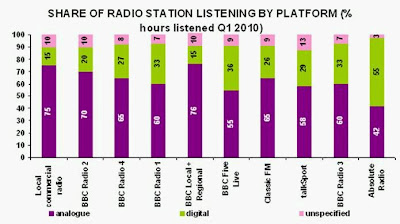
Audience data published by Ofcom in its latest Communications Market report (page 219, Figure 3.34) help us to understand the current roadblock with DAB consumer take-up. Ofcom divulged the proportion of listening to individual stations by platform, data that has not been made public by RAJAR (see graph below).

The information demonstrates that a few stations, notably AM broadcasters BBC Five Live and Absolute Radio, are making significant headway with attracting audiences on digital platforms. However, in order to put these data in a market perspective, it is necessary to understand the relative importance of each of these stations.

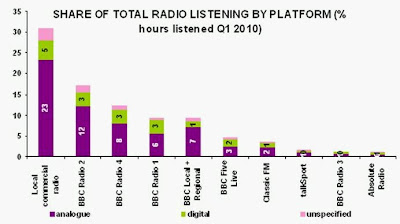
The above graph helps put the planned transition from analogue to digital in a proper market perspective. For example, Absolute Radio has made much of the fact that more than 50% of its listening is already attributed to digital platforms. However, in the context of digital radio switchover, its audience is so small that it has little overall impact. The volume of listening to some local London stations is greater than to national Absolute Radio.

The government has stated that it will not consider ‘switchover’ until at least 50% of radio listening is via digital platforms. Digital listening to the ten stations and station types shown in the above graph add up to only 20%, even after ten years of DAB (digital-only stations bring the total to 24%). There is a reason that it will prove an impossible challenge to get this up to the 50% government target.

Around 300 local commercial radio stations account for 31% of all radio listening. Their success in convincing audiences to migrate to digital platforms will be a vitally important part of the aim to achieve the 50% criterion. However, only 15% of local commercial radio listening is attributed to digital platforms, the lowest proportion (along with BBC local radio) of the ten stations/types in the graph. The task to improve this performance from 15% to the 24% national average is likely to prove impossible, let alone to grow it to the 50% criterion.

This is because many stations in the local commercial radio sector cannot and will not ever be available on DAB because:
• The economics of DAB transmission make it too costly
• The unavailability of any local DAB multiplex in some areas
• The unavailability of space for stations on some local DAB multiplexes
• The industry grand plan to amalgamate existing local multiplexes into regional multiplexes makes DAB transmission, for small local radio stations, more irrelevant and more costly.

These issues had been identified by the government in its Digital Britain consultation in June 2009:
• “merging [DAB] multiplexes will reduce the overall capacity available for DAB services, therefore reducing the potential for new services”
• “reduced capacity on local multiplexes might result in some services losing their current carriage on DAB.”

The government’s decision to ignore these outcomes is now coming back to bite it on the bum. Not having a plan to ensure that all local commercial radio stations can be made available on DAB will only ensure that the government’s 50% criterion can never be met.

At the same time, the determination of the largest players in the commercial radio sector to forge ahead with DAB, regardless of these unresolved issues, has created a serious schism between them and the smaller local radio groups and independent local stations who have no digital future. These issues were raised in parliamentary debate of the Digital Economy Act but were ignored and trivialised by the DAB lobbyists.

Some local commercial radio owners are seriously alienated by the way their predicaments have been ignored by large radio groups and their trade organisations – RadioCentre, Digital Radio Development Bureau and Digital Radio UK. One such group owner, UKRD, has taken direct action by running a campaign on-air and on its stations’ websites against the government’s proposed switchover to DAB.

A page entitled ‘Love FM’ on the Wessex FM website says:

“As you probably know Wessex FM proudly broadcasts to this area on the FM frequencies 96 & 97.2, and had been hoping to for many years to come. However, recent developments mean that we may not be able to broadcast in this way for much longer. In fact, the current plan from parliament is to switch off the use of FM for many stations in 2015. That means, soon, you may not be able to listen to us on FM.”

William Rogers, UKRD Group chief executive officer explained:

“We are not prepared to encourage any of our listeners to go and replace their perfectly satisfactory analogue radio set with a DAB one which may not be able to pick up a DAB signal at all and if it can, it may be a signal which may be wholly inadequate. Even worse, the very station that the listener may have heard the [DAB marketing] advertisement on may not be on DAB or even have a DAB future.”

Pam Lawton, managing director of another UKRD-owned station, KL.FM in King’s Lynn, said:

“We are not on DAB at the moment and currently most of the DAB digital platforms have been snapped up. As things stand, West Norfolk does not have a digital platform because there are limitations about how many there can be and there will only be one station that will serve Norfolk. That station will probably be based in Norwich so once the government decides to turn off FM, we will have to switch off for good.”

The paradox is that the radio sector stakeholders who have been pushed aside and ignored by the DAB movers and shakers are some of the very ones who hold the key to enabling digital radio switchover to happen. Unless the huge audience for local commercial radio can be persuaded to migrate its listening to DAB, the 50% criterion cannot be achieved.

At the same time, some stakeholders who are making the most noise about DAB switchover matter the least in the scheme of things. Absolute Radio can trumpet its individual success with digital listening, but it is contributing less than 1% to the 50% criterion that has to be reached, despite being a national station. It is the hundreds of local commercial radio stations that, collectively, matter the most. Yet, many of these have been denied any seat at the DAB table.

As politicians have learnt through the ages, unless you can convince the little guys (the local radio station owners) and the ‘man in the street’ (the radio listener) to endorse your grand scheme, a scheme is all it will remain. Fancy words in boardrooms, lengthy documents from corporate consultants and detailed project management timelines will inevitably come to nothing, without involving and bringing on board the people who really matter.

It is the radio industry data, particularly for local radio, that tell the real story of DAB and why it can never become the mass radio medium for UK consumers. That is why digital radio switchover will not happen.

[all RAJAR data are Q1 2010, as used by Ofcom]

Choice FM R.I.P.: the birth and near death of licensed black music radio in London

31 March 1990 was the memorable day when London‘s first licensed black music station, Choice 96.9 FM, arrived on-air. Until then, the availability of black music on legal radio had been limited to a handful of specialist music shows, even though about half of the singles sales chart was filled with black music. The decision by then regulator the Independent Broadcasting Authority [IBA] to license a London black music station was part of a huge government ‘carrot and stick’ campaign to rid the country of pirate radio. On the one hand, new draconian laws had been introduced that made it a criminal offence even to wear a pirate radio T-shirt or display a pirate radio car sticker. On the other hand, the establishment knew that some kind of olive branch had to be offered to the pirate stations and their large, loyal listenership.

Many pirate stations, having voluntarily closed down in the hope of becoming legitimate, were incensed when the IBA instead selected Choice FM for the new South London FM license. Its backers had no previous experience in the London pirate radio business, but had previously published ‘Root’ magazine for the black community in the 1970s. Although it was impossible for one station to fill the gap left by the many pirates, Choice FM tried very hard to create a format that combined soul and reggae music with news for South London’s black community, which was precisely what its licence required. The station attracted a growing listenership and it brought a significant new audience to commercial radio that had hitherto been ignored by established stations. With Choice FM, the regulator succeeded in fulfilling two aspects of public broadcasting policy: widening the choice of stations available to the public; and filling gaps in the market for content that only pirate radio had supplied until then.

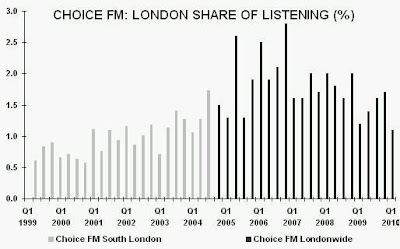
In 2000, Choice FM won a further licence to cover North London with an additional transmitter. For the first time, the station was now properly audible across the whole capital and had access to more listeners and more potential advertising revenues. Its listening doubled and, at its peak in 2006, Choice FM achieved a 2.8% share, placing it ahead of TalkSport and BBC London in the capital. Choice FM had no direct competitor in London, although indirectly some of its music had always overlapped Kiss FM. The station’s future looked rosy.

However, the Choice FM shareholders must have realised just how much their little South London station was worth, at a time when commercial radio licences were being acquired at inflated prices. Already, in 1995, Choice FM shareholders had won a second licence in Birmingham, but had then sold the station in 1998 for £6m to the Chrysalis Radio group, who turned it into another local outlet for its network dance music station Galaxy FM. At a stroke, the black community in Birmingham had lost a station that the regulator had awarded to serve them. Black radio in Birmingham was dead. The die was cast.

The then regulator, the Radio Authority, had rubber-stamped this acquisition, stating that it would not operate against the public interest. The Authority requested some token assurances: at least one Afro-Caribbean member on the station’s board; an academy for training young people, especially from the black community, in radio skills; and market research about the impact of the format change on the black community. None of these made any difference to what came out the loudspeaker. Birmingham’s black community was sold down the river.

Changes in UK media ownership rules were on the horizon that would soon allow commercial radio groups to own many more stations within a local market. As a result, in 2001, the UK’s then largest radio group, Capital Radio plc, acquired 19% of Choice FM’s London station for £3.3m with an option to acquire the rest. In 2003, it bought the remaining 81% for £11.7m in shares, valuing the London station at £14.4m. The Choice FM shareholders had cashed in their chips over a five-year period and had generated £21m from three radio licences. What would happen to Choice FM London now?

Graham Bryce, managing director of Capital Radio’s London rock station Xfm (which Capital had acquired in 1998 for £12.6m), said then:

“Our vision is to build Choice into London’s leading urban music station, becoming the number one choice for young urban Londoners. Longer term, we intend to fully exploit the use of digital technology to build Choice nationally into the UK’s leading urban music station and the number one urban music brand.”

Capital Radio and subsequent owners seemed to want to turn Choice FM into a station that competed directly with Kiss FM (owned by rival EMAP). But they never seemed to understand that Kiss FM was now a ‘dance/pop’ station, whereas Choice FM had always been firmly rooted in the black music tradition of soul, reggae and R&B. Such semantics seemed to be lost on Choice FM’s new owners and on the regulator, but certainly not on Choice FM’s listeners, who had no interest in Kylie Minogue songs.

In 2004, Capital Radio moved Choice FM out of its South London base and into its London headquarters in Leicester Square. The station’s final link with the black community of South London it had been licensed to serve was discarded. In 2005, Capital Radio merged with another radio group, GWR plc, to form GCap Media plc. In March 2008, Global Radio bought GCap Media for £375m. In July 2008, Choice FM managing director Ivor Etienne was suddenly made redundant. One of the station’s former founder shareholders commented:

“I’m disappointed that the new management decided to relieve Ivor Etienne so quickly. My concern is that I hope they will be able to keep the station to serve the community that it was originally licensed for.”

However, from this point forwards, it was obvious that new owner Global Radio had no interest in developing Choice FM as one of its key radio brands. In the most recent quarter, the station’s share of listening fell to an all-time low of 1.1% (since its audience has been measured Londonwide). Sadly, the station is now a shadow of its former self, even though it holds the only black music commercial radio licence in London (BBC digital black music station 1Xtra has failed to dent the London market, with only a 0.3% share).

This week, news emerged from Choice FM that its reggae programmes, which have been broadcast during weekday evenings since the station opened, will be rescheduled to the middle of the night (literally). One of the UK’s foremost reggae DJs, Daddy Ernie, who has presented on Choice FM since its first day, will be relegated to the graveyard hours when nobody is listening. From 2003, after the Capital Radio takeover, reggae songs have been banished from the 0700 to 1900 daytime shows on Choice FM. Now the specialist shows will be removed from evenings, despite London being a world centre for reggae and having more reggae music shops than Jamaica.

Station owner Global Radio responded to criticism of these changes in The Voice newspaper: “Choice [FM] has introduced a summer schedule which sees various changes to the station including the movement of some of our specialist shows.”

Once again, the regulator will roll over obligingly and rubber-stamp these changes. For Global Radio, the endgame must be to transform the standalone Choice FM station into a London outlet for its Galaxy FM network. At present, London-based advertisers and agencies can only listen to Galaxy on DAB or via the internet. A London Galaxy station on FM would bring in more revenue for the brand as a result of more listening hours and its higher profile in the advertising community. It would also provide a direct competitor to Kiss FM London (ironic, because Galaxy FM had been launched in 1990 by an established commercial radio group as an out-of-London imitation of successful, London-only Kiss FM). Global Radio’s argument to persuade the regulator will probably be that Choice FM’s audience has fallen to uneconomic levels. And whose fault was that?

Already, Global Radio’s website tells us that “Choice FM is also included as part of the Galaxy network” which “consists of evolving mainstream music supported by entertaining and relatable presenters.” And yet, according to Ofcom, Choice FM’s licence is still for “a targeted music, news and information service primarily for listeners of African and Afro-Caribbean origin in the Brixton area but with cross-over appeal to other listeners who appreciate urban contemporary black music.” How can both these assertions be true of a single station?

For the black community in London, and for fans of black music, this will be the final straw. Just as happened in Birmingham, the new owner and the regulator will have collectively sold Choice FM’s listeners down the river. Another station that used to broadcast unique content for a unique audience will have been wilfully destroyed in order to make it almost the same as an existing station, playing almost the same content. We have many commercial radio stations, but less and less diversity in the music they play. Radio regulation has failed us.

For Choice FM, the writing was on the wall in 2003 when Capital Radio bought the station and one (unidentified) former DJ commented:

“Choice [FM] was there for a reason [to be a black music station for black people], but that reason changed [since] 13 years ago. That’s why you’ve got over 30 pirate stations in London. If Choice FM kept to the reason why they started, you wouldn’t need all them stations. But Choice has become a commercial marketplace. They’ve sold the station out and they should just say they’ve sold the station out. What’s wrong with that? They have sold the station that was set up for the black community and they know they’ve done the black community wrong. But they’ve made some money and they’ve sold it. Why not let your listeners know?”

For me personally, as a black music fan and having listened to Daddy Ernie for twenty years, I am much saddened. In the 1970s and 80s, I had found little on the radio that interested me musically, so I listened to pirate stations and my own records. During those two decades, I actively campaigned for a wider range of radio stations to be licensed in the UK and, by the 1990s, I had played a direct role in making that expansion of new radio services happen successfully. Where did it get us? Now, years later, I have gone back to listening mostly to pirate radio and my own records (and internet radio). I am sure I am not the only one.

The radio industry and the regulator seem not to understand one important reason why radio listening and revenues have been declining for most of the last decade. They need to examine how, through their decisions, they have consistently sold down the river their station audiences and the very citizens whom their radio licenses were specifically meant to serve. Listeners vote with their ‘off’ buttons when station owners renege on their licence promises and the regulator lets them. Choice FM is sadly just one example.

In 2006, a lone enlightened Ofcom officer, Robert Thelen-Bartholomew, had asked at a radio conference:

“Is there room to bring the content of illegal stations into the fold? One way or another, whether we like it or not, we have a large population out there listening to illegal radio. Why do they listen? We are trying to find out. But, if you listen to the stations, they are producing slightly different content and output [from licensed stations]. Some of it is very high quality. Some of it is very interesting. So, what options are there for bringing some of that content into mainstream radio?”

Seemingly, none. The last FM commercial radio licence the regulator offered in London was more than a decade ago. Last year, when two small South London FM stations (one licensed for a black music format) were closed by their owner, the regulator unilaterally decided not to re-advertise their commercial radio licences (see the story here). A pirate radio station has not been awarded a commercial radio licence by the regulator for two decades.

Why do pirate radio stations still exist? Because, just as in the 1970s and 1980s, there are huge gaps in the market for radio content that – in spite of BBC radio, commercial radio and their regulators – remain unfilled. It is no coincidence that the share of listening to ‘other’ radio stations (i.e. not BBC radio and not commercial radio) in London is near its all-time high at 3.1%.

Farewell, Choice FM. I knew you well for twenty years.

And, irony of ironies, we are in Black Music Month.

[thanks to Sharleen Anderson]