The birth and near death of licensed black music radio in London : 2010 : Choice FM, London

 31 March 1990 was the memorable day when London‘s first licensed [South London community of interestblack music station, ‘Choice 96.9 FM’, arrived on-air. Until then, the availability of black music on legal radio had been limited to a handful of specialist music shows, even though about half of the singles sales chart was filled with black music. The decision by then regulator the Independent Broadcasting Authority [IBA] to license a London black music station was part of a huge government ‘carrot and stick’ campaign to rid the country of pirate radio. On the one hand, new draconian laws had been introduced that made it a criminal offence even to wear a pirate radio tee-shirt or display a pirate radio car sticker. On the other hand, the establishment knew that some kind of olive branch had to be offered to the pirate stations and their large, loyal listenership.

Many pirate stations, having voluntarily closed down in the hope of becoming legitimate, were incensed when the IBA instead selected Choice FM for the new South London FM license. Its backers had no previous experience in the London pirate radio business, but had previously published ‘Root’ magazine for the black community in the 1970’s. Although it was impossible for one station to fill the gap left by the many pirates, Choice FM tried very hard to create a format that combined soul and reggae music with news for South London’s black community, which was precisely what its licence required. The station attracted a growing listenership and it brought a significant new audience to commercial radio that had hitherto been ignored by established stations. With Choice FM, the regulator succeeded in fulfilling two aspects of public broadcasting policy: widening the choice of stations available to the public; and filling gaps in the market for content that only pirate radio had supplied until then.

In 2000, Choice FM won a further licence to cover North London with an additional transmitter. For the first time, the station was now properly audible across the whole capital and had access to more listeners and more potential advertising revenues. Its listening doubled and, at its peak in 2006, Choice FM achieved a 2.8% share, placing it ahead of ‘TalkSport’ and ‘BBC London’ in the capital. Choice FM had no direct competitor in London, although indirectly some of its music had always overlapped ‘KISS FM’. The station’s future looked rosy.

However, the Choice FM shareholders must have realised just how much their little South London station was worth, at a time when commercial radio licences were being acquired at inflated prices. Already, in 1995, Choice FM shareholders had won a second licence in Birmingham, but had then sold the station in 1998 for £6m to the Chrysalis plc group, who turned it into another local outlet for its network dance music station ‘Galaxy FM’. At a stroke, the black community in Birmingham had lost a station that the regulator had awarded to serve them. Black radio in Birmingham was dead. The die was cast.

The then regulator, the Radio Authority, had rubber-stamped this acquisition, stating that it would not operate against the public interest. The Authority requested some token assurances: at least one Afro-Caribbean member on the station’s board; an academy for training young people, especially from the black community, in radio skills; and market research about the impact of the format change on the black community. None of these made any difference to what came out the loudspeaker. Birmingham’s black community was sold down the river.

Changes in UK media ownership rules were on the horizon that would soon allow commercial radio groups to own many more stations within a local market. As a result, in 2001, the UK’s then largest radio group, Capital Radio plc, acquired 19% of Choice FM’s London station for £3.3m with an option to acquire the rest. In 2003, it bought the remaining 81% for £11.7m in shares, valuing the London station at £14.4m. The Choice FM shareholders had cashed in their chips over a five-year period and had generated £21m from three radio licences. What would happen to Choice FM London now?

Graham Bryce, managing director of Capital Radio’s London rock station ‘Xfm’ (which Capital had acquired in 1998 for £12.6m), said then:

“Our vision is to build Choice into London’s leading urban music station, becoming the number one choice for young urban Londoners. Longer term, we intend to fully exploit the use of digital technology to build Choice nationally into the UK’s leading urban music station and the number one urban music brand.”

Capital Radio and subsequent owners seemed to want to turn Choice FM into a station that competed directly with KISS FM (owned by rival EMAP plc). But they never seemed to understand that KISS FM was now a ‘dance/pop’ station, whereas Choice FM had always been firmly rooted in the black music tradition of soul, reggae and R&B. Such semantics seemed to be lost on Choice FM’s new owners and on the regulator, but certainly not on Choice FM’s listeners, who had no interest in Kylie Minogue songs.

In 2004, Capital Radio moved Choice FM out of its South London base and into its London headquarters in Leicester Square. The station’s final link with the black community of South London it had been licensed to serve was discarded. In 2005, Capital Radio merged with another radio group, GWR plc, to form GCap Media plc. In March 2008, [offshore] Global Radio Ltd bought GCap Media for £375m. In July 2008, Choice FM managing director Ivor Etienne was suddenly made redundant. One of the station’s former founder shareholders commented:

“I’m disappointed that the new management decided to relieve Ivor Etienne so quickly. My concern is that I hope they will be able to keep the station to serve the community that it was originally licensed for.”

However, from this point forwards, it was obvious that new owner Global Radio had no interest in developing Choice FM as one of its key radio brands. In the most recent quarter, the station’s share of listening fell to an all-time low of 1.1% (since its audience has been measured Londonwide). Sadly, the station is now a shadow of its former self, even though it holds the only black music commercial radio licence in London (BBC digital black music station ‘1Xtra’ has failed to dent the London market, with only a 0.3% share).

This week, news emerged from Choice FM that its reggae programmes, which have been broadcast during weekday evenings since the station opened, will be rescheduled to the middle of the night (literally). One of the UK’s foremost reggae DJ‘s, Daddy Ernie, who has presented on Choice FM since its first day, will be relegated to the graveyard hours when nobody is listening. From 2003, after the Capital Radio takeover, reggae songs have been banished from the 0700 to 1900 daytime shows on Choice FM. Now the specialist shows will be removed from evenings, despite London being a world centre for reggae and having more reggae music shops than Jamaica.

Station owner Global Radio responded to criticism of these changes in ‘The Voice’ newspaper“Choice [FM] has introduced a summer schedule which sees various changes to the station including the movement of some of our specialist shows.”

Once again, the regulator will roll over obligingly and rubber-stamp these changes. For Global Radio, the endgame must be to transform the standalone Choice FM station into a London outlet for its Galaxy FM network. At present, London-based advertisers and agencies can only listen to Galaxy on DAB or via the internet. A London Galaxy station on FM would bring in more revenue for the brand as a result of more listening hours and its higher profile in the advertising community. It would also provide a direct competitor to KISS FM London (ironic, because Galaxy FM had been launched in 1990 by an established commercial radio group as an out-of-London imitation of successful, London-only KISS FM). Global Radio’s argument to persuade the regulator will probably be that Choice FM’s audience has fallen to uneconomic levels. And whose fault was that?

Already, Global Radio’s website tells us that “Choice FM is also included as part of the Galaxy network” which “consists of evolving mainstream music supported by entertaining and relatable presenters.” And yet, according to Ofcom, Choice FM’s licence is still for “a targeted music, news and information service primarily for listeners of African and Afro-Caribbean origin in the Brixton area but with cross-over appeal to other listeners who appreciate urban contemporary black music.” How can both these assertions be true of a single station?

For the black community in London, and for fans of black music, this will be the final straw. Just as happened in Birmingham, the new owner and the regulator will have collectively sold Choice FM’s listeners down the river. Another station that used to broadcast unique content for a unique audience will have been wilfully destroyed in order to make it almost the same as an existing station, playing almost the same content. We have many commercial radio stations, but less and less diversity in the music they play. Radio regulation has failed us.

For Choice FM, the writing was on the wall in 2003 when Capital Radio bought the station and one (unidentified) former DJ commented:

“Choice [FM] was there for a reason [to be a black music station for black people], but that reason changed [since] 13 years ago. That’s why you’ve got over 30 pirate stations in London. If Choice FM kept to the reason why they started, you wouldn’t need all them stations. But Choice has become a commercial marketplace. They’ve sold the station out and they should just say they’ve sold the station out. What’s wrong with that? They have sold the station that was set up for the black community and they know they’ve done the black community wrong. But they’ve made some money and they’ve sold it. Why not let your listeners know?”

For me personally, as a black music fan and having listened to Daddy Ernie for twenty years, I am much saddened. In the 1970’s and 80’s, I had found little on the radio that interested me musically, so I listened to pirate stations and my own records. During those two decades, I actively campaigned for a wider range of radio stations to be licensed in the UK and, by the 1990’s, I had played a direct role in making that expansion of new radio services happen successfully. Where did it get us? Now, years later, I have gone back to listening mostly to pirate radio and my own records (and internet radio). I am sure I am not the only one.

The radio industry and the regulator seem not to understand one important reason why radio listening and revenues have been declining for most of the last decade. They need to examine how, through their decisions, they have consistently sold down the river their station audiences and the very citizens whom their radio licenses were specifically meant to serve. Listeners vote with their ‘off’ buttons when station owners renege on their licence promises and the regulator lets them. Choice FM is sadly just one example.

In 2006, a lone enlightened Ofcom officer, Robert Thelen-Bartholomew, had asked at a radio conference:

“Is there room to bring the content of illegal stations into the fold? One way or another, whether we like it or not, we have a large population out there listening to illegal radio. Why do they listen? We are trying to find out. But, if you listen to the stations, they are producing slightly different content and output [from licensed stations]. Some of it is very high quality. Some of it is very interesting. So, what options are there for bringing some of that content into mainstream radio?”

Seemingly, none. The last FM commercial radio licence the regulator offered in London was more than a decade ago. Last year, when two small South London FM stations (one licensed for a black music format) were closed by their owner, the regulator unilaterally decided not to re-advertise their commercial radio licences (see my story here). A pirate radio station has not been awarded a commercial radio licence by the regulator for two decades.

Why do pirate radio stations still exist? Because, just as in the 1970’s and 1980’s, there are huge gaps in the market for radio content that – in spite of BBC radio, commercial radio and their regulators – remain unfilled. It is no coincidence that the share of listening to ‘other’ radio stations (i.e. not BBC radio and not commercial radio) in London is near its all-time high at 3.1%.

Farewell, Choice FM. I knew you well for twenty years.

And, irony of ironies, we are in Black Music Month.

[thanks to Sharleen Anderson]

[Originally published in 2010 at https://grantgoddardradioblog.blogspot.com/2010/06/choice-fm-rip-birth-and-near-death-of.html . Three years subsequently, ‘The Guardian’ published a remarkably similar, shorter article ‘RIP Choice FM‘ authored by Boya Dee.]

[Re-blogged now at https://peoplelikeyoudontworkinradio.blogspot.com/2025/07/the-birth-and-near-death-of-licensed.html ]

Aggrieved by UK government insistence it launch a national popular music radio station, the BBC unilaterally created a high culture network : 1945 : BBC Radio 3

 In terms of delivering value for money for the Licence Fee payer, ‘Radio 3’ is easily the most expensive of the BBC‘s five analogue radio networks. My calculations for 2009/10 show it had cost 8.5p per listener hour, compared to 1.7p for ‘Radio 4’, 2.5p for ‘Five Live’, 0.9p for ‘Radio 1’ and 0.6p for ‘Radio 2’.

There may be arguments about the artistic merit of Radio 3 (though I would argue exactly the same for Radios 1 and 2), but there is no denying that, in value for money terms, it is up there with the ‘BBC Asian Network’ [9.0p per listener hour] and ‘Radio Cymru’ [14.6p] on the expensive-ometer.

Remember the network’s history. After World War Two, the BBC was ‘persuaded’ to continue the popular wartime ‘General Forces Programme’ as a new domestic network – the ‘Light Programme’. Until then, the BBC had resisted the notion of a full-time comedy and popular music network as horribly downmarket. At the same time, as a cultural response, the BBC made its own decision to launch the ‘Third Programme’ (renamed ‘Radio 3’ from 1967) on which then Director General WJ Haley promised “operas, plays, discussions, features will be given the fullest time their content needs.”

As Sean Street wrote in his excellent account of UK radio from 1922 to 1945, ‘Crossing The Ether‘: “The message for the old guard was clear: taste would not be undermined by change, culture would not be sacrificed for populism.”

Radio 3 exists because the section of the BBC that would not be seen dead listening to Radio 2 (as the Light Programme was renamed from 1967) wanted their own high-brow radio station. The question is – should the rest of us still have to pay so highly for them to enjoy that privilege?

There is no doubt that Radio 3 produces some excellent unique programmes. The problem is that too few people ever get to hear them. And, if BBC Asian Network is still on the chopping board for these very reasons, how is it that Radio 3 has always managed to justify its continuing existence as a network that is virtually ‘untouchable’ when axes fall?

[Published reader comment to ‘Radio 3 Is Letting Its Listeners Down’, Sarah SpilsburyThe Guardian, 5 Oct 2011]

[Originally blog published at https://peoplelikeyoudontworkinradio.blogspot.com/2025/06/aggrieved-by-uk-government-insistence.html ]

Attempted murder on the Waterloo express? : 1971 : Bagshot railway station

 Kapow! There was an explosion. Before I even grasped what had just happened, I could see I was covered with shards of glass. What was that noise? The train window I was sat next to had suddenly vanished and was in pieces on me and the seat. Luckily, I had not been looking towards the window at the time, otherwise my face would have been injured. Luckily, because it was winter, I was wearing an army surplus hat with furry earflaps that had protected my head and ears. Luckily, I was wearing a coat over my school blazer, gloves and long trousers that had shielded me, these winter woollies necessary because trains’ heating systems rarely functioned adequately.

I caught the ten-past-eight number 28 train every day for seven years from Camberley station to my school half-an-hour away in Egham. It was part of a commuter route propelling workers on the one-hour journey into London’s busy Waterloo terminus. Travelling to school this way felt like stepping into Narnia through the wardrobe door of our suburban British Rail station. Journeys were populated by strange characters not present in my normal day-to-day homelife. The station platform was awash with bowler-hatted, suited gentlemen carrying leather briefcases and rolled-up umbrellas. Women were a rare sight. Humourless station staff in uniforms shouted announcements about delays in the tone of army drill sergeants. Bumptious Terry-Thomas ticket inspectors walked through train carriages, looking down their noses at our thick green cardboard season tickets as if we were interlopers on their Orient Express.

At least the trains on our line were relatively modern electric rolling stock. As a small child, I recall standing at the top of the open footbridge over Camberley station, looking down at the signal box beside the level crossing and feeling clouds of smoke envelope me from a steam train passing underneath. Or was that a ‘Railway Children’-inspired false memory, acquired from reminiscences by my grandfather who had worked unloading timber for local building firm ‘Dolton, Bournes & Dolton’ in the goods yard beside the station? He had been made redundant in the early 1960’s for the yard to be replaced by a new ring road and Camberley ‘bus station’, in reality no more than a line of bus stops and tiny shelters without a waiting room. After my afternoon arrival in Camberley by train to await the hourly 39B (40 minutes past every hour) or two-hourly 34A bus (15 minutes past even hours) for the final two-mile journey home, I would have to walk over to the railway station lobby and sit opposite the ticket window to keep warm and dry.

My schoolfriends and I were the Pevensie children of Camberley, rendezvousing every morning at the very rear of the station’s eastbound platform that could accommodate only four carriages, despite our train normally being eight. When the train driver pulled up close to the signal at the top of the platform, we could just about clamber up to open the first door of the fifth carriage from the platform’s sloping end. Those rear four carriages became our playground because, until the train reached Ascot station’s longer platform, we had that section entirely to ourselves. No other passengers, no train staff. We could be as loud and unruly as we wanted. We would walk down the corridor to sit at the very rear of the train because, eventually alighting at Egham station’s full-length platform, we would be right next to the exit gate.

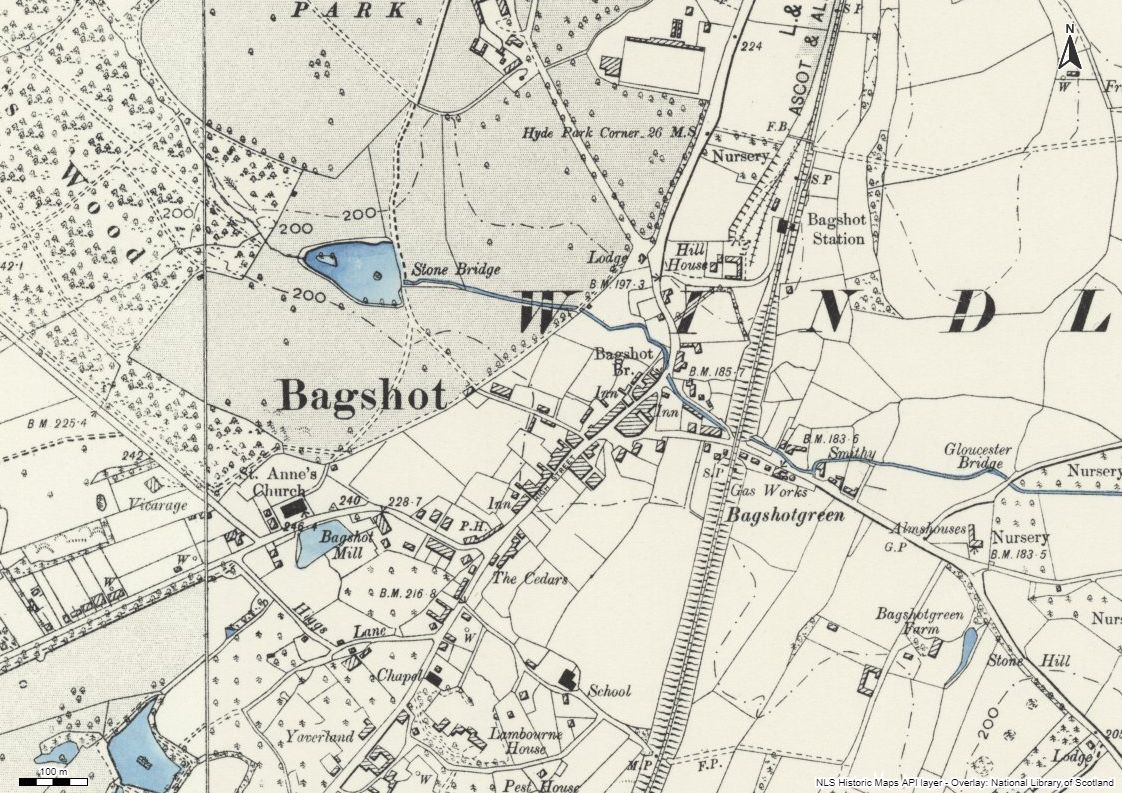
When the incident happened that morning, the train had slowed down to pull into Bagshot station and was about to cross the Guildford Road viaduct, a massively tall structure of four arches built in 1878. On either side of this bridge carrying dual train tracks were high embankments with steep, near vertical sides. On the north side, below the railway, was a vast tract of land owned by ‘Waterers Nurseries’ since 1829 to grow and sell plants. Before reaching that was Bagshot Infant School, set back from the embankment, on School Lane that ended in a footpath passing under the embankment towards Bagshot Green farm on the south side. At the time, undeveloped land stretched on both sides and (unlike now) the embankment was not bordered by trees.

Could a person have thrown a stone from the north side to make the train window next to me shatter? Unlikely because the embankment on which the train passed was too steep to stand upon. If the culprit had stood further away, below the embankment, a rock could not have reached the height necessary to make contact with the train, nor would it have retained sufficient momentum to smash the window with enough force for it to have not merely cracked, but to have shattered in its entirety.

What kind of projectile could have caused such damage? A powerful gun of some kind could have generated the necessary velocity and momentum for its bullet to shatter the thick glass window. A gunman (or woman?) would have needed practiced skill to aim upwards from the land below the embankment, or possibly to have lain half-way up the embankment adjacent to the footpath (now ‘School Lane Field’). In either case, it would have required planning and experience to succeed in such a challenging topography next to the train route. Since only two trains per hour travelled in either direction, this act could not have been a spur-of-the-moment impulse.

Why was the window I had sat beside targeted? As the train decelerated to enter Bagshot station, the rear carriages would have passed at a slower speed, making them an easier moving target than the front ones. Us schoolboys were habitually the only passengers anywhere in those rear four carriages, making my head the one visible sign of on-board life amongst dozens of otherwise empty train windows. That implies that my window must have been purposefully selected as the intended target. It was a dark winter morning and the internal carriage lighting would have made my outline visible from outside the train.

So where did the bullet land? Only one thing was certain: it had not hit me, otherwise I would not be here to tell the tale. Did we look to see if a bullet had passed over my head and become embedded in the carriage’s structure? No. In that pre-‘CSI’ era, forensic science remained an unknown foreign land. From watching weekly television detective shows, all we understood was that ‘McCloud’ cracked cases by riding his horse down Broadway, ‘Columbo’ used his raincoat and ‘McMillan’ solved crimes by getting into bed with sweatshirt-wearing wife Sally. In the aftermath, I had not even deduced that I had likely been targeted by somebody shooting a gun. That is how unworldly I must have been, though I had always enjoyed the pellet-gun target shooting stall at the fair’s bi-annual visits to Camberley Recreation Ground.

So how DID I react to this dramatic event? Did I scream? Cry? Sob uncontrollably? No, I simply stood up, brushed off the glass fragments that had covered me, and our little group moved to an adjoining carriage where the breeze through the vacant window would not make us feel colder. Even had we wanted to, there was nothing we could have done immediately. There were no train staff in those rear carriages and, once the train stopped in Bagshot station, its platform was too short to get out. Only once we reached Ascot was the platform long enough to deboard. So, did we? No, because if we had raised the alarm, we realised the fickle finger of fate might have pointed to us bunch of schoolboys for having broken the window. Which British Rail jobsworth would have believed our story that someone laying on a grassy knoll in Bagshot must have targeted me for assassination?

Leaving the train at Egham twenty-five minutes later, we could see the void where the window had exploded in front of our eyes. Nobody else seemed to have noticed the gaping hole or had bothered to halt the train to investigate. If they had, we might have arrived late for school that day. That would have been a fate worse than death. We had already brushed aside the incident and were more concerned with the school day ahead of us. Once I returned home that evening, I did not even bother mentioning to my parents what had happened. Only years later would I realise what a close call I had experienced that winter morning at the age of thirteen.

For us kids, trekking from one end of Surrey to the other every weekday on public transport, strange events would occur regularly in this otherworld. Our trains were sometimes cancelled, or rerouted through stations that were unknown to us, or suspended when someone jumped to their death off the footbridge at Egham station. In the latter case, some of us would watch morbidly for the arrival of emergency services whose crew had to scoop up the person’s bloodied remains spread along the tracks by a speeding train. Our unspoken attitude was: almost anything could happen on our way to and from school … and often did. It was a daily expedition into a world beyond ours, populated by weird adults to whom we appeared to be invisible.

Once a year, during ‘Royal Ascot’ week in June, our train would fill with bizarrely overdressed racegoers with strange toff accents and extremely loud voices who carried bottles of alcohol, swayed precariously and occasionally were sick on the carriage floor. They were much worse behaved than we had ever been, their conversations often ribald and filled with profanities. Did anyone chastise them, force them off the train or tell them to act respectfully in front of us children? Not at all! They did precisely what the upper classes are wont to do with their own children: they ignored us totally and appeared completely unembarrassed by their own behaviours.

I recalled the Bagshot train incident when, half a century later, I went for a run through rural France on a bright summer morning. There was no traffic and no visible human activity as I ran down the middle of a tarmacked road flanked on both sides by flat agricultural land. The only noise was birdsong until … a high velocity bullet whizzed above my head from left to right. I stopped running, turned in the direction from which it had come and shouted profanities (in English) at the top of my voice. Without my glasses, I was unable to see far enough into the distance to spot the culprit. This was no accident. I could not have been mistaken by a hunter for an animal. I was clearly visible on a ‘departmental’ road, not in the middle of woodland. But I had been the only object moving in this static landscape and that seemed sufficient to unwittingly make me a target.

If I were superstitious, I might be worried about ‘third time lucky’.

[Originally published at https://peoplelikeyoudontworkinradio.blogspot.com/2024/04/attempted-murder-on-waterloo-express.html ]

Walking on the Chinese glass ceiling : 2004 : FM 102 Radio, Women’s Media Centre of Cambodia

 I was standing over the motionless body of my line manager. He was dead to the world, naked under the sheet on his bed. Neither my arrival in his studio apartment through its wide-open front door, nor the chatter of little ‘street boys’ passing up and down the building’s internal staircase, nor the morning sunshine streaming through the open windows, nor the noise of rush hour traffic on the road below seemed to have stirred him. Should I call out? Should I nudge him? Since the limit of my responsibilities to the BBC had already been sorely tested by a recent health & safety ‘issue’, I decided that playing butler to my boss would stretch my patience one step too far. I turned around, leaving him asleep, walked out and descended the stairs to rejoin the driver waiting out front in the BBC SUV.

It was the ‘big day’ in March when my trainees were to interview candidates for two radio presenter jobs. Charles ‘Chas’ Hamilton had asked to attend too, so I had arranged a detour at eight o’clock to pick him up en route from my hotel to the radio station. This was unusual because, to date, he had demonstrated scant interest in my 28 hours per week of sessions training teams at two Phnom Penh radio stations in production skills, apparently preferring to remain at his desk in the air-conditioned, open-plan BBC office. On my arrival in Cambodia, rather than having furnished a training plan or schedule, Hamilton had invited me for an evening meal in his apartment, bending my ear with gossip about the BBC World Service Trust’s recently arrived Canadian manager. Now I was having to spend what remained of my seven-day working week determining which skills I needed to demonstrate to my teams and how to instruct them when I understood not one word of Khmer. 

Hamilton was oblivious to the supreme irony of my bedside presence that morning. Before departing London, BBC management had confided that, only after having signed contracts in December 2003 to supply radio training to two Cambodian stations, had it understood that its prior internal appointee to head the country’s radio projects had no experience producing live radio programmes. Having been hurriedly headhunted as a result of my international track record in radio production and presentation during three decades, my latest mission was necessary solely to bail out a consequence of the Corporation’s arcane appointment system. Meanwhile, in spite of my radio experience, my own applications over two decades for 43 BBC vacancies had resulted in thirteen interviews but not a single job offer.

Although the BBC contract required me primarily to train in radio production, it quickly became evident that, in order for my young but enthusiastic trainees to appoint inexperienced presenters for the station’s new youth phone-in programme, I needed to teach them how to word a job vacancy advertisement, shortlist applicants, interview candidates and take personnel decisions. They were fortunate that, after a decade assisting in my father’s self-employed architectural business, I had taken my first management post in 1978, hiring and firing people since then and managing teams of more than fifty. In Cambodia, my role became necessarily upgraded to informal ‘management consultant’ despite having had to accept a BBC freelance pay rate lower than the mediocre job at Ofcom from which I had just resigned in the UK … and undoubtedly lower than Hamilton’s pensioned salary as head of radio.

On arrival at the Women’s Media Centre that morning, I found my trainees already assembled in the first-floor radio studio to commence job interviews. I waited in the downstairs lobby to greet the candidates (a bow accompanying ‘hello’ the limit of my Khmer communication skills) and usher them upstairs. However, as Hamilton had yet to arrive, the schedule soon started to run over and resulted in successive applicants seated together in the reception area, a situation I had hoped to avoid. Eventually appearing apologetically an hour late, Hamilton would never be told about that morning’s ‘sleeping beauty’ encounter. It was more important to proceed with the tasks at hand.

During previous weeks’ sessions, the trainees had agreed upon three candidate tasks: an interview by the production team with a prepared list of questions allocated to each member; a script I had written and had translated, to be read into a studio microphone for recording; and a faked phone conversation recorded with a production member pretending to be a caller, to test each potential presenter’s spontaneity and improvisation skills. None of the candidates had prior radio experience, which it why it was imperative to identify ‘potential’ rather than ‘accomplishment’. The planned radio show was destined to become Cambodia’s first live youth phone-in, for which we needed one male and one female presenter.

Having completed the interview round, we broke for the mandatory two-hour lunch, me and Hamilton returning to the BBC office by car. I shared lunch with local staff at the kitchen table, while Hamilton took his usual sojourn with the ex-pat employees to a local restaurant. Afterwards, he did not accompany my return to the radio station for the afternoon session in which my trainees discussed and contrasted the candidates’ performances, assisted by BBC translator Keo Sothearith. I was incredibly impressed by the professionalism with which they ranked the candidates against criteria we had previously decided and then unanimously agreed upon the most suitable pair of applicants.

I was pleased that the whole interview process had been done and dusted so competently and quickly. However, just as I was ready to pat myself on the metaphorical back, a passionate conversation broke out amongst my trainees that the translator seemed reluctant to explain in English. I had to press him repeatedly to tell me what new issue had arisen, since there had been undivided agreement only a few minutes earlier.

“They say it is not possible to employ the woman because she is Chinese,” he explained embarrassedly. “They agree she is the most competent … but the job has to be given to a Khmer woman.”

I was shocked. Clarification was necessary for me to understand this issue. Though I could not discern the distinction, I was told the woman was ethnically Chinese (0.6% of Cambodia’s population) though not a recent immigrant, apparently speaking Khmer perfectly. Wikipedia explains:

“Most Chinese are descended from 19th–20th-century settlers who came in search of trade and commerce opportunities during the time of the French protectorate.”

I had read about ethnic tensions in Cambodia, but primarily involving neighbouring Thailand with which there had long been territorial disputes. In January 2003, following an alleged remark by Thai actress Suwanna Konying that Cambodia’s Angkor Wat temple actually belonged to Thailand, a mob in Phnom Penh had burnt down the Thai embassy and attacked Thai businesses, forcing the evacuation by military aircraft of 400 Thai citizens to their homeland. I had recently passed Thailand’s newly opened replacement embassy in Phnom Penh, surrounded by high walls for improved security.

A 2021 academic paper reported:

“Although anti-Chinese riots are rare in Cambodia, the ethnic Chinese in Cambodia during the Khmer Rouge era experienced some of the most severe repression in the world. The situation had improved by the 1990s, following the Hun Sen government’s abolishment of discriminatory policies towards them.”

The Minority Rights Group noted:

“After 1990, [the Chinese] were allowed to celebrate Chinese festivals and religious practices, then to re-establish Chinese associations and conduct business activities. They subsequently started operating their own schools…”

For the next hour, I felt compelled to argue that it was morally wrong to discriminate against a job applicant purely on the grounds of their ethnicity. It was essential to appoint the best candidate for the job. I told my trainees that the BBC would never countenance such behaviour and, since the BBC was funding their training, it was essential to follow guidelines set out within the BBC editorial handbook (a copy of which I usefully brandished from my briefcase). The trainees had already written a sign that said ‘BBC office’ (in Khmer) on their production room within the radio station, even though they were not BBC employees (as neither was freelance me).

However, I was internally conflicted by my own argument. As a 43-time applicant to the BBC who had been rejected 43 times, I was well aware from personal experience that discrimination was alive and well and living inside the Corporation. Following one of my post-interview rejections at the end of a three-month wait, I had phoned the BBC to ask precisely why I had been rejected yet again and was informed that it would be necessary for me to prove to interviewers that I was “one of us”. The unspoken implication was that I could not join the BBC ‘club’ unless either I was posh, spoke a certain way, had attended private schools or been educated at Oxford or Cambridge. Perhaps I needed a relative who was already employed there. None of the above qualified me.

Even BBC director general Greg Dyke had commented in 2001:

“I think the BBC is hideously white. […] The figures we have at the moment suggest that quite a lot of people from ethnic backgrounds that we do attract to the BBC leave. Maybe they don’t feel at home, maybe they don’t feel welcome.”

Though I had the advantage of being white, it was evident that the BBC discriminated on multiple levels. During the decades since my love of radio had blossomed at primary school, my ambition had always been to work in BBC radio. Apart from my current freelance contract, dispatched to the opposite side of the world due to the Corporation’s ineptitude, my dream was never to be realised.

In the end, I had to give up arguing with my trainees. Cambodia was not my country. I could not pretend to understand its culture or heritage. Its history was turbulent. The people’s identity was complex. I gave in to their desire to appoint the second-best female candidate for the job. I hated myself for giving in. I had been on the receiving end of discrimination on too many occasions over too long a period in several countries. But I had lost the argument. I returned to the BBC office with the names of the two presenters whom the team had chosen. Yes, I confirmed, they were the best candidates (cringe). Both quickly became astoundingly competent radio presenters.

Later that month, Charles Hamilton arrived in our Phnom Penh office one morning and explained that he had lost a BBC laptop computer on the journey from home. It would need to be replaced. Within the hour, the number of laptops he said he had lost that day had increased to two. His comments, combined with the memory of my early morning visit to his apartment, made me contemplate that the BBC staff induction programme should be appended with an additional topic: ‘How to close and lock the front door of your accommodation’.

https://drive.google.com/file/d/1glfc6ziCi-9bWg4buIj-29rSK-1hV88f/preview

During the decade following my extended mission in Cambodia, I applied for a further twenty BBC job vacancies and was rejected for all.

[Originally published at https://peoplelikeyoudontworkinradio.blogspot.com/2024/04/walking-on-chinese-glass-ceiling-2004.html ]

Around the British Rail network in eight hundred minutes : 1976 : Durham University challenge

 “Which bus goes to the University, please?” I asked. The man replied helpfully, but I could not understand a word he had said. He spoke English, though not an English I had heard before. I was confused by all the bus stops, having just exited Lancaster railway station. At which one did I need to wait? There was no bus map. There were no obvious students to ask. I had never been north of Luton until then. I had never watched ‘Coronation Street’. I was a southerner who barely understood a word that was being said to me there, hundreds of miles from home.

I had left the house that morning at the crack of dawn to make a day trip to check out Lancaster University. It was one of five universities I had selected on my UCCA form, all of which had offered me a place, conditional upon A-level results, without requesting an interview. However, if I was going to spend three years far away from home, I wanted to go see each one to help me choose. I had never visited a university before. Aside from my teachers, I had never met anyone who had attended university. That year, I hoped to be one of the 6% of school leavers who would go on to university, a proportion that had multiplied from 2% the year I had been born.

My state school had provided no useful advice how to choose a university or course. Our designated ‘careers counsellor’ was actually a moonlighting English teacher who would merely direct us to a row of dogeared university prospectuses on his office shelf. Some were out-of-date, many were missing. We were offered no ‘careers’ seminars. Surrey County Council had compelled each sixth-former to complete a multiple-choice questionnaire and then informed us for which career we were supposedly suited. Further studies were never suggested. You were on your own when it came to an academic future.

I understood that my choice of university could be a life-changing decision, one that required me to review the maximum amount of available information. If neither my family nor my school could provide useful advice, I would research all the options myself. I wrote a letter to every UK university outside London (where I realised accommodation was unaffordable), requesting their current prospectus and details of their economics courses. I chose that subject simply because it had provided my best academic results at school. I had known for a decade that I desired a career in ‘radio’, though university courses in media or broadcasting did not exist. If I had known then that Britain’s first ‘media studies’ degree had been launched at the Polytechnic of Central London (later renamed the University of Westminster) in 1975, I might have rethought my plans.

Seven years earlier, at my council estate junior school, I had been one of three children out of my class of thirty (10%) to have passed the ’11-Plus’ examination, necessary to progress to ‘grammar school’. However, at that time, around 20% of UK pupils attended these ‘selective’ secondary schools, the difference attributable to the substantial numbers of privately educated children who were crammed intensively at fee-paying ‘preparatory schools’ to pass the exam and who then dominated grammar schools’ intakes. From my ‘year’ of sixty students at Strode’s School, only around ten of us progressed to university, an indication that the ’11-Plus’ was less a successful method of identifying Britain’s brightest children, and more a route for middle-class parents to secure their offsprings an elitist secondary education paid for by the state. Has this situation since improved? In 2008, the Sutton Trust reported that grammar schools were enrolling “…half as many academically able children from disadvantaged backgrounds as they could do”.

I was fortunate that Surrey County Council would pay my train fares for visits to five universities, whether an interview was required or not. I had to determine when each institution offered ‘open days’, book my place, arrange train tickets and inform the school of my impending absence. It required considerable organisation, particularly as these visits necessitated train connections in London. These were days when I would not return home until almost midnight and would have to go to school the following day. I had never travelled so many miles on public transport or seen so much of England from a train window.

I must have been the only student at my school to own a copy at home of almost every UK university’s current prospectus. My request for economics course information proved less successful. Many sent me nothing, the remainder provided a single sheet outlining a course that merely encompassed all aspects of the subject. I read absolutely everything I was sent and concluded that every university claimed to be absolutely perfect and their courses the best. I had merely filled my bedroom bookshelf with marketing propaganda. Instead, I decided to select four universities that already operated student radio stations as this was my long-term career objective … plus Durham.

Although Durham University had no radio station, I learned it was apparently thought of highly. If I were rejected by Cambridge, I considered it might be a reputational substitute. Due to the 300-mile distance, my trip to Durham required an overnight stay in Collingwood College which was offered free to those attending ‘open days’. After a long train journey followed by an uphill walk, I was given an undergraduate bedroom within the college and met several other visitors who were there for the same reason. We took the university’s guided tours together the next day and ate as a group in the college’s dining room, offering us a first taste of undergraduate life.

The following morning, we packed our bags and met together for the thirty-minute walk to Durham railway station on the opposite side of town to catch our trains back to ‘the south’. However, we found the platforms deserted and, eventually locating a member of staff, we were told that a strike had started that morning and there were no trains departing in any direction. Returning to the college with our tails between our legs, we explained our problem and it kindly offered to extend its hospitality until we could depart. Each of us changed our banknotes into piles of ten-pence coins and queued at the college’s one public phone in the basement to contact our parents and schools to explain that we did not yet know when we could return. A quick visit had unexpectedly transformed into something longer.

I took the opportunity to wander around Durham’s compact town centre and explore more places, particularly the ‘Musicore’ record shop. The university library and the cathedral were both impressive, as was the brutalist concrete student union building ‘Dunelm House’ and adjoining ‘Kingsgate Bridge’ constructed by architect Ove Arup in 1963. The other universities I had visited were campus-based, requiring a bus journey to the nearest town. I quite liked Durham’s integration into the city and the ability to walk from one end to the other without need of transport.

The next morning, before breakfast in the college dining room, I phoned Durham railway station, to be informed that no trains would be running for the second consecutive day. This was the only method to obtain information in those days. I met the others and we phoned our families with our disappointing update. We spent most of that day sat together in the Junior Common Room chatting, sharing our university visit experiences and our hopes for the future. For me, it was particularly interesting to meet young people for the first time who shared my situation.

I made another call to the railway station the next morning, anticipating more bad news, but was told a single train was expected that day. It would be heading north, the opposite direction to what we required. I asked if there was any alternative route to London and it was explained that, although the east coast route was still on strike, we could try travelling via the west coast on the opposite side of the country. When was this one train expected? In an hour, I was told. Action stations!

I located my fellow visitors and, without taking breakfast, we all signed out of college and rushed off to the station. There was no information available there about the time of the train, on which platform it would arrive or where it would be heading. While we waited, we examined a British Rail route map in the ticket office which showed a cross-country route from east to west coast that started in Newcastle, the next major stop north of Durham. We were the only people awaiting a train and did wonder whether we had been sent on a wild goose chase, only to have to return to the college for yet another night.

Then the day’s promised one train appeared and pulled into the station. Unsurprisingly, it was almost empty. Who would have known it would be running in the midst of a crippling strike? We boarded and waved farewell to Durham, not knowing if any of us would ever return. Within a quarter-hour, we alighted in Newcastle. It was the first of many times that day that we were required to explain to confused railway staff that, although our tickets to London were dated days earlier, the unanticipated strike had forced us to take the only train available … in the opposite direction.

Next, to cross England to the west coast, we discovered we had to take a less regular, slower train that would depart in an hour. The wait gave us an opportunity to walk out of Newcastle railway station, buy some breakfast and wander around the city. Compared to Durham, it appeared a huge, busy scruffy city centre with huge Victorian stores and old-fashioned shopping arcades. Even the clothes people wore seemed dated and dowdy, particularly seeing many men wearing flat caps. It was an industrial city where time seemed to have stood still fifty years earlier.

Our ninety-minute journey in a local train from Newcastle to Carlisle took us across the bleak terrain of the North Pennine hills, stopping only at tiny towns with strange, unfamiliar names like Prudhoe, Corbridge, Hexham and Haltwhistle. Once again, we were required to explain to the train’s on-board ticket inspector why we were travelling in the wrong direction with out-of-date tickets. He knew about the strike and laughed heartily at our story, wishing us well on our journey home. It began to feel like a kind of ‘expedition’ where, at every step, it proved necessary to explain why our little group of seventeen-year-olds were taking a route no sane person would choose to follow.

The train terminated at Carlisle, a two-thousand-year-old city on the border between England and Scotland, fifty-five miles west and north of Durham. It was midday by now and, from there, we could now take a west coast ‘Intercity’ train southbound. We did not venture outside the station as this would have entailed having to explain our tickets once more and we feared not being allowed entry back into the station. This region was unaffected by the strike and trains seemed thankfully to be running as scheduled.

Our four-hour journey to London was comfortable until a ticket inspector arrived. We explained our story but he seemed unaware of the rail strike on the east coast and disbelieved our narrative. Initially, he demanded we pay for new tickets. We refused because we each held a valid, paid-for British Rail ticket that we had been prevented from using by the strike. The argument continued and he demanded we write down our names and addresses in order that the police could be contacted so that we would be fined for travelling without valid tickets. He was a ridiculous ‘jobsworthy’ who showed no sympathy for our plight. His attitude ruined the longest, most gruelling part of that day’s journey.

Reaching London’s Euston station, our small group split up to head different directions home. It was a sad parting of ways as we had no idea if we would ever see each other again or even which university each of us might attend (no social media or mobile phones then!). The last few days had required us to bond in the face of adversity, forcing us to make a round-Britain trip we had never imagined. It would be quite a story to tell our classmates.

I crossed London by Tube, caught a train from Waterloo station to Camberley and then a bus, reaching home more than twelve hours after having left Collingwood College in Durham. My school might not have been happy about my extended absence but, later that year, those awaydays would play a major role in my decision to study in Durham. I felt as if I was already sufficiently familiar with the college and the town as a result of that elongated visit. I imagined that my fellow Durham students would be similar to those with whom I had travelled the length and breadth of England.

Did I receive correspondence from British Rail or the police as a result of the unfriendly ticket inspector we had encountered? Thankfully, no. Did I ever see my newfound friends again? Sadly, no.

[Originally published at https://peoplelikeyoudontworkinradio.blogspot.com/2024/03/around-british-rail-network-in-eight.html ]