Tag: Germany
GERMANY: government drops FM radio switch-off 2015 date from new legislation
VPRT, the German trade association for commercial media, has welcomed the government’s decision not to include clauses in its new Telecommunications Bill that would have switched off FM radio broadcasts in 2015. In its 9 March 2011 press release, VPRT stated: “FM is and remains the basis for the development of new radio services.”
VPRT described the earlier federal plan to switch off FM radio on 31 December 2015 as a “completely unrealistic statutory requirement” which would have made redundant 300 million FM radio receivers.
Germany is making a second attempt to launch DAB radio with ten national services scheduled to start in August 2011. US broadcaster Radio Disney had been an initial applicant for one of the national commercial DAB radio channels, but subsequently withdrew its proposal in January 2011. Some of the other commercial stations had been offered a financial subsidy by DAB chip manufacturer Frontier Silicon in December 2010 [see blog].
However, as one German publication commented: “So far, consumer interest in digital radio has been extremely low.” Pit Klein from the magazine ‘Sat+Kabel’ explained: “We have estimated from the regional media authorities that only about 500,000 DAB radio devices are in circulation.” Christoph de Leuw from the magazine ‘Audio Video Foto Bild’ said: “In some areas, [DAB radio] receives only two or three stations. No one buys a new radio receiver for €100 to receive two stations … People are satisfied with FM quality. The real, practical benefits to consumers [of DAB] are yet to be determined.”
Experts in Germany agree that the future of radio is digital. “Whether the digitalisation of radio will take place on DAB is questionable,” said Sven Hansen, editor of the computer magazine ‘c’t’.
[with thanks to Follow The Media]
GERMANY: planned 2011 re-launch of national DAB "solved a problem that did not exist"
On 15 December 2010, five commercial radio stations in Germany – New Wave Radio, Lounge.fm, ERF Medien, Radio Energy in Hamburg and Regiocast Digital – signed contracts with transmission provider Media Broadcast to broadcast on the new national DAB+ platform, scheduled for launch in 2011.
One week earlier, British company Frontier Silicon, “market leading supplier of digital radio technology worldwide”, had announced that, in order to persuade four commercial radio broadcasters in Germany to persevere with DAB, it had promised them it would purchase an unspecified amount of their advertising airtime for the next four years.
Anthony Sethill, Frontier Silicon CEO, put a positive spin on an act that some might perceive as little more than legalised bribery in the face of desperation to sell DAB hardware in Germany: “We are delighted that our innovative approach to supporting the roll out will help everyone working on this new radio service to bring their efforts to fruition.”

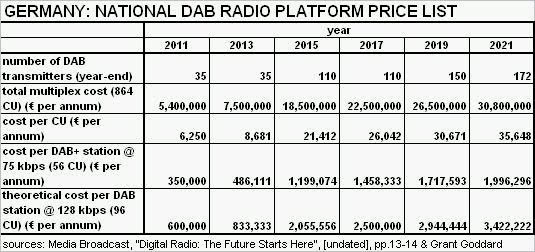
For years, German transmission provider Media Broadcast has been eager to put into action its masterplan to lock new DAB+ broadcasters into minimum 10-year contracts, for which it will be charging €2m per annum per station by 2021. The combination of Media Broadcast’s enthusiasm for the financial returns from DAB transmission contracts, and Frontier Silicon’s enthusiasm for the potential sales in Germany of DAB receivers that incorporate its technology, plus the offer of an amount of cash, persuaded a few commercial broadcasters to take on the risk of using the DAB+ platform.
Helmut Egenbauer, CEO of Media Broadcast, said: “Having introduced Frontier Silicon to the commercial broadcasters, we are delighted to see that their discussions have led to this important commitment to DAB+ radio services.”
Those five German commercial broadcasters should understand that even Frontier Silcon’s subsidy might not prevent them losing money hand over fist for the entire ten years of their transmission contract with Media Broadcast. The evidence is already there from the UK market. Not one commercial digital-only radio station has yet made an annual operating profit from the DAB platform in the UK, even after eleven years, let alone come close to recouping its investment.
Research commissioned by RadioCentre in 2009 found that the average annual revenues of a digital radio station were around £130,000 per annum. By then, 10m DAB receivers had been sold in the UK. Yet Germany is still at Year Zero with DAB+ radio penetration. The same report for RadioCentre had noted that the “annual negative cash flow impact of DAB” on the UK commercial radio industry was around £27m per annum, or 5% of sector revenues. Can German commercial radio afford to deplete its profitability by that sort of amount, year-on-year, for the next decade?
Frontier Silicon’s press release quoted Helmut G. Bauer as a “representative of the commercial broadcasters,” saying what a fantastic deal it was and promising that “2011 will be year that DAB+ is successfully launched in Germany.” However, Bauer is not associated with the German commercial broadcasting trade body, VPRT, which has been outspoken in its condemnation of plans for digital radio switchover in Germany. Bauer is a Cologne-based lawyer who has long made pro-DAB presentations at media conferences, and pro-DAB statements to the press, as a ”consultant.”
In fact, VPRT had commented: “As we know, DAB failed in the market. Against this background, plans for the closure of FM – originally scheduled for as early as 2015, but now postponed – are absurd from an economic and social perspective and are therefore unacceptable.”
Noting the developments in Germany this week, Berlin-based Christoph Lemmer wrote in Radioszene magazine:
“With this decision, DAB will now actually be introduced by those who have succeeded, smelling a quick buck, in selling Germans a new sort of equipment, with millions to be sunk into to a new transmission network. Our old radios will be useless for DAB. Those who want to continue listening to the radio will need a new receiver.“
“It does not take a prophet to suspect that the private radio industry has shot itself in the foot by agreeing to sign the DAB contracts. A few shekels subsidy from a chip manufacturer who wants to install as many of its chips in DAB receivers – that is what has led to this. You, dear people, were not considered in the end. Do you really believe that devices with DAB will ever be as numerous as FM radios are today?”
“No one will understand what [DAB] is and why it is good. Because, with DAB, you have solved a problem that did not exist. The existing technological distribution of radio programmes is excellent and widely used. You did not have to change anything. The argument that DAB will create new radio channels with lower entry barriers is specious, as long as media regulators continue not to award licences for technically available [analogue] frequencies because they do not want additional competition in the market.”
This week, World DMB, the body marketing DAB radio globally, was so excited by developments in Germany that its web site posted seven news stories about it on 15th, nine on 16th and a further four on 17th. The overkill speaks volumes. Lacking any upturn in DAB receiver sales, the only positive news that DAB lobbyists can muster is this second attempt in Germany to launch a DAB technology that was first developed in 1981.
It is hard to recall a comparable technology whose proponents were still pushing for its launch three decades after its invention. DAB proponents argue that, simply because DAB is ‘digital’, it is inevitable that it will replace analogue radio. History indicates otherwise.
Digital Audio Tape. Introduced 1987. Abandoned 2005.
Digital Compact Cassettes. Introduced 1992. Abandoned 1996.
GERMANY: DAB "is not financially viable", internet radio on the rise
“DAB or DAB+, in its current form, is not financially viable for commercial radio stations,” said Stefan Schmitt, managing director of RTL’s Berlin radio stations, in Promedia magazine. He pointed out that user numbers were increasing steadily for the internet, wireless via PC, laptops and smartphones. “Under these circumstances, I do not know where exactly the added value is for DAB,” he said.
Schmitt argued that the whole radio business model is still based on FM broadcasting and will remain so “for the foreseeable future.” He believes that the best alternative to broadcasting is currently ‘online radio’: “We are achieving market penetration [with online] much more rapidly than with DAB, which is not market driven.”
In Germany, a dispute continues to rage over the funding of DAB radio. The CDU party’s media expert Thomas Jarzombek has argued that “more than €200m of public funds were wasted on DAB” and that “these resources should be used for technologies that are well received by the public.”
Negotiations have been proceeding for months over a further €42m of public funds earmarked to be released to re-launch DAB radio nationally using the DAB+ codec, following the failure of the earlier launch using the older DAB codec. Initially, the contracts between transmission provider Media Broadcast and the station owners were meant to have been signed on 22 July 2010. Then, the subsequent 22 September 2010 deadline for negotiations passed without agreement, as a result of commercial radio’s unwillingness to commit financially to broadcasting on DAB+. This deadline has been extended again to 15 December, which experts in Germany now suspect is “the last chance for DAB+.”
At its annual conference on 12 November 2010, the German association of commercial broadcasters, VPRT, reiterated its opposition to the government forcing the introduction of DAB+ radio upon the German market. Outgoing VPRT vice president Hans-Dieter Hillmoth said: “The current draft of the new Federal Telecommunications Act ignores the existing interests of commercial radio in the functioning infrastructure, whose core business is FM radio.”
New research in Germany by the Frankfurt Link Market & Social Research Institute has demonstrated the increasing popularity of listening to radio via the internet platform. Consumers’ preference for radio delivered to a PC or laptop increased 84% year-on-year, and is now exceeded only by traditional radio hardware – car radios, kitchen radios and stereo systems. Amongst 14-29 year olds, radio via a PC/laptop scored second only to the car radio.
The question put to respondents was: “Radio can now be received on many different types of appliances. Please indicate which appliances you particularly appreciate, regardless of duration of usage.”
Shameless Book Plug
Apologies for the interruption to my normal radio sector analyses, but I wanted to let you know that a book of my writings about DAB radio was published this week. It collects together 99 of the essays that have appeared in this blog over the last two years concerning the digital radio switchover issue in the UK. The period between 2008 and 2010 was a critical ‘make or break’ time for DAB which ended with the legislation of the Digital Economy Act. But have any of the committees, consultations, working groups, reports and recommendations from this period made any difference to the slowing take-up of DAB in the UK? No.
“I’ve been surprised by how many of my peers at the golf club have adopted internet radio and some of those are people who can’t even get a decent FM signal, never mind DAB. The key issue with DAB and the migration to FM is going to be dictated by the speed at which at the motor car can be migrated, and there is no easy solution. If the migrations takes 20 or 25 years to go as it did from FM, the future is just possibly wi-fi.”
Digital radio switchover seems doomed and the only people still talking it up are those who have a direct stake in it, either through their financial investments, or from earning their living from talking it up. Because the UK started on the DAB switchover trail earlier than other European countries, our experiences have relevance to markets that started later on the DAB journey.
This week, it has been interesting to see the interest my book has spurred in markets such as Norway, Denmark and Italy where, like the UK, DAB is still being pursued despite widespread consumer indifference. In Norway, a news
story about the local receiver market appeared in the newspaper Aftenposten headlined ‘Customers do not want DAB: FM is still selling like hotcakes’. The buyer at a Norwegian electronics store said that DAB was already a flop and he was quoted: “So far, this year, according to industry sales statistics to which I have access, only one DAB radio has been sold for in-car installation”.Many countries are awaiting some kind of government decision as to whether digital radio switchover will still be a policy goal. In Norway, a government report on the DAB issue is to be published later this year. In France, a government report on the financial model for digital radio was meant to have been unveiled this week, but was not. In Germany, the 21 September deadline by which state and commercial radio was meant to have submitted a joint plan for government funding to re-launch a national DAB+ multiplex passed without agreement and has had to be extended to 15 December 2010. One German report said “it is highly doubtful whether the negotiating parties will agree by the [new] deadline.” Another report said: “experts suspect that this is the last chance for DAB+.”
In Italy, radio stations that have started broadcasting in DAB and DRM are angry at the lack of digital radio receivers in their shops and have turned to UK manufacturer Pure Digital for help. One Italian report asked: “Do people feel the need to replace their old FM radios? Especially in the era of the smartphone, internet radio and applications, the answer seems obvious.” In Spain, the existing DAB radio licences that were initially issued for a ten-year period in 2000 have just been extended to fifteen years, in the face of widespread consumer apathy towards DAB radio.
It is evident that the digital radio switchover issue continues to generate a lively debate in many European countries. My hope is that our experience in the UK can help other countries make an informed decision about the adoption of a realistic plan for ‘the future of radio’ in their own markets.
DAB DIGITAL RADIO: LICENSED TO FAIL
GRANT GODDARD
Radio Books, London
ISBN 978 0 9564963 0 0
paperback 297×210 mm, 314 pages
1 October 2010
book excerpts
more information http://www.radiobooks.org
available from online book retailers including Amazon
Book plug over.
GERMANY: “The over-40’s will be listening to radio on FM for the next 40 years”
On the afternoon of 10 August 2010, a group of radio people from Germany, Austria and Luxembourg gathered in Erfurt, Germany to discuss the future of radio in the digital age. They had been invited there by the media regulator for Thüringer state (TLM) and some of the region’s broadcasters. The event was entitled ‘Radio 2020: a radio future between optimism and pessimism’ and followed on from a similar event held a year earlier.
This year, the final conference session tackled the topic ‘Radio and the day after tomorrow: new possibilities for distribution and exploitation of radio content on the internet’. A presentation by Dr. Klaus Goldhammer, managing director of the Goldmedia Group in Berlin, included the assertion:
“Radio broadcasting and internet radio are different markets.”
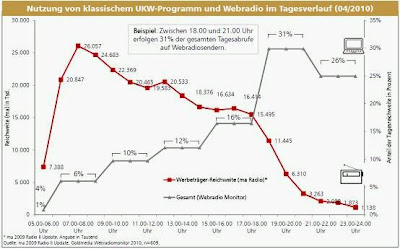
Goldhammer plotted the flow of daytime audiences in Germany for broadcast radio and internet radio on the same graph. It demonstrated that the peak broadcast radio audience between 0700 and 0800 corresponded with the lowest daytime audience for internet radio. Conversely, the peak audience for internet radio was between 1800 and 0000, corresponding with broadcast radio’s lowest audience of the day (see the slide below from his presentation).

Goldhammer noted that 31% of internet radio’s daily hours listened were consumed between 1800 and 2100. This appears to be very different from the US experience where a significant volume of listening to internet radio takes place during office hours in workplaces. In Europe, listening to radio (any radio) at work is still nowhere near as common as it is in North America.
Goldhammer noted that the growth of internet radio listening was still very slow in Germany, compared to the growth in available internet bandwidth. He concluded that:
“The over-40’s will be listening to radio on FM for the next 40 years”
Lars Gerdau, managing director of LandesWelle Thüringen, a regional rock/pop radio station broadcast on 14 FM frequencies, commented:
“We see the whole [internet radio] thing has become much more complicated than a year ago. Firstly, it is very expensive to stream a lot of radio programmes and, secondly, we have no claim to be first [in the internet space]. We have time and will focus first on FM.”
After the conference, Inge Müller-Seibel, a German radio sector commentator, noted that neither was DAB radio replacing FM as the main listening platform:
“After two decades of experimentation in Germany, the future of digital [terrestrial] radio remains uncertain. It was 1987 when the new DAB transmission technology was presented for the first time at the IFA in Berlin. Some ten years later, the German states listened to Brussels and recommended the closure of their terrestrial FM frequencies by 2015 at the latest. But almost nobody believes it will happen, and now the radio stations are putting more hope in new distribution technologies via the internet.”
And a reporter at this year’s IFA consumer electronics fair wrote:
“Digital radio is not a success story in Germany. Little more than 500,000 digital receivers have been purchased, a tiny number compared to the several million analogue FM receivers.”
A recent article in Die Welt newspaper asked ‘When will FM radio die?’ and explained:
“In fact, the [FM] technology should no longer exist. Originally, the abolition of FM was planned for this year. Instead, radio listeners across the country should have been receiving only digital signals. But the outcome has been different because most people are completely satisfied with the quality of good old FM stereo, and because of the inertia from an estimated 300 million FM radio receivers in Germany. Only a few geeks have so far bought digital radios with DAB technology.
Additionally, it is mobile phones, a symbol of the triumph of digital technology, that have supported the continuation of analogue FM radio. This is because most phones have a built-in FM radio receiver.”
[thanks to Katrin Penzel]
GERMANY: No radio interest in DVB-T digital platform
The media regulator for Hamburg and Schleswig-Holstein, MA HSH, has had to re-advertise a licence comprising spectrum for the DVB-T platform, this time to television applicants, after its previous attempt to offer the spectrum for digital radio channels met with disinterest. MA HSH director Thomas Fuchs told Rapid TV: “The response to our tenders of DTT frequencies is clear: There is very strong demand for the distribution of TV channels, but there seems to be little additional value for the radio industry.”
In December 2009, the regulator had invited bids to provide 16 radio channels in spectrum that also offered capacity for ‘Visual Radio’ enhancements. Thomas Fuchs said then: “Now that opportunities for development of the FM band are exhausted, we can invite bids to contribute to the advancement of the radio landscape in Hamburg and Schleswig-Holstein.”
However, in March 2010, the regulator had to report that “the interest on the part of radio broadcasters is so low that the Media Council decided, as a result, not to award any radio allocation.”
GERMANY: “FM is and will continue to be the most important means of transmission for radio,” say commercial broadcasters
Commercial radio broadcasters in Germany have published a policy paper emphasising that FM will continue to be the main broadcast platform for radio. The VPRT, a trade association of 160 commercial broadcasters (70 of whom are active in radio), this week responded to the draft Work Programme for 2010 set out by the Radio Spectrum Group [RSPG] of the European Commission. One of its proposed work streams had been “to discuss the pros and cons of indicating a target date for analogue radio broadcasting (FM) switch-off.”
The formal response from VPRT sets out powerful arguments why current FM spectrum (referred to as ‘Band II’) will continue to be radio’s most important platform for broadcasting:
The future development in the different frequency bands (especially Band II) is of utmost importance to our radio service members. Therefore, we are seriously concerned about the fact that RSPG is considering a target date for analogue radio broadcasting (FM) switch-off.
Nevertheless, we see the need to think about future developments and possible usages of Band II which comply with the provisions of the GE84 [Geneva radio conference of 1984] agreement and ensure FM services which are able to operate free of any interference. At the same time, we would like to stress the necessity of adapting and developing those GE84 provisions to ensure the continuity of Frequency Modulation (FM) and the future usages in Band II. However, this needs to be achieved without further co-ordination at international level.
1. Band II with FM is and will continue to be the most important means of transmission for radio
Band II with FM is the most important means of transmission for VPRT’s radio service members. Also, in the foreseeable future, Band II with FM will remain the basis of commercial activities for private radio stations. This is grounded by two reasons: firstly, the heavy usage by listeners and, secondly, the very high market penetration of FM receivers. Currently, more and more new Band II FM receivers are establishing in the market. As a consequence, the receiver basis is modernised constantly. Modern communication devices, such as mobile phones, smart phones and media players, integrate Band II FM receivers and ensure an even wider availability of FM. Switching off FM transmission is therefore neither realistic, nor can it be crowned with success.
2. FM in Band II is of utmost importance in the case of catastrophe
Due to the extremely high penetration of FM devices in Europe and its heavy usage, Band II is the only reliable way to inform the public in the case of catastrophe or need of contacting citizens in an emergency. This was recently proven when a blizzard hit Germany at the beginning of January. This is also valid in case of a regional power cut, as many devices are powered by batteries. For the time being, no digital receiver (DAB, etc.) has been developed for the operation with battery.
3. Band II is a small but efficiently used frequency range
The so-called Band II is the frequency range between 87.5 and 108 MHz and only represents 20.5 MHz. Nearly every single frequency is used in this bandwidth. Together with the broad receiver penetration and very high usage by the listeners, this small bandwidth is very efficiently used. In the last few years, receivers have been significantly developed which today results in an enormous improvement of their reception quality. Millions of listeners are convinced by the characteristics of FM. Even under very difficult circumstances for receiving a signal, a very good reception is possible. On the other hand, other (digital) systems are disconnected in a very early stage, which is rather disadvantageous. The usage of Band II is still “state of the art”.
4. No migration or partial migration of the services in other frequency spectrum
VPRT rejects any proposals which include the shifting of the current usage from Band II to other frequencies. This would bring the intensive and effective use of Band II to an end. Due to the lack of digital receivers, as well as of the absence of consumer demand for change and migration, a restart of a digital system would mean inefficiency and un-sustainability for a very long period of time. In other bands, there is enough space to introduce new systems. Band III (174 to 230 MHz, channels 5 to 12) and therewith corresponds to 56 MHz – is available.
5. Consideration of future developments of FM transmission after GE84
Since the Geneva conference of 1984 (GE84), different parameters of the FM usage in Band II have changed. In the meanwhile, different and changed sources of signals are available (music), the signal processing was adapted and a compression of the signals was introduced. The processing of the FM signals in the receivers is completely digital. 25 years after G84, the provision from the Geneva plan should be adapted and developed according to recent technical developments.
6. There is a chance for new standards with unlimited parallel FM operation
In the medium term, there are different options to develop the use of Band II. The use of FM has to remain, due to the heavy use described in point 1.4. An unlimited parallel FM operation offers the opportunity of financing additional engagements from the remaining FM transmission. Further developments with new standards based, on additional unlimited parallel operation of FM, is a chance for economical efficiency. Therefore, it is necessary to adapt the ETSI spectrum mask ITU-BS.412-9, as well as other ITU-R recommendations, by keeping the guidelines for aeronautical services (VOR and ILS). In this way, the “envelope concept” which was already used in the GE06 plan could be kept. Therewith, new standards under an adapted ETSI spectrum mask would be possible without interfering with the existing FM transmission and conditions. In this case, a new planning conference would not be necessary.
We support a conversion to digital assignments if the FM transmission can be maintained without any limitation. In this case, a switch from single FM transmission into a digital transmission would be possible, without discriminating other FM transmissions.
We do not see a future for technologies which are linked to a switch-off of the FM transmission.
7. Interference with FM through new standards have to be avoided
As already mentioned in point 6, it must be avoided that future technology developments cause any interference to the existing FM transmissions. A reduction of the current coverage caused by future developments is not acceptable for VPRT members. Some aspects of the technical developments are promising but, due to a lack of information, a full evaluation is not possible.
8. No international re-planning of Band II or of parts of it
Due to the very intensive and effective use of Band II, we do not see any need for a long and very costly international re-planning. The GE84 plan should be supported in its principles and adapted as mentioned in point 6. Even a re-planning of certain parts of the Band II would not lead to any benefit, as the complete Band II is used and needed in the future.
9. Re-adjustment of Band II at national level is necessary
However, we always have been calling for a re-adjustment of Band II at national level in order to balance the relation between public broadcasters and private broadcasters. At the moment, we face an imbalance with regard to the amount of frequencies, as well as the frequency capacity, held by public broadcasters on the one hand and by private broadcasters on the other hand. We therefore ask for a readjustment which takes the actual demands into account. The introduction of new standards would carry forward the current imbalance.
10. Further research and economical comparison are necessary
Next to the research and comparison, with respect to the technical characteristics and parameters of the available standards, further research is needed to complete a substantial evaluation. For the time being, an evaluation of the economical and financial factors is still missing. We therefore ask to also take those aspects into consideration.
Summary of VPRT comments
• Band II with FM is and will continue to be the most important means of transmission for radio
• FM in Band II is of utmost importance in the case of catastrophe
• Band II is a small but efficiently used frequency range
• No migration or partial migration of the services in other frequency spectrum
• Consideration of future developments of FM transmission after GE84
• There is a chance for new standards with unlimited parallel FM operation
• Interference with FM through new standards have to be avoided
• No international re-planning of Band II or of parts of it
• Re-adjustment of Band II at national level is necessary
• Further research and economical comparison are necessary
Berlin, January 2010
[this is VPRT’s own English translation]
GERMANY: government proposes to re-launch DAB in 2011, if sufficient interest
In Germany, the Commission for the Approval & Supervision of State Media Authorities, ZAK, has published a new directive today that attempts to stir interest in resuscitating the country’s DAB radio system. It requires the media authority of each German state to issue a common tender by 22 January 2010, calling for applications by 12 March 2010 from those who want to provide national radio services on DAB.
This new plan involves re-launching DAB radio in Germany in early 2011, but only “if sufficient qualified commercial applicants” show interest in acquiring licences, according to ZAK. Two-thirds of national DAB multiplex capacity has been allocated by the government to commercial radio, with the remainder for state broadcaster Deutschlandradio.
ZAK says it is seeking proposals for new digital stations that “strengthen the diversity of viewpoints in Germany” by offering information, business, sport, religion and specialist music formats. However, this suggestion flies in the face of evidence from other countries where it has not proven commercially viable to offer specialist radio formats on a national DAB platform, even after many years of consumer hardware take-up. For example, in the UK, many radio formats have come and gone on the DAB platform over the last ten years, including:
• news (ITN News 2000-2002)
• business (Talkmoney 2000-2003)
• 50s/60s music (PrimeTime 2000-2006)
• country music (3C 2000-2007)
• teenagers (Capital Disney 2002-2007)
• contemporary pop music (Core 1999-2008)
• soul music oldies (Virgin Groove (2000-2008)
• pop music for young women (Capital Life 1999-2008)
• book readings & talk (OneWord 2000-2008)
• jazz music (TheJazz 2006-2008)
• extreme rock music (Absolute Xtreme 2005-2009)
The worst thing a nascent or potential business can do is fail to learn from the experiences of those who have attempted the same proposition previously and failed. Continually re-inventing the wheel is a waste of human and financial capital. The agencies that are charged with promoting DAB broadcasting could do the global broadcast industry a massive favour by analysing and documenting why each of these stations, and others like them in other countries, failed. There is much more to be learnt from the 95% of business failures than from the 5% of successes.
Propagating the notion globally that DAB radio has been nothing other than a huge success in the UK is horribly irresponsible. More than £600m has been sunk into DAB in the UK over the last decade, but not one content provider has yet generated an operating profit from the platform. Actively encouraging and promoting implementation of DAB radio overseas as a means for broadcast entrepreneurs to emulate the ‘success’ achieved in the UK is as immoral an export as selling cigarettes to developing countries as a ‘luxury’ good.
Judged by their previous rejections of the DAB platform (see my July 2009 blog), radio stakeholders in Germany have demonstrated that they are not so easily duped.
GERMANY: National public radio to end DAB broadcasts year-end
At the end of September 2009, the Radio Council of Germany issued a public statement in which it objected to the withdrawal of further funding for DAB radio by the KEF [the organisation that allocates funds for public radio] in July 2009 (reported here) and it made a direct appeal to the Prime Minister to create an independent digital platform for radio broadcasting. It said the rollout of DAB+ to replace DAB would now be cancelled. It argued that the phased closure of analogue radio broadcasting between 2015 and 2020 was realistic and that the government should adopt a legal framework for digital radio migration.
Now, in an interview this month with ‘Digitalmagazin’, the director of Deutschlandradio (German national public radio) Willi Steul confirmed that its two national stations will end broadcasting on the DAB platform at the end of 2009.
Digitalmagazin: ‘Deutschlandradio Kultur’ and ‘Deutschlandfunk’ will not be available on DAB radio after the end of the year. What led to this bitter decision?
Steul: We need to face up to the fact that the KEF removed funding for further DAB broadcasting, including the DAB broadcasts of our two channels. This is all the more regrettable because DAB will no longer be available for the digital distribution of our new, knowledge-based, educational station.
Digitalmagazin: To what extent does this sound the final death knell for DAB?
Steul: So far, not yet. However, DAB – although vital – is in intensive care and living a sad, hospitalised existence. A paradoxical situation!
Digitalmagazin: We are meant to be re-launching with DAB+. Is this country making the transition to the age of digital radio, or will Germany remain an ‘analogue island’?
Steul: At the moment, we are on the low road to becoming a glorious analogue island. In the medium- and long-term, there is no alternative to the age of digital radio. Let’s see when the powers will be prepared to take responsibility for media policy and offer some certainty.
Digitalmagazin: The Radio Council has criticised the KEF decision as “unacceptable interference in the broadcasting policy of the German states”. Why?
Steul: The role of the KEF is to identify the financial needs of the public service broadcasters. Its job is not to forge media policy, even when there are fiscal issues, as with DAB. This is unacceptable.
Digitalmagazin: But is it not the responsibility of the KEF, in the absence of sound arguments – and this seems to be the case with DAB – to pull the plug?
Steul: You mean ‘economically’? If you invest properly for the future, you cannot expect immediate returns on your investment. The essence of investing is that money needs to be spent on innovation and a process of transformation that will only bear fruit at a later date. The digitisation of radio is, in many ways, a lengthy process and so it is premature to pull the plug now and jeopardise the investments made to date. This is definitely not economical!
Digitalmagazin: The [KEF] budget for digital radio has not been scrapped, but assigned to new initiatives. What options are there now for digital radio?
Steul: Digital radio is already available via cable and satellite. Also, internet streaming has a great future. There will be further developments, particularly in mobile internet access. At the moment, internet ‘on the move’ – in spite of flat tariffs – is still a very expensive pastime.
[cut]
Digitalmagazin: The Radio Council considers it is realistic to propose a switch-off of analogue radio between 2015 and 2020. How will this be achieved, given the estimated 300 million FM receivers in Germany?
Steul: It will not happen without appropriate incentives for the transition from analogue to digital. Such issues are not the major responsibility of radio people. They are an issue for media policymakers and receiver manufacturers. When people are offered something of interest to them, they will give up their old FM radios. Examples from other sectors should encourage us.