… and the award for car-crash Olympic flame live TV coverage goes to … : 2024 : La Premiere, French Guyana

 1995. The evening weatherwoman was standing in front of a wall map of the nation, reading the forecast for tomorrow’s conditions. In her hand were symbols for rain, sunshine and cloud that she went to place on relevant locations on the map. The icons remained there for no more than a few seconds before tumbling noisily to the floor. She bent down to pick them up and attempted once again to attach them to the map … with the same outcome. She soldiered on bravely until her script was completed in front of a wholly symbol-free map, then turned towards the camera with a weary farewell gaze that communicated: ‘why do I have to work with this rubbish technology?’

Was this ‘malfunction’ happening every evening on the Kenya government’s national television channel? I recognised her supposedly magnetic symbols from having watched nightly ITV regional weather forecasts during my childhood in Britain. Perhaps her masters had purchased a ‘job lot’ of second-hand apparatus from a classified advert in the back pages of ‘Broadcast’ magazine placed by one of those lazy UK commercial television stations that had eventually had their ‘licence to print money’ removed by the regulator. Wincey Willis, all is forgiven.

2014. I was lodging in a small town in southern Spain over the New Year. Just before midnight on 31 December, I impetuously took a ten-minute walk from the rented apartment to the main square to observe how the noisy Spanish were celebrating the impending change of calendar. There I found … they weren’t. Christmas decorations strung across the streets were fully illuminated, but not a soul was to be seen. In the town square, you would have heard a pin drop. It was eerie in a community of 15,000 to encounter deafening silence on entirely vehicle-free, human-free streets. Did the Spanish’s ‘reluctance’ to exert themselves (long daily siestas, shops closed during summer afternoons, holidays lasting weeks) extend to New Year’s Eve celebrations? I returned home, mystified.

There, switching on Spanish television, I caught a typically abysmal live variety show welcoming the New Year by parading a succession of uninspiring musicians and poorly choreographed dancers in front of a studio audience. Like so much of Spain’s TV, this circus was fronted by a male presenter whose suit seams were suffering immense stress and a young woman dressed like a high-class prostitute who would obligingly laugh loudly at her co-host’s every witticism. At twelve o’clock, the two of them indulged in Spain’s tradition of gulping down one grape at each of the twelve strokes of the midnight bell. For this, you can buy tiny cans of precisely twelve grapes in Spanish supermarkets.

Naturally, both presenters found utterly hilarious their inability to successfully complete this annual task, sat on their over-high bar stools. Then, amongst all the fake joviality, it became evident that the woman had wet herself and it was visibly trickling down her inside legs below an over-short, sparkly dress. What impact did this have on proceedings? None whatsoever. Everyone involved carried on as if nothing at all had happened. It was yet another of those television moments when you begin to question whether you really did see something THAT ‘abnormal’ on your TV. ‘Entertainment’ arrives in strange forms in Spain (The Inquisitions?) so, for all I know, she was probably invited back the following year.

2024. I have been lucky enough to be in France witnessing the run-up to the Paris Olympic Games. On 9 May, as the Olympic flame arrived in Marseille by boat from Greece, the French state broadcaster launched an online television channel dedicated solely to the impending event. Presently, the flame is passing through 68 of France’s 96 geographical ‘departments’, in each of which it is carried through streets of six or seven towns/villages consecutively by a relay of local volunteers walking/jogging around 200 metres each. In total, by the time the Games commence in July, the flame will have been carried during 68 days by 10,000 individuals through 450 of France’s 35,000 ‘communities.’

The new TV channel (confusingly named ‘Paris 24’ like longstanding news station ‘France 24’) offers around eight hours per day of live coverage of the torch as it wends its way up hills and down dales through France. The dominant visuals derive from Ronin Steadicam cameras held by two videographers sat facing backwards on the rear of peddle-powered tricycles, filming the torchbearer running towards them. This is supplemented by two scooter riders with lightweight cameras attached to their handlebars, a roving reporter interviewing people with another Steadicam, and two overhead drones. The vision mixer seems to be in situ (in a van behind the torchbearer?) and has a fondness for abrupt cutaways from the torchbearer, often of no more than a few seconds, as if directing an urgent pop music video. A bored male voiceover reads a script extolling the history of the town/village and the name, age and occupation of each volunteer carrier.

The results are often scrappy but make intriguing viewing. The satellite link occasionally fails, cameras temporarily lose their signals under bridges, inside buildings and when scooter riders collide with obstacles. There seems to be no ‘talkback’ facility, requiring camera operators to occasionally communicate using hand signals in front of their lenses. This coverage initially appeared somewhat amateurish, but quickly became addictive for this armchair viewer. What better way to visit so much of France’s rich land than the view from the back of a slow-moving tricycle? I have already accompanied the flame’s journey to mountain peaks above clouds, to caves of prehistoric art, across magnificently modern bridges, on kayaks down fast-flowing rivers and through historical theme parks. Watching the way France has beautifully maintained and restored its phenomenal history helps you understand why the majority of the French take their annual holiday within their country. There is so much to experience here!

Simultaneously, the sheer humanity on view has proven heartwarming in these ‘challenging’ times. Volunteers chosen to carry the flame have been of all ages, visually diverse and many with disabilities they have overcome to participate. One very elderly man with an arm in a sling shuffled along the route more than walked, taking an age to complete 200 metres, but was patiently accommodated. One torchbearer fell to his knees en route and proposed to his girlfriend as he passed her amongst bystanders. The crowds that have attended each stage of the torch’s journey have been huge and enthusiastic, particularly the hordes of children given the day off school to display the results of their Olympic Games art projects. There have regularly been very moving, spontaneous little moments that pre-scripted, sanitised television can never achieve.

On 9 June, the flame skipped out of mainland France for the first time to travel through the department of French Guyana in South America. I was very much looking forward to watching a travelogue through this little-known, far-flung outpost … until it emerged that, instead of coverage being mixed on-the-ground as usual by ‘France TV’ staff, responsibility had been inexplicably handed to the organisation’s local television station ‘Guyane La Première’. Instead of the focus remaining on the journey of the torch, the dozens of torchbearers and the communities passed, its station management turned this potentially historic outside broadcast into a studio-based programme. Had they not read the memo from head office? Had they not watched online the coverage of the torch journey to date? Or had they merely decided to do what the hell they wanted regardless? The outcome was predictably disastrous.

The TV station’s morning broadcasts omitted any live coverage of the flame arriving by boat in the village of Camopi at 0620 and its 1km journey through the town. The usual cameras and drones were on-site but their raw videography was edited down to an inadequate two-minute roundup repeatedly broadcast later in the day. The thrill of continuous live coverage had been completely lost. When the morning studio programme eventually started, it was led by a well-dressed man and woman (Nikerson Perdius and Geniale Attoumani) sat side-by-side at a desk covered in sheets of paper scripts. They appeared so under-confident that the man constantly shuffled their papers while the woman rung her hands. Occasionally, their eyes would meet with a look of ‘what the hell should we do next’. Instead of simply giving us the live feed of the flame, they viewed their role as interviewing their equally nervous two non-Olympic sportsman studio guests who used the airtime to complain about the lack of professional quality sports facilities locally. The studio presentation continued in this style for 90 minutes, repeatedly reading out the times and locations of the torch’s journey as if it were a radio show, but failing to show us more than sporadic visuals of the flame.

Unbelievably, after a break, the same two presenters returned for a further three-hour studio-based show that still failed to provide much live coverage. The flame’s 800-metre journey at 1110 around the huge high-tech satellite launching pad ‘space station’ at Kourou should have provided a great opportunity to appreciate Guyana’s technological significance. Instead, we saw almost nothing of the event because the presenters decided, at that critical moment, inexplicably to reshow the edited package of the flame’s early morning arrival at Camopi. I was moved to repeatedly shout at the television: “what the hell is the editor doing?” Much more important to the station were more endless studio chats with another set of non-Olympic sports guests. Just as bizarre were the live vox-pops with people on the streets who had observed the flame’s progress … instead of allowing us viewers to watch the flame’s progress first-hand.

Surely, the station’s afternoon coverage could not be worse? Don’t underestimate. Whereas the early shift presenters were under-confident, the afternoon team (Tamo Brasse and Charly Torres) appeared supremely over-confident, particularly in their own self-importance, one inexplicably wearing a ‘Tram Tours, Lisboa, Portugal’ tee-shirt. For 140 minutes, they talked and talked and talked with their sporting studio guests. The station’s on-the-ground contributors providing live commentary on the flame’s passage proved professional but were far too infrequently used. By now, my wife was also shouting at the television for the hosts to shut up because, once again, they seemed to imagine they were on the radio and left no space unfilled by their voices, instead of allowing us view the live images and accompanying ambient sound. Ironically, whilst they chatted interminably, a large-screen TV was visible on the wall behind them in the studio, displaying the live feed of the torch’s progress … a visual they and their editor were preventing us from viewing.

In the evening, when the flame made its final journey of the day through the capital Cayenne, these same presenters returned for a further one-hour show. Now with two on-the-ground live reporters, this should have been a more satisfying viewing experience .. but wasn’t. The only reason they talked less animatedly and, instead, mumbled to each other was the absence of studio guests or their possible exhaustion. Suddenly, just when it seemed possible that we might view some uninterrupted live local coverage, the station inexplicably cut to a live feed of the European Athletics Championships women’s 100m semifinal from Italy in which French athlete Gemima Joseph was competing. By now, we were both screaming at the television: “the Olympic flame happens once in a lifetime in Guyana!”. (Incidentally, Britain’s Dina Asher-Smith won and Joseph came second.)

Could it get worse? Yes. The station was now interrupting its live coverage with pre-recorded packages, each lasting several minutes, about preparations for the Olympic flame’s arrival that had already been broadcast within the station’s two daily local news bulletins on previous days. Why choose this ‘filler’ when there is a once-a-century live event happening in your backyard? The icing on the cake for this unmitigated television disaster happened just as the flame was about to arrive at its final destination in the capital Cayenne where, at 1920, it would light the Olympic cauldron in front of a huge crowd. Twenty minutes before that, the two presenters folded their arms and, looking pleased with their performances, bade their audience a final farewell … BEFORE the flame had reached the crowning glory of its journey. Live coverage terminated. We screamed our heads off.

Had these presenters viewed the event as a once-in-a-lifetime opportunity to show off their chat skills beyond French Guyana on a television channel watched across mainland France? Were their efforts a pitch for some kind of longform chat show? Their station’s mediocre efforts were an insult to the many local volunteers carrying the torch, to the communities in Guyana it passed through, and to the hundreds of Olympic Games staff on the ground who enabled the torch to pass through the landscape. While the broadcasters had sat self-absorbed in their cosy TV studio, the hard work of on-the-ground videographers had been marginalised and mostly discarded. I tuned in wanting to actually see French Guyana and what I got instead were ‘talking heads’ in a studio. It was a disgraceful betrayal of everything the Olympics stands for.

Did nobody from state TV’s Paris HQ phone up and demand to know what the hell their employees in Guyana were doing? We will never know. Will heads roll? Unlikely because employment in France’s public sector is mostly a ‘job for life’. You would have to murder a client to be sacked. Watching television in mainland France, its output is filled with ‘the great and the good’ talking endlessly on studio panel discussion shows about anything and everything. It’s essentially cheap ‘talk radio’ programming parading as ‘television’.

Whenever ‘the system’ screws up in France, there are never apologies, never sanctions. Any problem is passed down to the user, the consumer, the citizen to suffer the consequences. The day after the Guyana station’s contemptuous Olympic flame coverage, ‘France TV’ HQ in Paris suddenly blocked online viewers from watching that local station’s live output. The many Guyanese living in France are now denied the ability to keep up with news from ‘home’, paying the price for their public servants’ failures.

Should you think my criticism is unfair on tiny French Guyana (population 295,385) for its efforts, six days later I watched the Olympic flame pass through Caribbean island Guadeloupe (population 378,561) where coverage by its own outpost of the state television station ‘La Premiere’ proved absolutely excellent. Somebody there had evidently read and understood the memo.

[Sadly, links here to ‘France TV’ content may not work outside France.]

[Originally published at https://peoplelikeyoudontworkinradio.blogspot.com/2024/06/and-award-for-car-crash-olympic-games.html ]

Attempted murder on the Waterloo express? : 1971 : Bagshot railway station

 Kapow! There was an explosion. Before I even grasped what had just happened, I could see I was covered with shards of glass. What was that noise? The train window I was sat next to had suddenly vanished and was in pieces on me and the seat. Luckily, I had not been looking towards the window at the time, otherwise my face would have been injured. Luckily, because it was winter, I was wearing an army surplus hat with furry earflaps that had protected my head and ears. Luckily, I was wearing a coat over my school blazer, gloves and long trousers that had shielded me, these winter woollies necessary because trains’ heating systems rarely functioned adequately.

I caught the ten-past-eight number 28 train every day for seven years from Camberley station to my school half-an-hour away in Egham. It was part of a commuter route propelling workers on the one-hour journey into London’s busy Waterloo terminus. Travelling to school this way felt like stepping into Narnia through the wardrobe door of our suburban British Rail station. Journeys were populated by strange characters not present in my normal day-to-day homelife. The station platform was awash with bowler-hatted, suited gentlemen carrying leather briefcases and rolled-up umbrellas. Women were a rare sight. Humourless station staff in uniforms shouted announcements about delays in the tone of army drill sergeants. Bumptious Terry-Thomas ticket inspectors walked through train carriages, looking down their noses at our thick green cardboard season tickets as if we were interlopers on their Orient Express.

At least the trains on our line were relatively modern electric rolling stock. As a small child, I recall standing at the top of the open footbridge over Camberley station, looking down at the signal box beside the level crossing and feeling clouds of smoke envelope me from a steam train passing underneath. Or was that a ‘Railway Children’-inspired false memory, acquired from reminiscences by my grandfather who had worked unloading timber for local building firm ‘Dolton, Bournes & Dolton’ in the goods yard beside the station? He had been made redundant in the early 1960’s for the yard to be replaced by a new ring road and Camberley ‘bus station’, in reality no more than a line of bus stops and tiny shelters without a waiting room. After my afternoon arrival in Camberley by train to await the hourly 39B (40 minutes past every hour) or two-hourly 34A bus (15 minutes past even hours) for the final two-mile journey home, I would have to walk over to the railway station lobby and sit opposite the ticket window to keep warm and dry.

My schoolfriends and I were the Pevensie children of Camberley, rendezvousing every morning at the very rear of the station’s eastbound platform that could accommodate only four carriages, despite our train normally being eight. When the train driver pulled up close to the signal at the top of the platform, we could just about clamber up to open the first door of the fifth carriage from the platform’s sloping end. Those rear four carriages became our playground because, until the train reached Ascot station’s longer platform, we had that section entirely to ourselves. No other passengers, no train staff. We could be as loud and unruly as we wanted. We would walk down the corridor to sit at the very rear of the train because, eventually alighting at Egham station’s full-length platform, we would be right next to the exit gate.

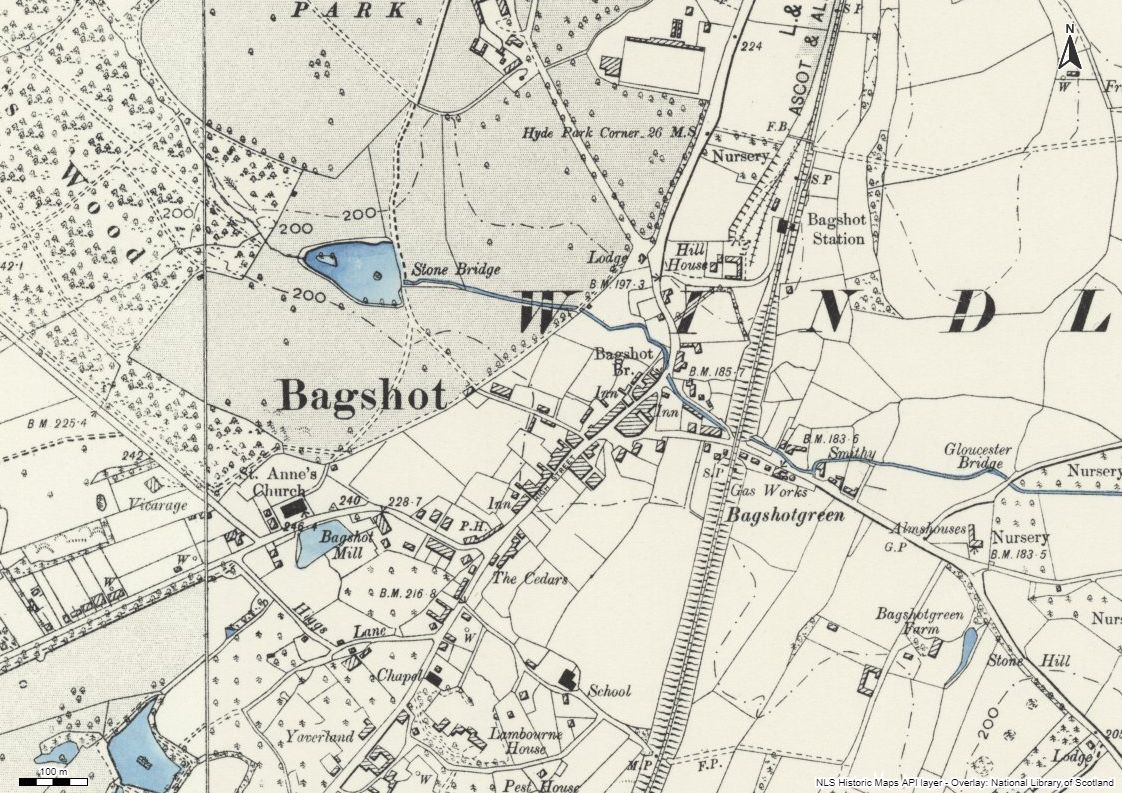
When the incident happened that morning, the train had slowed down to pull into Bagshot station and was about to cross the Guildford Road viaduct, a massively tall structure of four arches built in 1878. On either side of this bridge carrying dual train tracks were high embankments with steep, near vertical sides. On the north side, below the railway, was a vast tract of land owned by ‘Waterers Nurseries’ since 1829 to grow and sell plants. Before reaching that was Bagshot Infant School, set back from the embankment, on School Lane that ended in a footpath passing under the embankment towards Bagshot Green farm on the south side. At the time, undeveloped land stretched on both sides and (unlike now) the embankment was not bordered by trees.

Could a person have thrown a stone from the north side to make the train window next to me shatter? Unlikely because the embankment on which the train passed was too steep to stand upon. If the culprit had stood further away, below the embankment, a rock could not have reached the height necessary to make contact with the train, nor would it have retained sufficient momentum to smash the window with enough force for it to have not merely cracked, but to have shattered in its entirety.

What kind of projectile could have caused such damage? A powerful gun of some kind could have generated the necessary velocity and momentum for its bullet to shatter the thick glass window. A gunman (or woman?) would have needed practiced skill to aim upwards from the land below the embankment, or possibly to have lain half-way up the embankment adjacent to the footpath (now ‘School Lane Field’). In either case, it would have required planning and experience to succeed in such a challenging topography next to the train route. Since only two trains per hour travelled in either direction, this act could not have been a spur-of-the-moment impulse.

Why was the window I had sat beside targeted? As the train decelerated to enter Bagshot station, the rear carriages would have passed at a slower speed, making them an easier moving target than the front ones. Us schoolboys were habitually the only passengers anywhere in those rear four carriages, making my head the one visible sign of on-board life amongst dozens of otherwise empty train windows. That implies that my window must have been purposefully selected as the intended target. It was a dark winter morning and the internal carriage lighting would have made my outline visible from outside the train.

So where did the bullet land? Only one thing was certain: it had not hit me, otherwise I would not be here to tell the tale. Did we look to see if a bullet had passed over my head and become embedded in the carriage’s structure? No. In that pre-‘CSI’ era, forensic science remained an unknown foreign land. From watching weekly television detective shows, all we understood was that ‘McCloud’ cracked cases by riding his horse down Broadway, ‘Columbo’ used his raincoat and ‘McMillan’ solved crimes by getting into bed with sweatshirt-wearing wife Sally. In the aftermath, I had not even deduced that I had likely been targeted by somebody shooting a gun. That is how unworldly I must have been, though I had always enjoyed the pellet-gun target shooting stall at the fair’s bi-annual visits to Camberley Recreation Ground.

So how DID I react to this dramatic event? Did I scream? Cry? Sob uncontrollably? No, I simply stood up, brushed off the glass fragments that had covered me, and our little group moved to an adjoining carriage where the breeze through the vacant window would not make us feel colder. Even had we wanted to, there was nothing we could have done immediately. There were no train staff in those rear carriages and, once the train stopped in Bagshot station, its platform was too short to get out. Only once we reached Ascot was the platform long enough to deboard. So, did we? No, because if we had raised the alarm, we realised the fickle finger of fate might have pointed to us bunch of schoolboys for having broken the window. Which British Rail jobsworth would have believed our story that someone laying on a grassy knoll in Bagshot must have targeted me for assassination?

Leaving the train at Egham twenty-five minutes later, we could see the void where the window had exploded in front of our eyes. Nobody else seemed to have noticed the gaping hole or had bothered to halt the train to investigate. If they had, we might have arrived late for school that day. That would have been a fate worse than death. We had already brushed aside the incident and were more concerned with the school day ahead of us. Once I returned home that evening, I did not even bother mentioning to my parents what had happened. Only years later would I realise what a close call I had experienced that winter morning at the age of thirteen.

For us kids, trekking from one end of Surrey to the other every weekday on public transport, strange events would occur regularly in this otherworld. Our trains were sometimes cancelled, or rerouted through stations that were unknown to us, or suspended when someone jumped to their death off the footbridge at Egham station. In the latter case, some of us would watch morbidly for the arrival of emergency services whose crew had to scoop up the person’s bloodied remains spread along the tracks by a speeding train. Our unspoken attitude was: almost anything could happen on our way to and from school … and often did. It was a daily expedition into a world beyond ours, populated by weird adults to whom we appeared to be invisible.

Once a year, during ‘Royal Ascot’ week in June, our train would fill with bizarrely overdressed racegoers with strange toff accents and extremely loud voices who carried bottles of alcohol, swayed precariously and occasionally were sick on the carriage floor. They were much worse behaved than we had ever been, their conversations often ribald and filled with profanities. Did anyone chastise them, force them off the train or tell them to act respectfully in front of us children? Not at all! They did precisely what the upper classes are wont to do with their own children: they ignored us totally and appeared completely unembarrassed by their own behaviours.

I recalled the Bagshot train incident when, half a century later, I went for a run through rural France on a bright summer morning. There was no traffic and no visible human activity as I ran down the middle of a tarmacked road flanked on both sides by flat agricultural land. The only noise was birdsong until … a high velocity bullet whizzed above my head from left to right. I stopped running, turned in the direction from which it had come and shouted profanities (in English) at the top of my voice. Without my glasses, I was unable to see far enough into the distance to spot the culprit. This was no accident. I could not have been mistaken by a hunter for an animal. I was clearly visible on a ‘departmental’ road, not in the middle of woodland. But I had been the only object moving in this static landscape and that seemed sufficient to unwittingly make me a target.

If I were superstitious, I might be worried about ‘third time lucky’.

[Originally published at https://peoplelikeyoudontworkinradio.blogspot.com/2024/04/attempted-murder-on-waterloo-express.html ]

FRANCE: government report recommends 2-3 year "moratorium" before launch of digital radio

A new report on the introduction of digital terrestrial radio (‘DAB radio’ in the UK) in France has recommended to the government that the launch should be delayed by two to three years. In the interim, the French media regulator CSA would be asked to establish a project to investigate the “overseas experiences” of digital radio, according to the government press release.

David Kessler, former head of state radio station France Culture, was commissioned in June 2010 by the government to produce a strategic analysis of the launch of digital radio in France. His interim report, published in November 2010 [see blog], identified the “paradox of DAB radio – it is a sufficiently attractive technology to be launched successfully, but it is insufficiently attractive to successfully allow FM broadcasts to cease.”

In the final report, published this week, Kessler said that not all the conditions had been met from an economic standpoint to permit the widespread launch of digital terrestrial radio. His report identified the significantly different challenges between digital radio switchover and digital television switchover:

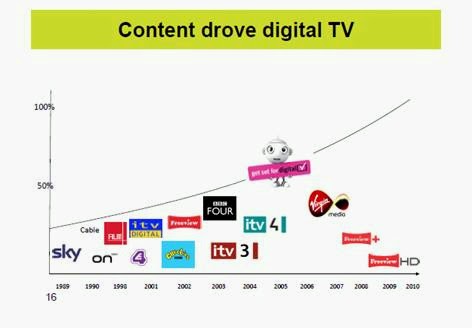
“An error in logic has probably contributed greatly to making the debate [about digital radio] opaque rather than transparent. The error came from having planned digital radio switchover with reference to digital television switchover, which started in 2005 and the success of which has been staggering and immediate, so that the changeover from analogue to digital TV will be completed throughout the land by 2012. Many parties imagined that the route to digital opened up by television would be followed by radio. But this plan was wrong for three reasons.

Firstly, the television market was dominated in 2005 by five channels (TF1, France 2, France 3, France 5/Arte and M6) that attracted 75% of television viewing. The transition to a score of free channels was obviously very attractive. However, as will be discussed later, the situation in radio is quite different – the current choice of stations is one of the richest that exists in the world, after the landscape opened up in the 80s. Even if the choice is not the same in every region, none of them – some near – are in a situation where only five major stations dominate the choice.

Second is the difference in receivers. Even if digital radio switchover had been launched simultaneously with that of television, where the evolution of televisions (flat screen, HD and now 3D) resulted in a faster replacement of equipment than anticipated, digital television was accessible without changing the set through the purchase of a single adaptor at a moderate price. Digital radio switchover requires the replacement of all receivers, and households have multiple radios and the market is sluggish. Without doubt, digital radio switchover could re-invigorate the market with a simple, inexpensive high-end (with screen) radio. At this point, no one can say how quickly take-up of replacement receivers will happen. Examples overseas – particularly Britain – demonstrate a relatively slow rate of replacement, and the different situation in countries where take-up is faster – Korea, Australia – make comparisons difficult.

The third reason is that the history of television demonstrates that it works through ‘exclusive changes’ where one technology replaces another quickly. Colour television pushed out black and white television. Digital television is about to push out analogue television. But experience shows that far from all media work this way. On the contrary, some go through ‘cumulative change’. Over a short or long period of time, different technologies co-exist and content is distributed through several technologies. As Robert Darnton noted about the book, we often forget that the printed word has long co-existed with the manuscript. From this perspective, the history of radio is the opposite of television: different transmission systems are cumulative rather than exclusive. This does not exclude the possibility that, in the long run, some transmission systems will decline and no longer be used, just as printing marginalised the manuscript. But what it means is that one cannot plan the launch of digital radio by imagining that all other transmission systems will be switched off, particularly FM. Even today, despite the success of FM, Long Wave and Medium Wave transmissions are still used because they reach a sufficient number of listeners not be switched off by broadcasters.

In fact, a careful examination of the launch of digital radio in other European countries shows that a ‘cumulative change’ scenario exists that we must anticipate in France too. Indeed, the launch of digital radio in other European countries had been presented as a quick substitute for analogue radio, even though the existing choice of analogue stations was less than in France, and the choice of digital stations seemed more attractive and content-rich than offered by analogue. Even if a proportion of listeners are quickly adopting digital radio, a greater proportion are still sticking with their traditional radios, with the possible exception of Norway, where analogue switch-off seems to be seriously considered at present. This leads to a situation in which the government initially adopts a goal of analogue switch-off but then, given the impossibility of switch-off, drops or postpones the switch-off date by several years. As the choice of existing radio stations is particularly substantial in France, it would appear that this situation is most likely to be repeated if digital radio were to be launched. Radio station owners are not mistaken. Very few want a quick switch-off of FM, and some do not want any switch-off.”

These points echo evidence on digital radio switchover in the UK that I had presented to the House of Lords Select Committee on Communications in January 2010:

“With television, there existed consumer dissatisfaction with the limited choice of content available from the four or five available analogue terrestrial channels. This was evidenced by consumer willingness to pay subscriptions for exclusive content delivered by satellite. Consumer choice has been extended greatly by the Freeview digital terrestrial channels, many of which are available free, and the required hardware is low-cost.

Ofcom research demonstrates that there is little dissatisfaction with the choice of radio content available from analogue terrestrial channels, and there is no evidence of consumer willingness to pay for exclusive radio content. Consequently, the radio industry has proven unable to offer content on DAB of sufficient appeal to persuade consumers to purchase relatively high-cost DAB hardware in anywhere near as substantial numbers as they have purchased Freeview digital television boxes.”

The Kessler document should offer significant food for thought to the British government for its unworkable plans for DAB radio switchover. Whereas Kessler correctly identified that TV and radio digital switchover are two very different undertakings, our public servants working on digital radio policy in the government and in Ofcom have long failed to understand these differences. The appointment of Ford Ennals as chief executive of Digital Radio UK in 2009, on the back of his work between 2005 and 2008 managing digital television switchover, should have been viewed as barely relevant experience to achieve successful digital radio switchover.

Have any of the people managing digital radio switchover for the UK ever actually worked in the radio industry? At DCMS? No. At Ofcom? No. At Digital Radio UK? No. If, like Kessler, they had radio sector experience, they would realise that all their speeches and presentations that repeatedly cite digital TV switchover as the precedent for radio are completely off-target.

Is there any wonder that failure of DAB public policy was inevitable?

FRANCE: digital radio report for government identifies 'the paradox of DAB'

David Kessler, former chief executive of Radio France, submitted a 22-page interim report on the planned launch of digital terrestrial radio in France to the government on 23 October 2010. The report was made public last week. This is the third such report on the topic that the government has commissioned in the last year. Most of Kessler’s report summarised the existing positions of the main players in France (public radio, commercial radio networks, local stations, etc.), but it also outlined some wider market issues. France has yet to launch digital terrestrial radio, despite many start dates having come and gone over the years. The commercial FM radio networks have argued that the cost would be prohibitive and the expected financial returns insufficient.


The following are excerpts from the report:

1.6 Manufacturers
“Both equipment manufacturers (Simavelec and Secimavi) have focused on the renewal of television receivers (digital TV, flat screens, 3D TV, connected TV) and, at this stage, have invested little in radio receivers. This is evidenced by the IFA [consumer electronics trade fair] held in Berlin in September 2010, where radio receivers were virtually absent from the stands of the main manufacturers. Although, at this international show, the big manufacturers are present in markets where DAB has already launched, they do not consider it sufficiently beneficial to manufacture and sell digital radio receivers. Manufacturers consider that the improvement in sound quality offered by digital radio will be harder [for consumers] to appreciate than the improvement in quality for digital television.”

2.3 The situation in other European countries
“A review of the situation overseas illustrates the same problem: many countries have launched DAB and have long experience of it, but none have been able to implement it as the dominant model for terrestrial broadcasting. This demonstrates what could be called ‘the paradox of DAB radio’ – it is a sufficiently attractive technology to be launched successfully, but it is insufficiently attractive to successfully allow FM broadcasts to cease.”

4.0 Conditions to launch DAB
“Difficulties surrounding the launch of DAB:
· Uncertainties about the economic model
· The consumer benefit is uneven between towns and country
· The existence of IP as a competing platform, even if it is discounted, already exists and can appear to be a real alternative
· Finally, little interest by telecom owners to use the FM band – it is too low frequency (unlike the spectrum released by analogue TV) – which makes it very difficult to monetise it and removes any global interest in accelerating towards digital switchover.”

4.1 How could DAB conquer the public?
“For DAB to be a success with consumers, several conditions must be met:
· DAB radio receivers must be widely available, there must be an incentive for consumers to buy them, and they must be installed in vehicles […]
· The sound quality of DAB must be at least equal, or superior, to that of existing FM radio
· DAB radio must be known to the public and must be made attractive. This requires a powerful, dynamic launch campaign.
· Radio offerings to listeners must be enriched. Since the launch has to be a lesson in effective marketing, it must be huge from the outset in those areas where the media regulator has identified that the increase in the number of radio stations is relatively tangible and quite impressive.”

The report noted that the transmission cost for a national radio station to broadcast to 90% of the population in France, using the digital T-DMB standard, will be €4.4m per annum. Some existing national commercial networks have suggested that the cost of digital transmission would only prove economically viable if it were reduced to between €0.5m and €1m per annum and achieved coverage of 90% to 95% of France.

Kessler’s full report to the government will be published by year-end.

[I have used ‘DAB’ as shorthand for ‘digital terrestrial radio’ though France decided to adopt a technical standard other than DAB]

Shameless Book Plug

Apologies for the interruption to my normal radio sector analyses, but I wanted to let you know that a book of my writings about DAB radio was published this week. It collects together 99 of the essays that have appeared in this blog over the last two years concerning the digital radio switchover issue in the UK. The period between 2008 and 2010 was a critical ‘make or break’ time for DAB which ended with the legislation of the Digital Economy Act. But have any of the committees, consultations, working groups, reports and recommendations from this period made any difference to the slowing take-up of DAB in the UK? No.

Leslie Burrage, chief executive of Roberts Radio, one of the main UK manufacturers of radio receivers, said recently:

“I’ve been surprised by how many of my peers at the golf club have adopted internet radio and some of those are people who can’t even get a decent FM signal, never mind DAB. The key issue with DAB and the migration to FM is going to be dictated by the speed at which at the motor car can be migrated, and there is no easy solution. If the migrations takes 20 or 25 years to go as it did from FM, the future is just possibly wi-fi.”

Digital radio switchover seems doomed and the only people still talking it up are those who have a direct stake in it, either through their financial investments, or from earning their living from talking it up. Because the UK started on the DAB switchover trail earlier than other European countries, our experiences have relevance to markets that started later on the DAB journey.

This week, it has been interesting to see the interest my book has spurred in markets such as Norway, Denmark and Italy where, like the UK, DAB is still being pursued despite widespread consumer indifference. In Norway, a news story about the local receiver market appeared in the newspaper Aftenposten headlined ‘Customers do not want DAB: FM is still selling like hotcakes’. The buyer at a Norwegian electronics store said that DAB was already a flop and he was quoted: “So far, this year, according to industry sales statistics to which I have access, only one DAB radio has been sold for in-car installation”.

Many countries are awaiting some kind of government decision as to whether digital radio switchover will still be a policy goal. In Norway, a government report on the DAB issue is to be published later this year. In France, a government report on the financial model for digital radio was meant to have been unveiled this week, but was not. In Germany, the 21 September deadline by which state and commercial radio was meant to have submitted a joint plan for government funding to re-launch a national DAB+ multiplex passed without agreement and has had to be extended to 15 December 2010. One German
report said “it is highly doubtful whether the negotiating parties will agree by the [new] deadline.” Another report said: “experts suspect that this is the last chance for DAB+.”

In Italy, radio stations that have started broadcasting in DAB and DRM are angry at the lack of digital radio receivers in their shops and have
turned to UK manufacturer Pure Digital for help. One Italian report asked: “Do people feel the need to replace their old FM radios? Especially in the era of the smartphone, internet radio and applications, the answer seems obvious.” In Spain, the existing DAB radio licences that were initially issued for a ten-year period in 2000 have just been extended to fifteen years, in the face of widespread consumer apathy towards DAB radio.

It is evident that the digital radio switchover issue continues to generate a lively debate in many European countries. My hope is that our experience in the UK can help other countries make an informed decision about the adoption of a realistic plan for ‘the future of radio’ in their own markets.

DAB DIGITAL RADIO: LICENSED TO FAIL
GRANT GODDARD
Radio Books, London
ISBN 978 0 9564963 0 0
paperback 297×210 mm, 314 pages
1 October 2010
book excerpts here
more information http://www.radiobooks.org
available from online book retailers including Amazon

Book plug over.

FRANCE: "In no country is digital terrestrial radio working out"

From 1 September 2010, French law required that every new radio receiver sold in France which includes a multimedia display must offer reception of digital terrestrial radio. The law had been proposed in 2007 when it was envisaged that digital radio would be up and running by now. However, in France, digital radio is barely at the starting block after several launch dates have come and gone without event.

The same French law requires that, from 1 September 2012, new radio receivers (except for car radios) must be capable of receiving digital radio. How realistic is this date when arguments continue in France even about which digital radio transmission system – T-DMB or DAB – to use? SatMag suggested that legislation will need to be amended to account for the delay in launching digital radio.

Then, from 1 September 2013, the law requires that all radios sold in France offer the capability to receive digital terrestrial radio. This date, too, is likely to have to be changed.

French publication RadioActu described the current state of progress:

“Presently, with the exception of experimental broadcasts such as in Nantes, digital terrestrial radio in France is stalled.”

On 30 September 2010, the initial findings of a further government report on ‘the digital future of radio’ will be published, with the detailed report examining the economic model for digital radio anticipated by 30 November 2010.

Just as in Britain, French government predictions that digital radio would be quick to take off have proven misguided. In December 2007, then Minister of Culture Christine Albanel had promised that “Christmas 2008 will be digital radio [season].” It was not. The launch was postponed to December 2009, and then to mid-2010, and now again to 2011.

At the time the law was made a statute in France in 2009, the British government had just published its Digital Britain consultation. Quentin Howard, President of the WorldDMB Forum, said then:

“This ringing endorsement of digital radio from two major governments is a positive move which we hope will encourage other European governments to take similar steps. The bold position taken by the French government recognises the need to ensure universal availability of digital receivers and gives the radio industry a solid foundation and certainty with which to plan its digital future.“

How wrong can you be? All that the “bold” French legislation has proven is that a law is meaningless without the necessary action. This is an obvious truism. However, bureaucrats in France, the UK and elsewhere still seem to believe that merely stating that digital radio switchover will happen in some official document is enough to make it happen. Those who have long been working at the coalface of the radio industry know better. Jean-Paul Baudecroux, chairman and chief executive of French radio group NRJ, said recently:

“In no country is digital terrestrial radio working out.”

French Culture Minister: launch of digital radio not “a priority”

On 29 March 2010, the French Minister of Culture & Communications, Frederic Mitterand, spoke at the monthly luncheon of the Association of Media & Communications Journalists. He was asked about the much delayed launch of digital terrestrial radio in France and replied:

“I note that the cost of the [digital radio] project is significant, that a number of the radio licensees are not at all favourable towards the project, and that it is the CSA [media regulator] that for the moment is escalating the issue. The CSA itself should still submit a report on the [digital radio] issue with recommendations, although I know roughly what will be in such a report. I have the greatest respect for the CSA, and I have the greatest feelings of respect for [CSA president] Michel Boyon, but we are not exactly on the same wavelength.”

“Without organising a funeral with great pomp and ceremony, which would presume a death, I think that everything will inevitably be digital one day. And then radio will be too. Put simply, in today’s economic conditions, in the general context of radio, and with the lack of consensus around this [digital radio] issue, I do not think its resolution is a priority and the launch of digital radio will not happen this year.”

The video is available here.

FRANCE: Digital radio “is not progressing one inch”

A meeting of radio sector stakeholders on Monday 15 March 2010 at France’s media regulator, the CSA, failed to progress the plan to launch digital terrestrial radio this year. According to Le Point, the commercial broadcasters – RTL, Europe 1, NRJ and RMC – demanded a moratorium. State broadcaster Radio France is one of the few continuing to support the CSA’s plan to launch digital radio, delayed from 2009 to mid-2010, using the T-DMB transmission standard.

A member of the Bureau de la Radio trade organisation commented: “There is no economic model [for digital radio]. The choice of the [T-DMB] broadcast standard adopted in Bercy is very expensive. The upside for listeners is not sufficient for us to fund a third broadcast platform to add to the existing Long Wave and FM [platforms]. … We are disappointed because this meeting has not enabled anything to progress. What happens next?”

According to Le Point, the regulator has responded only with “radio silence”. Its headline read: “Digital terrestrial radio is not progressing one inch.”

FRANCE: “2010 will be the last chance” to launch digital radio

2010 will be the last chance for digital terrestrial radio” to launch in France, said Alain Mear, vice chairman of the CSA [media regulator] digital radio working group. “If digital radio does not start in 2010, there will be no digital radio.” He was speaking at a roundtable meeting held 15 January at the Senate to discuss the future of radio, according to RadioActu. Mear argued that the government needed to set a deadline for the ending of radio broadcasting on FM and AM. “This is the moment of truth”, he said.

However, the view of some radio groups represented at the meeting was that radio in future would be delivered to listeners via a mix of platforms. Concern was also expressed about the financial cost of launching a new digital broadcast platform. Michel Cacouault, representing the commercial radio trade body Bureau de la Radio, predicted that there could be “no development without an economic assessment”. He stressed that the sector’s declining advertising revenues in 2009, resulting from the global economic crisis, had required “all the big groups to face re-organisation and downsizing.”

Arnaud Decker, director of corporate relations at media group Lagardere Active, said that “the authorities must ask themselves how the competitiveness of the national music radio networks can be maintained” when the launch of digital radio would increase broadcasters’ costs.

Jacques Donat-Bouillud, director of radio at transmission provider TDF, said that the cost of providing digital terrestrial radio to a population of 40m would be around 500m Euros per annum. For a single station requiring national coverage in France, he said that digital transmission would cost 3m Euros per annum, compared to 6m Euros per annum for FM transmission.

Pierre Bellanger, CEO of commercial station Skyrock, pointed out that “60% of mobile handsets are internet enabled” and cautioned that “there is no single correct answer to the question about the future of radio. The solution is a hybrid and, ultimately, the listener will be the winner.”

Bruno Patino, director of state radio station France Culture, agreed: “[State] Radio France must participate in the digitalisation of broadcasting. Digital radio delivered by IP will be there, but that will not kill the broadcast platform.”

FRANCE: de-localising RFM and Virgin Radio

Like the UK, commercial radio in France is delivered both nationally and locally. Category ‘C’ stations have local studios, employ local staff and are permitted by the regulator to sell local advertising and use a national brand name, as long as they produce a minimum of 3 hours per day of local programmes. Category ‘D’ stations are broadcast nationally from one central studio, have no local offices and are only allowed by the regulator to sell national advertising.

Now it seems as if some of the local radio operations of European media conglomerate Lagardere, branded RFM and Virgin Radio in France, might have to be closed. “We are in the process of looking at some of them,” said Lagardere Active chairman Didier Quillot. The objective, he told Le Monde, is to know “whether they are all profitable”. The newspaper commented: “the future looks bleak for those that are not.”

Monday 14 December 2009 was a busy day for Lagardere. In the morning, it made a detailed presentation to the CSA, France’s media regulator, about “the economic and financial situation” of its RFM and Virgin Radio local operations. In the afternoon, it repeated the presentation to the IRTS public body, trade unions and staff representatives of the two networks.

RFM is presently available from 192 transmitters across France, of which 55 are local Category ‘C’ stations. Virgin Radio is available from 228 transmitters, of which 146 are local Category ‘C’ stations. Each of the local stations employs at least one journalist and one producer (as required by the regulator) plus advertising sales staff. Lagardere insists that, for the moment, “no decision has been taken and no request has been filed with the regulator”.

A few weeks ago, the programme director of RFM and Virgin Radio, Jean Isnard, produced a study on the future of local radio. Its conclusion was that it would be more profitable to close down some local stations and centralise them in Paris. Such closures, converting Category ‘C’ to Category ‘D’ stations, are unlikely to be implemented until February or March 2010, once the regulator has approved. Lagardere has referred to this strategy as “drastic economic measures” although it has reiterated its “determination to maintain a significant local presence”.

One insider told Le Monde: “For Didier Quillot and Alexandre Bompard, CEO of Europe 1, the crisis impacting the radio sector is not cyclical but structural.” Lagardere is also trying to sell its Paris sports news station, Europe 1 Sport, which is losing 1.2m Euros per annum. It had acquired the station two years ago, intending to transform it into a national station on T-DMB digital radio. However, as Le Monde commented: it is “too expensive, too late!”

The journalist union, SNJ, has denounced Lagardere’s proposed re-structuring of RFM and Virgin Radio “in the strongest terms”. It suspects that 25 local offices would be closed and 40 jobs are threatened. It accused Lagardere of using the economic crisis and competition from new media as pretexts for a purge of local journalists.

Meanwhile, competing national radio station RTL (owned by Bertelsmann) has seen advertising revenues fall 10% year-on-year, despite being ranked #1 station in France for the last three years. On Thursday 17 December 2009, management requested 30 voluntary redundancies from the station’s 300 staff. Chief executive Christopher Baldelii told Le Figaro: “Being market leader is good, but we must not rest on our laurels. RTL has to be modernised to increase its competitiveness”. The objective is to save 20m Euros over the next three years.