Lobby the EU to mandate Europe-wide digital radio switchover? No chance!

The European Union [EU] has always made its position perfectly clear on radio broadcasting policy for its member states. It will not adopt an EU-wide digital radio strategy. A year ago, Viviane Reding, then EU commissioner for information society & media, reiterated the policy in an interview:

“This issue of EU-wide radio standardisation is still in its infancy. The main reason is that radio, from a political, business and consumer standpoint, is organised primarily as a regional or even local product. This is, in principle, rightly so. The reason the radio landscape in Europe is so fascinating is because it is so diverse and highly innovative. Therefore, EU-wide radio legislation is not advocated.”

“I believe the time is not ripe for a single EU-wide radio FM switch-off, such as we are doing for analogue TV in 2012. I can also well imagine that the 27 EU Member States, given their different levels of development, will want to take their own innovative approaches to digital radio switchover.”

Given this clearly stated EU policy, it was a surprise when World DMB, the lobbying organisation for DAB radio,
announced on 10 November 2010 that one of its three objectives for the coming year was:

“To persuade the European Union to champion switch-over policies at European level …”

Using the forum of the European Broadcasting Union [EBU] Digital Radio Conference 2010 held in Belfast the previous week, World DMB seemed to have persuaded the EBU to endorse a no-hope strategy of challenging existing EU strategy in order that digital switchover be mandated through diktat. This follows the evident failure of World DMB’s bottom-up approach to convince consumers in many EU countries to replace their satisfactorily working FM/AM radios with DAB receivers.

World DMB president Jørn Jensen said in the press release:

“If digital radio is to succeed, then the EBU must show their support for the DAB family, the only technology platform chosen by Germany, UK, France, Italy, Spain and the Nordic countries as the future of digital radio.”

The EBU obliged by issuing its own statement which stressed that its conference had “achieved a significant breakthrough in efforts to accelerate moves towards securing a digital future for radio.” The EBU wording is significant – its public statement talked about ‘digital’ radio but never mentioned the ‘DAB’ platform specifically. Whereas, the World DMB press release went out of its way to interpret ‘digital’ radio narrowly as ‘DAB’, almost to the point of obsession, when Jensen said:

“It’s time to stop talking about less mature standards, EBU needs to promote the Eureka 147 [DAB] family of standards.”

And what exactly did Jensen mean by “less mature standards”? Could he be referring to the platform whose name dare not be spoken amongst DAB lobbyists – THE INTERNET? Coincidentally, five days prior to the World DMB press release, Neelie Kroes, the current EU commissioner for the digital agenda, had admonished content producers who do not adapt their businesses to the internet age in a speech:

“Like it or not, content gatekeepers risk being sidelined if they do not adapt to the needs of both creators and consumers of cultural goods. So who will win the heart of the creators and of the public? It is still too soon to say. Of course, some of the new giants of internet come from another continent. I would wish that more of them were European, but when I see the wealth of creativity gathered in this room, I am optimistic for the future.

I believe that those who will prosper in the digital age are those who understand that convergence is one of the keys. The convergence of media provides an incredible opportunity for the artists and creators of our times, and also for their public – you and me. Just like cinema did not kill theatre, nor did television kill radio. The internet won’t kill any other media either.”

Despite the EU’s enthusiasm for convergence, the internet is still perceived as a competitive threat by some European radio broadcasters, who fear attrition to their audiences from an influx of online audio content from beyond their borders. To them, Last.fm, Spotify and We7 are the antichrists, and they hope that DAB’s walled garden will banish these insurgents from their kingdom. But, although Jensen wants to paint the internet as a “less mature standard”, history books show that it was around long before DAB (I was sending e-mails, before they had that name, across the Atlantic in 1978).

Also, when World DMB promised in its 10 November press release that it would “foster effective partnerships between broadcasters and the automotive sector” over the next year to get DAB radio into cars, it was advocating actions it could and should have taken more than a decade ago. It has long missed the boat. EU commissioner Neelie Kroes had announced on 8 November that IP-connected cars were the current European policy objective:

“Europe leads in wireless communication to and from vehicles. That is critical to improve both safety and efficiency. And to convert this into global market success global cooperation and standardisation will be required. This is where the EU’s Future Internet Public Private Partnership comes in. We need the automotive and ICT communities side-by-side. That way we can seize the opportunities of the next generation of wireless broadband, beyond 3G, to meet the growing demand for connectivity in cars.”

So what chance does World DMB have of achieving these two stated objectives for EU policy during the next year (compulsory digital radio switchover, DAB in cars)? None whatsoever. So why would it set itself objectives that are bound to fail? It can only be sheer desperation at this rapidly deteriorating stage in DAB’s lifecycle.

The third of World DMB’s stated objectives for the next year – “to advance partnerships between public and broadcasters” to make DAB happen – must have been drafted by someone with a wry sense of irony. Such ‘partnerships’ appear to be going nowhere in DAB:
· In the UK, RadioCentre, the commercial radio trade body, has failed in its insistence that publicly funded BBC should pay for the upgrade of commercial radio’s local DAB transmitters
· In Germany, commercial radio has failed to agree with public radio to a new plan to re-launch national DAB radio
· In Spain, commercial radio called DAB “a road to nowhere” despite public radio’s insistence on persevering
· In France, national commercial radio networks have refused to support public radio’s plan to launch digital terrestrial radio
· In Denmark, only one commercial station is broadcasting on DAB, alongside 17 state radio stations (many of which are about to be axed)
· In the Netherlands, national commercial radio stations have had to be forced to broadcast on DAB by the government inserting new clauses in their licence renewals.

World DMB’s rallying call of “let’s just get on with it!” might make more sense if its proposed solutions were practical in any way. Its press release was headlined ‘European Broadcasting Union backs digital radio switch over across Europe.’ Given that all three of its objectives for the next 12 months fly in the face of realpolitik, it would have been more accurate to entitle the press release ‘Three impossible European things before breakfast.’

[with thanks to Michael Hedges at Follow The Media]
Benefits of DAB radio “insufficient compared to its cost per user” warned EU report … in 2002

Sometimes it proves useful to take a look backwards to try and understand where you are now. In 2002, a 236-page report was produced for the European Commission on the topic of ‘Digital Switchover In Broadcasting’ by BIPE Consulting. Re-reading it is a stark reminder that the current problems with DAB radio implementation in Europe had been anticipated at least eight years ago.

Firstly, the BIPE report admitted that a significant motivation for introducing DAB radio was so that existing licensed European broadcasters could maintain market control in the face of competition from IP-delivered radio content produced by pesky foreigners:

“Some radio broadcasters consider digital radio as a question of survival in the long term … digitisation of content, transmission and multipurpose receivers could squeeze out the possibility of having a dedicated radio platform with its own players, services and listeners. The fact of having a dedicated [DAB] platform could maintain the existing value chain. If not, alternative, third-party digital platform operators will enter the game, and this could reduce radio specificity as it is understood today or even break the radio business model.”

Many of the problems of implementing DAB were identified then:

“New frequencies have to be found to simulcast analogue programmes and new expected ones (which is not the case with digital TV that can be simulcast in the same bands); very high digital receivers prices create a chicken-and-egg situation; while pay TV is a strong driver of TV digital migration, a pay-radio business model seems not to be sustainable so far; RDS, data services and free-to-air multi-channel FM reduce the attractiveness of digital radio.”

And the huge challenge of convincing consumers was made very clear:

“Analogue radio receivers are low cost devices offering numerous, free-to-air channels and with FM audio quality. In this context, the benefits of digital radio as presented by the DAB model so far are insufficient compared to its cost per user.”

The long period of consumer migration from AM to FM broadcasting in Europe was recognised:

“More than 30 years of simulcast AM/FM were necessary to substitute nearly completely AM by FM listening. This lengthy duration covered network deployment, frequency release, launch of music channels (the killer application), and diffusion of FM functionality through the installed base of all the receivers.”

The report identified the “major obstacles to digital radio migration” as:
• Receiver cost
• Low consumer awareness
• No pressure to release the FM band (“DAB is costly in terms of bandwidth used and difficult to insert in existing radio bands. … But the quantity of spectrum released by terminating analogue radio services is much less significant than the potential release of spectrum following the turn-off of analogue terrestrial television broadcasting.”)
• No pay model driver
• No clear killer application (“Together, FM and RDS already combine a certain degree of quality with important data services.”)
• Lack of interest for higher quality sound
• Lack of interest from carmakers
• Necessity of a European market (“Low cost receivers require addressing mass markets. Different national timing in the digitisation of radio does not create the conditions or incentives for achieving critical mass.”)
• The installed base of receivers (“There are between 3 to 5 radio receivers per household, many of them being lower cost receivers. To replace such an installed base means achieving low costs and/or to supply attractive, new services.”)
• Other standards than DAB are possible (“This competition may reduce the mass-market achievement in Europe.”)
• Lack of radio spectrum capacity for DAB (“The DAB multiplex is much larger than one FM channel: insertion in the FM band is not possible, spectrum efficiency is poor.”)
• Multi-channel is already a feature of analogue FM radio (“Additional services will have a marginal effect.”)
• DAB licences have sometimes been delayed.

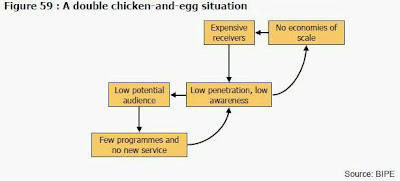
Finally, the report identified what it called “a chronic chicken-and-egg situation” whereby:
• “Receivers remain expensive because there are no scale effects. This reduces audience and revenues of radio broadcasters who demand that manufacturers decrease receiver prices in order to provoke a mass-market and to trigger mass audiences ;
• There is no specific advantages [sic] in digital radio, no killer application, nobody buys digital receivers, the audience remains negligible, and prices stay high.”

There was even a graphic to illustrate the problem:


This all feels very much like DAB in Europe … eight years on. And, to hammer home the impending fragmentation of radio delivery platforms, the report’s recommendations noted that:

“Digital radio will probably be delivered through a much larger variety of technologies and platforms than analogue radio, which is essentially terrestrial. These will involve broadcasting or point-to-point, online or on-air, satellite, terrestrial or cable delivery, DAB, DVB or DRM technologies. These techniques will be competitors but very complementary for consumers and broadcasters.”

The questions all of this raises are:
• How did the UK government’s Digital Radio Working Group spend one year (2007-2008) considering how to make DAB radio a success in the UK but not reference this 2002 report?
• How did the UK government’s Digital Britain consultation spend much of a year (2008-2009) looking for the answers to DAB radio implementation but not reference this 2002 report?
• Did DAB stakeholders in the UK read this report in April 2002? And, if so, did they simply choose to ignore it?

[thanks to Eivind Engberg]

European commercial radio trade group says ‘no’ to universal FM switch-off date

At the start of its annual conference held in Brussels on 11/12 February 2010, the Association of European Radios [AER], the trade group representing 4,500+ European commercial radio stations (including RadioCentre members in the UK), issued the following press statement:

“AER considers that setting a date for the switch-off of analogue radio services is currently impossible. Indeed, the question of which kind of technology will be used should be solved first. Hence, broadcasting in FM and AM shall remain the primary means of transmission available for radios in all countries, with the possibility to simulcast in digital technology, until market developments enable a potential time-frame for general digitisation of radio. Transition to any digital broadcasting system should benefit from a long time-frame, unless there is industry agreement at national level to move at a faster rate.”

This statement followed on from a policy paper the Association had published a few days earlier, responding to the European Commission’s Radio Spectrum Policy Group plans for its draft Work Programme. The paper said, in part:

“It should be underlined that, in most of Europe, currently and for the foreseeable future, there is only one viable business model: free-to-air FM broadcasting on Band II. Thus, Band II is the frequency range between 87.5-108 MHz and only represents 20.5 MHz. Across Europe, nearly every single frequency is used in this bandwidth. Thanks to the broad receiver penetration and the very high usage by the listeners, this small bandwidth is very efficiently used. On-air or internet-based commercially-funded digital radio has indeed not yet achieved widespread take up across European territories. These two means of transmission will be part of the patchwork of transmission techniques for commercially-funded radios in the future, but it is hard to foresee when.

So no universal switch-off date for analogue broadcasting services can currently be envisaged and decision on standards to be used for digital radio broadcasting should be left to the industry on a country-by-country basis.

Radio’s audience is first and foremost local or regional. Moreover, spectrum is currently efficiently managed by European states and this should remain the case: national radio frequency landscapes and national radio broadcasting markets are different, with divergent plans for digitization, diverse social, cultural and historical characteristics and with distinct market structures and needs…..”

“Finally, AER would like to recall that European radios can only broadcast programmes free of charge to millions of European citizens, thanks to the revenues they collect by means of advertising. These revenues are decreasing all through Europe due to two factors: the shift towards internet-based advertising, and the recent financial crisis. For 2009, radio advertising market shares were forecast to decrease by 3 to 20% all across Europe, compared to 2008.

In some countries (e.g. France and the UK), a part of the revenues derived from the TV digital switchover was supposed to be allocated to the support of digitisation schemes for radio. This is no longer the case. In most countries, it is still unclear who will bear the costs of the digitisation process.

However, any shift towards digital radio broadcasting entails very long-lasting and burdensome investments. Nevertheless, some individual nations may wish to proceed with a move to greater digital broadcasting at a faster rate, as there will be no ‘one-size-fits-all’ approach.

So, any shift towards digital radio broadcasting will most likely require a very long process. Decision on the adequate time-frame should be left to each national industry: as a matter of principle, transition to any improved digital broadcasting system should benefit from a long time-frame, unless there is industry agreement to move at a faster rate.

It should also be recalled that commercially-funded radios are SMEs, and are in no position to compete for access to spectrum with other market players. So, market-based approaches to spectrum (such as service neutrality or secondary trading) should not be enforced in bands where commercially-funded radios broadcast or may broadcast.

To end up with, AER would like to recall that, in most of Europe, currently and for the foreseeable future, there is only one viable business model: free-to-air FM broadcasting on Band II; hence:

• no universal switch-off date for analogue broadcasting services can currently be envisaged
• now and for a foreseeable future, commercially-funded radios need guaranteed access to spectrum, in all bands described above. Besides, no further change to the GE 84 plan [the 1984 Geneva FM radio broadcast frequencies agreement] should be suggested, but the plan should be applied with consideration to the technological development (and its enlarged scope of possibilities) throughout the past 25 years
• any shift towards digital radio broadcasting should benefit from a long and adequate time-frame.”

GERMANY: “FM is and will continue to be the most important means of transmission for radio,” say commercial broadcasters

Commercial radio broadcasters in Germany have published a policy paper emphasising that FM will continue to be the main broadcast platform for radio. The VPRT, a trade association of 160 commercial broadcasters (70 of whom are active in radio), this week responded to the draft Work Programme for 2010 set out by the Radio Spectrum Group [RSPG] of the European Commission. One of its proposed work streams had been “to discuss the pros and cons of indicating a target date for analogue radio broadcasting (FM) switch-off.”

The formal response from VPRT sets out powerful arguments why current FM spectrum (referred to as ‘Band II’) will continue to be radio’s most important platform for broadcasting:

The future development in the different frequency bands (especially Band II) is of utmost importance to our radio service members. Therefore, we are seriously concerned about the fact that RSPG is considering a target date for analogue radio broadcasting (FM) switch-off.

Nevertheless, we see the need to think about future developments and possible usages of Band II which comply with the provisions of the GE84 [Geneva radio conference of 1984] agreement and ensure FM services which are able to operate free of any interference. At the same time, we would like to stress the necessity of adapting and developing those GE84 provisions to ensure the continuity of Frequency Modulation (FM) and the future usages in Band II. However, this needs to be achieved without further co-ordination at international level.

1. Band II with FM is and will continue to be the most important means of transmission for radio
Band II with FM is the most important means of transmission for VPRT’s radio service members. Also, in the foreseeable future, Band II with FM will remain the basis of commercial activities for private radio stations. This is grounded by two reasons: firstly, the heavy usage by listeners and, secondly, the very high market penetration of FM receivers. Currently, more and more new Band II FM receivers are establishing in the market. As a consequence, the receiver basis is modernised constantly. Modern communication devices, such as mobile phones, smart phones and media players, integrate Band II FM receivers and ensure an even wider availability of FM. Switching off FM transmission is therefore neither realistic, nor can it be crowned with success.

2. FM in Band II is of utmost importance in the case of catastrophe
Due to the extremely high penetration of FM devices in Europe and its heavy usage, Band II is the only reliable way to inform the public in the case of catastrophe or need of contacting citizens in an emergency. This was recently proven when a blizzard hit Germany at the beginning of January. This is also valid in case of a regional power cut, as many devices are powered by batteries. For the time being, no digital receiver (DAB, etc.) has been developed for the operation with battery.

3. Band II is a small but efficiently used frequency range
The so-called Band II is the frequency range between 87.5 and 108 MHz and only represents 20.5 MHz. Nearly every single frequency is used in this bandwidth. Together with the broad receiver penetration and very high usage by the listeners, this small bandwidth is very efficiently used. In the last few years, receivers have been significantly developed which today results in an enormous improvement of their reception quality. Millions of listeners are convinced by the characteristics of FM. Even under very difficult circumstances for receiving a signal, a very good reception is possible. On the other hand, other (digital) systems are disconnected in a very early stage, which is rather disadvantageous. The usage of Band II is still “state of the art”.

4. No migration or partial migration of the services in other frequency spectrum
VPRT rejects any proposals which include the shifting of the current usage from Band II to other frequencies. This would bring the intensive and effective use of Band II to an end. Due to the lack of digital receivers, as well as of the absence of consumer demand for change and migration, a restart of a digital system would mean inefficiency and un-sustainability for a very long period of time. In other bands, there is enough space to introduce new systems. Band III (174 to 230 MHz, channels 5 to 12) and therewith corresponds to 56 MHz – is available.

5. Consideration of future developments of FM transmission after GE84
Since the Geneva conference of 1984 (GE84), different parameters of the FM usage in Band II have changed. In the meanwhile, different and changed sources of signals are available (music), the signal processing was adapted and a compression of the signals was introduced. The processing of the FM signals in the receivers is completely digital. 25 years after G84, the provision from the Geneva plan should be adapted and developed according to recent technical developments.

6. There is a chance for new standards with unlimited parallel FM operation
In the medium term, there are different options to develop the use of Band II. The use of FM has to remain, due to the heavy use described in point 1.4. An unlimited parallel FM operation offers the opportunity of financing additional engagements from the remaining FM transmission. Further developments with new standards based, on additional unlimited parallel operation of FM, is a chance for economical efficiency. Therefore, it is necessary to adapt the ETSI spectrum mask ITU-BS.412-9, as well as other ITU-R recommendations, by keeping the guidelines for aeronautical services (VOR and ILS). In this way, the “envelope concept” which was already used in the GE06 plan could be kept. Therewith, new standards under an adapted ETSI spectrum mask would be possible without interfering with the existing FM transmission and conditions. In this case, a new planning conference would not be necessary.

We support a conversion to digital assignments if the FM transmission can be maintained without any limitation. In this case, a switch from single FM transmission into a digital transmission would be possible, without discriminating other FM transmissions.

We do not see a future for technologies which are linked to a switch-off of the FM transmission.

7. Interference with FM through new standards have to be avoided
As already mentioned in point 6, it must be avoided that future technology developments cause any interference to the existing FM transmissions. A reduction of the current coverage caused by future developments is not acceptable for VPRT members. Some aspects of the technical developments are promising but, due to a lack of information, a full evaluation is not possible.

8. No international re-planning of Band II or of parts of it
Due to the very intensive and effective use of Band II, we do not see any need for a long and very costly international re-planning. The GE84 plan should be supported in its principles and adapted as mentioned in point 6. Even a re-planning of certain parts of the Band II would not lead to any benefit, as the complete Band II is used and needed in the future.

9. Re-adjustment of Band II at national level is necessary
However, we always have been calling for a re-adjustment of Band II at national level in order to balance the relation between public broadcasters and private broadcasters. At the moment, we face an imbalance with regard to the amount of frequencies, as well as the frequency capacity, held by public broadcasters on the one hand and by private broadcasters on the other hand. We therefore ask for a readjustment which takes the actual demands into account. The introduction of new standards would carry forward the current imbalance.

10. Further research and economical comparison are necessary
Next to the research and comparison, with respect to the technical characteristics and parameters of the available standards, further research is needed to complete a substantial evaluation. For the time being, an evaluation of the economical and financial factors is still missing. We therefore ask to also take those aspects into consideration.

Summary of VPRT comments
• Band II with FM is and will continue to be the most important means of transmission for radio
• FM in Band II is of utmost importance in the case of catastrophe
• Band II is a small but efficiently used frequency range
• No migration or partial migration of the services in other frequency spectrum
• Consideration of future developments of FM transmission after GE84
• There is a chance for new standards with unlimited parallel FM operation
• Interference with FM through new standards have to be avoided
• No international re-planning of Band II or of parts of it
• Re-adjustment of Band II at national level is necessary
• Further research and economical comparison are necessary

Berlin, January 2010

[this is VPRT’s own English translation]

EU Commissioner Viviane Reding: digital radio in Europe

Interview from the latest issue of Germany’s Meinungsbarometer Digitaler Rundfunk magazine:

EU COMMISSIONER OPPOSES EUROPEAN RADIO LEGISLATION
Equipment manufacturers and broadcasters must promote standardisation

In light of the national debate about digital radio [in Germany], EU Commissioner for Information & Media, Viviane Reding, in an interview with Meinungsbarometer Digital Broadcasting, has called for receiver manufacturers and content providers to implement compatible standards. This would ensure that, in most EU Member States, the family of DAB standards are either already being used or would be introduced. If the trend towards hybrid media devices continues, the EU Commissioner believes there is no need for statutory regulation.

Ms Reding, millions of European motorists make cross-border journeys and are subject to various digital terrestrial radio standards. What is the EU doing to achieve a unified standard for digital terrestrial radio in Europe?

This issue of EU-wide radio standardisation is still in its infancy. The main reason is that radio, from a political, business and consumer standpoint, is organised primarily as a regional or even local product. This is, in principle, rightly so. The reason the radio landscape in Europe is so fascinating is because it is so diverse and highly innovative. Therefore, EU-wide radio legislation is not advocated.

Standardisation, however, is still an issue during the transition to digital radio reception. The market is making considerable progress on this question. Currently, the DAB standard is the most widely used digital terrestrial radio technology in the Member States of the EU. DAB is already used in Belgium, Denmark, Germany, Spain, Luxembourg, the Netherlands, Portugal, Sweden and the UK. Malta is already using the newer DAB+ standard, and its implementation is currently also being considered in Germany. Later this year, France and the Netherlands want to test another new standard, DMB, for digital terrestrial radio broadcasting.

I hope that, in the interest of tourists and cross-border travellers, that device manufacturers and content providers here will soon agree with each other to use a standard or at least open, compatible standards. I therefore welcome the fact that device manufacturers are increasingly coming to market with products, at little additional cost, that can process several standards and codecs. If this positive development continues, a statutory standardisation will certainly not be necessary.

In Germany, there are moves to postpone the 2015 date for the planned closure of FM. How do you see this situation developing in other European countries?

I believe the time is not ripe for a single EU-wide radio FM switchoff, such as we are doing for analogue TV in 2012. I can also well imagine that the 27 EU Member States, given their different levels of development, will want to take their own innovative approaches to digital radio switchover. Therefore, it is important from the perspective of the EU that the Member States take into account in their plans what their neighbours – and beyond – have done and learn from others’ good and less good experiences. The European Commission is strongly promoting these individual views and experiences at a European level.

As for financing the construction of the infrastructure for new digital terrestrial audio broadcasting: can you envisage the Digital Dividend being used?

The digital dividend is defined as the spectrum freed by the shutdown of analogue broadcasting once all programmes are only broadcast digitally. The term “digital dividend” is therefore not a direct means with which one can finance digital radio networks, as it only creates efficiency gains through technical progress. The digital dividend in the medium of terrestrial radio is significantly lower than in terrestrial television where, through appropriate co-ordination at the European level, the potential economic benefits of the digital dividend between 2009 and 2015 will create an additional 20 to 50 billion Euros. With terrestrial radio, however, the digital dividend could be higher, depending on the performance of digital transmission standards that are replacing analogue FM. In my view, this is the strongest incentive for a shift to digital terrestrial radio broadcasting.