The exit strategy for DAB radio switchover: the Consumer Expert Group addresses Vaizey’s “big if”

When you are looking for an exit route from a product you have been developing for nearly two decades, and which has consumed hundreds of millions of pounds, you need to find a damn good reason that will deflect the blame elsewhere. You need a report, an organisation or some bona fide research that screams out ‘no’ at the highest volume. Then your response can be: “I would be a fool to ignore the warning signs voiced by X” when what you are really saying is: “Blame them, not me! It’s them that made me do it.”

DAB radio and digital radio switchover presently seem to be at this point. But there is a big problem for a radio industry that is belatedly trying to find a way ‘out’. Almost all previous reports produced by the government, the regulator, the radio industry, the electronics industry, the working groups, Digital Britain and the car manufacturers have been overwhelmingly positive about DAB and have painted an amazingly rosy future. There has been almost nothing published about DAB by agencies of the state that has said plainly: “Stop this crazy plan.”

So whose fault can it be that DAB radio and digital switchover has not worked? Given the sheer number of agencies that have been so gung-ho for so long about DAB, the fickle finger of fate naturally had to point elsewhere and so it landed upon ‘the consumer’. It becomes much easier to decide that the general public is the reason for a masterplan’s lack of success when everybody sat around the government’s conference table is feeling a little guilty about their shared role in a wasted £1bn investment.

A change of regime is always a useful point at which to invoke such a change. In July 2009, less than a year into his first radio job, the BBC’s top radio manager Tim Davie explained that digital radio switchover would be determined by listeners, not by the BBC:

“From a BBC perspective, whether it be ‘Feedback’ or our constant audience research, the idea that we would move to formally engaging switchover without talking to listeners, getting listener satisfaction numbers, all the various things we do, would be not our plan in any way. We would be – we are – in dialogue now for the next six years. … I think we are pretty committed to digital. Having said that, since I have arrived at the BBC, I certainly haven’t seen it as inevitable that we move to DAB.”

The following month, BBC Trust chairman Sir Michael Lyons reinforced this notion:

“Who comes first in this? Audiences and the people who pay the Licence Fee. It is an extraordinarily ambitious suggestion, as colleagues have referred to, that by 2015 we will all be ready for this. So you can’t move faster than the British public want you to move on any issue.”

The change of government then provided an opportunity for the Department for Culture, Media & Sport [DCMS] to similarly invoke the will of the people in determining digital radio switchover. In July 2010, culture minister Ed Vaizey said:

“If, and it is a big if, the consumer is ready, we will support a 2015 switchover date. But, as I have already said, it is the consumer, through their listening habits and purchasing decisions, who will ultimately determine the case for switchover.” [emphasis added]

For both the BBC and the government, the problem with belatedly putting the consumer at the centre of digital radio switchover is that almost no organisation, over the course of a decade of DAB, has done any significant consumer research about DAB. Why? Because the implementation of DAB radio in the UK had always been a top-down policy initiative by civil servants, regulators, trade organisations and commercial opportunists, without ‘the man on the Clapham omnibus’ having ever been consulted.

There was one notable exception. When the government’s Digital Radio Working Group considered the issue of DAB radio switchover during 2007/8, a sub-committee named the Consumer Impact Group had prepared a report. However, this report was not made public until almost a year after the Working Group had been wound up. The report had been highly critical that consumers’ viewpoints were not being considered:

“The group is concerned that the case for digital [radio] migration has not been made clearly enough from the point of view of the consumer. While it is clear what the rationale is for the radio industry, the group would like to see a compelling argument as to why digital migration is desirable for consumers and what its benefits would be for consumers.”

But that was then, this is now. Then, digital radio was considered by the previous government to be a real possibility, and that is why dissent from consumer groups was buried. Now, that same consumer dissent could provide the perfect nail on which to hang any number of DAB exit strategies. A new report outlining the massive consumer challenge of digital radio switchover would be a perfect ‘get out of jail free’ card for many long-term DAB stakeholders.

So today, a new report has been published by the government’s Consumer Expert Group [CEG] which asks the pertinent question ‘Digital radio switchover: what is in it for consumers?’ Moreover, rather than it being embarrassedly added to the depths of the DCMS web site a year later, today’s report was circulated to the press and stakeholders in advance of publication. Its introduction states:

“This report was not requested by Government but the CEG have taken the initiative to attain a thorough understanding of the consumer issues surrounding digital radio and bring them to the Government’s attention as preliminary policy decisions are made.”

In other words, this new report just happens to directly address the “big if” cited in the culture minister’s speech about digital radio switchover nine weeks earlier. If its publication were not startling enough, its conclusions are damning in almost every respect about the lack of progress made to date with digital radio switchover. But, before that, the report is quick to invoke the role of consumers in what it admits is “new” government policy:

“Setting a date, or a firm commitment to a date, would have had the effect of scaring consumers to switch. Clearly this would not be compatible with Government policy to support a switchover when enough listeners voluntarily adopt digital radio. Government’s new emphasis on consumers should provide the focus to ensure consumer concerns and needs regarding digital radio are addressed, thereby reducing the barriers to voluntary take-up.”

However, if these “consumer concerns and needs” were to prove simply too onerous and costly for the government to address in the current economic climate, the choice is now there to opt out of pursuing the DAB switchover policy altogether. The Film Council … the Audit Commission … DAB radio switchover. Chop chop chop. The first two might have seemed a bit arbitrary to voters. Now, at least this one has a consumer report to back it up.

So this new report reiterates and elaborates the same arguments made in the previous consumer report to the Digital Radio Working Group two years earlier, and adds some more. Its recommendations are worth quoting in full:

“The consumer costs and consumer benefits of digital radio
• A full cost benefit analysis from a user perspective must be carried out as a matter of urgency;
• Consumer benefits need to be clear and demonstrable before an announcement for a digital switchover is made;
• A workable system for the disposing and recycling analogue radios, which consumers are likely to implement must be introduced;
• Emphasis should not be placed on driving down costs unless the sound quality and functionality of cheaper DAB sets are at least equal to analogue;
• There must be more emphasis on improving the basic usability, rather than the advanced functionality, of digital radio to encourage take-up;
• Both the BBC and the commercial sector need to offer new and compelling digital content to convince consumers to adopt digital radio;
• Research into consumers’ willingness to pay and into their concerns and needs relating to digital radio needs to be carried out as a matter of urgency.

Take-up
• The take-up criterion should compare like-for-like listening platforms and measure DAB listening only;
• A digital switchover date should only be announced when no more than 30 per cent of listening remains on analogue;
• The target date for a digital switchover should be revised upwards as 2015 is realistically far too early for the necessary preparations to be put in place for consumers. Any target date set should be looked upon as secondary to consumer issues such as willingness to adopt the technology, voluntary take-up and digital radio reception as an instigator for switchover;
• Measures need to be taken to introduce a more inclusive methodology for measuring take-up.

Coverage
• The fair allocation of coverage build-out costs between the BBC and the commercial sector must be made once build-out plans are agreed;
• The coverage criterion should be measured by signal strength, not just population, so that indoor and mobile reception are considered;
• The coverage criterion must be geographically weighted to ensure rural communities are not left behind;
• The switchover roadmap must include plans for DAB+;
• DAB+ compatible chips must be installed as standard to “future-proof” receivers as a matter of urgency;
• The reception time delay between receivers should be standardised.

Vehicles
• A Digital Radio Switchover date cannot be announced until DAB radios have been standard in vehicles for a minimum of 2 years, in other words by 2015 at the earliest;
• An affordable in-vehicle converter needs to be developed urgently which works with a vehicle’s external aerial, is safe, easy to fit and aesthetically pleasing;
• A switchover date cannot be announced until there is a solution to in-vehicle conversions, providing the majority of motorists with the opportunity to have a digital radio in their vehicle;
• A solution for the continuation of traffic and travel services on FM for a transitional period following digital switchover needs to be agreed;
• An accreditation scheme for dealers and other installers of retrofit digital devices must be developed.

Accessibility
• Digital switchover should not go ahead without suitable equipment being available for all listeners including older and disabled people;
• Digital radios which incorporate voice output technology must be available for blind and partially-sighted people preferably via the mainstream market or, if that is not feasible, through a channel made affordable by Government intervention, such as a help scheme;
• Appropriate information and support on the enhanced features of accessible digital radios should be available from retailers;
• Appropriate usability requirements should be included in minimum receiver specifications and a kitemarking scheme;
• The proposed integrated station guide must be consumer tested before any decision on its inclusion in devices is made.

Consumer information
• A clear and balanced public information campaign needs to be implemented through a trusted body, independent of the industry;
• Once a switchover date is announced, sales of analogue-only radio must stop;
• A post-announcement information campaign to target vulnerable groups should be developed;
• The digital tick should be adopted for digital radio and adapted as necessary;
• A ‘scorecard’ should be displayed on all products to convey more information about the available features at the point of sale;
• A digital radio pre-purchase checklist should be widely available and at point of sale;
• An effective training and “accredited adviser” scheme needs to be developed for retailers;
• The CEG must be involved in the minimum specification for digital radio;
• The CEG must be involved in the design and development of any public information campaigns.

Consumer support and a help scheme
• Any Digital Radio Switchover must be accompanied by a help scheme to assist those who would find it disproportionately difficult to switch;
• The eligibility criteria of a help scheme should include people registered blind or partially sighted, those on low incomes, the over 65s and those with learning disabilities and other cognitive difficulties such as Alzheimer patients;
• A help scheme for digital radio should provide appropriate accessible equipment and include as many instructional home visits as necessary;
• A help scheme should be publicised early on in the information process on a national level and the publicity should coincide with the start of the national information campaign for a switchover;
• The CEG must be consulted in the preparation of printed material and publicity on the help and support available;
• The engagement of the voluntary sector in providing assistance with a digital radio switchover should be properly supported and funded;
• Government should ensure that charities, such as Wireless for the Blind Fund and W4B, are not undermined financially or strategically by a help scheme or any of its components, as these charities will be left with providing the ongoing of support, assistance and help people need once a help scheme has finished.”

These recommendations seem to divide into: those that would require considerable time to implement, those that would require considerable money to implement, those that would require both time and money, and those that would be almost impossible to implement. Such recommendations should have been considered and acted upon before DAB transmitters even started to be built-out in the 1990s. Their presence in 2010 only serves to highlight the ineptitude of the 1990s ‘plan’.

No organisation escapes unscathed from the critique of the Consumer Expert Group (some are not named): BBC radio, commercial radio, Ofcom, RadioCentre, receiver manufacturers, the Digital Radio Development Bureau, Digital Radio UK, etc. By spreading the criticism so widely, no single stakeholder gets to feel singled out or isolated for DAB’s failure.

Now it is left to the government to decide to pull down the shutters on DAB radio switchover. That will not require the immediate death of DAB. But it will provide the BBC with something that it can sacrifice down the line to budget cuts in the assault on its Licence Fee. For commercial radio, it will provide relief from expensive dual transmission costs, once a settlement has allowed it to keep its coveted licence renewals invoked by this year’s Digital Economy Act. For consumers, it will offer certainty that FM radios will continue to work. There will be sighs of relief all around.

I started writing about DAB radio as a news editor in 1992 and today’s report is the first government distributed document I have seen that sensibly articulates the multitude of barriers and obstacles to digital radio switchover happening in the UK. The very first words of the report summarise the current situation perfectly:

“Despite the introduction of digital radio in the UK in 1998, analogue radio is still a key feature in many households.”

Now we await the fat lady.
Without local commercial radio, switchover to DAB will not happen

I am often asked why I believe that digital radio switchover will never happen in the UK. My answer is always this – the available statistics and data on consumer take-up of DAB radio fail to demonstrate that it will grow sufficiently to become the mass medium for radio broadcasting. I can see nothing in more than a decade of figures to offer an inkling that DAB radio will ever become anything more than a minority interest, compared to FM/AM.

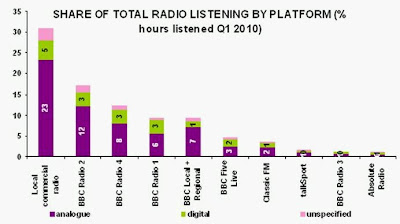
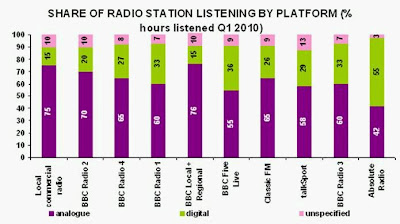
Audience data published by Ofcom in its latest Communications Market report (page 219, Figure 3.34) help us to understand the current roadblock with DAB consumer take-up. Ofcom divulged the proportion of listening to individual stations by platform, data that has not been made public by RAJAR (see graph below).

The information demonstrates that a few stations, notably AM broadcasters BBC Five Live and Absolute Radio, are making significant headway with attracting audiences on digital platforms. However, in order to put these data in a market perspective, it is necessary to understand the relative importance of each of these stations.

The above graph helps put the planned transition from analogue to digital in a proper market perspective. For example, Absolute Radio has made much of the fact that more than 50% of its listening is already attributed to digital platforms. However, in the context of digital radio switchover, its audience is so small that it has little overall impact. The volume of listening to some local London stations is greater than to national Absolute Radio.

The government has stated that it will not consider ‘switchover’ until at least 50% of radio listening is via digital platforms. Digital listening to the ten stations and station types shown in the above graph add up to only 20%, even after ten years of DAB (digital-only stations bring the total to 24%). There is a reason that it will prove an impossible challenge to get this up to the 50% government target.

Around 300 local commercial radio stations account for 31% of all radio listening. Their success in convincing audiences to migrate to digital platforms will be a vitally important part of the aim to achieve the 50% criterion. However, only 15% of local commercial radio listening is attributed to digital platforms, the lowest proportion (along with BBC local radio) of the ten stations/types in the graph. The task to improve this performance from 15% to the 24% national average is likely to prove impossible, let alone to grow it to the 50% criterion.

This is because many stations in the local commercial radio sector cannot and will not ever be available on DAB because:
• The economics of DAB transmission make it too costly
• The unavailability of any local DAB multiplex in some areas
• The unavailability of space for stations on some local DAB multiplexes
• The industry grand plan to amalgamate existing local multiplexes into regional multiplexes makes DAB transmission, for small local radio stations, more irrelevant and more costly.

These issues had been identified by the government in its Digital Britain consultation in June 2009:
• “merging [DAB] multiplexes will reduce the overall capacity available for DAB services, therefore reducing the potential for new services”
• “reduced capacity on local multiplexes might result in some services losing their current carriage on DAB.”

The government’s decision to ignore these outcomes is now coming back to bite it on the bum. Not having a plan to ensure that all local commercial radio stations can be made available on DAB will only ensure that the government’s 50% criterion can never be met.

At the same time, the determination of the largest players in the commercial radio sector to forge ahead with DAB, regardless of these unresolved issues, has created a serious schism between them and the smaller local radio groups and independent local stations who have no digital future. These issues were raised in parliamentary debate of the Digital Economy Act but were ignored and trivialised by the DAB lobbyists.

Some local commercial radio owners are seriously alienated by the way their predicaments have been ignored by large radio groups and their trade organisations – RadioCentre, Digital Radio Development Bureau and Digital Radio UK. One such group owner, UKRD, has taken direct action by running a campaign on-air and on its stations’ websites against the government’s proposed switchover to DAB.

A page entitled ‘Love FM’ on the Wessex FM website says:

“As you probably know Wessex FM proudly broadcasts to this area on the FM frequencies 96 & 97.2, and had been hoping to for many years to come. However, recent developments mean that we may not be able to broadcast in this way for much longer. In fact, the current plan from parliament is to switch off the use of FM for many stations in 2015. That means, soon, you may not be able to listen to us on FM.”

William Rogers, UKRD Group chief executive officer explained:

“We are not prepared to encourage any of our listeners to go and replace their perfectly satisfactory analogue radio set with a DAB one which may not be able to pick up a DAB signal at all and if it can, it may be a signal which may be wholly inadequate. Even worse, the very station that the listener may have heard the [DAB marketing] advertisement on may not be on DAB or even have a DAB future.”

Pam Lawton, managing director of another UKRD-owned station, KL.FM in King’s Lynn, said:

“We are not on DAB at the moment and currently most of the DAB digital platforms have been snapped up. As things stand, West Norfolk does not have a digital platform because there are limitations about how many there can be and there will only be one station that will serve Norfolk. That station will probably be based in Norwich so once the government decides to turn off FM, we will have to switch off for good.”

The paradox is that the radio sector stakeholders who have been pushed aside and ignored by the DAB movers and shakers are some of the very ones who hold the key to enabling digital radio switchover to happen. Unless the huge audience for local commercial radio can be persuaded to migrate its listening to DAB, the 50% criterion cannot be achieved.

At the same time, some stakeholders who are making the most noise about DAB switchover matter the least in the scheme of things. Absolute Radio can trumpet its individual success with digital listening, but it is contributing less than 1% to the 50% criterion that has to be reached, despite being a national station. It is the hundreds of local commercial radio stations that, collectively, matter the most. Yet, many of these have been denied any seat at the DAB table.

As politicians have learnt through the ages, unless you can convince the little guys (the local radio station owners) and the ‘man in the street’ (the radio listener) to endorse your grand scheme, a scheme is all it will remain. Fancy words in boardrooms, lengthy documents from corporate consultants and detailed project management timelines will inevitably come to nothing, without involving and bringing on board the people who really matter.

It is the radio industry data, particularly for local radio, that tell the real story of DAB and why it can never become the mass radio medium for UK consumers. That is why digital radio switchover will not happen.

[all RAJAR data are Q1 2010, as used by Ofcom]

GERMANY: “The over-40’s will be listening to radio on FM for the next 40 years”

On the afternoon of 10 August 2010, a group of radio people from Germany, Austria and Luxembourg gathered in Erfurt, Germany to discuss the future of radio in the digital age. They had been invited there by the media regulator for Thüringer state (TLM) and some of the region’s broadcasters. The event was entitled ‘Radio 2020: a radio future between optimism and pessimism’ and followed on from a similar event held a year earlier.

This year, the final conference session tackled the topic ‘Radio and the day after tomorrow: new possibilities for distribution and exploitation of radio content on the internet’. A presentation by Dr. Klaus Goldhammer, managing director of the Goldmedia Group in Berlin, included the assertion:

“Radio broadcasting and internet radio are different markets.”

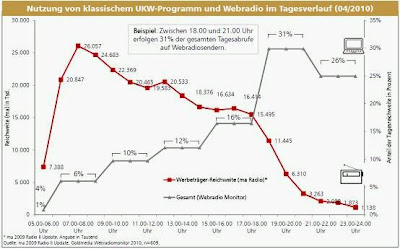
Goldhammer plotted the flow of daytime audiences in Germany for broadcast radio and internet radio on the same graph. It demonstrated that the peak broadcast radio audience between 0700 and 0800 corresponded with the lowest daytime audience for internet radio. Conversely, the peak audience for internet radio was between 1800 and 0000, corresponding with broadcast radio’s lowest audience of the day (see the slide below from his presentation).

Goldhammer noted that 31% of internet radio’s daily hours listened were consumed between 1800 and 2100. This appears to be very different from the US experience where a significant volume of listening to internet radio takes place during office hours in workplaces. In Europe, listening to radio (any radio) at work is still nowhere near as common as it is in North America.

Goldhammer noted that the growth of internet radio listening was still very slow in Germany, compared to the growth in available internet bandwidth. He concluded that:

“The over-40’s will be listening to radio on FM for the next 40 years”

Lars Gerdau, managing director of LandesWelle Thüringen, a regional rock/pop radio station broadcast on 14 FM frequencies, commented:

“We see the whole [internet radio] thing has become much more complicated than a year ago. Firstly, it is very expensive to stream a lot of radio programmes and, secondly, we have no claim to be first [in the internet space]. We have time and will focus first on FM.”

After the conference, Inge Müller-Seibel, a German radio sector commentator, noted that neither was DAB radio replacing FM as the main listening platform:

“After two decades of experimentation in Germany, the future of digital [terrestrial] radio remains uncertain. It was 1987 when the new DAB transmission technology was presented for the first time at the IFA in Berlin. Some ten years later, the German states listened to Brussels and recommended the closure of their terrestrial FM frequencies by 2015 at the latest. But almost nobody believes it will happen, and now the radio stations are putting more hope in new distribution technologies via the internet.”

And a reporter at this year’s IFA consumer electronics fair wrote:

“Digital radio is not a success story in Germany. Little more than 500,000 digital receivers have been purchased, a tiny number compared to the several million analogue FM receivers.”

A recent article in Die Welt newspaper asked ‘When will FM radio die?’ and explained:

“In fact, the [FM] technology should no longer exist. Originally, the abolition of FM was planned for this year. Instead, radio listeners across the country should have been receiving only digital signals. But the outcome has been different because most people are completely satisfied with the quality of good old FM stereo, and because of the inertia from an estimated 300 million FM radio receivers in Germany. Only a few geeks have so far bought digital radios with DAB technology.

Additionally, it is mobile phones, a symbol of the triumph of digital technology, that have supported the continuation of analogue FM radio. This is because most phones have a built-in FM radio receiver.”

[thanks to Katrin Penzel]

Back to the future of radio – the FM band

Help seemed to have arrived for those consumers who are confused by the contradictory messages they are receiving about DAB radio, digital switchover and the future of FM/AM radio. The government created a ‘hot topic’ web page that addresses these issues in the form of a ‘FAQ’. Does it help clarify things?

The government FAQ states:
“We support 2015 as a target date for digital radio switchover” but, in the next sentence, it says that 2015 is “not the date for digital radio switchover”
“FM will not be ‘switched off’ … and will continue for as long as it is needed and viable” but then it fails to explain the reason the government is calling it ‘switchover’
“We believe digital radio has the potential to offer far greater choice and content to listeners” but then it asserts that “quite simply the listener is at the heart of this [switchover] process”
“11 million DAB sets [have] already [been] sold” but, in the next sentence, it deliberately confuses ‘DAB radio’ with ‘digital radio’ which, it states, “accounts for around a quarter of all radio listening” [DAB accounts for only 16% of all radio listening]
“Car manufacturers have committed to fit DAB as standard in all new cars by 2013” but it does not explain that only 1% of cars currently have DAB radio
“Some parts of the country are not served well by DAB” but it then admits that “switchover can only occur when DAB coverage matches [existing] FM [coverage].”

Well, that makes everything crystal clear now. Switchover is not switchover. 2015 is the date but is not the date. It is the government that is insisting upon digital ‘switchover’ but it is a consumer-led process. Almost no cars have DAB now but, in 2+ years’ time, magically they all will. In parts of the UK, DAB reception is rubbish or non-existent, but ‘switchover’ will not happen until somebody spends even more money to make DAB coverage as good as FM … even though FM is already serving consumers perfectly well.

Sorry, what was the point of DAB?

While the UK government ties itself in increasingly tighter knots trying to explain the unexplainable, and to justify the unjustifiable, most of the rest of the world carries on regardless, inhabiting reality rather than a fictional radio future. In May 2010, a meeting in St Petersburg of the European Conference of Postal & Telecommunications Administrations considered the future usage of the FM radio waveband [which it refers to as ‘Band II’] in Europe. Its report stated:

“Band II is currently the de facto analogue radio broadcasting band, due to its excellent combination of coverage, quality and low cost nature both in terms of current networks available and receivers in the market. It is well suited to local, regional and national programming and has been successfully used for over forty years now. FM receivers are part of our daily lives and millions of them populate our households. FM radios are cheap to manufacture and for the car industry FM still represents the most important medium for audio entertainment.”

Its report concluded that:
• “Band II is heavily used in all European countries
• For the current situation the FM services are still considered as satisfactory from the point of sound quality but the lack of frequencies hinders further development
• There are no wide-spread plans or strategies for the introduction of digital broadcasting in Band II
• No defined final switch-off dates are given so far.”

Two paragraphs in the 28-page report seemed to sum up the present UK situation:

“The FM band’s ability to provide high-quality stereo audio, the extremely high levels of receiver penetration and the relative scarcity of spectrum in the band combine to make this frequency band extremely valuable for broadcasters.”

“As FM in Band II is currently, and for the foreseeable future, the broadcasting system supporting the only viable business model for radio (free-to-air) in most European countries, no universal switch-off date for analogue services in Band II can be considered.”

In the UK, we have just seen how “extremely valuable” FM radio licences still are to their owners. Global Radio was prepared to promise DAB heaven and earth to Lord Carter to ensure that a clause guaranteeing automatic renewal of its national Classic FM licence was inserted into the Digital Economy Act 2010. It got what it wanted and therefore avoided a public auction of this licence. Then, when expected to demonstrate its faith in the DAB platform, Global sold off its majority shareholding in the national DAB licence and all its wholly-owned local DAB licences.

Now the boot is on the other foot. Having succeeded in persuading the government to change primary legislation to let it keep commercial radio’s most valuable FM licence for a further seven years, Global Radio has now had to argue to Ofcom that analogue licences will become almost worthless in radio’s digital future. Why? In order to minimise the future Ofcom fee for its Classic FM licence. The duplicity is breathtaking.

When it last reviewed its fee for the Classic FM licence in 2006, Ofcom reduced the price massively because, it explained, it took

“the view that the growth of digital forms of distribution meant that the value associated with what was considered to be the principal right attached to the licence – the privileged access to scarce analogue spectrum – was in decline.”

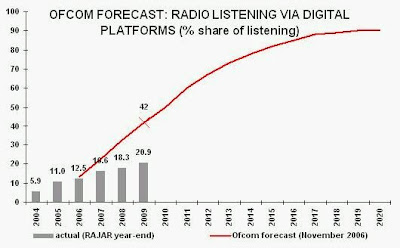
In 2006, Ofcom had published a forecast for the growth of digital radio platforms which has since proven to have been wildly over-optimistic. It had predicted that 42% of listening would be digital by year-end 2009, whereas the outcome was 21%. In 2006, as a result of the steep decline it was forecasting in analogue radio’s usage, Ofcom reduced the cost of Classic FM’s licence fee by 95% from £1,000,000 to £50,000 per annum (an additional levy on the station’s revenues was also reduced from 14% to 6% per annum). The losers were UK taxpayers – the licence fees collected by Ofcom are remitted to the Treasury. The winners were Classic FM’s shareholders, who were gifted a cash cow by Ofcom bureaucrats who misunderstood the radio market.

Fast forward to 2010, and Ofcom is undertaking yet another valuation of how much Classic FM (plus the two national AM commercial stations) will pay during the seven years of its new licence, following the expiry of the current one in September 2011. Has Ofcom apologised for getting its sums so badly wrong in 2006? Of course not. Will it make a more realistic go of it this time around? Well, the signs are not good.

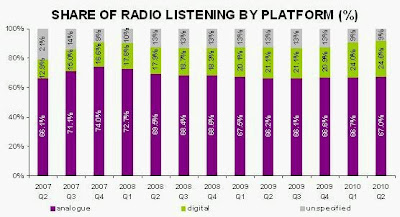
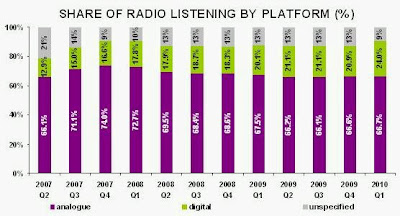
In its consultation document on this issue, Ofcom has repeated the same errors it made in other recent publications about the take-up of digital radio. In Figure 1, Ofcom claims that analogue platforms’ share of all radio listening has fallen from 87% in 2007 to 76% in 2010. This is untrue. As noted in my previous blog entry, listening to analogue radio has remained remarkably static over this time period. Ofcom’s graph has completely ignored the existence of ‘unspecified’ platform listening, the volume of which has varied significantly in different surveys. The graph below plots the actual numbers from industry RAJAR data.

Exactly the same issue impacts the accuracy of Figure 3 in the Ofcom consultation, which purports to show that analogue listening to Classic FM fell from 86% to 72% between 2007 and 2010. Once again, this must be factually wrong. Once again, the volume of ‘unspecified’ listening to Classic FM has simply been ignored and the decline of analogue listening to Classic FM has probably been overstated by Ofcom.

Confusingly, the platform data for Classic FM cited in Figure 3 differ from data in a different Ofcom document [Figure 3.34 on page 33 of The Communications Market 2010] which state that, in Q1 2010, 65% of listening to Classic FM was via analogue, 26% was via digital and 9% was unspecified. In Figure 3, the values for the same quarter are stated as 72%, 28% and 0% respectively. It is impossible for both assertions to be correct.

These inaccuracies have the impact of painting a quite different picture of Classic FM’s transition from analogue to digital listening than the market reality. These matters are not academic. They will have a direct and significant impact on the perceived value of the Classic FM licence over the duration of its next seven-year period. Sensible decisions about the value of the station’s licence cannot be made on the basis of factually inaccurate market data published by Ofcom.

Undeniably, Ofcom is between a rock and a hard place:
• An admittance that, in 2006, Ofcom got its digital radio forecast and its sums badly wrong and, as a result, has already lost the Treasury millions of pounds in radio licence fees, would require humility (and humiliation)
• Not admitting that, in 2006, Ofcom got it wrong would necessitate it to now fix the Classic FM licence fee at the same low rate as in 2006, or even lower, denying the Treasury millions more in lost revenue between 2011 and 2018
• Increasing the cost of Classic FM’s licence fee would be a tacit admittance by Ofcom that its entire DAB ‘future of radio’ policy is simply not becoming reality and that FM spectrum will still remain “extremely valuable for broadcasters”.

In 2006, the low valuation of Classic FM’s licence fee was built upon a top-down bureaucratic strategy which insisted that the UK radio industry was ‘going digital’, whether or not consumers wanted to or not. Now, it is even more evident than it was then that consumers are not taking up DAB radio at a rate that will ever lead to ‘digital switchover’ (whatever that phrase might mean).

However, reading the Ofcom consultation document, it is also evident that the regulator remains wedded to its digital radio policy, however unrealistic:

“We consider that this [Digital Radio] Action Plan is relevant when considering future trends in the amount of digital listening since it represents an ambition on behalf of the industry and Government to increase the amount of digital listening in the next few years.”

In the real world, Classic FM’s owner understands precisely what the international delegations who met in St Petersburg also knew – FM will remain the dominant broadcast platform for radio. Only the UK government and Ofcom seem not to accept this reality, still trying to go their own merry way, while the rest of Europe has already acknowledged at this meeting that:

• The FM band is “extremely valuable for broadcasters”
• The FM band is “currently, and for the foreseeable future, the broadcasting system supporting the only viable business model for radio (free-to-air) in most European countries”
• “No universal switch-off date for analogue services in Band II can be considered.”

[thanks to Eivind Engberg]

Download The First Annual Not ‘The Ofcom Digital Radio Progress Report’ Report

Download this report here

In July 2010, Ofcom had published its first annual report on the progress made in the UK with take-up and usage of digital radio. I criticised the report in this blog for being selective with data and distorting the real picture of the slow take-up of DAB radio.

Ofcom responded to two of my criticisms in a subsequent news article in Media Week. Ofcom explained that it had “categorised ‘unspecified’ listening as ‘analogue’ rather than ‘digital’ listening because it did not want to exaggerate ‘digital’ listening.” What?

This response seems only to confirm my assertion that Ofcom invented the numbers it published. There are two possible scenarios: either Ofcom did not realise that deliberately mis-stating the results of market research breaches the Code of Conduct of the Market Research Society; or Ofcom did realise this but decided to do it anyway. I am uncertain which scenario is scarier. If Ofcom’s invented RAJAR statistics had been included in an advertisement, it would be banned by the Advertising Standards Authority. Adding the ‘don’t know’ answers to either the ‘for’ or the ‘against’ totals in any consumer survey is a crime against statistics.

Secondly, Ofcom responded to my criticism that it had not published historical data to demonstrate how close we are to achieving the 50% digital listening criterion set by government. Ofcom said that it “did not set historical figures next to the forecasts because they are not formal criteria”. What?

I suggest that Ofcom stops daydreaming about a DAB future and starts listening to the words of its government paymasters. To take just one example of dozens, on 8 July 2010, Culture Minister Ed Vaizey said very plainly:

“We will only consider implementing a Digital Radio Switchover once at least 50% of all listening is already on digital or, to put it another way, when analogue listening is in the minority.”

Besides, Ofcom’s report itself had noted (in two places) that:

“A decision on switchover could only made once two criteria had been fulfilled [sic]:
• when 50% of all radio listening is via digital platforms; and
• when national DAB coverage is comparable to FM …”

The Ofcom Digital Radio Progress Report published last month was required by the Digital Economy Act 2010 to inform the government how close the UK is to achieving this 50% criterion. Yet, bizarrely, the very numbers the government wanted to see were missing from the relevant Ofcom graph.

In the spirit of constructive action, I have collated a short collection of graphs and tables in a presentation titled The First Annual Not ‘The Ofcom Digital Radio Progress Report’ Report. It can be downloaded here for free. All of the data within are derived from freely published industry sources to which Ofcom had access.

The first section of the report demonstrates that none of the radio industry forecasts for UK digital radio take-up stand a chance of being achieved, whether those predictions were made by the government, its committees, Ofcom, RadioCentre, Value Partners or whomever. These forecasts were not just wrong – they were wildly wrong.

The inability of forecasters to observe the reality of slowing DAB radio take-up in the UK was underlined by a forecast published in August 2010 by a US company that predicted:

“By 2015, the worldwide installed base of digital radio receivers, excluding handsets, is expected to reach nearly 200 million units. … ‘The adoption of DAB radios in Europe has been led primarily by tabletop radio sales in the UK,’ says [Sam] Rosen. In addition to the US and the UK, Switzerland, Denmark, and Norway all have significant broadcast infrastructure in place, with Australia, Germany and France to complete the majority of their infrastructure in 2011.”

Yes, and pigs will fly. It has taken a decade for 11 million DAB radios to be sold in the UK, and they still only account for 16% of radio listening. Far from the UK’s DAB broadcast infrastructure being almost complete, there is an impasse about who will stump up the money to render it fit for purpose. France is still debating whether to go digital at all. Germany abandoned its first effort and is planning a second attempt. Besides, the US, UK, French and Australian technology systems for digital terrestrial radio are each mutually exclusive. There is no globally agreed standard for digital terrestrial radio, so there is no universal ‘digital radio’ receiver, and nothing like 200 million digital radios (of all types) will be sold by 2015.

But a woefully inaccurate, over-optimistic forecast is always a good excuse for writing fantasy news. In the US, Media Post reported:

“HD digital radio is poised for rapid growth over the next few years … with much of the increase coming abroad, especially in Europe, where various governments have established HD radio as the national standard. … US consumers have purchased 4 million HD radio sets, while European consumers – led by the UK – have purchased about 13.5 million.”

Oh dear. Lie One: the American HD radio system is not a national standard in any European country. Lie Two: not a single HD radio has been sold in the UK. Lie Three: maybe 13 HD radios have been sold in Europe, but certainly not 13 million.

Consequently, US broadcast industry trade body NAB summarised this completely inaccurate news story (“… the real growth is happening overseas, where governments have already established HD [radio] as a standard technology”) and sent it to everyone on its mailing list. The whole of the US radio sector must be amazed that Europe, led by the UK, has embraced American HD radio technology so warmly, while it is failing so dismally in its homeland. Wrong! In reality, no consumer in Europe has even heard of HD radio (except for a few techies testing it in Switzerland).

Closer to home, the continuing failure of the DAB digital radio system to impress European consumers seems to have impacted thinking at the European Broadcasting Union [EBU], which has supported Europe-wide implementation of DAB since 1986. In outlining the agenda of its fourth Digital Radio Conference [DRC10], the EBU came close to acknowledging that DAB is no longer ‘the future of radio’:

“Where previous [conference] editions have focused on the relative merits of the different digital radio platforms and their roll-out across Europe, DRC10 will focus on radio’s position within a pluralistic distribution model. That the discussion of digital radio’s future has, to date, been weighted towards different platforms is understandable given the uneven pace of Eureka 147 (DAB/DAB+/DMB) adoption and the rapid deployment of internet to European homes. Indeed, technical development has now reached something of a plateau. … The debate has moved forward from which platform might ‘win’ to how best to chart a digital future for radio on multiple platforms. … A more fundamental question then is ‘what is the case for digital radio?’. This is about business and social arguments for and against the development of digital radio in all its forms. It involves the economics of radio revenues and costs, the social value, the mix of public and commercial broadcasters, as well as the quality and variety of the offering.”

“Uneven pace”? “Plateau”? “Multiple platforms”? Am I the only one to smell EBU back-peddling here on the DAB issue? At last year’s EBU conference, I seemed to be the only speaker exploring “the economics of radio revenues and costs” amongst a sea of technologists whose enthusiasm for DAB remained unsullied by the constraints of the economics of radio. Maybe the penny has dropped – a platform remains no more than a platform if you cannot afford to fill it with compelling, exclusive radio content, and convince consumers to use it, and generate a profit from it.

Here in the UK, while the biggest commercial radio owners have already baled out of most of their DAB commitments (and the BBC is trying to close two of its digital stations), the digital minnows are left suffering the economic consequences of a platform that has effectively been thrown to the dogs. Passion For The Planet, an independent digital-only station that has persevered on the DAB platform since 2002, announced in August 2010 that it will no longer broadcast on DAB in London. Managing director Chantal Cooke explained:

“DAB is a great medium for radio, but squabbling within the industry and a lack of clarity and direction from Ofcom leaves us worried that radio may well have missed a great opportunity. I believe London has too many stations, and the signal on the ‘London 3’ multiplex has always been, and continues to be, very poor. The lack of a robust signal has hampered independent services from the start, yet neither the multiplex operators nor Ofcom has taken the problem seriously. Passion for the Planet has spent a small fortune broadcasting on ‘London 3’ because we believed in the platform but, while there are still so many issues to be rectified, further investment in DAB in London has become increasingly difficult to support.”

The writing on the wall for DAB’s impending failure is writ so large now that Ofcom staff must have to leave work under cover of darkness not to see it. Large parts of the radio industry evidently have no faith in DAB ever replacing analogue radio. However, over at Ofcom HQ, the futile work continues to try and convince consumers and the government that DAB is still ‘the future of radio’. We will probably never know how much public money and time has been wasted on these foolish endeavours.

[many thanks to John Catlett and Eivind Engberg for their valuable contributions]

Lies, damned lies and … Ofcom’s first digital radio progress report

Ofcom quietly published its first Digital Radio Progress Report in July 2010, without fanfare or a press release. This report has been a remarkably long time coming, given that DAB radio has been with us more than a decade. During that time, Ofcom has published 26 Digital Television Progress Reports, starting in 2003.

Here was an opportunity for Ofcom to demonstrate that it is acting in the public interest by publishing solid, objective data about the progress of digital radio in the UK. Did it take that opportunity? No. Instead, Ofcom published a set of data that are so selective and so distorted that they misrepresent the progress (or lack of it) made to date in advancing the UK towards the ‘digital radio switchover’ that our government is determined to execute. Why? Because Ofcom (like the government’s DCMS department) seems determined to persuade us that its totally unrealistic plan for DAB radio has not been an unmitigated disaster with the citizen/consumers on whose behalf it is supposed to be working.

It might appear pedantic to pick over the details of data represented in this feeble 24-page Ofcom report. However, it must be stressed that this is no nitpicking exercise. The Digital Economy Act 2010 insists that this very document submitted by Ofcom (and another by the BBC) to the government will decide whether the UK will progress to ‘digital radio switchover’. It is these data that will decide whether we can continue to receive BBC network radio stations on the 100 million analogue radios that are out there. It is these data that could mean we have to replace perfectly satisfactory analogue radio receivers in every household across the country, at a cost of millions to consumers.

To note the issues in the order they appear in the Ofcom report:

FIGURE 1
This Ofcom graph purports to show that:
• Digital platforms’ share of radio listening increased from 12.8% to 24.0% between 2007 and 2010 (this is TRUE)
• Analogue platforms’ share of listening decreased from 87.2% to 76.0% between 2007 and 2010 (this is FALSE)

The four figures cited in Figure 1 for the analogue platform – 87.2% in 2007, 82.2% in 2008, 79.9% in 2009 and 76.0% in 2010 – are an Ofcom invention. These false data seek to demonstrate that a rapid decline in analogue listening has taken place. This is not true. As the graph below shows, analogue listening has remained remarkably static over this timeframe.


The situation is complicated by two facts: a significant proportion of radio listening remains ‘unspecified’ by respondents in RAJAR listening surveys, and that this proportion has varied greatly in size in different surveys. However, this does not detract from the falsehood of Ofcom’s attempt to demonstrate that analogue listening is in sharp decline.

FIGURE 2
This Ofcom graph purports to show that:
• 54% of 15-24 year olds use digital radio
• 57% of 25-34 year olds use digital radio
• 56% of 55-64 year olds use digital radio
• 46% of 65-74 year olds use digital radio
• 29% of 75+ year olds use digital radio.

In fact, the fine print explains that Ofcom had asked the question ‘Have you ever used digital radio?’ This ensured that the results were almost meaningless because they tell us nothing whatsoever about current usage of digital radio. For example, a 68-year old who, on a single occasion ten years ago, had listened to digital radio for 10 minutes will have answered ‘yes’, despite having made no further usage during the last decade.

Ofcom’s objective here seems to have been to highlight the large size of the resulting numbers, without indicating that they derive from an almost useless question (garbage in, garbage out). If you were to ask people ‘Have you ever bought a banana?’, almost 100% would respond ‘yes’. Their answers tell you absolutely nothing about the current market for bananas. Exactly the same is true of digital radio usage. In this context, the resulting numbers seem remarkably low because only half the population has ever tried digital radio (even once in their lifetime).

FIGURE 3
This Ofcom graph purports to show that:
• 53% of adults use digital radio
• 63% of adults in socio-economic groups AB use digital radio
• 55% of adults in socio-economic group C1 use digital radio
• 48% of adults in socio-economic group C2 use digital radio
• 42% of adults in socio-economic groups DE use digital radio.

Just as in Figure 2, the fine print explains that Ofcom had asked the question ‘Have you ever used digital radio? The same issues apply here as with Figure 2.

FIGURE 5
This Ofcom graph shows digital platforms’ share of total radio listening, but the data omit:
• A comparison with the analogue platform
• A time sequence to show how fast the market is changing.

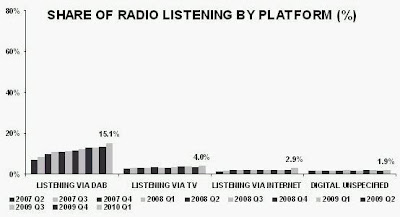
The following graph demonstrates the slow growth of digital platforms and their low level in comparison with analogue. It also demonstrates that a proportion of the growth in digital platform usage is the result of a statistical technicality caused by a reduction of ‘unspecified’ listening in recent quarters.

The following graph demonstrates the slow growth of individual digital platforms since 2007, using the same scale as applied in the preceding graph.

FIGURE 8
This Ofcom graph purports to show that:
“five digital-only services generated a weekly reach of 1 million+ listeners in Q1 2010.”

However, the fine print explains that the Ofcom data refer to “all listeners [aged] 4+”, whereas the radio industry’s standard metric is and always has been ‘adults 15+’. Indeed, all RAJAR audience data used in this same Ofcom report refer to ‘adults 15+’, except for Figure 8.

Once the graph is re-worked using ’15+’ instead of ‘4+’ data (see above), it is evident that:
• Only three digital-only radio stations generate a weekly reach of 1m+ adult listeners
• BBC World Service was included in the Ofcom graph (and was one of the five stations cited as exceeding 1m weekly reach) even though it is not digital-only, being available across a large part of the UK on 648AM
• BBC Asian Network was omitted from the Ofcom graph (also available on analogue but limited to the Midlands)
• Not only are Panjab Radio and NME Radio no longer available on the national DAB platform (as the Ofcom text notes), but Q Radio is no longer on DAB, and the BBC has proposed the closure of Asian Network
• These weekly reach data for digital-only stations should be considered in the context of analogue radio stations – for example, BBC Radio 2 has a weekly adult reach of 14.6m.

FIGURE 9
This Ofcom graph purports to show that:
• Digital radio’s current share of listening is “broadly in line with the organic growth outlined on the [government’s] forecast chart.”

Bizarrely, the Ofcom graph displays the government forecasts but has omitted the historical data that would show how successfully the forecast has been achieved to date.

The forecast published in June 2009 predicted that, by year-end 2009 (a mere six months later), digital platforms would account for 24% or 26%, the latter the result of a concerted ‘drive to digital.’ In fact, the year-end figure was 21%. The likely reason that Ofcom has failed to include the historical data is that neither of the two forecasts (‘organic growth’ or the ‘drive to digital’) has any chance of being realised. If the current growth rate is extrapolated, the 50% criterion will be reached by year-end 2018, and certainly not by either 2013 or 2015, as the forecast (credited to Value Partners) predicted.

FIGURE 14
This Ofcom graph and accompanying text assert that:
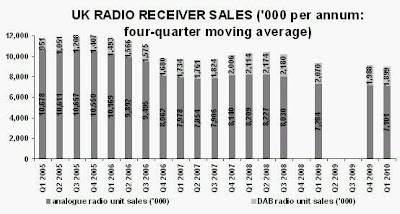
• “DAB sets made up over a fifth (21%) of all radio sales by volume” in the year to Q1 2010
• “In the portable market, DAB sets accounted for 65% of sales.”

However, Ofcom omitted to point out that:
• Fewer DAB radios had been sold in 2009 than in 2008
• DAB radios were a lower proportion of total radios sold in 2009 than in 2008
• Its reference to “the portable market” is limited strictly to ‘portable radios’ of the type used in kitchens. There is not a single mobile phone on sale in the UK that includes DAB radio, and the vast majority of portable media players that include radio do not have DAB radio.

In fact, the data in the graph above demonstrate that:
• DAB radio receiver sales volumes peaked in 2007/8 at 2.2m per annum and have declined 13% since then to 1.9m per annum
• Analogue radios contributed a greater proportion of total radio receiver sales in 2009 (79%) than they had in 2008 (78%)
• DAB has not invigorated the market for radios, with fewer radios sold now than ever, perhaps due to evident consumer confusion about ‘digital radio switchover’.

FIGURE 17
The Ofcom graph shows that:
• 17% of adults say they are likely to buy a DAB radio in the next 12 months.

However, the Ofcom graph does not offer a historical perspective. The graph above demonstrates that the propensity to purchase a DAB radio has diminished over time. In 2006, 17% of respondents said they would be likely to buy a DAB radio within the next six months. In 2010, 17% said they would be likely to buy a DAB radio within the next 12 months. This would translate into a significant reduction in DAB radio receiver sales. Additionally, the proportion of respondents who say they do not know if they will purchase a DAB radio continues to increase over time, perhaps a further symptom of market confusion or DAB indifference.
————
Given that Ofcom has had the luxury of several years to prepare this first Digital Radio Progress Report, the result is a travesty. It should not be the regulator’s role to selectively highlight and distort data that support its own policies in a document specifically requested by government in order to inform a parliamentary decision on digital radio switchover. We deserve better from our public servants. Otherwise, they might as well go and work for Digital Radio UK, the lobby group (funded by commercial interests and the BBC) busy pumping out propaganda to try and persuade consumers that they need DAB radio.

On page 5 of this first Digital Radio Progress Report, Ofcom notes:

“Our principal general duty, when carrying out our radio functions, is … to further the interests of citizens in relation to communications matters.”

Exactly how are citizens’ interests being furthered by Ofcom distorting the facts about digital radio take-up?

Cost/benefit analysis of DAB radio: Murdoch rushes in where governments fear to tread

Governments have had plenty of practice, over many years, of hiding reports from the electorate. In some cases, they might justify this as a matter of national security or military expedience. However, it is hard to understand how the UK government thought it could justify hiding from the public a cost/benefit analysis of digital radio switchover it had commissioned and then, a year later, have believed the matter had been successfully buried. But so it was, until the House of Lords Communications Committee intervened in early 2010.

On 6 February 2009, PricewaterhouseCoopers [PWC] delivered a 91-page report entitled ‘Cost Benefit Analysis of Digital Radio Migration’ to Ofcom. It contained a number of serious reservations that any benefits would arise from switchover to DAB radio, even by the year 2030:

“The results suggest that there are relatively few up-sides to the estimates, and several significant downside risks. … The results suggest that there is a very long pay-back from the Digital Radio Working Group [DRWG] policy ‘investment’ – the Net Present Value [NPV] turns positive after 2026. This result assumes that the existing multiplex licences are extended to 2030, as per the DRWG recommendations. Without the licence extension or any other policy instruments that provide clarity on the long term future of commercial radio, the industry and consumers may fail to see the benefits of digital radio over the longer term. Our analysis suggests that the NPV is negative should either of these two proposals not be implemented.” [emphasis added]

Since then, parliamentary policy has failed to provide “clarity on the long term future of commercial radio,” as evidenced by last week’s wholly ambivalent government statement about digital radio switchover. As a result, just as PWC predicted, industry and consumers increasingly “fail to see the benefits of digital radio over the longer term.”

The PWC report, and its verdict that digital radio switchover offers almost no benefits, remained hidden from public view from February until November 2009, when an appendix to the government’s Digital Economy Bill mentioned it casually. That citation raised questions: what was this PWC report, and why could not the public see it?

When the House of Lords Select Committee on Communications convened in January 2010 to consider the digital switchover issue, it asked those same questions of the Ofcom officers it invited to present evidence:

Baroness McIntosh of Hudnall: We understand that you commissioned a report from PWC last year into the costs and benefits of digital switchover in radio, but you didn’t publish it. We know, therefore, what we have learned from the Department for Culture, Media & Sport about what it said. It appears that it found, for example, that the benefits could – and I emphasise the word “could” – outweigh the costs by £437 million after 2026, but that conclusion is hedged about with quite a lot of caveats to do with what would have to happen in order for that good outcome to eventuate, and that if those things didn’t happen, then quite quickly you would get into a position where the costs would outweigh the benefits. Can you tell us a bit about that report? In particular, can you tell us why you haven’t published it? Do you think that, given what it appears to say – I choose my words carefully – about the constraints on potential for benefit, that it should have been available to inform the Government’s digital policy? ….. [edited]

Mr Peter Davies [Director of Radio Policy & Broadcast Licensing, Ofcom]: We were asked to commission it by the Government. We then commissioned it from PWC with a lot of input from various government departments and then submitted it to the Secretary of State.

Chairman: So you decided not to publish it.

Mr Stewart Purvis [Partner for Content & Standards, Ofcom]: …. [edited] On this particular occasion, it was decided in conjunction with the Department that work would be sent to the Department. Perhaps the most important thing is for Peter to respond to your characterisation of the work, but, in a sense, we have not hidden the piece of work. Indeed, I think it is now available to you. Is that right?

Baroness McIntosh of Hudnall: In, as they say, a redacted form.

Chairman: Just to be absolutely clear, the Department asked you to commission the work from PWC. Is that what you are saying?

Mr Purvis: They asked us to commission the work. Did they ask us specifically from PWC?

Mr Davies: Not specifically from PWC.

Chairman: The Department said to Ofcom, “Ofcom, you go and commission this particular work.” Is that the position?

Mr Davies: Yes.

Chairman: You then got the work which then came back to you and then you sent it to the Government and the Government said, “We’re not going to publish this in full.”

Mr Davies: I think they have certainly made it available to various groups. I think consumer groups have had it for some time.

Chairman: Fine. There will be no problem, therefore, in this Committee having the full report. …. [edited]

Baroness McIntosh of Hudnall: The thing that is slightly troubling – perhaps only to me, but a bit – is that when you see what appears to be evidence that the costs and benefits are, let’s say, finely balanced, or could be, that the drive towards digital migration, one might think, was driven more by the technology than by the needs either of the broadcasters or the consumers.

The Committee’s displeasure with Ofcom and the government was evident both in this exchange and in its subsequent report on digital switchover, published in March 2010, which stated:

“We strongly regret that the cost benefit analysis carried out by PricewaterhouseCoopers was not published at the time it was delivered to Ofcom and the Department for Culture, Media & Sport in February 2009.”

The government’s response to the Committee’s statement, published in June 2010, was:

“The Cost Benefit Analysis produced by PricewaterhouseCoopers, to accompany the work of the Digital Radio Working Group, was widely distributed amongst broadcasters and consumer representatives. However, there were technical difficulties which prevented the initial publication of the report on the DCMS website; these were rectified and the report published in February 2010.”

“Technical difficulties” for a whole year? As excuses go, this really takes the biscuit. It seems unlikely that the PWC report would ever have been made public, if not for the intervention of the House of Lords Communications Committee in January 2010 (first publication of the report’s findings was in this blog a few days later).

The PWC report did not offer the government the support for its digital radio switchover strategy that it had anticipated, so now it has to commission a further cost/benefit analysis which it hopes will produce a more favourable outcome. Is the government in a hurry to complete another study evaluating the supposed benefits of digital radio switchover? Hardly, judging by the evidence.

In June 2009, the government’s Digital Britain report had promised:

“We will conduct a full Impact Assessment, including a Cost/Benefit Analysis of Digital Radio Upgrade.”

In January 2010, Ofcom’s Peter Davies had offered evidence to the House of Lords Communications Committee:

Baroness McIntosh of Hudnall: What about your own impact assessment?

Mr Davies: We haven’t done an impact assessment yet.

Baroness McIntosh of Hudnall: But you have been asked to – correct?

Mr Davies: At some point in the future. I think the Digital Britain report said that we would be asked to do one, but we haven’t been asked to do one yet. Obviously we would need to do that and we would need a much fuller cost-benefit analysis before any final decision was taken.

Most recently, in June 2010, the government stated:

“We agree that a full impact assessment is an essential part of informing the Government’s decision on whether and when to move from a primarily analogue to a digital radio landscape. Work has already begun to collect the evidence needed to support an impact assessment and analysis should begin shortly.” [emphasis added]

Why bother with yet another report at this late hour in DAB’s history? Someone else has already done the sums. News International has just run its sliderule over the idea of launching a national digital radio station ‘SunTalk’ (a brand extension of its national daily newspaper ‘The Sun’) on the DAB platform. Its result was: DAB radio is not a viable commercial platform.

According to The Guardian: “News International management were considering extending the [SunTalk] station’s reach by launching it nationally on DAB digital radio. But it is understood they baulked at the extra cost.”

If Murdoch cannot see a way to make a profit from a broadcast platform that is crying out for compelling content, then how exactly does any other content owner think it can make a financial return from DAB radio?

It’s the platforms Rupert Murdoch rejects ….

Ofcom’s DAB radio strategy: busy doing nothing, trying to find lots of things not to do

In June 2010, the government published its flimsy 5-page response to the House of Lords Communications Committee’s critical 279-page report on digital switchover that had been unveiled three months earlier. The response was a disappointing document that dismissed with little more than one sentence each of the Committee’s carefully worded recommendations, deduced after having considered hours and volumes of evidence.

One of the Communications Committee’s most forceful recommendations, in Paragraph 107, had concerned the necessary improvements to DAB reception:

“Given the importance for the Government’s plans for digital switchover of universal reception of the BBC’s national stations, it is essential that a firm and unambiguous plan and funding for the completion of build-out of the BBC’s national multiplex is put in place as soon as possible.”

The government’s feeble response to this issue was:

“In order to agree a plan for DAB coverage build-out, so that it can ultimately meet the current levels of FM coverage, Ofcom have been asked to form a Coverage and Spectrum Planning Group to make recommendation on the following:
• the current coverage of national and local radio on FM;
• changes to the current multiplex structure and frequency allocation; and
• what new infrastructure is needed so that DAB can match FM.
Ofcom are expected to present their recommendation to Government in Spring 2011.”

Surely it does not need yet another government committee to look into DAB? Had not these issues already been considered by the Digital Radio Working Group two years ago? By Digital Britain a year ago? By Ofcom? By anybody during the last decade of DAB underachievement?

Then I recalled a speech made by Ofcom Director of Radio, Peter Davies, to the Radio Festival in July 2008, in which he had set out his imminent workplan on the DAB issue:

“Increased coverage of DAB will be absolutely essential if it is ever to become a full replacement for FM for most services…… That brings us to the tricky part – defining what existing coverage is and how we improve it. This is still work in progress but we are approaching it in three stages. Firstly, we need to define what existing FM coverage is. That’s not nearly as simple as it might sound. Radio is not like television where you stick an aerial on the roof and you get reception or you don’t. Radio is used in every room in the house, usually with a portable aerial. It’s used outdoors on a wide variety of devices and it’s listened to in cars. So we need to look at geographic coverage as well as population coverage, and we need to look at indoor coverage in different parts of the house. FM coverage gradually fades as you move around, so we need to decide how strong the signal needs to be to be usable. And, surprisingly, this work has never really been done in any kind of consistent manner for the UK as a whole, so it has taken a little while to agree a framework and calculate the numbers.

Having done that, we then have to do the same for existing DAB coverage. Now DAB has all the same issues as FM, but it also has different characteristics. It doesn’t fade in the same way – you either get it or you don’t – so we need a different set of definitions here. Once we have defined what existing DAB coverage is, we then have to work out what it would take to get existing DAB coverage up to the level of existing FM coverage. Now, we have already done a lot of work on this, and certainly enough to inform the interim report, and the whole thing will be finalised in time for the [government’s] Digital Radio Working Group final report later this year.”

This 2008 workplan seems to comprise precisely the same tasks that the government has just told Ofcom to start and complete by Spring 2011. So what happened? Was this work not done by late 2008, as Davies had promised? And if not, why not?

Improvements to DAB reception were considered a critical issue for consumer take-up of DAB radio … in 2008. Now, in 2010, they are probably the main factor likely to sound the death knell of DAB as a mass market consumer platform. So are we to assume that, in the intervening two years, work on this essential issue was never done, or was not completed, by Ofcom?

Why should consumers consider DAB radio to be anything other than a disaster if even our public servants appear to be busy doing little to fix the acute problems with DAB reception that the public has been rightly complaining about for years?

Digital radio switchover: talk is cheap, action will never happen

Politics is the art of flip-flop policymaking (and justifying it convincingly). This is evident in the new UK government’s first statement about DAB radio and digital radio switchover, published this week. What is its new policy? Well, there is no new policy. The Conservatives are simply continuing the previous Labour government’s ill-advised determination to foist digital radio switchover on an increasingly resistant public. A critic might even be so bold as to say of new Secretary of State for Culture, Media & Sport, Jeremy Hunt:

“The Government have ducked sorting out digital radio switchover…. They are giving Ministers the power to switch over in 2015, yes, but without taking any of the difficult measures necessary to make it practical or possible.”

But wait! In fact, these were the words of Jeremy Hunt himself, in April 2010, criticising his predecessor, Ben Bradshaw, during the previous Labour government. Now that the boot is on the Right foot, Hunt seems to have simply dusted off the Labour policy he had previously lambasted, crossed out Bradshaw’s name and written in his own instead.

In his same speech to the House of Commons, Hunt had been scathing about the digital radio switchover clause in the Digital Economy Bill:

“I think that clause is so weak that it is virtually meaningless, as it gives the Secretary of State the power to mandate switchover in 2015 but the Government have not taken the difficult steps that would have made that possible, such as ensuring that the car industry installs digital radios as standard [….] and that there is proper reception on all roads and highways. As a result, a lot of people are very concerned that 110 million analogue radios will have to be junked in 2015.”

That was ‘opposition’ Hunt then. Three months later, ‘government’ Hunt appears to see nothing problematic with the digital radio switchover clause. Indeed, the new government has committed itself to exactly the same fantastical strategy for DAB radio as the old government:

• digital radio listening will somehow reach 50% of the total by 2012
• someone somewhere will pay to upgrade the DAB transmission system to render it as robust as FM
• someone somewhere will launch lots of fab new digital radio stations
• consumers will somehow be persuaded to replace all six or more of their household’s radios with new DAB ones
• analogue radio transmitters will somehow be switched off in 2015
• all cars will somehow be fitted with DAB radios by 2015
• mobile phones and portable devices will somehow all suddenly include DAB, rather than FM, radio receivers.

All these objectives always had been, and still are, pure fantasy. None, and I literally mean ‘none’, of the available evidence and data demonstrate that these things will happen. Definitely not by 2012, certainly not by 2015, and probably never.

A year ago, Hunt was very clear in marking out his party’s strategy for digital radio as more realistic than the ruling Labour government’s:

“I think the most important thing is not something the government can do, but something the industry can do is, which is to develop new services on digital platforms that actually mean there is a real consumer benefit to DAB. At the moment, the benefits are marginal. I mean, there are some benefits in terms of quality, but your batteries get used up a lot more quickly, the reception is a lot more flaky, and a lot of the things that make digital switchover attractive on TV don’t apply to radio in the same way. So I think the industry needs to do a lot more to make it in consumers’ interests to have that switchover…..

We have also got to think about consumer anger. Consumers are people that the radio sector needs. It’s going through a very tough patch. We don’t want to switch off listeners by suddenly saying that we are not going to – that we are going to force you to have a new radio, and there’s a real danger, if we do that, that they might start listening to their iPods and their CD players instead. … At the moment, we seem to be getting into this mindset where we want to force it on the public, even though the public can’t really see what the benefits are.”

So, between then and now, who is it that has convinced Hunt to backtrack and instead to endorse the status quo? The civil servants in his Department who hitched their wagon to the ‘DAB is the future’ train too long ago to let go now? The Ofcom radio staff who were appointed years ago on the strength of their promise to deliver digital radio switchover? The commercial lobbyists who still fantasise about the huge profits to be made (for Britain!) from global exports of their European DAB technology? All of them are nothing more than dreamers.

At the same time, many of these same parties are already distancing themselves from responsibility for DAB so as to save their own skins once DAB’s ‘fall from grace’ inevitably arrives:

• the government is saying that digital radio switchover depends upon the public’s take-up
• the regulator is saying that digital radio switchover depends upon the radio industry’s commitment
• the commercial radio industry is saying that digital radio switchover depends upon the BBC paying
• the BBC is saying that digital radio switchover depends upon its audiences
• the BBC Trust is saying that digital radio switchover depends upon the commercial radio sector’s commitment.

For years now, the stakeholders assembled around the table in those endless DAB committee meetings have been occupied identifying DAB’s problems yet, at the same time, every one of them has expected somebody somewhere else to fix them. But there is no sugar daddy out there. There is no cavalry about to ride over the horizon. It is you stakeholders who created such a mess of DAB and either you must fix it….. or throw in the towel.

This week’s announcement about digital radio switchover demonstrated that the new government does not have the guts to do what many, including the House of Lords Communications Committee chaired by Lord Fowler, had asked of them. To commission an objective analysis of why DAB was introduced in the first place, how close we really are to digital switchover, whether we will ever get there, what the costs have been to the radio sector to date, and to evaluate whether it is still worth pursuing these objectives thirty years after the DAB technology was invented.

Instead, the government has decreed that the present DAB unreality will continue … probably until one of these stakeholders eventually is forced by circumstance to kick the entire digital radio switchover issue into the long grass. In the meantime, the poor consumer is still on the end of misleading campaigns to persuade them that they will need to buy new DAB radios (which are mostly British), throw out their old radios (which are mostly foreign) and somehow get used to the sub-standard quality of DAB radio reception that most of us experience. No wonder they are asking in increasing numbers: ‘What was wrong with FM?’ And the correct answer is: ‘Nothing at all’.

This week’s government statement by Ed Vaizey, the new Culture Minister, was so woolly and vague that the media were able to write it up from wholly contradictory viewpoints.

“Government abandons 2015 target date for switching radio to digital signal,” said the Bloomberg News headline.

“Radio industry welcomes Tory backing for digital switchover in 2015”, said The Guardian headline.

Those two headlines cannot both be true. All the government has done this week is leave everyone more confused than ever. So why did it bother saying anything at all? A critic of Ed Vaizey’s announcement might be moved to say:

“We have got to be concerned that people will be ready before any switchover takes place and that there won’t be literally millions of analogue radios which suddenly become redundant. As you know, the government has set a provisional target date of 2015 and we are sceptical about whether that target can actually be met.”

But wait! In fact, those were the words of Ed Vaizey himself, in March 2010, criticising the then Labour government’s digital switchover plans.

Meet the new boss, same as the old boss.