Rubbish DAB radio reception: why is Ofcom working hard NOT to fix the problem?

“Ofcom’s primary concern in radio is to look after the interests of the listeners.”
Peter Davies, Ofcom, January 2007.

When something is broken, you have to fix it. Thinking about fixing it, planning to fix it, talking about fixing it, convening meetings about fixing it – none of these will actually fix it. You just have to fix it.

DAB radio reception has been broken since the broadcast platform was introduced in the 1990s. Transmitter powers are inadequate and there are insufficient transmitters, particularly in urban areas. These issues have still not been fixed.

For most of the last decade, the radio industry and the regulator were in denial that DAB reception was rubbish. Initially, it proved easy to blame the consumer. The advice to early DAB adopters was that they should install a DAB aerial on their roof and attach it to their new DAB radio because their home might be constructed of the wrong type of materials (bricks?). What? All this just to listen to Radio 7 in the bath?

Eventually, sufficient people had bought DAB radios that they started to compare experiences. People in the same street, the same family, the same house all found that they had similar problems with DAB reception.

In 2004, a technical paper entitled ‘Indoor Reception Of DAB’ by Simon Mason of NTL concluded that “a field strength of 71 dbμV/m is required in order to provide good indoor DAB reception to handheld devices.” Mason found that, in London, “the worse [sic] reception areas were, in every case, on the ground and first floors” of large buildings.

In 2006, at the TechCon conference, Ofcom’s Mark Thomas explained: “The Radio Authority had no data of how [DAB] receivers performed, so it had to make some very broad-brush assumptions. More recently, now that we have a lot of receivers in the market and we can see how they behave, an industry group has been working under Ofcom’s chairmanship for the last two years to look into the issue in more detail and come up with some modus operandi for new transmitter sites.”

At the same conference, EMAP’s Grae Allen
advocated: “In the future, as I envisage it, we will see a need to put more and more [DAB transmitter] sites inside the cities in areas where we actually need significant power where people are living and working.”

Did any of these ‘fixes’ happen? Only in London, and only for one of the four DAB multiplexes that serve the capital. Did Ofcom fix this? No. Did the radio industry pay for it? No. It was BT that paid for new DAB transmitters in London to improve the reception of its new mobile television service, Movio, which soon failed commercially. The DAB improvements were left in place.

As Mark Thomas had explained, it was the regulator (the Radio Authority, now Ofcom) that had set the technical criteria for DAB transmitters in the UK. So you might imagine that it would naturally be the regulator that would take responsibility to fix inadequate DAB reception. You would be wrong.
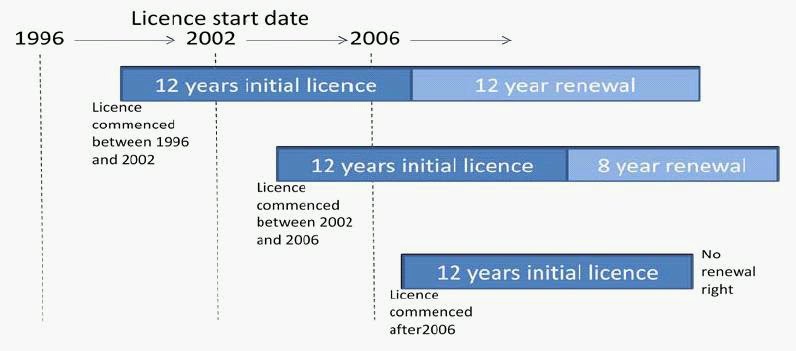
In 2010, Ofcom launched a consultation about the terms of its contract renewals for DAB multiplex licences. You might think that this would be the ideal opportunity for Ofcom to insist that licensees must improve the coverage of DAB transmitters so that consumers would receive satisfactory reception. You would be wrong.

Ofcom indirectly acknowledged that the current quality of DAB reception was the result of inadequate criteria having been implemented. It stated:

“Digital One’s [national DAB] network and all other existing DAB networks have been planned to a signal strength of 58 dBμV/m. This is what we currently call ‘outdoor’, or mobile, coverage.”

“A signal strength of 65 dBμV/m is what we currently call ‘indoor’, or portable, coverage. The network of 30 additional transmitters that Digital One implemented in order to facilitate the now-defunct BT Movio mobile television service were planned in order to deliver coverage in certain areas at a much higher signal strength of 82 dBμV/m.”

Evidently, BT had understood that you cannot hope to persuade consumers to spend their money on new equipment if they find that reception is not good enough to use it. Unfortunately, nobody in the radio sector took the hint. So what did Ofcom decide to do about this sorry state of affairs that has ruined so many listeners’ usage of DAB since 1999? Nothing at all. It said:

“In general, the coverage which applicants for radio multiplex licences propose to deliver has been seen as a commercial decision for the licensees, with neither Ofcom nor its predecessor regulator the Radio Authority seeking to impose a minimum coverage obligation that an applicant’s proposals must meet …” [emphasis added]

This decision was made, despite Ofcom having already convened meetings of an “ad-hoc working group” that had included the BBC, the government and the DAB multiplex licensees. The outcome was:

“This group came to a provisional agreement that the field strengths currently used for determining coverage are no longer appropriate given operators’ experience after several years of operation. The group provisionally agreed that a revised set of appropriate field strengths should be used from now on …”

This group’s new recommended signal strengths for adequate DAB reception were:
· 58 dBμV/m for outdoor reception
· 69 dBμV/m for indoor reception
· 77 dBμV/m for indoor reception in dense urban areas.

So it would make perfect sense for Ofcom to insist upon these agreed new field strengths in the new contracts for DAB multiplexes that will run for a further 12 years. But to Ofcom, it did not. Ofcom simply said to multiplex owners: just carry on as if nothing is at all wrong with DAB reception. In Ofcom’s words:

“We are not proposing to set any additional coverage obligations that Digital One must meet as part of the [national DAB multiplex] licence renewal process” and “we will not set any additional coverage obligations for local [DAB] radio multiplex licensees as part of the process of licence renewal …”

Perhaps Ofcom should explain precisely how its policy on DAB reception quality is working “to look after the interests of listeners.” The story to date seems to look like this:
· When DAB was introduced, the regulator got its technical sums wrong
· Poor quality reception dogged DAB from the beginning
· The regulator ignored the problem
· The radio industry knew this was a problem
· The regulator still ignored the problem
· Belatedly, the industry came up with better DAB technical parameters
· Implementing those new parameters would cost it lots of money
· Belatedly, the regulator acknowledged the problem
· The regulator refused to accept responsibility for having created the problem
· The regulator refused to take responsibility for fixing the problem
· The regulator said it was a “commercial decision for the licensees” to fix the problem
· The regulator renewed existing DAB multiplex licences to prolong the problem for a further 12 years.

Maybe Peter Davies’ earlier quote should be amended to:

“Ofcom’s primary concern in DAB radio is to stick two fingers up to all those radio listeners who, since 1999, have spent money buying a DAB radio, taken it home, and found that reception is too poor to use it.”
DAB radio numbers: why do they keep making them up?

I’m a numbers man. I can tolerate a little numerical exaggeration, a few rounding ups, or even the odd ‘nearly x million’. But when people invent numbers and stick them in their press releases, I reach for my calculator. Not for the first time, today Digital Radio UK advanced the concept of ‘mind over mathematics’ to a new level.

In its press release of 21 December 2010, Digital Radio UK estimated “that due to strong Christmas sales, over two million digital radios will be sold in 2010.” I questioned how this could be true in my blog. Turns out that it wasn’t.

In today’s update, Digital Radio UK admitted that the “increase in digital radio sales” it had heralded in December was, in fact, a decrease because “2010 was slightly down in digital radio sales volumes (-2.3%) compared to 2009.”

In plain English, 1.94m digital radios were sold in 2010, compared to 1.99m in 2009 and 2.08m in 2008. Increase? No. Growth? No. Over 2m in 2010? No. Were these sales figures in the Digital Radio UK update? No.

In another numerical nonsense, today’s Digital Radio UK update said:

“If this annual growth rate [in digital radio listening] is sustained, then the Government criterion of 50% of digital listening will be achieved in 2014.”

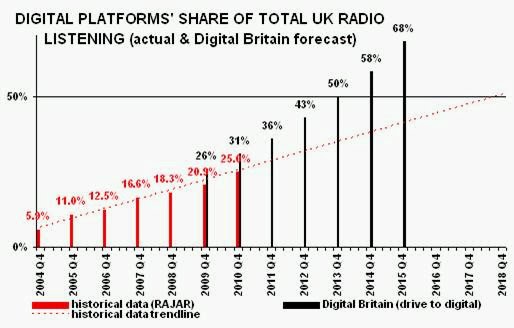
This is mumbo jumbo rubbish from people who like to use numbers to baffle the public and to obscure the truth. The 50% threshold is no more likely to be reached in 2014 than it is in 2013, which had been the original government target. A trendline* through six years of quarterly data (see graph above) shows that the 50% criterion will not be reached until year-end 2018.

So what happened to the original 2013 target for 50% that had been set by the government’s 2009 Digital Britain report? It now seems to have been completely forgotten. No explanation, no apology – just ignored (in June 2009, I had predicted that the 2013 target would prove “impossible”).

So how confident is Digital Radio UK that its new 2014 target is attainable? Enter stage left its CEO, standing next to a PowerPoint chart last week:

“This next chart is the most risky one I have in the pack. I hesitate showing you, particularly given the most recent conversations. But, I think, rather than just looking at a moment in time, there is a value in extrapolating. And all sorts of health warnings around this, you know, you’ve got government economists, you’ve got analysts in the stock market, you know, you can’t ever predict these things correctly. But, just taking the trends of the last three years and of the last year and running them forward – and life won’t be that simple but – just to understand from a mathematical calculation, where would that take you? Well, if we took the three-year compound growth rate, of the last three years, it would run us through to achieving 50% by the end of 2015, if we take the three-year curve. If we took the one-year curve that we’ve seen in 2010, it would take us to the end of 2014. To get to the end of 2013, which was an aspiration of Digital Britain, would require the compound growth rate to rise to 26%. So it needs to take a step change. You could put an argument forward that there are step changes coming, in content, in coverage, in cars, in communications and in consumer electronics. But I think it would be a brave man, or a brave woman, to say that, you know, you are definitely going to hit that grey line, and I wouldn’t say that. What I would say is that, on current trends over the last three or four years, we are likely to hit 50%, you know, in the next five years, I would say.”

So, February 2011 plus five years equals 2016. Well, this does not match the forecast in the ‘real world’ graph above of 50% being attained by year-end 2018. But neither does it match the 2014 date in today’s Digital Radio UK update.

Exactly where that leaves us is unclear. Is it 2014? 2016? Another year? Any old year?

DAB and realism and numbers seem to mix as well as oil and water and … er, more oil.

“Quite where the maths comes from to deliver 2014 is beyond me!” one senior radio executive said to me today. “Why do they put this out when it will surely mean another stick to beat them when it doesn’t happen?”

[* = there is no statistical evidence from historical data to demonstrate that the automated Microsoft Excel trendline is anything other than straight line.]

DAB radio switchover: the view from the government bunker

The government’s second stakeholder consultation on DAB radio switchover happened this afternoon. It was held in what felt like an underground government bunker in Victoria. No windows, long corridors, and lots of seemingly identical numbered rooms hidden by massive doors that had no viewing windows. When I tried to go up a staircase to ground level, a man appeared from nowhere and told me not to.

Even if the bomb had dropped, down there, you might not have known it. The cityscape outside could have transformed into a wasteland but, down there, you can be certain that our civil servants would continue planning digital radio switchover regardless, even if the precise date had to be postponed until the contamination had receded. I imagine that the government staff working there hardly need to go out, even at lunchtime, because a little lady with a trolley probably comes around with salmon sandwiches.

In this cosseted environment, it is easier to understand how you might spend your days (or months or years) of servitude, devising schemes that have so little relevance to the real world above your bunker office. Perhaps this is why the afternoon was filled with PowerPoint presentations that all looked great, slides that had lots of action words, and monologues from grey men that were filled with the current jargon. It was a perfectly unreal world.

What the afternoon lacked was realism. Occasionally I had to pinch myself to make sure that this was not a Lemsip-induced slumber. It wasn’t. However, I did witness the Civil Service suggest that asking consumers their opinion about DAB radio switchover would be a good idea, as if it was a novel thought that had just come to them. Not withstanding that the government has been pursuing the notion of the DAB platform since the 1980s but, in all those decades, somehow omitted the ‘consumer’ (or ‘listener’) from its plans.

The following quotes came from our civil servants this very afternoon. I wrote them down. Reading them now, these lines could have been extracted from the script of a lost episode of ‘Yes Minister’ in which the cast cleverly parody government plans for digital radio switchover. Sadly, they did not. This is what stakeholders were told today (amongst many other things):

“We genuinely have seen more progress [on digital radio switchover] in the last eighteen months than we have in the last six or seven years I’ve worked on this issue. But, as far as the consumer is concerned, we’ve never certainly in any way advocated or used 2015 [switchover date] as a ‘stick.’ It’s always been the industry target. And, certainly, when this government came in, it was adamant and clear that the consumer would make the case for switchover by purchasing habits, by the percentage of listening [on digital platforms], the way it absorbs and consumes radio. Now, will I, at this point, say that there has been a cross-pollination of those two things? Has the 2015 [date], which was an industry date, started to creep into the public consensus and been used by the media as a scare tactic? Yes, of course it has. And do we, as an industry, need to look at that? Yes, I think we do. I would say that I don’t think anyone – I think very few people – in this room would welcome the government standing up tomorrow and saying that the [switchover] date is the 31st December 2015. And I don’t think we have any answers to the questions that we need to have the answers to before any such decision can be made, and whether the consumer genuinely believes that this is something they want to do.”

“I don’t think we know what listeners want. I think part of this [Digital Radio] Action Plan process is absolutely understanding the value people put on various parameters of radio – what they want, how they want to consume it. I think that part of understanding this decision is understanding the listener better. And I think, whilst we all have our own views on that, I don’t think there’s enough evidence based [data] for us to make those assumptions about what listeners want.”

“I don’t think the government has never ever said ‘digital radio switchover will happen in 2015’ but we think we need to go away and look at the messaging around the cross-pollination. The one thing I would say is: 2013 and 2015 is used by both sides of people in the debate, those who like to frighten people into the fear of losing their analogue services, and those who like to sell digital radios. For all of us who believe that certainty and clarity and the consumer is important, I think we all need to look at how we use the threat of 2013 and 2015 and have some consistency ourselves about how we talk to the consumer about it.”

Threat? Are radio listeners so malleable that they must be viewed by government like cattle to be herded to slaughter? Maybe I imagined mistakenly that government was FOR the people. Anyway, I suppose we should be grateful at all that the ‘consumer’ has suddenly been pushed centre stage in the long running DAB drama, even it is so late in the show [see 2009 blog and 2010 blog where I predict it would be ideal for bureaucrats to eventually blame DAB’s failure on the consumer rather than themselves].

Is there any difference between the government forcing the population to buy a DAB radio to listen to The Archers, and Sky persuading them to buy Sky Atlantic to watch their favourite HBO shows that used to be free? Is the government’s DAB switchover drive really a policy for public regulation, or simply capitalist radio (© LBC poster campaign 1989)?

This afternoon, while DAB was being discussed in the government bunker, could anyone have actually achieved satisfactory DAB radio reception down there? I think not. Are those government people listening to DAB in their cubicles? They can design as many PowerPoint presentations as they want but, at the end of the day, if DAB radio don’t work properly now, then it don’t work for the consumer.

Bauer Radio talks the DAB talk, but walks its Magic brand off DAB

Bauer Radio is the second largest commercial radio group in the UK. It publicly supports the government’s plans for DAB radio switchover. Only this month, Paul Keenan, chief executive of Bauer Media, told The Guardian: “What part if any is the BBC going to play on the local DAB level?” He went on to ask:

“Will there be some form of seismic content innovation or intervention that really pulls listeners across [to DAB]?”

Keenan need have looked no further than his own company’s DAB radio strategy to discover a form of “seismic content intervention” that might well result in pushing existing listeners away from DAB, rather than pulling them in. While Keenan was talking to The Guardian, Bauer was busy pulling the plugs on its ‘Magic’ brand from the DAB platform in the following areas:
· Aberdeen
· Ayr
· Birmingham
· Bradford & Huddersfield
· Cambridge
· Dundee & Perth
· Edinburgh
· Glasgow
· Kent
· Northern Ireland
· Norwich
· Peterborough
· Stoke
· Sussex Coast
· Swansea

If you were a loyal listener to Magic in one of these areas, your favourite station simply disappeared from the DAB menu in January 2011 (Magic had 1m out-of-analogue-area listeners per week, contributing 24% of the brand’s total hours listened, according to RAJAR). This change is surprising given that, as recently as May 2008, Bauer Radio decided to add its Magic brand to the DAB platform in the following areas:
· Aberdeen
· Ayr
· Birmingham
· Bradford & Huddersfield
· Cambridge
· Dundee & Perth
· Edinburgh
· Glasgow
· Kent
· Northern Ireland
· Norwich
· Peterborough
· Stoke
· Sussex Coast
· Swansea

In 2008, in most of these areas, Magic had replaced another Bauer brand, ‘Kiss’, which could not have pleased existing Kiss listeners. Now, in 2011, it is the Kiss brand that is replacing the Magic brand in all but three of these areas. Musical chairs, anyone?

In 2009, Bauer had said that it was investing in the “right long-term platforms for the right stations at the right time.” So, in 2008, Kiss was right for DAB whereas, in 2011, now Magic is right?

It is hard to believe that such precipitous content changes inspire consumer confidence in the DAB platform. But, sadly, the DAB platform has never really been about ‘radio’ and ‘listeners’. Loyalty to DAB radio? What’s that? For commercial radio, its pursuit of the DAB platform had been about the exercise of power, the expectation of profit and the promise of automatic renewals for the industry’s most valuable analogue radio licences.

It was also about a much coveted transfer of the power to determine which stations are broadcast to a cartel of commercial DAB multiplex owners, and away from the regulator. This is why station changes on DAB, such as Bauer’s (Kiss to Magic to Kiss) can be executed without a public consultation or impact assessment.* The regulator merely nods its head and makes a quick note in a file. So what role does Ofcom play in ensuring that the DAB radio platform “furthers the interests of citizens and of consumers” as mandated by law? The answer is: absolutely none. We might as well have a scarecrow in charge of digital radio at Ofcom.

The reason that Bauer Radio (with a 25% listening share of commercial radio) made these latest changes to DAB is that it is locked in a war with archrival Global Radio (38%). Neither company has a track record of developing its own successful radio stations from the ground up. Both companies are piled high with acquisitions and mergers of other radio businesses. As a result, the two compete with each other by moving their radio pieces around the chess board, rather than by innovation.

In January 2011, Global Radio extended its ‘Capital’ brand outside London, replacing the former ‘Galaxy’ brand and some local FM stations. Global describes the brand:

“Capital’s target audience of 15-34 year olds are big fans of popular music, they are media savvy and are on trend.”

To compete, Bauer Radio extended its Kiss brand to every available local DAB multiplex (replacing Magic). Bauer describes the brand:

“Kiss evolves around ever changing lifestyles and trends of the UK’s young 15-34 market … Every part of their day revolves around music.”

If, like me, you think that these two brands sound almost identical, understand that this phenomenon is the outcome of long understood business practice in the radio sector. In 1951, American economist Peter Steiner wrote:

“If, as is often suspected, [radio] broadcasters exaggerate the homogeneity of audiences and their preferences for certain program stereotypes, the tendencies towards [programme] duplication will be increased. … The problem, of course, is that a series of competing firms, each striving to maximize its number of listeners, will fail to achieve either the industry or the social good. Here, then, competition is providing a less than desirable result.”

In the UK, this is precisely why we have a regulator for radio broadcasting – to ensure that consumers benefit from a wider choice of content than a free market would provide. However, with its hands tied in DAB policy by the Broadcasting Act 1996, and its laissez-faire ‘do nothing until someone complains about it’ strategy, Ofcom has had no more impact on the DAB station menu than having no regulator at all.

DAB is the Wild West of radio where anything can, and often does, happen. Seemingly, it often happens with little concern for listeners or for those who paid good money for a DAB receiver. Without a sheriff in sight, or a cavalry about to ride over the horizon, the danger is that the public might come to view DAB radio as nothing more than a bunch of cowboys locked in a private war of one-upmanship.

Yet the radio industry wonders why the DAB platform is not stimulating more listening or more receiver sales.

[*NB: There was an Ofcom consultation in November 2010 about a change of format for the Kiss brand, but this did not touch upon Magic being dropped from DAB. Magic continues to be simulcast on DAB in nine areas where it is already available on FM or AM, as a contractual condition of its automatic analogue licence renewals.]

Q: Who is the government commissioning to produce an objective report on the costs & benefits of DAB radio switchover? A: The government

For two decades, the British government has pursued a policy to replace analogue radio broadcasting with DAB digital radio broadcasting. Why? The real reasons might as well be lost in the mists of time (or maybe were never made public). However, this has not stopped the government and its civil servants continuing to pursue the same digital radio switchover policy since the 1980s, despite overwhelming evidence that the surrounding media landscape has changed beyond recognition in the interim.

Because the government policy to replace AM and FM radio with DAB radio had never been decided on the basis of consumer demand, commercial necessity or global standards, it was unnecessary for officials to produce a document that justified it logically. When a government decides that a particular policy is necessary, it can make legislative change happen without recourse to the consumer market outside of Parliament or the Ministries. Politics and the real world do not inhabit the same space.

In the case of DAB radio switchover, the government made no effort to produce a cost/benefit analysis until 2008, when PricewaterhouseCoopers [PWC] was commissioned by Ofcom. However, the resulting 91-page report did not provide the solid, positive argument for DAB radio switchover that the government had desired. So the PWC report was hidden from the public for a year, eventually to be released and trivialised by civil servants [see blog entry Feb 2010].


In contrast to the government’s unbridled enthusiasm for DAB, the PWC report felt that “the [radio] industry and consumers may fail to see the benefits of digital radio over the longer term.” It concluded that “there are relatively few up-sides to the estimates and several significant downside risks” from its cost/benefit analysis of DAB radio switchover [see
blog entry Jul 2010].

The House of Lords Select Committee on Communications, in a report on digital radio switchover in March 2010, expressed its dissatisfaction with the government’s attempt to bury the evidence from this PWC report:

“We strongly regret that the cost benefit analysis carried out by PricewaterhouseCoopers was not published at the time it was delivered to Ofcom and the Department for Culture, Media & Sport in February 2009.”

The government responded that “technical difficulties” had prevented the report’s publication for nearly a year. As excuses go, it would probably have been better for the government not to have responded at all.

After this embarrassing debacle over the PWC report, the government must have wanted to commission a further report that would conclude what PWC had not: that DAB radio switchover is a wonderful thing and that there are sensible economic arguments to justify forcing it upon the British public.

In June 2009, the government’s Digital Britain report promised: “We will conduct a full Impact Assessment, including a Cost/Benefit Analysis of Digital Radio Upgrade.”

In January 2010, Ofcom’s Peter Davies offered
evidence to the House of Lords Communications Committee that another report would be done:

Baroness McIntosh of Hudnall: “What about your own impact assessment?”

Mr Davies: “We haven’t done an impact assessment yet.”

Baroness McIntosh of Hudnall: “But you have been asked to – correct?”

Mr Davies: “At some point in the future. I think the Digital Britain report said that we would be asked to do one, but we haven’t been asked to do one yet. Obviously we would need to do that and we would need a much fuller cost-benefit analysis before any final decision was taken.”

In June 2010, the government stated:

“We agree that a full impact assessment is an essential part of informing the Government’s decision on whether and when to move from a primarily analogue to a digital radio landscape. Work has already begun to collect the evidence needed to support an impact assessment and analysis should begin shortly.” [emphasis added]

Here we are now, in January 2011, and there remains no sign of the long promised cost/benefit analysis of DAB radio switchover, despite the new government continuing to pursue the digital radio switchover policy of the previous government. However, in December 2010, a document from the Department for Culture Media & Sport [DCMS] (marked “UNCLASSIFIED”) disclosed:

“The Government launched a joint Government and industry Digital Radio Action Plan on 8 July 2010. This Action Plan sets out the process for providing ministers with the information and assurances necessary to make a decision on whether and how to proceed with a Digital Radio Switchover. … Fundamental to the information provided to Government as part of the Action Plan will be a comprehensive Cost Benefit Analysis on the proposals for a digital switchover. … Government is conducting the modelling of the costs and benefits in-house. This research will provide robust evidence of potential costs and benefits to consumers of digital switchover to be incorporated into the Government’s Cost Benefit Analysis.”

So the government has confirmed that the government decision on digital radio switchover will be informed by a government cost/benefit analysis of digital radio switchover that utilises government modelling of the costs and benefits. It appears that, in the case of DAB radio switchover, the government has decided to be judge, jury and executioner too. This smacks more of ‘big brother’ than of the Conservatives’ much touted ‘big society.’

The unclassified DCMS document hinted that the earlier PWC report had not produced the desired results:

“A similar piece of work was carried out by PricewaterhouseCoopers in 2008 to inform the work of the Digital Radio Working Group into the future of digital radio and the potential for switchover. That Cost Benefit Analysis raised a number of caveats, chief among which were the gaps in research into consumer behaviour and willingness to pay. Although the radio ecology has changed since that Cost Benefit Analysis was produced, the document provides useful insights and the recommendations made by PricewaterhouseCoopers on further research remain valid.”

So what will be in the government’s new cost/benefit analysis report? The latest version of the government’s Digital Radio Action Plan explained:

1.4 IMPACT ASSESSMENT
Carry-out an impact assessment of the options and timings of the Radio Switchover. This will include, but not limited to, the following:
· the costs and benefits of any interventions to enable the switching the migration of all national and large local radio stations to DAB and alternative uses for the analogue spectrum vacated after the Radio Switchover;
· the rural impact of implementing the Digital Radio Switchover;
· Impact on energy consumption of a Switchover; and
· Environmental impact of analogue receiver disposal following Switchover.”

Interesting to see that neither the ‘consumer’ nor the ‘listener’ are mentioned here. For this workstream, the “first report to Ministers” is not scheduled until Q4 2011. It is evident that there is little urgency to execute this new cost/benefit analysis or for it to make a significant contribution at this juncture to any government re-evaluation as to whether to proceed with DAB radio switchover. If a cost/benefit analysis were a genuine priority, why was:
· the PWC report buried in February 2009 for a year
· a new cost/benefit analysis promised by Digital Britain in June 2009 but not prioritised subsequently
· the government saying in June 2010 that “work should begin shortly” on the analysis
· a “first report” of this work now not scheduled to be presented until Q4 2011?

If the government’s DAB radio switchover policy were but a minor issue within the DCMS Ministry, all this deceit, delay and manipulation might be considered trivial. It is not. In December 2010, Minister Ed Vaizey admitted that he receives more correspondence from angry consumers about DAB radio than about any other issue within his portfolio.

So why are we witnessing such a continued lack of government transparency on the DAB radio switchover issue, despite prime minister David Cameron’s commitment in November 2010 to make the UK “the most open and transparent government in the world”?

DAB radio receiver sales in 2010: what was the actual number?

On 21 December 2010, a press release from Digital Radio UK announced that “12 million digital radios have been sold in total in the UK” and estimated that:
· “due to strong Christmas sales, over 2m digital radios will be sold during 2010
· A cumulative total of 20 million digital radios will be sold by the end of 2013.”

It takes a brave person to predict in mid-December what a year-end sales figure will be. More so with DAB radio receivers because, in previous years, the month of December alone has accounted for more than a quarter of annual sales.

It takes an even braver person to predict that, by year-end 2013, an additional 8m digital radios will have been sold. Whether or not 2m units were actually sold in 2010, we do know that just under 2m units had been sold in 2009, and just over 2m units in 2008 and in 2007. So please can Digital Radio UK explain what revolutionary change will ensure that sales suddenly spurt during 2011, 2012 and 2013? Buy one, get one free?


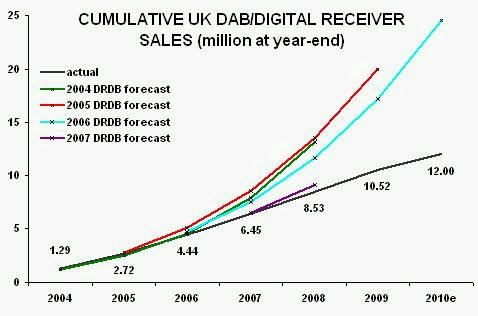
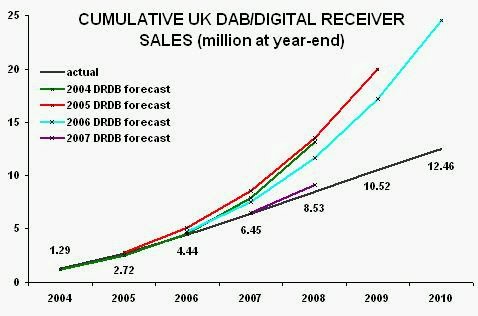
Perhaps this new ‘20m by 2013’ figure was forecast by the same party that produced earlier forecasts for the Digital Radio Development Bureau, the forerunner to Digital Radio UK. As the graph above demonstrates, none of those forecasts made in 2004, 2005, 2006 and 2007 were rooted in an analysis of reality. If they were, then 24.5m digital radios would have been sold by now. Whereas, the actual figure is 12m, less than half the forecast for 2010 the industry had made four years ago.

It is interesting to note that all the recent sales figures offered by DAB lobbyists refer to ‘digital radios’ rather than ‘DAB radios.’ One wonders exactly how many internet radio receivers have been sold in the UK and are being used to prop up the illusion that DAB radio is some kind of success story with consumers. When I have asked for a breakout of internet radio sales, data were not supplied.

If, as the Digital Radio UK press release shouts, a “digital radio landmark” was really achieved in December 2010, then why are the recorded UK monthly and quarterly sales figures for DAB radios not available from the Digital Radio UK web site for the public to admire? (Maybe because the Digital Radio UK web site is completely empty.)

The chief executive of Digital Radio UK was quoted last week saying: “There is now real momentum in the transition to digital radio.”

“Real momentum” is not what the sales data for DAB receivers, even those few estimated figures released by Digital Radio UK, demonstrate to be the reality.

Commercial radio local DAB build-out "not the BBC's responsibility" says BBC Trust chairman

Culture Media & Sport Select Committee, House of Commons
15 December 2010
BBC Annual Report & Accounts 2009-10 [excerpt]

Sir Michael Lyons, Chairman, BBC Trust
Mark Thompson, Director General, BBC

Damian Collins, MP Folkestone & Hythe (Con): Has the [Licence Fee] settlement affected the amount of support you can give to digital radio switchover and the build-out of digital radio in local services within the regions?

Sir Michael Lyons: What you see in yesterday’s announcement is a clear message that the BBC remains committed to DAB and will continue to build out up to FM equivalents. That is clear. It is involved in discussions with the commercial radio industry and Government about local build-out, for which it is not responsible and for which there are not funds currently identified. They were expected to be undertaken by the commercial operators of those Mux [DAB multiplex] licences.

I don’t think I should add very much to that, other than that, clearly, the Government has determined on a switchover date. Whether that can be achieved is, in our view, whether the audience is ready for it to be.

Damian Collins: I suppose whether it can be achieved ought to be linked to the level of coverage as well. The Government has been clear about that, too. In those negotiations you are having with Government and the commercial stations, is the amount of money you have on the table a smaller amount, as a result of the settlement, than it was before?

Mark Thompson: No.

Sir Michael Lyons: It is clearly another one of the pressures that we have to balance in a tighter envelope; that is the important thing.

Mark Thompson: I think it is fair to say that the underlying commitment that we have made and the focus we have on the building out of our own national multiplex, is unchanged by the settlement.

Sir Michael Lyons: Absolutely. It is a reference to local, I think, that I was …

Mark Thompson: Quite. But the BBC’s focus has always been … the issue about local is that we only have in England, and only intend to have, a single BBC local radio station per region. With each local multiplex that has been opened so far, we have taken a place on that multiplex; we decided that we should do that.

I have no reason to believe we would not continue to do that as they are built out. But whereas the national multiplex, obviously, is a way of getting additional BBC services to the public – the digital services – there is no such increase in BBC services that we can offer if you are taking a single station which is analogue and putting it on digital as well. So our focus is on national build-out, and the broad policy and the commitment over time to absolutely keeping pace with the audience, building out nationally, is unchanged by the settlement.

Damian Collins: Your commitment is clear, and you made that again today, but is it going to take longer to get there now, as a consequence of finding some other issues you have to deal with?

Mark Thompson: I don’t think so. If you say something slightly different, which is, “Would some people have liked some level of additional commitment in the settlement?”, perhaps they would, but it is not there.

Damian Collins: But as far as you are concerned, your commitment is the same?

Mark Thompson: It is exactly the same.

Damian Collins: In the document put to us yesterday, you talk about preparing for any potential radio switchover. That does not sound like it is going to happen within the next five years.

Sir Michael Lyons: That is not a judgment for the BBC; that is a judgment for Government. The BBC is very clear that it is doing its bit in these national investments. There remain unresolved issues about where the investment comes from at a local level. That is not the BBC’s responsibility, but we are part of those discussions. And then, very critically, as the Government has conceded, switchover can only take place … I do take your point that audience preparedness will to some extent depend on coverage, but it also depends on choices made about replacement television sets, investment in cars and a whole series of other things, which are not in our gift.

[This is an uncorrected transcript of evidence taken in public and reported to the House. The transcript has been placed on the internet on the authority of the Committee, and copies have been made available by the Vote Office for the use of Members and others. Any public use of, or reference to, the contents should make clear that neither witnesses nor Members have had the opportunity to correct the record. The transcript is not yet an approved formal record of these proceedings.]

NORWAY: digital radio switchover "postponed indefinitely"

In November 2010, a daily newspaper in Denmark reported that the government’s plan for digital radio switchover had been postponed indefinitely [see earlier blog]. Now, the same is reported to have happened in Norway.

“The transition from analogue to digital radio began more than ten years ago. At the end of 2010, we still have no idea what is going on,” said the headline in Norwegian daily newspaper Aftenposten.

In 2009, then culture minister Trond Giske had promised that the Norwegian government would publish a white paper in 2010 on digital radio switchover [see earlier blog]. It has failed to appear. “Recently, it has become clear that the strategy had to be postponed indefinitely,” said Aftenposten.

Ib Thomsen, cultural affairs spokesman for the Progress party, said: “This is undoubtedly a hot political potato and DAB is, in many ways, a risky sport.” He believes that it is wrong to compare the migration of digital radio with digital television switchover, as many do, because the number of radios in use is much greater. “Nevertheless, we should not set a [switchover] date in order to go out and force people to buy new radios,” Thomsen said.

Olemic Thommsessen, cultural policy spokesman for the Conservative party, said: “I am more concerned with getting the policy on the table so that we can advance work on planning a digital radio future.” He noted that it had been a long time since the government’s last review of digital radio strategy, and that subsequent development of DAB and DAB receiver sales had not lived up to expectations.

Trine Schei Grande, leader of the Liberal party, said: “The time is over when politicians can decide how people will listen to the radio.” She believes that the only way to get listeners to invest in digital radio is to make digital content and stations sufficiently attractive. Until then, she said, FM transmissions must be continued.

Øyvind Vasaasen, distribution manager of state broadcaster NRK, said it would not be a very costly issue for NRK to broadcast DAB+ transmissions, should it be required by the government. He emphasised that NRK had a continuing obligation to serve those who had already bought DAB radios that do not support the newer DAB+ standard. “These can be addressed by broadcasting in both DAB and DAB+ for a period,” he said.

The possibility of the government switching from the DAB to the DAB+ standard was taken up by a commentary in Aftenposten, whose headline asked: “Your new, expensive DAB radio may be useless in a few years. What is really happening?” It explained:

“The problem is that there are already more than 300,000 DAB radios in the country. NRK distribution manager Øyvind Vasaasen had said that NRK has a contract with listeners who have already bought a DAB radio, and which makes it difficult to switch [to DAB+]. What about all those who listen on one of the country’s 15+ million FM radios? Does NRK not have a contract with them? And what of DAB users who feel they had signed the contract without full disclosure?”

The commentary continued: ”When [state broadcaster] NRK had argued for a transition from FM to DAB, it had said that the DAB system would give us CD-quality audio from the radio. It has not. DAB technology does allow very high sound quality, but most stations use lower sound quality than FM, according to University of Oslo professor Sverre Holm. Many people find the [DAB] sound clearer and less harsh, but many also complain of less detail and poorer stereo image. Moreover, no local radio station can afford the investment of over half a million kroner to broadcast on DAB, so that the diversity we were promised has not become a reality.”

Even DAB lobbyists are acknowledging the slow take-up achieved to date. Jørn Jensen, president of World DMB, the international marketing organisation for DAB, told Germany’s Digitalmagazin recently:

“Digital radio is still in its infancy. If we compare the situation to the computer market, we are still in the time of MS-DOS!”

Digital Radio UK meets BBC Radio Northampton listeners in a DAB black hole

In October 2007, Ofcom had awarded the DAB local multiplex licence for Northamptonshire to NOWdigital Ltd. and had required “implementation by September 2008” to put it on-air. The multiplex was to carry BBC Radio Northampton along with commercial stations. More than three years after this licence award, the DAB service has still not launched. As a result, BBC Radio Northampton is not yet available on DAB.

NOWdigital Ltd. had been owned by GCap Media, the UK’s largest commercial radio group, which was acquired by Global Radio in 2008. In 2009, NOWdigital Ltd. was sold to Arqiva, the transmission specialist which owns the lion’s share of DAB commercial infrastructure in the UK. In its application for the Northamptonshire licence in 2007, NOWdigital had boasted:

“GCap … has invested more into digital radio than any other UK operator. This investment has driven the industry forward and is helping build radio’s digital future … Having launched and operated multiplexes since 2001, NOWdigital is in an excellent position to successfully launch and operate the Northamptonshire multiplex.”

So what has Ofcom done to make this licensee comply with the stipulation that the Northampton DAB multiplex had to be launched by September 2008? Nothing. Does the commercial radio industry have a masterplan that includes a specific date for the launch of the Northamptonshire DAB multiplex? No. NOWdigital states disingenuously that its on-air date for Northamptonshire is “awaiting launch”.

Northamptonshire is one of 13 local DAB multiplex licences that Ofcom
awarded in 2007 and 2008 that have failed to materialise by their required launch dates. In 2007, Ofcom also awarded a national DAB multiplex licence to a consortium, led by Channel 4 television, that similarly failed to launch (all trace of which has been erased from the Ofcom web site).

Despite three years of broken promises to the people of Northamptonshire by Ofcom, NOWdigital, GCap Media, Global Radio and Arqiva that a local DAB radio multiplex will be launched for their area, they were not excused from this year’s Christmas radio industry campaign to sell more DAB receivers. DAB marketing organisation Digital Radio UK was interviewed by BBC Radio Northampton last week, though it was unable to offer even a vague date when either the local DAB multiplex for Northamptonshire will be launched, or when the signal of the existing DAB national multiplexes will be improved.

Although Digital Radio UK is funded jointly by the BBC, commercial radio and Arqiva, these heavyweight stakeholders could offer nothing more concrete to the people of Northamptonshire than platitudes and more promises about DAB … always in the future tense.


BBC Radio Northampton,
lunchtime show
15 December 2010 @ 1223 [excerpts]

Stuart Linnell, presenter [SL]
Jane Ostler, director of communications, Digital Radio UK [JO]

SL: You said, Jane, that the coverage and the reception is pretty good in most parts of the country. From my experience, and from what I hear people saying, where it’s good, it’s great. Where it’s not so good, it’s blooming awful.

JO: Yes. That is absolutely right, and we know that organisations like the BBC actually have a plan in place to make sure that coverage improves. And that’s not only building more transmitters, but it’s also increasing the power on transmitters, so that you don’t get the drop-out of signal that you will get in some areas. However, we know that when people do have a good signal, they absolutely love digital radio and everything that it brings …

[…]

SL: Rod in Daventry has got a question about the DAB signal in Northampton. It’s not specific to any one radio station, this question, I don’t think. It’s come in on a text. He just says: why is the DAB signal in Northampton so weak?

JO: Yeah, there are variances around the country in the signal. And, as I say, you know, there are plans in place, over the course of the next few years, to improve coverage for national radio stations and local radio stations as well. It’s one of these things that we are used to with other electronic devices like mobile phones and even Freeview signals. You know, there’s a course – an engineering programme – that’s taking place over time that will allow the signal to improve. So, if it is weak at the moment, it will get better.

[…]

JO: We believe that DAB will … is the broadcast backbone for the country. It’s free to air, it’s becoming increasingly available, and the signal is getting better all the time…

[…]

John in Corby [caller]: My question is that I watch this, I’ve been doing radio for sixty years, I’ve watched this very, very carefully, and the thing is that there are some very attractive radios which carry DAB which are available now. I take all the magazines, every magazine that’s related to radio and high fidelity in this country. And the point is this. What the $64,000 question is, dear Stuart, is: when shall DAB radio be available on Radio Northampton? Can the lady guesstimate that? That’s what’s important – all the things that have been broadcast about it – I won’t buy a DAB radio until I can get it in my locality, my local station, which makes commonsense to me.

SL: Okay. We get the point. Jane, do you know the answer to that?

JO: That is a very good question from John because I know that BBC Radio Northampton is not available on a local digital multiplex. Obviously, around the Northampton area, you can get – and Corby, you can get – the national stations but not the local ones. There are plans in place to build local coverage, and that includes BBC services by the time …

John [interrupts]: This is what will be needed and this is what will sell the radio … this is what will sell the radios, in my view. [When] this fine station in this fine county has its own DAB service.

JO: Yeah, we completely support that and we understand that. What’s happening is: there is a plan in place to develop local coverage in time for the digital radio switchover, and these plans are being worked on right now. So I can’t give you an exact date, but it will be over the next few years that local radio will be more available on digital.

SL: Because we must make it clear that John’s question is a valid one, but it’s not just BBC Radio Northampton that’s not on DAB. There are other stations as well who have not yet migrated to that platform.

JO: That’s right. The local stations in your area aren’t available. They are in some, but not in your particular area. But you can, subject to doing a postcode check, you can still get all the national services that are available …

[…]

Peter [caller]: What exactly is going to happen to existing car radios and also hi-fi stereos at home and also alarm clock radios? Is there going to be an adapter?

JO: If I deal with the car question first. That is also a very good question. There are lots of cars, there are lots of lorries and vehicles on the road, and only a small percentage of them today can actually receive digital radio. But you will start to see – and it’s starting already, and over the next few years – an increasing number of adapters coming onto the market, which you can either fit yourself or which you can get fitted by stores such as Halfords, for example. And then that’s with existing vehicles. With new cars, the motor manufacturers who import and make vehicles in the UK have committed that all new cars will have digital radio as standard by the end of the year 2013. So more and more adapters will come onto the market that are available …

SL [interrupts]: Can I just push you on that a little bit, Jane, because I heard – this is going back probably about 18 months now – that one of the largest motor manufacturers in the world, manufacturing two major brands – luxury brands – in this country, had actually withdrawn their DAB digital radios from their cars, as an optional extra even, because they said it just wasn’t working – the technology wasn’t good enough. Have all the manufacturers now signed up?

JO: They have, into the UK, of getting DAB as standard in cars – in new cars – by the end of 2013. And part of this target date that we talked about earlier on has got the motor manufacturers moving, and it’s also got other manufacturers coming up with new devices which you can fit into your existing car alongside your FM radio.

SL: And that really answers Peter’s point that, whether he has got his clock radio, his hi-fi in his lounge or the car radio, there are going to be adapters that will covert them to take DAB as well.

JO: Not, not the alarm clock. No, the alarm clock example is one where … I think, if you did want an alarm clock that had DAB radio built in, you’d have to get a new alarm clock.

SL: Buy a specific one, okay?

JO: Exactly, exactly. They are increasingly available in stores and they are becoming more affordable all the time.

SL: But for the hi-fi and for the car radio, there should be an adaptor at some stage.

JO: The hi-fi is an interesting question actually because obviously you can get digital radio tuners for hi-fi’s now which can plug in as a separate device. Quite often, a radio might be built into something like a large amplifier where the primary use is actually the amplifier rather than the radio. Ultimately, it would be down to the listener. But these devices are becoming available all the time and, if you go into any electrical store, you’ll start to see more digital radio devices.

SL: Okay, does that answer your question, Peter?

Peter: Yes, it does. I just hope that … I think it’s going to be a big sledgehammer to get a DAB adapter to fit in an existing car. There’s not a lot of room underneath dashboards.

JO: That’s absolutely fair. You can get some now which actually fit onto your windscreen and plug in around the dashboard. But soon, towards the end pf next year, when we anticipate that digital radios in cars will double during the course of next year, you will start to see these devices more hidden away in the glove compartment and that sort of thing.

[…]

SL: It’s Mike in Northants who says: digital reception on Radio Five Live for me, he says, was dreadful, so I just switched back to AM and FM and rejected DAB. No more problems.

JO: Right, well that’s … I don’t know precisely where he lives but, obviously, doing a postcode check would tell him whether he should be able to receive a good signal or not. And there are currently … until the transmitter improvements happen, there are other ways of listening to Radio Five Live, for example on the internet, and on digital television platforms as well, in fact. But, as I say, these coverage improvements are happening all the time. He should check his postcode at our web site.

[…]

Graham from Whitehills [caller]: I’m a communications buff so, as soon as DAB came out, I went and bought myself a mains portable one before I found out I couldn’t get Radio Northampton on it. The big, big problem is that it roars through batteries. It uses batteries at twice the rate of anything else I’ve ever owned.

SL: And I had a letter about this from somebody a while ago, Jane, asking why … is digital radio really environmentally friendly, because it uses up so much power?

JO: Yeah, you will find this is absolutely true for older radio sets that, you know, have been bought a few years ago, that they were quite power hungry and used a lot of batteries all the time and many people chose to operate them from the mains. But there’s been a report out in the last few months that government’s done about the battery consumption and the energy consumption of digital radios. And you’ll find that all the main manufacturers now are making really amazing claims about the battery life of the radios, that they will last for, you know, in some cases, hundreds of hours and use less power than an energy efficient lightbulb and that sort of thing. So, as technology progresses, the energy consumption gets better as well. So I’m afraid that some of those older radios do use quite a lot of energy and the new ones don’t.

SL: You need a new one for Christmas, Graham.

Graham: Yeah, eighty quid down the drain, that was. Thank you.

JO [laughs]: You can get them … you can get them from around £25 now, so you needn’t spend that much.

Graham: Yeah, but I paid eighty. Bye.

[…]

SL: Somebody’s asking: why is it that, when you’re listening to DAB, sometimes it can suddenly cut out altogether or just go to an absolutely garbled signal that sounds like it is underwater?

JO: Yeah, that’s … that’s something that happens when you’re on the edges – or on the fringes – of a reception area and, like other digital media, it can also happen during periods of high weather pressure. So you will find that, if you’re on the edges of a reception area, the signal does cut out rather than degrade gently, which is what it does with FM. So, again, as the coverage improves and the signal strength improves, that should stop happening.

GERMANY: planned 2011 re-launch of national DAB "solved a problem that did not exist"

On 15 December 2010, five commercial radio stations in Germany – New Wave Radio, Lounge.fm, ERF Medien, Radio Energy in Hamburg and Regiocast Digital – signed contracts with transmission provider Media Broadcast to broadcast on the new national DAB+ platform, scheduled for launch in 2011.

One week earlier, British company Frontier Silicon, “market leading supplier of digital radio technology worldwide”, had announced that, in order to persuade four commercial radio broadcasters in Germany to persevere with DAB, it had promised them it would purchase an unspecified amount of their advertising airtime for the next four years.

Anthony Sethill, Frontier Silicon CEO, put a positive spin on an act that some might perceive as little more than legalised bribery in the face of desperation to sell DAB hardware in Germany: “We are delighted that our innovative approach to supporting the roll out will help everyone working on this new radio service to bring their efforts to fruition.”


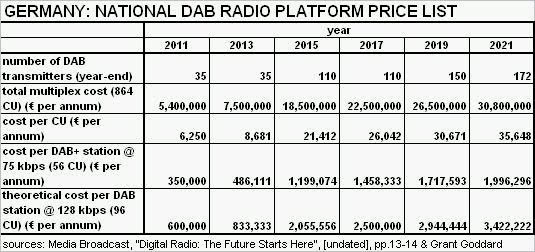
For years, German transmission provider Media Broadcast has been eager to put into action its masterplan to lock new DAB+ broadcasters into minimum 10-year contracts, for which it will be charging €2m per annum per station by 2021. The combination of Media Broadcast’s enthusiasm for the financial returns from DAB transmission contracts, and Frontier Silicon’s enthusiasm for the potential sales in Germany of DAB receivers that incorporate its technology, plus the offer of an amount of cash, persuaded a few commercial broadcasters to take on the risk of using the DAB+ platform.

Helmut Egenbauer, CEO of Media Broadcast, said: “Having introduced Frontier Silicon to the commercial broadcasters, we are delighted to see that their discussions have led to this important commitment to DAB+ radio services.”

Those five German commercial broadcasters should understand that even Frontier Silcon’s subsidy might not prevent them losing money hand over fist for the entire ten years of their transmission contract with Media Broadcast. The evidence is already there from the UK market. Not one commercial digital-only radio station has yet made an annual operating profit from the DAB platform in the UK, even after eleven years, let alone come close to recouping its investment.

Research commissioned by RadioCentre in 2009 found that the average annual revenues of a digital radio station were around £130,000 per annum. By then, 10m DAB receivers had been sold in the UK. Yet Germany is still at Year Zero with DAB+ radio penetration. The same report for RadioCentre had noted that the “annual negative cash flow impact of DAB” on the UK commercial radio industry was around £27m per annum, or 5% of sector revenues. Can German commercial radio afford to deplete its profitability by that sort of amount, year-on-year, for the next decade?

Frontier Silicon’s press release quoted Helmut G. Bauer as a “representative of the commercial broadcasters,” saying what a fantastic deal it was and promising that “2011 will be year that DAB+ is successfully launched in Germany.” However, Bauer is not associated with the German commercial broadcasting trade body, VPRT, which has been outspoken in its condemnation of plans for digital radio switchover in Germany. Bauer is a Cologne-based lawyer who has long made pro-DAB presentations at media conferences, and pro-DAB statements to the press, as a ”consultant.”

In fact, VPRT had
commented: “As we know, DAB failed in the market. Against this background, plans for the closure of FM – originally scheduled for as early as 2015, but now postponed – are absurd from an economic and social perspective and are therefore unacceptable.”

Noting the developments in Germany this week, Berlin-based Christoph Lemmer wrote in Radioszene magazine:

“With this decision, DAB will now actually be introduced by those who have succeeded, smelling a quick buck, in selling Germans a new sort of equipment, with millions to be sunk into to a new transmission network. Our old radios will be useless for DAB. Those who want to continue listening to the radio will need a new receiver.“

“It does not take a prophet to suspect that the private radio industry has shot itself in the foot by agreeing to sign the DAB contracts. A few shekels subsidy from a chip manufacturer who wants to install as many of its chips in DAB receivers – that is what has led to this. You, dear people, were not considered in the end. Do you really believe that devices with DAB will ever be as numerous as FM radios are today?”

“No one will understand what [DAB] is and why it is good. Because, with DAB, you have solved a problem that did not exist. The existing technological distribution of radio programmes is excellent and widely used. You did not have to change anything. The argument that DAB will create new radio channels with lower entry barriers is specious, as long as media regulators continue not to award licences for technically available [analogue] frequencies because they do not want additional competition in the market.”

This week, World DMB, the body marketing DAB radio globally, was so excited by developments in Germany that its web site posted seven news stories about it on 15th, nine on 16th and a further four on 17th. The overkill speaks volumes. Lacking any upturn in DAB receiver sales, the only positive news that DAB lobbyists can muster is this second attempt in Germany to launch a DAB technology that was first developed in 1981.

It is hard to recall a comparable technology whose proponents were still pushing for its launch three decades after its invention. DAB proponents argue that, simply because DAB is ‘digital’, it is inevitable that it will replace analogue radio. History indicates otherwise.

Digital Audio Tape. Introduced 1987. Abandoned 2005.
Digital Compact Cassettes. Introduced 1992. Abandoned 1996.