Digital radio switchover: legislation is “virtually meaningless,” says Shadow Culture Secretary

House of Commons
6 April 2010 @ 1627
Digital Economy Bill, Second Reading [excerpts]

The Secretary of State for Culture, Media and Sport (Mr. Ben Bradshaw): The switchover to digital radio has probably aroused more interest than any other issue in the Bill except that of unlawful file sharing. The target date of 2015, set by the Government, is an incentive not an ultimatum. We have made it clear that a decision on digital switchover will not be made until national DAB coverage is comparable to that of FM, until local DAB reaches 90 per cent of the population and all major roads and until 50 per cent of listening is through digital means. Once all those criteria have been satisfied, there will be at least two years before switchover takes place, at which point we expect coverage and listening to reach nearly universal levels — that is, about 98.5 per cent judged by television reach.

[…]

Mr. Jeremy Hunt (South-West Surrey) (Conservative): The Government have ducked sorting out digital radio switchover, which the Secretary of State has just talked about. They are giving Ministers the power to switch over in 2015, yes, but without taking any of the difficult measures necessary to make it practical or possible.

[…]

Robert Key (Salisbury) (Conservative): Is my hon. Friend content with clause 31, on the digital switchover? It is estimated that the costs to the consumer will be £800 million, and there is no sign of manufacturers of DAB radios producing cheap radios, no estimate of the cost of throwing away millions of existing FM sets, no sign that the motor car industry is going to come up with the goods — [interruption]. A Labour Back Bencher says, “Yes there is,” but I have read all the papers and although there are one or two pious hopes, there is nothing more than that. This will be extremely expensive, and the 2015 deadline is unattainable. Is my hon. Friend content, therefore, or will we make some further promises?

Mr. Hunt: I share my hon. Friend’s concerns, because I think that clause is so weak that it is virtually meaningless, as it gives the Secretary of State the power to mandate switchover in 2015 but the Government have not taken the difficult steps that would have made that possible, such as ensuring that the car industry installs digital radios as standard, as my hon. Friend suggests, and that there is proper reception on all roads and highways. As a result, a lot of people are very concerned that 110 million analogue radios will have to be junked in 2015. In particular, I would have liked the Government to find out whether we could move from DAB to the DAB+ technology, which most people think will be far more effective. If they had done that, this measure would not threaten smaller local radio stations.

Mr. Siôn Simon (Birmingham, Erdington) (Labour) rose —

Mr. Hunt: I will give way to the former Minister with responsibility for creative industries, and then I will make some progress.

Mr. Simon: Given the hon. Gentleman’s desire to move to DAB+, what does he suggest the 8 million people in this country who have bought very expensive DAB radios should do?

Mr.Hunt: First, let me say that when the hon. Gentleman stepped down as Minister for the creative industries, it was a great shame that he was not replaced. It would have helped in the sensible framing of the Bill if we had had a Minister with that responsibility now, but there is none. The answer to the hon. Gentleman’s question is simply this: when we migrate from one technology to another — whether analogue to DAB, or DAB to DAB+ — we need some kind of help scheme, as we have with TV digital switchover, but there is no mention of a help scheme in this Bill. That serves to highlight why the Government have ducked the important decisions.

[…]

Mr. Don Foster (Bath) (Liberal Democrat): Notwithstanding the many concerns that have been raised over the past few months about the move from analogue to digital radio, broadly speaking there is now consensus about that measure. The Secretary of State has laid down clear criteria that have to be met on listenership and coverage before the two-year starting pistol can be fired. Of course, there have been concerns. For example, some people thought that FM would be dropped, but we know that it will not be dropped; indeed, FM could become a new vibrant platform for local and micro-local radio stations and given more power. Possibly, Ofcom could start to give them even longer licences. With all the conditions that have been inserted, that is another exciting provision that we should acknowledge and accept so that everyone can have the real benefits of the digital radio era, in terms of greater interactivity and so on. The Government have done a disservice by failing to promote the real benefits of digital radio as effectively as they could. It is not surprising that the Committee in their lordships’ House castigated the Government for their failure. The industry could have done more. It is a pity that it has taken so long for FM to be included in all the DAB radios now on sale. It is only very recently that we have heard of the launch of the mechanism that will ensure people can have a single tuner covering DAB and FM — a single EPG, or electronic programme guide. That is welcome, but the work could have been done sooner.

[…]

Mr. John Whittingdale (Maldon and East Chelmsford) (Conservative): I now turn to DAB radio. Commercial radio and the BBC have invested huge amounts in moving to DAB, and commercial radio in particular is now in real economic difficulties, as the report that my Select Committee — the Culture, Media and Sport Committee — issued this morning explains. There is no doubt that one burden on it is having to broadcast in analogue and digital simultaneously, and it would provide some help if it had a firm pathway to a future in which it need only broadcast in DAB. I believe that the 2015 date, which I know is not in the Bill, is unrealistic. It is sensible to set a date, but most people believe that that is probably too ambitious, because of the single problem of car radios. Yes, some manufacturers are beginning to fit DAB radios in cars, but there is a huge reservoir of cars that will not have them for a very long time. We must get to a point at which an in-car radio can easily be converted to DAB. The device that is on the market at the moment, which I have in my car, has so many wires, antennae and bits of equipment that I do not believe it will be taken up with great enthusiasm.

[…]

Mr. Austin Mitchell (Great Grimsby) (Labour): I cannot agree with my hon. Friend the Member for Sittingbourne and Sheppey (Derek Wyatt) in his analysis of the digital radio switchover. Clearly the industry, in the main, supports digital switchover, but of course a switchover to DAB radio by 2015 is wholly impractical and out of the question because that is too soon. It will be much more difficult to switch over to digital radio than it was to switch over to digital TV, because that process was helped by the mass subscription to Sky and by the development of Freeserve. Such provision does not exist in respect of radio, because there are 120 million radios in this country and sales of digital radio have not taken off. Digital radio is quite expensive and if we make it compulsory, that will be a heavy tax on the consumer. One of the lower prices for a digital radio is about £85, and that price has increased with devaluation. So this would be a heavy burden to impose on the consumer, and if we require switchover, it would leave about 120 stations still on FM and locked out in the cold. We do not have to switch over at this speed and we do not have to switch over to DAB because we could move to DAB+, which would allow both services to be run concurrently. I am worried about the digital switchover for radio, because the crucial factor here is car radios, for which the technology is never sold effectively. Like the hon. Member for Maldon and East Chelmsford (Mr. Whittingdale), my experience with DAB in the car has been totally unsatisfactory. Not only is it messy, but it is difficult to pick up a station, and the signal cuts in and out and fades away, so one is constantly having to switch back to FM. Digital car radio sales are crucial, but such sales have been low and there is no sign of their taking off. Only 1 per cent of cars are fitted with a digital radio, and until there is a mass fitting of digital car radios we shall not be able to have an effective switch-off. I am worried about that provision.

[…]

Mr. John Grogan (Selby) (Labour): Two great debates on this Bill, with commercial interests on both sides, have been referred to tonight. I will not rehearse all the arguments, but one of the debates is on digital radio. The Opposition Front-Bench team seems to be saying that it opposes the current model the Government are suggesting. The Opposition spokesman suggested that he was now in favour of DAB+. It is interesting that hundreds of radio stations listened to by our constituents throughout the land, such as Minster FM, are being offered no digital future whatever in this Bill. What they are being offered, at best, is a place on a joint FM and digital electronic programme guide that is still being developed, and even if they get on that device, they will still not have all the advantages of potential and so forth, and they will be very much second-class stations. Under the Bill as currently drafted, that is the future. Helpful amendments were tabled by the Conservatives and the Liberal Democrats in the House of Lords suggesting that before any switchover there should be full consideration of all local and community stations. I will re-table those amendments today; I hope that the hon. Member for Bath will support them, and that they might tempt the Conservative Front Bench, too, in the negotiations for the wash-up. There is another side to the debate, to do with the BBC and some other digital radio interests. This reinforces the point that we should still have a full Committee stage — and if we cannot have that, we should pass the Bill on to our successors.

[debate ended 10pm]
Marketing DAB radio: misleading listeners only damages the medium

The radio medium’s loyalty amongst consumers derives substantially from the trust engendered between the on-air presenter and the listener. Research has demonstrated that radio is trusted more than any other medium, and that its audience feels a much greater affinity than it does with less intimate media such as television and newspapers.

In view of the importance of this ‘trust’ between radio and its audience, it seems a remarkable own-goal for radio to be promoting itself in a misleading way in advertisements carried on its own medium – radio. If listeners cannot trust radio people to be truthful about radio on the radio, then does it not undermine the bond that exists between a radio station and its listenership?

A recent radio advertisement placed on commercial radio stations by the Digital Radio Development Bureau, the agency tasked with persuading the public to buy and use DAB radios, stated:

“This is an advert for DAB digital radio. If you were listening to me on a conventional analogue …” [the sound of radio interference interrupted the speaker momentarily. The voice-over then continued:] “… radio you might very well hear strange noises …” [further sounds of radio interference followed. The voice-over continued:] “… which would ruin your enjoyment of your favourite programme …” [more interference sounds were audible. The voice-over continued:] “… meaning you might miss out on the crucial …” [radio interference sounds could be heard once more] “… but, with a DAB radio, you can enjoy crisp, clear digital sound. To find out more and discover loads more stations, visit getdigitalradio.com. Prices start from £24.99. Digital radio, get more from your radio”.

Listeners complained to the Advertising Standards Authority [ASA] that this advertisement was misleading because, when the DAB radio signal is inadequate, the audible broadcast signal is interrupted.

The Digital Radio Development Bureau responded that:
• because DAB is a digital technology which is either ‘on’ or ‘off’, the signal is always the same right up to the coverage limit
• DAB uses single-frequency networks technology where the same programme is transmitted from a number of sites, and DAB receivers add the signals from all the transmitters together, reducing gaps whereas, in an analogue radio network, gaps between transmitters cause the signal to fade in and out as the listener moves around
• a digital radio receiver is not subject to the background hiss and interference that might be audible with an analogue radio, and it is only when the listener is not in a digital station’s coverage area that the signal drops out
• electrical interference from fridges, thermostats, motors or light switches can cause crackle on analogue radio, whereas digital radio is not susceptible to this
• the other interference referred to in the advert is intrusion of pirate radio broadcasters that listeners might hear on analogue radio. Because there is no low-grade, cheap equipment available for DAB, pirates are not able to broadcast on digital radio
• the advert sought to promote the fact that DAB radio was hiss- and crackle-free, which the Bureau believed was reasonable and responsible.

The ASA believed otherwise. It said it understood that “if listening to digital radio whilst travelling, the digital signal could drop out when entering a built-up area or walking between tall buildings,” whereas the adverts “gave the misleading impression that listeners would never experience any interruption to a DAB signal, when that was not the case.” The ASA banned future use of the advert.

This was not the first occasion on which advertisements promoting DAB radio have been found to be misleading. In 2005, the ASA had similarly banned a radio advert which had stated:

“If you’re someone who thinks an iPod is something you might keep your contact lenses in you probably haven’t heard about DAB digital radio. With a new digital radio costing from as little as 49.99, not only can you hear all your current favourites in crystal clear sound, you can switch on to a dial-full of digital-only stations specialising in everything from classic rock to books that talk. The future is here today with distortion free DAB digital radio: taking the hiss out of the way you listen to the radio. Message provided by TWG Emap Digital.”

On this occasion, the ASA decided that “not all DAB digital radio listeners would receive ‘distortion free’ and ‘crystal clear’ sound and concluded that the claims were misleading,” it having “received no evidence to show that DAB digital radio was superior to analogue radio in terms of audio quality.”

On another occasion, in 2004, Ofcom banned an advertisement broadcast on London station Jazz FM which had claimed falsely that DAB radio offers consumers “CD-quality sound”. Ofcom concluded that “some listeners, in particular listening circumstances, would perceive a difference in sound quality between services using lower bit rates or broadcasting in mono compared to the quality attainable on CDs.”

There is a recurring theme here of DAB radio marketing campaigns repeatedly being found to be misleading listeners. Their response: just try and try and try again. Perhaps there should be a ‘three strikes, then you’re out’ policy. Do not pass go. Do not advertise DAB radio misleadingly on the radio. Do not continue to abuse the trust between the radio medium and its listenership.

GERMANY: No radio interest in DVB-T digital platform

The media regulator for Hamburg and Schleswig-Holstein, MA HSH, has had to re-advertise a licence comprising spectrum for the DVB-T platform, this time to television applicants, after its previous attempt to offer the spectrum for digital radio channels met with disinterest. MA HSH director Thomas Fuchs told Rapid TV: “The response to our tenders of DTT frequencies is clear: There is very strong demand for the distribution of TV channels, but there seems to be little additional value for the radio industry.”

In December 2009, the regulator had invited bids to provide 16 radio channels in spectrum that also offered capacity for ‘Visual Radio’ enhancements. Thomas Fuchs said then: “Now that opportunities for development of the FM band are exhausted, we can invite bids to contribute to the advancement of the radio landscape in Hamburg and Schleswig-Holstein.”

However, in March 2010, the regulator had to report that “the interest on the part of radio broadcasters is so low that the Media Council decided, as a result, not to award any radio allocation.”

French Culture Minister: launch of digital radio not “a priority”

On 29 March 2010, the French Minister of Culture & Communications, Frederic Mitterand, spoke at the monthly luncheon of the Association of Media & Communications Journalists. He was asked about the much delayed launch of digital terrestrial radio in France and replied:

“I note that the cost of the [digital radio] project is significant, that a number of the radio licensees are not at all favourable towards the project, and that it is the CSA [media regulator] that for the moment is escalating the issue. The CSA itself should still submit a report on the [digital radio] issue with recommendations, although I know roughly what will be in such a report. I have the greatest respect for the CSA, and I have the greatest feelings of respect for [CSA president] Michel Boyon, but we are not exactly on the same wavelength.”

“Without organising a funeral with great pomp and ceremony, which would presume a death, I think that everything will inevitably be digital one day. And then radio will be too. Put simply, in today’s economic conditions, in the general context of radio, and with the lack of consensus around this [digital radio] issue, I do not think its resolution is a priority and the launch of digital radio will not happen this year.”

The video is available here.

When is an FM radio not a radio? When it’s in a portable media player, says digital switchover group

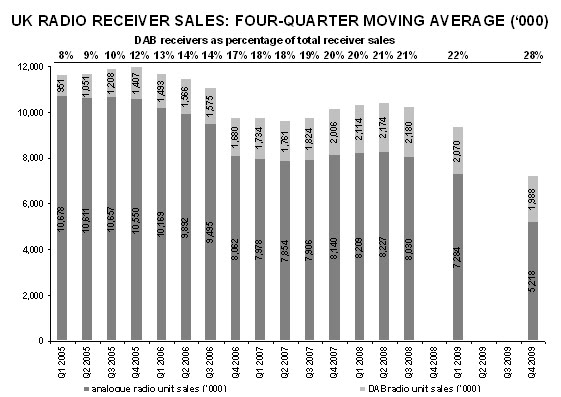
Digital Radio UK is the new organisation funded by the BBC and commercial radio “to ensure that the UK is ready for digital radio upgrade”. In February 2010, Digital Radio UK submitted written evidence to the House of Lords Communications Committee informing it of the latest data for UK retail sales of radio receivers. Amongst other things, the data showed that:

• Sales of digital radios in 2009 were under 2 million units, their lowest annual volume since 2006
• Sales of analogue radios seemed to have dropped dramatically to 5.2 million in 2009 from between 7 and 8 million during 2008
• As a proportion of the total volume of radios sold, digital radios had apparently leapt to 28% in 2009 from 21% only a year earlier.

I was puzzled. Why had sales of analogue radios fallen so dramatically by year-end 2009 (see graph below)? There seemed to be almost no substitution effect by DAB radios, whose volume sales were also down, though not by as much as analogue radios. It appeared as if many consumers had just suddenly decided to stop purchasing radios. I wrote to [*****], the company that [***********************************************] Digital Radio UK, asking why the data had suddenly ‘jumped’ in Q4 2009.

The written response from [*****] was:

“The q4 2009 drop is more about the basket of products included as areas previously included such as set top boxes and portable media players were excluded from the data at that time.”

[*****] defines a ‘portable media player’ as any device that plays music and has a 3.5mm headphone jack: MP3 players, iPods, portable cassette players, portable CD players, etc. From Q4 2009 onwards, when any of these devices are sold in the UK and also include a radio, they are no longer counted as ‘a radio’. Now, every MP3 player sold that includes a radio is simply excluded from these statistics. This is why the number of radios sold appeared to drop so significantly (by around 2m units per annum) in the latest Digital Radio UK data.

Why was this change in definition made? It is hard to understand the logic because a radio within an MP3 player is still used as a radio and has no other purpose. It is a real radio, not a fake radio, but to [*****] it is no longer a radio.

The answer seems to be that a huge number of MP3 players are sold in the UK (value £666m in 2009) but almost none of them incorporate a DAB radio. When an MP3 player does include a radio, it is inevitably an FM radio. MP3 players are manufactured and sold globally by multinational electronics manufacturers who understand that FM remains the universal standard for listening to broadcast radio, while DAB is still confined to no more than a handful of countries. Global manufacturers are reluctant to mass produce an MP3 player incorporating a DAB radio because the sales market would be limited to a few, small territories.

I checked the Argos retail website this week and found it offered 82 models of MP3/MP4 player. None incorporated DAB radio, whereas there were 16 that included an FM radio and 66 that had no radio.

It seems that the last resort for Digital Radio UK to be able to demonstrate to a sceptical public (and increasingly sceptical members of the House of Lords) that DAB radio is ‘taking off’ with consumers is to fix the figures to make it look that way. If you cannot convince the public to stop buying analogue radios, you can ‘bend’ the figures to magically make it appear that the public is buying fewer analogue radios.

Earlier this month, I documented how Digital Radio UK had similarly fixed the same dataset from [*****] to declare in its publicity that “when buying a radio, more than 75% of people choose a digital radio”. This was not at all true. The real fact was that, in December 2009 alone (December always being the peak month for DAB radio sales), 76% of people who bought a kitchen radio bought a digital kitchen radio. That was an attempt to brazenly redefine ‘a radio’ as only ‘a kitchen radio’ so as to exclude clock radios, tuners, in-car radios, boomboxes, etc.

I can only repeat what I said then. However desperate you might be to try and make DAB radio a success, how is it justifiable to deliberately mis-state data so outrageously in print? And to Parliament?

The Digital Economy Bill: let the horse-trading begin, says Shadow Minister

Ed Vaizey MP for Wantage & Didcot
Conservative Party Shadow Minister for Culture
23 March 2010 @ Imperial War Museum North

In today’s radio industry, brands have been shaped more by scarcity of analogue spectrum than necessarily by the market. Brands have been built as much on the frequencies they occupy as much as the characteristics of their content, and commercial revenues have tended to stay limited to local markets.

We very much support the move to digital switchover, both because we believe it is important obviously to upgrade the technology, but because we also think that it will encourage plurality and expand listener choice. We have got to be concerned that people will be ready before any switchover takes place and that there won’t be literally millions of analogue radios which suddenly become redundant. As you know, the government has set a provisional target date of 2015 and we are sceptical about whether that target can actually be met. That is not to say that we are sceptical about digital switchover. We simply think that 2015 might be too ambitious. But we are delighted to see that Ford Ennals is now chief executive of Digital Radio UK, after having steered digital television switchover so successfully, and we hope that all hurdles can be overcome.

We hope that the advent of new digital stations will bring significant new opportunities for independent radio production and it will also free up commercial radio spend. At the moment, as I understand it, the commercial sector spends nearly 10% of its annual revenue on analogue transmission. In the battle for ratings in the new digital world, we would hope that great programming would be at the forefront and that therefore a good proportion of the £40m annual cost of analogue broadcasting will go to independent radio production.

At the moment, the BBC holds four out of the five available national FM licences, and it has the only national digital multiplex. So the aspiration as we move over to digital is as much about making more space for plurality in radio broadcasting as it is about new technology. And if new stations are broadcast, we hope there is plenty of scope for new exciting radio production.

We are also keen obviously not to switch off FM, but to maintain FM as a spectrum particularly for local radio. As you are probably aware, there has been a lot of lobbying during the passage of the Digital Economy Bill about that. I’m pleased to say, as well, that some of the new technology that seems to be coming on-stream, with radios that can switch seamlessly between digital and FM broadcasts, will ensure that there will still be a place for ultra-local FM broadcast stations.

Obviously, many of you will also be interested in what will happen with the Digital Economy Bill as we approach the dissolution of Parliament. My understanding is that the Second Reading will happen on the 6th of April, which I think is also the date that Gordon Brown drives up the Mall to see the Queen to call for the dissolution of Parliament if he wants an election on the 6th of May […] We will have this rather surreal Second Debate in the House of Commons and then we will go straight into what is now called the ‘wash up’ where we horse-trade over the various clauses of the Digital Economy Bill to be passed by the 8th of April. But I can assure you that the deregulation of radio clauses in the Digital Economy Bill have strong cross-party support so, if anything is going to go through, it will be those clauses.

[…]

Q&A

Q: It’s interesting that you touch on digital radio as a platform going forward. Once we find the larger stations, commercial and the BBC, make the switch to digital, and they leave the FM spectrum, do you feel that the majority of listeners will move to digital radio when they vacate their homes, as most cars don’t come with a DAB receiver, so obviously the commercial sector and the BBC are going to be losing listeners because the majority of times listeners tune in to these station is in the car? Furthermore, with DAB, it’s reported and seen by some people in the media/press as being a failed format, competing with new technologies such as DRM. With these changes, do you think that, when people do make the migration to DAB, that smaller stations are going to lose out and that the money from the commercial side is going to be re-invested in programming and we’re not going to lose the quality of the content…

A: Well, I think the problem in the last few years has been a kind of half-way house, so people weren’t really sure what the future of digital radio was going to be, particularly with commercial radios stations that were having to make a double investment which was costing them a lot of money, so we supported the government in making a firm decision that we were going to move over to digital switchover. As I said in my remarks, I think that 2015 might be a bit ambitious.

Your particular point about converting cars to digital radio is, I think, the crucial point. We have got to get to a stage where new cars are fitted – as the French have now mandated, for example – with digital radios and that it gets easy to convert to digital in the car. I think that 2015 is going to be ambitious, but that does not mean that we are sceptical about switchover.

The other point about FM, as against DAB. I think that there will be… There are radios on sale now that switch seamlessly between FM and digital as if you were simply changing channels. I think that, particularly as FM will then be, broadly speaking, a spectrum used by the local radio stations, that won’t be such a problem if you’ve only got a digital radio in your car, as you tend to listen to a local radio station when you’re at home – or you can de-construct that remark. The point you make about whether DAB is the right technology or whether we should be using DAB+, to a certain extent I slightly take the view that we have gone down this road, so let’s leave it. I think the pain of trying to move to DAB+ or beyond will be too much, given how far we’ve come.

Q: I also found it quite interesting that you had the idea that there were going to be more digital-only services. In the past, we have seen digital services such as Capital Life and Core which have come and now gone again because they were not commercially profitable. Do you think that is not going to have an impact when most people make the migration to DAB? Do you think that the local full-scale FM operators are going to suffer?

A: Er, well, er, I hope that they won’t. There will be a distinction between national or big regional radio stations and local stations, and there is already a distinction between local and community which is ultra-local. As I say, we want to put in place a platform that will also enable cross-media ownership at a local level that will enable local media companies to create scale. So, what I hope is that, across the range of media. there will be opportunities for any good radio station that is likely to command a loyal audience – whether that be an ultra-local audience, a regional audience or a national audience – because, in terms of Capital Radio coming and going, I think that was frankly a symptom of that we were in a half-way house about digital. We need to drive digital, which I think is now underway.

[…]

Government: digital radio switchover in 2015 “still on track”

Tony Lloyd MP Manchester Central
Chair of the Parliamentary Labour Party
23 March 2010 @ Imperial War Museum North

One of the commitments that the government has already made is the switchover to digital [radio]. That will go ahead, although it will go ahead dictated by the pace of change that the markets themselves will involve. You know the ground rules for that. I was talking to a multimedia producer who just tells me she can’t get digital radio in her own home. Now this is still one of the big issues because, until we have got 90% coverage of the country and until we see something along the lines of 50% of people using digital, that switchover won’t take place. But all the evidence is that we are still on track for that switchover to take place by 2015.

The second debate within that is how is that paid for, how far will the commercial sector – the commercial radio stations – be prepared to pay to invest in the digital networks and how far will the BBC contribute? Because what is clear is that there always will be a role for the BBC to fund because there will be parts of the country where the commercial sector simply won’t take that process forward.

We know that the analogue [radio transmission] system, even if we do nothing at all to maintain it, will require investment of the order of £200m simply to keep the existing networks up and running and that money frankly is better spent on the switchover to digital and, of course, there will be consequential changes in terms of the licensing framework at the point of switchover.

[…]

This government, the Labour government, once re-elected, probably on May 6th ….

The DAB challenge: most radios stay tuned to one station most of the time

A ‘thought piece’ by Ipsos MediaCT, entitled ‘The Future of Radio’, identified the many challenges for the government’s proposed digital radio switchover to be successfully implemented by the 2015 target date:

• digital listening share has to more than double in just four years
• the UK’s DAB coverage [..] is currently around 90%, but there is now the need to extend it across all the UK population
• a requirement to improve the quality of [DAB] reception and sound
• the issue of people having to replace their analogue radio sets
• less than 1 in 10 of these [existing radio] sets is DAB, so a very significant number of replacements need to be sold
• all manufacturers are committed to producing sub-£20 sets in the next two years
• more digital radios need to be fitted in new cars and more digital converters need to be sold for existing cars
• take-up of digital platforms has been steady, but not remarkable
• digital listening has a long way to go to meet the Government’s targets
• there are a number of barriers to overcome to meet the demands of the Digital Britain Report, which require investment – in a recession – and co-operation between manufacturers and broadcasters
• DAB will have to be marketed properly and quickly

A Capibus study conducted by Ipsos found that a high proportion of radio receivers were tuned to the same station most of the time:
• 86% of kitchen sets
• 79% of bedroom sets
• 74% of living room sets
• 70% of car radios

Ipsos asked:

“What happens when the switchover occurs and the station now only broadcasts on DAB? Do listeners go out and buy a new DAB set for each room in the house or switch their listening to another station or stop listening? This will be a major issue for stations and their audiences. It will be the listener who will be in control of radio’s digital destiny.”

FRANCE: Digital radio “is not progressing one inch”

A meeting of radio sector stakeholders on Monday 15 March 2010 at France’s media regulator, the CSA, failed to progress the plan to launch digital terrestrial radio this year. According to Le Point, the commercial broadcasters – RTL, Europe 1, NRJ and RMC – demanded a moratorium. State broadcaster Radio France is one of the few continuing to support the CSA’s plan to launch digital radio, delayed from 2009 to mid-2010, using the T-DMB transmission standard.

A member of the Bureau de la Radio trade organisation commented: “There is no economic model [for digital radio]. The choice of the [T-DMB] broadcast standard adopted in Bercy is very expensive. The upside for listeners is not sufficient for us to fund a third broadcast platform to add to the existing Long Wave and FM [platforms]. … We are disappointed because this meeting has not enabled anything to progress. What happens next?”

According to Le Point, the regulator has responded only with “radio silence”. Its headline read: “Digital terrestrial radio is not progressing one inch.”

DAB converters for portable analogue radios? It’s a “no no”

All of us would like to invent a ‘killer application’ that could captivate consumers with its usefulness, change the future direction of technology, and make millions. But there is a big difference between inventing one in our heads and turning it into a technical reality in the marketplace.

The converter/adapter that is able to magically transform a portable analogue radio into a DAB radio is one such invention. It exists in the heads of the DAB radio lobby as a means to persuade politicians that mass consumer conversion to DAB is a possibility rather than a pipedream. Unfortunately, it does not exist in reality.

When the notion of such a converter was mentioned last year, I examined the analogue portable radios scattered in almost every room of our home. The only access to their internal electronics that some of them allow is via a headphone socket – and when you insert anything into that, the loudspeaker cuts out. So how exactly could any kind of gizmo be ‘added’ to such radios to transform them into DAB?

My doubts were confirmed when Intellect, the trade organisation that represents UK radio receiver manufacturers, wrote to Parliament in February 2010 and stated: “Whilst it is technically feasible, there are currently no products on the market that can adapt an analogue radio to receive DAB signals.”

Subsequently, Laurence Harrison of Intellect presented evidence in person on this issue to the Lords’ Communications Committee: “A converter would have to include within it pretty much all the components, bar the speakers, of a standard digital radio anyway. Therefore, the cost differential for a converter will be minimal between that and just buying a new digital radio.”

The converter is a prime example of the radio industry’s current pre-occupation with technology being the answer to its problems. Last week, Steve Orchard (former group programme director of GWR, former operations director of GCap) wrote an opinion piece which proclaimed: “DAB is vital to commercial radio’s future.” What?? Sorry?? Surely, it is ‘content’ which is vital to the future of commercial radio, just as it always has been, and just as it always will be. Content = listening = advertising = revenues = profit. Whereas: DAB = platform = infrastructure = investment = risk.

The radio industry desperately needs a strategy that focuses on producing content, rather than focusing on DAB. We already have platform businesses such as Arqiva whose function is transmission infrastructure such as DAB and FM; and we already have consumer electronics companies that produce radio receiver hardware. I don’t see Arqiva or Roberts trying to produce radio shows, so why does the radio industry so desperately want to control platforms and invent hardware?

As ever, the challenge for the radio industry is to create content that is sufficiently compelling, regardless of the platform. Consumers gravitate to content, whatever platform that content is on. The history of radio has demonstrated this time and time again. For example:

• 90% of the population listen to analogue radio for around 20 hours per week (on FM and AM platforms that the radio industry has lobbied to have shut down)
• BBC Five Live and TalkSport attract 5% and 2% shares respectively of all radio listening, despite being broadcast on AM (a platform that commercial radio lobbied the regulator in the 2000s to write off for mainstream formats)
• Pirate radio with poor FM reception continues to attract significant audiences in cities (stations which the radio industry has long lobbied to be shut down, despite itself not offering consumers any comparable content)
• Atlantic 252 attracted a 4% share of all UK radio listening in 1994, despite broadcasting from Ireland on Long Wave (a platform the BBC tried to shut down in 1992)
• Ricky Gervais’ radio show remains the most downloaded podcast ever, despite never having been broadcast and only ever having been made available as an online download (a platform largely ignored by commercial radio).

Sometimes, it seems that parts of the radio industry have stumbled so far away from their core product, content, that the eventual outcome might even be (to adapt Steve Orchard’s comment): ‘DAB is a vital part of commercial radio’s death’. The sector’s profitability is already zero. This is no time for distractions that will not directly put bums on seats.

The quotes below offer more detail on recent dialogue concerning the mythical DAB adapter.
…………………………………………….

“For customers who don’t want to buy a new radio set, it will be possible to convert existing sets to digital instead. An adaptor device will come onto the market soon that will cost around £50 and, in time, conversion may cost less than a new radio set.”
Digital Radio UK
2 December 2009
……………………………………………

House of Lords
Select Committee on Communications
20 January 2010

Witnesses:
Ford Ennals, Chief Executive, Digital Radio UK
Barry Cox, Chairman, Digital Radio Working Group

Lord Gordon of Strathblane: There is, I might suggest, a vital difference. It is comparatively easy and cheap to convert a television set to digital with a set-top box that you can buy from Tesco for £20. Can you do that to an analogue radio set?

Mr Ennals: I fully expect that there will be low-cost converters available. We were talking to companies which were making these last week, and they are talking about DAB adaptors for about £20 or £25. When the DTT Freeview development started, those products were costing over £100. The market will become more competitive, prices will come down. You can replace your radio for £25 with a digital radio. There will be a burden of cost on the consumer, but it is significantly more affordable than it would have been in the past.

Lord Gordon of Strathblane: If it is as cheap to buy a new digital set as it is to buy a converter, there is a fair disposal problem involved in 50 to 100 million radio sets that are good to go to the rubbish dump.

Mr Cox: There is undoubtedly a difference with television because you can keep your old set and put the adaptor on it. I heard what Ford was saying, and it would be useful if some adaptors come on the market, but the likelihood is that many of those analogue sets will have to be disposed of.
……………………………………………

Intellect [UK trade association for the electronics industries]
Written evidence to the House of Lords Communications Committee
1 February 2010

“Converting analogue radios to digital:
Whilst it is technically feasible, there are currently no products on the market that can adapt an analogue radio to receive DAB signals. Our members would undoubtedly produce such devices should a clear market demand ensue following the passing of the Digital Economy Bill.
However, simply adapting an analogue product will not allow listeners to enjoy the full range of benefits that DAB can offer. With some entry level digital radio receivers costing as little as £25, adapter devices are likely to cost more than digital receivers at the start.
……………………………………………

House of Lords
Select Committee on Communications
24 February

Witness:
Laurence Harrison, Director, Consumer Electronics, Intellect

Lord Gordon of Strathblane: What about converters for what are known as ‘kitchen’ sets? [….]

Mr Harrison: Converters – if you like, a set-top box for an analogue radio – are technically possible. I think we need to look at just how appealing that would be for the listener. A converter would have to include within it pretty much all the components, bar the speakers, of a standard digital radio anyway. Therefore, the cost differential for a converter will be minimal between that and just buying a new digital radio.

Lord Gordon of Strathblane: So they are not going to fly off the shelves?

Mr Harrison: It will depend on just how much the individual values their analogue set. Of course, converters would also come into play if you are talking about, for example, a large expensive hi-fi system; they would work for that, and if you like the sound quality of that hi-fi then a converter may be an option, but I do think we need to be careful, purely because we know that the price differential, for example, will not be that great between a converter and a standard digital set.

Lord Gordon of Strathblane: So for big, stand-alone hi-fi sets with colossal speakers and everything else it might make sense but for the small ‘kitchen’ portable a no no?

Mr Harrison: We know that some manufacturers are looking at the possibility of introducing a converter, so it may well be that some of those do come to market. I just think for the context we need to be aware of what that converter will look like, and how appealing it may be. I think your assessment is correct.

[…]

Lord Maxton: There is a major difference; with your existing television all you need is a box.

Mr Harrison: Indeed.

Lord Maxton: A converter, basically. With radios that is not the case.

Mr Harrison: That is true.

Lord Maxton: You do not have to get rid of the televisions but you do have to get rid of the radios.

Mr Harrison: That is absolutely true. All I would say on TVs – you are absolutely right and I do not want to downplay the situation at all ……